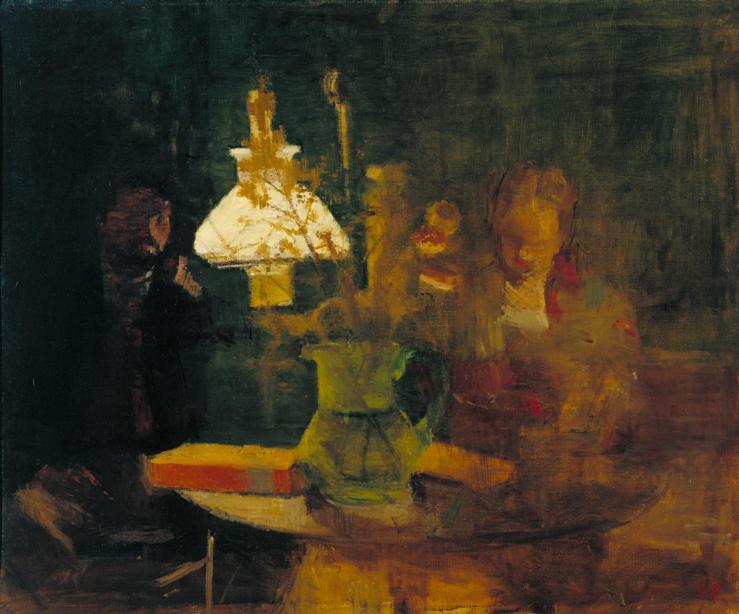
Lamplight — Victor Pasmore

Lamplight 1941 by Victor Pasmore 1908-1998

Lamplight, 1941 by Victor Pasmore (1908–1998)

Blog about some books acquired, 13 March 2020

img_5049

After one week of abstinence I drove the mile or so to the used bookstore I go to too often and browsed.

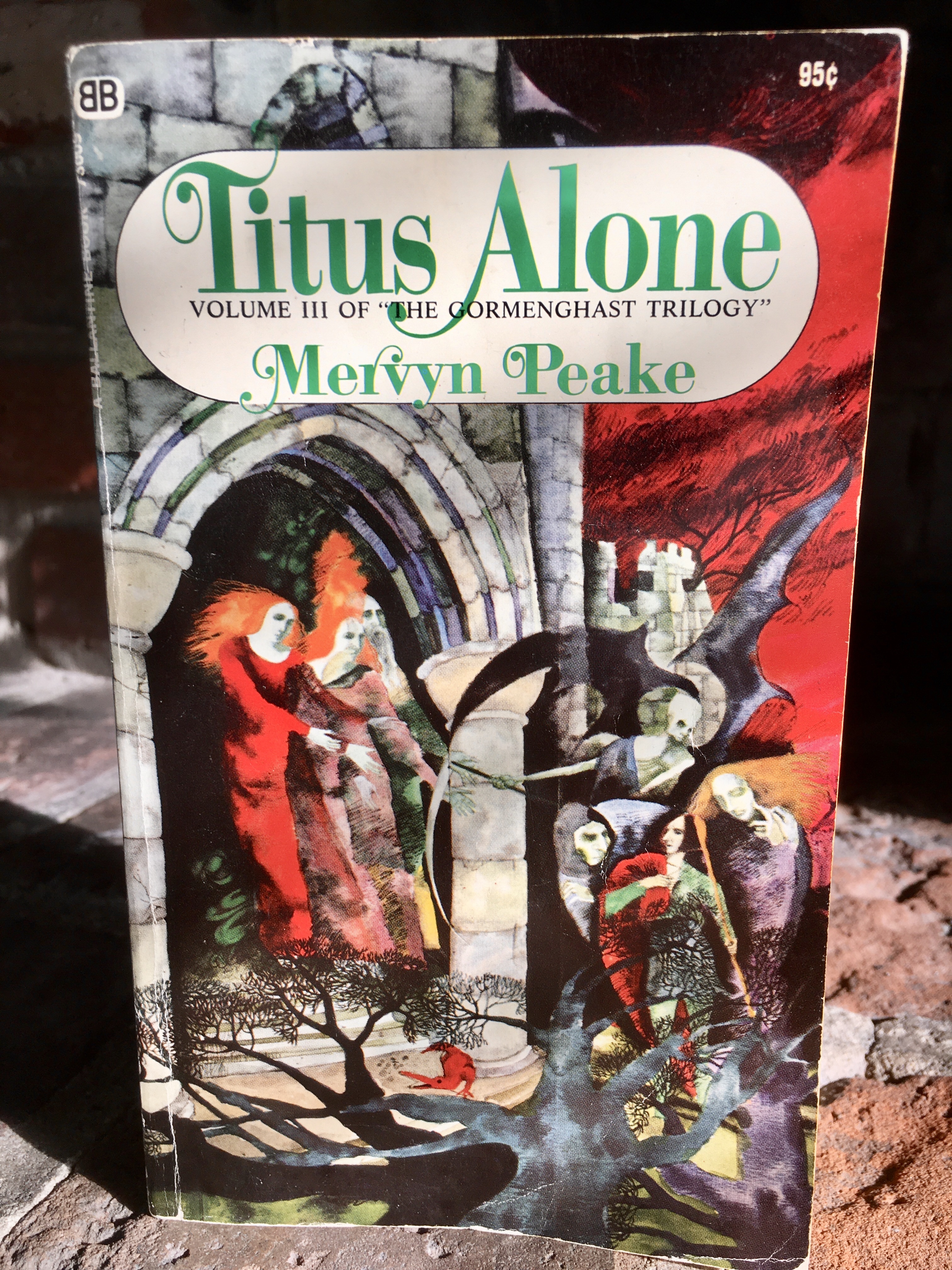
I was specifically looking for the other Gormenghast books by Mervyn Peake, the 1956 novella Boy in Darkness, and the unfinished Titus Awakes, completed by Peake’s wife Maeve after his death. I’m in the last few pages of Titus Alone, and I guess I don’t want to exit his proseworld just yet. Anyway, I went to this bookstore almost every week of February looking for Peake books with no luck after having picked up Gormenghast there on a lark a while back. I ended up buying the first and third of the Gormenghast trilogy online, because I couldn’t find them there, but today I found the complete trilogy in matching Ballantine editions. I did not find the other Gormenghast books though.
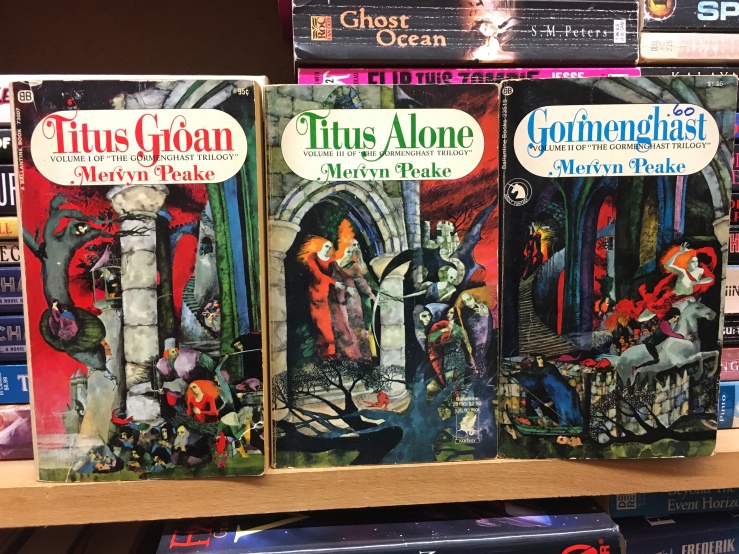
img_5048

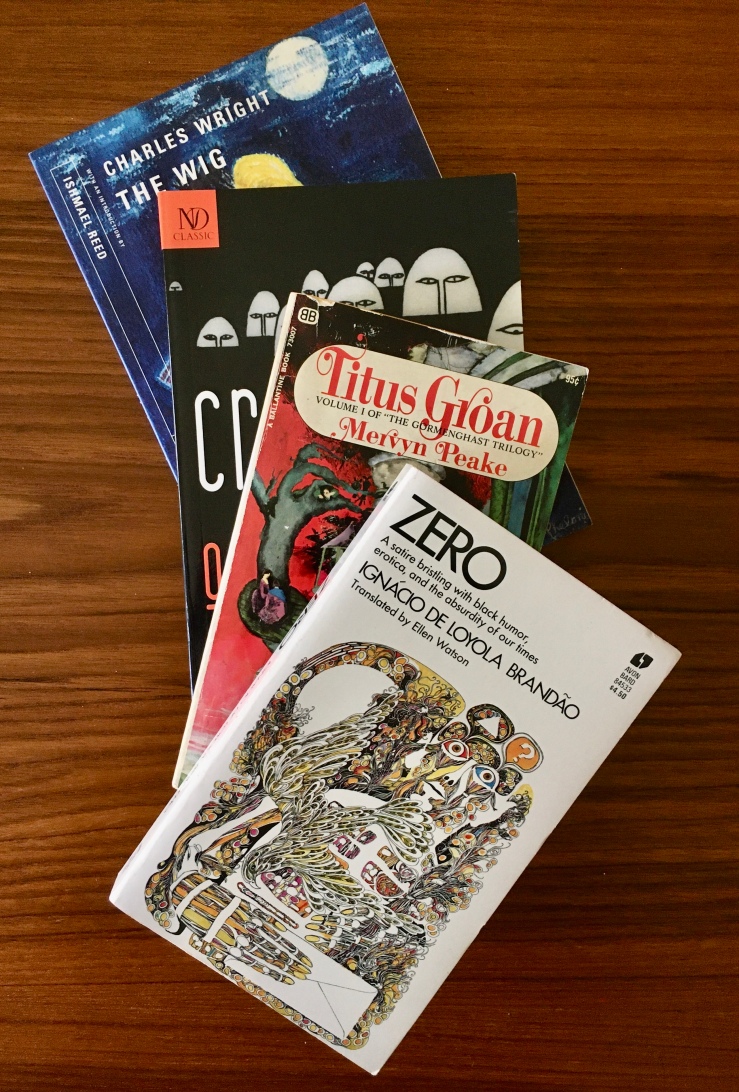
As much as I hated to break up the triplets pictured above, I picked up the Ballantine Titus Groan and adopted it to fit my other Ballantine editions. There is a specific student I have in mind whom I think will love the Penguin edition of Titus Groan I’ll give him next week (even though my dog bit it).
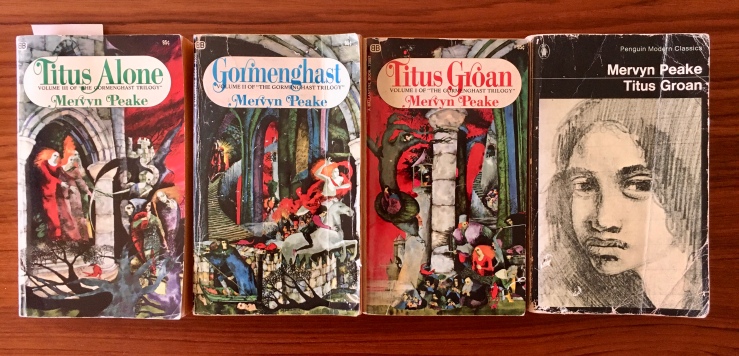
img_5050

I’m obviously a sucker for covers, as any one who’s followed this blog for a while probably knows, and the Ballantine covers are better, I think—the Penguin editions of Peake’s trilogy are great, but they shy away from the bizarre nature of the narratives, tilting toward respectability.

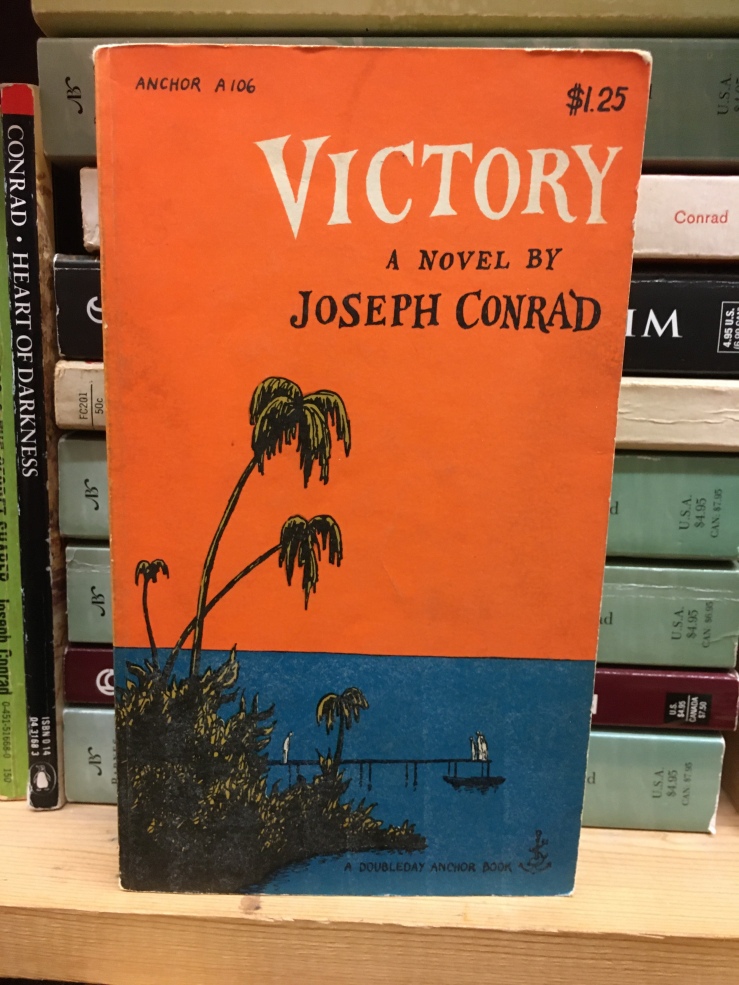
Indeed, I like browsing in large part because I like the aesthetics of books, particularly older books. I absolutely loved this Edward Gorey cover for a 1957 edition of Joseph Conrad’s Victory—but I settled for a picture. I mean, I doubt I’ll read lesser-known Conrad at this point. But I love the orange and the blue, and Gorey’s handlettering:
img_5045

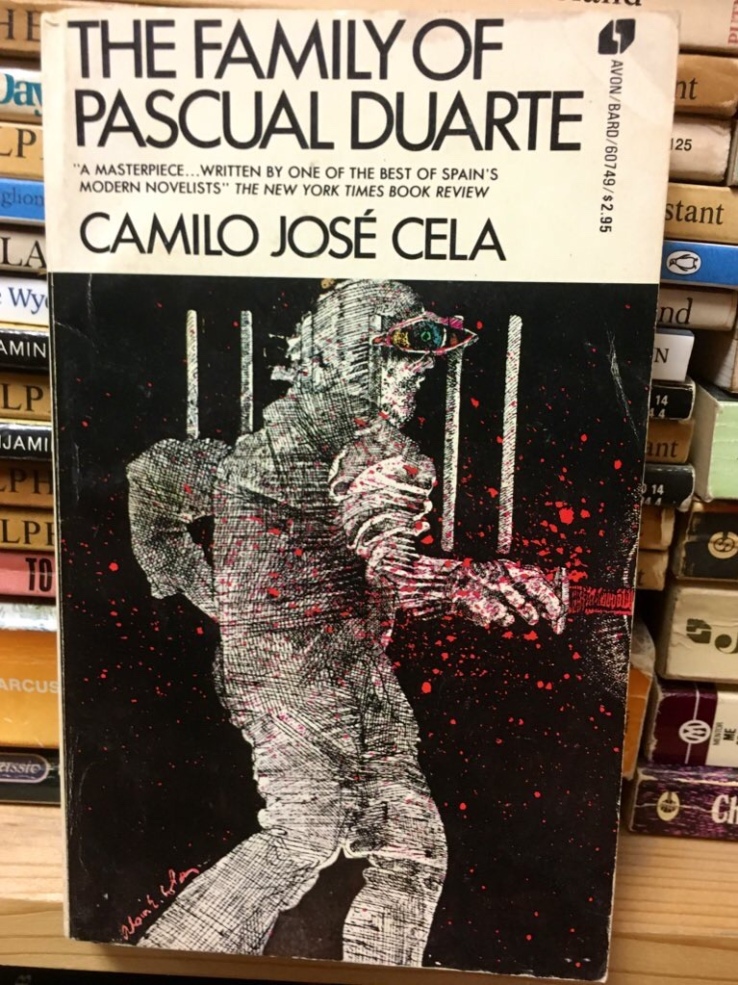
I often settle for just a snapshot of a beautiful cover, like this bizarre one for The Family of Pascual Duarte by Camilo José Cela. I didn’t pick it up a few weeks ago, but then wished I had.
img_5004

I had left it on the shelf like this, face outward. It wasn’t there today, and I wished that I had picked it up. Apparently it is brutal and was banned for a few years in its native Spain.

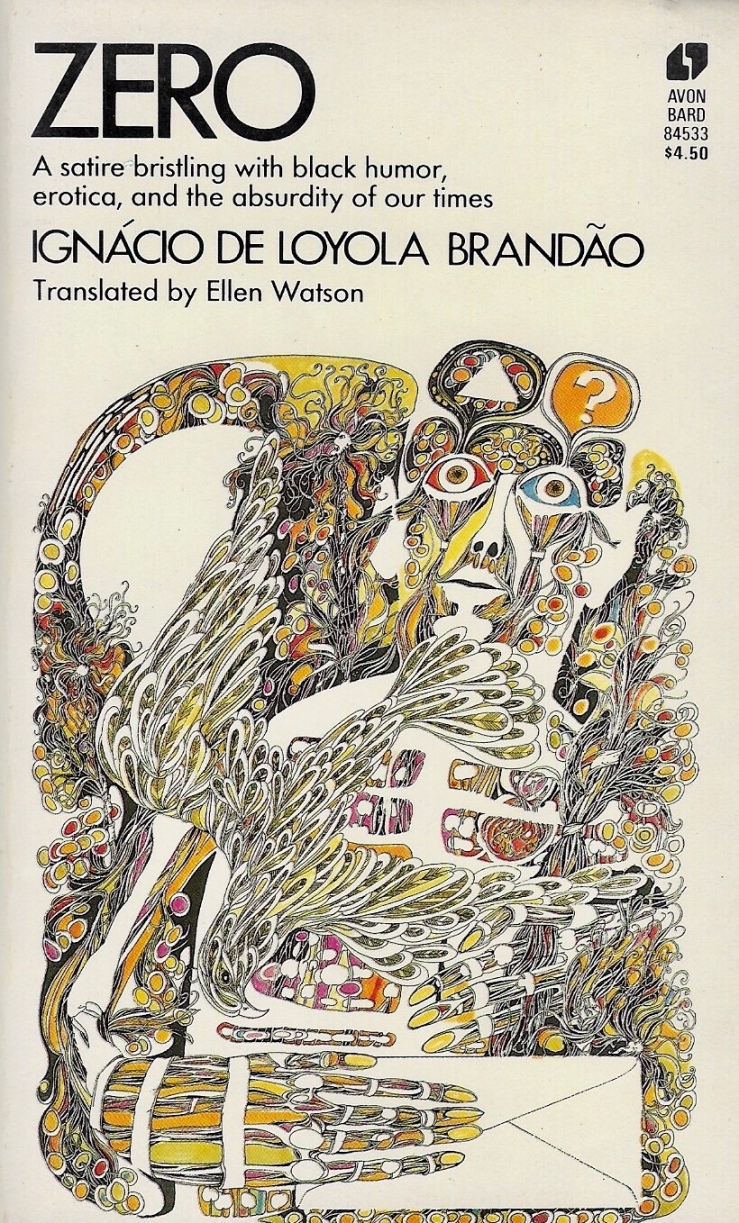
So well and anyway when I spied another Avon-Bard spine with a strange title I pulled it out, wowed at the cover, and dove in. Brazilian author Ignácio de Loyola Brandão’s Zero instantly struck a chord with me. The book is typographically all over the place, with text offset in boxes or laid out in columns. There are diagrams, enormous fonts, glypsh, citations, footnotes, etc. The book is a dystopian satire that seems to be written in its own idiom. The translation is by Ellen Watson. The wonderful cover art is uncredited (as far as I can tell).
2020-03-06_151902

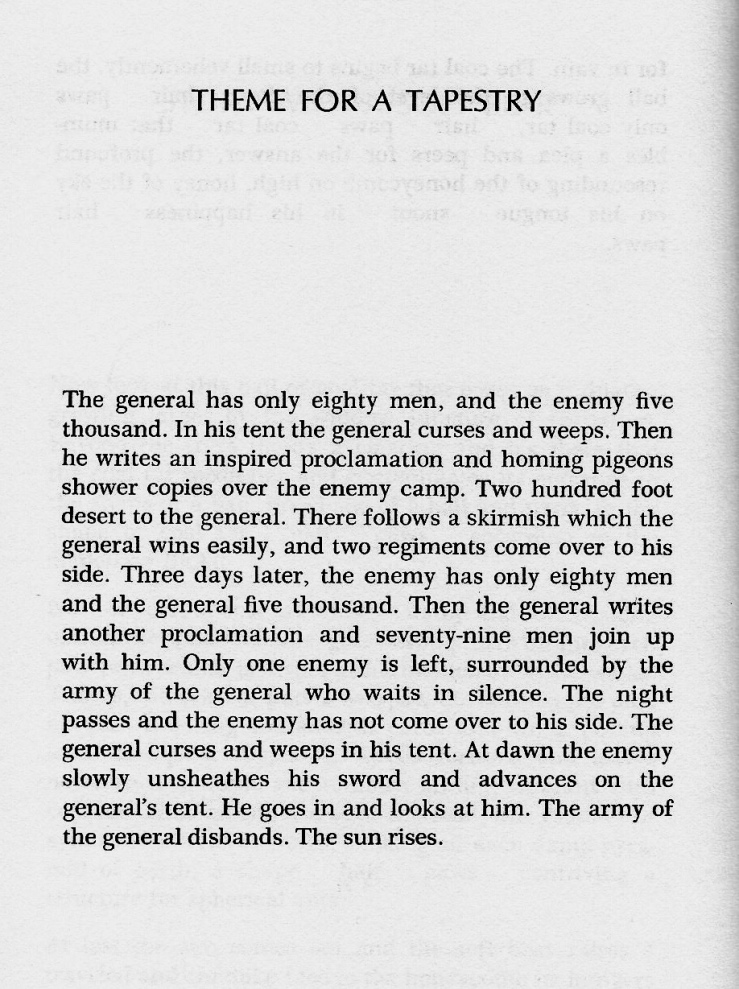
I’ve never been able to get through Julio Cortázar’s famous book Hopscotch (despite many attempts), but I liked the short stories by him that I’ve read. I’m also a sucker for anything supershort, so when I saw his collection Cronopios and Famas (translated by Paul Blackburn), I was intrigued. I love a book in slices and morsels that I can snack on for a while (I’m really digging Gary Lutz’s The Complete Gary Lutz for the same reason). Most of the stuff in here is under three pages; much of it is much shorter too, like “Theme for a Tapestry”:
2020-03-06_151902_5

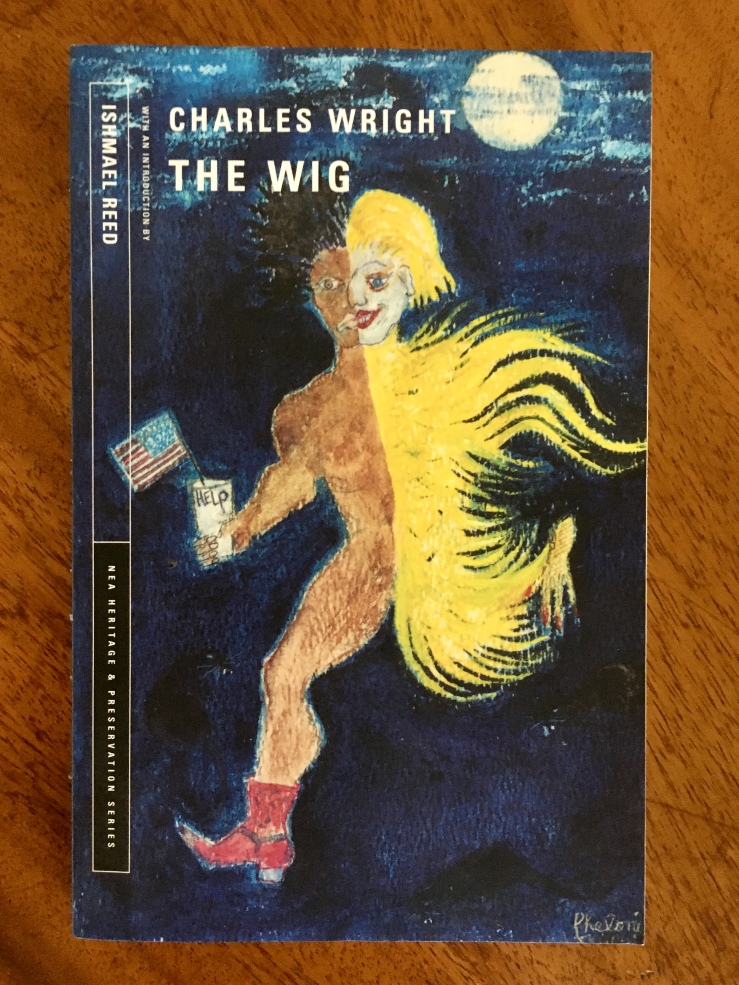
While scanning for anything by Rudolph Wurlitzer (no dice), I spied the spine of Charles Wright’s The Wig. Wright has been on my radar for a while now, mostly due to Ishmael Reed’s consistent endorsement of him (in both fiction and nonfiction alike), and when I pulled the volume to reveal its beautiful cover, I saw Reed’s name on the margin (and on the blurb on the back), and had to have it. The cover art is by Phelonise Willie; design by Scott di Giolamo:
img_5057

The dreamers and the scum of the earth

So the grey arena formed itself and the crowd grew, while the domed ceiling of the dark place dripped, and the lamps were re-filled and some held candles, some torches, while others had brought mirrors to reflect the light, until the whole place swam like a miasma.

Were his shoulder not hurting from the grip it had sustained Titus might well have wondered whether he was asleep and dreaming.

Around him, tier upon tier (for the centre of the arena was appreciably lower than the margin, and there was about the place almost the feeling of a dark circus) were standing or were seated the failures of earth. The beggars, the harlots, the cheats, the refugees, the scatterlings, the wasters, the loafers, the bohemians, the black sheep, the chaff, the poets, the riff-raff, the small fry, the misfits, the conversationalists, the human oysters, the vermin, the innocent, the snobs and the men of straw, the pariahs, the outcasts, rag-pickers, the rascals, the rakehells, the fallen angels, the sad-dogs, the castaways, the prodigals, the defaulters, the dreamers and the scum of the earth.

My kind of people.

A wonderful view of the preterite underworld in Mervyn Peake’s Titus Alone.

img_5041

Robota I — Susanne Kühn

gross_2pages_robota-i-2018-1

Robota I, 2018 by Susanne Kühn (b. 1969)

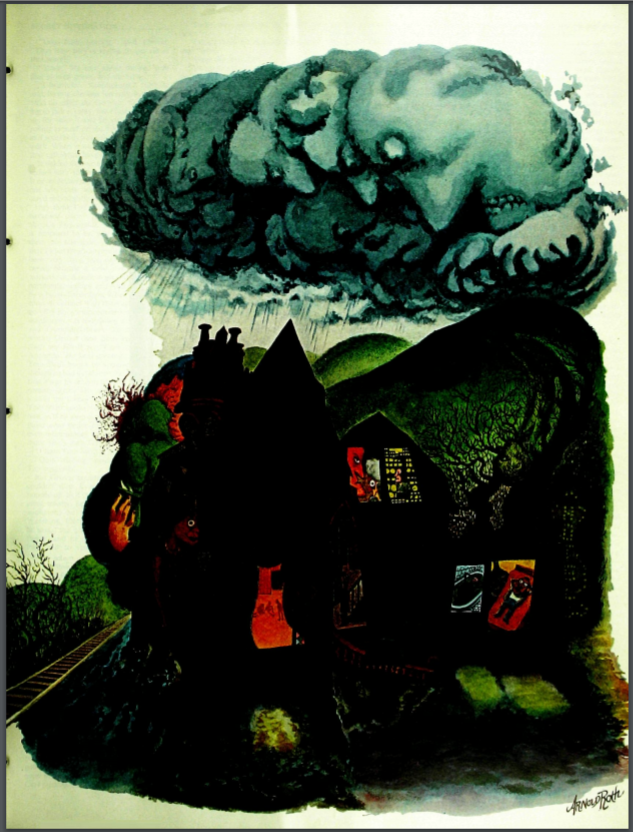
Arnold Roth’s original illustrations for Thomas Pynchon’s 1964 short story “The Secret Integration” (and a link to the full text of the story)

ar 2

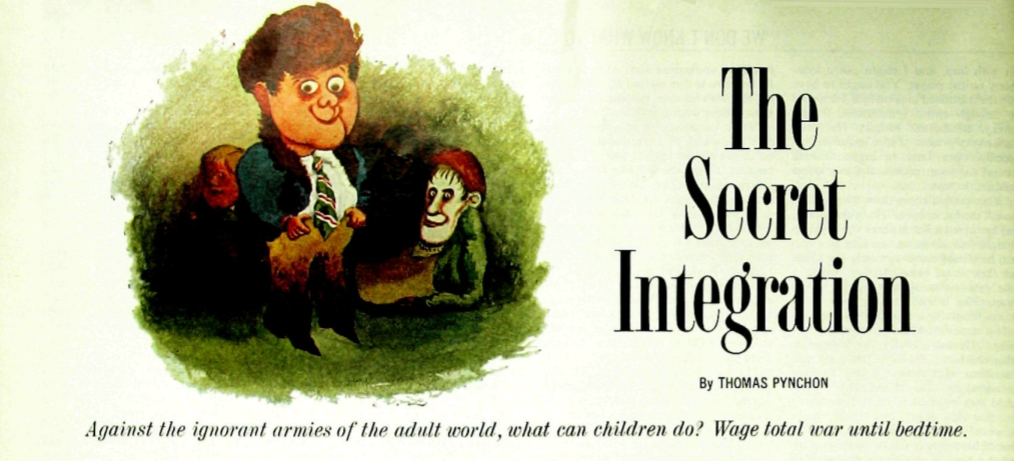
Thomas Pynchon’s short story “The Secret Integration” was first published in a December issue of The Saturday Evening Post, and later published again as part of Pynchon’s first and only short story collection, Slow Learner.

In a 2018 article published at The Yale Review, Terry Reilly suggested that by publishing “The Secret Integration” in The Saturday Evening Post,

…Pynchon uses the form of an apparently simple, entertaining adolescent boys’ story to engage and then to manipulate the Post readers; to invoke various features of the publication history of The Saturday Evening Post while simultaneously calling attention to the magazine’s limited scope and conservative bias concerning issues of civil rights and racial integration in 1964.

ar 3

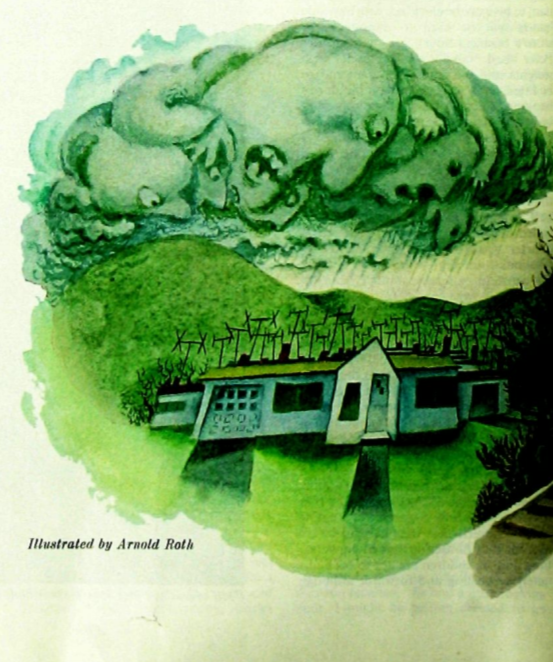
Pynchon’s story was accompanied by three illustrations by the cartoonist Arnold Roth, including a header, a small illustration, and this full page illustration below:

ar

The first page of the story:

“The Secret Integration”

by

Thomas Pynchon


OUTSIDE it was raining, the first rain of October, end of haying season and of the fall’s brilliance, purity of light, a certain soundness to weather that had brought New Yorkers flooding up through the Berkshires not too many weekends ago to see the trees changing in that sun. Today, by contrast, it was Saturday and raining, a lousy combination. Inside at the moment was Tim Santora, waiting for ten o’clock and wondering how he was going to get out past his mother. Grover wanted to see him at ten this morning, so he had to go. He sat curled in an old washing machine that lay on its side in a back room of the house; he listened to rain going down a drainpipe and looked at a wart that was on his finger. The wart had been there for two weeks and wasn’t going to go away. The other day his mother had taken him over to Doctor Slothrop, who painted some red stuff on it, turned out the lights and said, “Now, when I switch on my magic purple lamp, watch what happens to the wart.” It wasn’t a very magic-looking lamp, but when the doctor turned it on, the wart glowed a bright green. “Ah, good,” said Doctor Slothrop. “Green. That means the wart will go away, Tim. It hasn’t got a chance.” But as they were going out, the doctor said to Tim’s mother, in a lowered voice Tim had learned how to listen in on, “Suggestion therapy works about half the time. If this doesn’t clear up now spontaneously, bring him back and we’ll try liquid nitrogen.” Soon as he got home, Tim ran over to ask Grover what “suggestion therapy” meant. He found him down in the cellar, working on another invention. Continue reading “Arnold Roth’s original illustrations for Thomas Pynchon’s 1964 short story “The Secret Integration” (and a link to the full text of the story)”

Tasting the First Oyster — George Frederic Watts

Watts, George Frederic, 1817-1904; Tasting the First Oyster

Tasting the First Oyster, c. 1883 — George Frederic Watts (1817–1904)

Titus Alone (Book acquired, 29 Feb. 2020)

img_5041

Not a dozen pages into Mervyn Peake’s 1959 novel Titus Alone something very strange happens: A man shows up in a car. The narrator simply uses the word “car,” and our hero Titus seems to accept the technological marvel in stride, using the word himself a bit later.

The strangeness of the car, a thing wholly banal in our own contemporary world, derives from its technological dissonance compared to the previous two Titus novels, Titus Groan (1946) and Gormenghast (1950).

These first two novels of the so-called “Gormenghast Trilogy” take place primarily in a strange, isolated castle called Gormenghast, and the limited terrain around it. The world of Gormenghast and environs seems medieval, stagnant, insular, but also wonderfully baroque, a world that centers on byzantine rituals that have been practiced and observed for at least seventy-seven generations. No one living knows what the rituals mean or from whence they derive; indeed, the rituals seem to be their own telos.

Tinged with fantastic and strange imagery, these first two novels are not fantasy per se, at least not in the traditional sense. They owe more to Charles Dickens’ novels than to the Nordic and Germanic myths that underwrite so much of Tolkien. The books are also wonderfully grotesque, full of weird mutants in varying stages of decay, imagery reflected in Peake’s illustrations for his books (which recall Leonardo’s caricatures). Peake’s prose style is singular as well: his syntax is thick, his vocabulary Faulknerian. Peake essentially creates an original idiom through which Gormenghast can exist. The world is so insular that it creates and sustains itself, both aesthetically and verbally.

img_5039

Young Titus Groan is stifled by all of this insularity and apparently-meaningless ritual, however, and he escapes it at the end of Gormenghast. Somehow he arrives into a new world—the narrative logic is dreamy, perhaps because Titus arrives in this new world asleep in a boat, a positively mythic image. And then he’s picked up by the motorist Muzzlehatch, who feeds him and lets him rest and recover. Titus then witnesses a terrible battle between a camel and a mule, members of Muzzlehatch’s strange menagerie. After he leaves—he’s always leaving, always more or less alone, a word that repeats throughout Titus Alone—after Titus leaves Muzzlehatch, he arrives in a technologically-advanced city of glass and steel. He escapes flying surveillance drones and soon drops into a party (quite literally), where he meets Juno, a beautiful woman twice his age who will later take him as a lover. I should stop summarizing. Titus Alone is episodic, picaresque even, with one damn thing happening after another. The chapters are short and propulsive — most are no more than the front and back of a pageIt’s just one damn thing happening after another, and happening with an energy and rapidity that seems the opposite of the methodical rhythm of the first two books. It reminds me of Voltaire’s Candide and Calvino’s The Baron in the Trees, both punchy picaresques, but also Carroll’s Through the Looking Glass or even Walter Murch’s 1985 film Return to Oz.

I passed a little over the half way mark of Titus Alone this afternoon. The book somehow has taken an even more surreal turn, as Titus enters the Under-River, a labyrinthine Hadean space under the city populated by outcasts and refugees. Peake’s overview of these underdwellers is cinematic and at times startling; he seems to point to a much larger universe, but one that Titus (and the reader) will never fully glimpse. And yet Titus Alone takes its hero (and the reader) into the new, into a world that must be rich and severe and stocked with lore—only Peake keeps us isolated from knowing. We are on the outside of knowing, alone.

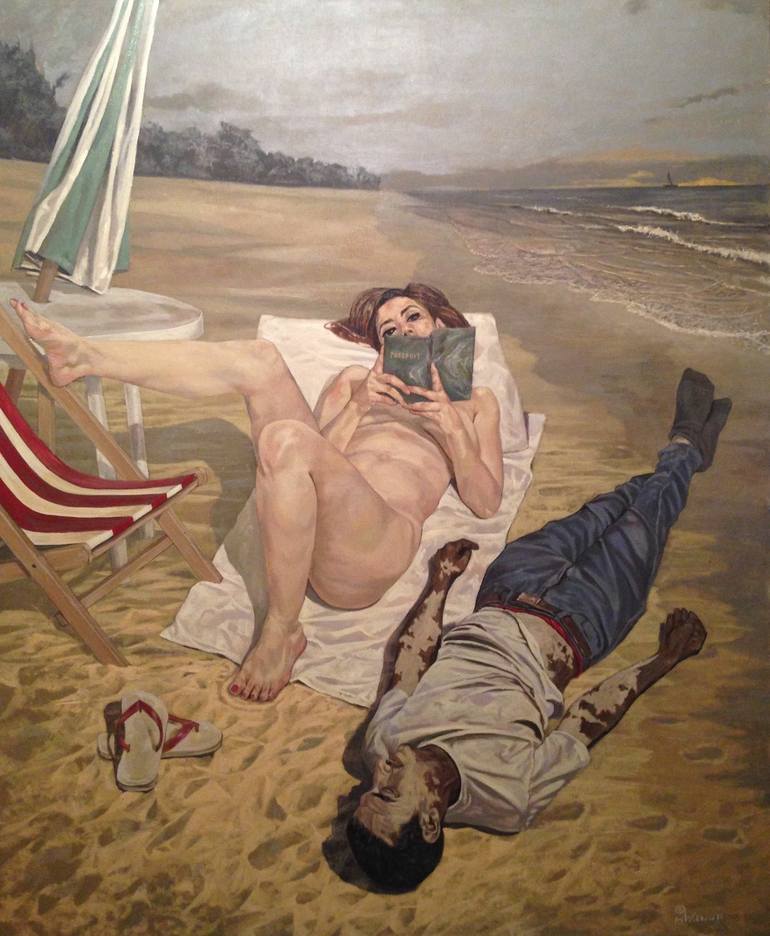
The Immigrant — Walid Ebeid

3628567-nuzxnmcg-7

The Immigrant by Walid Ebeid (b. 1970)

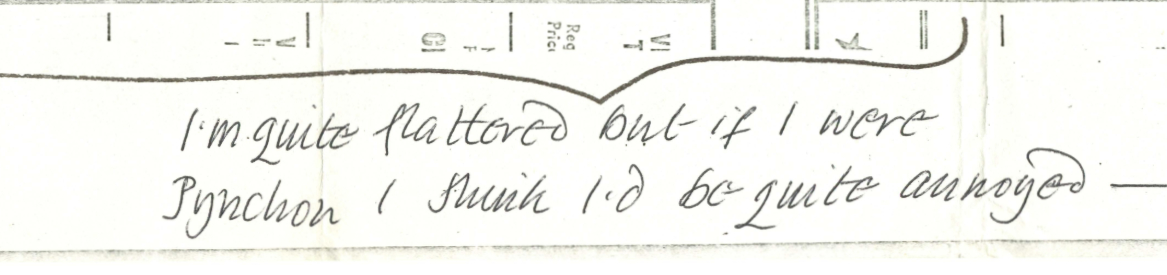
“I’m quite flattered but if I were Pynchon I think I’d be quite annoyed” | William Gaddis annotates a review of Gravity’s Rainbow

irubg8x7lzj41

This is a clipping of W.G. Rogers’ (circa 1973) review of Gravity’s Rainbow (click on the image to enlarge it). The marginal annotation is by William Gaddis:

gaddis

Rogers’ review of Gravity’s Rainbow is eleven paragraphs long in two columns. The final three paragraphs are devoted to a comparison with The Recognitions (this comparison takes up about three quarters of the second column). Rogers refers to Gaddis’s novel as Recognitions.

The final paragraph reads:

Gaddis could have written Gravity’s Rainbow and Pynchon could have written Recognitions [sic].That two hearts can beat as one is no proof two minds can. Would we not expect Gaddis to use his own respected name? Could there be two separate master hands? I suppose so, but…

Gaddis published his second novel J R, two years later, in 1975.

This document is part of the William Gaddis Papers collection at Washington University. I saw it earlier this morning thanks to Reddit user Signor Mantissa.