“The Already Wildly Implausible Real We’re All Struggling to Absorb” | Carl Shuker Talks to Biblioklept About His Novel Anti Lebanon

New Zealand writer Carl Shuker is the author of four novels, including Three Novellas for a Novel, cult novel The Lazy Boys, and The Method Actors. His latest novel is Anti Lebanon (Counterpoint Press) is a strange work of surreal horror, set primary in Lebanon in the immediate fallout of the Arab Spring.  In my review, I wrote that Anti Lebanon’s “trajectory repeatedly escapes the reader’s expectations, driving into increasingly alien terrain.”

Carl was kind enough to talk about his work over a series of emails. He was especially kind in letting Biblioklept publish the short story “Fiction” which he mentions in the first part of this interview.

Carl Shuker Author Photo B&W

Biblioklept: How did Anti Lebanon begin? Did you set out to write about a Lebanese Christian? Tell us about the genesis of the novel and your research process.

Carl Shuker: Anti Lebanon started with the words, and the disjunction between my sense memories of the words, the place names and the language, and the atrocity exhibition of the Lebanese civil war of ‘75-’90 (which we are reliving now in the Syrian civil war).

I was brought up moderately conservative Anglican, which early on involved a lot of Bible stories and Sunday school. I had a very deep and powerful connection with the vocabulary. I remember tasting the words in a totally engrossing synesthesia: lying in bed in a small town in the South Island of New Zealand, ten years old and waiting for sleep and saying the words to myself.

Lebanon, for example, was thick milk and Alpine honey (as Nabokov once described his life). You can taste it in those pregnant Bs, those labile Ls and sonorous Os and Ns. And Syria and Damascus—with the latter I had generated some fertile misprision, I think, because into it I had somehow conflated “alabaster.” So the city had the word within it, and these cool and chalky white walls I felt up under my fingernails were as real to me as the blanket at my cheek. Jounieh, Jtaoui, and Bsharre; Ehden, and Zghorta.

Sometime in late 2006 I lost my agent (of only two years), via a one-paragraph email entitled, chillingly, “Cutting back.” He was a bit older and I hadn’t made him any money so it was understandable.

I saw, after eight years of trying to get it published, that although it did well critically and got a very cult following of some very cool and interesting people (a lot of eastern European teenage girls, pleasingly), that The Lazy Boys (2006) was not going to be any kind of breakthrough. There would be no musical. That book does sometimes feel to me like a cursed chalice. Another two years of querying agents for my Three Novellas for a Novel project had not gotten me representation again. I had no publisher for it. A long-gestating film project with a director and producer finally fell through due to funding and all the difficulties surrounding that. (The screenplay for The Lazy Boys is sitting humming in my drawer.)  I was running out of money I had from a prize and I felt after nearly ten years of work I was back almost at square one. Currently I have no agent and I think I’m fortunate to have gotten through the current convulsions in publishing under my own steam. I don’t know what I’d advise a young writer right now, about getting represented.

With writing and publishing, which is a tough and demanding ambient, the cliché is very useful: you get bitter or you get better. Working on a new thing is the best and only antidote to publishing an old thing. It’s always and only the writing that saves you. I started looking around for a new project. Though I don’t write short stories I wrote a suicide note for the lit-fict writer of the time and of the writer I’d almost become, a short story called “Fiction” that started to encompass elements of this new obsession with Lebanon, and to extend it to the consequences of that obsession.

I’m intuitive and a weird hybrid of deeply elemental and playful and airy fairy when I look around for a new project. But I’ve learned to identify and focus in on my obsessions, which is an important skill for a novelist. And usually it is what is troubling me; what I can’t figure out.

Etienne Sakr, a Christian militia leader in the civil war, who has been subsequently exiled and tarred as a rightist and racist and has not emerged from the post-war period at all well, wrote, “Politics is not the art of the possible. Politics, like all great art forms, is the art of the impossible. Otherwise there is no problem to resolve.”

Like all great art forms. This was a conception of the novel as well. The writing is a resolving of unresolved and seemingly irresolvable elements—it’s a tension, also, that can sustain you through the long period of composing something as big and demanding as a novel. Solving some problem you couldn’t any other way.

And the solution was the mode I think I am refining, that I work in by default anyhow. Freud in The Interpretation of Dreams: “Contradictory thoughts do not try to eliminate one another, but continue side by side, and often combine to form condensation products, as though no contradiction existed.”

In Anti Lebanon it was: how to resolve and express this deep but wordless feeling I have for the words of this country, the bloody holy dirt of this country, and the tropes and gestures of the vampire, the monster?

I prepped and read as much as I could on the civil war, and went to Beirut in May 2008 to taste the dirt. This was the same month I published the Three Novellas in serial online for a limited time for free or more, a la Radiohead’s In Rainbows, clearing the decks for something new (These were rereleased with a new introduction, for all ebook formats, in 2011: http://www.threenovellasforanovel.com).

And while I was there Hezbollah invaded Beirut, and I was given my novel to the sound of gunfire in the west, to the sight of an old Christian making fun of the Ashura and of the Shi’a who now owned his city and his country, wearing a comedy fez and mock self-flagellating with a plastic whip.

Biblioklept: Was it always in your head to introduce the vampire element into the plot? How did that come about?

CS: Well, when I started Anti Lebanon I started with the scene in the amusement park with my protagonist Leon, a security guard there who’s fallen asleep and wakes up to “a dead and freakish still.” I had all these materials in my head for the book:

I had the country, my obsession with it. I had the this amazing historical moment when Hezbollah took over, in response to the Sunni-heavy government under Saad Hariri trying to control them, to shut down their illegal communications network. The revenge of the Shia in Lebanon against the Sunni who have always looked down upon them. And the first time the seemingly untouchable Hezbollah turned their guns against fellow Lebanese. It was a complex contemporary political and military moment that I think novels have a particular genius in showing us, if novelists would only look at them.

I had Christians in Lebanon after the civil war. All the tragedy and the bloodthirstiness of Lebanese Christianity. The decline of things, which I’m very attracted to: pride in decline. And I had this character of Leon’s father very powerfully in mind: a big Christian, both physically and in personality; a security guard, a burly, charismatic, working man and leader and a civil war veteran. A man I became friendly with in east Beirut. One of those powerful male figures in our lives we feel are untouchable and always right. (“Three times jujitsu champion of Lebanon during the civil war; when? who remembers; who knows now.”) I had the contradictions creeping into his life, as the Hezbollah he has to support, because the Christian party he supports has aligned with them, do something very ambiguous and worrying.

But there was something missing, some binding element, or catalyst, some next level shit that could help the novel embody the whole messy idea. Somehow represent the addiction to violence, the ancestral handing-down of this kind of obligation to violence, and the sense of the blood in the soil always under your feet in Beirut. Walking a particular corner, looking at the men outside Phalange headquarters, and knowing Black Saturday started here where you stand. I had always wanted to write a vampire, one day. It was right in front of me, begging me to see it.

When I finally realised it, that was when the problems started.

Biblioklept: Okay—you can’t just stop there. Tell us about those problems.

CS: Oh my God. It would seem so silly and all writers’ problems when it comes to actually writing are the same or similar. Not finding a voice. Doubting your own voice. Time. Jobs. Debt. Money. Doubt, principally. The only mentionable and salvageable things, because they are, in retrospect, possibly funny, are the symptoms: I became convinced I was losing my hair. I went to an ER one day and had to abashedly (I was then a 36-year-old heavy smoker) tell the doctor (kind of leaning into him, and making an “I know this sounds stupid” face) that I thought I might be having a heart attack.

You don’t want to go into the emotions you feel when you enter a hospital ER thinking you’re having a heart attack and leave with some over-the-counter Gaviscon and one rogue ECG electrode still stuck to your ribs.

There were pressures. The worst were probably internal. But when my daughter was born she slept a lot of the time and I had a sudden superhuman burst of clarity and focus and went through the entire manuscript again stem to stern, took two weeks off work to rewrite one of the Japan sequences where Beirut and Lebanon had slipped off the page and the book had gotten floaty and lost, and then almost immediately I submitted it to Jack Shoemaker.

Anti_lebanon_CAT

Biblioklept: The final third of the book, those Japan sequences and the Israel bit, those are some of my favorites. I think there’s a lot of picaresque energy there. Was Jack Shoemaker your editor as well as publisher?

CS: Jack is my first reader, then there’s a second, but he’s never edited me as a copy editor edits. He’s always been my greatest advocate and is an amazing reader (and his list speaks for itself) but I don’t even know if he edits anyone any more. My editor on the first two books was the incomparable Trish Hoard, who was then one half of Shoemaker and Hoard before Jack got Counterpoint back.

Biblioklept: Were you ever pressured or tempted to play up the vampire aspect of the novel as a means to, I don’t know, bolster its commercial appeal?

CS: Well I started the book in 2008 and very soon after Twilight hunched and slouched and pouted into my awareness and after about six seconds of thinking “oh cool, trickledown” I realised it was an unmitigated disaster for me. Not only was my vampirism in Anti Lebanon supposed to be truly terrifying – and geopolitical, and religious – plus it had to do with sex but was also kind of unsexy in the easier ways (in that the sex in the book is constrained by religion, and is difficult and a bit sad and more about relief and frustration), but it was also the kind of vampirism I actually believed in: a nearly physical manifestation of a metaphor that is so persistent and pervasive and persuasive: a shade.

So I asked myself would the audience of Twilight and True Blood really want to broaden their fun base into a novel about Beirut, Hezbollah, the Lebanese civil war and the Christian exodus, and I decided probably not. So I thought so I’m writing the wrong kind of vampirism to speak to these people, and too much vampirism to speak to everybody else who’s thoroughly sick of it, and I’m screwed when it comes to publication.

But the metaphor was so true and so right and the novel started to click “like a fucking Geiger counter” as dfw would have it, so I really had no choice. I stuck by the kind of vampire the book was into and the kind of questions the book was asking: is he or is he not a vampire? What is a vampire really? If the historical record clearly demonstrates so many acts that are far, far worse and the cause of so much more blood spilled than any act of vampirism, then what kind of creature is a vampire? Is he mourning?

Late in the war a Christian priest was quoted as saying, “For a long time it was fun. Playing in our own blood.”  I put alongside this a Patrick Chauvel photograph of a priest in robes standing in a pile of shells firing a 50-cal. machine gun in south Lebanon in 1985. The glee on his face. A soldier beside him with his face in his hand. The material in the “pyr” chapter, about PLO soldiers ransacking the the Christian mausoleums in Damour: it was all true. What more evidence did I need? All good lit, music, film goes against what prevailing fashions, even if they’re dealing in the same ostensible material.

And here we recognize conclusive evidence of pyr: The process of exection extended to the dead. The Damour cemetery was invaded and it was a rout. They rooted out the corpsesnipers from the mausoleums, dragged the skeletonsoldiers from their elaborate Christian coffins, stripped them of their mortuary best, murdered their cadavers, pulling rib from rib, penetrating the vacant insides to locate and despoil and exect the very Christian soul.

Anti Lebanon – 150

Plus, in terms of “commercial appeal”, Etienne Sakr said another smart thing:

“When you are fighting you either follow the cause and don’t get the money, or you follow the money and lose the cause.”

Biblioklept: There’s a lot in the book that makes the reader go, “Wait, what?” Is this real? Is this really happening to Leon? Is this in his head?” The section in Israel for example . . .

CS: The idea became for me the discipline of this particular novel, which was to attempt to analogise contemporary Christian Lebanon while invoking and revitalising the vampire genre. [Note: some spoilers follow in this response only]

Leon is a young Christian in a very precarious situation. Yet paradoxically he and his father are security guards. (The novel is riddled with them – and Leon kills one later.) With some fellow Christians he commits, through a fin de siècle hedonism, accident and the absence of inhibition bred of desperation and overfamiliarity, a violent crime against, not a rival sect, but a fellow Christian. This is the vulnerable, damaged Armenian jeweller Frederick Zakarian. And, believing him dead, as they try to dispose of his body Zakarian, tied up but seemingly still alive, bites him. With the only weapon Zakarian has any longer. Teeth.

It is here (though for close readers the inevitability is triggered at the threshold to Zakarian’s workshop) that the narrative attempts to successfully double or mirror Leon – as vampire, as criminal, as victim, failed son, inheritor of paternal sin and a psychology overdetermined by violence, and simply as mourning brother. To me, being undead and mourning share a lot of the same qualities.

There was a wonderful 1984 Playboy interview with the Druze leader Walid Jumblatt (despite the blood and compromise on his hands a very interesting polymath and political genius, who showed William Dalrymple the rooms of priceless religious artifacts he’d saved from the war – see Dalrymple’s excellent From the Holy Mountain). I had it as an epigraph for a time:

Q: How do you deal with those feelings on a personal level? How does it feel not to know if you or your family will live through another day?

A: We become inhuman. We no longer respond to normal human feelings.

—interview with Walid Jumblatt, Playboy 1984

Leon flees Lebanon when it becomes clear the Armenians, missing their man and the jewels he was working on (destined for Iranians), are talking to the Christians of Beirut who have decades-old scores to settle against Leon’s father for his alliances in the civil war. The factions begin to align around money. Leon’s flight from Lebanon also simply mirrors in a particular sense the horrible inevitability of the more general Christian flight after 1400 continuous years of settlement in that one place.

The scenes in Israel you mention, that feature a psychic during immigration questioning at the Allenby Bridge border: these are simply in-context extrapolations of the already wildly implausible real we’re all struggling to absorb.

Biblioklept: Can you tell us what you’re working on now? I know you’ve been working on something new…

CS: [sotto voce] Right now I’m writer in residence at Victoria University of Wellington’s International Institute of Modern Letters, and the generosity and good company of students and staff here have allowed me to get 60,000 words into a new novel set in a medical journal in London. It’s a social comedy in the world of work, with a Straw Dogs strand and a healthy skepticism for the whole project of “a social comedy in the world of work” driving the plot—like Saki meeting Julio Cortazar in an argument over grammar and style in a London pub full of eccentric, driven healthcare professionals.

Biblioklept: Have you ever stolen a book?

CS: I once rescued Burroughs’ Cities of the Red Night (in English) from a trashcan in Tokyo (and stole a great nickname for one of my dark drinking lazy boys: “Pazuzu, of the rotting genitals’). I was also prohibited from graduating from Victoria due to more than $1000 in overdue fees from the library. One of the books was David Bergamini’s astonishing Japan’s Imperial Conspiracy. So I have no regrets.
The Complete Short Stories of J.G. Ballard (Second Riff: Stories of 1960)

jgb_complete_ss400 PREVIOUSLY:

Introductions + stories 1956-1959

IN THIS RIFF:

Stories published in 1960:

“The Sound-Sweep”

“Zone of Terror”

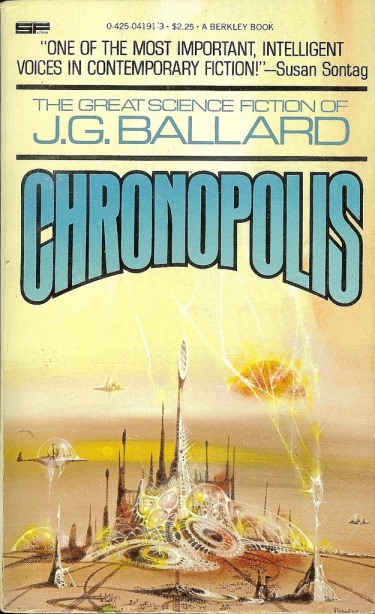
“Chronopolis”

“The Voices of Time”

“The Last World of Mr. Goddard”

1. “The Sound-Sweep” (1960)

Ballard’s strong suit isn’t characterization. In his later writing, he transcends this apparent weakness, employing a style and rhetoric that dispenses with—or nakedly accepts, in some cases—the flatness of his characters. Ballard works in types: the scientist, the madman, the artist, the detective, the ingenue, the explorer, the has-been. Most of his characters are driven by very basic desires—curiosity, madness, revenge. There’s a thin line though between archetypal placeholders and hackneyed stereotypes, and Ballard occasionally stumbles over it in some of these early stories. “The Sound-Sweep” is one such story, plodding along over too many pages, asking its readers to care about characters that lack emotional or psychological depth. And while I don’t think we read Ballard for emotional depth, necessarily, we do read Ballard’s best work because it plumbs the contours of human psychology colliding into nascent technological changes that affect the most basic human senses.

As its title suggests, “The Sound-Sweep” is another early Ballard tale that takes on the sense of sound. The short version: This is a story about noise pollution, and also about how we might sacrifice an artistic way of listening in favor of apparent convenience. As is often the case in these early stories, Ballard constructs the tale to explore the fallout of one particular idea. In this case, that’s “ultrasonic music”:

Ultrasonic music, employing a vastly greater range of octaves, chords and chromatic scales than are audible by the human ear, provided a direct neural link between the sound stream and the auditory lobes, generating an apparently sourceless sensation of harmony, rhythm, cadence and melody uncontaminated by the noise and vibration of audible music. The re–scoring of the classical repertoire allowed the ultrasonic audience the best of both worlds. The majestic rhythms of Beethoven, the popular melodies of Tchaikovsky, the complex fugal elaborations of Bach, the abstract images of Schoenberg – all these were raised in frequency above the threshold of conscious audibility. Not only did they become inaudible, but the original works were re–scored for the much wider range of the ultrasonic orchestra, became richer in texture, more profound in theme, more sensitive, tender or lyrical as the ultrasonic arranger chose.

To tease out this idea, Ballard employs a washed-up opera singer, Madame Giaconda (a heavy base of Sunset Boulevard’s Norma Desmond with a heavy dash of Miss Havisham and cocaine), and Mangon, a mute orphan, the titular sound-sweep (should I wax on the Blakean undertones here? No? Okay).

“The Sound-Sweep” plods along over far too many pages, even divvying up the plot into chapters, asking us to care about the relationship between Giaconda and Mangon. The story would probably have made an excellent episode of The Twilight Zone, where performers might give life to some of the flat dialogue here and the constraints of television might compress the plot. The most interesting thing about “The Sound-Sweep”: The tale in some ways anticipates the mp3 and the ways in which music will be consumed:

But the final triumph of ultrasonic music had come with a second development – the short–playing record, spinning at 900 r.p.m., which condensed the 45 minutes of a Beethoven symphony to 20 seconds of playing time, the three hours of a Wagner opera to little more than two minutes. Compact and cheap, SP records sacrificed nothing to brevity. One 30–second SP record delivered as much neurophonic pleasure as a natural length recording, but with deeper penetration, greater total impact.

2. “Zone of Terror” (1960)

Edgar Allan Poe’s “William Wilson” is a much better doppelganger story. “Zone of Terror” reads like a very rough sketch for some of the stuff Ballard will do in his 1962 novel The Drowned World. (Both “Chronopolis” and “The Voices of Time” also clearly anticipate The Drowned World, each with much stronger results).

chronopolis

3. “Chronopolis” (1960)

“Chronopolis” offers an interesting central shtick: Clocks and other means of measuring and standardizing time have been banned. But this isn’t what makes the story stick. No, Ballard apparently tips his hand early, revealing why measuring time has been banned—it allows management to control labor:

‘Isn’t it obvious? You can time him, know exactly how long it takes him to do something.’ ‘Well?’ ‘Then you can make him do it faster.’

But our intrepid young protagonist (Conrad, his loaded name is), hardly satisfied with this answer, sneaks off to the city of the past, the titular chronopolis, where he works to restore the timepieces of the past. “Chronopolis” depicts a technologically-regressive world that Ballard will  explore in greater depth with his novel The Drowned World, but the details here are precise and fascinating (if perhaps ultimately unconvincing if we try to apply them as any kind of diagnosis for our own metered age). Ending on a perfect paranoid note, Ballard borrows just a dab of Poe here, synthesizing his influence into something far more original, far more Ballardian. Let’s include it in something I’m calling The Essential Short Stories of J.G. Ballard.

4.  “The Voices of Time” (1960)

“The Voices of Time” is easily the best of the early stories in the collection. Ballard allows himself to dispense almost entirely with plot, or at least the kind of plot he’s been thus-far constrained by. Instead of the neat concision of his nineteenth century forebears (Chekhov and Poe), Ballard moves to something far more Ballardian (excuse the repetition), opening his text to a range of images and phrases that will repeat throughout his career—the word terminal, drained vessels, cryptic designs and sequences, a kind of psychic detritus the reader is left to account for and monitor. The loose threads in “The Voices of Time” are too many to enumerate. There’s a mutant armadillo and a girl named Coma. Mass narcolepsy and cacti that absorb gold from the earth as a shield against radiation. And sleep. And de-evolution:

…thirty years ago people did indeed sleep eight hours, and a century before that they slept six or seven. In Vasari’s Lives one reads of Michelangelo sleeping for only four or five hours, painting all day at the age of eighty and then working through the night over his anatomy table with a candle strapped to his forehead. Now he’s regarded as a prodigy, but it was unremarkable then. How do you think the ancients, from Plato to Shakespeare, Aristotle to Aquinas, were able to cram so much work into their lives? Simply because they had an extra six or seven hours every day. Of course, a second disadvantage under which we labour is a lowered basal metabolic rate – another factor no one will explain. …

… It’s time to re–tool. Just as an individual organism’s life span is finite, or the life of a yeast colony or a given species, so the life of an entire biological kingdom is of fixed duration. It’s always been assumed that the evolutionary slope reaches forever upwards, but in fact the peak has already been reached, and the pathway now leads downward to the common biological grave. It’s a despairing and at present unacceptable vision of the future, but it’s the only one. Five thousand centuries from now our descendants, instead of being multi–brained star–men, will probably be naked prognathous idiots with hair on their foreheads, grunting their way through the remains of this Clinic like Neolithic men caught in a macabre inversion of time. Believe me, I pity them, as I pity myself. My total failure, my absolute lack of any moral or biological right to existence, is implicit in every cell of my body…

I harped on Ballard’s lack of characterization earlier, and “The Voices of Time” makes no strong case for its author’s ability to create deep, full characters. What Ballard does very very well though is harness, express, and communicate the intellect of his smart, smart characters—something many if not most other writers (contemporary or otherwise) can’t do, despite any technical prowess they may possess. “The Voices of Time” doesn’t just tell you that its heroes and antiheroes are brilliant (and/or mad)—it shows you.

Marvelous stuff. Include it in The Essential Short Stories of J.G. Ballard

5. “The Last World of Mr. Goddard” (1960)

More Twilight Zone stuff. God-dard. Lilliput, sort of. Doll’s house. Etc. A one-note exercise that I doubt is worth your time. Skip it.

6. On the horizon:

Ballard anticipates how hollow and stale contemporary writing will become in “Studio Five, The Stars.”

The Complete Short Stories of J.G. Ballard (First Riff: Introductions + Stories 1956-1959)

jgb_complete_ss400

IN THIS RIFF:

Introductions

Stories published between 1956 and 1959:

“Prima Belladonna”

“Escapement”

“The Concentration City”

“Venus Smiles”

“Manhole 69”

“Track 12”

“The Waiting Grounds”

“Now: Zero”

1. Introduction

I first read J.G. Ballard in high school. I found his work, somehow, after reading Burgess, Burroughs, and Vonnegut. I devoured many of his novels over the next few years, as well as several short story collections. One of these, The Best Short Stories of J.G. Ballard was particularly important to me. That collection—which I loaned to a friend who thought enough of it to never give it back—offers a concise overview of Ballard’s development as a writer, from the pulp sci-fi of his earliest days (“Chronopolis”) to his later evocations of ecological disaster and dystopia (“Billenium,” “The Terminal Beach”) to his more experimental work from The Atrocity Exhibition, stories that pointed toward one of his most famous books, Crash.

I hadn’t returned to Ballard since reading Super-Cannes when it came out a decade ago; at the time I recall being disappointed in the novel and filing it away with William Gibson’s recent efforts, which I found dull.

I’d been reading Donald Barthelme’s wonderful and strange short stories, and, rereading “Glass Mountain,” a story composed in a list, I remembered Ballard’s brilliant story “Answers to a Questionnaire” (from 1990’s War Fever). I tracked the story down in The Complete Short Stories of J.G. Ballard, read it, read a few more at random, and then decided to start at the beginning.

I’ll be reading and riffing on all 98 stories in the collection over the next few months—giving myself breaks for other stuff, of course (although Ballard’s stuff, especially the early stuff is really easy to read).

2. Another introduction

Martin Amis writes the introduction to the 2009 edition and of course manages to bring up his father Kingsley almost immediately. He talks about the times he (Martin) got to spend with Ballard. He points out that Ballard possessed “a revealingly weak ear for dialogue.” He suggests that Ballard could have been the love child of Saki and Jorge Luis Borges. He describes Ballard as “somehow uniquely unique.” He reminds me of why I usually skip introductions.

3. And Ballard’s introduction, from the 2001 first edition of the book

He situates his hero, his contemporary, and his forbear in the first paragraph:

Short stories are the loose change in the treasury of fiction, easily ignored beside the wealth of novels available, an over-valued currency that often turns out to be counterfeit. At its best, in Borges, Ray Bradbury and Edgar Allan Poe, the short story is coined from precious metal, a glint of gold that will glow for ever in the deep purse of your imagination.

He also tells us,

Curiously, there are many perfect short stories, but no perfect novels.

I agree, except for the adverb there.

Did Ballard’s sensibilities gel with the sci-fi fans who read the pulp mags his early stories were published in?

I was interested in the real future that I could see approaching, and less in the invented future that science fiction preferred.

In the final lines of his introduction he describes his oeuvre and addresses criticisms that there’s so much damn analog tech in his stuff:

Vermilion Sands isn’t set in the future at all, but in a kind of visionary present – a description that fits the stories in this book and almost everything else I have written. But oh for a steam-powered computer and a wind-driven television set. Now, there’s an idea for a short story.

Vermilion Sands, the strange resort town where Ballard set over a half-dozen of his tales, is the setting of the first and fourth tales in the collection.

4. “Prima Belladonna” (1956) / “Venus Smiles” (1957)

Ballard already had a distinct setting in mind to play out his future-nowisms. That early stories “Prima Belladonna” and “Venus Smiles” are both in set in Vermilion Sands is maybe the most interesting thing about them. “Prima Belladonna” is never better than its first line:

I first met Jane Ciracylides during the Recess, that world slump of boredom, lethargy and high summer which carried us all so blissfully through ten unforgettable years, and I suppose that may have had a lot to do with what went on between us.

Ballard has the good sense to leave that cryptic reference to “the Recess” unexplained, or at least underexplained throughout the story—exposition is usually the worst aspect of pulp sci-fi. Still, the story is hardly one of his best. I’m guessing Roger Corman must have read it though, as his film Little Shop of Horrors (1960) seems to owe it a certain debt.

vermilion_sands

“Venus Smiles” is also set in Vermilion Sands, and it also takes music—sound—as its major motif (several of Ballard’s early stories do). Ballard strives to do too much in the story—he wants to criticize public attitudes about art, sculpture, music, etc., and also name drop John Cage to bolster his avant garde bona fides. Both stories drag, weighed down by Ballard’s clunky similes and bad dialogue (dear lord I’m agreeing with Amis here!). What’s most frustrating is knowing that Ballard is just a decade away from finding a rhetorical style to match the content of his ideas.

5. “Escapement” (1956)

The story of a man who realizes he is stuck in a time loop, repeating the same actions, “Escapement” is particularly frustrating. The stakes are incredibly low—the domestic scene of a married couple watching TV on a couch begs for darker treatment—and the reader figures out what’s going on way before the narrator. Time is clearly a major motif for Ballard, but his earliest published treatment of it is not especially inspiring. (I realize writing this what an ass I sound like: look, I know this is early work, pulp fiction—my frustration is that I want it to be better—or at least more abbreviated.

6. “The Concentration City” (1957)

“The Concentration City” finally sees Ballard in stronger territory, here exploring one of his favorite dystopic tropes—overpopulation—via one of his favorite conceits—the intrepid and intellectually curious young man. “The Concentration City” also showcases some early experimental touches in its opening paragraphs:

Noon talk on Millionth Street:

‘Sorry, these are the West Millions. You want 9775335th East.’

‘Dollar five a cubic foot? Sell!’

‘Take a westbound express to 495th Avenue, cross over to a Redline elevator and go up a thousand levels to Plaza Terminal. Carry on south from there and you’ll find it between 568th Avenue and 422nd Street.’

‘There’s a cave–in down at KEN County! Fifty blocks by twenty by thirty levels.’

‘Listen to this – “PYROMANIACS STAGE MASS BREAKOUT! FIRE POLICE CORDON BAY COUNTY!”

‘It’s a beautiful counter. Detects up to .005 per cent monoxide. Cost me three hundred dollars.’

‘Have you seen those new intercity sleepers? They take only ten minutes to go up 3,000 levels!’

‘Ninety cents a foot? Buy!’

The story follows up on these early notes, using the initially-estranging material to tell the story of a seemingly-infinite city; our young hero of course wants to bust out. Ballard also gives us an early prototype of what will be one of his major conventions: the green-zone/danger-zone split:

‘City Authority are starting to seal it off,’ the man told him. ‘Huge blocks. It’s the only thing they can do. What happens to the people inside I hate to think.’ He chewed on a sandwich. ‘Strange, but there are a lot of these black areas. You don’t hear about them, but they’re growing. Starts in a back street in some ordinary dollar neighbourhood; a bottleneck in the sewage disposal system, not enough ash cans, and before you know it a million cubic miles have gone back to jungle. They try a relief scheme, pump in a little cyanide, and then – brick it up. Once they do that they’re closed for good.’

No exit!

7. “Manhole 69” (1957)

Despite its unfortunate name, “Manhole 69” is perfect early Ballard. The story follows three men in an experimental group who have undergone a surgery that eliminates their ability to sleep. The story is precise and concise; Ballard seems comfortable here (“comfortable” is not a very Ballardian word, but hey…)—he sets up his experiment and then lets his principals carry it out. The story’s heavy Jungian vibe resurfaces a few years later in Ballard’s early novel The Drowned World

“Manhole 69” is the first of the 98 stories here I’d put in a collection I’ll tentatively call The Essential Short Stories of J.G. Ballard

8. “Track 12” (1958)

While “Track 12” is hardly perfect, its concision and focus do it many favors. Again, we find Ballard playing with sound—particularly something called “microsonics”:

Amplified 100,000 times animal cell division sounds like a lot of girders and steel sheets being ripped apart – how did you put it? – a car smash in slow motion. On the other hand, plant cell division is an electronic poem, all soft chords and bubbling tones. Now there you have a perfect illustration of how microsonics can reveal the distinction between the animal and plant kingdoms.

As is often the case, Ballard has an idea that fascinates him (“microsonics,” here) and simply constructs a story to deliver that idea. Or, rather, rips off a story—and Ballard has the good sense to steal from the best. “Track 12” is a fairly straightforward Edgar Allan Poe ripoff, a revenge tale recalling “The Cask of Amontillado,” and if the reader seems to guess where everything is going before the victim, well, it works here.

9. “The Waiting Grounds” (1959)

Ballard is better at inner space than outer space. “The Waiting Grounds” seems like a bait and switch, or at least I imagine many meat and potatoes SF fans might have felt that way. Ballard has his hero head to some distant planet, only to spend most of that trip in his own mind. And oh what a trip! The story’s central set piece anticipates the final scenes of Kubrick’s 2001: A Space Odyssey as Ballard sends his hero through “deep time”:

Deep Time: 10,000,000,000 mega–years. The ideation–field has now swallowed the cosmos, substituted its own dynamic, its own spatial and temporal dimensions. All primary time and energy fields have been engulfed. Seeking the final extension of itself within its own bounds the mantle has reduced its time period to an almost infinitesimal 0.00000000… n of its previous interval. Time has virtually ceased to exist, the ideation–field is nearly stationary, infinitely slow eddies of sentience undulating outward across its mantles.

The frame Ballard builds to deliver his idea is clunky, but I suppose in those days one could make a sort of living writing stories for magazines, and maybe more words meant more moolah. Again, this story points to the Jungian themes that Ballard would explore in greater depth in The Drowned World.

10. “Now: Zero” (1959)

Here is the first paragraph of “Now: Zero,” the last story of Ballard’s to be published in the 1950s:

You ask: how did I discover this insane and fantastic power? Like Dr Faust, was it bestowed upon me by the Devil himself, in exchange for the deed to my soul? Did I, perhaps, acquire it with some strange talismanic object – idol’s eyepiece or monkey’s paw – unearthed in an ancient chest or bequeathed by a dying mariner? Or, again, did I stumble upon it myself while researching into the obscenities of the Eleusinian Mysteries and the Black Mass, suddenly perceiving its full horror and magnitude through clouds of sulphurous smoke and incense?

No doubt, dear reader, you immediately detect Edgar Allan Poe all over this piece, and you’re not wrong. The story is mostly interesting as a style exercise—namely, Ballard doing Poe—but its cheesiness and predictability drowns out any humor. But again, these are the complete short stories—not just the perfect exercises.

11. On the horizon:

The early 1960s! “Chronopolis”! “The Overloaded Man”! “Billenium”! You are encouraged to play along.

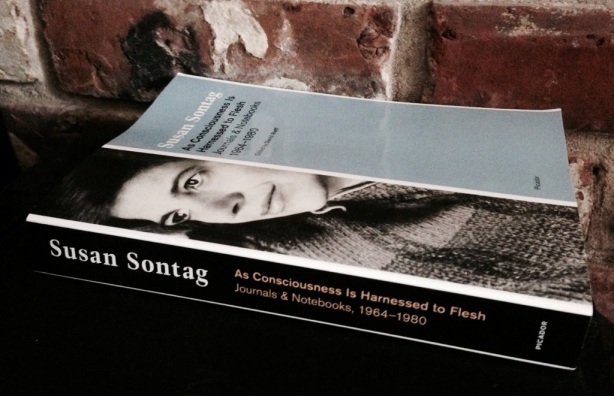
“Recycling one’s own life with books” |Thirteen Notes on Susan Sontag’s Notebook Collection, As Consciousness Is Harnessed to Flesh

20130929-103619.jpg

1. “In my more extravagant moments,” writes David Rieff in his introduction to Susan Sontag’s As Consciousness Is Harnessed to Flesh, “I sometimes think that my mother’s journals, of which this is the second of three volumes, are not just the autobiography she never got around to writing…but the great autobiographical novel she never cared to write.”

2. In my review of Reborn, the first of the trilogy Rieff alludes to, I wrote, “Don’t expect, of course, to get a definitive sense of who Sontag was, let alone a narrative account of her life here. Subtitled Journals & Notebooks 1947-1963Reborn veers closer to the “notebook” side of things.”

As Consciousness Is Harnessed to Flesh is far closer to the ‘notebook’ side of things too, which I think most readers (or maybe I just mean me here) will appreciate.

3. I mean, this isn’t the autobiographical novel that Rieff suggests it might be (except of course it is).

Consciousness/Flesh offers something better: access to Sontag’s consciousness in its prime, not quite ripe, but full, heavy, bursting with intellectual energy,  her mind attuned to (and attuning) the tumult of the time the journals cover, 1964 through 1980.

It’s an autobiography stripped of the pretense of presentation; it’s a novel stripped of the pretense of storytelling.

4. Sontag’s intellect and spirit course through the book’s 500 pages, eliding any distinction between lives personal and professional. “What sex is the ‘I’?” she writes, “Who has the right to say ‘I’?” The journals see her working through (if not resolving, thankfully) such issues.

5. An entry from late 1964, clearly background for Sontag’s seminal essay “Notes on Camp” (itself a series of notes), moves through a some thoughts on artists and poets, from Warhol to Breton to Duchamp (“DUCHAMP”) to simply “Style,” which, Rieff’s editorial note tells us, has a box drawn around it. The entry then moves to define

Work of Art

An experiment, a research (solving a “problem”) vs. form of a play

—before turning to a series of notes on the films of Michelangelo Antonioni.

6. A page or two later (1965) delivers the kind of gold vein we wish to discover in author’s notebooks:

PLOTS & SITUATIONS

Redemptive friendship (two women)

Novel in letters: the recluse-artist and his dealer a clairvoyant

A voyage to the underworld (Homer, Vergil [sic]Steppenwolf)

Matricide

An assassination

A collective hallucination (Story)

A theft

A work of art which is really a machine for dominating human beings

The discovery of a lost mss.

Two incestuous sisters

A space ship has landed

An ageing movie actress

A novel about the future. Machines. Each man has his own machine (memory bank, codified decision maker, etc.) You “play the machine. Instant everything.

Smuggling a huge art-work (painting? Sculpture?) out of the country in pieces—called “The Invention of Liberty”

A project: sanctity (based on SW [Simone Weil]—with honesty of Sylvia Plath—only way to solve sex “I” is talk about it

Jealousy

7. The list above—and there’s so much material like it in Consciousness/Flesh—is why I love author’s notebooks, We get to see the raw material here and imagine along with the writer (if we choose), free of the clutter and weight of execution, of prose, of damnable detail.

There’s something joyfully cryptic about Sontag’s notes, like the solitary entry “…Habits of despair” in late July of 1970—or a few months later: “A convention of mutants (Marvel comics).”

If we wish we can puzzle the notes out, treat them as clues or keys that fit to the work she was publishing at the time or to the personal circumstances of her private life. Or (and to be clear, I choose this or) we can let these notes stand as strange figures in an unconventional autobiographical novel.

8. Those looking for more direct material about Sontag’s life (and really, why do you want more and what more do you want?) will likely be disappointed—everything here is oblique (lovely, lovely oblique).

Still, there are moments of intense personal detail, like this 1964 entry where Sontag describes her body:

Body type

  • Tall
  • Low blood pressure
  • Needs lots of sleep
  • Sudden craving for pure sugar (but dislike desserts—not a high enough concentration)
  • Intolerance for liquor
  • Heavy smoking
  • Tendency to anemia
  • Heavy protein craving
  • Asthma
  • Migraines
  • Very good stomach—no heartburn, constipation, etc.
  • Negligible menstrual cramps
  • Easily tired by standing
  • Like heights
  • Enjoy seeing deformed people (voyeuristic)
  • Nailbiting
  • Teeth grinding
  • Nearsighted, astigmatism
  • Frileuse (very sensitive to cold, like hot summers)
  • Not very sensitive to noise (high degree of selective auditory focus)

There’s more autobiographical detail in that list than anyone craving a lurid expose could (should) hope for.

9. For many readers (or maybe I just mean me here) Consciousness/Flesh will be most fascinating as a curatorial project.

Sontag offers her list of best films (not in order),her ideal short story collection, and more. The collection often breaks into lists—like the ones we see above—but also into names—films, authors, books, essays, ideas, etc.

10. At times, Consciousness/Flesh resembles something close to David Markson’s so-called “notecard” novels (Reader’s Block, This Is Not a NovelVanishing Point, The Last Novel):

Napoleon’s wet, chubby back (Tolstoy).

and

Wordsworth’s ‘wise passiveness.’

and

Nabokov talks of minor readers. ‘There must be minor readers because there are minor writers.’

and

Camus (Notebooks, Vol. II): ‘Is there a tragic dilettante-ism?'”

and

‘To think is to exaggerate.’ — Valéry.

and so on…

11. Sometimes, the lists Sontag offers—

(offers is not the right verb at all here—these are Sontag’s personal journals and notebooks, her private ideas, material never intended for public consumption, but yes we are greedy, yes; and some of us (or maybe I just mean me here) are greedier than others, far more interested in her private ideas and notes and lists than the essays and stories and novels she generated from them—and so no, she didn’t offer this, my verb is all wrong)

—sometimes Sontag [creates/notes/generates] very personal lists, like “Movies I saw as a child, when they came out” (composed 11/25/65). There’s something tender here, imagining the child Sontag watching Fantasia or Rebecca or Citizen Kane or The Wizard of Oz in the theater; and then later, the adult Sontag, crafting her own lists, making those connections between past and present.

12. While Reborn showcased the intimate thoughts of a nascent (and at times naïve) intellect, Consciousness/Flesh shows us an assured writer at perhaps her zenith. In September of 1975, Sontag defines herself as a writer:

I am an adversary writer, a polemical writer. I write to support what is attacked, to attack what is acclaimed. But thereby I put myself in an emotionally uncomfortable position. I don’t, secretly, hope to convince, and can’t help being dismayed when my minority taste (ideas) becomes majority taste (ideas): then I want to attack again. I can’t help but be in an adversary relation to my own work.

13. Readers looking for a memoir or biography might be disappointed in Consciousness/Flesh; readers who seek to scrape its contours for “wisdom” (or worse, writing advice) should be castigated.

But As Consciousness Is Harnessed to Flesh will reward those readers who take it on its own terms as an oblique, discursive (and incomplete) record of Sontag’s brilliant mind.

I’ll close this riff with one last note from the book, a fitting encapsulation of the relationship between reader and author—and, most importantly, author-as-reader-and-rereader:

Recycling one’s own life with books.

As Consciousness Is Harnessed to Flesh is new in trade paperback from Picador; you can read excerpts from the book at their site.

“…in the direction of increasing entropy” (Another Riff on Pynchon’s Novel Against the Day)

1. So in the final pages of Against the Day, Thomas Pynchon takes us back to those heroes of the ether who initiated the book, the Chums of Chance. They’ve been absent for a long stretch, with only the occasional mention here or there to assure us that yes, they are still in the narrative, but under its surface, or, rather—invisible (this, in a novel full of invisibility).

2. Example: in a maddening moment, we learn that, via Pugnax’s girlfriend, a dog named Ksenija, “the Chums of Chance had been invisibly but attentively keeping an eye on the progress of Reef’s family exfiltration from the Balkan Peninsula.”

3. Several chapters later, Pynchon makes our sky-heroes visible again; they’ve dramatically expanded the size of their ship Inconvenience and have essentially declared independence from Chums headquarters.

They learn of a strange “updraft” over the Sahara desert that spells new adventure—

Tonight’s meeting was about whether or not to take the Inconvenience into the great updraft over the Sahara without somebody paying for it in advance. Miles called the session to order by bashing upon a Chinese gong acquired years before from an assassination cult active in that country, during the boys’ unheralded but decisive activities in the Boxer Rebellion (see The Chums of Chance and the Wrath of the Yellow Fang), and wheeled around a refrigerated Champagne cart, refilling everyone’s glass from a Balthazar of ’03 Verzenay.

4. And so of course they go, and we get this remarkable passage:

 And as they entered and were taken, Chick Counterfly thought back to his first days aboard the Inconvenience, and Randolph’s dark admonition that going up would be like going north, and his own surmise that one could climb high enough to descend to the surface of another planet. Or, as the commander had put it then, “Another ‘surface,’ but an earthly one . . . all too earthly.”

—and jeez I hate to break in, but I just have to point out that Pynchon is citing himself here, that the lines that Chick Counterfly recollects go all the way back to page nine, to the first chapter of the book.

5. Continuing:

The corollary, Chick had worked out long ago, being that each star and planet we can see in the Sky is but the reflection of our single Earth along a different Minkowskian spacetime track. Travel to other worlds is therefore travel to alternate versions of the same Earth. And if going up is like going north, with the common variable being cold, the analogous direction in Time, by the Second Law of Thermodynamics, ought to be from past to future, in the direction of increasing entropy.

So the great grand theme of bilocation gets tied in here to the novel’s hard sci-fi tropes, all pointing to “increasing entropy.” There are other Chums on other Earths, bilocating into other systems that are breaking “in the direction of increasing entropy.”

6. Which is a fairly accurate description of both the plot and the structure of Against the Day. The novel is shaggy and seemingly fails to cohere because it is a stylistic approximation of entropy.

7. And a few paragraphs later, we get a demonstration of this program. Miles Blundell, the most mystical and reflective Chum, is able to perceive the violence and terror of The Great War that rages below the Chums—who, bilocated, displaced cannot see it—it’s invisible. 

Blundell:

“Those poor innocents,” he exclaimed in a stricken whisper, as if some blindness had abruptly healed itself, allowing him at last to see the horror transpiring on the ground. “Back at the beginning of this . . . they must have been boys, so much like us. . . . They knew they were standing before a great chasm none could see to the bottom of. But they launched themselves into it anyway. Cheering and laughing. It was their own grand ‘Adventure.’ They were juvenile heroes of a World-Narrative—unreflective and free, they went on hurling themselves into those depths by tens of thousands until one day they awoke, those who were still alive, and instead of finding themselves posed nobly against some dramatic moral geography, they were down cringing in a mud trench swarming with rats and smelling of shit and death.”

“Miles,” said Randolph in some concern. “What is it? What do you see down there?”

Miles points out that the “boys” fighting in the war are “so much like” the Chums — “juvenile heroes of a World-Narrative” on their “own grand ‘Adventure'” and then punctures the high heroic rhetoric that marked the Chums episode up until this point, his analysis culminating in the abject image of “a mud trench swarming with rats and smelling of shit and death.” The language and sentiment of the Chums is bilocated, unraveling in the direction of increasing entropy.

Borges Riff/Borges Anxiety

borgesscan
Art by Roman Muradov

1. Jorge Luis Borges is 115 today.

2. I’ve shared clips from my scattered readings of Borges on this blog (receiving the occasional takedown notice as well)—but I’ve never mustered the energy to try to say anything about him or describe his writing or try to situate it or analyze it or anything—

3. Because that’s what Borges does: He situates, analyzes, condenses, clarifies, expands, complicates, archives, curates, cultivates, teaches, improves literature.

4. And he does it in a way that makes following him with my own mealy mottled words seem superfluous (or maybe futile is the word I want—although I think Borges is unrelentingly positive and futile is such an ugly word).

5. I read a book of Borges’ essays this summer, a collection entitled Other Inquisitions. I read most of it in the Great Smoky Mountains, where the crisp morning air was perfect for Borges. Or for me to read Borges. It was lovely.

6. I wanted to write about Borges’ book—or, rather, and more exactly, I wanted to have written Borges’ book.

7. In one essay—I’ve put the book aside for now and can’t recall exactly which essay (maybe on FitzGerald and Omar Khayyam?); nor will I go look; if I had it out I’d only cite it, recycle it here; the book would kill this riff immediately, put a stake through its heart—Borges suggests that “A great writer creates his precursors.” — This, years, decades before Harold Bloom makes a career out of the same notion.

8. And Borges’ essays are a canon-making: His own canon–the formation and creation of his own precursors: Whitman, Kafka, DeQuincey, Carlyle, Becher, Valery, Wilde, Poe, Hawthorne…

9. The shock I experienced reading Borges’ essay on Nathaniel Hawthorne. That Borges had set about to riff on Hawthorne’s Note-Books, the same note-books I’d been reading since the early spring, the same note-books that seemed and still seem so generative to me, so full of entire worlds, so rich, so much fuller and richer than Hawthorne’s novels or his stories, so full in their singularity and off-focus, these notes, these Borgesian notes. Oh and that Borges had written the essay that I wished I could write!

10. Borges, who never wrote a novel, whose entire work might be some kind of postmodern novel.

11. Borges, whose short stories often seem like pretexts to an essay he’d like to write—and here pretext is not the right word, again—-so maybe the short stories, so many of them so brilliant, act as some kind of surface text that illuminates and yet simultaneously hides an essay underneath.

12. The great joy of reading Borges: We read through Borges: Borges the librarian grants us access to so many minds. We get to share his perceptions, read over his shoulder, or maybe through his glasses—we get to glance over his annotations, his notes. But that’s not accurate—he’s so much more lucid than that scatter-shot image suggests, even when he’s at his most Borgesian, which is to say his most labyrinthine, mirrored, winding, forking, decentering and recentering, deferring, echoing, prefiguring…

13. I’ve written more than I intended to and have yet barely edged into all the thicket of anxieties that guard Borges’ oeuvre from poseurs like myself. It’s enough to know that his works exist, will exist.

Gargoyles, Thomas Bernhard’s Philosophical Novel of Abject Madness

In its English translation, Thomas Bernhard’s 1967 breakthrough novel Verstörung received the title GargoylesVerstörung translates to something like distress or disturbance, while Gargoyles (obviously) evokes Gothic monsters. Considered together, both titles communicate this philosophical novel’s themes of abjection, decay, and madness.

Bernhard explores these themes by dividing the novel into two sections that occur over the span of the same day. In the first section, “First Page,” a country doctor takes his son on his daily rounds in rural Stryia, “a relatively large and ‘difficult’ district.” The son, a mining engineer student and aspiring scientist, is ostensibly the narrator of Gargoyles. He tells us that his father “was taking me with him for the sake of my studies.” Their journey culminates in a visit to Hochgobernitz, the gloomy castle of Prince Saurau, an insane, suicidal aristocrat who mourns his own son’s self-exile to England, where he has gone to study. While the doctor’s son remains the narrator of the book in “The Prince,” the second part of Gargoyles, Prince Saurau overwhelms the novel with the force of his monologue, a tirade that gobbles up all that comes before it. His monologue ventriloquizes the narrator’s consciousness, echoing in the young man’s skull long after he’s left the castle.

The prince’s monologue is a prototypical Bernhardian rant that will be familiar to anyone who’s read The Loser or Correction (and undoubtedly other Bernhard novels I haven’t read yet). Unlike those novels, Gargoyles offers its first section “First Page” as a point of contrast to the monologue that will come later. These episodes are short and digestible, and while hardly conventional, they are far easier to handle than the sustained intensity of the prince’s monologue. The grotesque cavalcade that the doctor and son trek through in “First Page” allows Bernhard to set out his themes — not neatly or precisely, but clearly — before the prince commences to swallow and then vomit them.

Here are the first two paragraphs of the novel:

On the twenty-sixth my father drove off to Salla at two o’clock in the morning to see to a schoolteacher whom he found dying and left dead. From there he set out toward Hüllberg to treat a child who had fallen into a hog tub full of boiling water that spring. Discharged from the hospital weeks ago, it was now back with its parents.

He liked seeing the child, and dropped by there whenever he could. The parents were simple people, the father a miner in Köflach, the mother a servant in a butcher’s household in Voitsberg. But the child was not left alone all day; it was in the care of one of the mother’s sisters. On this day my father described the child to me in greater detail than ever before, adding that he was afraid it had only a short time to live. “I can say for a certainty that it won’t last through the winter, so I am going to see it as often as possible now,” he said. It struck me that he spoke of the child as a beloved person, very quietly and without having to consider his words.

The specter of infanticide and the doctor’s resistance to it haunts the novel. We can also sense a cerebral chilliness in the narrator, who is “struck” by his father’s empathy. The doctor’s empathy repeats throughout the novel; we next see it clearly when he’s brought to attend an innkeeper’s wife assaulted in the early morning “without the slightest provocation” by one of the drunken miners who frequented her inn. Unconscious for hours before police or doctor are even called for, the woman dies. But—

It was of no importance that the innkeeper had not notified him of the fatal blow until three hours after the incident, my father said. The woman could not have been saved. The deceased woman was thirty-three, and my father had known her for years. It had always seemed to him that innkeepers treated their wives with extreme callousness, he said. They themselves usually went to bed early, having overworked themselves all day on their slaughtering, their cattle dealing, their farms. But because they thought of nothing but the business, they left their wives to take care of the taverns until the early morning hours, exposed to the male clients who drank steadily so that as the night wore on their natural brutality became less and less restrained.

As the day unfolds, the “natural brutality” that the doctor is up against evinces again and again in the various gargoyles he attends to. The rumor of the innkeeper’s wife’s murder floats in the background as a reminder of violence and brutality that bizarrely unites this community of outsiders.

Those outsiders: a bedridden, dying woman with a feeble-minded son and a murderer for a brother; a retired industrialist, living “like man and wife” with his half-sister, who devotes “himself to a literary work over which he agonized, even as it kept his mind off his inner agony”; the school teacher whose death initiates the novel; mill workers murdering exotic birds with the help of a young bewildered Turk; an insane and deformed man, the son’s age, attended to and cared for by his sister. And the prince. But I’ve rushed through so much here, so much force of language, so much terror, so much horror.

These gargoyles live, if it can be called that, in abject, isolated otherness. The doctor diagnoses it for his son:

. . . no human being could continue to exist in such total isolation without doing severe damage to his intellect and psyche. It was a well-known phenomenon, my father said, that at a crisis in their lives some people seek out a dungeon, voluntarily enter it, and devote their lives—which they regard as philosophically oriented—to some scholarly task or to some imaginative scientific obsession. They always take with them into their dungeon some creature who is attached to them. In most cases they sooner or later destroy this creature who has entered the dungeon with them, and then themselves. The process always goes slowly at first.

There is something of a warning here for the doctor’s son, who tells us at one point: “Every day I completely built myself up, and completely destroyed myself.” Like Roithamer of Correction, the son is something of a control freak (“Only through such control can man be happy and perceive his own nature”), and, like Roithamer and so many other Bernhardian figures, he has a frail (perhaps suicidal) sister who could perhaps fall prey to his idealism—who might indeed be the “creature who has entered the dungeon” with him.

There’s also the risk, one which the doctor perhaps did not account for when he set out to help his son with his “studies,” that the son might fall into the prince’s dungeon. But perhaps I’m making too much of the doctor’s empathy, of his resistance to brutality and his commitment to caring for those who repel all others. His own philosophy seems coded in misanthropy and failure. “All of living is nothing but a fervid attempt to move closer together,” he says at one point. But also: “Communication is impossible.”

The resistance to abjection is paradoxical—as the doctor points out, the “philosophically oriented” and “imaginative scientific obsession[s]” often lead people deeper into the abyss—as the prince’s monologue will illustrate. Each of the gargoyles presented in the text offers a rare and special talent—art, music, philosophy, etc. Sussing out the novel’s treatment of the philosophies it invokes is beyond my ken, but I can’t resist lazily dropping a few names: Kant, Marx, Nietzsche, Pascal, Diederot (all on the doctor’s reading list), and Schopenhauer, whose philosophy of the will surely informs the text more than I can manage here. (From the prince’s father’s suicide note: “Schopenhauer has always been the best nourishment for me”). And while I’m lazily dropping names: Edgar Allan Poe, King Lear, Macbeth, Dostoevsky, and Francisco Goya—especially his Los caprichos, a few of which accompany this review . (And although he came after, I can’t help but read Roberto Bolaño in some of the more grotesque, horrific passages).

The levels of ventriloquizing and the layers of madness set against the novel’s depiction of radical repression lead to an abyssal paradox, perhaps best figured not in the philosophers Bernhard invokes but in the novel’s backdrop: a dark, enveloping gorge, the yawning chasm that surrounds the high walls of the castle the prince walks with his auditors. These walls are the stage from which the prince performs his monologue; their visceral dramatic emphasis derives from the abyss below. In an ironic note at the beginning of “The Prince,” the son remarks, “From here, I thought, you probably had the finest view of the entire country.”

Upon this stage, Bernhard’s main characters function as asymmetrical parallels (forgive the purposeful absurdity of this oxymoron). The father and his son the narrator are set against the prince and his absent son. In a particularly bizarre episode, the prince recounts a dream:

“But my son,” he said, “will destroy Hochgobernitz as soon as he receives it into his hands.”

Last night, the prince said, he had had a dream. “In this dream,” he said, “I was able to look at a sheet of paper moving slowly from far below to high up, paper on which my own son had written the following. I see every word that my son is writing on that sheet of paper,” the prince said. “It is my son’s hand writing it. My son writes: As one who has taken refuge in scientific allegories I seemed to have cured myself of my father for good, as one cures oneself of a contagious disease. But today I see that this disease is an elemental, shattering fatal illness of which everyone without exception dies. Eight months after my father’s suicide—note that, Doctor, after his father’s suicide, after my suicide; my son writes about my suicide!—eight months after my father’s suicide everything is already ruined, and I can say that I have ruined it. I can say that I have ruined Hochgobernitz, my son writes, and he writes: I have ruined this flourishing economy! This tremendous, anachronistic agricultural and forest economy. I suddenly see, my son writes,” the prince said, “that by liquidating the business even though or precisely because it is the best, I am for the first time implementing my theory, my son writes!” the prince said.

Note the strange layers of narration and creation here. The prince’s son, a creation of the prince, exists in the prince’s dream (another creation) where he creates a manuscript. All this creation though points to destruction—of the father, of the ancestral estate. The prince’s impulses signal self-erasure, suicide as a kind of radical return of the repressed (here, Austria’s inability to speak about, reconcile, admit its complicity in the horrors of World War 2).

The doctor contrasts with the prince, perhaps representing an order, health, and sanity that serve to sharpen and darken the abject decay of the crazed aristocrat. “My father goes to see the prince only to treat him for his insomnia,” observes the narrator, “without doing anything about his real illness . . . his madness.” But can the doctor really treat the prince’s illness?

Both fathers in their respective philosophies signal the possible paths that might be inherited by their sons (and, if you like, by allegorical extension the sons could represent Austria, or perhaps even Western Europe). How to live against the promise of suicide, against the perils of infanticide, against the kind of “natural brutality” that leads to murder, insanity, the abyss?

This problem is encoded into Bernhard’s rhetorical technique. The prince’s devastating monologue consumes the narrative, reader and narrator alike. By the end of the novel, he’s infiltrated (and perhaps infected) the narrator’s consciousness, highlighting the dramatic stakes here—of being ventriloquized, possessed by the diseases of history and authority—an illness that trends to self-destruction. It’s worth sharing a passage at some length; the following section highlights and perhaps even condenses what I take to be the core themes of Gargoyles:

“Whenever I look at people, I look at unhappy people,” the prince said. “They are people who carry their torment into the streets and thus make the world a comedy, which is of course laughable. In this comedy they all suffer from tumors both mental and physical; they take pleasure in their fatal illness. When they hear its name, no matter whether the scene is London, Brussels, or Styria, they are frightened, but they try not to show their fright. All these people conceal the actual play within the comedy that this world is. Whenever they feel themselves unobserved, they run away from themselves toward themselves. Grotesque. But we do not even see the most ridiculous side of it because the most ridiculous side is always the reverse side. God sometimes speaks to them, but he uses the same vulgar words as they themselves, the same clumsy phrases. Whether a person has a gigantic factory or a gigantic farm or an equally gigantic sentence of Pascal’s in his head, is all the same,” the prince said. “It is poverty that makes people the same; at the human core, even the greatest wealth is poverty. In men’s minds and bodies poverty is always simultaneously a poverty of the body and a poverty of the mind, which necessarily makes them sick and drives them mad. Listen to me, Doctor, all my life I have seen nothing but sick people and madmen. Wherever I look, the worn and the dying look back at me. All the billions of the human race spread over the five continents are nothing but one vast community of the dying. Comedy!” the prince said. “Every person I see and everyone I hear anything about, no matter what it is, prove to me the absolute obtuseness of this whole human race and that this whole human race and all of nature are a fraud. Comedy. The world actually is, as has so often been said, a stage on which roles are forever being rehearsed. Wherever we look it is a perpetual learning to speak and learning to walk and learning to think and learning by heart, learning to cheat, learning to die, learning to be dead. This is what takes up all our time. Men are nothing but actors putting on a show all too familiar to us. Learners of roles,” the prince said. “Each of us is forever learning one (his) or several or all imaginable roles, without knowing why he is learning them (or for whom). This stage is an unending torment and no one feels that the events on it are a pleasure. But everything that happens on this stage happens naturally. A critic to explain the play is constantly being sought. When the curtain rises, everything is over.” Life, he went on, changing his image, was a school in which death was being taught. It was filled with millions and billions of pupils and teachers. The world was the school of death. “First the world is the elementary school of death, then the secondary school of death, then, for the very few, the university of death,” the prince said. People alternate as teachers or pupils in these schools. “The only attainable goal of study is death,” he said.

Such searing nihilism here—the prince angrily mourns the grotesqueness of the world, the lack of agency of people to control their own fate, to be but players, dummies mumbling someone else’s script. And it all leads to death. For the prince, dialogue is impossible in the face of this death: “All interlocutors are always mutually pushing one another into all abysses.” But the prince, notably, is his own interlocutor; he pushes himself into abysses of his own contrivance.

Neither is love a solution for the prince:

“We face questions like an open grave about to be filled. It is also absurd, you know, for me to be talking of the absurdity,” he said. “My character can justly be called thoroughly unloving. But with equal justice I call the world utterly unloving. Love is an absurdity for which there is no place in nature.

And community?

We see in a person frailties which at once make us see the frailties of the community in which we live, the frailties of all communities, the state; we feel them, we see through them, we catastrophize them.

But is this necessarily the essential view of the novel? I don’t think it plausible to argue that the prince’s monologue be read entirely ironically, but it’s worth bearing in mind that both his auditors understand him to be mentally ill and terribly isolated. The guy is histrionic, a drama fiend holding forth on his stage. And while his acerbic misanthropy and nihilism may scorch, it’s also very, very funny. I chuckled a lot reading Gargoyles.

But yes—the prince is sincere in his pain. “We assume the spirit of the walls that surround us,” he declares near the end of the novel. He’s a a prisoner in his own gloomy castle, the dungeon he refuses to leave. He resents his son’s self-exile to London, but also longs—literally dreams for—his son to return to destroy that dungeon.

Of his family: “But probably all these creatures deserve ruthlessness more than pity.” I think that But is important here. The doctor, like the prince, also situates everyone on an axis of ruthlessness and pity. The doctor is full of cruel observations about the gargoyles he encounters. But: But he gets up, goes out, does his rounds, tries in some way to mitigate some of the “natural brutality” of the world. And he tries to show this world—and this method—to his son this as well, for his son’s “studies.” In the room of the lonely, dying woman, the son remarks of his father: “I noticed that he made an effort to stretch out the call, for all his eagerness to leave.” The son, in thrall to the prince’s monologue, perhaps fails to notice that his father also stretches out his time on the castle wall despite an eagerness to leave the prince.

By the end of the novel, we see the prince’s consciousness inhabiting the son’s thoughts:

In bed I thought: What did the prince say? “Always wanting to change everything has been a constant craving with me, an outrageous desire which leads to the most painful disputes. The catastrophe begins with getting out of bed. 

The pessimism and sheer despair here erupts into black comedy with that last line, one echoed in Bernhard’s later novel Correction: “Waking up is the always frightening minimum of existence.” If to simply get out of bed (which, of course, is where the son is as he work’s through the prince’s ideas) is to invoke and invite disaster and despair, it’s worth noting that this simple action—getting out of bed—is what the doctor performs each day, even if it means he wakes to a dead teacher, a boiled infant, a murdered wife. While hardly a beacon of optimism or hope, the doctor nonetheless figures an alternative to the prince’s abject madness. If we “assume the spirit of the walls that surround us,” the doctor understands that it’s important to leave those walls, to not seek out dungeons—and drag others into dungeons with us.

Gargoyles is by turns bleak and nihilistic. It’s also energetic, profound, and at times very, very funny. Its opening section will likely provide an accessible introduction to readers interested in Bernhard, with the prince’s monologue offering the full Bernhardian experience. Dark, cruel, and taxing, Gargoyles isn’t particularly fun reading—except when it is. Highly recommended.

David Gordon Green’s Prince Avalanche Reviewed

prince-avalanche-poster

At this point, pretty much anything anyone writes about director David Gordon Green sets out to divide his early “promising” work—impressionistic, Malick-beholden films like All the Real Girls and George Washington—from more recent stoner comedies like Pineapple Express, the much-vilified-now-but-future-cult-classic Your Highness, and Green’s work on Eastbound & Down.

The critical line on Green’s latest film, Prince Avalanche, is that it synthesizes the poetic and artistic impulses of the earlier films with the commercial comedy of what came after—that, in shortGreen has found his way again. I don’t think that this is especially true.

Based on the 2011 Icelandic film Either WayPrince Avalanche floats around the barest wisp of a plot. It’s the end of the 1980s, and in the middle of wildfire-ravaged Texas, uptight Alvin (Paul Rudd) and slacker Lance (Emile Hirsch, channeling a sensitive Jack Black) paint yellow lines on the old rural roads and hammer in new signposts. They squabble, share vodka with an alcoholic truck driver, and encounter a woman whose house has burned down. We learn that Lance has scored the job because his sister is Alvin’s girlfriend—but that romantic relationship looks pretty rocky from the get-go.

Prince Avalanche is never better than its opening scenes, where Alvin and Lance wordlessly perform their duties, hammering stakes into the ground and measuring out yellow dashes. Green is confident enough to let the camera linger on his actors, and most of the memorable scenes are simple—Paul Rudd’s motions as he sets up a folding table, or Hirsch tying down equipment to the work jeep. The blasted Texas forest is beautiful, as new growth mixes with charred tree trunks in frames by turns surreal and painterly.

The story line of Prince Avalanche isn’t especially bad; it’s just not especially good, or even interesting. There’s simply too much indie dramedy quirkiness going on here, and when Green’s plotting hits familiar arc-driven beats—a climactic fight, a scene of drunken abandon—the story feels false against the pure, beautiful cinematography. The original score by postrockers Explosions in the Sky is maddeningly intrusive, buzzing with overly-detailed blips and rhythm huffs that sound at times like Tangerine Dream’s work on Risky Business. Calm down!

This is all perhaps a way of saying that the “synthesis” many critics have detected in Prince Avalanche is not particularly satisfying. It’s true that the film is smaller and more intimate than Green’s last effort, the execrable and indefensible into-the-night film The Sitter, but Prince Avalanche is just as much a product of formula as that film.

In most of his films, Green retells the same core story about a lonely young man with communication troubles who really just wants a friend (this is Paul Schneider in All the Real Girls or James Franco in Pineapple Express or Danny McBride in Your Highness). Prince Avalanche is no different, but it seems unsure of pulling off its emotional impact without all the indie-quirk baggage. It feels bloated at a scant 96 minutes and would be a far better film if, like the burned and beautiful world it depicts, it was willing to strip away more of its protective layers. (It doesn’t help that Kelly Reichardt told a similar story far better in 2006 with her film Old Joy).

Perhaps I’m being too harsh on the film—I’ll confess I wanted it to be great, something that could transcend the self-seriousness of All the Real Girls and surpass the final, perfect diner scene of Pineapple Express (the single moment where Green best combines his Malick-tinged naturalism with his sense of bromance-up-too-late humor).

Of course I could be dead wrong—I might catch the film on cable in a year and see something there that I missed the first time. Like most viewers, I had no love for Your Highness on first viewing but have since sat through it at least four times—it’s a failure, to be sure, but a compelling, bizarre failure, one that I find funnier and more self-aware each time. And the same promise that Green has always shown in all his work (okay, not The Sitter) shines brightly throughout Prince Avalanche. The final shot of the film shows us children joyfully chasing a chicken. It’s one of the finest moments in the film, and I wish Green’s lens lingered there longer—I’d like to see what happens next.

“…the Mask’s desire was to be invisible, unthreatening, transparent yet mercilessly deceptive…” / Another Pynchon Riff

Capture

IT WAS MIDAPRIL, Carnevale had been over for weeks, and Lent was coming to a close, skies too drawn and pallid to weep for the fate of the cyclic Christ, the city having slowly regained a maskless condition, with a strange dull shine on the paving of the Piazza, less a reflection of the sky than a soft glow from regions below. But the silent communion of masks was not quite done here.

On one of the outer islands in the Lagoon, which had belonged to the Spongiatosta family for centuries, over an hour away even by motor craft, stood a slowly drowning palazzo. Here at midnight between Holy Saturday and Easter Sunday began the secret counter-Carnevale known as Carnesalve, not a farewell but an enthusiastic welcome to flesh in all its promise. As object of desire, as food, as temple, as gateway to conditions beyond immediate knowledge.

With no interference from authority, church or civic, all this bounded world here succumbed to a masked imperative, all hold on verbatim identities loosening until lost altogether in the delirium. Eventually, after a day or two, there would emerge the certainty that there had always existed separately a world in which masks were the real, everyday faces, faces with their own rules of expression, which knew and understand one another—a secret life of Masks. It was not quite the same as during Carnevale, when civilians were allowed to pretend to be members of the Maskworld, to borrow some of that hieratic distance, that deeper intimacy with the unexpressed dreams of Masks. At Carnevale, masks had suggested a privileged indifference to the world of flesh, which one was after all bidding farewell to. But here at Carnesalve, as in espionage, or some revolutionary project, the Mask’s desire was to be invisible, unthreatening, transparent yet mercilessly deceptive, as beneath its dark authority danger ruled and all was transgressed.

1. Okay—I know it’s been like forever since I riffed on Thomas Pynchon’s novel Against the Day (here, “forever” = a few weeks), but I took a week off from the novel, which turned into two weeks, which is a bad habit, yes, but here we are, and I’m nearing the end of the shaggy beast. I don’t think Pynchon is going to tie all the loose threads  into some perfect picture for me, but I don’t think I’d want that anyway.

2. Where I am in the book: Cyprian, Cyprian, Cyprian. The beginning of The Great War. Just waaaaaay too much going on to even bother to begin to try to summarize.

3. Cyprian is surely the most fascinating character of Against the Day, but his somewhat late arrival in the text feels, I don’t know, lumpy or something. Something about reading such a long book—we make a kind of investment in certain plots, figures, characters, and Pynchon here sort of moves them into the background, or disappears them completely, for long, long stretches. I’m thinking about The Chums of Chance in particular, but also Lew Basnight, the Tunguska event, the Vibes vs. the Traverses, etc. Thematically it’s all there, but this stretch with Cyprian’s dark adventures, while fantastic, also feels almost like a novella shoehorned into the final chapters of an epic. This is not a complaint.

4. I’ve shared a few citations from Against the Day since my last riff, but the one above (my Kindle tells me its at the 82% mark, if that means anything to you) seems to resonate with what I take to be the major themes and motifs of the novel.

I’m thinking specifically of the final line: “But here at Carnesalve, as in espionage, or some revolutionary project, the Mask’s desire was to be invisible, unthreatening, transparent yet mercilessly deceptive, as beneath its dark authority danger ruled and all was transgressed.”

Invisible is obviously a key word in Against the Day, and the novel turns on concepts of doubling, masking, transgression, themes that the Carnevale-Carnesalve disjunction highlights (flesh vs. spirit, visible vs. invisible, etc.).

5. Actually, now that I think about it, Cyprian probably most embodies, or, rather, embodies most complexly, Pynchon’s themes of doubling, masking, and transgression. He’s his own doppelganger. (Even the name suggest a kind of bilocation — Cyprus, that ancient crossroads of East and West).

6. And —

The Carnesalve chapter culminates in a truly salacious sex scene, an S&M-fueled ménage à trois that somehow simultaneously punctures the novels structure of doubling (cause, uh, a three-way) at the same time it reinforces it (Cyprian as self-double). I’m not sure if any of this that I’m saying makes any sense at all.

7. The image at the top of this riff is a detail from The Fight Between Carnival and Lent by Pieter Bruegel.

Josh Melrod Talks to Biblioklept About His Documentary, Cartoon College

When I first read the press materials for Josh Melrod and Tara Wray’s documentary Cartoon College, I’ll admit that I was mostly interested in the prospect of seeing comix legends like Art Spiegelman, Charles Burns, Lynda Barry, Chris Ware, Scott McCloud, and Stephen Bissette discuss their craft. What Melrod and Wray deliver though is much more—an intimate and often very moving look at the lives of the young artists who attend the prestigious Center for Cartoon Studies. This is a film about passion, drive, commitment, and what it means to be an outsider.

In my review, I wrote: “Cartoon College offers an intriguing story about real people trying to do something that they love, and I enjoyed that. This is a film about the impetus, motivation, and hard, hard work that goes into the creative process. Great stuff.”

Josh was kind enough to talk to me about making the film over a series of emails.

See more at the film’s official website. Cartoon College is now available on iTunes.

Banner_Color with Laurels

Biblioklept: How did you begin the documentary Cartoon College? How did the project come about?

Josh Melrod: In 2006 my wife, then my girlfriend, Tara Wray, had just finished her first movie, Manhattan, Kansas, and was looking for her next project. She’s a huge fan of Chris Ware and she read an article about how he’d been a visiting lecturer at CCS, which had just opened a year earlier, and that was enough to get her thinking about a cartoon school documentary. She asked me if I’d consider moving to Vermont for a year–we were living in New York, and had been for a while–and I said ok. Then we had to convince James Sturm and Michelle Ollie, who founded the school, to let us film, which took several months of emails and a couple of face-to-face meetings and a trip or two to White River Junction. Once they gave us the green light we basically packed up and moved to Vermont. That was in August of 2007, and we’ve been here ever since.

Biblioklept: So you guys were shooting for like, three years? When you started did you have an idea of the kind of story you wanted to tell in Cartoon College?

JM: Our original conceit for the movie was a year in the life of a cartoon school. It was supposed to be more about the institution and how it was helping to revitalize White River Junction, which had been a town in decline for about a century. So we shot for the 2007-2008 academic year and then started working with an editor in New York that summer. It took about six months to get a rough cut put together, but when all was said and done we weren’t happy with what we had. Part of it was that the story of the school’s impact on the town didn’t quite come together–it was an arc that was unfolding too slowly to really be seen during the year we’d been filming. But we also realized that what really interested us, much more than the school itself, was documenting the creative lives of the students and witnessing these aspiring artists at a very pivotal time in their careers. We basically scrapped the rough cut, which was a pretty difficult decision, and went back to film for what turned out to be another year-and-a-half.

The filmmakers, Tara Wray and Josh Melrod

Biblioklept: Some of the students, like Blair Sterett and Jen Vaughn, for example, are on screen a lot more than others. Was this because they were more open to the cameras? Were there students who were reticent to talk to you?

JM: Jen is kind of a natural in front of the camera, so in a sense she was more open than some of the others. But there were only a very small handful of people during the entire production who told us they really didn’t want to be filmed. A lot of the cartoonists we spoke with are fairly introverted, and quite a few, both the younger and the more experienced artists, discussed how they express themselves best through their comics, but it doesn’t take too long for most people to begin to forget the camera is there.

Biblioklept: I like that the film is really about the career of cartooning, and that the film focuses on the arcs of these aspiring cartoonists. You’ve got all these great interviews with people like Chris Ware and Art Spiegelman and Charles Burns, but their comments ultimately work to illuminate or enrich, through their perspectives, what the students are going through. It seems like there’s a lot of restraint and wise editing on your end here. Can you talk about how you put the film together? I’m curious how intuitive the process of forming the narrative was . . .

JM: By the time we finished shooting we had something like 150 hours of footage. I don’t remember how it all broke down, but maybe forty percent was interviews. There was a lot to go through. But it was pretty clear what the character arcs were for Blair and Al and Jen. Actually, it’s kind of hard for me to remember the process in any great detail. I was just starting to work on the rough cut when Tara and I had our twins, so for the first six months of the edit I was working from around ten at night until six a.m., stopping every couple of hours to help with feedings and changing diapers, and getting a few hours of sleep here and there during the day. It’s all very blurry, and sort of miraculous that I finished the rough cut at all. My method of working was to cut the footage down from 150 hours to just 10, which is a manageable amount of material, and from there put together an assembly that had the basic structure of a movie, and then loosely refine that into a two-hour rough cut. Then I went to New York to work with another editor, Chris Branca, who came in with a ton of great ideas and further refined the story. As for the interviews serving to illuminate what the students were going through, that was pretty organic. The challenges that a person faces when they decide to become an artist are fairly universal–the self-doubt, managing your time, coming to terms with your own limitations, figuring how to make a living, etc.–so the experiences shared by the established artists were in-line with what we documented from the students.

Biblioklept: You brought up that Tara’s interest in Ware’s work kind of sparked the genesis of the documentary. Were you a fan of comics too? How much did you know about the cartooning world going into the filming process?

JM: As a kid I loved Calvin and Hobbes and Bloom County/Outland and The Far Side, but those all ended when I was in high school and I pretty much stopped reading comics at that point. Then, after Tara and I moved in together, I’d pick up some of the books she’d leave around the apartment–like Jimmy Corrigan and Hate, I remember in particular–but I knew virtually nothing about the cartooning world when we started the movie.

Biblioklept: Have you become a fan since then?

JM: I love comics, but I’m a very casual fan. I still gravitate towards non-graphic novels, and I’m not quite sure why that is. Comics certainly demand more attention from the reader, if the reader we’re talking about is me–the interplay between the pictures and the text require a level of focus that isn’t needed when you’re just reading words, although I’m not sure I ever noticed that when I was a kid–and so maybe it’s that I don’t always have the mental energy to pick up a heavy graphic novel. I am really interested in reading comics from the people in the movie–CCS graduates are doing just incredible work and a lot of the former students we followed are starting to put out books now. Katherine Roy just illustrated a book and has a couple of others coming out soon; Jen Vaughn released a book last week; Josh Rosen is going to start serializing the project he was working on while we were filming; Joe Lambert, who we interviewed but didn’t appear in the movie, although he designed the poster, made a book about Annie Sullivan and Helen Keller that’s just incredible.

Biblioklept: What kind of movie would you like to do next?

JM: I’m working on a short, a fiction movie, with a couple of guys who used to edit a literary magazine with me. It was called the Land-Grant College Review and we published for five or six years starting in about 2002. We wanted to work on something new, and I’m really interested in doing a narrative, and they’d been thinking of doing a screenplay, so that’s what we decided to do. We’re still writing, but we have some good advisers on board and the plan is to shoot next summer. And I’m in the development phase on a pair of new docs. They’re both about personalities, as opposed to being issue-based, which is a common denominator. One follows a semi-famous performer and the other involves a family on its summer vacation. It’s still pretty early to talk confidently about any of this stuff. I just have to keep plugging away and see what happens, but these are the projects I’d like to do next.

Biblioklept: The docs sound intriguing. I spent some time in the Land-Grant College Review archive just now—what a great collection of authors. Your little microfiction there is a good creepy laugh. What are you reading now?

JM: Thanks! We had a short but good run, and got to publish a lot of great writers. One of my most prized possessions is a postcard that David Foster Wallace sent me–in response to a letter I’d written asking him to send us a story–saying that he’s “just working on stuff that isn’t suitable for publication any place.”

As for what I’m reading, I just started [Erik Larson’s] The Devil In The White City, which I’d been hesitant to open for a few years since I do a lot of reading before bed and I thought it would mess with my sleep. So far so good.

Biblioklept: Have you ever stolen a book?

JM: No, never stolen a book, but I have gone a long time without paying for a book. A lot of the books on my shelf I picked out of piles left on the curb or at the recycling center near where we live now. Sometimes I like to let the universe decide what I read depending on what I find in front of me, which is how I got to read The Universe And Dr. Einstein, a lay readers guide to general relativity that I still managed not to understand.

theNewerYork, a Worthy Alternative to Your iPhone

20130709-154848.jpg

Like many (maybe most) Americans, my first impulse when I have to wait somewhere is to pull out my smart phone and dick around. I like to dick around on Twitter, which often leads me to stuff that I scan or gaze or graze through, with a kind of distracted, even half-hearted, attention. Because I’m also attending to something else—the waiting.

I had to wait, or be patient, or be a patient, or what have you several times last month, and each time I brought with me the newest or forthcomingest issue of theNewerYork—issue 3 (or III, depending on press materials). It fits neatly in my pocket and most of the pieces are a page at most—a perfect alternative to my iPhone, with none of the eye-deadening numbness that so often happens with long binges on a tiny screen.

theNewerYork describes itself as

a weird sort of literary mag. Our rule: no short stories, no poetry, no essays. We want to play around with literary form and narration, we want to screw with your mind! There will be personal letters, flash-fictions, glossaries, aphorisms, manuals, lists and other absurdities. We received over 600 submissions from all over the world. We’ve got flash fictions of sex and drugs, teenage romances, philosophical treatises, pretentious definitions, web forums, silly, sappy, scary stuff.

That’s a pretty apt description. To hijack and cannibalize my write-up of the last issue, theNewerYork’s “willingness to showcase experimentation in what goes on paper for people to look at and read is both a strength and a weakness.” This third issue sees an all-around increase in quality, from the production design, to the art, to the writing.

Highlights include Panayotis Pakos’s “Les Innumerables (A Binary Tale),” a Calvinoesque flash that imagines the dream-life of numbers, and Shane Jesse Christmass’s “My Delicate Response to a Child’s Writing Prompt Website” (quick sample: “If there were no television I’d beach my television set down within the dunes…”). Zach Davidson’s “Unstandardized Testing” claims (truthfully?) to present a set of scrambled questions from a trash bin; the testtaker is tasked with creating proper order (sample: “too lazy to do lazy something you are if you are still?”)

The most affecting piece in the collection is Anton Nimblett’s “Show & Tell: An American Game,” an analysis posing as a chronology. I’ll share only the nineteenth century portion, and, at the risk of spoiling, let you know that the story ends with the line “Show birth certificate (again, again, again).”

20130807-130214.jpg

The list-form, along with (or combined with) the second-person POV seems a favorite for “experimental” fiction, which can occasionally be grating (but only when it doesn’t work)—but most of the pieces here work. And if they don’t, there’s something coming up that does.

Despite the disparate tones, approaches, and geographies of its contributors, theNewerYork coheres—the little magazine has a clear (if discursive vision). Good stuff. Check out their website for more. 

The Garden of Eden, Ernest Hemingway’s Tale of Doomed Polyamory

In general, I dislike reviews that frontload context—get to the book, right? So here’s a short review of Ernest Hemingway’s The Garden of Eden: it is stranger than most of what Hemingway wrote, by turns pleasant, uncomfortable, bewildering, and beautiful. And readable. It’s very, very readable. Young people (or older folks; let’s not be prejudiced) working their way through Hemingway shouldn’t put The Garden of Eden on the back-burner in favor of his more famous works, and anyone who might have written off Hemingway as unreflective macho bravado should take a look at some of the strange gender games this novel has to offer. So, that’s a recommendation, okay?

Now on to that context, which I think is important here. See, The Garden of Eden is one of those unfinished novels that get published posthumously, put together by editors and publishers and other book folk, who play a larger role than we like to admit in the finished books we get from living authors anyway. For various reasons, cultural, historical, etc., we seem to favor the idea of the Singular Artistic Genius who sculpts beauty and truth out of raw Platonic forms that only he or she can access (poor tortured soul). The reality of how our books get to us is a much messier affair, and editors and publishers and even literary studies departments in universities have a large hand in this process, one we tend to ignore in favor of the charms of a Singular Artistic Genius. There’s a fascinating process there, but also a troubling one. Editing issues complicate our ideals of (quite literally) stable authority—is this what the author intended?, we ask (New Critics be damned!). David Foster Wallace and Michael Pietsch, Raymond Carver and Gordon Lish, Franz Kafka and Max Brod, Mary Shelley and Percy Shelley . . . not to mention Shakespeare, Chaucer, Beowulf, The Bible, Homer, etc. etc. etc. But you’re here to read about The Garden of Eden, right gentle reader? Mea culpa. I’ve been blathering away. Let me turn the reins over to the estimable talents of E.L. Doctorow, who offers the following context in his 1986 review of the book in The New York Times

Since Hemingway’s death in 1961, his estate and his publishers, Charles Scribner’s Sons, have been catching up to him, issuing the work which, for one reason or another, he did not publish during his lifetime. He held back ”A Moveable Feast” out of concern for the feelings of the people in it who might still be alive. But for the novel ”Islands in the Stream” he seems to have had editorial misgivings. Even more deeply in this category is ”The Garden of Eden,” which he began in 1946 and worked on intermittently in the last 15 years of his life and left unfinished. It is a highly readable story, if not possibly the book he envisioned. As published it is composed of 30 short chapters running to about 70,000 words. A publisher’s note advises that ”some cuts” have been made in the manuscript, but according to Mr. Baker’s biography, at one point a revised manuscript of the work ran to 48 chapters and 200,000 words, so the publisher’s note is disingenuous. In an interview with The New York Times last December, a Scribners editor admitted to taking out a subplot in rough draft that he felt had not been integrated into the ”main body” of the text, but this cut reduced the book’s length by two-thirds.

So, yeah. The version we have of The Garden of Eden is heavily cut, and also likely heavily arranged. But that’s what editors do, and this is the book we have (for now, anyway—it seems like on the year of its 25th anniversary of publication, and the 50th anniversary of Hemingway’s death that Scribner should work toward putting out an unedited scholarly edition) — so I’ll talk about that book a bit.

The Garden of Eden tells the story of a few months in the lives of a young newlywed couple, David Bourne, an emerging novelist, and his wife Catherine, a trust fund baby flitting about Europe. The novel is set primarily on the French Riviera, in the thin sliver of high years between the two big wars. David and Catherine spend most of their days in this Edenic setting eating fine food and making love and swimming and riding bikes and fishing. And drinking. Lots and lots of drinking. Lots of drinking. It all sounds quite beautiful—h0w about a taste?

On this morning there was brioche and red raspberry preserve and the eggs were boiled and there was a pat of butter that melted as they stirred them and salted them lightly and ground pepper over them in the cups. They were big eggs and fresh and the girl’s were not cooked quite as long as the young man’s. He remembered that easily and he he was happy with his which he diced up with the spoon and ate with only the flow of the butter to moisten them and the fresh early morning texture and the bite of the coarsely ground pepper grains and the hot coffee and the chickory-fragrant bowl of café au lait.

Hemingway’s technique throughout the novel is to present the phenomenological contours of a heady world. It’s lovely to ride along with David and Catherine, rich and free and beautiful.

Their new life together is hardly charmed, however. See, Catherine gets a haircut—

Her hair was cropped as short as a boy’s. It was cut with no compromises. It was brushed back, heavy as always, but the sides were cut short and the ears that grew close to her head were clear and the tawny line of her hair was cropped close to her head and smooth and sweeping back. She turned her head and lifted her breasts and said, “Kiss me please.” . . .

“You see, she said. “That’s the surprise. I’m a girl. But now I’m a boy too and I can do anything and anything and anything.”

“Sit here by me,” he said. “What do you want, brother.”

David’s playful response—calling his wife “brother”—covers up some of his shock and fear, but it also points to his underlying curiosity and gender confusion. And indeed, Catherine’s new haircut licenses her to “do anything and anything and anything” — beginning with some strange bed games that night—

He had shut his eyes and he could feel the long light weight of her on him and her breasts pressing against him and her lips on his. He lay there and felt something and then her hand holding him and searching lower and he helped with his hands and then lay back in the dark and did not think at all and only felt the weight and the strangeness inside and she said, “Now you can’t tell who is who can you?”

“No.”

“You are changing,” she said. “Oh you are. You are. Yes you are and you’re my girl Catherine. Will you change and be my girl and let me take you?”

“You’re Catherine.”

“No. I’m Peter. You’re my wonderful Catherine. You’re my beautiful, lovely Catherine. You were so good to change. Oh thank you, Catherine, so much. Please understand. Please know and understand. I’m going to make love to you forever.”

David, partial stand-in for Hemingway, transforms into a girl who feels “something” during sex with Catherine (or, ahem, Peter)—note that that “something” has no clear referent. As their gender inverting games continue (much to David’s horror), Hemingway’s usually concrete language retreats to vague proforms without referents, “it”s without antecedents; his usually precise diction dissolves in these scenes, much as the Bournes’ marriage dissolves each time Catherine escalates the gender inversion. David gives her the nickname “Devil,” as if she were both Eve and Serpent in their Garden. Catherine’s transformations continue as she cuts her hair back even more, and sunbathes all the time so that she can be as dark as possible. She dyes her hair a silver blonde and makes David get his hair cut and dyed the same.

The bizarre behavior (shades of Scott and Zelda?) culminates in Catherine introducing another woman into the marriage. Marita falls in love with both David and Catherine, but her lesbian sex with Catherine only accelerates the latter’s encroaching insanity. David is initially radically ambivalent to the ménage à trois proposed by his wife; he has the good sense to see that a three-way marriage is ultimately untenable and that his wife is going crazy. He vacillates between hostility and love for the two women, but eventually finds a support system in Marita as it becomes increasingly apparent (to all three) that Catherine is depressed and mentally unstable, enraged that David has ceased to write about the pair’s honeymoon adventures on the Riviera. Catherine has been bankrolling David; jealous of good reviews from his last novel, she insists that he write only their story, but David would rather write “the hardest story” he knows—the story of his childhood in East Africa with his father, a big game hunter.

In some of the most extraordinary passages of The Garden of Eden, David writes himself into his boyhood existence, trailing a bull elephant with his father through a jungle trek. David has spotted the elephant by moonlight, prompting his father and his father’s fellow tracker and gun bearer Juma to hunt the old beast. As they trail the animal, David begins to realize how horrible the hunt is, how cruel it is to kill the animal for sport. The passages are somewhat perplexing given Hemingway’s reputation as a hunter. Indeed, this is one of the major features of The Garden of Eden: it repeatedly confounds or complicates our ideas about Hemingway the man’s man, Hemingway the writer, Hemingway the hunter. David describes the wounded, dying elephant—

They found him anchored, in such suffering and despair that he could no longer move. He had crashed through the heavy cover where he had been feeding and crossed a path of open forest and David and his father had run along the heavily splashed blood trail. Then the elephant had gone on into thick forest and David had seen him ahead standing gray and huge against the trunk of a tree. David could only see his stern and then his father moved ahead of him and he followed and they came alongside the elephant as though he was a ship and David saw the blood coming from his flanks and running down his sides and then his father raised his rifle and fired and the elephant turned his head with the great tusks moving heavy and slow and looked at them and when his father fired the second barrel the elephant seemed to sway like a felled tree and came smashing down toward them. But he was not dead. He had been anchored and now he was down with his shoulder broken. He did not move but his eye was alive and looked at David. He had very long eyelashes and his eye was the most alive thing David had ever seen.

David succeeds in writing this “hard” story, and the passages are remarkable in their authenticity—David’s story is a good story, the highlight of the book perhaps; it’s not just Hemingway telling us that David wrote a great story, we actually get to experience the story itself as well as the grueling process by which it was made. Hemingway and his surrogate David show us—make us experience—how difficult writing really is, and then share the fruit of that labor with us. These scenes raise the stakes of The Garden of Eden, revealing how serious David is when he remarks (repeatedly) that the writing is the most important thing—that it outweighs love, it surpasses his marriage. These realizations freight the climax of the novel all the more heavily, but I will avoid anymore spoilers.

The Garden of Eden has some obvious flaws. Marita is underdeveloped at best for such an important character, and her love for David and Catherine remains unexplored, and in fact barely remarked upon. The biggest problem with the book is its conclusion, which feels too pat, too obvious for such a strange, amorphous book. It is here that the presence of an editorial hand seems clearest, to the extent that I wonder if the short little chapter that concludes the novel wasn’t cobbled together from a few stray sentences throughout the manuscript. But The Garden of Eden, despite some shortcomings, is a book well worth reading. The novel complicates not just Hemingway’s reputation, but also our sense of Hemingway’s sense of himself. Recommended.

[Ed. note: Biblioklept originally published a version of this review in August of 2011]

Intertexuality and Structure in Roberto Bolaño’s 2666

the-librarian1

•I had been reading William T. Vollmann’s enormous book Imperial. I bought the book in paperback and then put an illicit copy on my Kindle (this riff is not about the ethics of that move). It’s just easier to read that way, especially at night. At some point in Imperial, probably at some mention of coyotes or polleros—smugglers of humans—I felt a tug in the back of my brain pan, a tug that wanted to pull up Roberto Bolaño’s big big novel 2666—also on my Kindle (also an illicit copy, although I bought the book twice).

•This is how I ended up rereading 2666 straight through. It was unplanned.

•Like many readers, I aim to reread more than I actually end up rereading.

•Truly excellent novels are always better in rereading: richer, fuller, more resonant. Sometimes we might find we’ve thoroughly misread them. (Imagine my horror rereading Lolita in my twenties to discover the vein of evil throbbing through it). Sometimes we find new tones that seemed impossible on the first run through. (I’ve read Blood Meridian at least once a year since the first time I read it, and it keeps getting funnier and funnier). Most of the time, rereading confirms the greatness of the novel, a greatness inhabiting the smallest details. (I’m looking at you Moby-Dick).

•Even a riff should have a thesis, and here’s mine:  2666 has a reputation for being fragmentary and inconclusive—and in some ways, yes, of course it is—but a second full reading of 2666 reveals a book that is cohesive, densely allusive, and thematically precise.

Rereading is one way of stepping back to see the bigger picture that  Bolaño twists together from smaller fragments. Rereading reveals the intertextual correspondences between the books of 2666 (the five books proper, the “Parts,” of course, but also the texts, invented or real, that those books house).

•2666 is also a book about writing.

fire-15661

•To wit: “The Part About Archimboldi,” the fifth and final book of 2666, the book that features Benno von Archimboldi, the writer at the heart of 2666—this final chapter sews together many of the book’s (apparently) loose threads.

•Two problems with the above:

A. Benno von Archimboldi (aka Hans Reiter) is not at the heart of 2666 but rather a shadowy trace slipping through the margins, a ghost-presence that’s always there, but not generative or muscular like a heart. (I’m not sure exactly what I mean by this).

B. “The Part About Archimboldi” most decidedly does not sew together all the loose threads: That’s the reader’s job (or task or pleasure or plight or burden).

•And so then also above (“2666 is also a book about writing”): 2666 is also a book about reading: A book about reading as detective work.

•Who are the heroes of 2666?

They are all detectives of some kind, literal or otherwise.

Literary critics. Journalists. Philosophers. Psychologists. Psychics and fortune tellers. Police detectives. Private detectives. An American sheriff. A rogue politician. Poets. Publishers. Parents. Searchers.

•Archimboldi shows up in the first book of 2666, “The Part About the Critics”; the eponymous critics, literary detectives are searching for him.

How does Archimboldi show up?

Inside a story (the Frisian lady’s) inside a story (the Swabian’s) (inside the story of “Critics,” which is inside the story of 2666).

The Frisian lady asks:

“Does anyone know the answer to the riddle? Does anyone understand it? Is there by chance a man in this town who can tell me the solution, even if he has to whisper it in my ear?”

And Archimboldi answers. He’s a reader, a detective.

•Again, 2666 is a book about writing, and it shares the postmodern feature of calling attention to its own style and construction, yet it never does this in an overtly clever or insufferable fashion: It’s far more sly.

water-15661

•What is the construction or shape of 2666?

A straightforward answer: Five books in an intertextual conversation that seem to loop back around, where the last book prefigures the first book in a strange circuit.

Some possible metaphorical answers:

A void (“Voids can’t be filled,” Archimboldi says).

A labyrinth (the word labyrinth appears 14 times in Wimmer’s translation of 2666).

A mirror (61 times).

An abyss (22 times)

An asylum (43 times; madhouse appears 5 times).

•And then, again: How does Bolaño slyly announce or criticize or puncture his style in 2666?

In Ignacio Echevarria’s “Note to the First Edition” of 2666, he tells us that:

Among Bolaño’s notes for 2666 there appears the single line: “The narrator of 2666 is Arturo Belano.” And elsewhere Bolaño adds, with the indication “for the end of 2666”: “And that’s it, friends. I’ve done it all, I’ve lived it all. If I had the strength, I’d cry. I bid you all goodbye, Arturo Belano.”

Belano is Bolaño’s alter ego, a trace who slips and sails and ducks through the Bolañoverse (he also shows up unnamed in 2666 with his partner Ulises Lima; they manage to father a bastard son, Lalo Cura).

So Belano who narrates 2666 (how?!) is Bolaño: Okay: So? Now?

• I suggested earlier on Biblioklept that 2666 is a grand ventriloquist act, a forced possession, a psychic haunting. Bolaño channels Belano who channels detectives, journalists, poets, writers. Readers.

•The channeling is metatextual or intertextual, a series of transpositions between the various narrators and protagonists and readers (detectives all).

•The passage that I see most frequently cited from 2666 points to its intertextuality.

The passage is likely frequently cited because

A) Ignacio Echevarria cites it in his note at the beginning of 2666 and

B) it describes Bolaño’s project in 2666, both internally (the book as a strange beast, with intertextual readings within its five (plus) parts), and also externally (intertextually against the canon). Here is the passage (from “The Part About Amalfitano”):

One night, while the kid was scanning the shelves, Amalfitano asked him what books he liked and what book he was reading, just to make conversation. Without turning, the pharmacist answered that he liked books like The Metamorphosis, Bartleby, A Simple Heart, A Christmas Carol. And then he said that he was reading Capote’s Breakfast at Tiffany’s. Leaving aside the fact that A Simple Heart and A Christmas Carol were stories, not books, there was something revelatory about the taste of this bookish young pharmacist, who in another life might have been Trakl or who in this life might still be writing poems as desperate as those of his distant Austrian counterpart, and who clearly and inarguably preferred minor works to major ones. He chose The Metamorphosis over The Trial, he chose Bartleby over Moby-Dick,he chose A Simple Heart over Bouvard and Pecuchet, and A Christmas Carol over A Tale of Two Cities or The Pickwick Papers. What a sad paradox, thought Amalfitano. Now even bookish pharmacists are afraid to take on the great, imperfect, torrential works, books that blaze paths into the unknown. They choose the perfect exercises of the great masters. Or what amounts to the same thing: they want to watch the great masters spar, but they have no interest in real combat, when the great masters struggle against that something, that something that terrifies us all, that something that cows us and spurs us on, amid blood and mortal wounds and stench.

•At the risk of belaboring or repeating the last point: Bolaño, ever the canon-maker, the list maker, situates 2666, his final work (he knows it’s his final work) along with “the great, imperfect, torrential works, books that blaze paths into the unknown,” a book that struggles “against that something, that something that terrifies us all, that something that cows us and spurs us on, amid blood and mortal wounds and stench.”

air-15661

•So some metatextual moments that, read intertextually, perhaps (perhaps!) work to outline that “unknown,” that “something” of 2666:

•Near the end of “The Part About Crimes,” a culminating moment, where a female journalist (NB: a female journalist is the first murder victim in “Crimes”) reads the work of the poet/journalist Mercado:

Hernandez Mercado’s style wavered between sensationalism and flatness. The story was riddled with clichés, inaccuracies, sweeping statements, exaggerations, and flagrant lies. Sometimes Hernandez Mercado painted Haas as the scapegoat of a conspiracy of rich Sonorans and sometimes Haas appeared as an avenging angel or a detective locked in a cell but by no means defeated, gradually cornering his tormentors solely by dint of intelligence.

A description of the style of “The Part About the Crimes”: “The story was riddled with clichés, inaccuracies, sweeping statements, exaggerations, and flagrant lies.”

•And, from “The Part About Archimboldi,” a moment where some critics read Ansky’s novel Twilight and assess it:

Professor Stanislaw Strumilin read it. It struck him as hard to follow. The writer Aleksei Tolstoy read it. It struck him as chaotic. Andrei Zhdanov read it. He left it half finished. And Stalin read it. It struck him as suspect.

These are internal criticisms of 2666.

• Another moment from Ansky’s journal that seems to describe “The Part About the Crimes,” 2666, and the Bolañoverse in general:

He mentions names Reiter has never heard before. Then, a few pages on, he mentions them again. As if he were afraid of forgetting them. Names, names, names. Those who made revolution and those who were devoured by that same revolution, though it wasn’t the same but another, not the dream but the nightmare that hides behind the eyelids of the dream.

•While I’m using Ansky’s journal as a pseudo key for the intertextual labyrinth of 2666, let me grab this nugget:

Only in chaos are we conceivable.

(I added the note “thesis” in the electronic margin).

•Or another description of the novel, couched in a description of history:

. . . history, which is a simple whore, has no decisive moments but is a proliferation of instants, brief interludes that vie with one another in monstrousness.

•Another description of 2666 can be found in Bubis’s description of Archimboldi’s second novel:

Lüdicke had yet to come off the presses when Mr. Bubis received the manuscript of The Endless Rose, which he read in two nights, after which, deeply shaken, he woke his wife and told her they would have to publish this new book by Archimboldi.

“Is it good?” asked the baroness, half asleep and not bothering to sit up.

“It’s better than good,” said Bubis, pacing the room.

Then he began to talk, still pacing, about Europe, Greek mythology, and something vaguely like a police investigation, but the baroness fell back asleep and didn’t hear him.

The names of the novels here also suggest something about the structure of 2666The Endless Rose suggests an eternal loop, as does Lüdicke, which etymologically suggests ludic, recursively playful . . . (Again, I’m just riffing here).

•Another description of Archimboldi’s writing, which is of course a description of Bolaño’s 2666:

The style was strange. The writing was clear and sometimes even transparent, but the way the stories followed one after another didn’t lead anywhere: all that was left were the children, their parents, the animals, some neighbors, and in the end, all that was really left was nature, a nature that dissolved little by little in a boiling cauldron until it vanished completely.

earth-15701

•Archimboldi’s name is some sort of secret key to the novel. He invents the name, of course, seemingly on the spot. (Invents is not the right word—rather, he synthesizes the name, cobbles it together from his readings. The name is intertextual).

The last name he appropriates from the painter Arcimboldo, whose paintings are instructive in understanding the structure of 2666, a narrative that comprises hundreds of internal discrete narratives that define the shape of the larger picture.  The first name?

“They called me Benno after Benito Juarez,” said Archimboldi, “I suppose you know who Benito Juarez was.”

The dark heart of 2666, site of “Crimes,” is Santa Teresa, a transparent stand-in for Ciudad Juarez.

(Florita Almada, psychic medium and honest detective of “Crimes” channels Benito Juarez, the shepherd boy who became the president of Mexico; I’m tempted to quote here at some length but resist).

•Re: the previous point: I foolishly suggest that Archimboldi’s name is some sort of secret key. I don’t think there is a secret key. Just reading. Rereading.

•I seem to be focusing a lot on “The Part About Archimboldi” in this riff. I riffed about the first three books here, and “The Part About Crimes” here.

•But, still dwelling on “Archimboldi,” there’s a moment in it where an old alpine hermit confesses to murdering his wife by pushing her into a ravine. In some way his confession seems to answer all the puzzles of “Crimes,” all the unresolved abysses, all the falls (literal and metaphorical).  How can I justify this claim? How does a man confessing to a murder in a remote German border town in the 1950s answer the murders in Mexico in the 1990s? Or any of the other murders in the book? I suppose it’s a thematic echo, not a solution. Sweating late at night, reading past midnight, the moment struck me as larded with significance. I’m losing whatever thread I had . . .

•So to end—how to end? Perhaps I’ll raid my first review of 2666, from January, 2009—surely I must have remarked on the end of the book, or on its apparent inconclusiveness—

• —and so I did. And I don’t know if I can do better than this: 

Readers enthralled by the murder-mystery aspects of the novel, particularly the throbbing detective beat of “The Part About The Crimes,” may find themselves disappointed by the seemingly ambiguous or inconclusive or open-ended ending(s) of 2666. While the final moments of “The Part About Archimboldi” dramatically tie directly into the “Crimes” and “Fate” sections, they hardly provide the types of conclusive, definitive answers that many readers demand. However, I think that the ending is perfect, and that far from providing no answers, the novel is larded with answers, bursting at the seams with answers, too many answers to swallow and digest in one sitting. Like a promising, strangely familiar turn in the labyrinth, the last page of the book invites the reader back to another, previously visited corridor, a hidden passage perhaps, a thread now charged with new importance . . . 2666 is a book that demands multiple readings.

It was a good suggestion three years ago and I’ll take it up again.

[Ed. note: Biblioklept originally published this essay in July of 2012; since then, a licit e-book of 2666 has been published].


Sandokan, Nanni Balestrini’s Poetic Examination of Criminal Brutality

Nanni Balestrini’s novella Sandokan, in English translation from Melville House, tells the story of the rise of the Camorra crime syndicate in the small, poverty-stricken cities around Naples. Balestrini’s unnamed narrator occupies a fascinating insider-outsider perspective: one one hand, he, unlike many of his peers, does not join the gang, or “clan,” as its called–in fact, their behavior repulses him. On the other hand, he’s a native of the small town where Francesco Schiavone (aka Sandokan), Antonio Bardellino, and their henchman rule mercilessly, an eye-witness to the brutality and inhumanity of organized crime. The narrator is a sensitive young man who delineates clearly how the crime cartel was able to achieve such economic prosperity and power in the 70s, 80s, and 90s, detailing the various rackets the clan imposed upon the town, like stealing elections, peddling drugs, and manipulating the agribusiness that is the main source of income for average Neapolitan peasants. The narrator also explores why these small towns fall so easily into the terror of organized crime. The main reason: boredom stemming from little or nothing to do.

Balestrini’s narrator’s description of the Camorra is systematic, detailing the awful history and brutal practices of the syndicate in spare, concrete terms. His explications of the clan’s violence is not so much thrilling as  it is ugly, as the narrator always shows how “normal people” (his words) are cheated, killed, or otherwise harmed by the Camorra. The narrator’s tone is often journalistic but never clinical; he always shows what’s at stake for the “normal people,” how they are affected by these crimes. At times the narrator is wryly funny, a tone that results in large part from his observation that the townspeople, the people he grew up around, begin to normalize the violence. It becomes part of their daily lives and affects them so directly that it becomes casual, and the sensitive narrator is one of only a few not to bow to it, ignore it, or take part in it–yet the violence and crime is so overwhelming that to live with it is to live with absurdity. Balestrini employs a punctuation-free rhetorical style in Sandokan that captures the breathless energy and frustration of the narrator. While many readers might balk at the lack of commas, periods, or semi-colons, I found the technique quite liberating. It enhances the immediacy of the narrator’s voice, the rushed sense of importance to his tale. It also promotes sustained readings of the text–I read most of Sandokan in three enthralled sittings.

Sandokan has its cinematic twin in the 2008 film Gomorra, directed by Matteo Garrone. The film, like the book, illustrates the affect that crime has on a range of “normal people,” mostly occupants of a housing project outside of Naples. As in Sandokan, the ordinary citizens find that they have no choice but to choose between sides as an absurd, petty gang war ravages their already decimated landscape. Where Balestrini’s punctuation-free rhetoric allows readers closer access to his narrator’s pathos-driven story, Garrone lets his camera wander freely over the grim landscape without ever imposing any clear narrative structure. It is not until the film’s final third that the five disparate stories he tells coalesce, and even then, it remains unclear who is on whose side. What is clear is that the violence and crime is quickly stealing–and killing–another generation.

In an age where violence is sensationalized and glamorized, particularly in gangster films and TV shows (do I really need to list them?), Sandokan and Gomorra both lay bare the Darwinian cost of crime. In both narratives, the violence is mundane and inescapable, meaningless yet awful, and very, very dark. Neither narrative is didactic in the least–or even hopeful, for that matter–but their is an implicit suggestion that if only there were some alternative to the Camorra–libraries, social clubs, movie houses–there might be another prospect for the young people in this area.

I highly recommend both Sandokan and Gomorra. As an end note, I’d love to see more of Nanni Balestrini’s work come into English translation, perhaps via Antony Shugaar and Melville House, who’ve done a lovely job here.

[Ed. note: Biblioklept published a version of this review in January of 2010]


Suttree, Cormac McCarthy’s Grand Synthesis of American Literature

In his 1992 interview with The New York Times, Cormac McCarthy said, “The ugly fact is books are made out of books. The novel depends for its life on the novels that have been written.” McCarthy’s fourth novel, 1979’s Suttree is such a book, a masterful synthesis of the great literature — particularly American literature — that came before it. And like any masterful synthesis, Suttree points to something new, even as it borrows, lifts, and outright steals from the past. But before we plumb its allusions and tropes and patterns, perhaps we should overview the plot, no?

The novel rambles over several years in the life of Cornelius Suttree. It is the early 1950s in Knoxville, Tennessee, and Suttree ekes out a mean existence on the Tennessee River as a fisherman, living in a ramshackle houseboat on the edge of a shantytown. This indigent life is in fact a choice: Suttree is the college-educated son of an established, wealthy family. His choice is a choice for freedom and self-reliance, those virtues we like to think of, in our prejudicial manner, as wholly and intrinsically American. Suttree then is both Emersonian and Huck Finnian, a reflective and insightful man who finds his soul via a claim to agency over his own individuality, an individuality poised in quiet, defiant rebellion against the conforming forces of civilization. These forces manifest most pointedly in the Knoxville police, a brutal, racist organization, but we also see social constraint in the form of familial duty. One thinks of the final lines of Huckleberry Finn: “I reckon I got to light out for the Territory ahead of the rest, because Aunt Sally she’s going to adopt me and sivilize me and I can’t stand it. I been there before.”

Like Huck, Suttree aims to resist all forces that would “sivilize” him. His time on the river and in the low haunts of Tennessee (particularly the vice-ridden borough of McAnally) brings him into close contact with plenty of other outcasts, but also his conscience, which routinely mulls over its place in the world. Suttree is punctuated by–perhaps even organized by–several scenes of hallucination. Some of these psychotrips result from drunkeness, one comes from accidentally ingesting the wrong kind of mushrooms (or, the right kind, if that’s your thing), and the final one, late in the novel, sets in as Suttree suffers from a terrible illness. In his fever dream, a small nun–surely a manifestation of the guilt that would civilize us–accuses him–

Mr. Suttree it is our understanding that at curfew rightly decreed by law in that hour wherein night draws to its proper close and the new day commences and contrary to conduct befitting a person of your station you betook yourself to various low places within the shire of McAnally and there did squander several ensuing years in the company of thieves, derelicts, miscreants, pariahs, poltroons, spalpeens, curmudgeons, clotpolls, murderers, gamblers, bawds, whores, trulls, brigands, topers, tosspots, sots and archsots, lobcocks, smellsmocks, runagates, rakes, and other assorted and felonious debauchees.

The passage is a marvelous example of McCarthy’s stream-of-consciousness technique in Suttree, moving through the various voices that would ventriloquize Suttree, into the edges of madness, strangeness, and the sublimity of language. The tone moves from somber and portentous into bizarre imagery that blends humor and pathos. This is the tone of Suttree, a language that gives voice to transients and miscreants, affirming the dignity of their humanity even as it details the squalor of their circumstance.

It is among these criminals and whores, transvestites and gamblers that Suttree affirms his own freedom and humanity, a process aided by his comic foil, Gene Harrogate. Suttree meets Harrogate on a work farm; the young hillbilly is sent there for screwing watermelons. After his release, Harrogate moves to a shantytown in Knoxville. He’s the country mouse determined to become the city rat, the would-be Tom Sawyer to Suttree’s older and wiser Huck Finn. Through Harrogate’s endless get-rich-quick schemes, McCarthy parodies that most-American of tales, the Horatio Alger story. Simply put, the boy is doomed, on his  “way up to the penitentiary” as Suttree constantly admonishes. In one episode, Harrogate tries to buy arsenic from “a grayhaired and avuncular apothecary” to poison bats he hopes to sell to a hospital (don’t ask)–

May I help you? said the scientist, his hands holding each other.

I need me some strychnine, said Harrogate.

You need some what?

Strychnine. You know what it is dont ye?

Yes, said the chemist.

I need me about a good cupful I reckon.

Are you going to drink it here or take it with you?

Shit fire I aint goin to drink it. It’s poisoner’n hell.

It’s for your grandmother.

No, said Harrogate, craning his neck suspectly. She’s done dead

Suttree, unwilling father-figure, eventually buys the arsenic for the boy against his better judgment. The scene plays out as a wonderful comic inversion of William Faulkner’s “A Rose for Emily,” from which it is so transparently lifted. McCarthy borrows liberally from Faulkner here, of course, most notably in the language and style of the novel, but also in scenes like this one, or a later episode that plays off Faulkner’s comic-romantic story of a man and a woman navigating the aftermath of a flood, “Old Man.” Unpacking the allusions in Suttree surpasses my literary knowledge or skill, but McCarthy is generous, if oblique, with his breadcrumb trail. Take, for example, the following sentence: “Suttree with his miles to go kept his eyes to the ground, maudlin and muttersome in the bitter chill, under the lonely lamplight.” The forced phrase “miles to go” does not immediately present itself as a reference to Robert Frost’s famous poem, yet the direction of the sentence retreats into the history of American poetry; with its dense alliteration and haunted vowels, it leads us into Edgar Allan Poe territory. Only a few dozen pages later, McCarthy boldly begins a chapter with theft: “In just spring the goatman came over the bridge . . .” The reference to e.e. cummings explicitly signifies McCarthy’s intentions to play with literature. Later in the book, while tripping on mushrooms in the mountains, Suttree is haunted by “elves,” the would-be culprits in Frost’s poem “Mending Wall.” The callback is purposeful, but tellingly, McCarthy’s allusions are not nearly as fanciful as their surface rhetoric might suggest: the goatman does not belong in Knoxville–he’s an archaic relic, forced out of town by the police; the elves are not playful spirits but dark manifestations of a tortured psyche.

Once one spots the line-lifting in Suttree it’s hard to not see it. What’s marvelous is McCarthy’s power to convert these lines, these riffs, these stories, into his own tragicomic beast. An early brawl at a roadhouse recalls the “Golden Day” episode of Ralph Ellison’s Invisible Man; a rape victim’s plight echoes Hubert Selby’s “Tralala”; we find the comic hobos of John Steinbeck’s Cannery Row–we even get the road-crossing turtle from The Grapes of Wrath. A later roadhouse chapter replays the “Circe/Nighttown” nightmare in James Joyce’s Ulysses. Ulysses is an easy point of comparison for Suttree, which does for Knoxville what Joyce did for Dublin. Suttree echoes Ulysses’s language, both in its musicality and appropriation of varied voices, as well as its ambulatory structure, its stream-of-consciousness technique, its rude earthiness, and its size (nearly 600 pages). But, as I argued earlier, there’s something uniquely American about Suttree, and its literary appropriations tend to reflect that. Hence, we find Mark Twain, Herman Melville, Ernest Hemingway, Walt Whitman, Emerson and Thoreau, Emily Dickinson, and William Carlos Williams, to name just a few writers whose blood courses through this novel (even elegant F. Scott Fitzgerald is here, in an unexpected Gatsbyish episode late in the novel).

Making a laundry list of writers is weak criticism though, and these sources–all guilty of their own proud plagiarisms–are mentioned only as a means to an end, to an argument that what McCarthy does in Suttree is to synthesize the American literary tradition with grace and humor, while never glossing over its inherent dangers and violence. So, while it appropriates and plays with the tropes of the past, Suttree is still pure McCarthy. Consider the following passage, which arrives at the end of a drunken, awful spree, Suttree locked up for the night–

He closed his eyes. The gray water that dripped from him was rank with caustic. By the side of a dark dream road he’d seen a hawk nailed to a barn door. But what loomed was a flayed man with his brisket tacked open like a cooling beef and his skull peeled, blue and bulbous and palely luminescent, black grots his eyeholes and bloody mouth gaped tonguless. The traveler had seized his fingers in his jaws, but it was not alone this horror that he cried. Beyond the flayed man dimly adumbrate another figure paled, for his surgeons move about the world even as you and I.

Suttree’s dark vision points directly toward the language of McCarthy’s next novel, 1985’s Blood Meridian, roundly considered his masterpiece. Critics who disagree tend to point to Suttree as the pinnacle of McCarthy’s writing. I have no interest at this time in weighing the books against each other, nor do I think that doing so would be especially enlightening. For all of their sameness, they are very different animals: Suttree provides us intense access to its hero’s consciousness, where Blood Meridian always keeps the reader on the outside of its principals’ souls (if those grotesques could be said to have souls). And while Blood Meridian does display some humor, it is the blackest and driest humor I’ve ever read. Suttree is broader and more compassionate; it even has a fart joke. Blood Meridian, at least in my estimation (and many critics will contend this notion) has no flawed episodes; much of this results from the book’s own internal program–it resists love, compassion, and even human dignity. In contrast, Suttree is punctuated by two deaths the audience is meant to read as tragic, yet I found it impossible to do so. The first is the death of Suttree’s child, whom he has abandoned, along with its mother. As such, he is not permitted to take part in the funeral, observing the process rather from its edges. The second tragedy is the death of Suttree’s young lover in a landslide. The book begs us to empathize with Suttree, just as he often empathizes with the marginal figures in the novel, but ultimately these tragedies are a failed ploy. They underwrite a sublime encounter with death for Suttree, an encounter that deepens and enriches his character while paradoxically freeing him from the burdens of social duty and familial order. McCarthy is hardly alone in such a move; indeed, it seems like the signature trope of American masculine literature to me. It’s the move that Huck Finn wishes to make when he promises to light out for the Territory to escape the civilizing body of Aunt Sally; it’s the ending that Hemingway was compelled to give to Frederic Henry at the end of A Farewell to Arms; it’s all of Faulkner, with his mortification of fatherhood and the dramatic responsibility fatherhood entails. It is a cost analysis that neglects any potential benefits.

But these are small criticisms of a large, beautiful, benevolent novel, a book that begs to be reread, a rambling picaresque of comic and tragic proportions. “I learned that there is one Suttree and one Suttree only,” our hero realizes, but this epiphany is set against a larger claim. Near the end of the novel, Suttree goes to check on an old ragman who he keeps a watchful eye on. He finds the man dead, his shack robbed, his body looted. Despairing over the spectacle’s abject lack of humanity, Suttree cries, “You have no right to represent people this way,” for “A man is all men. You have no right to your wretchedness.” Here, Suttree’s painful epiphany is real and true, an Emersonian insight coded in the darkest of Whitman’s language. If there is one Suttree and one Suttree only, he is still beholden to all men; to be anti-social or an outcast is not to be anti-human. Self-hood is ultimately conditional on others and otherness. To experience the other’s wretchedness is harrowing; to understand the other’s wretchedness and thus convert it to dignity is life-affirming and glorious. Suttree is a brilliant, bold, marvelous book. Very highly recommended.

[Ed. note—Biblioklept originally published a version of this review on November 27, 2010].


Airships, Barry Hannah’s Cult Classic of Violent Humor

In his 1978 collection Airships, Barry Hannah sets stories in disparate milieux, from the northern front of the Civil War, to an apocalyptic future, to the Vietnam War, to strange pockets of the late-twentieth century South. Despite the shifts in time and place, Airships is one of those collections of short stories that feels somehow like an elliptical, fragmentary novel. There are the stories that correspond directly to each other — the opener “Water Liars,” for instance, features (presumably, anyway), the same group of old men as “All the Old Harkening Faces at the Rail.” The old men love to crony up, gossip, tell tall tales. An outsider spoils the fun in “Water Liars” by telling a truth more terrible than any lie; in “Harkening,” an old man shows off his new (much younger) bride. These stories are perhaps the simplest in the collection, the homiest, anyway, or at least the most “normal” (whatever that means), yet they are both girded by a strange darkness, both humorous and violent, that informs all of Airships.

We find that humor and violence in an outstanding trio of Civil War stories (or, more accurately, stories set during the Civil War). The narrator of “Dragged Fighting from His Tomb,” a Confederate infantryman relates a tale of heroic slaughter with a hypberbolic, phallic force. Observe—

I knew the blueboys thought they had me down and were about ready to come in. I was in that position at Chancelorsville. There should be about six fools, I thought. I made the repeater, I killed four, and the other two limped off. Some histrionic plumehead was raising his saber up and down on the top of a pyramid of crossties. I shot him just for fun. Then I brought up another repeater and sprayed the yard.

Later, the narrator defects, switches to the Union, and claims he kills Jeb Stuart, a figure that towers over the Civil War tales. The narrator of “Dragged Fighting” hates Stuart; the narrator of “Knowing He Was Not My Kind Yet I Followed” is literally in love with the General. In contrast to the narrator of “Dragged Fighting,” the speaker in “Knowing” — an avowed “sissy” whom the other soldiers openly detest — hates the violence and madness of war—

We’re too far from home. We are not defending our beloved Dixie anymore. We’re just bandits and maniacal. The gleam in the men’s eyes tells this. Everyone is getting crazier on the craziness of being simply too far from home for decent return. It is like Ruth in the alien corn, or a troop of men given wings over the terrain they cherished and taken by the wind to trees they do not know.

He despairs when he learns of Jeb Stuart’s death. In the final Civil War story, “Behold the Husband in His Perfect Agony,” a Union spy is given the task to communicate news of Stuart’s death through enemy lines. Rather than offering further explication, let me instead point you, dear reader, to more of Hannah’s beautiful prose, of which I have not remarked upon nearly enough. From “Behold the Husband” —

Isaacs False Corn, the Indian, the spy, saw Edison, the Negro, the contact, on the column of an inn. His coat was made of stitched newspapers. Near his bare feet, two dogs failed earnestly at mating. Pigeons snatched at the pieces of things in the rushing gutter. The rains had been hard.

The short, descriptive passage rests on my ears like a poem. Hannah, who worked with Gordon Lish, evinces in his writing again and again that great editor’s mantra that writing is putting one sentence after another.

Although set in the Vietnam War, “Midnight and I’m not Famous Yet” seems an extension of the Civil War stories. In it, an officer from a small Southern town goes slowly crazy from all the killing, yet, like the narrator of “Dragged Fighting,” he presents himself as a warrior. Above all though, he laments that the war has robbed him of some key, intermediary phase of his late youth, a phase he can’t even name—

The tears were out of my jaws then. Here we shot each other up. All we had going was the pursuit of horror. It seemed to me my life had gone straight from teen-age giggling to horror. I had never had time to be but two things, a giggler and a killer.

This ironic sense of a “pursuit of horror” pervades Airships, particularly in the collection’s most apocalyptic visions. “Eating Wife and Friends” posits an America where food shortages and material scarcity leads people to eating leaves and grass — and then each other. In “Escape to Newark,” the environment is wildly out of balance—

In August it’s a hundred fifty degrees. In December it’s minus twenty-five and three feet of snow in Mississippi. In April the big trees explode.

A plan is made to “escape” these conditions via a rocket, but of course there’s not enough fuel to get past Newark. In Airships, modes of flight are transcendent but ultimately transient. Gravity’s pull is heavy stuff.

Just as Hannah’s war stories are not really war stories, his apocalypse tales are really about human relationships, which he draws in humor, pathos, and dark cynicism. In “Green Gets It,” an old man repeatedly attempts his suicide, only to fail again and again. His suicide note, written to his daughter, is scathing and shocking and sad and hilarious and wise–

My Beloved Daughter,

Thanks to you for being one of the few who never blamed me for your petty, cheerless and malign personality. But perhaps you were too busy being awful to ever think of the cause. I hear you take self-defense classes now. Don’t you understand nobody could take anything from you without leaving you richer? If I thought rape would change you, I’d hire a randy cad myself. I leave a few dollars to your husband. Bother him about them and suffer the curse of this old pair of eyes spying blind at the minnows in the Hudson.

Your Dad,

Crabfood

Although Hannah explores the darkest gaps of the soul in Airships, he also finds there a shining kernel of love in the face of waste, depravity, violence, and indifference. This love evinces most strongly perhaps in Airships trio of long stories. These tales, which hover around 30 pages, feel positively epic set against the other stories in the collection, which tend to clock in between five and ten pages. The first long story, “Testimony of Pilot,” details the development of a boyhood friendship over a few decades. It captures the strange affections and rivalries and unnameable bonds and distances that connect and disconnect any two close friends. The second of the long tales is “Return to Return,” a tragicomic Southern drama in the Oedipal vein (with plenty of tennis and alcoholism to boot). As in “Testimony of Pilot,” Hannah finds some measure of redemption, or at least solace, for his characters in their loving friendship, yet nothing could be more unsentimental. The final long story, which closes the collection, is “Mother Rooney Unscrolls the Hurt,” a daring work of stream of consciousness that seems to both respond to — and revise — Katherine Anne Porter’s “The Jilting of Granny Weatherall.” The story concludes (and of course concludes the volume) with a vision of love that corresponds to the imagery of The Pietà, a kind of selflessness that ironically confirms the self as an entity that exists in relation to the pain of others.

I could keep writing of course — I’ve barely touched on Hannah’s surrealism, a comic weirdness that I’ve never seen elsewhere; it is Hannahesque, I suppose. Nor have I detailed Hannah’s evocations of regular working class folk, fighting and drinking and divorcing and raising children (not necessarily in that order). Airships is a world too rich and fertile to unpack in just one review, and I’ve already been blathering too long, I fear, when what I really want  to do is just outright implore you, kind reader, to find it and start reading it immediately. Very highly recommended.

[Editorial note: Biblioklept published a version of this review on March 20th, 2011]

Jason Schwartz’s John the Posthumous Is a Dark, Disarming Novella

Knife and Glass, Richard Diebenkorn

The strongest and strangest literature usually has to teach its reader how to read it, and, consequently, to read in a new way. Jason Schwartz’s new novella John the Posthumous is strong, strange literature, a terrifying prose-poem that seizes history and folklore, science and myth—entomology, etymology, gardening, the architecture of houses, the history of beds, embalming practices, marital law, biblical citations, murder, drowning, fires, knives, etc.—and distills it to a sustained, engrossing nightmare.

What is the book about? Was my list too choppy? Our unnamed, unnameable narrator tells us, late in the book: “Were this a medical, rather than a marital history—you might then excuse so conspicuous a series.” (His series, of course, is different from mine—or perhaps the same. John the Posthumous, as I’ll suggest later, is a series of displacements). 

So, John the Posthumous is a marital history. There. That’s a summary, yes? Ah! But there’s conflict! Yes, this is a book about adultery, about cuckoldry! (“Cuckoldry, my proper topic . . .”). Adultery is threaded into the titles of the three sections Schwartz divides his novella into: “Hornbook” — “Housepost, Male Figure” — “Adulterium.” There’s something of a poem, or at least a poetic summary just there.

Do you sense my anxiety about writing about the book? Some need to deliver a summation? Perhaps I’m going about this wrong. How about a sustained passage of Schwartz’s beguiling prose. From the first book, the “Hornbook”:

The lake is named for the town, or for an animal, and is shaped like a blade.

Adulterium, as defined by the Julian Statute, circa 13 B.C., offers fewer charms, given the particulars of winter, not to mention various old-fashioned sentiments concerning execution. Mutilation, for its part, is more common—the adulterous wife, or adultera, to use the legal term, surrenders her ears or nose, and, on occasion, her fingers—with divorce following in short order. Some transcriptions neglect the stranger, or adulterer, in place of graves—a simple matter of manners, this, not withstanding the disquisition upon the marriage bed. Others relate ordinary household details—dismantling the chairs, and visiting the windows, and departing the courtyard.

A gentleman, remember, always averts his eyes.

Cuckold’s Point, near Brockwell, in London, is most notable for its gallows—the red sticks recall horns—and for the drowning of dogs.

Schwartz’s narrator’s sentences do not seem to flow logically into or out of each other. They seem to operate on their own dream/nightmare logic, as if the words of John the Posthumous were the concordance to some other book. The single line paragraph about the lake (source of its name not entirely determined; its shape best expressed in simile) shifts into a horrific legal history of adultery and then into Cuckold’s Point, a bend in the Thames that owes its name to a simile.

Simile is perhaps the dominant mode of John the Posthumous. Schwartz’s narrator condenses and expands and displaces his objects, his characters, his themes. Sentences sometimes seem to belong to other paragraphs, as if multiple discursive discussions wind through the book at once. Our narrator tells us that

The common wasp measures roughly two hundred hertz. This is well below the frequency of, say, a human scream. Anderson compares the sound of a dying beetle with the sound of a dying fly. (The names of the families escape me at the moment.) The common bee, absent its wings, is somewhat higher in pitch. (Carpenter bees would swarm the porch in August.) The true katydid says “Katy did” — or, according to Scudder, “she did.” The false katydid produces a different phrase altogether, something far more fretful. Wheeler concludes with the house ant and the rasp of a pantry door. Douglas prefers a hacksaw drawn across a tin can. (We found termites in the bedclothes one year.) A sixteenth note, poorly formed, may be said to resemble a pipe organ or a hornet. The children set their specimens on black pins.

Here, entomologists (note how Schwartz always pulls his language from his reading, his research) try to describe the language of insects. Interspersed we get images of mutilation and impalement (“The common bee, absent its wings”; “The children set their specimens on black pins”) along with interjections of insects infesting intimate domestic spaces (“We found termites in the bedclothes”). The passage also picks up the novella’s motif of sharp objects (“a hacksaw drawn across a tin can”). There’s something simultaneously banal and horrifying about the tone of this passage, its language a juxtaposition of scientific observation and cloudy personal recollections—all contrasted with “the frequency of, say, a human scream.”

Infestation, violence, and betrayal shudder throughout John the Posthumous, erupting in strange moments of deferral and transference: “When the horse becomes a house, furthermore, termites appear on the floor,” reads one bizarre line. “A woman says ‘dear’ or perhaps ‘door,’ and then two names—or perhaps only one,” we’re told. “Even the earliest primers compare the heart’s shape to a fist or to a hand waving goodbye,” the narrator points out.

At one point, the narrator laments: “how I regret these grisly, inexpert approximations.” In context, he’s working through a series of etymologies (linking shroud to groom and wishing that dagger had some connection to dowager), but the phrase—“grisly, inexpert approximations”—approaches describing the narrator’s program of deferral and displacement.

Etymology repeatedly allows the narrator (an approximation of; an attempt at) a basis of description:

The doorframe disappoints the wall, as the wall disappoints the door. The mullions divide the yard into nine portions. But portions—or, if you like, portion—is an unlovely word. Guest and host, for their part, issue from the same root—ghostis. Which means strangervillainenemy—though naturally I had believed it to mean ghost. And the figure in the corner, lower right, is neither my daughter nor her hat, but just a paper bag in the grass.

The passage is remarkable. We begin with the mundane but symbolically over-determined image of a doorframe, along with an equally mundane wall and door—all connected, bizarrely, with the verb disappoints, producing an uncanny effect. The mundane mullions that divide the yard reveal the perspective of our narrator. He is looking out. He seems to be trapped in a house, but the house is always displaced, shifting—it’s many houses. Portion leads him etymologically to ghostis (a root I’ve long been obsessed with), a word that condenses a series of oppositions—and, as the narrator points out, provides its own imaginary ghost. The final sentence shifts us again; it seems to belong to another paragraph. But perhaps not. Perhaps we continue to survey the wall, the door, the mullions—do we look out the window and see the figure that is not (and thus, in the realm of the narrator’s program of imaginative displacement, is, or rather, approximates) his daughter or her hat? Is it a photo on the wall? Both?

I’m tempted to keep on in this manner, pulling out passages from John the Posthumous and riffing on them, but maybe that’s a disservice to its potential readers, who I think should like to be assimilated by its strange strength on their own terms. Schwartz’s narrative doesn’t cohere so much as it enmeshes the reader, who must learn a new way of reading, of grasping (or releasing) his series of objects and histories and rumors and rituals.

The novelist and editor Gordon Lish (who has championed Schwartz) famously advised: “Don’t have stories; have sentences.” Great writing happens at the syntactic level, which cannot be separated from plot—the language is the plot. John the Posthumous embodies this aesthetic, creating its own idiom, composed from the real and the imaginary and the symbolic, an idiom that refuses to yield a straightforward calculus or grammar. The effect is wonderfully frustrating; the novel nags at the reader, confounds the reader, haunts the reader.

Haunt has its own strange etymology, likely deriving from the Old Norse heimta, “to return home,” through to Old French hanter, “to be familiar with,” popping up in Middle English haunten, “to use, to reside.” We can take it all the way back to the Proto-Indo-European root kei — “lie down, sleep, settle, hence home, friendly, dear.” Etymologically, all houses are therefore haunted—the series of houses (all different, all the same) in John the Posthumous especially so. This is a horror story, a haunted house story, a story larded with killers and connivers and adulterers. Another passage (I promise just to share this time and withhold remarks):

In the cellar: a pull saw and a hasp, a jack plane, a wrecking bar, and a claw hammer. A tin contains a cap screw and a razor blade. A jar contains the remains of a carpet beetle.

I dismantle the chairs and place all the parts in a crate. I station the broom beside the garden spade.

The killer in the cellar, in folklore, is discovered by a mute child. The prisoner in the cellar survives a fire or a storm—but is later mauled by wolves.

There were fleas last year, and squirrels the year before that.

I feel like I’ve offered enough of Schwartz’s uncanny prose here to appropriately intrigue or repel readers. The vision here is dark and the prose imposes an alterity that the reader must work through. This book is Not For Everyone, but it might be for you—I loved it. Haunting, frustrating, and disturbing, John the Posthumous is one of the best new books I’ve read this year.

John the Posthumous is new in trade paperback and e-book from OR Books on August 6th, 2013.