An Interview with Jason Schwartz

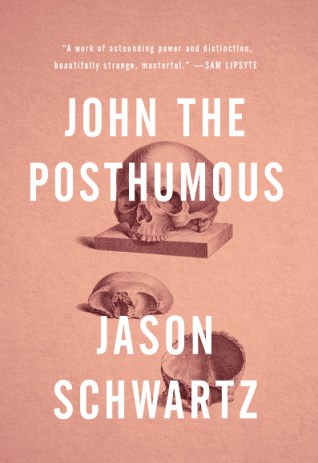
Jason Schwartz’s novel John the Posthumous was published last year to wide acclaim, despite—or maybe because of—its challenging, disruptive qualities. With blurbs from Gordon Lish, Ben Marcus, and Sam Lipsyte, John the Posthumous had “cult novel” written all over it from the outset. It was a 2013 highlight for many critics, including K. Thomas Khan, who called it “a dizzyingly delightful and hypnotically haunting book that resists easy classification,” and David C. Winters, who described it as a “Fractal baroque: an unfurling art that enfolds us in incomprehension, in fear, but also in irreducible beauty.” In my review, I  wrote that John the Posthumous is “strong, strange literature, a terrifying prose-poem that seizes history and folklore, science and myth . . . and distills it to a sustained, engrossing nightmare.”

Schwartz is the author of another book, A German Picturesque (1998). He lives and works in Florida. Schwartz kindly consented to an interview with me via email; his answers here approach the same oblique verbal dexterity that we see in his fiction. Get John the Posthumous from OR Books or your local bookstore.

SchwartzBiblioklept: Your book John the Posthumous is a challenge to describe, let alone summarize. How do you describe the book to those who haven’t read it?
Jason Schwartz: I lie–it seems the only decent way to proceed.  Why dwell upon unpleasant things?

Biblioklept: In a recent interview with 3:AM Magazine, you said that one of the first things you tried to write—in high school—was “a very long espionage novel.” You mentioned charts and appendices—lots of plots. In the same interview, you also say that you “favor format as someone else might favor plot,” which I think evinces in John the Posthumous and A German Picturesque. I’m curious what experiences—particularly what reading experiences—may have motivated a shift from an initial interest in writing plot-driven genre fiction to the stuff you write now.

JS: I’m sure I was abandoning other things too.  I seem to recall something about a war.  A catalog of imaginary battles, land and air–that would have been a handy enough project for a kid.  Remember Little Wars?  I don’t, but I like the idea of H.G. Wells and company concealed behind end tables, orchestrating cavalry raids.  Unless the tactician was free to explore the drawing room, inspecting positions and so on, enumerating the wounded, admiring an especially fine artillery barrage.  That seems more likely.  But the would-be novel, espionage–I started that on a lark.  I’d found an old Olivetti somewhere in the house–in the attic, I’d like to say, but we didn’t have an attic–and one thing led to another, et cetera, et cetera.  A turn may or may not have occurred at that same moment, give or take, with all those devices, the appendices, the charts and annotated maps, captions for photographs that didn’t exist.  Hard to say, exactly, going back now to the tenth grade.  But they began to overtake the plot, such as it was.  I liked some of the Bond books, and Graham Greene–still do–but I also liked The Encyclopedia of Espionage and that kind of thing, compendiums of jargon, biographies of Bulgarian spies.  So maybe it was more the subject than the genre.

Biblioklept: Do you think about a particular audience when you compose?

JS: A young family, stranded on a mountain pass, killing time until help arrives.  They take turns reading aloud–the text in question having been purchased by mistake and packed by accident, and later discovered in the luggage as potential kindling.  The father shields the first child from those passages displaying traces of grotesquerie.  The mother corrects the second child’s pronunciation or praises his elocution–as the case may be–on the occasion of the most ostentatious phrases.  The third child, meanwhile, has wandered off into the woods.  Ah!–it’s beginning to rain.

Biblioklept: Did John the Posthumous start as something smaller, like the pieces that make up A German Picturesque? Did you have the theme of adultery in mind from the outset?

jtpJS: Yes, it was there from the outset, adultery, running through a number of things–directly and otherwise–and many of these appeared in magazines as individual pieces, beginning in 2003 or so.  The “Corinthians” section, for instance, was once called “Breviary.”  The final section in “Hornbook” was “Notation on Hidden Children.”  Another one in that little series–a section in “Adulterium”–was “Notation on the Principal Graves.”  There were changes in every case–all this happened over a very long period of time, obviously.  “Housepost,” on the other hand, was done more or less at once, mostly in sequence.  I published certain parts of this–“The Mary Casket” is an example–in various combinations, dismantling the house a few different ways.
Biblioklept: Your sentences are precise and concrete, but they also often refuse to give the reader something definite to grip on to. There’s a lot of power—and, I’d argue horror—in this restraint. How much of this technique is attributable to editing? How do you edit your work?

JS: As to the second question: it varies.  No set method.  And as to the first:  I’m not really editing in that direction, no.  I see this more as a simple matter of description.  So–for instance–the schoolmarm in the museum, a wax form, with pins for eyes.  A person of reputation in her hometown, I take it, and–it turns out–a distant relation of mine.  I don’t wish to be flippant–or to sunder a cousin without good reason, here on the spur of the moment–but she seems easy enough to grasp in one’s hands, or at least as easy as any other set of letters.  And she was, she certainly was, when they cut her in two, at the waist, and then into several smaller portions–her coat and purse set off to one side, forgotten there (the former eaten by moths, I’d guess, the remnants used to stuff the dummies on the second floor; the latter left on a shelf and, later on, mistaken for something foreign and important, given its own display)–in order to get her out the door.  She’d have used, by the way, back at the schoolhouse, a razor blade and a ruler, according to a practice now out of fashion.  “Children, let’s remove all your objectionable words and phrases, replacing them with more companionable ones.”  And in the evening, the janitor and janitress would sweep up the scraps, and then use them to write ransom notes.

Biblioklept: Have you ever stolen a book?

JS: Sure.  Including one from my grandparents’ bookcase, I’m ashamed to say.  The book was The Deer Park.  I was three, I believe, or four, or five.  I was not, at the time, a fan of Norman Mailer.  I must have mistaken it for something else–or maybe I had plans for it in the construction of a fort or what have you, some structure already underway, or only in the earliest planning stages, back home, down in the basement, off in a corner reserved for projects of just that sort.  I suppose it could have been the jacket art, an attraction to that, but I can’t recall what was depicted on the cover, or even the colors on display.  It’s unfair to speculate in this way, I know, but–to be on the safe side, and to put the matter out of mind, once and for all–let’s just assume it was a stick-figure deer, in black, on a field of red.  Very much, in other words, the kind of stick figure–and field–I’d have quite disliked as a child.  Anyway, my grandmother gave chase.  She shouted in a language manufactured on the spot, and composed wholly of bedbugs and regret, dozens of variations on these words, accompanied by near-simultaneous translations, bent by the effect of her breathlessness, and taking curious shapes, in formation, at my back and overhead–or so it all seemed to me.  And then?  I was caught, of course.

The Complete Short Stories of J.G. Ballard (Eighth Riff: Closing Out the Sixties)

jgb_complete_ss40031

PREVIOUSLY:

Introductions + stories 1956-1959

Stories of 1960

Stories of 1961

Stories of 1962

“The Subliminal Man,” Black Friday, and Consumerism

Stories of 1963-1964

Stories of 1966

IN THIS RIFF:

“Cry Hope, Cry Fury!” (1967)

“The Recognition” (1967)

“The Cloud–Sculptors of Coral D” (1967)

“Why I Want to Fuck Ronald Reagan” (1968)

“The Dead Astronaut” (1968)

“The Comsat Angels” (1968)

“The Killing Ground” (1969)

“A Place and a Time to Die” (1969)

“Say Goodbye to the Wind” (1970)

1. “Cry Hope, Cry Fury!” (1967) / “The Cloud-Sculptors of Coral D” (1967) / “Say Goodbye to the Wind” (1970)

Ballard’s Vermilion Sands stories, collected and published together (under the title Vermilion Sands in 1971), are generally my least favorite selections in The Complete Short Stories of J.G. Ballard. The stories, composed over a decade, share a unified tone and a consistent (first-person) point of view to match their unified setting, and that setting is interesting enough—Ballardian enough—but each story is essentially just a delivery mechanism for a Cool Idea that Ballard has about art.

In “Cry Hope, Cry Fury!”, Ballard’s Cool Idea is a light-responsive painting technique:

Like all paintings produced at Vermilion Sands at that time, it would not actually need the exercise of the painter’s hand. Once the pigments had been selected, the photosensitive paint would produce an image of whatever still life or landscape it was exposed to. Although a lengthy process, requiring an exposure of at least four or five days, it had the immense advantage that there was no need for the subject’s continuous presence. Given a few hours each day, the photosensitive pigments would anneal themselves into the contours of a likeness.

This discontinuity was responsible for the entire charm and magic of these paintings. Instead of a mere photographic replica, the movements of the sitter produced a series of multiple projections, perhaps with the analytic forms of cubism, or, less severely, a pleasant impressionistic blurring.

The idea is interesting in and of itself, calling back to the central conceit of another VS story, “Studio 5, The Stars.” In that tale, poetry is the automated product of programmed machines. The concept of programmed art is fascinating, and clearly Ballard’s fiction tracks a predictive curve, but like most Vermilion Sands stories, “Cry Hope, Cry Fury!” is clumsily executed pulp fiction. “The Cloud-Sculptors of Coral D” is no different (the Cool Idea is cloud-sculpting, which allows Ballard to riff on one of his central motifs, airplanes). “Say Goodbye to the Wind” features living, responsive clothing. It also features another stereotypical Ballardian (pseudo)ingénue (the man really had a difficult time coming up with complex female characters). However, with its notes on “the teenage cult” and its obsession with plastic surgery, the story points to the more compelling territory Ballard was exploring.

2. “The Recognition” (1967)

A doomed circus, another (pseudo)ingénue, another dwarf, another morality fable, another stab at magical realism—far less successful than “The Drowned Giant” though.

3. “Why I Want to Fuck Ronald Reagan” (1968)

This is one you might as well just read: I mean, an attempt to describe it here will fail. But I’ll fail anyway.

“Reagan” was first published when the former actor and then-Governor of California was positioned as a write-in candidate for the ’68 election—the Gipper was the conservative alternative to Nixon. Written in the style of an academic psychology paper, the piece isn’t so much satire as something else entirely. I’m not sure exactly what that “something else” is, but it’s probably best signaled in Ballard’s own prose:

Sexual fantasies in connection with Ronald Reagan. The genitalia of the Presidential contender exercised a continuing fascination. A series of imaginary genitalia were constructed using (a) the mouth–parts of Jacqueline Kennedy, (b) a Cadillac rear–exhaust vent, (c) the assembly kit prepuce of President Johnson, (d) a child–victim of sexual assault. In 89 per cent of cases, the constructed genitalia generated a high incidence of self–induced orgasm. Tests indicate the masturbatory nature of the Presidential contender’s posture. Dolls consisting of plastic models of Reagan’s alternate genitalia were found to have a disturbing effect on deprived children.

According to a number of sources, including Ballard himself, the story was disseminated at the 1980 Republican National Convention in Detroit. VICE reports:

. . . a number of still-unknown former Situationists got hold of letterhead stamped with the seal of the Republican National Committee, upon which they printed Ballard’s Reagan text, replaced his offending title with the innocuous, “Official Republican 1980 Presidential Survey,” and managed to distribute copies to delegates on the convention floor in Detroit, one of the most audacious acts of political theater in our time.

“Reagan” is one of only three sections of The Atrocity Exhibition collected in The Complete Stories. It also clearly belongs in The Essential Short Stories of J.G. Ballard, an ideal collection that does not yet exist.

4. “The Dead Astronaut”

Betrayal, unfaithful wives, the fall-out of the space race against the backdrop of the Cold War, paranoia, radiation, etc.

5. “The Comsat Angels”

Ballard’s best stories, like “The Index,” “Why I Want to Fuck Ronald Reagan,” “The Beach Murders,” or “Answers to a Questionnaire” all succeed because their form is indivisible from their content—the idea that Ballard delivers is inseparable from the method of delivery. Most of Ballard’s stories are beholden to genre conventions though, and while Ballard’s treatment of these conventions are often excellent (and sometimes not-so-excellent), against the backdrop of his best stuff, the conventional exercises are always a little disappointing, or at least frustrating. Often clunky and heavy-handed, his stories for sci-fi mags are often the worst offenders.

However, when Ballard works through the conventions of detective fiction, he usually has stronger results. Edgar Allan Poe is surely Ballard’s foremost literary ancestor, a comparison that finds illustration in “The Comsat Angels,” a detective piece with a nimble streak of sci-fi running through it for flavor. Cloning, conspiracy, and paranoia done right. Great stuff.

6. “The Killing Ground” (1969) / “A Place and a Time to Die” (1969)

These stories are basically thought exercises where Ballard takes on the Vietnam War and its simultaneous culture war. “The Killing Ground” foregrounds the Vietnam War, but still displaces it, extrapolating a future where “Thirty years after the original conflict in south–east Asia, the globe was now a huge insurrectionary torch, a world Vietnam,” with Imperial America dominating the globe with its war machine. (Thank goodness nothing like that really happened!).  “A Place and a Time to Die” is more oblique, a tale of fear of invading otherness. “A Place and a Time to Die” could resonate just as strongly today in contemporary America, with its exurbs and gated communities and Stand Your Ground laws.

7. On the horizon:

Some of Ballard’s best, including “The Index” and another (oblique) Vietnam story, “Theatre of War.” I’ll also riff on Ballard’s pseudo-but-not-so-pseudo-autobiographical story, “Notes Toward a Mental Breakdown.”

The Complete Short Stories of J.G. Ballard (Seventh Riff: 1966)

jgb_complete_ss40031

PREVIOUSLY:

Introductions + stories 1956-1959

Stories of 1960

Stories of 1961

Stories of 1962

“The Subliminal Man,” Black Friday, and Consumerism

Stories of 1963-1964

IN THIS RIFF:

“The Beach Murders'”(1966)

“The Day of Forever” (1966)

“The Impossible Man” (1966)

“Storm–Bird, Storm–Dreamer” (1966)

“Tomorrow is a Million Years” (1966)

“The Assassination of John Fitzgerald Kennedy Considered as a Downhill Motor Race” (1966)

1. “The Beach Murders” (1966)

Up until the mid-sixties, Ballard wasn’t able to find a rhetoric to match his ideas. Perhaps this makes sense if we consider that Ballard’s fiction has always been more interested in art, music, film, and biology than literature itself. He still relied on the tropes of magazine pulp fiction and hard-boiled detective stories to frame his tales, and while even the weakest of these tales was better than an episode of The Twilight Zone, they still occupied the same territory. Although Ballard’s earliest stories are distinctly Ballardian–obsessed with time, saturated in surrealism and psychology, shot through with a Cold War era paranoia and its attendant nihilism—it’s not until 1964, in the fragmentary “The Terminal Beach,” and the wry fabulism of “The Drowned Giant,” that Ballard finally merges form and content.

With “The Beach Murders,” Ballard manages to overstuff all of his tropes into a strange burlesque game. Paranoid, breast-obsessed, violent and funny, “The Beach Murders” comprises 26 sections, one for each letter in the English alphabet. And like the alphabet, Ballard’s story can be combined in any number of possibilities. In his introduction to the story, the narrator hints at a solution to the puzzle, before pointing out that any “final answer” will forever remain unclear:

Readers hoping to solve the mystery of the Beach Murders – involving a Romanoff Princess, a CIA agent, two of his Russian counterparts and an American limbo dancer – may care to approach it in the form of the card game with which Quimby, the absconding State Department cipher chief, amused himself in his hideaway on the Costa Blanca. The principal clues have therefore been alphabetized. The correct key might well be a familiar phrase, e. g. PLAYMATE OF THE MONTH, or meaningless, e. g. qwertyuiop… etc. Obviously any number of solutions is possible, and a final answer to the mystery, like the motives and character of Quimby himself, lies forever hidden.

“The Beach Murders” reads like a postmodern update of one of Edgar Allan Poe’s detective stories. Its gestures recall the fragmentation of his hero William Burroughs, as well as the techniques of his American contemporary Donald Barthelme–not to mention the emerging wave of continental deconstruction. It’s also very, very fun. Part of my ideal collection, The Essential Short Stories of J.G. Ballard.

2. “The Day of Forever” (1966)

It’s tempting to give in to biographical criticism when considering the subtle but significant shift in Ballard’s work after the shocking death of his wife Helen in 1964. While themes of loss, sleeplessness, and despair reverberate through many (if not most) of his early stories, they become sharper, more defined after 1964.

“The Day of Forever” is not exactly a great story, especially if you do what I’m doing—that is, read all of his stories chronologically. The story, about a world that has ceased to rotate, feels like a series of sketches that Ballard is using for something bigger (or has left out of something bigger). Taken in the context of his wife’s death, however, the story seems richer, sadder, more personal in its evocations of dreamlessness and loss.

When the story’s protagonist Halliday raids an abandoned gallery for its surrealist images, it’s hard not to intuit Ballard’s own desire to recover the unrecoverable:

In the students’ gallery hung the fading reproductions of a dozen schools of painting, for the most part images of worlds without meaning. However, grouped together in a small alcove Halliday found the surrealists Delvaux, Chirico and Ernst. These strange landscapes, inspired by dreams that his own could no longer echo, filled Halliday with a profound sense of nostalgia. One above all, Delvaux’s The Echo’, which depicted a naked Junoesque woman walking among immaculate ruins under a midnight sky, reminded him of his own recurrent fantasy. The infinite longing contained in the picture, the synthetic time created by the receding images of the woman, belonged to the landscape of his unseen night.

Delvaux’s The Echo

3. “The Impossible Man” (1966)

The theme of recovery surfaces again in “The Impossible Man,” where a young man named Conrad (insert observation here that so many of Ballard’s protagonist’s are nakedly named for writers) is given the chance to walk again after a terrible accident—he’ll receive the limbs of a man who died causing the accident. With its fetishizing of scars, auto accidents, and surgery, “The Impossible Man” points directly toward Ballard’s weirdest works, The Atrocity Exhibition and Crash.

4. “Storm–Bird, Storm–Dreamer” (1966)

“Storm-Bird, Storm-Dreamer” evokes a rich, Gothic world, a swampland where humans battle mutant birds. Here, a strange woman in mourning awaits the return of her lost child (there’s that theme again!) through some avian agency. There are skiffs and pergolas and feathers and shotguns. There is a dwarf. Dark and romantic, the tale’s themes—and the delivery of those themes—recall Ballard’s earlier forays into magical realism, “The Drowned Giant” and 1962’s “The Garden of Time.”

5. “Tomorrow is a Million Years” (1966)

Ballard’s narrator in “Tomorrow is a Million Years” directly invokes Robinson Crusoe and Moby-Dick and alludes to the myth of the Flying Dutchman. Allusion is a fundamental trope of literature—indeed, most literature seems to take literature as its own subject—but Ballard’s allusions, beyond his character names (he christens a character in 1967’s “Cry Hope, Cry Fury!” Melville) tend to skew toward art and music. The allusions to doomed voyages and shipwreck are appropriate here, and Ballard synthesizes them into a tale of madness and hallucination. And, at the risk of spoiling the tale’s shocking ending, I’ll suggest again that Ballard is writing through/to/around/beneath the death of his wife.

6. “The Assassination of John Fitzgerald Kennedy Considered as a Downhill Motor Race” (1966)

Ballard begins “Assassination” with an author’s note:

The assassination of President Kennedy on November 22nd, 1963, raised many questions, not all of which were answered by the Report of the Warren Commission. It is suggested that a less conventional view of the events of that grim day may provide a more satisfactory explanation. In particular Alfred Jarry’s “The Crucifixion Considered as an Uphill Bicycle Race” gives us a useful lead.

Author of the infamous proto-surrealist play Ubu Roi, Alfred Jarry’s pataphysical conceits undoubtedly influenced and engaged Ballard, offering him new ways of writing beyond the constraints of his earlier pulp fiction. Published almost 60 years after Jarry’s death, “Assassination” is just as shocking as the text it’s modeled on, suggesting that the disruptive powers of language that Ballard was beginning to experiment with retain vitality outside of history. It’s worth sharing the opening paragraphs of “Assassination”:

Oswald was the starter.

From his window above the track he opened the race by firing the starting gun. It is believed that the first shot was not properly heard by all the drivers. In the following confusion Oswald fired the gun two more times, but the race was already under way.

Kennedy got off to a bad start.

There was a governor in his car and its speed remained constant at about fifteen miles an hour. However, shortly afterwards, when the governor had been put out of action, the car accelerated rapidly, and continued at high speed along the remainder of the course.

The visiting teams. As befitting the inauguration of the first production car race through the streets of Dallas, both the President and the Vice–President participated. The Vice–President, Johnson, took up his position behind Kennedy on the starting line. The concealed rivalry between the two men was of keen interest to the crowd. Most of them supported the home driver, Johnson.

If “Kennedy got off to a bad start” doesn’t crack you up then it’s likely this story isn’t for you. Ballard’s humor often rests entirely on a kind of moral irony in his earlier stories (you know, like something from the Twilight Zone series), but “Assassination” shows a wry constraint, a trust in the reader that probably originated in Ballard’s growing comfort in his own powers. (Later stories like “The Greatest Television Show on Earth” and “The Life and Death of God” advance Ballard’s control of dark humor).

“The Assassination of John Fitzgerald Kennedy Considered as a Downhill Motor Race” was published in The Atrocity Exhibition; for whatever reason, The Complete Short Stories only includes two other stories from that collection (“Why I Want to Fuck Ronald Reagan” and “The Secret History of World War 3,” which wasn’t actually part of the original AE pressing). So maybe Complete is not so complete.

Should go without saying: Essential.

You can read “The Assassination of John Fitzgerald Kennedy Considered as a Downhill Motor Race” (paired with the Jarry text)and hear an audio version here.

7. On the horizon:

I’m actually almost finished with the book (my Kindle tells me I’m at 72%). I should probably slow down and try to take more notes for these riffs—or just write faster and looser. But the reading becomes far more compelling at this point, as Ballard transcends the limitations of sci-fi pulp and begins to contend with his surrealist forbears. Next time: “Why I Want to Fuck Ronald Reagan”! Another Vermilion Sands story—this one not so bad! Ballard takes on Vietnam! Etc.

Although Of Course You End Up Riffing Obliquely on How a David Foster Wallace Road Trip Movie Is a Terrible Idea

  1. In 1992 I asked my grandmother to rent Steven Soderbergh’s film Kafka from Blockbuster so I could watch it. We watched it together. I was intrigued; she found it dull. I saw it again in college and then again a few years ago. It’s nothing special.
  2. In my freshman year of college I lived right next to a big video rental place that rented most old films for a dollar. This is where I discovered Where the Buffalo Roam, a 1980 semi-biopic starring Bill Murray as Hunter S. Thompson with music from Neil Young. My metaphorical lid flipped. I returned to my apartment to screen this strange find. Disappointment.
  3. Seeing and immediately being disappointed by Where the Buffalo Roam fits neatly into another memory: In 1991 a record store clerk dissuaded me from buying an expensive bootleg recording of Jimi Hendrix featuring Jim Morrison. The clerk went to great lengths to do this (short of opening the CD, of course), insisting that the record was awful, that it should never have been released. A few weeks later a friend loaned me a tape of the recording he’d somehow acquired. Total garbage. I didn’t even bother to dub it.
  4. (Sometimes when I see that some new scrap and tittle of a dead author’s work is going to be posthumously published, I think of that Hendrix/Morrison recording).
  5. In 1998 I saw Terry Gilliam’s adaptation of Fear and Loathing in Las Vegas. Sloppy, cartoonish, vivid, and occasionally incoherent, Fear and Loathing is successful mostly because it isn’t a film about Hunter S. Thompson. It’s a film about the end of the illusion of the 1960s.
  6. I don’t remember when I first saw Barfly. Sometime in college. Undoubtedly I tried to keep pace with old Hank on-screen. Hence the poor memory.
  7. Factotum: I fell asleep at the end. But it wasn’t bad, I guess. A good attempt at interpreting Bukowski’s autobiographical novel.
  8. (But obviously the documentaries that feature Bukowski himself are so much more alive than any interpretation).
  9. Some interpretations of writers’ lives benefit from the distance—the distortion—of time: QuillsThe LibertineMarat/Sade, any riff on Shakespeare (although I can’t think of one that isn’t crap, actually, right this minute), etc.
  10. In particular, Jane Campion’s film Bright Star is excellent, but it’s not really about John Keats: The film is really about Fanny Brawne. Again though, I think time’s distortion helps.
  11. (And oh lord I would love to see Val Kilmer’s one-man Mark Twain show, but that’s a whole other thing, not a film thing, not even a writer thing, more of a Kilmer thing).
  12. The Faulkner/Hemingway amalgamation in Barton Fink is something else.
  13. I turned off Capote.
  14. I turned off The Motorcycle Diaries.
  15. A few weeks ago I turned off Walter Salles’s adaptation of On the Road.
  16. The Guardian and other sources report that Jason Segel will play David Foster Wallace in a film adaptation of David Lipsky’s Rolling Stone interview-turned-full-length-book, Although Of Course You End Up Becoming Yourself: A Road Trip With David Foster Wallace. Jesse Eisenberg will reportedly take awkwardly stammer through Lipsky’s role.
  17. Jason Segel, of the hit CBS comedy How I Met Your Mother, will play the late David Foster Wallace, who wrote “Good Old Neon.”
  18. Jason Segel, a Judd Apatow stable staple, will play the late David Foster Wallace, who wrote an essay about misanthropy and a cruise ship.
  19. Jason Segel, whose goofy charm and lovable good-nature belie a sensitive temperament, will play the late David Foster Wallace, who often wore a bandanna on his head.
  20. Although Of Course You End Up Becoming Yourself covers Wallace touring on his Infinite Jest book tour; his fame explodes and he’s not entirely sure what any of it means yet—whether to enjoy it, how to enjoy it, is it even possible to enjoy it, etc. Lipsky inserts a heavy editorial hand—lots of bracketed thoughts in this one, as our interlocutor repeatedly registers, or attempts to register, his own verbal dexterity, his own writerliness. And who can blame him? What writer-critic can resist showing a little plumage to the writer under discussion (to steal James Wood’s phrase)?
  21. Lipsky’s book features one of the most intriguing characters in late twentieth-century literature: David Foster Wallace performing David Foster Wallace attempting to not-perform David Foster Wallace by acknowledging that David Foster Wallace is self-consciously aware of performing himself.
  22. I can easily envision the shape, the tone, the contours, the set-pieces of this proposed film adaptation. A road trip film, a buddy film, but a film about antagonists, bullshitters, waxing hard, some high laughs, some intense moments (gaining so much easy shallow depth from Wallace’s suicide), maybe a few reading scenes. Etc.
  23. And that’s what most bothers me about this film adaptation: How easily I can imagine what it will likely look and sound and feel like. How comfortable it all is.
  24. There’s just not enough of that magical temporal distortion I referenced in point nine. The film is likely to piss off real fans of Wallace’s work and give anyone else interested a facile notion of who the writer was and what he thought and how he thought and how he represented and shared what he thought. How is such a film not a crass cash grab? Even if the film were artistically successful (leave aside what that nebulous term could mean for a moment, please)—again, how is such a film not a crass cash grab?
  25. I could be wrong though. I’m fine with being wrong.

The Complete Short Stories of J.G. Ballard (Sixth Riff: 1963-1964)

jgb_complete_ss40031

PREVIOUSLY:

Introductions + stories 1956-1959

Stories of 1960

Stories of 1961

Stories of 1962

“The Subliminal Man,” Black Friday, and Consumerism

IN THIS RIFF:

“The Reptile Enclosure” (1963)

“A Question of Re-Entry” (1963)

“The Time Tombs” (1963)

“Now Wakes the Sea” (1963)

“The Venus Hunters” (1963)

“End-Game” (1963)

“Minus One” (1963)

“The Sudden Afternoon” (1963)

“The Screen Game” (1963)

“Time of Passage” (1964)

“Prisoner of the Coral Deep” (1964)

“The Lost Leonardo” (1964)

“The Terminal Beach” (1964)

“The Illuminated Man” (1964)

“The Delta at Sunset” (1964)

“The Drowned Giant” (1964)

“The Gioconda of the Twilight Noon” (1964)

“The Volcano Dances” (1964)

1.”The Reptile Enclosure” (1963) / “A Question of Re-Entry” (1963) / “The Time Tombs” (1963) / “Now Wakes the Sea” (1963) / “The Venus Hunters” (1963) / “Minus One” (1963) / “Prisoner of the Coral Deep” (1964) / “The Illuminated Man” (1964) / “The Delta at Sunset” (1964) / “The Gioconda of the Twilight Noon” /”The Volcano Dances” (1964)

There are 98 stories in The Complete Short Stories of J.G. Ballard. That’s a lot of stories. Maybe too many. Too many for me to write about in full, anyway. I’ve lumped these stories together because they are somewhat unremarkable: Ballard does his Ballardian thing way better elsewhere. Several of these stories feel like sketches (or leftovers) from Ballard’s early novels like The Drowned WorldThe Burning World, and The Crystal World. Themes of time, memory, art, and nature abound here, usually glommed on to simple adventure narratives or sci-fi pulp treadthroughs. Jungles, watches, crystals, structures, beaches. Misanthropy, paranoia, nagging wives, misunderstood heroes. Man apart from nature, but beholden to nature. Etc. The worst moments of these stories—and we can find these moments all through early Ballard, to be fair—suffer from a bad case of White Man’s Burden doubled up with a shot of misogyny. I’ve written it before in these posts, but the most disappointing aspect of early Ballard is our would-be futurist’s inability to transcend the patriarchal ideology of the post-war era. So now let’s move to the good stuff.

2. “End-Game” (1963)

I first read “End-Game” when I was sixteen or seventeen, and it’s always stuck with me. It’s the story of a former “party member” who’s been imprisoned under nebulous circumstances—only his prison isn’t that bad—a nice little villa, comfortable, with books and a chess set. He even has a housekeeper. Unfortunately, the housekeeper is also his executioner, and the date and method of the execution is forever withheld from him:

This ironic inversion of the classical Kafkaesque situation, by which, instead of admitting his guilt to a non–existent crime, he was forced to connive in a farce maintaining his innocence of offences he knew full well he had committed, was preserved in his present situation at the execution villa.

The psychological basis was more obscure but in some way far more threatening, the executioner beckoning his victim towards him with a beguiling smile, reassuring him that all was forgiven. Here he played upon, not those unconscious feelings of anxiety and guilt, but that innate conviction of individual survival, that obsessive preoccupation with personal immortality which is merely a disguised form of the universal fear of the image of one’s own death. It was this assurance that all was well, and the absence of any charges of guilt or responsibility, which had made so orderly the queues into the gas chambers.

Ballard directly invokes Kafka, whose tale “Before the Law” comes to mind here (not to mention The Trial and The Castle); “End-Game” also feels like Ballard’s take on 1984. It’s a great little tale, and I think it helps to prove that Ballard is at his best when he sticks to a confined, limited cast and setting. Much of the force of “End-Game” comes from Ballard pitting his prisoner/protagonist against the protagonist’s mental conception of his guard/executioner. Part of my ideal collection, The Essential Short Stories of J.G. Ballard.

3. “The Sudden Afternoon” (1963) / “Time of Passage” (1964)

In “The Sudden Afternoon” and “Time of Passage,” Ballard explores how time and place—context, I suppose—constitute identity. The former story is a tale of metempsychosis with a troubling take on Indian spirituality, wherein a doctor—an Indian, of course—transplants his psyche and his wife’s psyche into the bodies of another couple (his wife is dying of a terminal disease). Ballard’s own wife died a year after the story was first published (I’m reminded of Poe here, whose wife Virginia died after the publication of “The Raven”). “The Sudden Afternoon” isn’t very good, but structurally we see Ballard beginning to employ something approaching the cut-ups/fragments he’ll move to in the next decade.

“Time of Passage” is essentially a rewrite of F. Scott Fitzgerald’s “The Curious Case of Benjamin Button.” It’s also basically a rewrite of Ballard’s own 1961 tale “Mr. F Is Mr. F” — only this time, Ballard dispenses with abject-horror-for-maternal-body in lieu of a fable-like exploration of what a life in reverse might actually look like. A lovely story. Stick it in The Essentials.

4. “The Screen Game” (1963)

Another Vermilion Sands story. More insanity. Another femme fatale. An attempt at the story of Orpheus, perhaps. I would have lumped it in with the stories in point 1, but I wanted to clarify: The Vermilion Sands stories are the worst.

15. “The Lost Leonardo” (1964)

This is an excellent little detective tale with mystical-magic undertones. I’m a sucker for any story of art theft, too. We all know Dan Brown ripped off Umberto Eco, but maybe Eco ripped off Ballard? Who cares. Lovely stuff. Ballard is excellent at the detective story; Poe is one of his clearest predecessors, but like Poe, he’s more famous for other stuff. Too bad. Let’s call it Essential.

6. “The Terminal Beach” (1964)

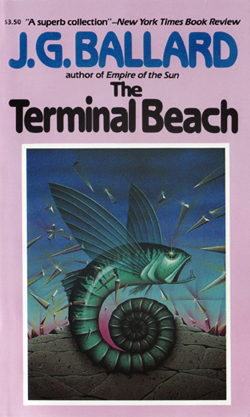
1964’s “The Terminal Beach” is such a big break through for Ballard in terms of formal elements and structuring that it probably deserves its own post, but I’ll jab at it here anyway. Up until now, Ballard’s stories have been notable almost entirely for their ideas—his prose has improved some, but ultimately, the pulp fiction he’s writing for magazine publication constrains him to a pedestrian rhetoric that simply can’t match how far out his concepts are. With “The Terminal Beach,” Ballard finally approaches a narrative structure—fractured, polyglossic, shifting through interiors to exteriors, breaking through different forms—that can match the themes of his tale. The story–clearly an Essential—points to the finest of Ballard’s future work. You can read it here in two parts, but here’s a taste that I think stands alone as a microfiction:

The Fly

(A small fly, which Traven presumes has followed him into the fissure, now buzzes about the corpse’s face. Guiltily, Traven leans forward to kill it, then reflects that perhaps this minuscule sentry has been the corpse’s faithful companion, in return fed on the rich liqueurs and distillations of its pores. Carefully, to avoid injuring the fly, he encourages it to alight on his wrist.)

DR YASUDA: Thank you, Traven. In my position, you understand

TRAVEN: Of course, Doctor. I’m sorry I tried to kill it – these ingrained habits, you know, they’re not easy to shrug off. Your sister’s children in Osaka in ’44, the exigencies of war, I hate to plead them. Most known motives are so despicable, one searches the unknown in the hope that YASUDA: Please, Traven, do not be embarrassed. The fly is lucky to retain its identity for so long. ‘That son you mourn, not to mention my own two nieces and nephew, did they not die each day? Every parent in the world grieves for the lost sons and daughters of their earlier childhoods.

TRAVEN: You’re very tolerant, Doctor. I wouldn’t dare – YASUDA: Not at all, Traven. I make no apologies for you. Each of us is little more than the meagre residue of the infinite unrealized possibilities of our lives. But your son, and my nephew, are fixed in our minds forever, their identities as certain as the stars.

TRAVEN: (not entirely convinced) That may be so, Doctor, but it leads to a dangerous conclusion in the case of this island. For instance, the blocks – YASUDA: They are precisely what I refer to, Traven. Here among the blocks you at last find an image of yourself free of the hazards of time and space. This islandis an ontological Garden of Eden, why seek to expel yourself into a world of quantal flux?

TRAVEN: Excuse me (The fly has flown back to the corpse’s face and sits in one of the dried-up orbits, giving the good doctor an expression of quizzical beadiness. Reaching forward, Traven entices it on to his palm. He examines it carefully) Well, yes, these bunkers may be ontological objects, but whether this is the ontological fly is doubtful. It’s true that on this island it’s the only fly, which is the next best thing

YASUDA: You can’t accept the plurality of the universe – ask yourself why, Traven. Why should this obsess you? It seems to me that you are hunting for the white leviathan, zero. The beach is a dangerous zone. Avoid it. Have a proper humility, pursue a philosophy of acceptance.

TRAVEN: Then may I ask why you came here, Doctor?

YASUDA: To feed this fly. ‘What greater love – ?’

TRAVEN: (Still puzzling) It doesn’t really solve my problem. The blocks, you see

YASUDA: Very well, if you must have it that way

TRAVEN: But, Doctor

YASUDA: (Peremptorily) Kill that fly!

TRAVEN: That’s not an end, or a beginning.

(Hopelessly, he kills the fly. Exhausted, he falls asleep beside the corpse.)

7. “The Drowned Giant” (1964)

Another Essential, this puzzling fable readily recalls Gabriel García Márquez’s story “A Very Old Man with Enormous Wings.” Ballard rarely handles archetypes so directly as he does here. Even if the story’s theme seems almost too-plain—we lose the miracle, we cast down the old gods, we deny the sublime, etc.—its construction and telling are wonderfully achieved.

The lower jaw, typically, found its way to the museum of natural history. The remainder of the skull has disappeared, but is probably still lurking in the waste grounds or private gardens of the city – quite recently, while sailing down the river, I noticed two ribs of the giant forming a decorative arch in a waterside garden, possibly confused with the jaw–bones of a whale. A large square of tanned and tattooed skin, the size of an indian blanket, forms a backcloth to the dolls and masks in a novelty shop near the amusement park, and I have no doubt that elsewhere in the city, in the hotels or golf clubs, the mummified nose or ears of the giant hang from the wall above a fireplace. As for the immense pizzle, this ends its days in the freak museum of a circus which travels up and down the north–west. This monumental apparatus, stunning in its proportions and sometime potency, occupies a complete booth to itself. The irony is that it is wrongly identified as that of a whale, and indeed most people, even those who first saw him cast up on the shore after the storm, now remember the giant, if at all, as a large sea beast.

8. On the horizon:

Ballard plays with fragmentation again in “The Beach Murders” and “The Assassination of John Fitzgerald Kennedy Considered as a Downhill Motor Race” — and we finally get to his stories of the late sixties.

A Lazy Riff on Margaret Atwood’s Novel MaddAddam

page1080monsters

1. Margaret Atwood’s latest novel, MaddAddam concludes the trilogy she began with Oryx and Crake (2003) and The Year of the Flood (2009).

2. Both of those novels are superior to MaddAddam (Oryx and Crake is the strongest, in my estimation, although I read it almost a decade ago).

3. I audited the audiobook of MaddAddam, read by Bernadette Dunne, Bob Walter and Robbie Daymond. The actors do a fine job and the production is swell.

4. I am now going to rip off elements of my own 2010 review for The Year of the Flood.

5. In that review I wrote:

Apocalypse lit isn’t so much predictive as it is descriptive of the contemporary world, and Atwood’s dystopian vision is no exception.

I still more or less agree with that sentence, and MaddAddam is, like the two books preceding it, a satire of sorts on modern life.

6. And–

Viscerally prescient, Flood paints our own society in bold, vibrant colors, magnifying the strange relationships with nature, religion, and our fellow humans that modernity prescribes.

I don’t know if it’s me or the book or just the fact that so much of what Atwood conjures in her trilogy seems more real than it was just a decade ago—but MaddAddam didn’t read quite so bold or vibrant as the first two books.

7. I also wrote:

Atwood ends her book in media res, with Toby and a handful of other characters somehow still alive, ready, perhaps, to become stewards of a new world. Flood concludes tense and, in a sense, unresolved, but Atwood implies hope: Toby will lead her small group to cultivate a new Eden. Despite all the ugliness and cruelty and devastation, people can be redeemed.

MaddAddam picks up right where Flood and O&C end (those novels essentially converge). In some ways—often very obvious, sometimes boring ways—MaddAddam provides a sense of resolution for the trilogy’s many threads.

monsters_03

8. What is the book about?

I will lazily slap in publisher Random House’s blurb here, interspersed with my riffage :

Months after the Waterless Flood pandemic has wiped out most of humanity, Toby and Ren have rescued their friend Amanda from the vicious Painballers.

The opening of MaddAddam was a bit too in media res for me: I think the beginning of the book will probably read much smoother if the reader has immediately read the first two books. I had to go reread a summary of the first two books (thanks Wikipedia!) to refresh my old brain.

They [Toby/Ren/Amanda] return to the MaddAddamite cob house, newly fortified against man and giant pigoon alike. Accompanying them are the Crakers, the gentle, quasi-human species engineered by the brilliant but deceased Crake.

The Crakers are potentially the most interesting aspect of MaddAddam, but Atwood keeps them on the margins; in the book’s most disappointing moments they’re behavior is basically relegated to punchlines. (Maybe I wanted the book to be an entirely different book—never a fair position for a reviewer to take, but hell, I’ll just say it here in the protection of parentheses—I wanted the book to be about the Crakers in the new world).

Their [the Crakers’] reluctant prophet, Snowman-the-Jimmy, is recovering from a debilitating fever, so it’s left to Toby to preach the Craker theology, with Crake as Creator. She must also deal with cultural misunderstandings, terrible coffee, and her jealousy over her lover, Zeb.

MaddAddam kinda sorta takes the form of an oral history (the novel is polyglossic, fragmented, decentered, blah blah blah). Toby, taking over Jimmy’s storytelling role with the Crakers, essentially invents a mythology. These are some of the best moments of the novel—little riffs on storytelling and memory and legend and myth and history and language and how meaning is made and preserved and transmitted. By the end of the novel, Toby has taught a Craker child—Blackbeard—to read and write. He becomes a translator between the MaddAddamites and the pigoons, but he also takes on the role of storyteller and scribe. He becomes Blackboard, Blackbard.

Zeb has been searching for Adam One, founder of the God’s Gardeners, the pacifist green religion from which Zeb broke years ago to lead the MaddAddamites in active resistance against the destructive CorpSeCorps. But now, under threat of a Painballer attack, the MaddAddamites must fight back with the aid of their newfound allies, some of whom have four trotters. At the center of MaddAddam is the story of Zeb’s dark and twisted past, which contains a lost brother, a hidden murder, a bear, and a bizarre act of revenge.

Atwood devotes most of the novel to Zeb’s backstory, which is mildly entertaining but oh lord! exposition exposition exposition. Even when Zeb’s backstory is conveyed with action and energy, there’s often this constant state of clarification/reminder/callback going on, where the narrative voice has to remind the reader for some reason how the particular event being narrated squares against events in the previous two books.

monsters_02

9. In my review for YotF I wrote

Atwood’s prose sometimes relies on placeholders and stock expressions common to sci-fi and YA fiction, and her complex plot (disappointingly) devolves to a simple adventure story in the end, but her ideas and insights into what our society might look like in a few decades are compelling reading (or, uh, listening in this case).

Okay, so ditto most of that for MaddAddam, only perhaps less compelling. There’s nothing wrong with the simple adventure story that Atwood uses to move her ideas along on here, but there’s also nothing especially engaging either.

10. MaddAddam features an overlong dénouement, culminating in several deaths and births. Even though the ending seems stretched (and often predictable), it nevertheless offers the most cohesive vision in the novel: A future of hybridization and radical diversity that is still beholden to the Darwinian economy of the natural world.

11. The novel resolves by clearing out all of its major characters (sorry if this is a spoiler, but it really isn’t), freeing the imaginative space that Atwood has created—and to be clear, that’s a rich, fertile space—for new adventures, new ways of living, new creatures. I suppose I wanted more What now? explored than the novel had to offer—more exploration of what the genetically-hybridized world might look like with  humans no longer the dominant species.

12. But a review (or even a lazy riff) shouldn’t fault a novel for what it doesn’t set out to do. Perhaps leaving the post-flood world barely explored is Atwood’s parting gift to the trilogy’s readers: She offers us a chance to imagine more.

“Physical books should be sublime, digital books should be free” |Haute Culture Publisher Luis de Miranda Interviewed

truth

Biblioklept: What is Haute Culture Press?

Luis de Miranda: Haute Culture is a new venture in luxury publishing with a mission to bring masterpieces of global literature to English-speaking readers around the world. Since your site is called “Biblioklept,” I’ll start by saying that we are a new kind of Robin Hood: we give to both the “poor” and the “rich.” We offer free e-books to the modern global reader interested in discovering hidden gems of classic European literature and, simultaneously, we offer individuals of greater means the opportunity to become mini-Medici’s, actively supporting culture while enjoying a luxurious limited edition book that will increase in value year after year.

This model is summed up in our slogan: Physical books should be sublime, digital books should be free. The sales of our limited luxury editions—each a distinctive art object—support the distribution of free e-books for each of our titles. Buyers of our limited editions, in effect, become benefactors—or “Book Angels,” as we call them. I believe this model will satisfy collectors and book lovers.

Furthermore, as e-books become cheaper and cheaper, I want to create a model that does not depend on the diminishing revenues of e-book sales and allows us to reach as many readers as possible, particularly younger readers.  If we want younger generations to read quality literature, and not just the latest bestsellers, free e-books are the way to go.

Biblioklept: Is the possible disconnect between electronic books and “luxury” an issue? Does this new publishing model privilege the book as an aesthetic object?

LdM: This model privileges the free distribution of quality literature and it reinvents the physical book as a cult object. I aim to create unique objects that make the poetry of texts tangible.  As we all spend more time in front of screens, I believe that the experiential aspect of the printed book will become more important, with readers looking for a higher quality object. I foresee the return of the “gentleman’s library” (or “gentlewoman’s library”), with fine leather volumes and limited editions—the polar opposite of e-books. Our limited editions will embody my great respect for the ritual of reading and for the craftsmanship of book making, while at the same time subsidizing the free distribution of our e-books and building a new global audience for iconic European literary masters.

Biblioklept: Is Haute Culture the first group to employ this model, to your knowledge?

LdM: Yes. We are innovating and experimenting. I don’t know if ours will be an economically viable model in the end, but it is definitely a desirable one. Since we are exploring uncharted territory, we have to take things step by step. We are avoiding the established highways over artificial ponds, and attempting to build our own bridge. We might fail or we might create a new path that the others will soon follow.

Biblioklept: Why did you choose A.H. Tammsaare’s Truth and Justice as the first book in this series?

LdM: Our first publication is actually a new translation and an ultra-limited bilingual edition of the Flaubert novella, Felicity: The Tale of the Simple Heart. In December 2013, it will be on sale at Assouline Boutiques in New York, Los Angeles, London, and Paris.

Volume I of Tammsaare’s Truth and Justice is planned for publication in 2014. It is a fine example of an untranslated classic. Tammsaare himself is an icon of 20th century Estonian literature. Two museums, a monument, and a park in the center of Tallinn are all dedicated to him. Unlike some traditional classics, which are widely referred to but rarely read, his masterpiece, Truth and Justice, still retains its place at the front of Estonian bookshelves and yet this epic work has never been translated into English. I also have some personal reasons for launching the press with an Estonian icon like Tammsaare. I wrote my last novel in Estonia three years ago and I wanted to pay homage to the land that inspired me.

Biblioklept: What is Tammasaare’s book about? Why is it important?

LdM: Truth and Justice is considered Tammsaare’s most important work. It was written during the rise of dictators—Hitler, Stalin, Mussolini—and it captures the evolution of Estonia from Tsarist province to independent state. Though it’s deeply rooted in Estonian peasant life, the first volume deals with timeless literary and philosophical issues, developing a vigorous, straightforward narrative that addresses the dual nature of the human psyche.

The book’s characters, storylines, and language continue to inform Estonia’s culture today. References to Truth and Justice are pervasive, and one hears its echoes in contemporary Estonian literature, as well as other art forms. One need only call two men “Andres and Pearu” for any Estonian to understand the nature of their relationship.

Volume I presents life in an Estonian village, as farmers battle against nature during the last quarter of the 19th century. The two main characters, both unique and powerful men, represent the essential conflicts of human nature: not only good vs. evil, but also hope vs. conservatism, conquest vs. pettiness. The saga explores how human impulses compete with each other and complete the characters.

Although the first volume seems entirely dedicated to peasant life in rural Estonia at the threshold of modernity, the book deals with fundamental issues that are quite relevant today. You might say this book reflects what we are trying to do at Haute Culture. Truth and Justice is a story of simple people who work the land endlessly, striving to build a world were truth and justice prevail, where good is fostered and protected, not killed by conformity or lack of courage. Beautiful things grow slowly like plants. Perhaps this is a lesson for all the capitalists of the world.

Luis de
Luis de Miranda

Biblioklept: What future plans do you have for Haute Culture? What other books would you like to publish?

LdM: We are currently translating a Russian book by the cult novelist Yuri Mamleyev, called Shatuny. We are working with one of the best Russian to English translators, Marian Schwartz, who translated Bulgakov and Berberova. Shatuny is a mind-blowing, hallucinatory story about the quest for absolute truth. Maybe we are obsessed by truth?

Bringing untranslated texts to English readers around the world is one aspect of a wider mission to bring singular, fine, original works to the global corpus. That has always been my goal—to democratize access to culture. I’ve been to the Frankfurt Book Fair many times and met with publishers and agents in New York. I’ve noticed not only that many great European works have not been translated to English, but also that the mainstream US and UK publishers tend to translate only genre bestsellers—thrillers for example.

English is now the international language and I believe it’s possible, and indeed essential to bring to the international psyche works that aren’t standardized and cliché, but truly represent a unique viewpoint. I plan to build a catalogue that only includes masterpieces. Publishers who rely on the old publishing model must often publish potential bestsellers they secretly despise, yet there are so many excellent contemporary classics waiting to be discovered and translated into English. With Haute Culture, I refuse to compromise. Literature has the potential to create a more diverse and interconnected world, but in order to reach that potential we must fight against a profit-driven culture.

Biblioklept: Have you ever stolen a book?

LdM: When I was 18, I had a summer job at a bookshop in the Pompidou Center in Paris. At the end of my first day, I took about 20 books home with me, feeling that I had found Ali Baba’s cave, but a few days later I felt guilty and replaced all the books on their shelves.


The Complete Short Stories of J.G. Ballard (Fifth Riff: “The Subliminal Man”)

jgb_complete_ss4003

PREVIOUSLY:

Introductions + stories 1956-1959

Stories of 1960

Stories of 1961

Stories of 1962

IN THIS RIFF:

“The Subliminal Man” (1963)

1. Today is Black Friday in America. I don’t think it’s necessary to remark at length on the bizarre disjunction between this exercise in consumerism-as-culture and the intended spirit of the Thanksgiving holiday that precedes it. Indeed, I think that the cognitive dissonance that underwrites Black Friday—the compulsion to suffer (and cause suffering), both physically and mentally,  to “save” money on “consumer goods” (sorry for all the scare quotes, but these terms are euphemisms and must be placed under suspicion)—I think that this cognitive dissonance is nakedly apparent to all who choose to (or are forced to) actively engage in Black Friday. The name itself is dark, ominous, wonderfully satanic.

2. Rereading “The Subliminal Man” for this project, I was struck by how presciently Ballard anticipated not only the contours of consumerist culture—urban sprawl, a debt-based economy, the mechanization of leisure, the illusion of freedom of choice—but also how closely he intuited the human, psychological responses to the consumerist society he saw on the horizon. On the fiftieth anniversary of its publication, “The Subliminal Man” seems more relevant than ever.

3. The premise of the tale is fairly straightforward and fits neatly with the schema of many other early Ballard stories: Franklin, an overworked doctor, is approached by Hathaway, a “crazy beatnik,” who refuses to take part in the non-stop consumerism of contemporary society. Hathaway can “see” the subliminal messages sent through advertising; these messages, and he asks for Franklin’s help in stopping the spread of these messages. Hathaway reasons that the messages are intended to enforce consumerist society:

Ultimately we’ll all be working and spending twenty–four hours a day, seven days a week. No one will dare refuse. Think what a slump would mean – millions of lay–offs, people with time on their hands and nothing to spend it on. Real leisure, not just time spent buying things . . .

The fear of a slump. You know the new economic dogmas. Unless output rises by a steady inflationary five per cent the economy is stagnating. Ten years ago increased efficiency alone would raise output, but the advantages there are minimal now and only one thing is left. More work. Subliminal advertising will provide the spur.

Franklin is unconvinced, even though he is already working Saturdays and Sunday mornings to payoff TVs, radios, and other electronic goods that he and his wife replace every few months. Soon, however, he realizes that something is wrong:

He began his inventory after hearing the newscast, and discovered that in the previous fortnight he and Judith had traded in their Car (previous model 2 months old) 2 TV sets (4 months) Power mower (7 months) Electric cooker (5 months) Hair dryer (4 months) Refrigerator (3 months) 2 radios (7 months) Record player (5 months) Cocktail bar (8 months)

Franklin finally sees the truth, but only after Hathaway takes to blowing up signs’ switch boxes (the word “terrorism” is of course not used in the text, although it surely would be today):

Then the flicker of lights cleared and steadied, blazing out continuously, and together the crowd looked up at the decks of brilliant letters. The phrases, and every combination of them possible, were entirely familiar, and Franklin knew that he had been reading them for weeks as he passed up and down the expressway.

BUY NOW BUY NOW BUY NOW BUY NOW BUY NEW CAR NOW NEW CAR NOW NEW CAR NOW

YES YES YES YES YES YES YES YES YES YES

Like most of these stories, “The Subliminal Man” ends on a pessimistic note, with Franklin choosing to ignore his brief enlightenment and give in. Ballard drives his criticism home in the final image of the story, with Franklin and his wife heading out to shop:

They walked out into the trim drive, the shadows of the signs swinging across the quiet neighbourhood as the day progressed, sweeping over the heads of the people on their way to the supermarket like the blades of enormous scythes.

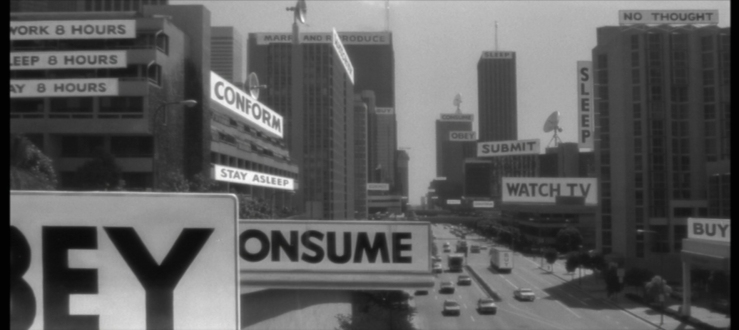
4. “The Subliminal Man” offers a critique of consumerism that John Carpenter would make with more humor, violence, and force in his 1988 film They Live (watch it online here). In Carpenter’s film, the hero John Nada (played by Roddy Piper) finds a pair of sunglasses that allow him to see through the ads, billboards, and other commercials he’s exposed. What’s underneath? Naked consumerism:

they-live-billboard

The images here recall the opening lines of “The Subliminal Man”: ‘The signs, Doctor! Have you seen the signs?’ Like Ballard’s story, Carpenter’s film is about waking up, to seeing the controlling messages under the surface.

In his film The Pervert’s Guide to Ideology, Slavoj Žižek offers a compelling critique of just how painful it is to wake up to these messages:

It’s worth pointing out that Carpenter offers a far more optimistic vision than Ballard. Ballard’s hero gives in—goes back to sleep, shuts his eyes. Carpenter’s hero Nada resists the subliminal messages—he actually takes up arms against them. This active resistance is possible because Carpenter allows his narrative an existential escape hatch: In They Live, there are real, genuine bad guys, body-snatching ugly-assed aliens—others that have imposed consumerism on humanity to enslave them. That’s the big trick to They Live: It’s not us, it’s them.

Ballard understands that there is no them; indeed, even as the story skirts around the idea of a conspiracy to dupe consumers into cycles of nonstop buying, working, and disposing, it never pins that conspiracy on any individual or group. There’s no attack on corporations or government—there’s not even a nebulous “them” or “they” that appears to have controlling agency in “The Subliminal Man.” Rather, Ballard’s story posits ideology as the controlling force, with the only escape a kind of forced suicide.

5. By way of concluding—and, before I forget, obviously this story merits inclusion in the ideal collection I’ve been imagining, The Essential Short Stories of J.G. Ballard—by way of concluding I would return to my earlier point: I don’t think that those who engage in consumerism-as-sport, in shopping-as-a-feeling are quite as blind as Ballard or Carpenter represent. I think they are aware. Hell, they enjoy it. What I think Ballard and Carpenter (and others, of course) really point to is the deep dissatisfaction that many of us feel with this dominant mode of life. For Ballard, we have resistance in the form of the beatnik Hathaway, an artist, a creator, a person who can perceive what real leisure would mean. For Carpenter, Nada is the resister—an outsider, a loner, a weirdo too. It’s somehow far more satisfying to believe that those who engage in spectacle consumerism are brainwashed by aliens than it is to have to come to terms with the notion that these people are acting through their own agency, of their own will and volition. Happy shopping everyone!

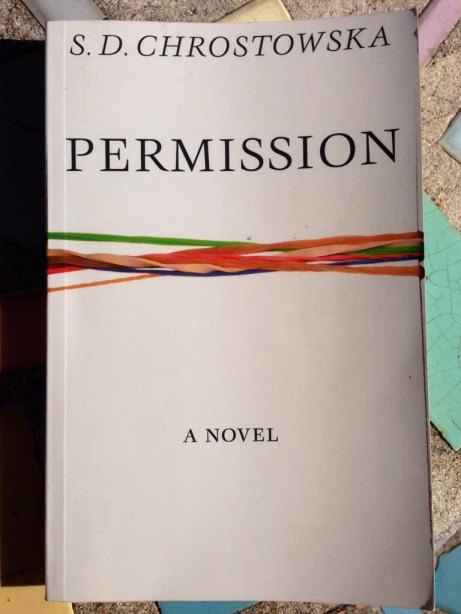
S.D. Chrostowska’s Novel Permission Deconstructs the Episotolary Form

20131123-125543.jpg

In trying to frame a review of S.D. Chrostowska’s novel Permission, I have repeatedly jammed myself against many of the conundrums that the book’s narrator describes, imposes, chews, digests, and synthesizes for her reader.

I have, for example, just now resisted the impulse to place the terms novelnarrator, and reader under radical suspicion. (I realize that the last sentence carries out the impulse even as it purports not to). Permission, thoroughly soaked in deconstruction, repeatedly places its own composition under radical suspicion.

This is maybe a bad start to a review.

Another description:

Permission pretends to be the emails that F.W. (later F. Wren, and even later, Fearn Wren) sends to an unnamed artist, a person she does not know, has never met, whom she contacts in a kind of affirmation of reciprocity tempered in the condition that her identity is “random and immaterial.” She aims to work out “an elementary philosophy of giving that is, by its very definition, anti-Western.” Her gift is the book she creates — “Permit me to write to you, today, beyond today,” the book begins.

Why?

What I want to measure—or, rather, what I want to obtain an impression of, since I do not claim exactitude of measurement for my results—is my own potential for creatio ad nihilum (creation fully within the limits of human ability, out of something and unto nothing). To rephrase my experimental question: can I give away what is inalienable from me (my utterance, myself) without the faintest expectation or hope of authority, solidarity, reciprocity?

F.W.’s project (Chrostowska’s project) here echoes Jacques Derrida’s deconstruction of giving, of the (im)possibility of authentic giving. F.W. wants to give, but she also deconstructs that impulse repeatedly. This is a novel (novel-essay, really) that cites Gilles Deleuze and Maurice Blanchot in its first twenty pages.

Her project is deconstruction; as she promises at the outset, her giving, her writing “is not solid, and does not lead to solidarity.” On the contrary,

it is solvent, and leads, through its progressive dissolution, towards the final solution of this writing (my work), which meanwhile becomes progressively less difficult, less obscure.

“Will it?” I asked in the margin of my copy. It does, perhaps.

After an opening that deconstructs its own opening, Chrostowska’s F.W. turns her attention to more concrete matters. We get a brief tour of cemeteries, a snapshot of the F.W.’s father (as a child) at a child’s funeral, a recollection of her first clumsy foray into fiction writing, a miniature memoir of a failed painter, color theory, the sun, the moon. We get an overview of our F.W.’s most intimate library—The Hound of the Baskervilles, a samizdat copy of Listy y Bialoleki [Letters from Bialoleka Prison], 1984. We get an analysis of Philip Larkin’s most famous line. Prisons, lunatic asylums, schools. Indian masks. Hamlet. More cemeteries.

My favorite entry in the book is a longish take on the “thingness of books,” a passage that concretizes the problems of writing—even thinking—after others. I think here of Blanchot’s claim that, ” No sooner is something said than something else must be said to correct the tendency of all that is said to become final.”

20131123-125626.jpg

The most intriguing passages in Permission seem to pop out of nowhere, as Chrostowska turns her keen intellect to historical or aesthetic objects. These are often accompanied by black and white photographs (sometimes gloomy, even murky), recalling the works of W.G. Sebald, novel-essays that Permission follows in its form (and even tone). Teju Cole—who also clearly followed Sebald in his wonderful novel Open Cityprovides the blurb for Permission, comparing it to the work of Sebald’s predecessors, Thomas Browne and Robert Burton. There’s a pervasive melancholy here too. Permission, haunted by history, atrocity, memory, and writing itself, is often dour. The novel-essay is discursive but never freewheeling, and by constantly deconstructing itself, it ironically creates its own center, a decentered center, a center that initiates and then closes the work—dissolves the book.

Permission, often bleak and oblique, essentially plotless (a ridiculous statement this, plotless—this book is its own plot (I don’t know if that statement makes any sense; it makes sense to me, but I’ve read the book—the book is plotless in the conventional sense of plotedness, but there is a plot, a tapestry that refuses to yield one big picture because its threads must be unthreaded—dissolved to use Chrostowska’s metaphor)—where was I?—Yes, okay, Permission, as you undoubtedly have determined now, you dear, beautiful, bright thing, is Not For EveryoneHowever, readers intrigued by the spirit of (the spirit of) writing may appreciate and find much to consider in this deconstruction of the epistolary form.

Permission is new from The Dalkey Archive.

Review: Tim O’Brien’s Novel The Things They Carried, Read by Bryan Cranston

thingsI’ve used Tim O’Brien’s short story “The Things They Carried” in the classroom for so many years now that I’ve perhaps become immune to any of the tale’s rhetorical force.Trekking through the story again with a new group of students can occasionally turn up new insights—mostly these days from veterans going back to school after tours in Iraq and Afghanistan—but for the most part, the story “The Things They Carried” is too blunt in its symbols, too programmatic in its oppositions of the physical and metaphysical, too rigid in its maturation plot. There’s no mystery to it, unlike other oft-anthologized stories which can withstand scores of rereadings (I think of Hawthorne or O’Connor here; when I reread “A Good Man Is Hard to Find,” for example, I always understand it or misunderstand it in a new, different way).
But my students invariably love “The Things They Carried,” and I love reading it with them.

Despite reading the story “The Things They Carried” semester after semester, I hadn’t gone back to the novel The Things They Carried in years, until the kind people at Audible sent me a new audiobook version read by character actor Bryan Cranston (Malcolm in the MiddleSeinfeld). I enjoyed the audiobook over a week of commutes.

The Things They Carried is a loose collection of stories that centers on a character named Tim O’Brien and his time with Alpha Company during the Vietnam War. The book also focuses on O’Brien’s experiences, as well as the experiences of some of his fellow soldiers, before and after Vietnam. O’Brien ties the book around a few major stories, fleshing it out with fragments, and telling tales from different viewpoints and even different chronologies. If a character dies in one story, he’s welcome to show up in a later story or vignette. That’s how memory works. And when memory fails, there are stories:

Forty-three years old, and the war occurred half a lifetime ago, and yet the remembering makes it now. And sometimes remembering will lead to a story, which makes it forever. That’s what stories are for. Stories are for joining the past to the future. Stories are for those late hours in the night when you can’t remember how you got from where you were to where you are. Stories are for eternity, when memory is erased, when there is nothing to remember except the story.

O’Brien’s major concern in The Things They Carried isn’t just the experiences of regular soldiers in the Vietnam War. He’s also deeply concerned with how to frame, recall, tell, and retell those experiences. In this sense, the formal aspects of the novel—its fragmentary, decentered structure—carry out its themes. The result is a strange beast, a novel that is simultaneously postmodern metafiction and dirty realism. Almost every single story in The Things They Carried attempts to suss out its own telling; indeed, how to tell, how to witness to (horror, violence, war) is probably the book’s real aim. Nowhere is this more evident than in “How to Tell a True Story”:

A true war story is never moral. It does not instruct, nor encourage virtue, nor suggest models of proper human behavior, nor restrain men from doing the things men have always done. If a story seems moral, do not believe it. If at the end of a war story you feel uplifted, or if you feel that some small bit of rectitude has been salvaged from the larger waste, then you have been made the victim of a very old and terrible lie. There is no rectitude whatsoever. There is no virtue. As a first rule of thumb, therefore, you can tell a true war story by its absolute and uncompromising allegiance to obscenity and evil.

The notation of a “rule of thumb” there is a dark little sick joke, a thread that O’Brien picks up from the opening title story. Moments like these, little threads, little images, help the work to cohere as a novel, even as O’Brien does his damnedest to fracture the whole business. His hand-wringing about truth and fiction and reality begins to wear on the reader. It’s not that O’Brien isn’t right to be concerned about these issues, but The Things They Carried spends a bit too much time dithering over its own right to imagine a truth.

O’Brien is better at the dirty realism, I think, which we can see in the brutal vivid details in “Sweetheart of the Song Tra Bong,” a story about a guy who brings his teenage girlfriend to Vietnam. “Vietnam was full of strange stories, some improbable, some well beyond that,” O’Brien writes at the beginning, “but the stories that will last forever are those that swirl back and forth across the border between trivia and bedlam, the mad and the mundane.” In “Sweetheart,” O’Brien toes that line to great effect. The story culminates in imagery that seems borrowed from Cormac McCarthy’s Blood Meridian. I’m tempted to share the story’s strongest image but won’t. No spoilers.

“Sweetheart” is less concerned with the frames and edges of its own telling than some of the other stories in The Things They Carried, but O’Brien still highlights the essential problem of witnessing:

“Patience, man. Up to now, everything I told you is from personal experience, the exact truth, but there’s a few other things I heard secondhand. Thirdhand, actually. From here on it gets to be … I don’t know what the word is.”

“Speculation.”

I think it helped me to hear The Things They Carried in a different voice, a different tone or mode or mood than my own. Bryan Cranston does a wonderful job here. I’ve written before about how a good reader makes all the difference in an audiobook. Cranston, surely most famous for his iconic performance as hapless father Hal in Malcolm in the Middle, telegraphs O’Brien’s tales in a straightforward but sonorous voice, injecting pathos and wry humor at the appropriate moments. Cranston inhabits each voice in The Things They Carried, imbuing every character with his own tone and rhythm. The result is a compelling and moving interpretation of The Things They Carried. Cranston opens up what I had thought to be a more-or-less closed book.

This new audiobook features a bonus essay called “The Vietnam in Me” which recounts O’Brien’s 1994 return to Vietnam with his young girlfriend. The essay reads as a condensation, repetition, and extension of the book that precedes it, with O’Brien repeatedly admitting as much—reminding us again and again of the relationship between memory and story. O’Brien reads the essay himself in a reedy, often shaky voice. The recording quality seems to depart from the clean studio perfection of the book proper—there’s more hiss, more crackly, longer gaps. More dirty realism. Strangely, O’Brien’s quaver suggests a man less in control of the story than alter-ego Cranston’s confidence suggested. The divergence in the two readers underscores the book’s core theme, reminding us that it’s not just the story that matters, but the storyteller

You can see/hear Cranston read bits of the book in this video:

The Complete Short Stories of J.G. Ballard (Fourth Riff: Stories of 1962)

jgb_complete_ss400

PREVIOUSLY:

Introductions + stories 1956-1959

Stories of 1960

Stories of 1961

IN THIS RIFF:

Nine stories published in 1962:

“The Insane Ones”

“The Garden of Time”

“The Thousand Dreams of Stellavista”

“Thirteen to Centaurus”

“Passport to Eternity”

“The Cage of Sand”

“The Watch Towers”

“The Singing Statues”

“Man on the 99th Floor”

1. “The Insane Ones” (1962)

Psychology, and particularly subliminal psychology, remained a major theme throughout Ballard’s writing career. “The Insane Ones” is a thought-experiment that examines what might happen if libertarianism were taken to its most extreme:

The Mental Freedom legislation enacted ten years earlier by the ultraconservative UW government had banned the profession outright and enshrined the individual’s freedom to be insane if he wanted to, provided he paid the full civil consequences for any infringements of the law. That was the catch, the hidden object of the MF laws. What had begun as a popular reaction against ‘subliminal living’ and the uncontrolled extension of techniques of mass manipulation for political and economic ends had quickly developed into a systematic attack on the psychological sciences. Overpermissive courts of law with their condoning of delinquency, pseudo–enlightened penal reformers, ‘Victims of society’, the psychologist and his patient all came under fierce attack. Discharging their self–hate and anxiety onto a convenient scapegoat, the new rulers, and the great majority electing them, outlawed all forms of psychic control, from the innocent market survey to lobotomy. The mentally ill were on their own, spared pity and consideration, made to pay to the hilt for their failings. The sacred cow of the community was the psychotic, free to wander where he wanted, drooling on the doorsteps, sleeping on sidewalks, and woe betide anyone who tried to help him.

“The Insane Ones” isn’t a particularly good story—as is the case with many of the tales in The Complete Stories, it’s mostly an excuse to tease out a speculative notion—but its conceit of a lack of adequate health care set against the backdrop of reactionary politics seems particularly germane today. 

2. “The Garden of Time” (1962)

“The Garden of Time” is an oddity in Ballard’s oeuvre. Most of his short stories take cues from Edgar Allan Poe, but “The Garden of Time,” a direct allegory, is pure-Hawthorne territory, a dark fairy tale with fantasy tropes unusual for Ballard. Count Axel and his darling wife live in a perfect Edenic space that they maintain by picking flowers that “freeze” time. At the periphery, a mechanized mob approaches:

At first glance, the long ranks seemed to be progressing in orderly lines, but on closer inspection, it was apparent that, like the obscured detail of a Goya landscape, the army was composed of a vast throng of people, men and women, interspersed with a few soldiers in ragged uniforms, pressing forward in a disorganized tide. Some laboured under heavy loads suspended from crude yokes around their necks, others struggled with cumbersome wooden carts, their hands wrenching at the wheel spokes, a few trudged on alone, but all moved on at the same pace, bowed backs illuminated in the fleeting sun.

I’m not sure how to read the tale—it seems that Ballard identifies the horde, the mob, as a dumb, dim force of history, a consumer society that will destroy the last vestiges of High Culture embodied by the graceful Count and his wife, the aristocrats who understand Truth and Beauty and Art &c. I think there’s a streak of conservatism here, a tendency that we might not immediately think of when we think of Ballard the futurist.

3. “The Thousand Dreams of Stellavista” (1962)

Another Vermilion Sands story, “Stellavista” takes on architecture. This is basically a haunted house story; the Ballardian trick here is the psychotropic house, dwellings that echo “every shift of mood and position of the occupants.” Young couple buys house, house is haunted, etc. The conceit is interesting, but again, Ballard’s not particularly inclined to write it in anything outside of a standard pulp fiction (or doesn’t seem to know how to yet).

Ballard’s treatment of his female characters is what I find most interesting here. As always, they seem to be divided into just a few classes: The wife, an unimaginative nag; the mysterious (and impossible to understand) ingenue; the mad, abandoned old woman (shades of Miss Havisham); and the abject, consuming Villain-Woman. Ballard often combines the last three types, but they are always set in opposition to the housewife. More on this in a moment.

4. “Thirteen to Centaurus”

“Thirteen to Centaurus” belongs in what I’ve been calling The Essential Short Stories of J.G. Ballard, a collection of the best stuff here. Each Ballard story is essentially a trick or a thought experiment—the tale is just a delivery system, a frame. Ballard here employs a metaframe; sure, the story is still composed in the tropes and language of pulp fiction, but Ballard shows signs of breaking out. In some ways, “Thirteen to Centaurus” is a rewrite of “Manhole 69” (which I also suggested is Essential). I haven’t described the plot and won’t—I think the story is probably better read without preview or explication.

5. “Passport to Eternity” (1962)

“Passport to Eternity” highlights Ballard’s greatest imaginative failure. This is a guy who can conceive of every kind of fantasy trip—extraterrestrial adventures, private-war-as-vacation, space safari (the occasion for the story here is a list of surreal vacations; the story would read much, much better as just that list). Yes, Ballard can conceive of any kind of future, except one where a woman is something other than a house wife:

For several centuries now the managerial and technocratic elite had been so preoccupied with the work of government that they relied on the Templars of Aphrodite not merely to guard their wives from any marauding suitors but also to keep them amused and contented. By definition, of course, their relationship was platonic, a pleasant revival of the old chivalrous ideals…

Even if Ballard is poking ironic fun here (and I don’t think that’s the case), his framing is aggressively chauvinistic; not only does the “managerial and technocratic elite” appear to exclude women, the underlying anxiety of cuckoldry manifests in a social structure that must manage (and contain) women’s passions and sexualities. There’s something aggressively misogynistic here, a streak that finds its twin in Ballard’s abjectification of women elsewhere in the stories (I wrote above that he only conceives women as house wives—not quite true—they can also be consuming monsters in the Ballardverse).

6. “The Cage of Sand” (1962)

Astronauts. Ecology. Etc. Pass.

7. “The Watch-Towers” (1962)

“The Watch Towers” is basically an extended riff on how churches institutionalize power and regulate behavior. Ballard’s trick here is to elide or omit any language that would directly evoke religion or spirituality though. The story also gets its power comes from its bare simplicity, its lack of ornamentation—one can sense Ballard’s restraint here. The story would likely be more successful stripped even further—something closer to Shirley Jackson’s “The Lottery,” which it echoes. There are also shades here of a particularly English brand of hauntology—The Prisoner and The Wicker Man come to mind.

8. “The Singing Statues” (1962)

“The Singing Statues” feels like a rewrite of several of Ballard’s Vermilion Sands stories. I suppose collected together in their own volume, the Vermilion Sands tales might read like a novel-in-stories, a work through of central themes, images, and ideas—but dispersed in The Collected Stories they get swallowed. They read like repetitions. Stale.

9. “Man on the 99th Floor” (1962)

Ballard handles subliminal suggestion much better in the next tale, “The Subliminal Man.” So I’ll take a pass on this one in anticipation of one of Ballard’s best

Under the Volcano, Malcolm Lowry’s Antipodal Odyssey of Despair

Most of Malcolm Lowry’s dense, depressing novel Under the Volcano takes place over the course of November 2nd, 1938, the Mexican Day of the Dead. Like a reticent, dour Virgil, Lowry guides the reader through the day’s tragic arc, floating between the minds of his novel’s three protagonists: Geoffrey Firmin, his half-brother Hugh, and Geoffrey’s estranged wife Yvonne. Geoffrey is British Consul to Mexico — ex-Consul, really, as British-Mexican relations sour against the backdrop of Spanish fascism and the rise of nationalism in Mexico — but he is almost always referred to as “the Consul,” a blackly ironic title. See, the Consul bears little authority aside from an extreme expertise on how to stay drunk (or “drunkly sober un-drunk”) 24/7. He’s ambassador to bar stools, a manager of mescal and little else (certainly not his own life; certainly not diplomatic affairs). The Consul is a wreck, an alcoholic to put Hemingway and Fitzgerald’s (and even Bukowski’s) alter-egos to shame.

After a first chapter that seems to derail all but the most patient readers, the narrative conflict arrives when Yvonne returns to Quauhnahuac, Mexico, a year after leaving (and divorcing) the Consul. She arrives to find the Consul (“Geoffrey,” as he’s called when the free indirect style inhabits her mind) drinking whiskey in a hotel bar in order to sober up (yep). It’s not immediately clear why Yvonne has returned to the Consul, but it seems that she hopes to save him from drowning in a drunken downward spiral. As the pair walks to the Consul’s house, they pass numerous advertisements for a boxing match; a child’s funeral proceeds down the avenue. These motifs of fighting, death, and futility permeate the novel.

During the walk we learn that Yvonne is not the only one concerned about the Consul’s health; his (much) younger brother Hugh has come to stay with him in the hopes of sobering him up. (Hugh employs a revolting and unsuccessful “strychnine cure”). That Hugh has also returned doubly complicates the plot. Much of Under the Volcano remains implicit, unnamed, hinted at, and this seems especially true of the implication that Yvonne cheated on the Consul with Hugh in the recent past (this implication may have been stated conclusively at some point in the novel, but I’ve only read the book once, which is perhaps like not having read it at all). What’s certainly clear is that Yvonne cheated on the Consul with a French filmmaker, Jacques Laruelle, a man whom the Consul, through sheer bizarre coincidence (but of course it isn’t sheer bizarre coincidence), spent a childhood summer with, an experience which bonded them as brothers in an Edenic holiday that eventually (inevitably) soured.

Despite her infidelities, Yvonne is generally present (I choose the verb “present” over “presented as” to highlight Lowry’s impeccable Modernist style) as a sympathetic character. Still, it is hard not to identify with the Consul (with “Geoffrey,” I suppose, if we are going to be familiar), the dark soul of this novel, and his complicated, painful feelings for Yvonne form the core of Volcano’s tragedy. He longs for her, pines for a complete life with her, yet resents her, cannot forgive her, hates her. For what? For leaving him. For betraying him. But perhaps foremost, he despises her inability to understand his alcoholism (he is particularly upset when she refuses to share a morning libation with him when they meet for the first time in a year). I’ll quote a passage at length now, one that showcases Lowry’s free indirect style, and one that reveals the strange indignities of the Consul’s sense of his own alcoholism. For context, dear reader, you must only know that Yvonne has suggested that she and the Consul might make long-term plans when he is sober “in a day or two”—

The Consul sat perfectly still staring at the floor while the enormity of the insult passed into his soul. As if, as if, he were not sober now! Yet there was some elusive subtlety in the impeachment that still escaped him. For he was not sober. No, he was not, not at this very moment he wasn’t! But what had that to do with a minute before, or half an hour ago? And what right had Yvonne to assume it, assume either that he was not sober now, or that, far worse, in a day or two he would be sober? And even if he were not sober now, by what fabulous stages, comparable indeed only to the paths and spheres of the Holy Cabbala itself, had he reached this stage again, touched briefly once before this morning, this stage at which alone he could, as she put it, “cope,” this precarious precious stage, so arduous to maintain, of being drunk in which alone he was sober! What right had she, when he had sat suffering the tortures of the damned and the madhouse on her behalf for fully twenty-five minutes on end without having a decent drink, even to hint that he was anything but, to her eyes, sober? Ah, a woman could not know the perils, the complications, yes, the importance of a drunkard’s life! From what conceivable standpoint of rectitude did she imagine she could judge what was anterior to her arrival? And she knew nothing whatever of what all too recently he had gone through, his fall in the Calle Nicaragua, his aplomb, coolness, even bravery there—the Burke’s Irish whiskey! What a world! And the trouble was she had now spoiled the moment.

The “fall in the Calle Nicaragua” the Consul references is quite literally a drunkard’s blackout (followed by the aforementioned fortifying whiskey, courtesy of a tourist), but it — falling — is perhaps the dominant motif in a novel crammed with motifs. In allegorical terms, if we want to ruin a good book (I don’t recommend this, of course), Volcano is pure Faust-stuff: end of innocence, fall of man, intractability of the human condition, ethical peril, moral inertia. While the Consul’s fall dominates the novel, Lowry brings this decline into dramatic relief in a late, climactic episode when his (anti-)heroic trio encounter a dying (dead?) man on the side of the road. Hugh tries to help, but the Darwinian venality of Mexican commonplace law makes his attempt impotent. Yvonne and the Consul are basically paralyzed.

Hugh’s attempt to save the man is a desperate call to action, an endeavor to perform some good in a world dominated by war and fascism. Hugh’s character fascinates. We learn of his past in one of the novel’s most intriguing episodes, a mini-bildungsroman that finds young Hugh working in the merchant marine as a calculated ploy to lend romance to his persona — he longs to prevail as a songwriter. He returns to find that no one cares about — has even heard — his guitar compositions; his publicity stunt fails. Although Hugh is only twenty-nine, he already seems himself as a failure, a fallen hero; he obsesses over the Battle of Ebro, daydreaming of helming a ship laden with hidden arms that he will deliver to the Loyalists who oppose the Fascists. Hugh’s greatest pain — and perhaps (only perhaps) Lowry’s greatest cruelty — is the awareness that the idealism of romantic heroism is intrinsically bound to a kind of selfish egoism. Hugh, perhaps with the visceral signal of his half-brother as a kind of radical prescience, can already see his own fall; his parts in Volcano are in a sense a constant meditation on falling. Hugh tries to save the dying man on the road, the cold double of his brother, whom he also tries to save — and yet it is all to little avail.

In Lowry’s world, in the volcano-world, there is only expulsion from the Eden. Lowry spells out this theme near the middle of his novel in a strange episode. The Consul wanders into his neighbor’s garden and reads a sign —

¿LE GUSTA ESTE JARDÍN?
¿QUE ES SUYO?
¡EVITE QUE SUS HIJOS LO DESTRUYAN!

The Consul stared back at the black words on the sign without moving. You like this garden? Why is it yours? We evict those who destroy! Simple words, simple and terrible words, words which one took to the very bottom of one’s being, words which, perhaps a final judgement on one, were nevertheless unproductive of any emotion whatsoever, unless a kind of colourless cold, a white agony, an agony chill as that iced mescal drunk in the Hotel Canada on the morning of Yvonne’s departure.

Significantly, either the sign is posted with improper punctuation, or (and?) the Consul’s translation is wrong — in either case a meaningful misreading occurs. We later receive the “proper” version of the sign: “¿Le gusta este jardín, que es suyo? ¡Evite que sus hijos lo destruyan! – “Do you like this garden that is yours? See to it that your children do not destroy it!”  The Consul’s first reading is a corruption, a cruel misreading that questions humanity’s right to happiness, and, tellingly, he connects the sign to the end of his relationship with Yvonne. The second version of the sign, while still foreboding, perhaps signals a kernel of hope in Lowry’s bleak work — the idea that a garden might be preserved, might be tended to; that children might be raised who do not kill, cheat, steal, rape, enslave, or otherwise prey on each other. Still, Lowry refuses to imagine what such a world might look like for us. Did I mention that Volcano is really, really sad?

For all its bleak, bitter bile, Volcano contains moments of sheer, raw beauty, especially in its metaphysical evocations of nature, which always twist back to Lowry’s great themes of Eden, expulsion, and death. Lowry seems to pit human consciousness against the naked power of the natural world; it is no wonder then, against such a grand, stochastic backdrop, that his gardeners should fall. The narrative teems with symbolic animals — horses and dogs and snakes and eagles — yet Lowry always keeps in play the sense that his characters bring these symbolic identifications with them. The world is just the world until people walk in it, think in it, make other meanings for it.

In many ways, Under the Volcano is an antipodal response to Joyce’s Ulysses. Both novels stream through a number of consciousnesses over the course of one day; both novels invert and subvert mythical frameworks against diurnal concerns; both novels point to the ways that the smallest meannesses — and kindnesses — can color and affect our lives. And while there are many divergences (chiefest, I believe, the spirit of redemption in Ulysses that seems entirely absent from Volcano), the greatest similarity may be their difficulty. Simply put, Lowry, like Joyce, throws his readers into the deep end. The first chapter of the novel inhabits the mind of Jacques Laruelle and takes place exactly one year after the events of the rest of the novel. It is both overture and context for all that follows, and yet it is radically alienating; indeed, it only fully makes sense after one finishes the novel and goes back and reads it again, realizing it is the rightful coda, the sad epilogue of a sad story. Lowry leads with his conclusion, show us the fall-out up front, the splinters and shards of the narrative to come. Picking up these pieces is hardly easy and never joyful, but it is a rewarding experience. Very highly recommended.

[Editorial note: Biblioklept ran a version of this review in March of 2011; we run it again in honor of The Day of the Dead]

Bolaño’s Werewolves

In the first chapter of his estimable volume The Book of Were-Wolves (1865), Sabine Baring-Gould outlines his project (emphasis mine):

In the following pages I design to investigate the notices of were-wolves to be found in the ancient writers of classic antiquity, those contained in the Northern Sagas, and, lastly, the numerous details afforded by the mediæval authors. In connection with this I shall give a sketch of modern folklore relating to Lycanthropy.

It will then be seen that under the veil of mythology lies a solid reality, that a floating superstition holds in solution a positive truth.

This I shall show to be an innate craving for blood implanted in certain natures, restrained under ordinary circumstances, but breaking forth occasionally, accompanied with hallucination, leading in most cases to cannibalism. I shall then give instances of persons thus afflicted, who were believed by others, and who believed themselves, to be transformed into beasts, and who, in the paroxysms of their madness, committed numerous murders, and devoured their victims.

The first few chapters of the book recount werewolf mythology in heavily archetypal terms: we’re talking Greek and Norse stuff here, really ancient stories that tap into primal-human-animal-instinct and so forth. Then there are a few chapters on Scandinavian werewolves (and other shapeshifters) that reminded me of William Vollmann’s marvelous saga The Ice-Shirt, a book that treats warriors shifting into bears as totally standard fare. The book then tackles “The Were-Wolf in the Middle Ages,” where Baring-Gould relies heavily on monks who seem to view their subject through the heady lens of supernaturalism. Baring-Gould weaves together these culturally disparate stories, citing a strong backlist of sources, and refraining from pointing out the obvious archetypal flavor that girds these tales.

It’s in Chapter VI, “A Chamber of Horrors,” that mythology and archetype give way to a kind of terrible realism. Perhaps this is simply an effect of records-keeping, of the vague fact that narratives and terms of the early Renaissance seem so much more accessible to us than, say, the terms of Scandinavian saga. In any case, the book takes on a horrific scope: the vagaries of myth give way to dates, names, places, witnessestrialsverdicts. To go back to Baring-Gould’s intro, we see the “solid reality” under “the veil of mythology,” stripped away. Continue reading “Bolaño’s Werewolves”

“Horror Demands Laughter” | This Is Not a Review of Thomas Bernhard’s Novel Frost

The Blind Man, Albert Bloch

I.

Thomas Bernhard’s first novel Frost is (unless I’m mistaken) his longest, and of the several I’ve now read, the most taxing on the reader—bitter, caustic, depressive, nihilistic.

It’s also terribly funny, the story of a young doctor hell-bent on making a career for himself who heads to the remote village of Weng to spy on Strauch, “the painter,” on behalf of Strauch’s brother, who can presumably further the narrator’s medical career. The painter, long-estranged from his family, his health deteriorating, lives (if it can be called that) in a vile inn at the bottom of a gorge. The painter’s brother dispatches the narrator to report back in the minutest detail: “Watch the way my brother holds his stick, I want a precise description of it.”

II.

A word I learned reading Frost: “knacker.” A knacker is a person who renders, buries, or otherwise disposes of dead animals. The knacker of Weng is one of the main characters of Frost. He’s having an affair with the innkeeper, a symbolically overdetermined plot device (in a basically plotless book) that thematically ties death to hearthFrost is savagely morbid, its blank white snow the perfect canvas for Bernhard’s bloody strokes. The abject violence of his next novel Gargoyles seems refined in comparison to the brutality of Frost. The painter declares that “the abattoir is the only essentially philosophical venue. The abattoir is the classroom and the lecture hall. The only wisdom is abattoir wisdom!” Frost is an abattoir.

III.

Frost is also a stage play of sorts—like the other Bernhard novels I’ve read, it takes something of its form from the conventions drama: limited sets, just a handful of characters, and dialogue that usually veers into monologue. Through the course of the novels, these monologues (usually delivered by an obsessive, sanity-challenged older man) eventually ventriloquize the ostensible narrator/auditor, a stand-in for the reader’s own consciousness. Bernhard designs, builds, destroys, and then rebuilds these consciousnesses; when the painter of Frost declares that he has mastered “perspectivelessness . . . because I am so full of different perspectives,” he offers us a condensation of Bernhard’s analysis of first-person perspective and its attendant imaginative capacity as simultaneously creative and destructive.

IV.

Indeed, as novelist Ben Marcus points out in his review of Frost:

Bernhard is an architect of consciousness more than a narrative storyteller. His project is not to reference the known world, stuffing it with fully rounded characters who commence to discover their conflicts with one another, but to erect complex states of mind—usually self-loathing, obsessive ones—and then set about destroying them. Bernhard’s characters are thorough accomplices in their own destruction, and they are bestowed with a language that is dementedly repetitive and besotted with the appurtenances of logical thinking. The devious rationality of Bernhard’s language strives for a severe authority, and it tends to make his characters seem believable, no matter how unhinged their claims. Phrases don’t get repeated so much as needled until they yield graver meanings, with incremental changes introduced as though a deranged scientist were adding and removing substances in the performance of an experiment.

V.

I can’t do better than Marcus, and Frost is too long a performance to try. I will say: Gargoyles or The Loser are probably better starting places for those interested in Bernhard’s work. This suggestion isn’t meant to slight the book at all—but it does read a bit like a first novel, occasionally weighed down by (what I perceive to be) its authors need to say it all, all of it, here and now. Of course, Frost features prose-passages that any first-time novelist would be proud (and probably terrified) to have in their debuts; I’ve featured several on the site already.

VI.

But this isn’t really a review of Frost. A proper analysis of Bernhard would take the time to work through his language. I marked so much in Frost, highlighted so many passages that I’m not really sure how to go about synthesizing it.

My initial thought was to dodge it all by making a sarcastic post, a parody of the so-called “listicle,” those non-articles that seek to boil a work down to a digestible (and forgettable) summation of quotes, often with the intention of offering the reader a modicum of self-help (under the pretense of “wisdom”). Something like “Forty Inspiring Quotes from Thomas Bernhard’s Frost” or “Timeless Wisdom from Thomas Bernhard” or some such nonsense. Anyway, the next section, VII, comprises 40 citations from Frost, mostly excellent one-liners too good not to share. I’ve enumerated them and lumped them into one big block quote; they are listed in the order they come in the text. I think that they offer a painful and funny overview of the novel.

VII.

  1. Suddenly I heard the story of a lineman who had been asphyxiated in a snowstorm, which ended: “He never cared about anything.”
  2. It’s the same disgust I felt when I was a child and had to vomit outside the open doors of the slaughterhouse.
  3. “Nature is bloody,” he said, “but bloodiest toward her own finest, most remarkable, and choicest gifts. She grinds them down without batting an eyelid.”
  4. Is it permissible for suicide to be a sort of secret pleasure to a man?
  5. Something was splendid, and the next thing was brutal, much more brutal than the first had been splendid.
  6. “You’ll get to meet a whole series of monsters here.”
  7. “Even dreams die. Everything turns into cold. The imagination, everything.”
  8. “People who make a new person are taking an extraordinary responsibility upon themselves. All unrealizable. Hopeless. It’s a great crime to create a person, when you know he’ll be unhappy, certainly if there’s any unhappiness about. The unhappiness that exists momentarily is the whole of unhappiness. To produce solitude just because you don’t want to be alone anymore yourself is a crime.”
  9. People don’t have favorite children, they just have a lot of them.
  10. I’m sure imagination is an illness. An illness that you don’t catch, merely because you’ve always had it. An illness that is responsible for everything, and particularly everything ridiculous and malignant. Do you understand the imagination? What is imagination?
  11. “There is a pain center, and from that pain center everything radiates out,” he said; “it’s somewhere in the center of nature. Nature is built up on many centers, but principally on that pain center.”
  12. “Nothing is progressive, but nothing is less progressive than philosophy. Progress is tripe. Impossible.”
  13. Helping and mankind, the distance between those two terms.
  14. Who had the idea of letting people walk around on the planet, or something called a planet, only to put them in a grave, their grave, afterward?
  15. By and by it comes to your attention: the world around you, nothing but corruption, colossal misrule.
  16. “How everything has crumbled, how everything has dissolved, how all the reference points have shifted, how all fixity has moved, how nothing exists anymore, how nothing exists, you see, how all the religions and all the irreligions and the protracted absurdities of all forms of worship have turned into nothing, nothing at all, you see, how belief and unbelief no longer exist, how science, modern science, how the stumbling blocks, the millennial courts, have all been thrown out and ushered out and blown out into the air, how all of it is now just so much air … Listen, it’s all air, all concepts are air, all points of reference are air, everything is just air …” And he said: “Frozen air, everything just so much frozen air …”
  17. What is pain, if not pain?
  18. “I used to take sleeping pills,” he said, “and slowly boosted the number of pills I took. In the end, they had absolutely no effect on me, and I could have gulped any number of them, and still not have got to sleep. I repeatedly took such high dosages, I should have died. But I only ever vomited them up.”
  19. Everything torments me now.
  20. Man is an ideal hell to his fellow men.
  21. He was just scraps of words and dislocated phrases.
  22. Things have lost their power to disgust me.
  23. The human race was the unfruitful thing, “the only unfruitful thing in the whole world. It serves no purpose. It can’t be made into anything. It can’t be eaten. It isn’t a raw material for some process outside itself.”
  24. “Men like rats, chopped up by street sweepers’ shovels. Too many negotiations with humans have done me in.”
  25. The ruin of mankind had been a child’s dream.
  26. The food had been better than for any corpse she could remember.
  27. “The frost eats everything up,” said the painter, “trees, humans, animals, and whatever is in the trees and the humans and the animals. The blood stalls, and at great speed. You can break apart a frozen human like a piece of stale bread.”
  28. There were no real humans anymore, just death masks of real humans.
  29. The nightmarish sweat of fear, that’s the air.
  30. Truth leads downhill, points downhill, truth is always an abyss.
  31. The abattoir is the classroom and the lecture hall. The only wisdom is abattoir wisdom!
  32. You wake up, and you feel molested.
  33. Everything is barbarous kitsch.
  34. “And when I saw the grisly chopped-up animals, I had to burst out laughing, I burst out into extraordinary laughter. Do you know what that means? It means horror demands laughter!”
  35. Various venerable old families would assemble “in a spirit of megalomania, to shoot holes in nature.
  36. It’s a mistake to count on people.
  37. Every object I see hurts me.
  38.  ” . . . hopelessness … There is only one way to go, through the snow and ice into despair; past the adultery of reason.”
  39. “The world is a progressive dimming of light,.”
  40. The breeding of a human being (thinking most rigorously of himself) is the decision of the father (first and foremost) and of the mother (as well) to sponsor the suicide of their offspring, the child, the sudden premonition “of having created a new suicide.”

Wherein I Suggest Dracula Is a Character in Roberto Bolaño’s Novel 2666

The Self Seers (Death and Man), Egon Schiele

1. Here’s my thesis:

Dracula is a character in Roberto Bolaño’s dark opus 2666.

Specifically, I’m suggesting that Dracula (like, the Count Dracula) is the unnamed SS officer in “The Part About Archimboldi” who hosts a strange party in a Romanian castle.

2. I’m willing to concede that my idea is probably full of holes and more than a little silly, but I think there’s some textual support for such a claim.

3. I’ve already suggested on this blog that 2666 is full of lycanthropic transformations, and in that earlier essay, I linked werewolves to vampires (using the work of mythologist Sabine Baring-Gould).

I also suggested on this blog that 2666 is a dark ventriloquist act, full of forced possessions and psychic hauntings.

It’s a work of mesmerism and transformation—vampire powers. Dracula showing up is a winking sick joke, a satire.

4. In his post “Castle Dracula” at Infinite Zombies, Daryl L. L. Houston connects the many strands of vampirism that run through 2666, suggesting that “Bolaño is using the vampirism in the story, and Dracula in particular, to tie together some of the threads he’s been unwinding pertaining to insiders and outsiders, parasitism and consumption of people, and a sort of larger parasitism of nations.” Hence Aztec blood rituals, the Holocaust, the murder of helpless, marginalized women in Santa Teresa . . .

5. Okay, so back to that thesis. Let’s start with the first appearance of the unnamed SS officer:

At midmorning they came to a castle. The only people there were three Romanians and an SS officer who was acting as butler and who put them right to work, after serving them a breakfast consisting of a glass of cold milk and a scrap of bread, which some soldiers left untouched in disgust. Everyone, except for four soldiers who stood guard, among them Reiter, whom the SS officer judged ill suited for the task of tidying the castle, left their rifles in the kitchen and set to work sweeping, mopping, dusting lamps, putting clean sheets on the beds.

Fairly banal, right? Also, “midmorning” would entail, y’know, sunlight, which is poison for most vampires. Let me chalk this up to the idea that the SS officer is inside the castle, which is sufficiently gloomy and dark enough to protect him (I’m not going to get into any vampire rules that might spoil my fun, dammit!). In any case, hardly noteworthy. Indeed, the SS officer—a butler commanding house chores—seems hardly a figure of major importance.

6. Next, we get the Romanian castle explicitly identified as “Dracula’s castle” and meet the actors for this milieu:

“And what are you doing here, at Dracula’s castle?” asked the baroness.

“Serving the Reich,” said Reiter, and for the first time he looked at her.

He thought she was stunningly beautiful, much more so than when he had known her. A few steps from them, waiting, was General Entrescu, who couldn’t stop smiling, and the young scholar Popescu, who more than once exclaimed: wonderful, wonderful, yet again the sword of fate severs the head from the hydra of chance.

(I love Popescu’s line here).

7. Our principals soon take a tour of castle and environs, led by the SS officer (boldface emphasis is mine):

Soon they came to a crypt dug out of the rock. An iron gate, with a coat of arms eroded by time, barred the entrance. The SS officer, who behaved as if he owned the castle, took a key out of his pocket and let them in. Then he switched on a flashlight and they all ventured into the crypt, except for Reiter, who remained on guard at the door at the signal of one of the officers.

So Reiter stood there, watching the stone stairs that led down into the dark, and the desolate garden through which they had come, and the towers of the castle like two gray candles on a deserted altar. Then he felt for a cigarette in his jacket, lit it, and gazed at the gray sky, the distant valleys, and thought about the Baroness Von Zumpe’s face as the cigarette ash dropped to the ground and little by little he fell asleep, leaning on the stone wall. Then he dreamed about the inside of the crypt. The stairs led down to an amphitheater only partially illuminated by the SS officer’s flashlight. He dreamed that the visitors were laughing, all except one of the general staff officers, who wept and searched for a place to hide. He dreamed that Hoensch recited a poem by Wolfram von Eschenbach and then spat blood. He dreamed that among them they had agreed to eat the Baroness Von Zumpe.

He woke with a start and almost bolted down the stairs to confirm with his own eyes that nothing he had dreamed was real.

When the visitors returned to the surface, anyone, even the least astute observer, could have seen that they were divided into two groups, those who were pale when they emerged, as if they had glimpsed something momentous down below, and those who appeared with a half smile sketched on their faces, as if they had just been reapprised of the naivete of the human race.

Bolaño concludes the crypt passage by highlighting an essential ambiguity that courses throughout the entire “Castle Dracula” episode, a strange axis of horror/humor, romance/banality. What has been revealed in the crypt? We don’t know, of course, but our surrogate Reiter allows us access to a few visions of what might have happened, including terror and fear and cannibalism. (He employs Hawthorne’s escape hatch too—it was all a dream).

The Knight of Death, Salvador Dali

8. Then, supper time:

That night, during dinner, they talked about the crypt, but they also talked about other things. They talked about death. Hoensch said that death itself was only an illusion under permanent construction, that in reality it didn’t exist. The SS officer said death was a necessity: no one in his right mind, he said, would stand for a world full of turtles or giraffes. Death, he concluded, served a regulatory function.

Clearly it’s easy to link any of the dinnertime comments about death to Dracula, but note that the SS officer’s idea that death is a “regulatory function” is terribly banal, is quite literally regular—this idea contrasts with Hoensch’s more poetic notion that death is an illusion (an illusion that the SS officer, if he is in fact Count Dracula, would realize in a perfectly mundane way that foreclosed the necessity of metaphor).

9. Dinner conversation turns to murder—obviously one of the central themes of 2666:

The SS officer said that murder was an ambiguous, confusing, imprecise, vague, ill-defined word, easily misused.

Again, ambiguity: on one hand, sure, an SS officer’s job was in large part about coordinating and executing mass murder. At the same time, we might appreciate that murder is a vague term if people are one’s lunch.

10. Then conversation turns to culture:

The SS officer said culture was the call of the blood, a call better heard by night than by day, and also, he said, a decoder of fate.

I’m pretty sure that this was the moment I started entertaining the fancy that the SS officer might be Dracula.

11. Popescu the intellectual also seems to reconsider the SS officer:

The intellectual Popescu remained standing, next to the fireplace, observing the SS officer with curiosity.

12. Then, they finally riff on Dracula. Significantly, the SS officer believes that Dracula is a good German (bold emphasis mine):

First they praised the assortment of little cakes and then, without pause, they began to talk about Count Dracula, as if they had been waiting all night for this moment. It wasn’t long before they broke into two factions, those who believed in the count and those who didn’t. Among the latter were the general staff officer, General Entrescu, and the Baroness Von Zumpe. Among the former were Popescu, Hoensch, and the SS officer, though Popescu claimed that Dracula, whose real name was Vlad Tepes, aka Vlad the Impaler, was Romanian, and Hoensch and the SS officer claimed that Dracula was a noble Teuton, who had left Germany accused of an imaginary act of treason or disloyalty and had come to live with some of his loyal retainers in Transylvania a long time before Vlad Tepes was born, and while they didn’t deny Tepes a real historical or Transylvanian existence, they believed that his methods, as revealed by his alias or nickname, had little or nothing to do with the methods of Dracula, who was more of a strangler than an impaler, and sometimes a throat slitter, and whose life abroad, so to speak, had been a constant dizzying spin, a constant abysmal penitence.

The SS officer is the noble Teuton. More importantly, we get language that connects Dracula to the murders in Santa Teresa, most of which are stranglings; we also get the idea that Dracula has had a “life abroad”—one outside of time—a life that might see his spirit inhabit and ventriloquize an industrial city in the north of Mexico. (Or not. I know. Look, I’m just riffing here).

We also get the idea of an abyss (this is the structure of 2666), as well as the idea of Dracula as a penitent of sorts.

So, let us recall that early in “The Part About the Crimes,” detective Juan de Dios Martinez is searching for a criminal dubbed The Penitent who desecrates churches and has committed a few murders in the process. He goes to psychologist Elvira Campos for help:

Sacraphobia is fear or hatred of the sacred, of sacred objects, especially from your own religion, said Elvira Campos. He thought about making a reference to Dracula, who fled crucifixes, but he was afraid the director would laugh at him. And you believe the Penitent suffers from sacraphobia? I’ve given it some thought, and I do. A few days ago he disemboweled a priest and another person, said Juan de Dios Martinez.

This is the first mention of Dracula in 2666, and he’s explicitly likened to the Penitent; later, as we see above, Dracula will be explicitly linked to penitence.

(I’m not suggesting that the Penitent is Dracula traveled to Mexico to piss in churches. What I want to say is that Dracula’s dark spirit ventriloquizes the text of 2666).

(I’m also suggesting, again, that 2666 be read intertextaully).

Riding with Death, Jean-Michel Basquiat

13. Our other principals continue to discuss Dracula, but I won’t belabor that discussion (I’d prefer you, dear reader, to return to the text).

I will summarize though: Popescu sees Dracula in nationalistic terms (“a Romanian patriot” who repels the Turks), and General Entrescu goes on a long rant about heroism and villainy and history, culminating in a lengthy digression on Jesus Christ (recall now that Entrescu will be crucified JC-style by his men).

One aside on the SS officer bears mentioning: we learn that “the fastidious SS officer” is the most sober conversant as he “scarcely wet his lips with alcohol.” (Because he’s a vampire who prefers blood! Muahahahaha!)

14. Fast forward a few hours. Our man Reiter, among fellow soldiers, sets out to explore the secret crannies and passageways of Castle Drac and play voyeur:

The room they came to was empty and cold, as if Dracula had just stepped out. The only thing there was an old mirror that Wilke lifted off the stone wall, uncovering a secret passageway.

Dracula’s spirit leaves the room, creating an opening, behind the ever-symbolic mirror. (Muahahahaha!). (2666: Mirror, tunnels, chambers, labyrinths).

They enter the passageway and come first upon our supposed Dracula, the SS officer:

And so they were able to look into the room of the SS officer, lit by three candles, and they saw the SS officer up, wrapped in a robe, writing something at a table near the fireplace. The expression on his face was forlorn. And although that was all there was to see, Wilke and Reiter patted each other on the back, because only then were they sure they were on the right path. They moved on.

15. Dracula, the epistolary novel. Count Dracula, troubled writer of letters, will author the following scenes, his spirit ventriloquizing the principals all: Here, we find Reiter and his homeboy Wilke, lurking in a secret passage, jerking off to werewolf-cum-Jesus-Christ-figure Gen. Entrescu screwing the lovely Baroness Von Zumpe and reciting poetry (emphasis per usual mine):

Then Wilke came on the wall and mumbled something too, a soldier’s prayer, and soon afterward Reiter came on the wall and bit his lips without saying a word. And then Entrescu got up and they saw, or thought they saw, drops of blood on his penis shiny with semen and vaginal fluid, and then Baroness Von Zumpe asked for a glass of vodka, and then they watched as Entrescu and the baroness stood entwined, each with a glass in hand and an air of distraction, and then Entrescu recited a poem in his tongue, which the baroness didn’t understand but whose musicality she lauded, and then Entrescu closed his eyes and cocked his head as if to listen to something, the music of the spheres, and then he opened his eyes and sat at the table and set the baroness on his cock, erect again (the famous foot-long cock, pride of the Romanian army), and the cries and moans and tears resumed, and as the baroness sank down onto Entrescu’s cock or Entrescu’s cock rose up into the Baroness Von Zumpe, the Romanian general recited a new poem, a poem that he accompanied by waving both arms (the baroness clinging to his neck), a poem that again neither of them understood, except for the word Dracula, which was repeated every four lines, a poem that might have been martial or satirical or metaphysical or marmoreal or even anti-German, but whose rhythm seemed made to order for the occasion, a poem that the young baroness, sitting astride Entrescu’s thighs, celebrated by swaying back and forth, like a little shepherdess gone wild in the vastness of Asia, digging her nails into her lover’s neck, scrubbing the blood that still flowed from her right hand on her lover’s face, smearing the corners of his lips with blood, while Entrescu, undeterred, continued to recite his poem in which the word Dracula sounded every four lines, a poem that was surely satirical, decided Reiter (with infinite joy) as Wilke jerked off again.

I contend that the poem is the work of the SS officer, psychic mesmerist, the poet Dracula, a poem no one in the scene can understand, a dark satire that might also be a war poem or a love poem or an elegy, but definitely a dark satire, written in violence and sex and blood, a poem that ventriloquizes not only Entrescu, phallic delivery device, but also the baroness, and also Reiter and Wilke. And perhaps the reader.

16. Where to go after such a climax? Maybe point out that Dracula infects Reiter and Wilke, of whom we learn:

Some of their battalion comrades dubbed them the vampires.

(But better to return I think to our strange figure, the SS officer).

17. Here, his last appearance:

The next morning the detachment left the castle after the departure of the two carloads of guests. Only the SS officer remained behind while they swept, washed, and tidied everything. Then, when the officer was fully satisfied with their efforts, he ordered them off and the detachment climbed into the truck and headed back down to the plain. Only the SS officer’s car—with no driver, which was odd—was left at the castle. As they drove away, Reiter saw the officer: he had climbed up to the battlements and was watching the detachment leave, craning his neck, rising up on tiptoe, until the castle, on the one hand, and the truck, on the other, disappeared from view.

Dracula stays in Dracula’s castle; his spirit, his seed, his blood seeps out.

[Ed. note: Biblioklept ran a version of this essay in September of 2012; I’m running it again in the healthy, evil spirit of Halloween]

James Wood’s The Fun Stuff Reviewed

20131013-093435.jpg

I hate that I love to hate reading James Wood—and when I love what he writes I hate that I love it. His take on Blood Meridian absolutely infuriated me, but a stray line from an essay he wrote on Virginia Woolf has informed pretty much every real review I’ve tried to write since I read it. Anyone who reads deeply and earnestly and cares about literary criticism is likely to find themselves shouting at Wood, and then maybe agreeing with him—with reserved qualifications, and then shouting again. (There is an entire blog devoted to pointing out the failures of Wood’s often deeply conservative aesthetic criticism, by the way).

The Fun Stuff, collecting many of Wood’s pieces from The New Yorker (but also elsewhere), is less pretentious than How Fiction Works, Wood’s last book, a polemic hiding behind the guise of literary criticism that faulted pretty much any prose stylist who deviated from a certain mode of 19th-century free indirect style.

I’ve already read a number of the pieces collected in The Fun Stuff, which is finally out in the U.S. in trade paperback thanks to Picador. You might have read them too. His essays championing Lydia Davis and László Krasznahorkai are fine fun stuff, as is his take on the late W.G. Sebald (first published as an introduction to Austerlitz). His appreciative review of Cormac McCarthy’s The Road though is in many ways a retake on his review of Blood Meridian—Wood can only view McCarthy’s existential questions through the lens of theodicy.

James Wood is maybe most fun—or most infuriating—when he’s at his harshest. The case file here is his pointed take-down “Paul Auster’s Shallowness.” Here, Wood goes through an Auster plot “checklist”:

 A protagonist, nearly always male, often a writer or an intellectual, lives monkishly, coddling a loss—a deceased or divorced wife, dead children, a missing brother. Violent accidents perforate the narratives, both as a means of insisting on the contingency of existence and as a means of keeping the reader reading—a woman drawn and quartered in a German concentration camp, a man beheaded in Iraq, a woman severely beaten by a man with whom she is about to have sex, a boy kept in a darkened room for nine years and periodically beaten, a woman accidentally shot in the eye, and so on. The narratives conduct themselves like realistic stories, except for a slight lack of conviction and a general B-movie atmosphere. People say things like “You’re one tough cookie, kid,” or “My pussy’s not for sale,” or “It’s an old story, pal. You let your dick do your thinking for you, and that’s what happens.” A visiting text—Chateaubriand, Rousseau, Hawthorne, Poe, Beckett—is elegantly slid into the host book. There are doubles, alter egos, doppelgängers, and appearances by a character named Paul Auster. At the end of the story, the hints that have been scattered like mouse droppings lead us to the postmodern hole in the book where the rodent got in: the revelation that some or all of what we have been reading has probably been imagined by the protagonist. Hey, Roger Phaedo invented Charlie Dark! It was all in his head.

I’m not a particular fan of Paul Auster, but I imagine those who deeply enjoy his work could feel personally insulted by Wood’s take-down. We get close to the books and authors we love. I think what manifests most in Wood’s criticism here—and elsewhere—is the weariness of someone who once deeply loved literature but who is now perhaps oppressed by it—who has become too aware of its mechanics, its forms, its stale formulations and bad parlor tricks.

Wood telegraphs far more passion and generosity in the collection’s title essay, which is about Keith Moon, the legendary drummer of The Who. He compares Moon’s rhythmic chops to D.H. Lawrence’s sentences:

For me, this playing is like an ideal sentence of prose, a sentence I have always wanted to write and never quite had the confidence to: a long, passionate onrush, formally controlled and joyously messy, propulsive but digressively self-interrupted, attired but disheveled, careful and lawless, right and wrong. (You can encounter such sentences in Lawrence’s prose, in Bellow’s, sometimes in David Foster Wallace’s.) Such a sentence would be a breaking out, an escape. And drumming has always represented for me that dream of escape, when the body forgets itself, surrenders its awful self-consciousness.

I like how personal he gets here. This essay opens the collection, and the one that closes it, “Packing My Father-In-Law’s Library” also communicates personally with the reader. Unconstrained by the pretense of a book review, Wood waxes on families and libraries and the meaning of life. When he writes of his father-in-law, whose books he’s sorting through, that “The books somehow made him smaller, not larger,” it’s hard not to hear a strong undertone of autobiography in the note.

Wood’s lyric essays are an unusual standout here (unusual in the sense that if someone had strung together the words James Wood’s lyric essays, I’d probably roll my eyes). They reveal a love of reading that goes missing in his attacks and his quibbling pieces. The serious literary critic is not, of course, beholden to being merely a cheerleader for literature (or worse, a cheerleader for publishing)—but I do think that the serious literary critic should offer something beyond condemnation or unenthusiastic grumbling. The risk the professional critic runs is to see the machinations of art too plainly, to become jaded to the point that experiencing the sublime is no longer possible (Tobias Wolff’s fantastic story “Bullet in the Brain” deals handily with this theme). Wood guides us here to several writers who disrupt, estrange, and resynthesize the tired tropes of literary fiction—and it’s in that strangeness where we can find the real fun stuff.

Alfonso Cuarón’s Gravity Is a Worthy Sequel to Children of Men

The final sequence of Alfonso Cuarón’s 2006 film Children of Men offers an example of film-making at its finest. Theo Faron, played by Clive Owen, frantically guides refugee Kee (Clare-Hope Ashitey) and her newborn through a hellish internment camp to an ostensible escape by sea. Kee, her name symbolically overdetermined, is the first person on earth to become pregnant after a generation of sterility.

Children of Men is set against the backdrop of militarized dystopia (Slavoj Žižek has suggested that this background is the essence of the film), a vile, clamorous police state that its hero Theo mutes with alcohol. Theo has yet to come to terms with the grief of losing his son, a plot conceit that mirrors the infinite loss figured in humanity’s sterility (and looming extinction). The film’s thrilling final third sees Theo convert his paralysis into radical action, as he ushers Kee and her newborn through the dystopic background, a violent blur the ideological details of which the audience is free to ignore.

Cuarón strips meaning down to raw, simple, archetypal impulses—Theo is a stand-in for any parent, Kee and her daughter emblematic of genetic futurity.  The film sublimates its underlying existential discourse into a gripping narrative fueled by its audience’s own anxieties. The drama culminates in a final sequence in which Cuarón amplifies and extends the existential anxiety by refusing to cut his shots for minutes at a time. The audience finds a surrogate in both Theo and cinematographer Emmanuel Lubezki, who moves us physically through violence and disaster.

While directors like Chris Nolan and Michael Bay produce anxiety in their films through frenetic editing and rapid jump cuts, Cuarón’s long takes force the viewer to engage the drama directly. The payoff is that rare creature: A film with an ending stronger than its beginning—a film that goes, that moves, that grips its audience right up until the credits.

Gravity-1

Cuarón’s newest film Gravity follows this same template. For ninety minutes, Cuarón—again working with cinematographer Lubezki—forces the audience into a propulsive and sustained anxiety trip. Gravity features astronauts as its heroes, but its technological milieu (space stations, shuttles, astronaut suits) belies its radical simplicity. This is a film about survival that questions why there is indeed a human impulse to survive.

Like Theo of Children of Men, the hero of Gravity Dr. Ryan Stone (Sandra Bullock) has also lost a child. She too has yet to come to terms with her grief. While Children of Men used a dystopic, politicized backdrop to highlight its character’s grief—and, significantly, the specter of infinite infanticideGravity offers up an existential void. The film’s near-perfection is that it refuses any other plot elements, giving us only Ryan’s literal attempt to save herself paired with the film’s overdetermined but singular metaphor: outer space as a beautiful, nihilistic abyss.

Gravity has been out for a few weeks now and has done gangbusters at the box office. I take this as a positive sign. This is the kind of blockbuster we need more of, a personal spectacle, a huge film in a minimalist mode. I could pick on a few things, maybe—the score is heavy-handed and obtrusive (and could probably be dispensed with entirely) and some of the dialogue falls clumsily—but I think that Cuarón has made the film he intended to, a sequel of sorts to Children of Men, and one worthy of that film’s climax.

I can’t end here though without addressing Richard Brody’s negative review of Gravity in The New Yorker. Brody is admittedly hard to take seriously after his opening claim that the film is simultaneously “viscerally thrilling and…deadly boring,” a statement that immediately highlights Brody’s biggest critical failure: He wants the film to be something that it is not trying to be.

Brody at length:

Cuarón has done a formidable job of piecing together a plausibly coherent material world of space, of conveying the appearance of that setting and the sensations of the characters who inhabit it. But he has created those sensations generically, with no difference between the subjectivity of his characters and the ostensible appearance to a camera of those phenomena. He offers point-of-view images that are imbued with no actual point of view. The movie, with its near-absolute absence of inner life, presents a material fantasy that flatters the studious humanism of critics who honor the attention to so-called reality—as an aesthetic endowed with a quasi-political virtue.

I’ve included the hyperlink in that last phrase to a confused essay in which Brody decries what he perceives as the failure of contemporary directors to address the imaginative capacity of their characters. For Brody, Gravity has to be a failure—by design, it is a thoroughly concrete transmission of events, a causal chain of consequences. Brody wants flashbacks, moments of introspection; he explicitly calls for the “moral forthrightness of a foregrounded speaker bearing witness.” In Gravity, Bullock’s Ryan is agent and surrogate for the audience, who process and bear witness to her choices and changes. The film’s minimalism strips her choices down to an extended but focused exploration of the problem Hamlet voiced centuries earlier: “To be or not to be.” And Cuarón has offered a moral forthrightness and a clear point of view, even if Brody is uncomfortable with the mechanisms through which Cuarón would have us access it: Gravity chooses To be.