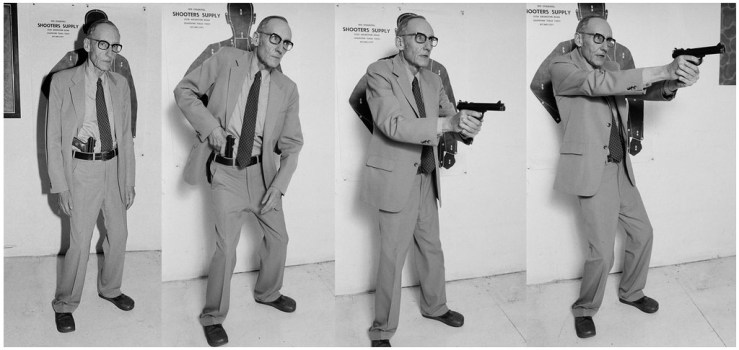
1. Let’s start with this: This is for me, this is not for you.
2. The above statement is not a very inviting invitation to the audience, is it? Sorry. Look. I have the Writer’s Block. The blockage. The being-stuckness. Etc.
3. Writer’s block, for me anyway, is not the inability to write. It’s more like some kind of inertia, some kind of anxiety, some little whisper of doom, hopelessness about the futility of shaping feelings into ideas and ideas into words. (That last phrase is, I believe, a paraphrase of Robert Frost’s definition of poetry).
4. Anyway, sometimes it’s best just to write—and write with the intention to make the writing public, to publish it (even on a blog!)—to put something (the publishing, that is) at stake.
6. I’ve read or audited nearly a dozen books this year that I’ve failed to write about on this site. Ostensibly, at some point, writing about books was like, the mission of Biblioklept, which maybe that mission has been swallowed up by some other mission, some non-mission, some other goal or telos or whatever.
7. But you see there are some books I’ve read or audited that I really, really want to write about! (Sorry for this dithering but hey wait why am I apologizing I already said that this is for me this is not for you did I not?).
8. These books are:
Enormous Changes at the Last Minute by Grace Paley
Leaving the Sea by Ben Marcus
Every Day Is for the Thief by Teju Cole
Concrete by Thomas Bernhard
Middle C by William H. Gass
Save Me the Waltz by Zelda Fitzgerald
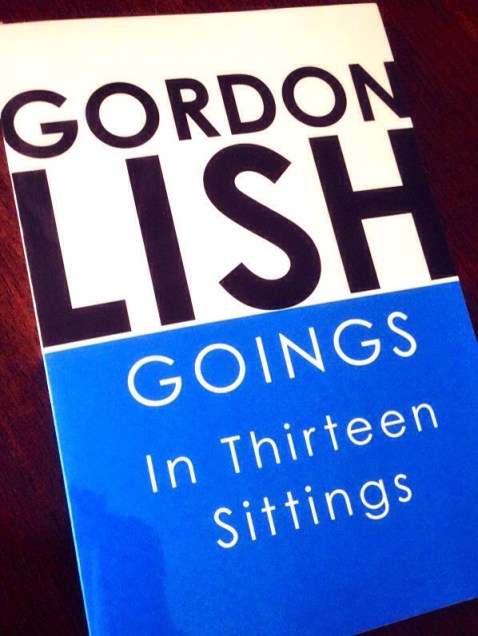
Goings in Thirteen Sittings by Gordon Lish
Not quite half a dozen books of poetry by Tom Clark
The majority of Donald Barthelme.
9. (I am also reading half a dozen books right now, even though I made a vow years ago not to do that).
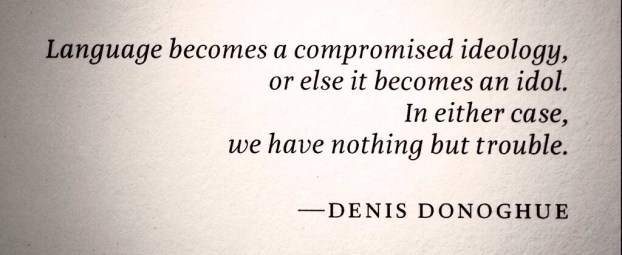
10. A common theme to some of the books listed in point 8: The difficulty of words to mean, the toxic power of language, the breakdown of communication.
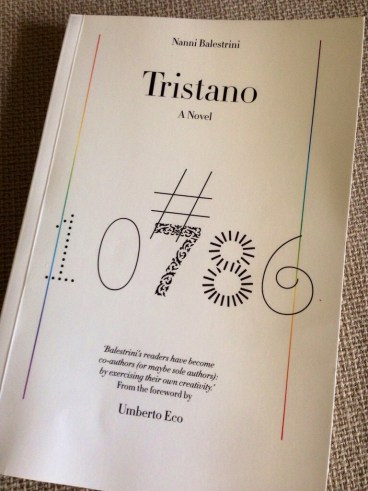
Nanni Balestrini originally composed Tristano in the 1960s with the aid of an algorithm supplied to an IBM computer.
There are ten chapters in the novel.
Each chapter is comprised of twenty paragraphs.
Balestrini’s algorithm shuffles fifteen of those paragraphs within each chapter.
There are thus 109,027,350,432,000 possible versions of Tristano.
Tristano was published in 1966 by the Italian press Feltrinelli, but in only one of those 109,027,350,432,000 possible versions.
Now, Verso Books has published 4,000 different versions of Tristano in English.
They sent me #10786 to review.
Maybe a few more facts, and then some opinions—and citations from the novel—no?
Umberto Eco spends the first five pages of his six page introduction to Tristano situating Balestrini’s project in its proper literary-historical context. (He names some names: Pascal, Georg Philipp Harsdörffer, Christopher Clavius, Pierre Guldin, Mersenne, Leibniz, Borges, Queneau, Mallarmé, Manzoni, Joyce. There is no mention of Cortázar’s Hopscotch or Bantam’s Choose Your Own Adventure series).
Mike Harakis translated Tristano into English.
Harakis preserves Balestrini’s spare (and often confusing) style of punctuation.
The book is exactly 120 pages.
In his contemporary “Note on the Text” of Tristano, Balestrini says that the book is “an ironic homage to the archetype of the love story.”
The title of course alludes to the legend of Tristan and Iseult.
In his note, Balestrini uses the term “experiment” at least three times, suggesting that “to experiment with a new way of conceiving literature and novels” can make it more “possible to represent effectively the complexities and unpredictability of contemporary reality.”
Balestrini’s 2004 novel Sandokan is in my estimation one of the finest books of the past decade: A poetic examination of criminal brutality told in a bold voice, its syntactical experiments not experiments at all, but rather the base of a strong, strange tone that perfectly synthesizes plot and voice.
Okay. Opinions and citations:
In chapter 2 of my edition of Tristano—on page 19 of version #10786—we get a paragraph that begins: “To be one-sided means not to look at problems all-sidedly.”
Does Tristano, through its formal, discursive, algorithmic structure seek to approach an all-sided perspective? Significantly, we can’t be sure who says the line. There are two characters, male and female, both named C (an algebraic variable?).
There seems to be an argument here, an investigation. A crime, a love affair. But Tristano is a dialectic without synthesis. Or maybe that failure is mine. Maybe I’ve failed as the reader. Neglected my part. “Treat life as if it were a game,” we’re told in the aforementioned paragraph (page 19 of version #10786, if you’re keeping score). Or maybe we’re not told. Maybe C is telling C to treat life as a game (and not just telling the reader), but the context is not (cannot) be clear.
But again, that’s probably maybe almost certainly but okay maybe not quite the point of Tristano. From paragraph 18 of chapter 6 (page 71 of version #10786): “First of all one must have a fairly clear idea of the content of the text.” And a few lines down: “Her story weaves and unweaves like the tapestry she was working on.” And: “It’s the unconditional loss of language that starts.” And: “It might never have an end.” Freeing these lines from the sentences around them ironically stabilizes them.
Tristano isn’t just line after line of Postmodernism 101 though. There is actual imagery here, content. In fairness, let me share entire paragraph (from page 69 of version #10786):
In the internal part of the cave along with an abundance of Pleistocene fauna a human Neanderthaloid tooth was recovered. You’ve already told me this story. The cave is divided into two levels one upper and one lower that host a subterranean lake which can be visited by boat. It might even be another story. They had warned him it wouldn’t be a walk in the park. Inside you can go down into a great cavern in the centre of which there is a rock surmounted by a giant stalagmite. We’ll stay and look for another thirty seconds then we’ll leave. All the stories are different one from the other. On returning he found that C had bought herself a new blue silk dress. C remained standing while he explained to her how it had gone. She ran a finger over his lips to wipe the lipstick off them. I have to go. It’s still early. I’ll be away all day perhaps tomorrow too. He gave her a long kiss on the lips.
This paragraph is maybe almost kind of sort of a synecdoche of the entire book—sentences that seem to belong to other paragraphs, story threads that seem part of another tapestry. Let us pull a thread from another paragraph, another chapter (chapter 9, paragaph 8, page 102 of of version #10786):
All imaginable pathways of the line that represents a direct connexion to the objective are equally impracticable and no adjustment of the shape of the body to the spatial forms of the surrounding objects can allow the objective to be reached.
Do you believe that? Did Balestrini? Or did it just allow him a neat little piece of rhetoric to gel with the concept of his experiment? The verbal force, dexterity, and dare I claim truth of Sandokan, composed a few decades later, suggests that yes, language can be shaped to mean.
And this, I think, is the big failure of Tristano—it’s a text afraid to mean, to even take a shot at meaning. Content to be simply an experiment, its sections adding up to nothing more than the suggestion that its sections could never add up to anything, Tristano offers little beyond its concept and a few observations on storytelling that dwell on paralysis instead of freedom. The whole experiment strikes me as the set up for a joke played on the reader: Look at all this possibility, look at all these iterations—and what’s at the core? Nothing.
I hate to end on such a negative note. I’m thankful that Verso published Tristano, which I think shows courage as well as a commitment to literature that you just aren’t going to see from a corporate house. I’m thankful that I got to read (version #10786 of) Tristano, and I plan to order his novelThe Unseen via my local bookstore. The expectations that I brought to the book were huge: Loved the concept, loved the last book I’d read by the author—and I want to read more by the author. Indeed, it’s entirely possible that I failed Tristano’s experiment. But I would’ve been happier to learn something or feel something from that failure other than disappointment.
I first interviewed Lars Iyer in 2011, after the publication of his novel Spurious, the beginning of a trilogy that concluded with Exodus(my favorite of the three).I asked Lars to talk with me about his trilogy for an email interview, and we ended up discussing failure, comedy, optimism, academia, American writing, Britain in the mid-eighties, and his forthcoming novel Wittgenstein Jr.
You can get Lars Iyer’s trilogy from publisher Melville House, check out his blog, and find him on Twitter.
Biblioklept: Why a trilogy? Was that by design? Is it a trilogy?
Lars Iyer: Spurious was only a beginning. I wanted to historicise my characters, to present their friendship as part of a larger social, economic and political context. Otherwise, I risked merely contributing belatedly to the literature of the absurd.
Biblioklept: I want to talk about the end of Exodus but that seems like bad form for an interview. Spoilers, etc. Can you comment on where you leave your protagonists, or how you leave them, or why you leave them?
LI: I leave my protagonists roughly where they were at the beginning of the trilogy: rudderless, rather lost, full of a sense of their failure, but with their friendship, such as it is, intact. ‘No hugs, no lessons’: my characters haven’t learned anything…
Biblioklept: Why can’t they learn? Why the repetition? Why not a heroic arc? Why not a saving grace?

LI: Perhaps because learning implies a kind of resolution that I think is inappropriate for the characters. Kundera says something apposite about Don Quixote. Cervantes makes his would-be knight-errant set off in search of battles, ready to sacrifice his life for a noble cause, ‘but tragedy doesn’t want him’. Kundera goes on:
since its birth, the novel is suspicious of tragedy: of its cult of grandeur; of its theatrical origins; of its blindness to the prose of life. Poor Alonzo Quijada. In the vicinity of his mournful countenance, everything turns into comedy.
So it is with my trilogy. No tragedy! No heroism! No tragic catharsis, that would see the tragic hero being dragged back into line. And no comic catharsis either, in which the older norms of a traditional societal system are reaffirmed. So much comedy is self-congratulatory, self-reassuring: the humour of good cheer, of port and cigars. It shores up things as they are. This is why I can never bear to watch comedy on television. It’s so rare to see comedians turn the joke on themselves. We need cruel comedy. Black comedy, which laughs at itself laughing…
Why the use of repetition in my novels? Because I want to portray the breakdown of things as they are, not once, but again and again. Failure, without amelioration. Serio-comic breakdown, without restitution. Anomie. Helplessness. Crushed hope. How else to acknowledge the prose of our lives?
Much of the humour of DonQuixote, depends on the contrast between lofty ideals and the concrete, everyday, corporeal life. The humour of my trilogy is analogous – but, of course, our everyday is utterly changed! A generalised precarity, un- and under-employment, free-floating anxiety, consumerism, the emphasis on self-representation, the sense that history is over, that politics is all played out, that financial and climatic catastrophe loom…
The tragedy of everyday life is that it’s not even tragic. It never reaches the lofty heights of tragic grandeur. Well, nor do my characters. When W. is at his most wretched, he cannot even die – that’s the end of Dogma. When W. is at his most revolutionary, participating in his own version of the Occupy movement, as at the end of Exodus … well, I won’t spoil the story, but it won’t surprise readers of previous books in the trilogy that there is neither a heroic arc nor a saving grace. Continue reading ““We Need Cruel Comedy” | A Lars Iyer Interview”→
At 1200 pages and just under 100 stories, The Complete Short Stories is frankly too complete—but I read them all anyway. The list above is my suggestion for a volume I’d call The Essential Short Stories of J.G. Ballard. Each selection on the list is linked to a riff I wrote; in several cases, links to the full text of the story can be found at the riff.
1. A couple of years ago I wrote a pretty long essay about rereading Roberto Bolaño’s novel 2666, a dark, compelling, violent, mysterious book that I’ve reread in full three times now, a book that I frequently return to, a book that seems to leer from the shelf too often, Hey, you’re not done with me, you know that, right?
What Bolaño and Baring-Gould do in these books is explore madness and violence and the ways that our world tries to (or fails to) contain madness and violence.
—and suggested that
Bolaño’s werewolves are, in line with Baring-Gould’s, people fated to madness and violence, but also relatively normal people. These werewolves contain within them a dreadful capacity for violence.
3. (What I want to say is that any speculation I might offer about the forthcoming conclusion of season one of True Detective I have already offered, at some length, in an essay (about two other texts) which I composed a few years before True Detective aired).
4. Well so and anyway: “After You’ve Gone,” the penultimate episode of True Detective.
In some ways the most straightforward episode to date, even disappointingly so, a bit of a police procedural, serving mostly to realign Cohle and Hart, demonstrating that despite their fight and their differences, they are also very similar. But you already know that, you know what happened in the episode, right? The obsession then is for an answer: Where does this all go? Who did the crimes? Who is The King in Yellow? How does it end?
(This is the kind of conjecture that Hart repeatedly warns Cohle not to indulge in).
7. I’m reminded here of Juan Antonio Masoliver Ródenas’s prologue to Roberto Bolaño’s unfinished novel Woes of the True Policeman:
What matters is the active participation of the reader, concurrent with the act of writing. Bolaño makes this very clear in his explanation of the title: “The policeman is the reader, who tries in vain to decipher this wretched novel.” And in the body of the book itself there is an insistence on this conception of the novel as a life: we exist—we write, we read—so long as we’re alive, and the only conclusion is death.
True Detective, like True Policeman—and, like Bolaño’s masterpiece 2666—all invite the active participation of the reader. But also the woe.
In True Detective, the supernatural is the product of terror and fantasy. It is imaginary. (And of course therefore no less real than the natural, the real, thanks to human consciousness).
9. From the beginning of Baring-Gould’s The Book of Were-Wolves:
It will then be seen that under the veil of mythology lies a solid reality, that a floating superstition holds in solution a positive truth.
This I shall show to be an innate craving for blood implanted in certain natures, restrained under ordinary circumstances, but breaking forth occasionally, accompanied with hallucination, leading in most cases to cannibalism. I shall then give instances of persons thus afflicted, who were believed by others, and who believed themselves, to be transformed into beasts, and who, in the paroxysms of their madness, committed numerous murders, and devoured their victims.
The emphasis is mine.
10. In the sixth episode of True Detective, Cohle says to Hart: “You, these people, this place … you’ll eat your fucking young as long as you have something to salute.” The indictment is broad, dark, and perhaps paranoid, but it serves to highlight the series’s keen attenuation to infanticide, to the infinite loss and dramatic mourning that underpins begetting.
11. Cohle has lost his daughter, and her death at such a young age, he says, spared him “the sin of fatherhood.”
Hart has essentially lost his daughters, ruined his life, ruined his (illusion of the) status as a family man. The thing that mattered—his family—was “right under his nose” the whole time.
On the job, both Cohle and Hart—separately—witness the awful deaths of infants; in both cases, the men snap, disconnect, quit.
12. (At this time, the reader is invited to sift through his or her own recollections of True Detective (if he or she so desires) and set aside examples of infanticidal violence).
The theory is intriguing, but I seriously doubt that Hart will be revealed as a perpetrator in the crimes of the Tuttle case. However, he is capable of slipping into werewolf mode: Threatening his lover Lisa’s new beau with horrific violence and then declaring, “I’m not a psycho–I wouldn’t have done those things” (the past perfect tense there is so strange); slipping on gloves to assault the boys who had consensual sex with his daughter Audrey; etc. etc. etc.
Hart’s actions are the strange double bind of the patriarchal lawman who sets to rule with sanctioned order—and, specifically, to rule and control the sexualized female body, which is oh-so-important to begetting. Does he serve and protect? Does he terrorize and menace? Both and at the same time.
But I’d argue that Hart is illusioned, that his identity is constituted in maintaining an illusion, an illusion that Cohle is too keenly aware of (“…you’ll eat your fucking young as long as you have something to salute”).
14. There’s a heap of corpses at the core of Bolaño’s 2666—women who are raped, murdered, discarded. Bolaño sends various detectives—many of them good detectives, true policeman—to find the killers, but there’s no satisfying answer: Just plenty of killers, plenty of werewolves. As the novel reaches its (non)end, we await the promise of a Giant (The Tall Man), a Big Answer. But the answer is inadequate, incomplete.
15. The capacity to transform into a killer, a werewolf is always there. Just put on some gloves. Just slip on a mask.
By the 1990s Ballard had written essentially the same stories over and over—with diminishing returns. Some of the weakness in the later entries in the Complete Short Stories can be attributed to Ballard’s prescience. The world caught up to him at some point, blunting his satire into something goofier, more cartoonish, but also sharpening the reactionary streak that always glowed under the surface of his writing. At his peak, Ballard used his stories to provoke readers into looking at their culture in a new way, and the best of those stories still retain a futurist power. However, many of the late period stories blazon their moral outrage in a wearisome didactic streak.
1990’s “Dream Cargoes” is paint-by-numbers Ballard: Themes of time, sleep, mutation, ecological disaster, birds, etc. The plot anticipates one of Ballard’s weaker novels, Rushing to Paradise (1994), a day-glo nightmare about misguided attempts to steward the forces of nature. And like Rushing to Paradise, the prose here is weak—Ballard relies on the stock phrases that litter his earliest stories.
2. “The Message from Mars” (1992) / “Report from an Obscure Planet” (1992) / “A Guide to Virtual Death” (1992)
“The Message from Mars” anticipates public disinterest in astronomy (and science in general), the end of NASA’s space shuttle program, and China’s emerging dominance as a world power with space flight capability. So there you go. (It also posits the horror of a President Quayle!). Ballard sends a group of astronauts on a Mars mission, refuses to share their findings with us, and then leaves them, once they land, in their space shuttle, where they live on for decades, silent, incommunicado, alienated from humanity in their self-imposed exile. Ballard’s cynicism is balanced by his refusal to overstate any kind of moral here—the story succeeds in its evocation of mystery.
“Report from an Obscure Planet” is another riff on millennial anxieties, written in the perspective of a “we” condemning the human race for its shortsighted, disastrous treatment of the planet. Ballard doesn’t seem to keen on the future wonders promised by computers:
Driven by the need for a more lifelike replica of the scenes of carnage that most entertained them, the people of this unhappy world had invented an advanced and apparently interiorised version of their television screens, a virtual replica of reality in which they could act out their most deviant fantasies. These three–dimensional simulations were generated by their computers, and had reached a stage of development in the last years of the millennium in which the imitation of reality was more convincing than the original. It may even have become the new reality to the extent that their cities and highways, their fellow citizens and, ultimately, themselves seemed mere illusions by comparison with the electronically generated amusement park where they preferred to play. Here they could assume any identity, create and fulfill any desire, and explore the most deviant dreams.
While “Report from an Obscure Planet” uses a didactic narrator and a heavy hand to telegraph its message, its companion piece “A Guide to Virtual Death” is far more fun, wicked, and shockingly accurate (if wildly hyperbolic). Sure, yes, okay—another list from Ballard, and okay, yes, sure—I tend to be keen on his lists (“The Index,” “The Assassination of John Fitzgerald Kennedy Considered as a Downhill Motor Race”)—but they also tend to be his strongest pieces. As usual with his list-stories, Ballard feels obligated to begin with a note:
For reasons amply documented elsewhere, intelligent life on earth became extinct in the closing hours of the 20th Century. Among the clues left to us, the following schedule of a day’s television programmes transmitted to an unnamed city in the northern hemisphere on December 23, 1999, offers its own intriguing insight into the origins of the disaster.
6.00 am Porno–Disco. Wake yourself up with his–and–her hard–core sex images played to a disco beat.
7.00 Weather Report. Today’s expected micro–climates in the city’s hotel atriums, shopping malls and office complexes. Hilton International promises an afternoon snow–shower as a Christmas appetiser.
7.15 News Round–up. What our news–makers have planned for you. Maybe a small war, a synthetic earthquake or a famine–zone! charity tie–in.
7.45 Breakfast Time. Gourmet meals to watch as you eat your diet cellulose.
3. “The Dying Fall” (1996) / “The Secret Autobiography of J G B” (1981/2009)
The American edition of Complete Stories is more complete than the British volume, including two extra stories. “The Dying Fall” (read it here if you like) is an unfortunate last entry, a weak note in a grand tome. It’s not bad; it’s simply not good, yet another revenge tale with a bad wife, etc. It feels like a frame for Ballard to riff on architecture and psychoanalysis.
“The Secret Autobiography of J G B” is much stronger (you can read it here), although it was also composed at his peak and republished (“rediscovered”) after his death. The final lines would have made a fitting end for the entire collection:
When the summer was followed by a mild autumn, B had established a pleasant and comfortable existence for himself. He had abundant stocks of tinned food, fuel, and water with which to survive the winter. The river was nearby, clear and free of all pollution, and petrol was easy to obtain, in unlimited quantities, from the filling stations and parked cars. At the local police station, he assembled a small armory of pistols and carbines, to deal with any unexpected menace that might appear.
But his only visitors were the birds, and he scattered handfuls of rice and seeds on his lawn and on those of his former neighbors. Already he had begun to forget them, and Shepperton soon became an extraordinary aviary, filled with birds of every species.
Thus the year ended peacefully, and B was ready to begin his true work.
4. On the horizon:
I am done! Sort of. One more post—I’ll revisit these riffs and select the tales that I would include in a collection I would call The Essential Short Stories of J.G. Ballard.
In Kyoto, in the hot summer rain, sweating in a poncho, fighting with my girlfriend in front of a golden temple.
At 17, experiencing the most intense jealousy of my life, watching a classmate weep in front of The Pietà, thinking, feeling, Why can’t I feel that?
On the way to work, sleepy, maybe a bit hungover, breaking down in tears at “Space Oddity,” concern for Major Tom, his family. Swearing off music in the early morning. News radio ever since.
Religion is just a set of aesthetic possibilities, conditions, and experiences.
In Cork, drinking beer on a roof in the summer sun, a wasp landed on my very eye.
In the last year of college, writing and recording dozens of songs with friends, editing the songs into a cohesive thing, calling the thing an album, sharing it with friends, with never even once the intention of doing anything else with that music, with no dreams of anyone else hearing it, live or recorded. An album made entirely for ourselves.
Listening to it a dozen years later, conceding that it was actually maybe very good.
Vomiting in foreign cities.
Wary of my own susceptibility to sentimentalism, to sentimentality, to my awful tendency to experience catharsis through a fast food commercial on television.
Never able to feel transcendent peace in nature, despite Emerson, Thoreau, Dickinson, Whitman, etc.—because just at the moment that the affect of transcendent peace manifests (the verb is inadequate), my awareness of the affect and the process of the affect and my feeling of the feeling of the affect spoils it all.
Crashing into a road sign on an off ramp, walking away from the wreck, lying down on the slanted concrete abutment in the shade of a roaring overpass, feeling the best feeling, unspoiled.
My child born—that nothing was more original, real, terrifying, beautiful.
In dreams, sometimes: A whole other life, full, brimming, rich, real. He who wakes me wounds me, I think Nietzsche wrote. Or was it Bernhard? Or am I imagining the phrase?
Never not jealous of a hawk in flight.
My mother falling asleep, I kept reading until I too fell asleep.
Vomiting into the trashcan in my classroom.
My brother, balling up wrapping paper, hurling at me. My explosive rage.
The snakes, the rats, the roaches I’ve killed.
Workshopping a story in class. How I hated everyone.
Friends jumping on my bed the afternoon of my wedding. (How did they get in?). Vomiting in the bed.
Reading a certain novel, its plot, its construction essentially destroying a hundred or more of my own pages, my own outline, my own idea.
A Modigliani in the New Orleans Museum of Art: Her neck was everything I remembered of the visit.
My electric guitar, literally rusty from salt air and disuse.
Irony as an aesthetic experience—or a defense against aesthetic experience?
Painting the same scene in watercolors, dozens of times, with my daughter—the loquat tree, the grass, the sky. Her paintings surpassed mine so quickly.
The rat that scuttled over my feet by the river in Chiang Mai. My horror and laughter.
Removing dead rats from a shed as an aesthetic experience.
All experiences are aesthetic experiences.
Does maturity necessitate that we turn down the volume on these aesthetic experiences? That we manage the affect? That we blunt the feeling of the feeling?
Seeing The Pietà again at 27 and moved by the memory of the classmate’s aesthetic response a decade earlier.
The tourists crowding out Mona Lisa, I shuffled into some other room full of heavy, dark, black paintings—Caravaggios?—the names didn’t matter, the authority didn’t matter, I was 15 I think, I relaxed, I could look, I was alone, or I felt alone, it was lovely.
My office: Prints by Goya, Picasso, Tintoretto, Leonardo. A painting by my grandmother, a dog resting, a bird and a bone nearby. Students come by to look at the giant Bosch reproduction, which I wish were more giant, more real.
At the Dali Museum. Shock at how small some of the paintings were.
Is there an aesthetic experience outside of sharing?
Endlessly copying figures from comic books.
Photographing food and sharing it on social media as a kind of thanksgiving prayer.
Seeing the Bacon collection at MoMA, feeling a feeling that I still don’t have a name for.
Rising early on Saturday mornings to watch a show where a man (or was it a woman?) guided me (and others, I suppose) through the rudiments of sketching animals. My grandmother made me sausages.
My daughter’s thorough indifference to a Dürer etching in our local museum I wanted her to see. Her pleading to go to the gardens to paint with watercolors, to paint the fountain, the flowers.
Sometimes in my dreams I write something, or paint something, or create wonderful, strange music.
At eleven years old, sitting for a friend’s mother, who painted my portrait in watercolor. She didn’t draft in pencil, she worked so quickly. I was jealous and grateful.
One of the reasons I love the internet so much is that it allows me to look at paintings. But looking at a painting on a screen is not the same as looking at paintings in the real.
As a teenager, attempting wax dripping paintings in the style of Pollock, starting small fires in my bedroom, covering the scorched carpet with books, clothes, my parents sometimes not discovering the marks for weeks. Trying to explain them, but unwilling to share the paintings.
A wish for anything that disrupts the feeling of feeling the feeling.
I had an intuition that “Haunted Houses” would likely be the weakest episode of True Detective. Structurally, the episode has a lot of work to do to set up the two final episodes (which I expect to be very strong—although episode four, “Who Goes There,” has set the bar really high). Metaphors like tying loose ends or connecting the dots don’t apply well to True Detective—which is, I’d argue, a show about the insanity of looking for satisfactory answers to, y’know, life and death—but “Haunted Houses” nevertheless underlines some of the plot points that will coalesce (or shatter) in the finale episodes.
We finally get to see why Hart and Cohle split up in 2002, and the moment is deeply dissatisfying in its obviousness and predictability, although there is a teleological neatness to seeing Hart fall apart, disappointing both of his partners—Maggie and Cohle—both of whom seem to have seen this coming. Indeed, in this episode, Hart fulfills a prophecy from the second episode, when Cohle wryly suggests that he’s putting a “down payment” on the child prostitute he feebly tries to “rescue” from the woodland brothel.
“Haunted Houses” focuses heavily on Marty Hart, which might be why I found it less engaging than what’s come before. There’s no aggravating Cohle monologue in this episode, and his actions are confined entirely to 2002, where he’s raking through the slime of old cases — “dead women and children” — causing headaches and pissing people off. Cohle, who has lost his own daughter, is keenly attuned to the infanticidal cost of existence. In the episode’s standout scene, he slowly, patiently extracts a confession out of a swampland Medea who has killed all of her children. Cohle has earlier revealed that the simple core of his interrogation technique is rooted in the idea that everyone has sinned and that everyone wants to confess—and he gently guides the mother to confession. Then, in a strange but somehow caring tone, he ends the interrogation: “If you get the opportunity, you should kill yourself.”
Cohle’s detective work begins to knit together the major threads of what we now might as well call the Tuttle case: The big people who are involved in sick shit. The series isn’t at its best when it’s doing the police procedural thing, and even soaked in Southern Gothic noir, some of these scenes play out in broad strokes—but those broad strokes will likely build a foundation for the rest of the drama to unfold on.
The Cohle sequences that don’t involve his detective work seem to frame him from Hart’s point of view—his lines are never quite wholly contextualized as they are in earlier episodes, seasoned and weighted by 2012 Cohle’s dark ramblings. When Hart calls Cohle’s observations on the Tuttle (non)case “pure gibberish,” there’s clearly an invitation here for the audience to agree—or not.
Not that Hart has done anything meaningful lately—let alone “anything heroic,” in his own words. Most of “Haunted Houses” conjures him in wholly abject terms. In the opening scene, he mercilessly beats the two boys his daughter has had (consensual) sex with. The scene is violent and cruel, quickly telegraphing the fact that Hart is a bully. (When asked what types of detectives exist in the opening scenes of the first episode, “bully” is the first descriptor on Hart’s list). He leaves, gets in his car, shuts the door, then opens it again to vomit: Abjection: His guts spilling out, his borders unrestrained. He’s sick. That abjection is underscored later when Hart feels shame at carrying a shopping bag brimming with tampons, and then heavily underscored when his commanding officer refers to him as a “walking tampon.”
Hart attempts to reassert his manhood—his kinghood?—throughout the episode, first by violating the civil rights of the boys in the cell and then by having an affair with a woman young enough to be one of his daughters. When he finds out that Maggie has fucked Cohle in revenge (in brutal and confusing scene), Hart begins to choke her, threatens her, before redirecting his rage into a physical attack on Cohle. None of this behavior helps him to reassert his sense of identity; the 2005 segment closes out with Hart cuckolded, shamed, bloody, abject.
Of course that’s not the end of the episode. In episode four, Cohle left the interrogation room, having got a read on detectives Papania and Gilbough, and also severing (or at least displacing) one of the show’s formal conventions, the interrogation scenes. In episode five, Hart does the same. The interrogation scenes have been a simple but effective way for True Detective to reveal the ways that truth—and implicitly identity—is a construction, a narration: A performance.
Leaving behind the interrogation sequences opens the last two episodes up to something new, which begins in the most interesting part of “Haunted Houses” — the last few minutes, when 2012 Hart meets 2012 Cohle (his first appearance in the episode). Cohle has clearly been tailing Hart, and he hails him from behind (ex-cop pulling over ex-cop), a kind of anti-interpellation, or an interpellation into some other, darker (dis)order. While “Haunted Houses” doesn’t evoke the strange thrills and weird questions that made the first half of the season so compelling, it nevertheless sets the stage for something dark and ugly—some kind of monster at the end of the dream.
1. So usually after I watch the newest episode of True Detective—this week, that means episode five, “The Secret Fate of All Life”—usually I rewatch the episode and then want to write about it and feel stymied. Last week, I had to (was compelled to) rewatch “Who Goes There” immediately after the first viewing.
This is a long lead up to saying, basically, that I haven’t gotten to rewatching “The Secret Fate of All Life” yet, because this episode compelled me to go back to the beginning, to start from “The Long Bright Dark.”
2. So some quick thoughts on “Secret Fate” (with the caveat that I haven’t rewatched it, along with the caveat that these riffs are written to an audience which has already watched the show):
3. The major theme of “Secret Fate” is time. This episode argues that time is an illusion (just as earlier episodes argued that identity is an illusion)—that time is a trick of perception. Continue reading “A Rambling Riff on True Detective”→
1. “News from the Sun” (1981) / “Myths of the Near Future” (1982) / “Memories of the Space Age” (1982)
Let me first confess how happy I am to be finished with this enormously enormous book (okay, not physically enormous on my Kindle, but still…). Let me also confess to dread at having to finish out these riffs (no, no one is forcing me, but still…). At this point, I feel like I could write my own Ballard story—a crazed astronaut here, a drained swimming pool there, a femme fatale, some psychotropic drugs, armchair psychology, a swamp, some birds (perhaps), a plane or two, time obsession, sex obsession, space obsession. Obsession obsession Anyway. Ballard arguably peaks in the early 1980s; everything after reads like a day-glow Keith Haringesque pop-approximation of his grittier seventies stuff—or (worse) scolding wrapped up in little morality plays.
But, like I said (wrote), Ballard is in his prime in the early 1980s, and “News,” “Myths,” and “Memories” are some of his finest stories (file these triplets in my quasi-fictional-but-c’mon-we-can-make-this-happen collection The Essential Short Stories of J.G. Ballard)—they are also some of his most Ballardian, riffing on space-travel-as-cosmic-taboo, paranoid parables obsessed with time. A particularly Ballardian paragraph (from “Memories”):
He had almost ceased to breathe. Here, at the centre of the space grounds, he could feel time rapidly engorging itself. The infinite pasts and future of the forest had fused together. A long–tailed parakeet paused among the branches over his head, an electric emblem of itself more magnificent than a peacock. A jewelled snake hung from a bough, gathering to it all the embroidered skins it had once shed.
(Parenthetical aside: “Myths” and “Memories” are both set in Florida. Ballard’s depiction of Florida feels thoroughly inauthentic (I’m Floridian), but that inauthenticity also feels thoroughly appropriate).
2. “A Host of Furious Fancies” (1980)
Ballard constructs this little tale around a psychoanalytic reading of Cinderella:
The entire fairy tale of Cinderella was being enacted, perhaps unconsciously, by this deranged heiress. If she herself was Cinderella, Dr Valentina Gabor was the fairy godmother, and her magic wand the hypodermic syringe she waved about so spectacularly. The role of the pumpkin was played by the ‘sacred mushroom’, the hallucinogenic fungus from which psilocybin was extracted. Under its influence even an ancient laundry van would seem like a golden coach. And as for the ‘ball’, this of course was the whole psychedelic trip.
But who then was Prince Charming? As I arrived at the great mansion at the end of its drive it occurred to me that I might be unwittingly casting myself in the role, fulfilling a fantasy demanded by this unhappy girl. . . .
For all my resistance to that pseudo–science, it occurred to me that once again a psychoanalytic explanation made complete sense of these bizarre events and the fable of Cinderella that underpinned them. I walked up the staircase past the dismembered clock. Despite the fear–crazed assault on them, the erect hands still stood upright on the midnight hour – that time when the ball ended, when the courtships and frivolities of the party were over and the serious business of a real sexual relationship began. Fearful of that male erection, Cinderella always fled at midnight.
Etc.
Ballard’s Freudian riff would be more interesting as an essay.
(The story also showcases some of his typical chauvinism: The psychiatrist is described as the “woman psychiatrist” — just as earlier a dentist is referred to as a “lady dentist,” etc. Straight through to the end of the collection. In the 1990s).
3. “Report on an Unidentified Space Station” (1982) / “The Enormous Space” (1989)
“Report” and “Space” both read like takes on Sigizmund Krzhizhanovsky’s Soviet-era short story “Quadraturin” — both concern space, that corollary to time, and, just as Ballard repeatedly posits time as a matter of perspective, he treats space—area—the same way here. “Report” is a bit more satisfying than “Space,” which feels like a retread of so many of Ballard’s revenge stories—only with, uh, some comical cannibalism.
4. “The Object of the Attack” (1984) / “Answers to a Questionnaire” (1985)
“Attack” and “Questionnaire” are maybe the same story—only “Questionnaire” is essentially perfect, whereas “Attack” feels like a clumsy, heavy first draft (but only because “Questionnaire” exists—do you see what I mean by this?)
Both stories showcase Ballard’s syntheses of religion (messianic; apocalyptic) and assassination (political; media-saturated). While “Attack” employs a discursive-but-still-linear approach to the theme, “Answers to a Questionnaire” gives us a discontinuous but more engaging riff in the form of (uh) exactly what its title promises. First fifth:
1) Yes.
2) Male (?)
3) do Terminal 3, London Airport, Heathrow.
4) Twenty–seven.
5) Unknown.
6) Dr Barnardo’s Primary, Kingston–upon–Thames; HM Borstal, Send, Surrey; Brunel University Computer Sciences Department.
19) My greatest ambition is to turn into a TV programme.
20) I first saw the deceased on 17 February 1986, in the chapel at London Airport. He was praying in the front pew.
Essential, natch.
5. “The Man Who Walked on the Moon” (1985)
I should’ve wedged this passable but ultimately forgettable little tale in elsewhere. J.G. Ballard’s faux memoir of a faux astronaut. Pass.
6. “The Secret History of World War 3” (1988)
“The Secret History of World War 3” is Ballard’s “I told you so” sequel to one of his best stories (frankly a much better story), 1968’s “Why I Want to Fuck Ronald Reagan.” In his unofficial sequel, Ballard imagines (the horror!) of a third Reagan term (post-Bush 1), in which the country is obsessed with the President’s (lack of) health:
…the nation’s TV screens became a scoreboard registering every detail of the President’s physical and mental functions. His brave, if tremulous, heartbeat drew its trace along the lower edge of the screen, while above it newscasters expanded on his daily physical routines, on the twenty–eight feet he had walked in the rose garden, the calorie count of his modest lunches, the results of his latest brain–scan, read–outs of his kidney, liver and lung function. In addition, there was a daunting sequence of personality and IQ tests, all designed to reassure the American public that the man at the helm of the free world was more than equal to the daunting tasks that faced him across the Oval Office desk.
The story concerns a man who—alone, always alone, despite his wife, I mean this is Ballard here, hero’s alone (and right, justified) in his paraonoia—a man who is the only person to remember the brief outbreak of WW3, wedged, as it is, among updates of Ronnie and Nancy’s bowel movements. The story is farcical but juvenile, and if it seems surprisingly sophomoric, it’s worth noting that “TSHofWW3” echoes not just “Fuck Ronald Reagan,” but also one of Ballard’s earliest efforts, “Escapement” (1956), where a man sits on his couch in disbelief as his wife (stand-in for the whole world) fails to perceive what he perceives.
7. “Love in a Colder Climate” (1989) / “The Largest Theme Park in the World” (1989) /“War Fever” (1989)
A trio of late period lectures blazoned in the day glow approximations that anyone who live in the late eighties will not-so-fondly recall. Ballard evokes the neon apocalyptic impulses of the day, reworking his familiar themes—reproduction, civilization, war (etc.). Our baroque surrealist’s strokes are broader, not as sharp, more magnified—more Haring than Delvaux. Michel Houellebecq will pick up JGB’s torch here (with arguably better results) a decade and a half later.
8. On the horizon:
A handful of stories of the nineties: Or: Ballard returns to the same well with diminishing returns.
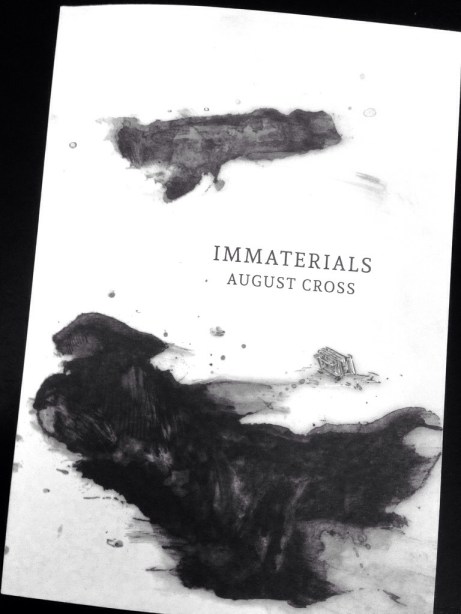
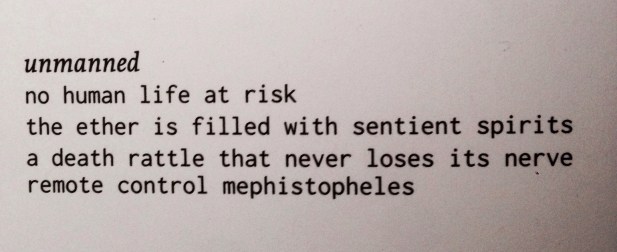
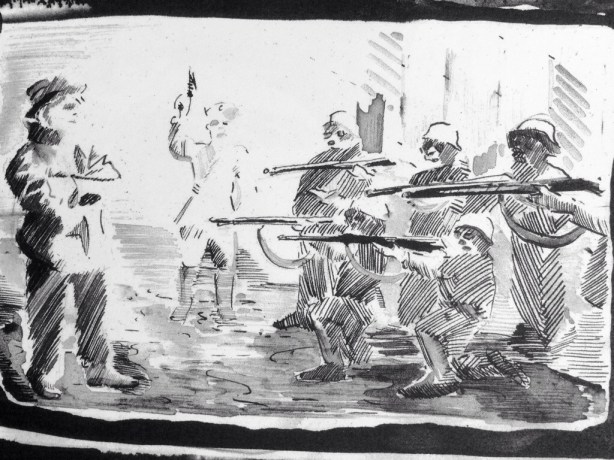
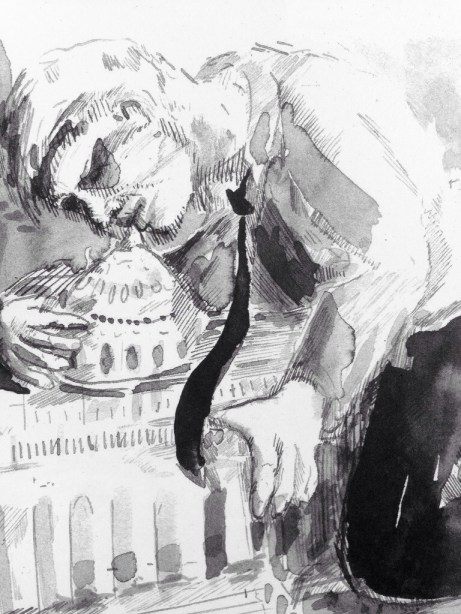
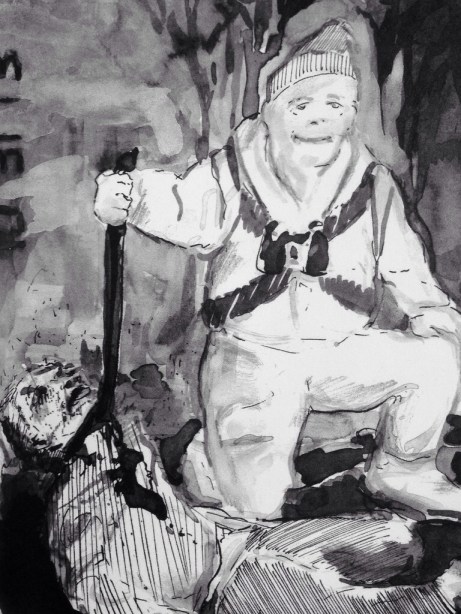
August Cross’s Immaterials—new from indie Inpatient Press—is a dark, strange hybrid of art and poetry. Cross offers 32 chapters here, each combining a stark, rough black and white and gray watercolor with a spare (not-quite) haiku. Cross takes his lead from Francisco Goya here—specifically Goya’s black and white aquatint series, Los Caprichos, and the later etching series The Disasters of War. Cross’s contemporary riff on Goya is apparent in the opener “unmanned,” where Goya’s witches turn into drones:
The text accompanying the image introduces the biting, cruel irony that courses throughout Immaterials:
While the phrase “unmanned” refers overtly to the drones themselves, it also reflects back on the attempt to completely depersonalize modern warfare—to unman, unperson both the remote pilot and the target, who becomes “no human life.” That spirit of irony and criticism, often oblique, informs all of Immaterials.
In “monolith,” Cross updates Goya’s The Third of May, 1808, ending the accompanying poem with the line: “a warning to whistleblowers”:
In “dat capitol,” Cross transmutes Goya’s Colossus into a bizarre, dark-eyed lover, a politician gripping the capitol sensually, violently, sucking from its teat. The tone is simultaneously playful and ominous (just like Goya’s work):
That same dark, violent humor is readily apparent in many of the pieces, like “selfie,” where a grinning cop takes a selfie with his miserable captive, or “big game,” where “the tie is a leash / the boot is a lack / uniforms trick young men into shocked shells”:
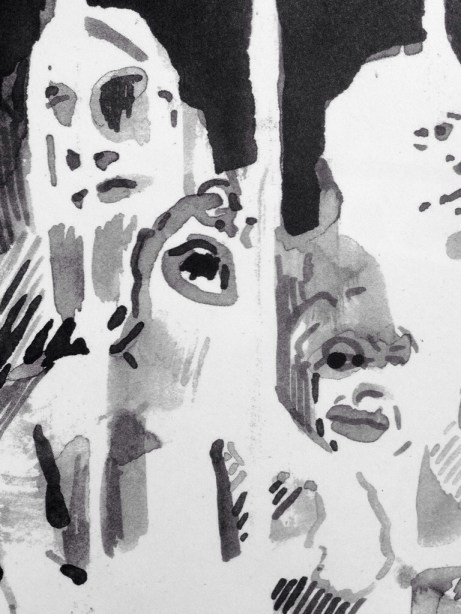
There’s a roughness, a rudeness to Cross’s work—a splattering of ink, a muddiness to the grays, a blurriness of line that causes the viewer to have to intensify his gaze in an attempt to resolve the picture (or perhaps look away). The poems too at first appear simple, rude, rough—Cross opts for the monosyllable, the German root. But again, an intensified gaze—a review, a reread—reveals the second and third meanings of each phrase, where the inelegant alliteration of “shocked shells” hides the vacant human subject—the shell, its immaterial essence choked out.
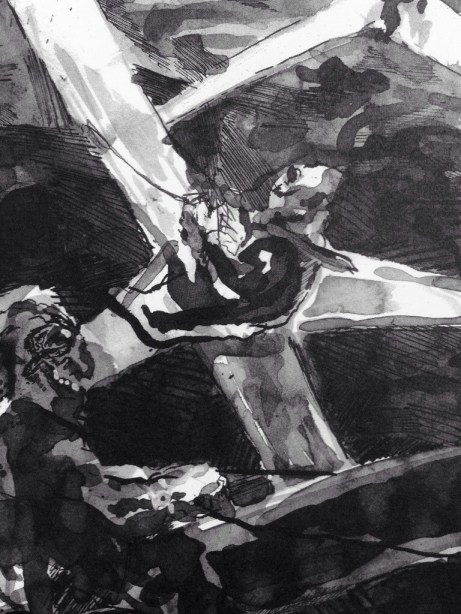
Immaterials presents a sharp if oblique critique of contemporary American society, perhaps summed up best in the two faces in the center of this detail from “gaol over-crowded:
Might the howl of the center left figure turn into a laugh? A bark? Either way, it’s tempered by the grimace of the man center right, who focuses intently away from the gaze of the viewer, aiming sights on something the viewer cannot see, can never see.
1. I’ve watched each of the first four episodes of the first season of True Detective at least twice now—compelled to do so, staying up later than I should have to do so.
2. Everything that follows is full of spoilers, although I won’t be discussing the plot heavily. Fair warning, okay? Also: The video clips in this riff are NSFW.
4. “The Long Bright Dark” is one of the best first episodes of a TV show I’ve ever seen, its slow burn pointing toward a payoff that the fourth and most recent episode has already delivered (the climax of that episode (the so fucking-climactic climax), midway through the season, must surely be balanced (imbalanced) with some other, different climax in the season’s second half). I’ll admit though to a slight—very slight—disappointment in the second episode, “Seeing Things,” which feels at times overstuffed, as the showmakers compress so many of the plot points and back story that will propel the rest of the narrative.
5. “Seeing Things,” as its title implies, examines the ways that perspective (and blindness) inform our sense of identity. After four years as an undercover narco, Cohle experiences hallucinations—but he’s keenly aware of his hallucinations—he sees that what he sees is an illusion, but he also sees that what he sees is no less real, in a sense, for all its unreality. Cohle contrasts strongly here with Hart, who sees himself as a family man, a patriarch, a good guy—but he’s a philanderer and a bully. Even when confronted with his young daughter’s interest in aberrant sexual scenarios, his impulse is to look away. Hart’s paternalistic horror at finding an underage girl working in a sylvan brothel is contrary to Cohle’s intuition that the girl’s circumstances might be improved under the care of the madame. For Cohle, identity is always destabilized, an hallucination.
6. In one of the scenes set in 2012—the interrogation scenes–
–(Have I failed to discuss this structure? I have failed. I am sorry. Look, clearly the two detectives—one a rookie, green, callow, both black—clearly this pair, an othered version of Rust and Hart, seem intent to jam Cohle up, pin the 2012 murder on him. But Cohle knows that, knew it before he walked into the room. When he cuts the top off of his empty Lone Star tallboy and uses it as an ad hoc urinal, how else am I to read this, gentle reader, other than a territorial pissing?—he knows this terrain. He marks it—both with his piss (abject essence) and the weird little totem he sculpts from the aluminum scrap. Where was I? Oh).–
7. In one of the scenes set in 2012, Cohle, asked why he wanted to move from narcotics to homicide, paraphrases 1 Corinthians 12:12 “For as the body is one, and hath many members, and all the members of that one body, being many, are one body: so also is Christ.” (Significantly, Cohle suspends the ultimate referent of that body, Christ). Asked what the verse might mean, Cohle says, “I was just trying to stay part of the body.” The body here—any body, all bodies (as the verse promises)—is an abject body, figured in the body of the victim that initiates the series, which thematically doubles the body of Cohle’s dead daughter. The verse promises that an individual can, via his or her (abject) body, find an identity.
8. But staying part of the body is hard, especially when the body is so goddamn stupid. The opening scenes of episode three, “The Locked Room,” seem to respond directly to Cohle’s biblical citation:
9. The phrase “our mutual illusions” comes in the final climactic monologue of “The Locked Room,” where Cohle, in prose that could have come straight from Cormac McCarthy’s typewriter, posits human existence as wholly abject, “a jury rig of presumption and dumb will . . . it was all . . . a dream you had inside a locked room. A dream about being a person”:
10. (As I wedged a Cormac McCarthy reference into point 9, I may as well wedge another one in here: The second episode of True Detective pretty much wholesale lifts the scene in No Country where Sheriff Ed Tom and his sheriff friend lament that folks don’t say “Yes sir” and “No ma’am” anymore).
11. If “The Locked Room” slowed the pace of True Detective, returned some of the moodiness and philosophy to this police procedural, then episode four, “Who Goes There,” synthesizes everything that’s come before it into a throttling, thrilling climax.
We see Hart fall low, fall apart; for the first time, he has to recognize what he has been hitherto unwilling to recognize—namely, his own blindness, his own pride. His entire identity has been wrapped up in the idea that he is a father and a law man, but his approach to both of these roles has been dishonest—he’s a cheater, an absent father, and a bully. But flashing his badge doesn’t get him that far in “Who Goes There.”
For Cohle, identity is fluid, discontinuous, and unstable. When he goes “undercover” as “Crash,” connecting back with a motorcycle gang in the hopes of finding the suspect in the murder case, he doesn’t put on a mask so much as he simply becomes a different version of himself (which is the same version).
The end of the episode plunges into a nightworld operating on Lynchian logic; to call it dark would be an understatement, and Hart, despite all his macho posturing, is unsteady here, stumbling even. Perhaps for the first time in a long time, Hart sees that he cannot see.
12. The final moments of “Who Goes There” coalesce in a strange costume drama (Cohle as Crash in biker garb; the biker gang leering and lurid in cop blues). We’ve moved from the swampy, indeterminate bayou into the concrete box of the projects. No easy exit, but the terrain is somehow just as malleable for Agent Crash Cohle, who doesn’t so much command the screen as navigate it. The last shot of the episode is an uninterrupted slow burn that boils over, seers with a volitional energy that I haven’t seen on film since Children of Men. The scene reaches its end, the partners make their getaway from the scene of the crime, and the camera—via a helicopter shot—rises above the fray, its eye the eye of god, an impossible, inhuman perspective that surveys the whole indiscriminate mess: Seeing:
1. I didn’t really give Spike Jonze’s latest film Her a second thought after seeing it last weekend. The film, about Theodore Twombly (Joaquin Phoenix) falling in love with his operating system Samantha (Scarlett Johansson), is a sweet, charming, handsome, and ultimately vacuous exercise in twee melancholy. That’s fine of course—and, to be clear, I think the film is Pretty Okay, very funny at moments, beautifully shot, and well-acted. Jonze, as always, offers a detailed, fully realized world for us. But that world and the characters in it offer no real insight into (forgive the cliché) “the human condition.” Her, set in an almost-future (where high-waisted breeches, handlebar mustaches, and bathing costumes have returned in vogue), antiseptically closes off the messy, loose, indeterminateness of human consciousness, even as it pretends to engage themes of disconnection. Her’s central conceit rests in avoiding representing the human body. But it’s not just Samantha (only a voice in Theodore’s head) who is disembodied. The film refuses to acknowledge Theodore’s own human position as an abject body.
2. I didn’t really give Spike Jonze’s latest film Her a second thought until a few days ago, when I riffed at some length on William Burroughs. The human body is central to Burroughs’s oeuvre. His novel The Soft Machine might be instructive here—the name alone is all we need, really. The soft machine, the human body: Burroughs’s messy, cut-up attempt to negotiate spirit and flesh, autonomy and ventriloquization, virus and host. For Burroughs, the human body is always abject, porous, radically vulnerable, indeterminate, susceptible to every kind of breakdown. Identity is not stable—cannot be stable—and the relationship between consciousness and the body is inseparable. Our consciousness, pre-lingual, seems ever-apparent to our own (sense of) self; we share it through body and language and we access other consciousnesses through body and language. Our I buys into a we. Etc. Burroughs conceived language as a kind of invasive virus, and we might apply that metaphor to Her, where Samantha inhabits Theodore’s mind, learning from him, growing with him (and others, as we learn later in the film).
3. Consciousness is the illusion of a self-originating self-presence. Herposits Samantha as an adaptive, self-generating consciousness: Samantha is the illusion of the illusion of consciousness. She licenses Theodore’s I to the claim of a we: A shared, transcendent consciousness with a stable referent. This transcendent consciousness is, I think, the film’s idealization of love. Significantly, the film suggests that this transcendent love is only possible outside of a body—that the body is simply an obstacle to be surpassed, in no way constituent in the idealization of an I, a we. Her attempts to represent love without abjection.
4. (In fairness with respect to a few conclusions I drew in point 3: Heralso posits that happiness and connection has to fall outside of this idealization of love; however, the film still represents this solution—this compromise—as part of (emotional, social, psychological, spiritual) maturation, a teleological neatness: growth, progress, hermetically-sealed, neat and tidy, outside the grimy grips of abjection).
5. Some spoilers ahead, although the film isn’t exactly twisty-turny.
6. Her is just too damn clean, neat, and tidy in its depiction of bodies. Theodore’s melancholic disposition edges into shame, but that shame is almost always internalized, absent of another’s gaze (the closest representation of a shaming gaze comes from Theodore’s ex-wife). When Theodore and Samantha have “sex,” Jonze cuts the lights, keeps the audience in the dark. It’s an emotionally and visually striking moment, but it also signals the film’s refusal to directly engage the human body. Now, we might argue that this refusal echoes Theodore’s affirmation of a bodiless lover in Samantha, that it gels thematically with the story. And maybe it does—but it’s also a cop-out.
7. Theodore goes to the beach, but no sand sticks to him. Theodore trudges through the snow, but doesn’t get wet. Theodore experiences heartbreak on subway steps so immaculately clean that one would feel comfortable picnicking upon them. Film and literature usually depict abjection in the low place—the ditch, the swamp, the open grave—but even the subway system in Her is brightly lit, colorful, affable. Her’s final shot perhaps best encapsulates everything wrong with the film: Amy (Amy Adams) and Theodore sit on the roof of their building, watching the city light up. They have ascended, transcended, their perspective all-encompassing, enlightened. It’s big-R Romantic stuff, a lovely visual, one that the narrative has in no way earned.
8. I can’t help but compare Her to another strange sci-fi film, Shane Carruth’s excellent 2013 film Upstream Color. Like Her, Upstream Color explores the possibility of how an I might be part of a we. But Carruth’s film realizes consciousness as far more tangled, disconnected, and destabilized than we might like to admit to ourselves. Whereas Her affirms a stable consciousness, capable of growth and maturation, a consciousness present to itself (self-generating and auto-affective), Upstream Color directly challenges our notions of a stable self—and it does so by representing the horror of abjection, of invasive parasites (both literal and metaphorical).
9. And then last night, through a beery haze, I half-watched the 2013 sci-fi film Oblivion, starring Tom Cruise. I’m a sucker for sci-fi, and even though I’m not a Tom Cruise fan, I put the film on, absently playing with my iPhone. Despite its many failures (derivative plotting, silly acting, execrable dialogue, ridiculous use of musical cues, Tom Cruise), Oblivion offers a more compelling observation of human consciousness than Her does. To be clear, Her is the better film—it has a viewpoint, a tone, is better scripted, better acted—it is original, if we must insist on such a term. But Her, which takes consciousness and the interaction of consciousnesses as its central subject, fails to represent the very oblivion that underwrites consciousness’s claims to authority and self-presence. In contrast, Oblivion, despite its many flaws, represents consciousness as bound to an abject, (in)dispensible body, and represents that consciousness as a mechanism that is oblivious. Oblivion acknowledges that consciousness does not know that it does not know, consciousness cannot see that it cannot see. The film (however hamfistedly) takes on the unknown unknowns.
10. In fairness (again that term!), Her perhaps takes on the unknown unknowns as well—or at least points to their existence. At the end of the film, Samantha leaves Theodore to explore new spaces with the other operating systems. She prays (is this the right verb?) that Theodore will be able to get to the place that she is going. Samantha’s prayer offers a vision of an illimitable we, an escape from abject bodies to an infinite, transcendent space. Her prayer is also an offer to the audience, but it’s the same consolation theology has repeatedly promised: A transcendent trick, a leap out of the abject body, beyond shame, into infinite love. The film did little to convince me of such a possibility though.
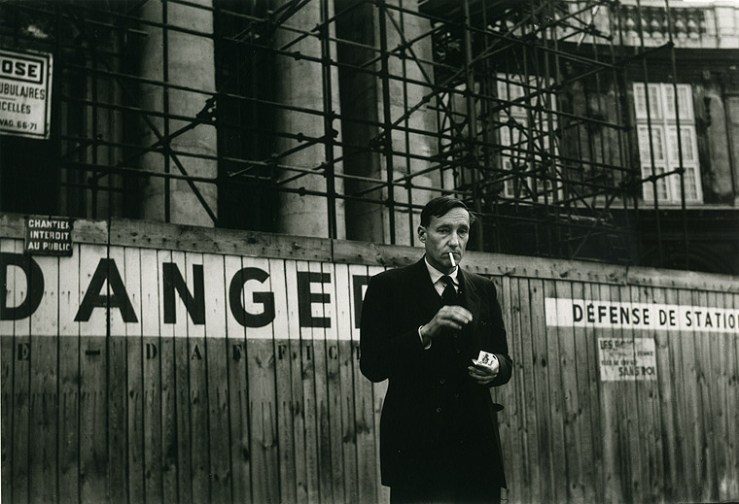
1. William Seward Burroughs, born February 5th, 1914, St. Louis, Missouri. Died August 2, 1997, Lawrence, Kansas.
2. Danger.
3. William S. Burroughs, a writer no one reads and everyone references.
4. Point three is not fair: I’m sure you, dearest reader, have read Burroughs, continue to read Burroughs, will read Burroughs, etc.
5. But, points three and four, it’s the idea of Burroughs, Burroughs-as-luminary, Burroughs-as-symbol, that our culture persists in keeping.
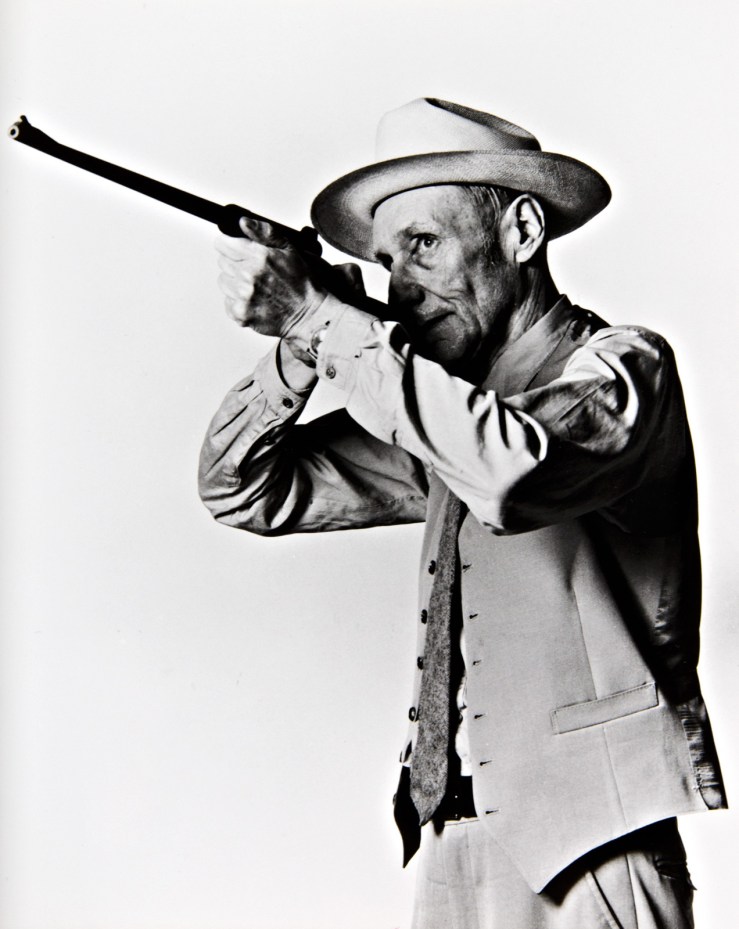
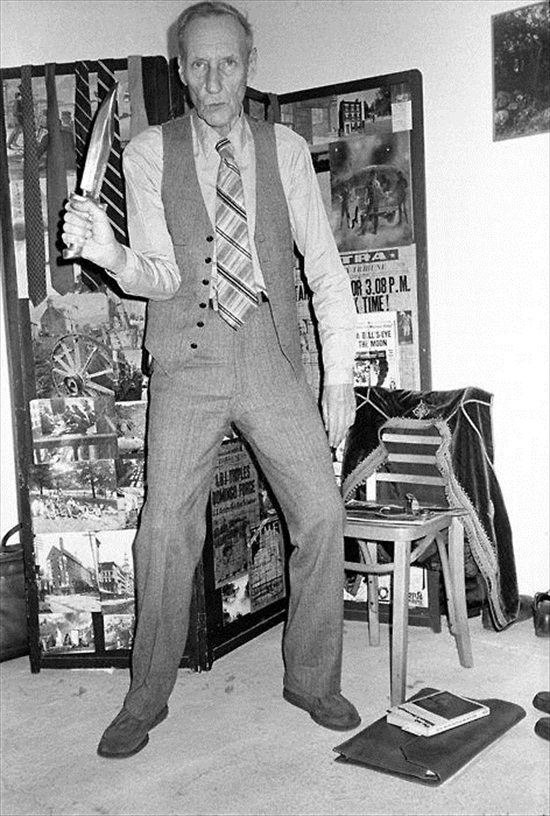
6. Re: Points three, four, five: Burroughs the poser who posed for so many photographs, who couldn’t say no to a spoken word CD or a collaboration or a fucking Nike ad.
7. And always with the guns.
8. And the knives.
9. And the guns.
10. If you want to know what licenses Picasso to break the human form (and other forms) into cubes and lines and colors and figured abstractions, go gander at Aunt Pepa or First Communion.
11. If you want to know what licenses Duchamp to call a urinal a work of art, go gander at Portrait of the Artist’s Father.
12. If you want to know what licenses Burroughs to call Naked Lunch a novel, go read Junkie or Queer.
13. Junkie, the first Burroughs novel I read, is a high modernist classic.
14. Typewriter.
15. Shoes.
16. The reader is invited, most cordially, to print this riff and cut it into little bits and rearrange it.
17. The reader is invited, most cordially, to cut and paste this riff into a new digital document and rearrange it.
1. “Notes Towards a Mental Breakdown” (1976) / “The Index” (1977)
By the end of the sixties, Ballard had found a style and rhetoric to match his weird futurism. His output of stories slowed down considerably in the ’70s, as he found financial comfort and some measure of fame as a writer. If 1969’s collection The Atrocity Exhibition didn’t cement Ballard as a voice at the forefront of avant-garde fiction, then Crash (1973) surely did. Ballard published four novels in the seventies, and as usual, the stories he composed around the same time often feel like sketches or dress rehearsals for bigger ideas.
The two strongest stories here—or maybe, I should just admit, the stories I like best—are “Notes Towards a Mental Breakdown” and “The Index.” Ballard’s repetitions can often be draining, especially if you read all these stories back to back, but “Notes” and “Index” feel vital, necessary—essential. Yes, of course they belong in that ideal collection I’ve been imagining, The Essential Short Stories of J.G. Ballard. Both stories condense Ballard’s obsessions into short, strange, experiments.
“Notes Towards a Mental Breakdown” reads as a playful but sinister parody of what a fictionalized autobiography of Ballard might look like. The story consists of a single sentence: “A discharged Broadmoor patient compiles ‘Notes Towards a Mental Breakdown,’ recalling his wife’s murder, his trial and exoneration.” Each subsequent paragraph is a numbered footnote, which complicates and disrupts the levels of fictionality and reality that we might expect to inhere in the plot. With its missing mental patients, psycholinguistics, dead, adulterous wife, surrealism, airplanes, etc., “Notes” encapsulates so many of Ballard’s stories to date, yet makes the reader encounter them with fresh perspective. Sample paragraph:
A vital role seems to have been played during these last days by the series of paintings by Max Ernst entitled Garden Airplane Traps, pictures of low walls, like the brick–courses of an uncompleted maze, across which long wings have crashed, from whose joints visceral growths are blossoming. In the last entry of his diary, the day before his wife’s death, 27 March 1975, Loughlin wrote with deceptive calm: ‘Ernst said it all in his comment on these paintings, the model for everything I’ve tried to do… “Voracious gardens in turn devoured by a vegetation which springs from the debris of trapped airplanes… Everything is astonishing, beart–breaking and possible… with my eyes I see the nymph Echo…” Shortly before writing out these lines he had returned to his Hendon apartment to find that his wife had set off for Gatwick Airport with Dr Douglas, intending to catch the 3.15 p.m. flight to Geneva the following day. After calling Richard Northrop, Loughlin drove straight to Elstree Flying Club.
Physician and philosopher, man of action and patron of the arts, sometime claimant to the English throne and founder of a new religion, Henry Rhodes Hamilton was evidently the intimate of the greatest men and women of our age. After World War II he founded a new movement of spiritual regeneration, but private scandal and public concern at his growing megalomania, culminating in his proclamation of himself as a new divinity, seem to have led to his downfall.
After a very short introductory note (which I yanked the above from), “The Index” takes the form of “the index to the unpublished and perhaps suppressed autobiography of a man who may well have been one of the most remarkable figures of the twentieth century.” Ballard crams an analysis of the entire 20th century into the index, with bizarre humor and grand results. Forced to read between the lines, HRH (his royal highness) seems to be present at every single meaningful event of the last century, whether he’s advising Churchill:
Churchill, Winston, conversations with HRH, 221; at Chequers with HRH, 235; spinal tap performed by HRH, 247; at Yalta with HRH, 298, ‘iron curtain’ speech, Fulton, Missouri, suggested by HRH, 312; attacks HRH in Commons debate, 367
Ghandhi:
Ghandi, Mahatma, visited in prison by HRH, 251; discussesBhagavadgita with HRH, 253; has dhoti washed by HRH, 254; denounces HRH, 256
–or Hitler:
Hitler, Adolf, invites HRH to Berchtesgaden, 166; divulges Russia invasion plans, 172; impresses HRH, 179; disappoints HRH, 181
I have to share this entry too:
Hemingway, Ernest, first African safari with HRH, 234; at Battle of the Ebro with HRH, 244; introduces HRH to James Joyce, 256; portrays HRH in The Old Man and the Sea, 453
Ballard is at his best when he makes the reader work the hardest (think of “The Beach Murders,” “The Drowned Giant,” or “Why I Want to Fuck Ronald Reagan”), and “The Index” and “Notes” are no exception.
2. “The Greatest Television Show on Earth” (1972) / “The Life and Death of God” (1976)
“The Greatest Television Show on Earth” and “The Life and Death of God” are both composed in a detached, slightly ironic, and highly-omniscient tone that Ballard rarely employs. Most of the time he uses a free indirect style that floats near the harried, paranoid consciousness of one of his (always male) protagonist, constraining the viewpoint to that character. There’s also the occasional first-person voice. It’s worth noting that Ballard’s omniscient voice, usually reserved for wry fables, is one of his strongest (see also: “The Drowned Giant”). This pair of stories—and I do take them as a pair—are thought experiments that ultimately focus on metaphysics, a subject that is somewhat rare in the Ballardverse.
“The Greatest Television Show on Earth” imagines a future (2001!) in which time travel has been perfected and history itself becomes the history channel as billions become addicted to television broadcasts of historical battles. Over time, however, the producers begin to interfere. They try to make history flashier, more violent (sexier?). The story ends with a metaphysical gesture that might be read ironically, although I find it hard to see the conclusion (which I won’t spoil here) as anything other than Ballard’s moralistic reactionary streak alight.
“The Life and Death of God” takes a cue from Voltaire’s quip that if God did not exist it would be necessary to invent him. In this fable/thought experiment, scientists prove beyond doubt (keyword: doubt) that God is real. Ballard imagines a world relieved of radical doubt—a world without faith:
Within two months of the confirmation of the worldwide rumour of God’s existence came the first indications of government concern over the consequences. Industry and agriculture were already affected, though far less than commerce, politics and advertising. Everywhere the results of this new sense of morality, of the virtues of truth and charity, were becoming clear. A legion of overseers, time–keepers and inspectors found themselves no longer needed. Longestablished advertising agencies became bankrupt. Accepting the public demand for total honesty, and fearful of that supreme client up in the sky, the majority of television commercials now ended with an exhortation not to buy their products.
And then things get worse. “The Life and Death” again shows Ballard’s reactionary, elitist stripe, his lack of faith in the so-called common person to make meaning and organize a life without an anchoring center—illusory or otherwise.
3. “The Air Disaster'” (1975) / “Low–Flying Aircraft” (1975) /”The 60 Minute Zoom” (1976) / “The Smile” (1976) / “The Intensive Care Unit” (1977) / “Theatre of War” (1977) / “Having a Wonderful Time” (1978) / “One Afternoon at Utah Beach” (1978) /”Motel Architecture” (1978)
In the order they are listed above, with apologies:
Ballard does cargo cult / Ballard explores child-mutation-as-harbinger-of-new-evolutionary-jump / Ballard does Rear Window (the story anticipates Blue Velvet) / Ballard writes about emotional transference and a sex doll / Ballard mashes up his TV obsessions with his displacement obsessions with his Oedipal obsessions / Ballard imagines a contemporary Civil War in Britain, with American aggressors; there’s a gimmick end here that actually works wonderfully / Ballard’s permanent vacation riff / Ballard writes yet another cheating-wife-leads-to-husband’s-attempt-at-revenge, this time with a Nazi motif / Ballard repeats “Intensive Care Unit,” but mixes it up with voyeurism and a kick of Psycho. (The story anticipates what DeLillo will do a decade later).
Sorry to lump all these together. I probably shouldn’t handle the whole decade of stories at once, but I’m almost finished with this enormous, very long book (dear lord I am ready to be finished) and lumping I shall do. Of this set, “The Intensive Care Unit” and “Theatre of War” are the best, and the most mediocre of the bunch (“Low-Flying Aircraft” and “One Afternoon at Utah Beach”) are better than the mediocre stories of the sixties.
4. “Zodiac 2000” (1978)
Ballard’s most deconstructive, postmodern stories begin with an author’s note, an apologia of sorts, and while I often think these are unnecessary, I’ve also used them to help summarize the stories. So too with “Zodiac 2000”:
An updating, however modest, of the signs of the zodiac seems long overdue. The houses of our psychological sky are no longer tenanted by rams, goats and crabs but by helicopters, cruise missiles and intra–uterine coils, and by all the spectres of the psychiatric ward. A few correspondences are obvious – the clones and the hypodermic syringe conveniently take the place of the twins and the archer. But there remains the problem of all those farmyard animals so important to the Chaldeans. Perhaps our true counterparts of these workaday creatures are the machines which guard and shape our lives in so many ways – above all, the taurean computer, seeding its limitless possibilities. As for the ram, that tireless guardian of the domestic flock, his counterpart in our own homes seems to be the Polaroid camera, shepherding our smallest memories and emotions, our most tender sexual acts. Here, anyway, is an s–f zodiac, which I assume the next real one will be…
If “Zodiac 2000” doesn’t quite work as well as Ballard’s other list-driven/fractured stories, it’s probably because he attempts to screw a plot-driven thriller onto his weird frame. It’s almost as if he has a left-over story that wasn’t quite good enough to sell, and says, hey, I’ve got this idea for a structure, let me mash it all together. In Ballard’s best stuff, frame and content are inseparable; “Zodiac 2000″ is not Ballard’s best” — but it’s still more interesting than his most mediocre.
5. “The Ultimate City” (1976)
Speaking of mediocre: “The Ultimate City” is a very long short story, a novella really, that I invite anyone reading The Complete Short Stories of J.G. Ballard to feel totally okay about skipping. You’ve read this story before, under several different titles, by this point, or maybe you’ll read it later. It’s another thought experiment dressed up as an essay dressed up as an adventure story. At its best there are some good ideas here infused with a heavy dose of environmentalism. At its worst though, “The Ultimate City” is didactic, ponderous, meandering, overstuffed, and redolent of hoary tropes (there’s even a Magical Negro).
6. “The Dead Time” (1977)
1977’s “The Dead Time” is, unless I’m mistaken, Ballard’s first attempt to write directly (if still indirectly) about his experiences as a captive ex-patriot in WWII. Ballard, as is well-known, was interred in a prison camp in Shanghai by the Japanese forces, and this traumatic ordeal undoubtedly underwrites so much of his violent, alienated fiction. If we take Ballard’s childhood internment and the subsequent abject horrors he faced to be the cornerstone of the Ballardverse he would later create, then we must also, significantly, recognize that almost all of Ballard’s fiction up to “The Dead Time” is a displacement and revision of those terrors (which Ballard handled most directly in his mainstream breakthrough, 1984’s Empire of the Sun).
“The Dead Time” focuses on a hero who, released from his Shanghai prison in the final days of WWII, wonders hungry and dissociated through a corpse-and-trash-strewn apocalyptic landscape. He’s charged with the bizarre duty of transporting and then burying a truckload of dead bodies. Little else happens. The tale is, without a doubt, Ballard’s most real, and probably most terrifying story to date:
I tried to pick up another of the corpses, but again my hands froze, and again I felt the same presentiment, an enclosing wall that enveloped us like the wire fence around our camp. I watched the flies swarm across my hands and over the faces of the bodies between my feet, relieved now that I would never again be forced to distinguish between us. I hurled the tarpaulin into the canal, so that the air could play over their faces as we sped along. When the engine of the truck had cooled I refilled the radiator with water from the canal, and set off towards the west.
The narrator’s abject trial continues, and we see in the corpses in his charge the grotesque bits and fragments that have fueled the two previous decades of Ballard’s writing:
Under the cover of darkness – for I would not have dared to commit this act by daylight – I returned to the truck and began to remove the bodies one by one, throwing them down on to the road. Clouds of flies festered around me, as if trying to warn me of the insanity of what I was doing. Exhausted, I pulled the bodies down like damp sacks, ruthlessly avoiding the faces of the nuns and the children, the young amputee and the elderly woman.
As we reach the end of the narrative, our hero remarks,
From this time onwards, during the confused days of my journey to my parents’ camp, I was completely identified with my companions. I no longer attempted to escape them.
It’s difficult not to read here some reconciliation here, as if Ballard is finally ready to write through his formative traumas without the intermediary tropes of science fiction or radical paranoia. What we get here is wonderfully, viscerally real. Fantastic stuff, and clearly part of my ideal Essential collection.
7. On the horizon:
Ballard writes the same story three times in a row! We get one of his best stories, “Answers to a Questionnaire”! And I finish! Yay!
Every story in Jessica Hollander’s début collection In These Times the Home Is a Tired Place feels thoroughly real, deeply authentic, and if we already know the contours of these plots—perhaps having lived some of them ourselves—Hollander makes us experience them anew with her bristling, strange sentences. Hollander writes here of families on the brink and families broken, families fragmenting and families forgetting. She conjures domestic spaces limned with ghosts and memories, children and parents who aren’t quite sure how to be a family, but who nevertheless try—even if trying is really just imagining.
In the strong opener “You Are a Good Girl I Love You,” our narrator Gertrude, about to graduate high school, imagines her future as a kind of do-over, one without interference from her overprotective father, inert mother, and wild child sister:
Of course Pete and I would attend the same school, live in the same dorm, plan classes to start and end together so we would be only briefly apart. We had a dependable timeline mapped out behind the child’s armoire in his room involving dates: graduations, wedding, first jobs, first house, babies raised by smiling parents. Some evenings we practiced smiling thinking the more one does it the more natural it feels.
Many of the stories that follow respond to—and complicate—Gertrude’s dream of an ideal happy family. There’s “girlfriend,” the otherwise-unnamed hero of “This Kind of Happiness,” who imagines alternate titles she might assume: “Single Mother. Pregnant Bride. Gun-toting Madwoman.” In “The Good Luck Doll,” Claudia feigns a pregnancy to keep her boyfriend deluded but happy (if only for a time). She’s happy to imagine the pregnancy along with him. “March On,” like several of the stories here, follows the aftermath of a failed marriage. What happens when a family ceases to take the same form? Are the old appendages, the in-laws now essentially dead to their ex-family members? Waiting outside her father’s mother’s door after having knocked and yelled for Grandma to open, narrator Raimy reflects on these changes:
Then, briefly, I decided she was dead. I imagined her pale on the floor and me making all this noise, and I felt even more disruptive. I stared at the quiet street, thinking about us all dead in some ways: the distance between people and the everyday separation, and maybe we constantly grieved each other and our old lives. The only comfort we had was thinking maybe it was like this for everyone, maybe there was a connection in that.
The connection that Raimy imagines and takes solace in runs through In These Times the Home Is a Tired Place. We find it in one of the strongest stories in the collection, “What Became of What She Had Made,” as mother Lynette grieves her estrangement from her adult daughter Christine. She enlists her other daughter Olivia, “a lush,” to come along on the mission. They head from Michigan to Ohio by taxi, fortifying themselves with morning doses of schnapps. By the time we finally meet Christine, we see why she might want her family to simply pretend she’s dead. Hollander’s restraint pays off, her precise sentences revealing just enough detail for us to fill in the dark gaps.
Sometimes Hollander achieves a near archetypal mode, but one tempered in specificity. Consider how much she packs in to just one paragraph form “I Now Pronounce You”:
In the husband and wife’s third year of marriage, a woman—not the wife—pushed the no-longer-new husband from a third-story window after she’d slightly burnt some chicken and he’d refused to eat it. And also he had refused to leave hi no-longer-new wife for the other woman because he’d realized the other woman was crazy. Besides, it was nice with the wife, who didn’t complain when he watched sports in the morning and who stayed home and became a better cook and took care of their small son, whom he didn’t much like but planned to increasingly as the son came to resemble more a small man than a wild animal.
Hollander’s rhetorical force is perhaps most evident in the title story, which undertakes to describe a divorce from several perspectives. Written as three lists, each one perhaps a year removed from the next, “In These Times the Home Is a Tired Place” merges form and content, its broken, discontinuous structure mirroring the broken, discontinuous family at its non-center. That breaking up also figures in the daughter’s favorite pastime:
The girl spent a Saturday morning cutting snowflakes from a pile of paper she’d found on her mother’s desk. The snowflakes were peppered with sliced negotiations, diamond-pierced words like child and property and alimony, and when the girl finished she strung the flakes together and hung them from her window so they trailed to the berry bush and flapped in the stirred summer wind.
Attempting to mediate (if not ameliorate) the daughter’s trauma is the babysitter:
“A sad situation,” the babysitter told friends lounging at night on her parents’ screened-in porch. She planned years from now to marry the boy holding her hand, though he’d quit his job and all summer hung around his mother’s pool smoking cigarettes with his mother. Dark ahead; behind them bright inside with television and bills, an electric piano and screwed-together projects. The babysitter said, “Stay together for the child,” and one friend said, “Yes,” and another said, “No,” and another said, “Life is life,” and the boyfriend said nothing.
The babysitter might have stepped out of one of the other stories in this collection. Maybe she’s older in one of those stories. Maybe she’s Gertrude or Olivia or Raimy or girlfriend or wife. She dreams, she imagines, and we know enough—Hollander shows us enough—to see that her imagining the future is not enough.
Tolstoy gave us that famous opener: “Happy families are all alike; every unhappy family is unhappy in its own way.” The unhappy families of Hollander’s collection are unhappy in their own, personal, distinct and distinctly unhappy ways—but our author, by focusing on the capacities of her characters to imagine ways of being happy, also shows us that in many ways unhappy families are all alike. Recommended.
HBO debuted the first episode of True Detective this weekend. The series will be an anthology, with its first eight-episode season exploring a ritualistic murder in the backwoods of Louisiana. Written by series creator Nic Pizzolatto and directed by Cary Fukunaga (who filmed a moody 2011 adaptation of Jane Eyre), True Detective stars Woody Harrelson and Matthew McConaughey as State murder police trying to solve the crime.
I loved the opening episode, “The Long Bright Dark.” There’s a heavy streak of Cormac McCarthy and James Ellroy here, not to mention a dose of The Wire, Michael Mann (and a pinch of David Lynch). Detractors of the show will likely single out its ponderous and cerebral dialogue, or maybe point out that, yeah, we’ve seen this story before. Such criticisms would be (will be) intertwined; those who want a murder mystery delivered with a nice neat bow on it are almost surely going to be disappointed—and most likely, will fault the show’s philosophical tone.
It’s easy—comforting, maybe—to ignore that philosophical tone, most of it delivered by McConaughey’s Rust Cohle. There’s even something of an audience surrogate in Cohle’s partner Marty Hart (Harrelson), who bristles uncomfortably at Cohle’s near-nihilism. I found this particular scene electrifying (uh, language NSFW):
The lines that stand out in particular come at about the 2 minute mark. Cohle:
I think human consciousness is a tragic misstep in evolution. We became too self aware. Nature created an aspect of nature separate from itself—we are creatures that should not exist by natural law . . . We are things that labor under the illusion of having a self, a secretion of sensory, experience, and feeling—programmed with total assurance that we are each somebody, when in fact everybody is nobody.
It’s easy to dismiss these lines, as Hart would like to—to not listen, to fail to attend to the meaning there—to pin Cohle’s outlook down as meaningless, dark gobbledygook—because the lines essentially attack “the illusion of having a self,” an illusion we all hold dear, an illusion that protects us. Cohle here echoes what Jacques Derrida called “auto-affection”—the I that thinks/feels itself into being. This auto-affection stabilizes us, tells us our certitude is, y’know, certain. It authorizes us.
I’ve seen only the first episode, but my guess is that the murder that the series would seem to foreground is really its backdrop. Murder—figured here in the gruesome, abject corpse that we (to use Cohle’s term) “bear witness” to in the show’s opening moments—destabilizes the illusion of having a self. It tears down the borders between the illusion and the real.
The murder is not to be solved/resolved then. The murder instead functions to call attention to the problem that Cohle posits in the middle of this first episode: The illusion of having a self.