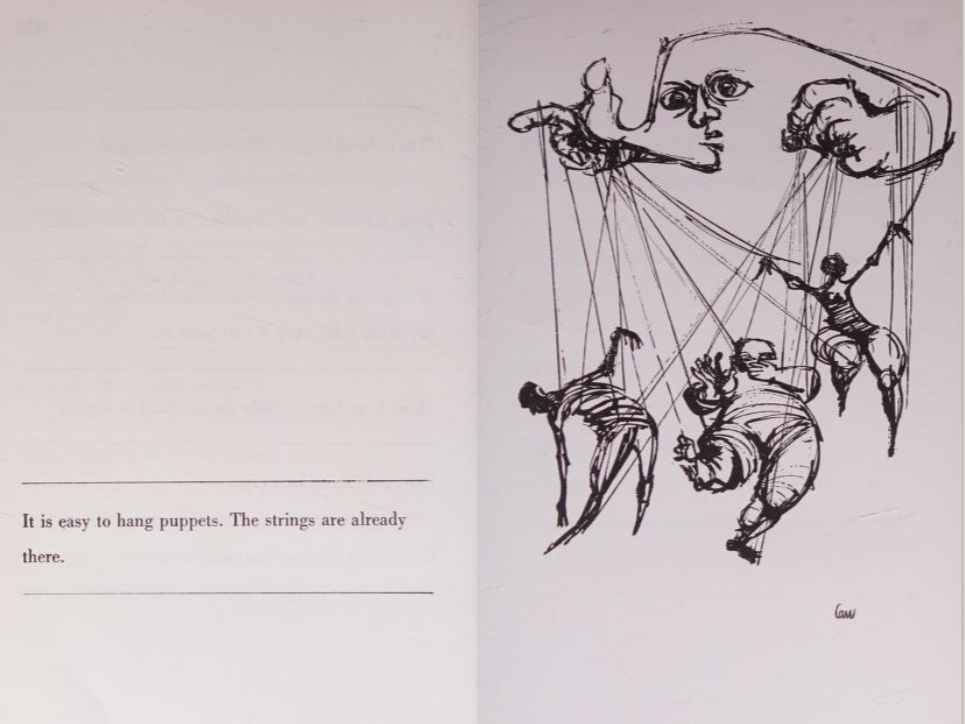
An aphorism from Stanislaw J. Lec’s Unkempt Thoughts with an illustration by Barbara Carr. Translation by Jacek Galazka.
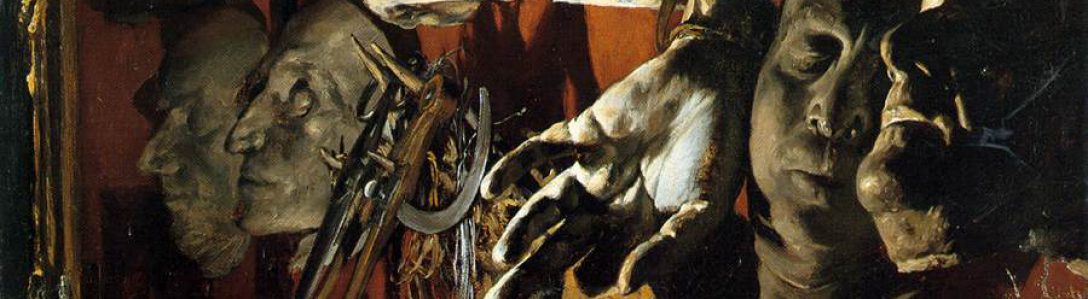
An aphorism from Stanislaw J. Lec’s Unkempt Thoughts with an illustration by Barbara Carr. Translation by Jacek Galazka.
Our perceptual relationship with the world works because we trust prior stories. We could not fully perceive a tree if we did not know (because others have told us) that it is the product of a long growth process and that it does not grow overnight. This certainty is part of our “understanding” that a tree is a tree, and not a flower. We accept a story that our ancestors have handed down to us as being true, even though today we call these ancestors scientists.
No one lives in the immediate present; we link things and events thanks to the adhesive function of memory, both personal and collective (history and myth). We rely upon a previous tale when, in saying “I,” we do not question that we are the natural continuation of an individual who (according to our parents or the registry office) was born at that precise time, on that precise day, in that precise year, and in that precise place. Living with two memories (our individual memory, which enables us to relate what we did yesterday, and the collective memory, which tells us when and where our mother was born), we often tend to confuse them, as if we had witnessed the birth of our mother (and also Julius Caesar’s) in the same way we “witnessed” the scenes of our own past experiences.
This tangle of individual and collective memory prolongs our life, by extending it back through time, and appears to us as a promise of immortality. When we partake of this collective memory (through the tales of our elders or through books), we are like Borges gazing at the magical Aleph—the point that contains the entire universe: in the course of our lifetime we can, in a way, shiver along with Napoleon as a sudden gust of cold wind sweeps over Saint Helena, rejoice with Henry V over the victory at Agincourt, and suffer with Caesar as a result of Brutus’ betrayal.
And so it is easy to understand why fiction fascinates us so. It offers us the opportunity to employ limitlessly our faculties for perceiving the world and reconstructing the past. Fiction has the same function that games have. In playing, children learn to live, because they simulate situations in which they may find themselves as adults. And it is through fiction that we adults train our ability to structure our past and present experience.
From Umberto Eco’s lecture “Fictional Protocols,” part of Six Walks in the Fictional Woods.
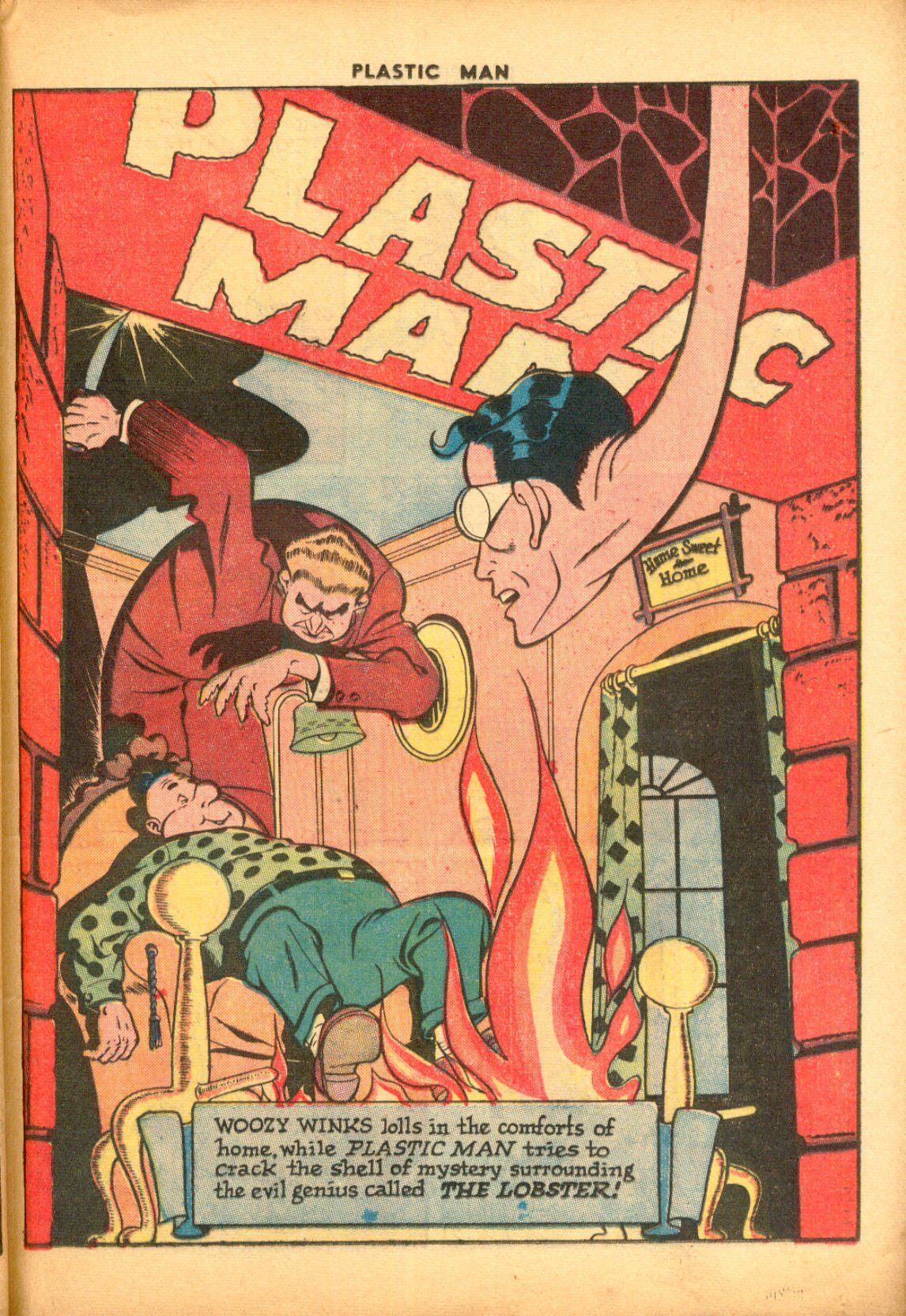
From “The Lobster” by Jack Cole, Plastic Man #4, July 1946, Quality Comics.

Paul Kirchner’s surreal comic strip The Bus is a looping, deadpan fugue of modern alienation and mechanical ritual, where a lone Commuter drifts through absurd, Escher-like permutations of transit life.
The Commuter’s foil and ferry is the titular bus (which Kirchner himself described as “demonic” in a 2015 essay in The Boston Globe); his Charon (and, really, partner) is the bus’s Driver. Each Bus strip is a double-decker one-pager rendered in precise black ink; most strips are wordless and consist of six or eight panels. Kirchner uses these constraints to conjure metaphysical gags that upend the banality of everyday existence. The previous two sentences that attempt to describe Kirchner’s formal techniques are a poor substitute for an example — so here is an example:

The strip above is the first entry in Kirchner’s new collection, The Bus 3. This strip neatly ushers us into The Bus’s charms. Old partners Commuter and Driver reunite; the bus subtly transforms into a theater; the Commuter turns to witness the loop start anew. Is there an exit? And would the Commuter want to escape the loop?
The second strip reaffirms Kirchner’s commitment to the Commuter’s eternal return. Our hapless hero is a kind of chthonic demigod, simultaneously plastic and immutable, wholly absurd:

The Bus’s first route was between 1978 and 1985 in the pages of Heavy Metal magazine. French publisher Tanibis Editions republished this original run in 2012. In 2015, they published The Bus 2, a sequel of new material. In my review, I wrote that “The Bus 2, like its predecessor, is a remarkably and perhaps unexpectedly human strip.” The same is true for The Bus 3. Kirchner’s strips demonstrate that the absurdity of the modern condition, for all its dulling machinations, reaffirms humanity and the imaginative, artistic vision as a site of surreal resistance.
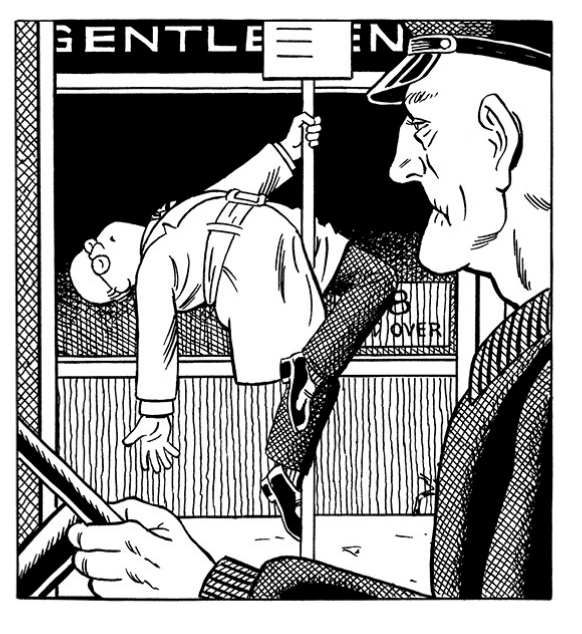
I kept The Bus 3 out on my coffee table the entire summer. I tried not to gobble up all the strips right away, but rather to read one or two a day, each page a small treat against the absurdity of the day. As I reached the end of the volume a week ago, I found myself strangely moved by the last three strips. Kirchner’s Möbius strips always send the Commuter back to his starting position. These last three pull the same move, but with a difference. In the first of the final three, the Commuter dies (waiting on the Driver, natch) and his spirit ascends. In eight speechless panels, Kirchner retells Kafka’s parable “Before the Law.”
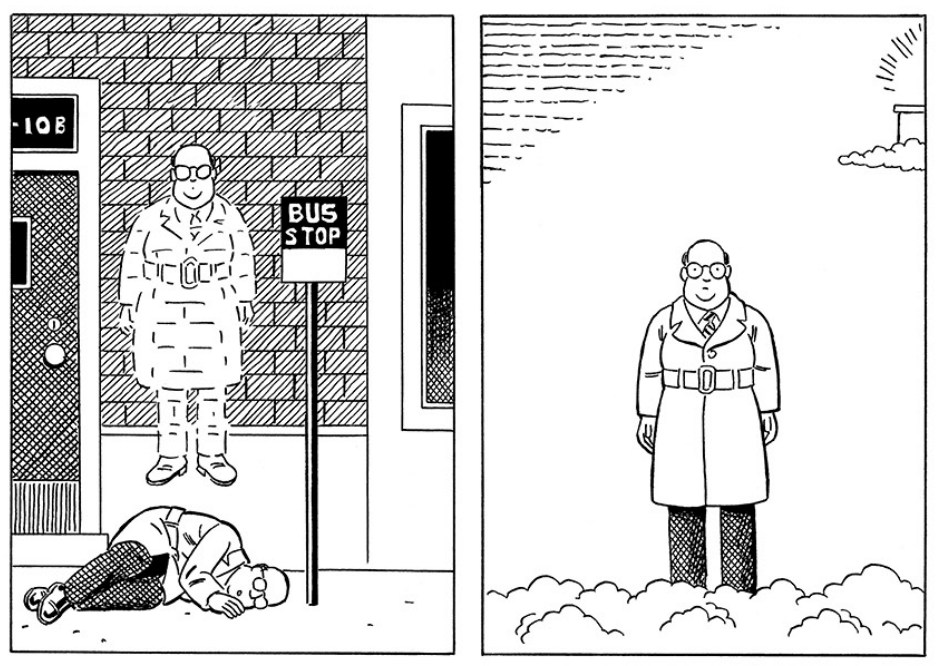
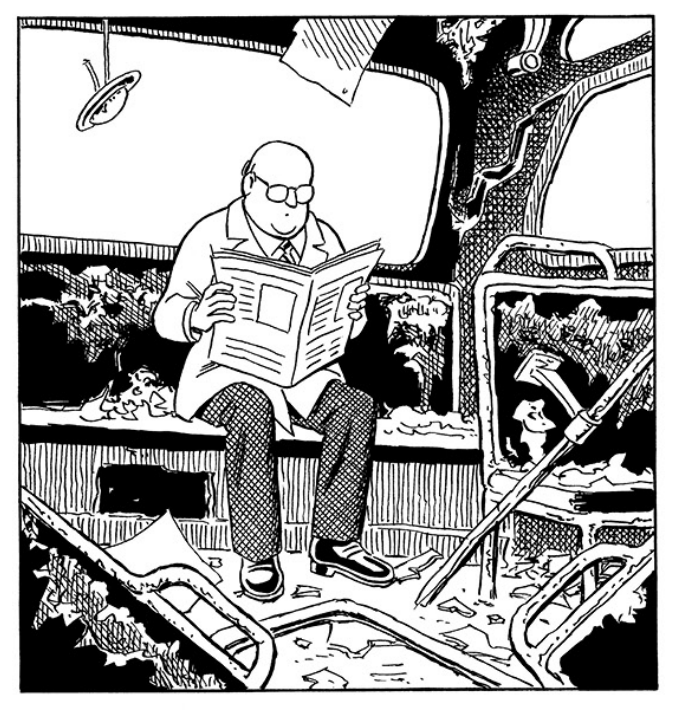
The penultimate strip, a gag on Macy’s Thanksgiving Day Parade balloons literally deflates the bus. The crowd has left, but the Commuter remains, stoic, waiting. And the last proper strip shows a techno-utopian future with a splendid flying bus — but our Commuter refuses to board. His neck stooped, he wanders to the outskirts of town to find the apocalyptic wreckage of his beloved broken down bus. It’s a lovely moment.
Has Kirchner retired his Commuter? Perhaps. The last page of the book shows our hero somehow looking bemused in a folding lawn chair, a cold one in his hand. He sits in front of the bus, now converted to an immobile home, scene of domestic bliss, maybe, everything tranquil and normal (just ignore the fish).
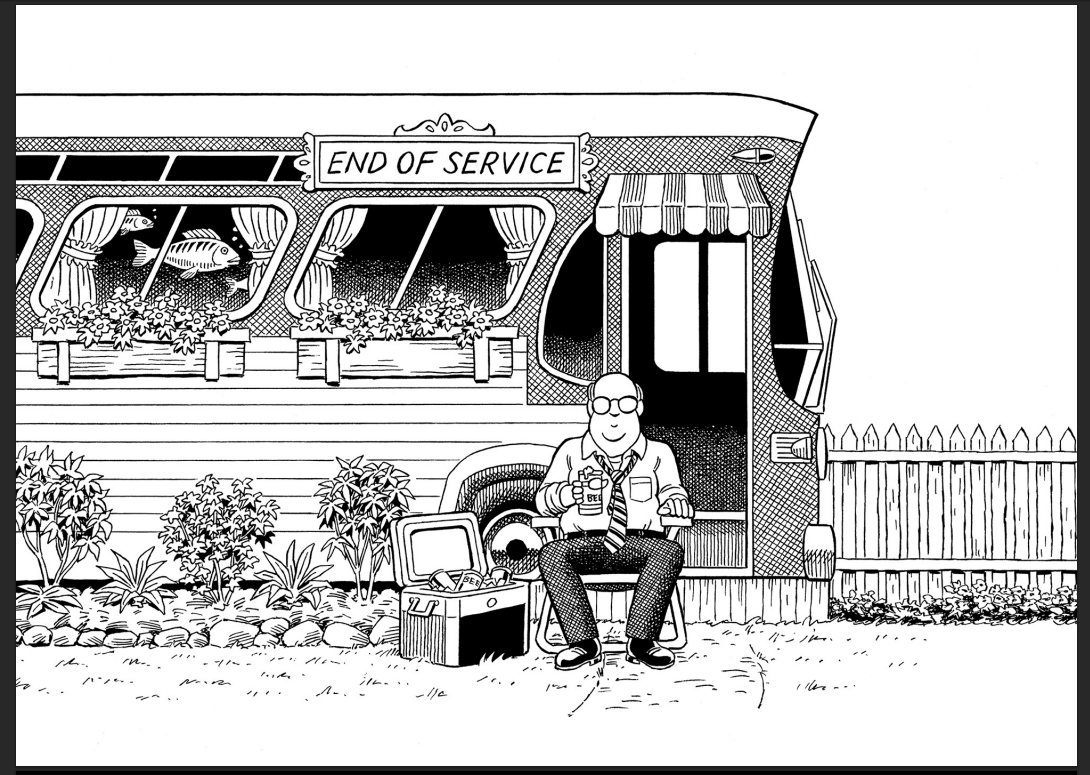
Is it really the end of service? If so, The Bus 3 offers a sweet send off for its hero. But I’ll hold out hope for one more ride. Great stuff.



Published in Arsenal: Surrealist Subversion, No. 2, Summer 1973.

Burning Land, 1973 by Christopher Croft (b. 1947)
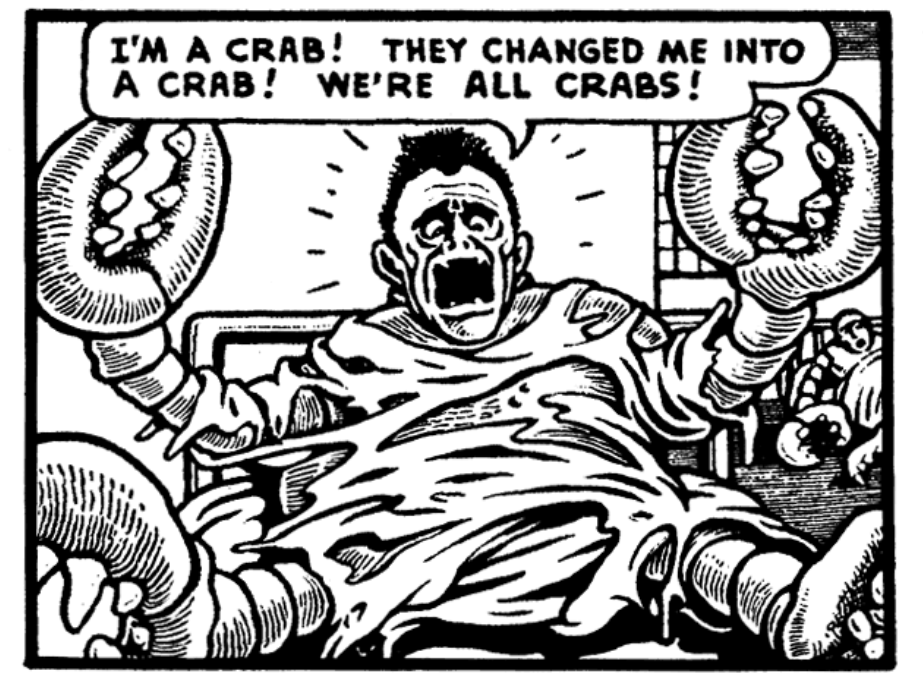
From “They Crawl by Night” by Daniel Keyes and Basil Wolverton, Journey Into Unknown Worlds #15, February 1953, Atlas Comics. Reprinted in Basil Wolverton’s Gateway to Horror #1, June 1988, Dark Horse Comics.

D.M. Black’s new translation of Dante’s The Divine Comedy concludes in this volume. Publisher NYRB’s blurb:
Paradiso brings The Divine Comedy to a virtuosic and visionary end. This final leg of Dante’s journey from Hell into the presence of God is for many the most memorable stretch of the poem, a musical and mystical interveaving of mind and heart and transported sense that is unlike anything else in world literature. This new English rendering of Paradiso by the poet D.M. Black, whose Purgatorio won the 2022 National Translation Award in Poetry, re-creates this masterpiece with fidelity and clarity.
Cleansed of sin after his grueling trek up Mount Purgatory, Dante’s pilgrim sets out to explore the celestial spheres under the guidance of his childhood sweetheart and lifelong muse, Beatrice. As he moves from the moon to the planets to the Primum Mobile and beyond, encountering emperors, heroes, saints, members of his family, and various other redeemed sinners, he contemplates optics, angels, free will, mercy, and love. The transcendent actuality of bliss is ever more palpable as the poem unfolds, and yet in the background remains the carnage of history and the deforming bitterness of the human heart, not to be denied—Dante is nothing if not a realist—even in the supreme light of “the Love that moves the sun and all the stars.”
Written at a time of great political turmoil in Italy and great personal anxiety in Dante’s life, Paradiso wrestles with many questions that have echoes in our own disturbing times. It is a book about the shape of the universe and how to find one’s place within it, composed with inventive daring and linguistic ingenuity as Dante stretches language to its very limits, striving to make vivid and tangible the ineffable and sublime.
The object of art is to make the reader or viewer or listener aware of what he knows but doesn’t know that he knows … And this is doubly true of photography, because the photographer is making the viewer aware of what he is actually seeing and yet at the same time not seeing. So many people in urban environments are walking around without seeing what is in front of them, let alone what is at the margin of vision, because what they see seems to have no meaningful relationship to them as observers. It is the art of the photographer to wrest back meaning for the observer from the input of impressions. Cut, shuffle, pick a card, any card… what do we see as we walk the streets of a city? A jumble of fragments. Now, these fragments are meaningful to you because they are what you have chosen to see.
I used to have an exercise that I suggested to my students at New York City College. Walk around the block and try to keep your eyes open for a change. Now sit down and write what you have just seen with particular attention to what you were thinking when someone walked by, when you saw a certain billboard, when a car passed… and so forth.
It soon becomes apparent that these fragments are not meaningless, that they mean something very definite to you, spelling out messages, cryptic messages … Some students think they are going insane. “Everything is talking to me.” Of course it is … it always was… You are just starting to listen and see a little. (One student became convinced that I was the Anti-Christ and that voices were telling him to kill me. At this point I edged into the kitchen and sought the proximity of a potato masher.)
Another exercise I called “color walks.” Walk down a New York street and pick out all the reds-focusing on the red. Now shift to the blues, the yellows, the whites… Blue again and I know the car coming up behind me will be blue… and it is. Or you’re running out of yellow… a yellow cab comes right on cue. Just start looking and you will see. Example-I am thinking about New Mexico. Round a corner and there is a New Mexico license plate. “New Mexico, Land of Enchantment.”
Click, click, click. Catch these intersection points between your inner reality and what you are seeing, between the inner reality and the outer reality. They have a particular relevance to the observer and, if the observer is also a photographer, the intersection points give the photographs their special style. Now take a stack of photographs. We are looking for the point where inner reality and outer reality intersect.
From William S. Burroughs’s introduction to Robert Walker’s New York Inside Out, a 1984 collection of street photography. The introduction was published, along with several of Walker’s photographs, in the August 1984 issue of Popular Photography.
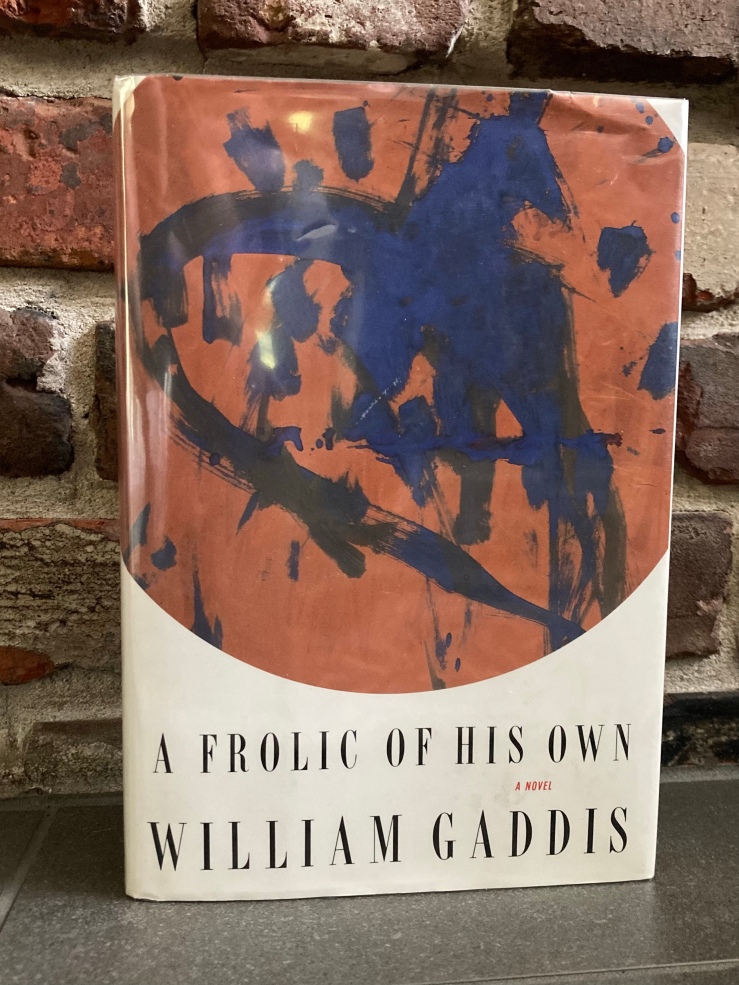
I want to comment on the themes and style of William Gaddis’s fourth novel, 1994’s A Frolic of His Own, and I’d like to do so without the burden of summarizing its byzantine plot, so I’ll crib from Steven Moore’s contemporary review of the novel that was first published in the Spring 1994 issue of The Review of Contemporary Fiction. Although he initially protests that the “plot is too wonderfully complex to summarize,” Moore nevertheless offers a concise precis. Moore writes that A Frolic of His Own
…concerns an interlocking set of lawsuits involving the Crease family: Oscar, a historian and playwright; Christina, his stepsister and married to a lawyer named Harry Lutz; and their father Judge Thomas Crease, presiding over two cases in Virginia during the course of the novel. The story unfolds by way of Gaddis’s trademark dialogue but also by various legal opinions, brilliantly rendered in the majestic language of the law.
Law, one of the major themes of the novel, is announced in its opening lines: “Justice? —You get justice in the next world, in this world you have the law.” A Frolic of His Own delves into the intersection of justice, law, art, theft, and compensation, all while foregrounding language as the mediating force of not just these nebulous concepts, but the medium, of course, of the novel itself. “What do you think the law is, that’s all it is, language,” the exasperated lawyer Harry declaims to his wife Christina.
Language is always destabilized and destabilizing in A Frolic of His Own. Gaddis lards the novel with mistakes, misinterpretations, and muddles of every mixture. Characters repeatedly fail to communicate clearly with each other, their dialogue twisting into new territories before they’ve mapped out their present concerns. A Frolic reads as linguistic channel surfing, an addled mind constantly turning the dial before a thought can fully land.
The effect of this linguistic channel surfing at times stuns and overwhelms the reader, approximating the noise of modern language that Gaddis’s heroes so often rail against, even as they participate in and create more of this noise. It’s worth sharing a paragraph in full to offer a sense of what Gaddis is doing in A Frolic of His Own. Here, Christina takes a phone call from her husband Harry, while her brother Oscar (who is slowly going mad) watches the evening news:
—Has Harry called? And when it finally rang —We’re fine, did you get to that new doctor? Well whatever you call him, you… I know that Harry but you’ve simply got to make time, if you don’t you’re going to end up like… that’s exactly what I mean, he’s sitting right here waiting for the evening news to whet his appetite for supper, I mean I can’t take care of both of you can I? Scenes of mayhem from Londonderry to Chandigarh, an overweight family rowing down main street in a freak flood in Ohio, a molasses truck overturned on the Jersey Turnpike, gunfire, stabbings, flaming police cars and blazing ambulances celebrating a league basketball championship in Detroit interspersed with a decrepit grinning couple on a bed that warped and heaved at the touch of a button —because they offered him a settlement Harry, almost a quarter million dollars but of course he insists on going ahead with the case or rather Mister Basie does, he was out here for… what? The Stars and Bars unfurled in a hail of rocks and beer cans showering the guttering remnants of a candlelight vigil—but if you can just try to be patient with her Harry, you know her mother just died and she’s been in an awful state trying to… to what? Oscar will you turn that down! that now she wants you to help her break her mother’s will? I don’t see what… well they never really got on after her mother was converted by that wildeyed Bishop Sheed was it? a million years ago convincing her that it was more exclusive with Clare Luce and all that after the wads of money she’d been giving St Bartholomew’s with these millions of Catholics jamming every slum you can think of if you call that exclusive, she…—Look! Christina look! Placards brandishing KEEP GOD IN AMERICA, MURDERER come quickly! and caught in the emergency vehicles’ floodlights towering over it all the jagged thrust of —that, that Szyrk thing that, look!
The noisy force of mass-mediated language threatens to overwhelm the reader, whom Gaddis challenges to make meaning of his mess. Later, Christina sums up the problem: “I mean you talk about language how everything’s language it seems all that language does is drive us apart.” Naive Oscar, whose multiple lawsuits initiate the plot of A Frolic, tries to clarify the problem of language in his own way too: “—Isn’t that what language is for? to say what you mean? That’s why man invented language, isn’t it? so we can say what we mean?” But the events that Gaddis arranges in his novel suggest that the answer is, Not quite. There’s only one language all Americans understand—money:
—You want to sue them for damages, that’s money isn’t it?
—Because that’s the only damn language they understand! …Steal poetry what do you sue them for, poetry? …Two hundred hours teaching Yeats to the fourth grade?
Oscar’s complaint is the apparent plagiarism of his Civil War play Once at Antietam by a major Hollywood studio that has turned it into a “piece of trash” called The Blood in the Red White and Blue. Gaddis includes large sections of Oscar’s play in A Frolic of His Own, often having various characters (including its author) stop to make critical remarks. Here, Gaddis has actually cannibalized parts of a play he wrote in the late 1950s after he’d finished The Recognitions. He was unable to get Once at Antietam produced or published. In a 1961 letter, he admitted that “Now it reads heavy-handed, obvious, over-explained, oppressive,” adding that there might be some value somewhere in the work “but the vital problem remains, to extract it, to lift out something with a life of its own, give it wings, release it.” A Frolic of His Own may, on one hand, “release” Gaddis’s old play, but it denies it any life of its own. The play is bound within the text proper, incomplete, riddled with elisions, terminally unfinished.
It also comes to light (via a lengthy legal deposition) that Oscar (and perhaps the younger Gaddis?) has plagiarized large sections of his play, notably from Plato’s Republic. Oscar pleads that his plagiarisms are justified—they are art. But in A Frolic of His Own, “it all evaporates into language confronted by language turning language itself into theory till it’s not about what it’s about it’s only about itself turned into a mere plaything.”
Language is, of course, Gaddis’s plaything, and his novel repeatedly underlines its own textuality without the preciousness that sometimes afflicts postmodernist writing. For all his innovations and experimentation with form, Gaddis here and elsewhere is at his core a traditionalist like his hero T.S. Eliot. And like Eliot, he seeks to pick up the detritus of culture and meld it into something new, all while attacking the hollow men who run America. There’s more than just crankiness here: There is howling and bleating and often despair. There’s no justice for our characters, but at the same time, they hardly deserve any. For all their apparent cares and worries, these rich, venal, petty characters are ultimately, to borrow a phrase from another book, careless people, leaving messes for others to clean up (often quite literally). The satire bites; it’s rightfully mean-spirited, caustic, and bitter.
As such, A Frolic of His Own, for all its humor, is often very bleak. It also becomes increasingly claustrophobic. The characters get stuck in their language loops; the only way out seems to be madness or death. Gaddis’s writing had long evoked suffocating domestic spaces, whether it was the paper-stuffed 96th Street apartment shared by Bast, Eigen, and Gibbs in 1975’s J R or the haunted house of 1985’s Carpenter’s Gothic. A Frolic of His Own takes the madness to another level, setting the stage for the monolingual stasis of his final work, Agapē Agape.
Even if its cramped quarters are often gloomy and crammed with sharp objects, there’s a zaniness to the linguistic channel surfing of A Frolic that propels its fractured narrative forward. “The rest of it’s opera,” repeats Harry throughout, calling attention to the novel’s satirical histrionics. “It’s a farce,” repeats Oscar, pointing to both his own legal cases and his family history. As A Frolic progresses, its farcical twists become more and more bizarre, yet Gaddis always ties his loose ends. The modern world he satirizes is absurd, but it is real.
The realism Gaddis evokes in A Frolic centers around food and shelter. The action is confined primarily to the dilapidated old Crease estate, with its family (in ever-shifting configurations) frequently trying to feed themselves: “We’ve got to get some food in the house” becomes a mantra. Poor privileged half-siblings Oscar and Christina can hardly shop for themselves, let alone cook.
They are very adroit at drinking, however. As the novel careens towards madness, the half-siblings respond by hitting the booze. Consumption runs throughout the novel, presaged in its domestic-but-dooming epigraph, a recollection of something Thoreau said to Emerson while they were walking:
What you seek in vain for, half your life, one day you come full upon, all the family at dinner. You seek it like a dream, and as soon as you find it you become its prey.
Gaddis was fond of repurposing language, and first used the lines in his first novel, 1955’s The Recognitions. The last line of the epigraph, which finds the seeker become prey to his own dream, seems to me now to further highlight A Frolic’s themes of consumption—taboo consumption: cannibalism.
Very early in the novel, the narrator calls attention to Oscar’s copy of George Fitzhugh’s 1857 defense of slavery, Cannibals All! The phrase “cannibals all” is then inverted near the very end of the novel, when a former lawyer, in the hopes of perpetrating an insurance scam, wedges his foot in Oscar’s door: “they’re cannibals Mister Crease, they’re all cannibals,” the former lawyer insists, referring broadly to the insurance industry (he’ll later extend the term to those working in the real estate market in particular and humanity in general).
These direct inversions—cannibals-all/all-cannibals—bookend A Frolic of His Own, neatly encasing the metaphorical cannibalism that runs through the novel. Gaddis depicts a “dog eat dog” world (full of literal dead dogs) ruled by venal consumption. Family members cannibalize family members, law cannibalizes art, texts cannibalize texts. “When the food supply runs out and the only ones around are your own species, why go hungry?” interjects the narrator of a nature documentary that Oscar watches absentmindedly. Harry puts it succinctly:
That’s…what this whole country’s really all about? tens of millions out there with their candy and beer cans and this inexhaustible appetite for being entertained? Anything they can get their hands on…
Gaddis depicts a world where all attempts at culture and art are ultimately cannibalized and excreted by capital. In one of the novel’s goofiest and meanest gags, an entrepreneur seeks to exploit the highly-publicized death of Spot, a dog trapped and then zapped in an ugly postmodernist sculpture. The huckster, capitalizing on the public’s love for Spot, creates “Hiawatha’s Magic Mittens…labeled ‘Genuine Simulated Spotskin® Wear ‘Em With The Furside Outside.'”
“Hiawatha’s Magic Mittens” might seem like a throwaway joke, but the joke is nevertheless part of the novel’s theme of cannibalized culture. Those familiar with the legend of Hiawatha may recall that in many versions, Hiawatha practices ritual cannibalism until he is converted by the Great Peacemaker Deganawida. After his conversion, Hiawatha ceases to eat human flesh and strives for mutual aid and cooperation.
Gaddis also evokes the Hiawatha of Henry Wadsworth Longfellow’s epic poem, itself a cannibalization of sorts of the mytho-historical Hiawatha. Gaddis grafts the oft-cited opening line of “Hiawatha’s Childhood,” “By the shores of Gitche Gumee” a few times early in the novel. The poem seems to loll and roll around in Oscar’s skull; as his alcoholic madness increases, the poem’s trochaic tetrameter infects his thoughts. The result is some of the most beautiful prose in the book (even if the lines are intended as half-parody). Consider the following passage, which begins with Oscar watching the sunset on the wetlands around his crumbling estate, takes flight into the poetic cannibalization of Longfellow’s lines, and winds up in the jumble of Oscar’s fish tank (I strongly suggest reading the passage aloud to hear the trochaic tetrameter):
Neither the red scream of sunset blazing on the icebound pond nor the thunderous purple of its risings on a landscape blown immense through leafless trees off toward the ocean where in flocks the wild goose Wawa, where Kahgahgee king of ravens with his band of black marauders, or where the Kayoshk, the seagulls, rose with clamour from their nests among the marshes and the Mama, the woodpecker seated high among the branches of the melancholy pine tree past the margins of the pond neither rose Ugudwash, the sunfish, nor the yellow perch the Sahwa like a sunbeam in the water banished here, with wind and wave, day and night and time itself from the domain of the discus by the daylight halide lamp, silent pump and power filter, temperature and pH balance and the system of aeration, fed on silverside and flake food, vitamins and krill and beef heart in a patent spinach mixture to restore their pep and lustre spitting black worms from the feeder when a crew of new arrivals (live delivery guaranteed, air freight collect at thirty dollars) brought a Chinese algae eater, khuli loach and male beta, two black mollies and four neons and a pair of black skirt tetra cruising through the new laid fronds of the Madagascar lace plant.
Forgive the long quote. Or don’t. As the novel swerves to its gloomy end, the poem overtakes Oscar’s consciousness, the transcendental beauty of Longfellow’s vision cannibalized by the chainsaws of “land developers,” the real fauna replaced with Disneyfied simulations to send him off to drunken troubled dream. Dreamy Oscar:
…made a bed with boughs of hemlock where the squirrel, Adjidaumo, from his ambush in the oak trees watched with eager eyes the lovers, watched him fucking Laughing Water and the rabbit, the Wabasso sat erect upon his haunches, watched him fucking Minnehaha as the birds sang loud and sweetly where the rumble of the trucks drowned the drumming of the pheasant and the heron, the Shuh-shuh-gah gave a cry of lamentation from her haunts among the fenlands at the howling of the chainsaws and the screams of the wood chipper for that showplace on the corner promising a whole new order of woodland friends for the treeless landscape, where Thumper the Rabbit and Flower the Skunk would introduce the simpering Bambi to his plundered environment and instruct him in matters of safety and convenience by the shining Big-Sea-Water, by the shores of Gitche Gumee where the desolate Nokomis drank her whisky at the fireside, not a word from Laughing Water left abandoned by the windows, from the wide eyed Ella Cinders with the mice her only playmates as he turned his back upon them with his birch canoe exulting, all alone went Hiawatha.
Many contemporary reviewers suggested that A Frolic of His Own was Gaddis’s most accessible novel to date, and it might be. Whereas J R and Carpenter’s Gothic are composed almost entirely in dialogue, Gaddis provides more stage direction and connective tissue in A Frolic. There are also the fragments of other forms: legal briefs, depositions, TV news clips, Oscar’s play…Some of these departures can exhaust a reader. Gaddis’s parodies of legalese are full of jokes, but the tone of the delivery can lead one’s mind’s eye to glaze over. Oscar/Gaddis’s play is problematic too, but in a rewarding if confounding way: Is it supposed to be, like, good? The answer, I think, comes in its cannibalized version—I mean the cannibalized version that Oscar watches over broadcast television. When he finally sees The Blood in the Red White and Blue, Oscar experiences a wild array of emotions, both positive and negative—but his feelings are real.
A Frolic of His Own is not the best starting point for anyone interested in William Gaddis’s fiction, although I don’t think that’s where most people start. It is rewarding though, especially read contextually against his other works, in which it fits chaotically but neatly, underscoring the cranky themes in a divergent style that still feels fresh three decades after its original publication. Highly recommended.
[Ed. note — Biblioklept first ran this review in June 2023. I’ve been falling asleep to William Hootkins’ reading of The Song of Hiawatha every night for the past two weeks.]

Plumber’s Shop Studio, Essendon, 1938 by Charles Bush (1919-1989)
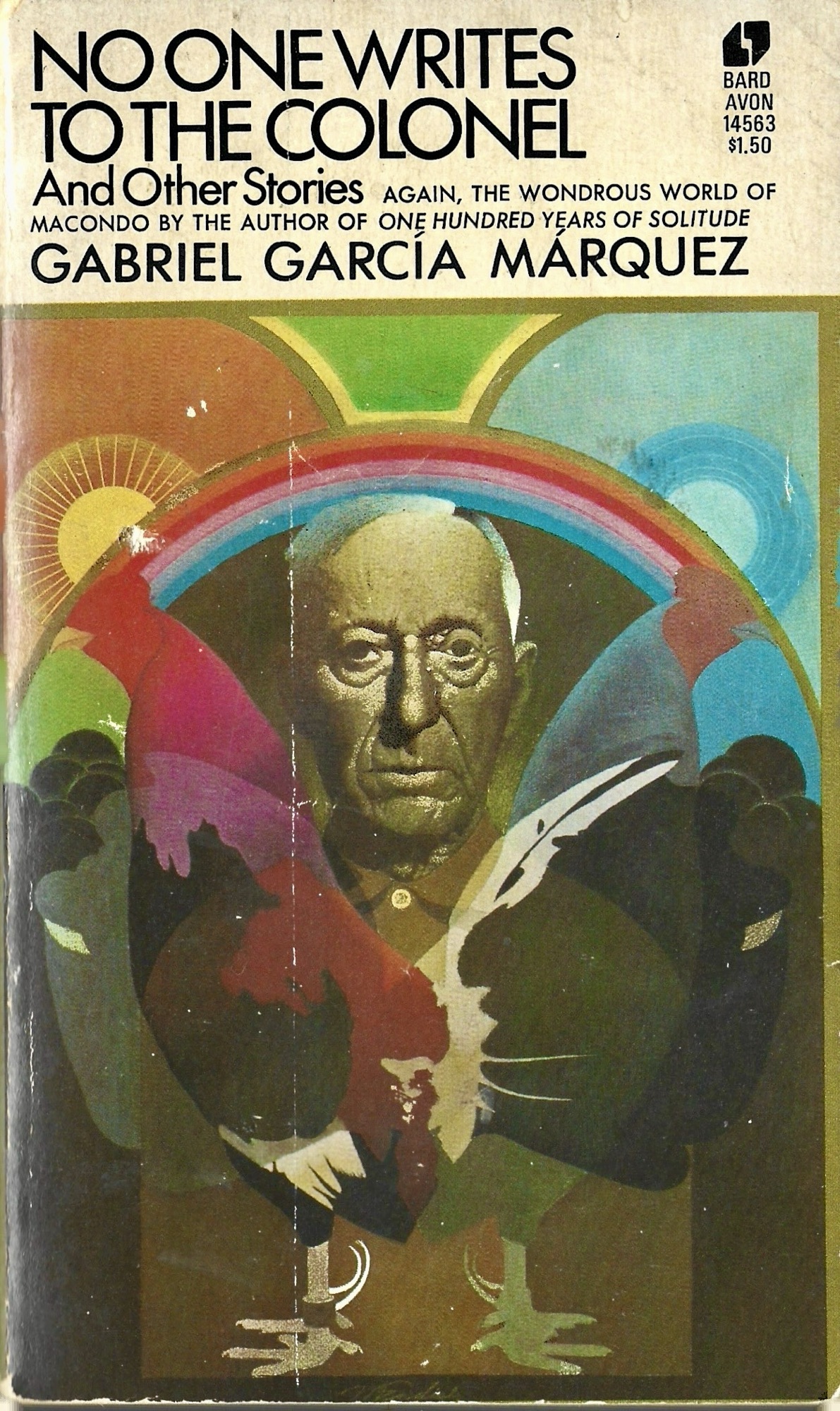
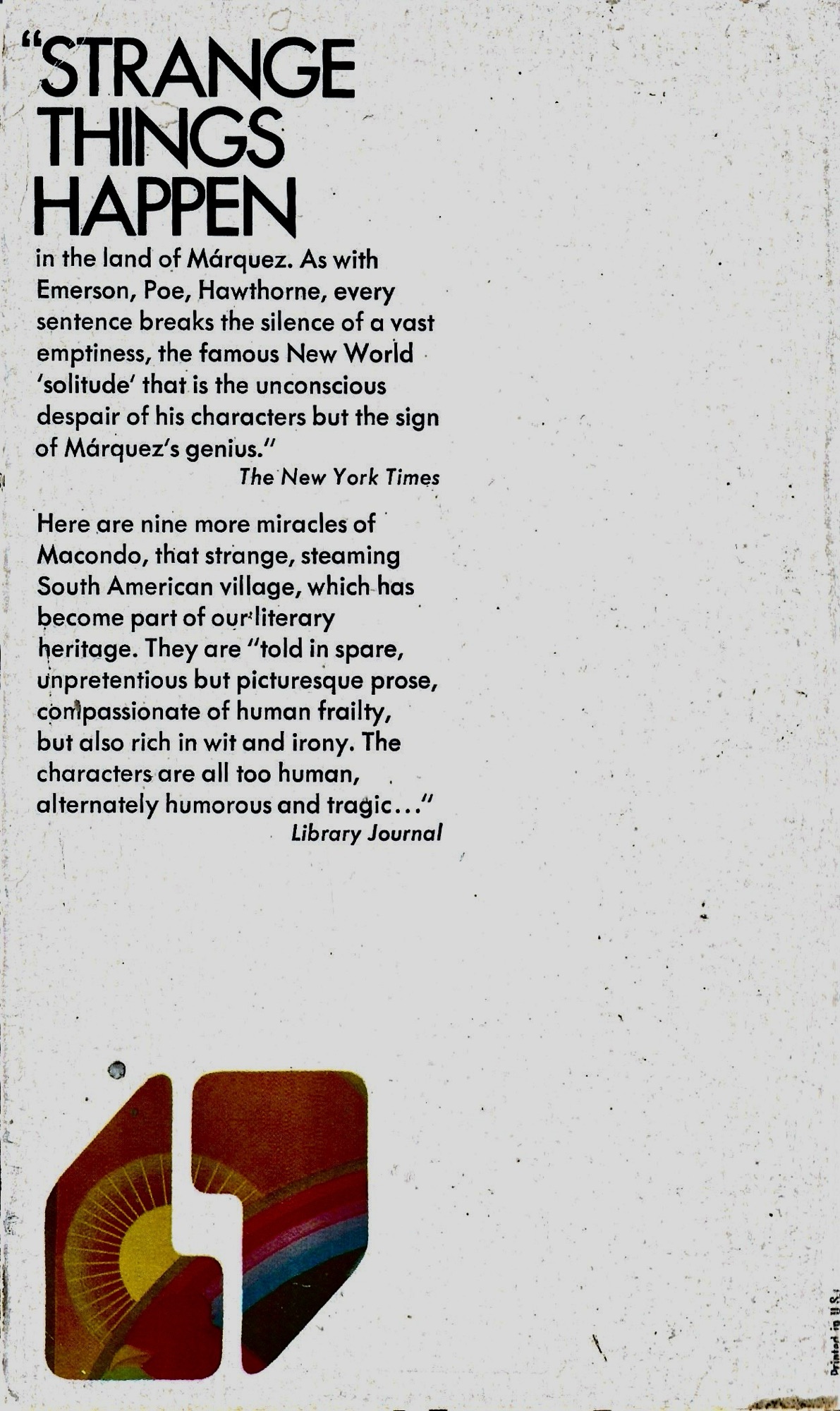
No One Writes to the Colonel and Other Stories, Gabriel García Márquez. Translation by J.S. Bernstein. Avon Bard (1973). No cover artist credited. 220 pages.
Another beautiful Avon Bard Latin American series cover that fails to attribute the cover artist. The “other” stories that supplement the titular novella are García Márquez’s 1962 collection Los funerales de la Mamá Grande. When I picked this up I fully expected the translator to be Gregory Rabassa, who did several of García Márquez’s major works, along with many, many of the other Avon Bard LA titles. But it’s J.S. Bernstein; as far as I can tell, this is their (his? her?) most famous translation. (Maybe Rabassa was doing a Richard Bachman thing.)
Continue reading “Mass-market Monday | Gabriel García Márquez’s No One Writes to the Colonel”
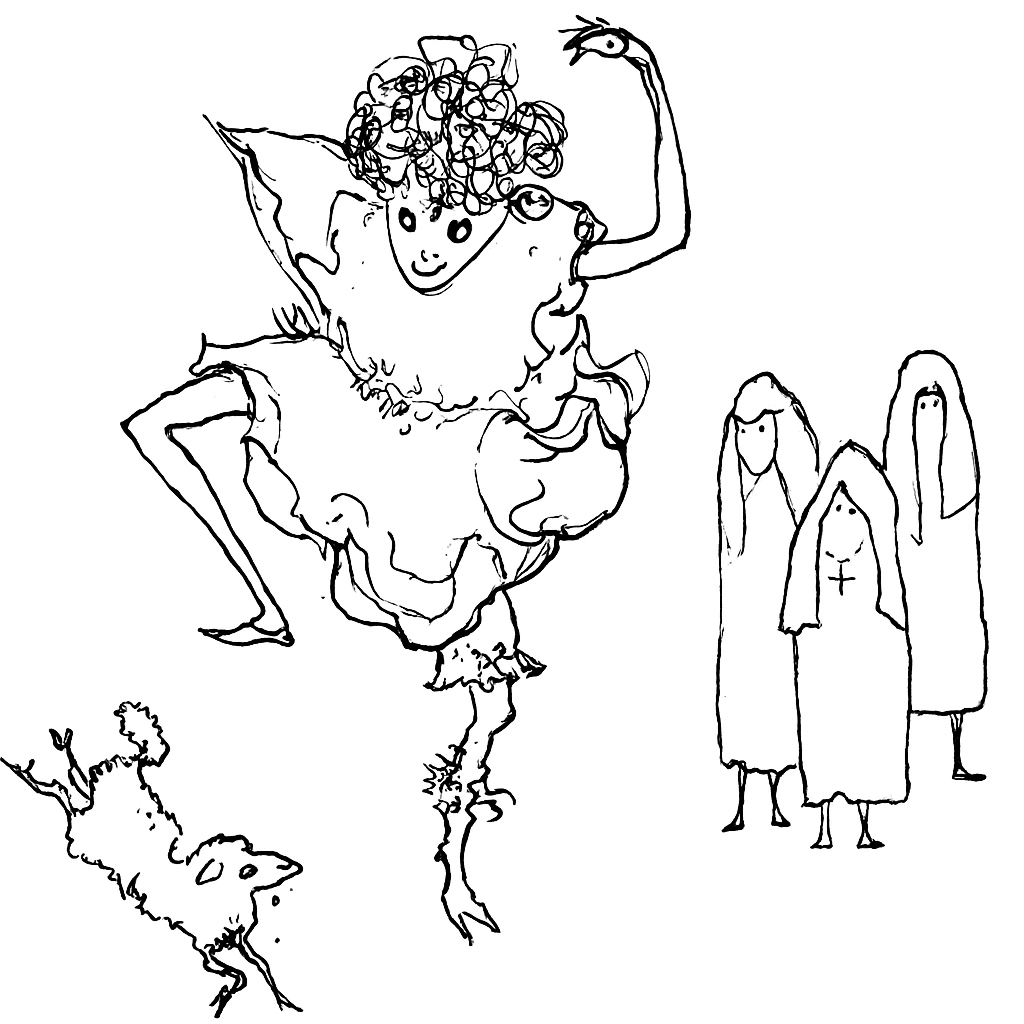
Illustration for Elena Poniatowska’s children’s novel, Lilus Kikus, c. 1954 by Leonora Carrington (1917 – 2011)
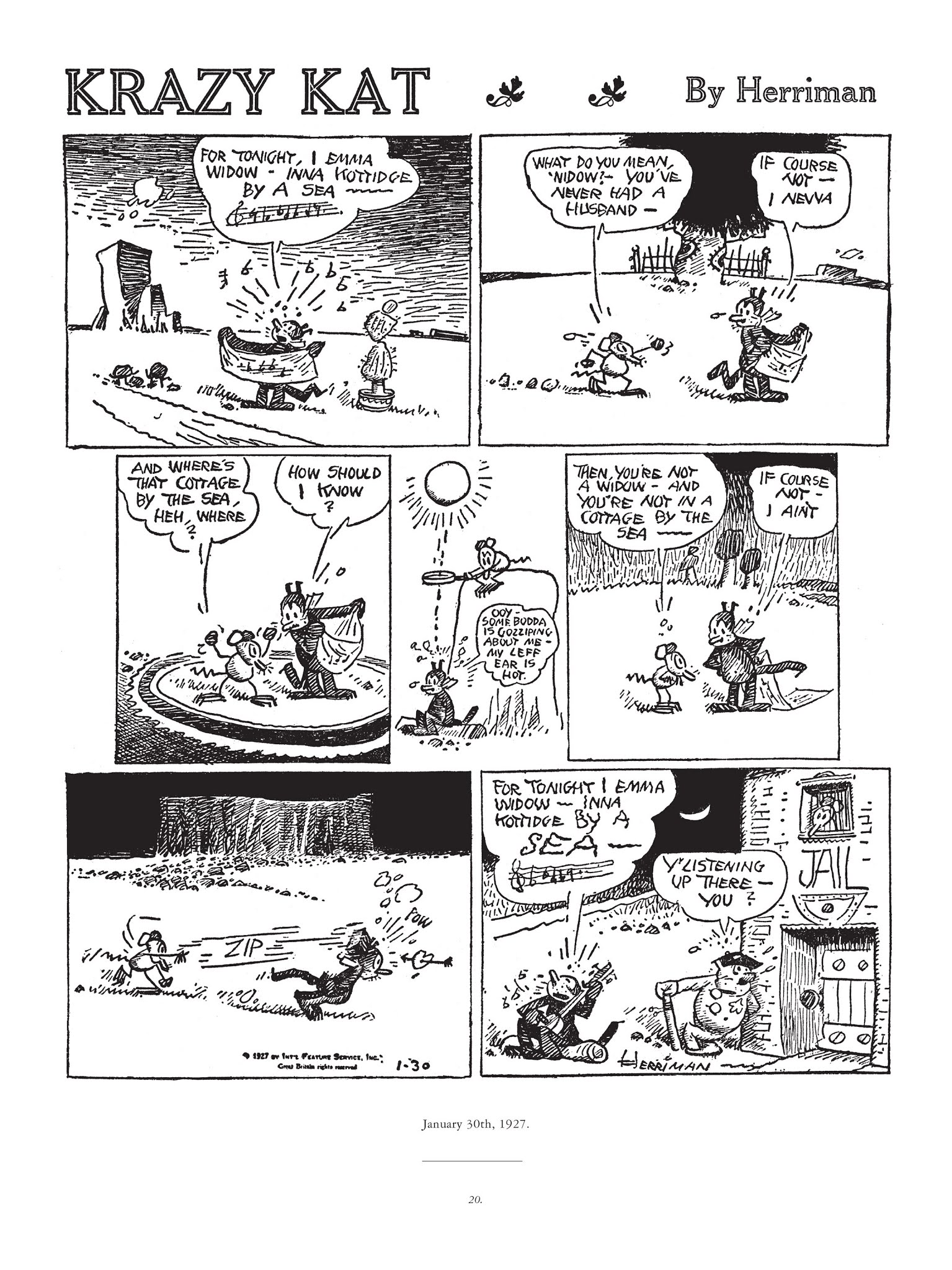
Krazy Kat, 30 Jan. 1927 by George Herriman
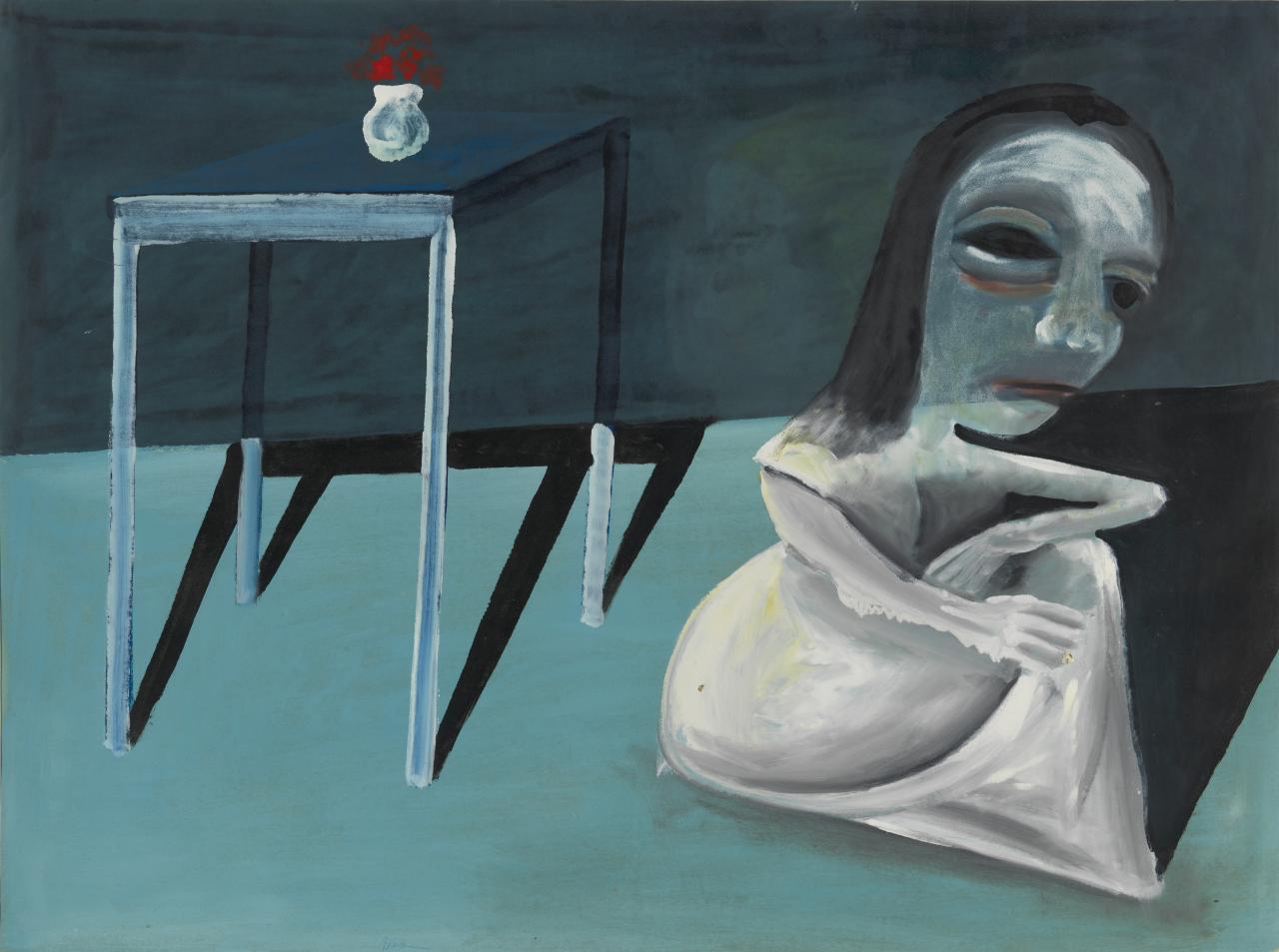
Girl Seated on the Ground beside a Tall Table, c. 1955 by Charles Blackman (1928-2018)
“Crates, Cynic”
by
Marcel Schwob
translated by Lorimer Hammond
from Imaginary Lives
Born at Thebes, he was a disciple of Diogenes and he also knew Alexander. From his father, a wealthy man named Ascondas, he inherited two hundred talents. Then one day, while attending a tragedy by Euripides, he beheld a vision. He saw Telephy, King of Mysia, dressed in beggar’s rags with a basket in his hand. So Crates stood up on his feet there in the theatre, declaring he would give the two hundred talents of his inheritance to all who wanted the money. Henceforth, he said, the garb of King Telephy would suffice him. Shaking with laughter, the Thebans troop before his house where they found him laughing even louder than they. After throwing all his money and furniture out of the windows he took up a plain cloak and leather sack and went away.
He went to Athens. In that city he spent his days walking the streets and his nights crouching against dirty walls. He put the doctrines of Diogenes into practice, all except the barrel. Crates thought even the barrel a superfluous dwelling. For a man, he contended, is neither a snail nor a Bernardine hermit.
He lived stark naked in the filth of the streets, filling his sack with dry crusts, rancid olives, and fish bones. He called the sack his city, a city without parasites or courtesans, he said, but a fine storehouse of thyme, garlic, figs, and bread for its king. So Crates carried his kingdom on his back and it fed him.
Though he never took part in public affairs, he never criticized them. He launched no insults nor did he approve this trait in Diogenes. Diogenes would call out, “Men, come to me!”, then rap them with his cane when they came, saying, “I called for men, not excrements!”
Crates was kind to men. He reproached them with nothing. Sores and wounds he knew, and his greatest regret was that his body were not supple like a dog’s so that he might lick them. He also deplored the necessity of nourishing himself with food and drink, for man, he thought, should be sufficient unto himself, asking no aid from the world. At any rate, he never hunted for water to wash in, being content to scratch himself against the walls after seeing how the asses did it. He seldom spoke of gods or questioned them. What difference did it make, said he, if there were gods or none, knowing as he did how little they could do for him. At first he reproached these divinities with having turned men’s faces toward heaven, thus depriving them of the faculties enjoyed by animals on all fours. Since these gods have decided that we must eat to live, thought Crates, they might better have turned our faces to the earth where food is, instead of twisting them up in the air to graze on the stars.
Life was not kind to Crates. His eyes grew bleary, exposed as they continually were to the acrid dusts of Attica, and an unknown skin plague covered his body with sores. While he scratched himself with his uncut nails he observed the twofold profit, as he called it, of wearing down these nails to their proper length while relieving his itch at the same time. He let his hair grow in a neglected mat on his head to protect him from the rain and sun.
When Alexander came to see him he flung no sharp gibes at the conqueror whom he considered merely as one with the spectators, acknowledging no difference between king and crowd. Crates no longer formed opinions about the great. Only men interested him, men and the problems of living his life as simply as possible. Diogenes with his chiding made Crates laugh no less than the pretensions of moral reformers. Holding himself infinitely above such sordid cares, he transcribed the maxim from the Delphian temple to read, “See Thyself”, and the idea of any knowledge whatsoever he thought absurd. He studied his bodily necessities, nothing more, striving always to reduce them to their simplest terms. Dog-like, Diogenes snapped at life, but Crates lived as the dogs lived.
He had a disciple named Metrocles, a wealthy young man from Marona. Hipparchia, sister of Metrocles, fell in love with Crates. Beautiful and aristocratic as she was, she was certainly the smitten one for she sought the cynic out. It seemed impossible but it was true, and nothing could turn her from him, neither his filthiness, nor his poverty, nor the horror of his public life. He warned her how he lived in the streets like a dog, scrambling for bones in the stench of gutters. He warned her further. If she came to him, he said, nothing of their life together should be hidden. He would want her publicly whenever desire prompted, as the dogs do among dogs. Hipparchia heard all. She declared she would end her own life if her parents interfered, so they let her go. She left the village of Marona with her hair unbound, a single ragged garment covering her nakedness. From that day she lived with Crates and dressed as he dressed. It has been said that she bore him one child, and that the child was named Pasicles, though nothing authentic can be found of that incident.
Hipparchia was kind to the poor. Compassionate, she soothed the sick with her hands, cleansing their bloody wounds without repugnance. To her men became as sheep are to sheep or dogs to dogs. When nights were cold she and Crates slept close to other poor folk, sharing the warmth of their bodies. From the beasts they learned the wordless kindnesses of beasts. When men approached they held no
preferences… they were men and that sufficed.
We know nothing more of Crates’ wife; we are not told when she died or how. Metrocles, her brother, admired the cynic and imitated him, but Metrocles lacked tranquillity. Troubled continually by a flatulency he could not control, he resolved upon suicide. Learning of his ailment Crates went to him after first eating a quantity of lupine. When Metrocles confessed himself no longer able to support the disgrace of his infirmity, the cynic showed his disciple how all men are submitted by nature to the same evil. Upbraiding him because he had dared to be ashamed of others, Crates led Metrocles away and they lived long together in the streets of Athens, Hipparchia undoubtedly beside them. They talked little but were ashamed of nothing. When they lapped water from a puddle with the dogs the dogs respected them. They must have fought together over scraps of food, though the biographers fail to mention it. Crates died old, we know. We know he ended his days squatting among bales of goods in a shed belonging to a shopkeeper from Pirus, and that he finally refused to move from that spot even to pick up scraps of meat. We know he was found there one day starved to death.

Reading, 1934 by Ishikawa Toraji (1875-1964)
 Biblioklept