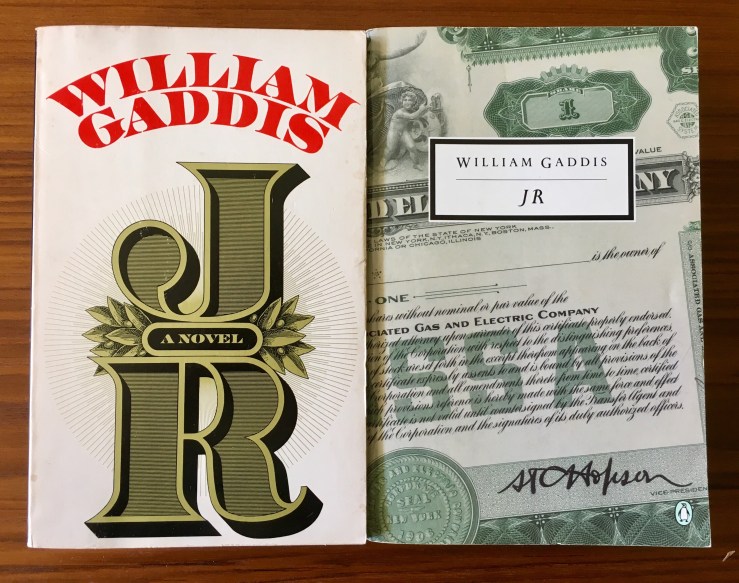
On buying a second copy of William Gaddis’s JR (Book acquired, 5 Aug. 2017)

img_7680

I was at the bookstore last week, killing a spare hour, looking for nothing in particular, when I spotted a first edition Knopf paperback copy of William Gaddis’s novel J R. The book is one of my favorites—I first read it in 2012 and then again in 2016 (which maybe means I’ll reread it again in 2020?). I’ll cobble really quickly from my 2016 review here:

Only a handful of novels are so perfectly simultaneously comic and tragic. Moby-Dick? Yes. Gravity’s Rainbow? Absolutely. (G R and J R, a duo published two years apart, spiritual twins, massive American novels that maybe America hardly deserves (or, rather: theses novels were/are totally the critique America deserves)). I guess maybe what I’m saying is J  R is the Great American Novel to Come . . .

The book is a performance, an opera, an essay on America, a howl, a condemnation, a farce, a romance, a tragedy. When I read it in 2012 I couldn’t believe how prescient it was, a feeling reconfirmed with force four years later. J R diagnoses and describes and ridicules American corporatism, the industrial-military-entertainment-banking-education-etc. -complex. And then it weeps.

. . . in J R the reader becomes the performer, making the voices, singing the voices, (muttering the voices), navigating all the trash, the entropy—J R is a novel of unraveling, where art trips over commercial trash and literal trash–old ads, betting tickets, stock ticker tape, phone book pages, train tickets, scraps. Is there another American novel so aware of its own textuality, its own metatextuality—I mean one that doesn’t goddamn wink all the time at its readers like so much clever postmodern slop?

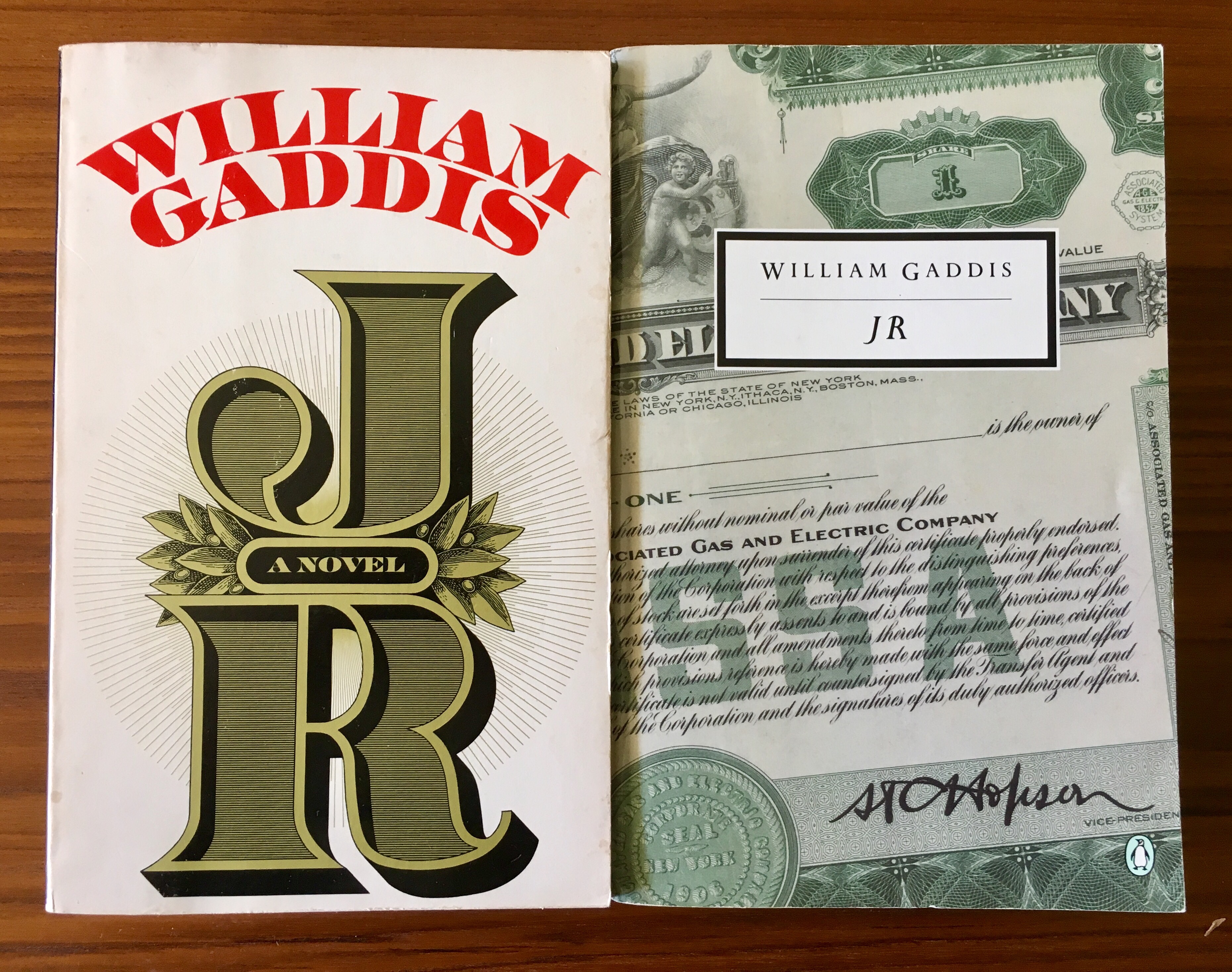
Well so and anyway, I was browsing the shelves of my local, looking for nothing, as I said, although I was ambling through the “GA-” section in the hopes of maybe picking up a copy of William Gass’s The Tunnel, when I spied the J R, with its bold oh-so-seventies design, its big stiff spine unbroken and seemingly unbent. After handling it a few minutes, I resigned myself to a pic and a tweet—

I didn’t intend to buy another paperback copy of J R, even a first edition, even though it was only seven bucks, and even though I have trade credit out the ying-yang there—I mean, I have a perfectly fine Penguin edition; better to leave the J R  for some other person to acquire, no? But qithin a few minutes Twitter folks had talked me out of my plan to not acquire it, advice that was perhaps not unwanted.
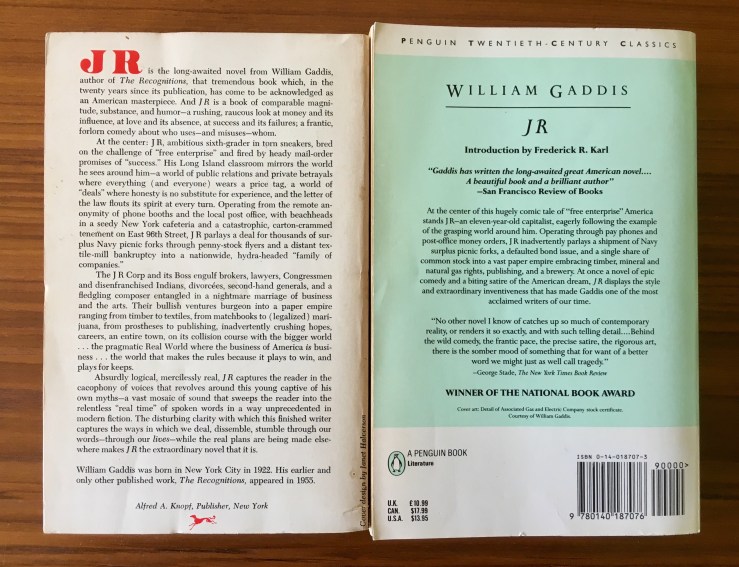
img_7681

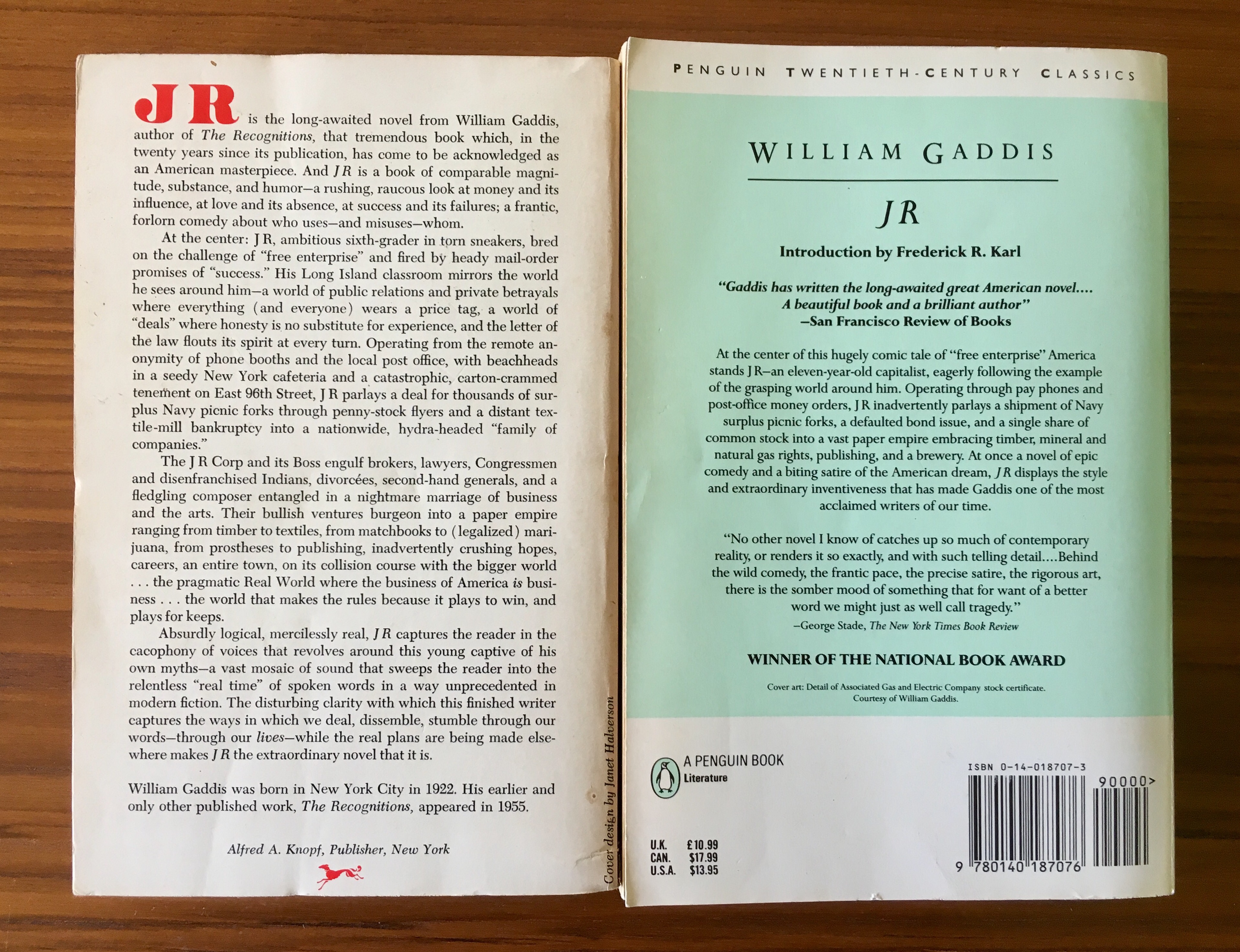
The Knopf edition—the cover design is by Janet Halverson, by the way—has a much longer summary blurb than my 1993 edition (and indeed, a much longer summary blurb than one usually sees on a paperback). The Penguin edition features an introduction by Frederick Karl (that readers should wait to read until after they’ve finished the book), a bibliography of “Suggestions for Further Reading,” and a new dedication page:  “For Matthew: Once more unto the breach, dear friend, once more” (I’m guessing the dedication is to Gaddis’s son Matthew). The ’93 Penguin does not have this though:
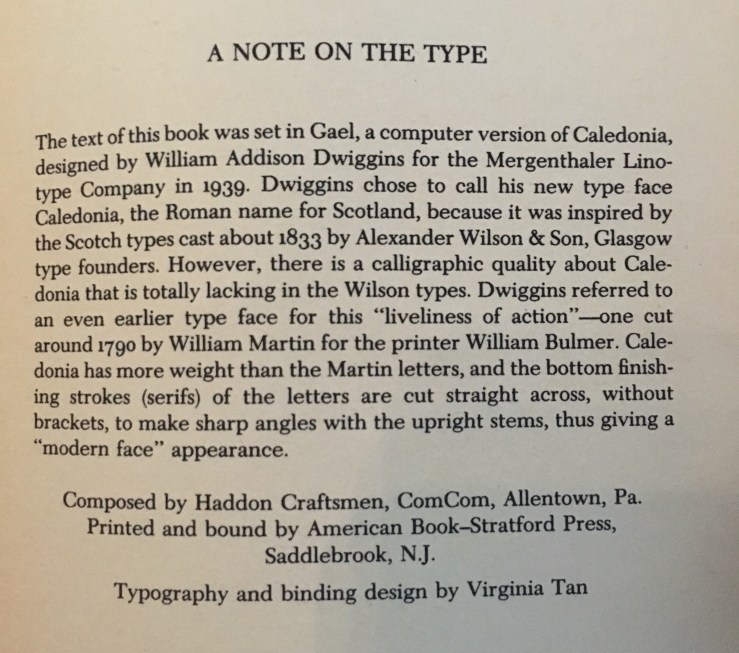
img_7683

But! The Penguin edition’s colophon promises that “Errors in the original publication have been corrected by the author for the first Penguin edition” (1985 btw).

Other than that, the two edition are pretty much typographically the same—the pages are aligned, and both editions are consistent with the same typographical oddities, like JR’s famous handwritten “Alsaka” memo and his logo designs and Gibbs’s pocket scrap citations.

The big difference between the two editions (besides the cover, obviously) can be summed up in this image—the seventies Knopf is above the nineties Penguin:
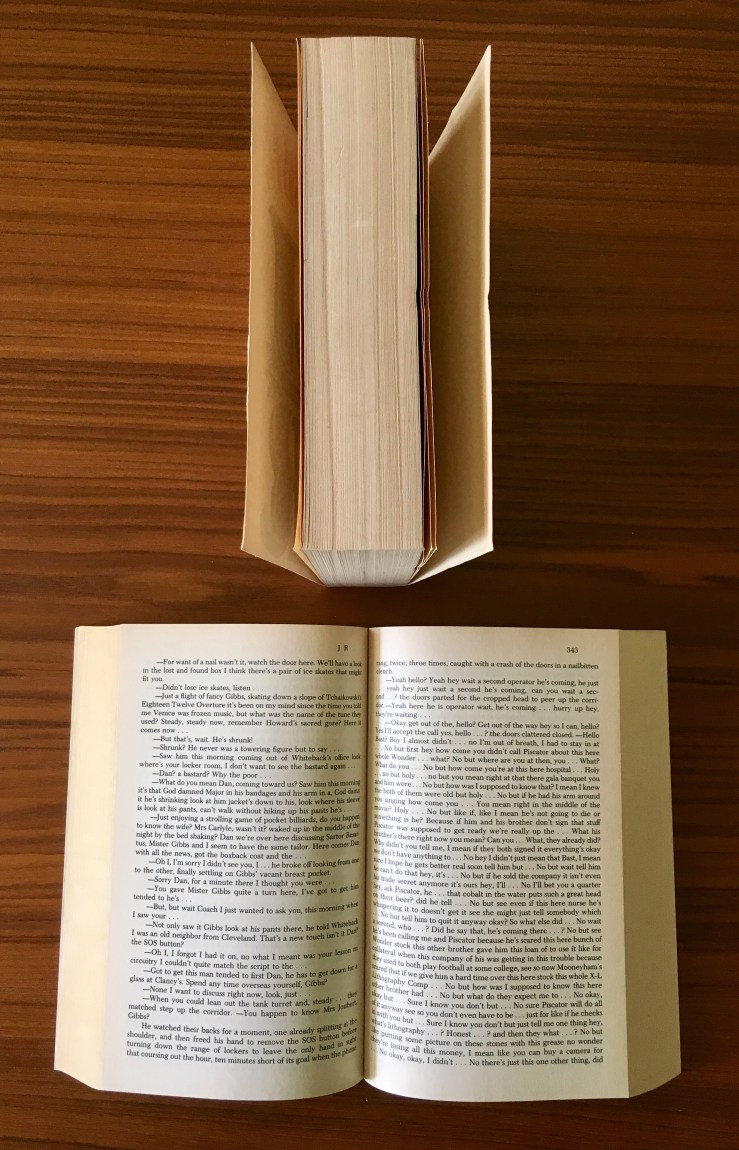
img_7682

The Penguin edition is slightly larger with much better binding. I’ve read it twice and I never had to break its spine; I’m pretty sure that the Knopf I picked up has never been read—and also that a serious reading would crack its spine pretty badly.

The most recent edition of J R is from Dalkey, and includes an essay by Rick Moody as its introduction. I don’t have a copy of it, but it has 752 pages—the other editions have 726 pages (which the Gaddis Annotations project match up to). I’ve handled the Dalkey, and I recall it being smaller and stiffer than the Penguin. Basically, I think, as of now, the Penguin edition is probably the best option for anyone wanting to read the book. So I love the cover of the 70’s first edition I’ve got, but I doubt I’ll be reading it soon (or, like in 2020 when I read the book again).

In the Dust Storm — Jacek Malczewski

W Tumanie (In the Dust Storm), 1893-1894 by Jacek Malczewski

Rainsong — Martin Wittfooth

rainsong_wittfooth

Rainsong, 2015 by Martin Wittfooth (b. 1981)

The Great Day of His Wrath — John Martin

The Great Day of His Wrath, c. 1853 by John Martin (1789-1854)

“Game” — Donald Barthelme

“Game”

by

Donald Barthelme


Shotwell keeps the jacks and the rubber ball in his attaché case and will not allow me to play with them. He plays with them, alone, sitting on the floor near the console hour after hour, chanting “onesies, twosies, threesies, foursies” in a precise, well-modulated voice, not so loud as to be annoying, not so soft as to allow me to forget. I point out to Shotwell that two can derive more enjoyment from playing jacks than one, but he is not interested. I have asked repeatedly to be allowed to play by myself, but he simply shakes his head. “Why?” I ask. “They’re mine,” he says. And when he has finished, when he has sated himself, back they go into the attaché case.

It is unfair but there is nothing I can do about it. I am aching to get my hands on them.

Shotwell and I watch the console. Shotwell and I live under the ground and watch the console. If certain events take place upon the console, we are to insert our keys in the appropriate locks and turn our keys. Shotwell has a key and I have a key. If we turn our keys simultaneously the bird flies, certain switches are activated and the bird flies. But the bird never flies. In one hundred thirty-three days the bird has not flown. Meanwhile Shotwell and I watch each other. We each wear a .45 and if Shotwell behaves strangely I am supposed to shoot him. If I behave strangely Shotwell is supposed to shoot me. We watch the console and think about shooting each other and think about the bird. Shotwell’s behavior with the jacks is strange. Is it strange? I do not know. Perhaps he is merely a selfish bastard, perhaps his character is flawed, perhaps his childhood was twisted. I do not know.

Each of us wears a .45 and each of us is supposed to shoot the other if the other is behaving strangely. How strangely is strangely? I do not know. In addition to the .45 I have a .38 which Shotwell does not know about concealed in my attaché case, and Shotwell has a .25 caliber Beretta which I do not know about strapped to his right calf. Sometimes instead of watching the console I pointedly watch Shotwell’s .45, but this is simply a ruse, simply a maneuver, in reality I am watching his hand when it dangles in the vicinity of his right calf. If he decides I am behaving strangely he will shoot me not with the .45 but with the Beretta. Similarly Shotwell pretends to watch my .45 but he is really watching my hand resting idly atop my attaché case, my hand resting atop my attaché case, my hand. My hand resting idly atop my attaché case. Continue reading ““Game” — Donald Barthelme”

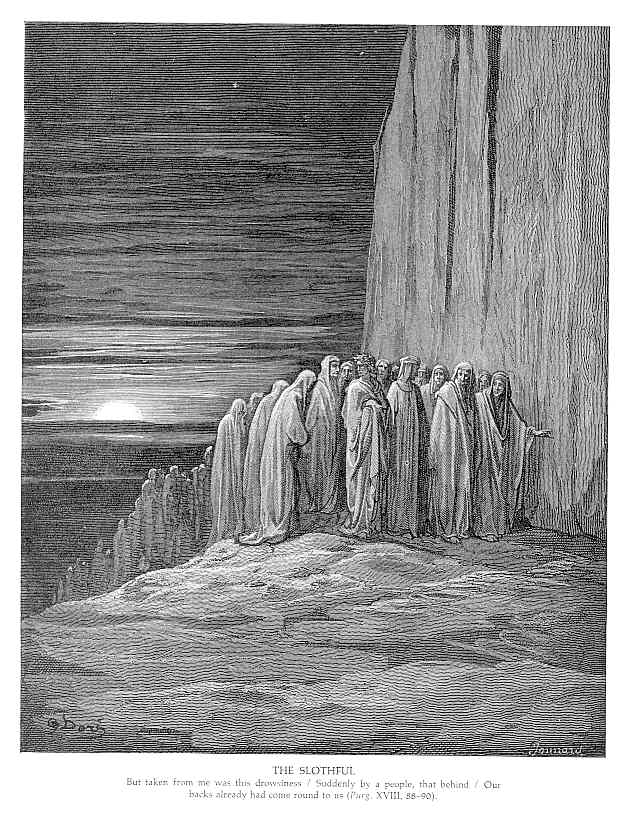
The Slothful — Gustave Dore

the-slothful

The Slothful, 1838 by Gustave Dore (1832-1883)

Bat — Germaine Richier

Bat 1948-51, published 1955 by Germaine Richier 1902-1959

Bat, 1951 by Germaine Richier (1902-1959)

Triple Dip — Ben Shahn

Triple Dip, 1952 by Ben Shahn (1898–1969). From Ben Shahn: His Graphic Art, George Braziller, Inc., NY 1957.

Allegory of Criticism — Carlo Maria Mariani

allegoria-della-critica-2005.jpg!Large

Allegoria della critica (Allegory of Criticism), 2005 by Carlo Maria Mariani (b. 1931)

Flannery O’Connor on Carson McCullers

All of the times that Flannery O’Connor mentions Carson McCullers in her letters collected in The Habit of Being: Letters of Flannery O’Connor:

IMG_0525

I read in the paper that Carson McCullers is going to have a play shortly to be called The Square Root of Wonderful—a title that makes me cringe. (8 Oct. 1957)

…Paul Levine [is] preparing a book on 6 writers—McCullers, Capote, Buechner, Bellow, Salinger, and me… (25 June 1960)

I haven’t read [Frederick] Buechner myself, but if I was writing it I would throw out Capote in favor of Malamud and Carson McCullers in favor of [J.F.] Powers. (9 July 1960)

Last week Houghton Mifflin sent me a book called Clock Without Hands by Carson McCullers. This long-awaited-by-the-faithful book will come out in September. I believe it is the worst book I have ever read. It is incredible…It must signal the complete disintegration of this woman’s talent. I have forgotten how the other three were, but they were at least respectable from the writing standpoint. (26 July 1961)

If you ever go to the Albee-McCullers [play] let me know what you think about it? … Did you ever consider Wise Blood as a possibility for dramatizing? If the times were different I would suggest that, but I think it would just be taken for the super-grotesque sub-Carson McCullers sort of thing that I couldn’t stand the sight or sound of. (5 Nov. 1963)

I was interested in the reviews of the Carson McCullers adaptation. I dislike intensely the work of Carson McCullers but it is interesting to see what is made of it in the theatre, and by Edward Albee at that. (28 Nov. 1963)


Between Right and Wrong — Samuel Bak

bk1122_images

Between Right and Wrong, 2007 by Samuel Bak (b. 1933)

The Luncheon on the Grass Is Finished — Susannah Martin


le-dejeuner-sur-l-herbe-est-fini

Le Déjeuner sur l’herbe est fini (The Luncheon on the Grass Is Finished), 2015 by Susannah Martin (b. 1964)


“The Curse” — Bonnie Prince Billy and The Roots of Music

Untitled — Marcel Dzama

Untitled 2003 by Marcel Dzama born 1974Screenshot 2017-08-04 at 11.12.28 AM

Untitled, 2003 by Marcel Dzama (b. 1974)

The Book of Emma Reyes (Book acquired, 3 Aug. 2017)

img_7636

This one looks pretty cool. The Book of Emma Reyes, an epistolary “memoir,” is new in hardback from Penguin, in English translation by Daniel Alarcón.  Here’s Penguin’s blurb/bio:

Anxiety of influence (Barry Hannah’s “ideal inner voices”)

The fact is I wanted to write long before I had anything to say. I don’t find this condition at all unusual in young writers, good or bad. A sort of attuned restlessness. Often it is simply an overriding need to talk. A sort of transcribed logorrhea, worse than decent gossip. I’ve taught these people, forever blasting away in wretched detail, solidly in love with their own noise. I must say, I was never infatuated with my own voice. It was the ideal inner voices that took me, and they came from everywhere, especially Hemingway, Joyce, Henry Miller, and later, Flannery O’Connor. Like many Mississippians, I shied away from Faulkner, who was at once remote and right there in your own backyard, the powerful resident alien. Having read a little of him, I sensed I would be overcome by him, and had a dread, in fact, that he might be the last word. That I would wind up a pining third-rate echo, like many another Southerner. Then T.S. Eliot, especially “Prufrock.” But the earliest great howler who made me want to make the team was the badly forgotten Dylan Thomas, whose voice seemed available everywhere in English departments in the ’50s and ’60s. It seemed to me a fine thing to get drunk and just start being Welsh and crowing surrealism, as I perceived it. Put that against the sullen bitchery of Holden Caulfield, which charmed almost everybody my age, and you would be cooking. Miles Davis might one day shake your hand. He was God, and that would be very nice.

From Barry Hannah’s essay “Why I Write”; read the whole thing at The Oxford American.

The Newborn — Georges de la Tour

the-newborn

The Newborn, c. 1640-1649 by Georges de la Tour (1593-1652)