Márcia Barbieri’s The Whore (Book acquired, Feb. 2023)

In a long, delirious monologue driven by bile and cocaine, a prostitute named Anúncia recounts the story of her life, remembering and sometimes inhabiting the men and women who left the deepest scars on her psyche—her absent father, her mentally disturbed mother, the son she never wanted, the parade of lovers like the poet and the philosopher—all the while drawing grand conclusions about the nature of sex, life, and death from her own experiences. In a world ravaged by pollution and unceasing war, the narrator’s acid tongue condemns anyone who believes that filth and depravity have more to do with copulation than the misery inflicted by exploitation and inequality.

In acidic, relentless, and sometimes dream-like prose, Barbieri conjures a figure at once singularly human and divine, an androgynous, eternal being made of viscera and utterance. The Whore, more than anything, is an interrogation of interiority, and the ways in which the emotional and spiritual interior is not only inseparable from one’s physical form, but, in fact, strengthened by acknowledgement of the body.

Márcia Barbieri’s novel The Whore is forthcoming this spring from Sublunary Editions in translation by Adrian Minckley.

Mountaineer — Gerhard Richter 

Mountaineer 18.2.64, 1964 by Gerhard Richter (b. 1932)

New Orleans adventure | From The Letters of William Gaddis

 For just about cocktail time (I use it only as a figure of speech, to indicate the hour, for no one thought of such an amenity) we arrived in New Orleans. There the fun started. And it was so consistently folly that I cannot take it from day to day. Enough to say that we slept in the car for a few nights (I have not thought it necessary to mention that it was raining—rain such as Malay gets once in a generation), being low enough on funds to consider selling the car and sailing across the Gulf (until we were told that sailboats bring around 1500$), and other similarly unfelicitous notions. We spent one night in a great house belonging to friends of Bill’s family, who apparently had not been posted on his standing (though one look at either of us should have told them that we were not exactly eligible bachelors). The living room was so big that a grand piano was passed quite unnoticed in one corner; there were, as a matter of fact, two kitchens, abreast of one another for no reason that my modest eating interests could resolve, and a dining room which should have been roped off and ogled at. By this time we had become rather legendary mendicants, with a good part of the city crossing the street when we approached. Fortunately New Orleans has a French Quarter. I was pulling at what was becoming a rather eager mustache and waiting for the time-honoured greeting: “Hello, friend/ Where are you from?”, this being the first step to any southern or western jail on a vagrancy charge, when we were introduced to a young man by a girl who had not the sense to see the desperation in our characters, and pictured us fondly as Bohem . . . This southern gentleman (for he is, or rather was before he became involved with us) found something in us which prompted him to offer an apartment which was kicking around in his hands. And therewith another resolve: sell the automobile, live for a little time in New Orleans, perhaps even work, and then go to Mexico in somewhat less sportive fashion than a Cord car. Oh, the gladsome effect of plans and resolution. We moved out of the car, into the apartment, had the lights and gas turned on, bargained with a passerby to sell the Cord for 300$, I wrote you a letter giving my address and settled state of mind, clothes were taken to be laundered and cleaned, and we drank a quiet glass of absinthe in what was once Jean Lafitte’s blacksmithshop and went ‘home’. As was well to be expected, dawn broke the following morning and so did everything else. The real-estate company appeared with legal forms which practically made us candidates for the penitentiary for our brief tenancy. The man who had made arrangements to buy the car had talked with some evil companion who convinced him that nothing could ruin him so quickly as a Cord (which is something I cannot quite deny flatly at the moment), and once more we were free to blow our brains out in the streets. But even New Orleans has laws against that, so what could we do but take miserable pennies to Lafitte’s and invest them, this time in defeatingly tiny glasses of beer?

The proprietor of Lafitte’s is a man whose name has passed me without ever leaving a mark. He is quiet, pleasant, 42, and believes that everyone should have a quiet little pub of his own, at least fifty yards from his. I approached him modestly simply to ask if he had any sporting friends who thought life had come to such a pass that they would enjoy sporting about the Quarter in a long low and very moderately priced automobile. From there we went on to the intellectual world, bogged through its vagaries for a little while, and after I had proved my metal by reciting a few lines from T S Eliot, he encouraged us with tasteful portions of absinthe and loaned me 10$.

From a letter William Gaddis wrote to his mother Edith Gaddis. The letter is dated 9 March 1947. It is collected in The Letters of William Gaddis. 

Chimeras in the Mountains — Max Ernst

(1891-1976)

All games aspire to the condition of war | From McCarthy’s Blood Meridian

The judge smiled. Men are born for games. Nothing else. Every child knows that play is nobler than work. He knows too that the worth or merit of a game is not inherent in the game itself but rather in the value of that which is put at hazard. Games of chance require a wager to have meaning at all. Games of sport involve the skill and strength of the opponents and the humiliation of defeat and the pride of victory are in themselves sufficient stake because they inhere in the worth of the principals and define them. But trial of chance or trial of worth all games aspire to the condition of war for here that which is wagered swallows up game, player, all.

Suppose two men at cards with nothing to wager save their lives. Who has not heard such a tale? A turn of the card. The whole universe for such a player has labored clanking to this moment which will tell if he is to die at that man’s hand or that man at his. What more certain validation of a man’s worth could there be? This enhancement of the game to its ultimate state admits no argument concerning the notion of fate. The selection of one man over another is a preference absolute and irrevocable and it is a dull man indeed who could reckon so profound a decision without agency or significance either one. In such games as have for their stake the annihilation of the defeated the decisions are quite clear. This man holding this particular arrangement of cards in his hand is thereby removed from existence. This is the nature of war, whose stake is at once the game and the authority and the justification. Seen so, war is the truest form of divination. It is the testing of one’s will and the will of another within that larger will which because it binds them is therefore forced to select. War is the ultimate game because war is at last a forcing of the unity of existence. War is god. Brown studied the judge.

You’re crazy Holden. Crazy at last.

The judge smiled.

From Chapter XVII of Cormac McCarthy’s novel Blood Meridian.

My liver, the pain of clear thought, $5.75 for an Absolut on the rocks at the Hotel Dorset, New York City, and other great prices paid by various writers in their careers

From “Don’t Everybody Talk at Once! (The Esquire Literary Survey).” Published in Esquire, August 1986.

The “article” consists of a ten-question questionnaire Esquire fiction editor Rust Hills sent to around fifty American writers.


What’s the greatest price you’ve paid in your career?

MAX APPLE: Over a career it’s more like a mortgage. You pay it out day by day and keep hoping that the rate will go down and some day you’ll renegotiate from strength.

VANCE BOURJAILY: $722,250—which is the difference between what my first nine books earned and the million dollars I’d have had by then if I’d made movies (if I’d had the ability).

HAROLD BRODKEY: The pain of clear thought.

HARRY CREWS: My liver.

J. P. DONLEAVY: Leaving everyone convinced I was a ruthless bastard.

STANLEY ELKIN: You’re sitting on an airplane, say, or talking to someone at a party, and the guy in the next seat or the person at the party says “And what do you do for a living, sir?” and you gotta say ‘I’m a writer,” and he says “Have you written anything I might have heard of?” This is the price I have paid for my career.

RICHARD FORD: Writers don’t have “careers.” Advertising executives do. The highest price I’ve paid is twenty-five dollars for a pizza Carver and I bought once in Port Angeles, Washington, in 1983.

BRUCE JAY FRIEDMAN: Little, if any, time on the playing field.

WILLIAM H. GASS: Ordinary life. We can’t find competent help to do our living for us. Another way of putting it: being an ordinary person in an ordinary world doing an ordinary job. What a waste of life that is.

BARRY HANNAH: Lack of peace of mind, lack of money.

KEN KESEY: Fame—it has made me the observed instead of the observer. Bad for a writer.

JAMES ALAN McPHERSON: I have been known to give up family, friends, and money in order to maintain my sense of personal integrity. I think it is this trait of character, whether or not based on “right” and “wrong,” that is at the basis of my work as a writer and as a teacher.

LEONARD MICHAELS: Marriage.

TONI MORRISON: Good company: that of my children and of friends. Much too little of both.

JOYCE CAROL OATES: ? (Perhaps I haven’t paid it yet.)

TIM O’BRIEN: My health, my golf game, fun.

PADGETT POWELL: You mean all the agony and wheel-racked whimpering before one can utter the good words? Or the booze and fractured homelife and fly-off-the-handle meannesses to the gentle folk around you? Or the loss of self-confidence. All that? Naa. I’ve gone scot-free.

REYNOLDS PRICE: I’ve been paid—thirty years of steady reward.

RICHARD PRICE: Too Much + Too Soon = Arrested Development.

TOM ROBBINS: I ’ve never thought of it as a career. A “careen” is more like it. And it would have been cheap at any price.

JOHN SAYLES: Writing is so much easier than the other jobs I’ve had. I can’t imagine any of it as “paying a price.”

BOB SHACOCHIS: The sacrifice of the artist is a romantic illusion. The possibility of forfeiture and loss is, if anything, democratic. Any person who makes a commitment to the pursuit of something meaningful is at risk.

JOHN EDGAR WIDEMAN: Circa $5.75 for an Absolut on the rocks at the Hotel Dorset, New York City.

Exodo –Julio Larraz 

Exodo, 2022 by Julio Larraz (b. 1944)

Listen — Vincent Hui

Listen, 2008 by Vincent Hui

Untitled (Driver) — Eric Haven

A page from “The Highway,” collected in Compulsive Comics, 2018 by Eric Haven.

Camilo José Cela’s 1950 novel The Hive (Book acquired, 1 Feb. 2023)

Camilo José Cela’s 1950 novel The Hive is forthcoming from NYRB in translation by James Womack. NYRB’s blurb:

The translator Anthony Kerrigan compared Camilo José Cela, the 1989 winner of the Nobel Prize in Literature, to Louis-Ferdinand Céline and Curzio Malaparte—all “ferocious writers, truculent, badly spoken, even foulmouthed.” However provocative and disturbing, Cela’s novels are also flat-out dazzling, their sentences as rigorous as they are riotous, lodging like knives in the reader’s mind. Cela called himself a proponent of “uglyism,” of “nothingism.” But he has the knack, to quote another critic, Américo Castro, of deploying those “nothings and lacks” to construct beauty.

The Hive is set over the course of a few days in the Madrid of 1943, not long after the end of the Spanish Civil War, when the regime of General Francisco Franco was at its most oppressive. The book includes more than three hundred characters whose comings and goings it tracks to hypnotic effect. Scabrous, scandalous, and profane, The Hive is a virtuosic group portrait of a wounded and sick society.

The Embroiderer — Neo Rauch

The Embroiderer, 2008 by Neo Rauch (b. 1960)


The tale of the enemy padrino | From Cormac McCarthy’s novel Cities of the Plain

Why would a man want an enemy for a padrino?

For the best of reasons. Or the worst. This man of whom we speak was a dying man when his lastborn came into the world. A son. His only son. So what did he do? He called upon that man who once had been a friend to him but now was his sworn enemy and he asked that man to be padrino to his son. The man refused of course. What? Are you mad? He must have been surprised. It had been years since last they spoke and their enemistad was a deep and bitter thing. Perhaps they had become enemies for the same reason they had once been friends. Which often happens in the world. But this man persisted. And he had the–how do you say–el naipe? En su manga.

The ace.

Yes. The ace up his sleeve. He told his enemy that he was dying. There was the naipe. Upon the table. The man could not refuse. All choosing was taken from his hands.

The blind man raised one hand into the smoky air in a thin upward slicing motion. Now comes the talk, he said. No end to it. Some say that the dying man wished to mend their friendship. Others that he had done this man some great injustice and wished to make amends before leaving this world forever. Others said other things. There is more than meets the eye. I say this: This man who was dying was not a man given to sentimentality. He also had lost friends to death. He was not a man given to illusions. He knew that those things we most desire to hold in our hearts are often taken from us while that which we would put away seems often by that very wish to become endowed with unsuspected powers of endurance. He knew how frail is the memory of loved ones. How we close our eyes and speak to them. How we long to hear their voices once again, and how those voices and those memories grow faint and faint until what was flesh and blood is no more than echo and shadow. In the end perhaps not even that.

He knew that our enemies by contrast seem always with us. The greater our hatred the more persistent the memory of them so that a truly terrible enemy becomes deathless. So that the man who has done you great injury or injustice makes himself a guest in your house forever. Perhaps only forgiveness can dislodge him.

Such then was this man’s thinking. If we may believe the best of him. To bind the padrino to his cause with the strongest bonds he knew. And there was more. For in this appointment he also posted the world as his sentinel. The duties of a friend would come under no great scrutiny. But an enemy? You can see how nicely he has caught him in the net he has contrived. For this enemy was in fact a man of conscience. A worthy enemy. And this enemy-padrino now must carry the dying man in his heart forever. Must suffer the eyes of the world eternally on him. Such a man can scarce be said to author any longer his own path.

The father dies as die he must. The enemy become padrino now becomes the father of the child. The world is watching. It stands in for the dead man. Who by his audacity has pressed it into his service. For the world does have a conscience, however men dispute it. And while that conscience may be thought of as the sum of consciences of men there is another view, which is that it may stand alone and each man’s share be but some small imperfect part of it. The man who died favored this view. As I do myself. Men may believe the world to be–what is the word? Voluble.

Fickle.

Fickle? I dont know. Voluble then. But the world is not voluble. The world is always the same. The man appointed the world as his witness that he might secure his enemy to his service. That this enemy would be faithful to his duties. That is what he did. Or that was my belief. At times I believe it yet.

How did it turn out?

Quite strangely.

The blind man reached for his glass. He drank and held the glass before him as if studying it and then he set it on the table before him once again.

Quite strangely. For the circumstance of his appointment came to elevate this man’s padrinazgo to the central role of his life. It brought out what was best in him. More than best. Virtues long neglected began almost at once to blossom forth. He abandoned every vice. He even began to attend Mass. His new office seemed to have called forth from the deepest parts of his character honor and loyalty and courage and devotion. What he gained can scarcely be put into words. Who would have foreseen such a thing?

What happened? said John Grady

The blind man smiled his pained blind smile. You smell the rat, he said.

Yes.

Quite so. It was no happy ending. Perhaps there is a moral to the tale. Perhaps not. I leave it to you.

What happened?

This man whose life was changed forever by the dying request of his enemy was ultimately ruined. The child became his life. More than his life. To say that he doted upon the child says nothing. And yet all turned out badly. Again, I believe that the intentions of the dying man were for the best. But there is another view. It would not be the first time that a father sacrificed a son.

The godchild grew up wild and restless. He became a criminal. A petty thief. A gambler. And other things. Finally, in the winter of nineteen and seven, in the town of Ojinaga, he killed a man. He was nineteen years of age. Close to your own, perhaps.

The same.

Yes. Perhaps this was his destiny. Perhaps no padrino could have saved him from himself. No father. The padrino squandered all he owned in bribes and fees. To no avail. Such a road once undertaken has no end and he died alone and poor. He was never bitter. He scarcely seemed even to consider whether he had been betrayed. He once had been a strong and even a ruthless man, but love makes men foolish. I speak as a victim myself. We are taken out of our own care and it then remains to be seen only if fate will show to us some share of mercy. Or little. Or none.

Men speak of blind destiny, a thing without scheme or purpose. But what sort of destiny is that? Each act in this world from which there can be no turning back has before it another, and it another yet. In a vast and endless net. Men imagine that the choices before them are theirs to make. But we are free to act only upon what is given. Choice is lost in the maze of generations and each act in that maze is itself an enslavement for it voids every alternative and binds one ever more tightly into the constraints that make a life. If the dead man could have forgiven his enemy for whatever wrong was done to him all would have been otherwise. Did the son set out to avenge his father? Did the dead man sacrifice his son? Our plans are predicated upon a future unknown to us. The world takes its form hourly by a weighing of things at hand, and while we may seek to puzzle out that form we have no way to do so. We have only God’s law, and the wisdom to follow it if we will.

The maestro leaned forward and composed his hands before him. The wineglass stood empty and he took it up. Those who cannot see, he said, must rely upon what has gone before. If I do not wish to appear so foolish as to drink from an empty glass I must remember whether I have drained it or not. This man who became padrino. I speak of him as if he died old but he did not. He was younger than I am now. I speak as if his conscience or the world’s eyes or both led him to such rigor in his duties. But those considerations quickly fell to nothing. It was for love of the child that he came to grief, if grief it was. What do you make of that?

I dont know.

Nor I. I only know that every act which has no heart will be found out in the end. Every gesture.

From Cormac McCarthy’s novel Cities of the Plain.

Blog about some weekend book browsing and book buying, other stuff

I took a box of books to trade in at my local used bookstore on Saturday. I was hoping to find a short history of Mexico City, or maybe some travel writing about Mexico City, but I didn’t find anything like that, although I rarely look through the history section or travel writing section when I browse there so was perhaps a bit overwhelmed. .

did come across a book published by something called Rosicrucian Press in the 1930s–W.S. Cerve’s Lemuria: The Lost Continent of the Pacific. Lost Lemuria hangs over a few Pynchon novels (and is touched on in Charles Portis masterful and zany Masters of Atlantis)—so of course I picked up Cerve’s book. Chapters include “The First Races of Man in America,” “Mysterious Forces in the Universe,” and “Present Day Mystic Lemurians in California.” There are also diagrams, charts, and maps, like this one:

This bookstore, Chamblin’s Bookmine, also featured a display of books removed from classrooms and school libraries in our city as a result of the current Florida Governor’s efforts to suppress critical thinking, whitewash American history, and generally turn Florida’s soul into a puddle of tepid piss. University of North Florida English Professor Laura Heffernan documented the display in the following tweet (notice a common thread?):

Today I stopped by Chamblin’s second, downtown location, Chamblin’s Uptown, mostly because I was dropping my daughter off at a birthday party about five minutes away. I go there only a few times a year, so it was nice to browse for a spare hour.

I snapped up two Stanley Elkins, The Magic Kingdon and The Living End, in Janet Halverson-designed editions that match my copy of Elkin’s The Dick Gibson Show. I listened to an audiobook of The Living End this summer and loved it–it made me want to get into more Elkin.

Going from the Es to the Fs, I spotted a nice used copy of Ann Goldstein’s translation of The Lost Daughter. I’ve been wanting to read it for a while, but picked it out for my wife to read first (I don’t think she really likes reading Valeria Luiselli’s Lost Children Archive, which I gave her a few weeks ago. And now that I type this out, I see that I may have picked a weird substitute).

I also snagged a pristine used copy of Richard McGuire’s graphic novel Here. I checked it out from the library a few years ago when new copies seemed prohibitively expensive.

At the checkout I picked up a pamphlet describing strategies for undoing the book banning here in Jacksonville (and Florida in general). This whole fucking thing has had me so mad and sad, and I have friends who are checking out of Florida, but I feel like we shouldn’t have to cede territory to these dull monsters—and it feels good to see other people who feel the same.

A succinct summary from the pamphlet:


Some people found the balloon “interesting” | Donald Barthelme

There were reactions. Some people found the balloon “interesting.” As a response this seemed inadequate to the immensity of the balloon, the suddenness of its appearance over the city, on the other hand, in the absence of hysteria or other societally induced anxiety, it must be judged a calm, “mature” one. There was a certain amount of initial argumentation about the “meaning” of the balloon, this subsided, because we have learned not to insist on meanings, and they are rarely even looked for now, except in cases involving the simplest, safest phenomena. It was agreed that since the meaning of the balloon could never be known absolutely, extended discussion was pointless, or at least less purposeful than the activities of those who, for example, hung green and blue paper lanterns from the warm gray underside, in certain streets, or seized the occasion to write messages on the surface, announcing their availability for the performance of unnatural acts, or the availability of acquaintances.

Daring children jumped, especially at those points where the balloon hovered close to a building, so that the gap between balloon and building was a matter of a few inches, or points where the balloon actually made contact, exerting an ever-so-slight pressure against the side of a building, so that balloon and building seemed a unity. The upper surface was so structured that a “landscape” was presented, small valleys as well as slight knolls, or mounds, once atop the balloon, a stroll was possible, or even a trip, from one place to another. There was pleasure in being able to run down an incline, then up the opposing slope, both gently graded, or in making a leap from one side to the other. Bouncing was possible, because of the pneumaticity of the surface, and even falling, if that was your wish. That all these varied motions, as well as others, were within one’s possibilities, in experiencing the “up” side of the balloon, was extremely exciting for children, accustomed to the city’s flat, hard skin. But the purpose of the balloon was not to amuse children.

Read “The Balloon” by Donald Barthelme.

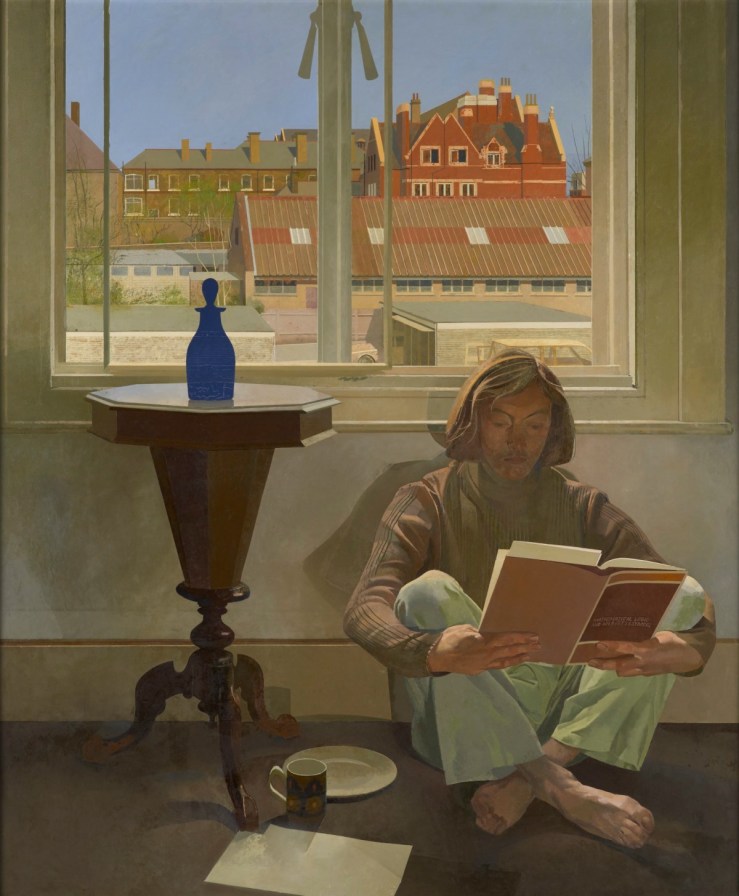
Kitty Pearson — Alice Neel

Kitty Pearson, 1973 by Alice Neel (1900-1984)

Seated Woman with Small Dog — Meraud Guevara

Seated Woman with Small Dog, c.1939 by Meraud Guevara (1904-1993)

“The Duel That Was Not Fought” — Stephen Crane

“The Duel That Was Not Fought”

by

Stephen Crane


Patsy Tulligan was not as wise as seven owls, but his courage could throw a shadow as long as the steeple of a cathedral. There were men on Cherry Street who had whipped him five times, but they all knew that Patsy would be as ready for the sixth time as if nothing had happened.

Once he and two friends had been away up on Eighth Avenue, far out of their country, and upon their return journey that evening they stopped frequently in saloons until they were as independent of their surroundings as eagles, and cared much less about thirty days on Blackwell’s.

On Lower Sixth Avenue they paused in a saloon where there was a good deal of lamp-glare and polished wood to be seen from the outside, and within, the mellow light shone on much furbished brass and more polished wood. It was a better saloon than they were in the habit of seeing, but they did not mind it. They sat down at one of the little tables that were in a row parallel to the bar and ordered beer. They blinked stolidly at the decorations, the bar-tender, and the other customers. When anything transpired they discussed it with dazzling frankness, and what they said of it was as free as air to the other people in the place.

At midnight there were few people in the saloon. Patsy and his friends still sat drinking. Two well-dressed men were at another table, smoking cigars slowly and swinging back in their chairs. They occupied themselves with themselves in the usual manner, never betraying by a wink of an eyelid that they knew that other folk existed. At another table directly behind Patsy and his companions was a slim little Cuban, with miraculously small feet and hands, and with a youthful touch of down upon his lip. As he lifted his cigarette from time to time his little finger was bended in dainty fashion, and there was a green flash when a huge emerald ring caught the light. The bar-tender came often with his little brass tray. Occasionally Patsy and his two friends quarrelled. Continue reading ““The Duel That Was Not Fought” — Stephen Crane”