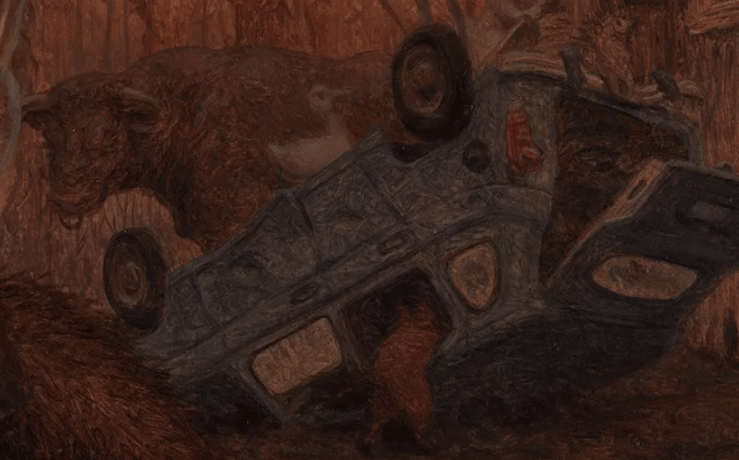
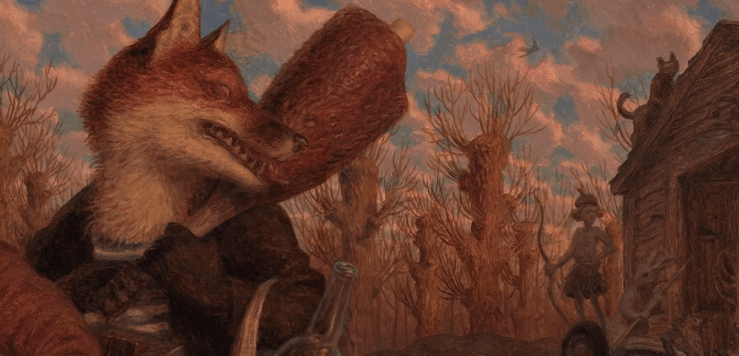
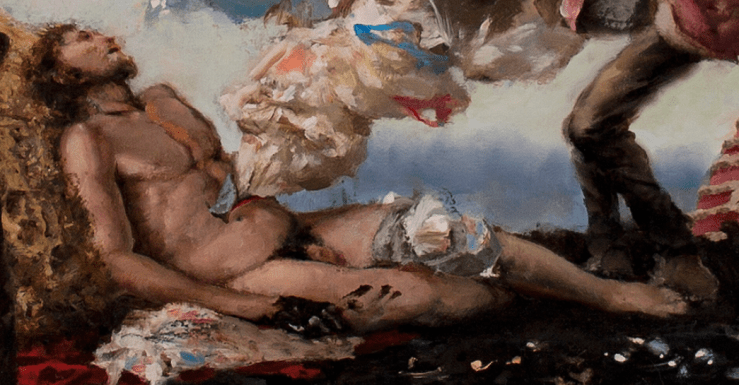
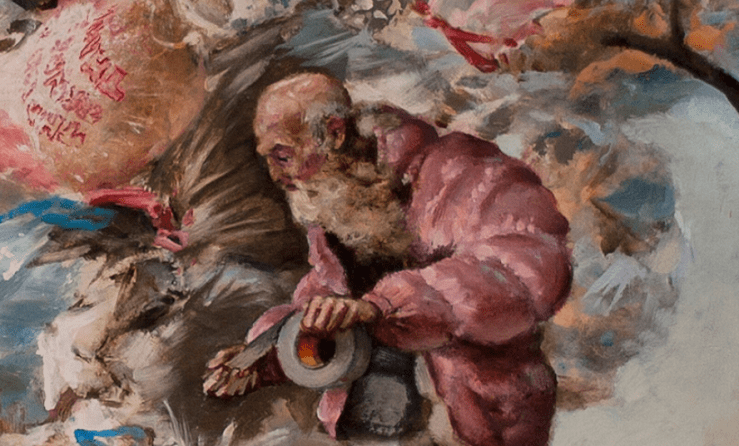
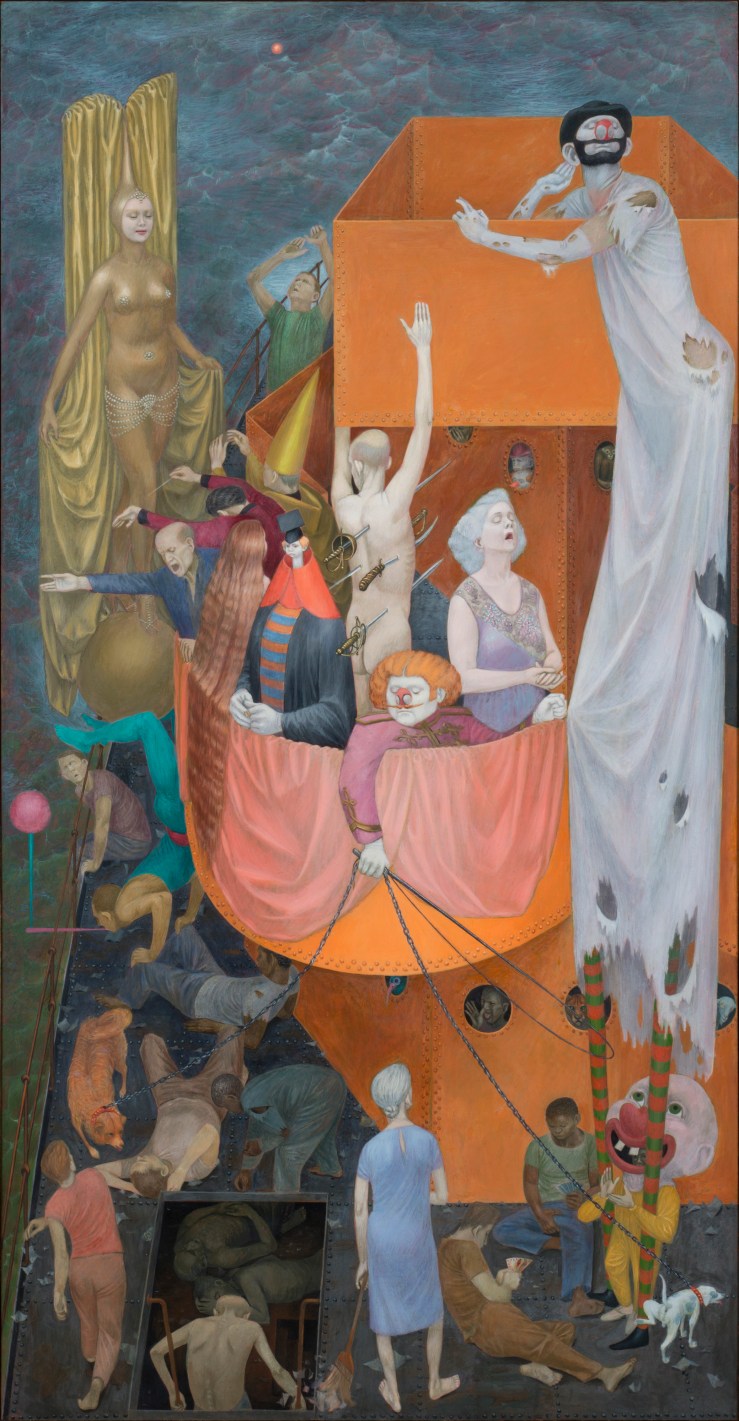
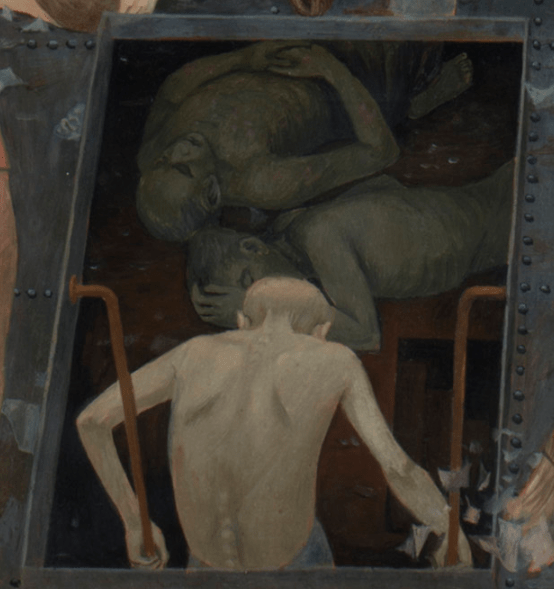
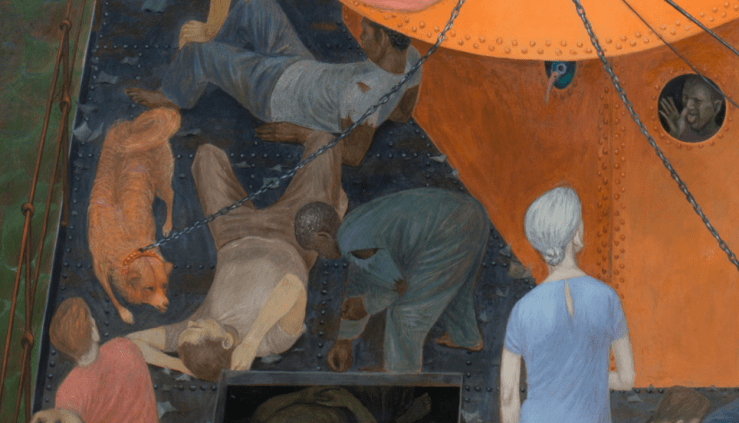
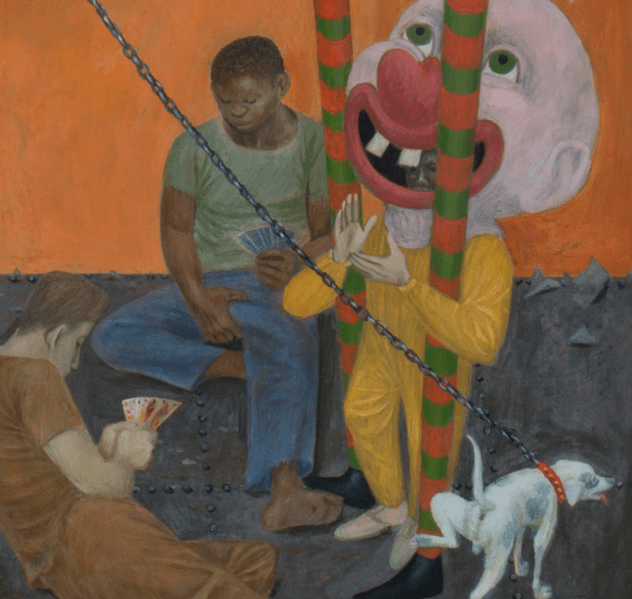
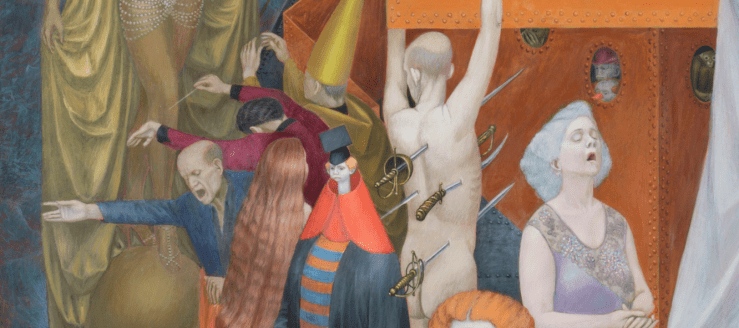
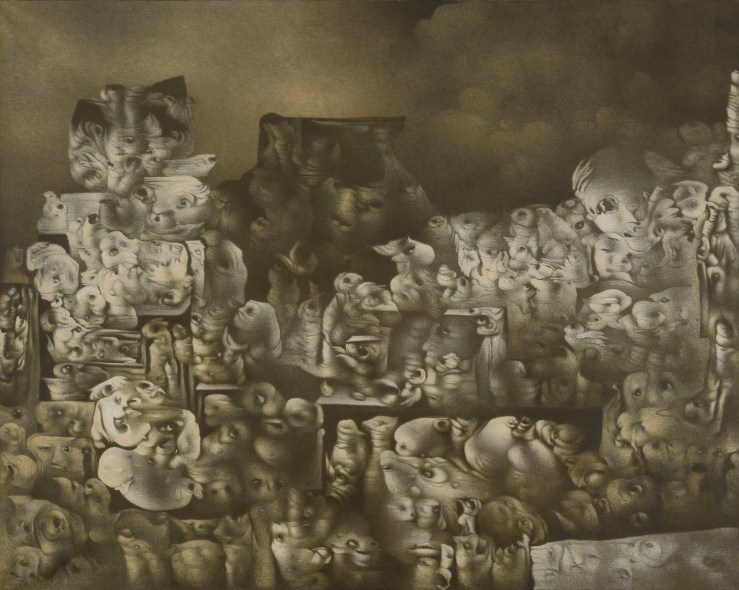
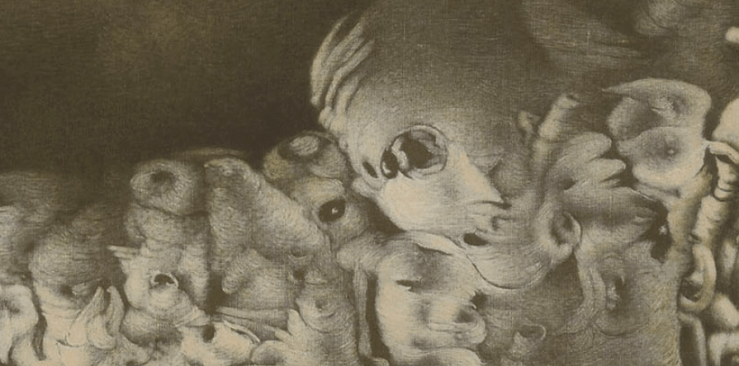
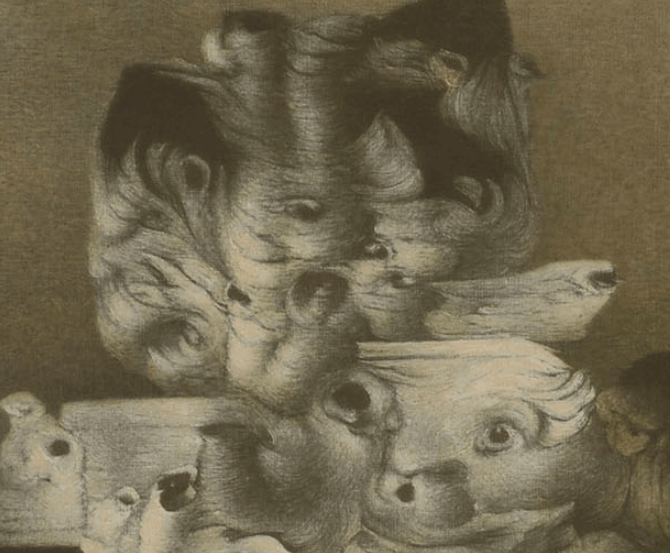
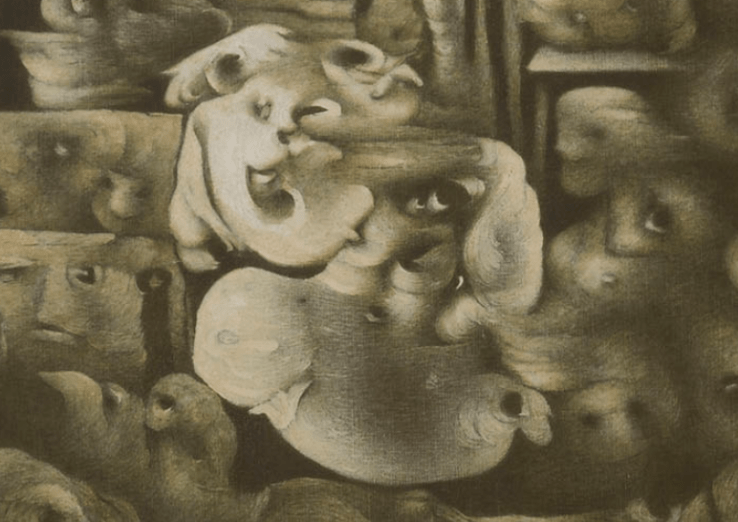
Island Library — Jamie Wyeth

island-library-1977

Island Library, 1977 by Jamie Wyeth (b. 1946)

Sic Transit — George Frederic Watts

Sic Transit 1891-2 by George Frederic Watts 1817-1904

Sic Transit, 1892 by George Frederic Watts (1817–1904)

“A Rabbit as King of the Ghosts” — Wallace Stevens

“A Rabbit as King of the Ghosts”

by

Wallace Stevens


The difficulty to think at the end of day,
When the shapeless shadow covers the sun
And nothing is left except light on your fur—

There was the cat slopping its milk all day,
Fat cat, red tongue, green mind, white milk
And August the most peaceful month.

To be, in the grass, in the peacefullest time,
Without that monument of cat,
The cat forgotten in the moon;

And to feel that the light is a rabbit-light,
In which everything is meant for you
And nothing need be explained;

Then there is nothing to think of. It comes of itself;
And east rushes west and west rushes down,
No matter. The grass is full

And full of yourself. The trees around are for you,
The whole of the wideness of night is for you,
A self that touches all edges,

You become a self that fills the four corners of night.
The red cat hides away in the fur-light
And there you are humped high, humped up,

You are humped higher and higher, black as stone—
You sit with your head like a carving in space
And the little green cat is a bug in the grass.

Perseus, whaleman (Melville/Sienkiewicz)

img_7584

From Bill Sienkiewicz’s adaptation of Herman Melville’s Moby-Dick. The Classics Illustrated edition (February 1990) is one of my favorite Moby-Dicks.

Of all divers, thou hast dived the deepest | Moby-Dick

Fathomless Sounding 1932 by Gertrude Hermes 1901-1983
Fathomless Sounding, 1932 by Gertrude Hermes (1901-1983)

It was a black and hooded head; and hanging there in the midst of so intense a calm, it seemed the Sphynx’s in the desert. “Speak, thou vast and venerable head,” muttered Ahab, “which, though ungarnished with a beard, yet here and there lookest hoary with mosses; speak, mighty head, and tell us the secret thing that is in thee. Of all divers, thou hast dived the deepest. That head upon which the upper sun now gleams, has moved amid this world’s foundations. Where unrecorded names and navies rust, and untold hopes and anchors rot; where in her murderous hold this frigate earth is ballasted with bones of millions of the drowned; there, in that awful water-land, there was thy most familiar home. Thou hast been where bell or diver never went; hast slept by many a sailor’s side, where sleepless mothers would give their lives to lay them down. Thou saw’st the locked lovers when leaping from their flaming ship; heart to heart they sank beneath the exulting wave; true to each other, when heaven seemed false to them. Thou saw’st the murdered mate when tossed by pirates from the midnight deck; for hours he fell into the deeper midnight of the insatiate maw; and his murderers still sailed on unharmed—while swift lightnings shivered the neighboring ship that would have borne a righteous husband to outstretched, longing arms. O head! thou hast seen enough to split the planets and make an infidel of Abraham, and not one syllable is thine!”

From Ch. 70 of Moby-Dick by Herman Melville.

“Herman Melville” — Jorge Luis Borges

“Herman Melville”

by

Jorge Luis Borges


He was always surrounded by the sea of his elders,

The Saxons, who named the ocean

The Whale-Road, thereby uniting

The two immense things, the whale

And the seas it endlessly ploughs.

The sea was always his. By the time his eyes

First took in the great waters of the high seas

He had already longed for and possessed it

On that other ocean, which is Writing,

And in the outline of the archetypes.

A man, he gave himself to the earth’s oceans

And to the exhausting days at sea

And he came to know the harpoon reddened

By Leviathan and he rippled sand

And the smells of nights and mornings

And chance on the horizon waiting in ambush

And the happiness of being brave

And the pleasure, at last, of spying Ithaca.

The ocean’s conqueror, he strode the solid

Earth out of which mountains grow

And on which he charts an imprecise course

As with a sleeping compass, motionless in time.

In the inherited shadows of the gardens

Melville moves through New England evenings,

But the sea possesses him. It is the shame

Of the Pequod’s mutilated captain,

The unreadable ocean with its furious squalls

And the abomination of the whiteness.

It is the great book. It is blue Proteus.

(English translation by Stephen Kessler)

“Evening Song” — Jean Toomer

“Evening Song”

by

Jean Toomer


Full moon rising on the waters of my heart,
Lakes and moon and fires,
Cloine tires,
Holding her lips apart.

Promises of slumber leaving shore to charm the moon,
Miracle made vesper-keeps,
Cloine sleeps,
And I’ll be sleeping soon.

Cloine, curled like the sleepy waters where the
moon-waves start,
Radiant, resplendently she gleams,
Cloine dreams,
Lips pressed against my heart.

A review of Yellow Back Radio Broke-Down, Ishmael Reed’s syncretic Neo-HooDoo revenge Western

img_0548

Ishmael Reed’s second novel Yellow Back Radio Broke-Down tells the story of the Loop Garoo Kid, a “desperado so onery he made the Pope cry and the most powerful of cattlemen shed his head to the Executioner’s swine.”

The novel explodes in kaleidoscopic bursts as Reed dices up three centuries of American history to riff on race, religion, sex, and power. Unstuck in time and unhampered by geographic or technological restraint, historical figures like Lewis and Clark, Thomas Jefferson, John Wesley Harding, Groucho Marx, and Pope Innocent (never mind which one) wander in and out of the narrative, supplementing its ironic allegorical heft. These minor characters are part of Reed’s Neo-HooDoo spell, ingredients in a Western revenge story that is simultaneously comic and apocalyptic in its howl against the dominant historical American narrative. Yellow Back Radio Broke-Down is a strange and marvelous novel, at once slapstick and deadly serious, exuberant in its joy and harsh in its bitterness, close to 50 years after its publication, as timely as ever.

After the breathless introduction of its hero the Loop Garoo Kid, Yellow Back Radio Broke-Down initiates its plot. Loop’s circus troupe arrives to the titular city Yellow Back Radio (the “nearest town Video Junction is about fifty miles away”), only to find that the children of the town, “dressed in the attire of the Plains Indians,” have deposed the adults:

We chased them out of town. We were tired of them ordering us around. They worked us day and night in the mines, made us herd animals harvest the crops and for three hours a day we went to school to hear teachers praise the old. Made us learn facts by rote. Lies really bent upon making us behave. We decided to create our own fiction.

The children’s revolutionary, anarchic spirit drives Reed’s own fiction, which counters all those old lies the old people use to make us behave.

Of course the old—the adults—want “their” land back. Enter that most powerful of cattlemen, Drag Gibson, who plans to wrest the land away from everyone for himself. We first meet Drag “at his usual hobby, embracing his property.” Drag’s favorite property is a green mustang,

a symbol for all his streams of fish, his herds, his fruit so large they weighed down the mountains, black gold and diamonds which lay in untapped fields, and his barnyard overflowing with robust and erotic fowl.

Drag loves to French kiss the horse, we’re told. Oh, and lest you wonder if “green” here is a metaphor for, like, new, or inexperienced, or callow: No. The horse is literally green (“turned green from old nightmares”). That’s the wonderful surreal logic of Reed’s vibrant Western, and such details (the novel is crammed with them) make Yellow Back Radio Broke-Down a joy to read.

Where was I? Oh yes, Drag Gibson.

Drag—allegorical stand-in for Manifest Destiny, white privilege, capitalist expansion, you name it—Drag, in the process of trying to clear the kids out of Yellow Back Radio, orders all of Loop’s troupe slaughtered.

The massacre sets in motion Loop’s revenge on Drag (and white supremacy in general), which unfolds in a bitter blazing series of japes, riffs, rants, and gags. (“Unfolds” is the wrong verb—too neat. The action in Yellow Back Radio Broke-Down is more like the springing of a Jack-in-the-box).

Loop goes about obtaining his revenge via his NeoHooDoo practices. He calls out curses and hexes, summoning loas in a lengthy prayer. Loop’s spell culminates in a call that goes beyond an immediate revenge on Drag and his henchmen, a call that moves toward a retribution for black culture in general:

O Black Hawk American Indian houngan of Hoo-Doo please do open up some of these prissy orthodox minds so that they will no longer call Black People’s American experience “corrupt” “perverse” and “decadent.” Please show them that Booker T and MG’s, Etta James, Johnny Ace and Bojangle tapdancing is just as beautiful as anything that happened anywhere else in the world. Teach them that anywhere people go they have experience and that all experience is art.

So much of Yellow Back Radio Broke-Down is turning all experience into art. Reed spins multivalent cultural material into something new, something arguably American. The title of the novel suggests its program: a breaking-down of yellowed paperback narratives, a breaking-down of radio signals. Significantly, that analysis, that break-down, is also synthesized in this novel into something wholly original. Rhetorically, Yellow Back Radio Broke-Down evokes flipping through paperbacks at random, making a new narrative; or scrolling up and down a radio dial, making new music from random bursts of sound; or rifling through a stack of manic Sunday funnies to make a new, somehow more vibrant collage.

Perhaps the Pope puts it best when he arrives late in the novel. (Ostensibly, the Pope shows up to put an end to Loop’s hexing and vexing of the adult citizenry—but let’s just say the two Holy Men have a deeper, older relationship). After a lengthy disquisition on the history of hoodoo and its genesis in the Voudon religion of Africa (“that strange continent which serves as the subconscious of our planet…shaped so like the human skull”), the Pope declares that “Loop Garoo seems to be practicing a syncretistic American version” of the old Ju Ju. The Pope continues:

Loop seems to be scatting arbitrarily, using forms of this and that and adding his own. He’s blowing like that celebrated musician Charles Yardbird Parker—improvising as he goes along. He’s throwing clusters of demon chords at you and you don’t know the changes, do you Mr. Drag?

The Pope here describes Reed’s style too, of course (which is to say that Reed is describing his own style, via one of his characters. The purest postmodernism). The apparent effortlessness of Reed’s improvisations—the prose’s sheer manic energy—actually camouflages a tight and precise plot. I was struck by how much of Yellow Back Radio Broke-Down’s apparent anarchy resolves into a bigger picture upon a second reading.

That simultaneous effortlessness and precision makes Reed’s novel a joy to jaunt through. Here is a writer taking what he wants from any number of literary and artistic traditions while dispensing with the forms and tropes he doesn’t want and doesn’t need. If Reed wants to riff on the historical relations between Indians and African-Americans, he’ll do that. If Reed wants to assess the relative values of Thomas Jefferson as a progressive figure, he’ll do that. If Reed wants to attack his neo-social realist critics, he’ll do that. If Reed wants to critique the relationship between militarism and science, he’ll do that. If Reed wants to tell some really dirty jokes about a threesome, he’ll do that. And you can bet if he wants some ass-kicking Amazons to show up at some point, they’re gonna show.

And it’s a great show. Yellow Back Radio Broke-Down begins with the slaughter of a circus troupe before we get to see their act. The real circus act is the novel itself, filled with orators and showmen, carnival barkers and con-artists, pistoleers and magicians. There’s a manic glee to it all, a glee tempered in anger—think of George Herriman’s Krazy Kat, or Thomas Pynchon’s zany rage, or Robert Downey Sr.’s satirical film Putney Swope.

Through all its anger, Yellow Back Radio Broke-Down nevertheless repeatedly affirms the possibility of imagination and creation—both as cures and as hexes. We have here a tale of defensive and retaliatory magic. Yellow Back Radio Broke-Down is the third novel of Reed’s novels I’ve read (after Mumbo Jumbo and The Free-Lance Pallbearers), and my favorite thus far. Frankly, I needed the novel right now in a way that I didn’t know that I needed it until I read it; the contemporary novel I tried to read after it felt stale and boring. So I read Yellow Back Radio Broke-Down again. The great gift here is that Reed’s novel answers to the final line of Loop’s prayer to the Loa: “Teach them that anywhere people go they have experience and that all experience is art.” Like the children of Yellow Back Radio, Reed creates his own fiction, and invites us to do the same. Very highly recommended.

[Ed. note—Biblioklept originally ran this review in February of 2017.]

24 still frames from Terry Gilliam’s Brazil

0206070911 (1)13 (1)15 (1)19 (1)20 (1)22 (1)2324 (1)26 (1)31 (1)3639 (1)4248495152545560

From Brazil, 1985. Directed by Terry Gilliam with cinematography by Roger Pratt. Via Film Grab.

Untitled (Self Portrait) — William Eggleston

eggleston-selfportrait

Untitled from The Democratic Forest, 1983-1986 by William Eggleston (b. 1939)

Posted in Art

Leda #1 — John D. Graham

w1siziisijixnjy2nijdlfsiccisimnvbnzlcnqilcitcmvzaxplidiwmdb4mjawmfx1mdazzsjdxqScreenshot 2019-07-16 at 10.47.50 AMScreenshot 2019-07-16 at 10.47.31 AM

Two Sisters, 1944 by John D. Graham (1881–1961)

Posted in Art

A review of Gisèle Prassinos’s collection of surreal anti-fables, The Arthritic Grasshopper

img_7667

I can’t remember which particular Surrealist I was googling when I learned about Gisèle Prassinos. I do know that it was just a few weeks ago, and I’ve had an interest in Surrealist art and literature since I was a kid, so I was a bit stunned that I’d never heard of her before now—strange, given the origin of her first publication. In 1934, when she was 14, Prassinos was “discovered” by André Breton, and the Surrealists delighted in what they called her “automatic writing.” (Prassinos would later reject that label, and go as far as to declare that she had never been a surrealist). Her first book, La Sauterelle arthritique (The Arthritic Grasshopper) was published just a year later.

1-work
Prassinos reading her work to the Surrealists; photograph by Man Ray


I somehow found a .pdf of one of her stories, “A Nice Family,” a bizarre little tale that runs on its own surreal mythology. The story struck me as simultaneously grandiose and miniature, dense but also skeletal. It was impossible. Surreal. I wanted more.

Luckily, just this spring Wakefield Press released The Arthritic Grasshopper: Collected Stories, 1934-1944, a new English translation of a 1976 compendium of Prassinos’s tales, Trouver sans checher. The translation is by Henry Vale and Bonnie Ruberg, whose introduction to the volume is a better review and overview than I can muster here. Ruberg offers a miniature biography, and shares details from her letters and visits with Prassinos. She situates Prassinos within the Surrealists’ gender biases: “For a young writer such as Prassinos, being involved with the surrealists would have meant gaining access to resources like publishers, but it also would have meant being fetishized and marginalized.” Ruberg characterizes Prassinos’s tales eloquently and accurately—no simple feat given the material’s utter strangeness:

Taken collectively, their effect is a piercing cackle, a complete disorientation, rather than an ethical lesson. The politics of these stories are absurdist. They upend the world by making children dangerous, by reanimating the dead, by letting the carefully tended domestic deform, foam, and melt. No social structure holds power in the world of these stories—not on the basis of gender, or nationality, or class. The force that reigns is chaos.

Let’s look at that reigning chaos.

In “The Sensitivity of Others,” one of the earliest tales in the volume, we get the sparest narrative action seemingly possible: A speaker walks forward. And yet dream-nightmare touches impinge on all sides and on all senses. The opening line shows a world that is never stable, and if monsters and other dangers lurk just on the margins of our narrator’s shifting path, so do wonders and the promise of strange knowledge. Here’s the tale in full:

img_7666

I still have no idea what to make of the punchline there at the end, but those final images—a father, a faulty library, a power failure—hang heavy against the narrator’s trembling walk.

Many of Prassinos’s anti-fables conclude with such apparent non sequiturs, and yet the final lines can also cast a weird light back over the previous sentences. In “Photogenic Quality,” a dream-tale about the act of writing itself, the final line at first appears as sheer absurdity. A man receives a pencil from a child, whittles it into powder, blots the powder on paper, and throws the paper in the river (more things happen, too). The tale concludes with the man declaring, “Brass is made from copper and tin.” It’s possible to enjoy the absurdity here on its own; however, I think we can also read the last line as a kind of Abracadabra!, magic words that describe an almost alchemical synthesis—a synthesis much like the absurd modes of transformative writing that “Photogenic Quality” outlines.

img_7664

You’ll see above one of Allan Kausch’s illustrations for The Arthritic Grasshopper. Kausch’s collages pointedly recall Max Ernst’s surreal 1934 graphic novel Une semaine de bonté (A Week of Kindness). Kausch’s work walks a weird line between horror and whimsy; images from old children’s books and magazines become chimerical figures, sometimes cute, sometimes horrific, and sometimes both. They’re lovely.

img_7663

Surreal figures shift throughout the book—monks and kings, daughters and mothers, deep sea divers and knights and salesmen and talking horses—all slightly out of place, or, rather, all making new places. Even when Prassinos establishes a traditional space we might think we recognize—often a fairy trope—she warps its contours, shaping it into something else. “A Marriage Proposal,” with its unsuspecting title, opens with “Once upon a time” — but we are soon dwelling in impossibility: “the garter snake appeared in the doorway, arm in arm with the snail, who was slobbering with happiness.” Other stories, like “Tragic Fanaticism,” immediately condense fairy tales into pure images, leaving the reader to suss out connections. Here is that story’s opening line: “A black hole, a little old woman, animals.” At five pages, “Tragic Fanaticism” is one of the collection’s longer stories. It ends with a four line poem, sung by five red cats to the old woman: “Go home and burn / Darling / You’re the only one we’ll love / Trash Bin.”

I still have a number of stories to read in The Arthritic Grasshopper. I’ve enjoyed its tales most when taken as intermezzos between sterner (or compulsory) reading. There’s something refreshing in Prassinos’s illogic. In longer stretches, I find that I tire, get lazy—Prassinos’s imagery shifts quickly—there’s something even picaresque to the stories—and keeping up with its veering rhythms for tale after tale can be taxing. Better not to gobble it all up at once. In this sense, The Arthritic Grasshopper reminds me strongly of another recently-published volume of surreal, imagistic stories that I’ve been slowly consuming this year: The Complete Stories of Leonora CarringtonIn their finest moments, both of these writers can offer new ways of looking at art, at narrative, at the world itself.

I described Prassinos’s tales as “anti-fables” above—a description that I think is accurate enough, as literary descriptions go—but that doesn’t mean there isn’t something that we can learn from them (although, to be very clear, I do not think literature has to offer us anything to learn). What Prassinos’s anti-fables do best is open up strange impossible spaces—there’s a kind of radical, amorphous openness here, one that might be neatly expressed in the original title to this newly-translated volume—Trouver sans checherTo Find without Seeking.

In her preface (titled “To Find without Seeking”) Prassinos begins with the question, “To find what?” Here is a question that many of us have been taught we must direct to all the literature we read—to interrogate it so that it yields moral instruction. Prassinos answers: “The spot where innocence rejoices, trembling as it first meets fear. The spot where innocence unleashes its ferocity and its monsters.” She goes on to describe a “true and complete world” where the “earth and water have no borders and each us can live there if we choose, in just the same way, without changing our names.” Her preface concludes by repeating “To find what?”, and then answering the question in the most perfectly (im)possible way: “In the end, the mind that doesn’t know what it knows: the free astonishing voice that speaks, faceless, in the night.” Prassinos’s anti-fables offer ways of reading a mind that doesn’t know what it knows, of singing along with the free faceless astonishing voice. Highly recommended.

[Ed. note–Biblioklept originally ran this review in August of 2017.]

Siren — Scott Greene

Screenshot 2019-05-09 at 3.43.57 PM

Siren, 2015 by Scott Greene

The Watschenmann at the Viennese Prater (The Punching Bag Man) — Henry Koerner

53154761_1_x

The Watschenmann at the Viennese Prater (The Punching Bag Man), 1956 by Henry Koerner (1915-1991)

Time, Gentlemen Please — Oskar Kokoschka

Time, Gentlemen Please 1971-2 by Oskar Kokoschka 1886-1980

Time, Gentlemen Please, 1972 by Oskar Kokoschka (1886–1980)

The Florist — André Marchand

7f9b32ae8a9a9540927ff8c80651f2a38424097a

The Florist, 1937 by André Marchand (1907–1997)

It’s for You, Dear — Danny Galieote

dg-itsforyoudear

It’s for You, Dear by Danny Galieote (b. 1968)