Gravity’s Rainbow — annotations and illustrations for page 203

Why here? 1 Why should the rainbow edges 2 of what is almost on him be rippling most intense here in this amply coded room? say why should walking in here be almost the same as entering the Forbidden 3  itself—here are the same long rooms, rooms of old paralysis and evil distillery, of condensations and residues you are afraid to smell from forgotten corruptions, rooms full of upright gray-feathered statues with wings spread, indistinct faces in dust 4 —rooms full of dust that will cloud the shapes of inhabitants around the corners or deeper inside, that will settle on their black formal lapels, that will soften to sugar the white faces, white shirt fronts, gems and gowns, white hands that move too quickly to be seen 5 … what game do They deal 6 ? What passes are these, so blurred, so old and perfect? “Fuck you,” whispers Slothrop 7. It’s the only spell 8 he knows, and a pretty good all-purpose one at that. His whisper is baffled by the thousands of tiny rococo surfaces. Maybe he’ll sneak in tonight—no not at night—but sometime, with a bucket and brush, paint FUCK YOU in a balloon 10 coming out the mouth of one of those little pink shepherdesses there  11… .

He steps back out, backward out the door, as if half, his ventral half, were being struck in kingly radiance: retreating from yet facing the Presence feared and wanted. 12

1 Why…not?

Okay—this seems like a fair question. Let’s not be glib.

The question is Our Hero Tyrone Slothrop’s, via Pynchon’s oft-present free indirect style.

The where is the hotel room  of Our Man in the French Riviera. Slothrop is on “furlough” (not really, they—They—have his ass hard at work) at the Hermann Goering Casino.

Poor Tyrone returns to his hotel room after a picaresque run (and wardrobe shift: tacky/sexy Hawaiian shirt to purple toga to English army uniform) to find that “everything in this room is really being used for something. Different. Meaning things to Them it has never meant to us. Two orders of being…”

Two orders of being: I could riff all day (night?) on this, but I suppose we can boil it down to GR’s binary theme. (Or, for fun, because it’s Our Boy Slothrop—Visible/Invisible (“paranoia” is the gradation between that binary).

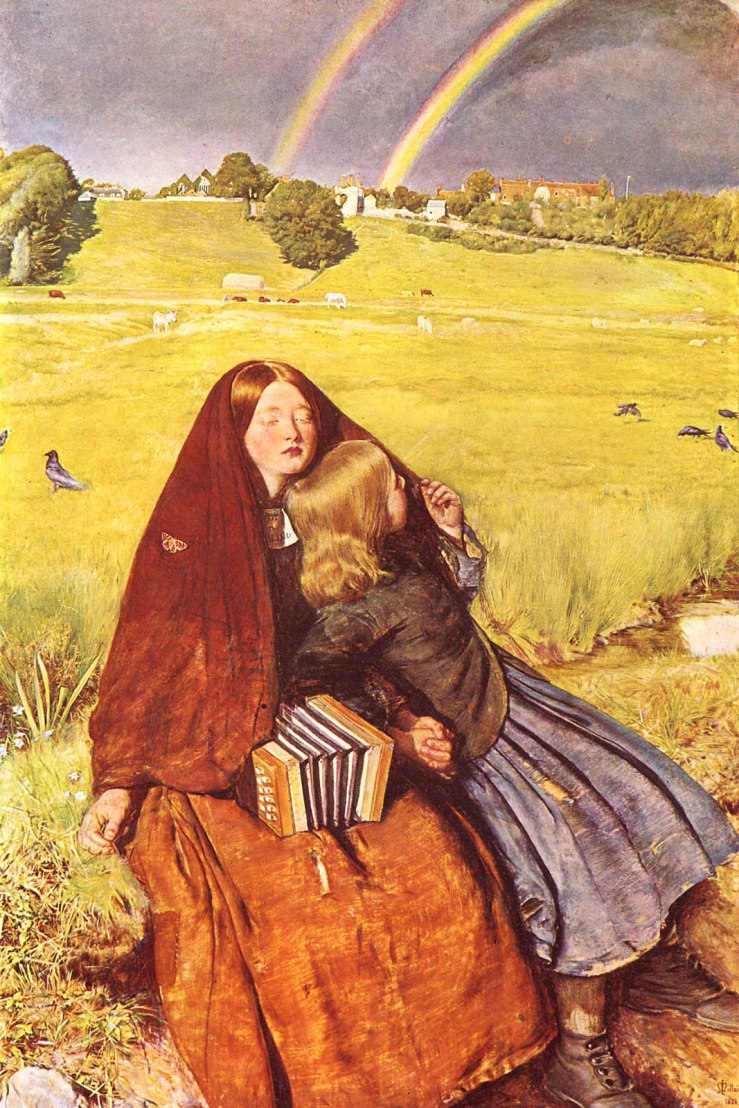
2 The fourth appearance of the word “rainbow” in GR (barring the title, colophon, etc.). Another gradation, the rainbow, between binaries. An arc, a rise, a fall.

Double rainbow. Blind-sighted: False binary. Gradations:
millais-blind_girl
The Blind Girl, John Everett Millais, 1856

(And music).

Cf. Genesis 9:11-16 (King James Version):

11 And I will establish my covenant with you, neither shall all flesh be cut off any more by the waters of a flood; neither shall there any more be a flood to destroy the earth.

12 And God said, This is the token of the covenant which I make between me and you and every living creature that is with you, for perpetual generations:

13 I do set my bow in the cloud, and it shall be for a token of a covenant between me and the earth.

14 And it shall come to pass, when I bring a cloud over the earth, that the bow shall be seen in the cloud:

15 And I will remember my covenant, which is between me and you and every living creature of all flesh; and the waters shall no more become a flood to destroy all flesh.

16 And the bow shall be in the cloud; and I will look upon it, that I may remember the everlasting covenant between God and every living creature of all flesh that is upon the earth.

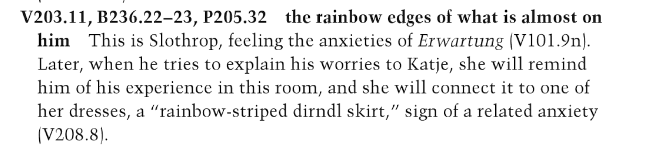
Cf. A Gravity’s Rainbow Companion: Sources and Contexts for Pynchon’s Novel, Steven Weisenburger:
screenshot-2016-09-19-at-7-41-44-pm

3 …the Taboo? The Abject? Another description of Gravity’s Rainbow…? Or do we just feel the meaning here? (Yes).

4 The imagery here—desiccation and paralysis, a taxidermist’s row in an old dusty museum—evokes the death|life binary.

5 The Elect (vs Preterite Slothrop). Our Dude TS has his own issues vis a vis whiteness (revisit his adventures down the toilet back during a night in Roxbury).

6 Recall we are in the Casino Hermann Goering. Recall GR’s themes of chance and fate, probability and statistics, zeroes and ones. Recall They.

7 This seems to me like another thesis statement of Pynchon’s in Gravity’s Rainbow.

Actually, fuck that hedging:fuck you to the They is Gravity’s Rainbow’s mission statement.

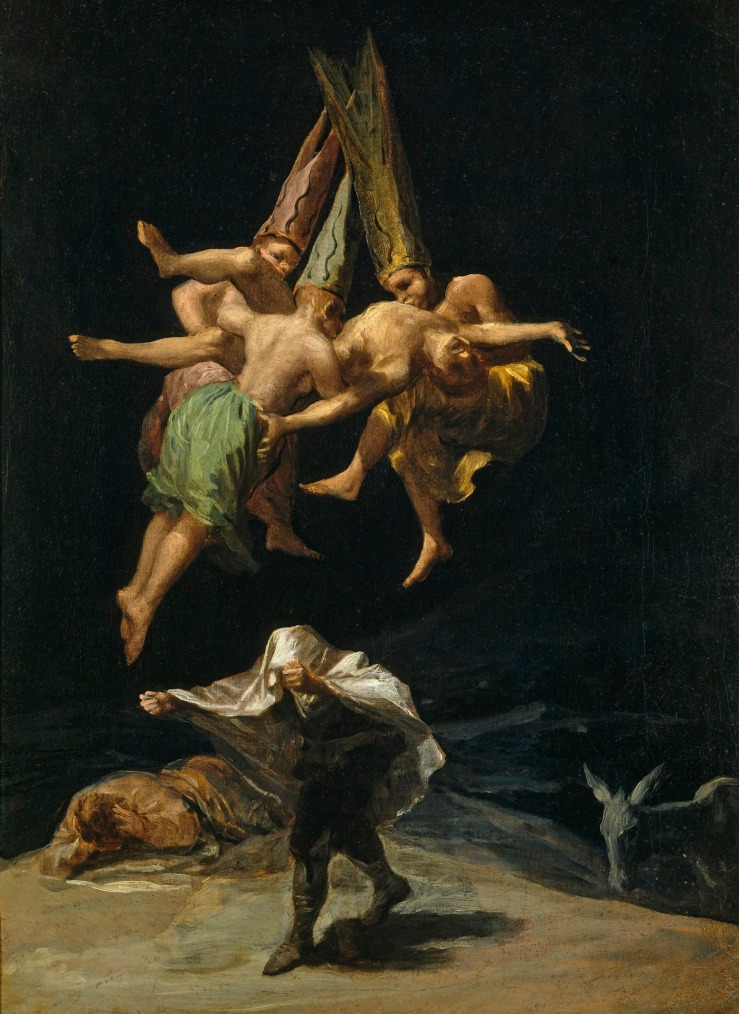
8 Gravity’s Rainbow is full of witches, and maybe Slothrop is a lazy novice.
qfa16nkmgon8ftak0ltb
Witches’ Flight, Francisco Goya, 1797-98.

9 Cf. Ch. 25 of J.D. Salinger’s 1951 novel The Catcher in the Rye:

It’s hopeless, anyway. If you had a million years to do it in, you couldn’t rub out even half the “Fuck you” signs in the world. It’s impossible.

10 Have you read Donald Barthelme’s 1968 short story “The Balloon”?

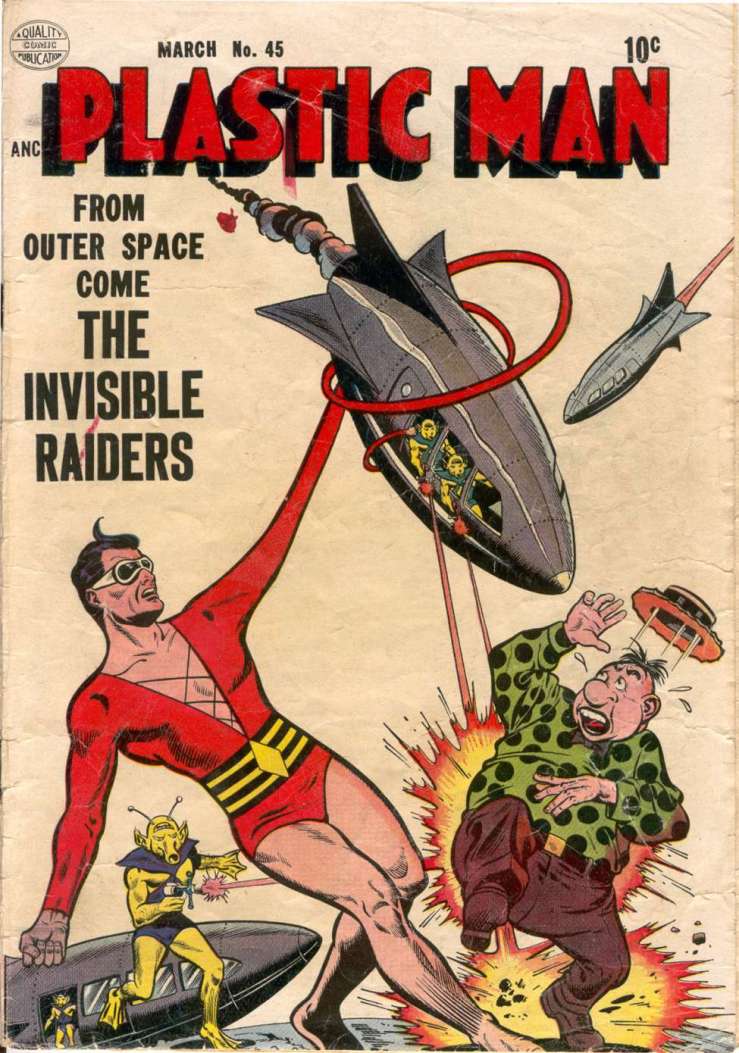
11 A fascinating image, I think. Leave the rococo knickknack of the pink shepherdess alone a moment (perhaps it suggests erotic enticement to you, pervert preterite?) and attend to just how and where Slothrop intends to append this “FUCK YOU” sign—in a comic book speech bubble. The intertextual (do I mean metatextual—it’s hard to keep up) possibilities here bubble and boil. It’s as if Slothrop would rewrite his room (“Two orders of being”) as a comic book.

A page or two later, we find Our Guy Slothrop reading an issue of Plastic Man.
0
Plastic Man #45 by Jack Cole, 1954.

12 Note here the halving of Slothrop, the text that cuts him—ventral. He’s in and out, facing a Presence but already half Absent. Is Our Savior Tyrone the one radiating the “kingly radiance” — or is he being radiated by it?—Or am I making too much of light?

Sunday Comics

img_3626

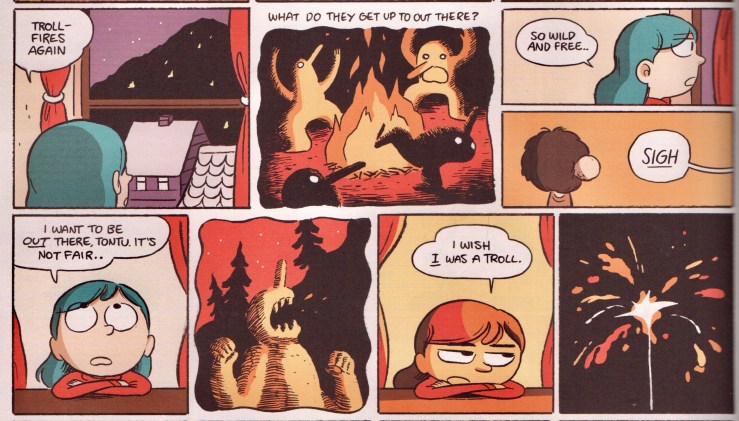
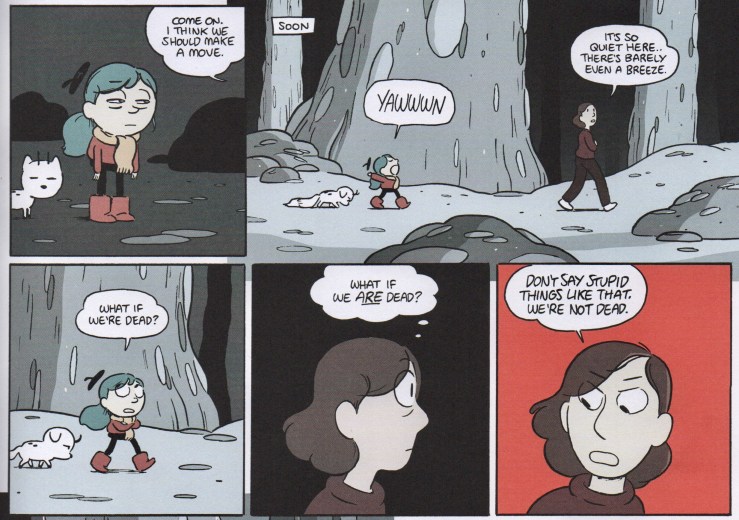
I love love love Hilda and the Stone Forest by Luke Pearson (Flying Eye/Nobrow, 2016). My kids love it too. It’s the richest, funniest, and most heartwarming Hilda book to date.

img_3628

Pearson manages to stuff The Stone Forest with miniature epics and minor gags, which he hangs on the central story of Hilda and her mother in an otherworldly (literally), uh, stone forest, where they encounter trolls and other dangers (including existential despair).

img_3629

Gravity’s Rainbow — annotations and illustrations for pages 148-49 | Our history is an aggregate of last moments

216292
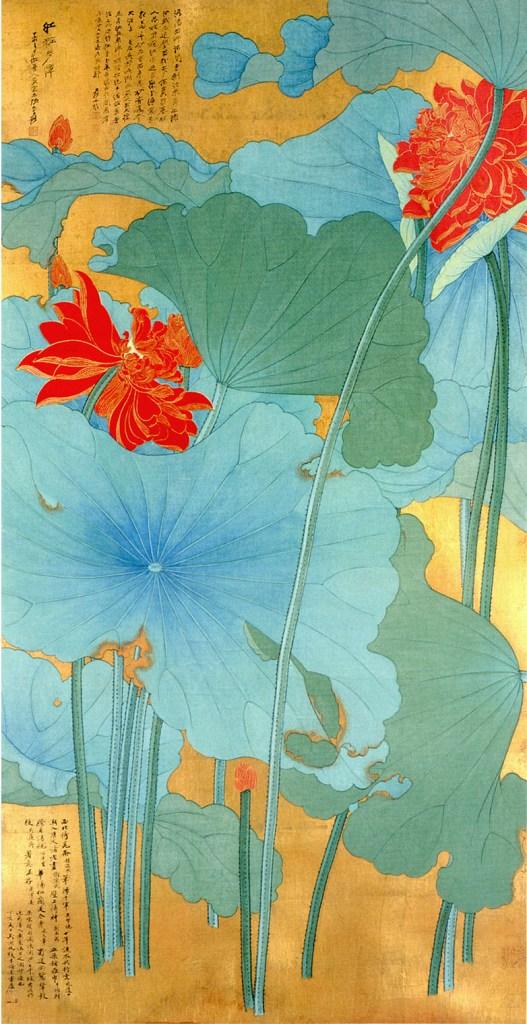
Lotus, Chang Dai-chien, 1948

—(Quietly) 1 It’s been a prevalent notion 2. Fallen sparks 3. Fragments of vessels broken at the Creation 4. And someday, somehow, before the end, a gathering back to home. A messenger from the Kingdom, arriving at the last moment 5. But I tell you there is no such message, no such home 6—only the millions of last moments… no more. Our history is an aggregate of last moments 7.

From pages 82-83 of Thomas Pynchon’s 1973 novel Gravity’s Rainbow.

1 A stage direction. These are the final lines in a one-act play, a small (cosmically-large) tragicomedy featuring two…nerve cells. Rollo Groast of the White Visitation prefaces a page earlier:

It is part…of an old and clandestine drama for which the human body serves only as a set of very allusive, often cryptic, programme notes—it’s as if the body we can measure is a scrap of this programme found outside in the street, near a magnificent stone theater we cannot enter.

In this little play (its rough setting echoes GR’s own martial satire), a younger cell asks a senior cell if she’s ever been to the “Outer Level” and is somewhat shocked when she tells him that “sooner or later everyone out here has to go Epidermal. No exceptions.”

Is this the first episode of Gravity’s Rainbow staged as a play? I think so.

The “prevalent notion” the younger cell subscribes to is characterized in the four sentences that follow, and then rejected in the fifth, the sentence that pivots with “But.” A satire of religious hope, perhaps?—the notion of salvation, redemption, an organizing principle to arrive and tidy all the chaos?

The preterite. But also/and—

The notations on broken vessels and sparks seem to allude to the Kabbalah of Isaac Luria (1534-1572). I will not attempt a bad paraphrase of Lurianic Kabbalah here, but a basic big picture—sparks—souls, fragments of a one-soul—looking to be rectified. Pynchon, inking heavy his preterite-and-elect theme.

The deus ex machina in the last act, the game-winning Hail Mary pass, the Messiah, smiling and terrible…

6 Bummer.

Cf. the opening of Gravity’s Rainbow. From the sixth paragraph:

“You didn’t really believe you’d be saved. Come, we all know who we are by now. No one was ever going to take the trouble to save you, old fellow. . . .”

These are the first lines of dialog in the novel. (If they can be called dialog).

7 The “our” here is biological—one cell to another business—but is there more to human history? Are we more than just our cells? Are there sparks for these vessels?

The narrator here seems to superimpose an answer into the senior cell’s line here: History is simply an imposition, a psychological trick, a way to organize chaos via narrative.

Cf.  Pointsman’s lines, which I brought up in some previous annotations:

Will Postwar be nothing but ‘events,’ newly created one moment to the next? No links? Is it the end of history?

This miniature cellular drama comes after the introduction to a minor character in Gravity’s Rainbow I’ve always found intriguing: Gavin Trefoil.

Trefoil, an agent (?!) of The White Visitation, has powers:

Lately, as if all tuned in to the same aethereal Xth Programme, new varieties of freak have been showing up at “The White Visitation,” all hours of the day and night, silent, staring, expecting to be taken care of, carrying machines of black metal and glass gingerbread, off on waxy trances, hyperkinetically waiting only the right trigger-question to start blithering 200 words a minute about their special, terrible endowments. An assault. What are we to make of Gavin Trefoil, for whose gift there’s not even a name yet? (Rollo Groast wants to call it autochromatism.) Gavin, the youngest here, only 17, can somehow metabolize at will one of his amino acids, tyrosine. This will produce melanin, which is the brown-black pigment responsible for human skin color. Gavin can also inhibit this metabolizing by—it appears—varying the level of his blood phenylalanine. So he can change his color from most ghastly albino up through a smooth spectrum to very deep, purplish, black. If he concentrates he can keep this up, at any level, for weeks. Usually he is distracted, or forgets, and gradually drifts back to his rest state, a pale freckled redhead’s complexion.

I suppose I could riff all day on the symbolic/historic implications of Trefoil’s powers: His gradations of color disrupt the binary (black-white, off-on, zero-one) that a Pavlovian like Pointsman insists upon (Trefoil’s super(?!)power falls in line with Roger Mexico’s gradations between 0 and 1).

nuevos2bmutantes
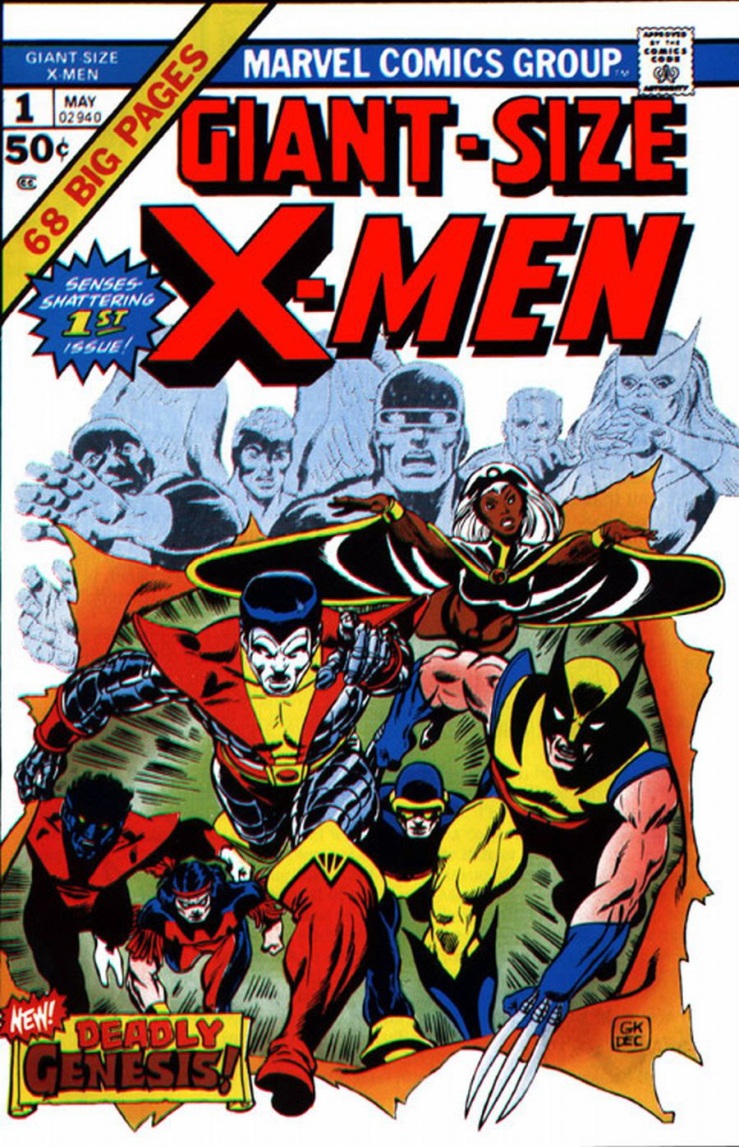
Giant-Size X-Men #1, 1975. Art by Gil Kane and Dave Cockrum, story by Len Wein.

But what really interests me here is Trefoil’s mutant powers and The White Visitation as a sort of potential comic book—I mean what I want to say here is that Pynchon points ahead to the 1975 “reboot” of Uncanny X-Men, and even The New Mutants: Post-global preterite underground weirdos with strange powers. Psychics and witches and protagonists that splinter into nothingness, after going through multiple reboots—(Plechazunga, the Pig-Hero, Rocketman, etc.). (Hell, the Pynchon X-Men team could even have Grigori the Octopus).

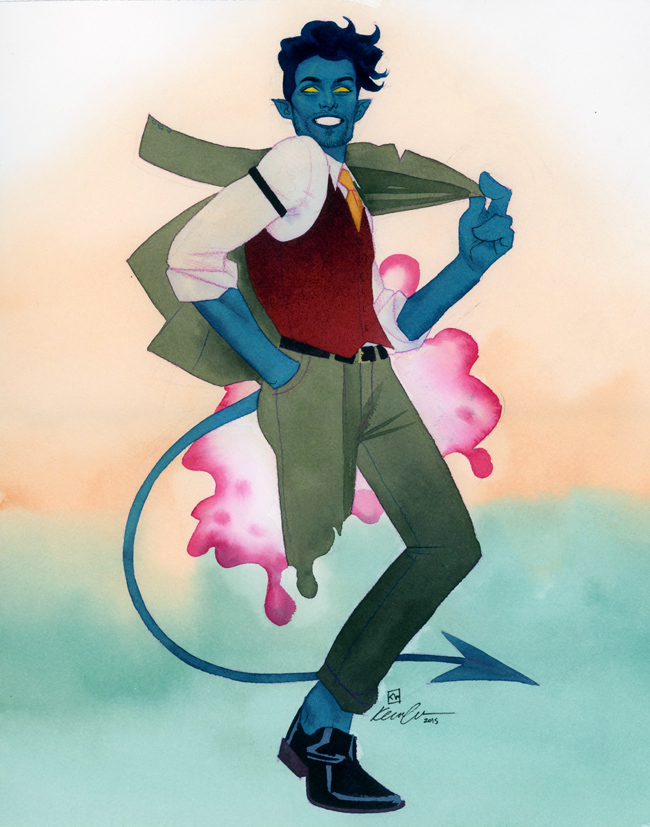
The closest X-Men comparison for Gavin Trefoil is probably the shapeshifter baddie X-Men antagonist Mystique, whose powers are obviously more pronounced than Trefoil’s. And there’s also Nightcrawler—maybe my favorite of Chris Claremont’s run on X-Men—or maybe I mean Excalibur. And also blueskinned Beast.


tumblr_nqf9yabhf91qbkgzfo1_1280
Nightcrawler, Kevin Wada, 2015

Late in the novel, Our Hero Tyrone Slothrop will help form the superish heroish team the Floundering Four (along with Myrtle Miraculous, zoot-suited Maximillian, and mechanical man Marcel). The Floundering Four will set out to battle the Paternal Peril. (Make of that what you will).

On Trefoil the Blueskin, here’s Steven Weisenburger (A Gravity’s Rainbow Companion):


trefoil

Gravity’s Rainbow — annotations and illustrations for page 105 | The real business of the War is buying and selling

“The blackmarket blights peace,” Dutch postwar propaganda poster, 1946

Don’t forget the real business of the War is buying and selling 1. The murdering and the violence are self-policing, and can be entrusted to non-professionals. The mass nature of wartime death is useful in many ways 2. It serves as spectacle, as diversion from the real movements of the War. It provides raw material to be recorded into History, so that children may be taught History as sequences of violence, battle after battle, and be more prepared for the adult world 3. Best of all, mass death’s a stimulus 4 to just ordinary folks, little fellows 5, to try ’n’ grab a piece of that Pie while they’re still here to gobble it up. The true war is a celebration of markets 6. Organic markets, carefully styled “black” 7 by the professionals, spring up everywhere. Scrip, Sterling, Reichsmarks continue to move, severe as classical ballet, inside their antiseptic marble chambers. But out here, down here among the people, the truer currencies come into being. So, Jews are negotiable. Every bit as negotiable as cigarettes, cunt, or Hershey bars. Jews also carry an element of guilt, of future blackmail, which operates, natch, in favor of the professionals. 8

From page 105 of Thomas Pynchon’s 1973 novel Gravity’s Rainbow.

1 Gravity’s Rainbow is often (unjustly and unfairly) maligned as a messy, even pointless affair—but here’s our author speaking through the narrator, offering up one of the novel’s points—clearly, without equivocation.

Our narrator digs irony though…

Entropy is all—but entropy doesn’t make for good capitalism, by which our sly narrator means, Their Capitalism. The adult world needs to be organized, systematized, caused and effected.

Cf. Jack Gibbs’s rant to his erstwhile young students, early in William Gaddis’s 1975 novel of capitalism, J R:

Before we go any further here, has it ever occurred to any of you that all this is simply one grand misunderstanding? Since you’re not here to learn anything, but to be taught so you can pass these tests, knowledge has to be organized so it can be taught, and it has to be reduced to information so it can be organized do you follow that? In other words this leads you to assume that organization is an inherent property of the knowledge itself, and that disorder and chaos are simply irrelevant forces that threaten it from the outside. In fact it’s the opposite. Order is simply a thin, perilous condition we try to impose on the basic reality of chaos . . .

Note the not-so-oblique reference to GR’s theme of stimulus-response (and upending that response).

Not too much earlier in the narrative, dedicated Pavlovian Dr. Edward W.A. Pointsman worries about the end of cause and effect, the rise of entropy:

Will Postwar be nothing but ‘events,’ newly created one moment to the next? No links? Is it the end of history?

5…the preterite?

Pynchon reiterates his thesis.

Note that organic (entropic?) markets fall outside of Their System—y’know, Them—the Professionals—these organic (chaotic, necessary) markets must be labeled “black” (preterite?).

Here’s another Dutch propaganda poster:

“Protect them against the black market!”, Dutch propaganda poster, 1944

Page 105 of Gravity’s Rainbow “happens,” more or less, in 1944, in the middle of an extended introduction of Katje Borgesius, a Dutch double agent. (Or is that double Dutch agent?). The propaganda poster above strikes me as overtly racist, but also seems to nod to King Kong (1933, dir. Cooper and Schoedsack). Gravity’s Rainbow is larded with references to King Kong, a sympathetic but powerful force of entropy, a force against the Professionals.

Still from King Kong, 1933

From the invaluable annotations at Pynchon Wiki’s Gravity’s Rainbow site (there is no annotation for page 105 at Pynchon Wiki, by the way, and no notes on the passage I’ve cited above either in Steven Weisenburger’s A Gravity’s Rainbow Companion):

King Kong & the Like

Fay Wray look, 57; Fay Wray, 57, 179, 275; “You will have the tallest, darkest leading man in Hollywood,” 179; “headlights burning like the eyes of” 247; “the black scapeape we cast down like Lucifer,” 275; Mitchell Prettyplace book about, 275; “Giant ape” 276; “the Fist of the Ape,” 277; “orangutan on wheels,” 282; taking a shit, 368; “The figures darkened and deformed, resembling apes” 483; “a troupe of performing chimpanzees” 496; “on the tit with no motor skills,” 578; “Negroid apes,” 586; “that sacrificial ape,” 664; “a gigantic black ape,” 688; Carl Denham, 689; poem based on King Kong, 689; See also: actors/directors film/cinema references;

The Kong-figure in the Dutch propaganda poster seems to wear the petasos (winged hat) and wield the caduceus of Hermes or Mercury—god of thieves. But also god of the market, of commerce, merchandise, all things mercenary.

From Joseph T. Shipley’s The Origin of English Words: A Discursive Dictionary of Indo-European Roots (1984):

img_3604

The passage as a whole, which emphasizes war as a conduit for the techne of the market (or do I have that backwards? should I note the market of techne?) echoes an earlier passage. From page 81:

It was widely believed in those days that behind the War—all the death, savagery, and destruction—lay the Führer-principle. But if personalities could be replaced by abstractions of power, if techniques developed by the corporations could be brought to bear, might not nations live rationally? One of the dearest Postwar hopes: that there should be no room for a terrible disease like charisma.

All signs seem to point to No.

Gravity’s Rainbow — Annotations and illustrations for pages 82-83

Andrea Solario
Andrea Solario

Overhead, on the molded plaster ceiling, Methodist versions of Christ’s kingdom swarm: lions cuddle with lambs, fruit spills lushly and without pause into the arms and about the feet of gentlemen and ladies, swains and milkmaids. No one’s expression is quite right. The wee creatures leer, the fiercer beasts have a drugged or sedated look, and none of the humans have any eye-contact at all 1 . The ceilings of “The White Visitation” aren’t the only erratic thing about the place, either. It is a classic “folly,” 2 all right. The buttery was designed as an Arabian harem in miniature, for reasons we can only guess at today, full of silks, fretwork and peepholes. One of the libraries served, for a time, as a wallow, the floor dropped three feet and replaced with mud up to the thresholds for giant Gloucestershire Old Spots to frolic, oink, and cool their summers in 3, to stare at the shelves of buckram books and wonder if they’d be good eating 4. Whig eccentricity 5 is carried in this house to most unhealthy extremes. The rooms are triangular, spherical, walled up into mazes 6. Portraits, studies in genetic curiosity, gape and smirk at you from every vantage. The W.C.s contain frescoes of Clive and his elephants stomping the French at Plassy 7, fountains that depict Salome with the head of John (water gushing out ears, nose, and mouth)8, floor mosaics in which are tessellated together different versions of Homo Monstrosus, an interesting preoccupation of the time—cyclops, humanoid giraffe, centaur repeated in all directions 9. Everywhere are archways, grottoes, plaster floral arrangements, walls hung in threadbare velvet or brocade. Balconies give out at unlikely places, overhung with gargoyles whose fangs have fetched not a few newcomers nasty cuts on the head. Even in the worst rains, the monsters only just manage to drool—the rainpipes feeding them are centuries out of repair, running crazed over slates and beneath eaves, past cracked pilasters, dangling Cupids, terra-cotta facing on every floor, along with belvederes, rusticated joints, pseudo-Italian columns, looming minarets, leaning crooked chimneys—from a distance no two observers, no matter how close they stand, see quite the same building 10 in that orgy of self-expression 11, added to by each succeeding owner, until the present War’s requisitioning. Topiary trees line the drive for a distance before giving way to larch and elm: ducks, bottles, snails, angels, and steeplechase riders they dwindle down the metaled road into their fallow silence, into the shadows under the tunnel of sighing trees. The sentry, a dark figure in white webbing, stands port-arms in your 12 masked headlamps, and you 13 must halt for him. The dogs, engineered and lethal, are watching you from the woods. Presently, as evening comes on, a few bitter flakes of snow begin to fall 14.

From pages 82-83 of Thomas Pynchon’s 1973 novel Gravity’s Rainbow.

 This strikes me as a description of Gravity’s Rainbow.

2 An architectural folly, but another description of Gravity’s Rainbow. (Perhaps ironic. Certainly ironic. Meta-ironic).

3 Late in the novel Our Hero Tyrone Slothrop will take up the mantle of “Plechazunga, the Pig-Hero” — one of many Circean (Odyssean?) transformations.

tumblr_na9apljsa81qf8evxo1_1280
Gustav-Adolf Mossa

4 Bibliophagy, baby. Another meta-description of the novel itself.

5 A reference to the Neo-Palladian baroque style that swept Britain in the 18th century?

6 Another description of Gravity’s Rainbow, a self-describing novel…you see where I’m going with this.

7 Clive of India is a very very minor character in Pynchon’s novel Mason & Dixon.

8 See the Solario painting above; you know this old saw of course. The femme fatale, etc. The lines of leakage from ears nose and mouth point to Gravity’s Rainbow’s themes of abjection and dissolution—of unbecoming from the inside out.

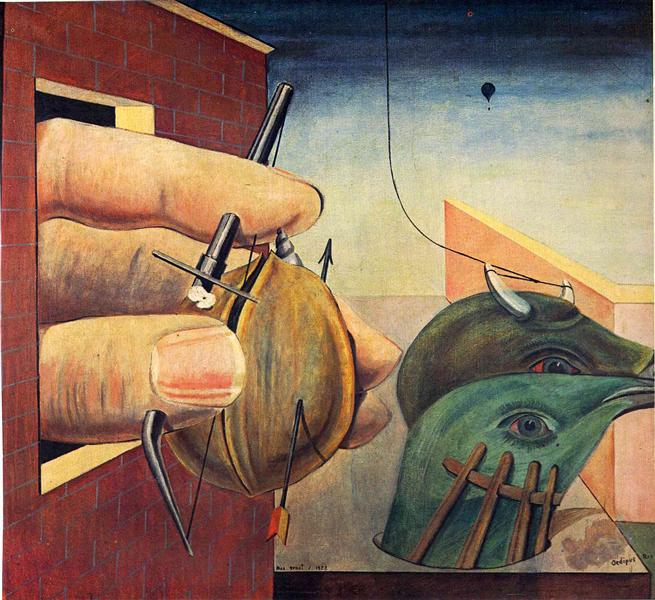
Another description of Gravity’s Rainbow (disputed). Monster men populated the undiscovered country. Do you know Gaspar Schott?

10 “…no two observers, no matter how close they stand, see quite the same building” — strike building and replace with novel, and we have, perhaps, another meta-description of Gravity’s Rainbow. 

11 You know by this point I’m going to say that “orgy of self-expression” is another meta-description of the novel itself, right?

There is, of course, a real orgy (by which I mean non-metaphorical, orgy-orgy) later in Gravity’s Rainbow, on the Anubis. 

12 …yourWha? Whence this narrative shift?

13 You!? And hold on who’s this fellow, this dark figure in white webbing (a sorta kinda oxymoron, maybe)—a sentry sure, a watcher, maybe—a statue? The martial imagery prefigures, perhaps, black and white, Enzian and Tchitcherine, the White Visitation (prefigures? This whole passage is set there!) and the Counterforce…(you’re stretching, dude).

14 Our paragraph begins with “Overhead” and ends with “begin to fall”—the descent of the rocket, the arc of the rainbow, the decline of the human condition. (And curves in other directions too).