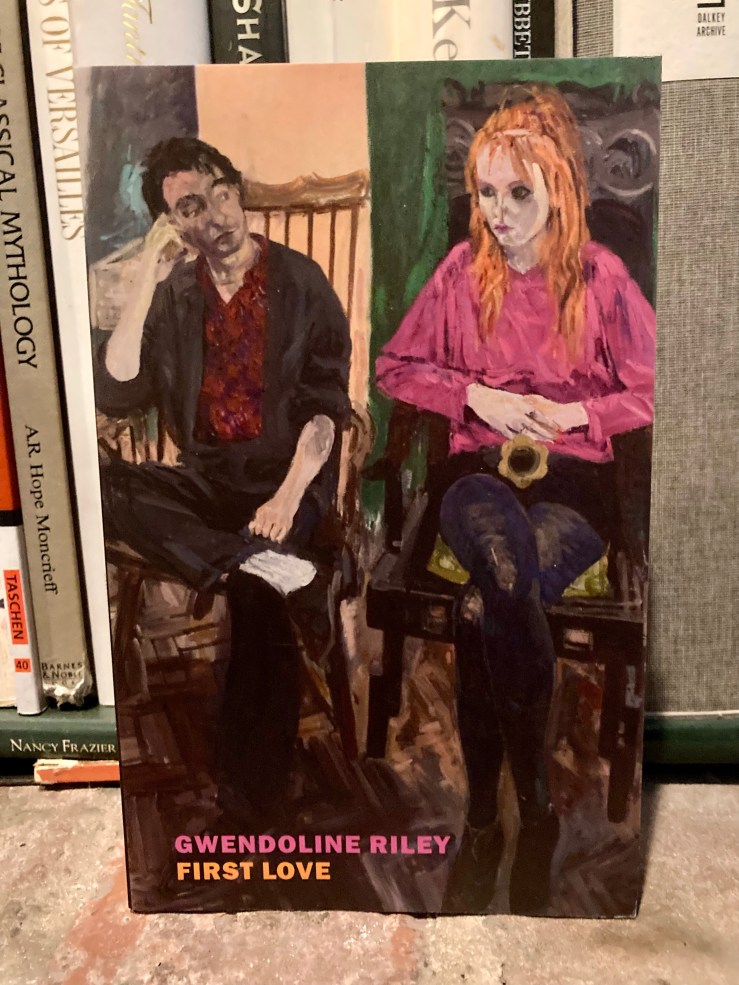
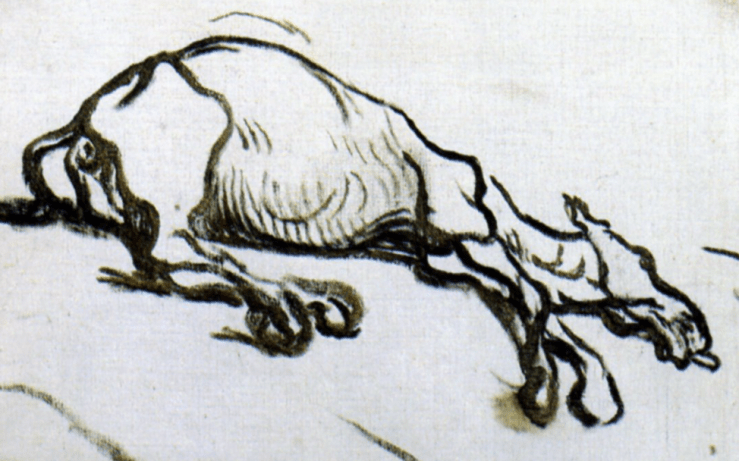
Schrödinger’s Deer | A review of Dashiel Carrera’s surreal debut novel The Deer

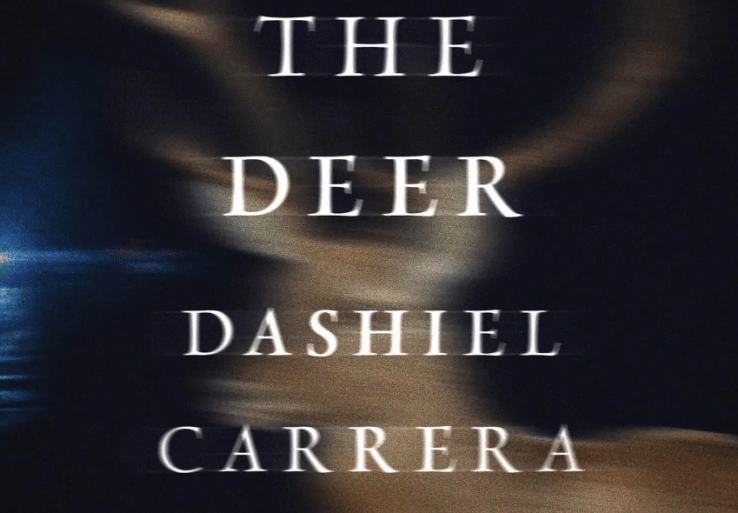
Dashiel Carrera’s debut novel The Deer is puzzling, sometimes brilliant, and occasionally frustrating. Gloomy, surreal, and terse, The Deer is at its best when it’s at its most sinister—namely, on its first half, “Side A.” Taking a record album as its model, The Deer has two sides (A and B), each divided into titled Tracks  (on side A) or Lessons (side B). This unusual structure results in a genuinely experimental novel, where some elements crackle with eerie verve and others fall flat. The result is a novel that simultaneously compels and baffles readers, while challenging their notions of what a novel can—or should—do.

“Side A” of The Deer follows a man who may or may not be quantum physicist Henry Haverford, who may or may not have been drunk when he may or may not have hit a deer with his automobile at the beginning of the story. Henry may or may not be going back to his parents’ home to bury his father. I could keep adding may or may not to pretty much everything else that happens in The Deer, which operates on its own nightmare logic. The name Schrödinger is invoked in the fourth paragraph. The Deer reads like an attempt to apply quantum superposition theory to a novel about family trauma.

The family trauma that resonates in the first half is dark and icky—dead dogs, dead deer, Henry’s aloof brother Arthur, their sinister father, a dying (dead) mother, and a mother-figure girlfriend. In the background murmurs jazz piano, messages from the International Space Station, baseball on the radio, and the stifling threat of the police force, which Henry Haverford’s father may or may not have been a member of.

Henry’s multiple encounters with the police, who are simultaneously local law enforcement officers as well as Kafkaesque Authorities — “the Force” — showcase some of the best writing in The Deer. An early run-in with the police at the grocery store unfolds with particularly menacing grace:

“What have you got there, Mr. Haverford?”
The cops sip their coffees and grin.
“Beets,” I say. “I’ve got to bring home some beets for
dinner.”
“We heard you were sick,” says one of the cops.
“You did?”
“Yes, we heard you’ve come down with something really awful.”
“Truly awful.”
“That you’ve been asking all sorts of strange questions.”
I frown. “Well, I’ve been remembering a few things here and there. It’s been a long time since I was home.”
“Yes, but very strange things, Mr. Haverford. You haven’t been thinking straight.”
I force a chuckle.
“Is that liquor in your bag?”
I fondle the cap and lean back. The sliding glass doors open. “Yes. It’s for Arthur.”
“Oh, Arthur.” The men exchange a smile.
“Yes—I should get back to him, actually.”
“Oh, of course, Mr. Haverford. We wouldn’t want to
keep Arthur waiting.”
“Thank you. Yes, I shouldn’t keep him waiting.” I turn.
“It’s just that—well—we’d like to have you come into
the station tomorrow. For a few questions.”
“Questions?”
The other man takes off his cap. “Just a routine follow-up, Mr. Haverford. I’m sure you understand.”
“Right. Sure.”
“Wonderful.” One of the cops glances at the other.
“Well, we must be off.” He grasps my forearm and smiles.
“Great to see you again, Mr. Haverford.”
I nod. “Right. Very good to see you too, Officer.”

When he goes to his first interrogation, things get even stranger, with the police asking Henry what they believe should be done with the dead deer. The interrogation culminates with an ominous line that shouldn’t feel like a threat, but nevertheless sounds like one:

“Am I free to go?”
“Yes,” says the man in the long grey coat. “But we’ll
have you back to see the fawn.”

From there, side A of The Deer edges further into a nightmare of superimpositions and displacements—Henry seems unstuck in time and reality, he’s a boy, a teen, a man, but also a deer, even a fawn, a victim. The situation climaxes in the final track on side A, “The Deer.” It’s another interrogation scene, far more intense, and by the end of it one senses that our Henry, like a character from a David Lynch film, has shifted identities by the time he’s left the room—although nothing is permanent or stable in the world Carrera’s constructed.

Side B continues exploring the may-or-may not themes of the first half, but in an entirely different setting. We move to a first-person narrator, a woman who cares for an ailing mother with her sister. They live in a vaguely post-apocalyptic world, with threats of marauding “riders,” illness, drought. Although the settings are radically different, Carrera takes pains to underscore the thematic line in his novel, invoking Schrödinger’s cat again:

Mother prepares another bowl. We eat slowly. The
kitchen light rocks back and forth. Sister leans back on the counter, popping bread in her mouth.
I read aloud to Mother. It is the Old Book, from the
Before Times. The title has long disintegrated.

I say, this is the story of a cat.

She nods slightly. Or maybe it is a rocking. Maybe her head was rocking, and I only thought it was a nod.

I say, the cat goes into a box.

I say, a man comes up to the box, and he leans down
next to it.

I say, the cat does not make a sound. Not even a scratch.

I say, the cat’s tail slowly curls around itself but the man does not know, because he cannot see the cat and the cat cannot see him.

I say, the man must decide if the cat exists.

At times the choppy, etiolated first-person voice of side B didn’t resonate as fully-realized in my ear, and I found some of the genre-bound descriptors (like “Before Times”) too on-the-nose in a book that is otherwise full of compelling obliquities. Other moments are stronger, like in the following passage, which again underscores the book’s theme of quantum superposition:

Read to me in the book how everything is shaking. Read to me how all the objects are composed of molecules and these molecules are fluid in structure. Read to me how all things twirl in recombination and the existence of objects is confirmed only through collective patterns of sensory perception. Read to me about how we must stay in sync, how these objects which we know to be real must be kept afloat by a rhythm of agreement, how this Earth which tilts so slowly pulls us all in the same direction. Read it to me again, Sister, because I can only feel the cool of the ink and the scratch of the parchment. Read it to me again, Sister, because I can only see the glimmers of this world.

It’s a remarkable paragraph, which feels both timely and timeless, for are we not always in a crisis of the “rhythm of agreement”?

Carrera studied writing under both Jason Schwartz and Evan Lavender-Smith, and the imprint of those writers, as well as the tree from which their own fiction might be said to extend, bears influence on The Deer. In his masterful John the Posthumous, Schwartz found sinister power in the vignette, in the cruel detail, which Carrera evokes in his novel as well. The Deer’s engagement with radical ambiguity also brings to mind Lavender-Smith’s novella Avatar, a study in untethered consciousness. Beyond that, Carrera branches from the Kafka tree, and The Deer will appeal to those who can hang in the surreal abject worlds of, say, João Gilberto Noll or Kōbō Abe or Anna Kavan or Hiroko Oyamada, without collapsing into goo. Good stuff.

The Deer is available from Dalkey Archive.


Roberto Bolaño’s 2666 | Rambling notes around a very long audiobook

img_3357

I listened to Roberto Bolaño’s opus 2666 on audiobook (in English translation by Natasha Wimmer) over the last month,

I listened while I took long early walks in my neighborhood before the big sun burned me back home; I listened while I gardened; I listened while I undertook a list of summer chores that included painting the interior of the house.

I was listening to the book when our fire alarm gave alarum to an accidental fire in our kitchen, which I put out quickly (I was hearing but not listening to the book during this exercise). I was walking, listening to the audiobook of 2666 when I started getting texts from friends about the Supreme Court’s overturning Roe. I was walking, listening to the audiobook of 2666 when my neighbor waved me down, approached me, told me while crying (she was walking her dog) that her ex-husband, who I was very close to, loved, frankly, a kind man who I spent a few hours a week drinking wine and discussing x and y and z, but especially discussing literature and civics film and local raptors, this man, my friend, had died unexpectedly the previous morning. I turned the audiobook off, finished my walk, and drove four hours to the Gulf shore, a nice place I take every July 4th holiday with my extended family. I took a week off 2666.

I finished the 2666 audiobook yesterday. This audiobook is 39 hours and 15 minutes long. A different reader reads each of the novel’s five distinct parts. (The readers are John Lee, Armando Durán, G. Valmont Thomas, Scott Brick, and Grover Gardner.)

Should someone who hasn’t read 2666 before try it on audiobook first?

I have no idea.

(Try it and tell me.)

I don’t think it would have worked for me, an audiobook on the first go around, for a lot of reasons, but the main one is that there are so so so many voices in the novel, and not all of the five readers necessarily fully capture those voices. (G. Valmont Thomas and Grover Gardner do; Armando Durán gets close; John Lee fares well for the most part; Scott Brick tries too hard at times and not hard enough at others).

Some people are pretty good at auditing audiobooks; other people have a difficult time zoning in. Forty hours is a long time, and if I opened with a list of “I” statements, related to the book, it was because it felt like a sharp chunk of life passed as I listened to 2666. (Sorry.)

img_3356

As for the actual novel, the story, the prose, whatever—it’s great. Just amazing. These are poor adjectives for a giant work. This was my fourth full trip through 2666, and it only confirms my impression that the novel is a labyrinthine masterpiece, sinister, brave, lurid, abject, often very funny, and stuffed with so much life and experience. I’ve written several “reviews” of the novel on this site over the years, if you want to be persuaded in greater detail. Probably the better of these riffs was a piece on intertextuality in the novel. There’s also my first review in early 2009 and one from my reread it in late 2009. I wrote about abjection and horror in 2666. At some point I wrote about werewolves and 2666 and argued that Dracula is a secret character in the book.

I probably also connected 2666 in some way to many, many other things while writing on this blog over the past thirteen years. I think it’s great, more than great, grand, gargantuan, giant stuff. I felt all sad and hollowed out when I got to the end yesterday, deflated, punctured, the final images of Archimboldi eating Neapolitan ice cream with a descendant of its creator, Fürst Pückler, kinda breaking my brain.

Put forty more hours in my ears.

If you follow this blog semi-regularly, you might’ve seen (and I hope read) excerpts I’ve posted from 2666 over the past few weeks. Something that initially caught me off guard, but that I soon came to predict, was that I would audit a section, and jot down notes, something like, Post this as an excerpt on the blog—and then it would turn out that I’d posted the same excerpt a decade ago.

I also remembered specific moments where I’d read some of the selections — on airplanes, or in hotel beds, or even on the beach of the Gulf, ten or eleven years ago over a July 4th vacation that wasn’t set against such a oh-wow-we’re-sliding-into-overt-authoritarian-oligarchy-dang backdrop. But also in blank or banal places, a black couch a now-dead cat clawed up, a chair my wife threatened to axe. Two different beds. And so much of what I audited the past month is blended into my experiences of the past month. (I will never ever forget that the moment when I found out about Roe, I was listening to a painful litany of misogynistic “jokes” told by a crooked cop to an audience of other cops in “The Part About the Crimes” — the section goes on and on, a little echo or prefiguration of the litany of rapes that formalize that particular section. I am looking for a way to use the word indelible here.)

(And while I’m in parentheses: Something I would have tuned out while reading 2666 that I certainly noticed while auditing it is how often Bolaño (and his translator Wimmer, of course) uses the phrase Around this time to begin a new paragraph.)

And so well anyway: A few remarks on the readers, translators all in their own right of the material:

John Lee reads “The Part About the Critics.” His posh British twang is well-suited to conveying the semi-serious/semi-ironic tone of this section, and if he sounds annoying as shit at times, that can be forgiven. Lee, who is often too arch, shows more restraint than in other audiobooks I’ve audited that he’s read.

Armando Durán reads “The Part About Amalfitano.” He’s perfect when conveying Amalfitano’s voice, as well as consciousness, but centers too closely to that consciousness. This is a very specific and petty criticism that is more about how I hear certain other voices in the novel. Great voice.

G. Valmont Thomas reads “The Part About Fate.” He inhabits the various voices the journalist Fate speaks to with aplomb, characterizing each voice with its own unique phrasing while staying true to the tone of the “Fate” section, which tip-toes to full-blown abject madness. My only gripe, and it’s not really even a gripe, is that he voices Fate himself as a total weirdo, a weirdo who simultaneously realizes he’s out of sync with everyone around him, but also doesn’t see to register that fact as a functioning human being might. Good interpretation, I guess, but still a bit of a bold choice.

Scott Brick reads “The Part About the Crimes.” Brick has the longest and arguably most-arduous section of 2666. I think the direction he takes (or the direction he was given) is a bit too intense — again this is a case of my own reading of the voices in the novel — I think the main narrative voice of “The Part About the Crimes” should be flat, affectless, reportorial, and that all drama and verve in that section should come from characters who ventriloquize the narrative — and Brick does a good job there.

Grover Gardner reads “The Part About Archimboldi” and I loved what he did, but I’m a big fan of his voice in general. And I love that particular section.

img_3360

If I have quibbled with these voices it comes from a place of love—I loved getting to reread 2666 through their voices. And, like I said above, they are ultimately translators too of the work. So I’ll close with Bolaño himself on translation (via his 2666 translator, Natasha Wimmer, from his essay “Translation Is an Anvil,” collected in Between Parentheses):

How to recognize a work of art? How to separate it, even if just for a moment, from its critical apparatus, its exegetes, its tireless plagiarizers, its belittlers, its final lonely fate? Easy. Let it be translated. Let its translator be far from brilliant. Rip pages from it at random. Leave it lying in an attic. If after all of this a kid comes along and reads it, and after reading makes it his own, and is faithful to it (or unfaithful, whichever) and reinterprets it and accompanies it on its  voyage to the edge, and both are enriched and the kid adds an ounce of value to its original value, then we have something before us, a machine or a book, capable of speaking to all human beings; not a plowed field but a mountain, not the image of a dark forest but the dark forest, not a flock of birds but the Nightingale.

I love the mountain, the forest, the Nightingale.

Last day of school

Today was the last day of school for my kids. They both started new schools this year (high school and middle school). It’s been a weird few years and a bad few days. My son chose not to attend the last two days but my daughter wanted to see her friends. My mother called me the afternoon of the Ulvade murders to ask if my kids were okay and I didn’t even know how to answer. My daughter has been in two active-shooter lockdowns already in her life and she’s not even 15. They’ve spent their entire life fully inscribed in this nightmare. One of the worst memories of my early parenthood was my daughter coming home from kindergarten and describing her first active-shooter practice drill: “Some of us were weeping,” she said. It was the word weeping that really stuck with my wife and me—the odd precision of it.

I don’t want to rant on here; that’s not what this blog is for, and not what I imagine those who check in on it want to read or see. I expressed my own sense of horror and despair obliquely on here the other day, in any case.

I spent too much of today staring at screens, reading, horrified and angry, still stunned by the stupidity of the world we’ve botched together. I tried to pick up the book I’ve been trying to read, but I found I couldn’t press into it, couldn’t focus on a sentence let alone a paragraph. I ended up playing a lot of internet chess, on the smaller screen.

And then I found myself exhausted, needing to get out of the house. So I pulled the same Friday trick I always do, which sometimes works and sometimes doesn’t. I went to the used bookstore down the road.

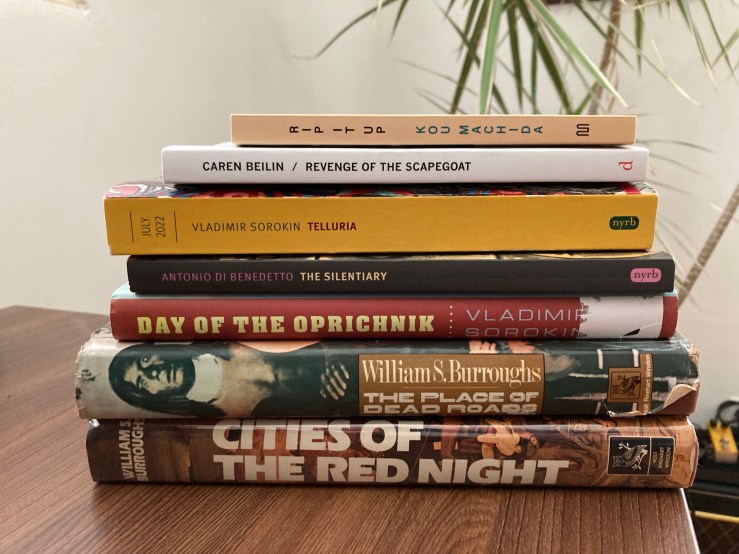
I like to browse and handle the material there, looking for oddities and weird scores. I ended up with a hardback ex-library copy of Vladimir Sorokin’s Day of the Oprichnik (trans. Jamey Gambrell, RIP). It’s in the stack below, a stack of books I’ve read or am (ostensibly) reading:

And so some mini-not-reviews, top to bottom:

Kou Machida’s Rip It Up (trans. Daniel Joseph): Read it back in April when I was finishing up the semester—it was a wonderful punk-psych antidote to final essay doldrums. Short, kinetic, caustic, and surreal. I wrote about the first part here.

Caren Beilin’s Revenge of the Scapegoat: This is the novel I attempted to start a few days ago, after finishing William Burroughs’s The Western Lands. I am having a hard time reading anything right now, let alone writing any proper review. I hope the thing I once had comes back.

Vladimir Sorokin’s Telluria (trans. Max Lawton): The best contemporary novel I’ve read in a long time—a polyglossic satirical epic pieced together in vital miniatures. Rich and dense but also loose and funny, Sorokin’s post-collapse world doesn’t seem all that bad.

Antonio di Benedtto’s The Silentiary (trans. Esther Allen): The narrator of this understated Kafkaesque novel cannot abide the increasing cacophony of 20th-century life. His resistance to noise is futile though, and comes at great cost to both himself and his family. The Silentiary is good stuff, but not as achieved as Di Benedetto’s novel Zama.

I bought Sorokin’s Day of Oprichnik today.

(Parenthetically: I went to the bookstore, as I stated above, to try to decompress, get away from screens, news, etc.—but I could not.

There was a young woman standing near the “RE” area in General Fiction having the loudest possible conversation one can have on a phone without actually yelling. She was talking at her mother about all the strife she has with her brother, who is also her roommate, and her father (who is divorced from the mother). The young woman cursed in almost every sentence she spoke, damning her brother for not taking out the trash, for not doing the dishes, etc. She near-shouted about her father’s siding with her brother, and about how the whole situation necessitates more therapy for her, and how she is the sane responsible one, while her brother is not. Her brother refuses to engage with her when she addresses him, claiming that he claims he can’t talk to her when she shouts, but how can she not be emotional when she’s angry? And how does that mean that she’s not rational, just because she’s yelling? And isn’t he really the abusive one, for shutting down on her and not responding when she, a grown-ass adult, is simply trying to confront him about not doing what he should be doing?

I put this information together in waves over 45 minutes. It was like running up a caustic radio show that tuned in and out depending on my proximity to its signal. Vile.)

William S. Burroughs’s final trilogy: I haven’t read WSB in ages, but I finished up his last novel, The Western Lands a few days ago (not pictured because it’s still in my car; I’d been rereading bits during carpool pick-up).. The final three books in Burroughs’s oeuvre are maybe his best (and most-overlooked), and The Place of Dead Roads is particularly fantastic.

Okay, I’m out of juice. I hope the summer is better for most of us, although there’s not much force in that verb, hope.

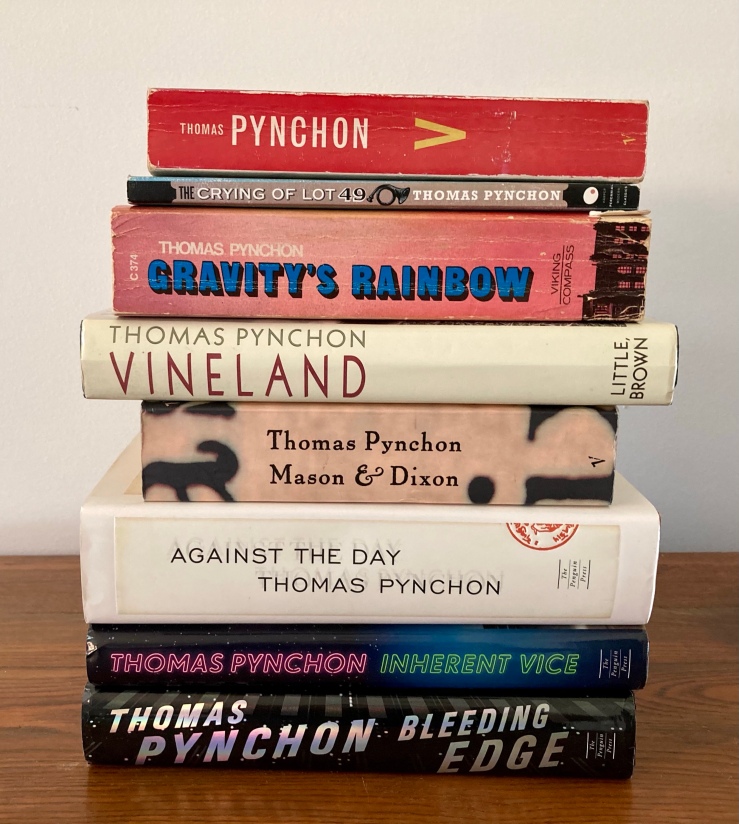
A few sentences on every Thomas Pynchon novel to date

Today, 8 May 2022, is Thomas Ruggles Pynchon’s 85th birthday. Some of us nerds celebrate the work of one of the world’s greatest living authors with something called Pynchon in Public Day. In the past I’ve rounded up links to Pynchon stuff on Biblioklept and elsewhere. To celebrate, here are short riffs on Pynchon’s eight novels:

V. (1963)

I reread Pynchon’s first novel for the first time last year and found it far more achieved than I had remembered. For years I’ve always recalled it as a dress rehearsal for the superior and more complex Gravity’s Rainbow. And while V. certainly points in GR’s direction, even sharing some characters, it’s nevertheless its own entity. I first read V. as a very young man, and as I recall, thought it scattershot, zany, often very funny, but also an assemblage of set pieces that fail to cohere. Rereading it two decades later I can see that there’s far more architecture to its plot, a twinned, yoyoing plot diagrammed in the novel’s title. The twin strands allow Pynchon to critique modernism on two fronts, split by the world wars that mark the first half of the twentieth century. It’s a perfect starting point for anyone new to Pynchon, and its midpoint chapter, “Mondaugen’s Story,” is as good as anything else he’s written.

The Crying of Lot 49 (1966)

Pynchon’s shortest novel is not necessarily his most accessible: Crying is a dense labyrinth to get lost in. At times Pynchon’s second novel feels like a parody of L.A. detective noir (a well he’d return to in Inherent Vice), but there’s plenty of pastiche going on here as well. For example, at one point we are treated to a Jacobean revenge play, The Courier’s Tragedy, which serves as a kind of metatextual comment on the novel’s plot about a secret war between secret armies of…letter carriers. The whole mailman thing might seem ridiculous, but Pynchon’s zaniness is always doubled in sinister paranoia: The Crying of Lot 49 is a story about how information is disseminated, controlled, and manipulated. Its end might frustrate many readers. We never get to hear the actual crying of lot 49 (just as we never discover the “true” identity of V in V.): fixing a stable, centered truth is an impossibility in the Pynchonverse.

Gravity’s Rainbow (1973)

Unbelievably rich, light, dark, cruel, loving, exasperating, challenging, and rewarding, Pynchon’s third novel is one of a handful of books that end up on “difficult novel” lists that is actually difficult. The difficulty though has everything to do with how we expect a novel to “happen” as we read—Gravity’s Rainbow is an entirely new thing, a literature that responds to the rise of mass media as modernist painters had to respond to the advent of photography and moving pictures. The key to appreciating and enjoying Gravity’s Rainbow, in my estimation, is to concede to the language, to the plasticity of it all, with an agreement with yourself to immediately reread it all.

Vineland (1990)

It took Pynchon a decade and a half to follow up Gravity’s Rainbow. I was a boy when Vineland came out—it was obviously nowhere on my radar (I think my favorite books around this time would probably have been The Once and Future King, The Lord of the Rings trilogy, and likely a ton of Dragonlance novels). I do know that Vineland was a disappointment to many fans and critics, and I can see why. At the time, novelist David Foster Wallace neatly summed it up in a letter to novelist Jonathan Franzen: “I get the strong sense he’s spent 20 years smoking pot and watching TV.” Vineland is angry about the Reagan years, but somehow not angry enough. The novel’s villain Brock Vond seems to prefigure the authoritarian police detective Bigfoot Bjornsen of Inherent Vice, but Pynchon’s condemnation of Vond never quite reconciles with his condemnation of the political failures of the 1960s.  Vineland is ultimately depressing and easily my least-favorite Pynchon novel, but it does have some exquisite prose moments.

Mason & Dixon (1997)

If Mason & Dixon isn’t Pynchon’s best book, it has to be 1A to Gravity’s Rainbow’s 1. The novel is another sprawling epic, a loose, baggy adventure story chronicling Charles Mason and Jeremiah Dixon’s Enlightenment effort to survey their bit of the Western World. Mason & Dixon presents an initial formal challenge to its reader: the story is told in a kind of (faux) 18th-century vernacular. Diction, syntax, and even punctuation jostle the contemporary ear. However, once you tune your ear to the (perhaps-not-quite-so-trustworthy) tone of Rev. Wicks Cherrycoke (who tells this tall tall tale), Mason & Dixon somehow becomes breezy, jaunty, even picaresque. It’s jammed with all sorts of adventures: the talking Learned English Dog, smoking weed with George Washington, Gnostic revelations, Asiatic Pygmies who colonize the missing eleven days lost when the British moved from the Julian to the Gregorian calendar…Wonderful stuff. But it’s really the evocation of a strange, hedged, incomplete but loving friendship that comes through in Mason & Dixon.

Against the Day (2006)

Oof. She’s a big boy. At over a thousand pages, Against the Day is Pynchon’s longest novel. Despite its size, I think Against the Day is the best starting point for Pynchon. It offers a surprisingly succinct and clear summation of his major themes, which might be condensed to something like: resist the military-industrial-entertainment-complex, while also showing off his rhetorical power. It’s late period Pynchon, but the prose is some of his strongest stuff. The songs are tight, the pastiche is tighter, and the novel’s epic sweep comes together in the end, resolving its parodic ironies with an earnest love that I believe is the core of Pynchon’s worldview. I forgot to say what it’s about: It’s about the end of the nineteenth century, or, more accurately, the beginning of the twentieth century.

Inherent Vice (2009)

Inherent Vice is a leaner work than its two predecessors, but could stand to be leaner still. The book pushes towards 400 pages but would probably be stronger at 200—or 800. I don’t know. In any case, Inherent Vice is a goofy but sinister stoner detective jaunt that frags out as much as its protagonist, PI Doc Sportello. Paul Thomas Anderson’s film adaptation finds its way through those fragments to an end a bit different from Pynchon’s original (which is closer to an echo of the end of The Crying of Lot 49)—PTA’s film finds its emotional resolution in the restoration of couple—not the main couple, but adjacent characters—an ending that Pynchon pulled in his first novel V.

Bleeding Edge (2013)

While Bleeding Edge was generally well received by critics, it’s not as esteemed as his major works. I think that the novel is much, much better than its reputation though (even its reputation among Pynchon fans). Pynchon retreads some familiar plot territory—this is another detective novel, like Crying and Inherent Vice—but in many ways he’s doing something wholly new here: Bleeding Edge is his Dot Com Novel, his 9/11 Novel, and his New York Novel. It’s also probably his domestic novel, and possibly (dare I?) his most autobiographical, or at least autobiographical in the sense of evoking life with teenagers in New York City, perhaps drawing on material from his own life with wife and son in the city. It’s good stuff, but I really hope we get one more.

[Ed. note–Biblioklept ran a version of this post on 8 May 2021.]

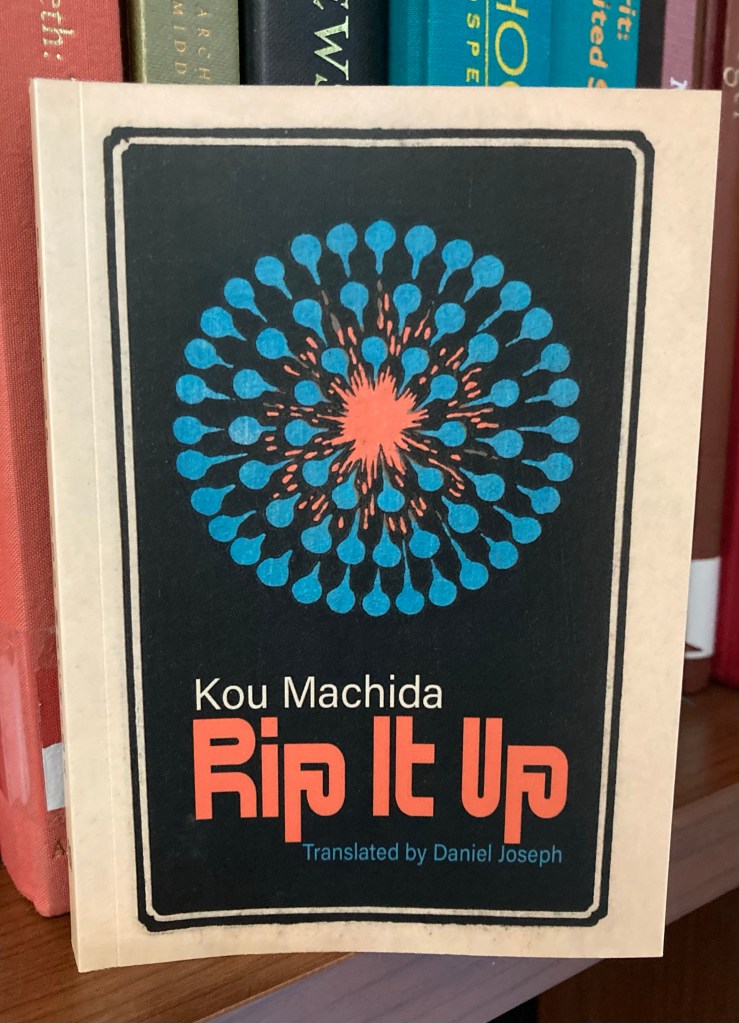
Kou Machida’s Rip It Up (Book acquired, 15 April 2022)

So I got into Kou Machida’s short novel Rip It Up last night. This Japanese novel (original title, きれぎれ [Kiregire]) gets its first English translation, via Daniel Joseph and Mercurial Editions, a new translation imprint from Inpatient Press. This is how the publisher describes Rip It Up:

Set in a kaleidoscopic hyperreal Japan circa Y2K, Rip It Up catalogues the misdeeds and misgivings of a down-and-out wannabe debonair who ekes out a meager living at the fringes of the art world, wracked by jealousy at his friend’s success and despondency of his own creative (and moral) bankruptcy. In turn hilarious and also horrifying, Machida’s pyrotechnic prose plumbs the discursive depths of the creative spirit, a head-spinning survey of degeneration and self-sabotage.

Machida’s psychedelic punk prose takes a few pages to tune into. The (as-yet?) unnamed narrator’s voice is tinged with madness and soaked with vitriol for the conformist society he can’t seem to get out of. He’s a rich kid, a lout, and a bum, obsessed with Satoe the horse-headed girl. Her head isn’t really a horse’s head; rather, it’s a mask she’s wearing when he first runs into her at a drunken Setsubun party at the “panty bar” where she works. He’s stumbled in after getting drunk at his friend’s funeral. The scene Machida conjures is simultaneously vile, hallucinatory, and hilarious, with salarymen and “little people gotten up to look like Fukusuke dolls” crashing about the place in a bizarre karaoke showdown. The narrator takes the mic, belting out malapropisms that synthesize and parody the lyrics of Western pop songs:

It’s not unusual to hi-de hi-de hi-de-hi

You’re as chaste as ice

And baby we were born to nun

Rollin’, rollin’, rollin’ on Moon River

Any way the lunch grows, doesn’t really matter

A few pages later, the narrator still pines for the horse-headed girl, spending all his money at the panty bar. He has to go visit his rich mother for a “loan,” but she makes him embark on a stolid omiai, a marriage interview, which he torpedoes by declaring to the prospective partner and her dour mother “exactly what kind of person I am”:

That I spend all my free time at the panty bar. That I dropped out of high school. That I’m a spendthrift. That I’ve got my head in the clouds and I’ve never done an honest days work in my life because I despise hard work. That’s all.

I’m digging Rip It Up so far; it’s alienating, self-indulgent stuff. Daniel Joseph’s translation conveys a desperate, stuffy world, and shows how linguistic resistance might puncture stifling conformity. More thoughts to come. Check out Kou Machida’s seminal punk band Inu,


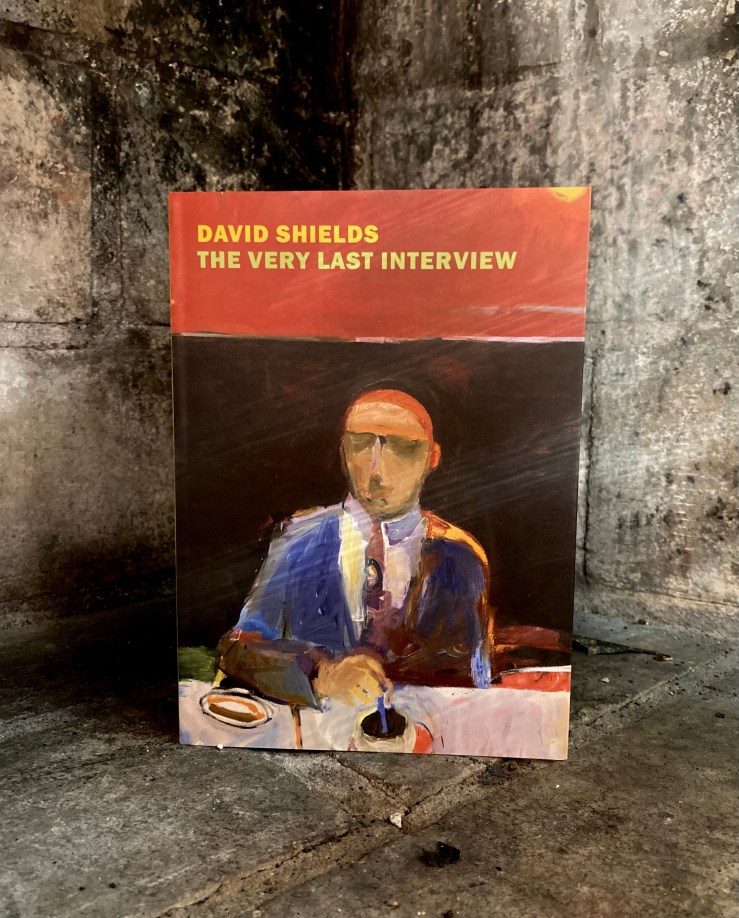
Is this a review of David Shields’ “autobiography” The Very Last Interview?

Is David Shields’ new book The Last Interview indeed an “autobiography in question form, with the reader working to supply answers based on the questions that follow,” as Bret Easton Ellis’ blurb attests?

Is it “Brilliant,” as Bret Easton Ellis’ blurb attests?

(Is this the same David Shields who authored Reality Hunger?)

Does, as Chris Kraus’ blurb states, Shields remix and reimagine “2,000 of the most annoying questions he’s been asked during his forty-year writing life”?

Is it really an “operatic tragic sojourn across American cultural life” (Kraus)?

Does The Very Last Interview confirm “Shields as the most dangerously important American writer since William S. Burroughs,” as Kenneth Goldsmith claims in his blurb?

(Is this the same Kenneth Goldsmith who was called out seven years ago for a publicly reading Michael Brown’s autopsy under the guise of “conceptual poetry”?)

Is it actually “very funny,” as Sheila Heti’s blurb contends?

Should I flip it over and actually dig in?

Is that a Richard Diebenkorn painting adorning the cover?

Are there actually five more blurbs once one opens the book?

Does Shields organize this “remix: of questions he’s (supposedly) been asked into chapters with titles like “Process,” “Truth,” “Art,” “Failure,” “Criticism,” and “Suicide”?

Does Shields open each chapter with epigraphs?

Does he attribute the authors of the epigraphs?

Is there an epigraph from Nietzsche?

Why doesn’t he attribute any of the interviewers at any point in The Very Last Interview?

Does David Shields believe he is a genius?

Does he believe that his audience will find delight or joy or even a momentary reprieve from reading The Very Last Interview?

When Jonathan Lethem (whose blurb makes the inside but not the back cover) claims he “blasted through it in one night,” is it possible that by “night” he means a thin hour or two?

Is the book skinnier than its 150 pages might suggest?

Are there any bits of the book that are, as Heti blurbed, “Very, very funny”?

How about this trio?

“When we are not sure, we are alive” — are you sure this is something that Graham Green said?

Can you prove it?

Do you know what “JSTOR” stands for?

Does this little blip skate closer to mildly amusing as opposed to very very funny?

But is there a general undertone of contempt that radiates in Shields’ curation of questions?

What about these?

Do you share my contempt for Greenpoint hipsters who look and act cool but whose work is about as challenging as a Toblerone bar?

Did you every study with Gordon Lish?

What did he like about your bracelet-cum-watch?

(What would we get if we removed the hyphens from the phrase bracelet-cum-watch?)

Is it possible that David Shields overestimates how interesting he is?

Does he really want us to empathize at points, to provide answers for questions, such as the ones below?

What’s the matter with you?

No, seriously. What is your underlying impasse?

Why can’t you feel?

What’s buried beneath that seeming numbness?

Anything?

Is The Last Interview pretentious, solipsistic, shallow, bathetic, and also very readable?

Is The Last Interview available in paperback from NYRB next month?

Are we done?

Are we?

A voice in her head that sound like her voice | Another report from Marlon James’s novel Moon Witch, Spider King

My last report from Marlon James’s Moon Witch, Spider King found the novel’s political machinations kicking in after its first seven chapters. Our hero Sogolon finds herself in the Northern Kingdom’s capital Fasisi. The capital is soaked in paranoia. The king is dying, a fact that cannot be admitted publicly or even privately (“The King is about his business,” courtiers and officials repeat). According to custom, it is the son of the king’s daughter who will take up his crown—only Princess Emini has been unable to conceive a child. Meanwhile, her brother Prince Lukid plots a coup, assisted (and likely designed, really), by the Aesi, a Machiavellian who may or may not have magic powers. The Aesi has engineered a literal witch hunt, accusing, arresting, and executing any woman who threatens his hold on power, with the aid of the Sangomin, a band of children necromancers with mutant powers (there’s a two-headed boy, a “razor boy,” a lizard girl, etc.)

The Aesi takes special note of Sogolon, recognizing an emerging power in her that others overlook. She’s wary of him, a feeling that only intensifies as she strikes up an odd friendship with Commander Ulu, a former commander of the Royal Guard who has no memories. Sogolon intuits that it’s likely that the Aesi is responsible for the memory loss, a suspicion that solidifies later in the novel. In an attempt to retain his memories, Ulu writes them down, filling every surface of his living quarters, and even writing in blood. Over time, Sogolon learns to read, with Ulu as a kind if unwitting teacher. Sogolon’s relationship with Keme also deepens, although she learns he has a wife and family.

The relative stability of Sogolon’s life ends when the king dies and Prince Likud claims the throne, taking up the mantle Kwash Moki. The Aesi’s schemes bear fruit-in a sequence that foregrounds the novel’s background trope of witch hunting, princess Emini is put on a trial for adultery. She’s exiled to a walled city of nuns, where she is to spend the rest of her life, and Sogolon is sent with her.

They never make it to the nunnery though. Presumably at the secret command of the Aeisi, the Sangomin attack their caravan killing everyone except Sogolon. She escapes, but the Sangomin track her down. As they attack, she seems to black out. She awakes to a scene of devastating violence she has no memory of. She appears to be in a giant crater, a “smooth bowl that she will have to climb out of.” There, she sees

…them floating, first the top half of the razor finger boy, his entrails dangling, his eyes gazing into nothing, and his legs nowhere to be seen. Slabs of loose white rock and cut white stone—the big man shattered in a multitude of pieces. She climb out and walk past the red and blue girl with the lizard tongue, her hands and legs swaying as if underwater, her face sleepy, the back of her head exploded with all of her shooting out. Perplexing it be, all three floating in air like they underwater, but everything stuck as if whatever happen don’t finish.

Sogolon comes to realize that she was the author of this destruction. When her life is threatened, Sogolon musters a telekinetic force that she refers to sometimes as “wind” or as the “push”–but she can’t control it (yet).

After wandering in the wilderness and cold, she’s found by Keme and other former members of the royal guard who are now part of the Red Army—the king Kwash Moki’s army. Keme has no memory of Sogolon. He brings her back to Fasisi, despite her protest (“They sent us on a fact finding mission, and you are the fact that we found”). Thus ends part one of Moon Witch, Spider King.

I’ve cobbled together a plot summary here, but I’m sure there are many gaps (and maybe some mistakes). In Moon Witch, we’re only privy to what Sogolon sees and hears, and while she’s a curious and perceptive girl, she’s also quite young and lacks any formal education. Much of our understanding of the plot is filtered through Sogolon’s intuition, and a major motif that emerges in these chapters is memory loss, as well as the power that controlling a narrative confers. The Aesi is able to rewrite history, to make people believe things that they witnessed first-hand could not be true.

At the same time the first part of Moon Witch, subtitled “No Name Woman,” is about a consciousness creating itself. Sogolon grew up imprisoned first in a termite mound, then in a whorehouse, then in the home of a fallen aristocrat. She had to name herself, teach herself to read, to scrape together her memories into a slim personal history. In the final sections of “No Name Woman,” the narrator repeats an attribution each time Sogolon enters into a dialogue with her emerging consciousness, as in the following example:

Wake up early girl, will yourself, say a voice in her head that sound like her.

This “voice in her head that sound like her” is Sogolon’s self-making, a consciousness reaching toward the “I” that disappears after the novel’s opening sentences:

One night I was in the dream jungle. It was not a dream, but a memory that jump up in my sleep to usurp it. And in the dream memory is a girl. See the girl.

After that second sentence, the first-person narrator disappears—only to reappear in the beginning of part two, “A Girl Is a Hunted Thing.” More thoughts to come.

See the girl | A report from Marlon James’s novel Moon Witch, Spider King

One night I was in the dream jungle. It was not a dream, but a memory that jump up in my sleep to usurp it. And in the dream memory is a girl. See the girl.

These four sentences open Marlon James’s novel Moon Witch, Spider King, the not-exactly sequel to 2019’s Black Leopard, Red WolfThat novel centered on Tracker and his quest to recover a missing child of enormous importance. Black Leopard, Red Wolf is a bizarre beast, a post-postmodern fantasy that queered its genre conventions and consistently contested the very notion that a story could ever be told straight. In it, Tracker segues between ever-shifting fellowships and nebulous nemeses–including the Moon Witch Sogolon, the protagonist of Moon Witch, Spider King.

Moon Witch, Spider King takes Sogolon as its viewpoint character, and the first seven chapters of this long, long novel (about a quarter of its 600ish pages) read far more straightforward than its predecessor. The narrative gambit of Black Leopard, Red Wolf is that Tracker, captured, is telling his story to an inquisitor—and that telling is a repeated deferral, teleporting through time and space (much like the “Ten and Nine Doors” that Tracker’s fellowship uses to teleport between city-states). Tracker does all he can do to tell any truth aslant. So far, James’s new novel follows a less demanding trajectory. The repeated invocation to “See the girl” follows our hero as her circumstances rise—although Sogolon experiences her rise in a picaresque, out-of-the-frying-pan-into-the-fire spirit.

We first find her an orphan of sort, a neglected witch-child more-or-less imprisoned in a termite hill by three cruel brothers, who blame her for killing their mother, who died birthing her. Sogolon even has to name herself. She escapes only to find herself in new peril, the house of Miss Azora. It’s a whorehouse, but Sogolon mixes potions to protect herself from its patrons–excepting one. The motif of male predation repeats in Moon Witch, as well as Sogolon’s resistance against those who would take her and take from her. In time, Sogolon finds herself into the house of a fallen aristocrat. Master Komwono may hold the title, but its Mistress Komwono who runs the show. Sogolon continues to spy and absorb, to play dumb, to use how others perceive her apparent weakness as an actual strength.

After Master Komwono dies under mysterious circumstances (take a guess!), Mistress Komwono is summoned back to the kingdom of Fasisi, from which she had previously been banished. A soldier named Keme is part of the caravan to bring the Komwono household to the capital, and Sogolon finds herself taken with the man. When they arrive at the palace, things take an even more sinister turn: the King is dying and his sister has disappeared (or been disapperead).

Here is where the plot machinations of Moon Witch truly kick in, shifting into a novel of political court intrigue. Mistress Komwono gives poor Sogolon to the princess of Fasisi, and she is drawn into all sorts of machinations. We begin to see the plotting of the Aesi (another of Tracker’s antagonists), whose Machiavellian moves are yet oblique to the young girl. In the meantime, witches are being burned, and Keme meets with his own fellowship (of griots and warriors and sentient lions) in a floating city. There’s a lot going on.

There’s a lot going on, but it’s a fun going on. See the girl, the narrator repeatedly intones, and James’s prose is marvelously vivid, setting strange scene after strange scene. And while the narrative voice, focused on Sogolon, is a removed third-person, I can’t help but now notice that the book opens with an I: “One night I was in the dream jungle”…who is this I, who so quickly disappears after a few sentences, replaced by the dream-memory incantation: See the girl.

(Parenthetically—while there are no Blood Meridian vibes so far to Moon Witch, Spider King, that incantation See the girl nevertheless seems to echo that McCarthy’s novel’s opening line, See the child (itself perhaps an echo of Melville’s Call me Ishmael.))

Anyway–I’m digging Moon Witch thus far. I’ve been auditing the audiobook (narrated by Bahni Turpin) and then rereading bits for clarification. So far, I think that anyone interested in what Marlon James is doing with this so-called Dark Star trilogy would be absolutely fine starting with this one. The line is straighter than Black Leopard, the thread is easier to follow, and it’s not necessary to know the contours or details of the plot of that “first” novel. But it still points to the wonderful queer weirdness of that novel. More to come.

A review of Ishmael Reed’s sharp satire The Last Days of Louisiana Red

img_2323

Ishmael Reed’s 1974 novel The Last Days of Louisiana Red is a sharp, zany satire of US culture at the end of the twentieth century. The novel, Reed’s fourth, is a sequel of sorts to Mumbo Jumbo (1972), and features that earlier novel’s protagonist, the Neo-HooDoo ghost detective Papa LaBas.

In Mumbo Jumbo, Reed gave us the story of an uptight secret society, the Wallflower Order, and their attempt to root out and eradicate “Jes’ Grew,” a psychic virus that spreads freedom and takes its form in arts like jazz and the jitterbug. The Last Days of Louisiana Red also employs a psychic virus to drive its plot, although this transmission is far deadlier. “Louisiana Red” is a poisonous mental disease that afflicts black people in the Americas, causing them to fall into a neo-slave mentality in which they act like “Crabs in the Barrel…Each crab trying to keep the other from reaching the top.”

The Last Days of Louisiana Red begins with Ed Yellings, “an american negro itinerant who popped into Berkeley during the age of Nat King Cole. People looked around one day and there he was.” Yellings is the West Coast counterpart to New-York-based Papa LeBas, a fellow Worker of Neo-HooDoo who fights against the secret forces of psychic slavery.

Sliding into the mythological motif that ripple through Louisiana Red, Reed writes,

When Osiris entered Egypt, cannibalism was in vogue. He stopped men from eating men. Thousands of years later when Ed Yellings entered Berkeley, there was a plague too, but not as savage. After centuries of learning how to be subtle, the scheming beast that is man had acquired the ability to cover up.

Yellings’ mission is to destroy the psychic cannibalism that afflicts his people. He gets to it, and earns “a reputation for being not only a Worker [of the voodoo arts] but a worker too.” Yellings’ working class bona fides helps solidify his sympathies and his mission:

Since he worked with workers, he gained a knowledge of the workers’ lot. He knew that their lives were bitter. He experienced their surliness, their downtroddenness, their spitefulness and the hatred they had for one another and for their wives and their kids. He saw them repeatedly go against their own best interests as they were swayed and bedazzled by modern subliminal techniques, manipulated by politicians and corporate tycoons, who posed as their friends while sapping their energy. Whose political campaigns amounted to: “Get the Nigger.”

As always, Reed’s diagnosis of late 20th-century American culture seems to belong, unfortunately, just as much to our own time, giving his novels a perhaps-unintended sheen of prescience. Reed’s work points to dystopia, even as his heroes work for freedom and justice. And yet Reed gives equal air time to the forces that oppress freedom and justice, forces that find expression in “Louisiana Red”:

Louisiana Red was the way they related to one another, oppressed one another, maimed and murdered one another., carving one another while above their heads, fifty thousand feet, billionaires few in custom-made jet planes equipped with saunas tennis courts swimming pools discotheques and meeting rooms decorated like a Merv Griffin Show set….

The miserable workers were anti-negro, anti-chicano, anti-puerto rican, anti-asian, anti-native american, had forgotten their guild oaths, disrespected craftsmanship; produced badly made cars and appliances and were stimulated by gangster-controlled entertainment; turned out worms in the tuna fish, spiders in the soup, inflamatory toys, tumorous chickens, d.d.t. in fish and the brand new condominium built on quicksand.

As a means to fight the culture of erosion, decay, and entropy, Yellings founds the Solid Gumbo Works. Here, he manufactures a gumbo—a spell, really—to combat “Louisiana Red.” In the process he manages to cure cancer, which pisses off a lot of big corporations, and pretty soon Yellings is murdered. Papa LeBas is sent in from New York to solve the case.

Papa LeBas runs into trouble pretty quickly, mostly by way of Yellings’ adult children: Wolf, Street, Sister, and the provocative and gifted Minnie, who leads a group of militants called the Moochers. Each of the children seem to embody an allegorical parallel to some aspect of the American counterculture of the late sixties and seventies, allowing Reed to mash up genres and skewer ideologies. There are a lot flavors in this gumbo: voodoo lore and California history bubble in the same pot as riffs on astrology and Cab Calloway’s hit “Minnie the Moocher.” Reed frequently compares and contrasts East with West, New York with California, underscoring the latter’s anxieties of influence about being the New World of the New World. Throughout the novel, we get routines on Amos & Andy, slapstick pastiches straight out of George Herriman’s Krazy Kat comix, hysterical nods to Kafka. Reed plays off early blaxploitation films like Sweet Sweetback’s Baadasssss Song and Superfly (not to mention Putney Swope), and synthesizes these tropes with kung fu imagery and neo-Nazi nostalgia garb. He turns Aunt Jemima into a loa at one point.

Reed’s prose ping-pongs between genres, skittering from pulp fiction noir to surrealist frenzies, from bizarre sex to raucous action, from political essaying to postmodernist mythologizing. Through these stylistic shifts, Reed satirizes a host of ideologies that feed into “Louisiana Red.” Aspects of the Berkeley youth movement, radical feminism, free love, and intellectual hucksterism all get skewered, but through an allegorical lens—Reed dares us, often explicitly (by way of a character named Chorus) to read Louisiana Red as an allegorical retelling of Sophocles’ Antigone.

This retelling is both tragic and comic though, premodern and postmodern, a carnival of varied voices. The chapters are short, the sentences sting, and the plot shuttles along, pivoting from episode to episode with manic picaresque glee. Reed’s narrator is always way out there in front of both the reader and the novel’s characters, hollering at us to keep up.

Ultimately, The Last Days of Louisiana Red is a bit of a shaggy dog. It’s not that it doesn’t have a climax—it does, it has lots of climaxes, some quite literal. And it’s not that the novel doesn’t have a point—it very much does. Rather, it’s that Reed employs his detective story as a frame for the larger argument he wants to make about American culture. Sure, Papa LaBas gets to the bottom of Yellings’ murder, but that’s not ultimately what the narrative is about.

When we get to the final chapter, we find LaBas, sitting alone “on a plain box” in the empty offices of the Solid Gumbo Works reflecting on the case in a way that, in short, sums up what The Last Days of Louisiana Red is about:

He thought of the eaters and the eaten of this parable on Gumbo…all ‘oppressed people’ who often, like Tod Browning ‘Freaks,’ have their own boot on their own neck. They exist to give the LaBases, Wolfs and Sisters of these groups the business, so as to prevent them from taking care of Business, Occupation, Work. They are the moochers who cooperate with their ‘oppression,’ for they have the mentality of the prey who thinks his destruction at the fangs of the killer is the natural order of things and colludes with his own death. The Workers exist to tell the ‘prey’ that they were meant to bring down killers three times their size, using the old morality as their guide: Voodoo, Confucianism, the ancient Egyptian inner duties, using the technique of camouflage, independent camouflages like the leopard shark, ruler of the seas for five million years. Doc John, ‘the black Cagliostro,’ rises again over the American scene. The Workers conjure and command the spirit of Doc John to walk the land.

So here, near the end of The Last Days of Louisiana Red, Papa LeBas—and Ishmael Reed, of course—conjures up the spirit of Doctor John, the voodoo healer who escaped slavery and brought knowledge of the hoodoo arts to his people. There’s a promise of hope and optimism here at the novel’s end, despite its many bitter flavors. But the passage cited above is not the final moments of Louisiana Red—no, the novel, ends, despite what I wrote about its being a shaggy dog story, with a marvelous punchline.

Ishmael Reed remains an underappreciated novelist whose early work seems as vital as ever. The Last Days of Louisiana Red is probably not the best starting place for him, but it’s a great novel to read right after Mumbo Jumbo, which is a great starting place to read Reed. In any case: Read Reed. Highly recommended.

[Ed. note–Biblioklept first published this review in March, 2019.]

Behind God’s back | On Thulani Davis’s poetry collection Nothing but the Music

Here are the first lines of Thulani Davis’s 1978 poem “Mecca Flats 1907”:

On this landscape

Like a thin air

Hard to breathe

Behind God’s back

I see the doors

I wanted to underline the line Behind God’s back—such an image! But the book itself is so pretty, lithe, lovely. Better to leave it unmarked?

The book is Nothing but the Music, a new collection of Thulani Davis’s poems. Its subtitle Documentaries from Nightclubs, Dance Halls, & a Tailor’s Shop in Dakar: 1974-1992 is a somewhat accurate description of the content here. These are poems about music—about Cecil Taylor and The Commodores and Thelonious Monk and Henry Threadgill and Bad Brains and more. “About” is not really the right word, and of course these poems are their own music; reading them aloud reveals a complexity of rhyme and rhythm that might be lost to the eye on the page.

But where was I—I wanted to underline the line Behind God’s back, but I didn’t. I didn’t even dogear the page. Instead, I went back to read Davis’s acknowledgements, a foreword by Jessica Hagedorn, and an introduction by Tobi Haslett. The material sets the stage and provides context for the poems that follow. Davis’s acknowledgments begin:

I have heard this music in a lot of clubs that no longer exist, opera houses in Italy that will stand another hundred years parks in Manhattan, Brooklyn, L.A., San Francisco, and Washington, DC as well as on Goree Island and in Harare, Zimbabwe. Some of it was in lofts in lower Manhattan now inhabited by millionaires, crowded bistros in Paris that are close, and legendary sites like Mandel Hall and the Apollo, radio studios, recording studios, and my many homes.

Acknowledging the weird times that have persisted (behind God’s back or otherwise), Davis touches on the COVID-19 lockdown that took the joy of live music from her—and then returned it in the strange form of “masked protesters massed in the streets singing ‘Lean on Me'” during the protests following the murder of George Floyd.

Poems in Nothing but the Music resonate with the protests against police violence and injustice we’ve seen this year. The speaker of “Back Stage Drama (For Miami)” (surely Davis herself?) repeats throughout the poem that “I was gonna talk about a race riot,” but the folks around her are absorbed in other, perhaps more minute affairs:

They all like to hang out

Thinking is rather grim to them.

Composed in 1980, the poem documents an attempt to attempt to address the riots in May of the same year in Miami, Florida, after several police officers were acquitted in the murder of Arthur McDuffie, a black man.

The speaker of the poem embeds a poetic plea, a poem-within-a-poem:

I said, ‘they’re mad, they’re on the the bottom going down/

stung by white justice in a white town

and then there’s other colored people

who don’t necessarily think they’re colored people

taking up the middle/leaving them the ground.’

But her would-be audience is weary:

I am still trying to talk about this race riot.

Minnie looked up and said, ‘We don’t have anywhere

to put any more dead.’

Snake put on his coat to leave, ‘We never did,

we never did.’

1992’s “It’s Time for the Rhythm Revue” takes for its erstwhile subject the riots that ensued after the acquittal of the LAPD officers who beat Rodney King. The subject is far more complex though—the speaker of the poem desires joy of course, not violence:

did they acquit somebody in LA?

will we burn it down on Saturday

or dance to the Rhythm Revue

the not too distant past

when we thought we’d live on?

Is God’s back turned—or do the protagonists just live behind it?:

…I clean my house

listening to songs from the past

times when no one asked anyone

if they’d seen a town burn

cause baby everybody had.

In Nothing but the Music, music is part and parcel of the world, entangled in the violence and injustice of it all, not a mere balm or solace but lifeforce itself, a point of resistance against it all. In “Side A (Sir Simpleton/Celebration), the first of two poems on Henry Threadgill’s 1979 album X-75, Vol. I, Davis’s narrator evokes

at the turning of the day

in these winters/in the city’s bottomless streets

it seems sometimes we live behind god’s back

we/the life blood

of forgotten places/unhallowed ground

sometimes in these valleys

turning the corner of canyons now filled with blinding light streams caught between this rock & a known hard place

sometimes in utter solitude

a chorale/a sweetness/makes us whole & never lost

And again there that line, a note from a previous jam—it seems sometimes we live behind god’s back—I’ll dogear it here, digitally, underline it in my little blog scrapbook.

I think seems is the right verb though, above. Does the star of “Lawn Chair on the Sidewalk” not remain in God’s gaze?

there’s a junkie sunning himself

under my front tree

that tree had to fight for life

on this Brooklyn street

disease got to its limbs

while still young

Typing the lines out, I wonder who I meant by star above.

Nothing but the Music is filled with stars. Here’s avant-piano great Cecil Taylor in “C.T. at the Five Spot”:

this is not about romance & dream

it’s about a terrible command performance of the facts

of time & space & air

In a synesthestic moment, the speaker merges her art with its subject:

the player plays/Mr. Taylor plays

delicate separate licks of poems

brushes in tones lighter & tighter/closer in space

In the end it’s one art:

I have heard this music

ever since I can remember/I have heard this music

There are plenty more famous musicians, of course, but more often than not minor players emerge with the greatest force. There’s the unknown hornplayer whose ecstatic playing inspired 1975’s “He Didn’t Give Up/He Was Taken.” In “Leaving Goree” there are the “two Bambara women…gold teeth gleaming” who “sit like mountains” and then explode in song.

Davis crafts here characters with deft economy. Here’s the aforementioned couple of “Back Stage Drama (For Miami)”:

Snake & Minnie

who love each other dearly

drink in different bars,

ride home in separate cars.

They like to kiss goodnight

with unexplored lips.

They go out of town

to see each other open.

Or the hero of 1982’s “Bad Brains, A Band”—

the idea that they think must scare people to death

the only person I ever met from southeast DC

was a genius who stabbed her boyfriend for sneaking up on her in the kitchen

she was tone deaf and had no ear for French

she once burned her partner in bid whist

for making a mistake

At the core of it all is Davis’s strong gliding voice, pure and clean, channeling miracle music and synthesizing it into new sounds. The speaker of “C.T. at the Five Spot” assessed Taylor’s performance as a work of physics, a transcendence beyond “romance & dream,” but the speaker of 1982’s “Zoom (The Commodores)” gets caught up in the aural romance of The Commodore’s pop magic:

zoom I love you

cause you won’t say no/cause you don’t want to go

cause it’s so cruel without love

give me the tacky grandeur of Atlantic City

on the Fourth of July

the corny promises of Motown

give me the romance & the Zoom.

I love those corny promises too. The romance and the zoom are not, at least in my estimation, behind God’s back, but rather, if you believe in that sort of thing, might be God’s special dream. Nothing but the Music cooks raw joy and raw pain into something sublime. I like poems best when they tell stories, and Davis is a storyteller. The poems here capture place and time, but most of all sound, sound, rhythm, and sound. Lovely stuff.

Nothing but the Music is available from Blank Forms Editions.

[Ed. note–Biblioklept first published this review in Nov. 2020.]

Marlon James’s Black Leopard, Red Wolf is a postmodern fantasy novel that challenges the conventions of storytelling itself

img_2496

Marlon James’s novel Black Leopard, Red Wolf is a postmodern fantasy that takes place in medieval sub-Saharan Africa. Set against the backdrop of two warring states, the North Kingdom and the South Kingdom, Black Leopard, Red Wolf is the story—or stories, really—of Tracker, a man “with a nose” who can track down pretty much anyone (as long as he’s got the scent).

The central quest of Black Leopard, Red Wolf is for Tracker to find and recover a missing child of great importance. An explanation of exactly how and why the child is so important is deferred repeatedly; indeed, James’s novel is as much a detective story as it is a fantasy. In his detective-quest, Tracker partners with a number of strange allies: a talkative giant (who tells us repeatedly that he is not a giant), an anti-witch who places charms on Tracker, a duplicitous Moon Witch, a skin-shedding warrior-spy, a sandy-colored soldier from an alien land, a surly archer, a very smart buffalo, and more, more, more.

I used the word allies above, but truculent Tracker is just as likely to fight against the members of his fellowship as he is to fight with them. Black Leopard, Red Wolf runs on the same logic we find in comic books, where heroes fight each other first and then figure out why they are fighting each other after the fact. Sure, they’ll band together to fight lightning zombies, vampires, or roof-walking night demons—but they’re just as likely to go at each other with brass knuckles, axes, or arrows right after.

Chief among Tracker’s  allies/rivals is the Leopard, a shapeshifter. Throughout the book, Tracker and the Leopard fall in and fall out, fight and fuck, laugh and scream. Their bond is forged early in the novel, when they work together to rescue Mingi children, outcast mutants with strange appearances and stranger abilities. These children become an ersatz family for Tracker and provide an emotional ballast to a novel that often reads like a violent tangle of chaotic, meaningless tangents.

The fact that Leopard and Tracker—the title characters for the novel (Tracker gets his eye sucked out by a were-hyena and replaces it with a magical wolf eye; don’t ask)—the fact that Leopard and Tracker save children, particularly strange children is central to understanding their motivations in their quest to save the missing child.

From the outset though, the reader has to doubt just how successful the quest will be. Black Leopard, Red Wolf opens with these intriguing sentences: “The child is dead. There is nothing left to know.” These lines for foreground the novel’s two major themes: radical infanticide and the problem of knowing what we know and (story)telling what we know.

James’s novel uses infanticidal threat as the impetus for its central plot, the fellowship’s quest to save a child. In the backdrop though is Tracker’s oedipal rage toward his father/grandfather (don’t ask), a rage born out of the infanticidal threats Tracker himself has survived. Tracker has survived, but he is not at peace. He is perhaps the angriest narrator I have ever read, quick to temper and driven by (oedipal) impulses of revenge against a target he cannot name. His anger boils over repeatedly, and not just at his foes, but at his partners and his lovers—the Leopard, in particular.

At the same time, Black Leopard, Red Wolf transports us to scenes of strange love and strange families. James’s novel shows how radical love—Tracker and his Mingi children—might mediate, disrupt, or upend the impulses of revenge. And yet there is nothing permanent or stable in this postmodern novel.

Indeed, Black Leopard, Red Wolf is very much about the problem of how we know what we know and how we can express what we know. Tracker is our narrator, but he doesn’t tell us his story straight (there is nothing straight about this queer novel). Tracker tells his stories—the novel—to someone he addresses as inquisitor, but we never learn how Tracker came to be the inquisitor’s captive. Like Sheherezade in One Thousand and One Nights, Tracker seems to spin his story as a life-saving trick.

Black Leopard, Red Wolf is a tangle, a fluid that courses this way and that, a jumble of time and space. Like the “Ten and Nine Doors” that Tracker’s fellowship uses to teleport from one city-state to another, the narrative leaps through time and space, discursive and discontinuous. Tracker nests his narrative as well. We get tales inside tales inside tales, a matryoshka doll without a clear and definite shape. I occasionally felt submerged in reading James’s novel, as if I’d disappeared into an undersea cave only to find some strange current that bore me elsewhere.

Late in Black Leopard, Red Wolf, Tracker neatly summarizes the novel’s deconstruction of a stable truth, and then reverses the roles, demanding testimony from the inquisitor:

And that is all and all is truth, great inquisitor. You wanted a tale, did you not? From the dawn of it to the dusk of it, and such is the tale I have given you. What you wanted was testimony, but what you really wanted was story, is it not true? Now you sound like men I have heard of, men coming from the West for they heard of slave flesh, men who ask, Is this true? When we find this, shall we seek no more? It is truth as you call it, truth in entire? What is truth when it always expands and shrinks? Truth is just another story.

James has planned to write two sequels to Black Leopard, Red Wolf in what he is calling his “Dark Star” trilogy, and he’s stated that each entry in the series will, like an episode in Akira Kurosawa’s 1950 film Rashomon, tell the story from another perspective. After all, “Truth is just another story.”

Of course, Tracker’s telling can be confounding, even exhausting. James’s prose often feels picaresque, one-damn-thing-happening-after-another, a phantasmagoria of sex and violence signifying nothing—only it doesn’t signify nothing. It means something. Many readers won’t want to puzzle that out though.

A lot of the plot is delivered after the fact of the action. We get a form of clunky post-exposition—another form of storytelling, really, with one character summarizing the fragmented details the reader has been wading through for another character. In a kind of metatextual recognition of his tale’s messiness, James will often wink at the reader through his characters. Summarizing pages and pages of plot for the Leopard (and the reader), Tracker finds himself befuddled:

I told the Leopard all this and this is truth, I was more confused by the telling than he was by listening. Only when he repeated all that I said did I understand it.

A few chapters later, the pattern repeats. “The more you tell me the less I know,” one character tells another. Even storytelling can’t stabilize the truth.

While the plot’s unwieldiness can become tiresome, it is not a defect of the book as much as an intentional feature. However, some of the battle scenes fall into a kind of mechanical repetition of blank violence. Tracker tells us again and again how he “hacked” or “yanked,” etc. in scenes that become duller and duller as there are more of them.

The book is far more fun when it’s weirder—Tracker getting trapped by a mutant spider demon who sprays webs all over his face, or Tracker swimming with mermaids to the land of the dead, or Tracker and his companion visiting a technologically-advanced tree city-state ruled by a mad queen. James’s best set pieces don’t need battles to reverberate with energy.

The sex is more interesting than the violence in Black Leopard, Red Wolf—and there’s plenty of both. “Fantastic beasts, fantastic urges,” our lead characters repeat to themselves. James’s novel is deeply horny, its characters fluidly shifting into all kinds of weird fucking. Tracker partners with various members of his fellowship in more ways than one. Sex is magic in Black Leopard, Red Wolf, too—only ten pages in, Tracker ejaculates on a witch, she flicks his semen into a river, fish eat it, and turn into mermaids who lead him to the land of the dead.

There’s so much more in Black Leopard, Red Wolf that I haven’t touched on. The novel is lurid and horny, abject and affecting. It’s often quite funny, and, in the end, it turned out to be unexpectedly moving. It’s also exhausting and confusing, and will likely prove divisive for many readers. It’s clear that Lord of the Rings was a reference point for James (the word “fellowship” is oft-repeated in his novel), but Black Leopard, Red Wolf reminded me more of Jonathan Littell’s The Kindly Ones than it did a traditional fantasy.

In its vivid weirdness and pure invention, James’s book also reminded me of Brian Catling’s novel The Vorrh. However, Catling’s novel often takes the colonialist viewpoint. Black Leopard, Red Wolf  points to a fantasy that could reverse our own history, potentially obliterate that viewpoint’s existence. When Tracker asks the inquisitor, “Now you sound like men I have heard of, men coming from the West for they heard of slave flesh, men who ask, Is this true?”, his questioning seems to point to the larger implications of the James’s Dark Star universe—a precolonial space with a looming threat from the West. Late in Black Leopard, Red Wolf, one character warns the others that the warring between the North and South Kingdoms, between tribes and city-states must end. There’s an existential threat on the horizon. I find the potential storytelling here intriguing.

Black Leopard, Red Wolf is clearly Not for Everybody. It’s violent and strange, and the sex in it will likely upset conservative readers. It’s also shaggy and unwieldy. It probably has a future as a cult novel. You just sort of have to go with its fluid (in every sense of that word) program and enjoy the ride. I enjoyed it very much and am looking forward to the sequel.

[Ed. note — Biblioklept first published this review in May of 2019. This novel’s sequel, Moon Witch, Spider King, is out next week.]

On Fran Ross’s postmodern picaresque novel Oreo

img_5795

Fran Ross’s 1974 novel Oreo is an overlooked masterpiece of postmodern literature, a delicious satire of the contemporary world that riffs on race, identity, patriarchy, and so much more. Oreo is a pollyglossic picaresque, a metatextual maze of language games, raps and skits, dinner menus and vaudeville routines. Oreo’s rush of language is exuberant, a joyful metatextual howl that made me laugh out loud. Its 212 pages galloped by, leaving me wanting more, more, more.

Oreo is Ross’s only novel. It was met with a handful of confused reviews upon its release and then summarily forgotten until 2000, when Northeastern University Press reissued the novel with an introduction by UCLA English professor Harryette Mullen(New Directions offered a wider release with a 2015 reissue, including Mullen’s introduction as an afterword.)

Mullen gives a succinct summary of Oreo in the opening sentence of her 2002 essay “‘Apple Pie with Oreo Crust’: Fran Ross’s Recipe for an Idiosyncratic American Novel“:

In Fran Ross’s 1974 novel Oreo, the Greek legend of Theseus’ journey into the Labyrinth becomes a feminist tall tale of a young black woman’s passage from Philadelphia to New York in search of her white Jewish father.

Mullen goes on to describe Oreo as a novel that “explores the heterogeneity rather than the homogeneity of African Americans.”

Oreo’s ludic heterogeneity may have accounted for its near-immediate obscurity. Ross’s novel celebrates hybridization and riffs–both in earnestness and irony—on Western tropes and themes that many writers of the Black Arts Movement of the 1960s and ’70s specifically rejected.

Indeed, Oreo still feels ahead of its time, or out of its time, as novelist Danzy Senna repeatedly notes in her introduction to the New Directions reissueSenna points out that “Oreo resists the unwritten conventions that still exist for novels written by black women today,” and writes that Ross’s novel “feels more in line stylistically, aesthetically, with Thomas Pynchon and Kurt Vonnegut than with Sonia Sanchez and Ntzoke Shange.”

In his review of Oreo, novelist Marlon James also posits Ross’s place with the postmodernists, suggesting that “maybe Ross is closer in spirit to the writers in the 70s who managed to make this patchwork sell,” before wryly noting, “Of course they were all white men: Vonnegut, Barth, Pynchon, and so on.”

Of course they were all white men. And perhaps this is why Oreo languished out of print so long. Was it erasure? Neglect? Institutional racism and sexism in publishing and literary criticism? Or just literal ignorance?

In any case, Ross belongs on the same postmodern shelf with Gaddis, Pynchon, Barth, Reed, and Coover. Oreo is a carnivalesque, multilingual explosion of the slash we might put between high and low. It’s a metatextual novel that plays zanily with the plasticity of its own form. Like Coover, Elkin, and Barthelme, Ross’s writing captures the spirit of mass media; Oreo is forever satirizing commercials, television, radio, film (and capitalism in general).

Ross plays with the page as well, employing quizzes, menus, and charts into the text, like this one, from the novel’s third page:

Screenshot 2020-07-24 at 3.14.00 PM

Oreo won me over with the postmodern paragraph that followed this chart, which I’ll share in full:

 A word about weather

There is no weather per se in this book. Passing reference is made to weather in a few instances. Assume whatever season you like throughout. Summer makes the most sense in a book of this length. That way, pages do not have to be used up describing people taking off and putting on overcoats.

What happens in Oreo? Well, it’s a picaresque, sure, but it goes beyond, as Ralph Ellison put it, being “one of those pieces of writing which consists mainly of one damned thing after another sheerly happening.” (Although there are plenty of damned things happening, sheerly or otherwise, after each other.)

Oreo is a mock-epic, a satirical quest for the titular Oreo to discover the “secret of her birth,” using clues left by her white Jewish father who, like her mother, has departed. All sorts of stuff happens along the way–run ins with rude store clerks, attempted muggings, rhyming little people with a psychopathic son camping in the park, a short voice acting career, a soiree with a “rothschild of rich people,” a witchy stepmother, and a memorable duel with a pimp. (And more, more, more.)

Throughout it all, Oreo shines as a cartoon superhero, brave, impervious, adaptable, and full of wit—as well as WIT (Oreo’s self-invented “system of self- defense [called] the Way of the Interstitial Thrust, or WIT.” In “a state of extreme concentration known as hwip-as [Oreo could] engage any opponent up to three times her size and weight and whip his natural ass.)

Indeed, as Oreo’s uncle declares, “She sure got womb, that little mother…She is a ball buster and a half,” underscoring the novel’s feminist themes as well as its plasticity of language. Here “womb” becomes a substitution for “balls,” a symbol of male potency busted in the next sentence. This ironic inversion might serve as a synecdoche for Oreo’s entire quest to find her father, a mocking rejoinder to patriarchy. As Oreo puts it, quite literally: “I am going to find that motherfucker.”

Find that motherfucker she does and—well, I won’t spoil any more. Instead, I implore you to check out Oreo, especially if you’re a fan of all those (relatively) famous postmodernist American novels of the late twentieth century. I wish someone had told me to read Oreo ages ago, but I’m thankful I read it now, and I look forward to reading it again. Very highly recommended.

[Ed. note — Biblioklept first published this review in July of 2020.]

Best Books of 1972?

A conversation with a colleague this week led me on a not-entirely successful search for the “best” books of 1972.

The gist of the conversation is something like this: Asked about the “best” books that came out last year, I admitted I don’t read that much new fiction, so I had no idea.

I also said something cavalier along the lines of, It takes like half a century to know if a novel is important or not. (This is not a statement I entirely believe in.)

So what did folks in 1972 think the best books published that year were?

The first thing I did is check the bestsellers of fiction that year.

(I should be clear that I’m mostly interested in novels here, or books of a novelistic/artistic scope, whatever that means–so I didn’t really pursue nonfiction stuff that much here.)

The New York Time’s fiction bestsellers for 1972 is dominated by two novels: Herman Wouk’s The Winds of War (21 weeks) and Richard Bach’s Jonathan Livingstone Seagull (26 weeks). Fiction bestsellers are often (but not always) entertainments that we don’t expect to last over time, and while Wouk and Bach’s titles still get reprints every decade or so, they aren’t exactly Ulysses (published fifty years earlier in 1922).

So I looked for what titles the NYT critics deemed the best books of 1972. The contemporary NYT comes up with a list of ten titles each year (five fiction, five non-), but things were a little looser fifty years ago. In December of that year, the NYT offered just “Five Significant Books of 1972.”

This list is entirely nonfiction:

The Children of Pride: A True Story of Georgia and the Civil War, edited by Robert Manson Myers (“…a loving work of scholarship. From 6,000 letters written among several branches of a Southern family between 1854 and 1865, Robert Manson Myers has woven 1,200 of them into a massive and touching portrait of a bygone society.”)

The Master by Leon Edel (“With…the fifth and final volume of his biography of Henry James, Leon Edel brings to a close a literary labor of 20 years.”)

Fire in the Lake by Frances FitzGerald (“…the richest kind of contemporary history; it places political and military events in cultural perspective—something rarely done in the hundreds of books written about Vietnam during the last dozen years.”)

The Coming of Age by Simone de Beauvoir, translated by Patrick O’Brian (“…confronts a subject of universal private anguish and universal public silence…she has single‐handedly established a history of and a rhetoric for the process of aging.”)

A Theory of Justice by John Rawls (“…a magisterial exercise in ‘moral geometry.'”)

Rawls’s book is the only one I’ve heard of and de Beauvoir is the only other author whose name I recognize on the list (I did know that there was a ridiculously long multi-volume biography of Henry James). Beyond the list’s being all nonfiction (if there was a fiction version somewhere, I could not find it), it’s also remarkable how long each of the books is: the shortest is 491 pages; the longest is 1,845 pages. Those are long books!

I tried searching for other newspaper and magazine lists of best books of 1972 but came up short. If anyone has anything else to offer for contemporary thoughts on the best of ’72 (by which I mean, folks in ’72 on the best of ’72), I’m all virtual ears.

I then looked into what Goodreads had to say.

I have no idea how their list works, but Richard Adams’s Watership Down tops it. That book completely fucked me up as a kid, which is maybe why I didn’t press too hard when both of my children were reluctant to read it when I pressed it on them. I think it’s a classic though (oh, and it made The New York Times year-end list in 1974–I guess it didn’t get an American publication until then?).

I don’t really think Watership Down is a children’s book, but rounding out the top three on the Goodreads list are two classics of the genre: Arnold Lobel’s Frog and Toad Together and Judith Viorst’s Alexander and the Terrible Horrible No Good Very Bad Day. (Judy Blume’s Tales of a Fourth Grade Nothing comes in way too low at #44.)

And now, because I’m lazy, I will use the rest of the list to offer an incomplete, inconclusive, and ultimately unnecessary list of the best books of 1972. There are many books on the list I’m pilfering from I have not read (including ones by authors whose books I esteem, like Nabokov, Welty, DeLillo, and Atwood), and these books may deserve a spot, as might the many many books that have failed through no fault of their own to wind up under the right eyes, ears, hands.

A list:

Mumbo Jumbo, Ishmael Reed

Invisible Cities, Italo Calvino

The Infernal Desire Machines of Doctor Hoffman, Angela Carter

Watership Down, Richard Adams

The Farthest Shore, Ursula K. LeGuin

Ways of Seeing, John Berger

Roadside Picnic, Arkady Strugatsky and Boris Strugatsky

Chimera, John Barth

Augustus, John Williams

Sadness, Donald Barthelme

TBR anxieties

It is not a bad problem to have to have a big ole stack of big boys stacked up, waiting to read, but I nevertheless continue to feel anxiety as the stack grows and I head into a new semester, knowing that my reading for work—student papers of course, but also all the other stuff, the rereads of ringers I can’t give up, the new reads I continue to dedicate myself to incorporating into a syllabus, cursing myself when I’m not sure how to do what I think I want to do with them, etc.—but yeah, it’s the knowing that work-based reading will dominate my eyes and brain, both of which have grown duller, slower, and more easily-wearied over the last two years (and I have, after forty-one years of perfect eyesight, taken up glasses to my face to read finer print), and that I will find myself without the reserves to jump into the big books like I used to (I fall asleep sooner too these days–but also wake up sooner too, and do dedicated some of those early morning minutes to reading).

Heimito von Doderer’s The Strudlhof Steps is (translation by Vincent Kling) is one of a few NYRB titles on my list. I’ve jumped into it a few times and I can tell it’s a big deal—maybe something revelatory to me, a big mash of consciousness like Alfred Döblin’s 1929 novel Berlin Alexanderplatz. But other books keep showing up.

Or, really, I keep picking up other books, like Zak Smith’s Gravity’s Rainbow Illustrated, almost eight hundred pictures to go with Thomas Pynchon’s novel. I’ve paged through it, but the anxiety here is the realization that I want to read Gravity’s Rainbow again, which will make me go insane.

The two by Pessoa cause me anxiety for other reasons. I’m pretty sure I will never finish The Book of Disquiet (in translation by Margaret Jull Costa). It’s smart at times, but it’s not really a novel—the catch is the protagonist’s consciousness. And the protagonist often needs a big kick in the ass. Disquiet will riff out some lovely little missives, and then whine a bit. Not my favorite flavor. And yet I feel like I can’t tangle with Writings on Art and Poetical Theory without engaging Pessoa’s aesthetic firsthand (or, really, mediated through translators and editors).

Pessoa’s Writings is published by Contra Mundum, as is Pierre Senges’ Ahab (Sequels) (translation by Jacob Siefring and Tegan Raleigh). I made a bit of dent of the book, but then took a slimmer volume with me on a vacation to some Smoky Mountains. I read Alan Garner’s novel Red Shift there in two or three days and loved it and failed to write about it here. (I am sometimes astounded that for a few years in very early thirties I somehow wrote about every book I read on this blog.) Maybe spring for Ahab.

I’m really excited about Vladmir Sorokin’s postapocalyptic novel Telluria (translation by Max Lawton). I’m so excited that I’ve decided not to have anxiety and commit to a proper review by the time it comes out this summer.

Esther Allen’s translation of Antonio di Benedetto’s 1965 novel Zama is one of the best books I’ve read in the past five years, so I was very happy to get Allen’s translation of El silenciero — The Silentiary–a week or two ago. I was so happy that I added the book to a stack of books I was intending to read, rubbed my eyes really hard, let anxiety pulse through me, and read a little more of the Pessoa (which added a different layer of anxiety).

Writing about these anxieties has not purged them, but maybe I have a plan, or an outline here, a promise to myself (but not you, if you’re reading this, I promise you nothing, to be clear). Maybe I’ll dig in, set an early AM alarm to read an extra hour or so. Maybe I’ll even quit acquiring new books for awhile.

(Or not, no, I’ll just lie to myself some more.)

Unread, 2021/Hope to read, 2022

Of course there were millions and millions of books that I left unread in 2021, but here are a few I hope to carve a space for sometime in the next year:

Heimito von Doderer’s The Strudlhof Steps (in translation by Vincent Kling) has been compared to Joyce and Döblin. I got a copy last month and couldn’t commit to the beast’s size. I was trying to make it through Thanksgiving and the end of the 2021 Fall term—this year I’ve favored short books and comfortable rereads I’ve bookended 2021 with rereads of Moby-Dick and Blood Meridian (such comfort!)—The Strudlhof Steps is long long long.

Also long long long (but not as compressed in its typography) is Pierre Senges’ Ahab (Sequels) (in translation is by Jacob Siefring). I’ve dipped into it a few times since I got a copy back in October, but haven’t been able to make the commitment I need to. I’ll get it in in 2022. (Sample here.)

I picked up Alan Garner’s novel Red Shift based on its cover and a blurb from Ursula K. LeGuin—also, it’s pretty short, and, like I’ve said, I’ve done well with short books this year. Hell, maybe I’ll even squeeze it in. Martin Levin’s 1973 minireview in the NYT:

Mr. Garner jump‐cuts nimbly through English history to underscore (I guess) the continuity of such commonalities as love and aggression. Macey is an early Briton, who talks Clockwork Orange style and lays about him in a hypnotic frenzy with his ceremonial stone axe. The axe‐head later becomes a talisman for Thomas Rowley (a 17th‐century citizen who cements it into his chimney) and for Tom, a young 20th‐century Now person, who sells it to the British Museum.

What links these three? Well, there is the artifact. And the place, a rural locus in Cheshire. Finally, there is selfless love —which seems to have survived the centuries. Macey is a twosome with a priestess in the corn festival, who is tender under some trying circumstances. Rowley’s wife stands by him during the bad times of Cromwell. Tom has tender bicycle outings with a student nurse.

Why three periods in time? Well, why not?

I’ve actually read a few chunks of John Berryman’s biography of Stephen Crane (which spine does not read so clearly in yon photograph above). I’ve been picking my way back through Crane, an underappreciated modernist master. I might not read the whole thing straight ever, but I will read it crooked.

Papa Hamlet showed up at the assend of the summer, by which I mean the very beginning of the Fall 2021 semester. This 1889 collaboritve novel by Arno Holz and Johannes Schlaf is available in English translation via James J. Conway for the first time ever. Read an excerpt here.

W.D. Clarke’s novel She Sang to Them, She Sang is a strange shape and volume. Also, for the first time in my life, my eyes are kinda fucked up. I have to wear different cheap glasses to see smaller print. This personal fact is embedded in my encounter with Clarke’s second novel.

I read Kobo Abe’s most famous novel Woman in the Dunes, but failed to get past the first ten pages of Secret Rendezvous (in English translation by Juliet Winters Carpenter). Woman in the Dunes is the sort of thing that I should’ve loved at 19, 20, 25. Maybe Rendezvous will do it for me in ’22.


Darker sensations | A review of Italo Calvino’s Under the Jaguar Sun

I read Italo Calvino’s posthumous collection Under the Jaguar Sun over the past three days (in William Weaver’s 1988 translation). When I bought it last month I had no idea that it was a collection of stories (and not a novella), nor posthumous. I didn’t read the summary on the back. I just knew it was a thin Calvino I hadn’t read and I’ve been into thin reads lately. (I have two fat novels in translation staring me down from across the room as I write this. Their accusations linger.)

But Under the Jaguar Sun is posthumous, and it is a collection–a thin collection, sure, but the stories are strong. In her note at the end of the book, Esther Calvino offers the following:

In 1972 Calvino started writing a book about the five senses. At his death, in 1985, only three stories had been completed: “Under the Jaguar Sun,” “A King Listens,” and “The Name, the Nose.” Had he lived, this book would certainly have evolved into something quite different.

Esther Calvino suggests that Italo “would have provided a frame, as in If on a winter’s night a traveler, a frame that amounts to another novel, virtually a book in itself,” but concludes that the book should be read “simply as three stories written in different periods of his life.” That conclusion was the last thing I read in the book, which I think is fortunate–my reading wasn’t colored by a sense of lack, a sense of what could have been.

The first story, “Under the Jaguar Sun” (1982), is the strongest. The unnamed narrator and his companion Olivia (presumably his wife) are traveling through the state of Oaxaca in Mexico. They visit temples, soak in history, but mostly enjoy the food. “Under the Jaguar Sun” is the “taste” episode of Calvino’s would-be five senses novel, and at times the story reads like a gourmand’s travelogue. The couple, led by Olivia, seek newer, stranger flavors. Calvino’s narrator renders the gustatory titillation in fatty detail. Our boy gets his first taste of guac:

… we found guacamole, to be scooped up with crisp tortillas that snap into many shards and dip like spoons into the thick cream (the fat softness of the aguacate — the Mexican national fruit, known to the rest of the world under the distorted name of “avocado” — is accompanied and underlined by the angular dryness of the tortilla, which, for its part, can have many flavors, pretending to have none); then guajolote con mole poblano — that is, turkey with Puebla-style mole sauce, one of the noblest among the many moles, and most laborious (the preparation never takes less than two days), and most complicated, because it requires several different varieties of chile, as well as garlic, onion, cinnamon, cloves, pepper, cumin, coriander, and sesame, almonds, raisins, and peanuts, with a touch of chocolate; and finally quesa-dillas (another kind of tortilla, really, for which cheese is incorporated in the dough, garnished with ground meat and refried beans).

The real flavor the pair (again, led by Olivia) seems to truly hanker after though is, uh, human flesh. There’s a light parody of tourism happening in “Under the Jaguar Sun,” but the story’s core is cannibalism, victors and victims, the predatory past. Olivia repeatedly seeks to learn about “that flavor” — the flavor of humans sacrificed by Aztecs through ritual sacrifice. She even asks if the priests who oversaw the sacrifices left any recipes.

The cannibal motif slithers into the couple’s (perhaps-failing) relationship. The narrator imagines himself as a willing victim to his partner:

It was the sensation of her teeth in my flesh that I was imagining, and I could feel her tongue lift me against the roof of her mouth, enfold me in saliva, then thrust me under the tips of the canines. I sat there facing her, but at the same time it was as if a part of me, or all of me, were contained in her mouth, crunched, torn shred by shred. The situation was not entirely passive, since while I was being chewed by her I felt also that I was acting on her, transmitting sensations that spread from the taste buds through her whole body. I was the one who aroused her every vibration — it was a reciprocal and complete relationship, which involved us and overwhelmed us.

“Under the Jaguar Sun” is unusually dark for Calvino. The sinister pulse in the background and the enthralling unresolved mystery recall the work of one of Calvino’s descendents, Roberto Bolaño—or really any descendent of the Marquis de Sade.

The next story, “A King Listens” (1984) is also uncharacteristically dark for Calvino, although it is composed in the master’s standby, the second-person perspective. Here, the you is a king. Despite its shadowy contours, “A King Listens” finds Calvino in familiar territory, playing with semiotics:

A king is denoted by the fact that he is sitting on the throne, wearing the crown, holding the scepter. Now that these attributes are yours, you had better not be separated from them even for a moment.

That core anxiety—holding onto the attributes of rule, of the symbols and signs of kingness—form the backbone of the fevered plot. The You-King finds himself imperiled by the ever-present specter of a coup. And the ever-present threat of a coup is, of course, part and parcel of the kingness of being king.

“A King Listens” plays out like something out of Poe:

Your every attempt to get out of the cage is destined to fail: it is futile to seek yourself in a world that does not belong to you, that perhaps does not exist. For you there is only the palace, the great reechoing vaults, the sentries’ watches, the tanks that crunch the gravel, the hurried footsteps on the staircase which each time could be those announcing your end. These are the only signs through which the world speaks to you; do not let your attention stray from them even for an instant; the moment you are distracted, this space you have constructed around yourself to contain and watch over your fears will be rent, torn to pieces.

With its paranoid court intrigues and shadowy dream-logic, “A King Listens” reminded me very much of a sketch that might find its way into Mervyn Peake’s Gormenghast trilogy.

The last piece in Under the Jaguar Sun is “The Name, The Nose” is the shortest and earliest (1972). I imagine Calvino might have expanded (and improved on) it had he lived to see (taste smell feel hear) his five senses book to completion. The narrative trick behind the “The Name the Nose” is a fairly straightforward postmodern conceit: three narrators from different eras tell stories that are archetypically identical. Their stories are all versions of Cinderella, only told from the prince’s perspective. Oh, and that glass slipper is a very specific scent. We get a 17th. century French dandy, a 1960s rock star, and a caveman (had Calvino read William Golding’s The Inheritors?) all sniffing after a particular lady’s singular scent. Calvino’s conceit allows him to riff on anthropology and biology, and the conclusion seems to be that all of the manners, modes, and airs that we might put on doesn’t change the fact that we are beings who sense, who smell to survive and procreate. Our caveboy:

 Odor, that’s what each of us has that’s different from the others. The odor tells you immediately and certainly what you need to know. There are no words, there is no information more precise than what the nose receives.

The dark trajectory of each male pursuant is again Edgar Allan Poe territory, gothic ground. In the end, the odor that haunts them is death. (I wonder if Patrick Süskind read this story, which seems like a condensation of his novel Perfume.)

Under the Jaguar Sun is probably the darkest thing I’ve read by Calvino. The stories here suggest that human perception is inexorably linked to death and sex, and that attempts to turn those links into signs and symbols are survival mechanisms. There might not be a soul in this world. But perhaps the darker sensations here are really just senses evading signs, senses just sensing. The world is dark without sense; sensation illuminates darkness. That’s what Calvino has done here.

I don’t think this collection is the best introduction to Calvino for those interested (although I think anyone interested probably knows to start with If on a winter’s night a traveler or Invisible Cities—or, hey, listen to me, start with The Baron in the Trees). I think Under the Jaguar Sun does offer a different flavor, or scent, or tone to Calvino’s oeuvre, though, and I enjoyed my time in these tales.

Donald Barthelme’s Sixty Stories in reverse: Chapter the Last, featuring Thirty Stories, Fifteen Stories, and Ten Stories

Previously,

Stories 60-55

Stories 54-49

Stories 48-43

Stories 42-37

Stories 36-31

Stories 30-25

Stories 24-19

Stories 18-13

Stories 12-7

Stories 6-1

I don’t know if there’s a need for a defense of Donald Barthelme, and I do know that I am not the person to mount that defense. I spent the last two months re-reading Sixty Stories along with/against Tracy Daugherty’s 2010 biography of Barthelme, Hiding Man. I read some other stuff, but most of the writing on this cursed website was about Barthelme’s stories.

Here’s the thing: these stories, even when soaked in the juices of their zeitgeist (“The Sandman,” “The Indian Uprising,” “Robert Kennedy Saved from Drowning”) more than hold up. They are still fresh, funny, strange, charming. I suppose they could be more upsetting–Barthelme’s world is never raw, and always displaces the visceral through a heavy salve of ironic refinements (and a three-martini haze).

But Barthelme’s rhetorical contortions vivify the forms that he parodies here—early French modernism (“Eugénie Grandet”) or Kafkaesque existentialism (“Me and Miss Mandible,” “The Sergeant”) or faux-academic essaying (“On Angels”). He transmutes the material into something more. In his introduction to the 2003 Penguin Classics edition of Sixty Stories that I read, David Gates remarks that,

Barthelme is a quintessential writer of the twentieth century, looking Janus-faced to both the past and future, and with a third eye turned inward. Yet he’s also an anomaly. Nobody before him really reads much like him: neither Beckett or Nabokov, nor such minimalist realists as Hemingway, nor such fabulists as Kafka and Borges…Nor has he become anyone’s Dead Father.

Gates’s appellation “Dead Father” is a nod to Barthelme’s best novel as well as the oedipal undercurrent that surges over and under his ouevre. Gates tries to situate Barthelme’s modernism, a modernism beholden to Dead Father Beckett, himself beholden to Dead Father Joyce.

But Gates never comes out and states what I think is clear after re-reading Sixty Stories (especially against Daugherty’s Barthelme biography)–Barthelme’s success is that he is a failed modernist. In his 1981 interview with J.D. O’Hara, Barthelme stated,

…my father was an architect of a particular kind—we were enveloped in modernism. The house we lived in, which he’d designed, was modern and the furniture was modern and the pictures were modern and the books were modern.

Raised a Modernist, Barthelme transcends Modernism.

And yet he was reticent of any terms that might fix him as something other. In a 1980 interview with Larry McCaffery, he called “‘postmodernism’…the least ugly, most descriptive” of the terms that had been used to pigeonhole his fiction.

He hedged more in his 1987 essay “Not Knowing,” musing that it was “not altogether clear as to who is supposed to be on the bus and who is not.” Postmodernism though is really just a descriptor. And we’re all on the bus.

Gates eventually settles on Barthelme as a “Dark Uncle” of literature, as opposed to a Dead Father. Like Nabokov, Gates suggests Barthelme may have imitators, but not true followers. (Gates does posit the potential of George Saunders to get there, and I’d argue no other living American writer (that I know of) would have at one time been fit to take up the Barthelme mantle, but kudos to Saunders for forging his own schmaltzy overly-empathetic path.)

But enough of Gates’s intro. It’s good. It’s very 2003–mentions of David Eggers, Harold Bloom, a lot of handwringing about postmodernism. (Somehow, unless I’m forgetting, Barthelme’s true contemporary Robert Coover isn’t mentioned.)

Anyway. The stuff in Sixty Stories still shines, still sings–and much of it is far more poignant than I would’ve initially credited.

So here are the silly lists.

If you want to turn Sixty Stories into Thirty Stories, here’s my edit (in reverse chronology):

“Bishop,” (previously uncollected, 1981)

“The Emerald,” (previously uncollected, 1981)

“The King of Jazz,” (Great Days, 1979)

“Cortes and Montezuma,” (Great Days, 1979)

“The Great Hug,” (Amateurs, 1976)

“The School,” (Amateurs, 1976)

“I Bought a Little City,” (Amateurs, 1976)

“At the End of the Mechanical Age,” (Amateurs, 1976)

“A Manual for Sons,” (The Dead Father, 1975)

“Eugénie Grandet,” (Guilty Pleasures, 1974)

“Nothing: A Preliminary Account” (Guilty Pleasures, 1974)

“Daumier” (Sadness, 1972)

“The Rise of Capitalism” (Sadness, 1972)

“The Sandman” (Sadness, 1972)

“The Glass Mountain” (City Life, 1970)

“The Policemen’s Ball” (City Life, 1970)

“Kierkegaard Unfair to Schlegel” (City Life, 1970)

“The Phantom of the Opera’s Friend” (City Life, 1970)

“On Angels” (City Life, 1970)

“Paraguay” (City Life, 1970)

“Views of My Father Weeping” (City Life, 1970)

“The Indian Uprising” (Unspeakable Practices, Unnatural Acts, 1968)

“See the Moon?” (Unspeakable Practices, Unnatural Acts, 1968)

“Report” (Unspeakable Practices, Unnatural Acts, 1968)

“Robert Kennedy Saved from Drowning” (Unspeakable Practices, Unnatural Acts, 1968)

“Game” (Unspeakable Practices, Unnatural Acts, 1968)

“The Balloon” (Unspeakable Practices, Unnatural Acts, 1968)

“For I’m the Boy” (Come Back, Dr. Caligari, 1964)

“Me and Miss Mandible” (Come Back, Dr. Caligari, 1964)

“A Shower of Gold” (Come Back, Dr. Caligari, 1964)


If you want to turn Sixty Stories into Fifteen Stories, here’s my edit (in reverse chronology):

“The Emerald,” (previously uncollected, 1981)

“The School,” (Amateurs, 1976)

“At the End of the Mechanical Age,” (Amateurs, 1976)

“A Manual for Sons,” (The Dead Father, 1975)

“Eugénie Grandet,” (Guilty Pleasures, 1974)

“Daumier” (Sadness, 1972)

“Kierkegaard Unfair to Schlegel” (City Life, 1970)

“On Angels” (City Life, 1970)

“Paraguay” (City Life, 1970)

“Views of My Father Weeping” (City Life, 1970)

“The Indian Uprising” (Unspeakable Practices, Unnatural Acts, 1968)

“Robert Kennedy Saved from Drowning” (Unspeakable Practices, Unnatural Acts, 1968)

“Game” (Unspeakable Practices, Unnatural Acts, 1968)

“The Balloon” (Unspeakable Practices, Unnatural Acts, 1968)

“Me and Miss Mandible” (Come Back, Dr. Caligari, 1964)


If you want to turn Sixty Stories into Ten Stories, here’s my edit (in reverse chronology):

“The Emerald,” (previously uncollected, 1981)

“A Manual for Sons,” (The Dead Father, 1975)

“Eugénie Grandet,” (Guilty Pleasures, 1974)

“Daumier” (Sadness, 1972)

“Kierkegaard Unfair to Schlegel” (City Life, 1970)

“Views of My Father Weeping” (City Life, 1970)

“The Indian Uprising” (Unspeakable Practices, Unnatural Acts, 1968)

“Game” (Unspeakable Practices, Unnatural Acts, 1968)

“The Balloon” (Unspeakable Practices, Unnatural Acts, 1968)

“Me and Miss Mandible” (Come Back, Dr. Caligari, 1964)