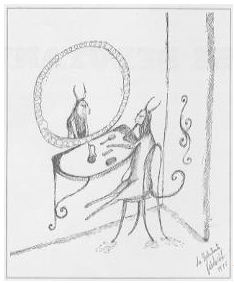
“Samuel” — Grace Paley

“Samuel”

by Grace Paley

Some boys are very tough. They’re afraid of nothing. They are the ones who climb a wall and take a bow at the top. Not only are they brave on the roof, but they make a lot of noise in the darkest part of the cellar where even the super hates to go. They also jiggle and hop on the platform between the locked doors of the subway cars.

Four boys are jiggling on the swaying platform. Their names are Alfred, Calvin, Samuel, and Tom. The men and women in the cars on either side watch them. They don’t like them to jiggle or jump but don’t want to interfere. Of course some of the men in the cars were once brave boys like these. One of them had ridden the tail of a speeding truck from New York to Rockaway Beach without getting off, without his sore fingers losing hold. Nothing happened to him then or later. He had made a compact with other boys who preferred to watch: starting at Eighth Avenue and Fifteenth Street, he would get to some specified place, maybe Twenty-third and the river, by hopping the tops of the moving trucks. This was hard to do when one truck turned a corner in the wrong direction and the nearest truck was a couple of feet too high. He made three or four starts before succeeding. He had gotten this idea from a film at school called The Romance of Logging. He had finished high school, married a good friend, was in a responsible job, and going to night school.

These two men and others looked at the four boys jumping and jiggling on the platform and thought. It must be fun to ride that way, especially now the weather is nice and we’re out of the tunnel and way high over the Bronx. Then they thought. These kids do seem to be acting sort of stupid. They are little. Then they thought of some of the brave things they had done when they were boys and jiggling didn’t seem so risky.

The ladies in the car became very angry when they looked at the four boys. Most of them brought their brows together and hoped the boys could see their extreme disapproval. One of the ladies wanted to get up and say, be careful you dumb kids, get off that platform or I’ll call a cop. But three of the boys were Negroes and the fourth was something else she couldn’t tell for sure. She was afraid they’d be fresh and laugh at her and embarrass her. She wasn’t afraid they’d hit her, but she was afraid of embarrassment. Another lady thought, their mothers never know where they are. It wasn’t true in this particular case. Their mothers all knew that they had gone to see the missile exhibit on Fourteenth Street.

Out on the platform, whenever the train accelerated, the boys would raise their hands and point them up to the sky to act like rockets going off, then they rat-tat-tatted the shatterproof glass pane like machine guns, although no machine guns had been exhibited.

For some reason known only to the motorman, the train began a sudden slowdown. The lady who was afraid of embarrassment saw the boys jerk forward and backward and grab the swinging guard chains. She had her own boy at home. She stood up with determination and went to the door. She slid it open and said, “You boys will be hurt. You’ll be killed. I’m going to call the conductor if you don’t just go into the next car and sit down and be quiet.”

Two of the boys said, “Yes’m,” and acted as though they were about to go. Two of them blinked their eyes a couple of times and pressed their lips together. The train resumed its speed. The door slid shut, parting the lady and the boys. She leaned against the side door because she had to get off at the next stop.

The boys opened their eyes wide at each other and laughed. The lady  blushed. The boys looked at her and laughed harder. They began to pound each other’s back. Samuel laughed the hardest and pounded Alfred’s back until Alfred coughed and the tears came. Alfred held tight to the chain hook. Samuel pounded him even harder when he saw the tears. He said, “Why you bawling? You a baby, huh?” and laughed. One of the men whose boyhood had been more watchful than brave became angry. He stood up straight and looked at the boys for a couple of seconds. Then he walked in a citizenly way to the end of the car, where he pulled the emergency cord. Almost at once, with a terrible hiss, the pressure of air abandoned the brakes and the wheels were caught and held.

People standing in the most secure places fell forward, then backward. Samuel had let go of his hold on the chain so he could pound Tom as well as Alfred. All the passengers in the cars whipped back and forth, but he pitched only forward and fell head first to be crushed and killed between the cars.

The train had stopped hard, halfway into the station, and the conductor called at once for the trainmen who knew about this kind of death and how to take the body from the wheels and brakes. There was silence except for passengers from the other cars who asked, What happened! What happened! The ladies waited around wondering if he might be an only child. The men recalled other afternoons with very bad endings. The little boys stayed close to each other, leaning and touching shoulders and arms and legs.

When the policeman knocked at the door and told her about it, Samuel’s mother began to scream. She screamed all day and moaned all night, though the doctors tried to quiet her with pills.

Oh, oh, she hopelessly cried. She did not know how she could ever find another boy like that one. However, she was a young woman and she became pregnant. Then for a few months she was hopeful. The child born to her was a boy. They brought him to be seen and nursed. She smiled. But immediately she saw that this baby wasn’t Samuel. She and her husband together have had other children, but never again will a boy exactly like Samuel be known.

In the Library, St James’s Square — Thomas Pole

pole

“The Unexplorer” — Edna St. Vincent Millay

esvm

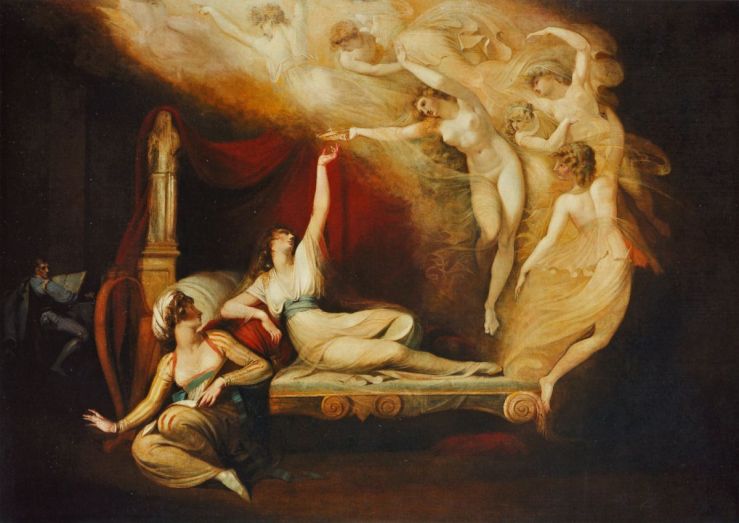
Queen Katherine’s Dream — Henry Fuseli

hf

Bored?

bored

“Apparently with no surprise” — Emily Dickinson

x

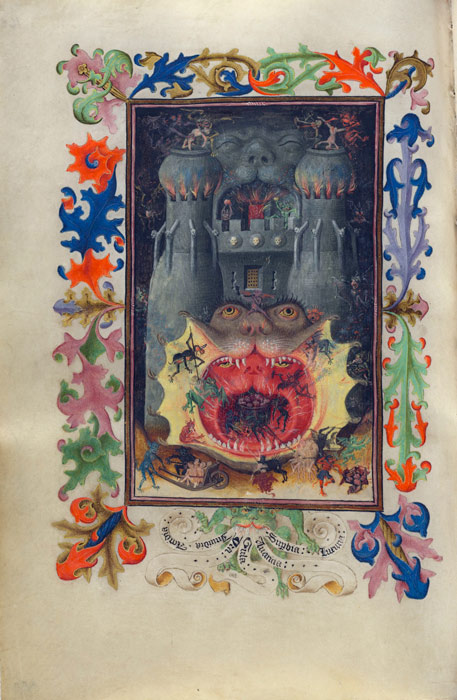
Mouth of Hell — The Master of Catherine of Cleves

Catherine_03

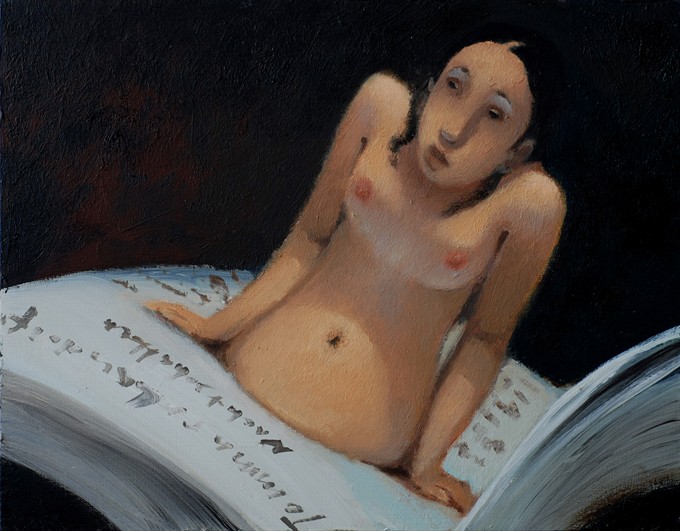
Johannes Hüppi Painting (Woman/Book)

Johannes Huppi  (23)

The Shepherd’s Dream (Paradise Lost) — Henry Fuseli

Jack London’s Dystopian Short Story, “A Curious Fragment”

“A Curious Fragment” by Jack London

[The capitalist, or industrial oligarch, Roger Vanderwater, mentioned in the narrative, has been identified as the ninth in the line of the Vanderwaters that controlled for hundreds of years the cotton factories of the South. This Roger Vanderwater flourished in the last decades of the twenty- sixth century after Christ, which was the fifth century of the terrible industrial oligarchy that was reared upon the ruins of the early Republic. From internal evidences we are convinced that the narrative which follows was not reduced to writing till the twenty- ninth century. Not only was it unlawful to write or print such matter during that period, but the working-class was so illiterate that only in rare instances were its members able to read and write. This was the dark reign of the overman, in whose speech the great mass of the people were characterized as the “herd animals.” All literacy was frowned upon and stamped out. From the statute-books of the times may be instanced that black law that made it a capital offence for any man, no matter of what class, to teach even the alphabet to a member of the working-class. Such stringent limitation of education to the ruling class was necessary if that class was to continue to rule. One result of the foregoing was the development of the professional story-tellers. These story-tellers were paid by the oligarchy, and the tales they told were legendary, mythical, romantic, and harmless. But the spirit of freedom never quite died out, and agitators, under the guise of story-tellers, preached revolt to the slave class. That the following tale was banned by the oligarchs we have proof from the records of the criminal police court of Ashbury, wherein, on January 27, 2734, one John Tourney, found guilty of telling the tale in a boozing-ken of labourers, was sentenced to five years’ penal servitude in the borax mines of the Arizona Desert.—EDITOR’S NOTE.]

Listen, my brothers, and I will tell you a tale of an arm. It was the arm of Tom Dixon, and Tom Dixon was a weaver of the first class in a factory of that hell-hound and master, Roger Vanderwater. This factory was called “Hell’s Bottom”… by the slaves who toiled in it, and I guess they ought to know; and it was situated in Kingsbury, at the other end of the town from Vanderwater’s summer palace. You do not know where Kingsbury is? There are many things, my brothers, that you do not know, and it is sad. It is because you do not know that you are slaves. When I have told you this tale, I should like to form a class among you for the learning of written and printed speech. Our masters read and write and possess many books, and it is because of that that they are our masters, and live in palaces, and do not work. When the toilers learn to read and write—all of them—they will grow strong; then they will use their strength to break their bonds, and there will be no more masters and no more slaves.

Kingsbury, my brothers, is in the old State of Alabama. For three hundred years the Vanderwaters have owned Kingsbury and its slave pens and factories, and slave pens and factories in many other places and States. You have heard of the Vanderwaters—who has not?—but let me tell you things you do not know about them. The first Vanderwater was a slave, even as you and I. Have you got that? He was a slave, and that was over three hundred years ago. His father was a machinist in the slave pen of Alexander Burrell, and his mother was a washerwoman in the same slave pen. There is no doubt about this. I am telling you truth. It is history. It is printed, every word of it, in the history books of our masters, which you cannot read because your masters will not permit you to learn to read. You can understand why they will not permit you to learn to read, when there are such things in the books. They know, and they are very wise. If you did read such things, you might be wanting in respect to your masters, which would be a dangerous thing… to your masters. But I know, for I can read, and I am telling you what I have read with my own eyes in the history books of our masters. Continue reading “Jack London’s Dystopian Short Story, “A Curious Fragment””

Fly to South — Qiu Anxiong

“The Debutante,” A Short Story by Leonora Carrington

debutante

“The Debutante”

by Leonora Carrington

WHEN I was a debutante I often went to the zoological garden. I went so often that I was better acquainted with animals than with the young girls of my age. It was to escape from the world that I found myself each day at the zoo. The beast I knew best was a young hyena. She knew me too. She was extremely intelligent; I taught her French and in return she taught me her language. We spent many pleasant hours in this way.

For the first of May my mother had arranged a ball in my honor. For entire nights I suffered: I had always detested balls, above all those given in my own honor.

On the morning of May first, 1934, very early, I went to visit the hyena. “What a mess of shit,” I told her. “I must go to my ball this evening.”

“You’re lucky,” she said. “I would go happily. I do not know how to dance, but after all, I could engage in conversation.”

“There will be many things to eat,” said I. “I have seen wagons loaded entirely with food coming up to the house.”

“And you complain!” replied the hyena with disgust. “As for me, I eat only once a day, and what rubbish they stick me with!”

I had a bold idea; I almost laughed. “You have only to go in my place.”

“We do not look enough alike, otherwise I would gladly go,” said the hyena, a little sad. “Listen,” said I, “in the evening light one does not see very well. If you were disguised a little, no one would notice in the crowd. Besides, we are almost the same size. You are my only friend; I implore you.”

She reflected upon this sentiment. I knew that she wanted to accept. “It is done,” she said suddenly.

It was very early; not many keepers were about. Quickly I opened the cage and in a moment we were in the street. I took a taxi; at the house, everyone was in bed. In my room, I brought out the gown I was supposed to wear that evening. It was a little long, and the hyena walked with difficulty in my high-heeled shoes. I found some gloves to disguise her hands which were too hairy to resemble mine. When the sunlight entered, she strolled around the room several times—walking more or less correctly. We were so very occupied that my mother, who came to tell me good morning, almost opened the door before the hyena could hide herself under my bed. “There is a bad odor in the room,” said my mother, opening the window. “Before this evening you must take a perfumed bath with my new salts.”

“Agreed,” said I. She did not stay long; I believe the odor was too strong for her. “Do not be late for breakfast,” she said, as she left the room.

The greatest difficulty was to find a disguise for the hyena’s face. For hours and hours we sought an answer: she rejected all of my proposals. At last she said, “I think I know a solution. You have a maid?”

“Yes,” I said, perplexed.

“Well, that’s it. You will ring for the maid and when she enters we will throw ourselves upon her and remove her face. I will wear her face this evening in place of my own.”

“That’s not practical,” I said to her.

“She will probably die when she has no more face; someone will surely find the corpse and we will go to prison.”

“I am hungry enough to eat her,” replied the hyena.

“And the bones?”

“Those too,” she said.

“Then it’s settled?”

“Only if you agree to kill her before removing her face. It would be too uncomfortable otherwise.”

“Good; it’s all right with me.” I rang for Marie, the maid, with a certain nervousness. I would not have done it if I did not detest dances so much. When Marie entered I turned to the wall so as not to see. I admit that it was done quickly. A brief cry and it was over. While the hyena ate, I looked out the window. A few minutes later, she said: “I cannot eat anymore; the two feet are left, but if you have a little bag I will eat them later in the day.”

“You will find in the wardrobe a bag embroidered with fleurs de lys. Remove the handkerchiefs inside it and take it.” She did as I indicated.

At last she said: “Turn around now and look, because I am beautiful!” Before the mirror, the hyena admired herself in Marie’s face. She had eaten very carefully all around the face so that what was left was just what was needed. “Surely, it’s properly done,” said I.

Toward evening, when the hyena was all dressed, she declared: “I am in a very good mood. I have the impression that I will be a great success this evening.” When the music below had been heard for some time, I said to her: “Go now, and remember not to place yourself at my mother’s side: she will surely know that it is not I. Otherwise I know no one. Good luck.” I embraced her as we parted but she smelled very strong.

Night had fallen. Exhausted by the emotions of the day, I took a book and sat down by the open window. I remember that I was reading Gulliver’s Travels by Jonathan Swift. It was perhaps an hour later that the first sign of misfortune announced itself. A bat entered through the window, emitting little cries. I am terribly afraid of bats, I hid behind a chair, my teeth chattering. Scarcely was I on my knees when the beating of the wings was drowned out by a great commotion at my door. My mother entered, pale with rage. “We were coming to seat ourselves at the table,” she said, “when the thing who was in your place rose and cried: ‘I smell a little strong, eh? Well, as for me, I do not eat cake.’ With these words she removed her face and ate it. A great leap and she disappeared out the window.”

Borges/Dieste (Books Acquired, 1.04.2014)

20140105-123041.jpg

Haven’t read Rafael Dieste (one of his books shows up in Bolaño’s novel 2666—Amalfitano hangs it in his backyard).

The Borges poetry collection matches nicely with these.

A poem by JLB:

20140105-124614.jpg

“Child’s Play” — Robert Louis Stevenson

“Child’s Play” by Robert Louis Stevenson

The regret we have for our childhood is not wholly justifiable: so much a man may lay down without fear of public ribaldry; for although we shake our heads over the change, we are not unconscious of the manifold advantages of our new state.  What we lose in generous impulse, we more than gain in the habit of generously watching others; and the capacity to enjoy Shakespeare may balance a lost aptitude for playing at soldiers.  Terror is gone out of our lives, moreover; we no longer see the devil in the bed-curtains nor lie awake to listen to the wind.  We go to school no more; and if we have only exchanged one drudgery for another (which is by no means sure), we are set free for ever from the daily fear of chastisement.  And yet a great change has overtaken us; and although we do not enjoy ourselves less, at least we take our pleasure differently.  We need pickles nowadays to make Wednesday’s cold mutton please our Friday’s appetite; and I can remember the time when to call it red venison, and tell myself a hunter’s story, would have made it more palatable than the best of sauces.  To the grown person, cold mutton is cold mutton all the world over; not all the mythology ever invented by man will make it better or worse to him; the broad fact, the clamant reality, of the mutton carries away before it such seductive figments.  But for the child it is still possible to weave an enchantment over eatables; and if he has but read of a dish in a story-book, it will be heavenly manna to him for a week.

If a grown man does not like eating and drinking and exercise, if he is not something positive in his tastes, it means he has a feeble body and should have some medicine; but children may be pure spirits, if they will, and take their enjoyment in a world of moon-shine.  Sensation does not count for so much in our first years as afterwards; something of the swaddling numbness of infancy clings about us; we see and touch and hear through a sort of golden mist.  Children, for instance, are able enough to see, but they have no great faculty for looking; they do not use their eyes for the pleasure of using them, but for by-ends of their own; and the things I call to mind seeing most vividly, were not beautiful in themselves, but merely interesting or enviable to me as I thought they might be turned to practical account in play.  Nor is the sense of touch so clean and poignant in children as it is in a man.  If you will turn over your old memories, I think the sensations of this sort you remember will be somewhat vague, and come to not much more than a blunt, general sense of heat on summer days, or a blunt, general sense of wellbeing in bed.  And here, of course, you will understand pleasurable sensations; for overmastering pain—the most deadly and tragical element in life, and the true commander of man’s soul and body—alas! pain has its own way with all of us; it breaks in, a rude visitant, upon the fairy garden where the child wanders in a dream, no less surely than it rules upon the field of battle, or sends the immortal war-god whimpering to his father; and innocence, no more than philosophy, can protect us from this sting.  As for taste, when we bear in mind the excesses of unmitigated sugar which delight a youthful palate, “it is surely no very cynical asperity” to think taste a character of the maturer growth.  Smell and hearing are perhaps more developed; I remember many scents, many voices, and a great deal of spring singing in the woods.  But hearing is capable of vast improvement as a means of pleasure; and there is all the world between gaping wonderment at the jargon of birds, and the emotion with which a man listens to articulate music. Continue reading ““Child’s Play” — Robert Louis Stevenson”

A Reading — Thomas Wilmer Dewing

Belly, balls, glory, skull (Bukowski)

lost

Lydia Davis on Using Nabokov’s Marginalia in Translating Madame Bovary