Seven Jests from Leonardo da Vinci’s Notebooks

1281.

When wine is drunk by a drunkard, that wine is revenged on the drinker.

1283.

An artizan often going to visit a great gentleman without any definite purpose, the gentleman asked him what he did this for. The other said that he came there to have a pleasure which his lordship could not have; since to him it was a satisfaction to see men greater than himself, as is the way with the populace; while the gentleman could only see men of less consequence than himself; and so lords and great men were deprived of that pleasure.

1285.

A JEST.

A man wishing to prove, by the authority of Pythagoras, that he had formerly been in the world, while another would not let him finish his argument, the first speaker said to the second: “It is by this token that I was formerly here, I remember that you were a miller.” The other one, feeling himself stung by these words, agreed that it was true, and that by the same token he remembered that the speaker had been the ass that carried the flour.

A JEST.

It was asked of a painter why, since he made such beautiful figures, which were but dead things, his children were so ugly; to which the painter replied that he made his pictures by day, and his children by night.

1289.

An old man was publicly casting contempt on a young one, and boldly showing that he did not fear him; on which the young man replied that his advanced age served him better as a shield than either his tongue or his strength.

1291.

A JEST.

A man was desired to rise from bed, because the sun was already risen. To which he replied: “If I had as far to go, and as much to do as he has, I should be risen by now; but having but a little way to go, I shall not rise yet.”

1292.

A man, seeing a woman ready to hold up the target for a jousting match, exclaimed, looking at the shield, and considering his spear: “Alack! this is too small a workman for so great a business.”

From the Notebooks of Leonardo da Vinci.


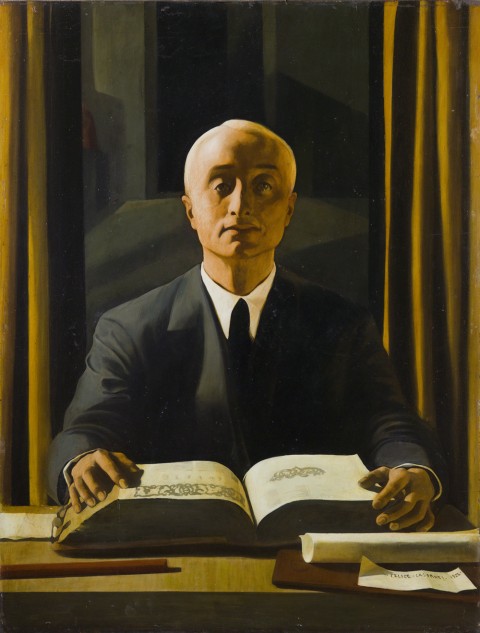
Portrait of Riccardo Gualino — Felice Casorati

03-Casorati_-480x633

The Antagonist (Book Acquired, 9.23.2013)

20130924-200527.jpg

The kind people at Random House sent a copy of Lynn Coady’s The Antagonist, which is new in trade paperback next month. Their blurb:

A piercing epistolary novel, The Antagonist explores, with wit and compassion, how the impressions of others shape, pervert, and flummox both our perceptions of ourselves and our very nature.

Gordon Rankin Jr., aka “Rank,” thinks of himself as “King Midas in reverse”—and indeed misfortune seems to follow him at every turn. Against his will and his nature, he has long been considered—given his enormous size and strength—a goon and enforcer by his classmates, by his hockey coaches, and, not least, by his “tiny, angry” father. He gamely lives up to their expectations, until a vicious twist of fate forces him to flee underground. Now pushing forty, he discovers that an old, trusted friend from his college days has published a novel that borrows freely from the traumatic events of Rank’s own life. Outraged by this betrayal and feeling cruelly misrepresented, he bashes out his own version of his story in a barrage of e-mails to the novelist that range from funny to furious to heartbreaking.

With The Antagonist, Lynn Coady demonstrates all of the gifts that have made her one of Canada’s most respected young writers. Here she gives us an astonishing story of sons and fathers and mothers, of the rewards and betrayals of male friendship, and a large-spirited, hilarious, and exhilarating portrait of a man tearing his life apart in order to put himself back together.

The book got a strange review from Ron Charles in The Washington Post that’s worth reading if your interest is piqued; from that review:

It’s an extraordinarily clever and sympathetic exploration of the cross-currents of male friendship, the intense relationships we make and abandon in school. How ill-fitting those intimacies feel years later whenever a college reunion or some chance encounter forces us to try them on again. Who owns our adolescent memories, our forgotten brutalities, our drunken confessions of affection and dread? (By the way, there are three Lynn Coadys on Facebook, but you were easy to find.)

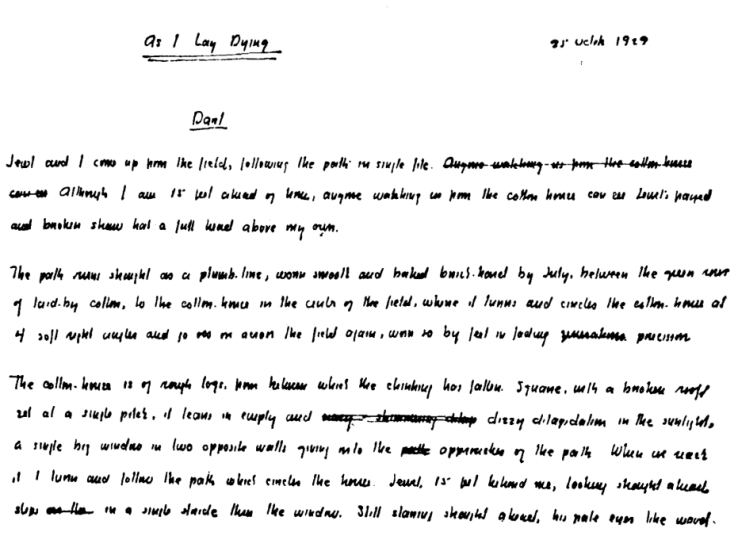
Manuscript Page of Faulkner’s As I Lay Dying

faulkner-w

“Ad Astra” — William Faulkner

“Ad Astra” by William Faulkner

I DON’T KNOW what we were. With the exception of Comyn, we had started out Americans, but after three years, in our British tunics and British wings and here and there a ribbon, I don’t suppose we had even bothered in three years to wonder what we were, to think or to remember.

And on that day, that evening, we were even less than that, or more than that: either beneath or beyond the knowledge that we had not even wondered in three years. The subadar, after a while he was there, in his turban and his trick major’s pips, said that we were like men trying to move in water. “But soon it will clear away,” he said. “The effluvium of hatred and of words. We are like men trying to move in water, with held breath watching our terrific and infinitesimal limbs, watching one another’s terrific stasis without touch, without contact, robbed of all save the impotence and the need.”

We were in the car then, going to Amiens, Sartoris driving and Comyn sitting half a head above him in the front seat like a tackling dummy, the subadar, Bland and I in back, each with a bottle or two in his pockets. Except the subadar, that is. He was squat, small and thick, yet his sobriety was colossal. In that maelstrom of alcohol where the rest of us had fled our inescapable selves he was like a rock, talking quietly in a grave bass four sizes too big for him: “In my country I was prince. But all men are brothers.”

But after twelve years I think of us as bugs in the surface of the water, isolant and aimless and unflagging. Not on the surface; in it, within that line of demarcation not air and not water, sometimes submerged, sometimes not. You have watched an unbreaking groundswell in a cove, the water shallow, the cove quiet, a little sinister with satiate familiarity, while beyond the darkling horizon the dying storm has raged on. That was the water, we the flotsam. Even after twelve years it is no clearer than that. It had no beginning and no ending. Out of nothing we howled, unwitting the storm which we had escaped and the foreign strand which we could not escape; that in the interval between two surges of the swell we died who had been too young to have ever lived.

We stopped in the middle of the road to drink again. The land was dark and empty. And quiet: that was what you noticed, remarked. You could hear the earth breathe, like coming out of ether, like it did not yet know, believe, that it was awake. “But now it is peace,” the subadar said. “All men are brothers.”

(Read the rest of “Ad Astra”).

Room in New York — Edward Hopper

“Willie & Wade” — Donald Barthelme

“Willie & Wade” by Donald Barthelme

Well we all had our Willie & Wade records ‘cept this one guy who was called Spare Some Change? ’cause that’s all he ever said and you don’t have no Willie & Wade records if the best you can do is Spare Some Change?

So we all took our Willie & Wade records down to the Willie & Wade Park and played all the great and sad Willie & Wade songs on portable players for the beasts of the city, the jumpy black squirrels and burnt-looking dogs and filthy, sick pigeons.

And I thought probably one day Willie or Wade would show up in person at the Willie & Wade Park to check things out, see who was there and what record this person was playing and what record that person was playing.

And probably Willie (or Wade) would just ease around checking things out, saying “Howdy” to this one and that one, and he’d see the crazy black guy in Army clothes who stands in the Willie & Wade Park and every ten minutes screams like a chicken, and Willie (or Wade) would just say to that guy, “How ya doin’ good buddy?” and smile, ’cause strange things don’t bother Willie, or Wade, one bit.

And I thought I’d probably go up to Willie then, if it was Willie, and tell him ’bout my friend that died, and how I felt about it at the time, and how I feel about it now. And Willie would say, “I know.”

And I would maybe ask him did he remember Galveston, and did he ever when he was a kid play in the old concrete forts along the sea wall with the giant cannon in them that the government didn’t want any more, and he’d say, “Sure I did.” And I’d say, “You ever work the Blue lay in San Antone?” and he’d say, “Sure I have.”

And I’d say, “Willie, don’t them microphones scare you, the ones with the little fuzzy sweaters on them?” And he’d say to me, “They scare me bad, potner, but I don’t let on.”

And then he (one or the other, Willie or Wade) would say, “Take care, good buddy,” and leave the Willie & Wade Park in his black limousine that the driver of had been waiting patiently in all this time, and I would never see him again, but continue to treasure, my life long, his great contributions.

Woman in a Bookshop — Aubrey Beardsley

Thomas Bernhard’s Reger on the Purpose of Art

Art is the most sublime and the most revolting thing simultaneously, he said. But we must make ourselves believe that there is high art and the highest art, he said, otherwise we should despair. Even though we know that all art ends in gaucherie and in ludicrousness and in the refuse of history, like everything else, we must, with downright self-assurance, believe in high and in the highest art, he said. We realize what it is, a bungled, failed art, but we need not always hold this realization before us, because in that case we should inevitably perish, he said.

RIP Álvaro Mutis

Alvaro-Mutis-600x300

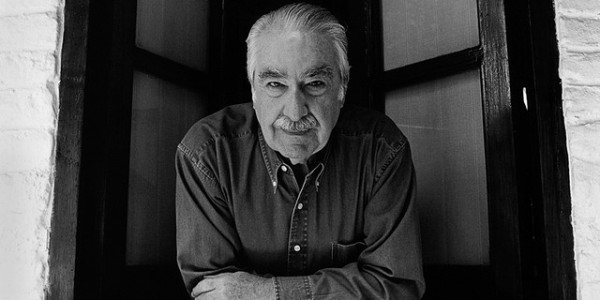
RIP Álvaro Mutis, 1923 – 2013

Colombian writer Álvaro Mutis died in Mexico City today. He was ninety.

Mutis is likely most famous in the English-speaking world for his excellent series of picaresque novellas focusing on the Gaviero, which have been collected as The Adventures and Misadventures of Maqroll. I first learned of the book through a friend who reviewed it on this blog; his review made me pick it up and read and riff on it myself. I don’t know if I can overstate how wonderful these novellas are. I’ve mixed them into my readings over the past year, breaking up the space between new novels by taking a trip with the Gaviero. They are something beyond palate-cleansers; they are the kind of adventure narratives that made me fall in love with reading in the first place. I feel strangely fortunate that there are two more I have yet to read.

Here’s John Updike’s thorough, excellent review of The Adventures and Misadventures of Maqroll.

And: a 2001 interview with Mutis by Francisco Goldman. From that interview:

FG: If you could travel with Maqroll to any period, which would it be?

AM: The 18th century. Casanova and I would have been friends. I would have been friends with the Prince de Ligne and I would have lived in Paris and Venice. I’d take the elegant life, the brilliant prose, like Voltaire—each time you read him you realize that he’s the real thing. And that is where my interest in the 18th century ends; once they get to the French Revolution and the horror and saving of mankind, that’s where I exit.

And a few last scraps from Un Bel Morir:

All the stories and lies about his past accumulating until they formed another being, always present and naturally more deeply loved than his own pale, useless existence composed of nausea and dreams.

A crack of wood waking him in the humble hotel on the Rue de Rempart and, in the middle of the night, leaving him on that shore where only God is aware of other people.

The eyelid twitching with the autonomous speed of one who knows he is in the hands of death. The eyelid of the man he had to kill, with repugnance, with no anger, to save the life of a woman whom he now found unbearable. 

All his waiting. All the emptiness of that nameless time used up in the foolishness of negotiations, proceedings, journeys, blank days, mistaken itineraries. All that life, from which he now begs, as he slips through the wounded dark toward death, some of the leftover scraps he thinks he has a right to. 

Barthelme’s Influences

INTERVIEWER

Your own influences—whom would you like to cite as your spiritual ancestors?

BARTHELME

They come in assorted pairs. Perelman and Hemingway. Kierkegaard and Sabatini. Kafka and Kleist. Kleist was clearly one of Kafka’s fathers. Rabelais and Zane Grey. The Dostoyevsky of Notes from Underground. A dozen Englishmen. The surrealists, both painters and poets. A great many film people, Buñuel in particular. It’s always a stew, isn’t it? Errol Flynn ought to be in there somewhere, and so should Big Sid Catlett, the drummer.

—From Donald Barthelme’s interview with The Paris Review.

“Beckett’s Theory of Comedy” — Anne Carson

btc

Sleep — Felix Vallotton

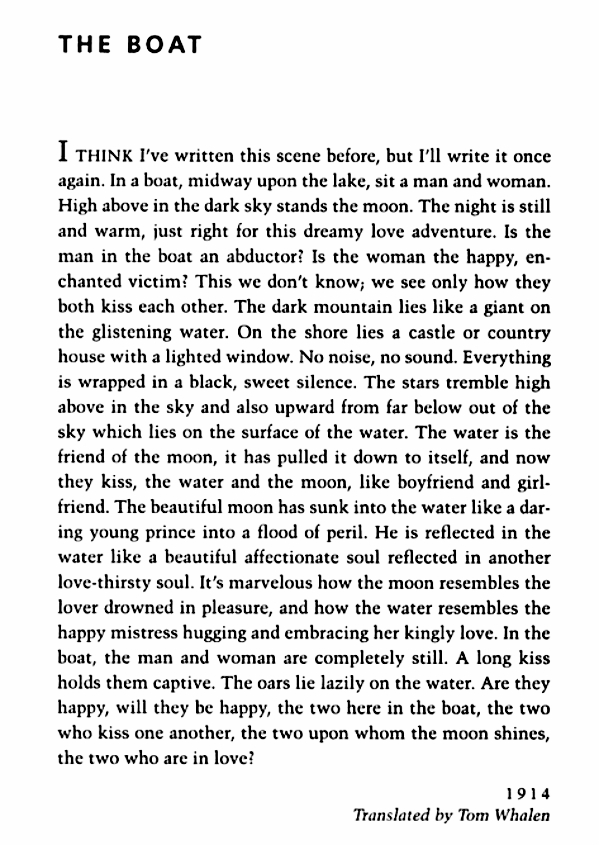
“The Boat” — Robert Walser

tb

Illustration for Kafka’s Metamorphosis — Jean-Michel Folon

folon-kafka-2

(More/via/about; then even more).

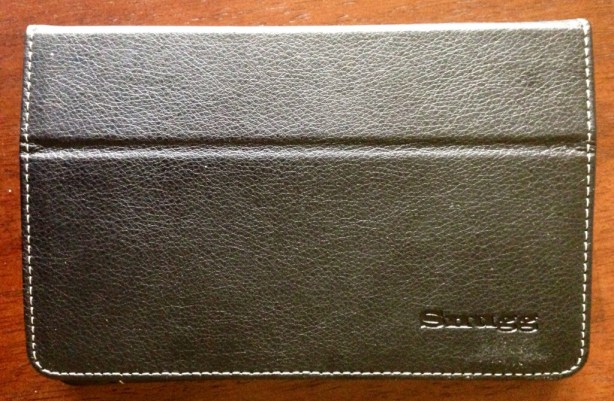
Snugg Kindle Case Reviewed

20130922-115119.jpg

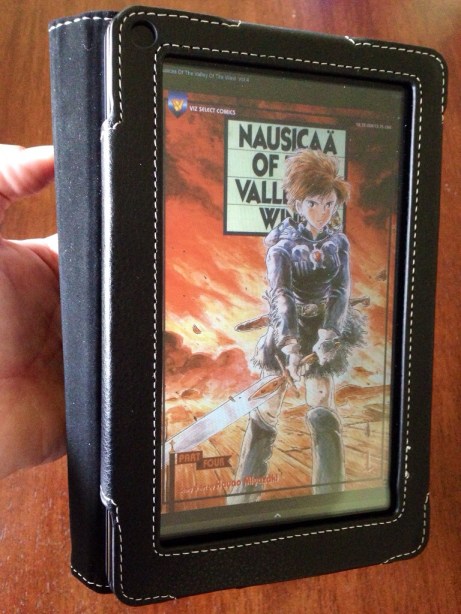
The people at Snugg, who make tablet and phone cases, sent me one of their Kindl Fire cases to review. I had never used a case for my Kindle before, so I wasn’t sure how it would feel. The leather seems like good protection and is already a better alternative to the handkerchief I wrapped my Kindle in, like some hobo barbarian, when I traveled with it.

20130922-115130.jpg

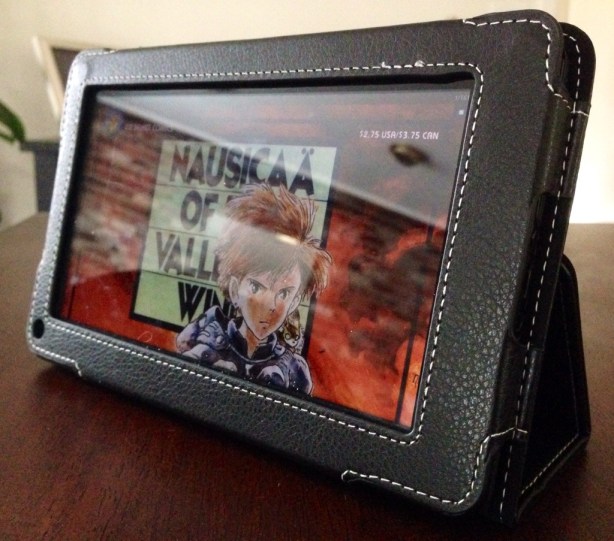
I initially didn’t like the feel of the case, but after extended reading on the Kindle I began to appreciate the handle on the back of the Snugg, which is very comfortable, particularly if you’re reading while reclined. Like most tablet cases, the Snugg also allows you to easily prop up the Kindle, a feature I don’t really use.

20130922-115147.jpg

I like the product—it improves on the Kindle’s readability and the thick leather seems to be of good quality. I’ve been using it for a month now and have no complaints.

Read “The House of the Beehives” by Italo Calvino

“The House of the Beehives” by Italo Calvino

It is difficult to see from far away, and even if someone had already been here once he could not remember the way back; there was a path here at one time, but I made brambles grow over it and wiped out every trace. It’s well chosen, this home of mine, lost in this bank of broom, with a single story that can’t be seen from the valley, and covered in a chalky whitewash with windows picked out in red.

There’s some land around I could have worked and haven’t; a patch for vegetables where snails munch the lettuce is enough for me, and a bit of terraced earth to dig up with a pitchfork and grow potatoes, all purple and budding. I only need to work to feed myself, for I’ve got nothing to share with anyone.

And I don’t cut back the brambles, either the ones now clambering over the roof of the house or those already creeping like a slow avalanche over the cultivated ground; I should like them to bury everything, myself included. Lizards have made their nests in the cracks of the walls, ants have scooped out porous cities under the bricks of the floor; I look forward every day to seeing if a new crack has opened, and think of the cities of the human race being smothered and swallowed up by weeds.

Above my home are a few strips of rough meadow where I let my goats roam. At dawn, dogs sometimes pass by, on the scent of hares; I chase them off with stones. I hate dogs, with their servile fidelity to man; I hate all domestic animals, their pretense of having sympathy with human beings just so they can lick the remains off greasy plates. Goats are the only animals I can stand, for they don’t expect intimacy or give any.

I don’t need chained dogs to guard me. Or even hedges or padlocks, those horrible contraptions of humans. My field is studded with beehives, and a flight of bees is like a thorny hedge that only I can cross. At night the bees sleep in the bean husks, but no man ever comes near my house; people are afraid of me and they are right; not because certain tales they tell about me are true—lies, I say, just the sort of thing they would tell—but they are right to be afraid of me, I want them to be.

When I go over the crest in the morning, I can see the valley dropping away beneath and the sea high all around me and the world. And I see the houses of the human race perched on the edge of the sea, shipwrecked in their false neighborliness; I see the tawny, chalky city, the glittering of its windows, and the smoke of its fires. One day brambles and grass will cover its squares, and the sea will come up and mold the ruins into rocks.

Only the bees are with me now; they buzz around my hands without stinging me when I take the honey from the hives, and settle on me like a living beard; friendly bees, ancient race without a history. For years I’ve been living on this bank of broom with goats and bees; once I used to make a mark on the wall at the passing of each year; now the brambles choke everything. Why should I live with men and work for them? I loathe their sweaty hands, their savage rites, their dances and churches, their women’s acid saliva. But those stories aren’t true, believe me; they’ve always told stories about me,; the lying swine.

I don’t give anything and I don’t owe anything; if it rains at night I cook and eat the big snails slithering down the banks in the morning; the earth in the woods is scattered with soft, damp toadstools. The woods give me everything else I need: sticks and pine cones to burn, and chestnuts; and I snare hares and thrushes, too, for don’t think I love wild animals or have an idyllic adoration of nature—one of man’s absurd hypocrisies. I know that in this world we must devour one another and that the survival of the fittest holds; I kill only the animals I want to eat, with traps, not with guns, so as not to need dogs or other men to fetch them.

Sometimes I meet men in the woods, if I’m not warned in time by the dull thuds of their axes cutting down trees one by one. I pretend not to see them. On Sundays the poor come to gather fuel in the woods, which they strip like the speckled heads of aloes; the trunks are hauled away on ropes and form rough tracks, which gather the rain during storms and provoke landfalls. May everything go to similar ruin in the cities of the human race; may I, as I walk along one day, see chimney tops emerging from the earth, meet parts of streets falling off into ravines, and stumble on strips of railroad track in the middle of the forest.

But you must wonder if I don’t ever feel this solitude of mine weighing on me, if some evening, one of those long twilights, I haven’t gone down, without any definite idea in my head, toward the houses of the human race. I did go, one warm twilight, toward those walls surrounding the gardens below, and climbed down over the medlar trees; but when I heard women laughing and a distant child calling, back I came up here. That was the last time; now I’m up here alone. Well, I get frightened of making a mistake every now and again, as you do. And so, like you, I go on as I was before.

You’re afraid of me, of course, and you’re right. Not because of that affair, though. That, whether it ever happened or not, was so many years ago it doesn’t matter now, anyway.

That woman, that dark woman who came up here to scythe —I had only been up here a short time then and was still full of human emotions—well, I saw her working high on the slope and she hailed me and I didn’t reply and passed by. Yes, I was still full of human emotions then, and of an old resentment, too; and because of that old resentment—not against her, I don’t even remember her face—I went up behind her without her hearing me.

Now, the tale as people tell it is obviously false, for it was late and there wasn’t a soul in the valley and when I put my hands around her throat no one heard her. But I would have to tell you my story from the beginning for you to understand.

Ah, well, let’s not mention that evening any more. Here I live, sharing my lettuce with snails that perforate the leaves, and I know all the places where toadstools grow and can tell the good ones from the poisonous; about women and their poisons I don’t think any more. Being chaste is nothing but a habit, after all.

She was the last one, that dark woman with the scythe. The sky was full of clouds, I remember, dark clouds scudding along. It must have been under a hurrying sky like that, on slopes cropped by goats, that the first human marriage took place. In contact between human beings there can only, I know, be mutual terror and shame. That’s what I wanted, to see the terror and shame, just the terror and shame, in her eyes; that’s the only reason I did it to her, believe me.

No one has said a word about it to me, ever; there isn’t a word they can say, since the valley was deserted that evening. But every night, when the hills are lost in the dark and I can’t follow the meaning of an old book by the light of the lantern, and I sense the town with its human beings and its lights and music down below, I feel the voices of you all accusing me.

But there was no one to see me there in the valley; they say those things because the woman never returned home.

And if dogs passing by always stop to sniff at a certain spot, and bay and scratch the ground with their paws, it’s because there’s an old moles’ lair there—I swear it, just an old moles’ lair.