“The End of Something” — Ernest Hemingway

“The End of Something” by Ernest Hemingway

In the old days Hortons Bay was a lumbering town. No one who lived in it was out of sound of the big saws in the mill by the lake. Then one year there were no more logs to make lumber. The lumber schooners came into the bay and were loaded with the cut of the mill that stood stacked in the yard. All the piles of lumber were carried away. The big mill building had all its machinery that was removable taken out and hoisted on board one of the schooners by the men who had worked in the mill. The schooner moved out of the bay toward the open lake, carrying the two great saws, the travelling carriage that hurled the logs against the revolving, circular saws and all the rollers, wheels, belts and iron piled on a hull-deep load of lumber. Its open hold covered with canvas and lashed tight, the sails of the schooner filled and it moved out into the open lake, carrying with it everything that had made the mill a mill and Hortons Bay a town.

The one-story bunk houses, the eating-house, the company store, the mill offices, and the big mill itself stood deserted in the acres of sawdust that covered the swampy meadow by the shore of the bay.

Ten years later there was nothing of the mill left except the broken white limestone of its foundations showing through the swampy second growth as Nick and Marjorie rowed along the shore. They were trolling along the edge of the channel-bank where the bottom dropped off suddenly from sandy shallows to twelve feet of dark water. They were trolling on their way to set night lines for rainbow trout.

“There’s our old ruin, Nick,” Marjorie said.

Nick, rowing, looked at the white stone in the green trees.

“There it is,” he said.

“Can you remember when it was a mill?” Marjorie asked.

“I can just remember,” Nick said.

“It seems more like a castle,” Marjorie said.

Nick said nothing. They rowed on out of sight of the mill, following the shore line. Then Nick cut across the bay.

“They aren’t striking,” he said.

“No,” Marjorie said. She was intent on the rod all the time they trolled, even when she talked. She loved to fish. She loved to fish with Nick. Continue reading ““The End of Something” — Ernest Hemingway”

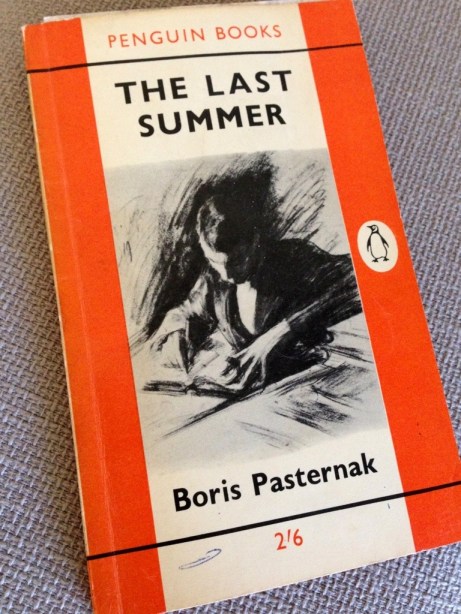
Pasternak’s The Last Summer, Another Lovely Penguin (Book Acquired Some Time in February, 2013)

20130302-105825.jpg

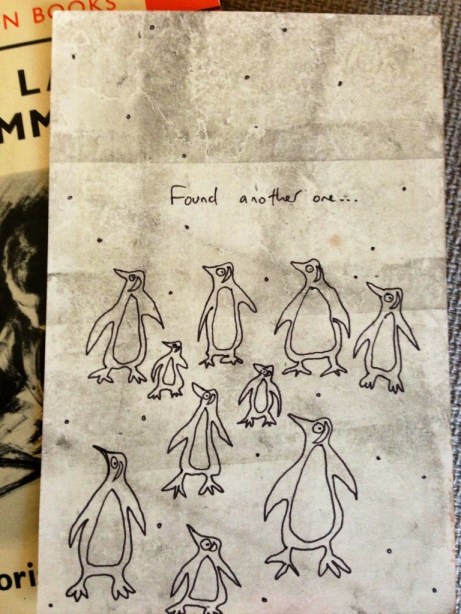
Big thanks again to Ryan Mihaly for sending me another Penguin edition. This time, Ryan sent me Boris Pasternak’s The Last Summer. (Ryan writes reviews of merit at Flying Object, btw). Ryan also sent me a bookmark he illustrated himself:

20130302-105835.jpg

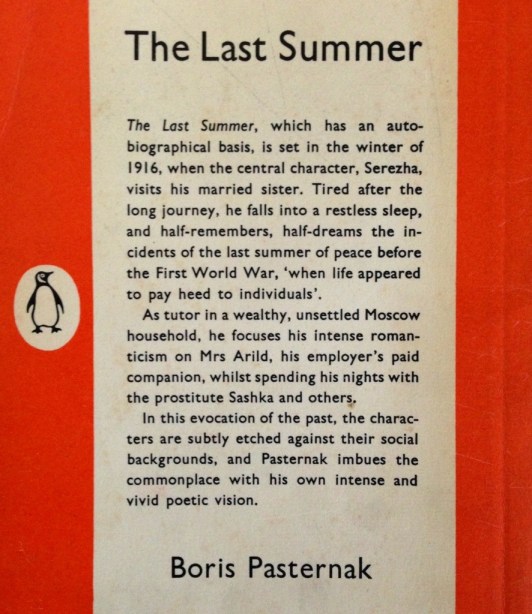
Lovely. Blurb:

20130302-111434.jpg

“The Offshore Pirate” — F. Scott Fitzgerald

“The Offshore Pirate” by F. Scott Fitzgerald

I

This unlikely story begins on a sea that was a blue dream, as colorful as blue-silk stockings, and beneath a sky as blue as the irises of children’s eyes. From the western half of the sky the sun was shying little golden disks at the sea—if you gazed intently enough you could see them skip from wave tip to wave tip until they joined a broad collar of golden coin that was collecting half a mile out and would eventually be a dazzling sunset. About half-way between the Florida shore and the golden collar a white steam-yacht, very young and graceful, was riding at anchor and under a blue-and-white awning aft a yellow-haired girl reclined in a wicker settee reading The Revolt of the Angels, by Anatole France.

She was about nineteen, slender and supple, with a spoiled alluring mouth and quick gray eyes full of a radiant curiosity. Her feet, stockingless, and adorned rather than clad in blue-satin slippers which swung nonchalantly from her toes, were perched on the arm of a settee adjoining the one she occupied. And as she read she intermittently regaled herself by a faint application to her tongue of a half-lemon that she held in her hand. The other half, sucked dry, lay on the deck at her feet and rocked very gently to and fro at the almost imperceptible motion of the tide.

The second half-lemon was well-nigh pulpless and the golden collar had grown astonishing in width, when suddenly the drowsy silence which enveloped the yacht was broken by the sound of heavy footsteps and an elderly man topped with orderly gray hair and clad in a white-flannel suit appeared at the head of the companionway. There he paused for a moment until his eyes became accustomed to the sun, and then seeing the girl under the awning he uttered a long even grunt of disapproval.

If he had intended thereby to obtain a rise of any sort he was doomed to disappointment. The girl calmly turned over two pages, turned back one, raised the lemon mechanically to tasting distance, and then very faintly but quite unmistakably yawned.

“Ardita!” said the gray-haired man sternly.

Ardita uttered a small sound indicating nothing.

“Ardita!” he repeated. “Ardita!”

Ardita raised the lemon languidly, allowing three words to slip out before it reached her tongue.

“Oh, shut up.”

“Ardita!”

“What?”

“Will you listen to me—or will I have to get a servant to hold you while I talk to you?”

The lemon descended very slowly and scornfully.

“Put it in writing.”

“Will you have the decency to close that abominable book and discard that damn lemon for two minutes?”

“Oh, can’t you lemme alone for a second?”

“Ardita, I have just received a telephone message from the shore——”

“Telephone?” She showed for the first time a faint interest.

“Yes, it was——”

“Do you mean to say,” she interrupted wonderingly, “‘at they let you run a wire out here?”

“Yes, and just now——”

“Won’t other boats bump into it?”

“No. It’s run along the bottom. Five min——”

“Well, I’ll be darned! Gosh! Science is golden or something—isn’t it?”

“Will you let me say what I started to?”

“Shoot!”

“Well it seems—well, I am up here—” He paused and swallowed several times distractedly. “Oh, yes. Young woman, Colonel Moreland has called up again to ask me to be sure to bring you in to dinner. His son Toby has come all the way from New York to meet you and he’s invited several other young people. For the last time, will you——”

“No,” said Ardita shortly, “I won’t. I came along on this darn cruise with the one idea of going to Palm Beach, and you knew it, and I absolutely refuse to meet any darn old colonel or any darn young Toby or any darn old young people or to set foot in any other darn old town in this crazy state. So you either take me to Palm Beach or else shut up and go away.”

“Very well. This is the last straw. In your infatuation for this man.—a man who is notorious for his excesses—a man your father would not have allowed to so much as mention your name—you have rejected the demi-monde rather than the circles in which you have presumably grown up. From now on——”

“I know,” interrupted Ardita ironically, “from now on you go your way and I go mine. I’ve heard that story before. You know I’d like nothing better.”

“From now on,” he announced grandiloquently, “you are no niece of mine. I——”

“O-o-o-oh!” The cry was wrung from Ardita with the agony of a lost soul. “Will you stop boring me! Will you go ‘way! Will you jump overboard and drown! Do you want me to throw this book at you!”

“If you dare do any——”

Smack! The Revolt of the Angels sailed through the air, missed its target by the length of a short nose, and bumped cheerfully down the companionway.

The gray-haired man made an instinctive step backward and then two cautious steps forward. Ardita jumped to her five feet four and stared at him defiantly, her gray eyes blazing.

“Keep off!”

“How dare you!” he cried.

“Because I darn please!”

“You’ve grown unbearable! Your disposition——”

“You’ve made me that way! No child ever has a bad disposition unless it’s her fancy’s fault! Whatever I am, you did it.” Continue reading ““The Offshore Pirate” — F. Scott Fitzgerald”

“Nam-Bok the Unveracious” — Jack London

“Nam-Bok the Unveracious” by Jack London

“A Bidarka, is it not so! Look! a bidarka, and one man who drives clumsily with a paddle!”

Old Bask-Wah-Wan rose to her knees, trembling with weakness and eagerness, and gazed out over the sea.

“Nam-Bok was ever clumsy at the paddle,” she maundered reminiscently, shading the sun from her eyes and staring across the silver-spilled water. “Nam-Bok was ever clumsy. I remember….”

But the women and children laughed loudly, and there was a gentle mockery in their laughter, and her voice dwindled till her lips moved without sound.

Koogah lifted his grizzled head from his bone-carving and followed the path of her eyes. Except when wide yawns took it off its course, a bidarka was heading in for the beach. Its occupant was paddling with more strength than dexterity, and made his approach along the zigzag line of most resistance. Koogah’s head dropped to his work again, and on the ivory tusk between his knees he scratched the dorsal fin of a fish the like of which never swam in the sea.

“It is doubtless the man from the next village,” he said finally, “come to consult with me about the marking of things on bone. And the man is a clumsy man. He will never know how.”

“It is Nam-Bok,” old Bask-Wah-Wan repeated. “Should I not know my son!” she demanded shrilly. “I say, and I say again, it is Nam-Bok.”

“And so thou hast said these many summers,” one of the women chided softly. “Ever when the ice passed out of the sea hast thou sat and watched through the long day, saying at each chance canoe, ‘This is Nam-Bok.’ Nam-Bok is dead, O Bask-Wah-Wan, and the dead do not come back. It cannot be that the dead come back.”

“Nam-Bok!” the old woman cried, so loud and clear that the whole village was startled and looked at her. Continue reading ““Nam-Bok the Unveracious” — Jack London”

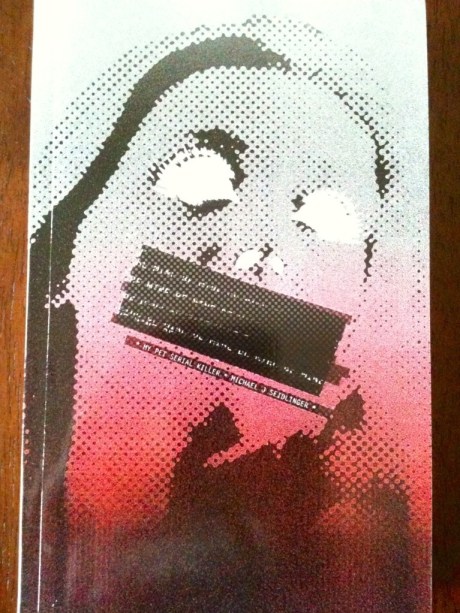
My Pet Serial Killer (Book Acquired, Some Time in January 2013)

20130213-170558.jpg

Okay: So I’ve been meaning to get to this one for awhile, but my review stack has just been too big.

Anyway, Michael J. Siedlinger’s My Pet Serial Killer is pretty weird stuff so far, but also compelling and very readable.

At Word Riot, Edward J. Rathke gave the book a favorable review, writing:

My Pet Serial Killer is a psychological thriller as pickup game as college days romance as media study as violent porn as metahorror as the most bizarre and cruelest master/slave relationship I can remember reading since John Fowles’ The Collector. Claire Wilkinson, a forensics graduate student, plays the pickup game but she searches for a very specific kind of lover: a serial killer. She finds her Gentleman Killer, tears him apart, and rebuilds him, hoping to mold the greatest serial killer ever, causing a media frenzy, and furthering her own academic career. Twisted without being overly violent, haunting without the ghosts, Claire is a narrator and protagonist that we race along with, burning through pages at a dizzying rate only to see what she does next.

20130213-170606.jpg

The book also got a good write-up at HTML Giant, which declared “Seidlinger is the sickest of the fucks. Few can compare.”

“On Sleep” — Samuel Johnson

“On Sleep” by Samuel Johnson (From The Idler, No. 39. Tuesday, March 20, 1753)

 —[Greek: Oduseus phulloisi kalupsato to d ar Athaenae
Hypnon ep ommasi cheu, ina min pauseie tachista
Dusponeos kamatoio.]—HOM. E. 491

 —Pallas pour’d sweet slumbers on his soul;
And balmy dreams, the gift of soft repose,
Calm’d all his pains, and banish’d all his woes. POPE.

If every day did not produce fresh instances of the ingratitude of mankind, we might, perhaps, be at a loss, why so liberal and impartial a benefactor as sleep, should meet with so few historians or panegyrists. Writers are so totally absorbed by the business of the day, as never to turn their attention to that power, whose officious hand so seasonably suspends the burthen of life; and without whose interposition man would not be able to endure the fatigue of labour, however rewarded, or the struggle with opposition, however successful.

Night, though she divides to many the longest part of life, and to almost all the most innocent and happy, is yet unthankfully neglected, except by those who pervert her gifts.

The astronomers, indeed, expect her with impatience, and felicitate themselves upon her arrival: Fontenelle has not failed to celebrate her praises; and to chide the sun for hiding from his view the worlds, which he imagines to appear in every constellation. Nor have the poets been always deficient in her praises: Milton has observed of the night, that it is “the pleasant time, the cool, the silent.”

These men may, indeed, well be expected to pay particular homage to night; since they are indebted to her, not only for cessation of pain, but increase of pleasure; not only for slumber, but for knowledge. But the greater part of her avowed votaries are the sons of luxury; who appropriate to festivity the hours designed for rest; who consider the reign of pleasure as commencing when day begins to withdraw her busy multitudes, and ceases to dissipate attention by intrusive and unwelcome variety; who begin to awake to joy when the rest of the world sinks into insensibility; and revel in the soft affluence of flattering and artificial lights, which “more shadowy set off the face of things.” Continue reading ““On Sleep” — Samuel Johnson”

Selections from One-Star Amazon Reviews of Melville’s Moby-Dick

[Ed. note: The following citations come from one-star Amazon reviews of Herman Melville’s novel Moby-Dick. To be very clear, I think Moby-Dick is fantasticbut I also enjoy seeing what people compelled to write negative reviews of the book on Amazon had to say. What follows are selections of one-star Amazon reviews; I’ve preserved the reviewers’ unique styles of punctuation and spelling. See also: on Joyce’s Ulysses and Markson’s Wittgenstein’s Mistress].


Yechh.

It made for a smashing movie.

If you want to read lots of meaningless whale trivia read the book.

Boy gets whale. Boy loses whale. Boy gets whale. Spawns yawns

I think if you made it into a short comic strip, you would have liked it.

I bought this book for a friend in jail. Alas, he was unable to read it because the font was too small.

Ray Bradbury, who wrote the screenplay for this novel, (a la Gregory Peck) couldn’t even finish the damn thing!

If you like a story with nonessential information and an author that is entirely to verbose, then this book is for you.

I am quite the fan of stories which involve man eating sea creatures, such as Jaws. Moby Dick is nothing compared to such classics, I fear.

Throughout the book, you may read one chapter with some action only to be followed by 5 or 6 chapters of tangents that are not necessary to understand the story.

Moby Dick, was a horrible waiste of time. Along with its wordy paragraphs, it also talked about uninteresting issues. It is also to long, and you don’t hear of them encountering the whale until the end of the book.

The only people who like this book are english teachers who derive a feeling of moral superiority from forcing others to read this incredibly bad novel.

First of all, classiflying it as fiction is a mistake. Probably a good 60% of the book is non-fiction – chapter after chapter dedicated to every imaginable detail of the biology of the whale and every imaginable nuance of whaling.

I love literatur just as much as the next guy but we must face it 100 years or so ago American literature was reall weak and lagging from the rest of the world, perhaps now they’re starting to catch up with writers like Ann Rice and them.

I have seen better writing in a Hallmark card! Boring! Give me a good ole copy of Elvis and Me! A true story that really tugs at your heart strings! I sleep with that one under my pillow! Keep Moby Dick away from my bed!

Those chapters about Ishmael sleeping with whatever his name was and Ishamel had such a good time with the other guy’s arm over him and leg over him that he didn’t know if he was straight or gay any more.

i personally didn’t enjoy the philosophical or deep side of the book, i have read much much better books in that regard.

There is no suspense, and I find the idea of people hunting whales offensive. Offensive with a capital O.

Honestly, Over 400 pages devoted to killing a whale because it ate your hand? Come on.

It is hard to read. like work. Doubt he could get published today.

What is the whales motivation? You dont know.

It is 540somepages of boring whaling details.

No wonder Melville flopped as a writter.

OMG, this is tedious and torture to read.

I HATE this book. Why? It’s BORING!

Moby Ick’s more like it.

“The Valley of Spiders” — H.G. Wells

“The Valley of Spiders” by H.G. Wells

Towards mid-day the three pursuers came abruptly round a bend in the torrent bed upon the sight of a very broad and spacious valley. The difficult and winding trench of pebbles along which they had tracked the fugitives for so long, expanded to a broad slope, and with a common impulse the three men left the trail, and rode to a little eminence set with olive-dun trees, and there halted, the two others, as became them, a little behind the man with the silver-studded bridle.

For a space they scanned the great expanse below them with eager eyes. It spread remoter and remoter, with only a few clusters of sere thorn bushes here and there, and the dim suggestions of some now waterless ravine, to break its desolation of yellow grass. Its purple distances melted at last into the bluish slopes of the further hills—hills it might be of a greener kind—and above them invisibly supported, and seeming indeed to hang in the blue, were the snowclad summits of mountains that grew larger and bolder to the north-westward as the sides of the valley drew together. And westward the valley opened until a distant darkness under the sky told where the forests began. But the three men looked neither east nor west, but only steadfastly across the valley.

The gaunt man with the scarred lip was the first to speak. “Nowhere,” he said, with a sigh of disappointment in his voice. “But after all, they had a full day’s start.”

“They don’t know we are after them,” said the little man on the white horse.

“SHE would know,” said the leader bitterly, as if speaking to himself.

“Even then they can’t go fast. They’ve got no beast but the mule, and all to-day the girl’s foot has been bleeding—-”

The man with the silver bridle flashed a quick intensity of rage on him. “Do you think I haven’t seen that?” he snarled.

“It helps, anyhow,” whispered the little man to himself.

The gaunt man with the scarred lip stared impassively. “They can’t be over the valley,” he said. “If we ride hard—”

He glanced at the white horse and paused.

“Curse all white horses!” said the man with the silver bridle, and turned to scan the beast his curse included.

The little man looked down between the melancholy ears of his steed.

“I did my best,” he said.

The two others stared again across the valley for a space. The gaunt man passed the back of his hand across the scarred lip. Continue reading ““The Valley of Spiders” — H.G. Wells”