Scientist — David Burliuk

scientist-1952.jpg!HD

The Worst Poetry I Have Ever Read

At the home of some good friends this past weekend, reclined nicely in a warm armchair, the warmth of various ales coursing through me, I picked off the shelf by my right hand a crumbling first edition of Modern Library’s A Comprehensive Anthology of Modern Poetry, edited by Conrad Aiken. I opened at random and found a small and perhaps undue joy that my stochastic flipping led to sections 10 and 11 of Song of Myself—maybe my favorite parts of Walt Whitman’s longassed poem.

Do you recall these bits? The trapper’s wedding? The runaway slave? The twenty-eight bathers and the woman who spies on them? I read them aloud to the room, ostensibly to the people in the room, but maybe just to myself. Walt Whitman’s storytelling is at its best when he moves most away from himself, when he puts on different hats, wears different ears, strolls around America a bit. I love his free verse in spite of—or even maybe because of—its swollen scope, its tendency toward bombast or even hamminess. O Walt! Get over yourself!—but not really, never change! Song of Myself is one of my favorite novels, or one of my favorite epics, or one of my favorite monologues—whatever it is, it’s one of my favorites (especially taken with doses of Emily Dickinson’s strange potions).

I don’t really know a lot about poetry, despite teaching the study of it in certain literature survey classes.

But hang on, it seems I was telling a story, or at least teasing out an anecdote, or at least going somewhere with all this: So, after riffling through the anthology a bit more, my friend says, Hey, if you want to read some really terrible poetry, check out that book to your right. Here is the book:

20130120-102401.jpg

I had never heard of Walter Benton or his (unintentionally) hilarious volume This Is My Beloved until that moment. So what is it? Combining the worst elements of Whitmanesque free verse with a downright silly conceit that these are diary entries, This Is My Beloved attempts to be the erotic record of a passionate love affair. Benton tries to keep his language sultry, sexy, and sensuous without veering into pornography, but the results are bizarre and grotesque. Here’s an entire page as evidence:

20130120-102411.jpg

“Your breasts are snub like children’s faces”?!

“…your lips match your teats beautifully”?!

And my favorite: “The hair of your arm’s hollow and where your thighs meet / agree completely, being brown and soft to look at like a nest of field mice.” A nest of field mice! Women love to be complimented on their matching pits and pubes, followed by a simile comparing said regions to a rodent’s hovel.

Indeed, Benton loves animal similes for his lady—later he writes: “Yes, your body makes eyes at me from every salient, / promises warm, lavish promises— / curved, colored . . . finished in a warm velvet like baby rabbits.”

But it’s not just the rabbits and mice that are gross. Lines like “We had loved hard—it’s all over your throat and hair” are simply queasy, bad writing. Or this nugget: “The white full moon like a great beautiful whore / solicits over the city, eggs the lovers on / the haves . . . walking in twos to their beds and to their mating. / I walk alone. Slowly. No hurry. Nobody’s waiting.”

Or this snippet:
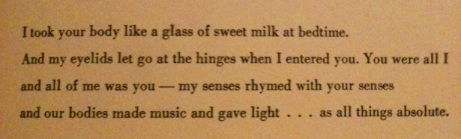
20130120-102418.jpg

It’s just really, really bad—I mean, at least when Henry Miller is gross, he’s deeply, earnestly gross, abject even, depraved perhaps (recall the famous lines: “I have set the shores a little wider. I have ironed out the wrinkles. After me you can take on stallions, bulls, rams, drakes, St. Bernards. You can stuff toads, bats, lizards up your rectum. You can shit arpeggios if you like, or string a zither across your navel”).

So, to return to my little story, we read most of Benton’s book aloud, doubling over laughing at times at just how wonderfully awful it is. And, wiping the tears from my eyes, I went to my trusty dusty iPhone to do a little background research—surely the world knew of this awful, awful poetry? Surely folks were getting the same giggly fun as happy we from poor Benton’s lurid verse?

And here, really, comes the occasion for this post, the real reason I write: It turns out that folks love this book—in a sincere, earnest, serious way. No fewer than four audio recordings were made of the book, all set to music (the most famous seems to be by Arthur Psyrock); the book has near-perfect five star review averages on both Amazon and Goodreads; and, perhaps most shocking of all, the book has been continuously in print since it was first published in 1949—it’s in its 34th edition (prestigious hardback with prestigious deckle edges, by the way). And of course you can buy an ebook version! (Unlike, say, Georges Perec’s Life A User’s Manual). Even worse, hack crooner Rod McKuen cites Benton as a major influence, so we have that to thank him for as well.

I don’t know. Am I wrong? Is Benton’s stuff actually good? I mean, I’ll concede that I enjoyed reading the book, but only inasmuch as it made me laugh so much. I don’t know. I already admitted I don’t know much about poetry. (As I write this, I pause to watch and listen to Richard Blanco read his inauguration poem “One Day”; I have no idea if it’s good or not). Benton’s verse seems so hammy, clumsy, indelicate; too earnest, too priapic, tripping over its own boners. It reads like a bad cribbing of Whitman and Miller, with an occasional lift from Hemingway. Even worse, it strikes me as amateurish, as the sort of thing that a teen might scrawl in his Moleskine only to cringe at later before hiding it somewhere. I just can’t believe that this book has been in continual publication from a major house (Knopf) for more than a half-century.

But maybe I’m misreading. Maybe I’m cynical. Maybe the poem is beautiful and profound and not icky solipsistic dreck. But I doubt it.

Love and Death — Francisco Goya

Film Footage of William Faulkner (1952)

The Alchemist — Pieter Bruegel the Elder

the-alchemist

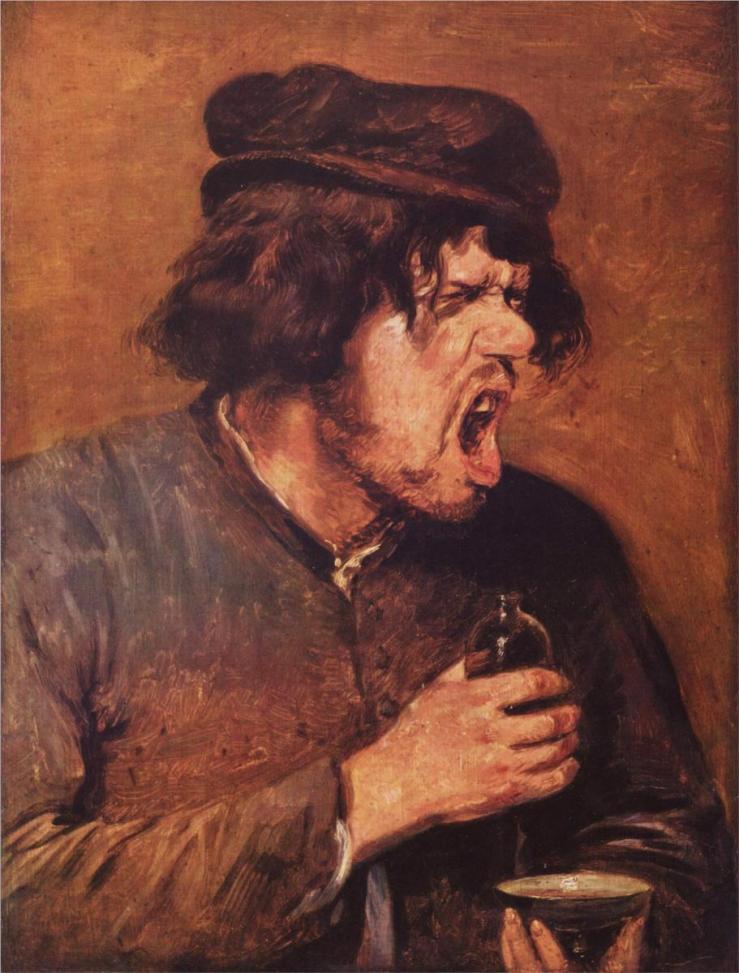
The Bitter Drunk — Adriaen Brouwer

the-bitter-drunk.jpg!HD

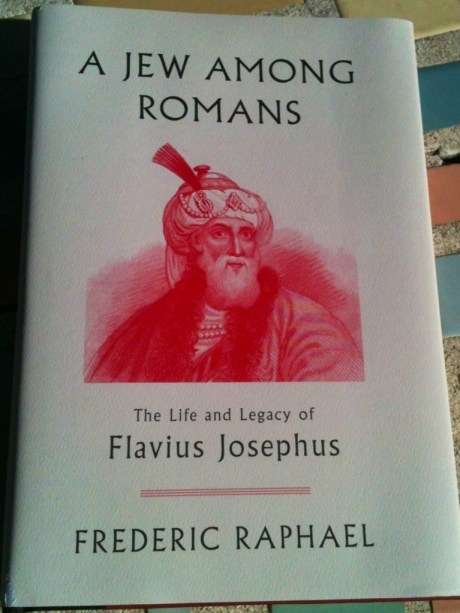
A Jew Among Romans: The Life and Legacy of Flavius Josephus (Book Acquired, 1.14.2013

20130120-174045.jpg

This one looks pretty interesting, and the first chapter was intriguing: A Jew Among the Romans: The Life and Legacy of Flavius Josephus. It’s new in hardback from Random House. Their blurb:

From the acclaimed biographer, screenwriter, and novelist Frederic Raphael, here is an audacious history of Josephus (37–c.100), the Jewish general turned Roman historian, whose emblematic betrayal is a touchstone for the Jew alone in the Gentile world.

Joseph ben Mattathias’s transformation into Titus Flavius Josephus, historian to the Roman emperor Vespasian, is a gripping and dramatic story. His life, in the hands of Frederic Raphael, becomes a point of departure for an appraisal of Diasporan Jews seeking a place in the dominant cultures they inhabit. Raphael brings a scholar’s rigor, a historian’s perspective, and a novelist’s imagination to this project. He goes beyond the fascinating details of Josephus’s life and his singular literary achievements to examine how Josephus has been viewed by posterity, finding in him the prototype for the un-Jewish Jew, the assimilated intellectual, and the abiding apostate: the recurrent figures in the long centuries of the Diaspora. Raphael’s insightful portraits of  Yehuda Halevi, Baruch Spinoza, Karl Kraus, Benjamin Disraeli, Ludwig Wittgenstein, and Hannah Arendt extend and illuminate the Josephean worldview Raphael so eloquently lays out.


The Special Pleasures of Guest Room Reading

20130120-102259.jpg

A few years ago, The New York Times ran a little wisp of an article describing the pleasures many readers take in reading “the moldy, dog-eared paperbacks found on the shelves and bedside tables of summer guest rooms.” The article features writers explaining how, staying somewhere, they reach for books they’d normally never pick up, like Wells Tower describing how he ended up reading The Bridges of Madison County. Like most ardent readers, I take a book (or two or three, or, more recently, a Kindle loaded with hundreds) with me anywhere I’m going to stay a night—but I’ll invariably read something I find in the room I’m staying if possible.

Sometimes I’ll end up reading something terrible—once, staying at a beachfront condo, I read an entire serialized Annie Oakley novel even though it was awful. Other times a stay prompts me to pick up a book I’d never reach for in my civilian life. For example, in a cabin in the Blue Ridge Mountains a few years ago I read a naturalist field guide for the area, written and published in the 1950s. More often than not, guest room reading leads me to read much faster and stay up reading much longer than I normally would, simply because I’m trying to finish the book before I leave. This is how I read Gabriel Garcia Marquez’s Memories of My Melancholy Whores in one long sitting (the book was my uncle), and how I ate up John Barth’s novel The End of the Road in friend’s mother’s childhood room—the book was hers, she had lots of cool books, and I wished I could’ve read more.

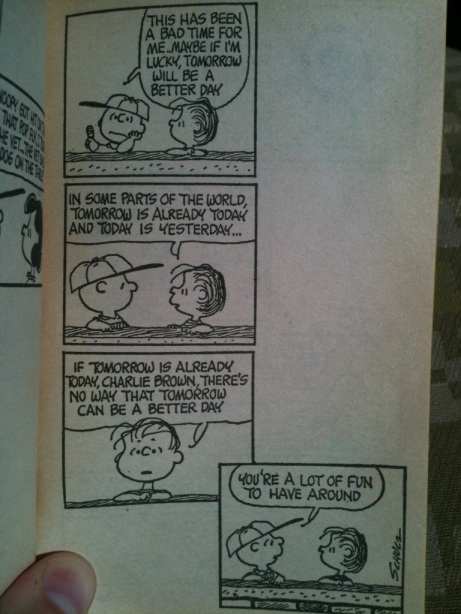
The other night, staying with some longtime friends, I reached for a brittle yellowed Peanuts collection on the nightstand by my bed. There were a few volumes of prose and poetry there, but Charles M. Schulz’s comics seemed more likely to make it through the haze of half a dozen beers. Plus, I’ve always loved Peanuts. I read the book entire, an arc beginning with the gang heading off to summer camp and ending, more or less, with Snoopy’s failed attempts at writing.

20130120-102308.jpg

Like many kids, I grew up with Peanuts, reading Schulz’s work in the paper and also in collected volumes that my grandparents would give me (my grandfather was an especially big fan). The comics were often funny—not funny like my favorite at the time, Gary Larson’s The Far Side to be sure—but they were just as often full of melancholy or even despair, a despair that was mediated, but not necessarily assuaged by, the consolations of friendship.

20130120-102345.jpg

I read as gently as possible, trying (and not always succeeding) to prevent any more pages from falling out of the collection. I mentally bookmarked several panels and a few entire strips to photograph the next day to maybe share on the blog. The next morning it occurred to me that I own almost a half dozen Peanuts collections—but I probably hadn’t picked them up in years. And I suppose this is one of the strange pleasures of guest room reading—that it might reintroduce us to an old favorite—but that seems like too pat a conclusion to me. I’ve found over the years that I’m just as likely to remember an awful book I read at random as a guest—and that for some reason the experience of reading someone else’s books—in a guest room, at a river house, in a cabin, at a hostel—is somehow always heightened. I don’t have a distinct explanation, other than the very obvious and simple one that I usually read in the same few places—a chair in my living room, a couch, my office, the bed, the bath, my back porch—and that reading other people’s texts in unfamiliar places estranges what I think of as reading—and that estrangement is invigorating. And pleasurable. 

“Sweat” — Zora Neale Hurston

“Sweat” by Zora Neale Hurston

It was eleven o’clock of a Spring night in Florida. It was Sunday. Any other night, Delia Jones would have been in bed for two hours by this time. But she was a wash-woman, and Monday morning meant a great deal to her. So she collected the soiled clothes on Saturday when she returned the clean things. Sunday night after church, she sorted them and put the white things to soak. It saved her almost a half day’s start. A great hamper in the bedroom held the clothes that she brought home. It was so much neater than a number of bundles lying around.

She squatted in the kitchen floor beside the great pile of clothes, sorting them into small heaps according to color, and humming a song in a mournful key, but wondering through it all where Sykes, her husband, had gone with her horse and buckboard.

Just then something long, round, limp and black fell upon her shoulders and slithered to the floor beside her. A great terror took hold of her. It softened her knees and dried her mouth so that it was a full minute before she could cry out or move. Then she saw that it was the big bull whip her husband liked to carry when he drove.

She lifted her eyes to the door and saw him standing there bent over with laughter at her fright. She screamed at him.

“Sykes, what you throw dat whip on me like dat? You know it would skeer me–looks just like a snake, an’ you knows how skeered Ah is of snakes.”

“Course Ah knowed it! That’s how come Ah done it.” He slapped his leg with his hand and almost rolled on the ground in his mirth. “If you such a big fool dat you got to have a fit over a earth worm or a string, Ah don’t keer how bad Ah skeer you.”

“You aint got no business doing it. Gawd knows it’s a sin. Some day Ah’m goin’ tuh drop dead from some of yo’ foolishness. ‘Nother thing, where you been wid mah rig? Ah feeds dat pony. He aint fuh you to be drivin’ wid no bull whip.”

“You sho is one aggravatin’ nigger woman!” he declared and stepped into the room. She resumed her work and did not answer him at once. “Ah done tole you time and again to keep them white folks’ clothes outa dis house.”

He picked up the whip and glared down at her. Delia went on with her work. She went out into the yard and returned with a galvanized tub and set it on the washbench. She saw that Sykes had kicked all of the clothes together again, and now stood in her way truculently, his whole manner hoping, praying, for an argument. But she walked calmly around him and commenced to re-sort the things.

“Next time, Ah’m gointer kick ’em outdoors,” he threatened as he struck a match along the leg of his corduroy breeches. Continue reading ““Sweat” — Zora Neale Hurston”

Reading — Konstantin Makovsky

reading (1)

“Were this world an endless plain…” (Moby-Dick)

Were this world an endless plain, and by sailing eastward we could for ever reach new distances, and discover sights more sweet and strange than any Cyclades or Islands of King Solomon, then there were promise in the voyage. But in pursuit of those far mysteries we dream of, or in tormented chase of that demon phantom that, some time or other, swims before all human hearts; while chasing such over this round globe, they either lead us on in barren mazes or midway leave us whelmed.

From “The Albatross,” Chapter 52 of Melville’s Moby-Dick.


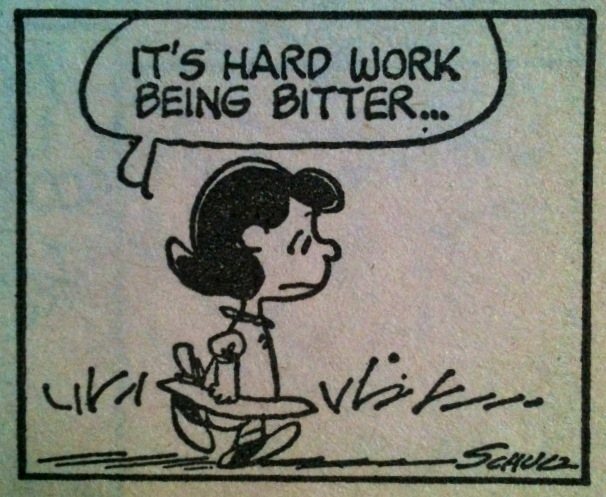
Hard Work (Peanuts)

20130120-101954.jpg

Puddle — MC Escher

https://i0.wp.com/uploads5.wikipaintings.org/images/m-c-escher/puddle.jpg

The Young Cicero Reading — Vincenzo Foppa

FOPPA, Vincenzo_the young cicero reading_ca 1464_wallace collection london

Alain Robbe-Grillet on Tolstoy, Dostoevsky, and Kafka

Alain Robbe-Grillet in his 1985 interview with The Paris Review:

ROBBE-GRILLET

When a novelist has “something to say,” they mean a message. It has political connotations, or a religious message, or a moral prescription. It means “commitment,” as used by Sartre and other fellow-travelers. They are saying that the writer has a world view, a sort of truth that he wishes to communicate, and that his writing has an ulterior significance. I am against this. Flaubert described a whole world, but he had nothing to say, in the sense that he had no message to transmit, no remedy to offer for the human condition.

INTERVIEWER

But did Dostoyevsky have nothing to say? Tolstoy?

ROBBE-GRILLET

Tolstoy yes. That is why on the whole he doesn’t interest me.

INTERVIEWER

Not even Anna Karenina?

ROBBE-GRILLET

Especially not Anna Karenina! Among Tolstoy’s books the one that interests me is The Death of Ivan Ilych. Ivan is someone who hurts himself while unhooking a curtain, and one sees his death in that gesture. As for Dostoyevsky, perhaps there is a message in his work but for me it is a kind of parasite. In Crime And Punishment, I am much more interested in the first part which is the preparation for the murder. You remember the scene where Raskolnikov is getting the axe ready? And he is fascinated by the act he has to accomplish? The last part of the book, about guilt and moral responsibility and so on, bores me profoundly.

INTERVIEWER

Because you, or your characters, never feel moral responsibility or guilt?

ROBBE-GRILLET

Never!

INTERVIEWER

Aren’t you lucky!

ROBBE-GRILLET

Perhaps. The book of Dostoyevsky’s that interests me most is The Possessed. It is an enigmatic novel; the main protagonist is an enigma. I read it over and over again and find it tremendous—it has a concept of reality that escapes “significance.” That may be my reading of it; someone else might apprehend it differently. I am sure Camus would have said something quite different about it.

INTERVIEWER

Another writer who has had a great influence on you is Kafka. He is someone who has been interpreted in more than one way. What is his fascination for you?

ROBBE-GRILLET

He has been read as having a metaphysical and religious message—the relationship between the Jew and his God. This is the influence of Max Brod, his friend and first biographer. It doesn’t interest me in the least. I read Kafka as the revelation of a world, which is much more important than yet another meditation on the Talmud. Brod’s reading of Kafka is reductive and restrictive, as if his work could be reduced to metaphysical relations. What I find extraordinary is the actual presence of this opaque world.


Bookplate, Dr. P.H.M. Travaglino — M.C. Escher

bookplate-dr-p-h-m-travaglino

“…all the waves rolled by like scrolls of silver; and, by their soft, suffusing seethings, made what seemed a silvery silence, not a solitude…” (Moby-Dick)

It was while gliding through these latter waters that one serene and moonlight night, when all the waves rolled by like scrolls of silver; and, by their soft, suffusing seethings, made what seemed a silvery silence, not a solitude; on such a silent night a silvery jet was seen far in advance of the white bubbles at the bow. Lit up by the moon, it looked celestial; seemed some plumed and glittering god uprising from the sea. Fedallah first descried this jet. For of these moonlight nights, it was his wont to mount to the main-mast head, and stand a look-out there, with the same precision as if it had been day. And yet, though herds of whales were seen by night, not one whaleman in a hundred would venture a lowering for them. You may think with what emotions, then, the seamen beheld this old Oriental perched aloft at such unusual hours; his turban and the moon, companions in one sky. But when, after spending his uniform interval there for several successive nights without uttering a single sound; when, after all this silence, his unearthly voice was heard announcing that silvery, moon-lit jet, every reclining mariner started to his feet as if some winged spirit had lighted in the rigging, and hailed the mortal crew. “There she blows!” Had the trump of judgment blown, they could not have quivered more; yet still they felt no terror; rather pleasure. For though it was a most unwonted hour, yet so impressive was the cry, and so deliriously exciting, that almost every soul on board instinctively desired a lowering.

From “The Spirit Spout,” Chapter 51 of Melville’s Moby-Dick