A review of Leonora Carrington’s surreal novel The Hearing Trumpet

Leonora Carrington’s novel The Hearing Trumpet begins with its nonagenarian narrator forced into a retirement home and ends in an ecstatic post-apocalyptic utopia “peopled with cats, werewolves, bees and goats.” In between all sorts of wild stuff happens. There’s a scheming New Age cult, a failed assassination attempt, a hunger strike, bee glade rituals, a witches sabbath, an angelic birth, a quest for the Holy Grail, and more, more, more.

Composed in the 1950s and first published in 1974, The Hearing Trumpet is new in print again for the first time in nearly two decades from NYRB. NYRB also published Carrington’s hallucinatory memoir Down Below a few years back, around the same time as Dorothy issued The Complete Stories of Leonora Carrington. Most people first come to know Carrington through her stunning, surreal paintings, which have been much more accessible (because of the internet) than her literature. However, Dorothy’s Complete Stories brought new attention to Carrington’s writing, a revival continued in this new edition of The Hearing Trumpet.

Readers familiar with Carrington’s surreal short stories might be surprised at the straightforward realism in the opening pages of The Hearing Trumpet. Ninety-two-year-old narrator Marian Leatherby lives a quiet life with her son and daughter-in-law and her tee-vee-loving grandson. They are English expatriates living in an unnamed Spanish-speaking country, and although the weather is pleasant, Marian dreams of the cold, “of going to Lapland to be drawn in a vehicle by dogs, woolly dogs.” She’s quite hard of hearing, but her sight is fine, and she sports “a short grey beard which conventional people would find repulsive.” Conventional people will soon be pushed to the margins in The Hearing Trumpet.

Marian’s life changes when her friend Carmella presents her with a hearing trumpet, a device “encrusted with silver and mother o’pearl motives and grandly curved like a buffalo’s horn.” At Carmella’s prompting, Marian uses the trumpet to spy on her son and daughter-in-law. To her horror, she learns they plan to send her to an old folks home. It’s not so much that she’ll miss her family—she directs the same nonchalance to them that she affords to even the most surreal events of the novel—it’s more the idea that she’ll have to conform to someone else’s rules (and, even worse, she may have to take part in organized sports!).

The old folks home is actually much, much stranger than Marian could have anticipated:

First impressions are never very clear, I can only say there seemed to be several courtyards , cloisters , stagnant fountains, trees, shrubs, lawns. The main building was in fact a castle, surrounded by various pavilions with incongruous shapes. Pixielike dwellings shaped like toadstools, Swiss chalets , railway carriages , one or two ordinary bungalows, something shaped like a boot, another like what I took to be an outsize Egyptian mummy. It was all so very strange that I for once doubted the accuracy of my observation.

The home’s rituals and procedures are even stranger. It is not a home for the aged; rather, it is “The Institute,” a cult-like operation founded on the principles of Dr. and Mrs. Gambit, two ridiculous and cruel villains who would not be out of place in a Roald Dahl novel. Dr. Gambit (possibly a parodic pastiche of George Gurdjieff and John Harvey Kellogg) represents all the avarice and hypocrisy of the twentieth century. His speech is a satire of the self-important and inflated language of commerce posing as philosophy, full of capitalized ideals: “Our Teaching,” “Inner Christianity,” “Self Remembering” and so on. Ultimately, it’s Gambit’s constricting and limited patriarchal view of psyche and spirit that the events in The Hearing Trumpet lambastes.

Marian soon finds herself entangled in the minor politics and scheming of the Institute, even as she remains something of an outsider on account of her deafness. She’s mostly concerned with getting an extra morsel of cauliflower at mealtimes—the Gambits keep the women undernourished. She eats her food quickly during the communal dinner, and obsesses over the portrait of a winking nun opposite her seat at the table:

Really it was strange how often the leering abbess occupied my thoughts. I even gave her a name, keeping it strictly to myself. I called her Doña Rosalinda Alvarez della Cueva, a nice long name, Spanish style. She was abbess, I imagined, of a huge Baroque convent on a lonely and barren mountain in Castile. The convent was called El Convento de Santa Barbara de Tartarus, the bearded patroness of Limbo said to play with unbaptised children in this nether region.

Marian’s creative invention of a “Doña Rosalinda Alvarez della Cueva” soon somehow passes into historical reality. First, she receives a letter from her trickster-aid Carmella, who has dreamed about a nun in a tower. “The winking nun could be no other than Doña Rosalinda Alvarez della Cueva,” remarks Marian. “How very mysterious that Carmella should have seen her telepathically.” Later, Christabel, another member/prisoner of the Institute helps usher Marian’s fantasy into reality. She confirms that Marian’s name for the nun is indeed true (kinda sorta): “‘That was her name during the eighteenth century,’ said Christabel. ‘But she has many many other names. She also enjoys different nationalities.'”

Christabel gives Marian a book entitled A True and Faithful Rendering of the Life of Rosalinda Alvarez and the next thirty-or-so pages gives way to this narrative. This text-within-a-text smuggles in other texts, including a lengthy letter from a bishop, as well as several ancient scrolls. There are conspiracies afoot, schemes to keep the Holy Grail out of the hands of the feminine power the Abbess embodies. There are magic potions and an immortal bard. There is cross-dressing and a strange monstrous pregnancy. There are the Knights Templar.

Carrington’s prose style in these texts-within-texts diverges considerably from the even, wry calm of Marian’s narration. In particular, there’s a sly control to the bishop’s letter, which reveals a bit-too-keen interest in teenage boys. These matryoshka sections showcase Carrington’s rhetorical range while also advancing the confounding plot. They recall The Courier’s Tragedy, the play nested in Thomas Pynchon’s 1965 novel The Crying of Lot 49. Both texts refer back to their metatexts, simultaneously explicating and confusing their audiences while advancing byzantine plot points and arcane themes.

Indeed, the tangled and surreal plot details of The Hearing Trumpet recall Pynchon’s oeuvre in general, but like Pynchon’s work, Carrington’s basic idea can be simplified to something like—Resistance to Them. Who is the Them? The patriarchy, the fascists, the killers. The liars, the cheaters, the ones who make war in the name of order. (One resister, the immortal traveling bard Taliesin, shows up in both the nested texts and later the metatext proper, where he arrives as a postman, recalling the Trystero of The Crying of Lot 49.)

The most overt voice of resistance is Marian’s best friend Carmella. Carmella initiates the novel by giving Marian the titular hearing trumpet, and she acts as a philosophical foil for her friend. Her constant warning that people under seventy and over seven should not be trusted becomes a refrain in the novel. Before Marian is shipped off to the Institution, Carmella already plans her escape, a scheme involving machine guns, rope, and other implements of adventure. Although she loves animals, Carmella is even willing to kill any police dogs that might guard the Institution and hamper their escape:

Police dogs are not properly speaking animals. Police dogs are perverted animals with no animal mentality. Policemen are not human beings so how can police dogs be animals?

Late in the novel, Carmella delivers perhaps the most straightforward thesis of The Hearing Trumpet:

It is impossible to understand how millions and millions of people all obey a sickly collection of gentlemen that call themselves ‘Government!’ The word, I expect, frightens people. It is a form of  planetary hypnosis, and very unhealthy. Men are very difficult to understand… Let’s hope they all freeze to death. I am sure it would be very pleasant and healthy for human beings to have no authority whatever. They would have to think for themselves, instead of always being told what to do and think by advertisements, cinemas, policemen and parliaments.

Carmella’s dream of an anarchic utopia comes to pass.

How?

Well, there’s a lot to it, and I’d hate to spoil the surrealist fun. Let’s just say that Marian’s Grail quest scores a big apocalyptic win for the Goddess, thanks to “an army of bees, wolves, seven old women, a postman, a Chinaman, a poet, an atom-driven Ark, and a werewoman.” No conventional normies who might find Marian’s beard repulsive here.

With its conspiracy theories within conspiracy theories and Templar tales, The Hearing Trumpet will likely remind many readers of Umberto Eco’s 1988 novel Foucault’s Pendulum (or one of its ripoffs). The Healing Trumpet’s surreal energy also recalls Angela Carter’s 1972 novel The Infernal Desire Machines of Doctor Hoffman. And of course, the highly-imagistic, ever-morphing language will recall Carrington’s own paintings, as well as those of her close friend Remedios Varo (who may have been the basis for Carmella), and their surrealist contemporaries (like Max Ernst) and forebears (like Hieronymus Bosch).

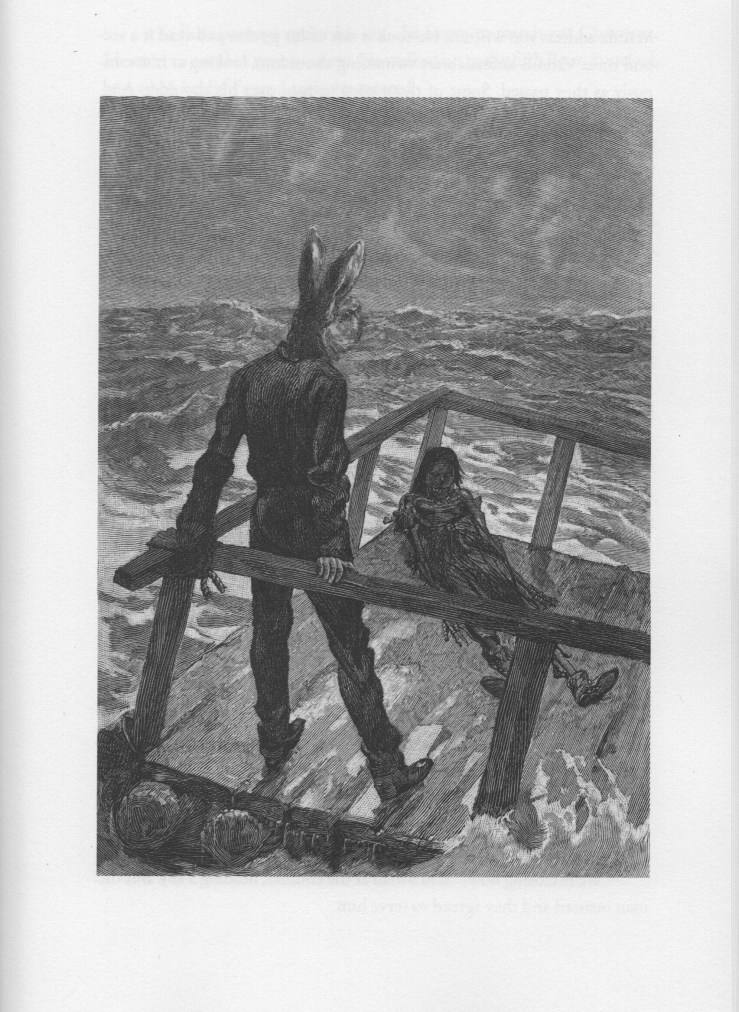
This new edition of The Hearing Trumpet includes an essay by the novelist Olga Tokarczuk (translated by Antonia Lloyd-Jones) which focuses on the novel as a feminist text. (Tokarczuk also mentions that she first read the novel without knowing who Carrington was). The new edition also includes black and white illustrations by Carrington’s son, Pablos Weisz Carrington (I’ve included a few in this review). As far as I can tell, these illustrations seem to be slightly different from the illustrations included in the 2004 edition of The Hearing Trumpet published by Exact Change. That 2004 edition has been out of print for ages and is somewhat hard (or really, expensive) to come by (I found a battered copy few years ago for forty bucks). NYRB’s new edition should reach the wider audience Carrington deserves.

Some readers will find the pacing of The Hearing Trumpet overwhelming, too frenetic. It moves like a snowball, gathering images, symbols, motifs into itself in an ever-growing, ever-speeding mass. Other readers may have difficulty with its ever-shifting plot. Nothing is stable in The Hearing Trumpet; everything is liable to mutate, morph, and transform. Those are my favorite kinds of novels though, and I loved The Hearing Trumpet—in particular, I loved its tone set against its imagery and plot. Marian’s narration is straightforward, occasionally wry, but hardly ever astonished or perplexed by the magical and wondrous events she takes part in. There’s a lot I likely missed in The Hearing Trouble—Carrington lards the novel with arcana, Jungian psychology, magical totems, and more more more—but I’m sure I’ll find more the next time I read it. Very highly recommended.

[Ed. note–Biblioklept first ran this review in December, 2020.]

Ann Quin’s novel Passages collapses hierarchies of center and margin

Ann Quin’s third novel Passages (1969) ostensibly tells the story of an unnamed woman and unnamed man traveling through an unnamed country in search of the woman’s brother, who may or may not be dead.

The adverb ostensibly is necessary in the previous sentence, because Passages does not actually tell that story—or it rather tells that story only glancingly, obliquely, and incompletely. Nevertheless, that is the apparent “plot” of Passages.

Quin is more interested in fractured/fracturing voices here. Passages pushes against the strictures of the traditional novel, eschewing character and plot development in favor of pure (and polluted) perceptions. There’s something schizophrenic about the voices in Passages. Interior monologues turn polyglossic or implode into elliptical fragments.

Quin repeatedly refuses to let her readers know where they stand. Indeed, we’re never quite sure of even the novel’s setting, which seems to be somewhere in the Mediterranean. It’s full of light and sea and sand and poverty, and the “political situation” is grim. (The woman’s brother’s disappearance may or may not have something to do with the region’s political instability.)

Passage’s content might be too slippery to stick to any traditional frame, but Quin employs a rhetorical conceit that teaches her reader how to read her novel. The book breaks into four unnamed chapters, each around twenty-five pages long. The first and third chapters find us loose in the woman’s stream of consciousness. The second and fourth chapters take the form of the man’s personal journal. These sections contain marginal annotations, which might be meant to represent actual physical annotations, or perhaps mental annotations–the man’s stream of consciousness while he rereads his journal.

Quin’s rhetorical strategy pays off, particularly in the book’s Sadean climax. This (literal) climax occurs at a carnivalesque party in a strange mansion on a small island. We see the events first through the woman’s perception, and then through the man’s. But I’ve gone too long without offering any representative language. Here’s a passage from the woman’s section, just a few paragraphs before the climax. To set the stage a bit, simply know that the woman plays voyeur to a bizarre threesome:

Mirrors faced each other. As the two turned, approached. Slower in movement in the centre, either side of him, turning back in the opposite direction to their first movement. Contours of their shadows indistinct. The first mirror reflected in the second. The second in the first. Images within images. Smaller than the last, one inside the other. She lay on the floor, wrists tied together. She bent back over the chair. He raised the whip, flung into space.

Later, the man’s perception of events at the party both clarify and cloud the woman’s account. As you can see in the excerpt above, the woman frequently refuses to qualify her pronouns in a way that might stabilize identities for her reader. Such obfuscation often happens in the course of a sentence or two:

I ran on, knowing I was being followed. She came to the edge, jumped into expanding blueness, ultra violet tilted as she went towards the beach. We walked in silence.

The woman’s becomes a She and then merges into a We. The other half of that We is a He, the follower (“He later threw the bottle against the rocks”), but we soon realize that this He is not the male protagonist, but simply another He that the woman has taken as a one-time lover.

The woman frequently takes off somewhere to have sex with another man. At times the sex seems to be part of her quest to find her brother; other times it’s simply part of the novel’s dark, erotic tone. The man is undisturbed by his lover’s faithlessness. He is passive, depressive, and analytical, while she is manic and exuberant. Late in the novel he analyzes himself:

How many hours I waste lying in bed thinking about getting up. I see myself get up, go out, move, drink, eat, smile, turn, pay attention, talk, go up, go down. I am absent from that part, yet participating at the same time. A voyeur in all senses, in my actions, non-actions. What a delight it might be actually to get up without thinking, and then when dressed look back and still see myself curled up fast asleep under the blankets.

The man longs for a kind of split persona, an active agent to walk the world who can also gaze back at himself dormant, passive.

This motif of perception and observation echoes throughout Passages. Consider one of the man’s journal entries from early in the book:

Above, I used an image instead of text to give a sense of what the journal entries and their annotations look like. Here, the man’s annotation is a form of self-observation, self-analysis.

Other annotations dwell on describing myths or artifacts (often Greek or Talmudic). In a “December” entry, the man’s annotation is far lengthier than the text proper. The main entry reads:

I am on the verge of discovering my own demoniac possibilities and because of this I am conscious I am not alone with myself.

Again, we see the fracturing of identity, consciousness as ceaseless self-perception. The annotation is far more colorful in contrast:

An ancient tribe of the Kouretes were sorcerers and magicians. They invented statuary and discovered metals, and they were amphibious and of strange varieties of shape, some like demons, some like men, some like fishes, some like serpents, and some had no hands, some no feet, some had webs between their fingers like gees. They were blue-eyed and black-tailed. They perished struck down by the thunder of Zeus or by the arrows of Apollo.

Quin’s annotations dare her reader to make meaning—to put the fragments together in a way that might satisfy the traditional expectations we bring to a novel. But the meaning is always deferred, always slips away. Passages collapses notions of center and margin. As its title suggests, this is a novel about liminal people, liminal places.

The results are wonderfully frustrating. Passages is abject, even lurid at times, but also rich and even dazzling in moments, particularly in the woman’s chapters, which read like pure perception, untethered by traditional narrative expectations like causation, sequence, and chronology.

As such, Passages will not be every reader’s cup of tea. It lacks the sharp, grotesque humor of Quin’s first novel, Berg, and seems dead set at every angle to confound and even depress its readers. And yet there’s a wild possibility in Passages. In her introduction to the new edition of Passages recently published by And Other Stories, Claire-Louise Bennett tries to capture the feeling of reading Quin’s novel:

It’s difficult to describe — it’s almost like the omnipotent curiosity one burns with as an adolescent — sexual, solipsistic, melancholic, fierce, hungry, languorous — and without limit.

Bennett, whose anti-novel Pond bears the stamp of Quin’s influence, employs the right adjectives here. We could also add disorienting, challengingabject and even distressing. While clearly influenced by Joyce and Beckett, Quin’s writing in Passages seems closer to William Burroughs’s ventriloquism and the hollowed-out alienation of Anna Kavan’s early work. Passages also points towards the writing of Kathy Acker, Alasdair Gray, and João Gilberto Noll, among others. But it’s ultimately its own weird thing, and half a century after its initial publication it still seems ahead of its time. Passages is clearly Not For Everyone but I loved it. Recommended.


[Ed. note–Biblioklept originally posted this review in May 2021.]

A review of Dinah Brooke’s excellent cult novel Lord Jim at Home

Dinah Brooke’s 1973 novel Lord Jim at Home had been out of print for five decades — and had never gotten a U.S. release — until McNally Editions republished in 2023 with a new foreword by the novelist Ottessa Moshfegh. I always save forewords until after I’ve finished a novel, so I missed Moshfegh’s implicit advice to go into Lord Jim at Home cold. She notes that the recommendation she received to read it “came with no introduction,” and that “I wouldn’t have wanted the effect of the novel to be mitigated in any way, so I’m reluctant to introduce it now.”

I am not reluctant to write about Brooke’s novel because I am so enthusiastic about it and I think those with tastes in literature similar to my own will find something fascinating in its plot and prose. However, l agree with Moshfegh’s advice that Lord Jim at Home is best experienced free from as much mitigating context as possible. I had never heard of the novel before lifting it from a bookseller’s shelf, attracted by the striking cover; I flipped it over to read a blurb parsed from Moshfegh’s foreword attesting that Brooke’s novel “was an instrument of torture. It’s that good.” The inside flap informed me that reviews upon its publication “described it as ‘squalid and startling,’ ‘nastily horrific,’ and a ‘monstrous parody’ of upper-middle class English life.” I was sold.

Lord Jim at Home is squalid and startling and nastily horrific. It is abject, lurid, violent, and dark. It is also sad, absurd, mythic, often very funny, and somehow very, very real for all its strangeness. The novels I would most liken Lord Jim at Home to, at least in terms of the aesthetic and emotional experience of reading it, are Ann Quin’s Berg, Anna Kavan’s Ice, Mervyn Peake’s Gormenghast novels, Virginia Woolf’s Mrs. Dalloway, and James Joyce’s Portrait (as well as bits of Ulysses). (I have not read Conrad’s Lord Jim, which Brooke has taken as something of a precursor text for Lord Jim at Home.)

After finishing Lord Jim at Home, I read it again by accident. At first I intended to take a few notes for a possible review, but after the first few pages I just kept reading. On a second reading, Brooke’s novel was just as strange—maybe even stranger—even if I was able to read it much more quickly, finding myself quicker to tune into the novel’s competing (and complementary) narrative registers. I found it far more precise, too, in the rhetorical development of its themes; Brooke’s styles and tones shift to capture the different ages of its hero. The novel begins in a mythical, archetypal mode and works its way through various registers, exploring the tropes of schoolboy novels, romances, war stories, adventure tales,  modernism, realism, and journalism. But despite its shifting modes, Lord Jim at Home is not a parodic pastiche. Rather, at its core, Lord Jim at Home skewers how aesthetic modes—primarily those derived from notions of class and manners—cover over abject cruelty. As Moshfegh puts it in her forward, Lord Jim at Home is “an accurate portrayal of how fucked-up people behave, artfully conveyed in a way that nice people are too polite to admit they understand.”

I’ve tried to be clear that I think it’s best to come to Lord Jim at Home without too much context—it’s best to just go with the novel’s strangeness. Below, however, I offer a more detailed discussion of the novel, its language, and some elements of the plot for those so inclined.

Answer, 2014 by Henrietta Harris

Continue reading “A review of Dinah Brooke’s excellent cult novel Lord Jim at Home”

“Titian Paints a Sick Man” — Roberto Bolaño

“Titian Paints a Sick Man”

by

Roberto Bolaño

translated by Natasha Wimmer


At the Uffizi, in Florence, is this odd painting by Titian. For a while, no one knew who the artist was. First the work was attributed to Leonardo and then to Sebastiano del Piombo. Though there’s still no absolute proof, today the critics are inclined to credit it to Titian. In the painting we see a man, still young, with long dark curly hair and a beard and mustache perhaps slightly tinged with red, who, as he poses, gazes off toward the right, probably toward a window that we can’t see, but still a window that somehow one imagines is closed, yet with curtains open or parted enough to allow a yellow light to filter into the room, a light that in time will become indistinguishable from the varnish on the painting.

1

The young man’s face is beautiful and deeply thoughtful. He’s looking toward the window, if he’s looking anywhere, though probably all he sees is what’s happening inside his head. But he’s not contemplating escape. Perhaps Titian told him to turn like that, to turn his face into the light, and the young man is simply obeying him. At the same time, one might say that all the time in the world stretches out before him. By this I don’t mean that the young man thinks he’s immortal. On the contrary. The young man knows that life renews itself and that the art of renewal is often death. Intelligence is visible in his face and his eyes, and his lips are turned down in an expression of sadness, or maybe it’s something else, maybe apathy, none of which excludes the possibility that at some point he might feel himself to be master of all the time in the world, because true as it is that man is a creature of time, theoretically (or artistically, if I can put it that way) time is also a creature of man.

2

In fact, in this painting, time — sketched in invisible strokes — is a kitten perched on the young man’s hands, his gloved hands, or rather his gloved right hand which rests on a book: and this right hand is the perfect measure of the sick man, more than his coat with a fur collar, more than his loose shirt, perhaps of silk, more than his pose for the painter and for posterity (or fragile memory), which the book promises or sells. I don’t know where his left hand is.

How would a medieval painter have painted this sick man? How would a non-figurative artist of the twentieth century have painted this sick man? Probably howling or wailing in fear. Judged under the eye of an incomprehensible God or trapped in the labyrinth of an incomprehensible society. But Titian gives him to us, the spectators of the future, clothed in the garb of compassion and understanding. That young man might be God or he might be me. The laughter of a few drunks might be my laughter or my poem. That sweet Virgin is my friend. That sad-faced Virgin is the long march of my people. The boy who runs with his eyes closed through a lonely garden is us.

From Between Parentheses.

Mass-market Monday | Muriel Spark’s Memento Mori

Memento Mori, 1954, Muriel Spark. Avon Bard (1978). No cover artist or designer credited. 191 pages.

From David Lodge’s 2010 reappraisal of the novel in The Guardian:

The fiction of the 50s was dominated by a new wave of social realism, represented by novels such as Lucky JimSaturday Night and Sunday Morning, and Room at the Top, whose originality lay in tone and attitude rather than technique. Typically they were narrated in the first person or in free indirect style, articulating the consciousness of a single character, usually a young man, whose rather ordinary but well observed life revealed new tensions and fault-lines in postwar British society. An unsympathetic character in Memento Mori called Eric has evidently written two dispiriting works of this kind. Memento Mori itself was an utterly different and virtually unprecedented kind of novel. It is a short book, but it has a huge cast of characters, to nearly all of whose minds the reader is given access. The speed and abruptness with which the narrative switches from one point of view to another, managed and commented on by an impersonal but intrusive narrator, is a distinguishing feature of nearly all Spark’s fiction, and it violated the aesthetic rules not only of the neorealist novel, but also of the modernist novel from Henry James to Virginia Woolf. Spark was a postmodernist writer before that term was known to literary criticism. She took the convention of the omniscient author familiar in classic 19th-century novels and applied it in a new, speeded-up, throwaway style to a complex plot of a kind excluded from modern literary fiction – in this case involving blackmail and intrigues over wills, multiple deaths and discoveries of secret scandals, almost a parodic update of a Victorian sensation novel. And she added to the mix an element of the uncanny, through which the existence of a transcendent, eternal and immaterial reality impinges on the lives of her ageing characters, reminding them of their mortality.

And another Moby-Dick

Herman Melville’s 1851 novel Moby-Dick is probably my favorite book.

***

Years ago at an awful dinner party a man I didn’t know asked me What do you do?, by which he meant how I made money to live, or, maybe charitably, if I had a specific profession. When I told him it had something to do with literature and college students he followed up with a question no stranger should aim at another stranger-

-So what’s your favorite book then?

-Moby-Dick is my favorite book, I offered, this being my somewhat standard answer then.

-Oh no, I mean, what’s your real favorite booknot just the one you say to impress people?

Okay Gravity’s Rainbow is my favorite book.

-I haven’t read that one yet but I like Tom Clancy too. 

***

A dear friend at our house this weekend, under truly awful circumstances, circumstances that have no bearing on this riff, claimed to have counted “eighteen copies” of Moby-Dick around the house. As far as I could tell, there are only about thirteen, including a children’s pop up version and three comic book adaptations (I don’t know how he would’ve found the comic adaptations, as they are slim and I think in drawer or box). He asked for one; I offered him the UC Press edition illustrated by Barry Moser, the one I’d used the last time I reread Moby-Dick. He opted instead for the most recent Norton Critical Edition, which a rep sent me a few years ago.

***

The last time I reread Moby-Dick I used the UC Press edition illustrated by Barry Moser. This was in 2021. I ended up writing forty riffs on the novel, likely trying the patience of any regular readers of this blog.

***

If you’re not up for forty riffs, I wrote a very short riff on this very long book back in 2013.

***

The two preceding notes are my way of saying: Moby-Dick is probably my favorite novel; it’s fantastic and I’ve written about it in both short and long form, and I think anyone can read it and should–it’s funny, sad, thrilling, captivating, meditative, beguiling, baffling–a thing larger than its own frame, certainly larger than its author and his era. And so now–

***

I have another Moby-Dick. This one is designed and illustrated by Dmitry Samarov. It’s about 650 pages, and is a pleasing, squarish shape that rests easy in the hands (a contrast to the coffin-shaped Norton Critical Editions). The pages are not too bright (I hate bright white pages) nor too crisp; the spine is not so rigid that one seeks to break it before setting about the business of checking into the Spouter Inn. It is a very readable copy — relaxed, not too heavy and not too cramped, no precious footnotes. And there are Samarov’s sketches.

***

***

Rifling (or is it riffling? I can never remember) through this edition today, reading a few passages aloud even, just to feel myself go a little crazy and then get a small relief from that craze, the dominant sense I got from Samarov’s accompanying sketches is something like this: Someone riffing along to Ishmael’s ghost-voice, not competing with it nor trying to turn the mechanics of its verbs and nouns and adjectives into a mimetic representation of action or thought. I think the drawings, as a body, rather approximate something like an aesthetic ear tuned to Ishmael’s wail: scratchy ink lines tangle into and out of shapes in a discourse with the narrative. Others tuned to the voice might on any given page jot down a note or circle a phrase or even, dare, dream of a crowded footnote; Samarov offers a sketch. His love for the novel comes through.

***

If you haven’t read Moby-Dick, you should. Samarov’s edition is a worthy entry into the fold. Check it out.


“The Meaning of Mourning” – – Sabine Baring-Gould

“The Meaning of Mourning”

by

Sabine Baring-Gould

from Curiousities of Olden Times, 1896 


A strip of black cloth an inch and a half in width stitched round the sleeve—that is the final, or perhaps penultimate expression (for it may dwindle further to a black thread) of the usage of wearing mourning on the decease of a relative.

The usage is one that commends itself to us as an outward and visible sign of the inward sentiment of bereavement, and not one in ten thousand who adopt mourning has any idea that it ever possessed a signification of another sort. And yet the correlations of general custom—of mourning fashions, lead us to the inexorable conclusion that in its inception the practice had quite a different signification from that now attributed to it, nay more, that it is solely because its primitive meaning has been absolutely forgotten, and an entirely novel significance given to it, that mourning is still employed after a death.

Look back through the telescope of anthropology at our primitive ancestors in their naked savagery, and we see them daub themselves with soot mingled with tallow. When the savage assumed clothes and became a civilised man, he replaced the fat and lampblack with black cloth, and this black cloth has descended to us in the nineteenth century as the customary and intelligible trappings of woe.

The Chinaman when in a condition of bereavement assumes white garments, and we may be pretty certain that his barbarous ancestor, like the Andaman Islander of the present day, pipeclayed his naked body after the decease and funeral of a relative. In Egypt yellow was the symbol of sorrow for a death, and that points back to the ancestral nude Egyptian having smeared himself with yellow ochre.

Black was not the universal hue of mourning in Europe. In Castile white obtained on the death of its princes. Herrera states that the last time white was thus employed was in 1498, on the death of Prince John. This use of white in Castile indicates chalk or pipeclay as the daub affected by the ancestors of the house of Castile in primeval time as a badge of bereavement. Continue reading ““The Meaning of Mourning” – – Sabine Baring-Gould”

Mass-Market Monday | Donald Barthelme’s Sadness

Sadness, 1972, Donald Barthelme. Kangaroo Pocket Books (1980). No cover artist or designer credited. 159 pages.

Here is the fifth section of “Departures,” a series of vignettes. It stands alone as its own short story–


My grandfather once fell in love with a dryad—a wood nymph who lives in trees and to whom trees are sacred and who dances around trees clad in fine leaf-green tutu and who carries a great silver-shining axe to whack anybody who does any kind of thing inimical to the well-being and mental health of trees. My grandfather was at that time in the lumber business.

It was during the Great War. He’d got an order for a million board feet of one-by-ten of the very poorest quality, to make barracks out of for the soldiers. The specifications called for the dark red sap to be running off it in buckets and for the warp on it to be like the tops of waves in a distressed sea and for the knotholes in it to be the size of an intelligent man’s head for the cold wind to whistle through and toughen up the (as they were then called) doughboys.

My grandfather headed for East Texas. He had the timber rights to ten thousand acres there, Southern yellow pine of the loblolly family. It was third-growth scrub and slash and shoddy—just the thing for soldiers. Couldn’t be beat. So he and his men set up operations and first crack out of the box they were surrounded by threescore of lovely dryads and hamadryads all clad in fine leaf-green tutus and waving great silver-shining axes.

“Well now,” my grandfather said to the head dryad, “wait a while, wait a while, somebody could get hurt.”

“That is for sure,” says the girl, and she shifts her axe from her left hand to her right hand.

“I thought you dryads were indigenous to oak,” says my grandfather, “this here is pine.”

“Some like the ancient tall-standing many-branched oak,” says the girl, “and some the white-slim birch, and some take what they can get, and you will look mighty funny without any legs on you.”

“Can we negotiate,” says my grandfather, “it’s for the War, and you are the loveliest thing I ever did see, and what is your name?”

“Megwind,” says the girl, “and also Sophie. I am Sophie in the night and Megwind in the day and I make fine whistling axe-music night or day and without legs for walking your life’s journey will be a pitiable one.”

“Well Sophie,” says my grandfather, “let us sit down under this tree here and open a bottle of this fine rotgut here and talk the thing over like reasonable human beings.”

“Do not use my night-name in the light of day,” says the girl, “and I am not a human being and there is nothing to talk over and what type of rotgut is it that you have there?”

“It is Teamster’s Early Grave,” says my grandfather, “and you’ll cover many a mile before you find the beat of it.”

“I will have one cupful,” says the girl, “and my sisters will have each one cupful, and then we will dance around this tree while you still have legs for dancing and then you will go away and your men also.”

“Drink up,” says my grandfather, “and know that of all the women I have interfered with in my time you are the absolute top woman.”

“I am not a woman,” says Megwind, “I am a spirit, although the form of the thing is misleading I will admit.”

“Wait a while,” says my grandfather, “you mean that no type of mutual interference between us of a physical nature is possible?”

“That is a thing I could do,” says the girl, “if I chose.”

“Do you choose?” asks my grandfather, “and have another wallop.”

“That is a thing I will do,” says the girl, and she had another wallop.

“And a kiss,” says my grandfather, “would that be possible do you think?”

“That is a thing I could do,” says the dryad, “you are not the least prepossessing of men and men have been scarce in these parts in these years, the trees being as you see mostly scrub, slash and shoddy.”

“Megwind,” says my grandfather, “you are beautiful.”

“You are taken with my form which I admit is beautiful,” says the girl, “but know that this form you see is not necessary but contingent, sometimes I am a fine brown-speckled egg and sometimes I am an escape of steam from a hole in the ground and sometimes I am an armadillo.”

“That is amazing,” says my grandfather, “a shape-shifter are you.”

“That is a thing I can do,” says Megwind, “if I choose.”

“Tell me,” says my grandfather, “could you change yourself into one million board feet of one-by-ten of the very poorest quality neatly stacked in railroad cars on a siding outside of Fort Riley, Kansas?”

“That is a thing I could do,” says the girl, “but I do not see the beauty of it.”

“The beauty of it,” says my grandfather, “is two cents a board foot.”

“What is the quid pro quo?” asks the girl.

“You mean spirits engage in haggle?” asks my grandfather.

“Nothing from nothing, nothing for nothing, that is a law of life,” says the girl.

“The quid pro quo,” says my grandfather, “is that me and my men will leave this here scrub, slash and shoddy standing. All you have to do is to be made into barracks for the soldiers and after the War you will be torn down and can fly away home.”

“Agreed,” says the dryad, “but what about this interference of a physical nature you mentioned earlier? for the sun is falling down and soon I will be Sophie and human men have been scarce in these parts for ever so damn long.”

“Sophie,” says my grandfather, “you are as lovely as light and let me just fetch another bottle from the truck and I will be at your service.”

This is not really how it went. I am fantasizing. Actually, he just plain cut down the trees.

Riff on some Friends of the Library Sale acquisitions

My move over the last few years when I go to a Friends of the Library Sale is to fill the ten dollar paper bag with a handful of pristine trade paperbacks I think will recoup the ten bucks in trade at my local used bookstore. I then pick through for titles to bolster my children’s growing personal libraries and for books that I might want to give away to friends, family, and students. And maybe I might get lucky with some overlooked gem — a first edition, a rarity, an oddity.

Most of what I picked up today was for my son to pick through. He took the Camus, Vonnegut, O’Connor, Palahniuk, and McCarthy. My daughter had zero interest in any of the haul.

I wound up with several of the exact same editions of titles I already own (Camus’ Exile and Kingdom; Faulkner’s A Light in August; William Burroughs’ Naked Lunch) and lots of books we already have in other editions, most of which I’ll give away or trade. But I’ll be happy to trade out the cheap mass markets of Mrs. Dalloway and To the Lighthouse I’ve had forever in favor of these HBJ Woolfs (Wolves?):

My two favorite finds today were cummings’ six nonlectures (the midcentury cover is lovely) and a Gwendolyn Brooks chapbook, The Near-Johannesburg Boy:

It wasn’t until I got home that I realized the Brooks’ chapbook was signed:

I had actually found two signed Brooks’ books at my favorite local used shop, also both inscribed to “Marilyn” (one was Blacks; I can’t remember the other one; they were both priced a bit beyond my casual range).

But maybe my favorite find was this Kmart bookmark:

The Kmart bookmark was tucked into a trade paperback University of Illinois Press copy of Randolph’s Pissing in the Snow. I doubt the collection of Ozark folktales was originally purchased at Kmart. But who knows.

Pissing in the Snow was one of the first books I wrote about on this blog, nearly twenty years ago. I look forward to passing it on to a student sooner or later.


873 words from Stephen Dixon’s 1991 novel Frog, followed by 469 words on Stephen Dixon’s 1991 novel Frog

Here are 873 words from Stephen Dixon’s long looping loopy lucid antilaconic 1991 novel Frog; the words are a segment of the ninth chapter, “Frog’s Brother”:

Alex was the only passenger on the freighter. His father’s patient called his son in England and asked as a favor to the man who’s treated his family’s teeth for forty years if he could take Alex aboard free. Alex was in London then, wanted to get back home, had little money, could have borrowed plane or ocean liner fare from his parents or Jerry, wanted the experience of being on a freighter during a long crossing. Though he got free passage, he asked to work without pay at any job the captain wanted him to. He’ll clean latrines, even, he said in his last letter to Howard. Anything the lowest-grade seaman does, just to get the full feel of it and perhaps seaman’s papers for a paid trip later. He was a newsman turned fiction writer. Two months after the ship disappeared a parcel of manuscripts arrived at their parents’ apartment from England by surface mail. Maybe the manuscripts he didn’t much care about. Maybe the ones he cared most about he took with him on the ship. Howard read the stories and vignettes soon after and then some of them every three or four years till about ten years ago. He never found them very good, but Alex was just starting. Two diaries and some oriental figurines in the parcel also, and lots of letters from his parents, brothers, friends. He’d traveled around the world. Saved up for three years to do it. Did it for a year. A prostitute in a dilapidated hut in a small village outside Bangkok. Why’s that experience come to mind first? It was in a letter to Howard, not the diaries. He searched the diaries for it, thinking an elaboration of it might be interesting, revealing, sexually exciting. She was fourteen years old. That made Alex sad. She asked him to marry her. She said she’d be devoted, would learn to cook and make love American, bear him many children if he wanted, all boys if he wanted (she knew how), would return to grade school. He gave her his silver ID bracelet, pleaded with her to give up prostitution. Then he did it a third time with her the same day and came back the next. Talk about hypocrisy! he said. What’s the trick of turning a customer into a suitor? he asked. But one who’ll be good to her and an adequate provider. If he knew, he’d give it to her. Sent her a pearl necklace from Manila. If he got a venereal disease from her he’d worry more about her than himself. He might go back for her before he leaves for India, or send for her once he gets back to America, and maybe even marry her when she comes of age. Keep this between them just in case it does happen. Taught English to Malaysian businessmen for a month. Met two old men in New Guinea—Canadians—who were living the primitive jungle life. They were good friends of his till they tried to drug and rape him. He’s afraid he had to kick them both in the balls to get out of there and then steal their canoe to get back to town. Fell in love with a witch. Read Proust’s Remembrances in five nearly sleepless days, an experience that’s left him dreaming of the books every night for the last six weeks. A Goan fortuneteller told him his trip would end badly. He said to go home by plane, don’t sail. Remind him when the time comes, for the man wouldn’t take any money. Had a fifteen-year-old girl in Nairobi. What can he tell Howard?—he likes young girls. It’s more than just the way their hair blows and breasts point and bellybuttons dimple and thighs are so even. Maybe it’s because of all the girls who barely let him pet them when he was a teenager. Rode a camel through part of the Sahara. Ate lizard, locusts, grasshoppers, grubs. Never felt very Jewish before till he started hitting all the old synagogues and Jewish cemeteries he could find in the Orient and Middle East. Wait’ll he gets to Poland and Prague and also tries to look the old families up. He’s afraid it’s converted him, but not to the point of wearing a skullcap. Hitchhiked with a sixteen-year-old sabra through Turkey and Yugoslavia, though she might have been younger. When she had to go back she said she thinks he got her pregnant—her device wasn’t put in right a few times, she was so new at it. He told her he’s heard that one before, but if she has the baby and the calendrical configurations fix it as his, or just if she still says it is, he’ll love and provide for it, adopt it if she wishes and take it to America with or without her or emigrate to Israel if she prefers, marry her if that’s what she wants—she’s quite striking and clever and potentially very artistic and smart. He’s written what he thinks is fairly decent work recently, he said in his last letter. He’s glad he’s found something he wants to do for the next twenty to thirty years, has Howard?

The titular “Frog’s Brother” is Alex. (“Frog,” by the way, is “Howard,” the protagonist of Frog.) Alex’s freighter goes missing in the North Atlantic; the ship is never recovered nor are lifeboats. No bodies. The only evidence of the disaster is absence.

In this absence, Frog imagines and reimagines Alex’s death at sea in different looping cycles; these reimaginings are also framed within Frog’s attempt to accurately recall his receiving the news that his brother Alex is lost at sea–was it by phone, that he received this awful news? in his other brother’s apartment? what were the specific conditions of this heartbreak?

Imagining and then reimagining the specific details of a horrifying, horrible, horrendous event is the rhetorical gist of Dixon’s 1995 follow-up to Frog, Interstate, a fucked-up eight-way riff on the narrator’s daughter’s murder by way of random highway violence.

I have read around 120 of Fog’s near 800 pages, and many of those pages feature the same rhetorical and narratological techniques or repetitions with differences that were so off-centered in Interstate: fraying phrases, looping tics, paranoid passages. In the absence of the one thing, Dixon’s narrators pony up iteration after iteration, something after something. But the narrators know that there’s not enough somethings to ever even come close to approximating everything. The iterations sharpen and highlight the beauty of the absence’s abyss.

That abyss was real, or true, or True, for Stephen Dixon, whose brother “Jimmy, a magazine writer, died in 1960 when the freighter he was on in the North Atlantic disappeared,” as the New York Times reported in Dixon’s 2019 obituary. The Times obituary continued: “Mr. Dixon felt that he was continuing his brother’s work. Jimmy Dixon had a short story published after his death.” If Jimmy Dixon was prototype to Alex Frogbrother, what are we to make of the fantastic paraphrase of his letters, above? The passage reads like a bizarre failed adventure tale, something we might expect from William T. Vollmann, who, with his heart of gold, tried to “free” sex workers. It’s also quite queasy when it comes to sex (a constant I’ve noticed in Dixon): “What can he tell Howard?—he likes young girls,” our narrator flatly, grossly reports.

The saddest and realest bit might be this though, the admission that “Howard read the stories and vignettes soon after and then some of them every three or four years till about ten years ago. He never found them very good, but Alex was just starting.” But Alex was just starting. The last bit of the section, “He’s glad he’s found something he wants to do for the next twenty to thirty years, has Howard?” seems both boon and curse, a door that opens and shuts simultaneously, cursing our Stephen Dixon, our Frog, to write write write write write write write write write…


Mass-market Monday | Philip K. Dick’s Radio Free Albemuth

Radio Free Albemuth, 1985, Philip K. Dick. Avon Bard (1987). Cover art by Ron Walotsky. 212 pages.

From Philip K. Dick’s posthumous (and likely never-fully revised) novel Radio Free Albemuth:

The human being has an unfortunate tendency to wish to please.

I was in effect exactly like those captured Americans: a prisoner of war. I had become that in November 1968 when F.F.F. got elected. So had we all; we now dwelt in a very large prison, without walls, bounded by Canada, Mexico, and two oceans. There were the jailers, the turnkeys, the informers, and somewhere in the Midwest the solitary confinement of the special internment camps. Most people did not appear to notice. Since there were no literal bars or barbed wire, since they had committed no crimes, had not been arrested or taken to court, they did not grasp the change, the dread transformation, of their situation. It was the classic case of a man kidnapped while standing still. Since they had been taken nowhere, and since they themselves had voted the new tyranny into power, they could see nothing wrong. Anyhow, a good third of them, had they known, would have thought it w
as a good idea. As F.F.F. told them, now the war in Vietnam could be brought to an honorable conclusion, and, at home, the mysterious organization Aramchek could be annihilated. The Loyal Americans could breathe freely again. Their freedom to do as they were told had been preserved.

I returned to the typewriter and drafted another statement. It was important to do a good job.

Mass-market Monday | Ivan Ângelo’s The Celebration

The Celebration, 1975, Ivan Ângelo. Translation by Thomas Colchie. Avon Bard (1982). No cover designer or artist credited. 223 pages.

From Theodore McDermott’s review of The Celebration in Context:

You can see something of Borges in The Celebration: in the way that the central event of the book—the event that gives it its title—is absent from its pages. You can see something of Cortázar in the way the chronology coils around and crosses over itself. You can see something of Nabokov in the fictional annotations that retell the story from an entirely new vantage, implying an endless number of other versions as yet untold. You can see something of Barth in the stylistic variations. You can see something of Machado de Assis, Osman Lins, and Ignacio Loyola Brandao in the peculiarly Brazilian integration of remarkable formal innovation and social and political engagement.
You can see all of this, but what’s most apparent, and most important, is that Ângelo has written a book unlike any other.

In which Robert Coover admits to shoplifting William Gaddis’s The Recognitions

It was the grad-school summer of ’60, I was lingering in Chicago past quarter’s end to edit the university calendar, earn some pennies to help pay the obstetrician who would deliver our firstborn in August, subletting a friend’s basement flat, and using the down time to do a lot of reading, which that summer of occasional light fingered forays into bookstores (I have done penance through the years since, buying more than I can possibly read) included, simultaneously, two big fat novels: Saul Bellow’s Adventures of Augie March (Bellow was already a Chicago legend and I was a fan of Dangling Man and Victim) and William Gaddis’s The Recognitions (he was unknown to me, recommended by some forgotten person), with the immediate consequence that I found Bellow’s Chicago saga of Augie humping the old fellow to the local whorehouses a boisterous treat, a tale I felt as if my own (just look out the window, there they go), whereas the Gaddis book was difficult to get into (all that talk, I kept losing my place); but as the month wore on, Augie’s tale paled even as it moved south into the sun and soon the book got tossed in disappointment across the room, while in Gaddis’s great universal satire the characters behind the voices (all that talk!) had come vividly alive, and the likes of Basil Valentine and Esther and Wyatt, Stanley, Esme and Otto, and Recktall Brown (Recktall Brown!) and Agnes Deigh and the Town Carpenter had moved into the basement flat with me, companions for life, far from noble though they mostly were and failing even to last the book out, their lives eclipsed by chatter’s echoey art.

From “William Gaddis: A Portfolio,” published in Conjunctions no. 41 (2003).

Lucky day | Stray thoughts on the announcement of Thomas Pynchon’s novel Shadow Ticket

Panel from Nancy, Ernie Bushmiller, 23 Oct.1954

For about a decade, a common social media joke (common enough among a certain stripe of nerd) has run something like, Thomas Pynchon seems to be writing the U.S.A. reality right now; another common (enough) social media rejoinder amounts to something like, No way Pynchon would write this reality—too sloppy, too lazy, too obvious. Too stupid. 

I just deleted an entire paragraph on Too stupid. I think we’re all attuned to the unfunny absurdity of the zeitgeist, and I think that as zany and goofy as Pynchon is in his byzantine plots, he wouldn’t muck with, say, RFK’s kid’s brain worm telling him to remove fluoride and bring back the plague. Just too stupid! And the stupidity is all bound up in evil, cruelty, pain. I hate it! Maybe you hate it too. The news, whatever “the news” means, seems to be uniformly bad. One might apply this statement throughout history, I suppose, so maybe I just mean: It (all of it) just gets worse.

So I take any good news as a gift.

And on Wednesday morning there was some, at least in my book, very good news: Penguin Random House announced a new novel from Thomas Pynchon. I had not expected another novel from Pynchon, who will turn 88 next month. If I’m really honest, I might have expected, like, a different headline about Pynchon.

The new novel, to be published this fall, is titled Shadow Ticket. Shadow Ticket is a rad title for a novel! I’ve had it rattling around my head. Pynchon has a history of using phrases from his novels for titles of future books, but as far as I can tell by searching ebooks, the phrase shadow ticket doesn’t appear in his published oeuvre. Simple internet searches for the phrase return publisher Penguin Random House’s announcement of the novel Shadow Ticket by Thomas Pynchon; the OED database has nothing. Unlike inherent vice or leading edgeshadow ticket seems to have no clear corollary to the uh, real world.

Perhaps the title might be a reference to the shadowy voyage of the novel’s purported protagonist, Hicks McTaggart, whom the blurb (presumably penned by TP) declares finds himself “shanghaied onto a transoceanic liner, ending up eventually in Hungary where there’s no shoreline.” I suppose that’s one kind of shadow ticket.

There’s a lot of predictably Pynchonesque picaresquery in the blurb: an “heiress of a Wisconsin cheese fortune,” “swing musicians, practitioners of the paranormal, outlaw motorcyclists,” and pastries. The novel is set in 1932 and the blurb notes that Hicks will find himself “entangled with Nazis, Soviet agents, British counterspies.” The blurb also tells us that Hicks is “a one-time strikebreaker turned private eye” — one of Them, or at least, a one-time agent of Them. Perhaps Shadow Ticket might read as a bridge between Pynchon’s grand opuses on the emerging 20th-century—the critique of labor and capital in Against the Day segueing into the explosion of Gravity’s Rainbow. 

But we’ll just have to wait. The announcement for Shadow Ticket came on a week of lucky days for me, or lucky-feeling days, I suppose I mean. I watched my alma mater’s basketball team win the national championship for the third time on Monday night — I’d watched almost all of their games since November — and woke up on Tuesday feeling elated (I also won my work’s March Madness pool). News of forthcoming albums by bands I’d loved in my youth like Pulp, Stereolab, and Tortoise also gave me that odd feeling of something to look forward to, something on the horizon that wasn’t just more horrible shit.

And I can wait in hope, I suppose, or at least in absurd appreciation like Sluggo in Ernie Bushmiller’s Nancy strip of 23 Oct. 1954, who finds surreal intercession in the form of a potted plant descending from the heavens to land upon his bald crown. I too wish I could crack this walnut.

Thomas Pynchon’s new novel Shadow Ticket to publish in October, 2025

Reading is a means of listening | Ursula K. Le Guin

Reading is a means of listening.

Reading is not as passive as hearing or viewing. It’s an act: you do it. You read at your pace, your own speed, not the ceaseless, incoherent, gabbling, shouting rush of the media. You take in what you can and want to take in, not what they shove at you fast and hard and loud in order to overwhelm and control you. Reading a story, you may be told something, but you’re not being sold anything. And though you’re usually alone when you read, you are in communion with another mind. You aren’t being brainwashed or co-opted or used; you’ve joined in an act of the imagination.

I know no reason why our media could not create a similar community of the imagination, as theater has often done in societies of the past, but they’re mostly not doing it. They are so controlled by advertising and profiteering that the best people who work in them, the real artists, if they resist the pressure to sell out, get drowned out by the endless rush for novelty, by the greed of the entrepreneurs.

Much of literature remains free of such co-optation, in part because a lot of books were written by dead people, who by definition are not greedy. And many living poets and novelists, though their publishers may be crawling abjectly after bestsellers, continue to be motivated less by the desire for gain than by the wish to do what they’d probably do for nothing if they could afford it, that is, practice their art—make something well, get something right. Literature remains comparatively, and amazingly, honest and reliable.

Books may not be “books,” of course, they may not be ink on wood pulp but a flicker of electronics in the palm of a hand. Incoherent and commercialised and worm-eaten with porn and hype and blather as it is, electronic publication offers those who read a strong new means of active community. The technology is not what matters. Words are what matter. The sharing of words. The activation of imagination through the reading of words.

The reason literacy is important is that literature is the operating instructions. The best manual we have. The most useful guide to the country we’re visiting, life.

From “The Operating Instructions,” a talk given by Ursula K. Le Guin at a meeting of Oregon Literary Arts in 2002, as reproduced in Words Are My Matter.

Mass-market Monday | Thomas M. Disch’s 334

334, 1972, Thomas M. Disch. Avon Bard (1974). No cover designer or artist credited. 269 pages.

Disch’s dystopian novel 334 is comprised of five separate but related novellas. The stories are set in and around the year 2025. Here’s “The Teevee,” the first vignette of the last novella in the collection, 334:

“The Teevee (2021)”

Mrs. Hanson liked to watch television best when there was someone else in the room to watch with her, though Shrimp, if the program was something she was serious about—and you never knew from one day to the next what that might be—, would get so annoyed with her mother’s comments that Mrs. Hanson usually went off into the kitchen and let Shrimp have the teevee to herself, or else to her own bedroom if Boz hadn’t taken it over for his erotic activities. For Boz was engaged to the girl at the other end of the corridor and since the poor boy had nowhere in the apartment that was privately his own except one drawer of the dresser they’d found in Miss Shore’s room it seemed the least she could do to let him have the bedroom when she or Shrimp weren’t using it.

With Boz when he wasn’t taken up with l‘amour, and with Lottie when she wasn’t flying too high for the dots to make a picture, she liked to watch the soaps. As the World Turns. Terminal Clinic. The Experience of Life. She knew all the ins and outs of the various tragedies, but life in her own experience was much simpler: life was a pastime. Not a game, for that would have implied that some won and others lost, and she was seldom conscious of any sensations so vivid or threatening. It was like the afternoons of Monopoly with her brothers when she was a girl: long after her hotels, her houses, her deeds, and her cash were gone, they would let her keep moving her little lead battleship around the board collecting her $200, falling on Chance and Community Chest, going to Jail and shaking her way out. She never won but she couldn’t lose. She just went round and round. Life.

But better than watching with her own children she liked to watch along with Amparo and Mickey. With Mickey most of all, since Amparo was already beginning to feel superior to the programs Mrs. Hanson liked best—the early cartoons and the puppets at five-fifteen. She couldn’t have said why. It wasn’t just that she took a superior sort of pleasure in Mickey’s reactions, since Mickey’s reactions were seldom very visible. Already at age five he could be as interior as his mother. Hiding inside the bathtub for hours at a time, then doing a complete U-turn and pissing his pants with excitement. No, she honestly enjoyed the shows for what they were—the hungry predators and their lucky prey, the good-natured dynamite, the bouncing rocks, the falling trees, the shrieks and pratfalls, the lovely obviousness of everything. She wasn’t stupid but she did love to see someone tiptoeing along and then out of nowhere: Slam! Bank! something immense would come crashing down on the Monopoly board scattering the pieces beyond recovery. “Pow!” Mrs. Hanson would say and Mickey would shoot back, “Ding-Dong!” and collapse into giggles. For some reason “Ding-Dong!” was the funniest notion in the world.

“Pow!”

“Ding-Dong!” And they’d break up.