NPR’s Fresh Air will rebroadcast a 1988 interview with Harry Crews and a 2003 interview with Earl Scruggs today. If you can’t listen live, check out the podcasts (Crews podcast; Scruggs podcast), or download the NPR smartphone app.
From the Crews interview:
I wrote four novels and short stories before I even published anything, and the reason I didn’t publish any of those things was because it wasn’t any good, and the reason it wasn’t any good was because I was trying to write about a world I did not know . . . One night it occurred to me that whatever strength I had was all back in there in Bacon County, Ga., with all that sickness and hookworm and rickets and ignorance and beauty and loveliness. But that’s where it was. It wasn’t somewhere else.
(Thanks to the readers who wrote in about these shows).
A passage from Harry Crews’s novel A Feast of Snakes:
When they got to his purple double-wide, Joe Lon skinned snakes in a frenzy. He picked up the snakes by the tails as he dipped them out of the metal drums and swung them around and around his head and then popped them like a cowwhip, which caused their heads to explode. Then he nailed them up on a board in the pen and skinned them out with a pair of wire pliers. Elfie was standing in the door of the trailer behind them with a baby on her hip. Full of beer and fascinated with what Joe Lon could feel—or thought he could—the weight of her gaze on his back while he popped and skinned the snakes. He finally turned and looked at her, pulling his lips back from his teeth in a smile that only shamed him.
He called across the yard to her. “Thought we’d cook up some snake and stuff, darlin, have ourselves a feast.”
Her face brightened in the door and she said: “Course we can, Joe Lon, honey.”
Elfie brought him a pan and Joe Lon cut the snakes into half-inch steaks. Duffy turned to Elfie and said: “My name is Duffy Deeter and this is something fine. Want to tell me how you cook up snakes?”
Elfie smiled, trying not to show her teeth. “It’s lots of ways. Way I do mostly is I soak’m in vinegar about ten minutes, drain’m off good, and sprinkle me a little Looseanner redhot on’m, roll’m in flour, and fry’m is the way I mostly do.”
Harry Crews died today at 76 in Gainesville, FL, where he lived and worked for years.
This isn’t an obituary—I’m sure you can find them elsewhere (I haven’t looked yet, but they’ll be out there)—it’s more a riff about me than Crews. Solipsistic, narcissistic, sure. Let’s say I feel a sense of unearned pride for the man, a geographical kinship, as if some of his bloody bravura might splatter on me, anoint me, confer on me a glimpse of his strange powers. (And although I would feel this way in any case, I’ll point out that Crews and I shared the same birthday). Maybe I should wait to write, put together a detailed overview of his work, delineate a chronological progression of his life and work . . . But it’s a warm spring day in Florida, I’m three beers down, a small buzz behind my eyes, the whir of the cheap electric fans on my backporch goading me into dim golden memory . . .
I graduated high school in 1997 and went to the University of Florida in Gainesville that fall—just in time to learn that Crews had retired his position in the Creative Writing department (he was also a graduate of the university) that spring. It was disappointing for me.
I’d read a few of Crews’s blistering, blustering novels, dark comic rants about the dirty malfeasance backwood Cracker folk get into after dark, and he’d come to occupy a fabled place in my impressionable mind—a Southern answer to the Bukowski and Henry Miller books I devoured in kind.
I was 18 and dramatically naïve. I honestly thought that I was going to write a Really Great Novel, and I honestly thought that Crews was going to teach me how. In that first semester of college, the poor underpaid graduate student who led the Creative Writing class I took—a class that all but killed a desire to write creatively for years (I write “all but” because I took a second fiction writing class that was the metaphorical nail in the coffin) informed me that Crews was no longer writer-in-residence (!), that some guy named Padgett Powell had taken up that mantle. This news dispirited me, took some of the wind out of my romantic illusions (without, y’know, properly killing them off). Maybe I’d have stuck it through the program if I thought it might end in a seminar with Crews, it’s hard to say. (I’ll also point out that it took me years to give Padgett Powell a fair read).
I won’t pretend to be sad at the death of Harry Crews: 76 is pretty old if you drank and fought and lived like that man did, and he’s already given more literature to the world than most of us could ever hope to. I was more sad at 18 to learn that I wouldn’t learn from him (not realizing at that age that reading is a way of learning). These statements seem in bad taste as I write them, but I assure you they’re not. You’re being too sensitive. But I do want to connote some reverence for the man, for his work at least, for his tales of rage and poverty, for the truth he sussed out of the swampy south.
Here’s a shift: Barry Hannah, another Southern boy whose work I’ve come to love, was not on my radar until his death in 2010. This isn’t to say I wouldn’t have found his stuff if he hadn’t died then, but I think that we all know what I’m pointing to here, the grand appraisals and reappraisals that we focus on our late writers, whose deaths might entail a second life, a life again in new readers. And Crews deserves readers: His writing is raw and jagged and ugly. It’s hard to imagine someone producing something like A Feast of Snakesor The Gypsy’s Curse today—I mean it would just be too politically incorrect I suppose. Crews is the kind of cult writer whose cult will likely grow a little now, after his death.
Starting places: The anthology Classic Crews collects Crews’s memoir Childhood, the novels Car and The Gypsy’s Curse, as well as some essays. There’s also Florida Frenzy, an essay collection larded with sex and violence and animals. You can’t go wrong with his novel A Feast of Snakes. Well, maybe you can. It’s actually entirely possible that Crews isn’t for your faint heart or delicate sensibilities—and that’s fine. But for those intrigued, come and get the grit.
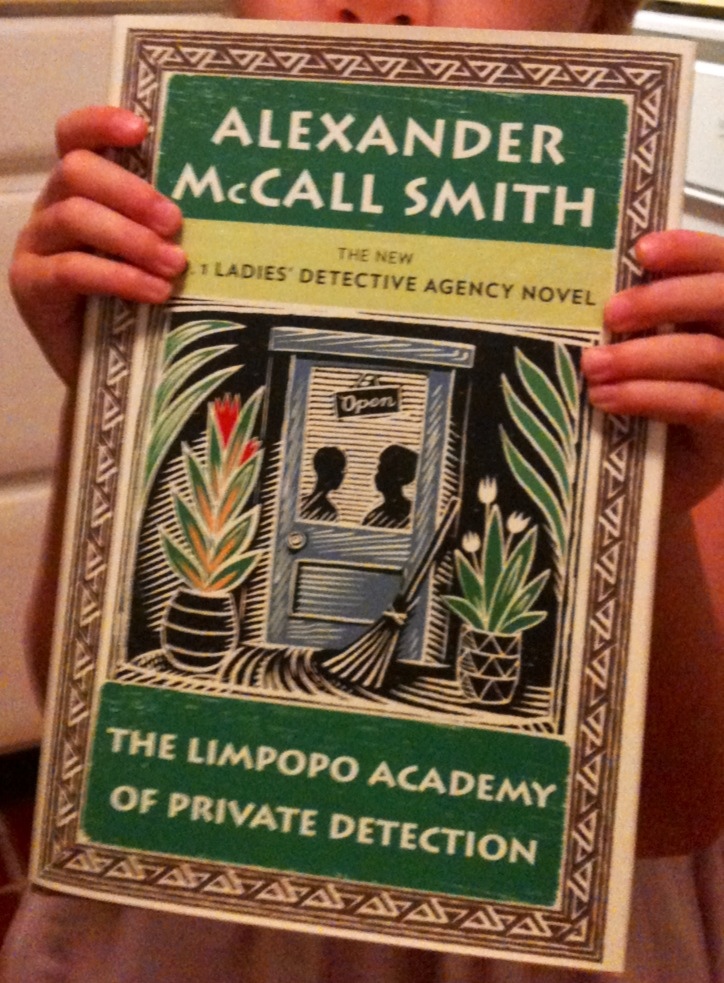
I’ve never read any of Alexander McCall Smith’s No.1 Ladies’ Detective Agency books, or any of his books, but I like the cover of this new one, which is called The Limpopo Academy of Private Detection. I was photographing it clumsily with my old iPhone when my daughter decided to get in the pics and help me out. So, thanks honey.
Jacket copy frompublisher Random House:
Precious Ramotswe is haunted by a repeated dream: a vision of a tall, strange man who waits for her beneath an acacia tree. Odd as this is, she’s far too busy to worry about it. The best apprentice at Tlokweng Road Speedy Motors is in trouble with the law and stuck with the worst lawyer in Gaborone. Grace Makutsi and Phuti Radiphuti are building the house of their dreams, but their builder is not completely on the up and up. And, most shockingly, Mma Potokwane, defender of Botswana’s weak and downtrodden, has been dismissed from her post as matron at the orphan farm. Can the No. 1 Ladies’ Detective Agency help restore the beloved matron to her rightful position?
As wealthy and powerful influences at the orphan farm become allied against their friend, help arrives from an unexpected visitor: the tall stranger from Mma Ramotswe’s dreams, who turns out to be none other than the estimable Clovis Andersen, author of the No. 1 Ladies’ prized manual, The Principles of Private Detection.Together, Mma Ramotswe, Mma Makutsi, and their teacher-turned-colleague help right this injustice and in the process discover something new about being a good detective.
127. Against the Disparagers of Brevity. —A brief dictum may be the fruit and harvest of long reflection. The reader, however, who is a novice in this field and has never considered the case in point, sees something embryonic in all brief dicta, not without a reproachful hint to the author, requesting him not to serve up such raw and ill-prepared food.
—Friedrich Nietzsche, Human, All Too Human, Part II.
The twenty-five short (and short-short and micro) stories that comprise Matt Mullins’s Three Ways of the Saw bristle with gritty, buzzing energy—these are crack-shot tales, simultaneously precise and off-center. Mullins offers a world of stumbling rock bands and day-drinkers, sorry sons and ugly lovers, all fumbling for meaning against the world’s sharp edges. Organized into three novellas-(of sorts)-in-stories, Saw is spiky, stinging, but also deeply moving, probing some of the darker places we’ve all been (or might be headed to).
Matt was kind enough to talk to me about his work over a series of emails, even though I’m sure he was busy—he had just gotten back from this year’s Association of Writers & Writing Programs (AWP) conference in Chicago where he helped promote Saw, which is fresh from Atticus Books. Matt teaches creative writing at Ball State University. In addition to his writing, he’s also a musician and filmmaker. Check out his blog.
Biblioklept: How was AWP?
Matt Mullins: I had an excellent time at AWP. Things had come full circle. Three years ago at AWP Chicago, I’d interviewed for the tenure-track job I now have teaching creative writing at Ball State University. Two years ago in Denver, I was part of the hiring committee that brought us our most recent fiction hire, Cathy Day. Last year in DC I found out Three Ways of the Saw had been accepted by Atticus Books. This year I was back in Chicago signing the book for people at the Atticus booth in the book fair, and hustling boxes of wooden matches with a picture of book cover on them. I believe AWP is in Boston next year If I go, I’m planning on buying a lotto ticket and a twelve pack at the first party store I see inside the city limits.
Biblioklept: The twelve pack will come in use if your luck is bold or ill (but I hope your luck remains good).
MM: Truly, the beer shares its love with us whether we’re drowning sorrows or celebrating.
The writer, in repose, enjoys a libation and book
Bibliokept: Could you describe the vibe at AWP for those of us who’ve never been? How important is it for authors?
MM: The vibe at AWP, the book fair specifically, always reminds me that there is a hell of a lot of love for books out there, regardless of what the cyber-world might cause us to think with the rise of e-readers and online literary magazines. Hundreds of tables filled with beautifully crafted books, some of them hand typeset, hand-stitched, custom illustrated, others slicker and more traditional, but all of them filled with an astonishing breadth of literature. More great books than anyone could read in a lifetime. There’s definitely that going on, a serious love for the book as an object.
Then there’s the conference. 8,000 writers descending upon a swanky hotel in City X (Austin, Chicago, New York, Vancouver, D.C., etc. It changes each year.) to attend panels on a wide variety of subjects of concern to writers who teach in university/college creative writing programs. Readings by notable authors in both the literary and indie publishing worlds. Fancy receptions with open bars put on by various sponsors. Serious networking.
Then there’s all the crazy “off site” events. Parties put on by lit magazines and publishers. Readings in bars and clubs. All the things you can imagine happening when you let thousands of writers and artistically inclined people loose on a city en masse for a long weekend. One of the interesting things I’ve noticed with AWP over the last few years is that there are now two strains that intermingle at will. There is what I would call the “indie-lit” community, the more recent community of people running small non-university affiliated presses and online literary magazines, and there is the longer standing community of university affiliated presses and creative writing programs. It’s been great to see how the coming together of these two communities (which have communities within and across their own larger communities) has energized the whole situation. It’s brought more people who love good writing together. This year the conference sold out for the first time in its forty-some year history.
In terms of its importance for authors: Many writers can take it or leave it. It’s a great place to meet editors of literary magazines and otherwise make connections with people who are potentially interested in reading your work. And personally, I’ve always enjoyed wandering through the book fair with a back pack and picking up submission guidelines at each journal’s table that I’ll sort through later as I get ready to send out a round of stories or poems. But it’s not a make or break situation for a writer by any means. I’m sure there are many writers out there to whom this conference would not appeal one bit. More power to them.
Biblioklept: Well, it sounds like you’ve had a lot of success at AWP. I hope that Three Ways of the Saw picked up some traction there. It’s a cool book, somehow simultaneously raw and refined. There’s a gritty energy to your prose, but it’s also precise and even elegant in its economy. Some of my favorite pieces in the book, like “Steam” and “Accepting Inner Change at the Grocery Store,” are these succinct moments that somehow encode epiphanies that aren’t forced, that are, for lack of a better word, naturalistic (this is a long-winded way of me saying: I completely identify with the truth of these moments as a reader, as a human). I’m curious about how you draft and execute them.
MM: For me there’s a certain grace inhabiting those things living at the very edge of our understanding. When, for various reasons, they spill over into some kind of sense we can apprehend we get a feeling of momentary clarity that can resonate forward into a longer lasting epiphany that changes the way we see ourselves and the world. There are those things born of a raw truth that come to us like a slap in the face. And there are those things that slide over us with a gentle sadness or joy. Whatever their type, they’re always there. They surround us. What brings them into focus is life context bumping up against individual consciousness.
When I’m trying to work that mechanism in a story, I don’t really know what that moment might be when I start out. Or if I do think I know what it is when I start out, it usually ends up being something else. What tends to happen, though, is that I end up writing my character into outer circumstances that allow a kind of collision, subtle or raw, with the character’s inner circumstances that result in this third element, this realization (or failed realization) of that new collided inner/outer state.
The language is the delivery mechanism for this idea, so it must be precise if the meaning is to come across. But language is sound and rhythm and even shape as well as meaning so all of those elements need to come together if this “third thing” as I’m calling it is to emerge fully. I think maybe it’s the attention to the language and the fact that these true moments don’t need to be conjured so much as revealed and caused to shine anew through the method of their delivery that makes their arrival feel natural rather than forced. Saying something the reader already intuits to be true in an unexpected way makes the gut say yes even as it makes the head tease out the complexities of the idea.
Biblioklept: There’s a moment in the title story, “Three Ways of the Saw,” when the narrator connects the scientific fact that matter can never be created nor destroyed, only changed, to the philosophical implication that, “if this is true it means the whole universe already contains everything that ever was or will be” — and hence all people are intrinsically connected (the narrator goes on to link himself to Nixon and Hitler and Gandhi and Jesus and rubber bands). Your collection contains a strong, unifying tone, but you also get inside the heads of lots of different kinds of people. Where do your characters come from?
MM: My characters come from within and from without. By within I mean two things. First, every character, no matter where it comes from, has a little part of me in its chemistry, if only by virtue of the fact that it’s being filtered through my consciousness. Secondly, some characters are wholly products of my imagination. That is, they are born in my head and I evolve them from there.
By without, I mean some of my characters are based partly on my experience with others. Some are inspired by people I know well. Others come from people I’ve seen or encountered indirectly. But even these characters that come from without have to be filtered through me to end being in the story, so they invariably take on facets of my perception, intentional or not, which makes them that first type of character I mentioned that comes from within. So, to untangle that, I guess the answer is that all my characters come from within–eventually–regardless of if they were born in my head or were filtered through it.
But more than where they come from is what I want from them. I want them to be compelling, flawed, multi-faceted and someone a reader can attach themselves to, whether it’s by way of sympathy or interest in “what’s going to happen to this person next.”
You make a good point about the collection’s unifying tone across its variety of characters. I believe in the idea of universality through specifics. That is, the more specific you get with a character’s mind, world and situation, the more universal your story becomes. It appears antithetical at first glance and I’ve had many a student tell me they wrote something purposefully vague because they wanted everyone to “Get it.” But what happens with vagueness is detachment and disinterest. So I always tell them to get that vaseline off the camera lens and start showing me the facets of the diamond. Because this much I’ve learned: When things vividly emerge for the reader, they descend into the story and the resulting empathy/interest allows them to attach themselves to the character and their experience. That’s why we could all relate to a well written story about astronauts that might say something universal about loss or isolation or perspective, or whatever, even though 99.99999% will never be in outer space.
Biblioklept: I teach basic college composition, not fiction writing, but I have a similar mantra: get to the abstract through what’s concrete. I’m curious about your teaching: Has it influenced how you write?
MM: Teaching influences my writing in that it keeps the creative process, revision and the idea of reading good examples by writers I admire in the forefront of my mind. Those are the general practices I try to pass along to my students. I’ve been teaching a lot of screenwriting over the last few years, and this has given me certain ideas about plot and character arc and scene and dialogue that have influenced the shape of some things I write as well, the more narrative stories particularly. I also have a clearer understanding of how to book end scenes I want to purposefully withhold so they emerge in the reader’s mind without literally appearing in the story. But screenwriting also pushes me toward more non-narrative forms of storytelling, because sometimes I want to get away from that more traditionally narrative mode. So this makes me more experimental in my approaches at times. But In general, teaching influences my writing by keeping me engaged in the idea of craft, how to talk about it, what I understand it to be. It keeps my mind focused on the practical application of techniques, which is where the true guts of writing are, at least for me, whether it’s in a traditional narrative or experimental mode.
Biblioklept: One of the techniques you use in a few of the stories is second-person perspective. What are the risks and payoffs in writing in this POV?
MM: Second person is much maligned, I think sometimes rightly so, for being presumptuous. Forcing the reader into a story as the protagonist–it’s a leap some readers aren’t willing to make, especially if they can’t connect themselves to the characterization or the outer realities of the character. 2nd person requires that leap of faith on the reader’s part. Especially when the reader gets drug through some shit and those “you’s” aren’t dwelling in very happy places. So there’s a risk in alienating the reader due to the nature of the leap you’re asking of them. Also, it’s a self-conscious device to create “intimacy” between the reader and the story, something that brings attention to what is usually a more subconscious relationship between reader/character that’s different from the objective subjectivity of the first person and the more distant narrative omniscience of 3rd; and that self-consciousness can put people off. This is why I only use 2nd person sparingly, and when I do it’s for very specific reasons. For me, unless 3rd person is essential to some aesthetic element of the story, I won’t use it.
For example, in “Getting Beaten” I’m using it to get the reader in close on a rather lost, though I hope sympathetic, character who undergoes a violent experience. I wanted to put the reader as close to that experience and subsequent catharsis as possible. 2nd person seemed the best way to bring across that character’s inner turmoil while attaching the reader to the outer situation. But that in itself wouldn’t justify its use for me. That story can be told just as well in 1st or 3rd person. 2nd person became integral to that story when I realized its true ending, which involves the projection of a second “you” into the story that pulls up next to the “you” the reader has been associating with the entire time–this effect of one you watching the other you in the context of how the story makes the idea of those two presences interact with each other would be impossible to write in the 1st or 3rd person.
“Accepting Inner Change in the Grocery Story” is a kind of companion piece in that it’s assumed the “you” is the same character if you were to view him objectively. With that story there’s also this idea of the doppelgänger, you confronting you, and this idea of a kind of psychic time travel. Using 2nd person here allowed me to get a character to confront himself literally while also throwing the idea of the reader inside that same mirror while pulling them back and forth in time.
In “The Bachelor’s Last Will and Testament” I shift between the 2nd person and that 1st person legalese of the will. So using 1st person for the beginning of the piece wasn’t working and 3rd felt too distant.
In “How to Time an Engine” I’m using it more in the poetic tradition of direct address, though I’ve angled the address to the character on the receiving end of my marveling over luck and timing versus karma, divine providence and fate and how maybe they’re all just different versions of the same thing. Using second person in that piece allows me to turn the reader into the example itself (the you) as we (reader and narrator) consider the idea together.
So, for me, when I’m trying to bend the whole idea of what “person” means in fiction, I might employ 2nd person. But, knowing its risks, I don’t make that choice too often. I think if a writer takes that kind of considered approach to 2nd person they’ll probably reap the rewards rather than suffer the risks.
Biblioklept: I’m curious what you’re working on now—more short stories? Music? Film? Do you have plans for a novel? Another Mortal Kombat film? (Oh, wait, I think that’s a different Matt Mullins . . .)
MM: Yeah, that other Matt Mullins. He’s something else. You’ve got to check him out on YouTube. He does all that acrobatic flying through the air ass-kicking type stuff. He also looks a little bit like I did when I was younger. When I first stumbled upon him it was almost like seeing an alternate reality version of myself, as if after the last time I had my nose busted in a fist fight I said, “Forget this reading and writing bullshit,” and started studying the martial arts instead. It makes me wonder how many Matt Mullins are out there and what they’re into. Maybe one likes to write. Maybe we can trade books one day or have a beer.
As for what I’m working on now: My interactive literary project in progress currently lives at lit-digital.com. I’ve been working on some videopoems and short, experimental films when I have the time. I have a manuscript of prose-poem type things called The Roaring Engine of Here that I want to finish up and start shopping around. I have a couple feature-length screenplays roughed out that I need to finish, and I have an idea for a novel that blows up my time spent as copywriter in corporate America. Basically, I just need to nail down what I want to focus on and get to it.
Biblioklept: Have you ever stolen a book?
MM: I went to an all-boys Catholic boarding school. We actually had to wear suit jackets with a crest on the breast pocket. But it was not some quasi Ivy League prep school. It was like the knock off version of that–an ignorant, ugly, cruel, violent place, but it taught me something of life’s truths early. You were required to bring your Bible to theology class under threat of “detention” and/or “demerits.” One day, I found I’d lost my Bible . . .
From Friedrich Nietzsche, Human, All Too Human, Part II:
58. Dangerous Books. —A man says: “Judging from my own case, I find that this book is harmful.” Let him but wait, and perhaps one day he will confess that the book did him a great service by thrusting forward and bringing to light the hidden disease of his soul.—Altered opinions alter not at all (or very little) the character of a man: but they illuminate individual facets of his personality, which hitherto, in another constellation of opinions, had remained dark and unrecognisable.
41. Enjoyment and Non-enjoyment of Poisons. —The only decisive argument that has always deterred men from drinking a poison is not that it is deadly, but that it has an unpleasant taste
–Friedrich Nietzsche, Human, All Too Human, Part II.
I finished reading William Gaddis’s enormous opus The Recognitions a few days ago. I made a decent first attempt at the book in the summer of 2009, but wound up distracted not quite half way through, and eventually abandoned the book. I did, however, write about its first third. I will plunder occasionally from that write-up in this riff. Like here:
In William Gaddis‘s massive first novel, The Recognitions, Wyatt Gwyon forges paintings by master artists like Hieronymous Bosch, Hugo van der Goes, and Hans Memling. To be more accurate, Wyatt creates new paintings that perfectly replicate not just the style of the old masters, but also the spirit. After aging the pictures, he forges the artist’s signature, and at that point, the painting is no longer an original by Wyatt, but a “new” old original by a long-dead genius. The paintings of the particular artists that Wyatt counterfeits are instructive in understanding, or at least in hoping to understand how The Recognitions works. The paintings of Bosch, Memling, or Dierick Bouts function as highly-allusive tableaux, semiotic constructions that wed religion and mythology to art, genius, and a certain spectacular horror, and, as such, resist any hope of a complete and thorough analysis. Can you imagine, for example, trying to catalog and explain all of the discrete images in Bosch’s triptych, The Garden of Earthly Delights? And then, after creating such a catalog, explaining the intricate relationships between the different parts? You couldn’t, and Gaddis’s novel is the same way.
I still feel the anxiety dripping from that lede, the sense that The Recognitions might be a dare beyond my ken. Mellower now, I’m content to riff.
I read this citation in Friedrich Nietzsche’s Human, All Too Human, Part II the other night, mentally noting, “cf. Gaddis”:
188. The Muses as Liars. —“We know how to tell many lies,” so sang the Muses once, when they revealed themselves to Hesiod.—The conception of the artist as deceiver, once grasped, leads to important discoveries.
The Recognitions: crammed with poseurs and fakers, forgers and con-men, artists and would-be artists.
To recognize: To see and know again. Recognition entails time, experience, certitude, authenticity.
Who would not dogear or underline or highlight this passage?:
That romantic disease, originality, all around we see originality of incompetent idiots, they could draw nothing, paint nothing, just so the mess they make is original . . .
In many ways The Recognitions, or rather the characters in The Recognitions whom we might identify with genuine talent, genius, or spirit (to be clear, I’m thinking of Wyatt/Stephan, Basil Valentine, Stanley, Anselm, maybe, and Frank Sinisterra) are conservative, reactionary even; this is somewhat ironic considering Gaddis’s estimable literary innovations.
Esme: A focus for the novel’s masculine gaze, or a critique of such gazes?
The central problem of The Recognitions (perhaps): What confers meaning in a desacralized world?
Late in the novel, in one of its many party scenes, Stanley underlines the problem, working in part from Voltaire’s (in)famous quote that, “If there were no God, it would be necessary to invent him”:
. . . even Voltaire could see that some transcendent judgments is necessary, because nothing is self-sufficient, even art, and when art isn’t an expression of something higher, when it isn’t invested you might even say, it breaks up into fragments that don’t have any meaning . . .
Here we think of Wyatt: Wyatt who rejects the ministry, contemporary art, contemporary society, sanity . . .
Wyatt’s quest: To find truth, meaning, authenticity in a modern world where the sacred does not, cannot exist, is smothered by commerce, noise, fakery . . .
The Recognitions conveys a range of tones, but I like it best when it focuses its energies on comic irony and dark absurdity to detail the juxtapositions and ironies between meaning and noise, authenticity and forgery.
(I like The Recognitions least when its bile flares up too much in its throat, when its black humor tips over into a screed of despair. A more mature Gaddis handles bitterness far better in JR, I think—but I parenthesize this note, as it seems minor even in a list of minor digressions).
Probably my favorite chapter of the book — after the very first chapter, which I believe can stand on its own — is Chapter V of Part II. This is the chapter where Frank Sinisterra reemerges, setting into motion a failed plan to disseminate his counterfeit money (“the queer,” as his accomplice calls it). We also meet Otto’s father, Mr. Pivner, a truly pathetic figure (in all senses of the word). This chapter probably contains more immediate or apparent action than any other in The Recognitions, which largely relies on implication (or suspended reference).
More on Part II, Chapter V: Here we find a savagely satirical and very funny discussion of Dale Carnegie’s How to Win Friends and Influence People, a book that seems to stand as an emblem (one of many in The Recognitions) of the degraded commercial world that Gaddis repeatedly attacks. The entire discussion of Carnegie’s book is priceless — it begins on page 497 of my Penguin edition and unfurls over roughly 10 pages—and the book is alluded to enough in The Recognitions to become a motif.
I’ll quote from page 499 a passage that seems to ironically situate How to Win Friends and Influence People against The Recognitions itself (this is one of the many postmodern moves of the novel):
It was written with reassuring felicity. There were no abstrusely long sentences, no confounding long words, no bewildering metaphors in an obfuscated system such as he feared finding in simply bound books of thoughts and ideas. No dictionary was necessary to understand its message; no reason to know what Kapila saw when he looked heavenward, and of what the Athenians accused Anaxagoras, or to know the secret name Jahveh, or who cleft the Gordian knot, the meaning of 666. There was, finally, very little need to know anything at all, except how to “deal with people.” College, the author implied, meant simply years wasted on Latin verbs and calculus. Vergil, and Harvard, were cited regularly with an uncomfortable, if off-hand, reverence for their unnecessary existences . . . In these pages, he was assured that whatever his work, knowledge of it was infinitely less important that knowing how to “deal with people.” This was what brought a price in the market place; and what else could anyone possibly want?
I’m not sure if Gaddis is ahead of his time or of his time in the above citation.
The Recognitions though, on the whole, feels more reactionary than does his later novel JR, which is so predictive of our contemporary society as to produce a maddening sense of the uncanny in its reader.
Even more on Part II, Chapter V (which I seem to be using to alleviate the anxiety of having to account for so many of the book’s threads): Here we find a delineation of (then complication of, then shuffling of) the various father-son pairings and substitutions that will play out in the text. (Namely, the series of displacements between Pivner, Otto, and Sinisterra, with the subtle foreshadowing of Wyatt’s later (failed) father-son/mentor-pupil relationship with Sinisterra).
Is it worth pointing out that the father-son displacements throughout the text are reminiscent of Joyce’s Ulysses, a book that Gaddis pointedly denied as an influence?
Ignorant of Gaddis’s deflections, I wrote the following in my review almost three years ago:
Gaddis shows a heavy debt to James Joyce‘s innovations in Ulysses here (and throughout the book, of course), although it would be a mistake to reduce the novel to a mere aping of that great work. Rather, The Recognitions seems to continue that High Modernist project, and, arguably, connect it to the (post)modern work of Pynchon, DeLillo, and David Foster Wallace. (In it’s heavy erudition, numerous allusions, and complex voices, the novel readily recalls both W.G. Sebald and Roberto Bolaño as far as I’m concerned).
When ”The Recognitions” arrived on the scene, it was already too late for those large acts of literary power ambition used to be good for. Joyce had come and gone. Imperially equipped for masterliness in range, language and ironic penetration, born to wrest out a modernist masterpiece but born untimely, Mr. Gaddis nonetheless took a long draught of Joyce’s advice and responded with surge after surge of virtuoso cunning.
We are not obligated to listen to Gaddis’s denials of a Joyce influence, of course. When asked in his Paris Review interview if he’d like to clarify anything about his personality and work, he paraphrases his novel:
I’d go back to The Recognitions where Wyatt asks what people want from the man they didn’t get from his work, because presumably that’s where he’s tried to distill this “life and personality and views” you speak of. What’s any artist but the dregs of his work: I gave that line to Wyatt thirty-odd years ago and as far as I’m concerned it’s still valid.
And so Nietzsche again, again from Human, All Too Human, Part II:
140. Shutting One’s Mouth. —When his book opens its mouth, the author must shut his.
And if I’m going to quote German aphorists, here’s a Goethe citation (from Maxims and Reflections) that illustrates something of the spirit of The Recognitions:
There is nothing worth thinking but it has been thought before; we must only try to think it again.
And if I’m going to quote Goethe, I’ll also point out then that Gaddis began The Recognitions as a parody of Goethe’s Faust. Peter William Koenig writes in his excellent and definitive essay “Recognizing Gaddis’ Recognitions” (published in the Winter Volume Contemporary Literature, 1975):
To understand Gaddis’ relationship to his characters, and thus his philosophical motive in writing the novel, we are helped by knowing how Gaddis conceived of it originally. The Recognitions began as a much smaller and less complicated work, passing through a major evolutionary stage during the seven years Gaddis spent writing it. Gaddis says in his notes: “When I started this thing . . . it was to be a good deal shorter, and quite explicitly a parody on the FAUST story, except the artist taking the place of the learned doctor.” Gaddis later explained that Wyatt was to have all talent as Faust had all knowledge, yet not be able to find what was worth doing. This plight-of limitless talent, limited by the age in which it lives-was experienced by an actual painter of the late 1940s, Hans Van Meegeren, on whom Gaddis may have modeled Wyatt. The authorities threw Van Meegeren into jail for forging Dutch Renaissance masterpieces, but like Wyatt, his forgeries seemed so inspired and “authentic” that when he confessed, he was not believed, and had to prove that he had painted them. Like Faust and Wyatt, Van Meegeren seemed to be a man of immense talent, but no genius for finding his own salvation.
The Faust parody remained uppermost in Gaddis’ mind as he traveled from New York to Mexico, Panama and through Central America in 1947, until roughly the time he reached Spain in 1948. Here Gaddis read James Frazer’s The Golden Bough, and the novel entered its second major stage. Frazer’s pioneering anthropological work demonstrates how religions spring from earlier myths, fitting perfectly with Gaddis’ idea of the modern world as a counterfeit-or possibly inspiring it. In any case, Frazer led Gaddis to discover that Goethe’s Faust originally derived from the Clementine Recognitions, a rambling third-century theological tract of unknown authorship, dealing with Clement’s life and search for salvation. Gaddis adapted the title, broadening the conception of his novel to the story of a wandering, at times misguided hero, whose search for salvation would record the multifarious borrowings and counterfeits of modern culture.
Is Wyatt the hero of The Recognitions? Here’s Basil Valentine (page 247 of my ed.):
. . . that is why people read novels, to identify projections of their own unconscious. The hero has to be fearfully real, to convince them of their own reality, which they rather doubt. A novel without a hero would be distracting in the extreme. They have to know what you think, or good heavens, how can they know that you’re going through some wild conflict, which is after all the duty of a hero.
If Wyatt is the hero, then what is Otto? Clearly Otto is a comedic double of some kind for Wyatt, a would-be Wyatt, a different kind of failure . . . but is he a hero?
When I first tried The Recognitions I held Otto in special contempt (from that earlier review of mine):
Otto follows Wyatt around like a puppy, writing down whatever he says, absorbing whatever he can from him, and eventually sleeping with his wife. Otto is the worst kind of poseur; he travels to Central America to finish his play only to lend the mediocre (at best) work some authenticity, or at least buzz. He fakes an injury and cultivates a wild appearance he hopes will give him artistic mystique among the Bohemian Greenwich Villagers he hopes to impress. In the fifth chapter, at an art-party, Otto, and the reader, learn quickly that no one cares about his play . . .
But a full reading of The Recognitions shows more to Otto besides the initial anxious shallowness; Gaddis allows him authentic suffering and loss. (Alternately, my late sympathies for Otto may derive from the recognition that I am more of an Otto than a Wyatt . . .).
The Recognitions is the work of a young man (“I think first it was that towering kind of confidence of being quite young, that one can do anything,” Gaddis says in his Paris Review interview), and often the novel reveals a cockiness, a self-assurance that tips over into didactic essaying or a sharpness toward its subjects that neglects to account for any kind of humanity behind what Gaddis attacks. The Recognitions likes to remind you that its erudition is likely beyond yours, that it’s smarter than you, even as it scathingly satirizes this position.
I think that JR, a more mature work, does a finer job in its critique of contemporary America, or at least in its characterization of contemporary Americans (I find more spirit or authentic humanity in Bast and Gibbs and JR than in Otto or Wyatt or Stanley). This is not meant to be a knock on The Recognitions; I just found JR more balanced and less showy; it seems to me to be the work of an author at the height of his powers, if you’ll forgive the cliché.
I’ll finish this riff-point by quoting Gaddis from The Paris Review again:
Well, I almost think that if I’d gotten the Nobel Prize when The Recognitions was published I wouldn’t have been terribly surprised. I mean that’s the grand intoxication of youth, or what’s a heaven for.
(By the way, Icelandic writer Halldór Kiljan Laxness won the Nobel in lit in 1955 when The Recognitions was published).
Looking over this riff, I see it’s lengthy, long on outside citations and short on plot summary or recommendations. Because I don’t think I’ve made a direct appeal to readers who may be daunted by the size or reputation or scope of The Recognitions, let me be clear: While this isn’t a book for everyone, anyone who wants to read it can and should. As a kind of shorthand, it fits (“fit” is not the right verb) in that messy space between modernism and postmodernism, post-Joyce and pre-Pynchon, and Gaddis has a style and approach that anticipates David Foster Wallace. (It’s likely that if you made it this far into the riff that you already know this or, even more likely, that you realize that these literary-historical situations mean little or nothing).
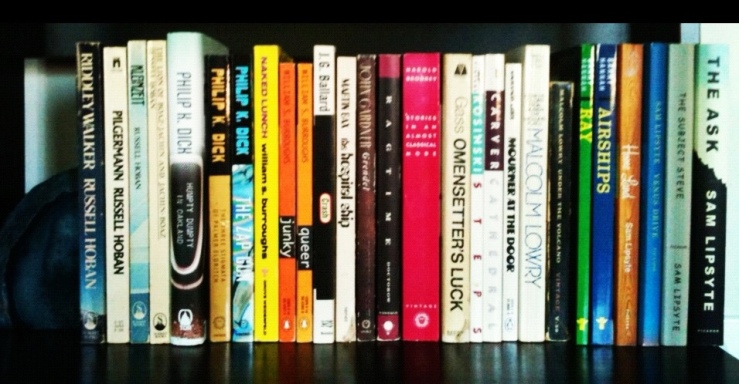
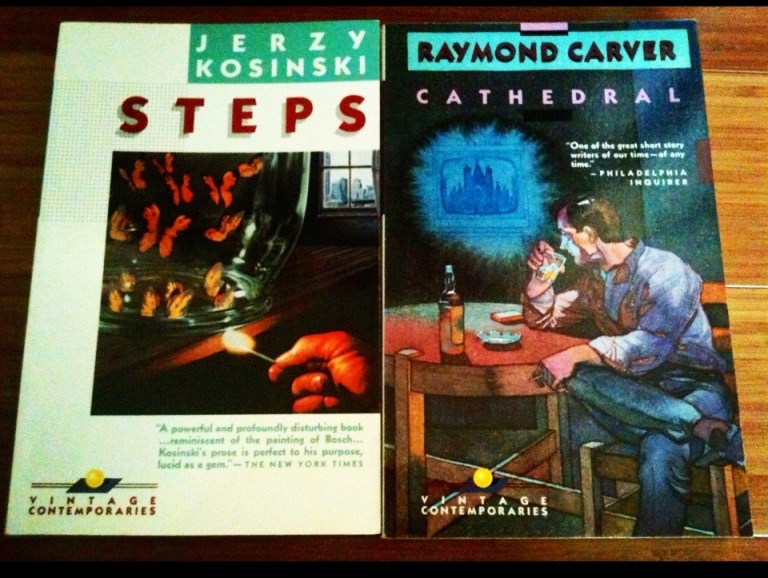
Book shelves series #13, thirteenth Sunday of 2012: Four by the late great Russell Hoban. A few Philip K. Dick volumes, although it’s worth pointing out that most of the good stuff I’ve owned by him has been loaned out and never returned and/or exists in ratty coverless mass market editions. PK Dick transitions to William Burroughs to JG Ballard (another writer who I used to own other books by before they were dispersed . . .). Martin Bax’s The Hospital Ship is a thoroughly obscure volume in a Ballardian/Burroughsian vein; it deserves a reprint. Gardner, Brodkey, Gass, Kosinski. I’ve owned Raymond Carver’s Cathedral since high school, or maybe freshman year of college. It’s all the Carver that any library needs. Lish comma Gordon. Two by Malcolm Lowry. Two by Barry Hannah. Four from Sam Lipsyte.
The Carver and Kosinski volumes are part of the 1980s Vintage Contemporaries line that all feature awful, hyper-literal covers. I have about a dozen such volumes and I’m planning a piece on them in the future. Observe:
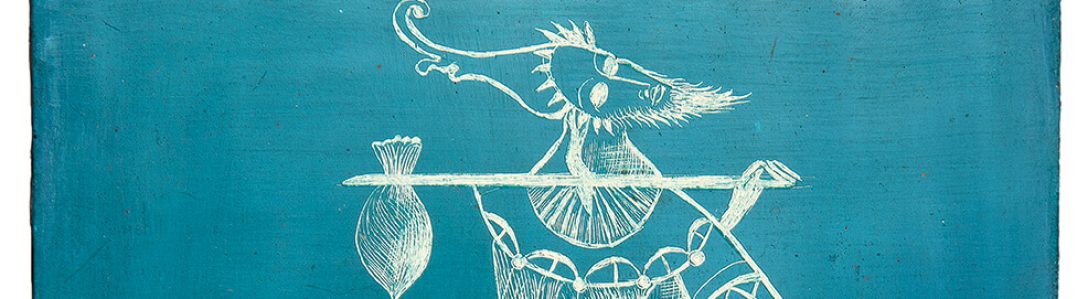
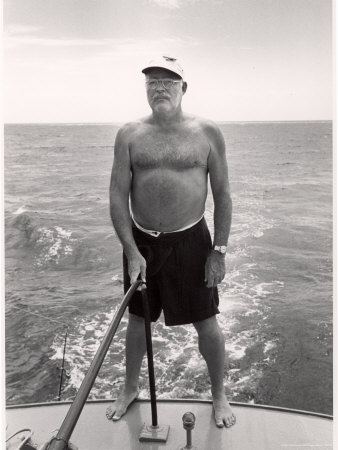


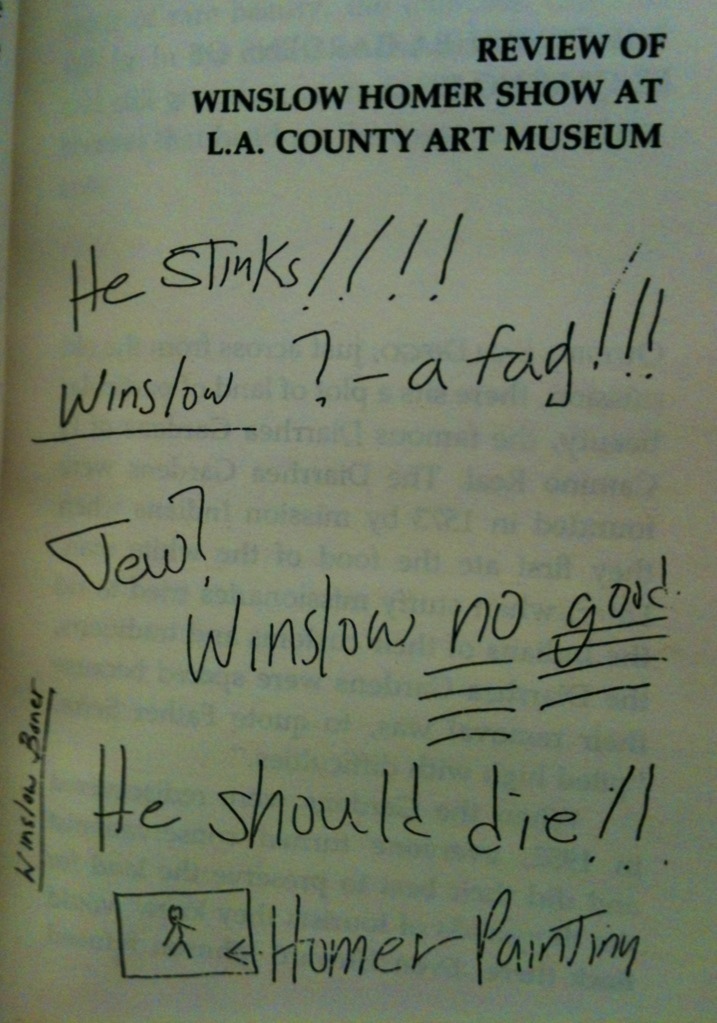 (I read my parents’ copy of Cruel Shoes at least a dozen times. At least. Let’s say it was formative stuff).


 Biblioklept