It was Bo Shmo and the neo-social realist gang. They rode to this spot from their hideout in the hills. Bo Shmo leaned in his saddle and scowled at Loop, whom he considered a deliberate attempt to be obscure. A buffoon an outsider and frequenter of sideshows.
Bo Shmo was dynamic and charismatic as they say. He made a big reputation in the thirties, not having much originality, by learning to play Hoagland Howard Carmichael’s “Buttermilk Sky” backwards. He banged the piano and even introduced some novel variations such as sliding his rump across the black and whites for that certain effect.
People went for it. It was an all the newspapers. He traveled from coast to coast exhibiting his ass and everything was fine until the real Hoagland Howard Carmichael (the real one) showed up and went for Bo Shmo’s goat. He called him a lowdown patent thief and railed him out of town. You would think that finding themselves duped, the impostor’s fans would demand his hide. Not so, Americans love being conned if you can do it in a style that is both grand and entertaining. Consider P.T. Barnum’s success, Semple McPherson and other notables. A guy who rigs aluminum prices can get himself introduced by Georgie Jessel at 100 dollars a plate but stealing a can of beer can get you iced.
So sympathetic Americans sent funds to Bo Shmo which he used to build one huge neo-social realist Institution in the Mountains. Wagon trains of neo-social realist composers writers and painters could be seen winding up its path.
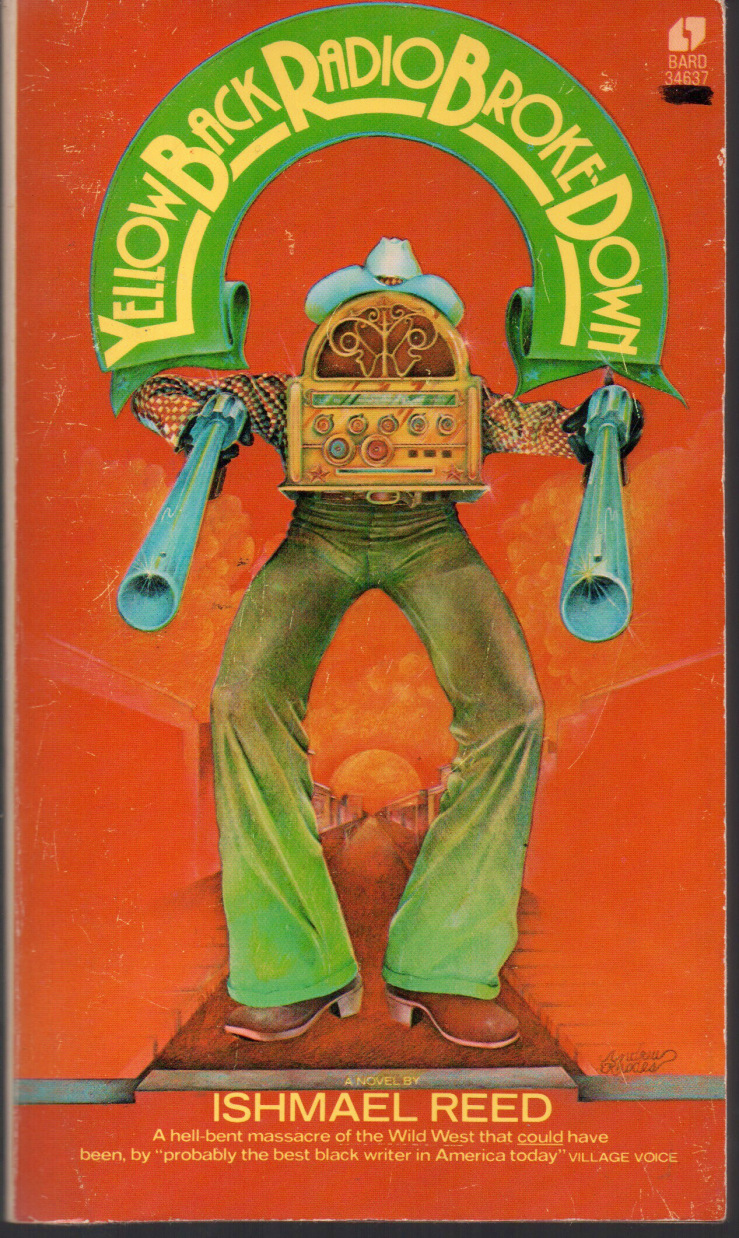
From Ishmael Reed’s 1969 novel Yellow Back Radio Broke-Down, which I am loving the hell out of.
Folks. This here is the story of the Loop Garoo Kid. A cowboy so bad he made a working posse of spells phone in sick. A bullwhacker so unfeeling he left the print of winged mice on hides of crawling women. A desperado so onery he made the Pope cry and the most powerful of cattlemen shed his head to the Executioner’s swine.
A terrible cuss of a thousand shivs he was who wasted whole herds, made the fruit black and wormy, dried up the water holes and caused people’s eyes to grow from tiny black dots into slapjacks wherever his feet fell.
Now, he wasn’t always bad, trump over hearts diamonds and clubs. Once a wild joker he cut the fool before bemused Egyptians, dressed like Mortimer Snerd and spilled french fries in his lat at Las Vegas’ top of the strip.
Booted out of his father’s house after a quarrel, whores snapped his heels and trick dogs did the fandango on his belly. Me called him brother only to cop his coin and tell malicious stories about his cleft foot.
Born with a caul over his face and ghost lobes on his ears, he was a mean night tripper who moved from town to town quoting Thomas Jefferson and allowing bandits to build a flophouse around his genius.
A funny blue hippo who painted himself with water flowers only to be drummed out of each tribe dressed down publicly, his medals ripped off.
Finally he joined a small circus and happily performed with his fellow 86-D—a Juggler a dancing Bear a fast talking Barker and Zozo Labrique, charter member of the American Hoo-Doo Church.
Their fame spread throughout the frontier and bouquets of flowers greeted them in every town until they moved into that city which seemed a section of Hell chipped off and shipped upstairs, Yellow Back Radio, where even the sun was afraid to show its bottom.
The opening paragraphs of Ishmael Reed’s 1969 novel Yellow Back Radio Broke-Down.
Our tyrants always feel in need of excuses. Our enemies are always spying, undermining, arming, plotting, seizing the high ground, inventing new horrors, inventing flashier weapons. This mole, or that rat, is smarter than we ever”“imagined, and it is working day and night against us—cunning and conniving—out of sight, in secret—because beneath deep undergarments it holds a gun, a knife, a bomb, or a book full of dreadful ideas. We must monitor our phones, watch our neighbors—note, film, record, trace, follow, measure every movement, scrutinize every public meeting, overhear every private one, rifle records, ponder every purchase, search through garbage, twist dumb tongues till they scream with the pain of prying pliers.
Tyrannies do not come in ones or twos; tyrannies come in battalions: there is Mother’s heart you mustn’t break or Father’s hopes you dare not dash; there are the reprisals taken by society because you sniffed when you should have sneezed; there are all those looks delivered like blows from someone sitting on his high horse and wielding his scorn like a whip. It does not matter what the party motto is, what flag flies, what history pretends to teach, what rewards will be yours, what hurt feelings will follow; we need to be free to choose our own errors, our own myths, to furnish our souls as we see fit.
Of course, what we believe is important, but that we believe it freely, that we can speak of it openly, that we fear neither disapproval nor contradiction, is essential to the humanness of our being. This freedom—if it is to be freedom and not another fraud—comes at a cost. It is a cost that those who have rarely been free are often reluctant to pay, because they are as unused to the presence of liberty in others as they are of freedom when granted to themselves.
We can be real only when others are allowed to play their radios. It’s odd, but our liberty lies in the liberty of our neighbors. They will be rude; they will cross the street against the light; they will eat offal; they will entertain tyrants at tea; they will be tasteless; they will be other; they will be … That’s it … they will be. They will speak strangely, dress oddly, live quaintly, worship a deity they found in a dime store. Worse: they won’t like Bach or Henry James. Worse: they will live like gnats in annoying clouds. Worse: for us they will have no particular esteem. Worst: they will want us to be nice to them, share our rights, give them room. Worse than worst: they will deny us our desires if they can; they will blame us for their plights; they will give evidence, everywhere, of the same mean-spirited insecurities that have soiled our souls from our birth.
When we deny to others their interior life, we deny ourselves all knowledge of it.
From William H. Gass’s essay “What Freedom of Expression Means, Especially in Times Like These.” Collected in Life Sentences.
“Palling around with injuns, Huck, is right down dangersome. You can’t trust ’em. Remember what happened to them poor emigrants we met when we first come out here. You’ll get your throat slit before you know it. And it ain’t right. There’s a war on.”“We made the war, not them,” I says, recollecting what Dan Harper said. “We been bullying in and taking away everything they s’posed was their’n. They’re only just defending theirselves.”
“Well, from where they set, Huck, they got a point. But we ain’t them. We got to stick with our own tribe, even if they ARE all lunatics. If we don’t, we’ll end up crazier’n any of them. You remember that poor preacher up in Minnysota? Even if he was maybe right, his rebel notions was turning him plumb loco, and in the end they probably got him lynched by his own congregation. These lands is become our lands, that’s the story now, and it’s only got just one ending. There ain’t nothing them hoss-tiles can do about it, nor not you nuther.”
“Tribes,” I says. “They’re a powerful curse laid on you when you get born. They ruin you, but you can’t get away from them. They’re a nightmare a body’s got to live with in the daytime.”
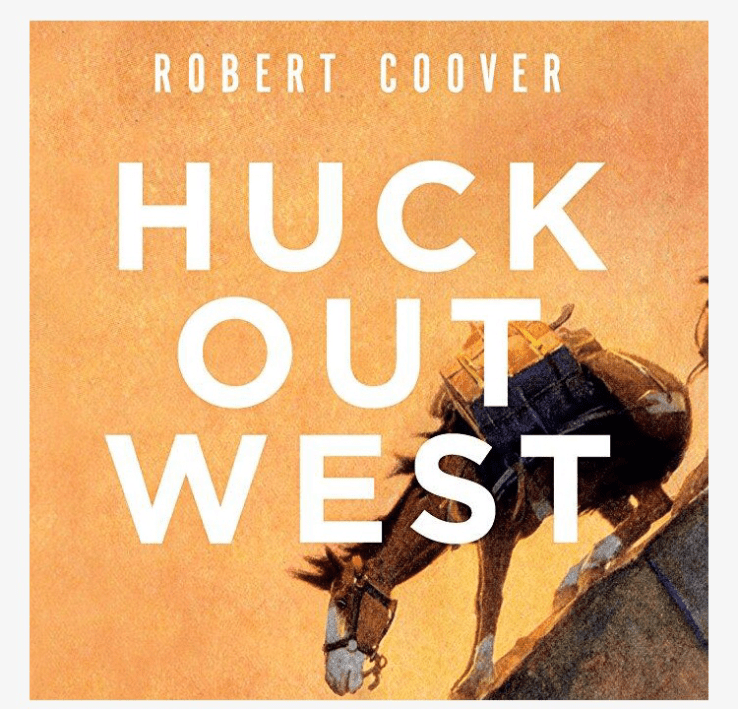
Dialogue between Huckleberry Finn and Tom Sawyer from Robert Coover’s 2017 novel Huck Out West.
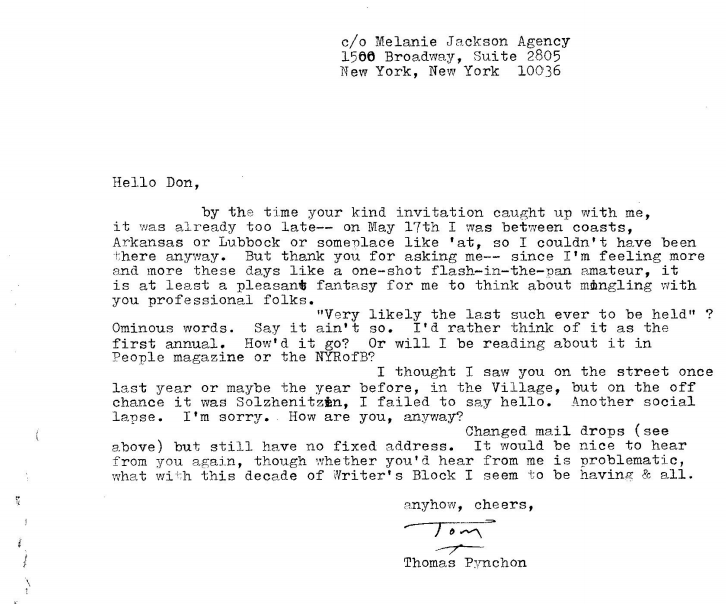
Pynchon here is ostensibly apologizing for missing Barthelme’s so-called “Postmodern Dinner” in New York.
In his 2009 Barthelme biography Hiding Man, Tracy Daugherty offers the following recollection from novelist Walter Abish:
Around this time — in the spring of 1983 — “Donald had this idea to make a dinner in SoHo,” says Water Abish. “A major dinner for a group of writers, and he planned it very, very carefully. It was a strange event. Amusing and intriguing. He invited…well, that was the thing of it. The list. I was astounded that he consulted me but he called and said, ‘Should we invite so-and-so?’ Naturally, I did the only decent thing and said ‘Absolutely’ to everyone he mentioned. I pushed for Gaddis. Gass was there, and Coover and Hawkes, Vonnegut and his wife, Jill Krementz, who took photographs, I think. Don’s agent, Lynn Nesbit, was there. She was always very friendly. Susan Sontag was the only woman writer invited.
Daugherty continues:
Pynchon couldn’t make it. He wrote Don to apologize. He said he was ‘between coasts, Arkansas or Lubbock or someplace like ‘at.”
Okay.
Abish recollects that the meal was at a very expensive restaurant, prefix, and the writers had to pay their own way. There were about 21 attendees, and Barthelme was “Very, very dour.”
I’ve had a hard time reading much (let alone writing anything) since November 8th.
A Klimt puzzle has been soothing though.
And I’ve found audiobooks, which I’ve always loved, particularly wonderful lately. They have provided a kind of anti-noise, antidote, anti-?—against the NPR news and punditry I might normally adhere to in the car (and especially potent against my own thoughts at night before I fall asleep).
My pattern with audiobooks has long been to reread at night the chapters or passages I audited that day, or to audit after I had read—or to mix it all up, going back and forth. I like this method because it allows me, essentially, to reread.
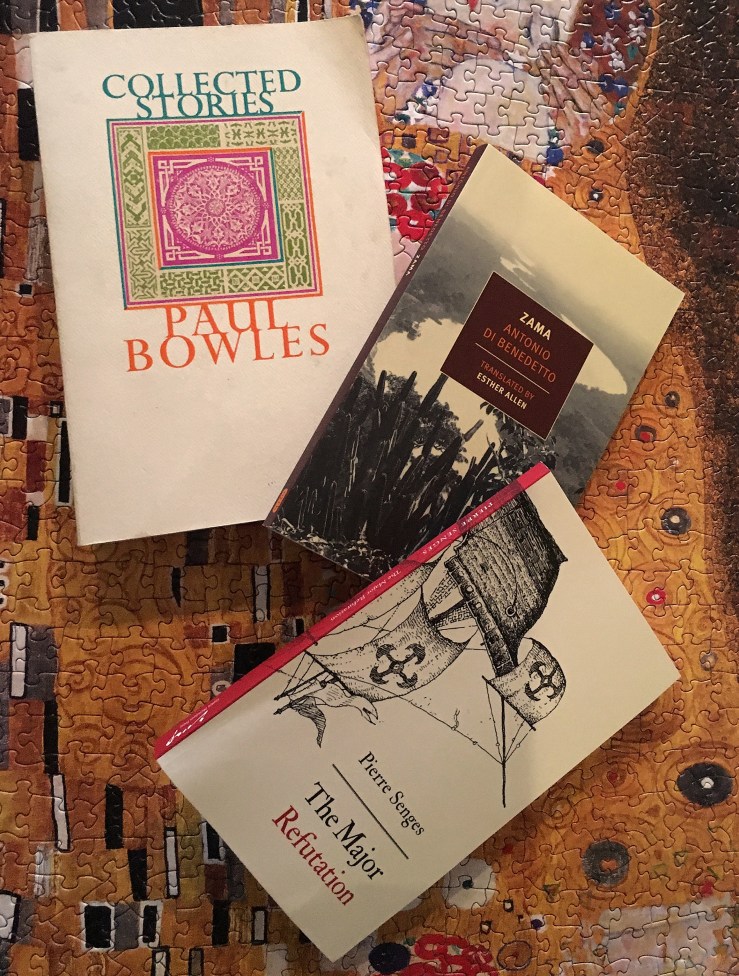
I’ve been listening to The Stories of Paul Bowles, read by like a dozen different performers (not a full-cast group read, but rather different voices for different tales). Then (mostly at night but occasionally very early in the morning), I’ve been rereading some of the stories that are collected in Collected Stories. (My local bookshop had copies of the more-complete The Stories of, but hell, who can pass up a Black Sparrow Press edition? Plus—parenthetically—the BSP edition collects the more essential stories).
Anyway, I’m coming to the end of The Stories of Paul Bowles and I’m almost a bit sad about it. The sadness come partially from the fact that the stories are presented chronologically, and, simply put, the later tales are sadder than the earlier ones. Not in content, but in tone—Bowles’s later stuff grows more bitter, more resentful. The earlier tales are strange, sharp, and driven by weird nightmare alienation and sinister surrealism. But they also open into possibility, exploration, and radical newness. The later tales, composed in the 1980s, seem to me a closing off, not just in themes and tone, but also stylistically. They retreat into formalist modernism. There’s a palpable resistance to postmodernism in the later stories, an elegiac tone that romanticizes (even through multiple ironies) the post-War colonial past.
But my sadness is also the feeling of Oh I want more. (Plus like, the aforereferenced general post-election malaise). This is all easily remedied by my plan to listen to the first two-thirds of these stories again—but probably after I take a crack at his novels.
I was too young the first time I took a crack at The Sheltering Sky—16 I think. I was reading a lot of Hemingway, Vonnegut, William Burroughs, et al. But I couldn’t click with Bowles, which makes sense to me two decades later. His stories are spare but sharp, wild but obscure. His fables refuse to square with our expectations. They are menacing, awful, loaded with strangers and travelers and outcasts. The characters do not know what is happening to them; they do not even know that they do not know what is happening to them. Often, the story’s narrator does not seem to know what is happening, and if the narrator does know what is happening, he’s not going to throw anything but the barest bones to the reader to piece together. Anyway, I’ll trek through again, for sure.
A late Bowles story, the epistolary “Unwelcome Words” (many of the later stories are epistolary affairs), offers me a neat transition to the audiobook I’ve been drifting off into unconsciousness the past few evenings with. Here’s Bowles’s narrator (a version of Bowles his-goddamn-self):
I’ve often wished that someone would rewrite the end of Huckleberry Finn, delivering it from the farcical closing scenes which Twain, probably embarrassed by the lyrical sweep of the nearly completed book, decided were necessary if the work were to be appreciated by American readers. It’s the great American novel, damaged beyond repair by its author’s senseless sabotage. I’d be interested to have your opinion, or do you feel that the book isn’t worth having an opinion about, since a botched masterpiece isn’t a masterpiece at all? Yet to counterfeit the style successfully, so that the break would be seamless and the prose following it a convincing continuation of what came before—that seems an impossible task. So I shan’t try it, myself.
Bowles here licenses my transition to Robert Coover’s latest, Huck Out West, a sorta-sequel to Twain’s problematic American masterpiece. Sure, Coover’s not rewriting the end of Huck Finn so much as he’s carrying out the mission of the novel’s final lines: “…I got to light out for the Territory ahead of the rest, because Aunt Sally she’s going to adopt me and sivilize me, and I can’t stand it. I been there before.” So Coover sets Huck out in the Territory, away from the maternal bodies that would otherwise sivilize him. I’ve gotten maybe two hours into the audiobook (it’s short, fewer than ten hours), but I keep launching in to different points, and only auditing late at night. I need a physical copy.
Physical copies report:
I’m crawling through Pierre Senges’s The Major Refutation (Eng. trans. by Jacob Siefring), mostly because I have to look up names, look for images, get lost in early depictions of “The New World” (and, uh, the refutation of the New World). . So far, it reminds me of the kind of fantasy-based literary criticism that I love: Eco, Borges, Calvino. Excerpt here.
A friend loaned me his copy of Antonio di Benedetto’s first novel Zama (Eng. translation by Esther Allen) last week, insisting I read it, and informing me that Bolaño based the titular figure of his story “Sensini” on di Benedetto. I read the first four chapters this afternoon; they were very short and I want to keep reading. Short chapters are working for me right now.
I’ve often wished that someone would rewrite the end of Huckleberry Finn, delivering it from the farcical closing scenes which Twain, probably embarrassed by the lyrical sweep of the nearly completed book, decided were necessary if the work were to be appreciated by American readers. It’s the great American novel, damaged beyond repair by its author’s senseless sabotage. I’d be interested to have your opinion, or do you feel that the book isn’t worth having an opinion about, since a botched masterpiece isn’t a masterpiece at all? Yet to counterfeit the style successfully, so that the break would be seamless and the prose following it a convincing continuation of what came before—that seems an impossible task. So I shan’t try it, myself.
To paint the portrait of this new territory, the mapmakers in their workshops are drawing free-hand sketches of coastlines that are not a whit newfangled, but for their way of appraising our world scornfully, as if from a foreign shore. Bringing islands into existence on paper is a heady game: I have taken it up myself in order to appreciate such intoxication as trumpery procures, that of an adventure on the high seas, at hardly any cost, drawn out in the meticulous outline of gulfs, hills natural harbours, headlands, capes, deltas, swamps, bone-heaps and rocks peopled with grey fowls; it sufficed to set some corsairs gamboling there. But the mapmakers go further: they invent the natives of these territories too, drawing their faces in the manner of the Guanches of the Canaries, or Ukrainians driven by force to Genoa; without inventing much they invent loincloths copied from Madeira, shoes copied from Ceylon, and sticks of incense copied from Bactria but placed in the mouth. As for the amorous rites of the natives, the clerks in Isabella’s workshops only had to leaf through the ledgers of the Old and New Inquisitions, but aslso the works of Tertullian where he denounces the excesses of the Gnostics & their collective mating practices, involving devorations, anthropophagy, child sacrifices, sodomies complicated by the age of the subjects and their numerousness. They plunge into these annals as if into the reservoir of all possible combinations, the imagination being for them but a principle of permutations, and nothing else. The Cathars, before they retracted, addressed their torturers with periphrases we find almost unchanged in the accounts of many impostors returned from the New Indies. We can see that the promoters of these lands under the horizon did not have to look very far for their lying words, which they simply cut from books, sometimes with their images, combining them freely with those old lullabies that our grandmothers recited now and then, no longer believing in them, but transmitting them all the same since one must talk of something if only to fill the day’s idle hours.
By reading these works, by plundering the archives, in other words by resurrecting these long dormant voices, each can see for himself that this world arbitrarily pulled out of the sea is neither a new idea, no an ingenious invention of our admirals, but rehashed legends, dressed up in drama and luxury to appeal to modern appetites, embellished sometimes with the help of parades of passive, nude savages, insinuated by the conquerors—the sole novelty these crude, chronically celibate men are capable of inventing to excite their fantasies, nay, the consummation of these fantasies in a tightly clenched fist, since love, discovery, and imagination are for them matters of force. No one can convince us that the Atlantic islands are an original idea, or that sailors from Lisbon or Genoa are telling for the first time of western archipelagoes adrift on the tenebrous sea. There are in our libraries so many allusions to Atlantis, to the voyages of St. Brendan, to the Seven Cities, to Ante Illa, and to the island of Brazil; so many now tattered books tell of the drifting of the Apostles of God toward the unbelievers and scorpions of the east and of the west, so many tattered books describe the walls of legendary cities and islands in the shape of tortoises: you would swear that the adventure of the new world were naught else than a hardly embellished copy of our old legends, a copy graven on the sea, instead of on paper: farce for farce, we could have been just as glad with a book.
From Pierre Senges’s novel The Major Refutation, new in English translation by Jacob Siefring from Contra Mundum Press.
The narrator is Antonio de Guevara, unsigned author of Refutatio major (c. 1517-25), an argument (?!) against the really real reality of The New World.
A stork was passing over desert country on his way north. He was thirsty, and he began to look for water. When he came to the mountains of Khang el Ghar, he saw a pool at the bottom of a ravine. He flew down between the rocks and lighted at the edge of the water. Then he walked in and drank.
At that moment a hyena limped up and, seeing the stork standing in the water, said: “Have you come a long way?” The stork had never seen a hyena before. “So this is what a hyena is like,” he thought. And he stood looking at the hyena because he had been told that if the hyena can put a little of his urine on someone, that one will have to walk after the hyena to whatever place the hyena wants him to go.
“It will be summer soon,” said the stork. “I am on my way north.” At the same time, he walked further out into the pool, so as not to be so near the hyena. The water here was deeper, and he almost lost his balance and had to flap his wings to keep upright. The hyena walked to the other side of the pool and looked at him from there.
“I know what is in your head,” said the hyena. “You believe the story about me. You think I have that power? Perhaps long ago hyenas were like that. But now they are the same as everyone else. I could wet you from here with my urine if I wanted to. But what for? If you want to be unfriendly, go to the middle of the pool and stay there.”
The stork looked around at the pool and saw that there was no spot in it where he could stand and be out of reach of the hyena.
“I have finished drinking,” said the stork. He spread his wings and flapped out of the pool. At the edge he ran quickly ahead and rose into the air. He circled above the pool, looking down at the hyena.
I’m in the middle of Paul Bowles’s stories right now, and loving the weird sinister menace of it all. I’ll probably take a crack at some of his novels this year too (The Sheltering Sky next? I’ll need to pick them up).
Senges’s The Major Refutation is also on deck.
Not pictured, because it’s not out yet, is Leonora Carrington’s The Complete Stories (forthcoming in the spring from Dorothy); I’m really looking forward to this one. The NYRB is also publishing Carrington’s memoir Down Below, which looks really cool. I’ve only read the collection The Oval Lady (and that through samizdat means), so I’m happy to see Carrington’s words in print.
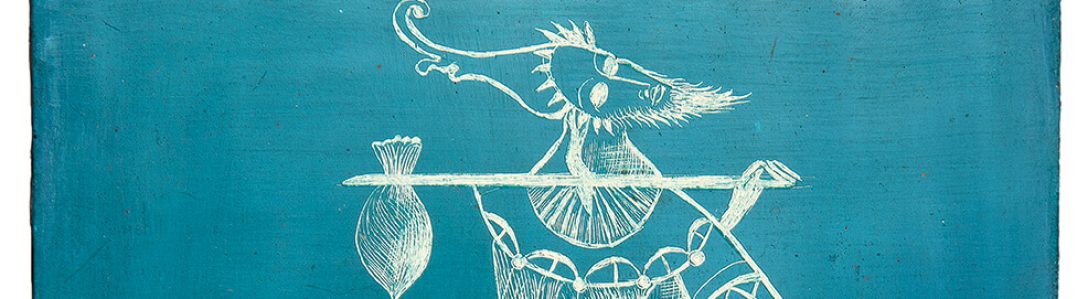
The Expedition of Dr. Ramsbottom, Leonora Carrington, 1961
Also not pictured because its forthcoming (from Two Lines Press) is Atlantic Hotel by João Gilberto Noll (translated by Adam Morris). I’m anxious to read more from Noll after digging his novella Quiet Creature on the Corner.
Back to the stack in the picture: I loved Ishmael Reed’s Mumbo Jumbo and The Freelance Pallbearers (which strikes me as a really under-remarked upon novel), and I plan on getting to Yellow Back Radio Broke-Down at some point this year.
I’ve had a few false starts with Arno Schmidt’s The Egghead Republic, but maybe I can knock it out in a weekend.
I’ve taken multiple cracks at the novels by Gray, Murdoch, and Hawkes in the stack…so we’ll see.
I read Leon Forrest’s There Is a Tree More Ancient Than Eden in a blur; I’d like to reread it and the other Forrest novel I picked up last month, Two Wings to Veil My Face.
I’ve read enough Pynchon now to make a better effort with Vineland…but again, we’ll see (I’m actually kind of jonesing to reread Against the Day).
(And oh I didn’t make a list like this in 2016, but I was 4 for 8 in the one I did in 2015).
The only way to do anything is to have it so well rehearsed in one’s imagination that when the moment comes one does it automatically, as though for the hundredth time. Then it is all natural, and there is little likelihood of a slip-up. And there was no slip-up anywhere along the way. It was a heavy day, but not too hot because of the rain, which fell quietly as I walked down the road to the station. On the train I was not in the slightest degree perturbed: I knew there was no chance of any trouble. I kept marveling at the peculiar pleasure afforded by the knowledge that one has planned a thing so perfectly there can be no room for the possibility of failure, all the while being conscious that both the pleasure and the idea itself were completely childish, and that my conviction of success was, at the very least, ill-founded. But certain situations call forth certain emotions, and the mind is a thing entirely apart. I have cakes of soap that I bought twenty-five years ago, still in their wrappers, and I am saving them in the perfect confidence that the right day will come to unwrap each one and use it. And there are probably a hundred books downstairs in the library that I am eager to read, have been eager to read for years, yet refuse to read until the day comes, the day that says to me: This is the morning to start Villiers de L’Isle-Adam, or George Borrow, or Psichari, or someone else. Now, in my logical mind, I know quite well that these promised days are not likely ever to arrive: I shall never use those old cakes of soap that are stored in the linen closet, and I am reasonably sure of never reading Romany Rye, because it doesn’t interest me. But there is that other person, the ideal one that I ought to be, whom it does interest, and it comforts me to think that those things are there waiting for him. Certainly, the mind is a thing absolutely apart.
People exaggerate the changes in nature so as to make nature seem lighter. Nature resists change. If something changes, nature waits to see whether the change can continue, and it it can’t, it crushes it with all its weight! Ten thousand years ago the trout in the stream would have been exactly the same as today.
Stasis and disruption and the relation between people and their natural and urban surroundings are the themes John Berger writes about in his 1979 collection of essays, poems and short stories, Pig Earth. Having moved from England, where he enjoyed considerable renown as an art critic and fiction writer, to the peasant villages of the French Alps, Berger settled into his role as an active participant in rural life, not only turning hay but observing and documenting the disappearance of a way of a once-pervasive mode of life. Pig Earth was one result of his labors, the first book of a trilogy that took some fifteen-odd years to complete, a moving but not uncritical account of humanity’s struggle to conquer nature by symbiosis.
Maybe symbiosis isn’t the proper term if we agree that humanity is part of nature’s whole, but Berger juxtaposes the frailty of humanity with the earth’s uncaring and often violent strength. Survival for the family of the subsistence farmer depends upon that family’s ability to tend to the needs of the plant and animal world (as well as more than a little bit of luck). In the collection’s first true story, “A Calf Remembered,” a baby cow is delivered on a dark winter’s night. Here, Berger stresses the protections that nature and man have designed to ensure the survival of a young, vulnerable animal: mucus, barn, salt, and sense. The human spends his night in the barn protecting his property because it provides him not only with sustenance in the forms of milk and meat, but also companionship and a sense of duty. When daily living requires acts that might mean life or death, the conscious and the instinct converge.
He sat on a milking stool in the dark. With his head in his hands, his breathing was indistinguishable from that of the cows. The stable itself was like the inside of an animal. Breath, water, cud were entering it: wind, piss, shit were leaving.
Pig Earth is a book worth studying as people attempt to make sense of a world transitioning from one type of living to another and fuss over the sources of their own limited strength and vitality. Berger may not have been looking to pioneer a slow-living locavore lifestyle, but his subjects worry about their increasing isolation from the circles of power and industry. They fret over the pointlessness of passing their knowledge to their children who need entirely different skills to survive in the rapidly encroaching urban wage economy. In “The Value of Money” a father refuses a tractor, branded “The Liberator” by the manufacturer, that his son has purchased for him because it will render his faithful work-horse obsolete. This same farmer kidnaps local tax officials because they want to confiscate the products of his labor without compensation for value that he exclusively created. Unable to make them understand their wrongdoing, he sets them free because “you can only take revenge on those who are your own.”
The final story, “The Three Lives of Lucy Cabrol,” is the lengthiest and perhaps most poignant narrative in the book. It follows the life of a bright, tenacious, physically stunted woman as she grows from young girl to town outcast. While Berger admired much of the life in the peasant village, he would fail in his duty as critic and chronicler if he ignored its darker sides. Berger often sets the title character’s pluck against the resignation and superstition endemic to village life. When life requires struggle, most people choose to hoard. When poor choices may lead to death or family hardship, capitulation to those in power, whether those rulers be the town’s big man or Nazi collaborators, can often seem the only obvious choice. Lucy shows us that cowardice, no matter the circumstances, only seems easy. Pig Earth is highly recommended.
[Ed. note—Biblioklept originally published this review of Pig Earth in 2011. We run it again in appreciation of John Berger, who died today at the age of 90].
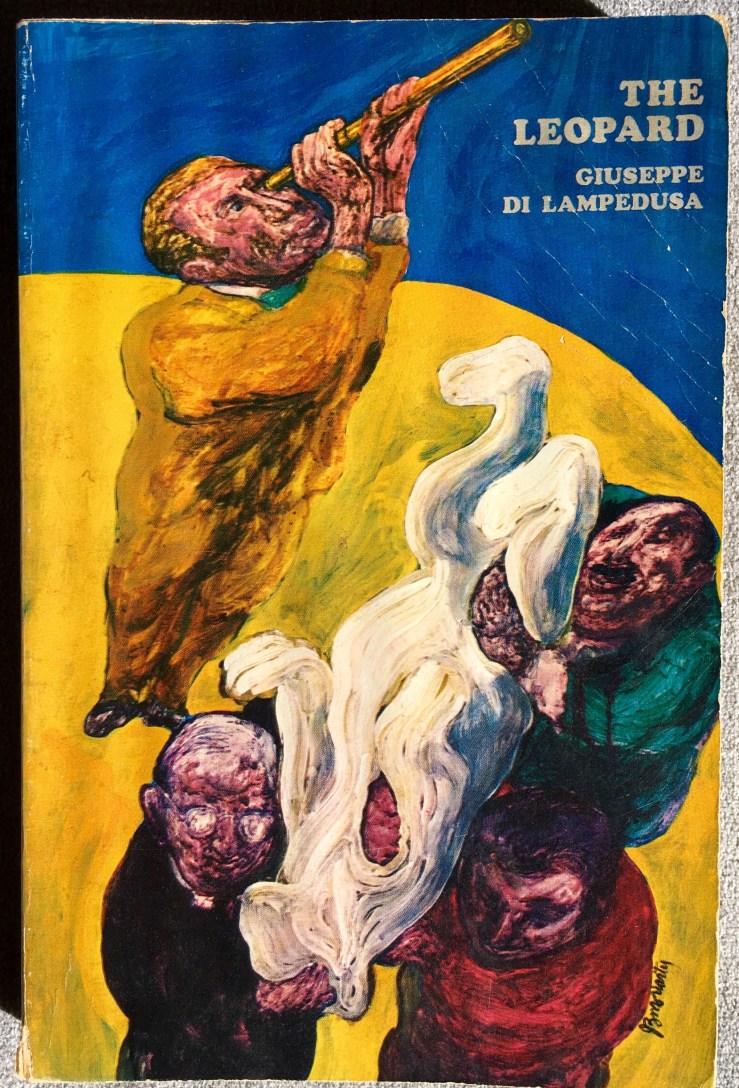
After years of false starts, I finally read Giuseppe Tomasi di Lampedusa’s 1958 novel The Leopard this August. Then I read it again, immediately. (It’s one of only two novels I can recall rereading right away—the other two were Blood Meridian and Gravity’s Rainbow). The Leopard tells the story of Prince Fabrizio of Sicily, who witnesses the end of his era during the Risorgimento, the Italian reunification. Fabrizio is an enchanting character, by turns fiery and lascivious, intellectual and stoic, and The Leopard takes us through his mind and through his times. He’s thoroughly complex, unknown even to himself, perhaps. The novel is impossibly rich, sad, electric, a meditation on death, sex, sensuality—pleasure and loss. More mood than plot, The Leopard glides on vibe, its action framed in rich set pieces: fancy balls and sumptuous dinners and games of pleasure in summer estates. But of course there is a plot—several strong plots, indeed (marriage plots and death plots, religious plots and political plots). Yet the narrative’s viewpoint characters keep the plots at bay, or mediate them, rather than propel them forward. Simply one of the better novels I’ve read in years, its final devastating images inked into my memory for as long as I have memory. (English translation by Archibald Colquhoun, by the way).
The 43 stories that comprise Lucia Berlin’s excellent collection A Manual for Cleaning Women braid together to reveal a rich, dirty, sad, joyous world—a world of emergency rooms and laundromats, fancy hotels and detox centers, jails and Catholic schools. Berlin’s stories jaunt through space and time: rough mining towns in Idaho; country clubs and cotillions in Santiago, Chile; heartbreak in New Mexico and New York; weirdness in Oakland and Berkeley; weirdness in Juarez and El Paso. (Full Biblioklept review).
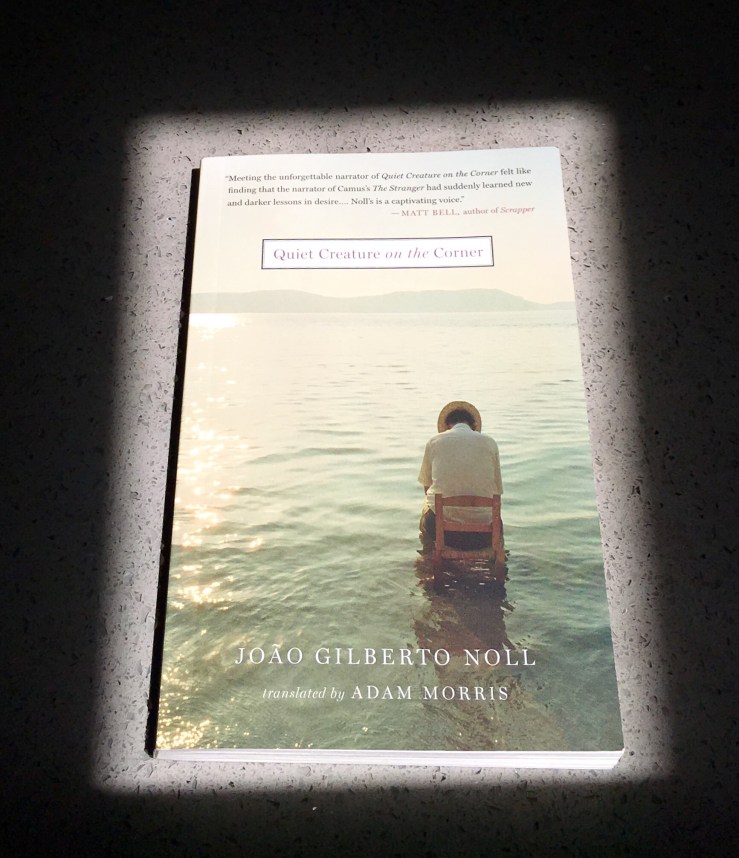
Brazilian writer João Gilberto Noll’s 1991 novella Quiet Creature on the Corner(English translation by Adam Morris; Two Lines Press) is probably best read without any kind of foregrounding or forewarning. The book is a nightmarish, abject, kinetic, surreal, picaresque read, a mysterious prose-poem that resists allegorical interpretation. Quiet Creature on the Corner is like a puzzle, but a puzzle without a reference picture, a puzzle with pieces missing. The publishers have compared the novella to the films of David Lynch, and the connection is not inaccurate. Too, Quiet Creature evokes other sinister Lynchian puzzlers, like Roberto Bolaño’s 2666 (or Nazi Literature in the Americas, which it is perhaps a twin text to). It’s easy to compare much of postmodern literature to Kafka, but Quiet Creature is truly Kafkaesque. It also recalled to me another Kafkaesque novel, Alasdair Gray’s Lanark—both are soaked in a dark dream logic. Other reference points abound—the paintings of Francis Bacon, Leon Golub, Hieronymus Bosch, Goya’s etchings, etc. But Noll’s narrative is its own thing, wholly. (Full Biblioklept review).
Daniel Green’s The Reading Experience was one of the first sites I started reading regularly when I first started blogging about literature on Biblioklept. If you regularly read literary criticism online, it’s likely you’ve read some of Green’s reviews in publications like The Kenyon Review, 3:AM, FullStop, The Los Angeles Review of Books, Full Stop, and more.
Green’s got a new collection out from Cow Eye Press, Beyond the Blurb: On Critics and Criticism, which presents his philosophy of literary criticism, drawing on writing he has done over the past dozen years on The Reading Experience, as well as essays he has published elsewhere. Beyond the Blurb lucidly explicates an approach to criticism that stresses careful attention to literary form and language. “The experience of reading is the experience of language” might be a tidy blurb for Beyond the Blurb.
In his own words, Green was trained as an academic literary critic, but has long since seen the error of his ways. He lives in central Missouri. Over a series of emails, Green was kind enough to talk to me about his new book Beyond the Blurb, literary criticism, experimental fiction, William H. Gass, the New Critics, James Wood, Harold Bloom, Susan Sontag, Bob Dylan’s winning the Nobel, and lots more.
Biblioklept: In the introduction to Beyond the Blurb, you outline some of the core tenets of your philosophy of literary criticism. One of these is, “The meaning of a literary work consists of the experience of reading it, not in abstracted ‘themes’ that signify what the work is ‘about.'” Another tenet is that, “The experience of reading is the experience of language.”
This idea of a reader’s experience of reading appears throughout Beyond the Blurb, and indeed, your website is named The Reading Experience. Is it possible to define, or at least describe, what you mean by the reader’s experience of reading, in a general sense?
Daniel Green: The Reading Experience is a direct allusion to John Dewey’s Art as Experience. My insistence that reading is experience of language is an attempt to apply Dewey’s concept of “experience” to reading works of literature. I probably put more emphasis on language per se than Dewey did, which is likely the residual influence of New Criticism. I was a graduate student at a time when many older literary scholars—including some of those with whom I studied—were still New Critics, or at least assigned New Critics in classes I took. (Or maybe I just read a lot of New Criticism on my own).
I still think the New Critics’ general approach, which emphasized the “ambiguity” inherent to a literary work, is sound, although they went too far in using words like “icon” and “heresy,” almost making works of literature into sacred objects. I discovered Dewey’s book and was converted to the notion that works of art are objects of experience whereby the reader/beholder is given the opportunity simply to appreciate experience for its own sake. (Dewey thought works of art gave us the greatest opportunity for this).
The experience of reading is always the experience of language, even though many readers don’t stop often enough to acknowledge this. We read artfully arranged words that in works of literature create “meaning” only relative to their arrangement, which is not the arrangement to be found in newspaper columns or political speeches. A critic should be sensitive to the particular kind of arrangement—which includes the arrangement into “form”—found in a particular work. Even leaping ahead to “story” or “setting” distorts our actual experience of the work unless we also notice the way the writer has used language to create the illusion of story and the illusion of setting.
Biblioklept: Is there a risk though at falling into “the experience of the experience” when reading literature? Many people like to “get lost” in the illusion that the language of literature replicates reality. James Wood, in particular, seems to particularly value reality or life in the literature he esteems.
DG: People are perfectly free to read in any way they want, including for the illusion of reality. But I see that as a secondary effect. Has the work succeeded aesthetically in creating that illusion? It seems to me that critics ought to be those readers who are most sensitive to the “experience of the experience.” This ought to be the first goal of the critic, to describe that experience. Jumping right to “life on the page” is jumping right over the art of literary art.
Frankly, I’ve always found the notion that literature (fiction) is valuable to the extent it provides access to “reality” or “human life” bizarre. Since we’re humans writing about human experience, what other than reality could we possibly find in a literary work? Doing creative things with words isn’t separate from human life. It’s part of human life.
DG: Yeah, there are a lot of claims that the primary value of fiction lies in its ability to allow readers to “share” other people’s experience and perspective, to see the world from their point of view. On the one hand this seems to me a fairly innocuous notion. If a novel effectively conveys the illusion that you’re inhabiting another subjectivity and you think the experience has been salutary in your sense of “empathy,” then so be it. It is, however, an illusion, so on the other hand in no way are you really sharing another perspective or point of view, since what’re you are in fact experiencing is an effect of the writer’s skillful disposition of language. There are no “people” in fiction, just words and sentences, and therefore when you talk about empathizing or adopting another perspective, at best you are speaking metaphorically—it’s like empathizing with a real person, even though it’s not.
I would also say that the notion you’re sharing the author’s perspective, or engaging with the author’s “mind,” is misbegotten as well. A work of fiction (at least a good one) doesn’t have a perspective, or it would be a work of nonfiction.
I actually do think reading literature can make you a better human being, by helping you to be a better reader, or by expanding your ability to have a rich aesthetic experience. The idea it can make you ethically or morally better (presumably by teaching you a lesson) is one I assumed had been discarded long ago.
Biblioklept: I think a lot of folks still believe in “moral fiction” of some kind though (Mark Edmundson’s attack on contemporary poets in Harper’s a few years ago comes immediately to mind). Your response recalls to me some favorite lines from William Gass’s “The Medium of Fiction.” “It seems a country-headed thing to say,” he writes, “that literature is language, that stories and the places and the people in them are merely made of words as chairs are made of smoothed sticks and sometimes cloth or metal tubes.” Gass is one of the examples you include in your chapter on “Critical Successes.” What do you admire in his criticism and his critical approach?
DG: I think of Gass as a “poet-critic,” even though he is of course a fiction writer. Indeed, I can think of few critics who make better use of the poetic resources of language in writing a criticism that is also pungent and deeply informed. He is among critics the most sensitive to the aesthetic character of literature and best able to express his aesthetic engagement in his own aesthetically rich prose. He’s a critic who registers an “appreciation” of literature more than he attempts to explicate through analysis, but there is room for both kinds of critics.
Biblioklept: Harold Bloom also strikes me as a critic “sensitive to the aesthetic character of literature,” and he also lands in your examples of “Critical Successes.” Bloom’s had a long history of pissing off various critics and even casual readers. What do you make of his agon with the so-called “School of Resentment”?
DG: I think he probably overdid the rhetoric with the “school of resentment” thing, although his underlying insight, that academic criticism had abandoned the study of literature for its own sake—to illuminate what is valuable about it—in favor of other agendas for which literature is merely a convenient tool of analysis, was certainly correct. I don’t object to forms of criticism or scholarship that favor cultural or political analysis over literary analysis, but these approaches came not to supplement or coexist with literary analysis; instead they completely replaced it. Bloom expressed his love of literature through becoming a learned professor and scholar. Now the idea that a literature professor is someone who loves literature seems quaint, if not outlandish. (Which is no doubt why Bloom seems an outlandish figure to many people).
Biblioklept: Sontag is another figure in your chapter on “Critical Successes”; indeed, you cite her at some length. Sontag wanted us to “learn to see more, to hear more, to feel more.” What are some practical methods for critics (and readers in general) to attend more to the “sensuous surface”?
DG: With literature, that has to mean attention to the palpable features of the writer’s shaping of language. A work of fiction is not a script for the reader to imagine into his/her own movie version. The “sensuous surface” is the sound and movement of the language. Gary Lutz is a good example of a writer who understands this. Lutz’s stories deliberately frustrate attempts to read for the plot or to visualize the characters, instead requiring attention to the transformed effects of word choice and syntax. Lutz may be an extreme example, but critics should approach all works of literature in the way his fiction demands. The notion that poetry should be read this way is not such an outlandish one, and criticism of fiction has moved too far away from criticism of poetry. Both fiction and poetry should be read first of all as aesthetic arrangements of language, although I don’t say that all criticism should necessarily stop there.
Biblioklept: What are some of the directions that criticism might go after appraising the aesthetic arrangements of language?
DG: As I say, I don’t object to criticism that examines works of literature for political or historical contexts and implications, but this should be done with the proviso that works of literature (most works of literature) are offered first of all as works of art. Examining a literary work for the aesthetic arrangements of language is the way of establishing that, because its language has been aesthetically arranged, it can’t coherently be subsumed to a political position or reduced to a cultural symptom. I’m speaking here of fiction and poetry (also drama, to the extent it belongs to literature). Including works of “creative nonfiction” as literature arguably muddies the waters some, but even here the “creative” part must count for something, must mean something other than simply “nice prose.” It ought to involve ways of making “meaning” more complex, more suggestive, not more transparent.
Older, more “canonical” works can certainly serve as the focus of lots of different critical inquiries, since in most cases their specifically literary qualities can be assumed as established, but I’d want them to be taught as first of all works of literary art. Presenting them to students immediately as politics or objects of theoretical discourse seems to me to simply erase “literature” as something about which it makes sense to speak as a separate category of writing.
Biblioklept: You include “Academic Criticism” in your section of “Critical Failures.” The focus in the chapter on “Academic Criticism” is on Joseph M. Conte’s study of American postmodern literature, Design and Debris, and not necessarily academic criticism in general. In general though, do you think American universities and schools are neglecting the aesthetics of literature in favor of different “theoretical” approaches?
DG: Yes, of course they are. I don’t think many academic critics would deny it. Certainly most of the academic journals that determine which approaches are informally—if not “officially”—sanctioned and which are disdained are now completely devoted to non-aesthetic approaches. Lately a quasi-formalist strategy called “surface reading” has become more respectable, but even it is offered as a corrective to certain kinds of theoretical overreach and doesn’t finally threaten the hegemony of theory itself as the primary concern of academic criticism. What’s called “digital humanities”—data-mining using literary texts as data—shares with theory the assumption that assessing works of literature for their aesthetic qualities was long ago deemed insufficiently “rigorous” as a way of organizing the study of literature—although for some reason, unclear to me even now, the term “literature” has been retained to identify the nominal object of study, and what these critics do is still referred to as “literary study.”
There are, of course, professors who do continue to present literary works as works of art. They are surely in the minority, however, particularly in the more prestigious universities.
Biblioklept: Another entry in your section on “Critical Failures” is James Wood, whom you devote quite a few pages to. I often find myself very frustrated with Wood’s approach to literary criticism, but he’s also a very perceptive reader.
DG: Yes, he can be a very insightful reader. I think in the essay I say that he is, on the one hand, one of the few practicing critics who is able to focus very closely on the text under consideration and offer a sensitive “reading.” But, on the other hand, he uses that sensitivity to advance a very narrowly conceived agenda. It seems to me he isn’t reading the work to understand what the author is doing, whatever that might be, but to find support for his bias toward psychologically complex realism. It causes him to unfairly characterize fiction for which he does not have affinity (“hysterical realism”), when he’s not merely ignoring work that contradicts his agenda. I actually learn from his reviews of some writers, especially certain translated authors whose work clearly does conform to his preconceptions of “how fiction works.” But he seems to know very little about American literature, and his critical agenda especially distorts the formal and aesthetic assumptions of many American writers, particularly those in the tradition of nonrealist writing going back to Poe and Hawthorne. Since the kind of experimental writing I admire to a significant extent has its source in that tradition, naturally I find his approach objectionable.
Biblioklept: Wood often violates the first of John Updike’s “rules” of reviewing books (from Picked-Up Pieces): “Try to understand what the author wished to do, and do not blame him for not achieving what he did not attempt.”
DG: Yes, that’s exactly right. You can then either judge the author a failure by the standards he/she has adopted, or you can rule what the author has attempted out of court—that’s not the sort of thing a novelist should be doing. It would be hard to justify the latter position, although you could mount a sustained critique of the author’s chosen mode. Perhaps its conventions are stale or its strategies are incoherent. Mostly Wood doesn’t do this. He instead continues to judge by the standards of his preferred mode—it’s realism all right, but it’s “hysterical.”Continue reading “An interview with literary critic Daniel Green about his new book, Beyond the Blurb”→
Later, toward dusk, several enormous water bugs, a very dark reddish brown, emerge like elves from the wainscoting, and go lumbering toward the larder—pregnant mother bugs too, with baby translucent outrider bugs flowing along like a convoy escort. At night, in the very late silences between bombers, ack-ack fire and falling rockets, they can be heard, loud as mice, munching through Gwenhidwy’s paper sacks, leaving streaks and footprints of shit the color of themselves behind. They don’t seem to go in much for soft things, fruits, vegetables, and such, it’s more the solid lentils and beans they’re into, stuff they can gnaw at, paper and plaster barriers, hard interfaces to be pierced, for they are agents of unification, you see. Christmas bugs. They were deep in the straw of the manger at Bethlehem, they stumbled, climbed, fell glistening red among a golden lattice of straw that must have seemed to extend miles up and downward—an edible tenement-world, now and then gnawed through to disrupt some mysterious sheaf of vectors that would send neighbor bugs tumbling ass-over-antennas down past you as you held on with all legs in that constant tremble of golden stalks. A tranquil world: the temperature and humidity staying nearly steady, the day’s cycle damped to only a soft easy sway of light, gold to antique-gold to shadows, and back again. The crying of the infant reached you, perhaps, as bursts of energy from the invisible distance, nearly unsensed, often ignored. Your savior, you see… .








 Biblioklept