“Some of Us Had Been Threatening Our Friend Colby” by Donald Barthelme
Some of us had been threatening our friend Colby for a long time, because of the way he had been behaving. And now he’d gone too far, so we decided to hang him. Colby argued that just because he had gone too far (he did not deny that he had gone too far) did not mean that he should be subjected to hanging. Going too far, he said, was something everybody did sometimes. We didn’t pay much attention to this argument. We asked him what sort of music he would like played at the hanging. He said he’d think about it but it would take him a while to decide. I pointed out that we’d have to know soon, because Howard, who is a conductor, would have to hire and rehearse the musicians and he couldn’t begin until he knew what the music was going to be. Colby said he’d always been fond of Ives’s Fourth Symphony. Howard said that this was a “delaying tactic” and that everybody knew that the Ives was almost impossible to perform and would involve weeks of rehearsal, and that the size of the orchestra and chorus would put us way over the music budget. “Be reasonable,” he said to Colby. Colby said he’d try to think of something a little less exacting.
Hugh was worried about the wording of the invitations. What if one of them fell into the hands of the authorities? Hanging Colby was doubtless against the law, and if the authorities learned in advance what the plan was they would very likely come in and try to mess everything up. I said that although hanging Colby was almost certainly against the law, we had a perfect moralright to do so because he was our friend, belonged to us in various important senses, and he had after all gone too far. We agreed that the invitations would be worded in such a way that the person invited could not know for sure what he was being invited to. We decided to refer to the event as “An Event Involving Mr. Colby Williams.” A handsome script was selected from a catalogue and we picked a cream-colored paper. Magnus said he’d see to having the invitations printed, and wondered whether we should serve drinks. Colby said he thought drinks would be nice but was worried about the expense. We told him kindly that the expense didn’t matter, that we were after all his dear friends and if a group of his dear friends couldn’t get together and do the thing with a little bit of eclat, why, what was the world coming to? Colbv asked if he would be able to have drinks, too, before the event. We said,”Certainly.”
The next item of business was the gibbet. None of us knew too much about gibbet design, but Tomas, who is an architect, said he’d look it up in old books and draw the plans. The important thing, as far as he recollected, was that the trapdoor function perfectly. He said that just roughly, counting labor and materials, it shouldn’t run us more than four hundred dollars. “Good God !” Howard said. He said what was Tomas figuring on, rosewood? No, just a good grade of pine, Tomas said. Victor asked if unpainted pine wouldn’t look kind of “raw,” and Tomas replied that he thought it could be stained a dark walnut without too much trouble.
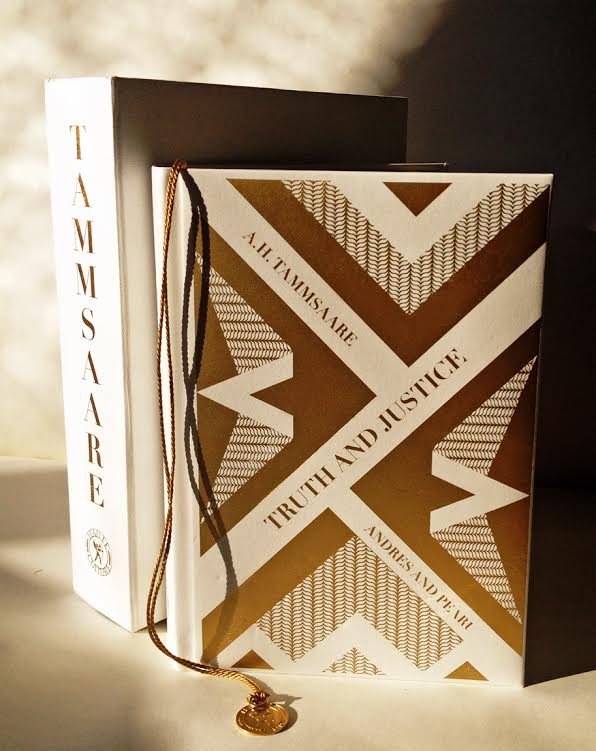
Luis de Miranda:Haute Culture is a new venture in luxury publishing with a mission to bring masterpieces of global literature to English-speaking readers around the world. Since your site is called “Biblioklept,” I’ll start by saying that we are a new kind of Robin Hood: we give to both the “poor” and the “rich.” We offer free e-books to the modern global reader interested in discovering hidden gems of classic European literature and, simultaneously, we offer individuals of greater means the opportunity to become mini-Medici’s, actively supporting culture while enjoying a luxurious limited edition book that will increase in value year after year.
This model is summed up in our slogan: Physical books should be sublime, digital books should be free. The sales of our limited luxury editions—each a distinctive art object—support the distribution of free e-books for each of our titles. Buyers of our limited editions, in effect, become benefactors—or “Book Angels,” as we call them. I believe this model will satisfy collectors and book lovers.
Furthermore, as e-books become cheaper and cheaper, I want to create a model that does not depend on the diminishing revenues of e-book sales and allows us to reach as many readers as possible, particularly younger readers. If we want younger generations to read quality literature, and not just the latest bestsellers, free e-books are the way to go.
Biblioklept: Is the possible disconnect between electronic books and “luxury” an issue? Does this new publishing model privilege the book as an aesthetic object?
LdM: This model privileges the free distribution of quality literature and it reinvents the physical book as a cult object. I aim to create unique objects that make the poetry of texts tangible. As we all spend more time in front of screens, I believe that the experiential aspect of the printed book will become more important, with readers looking for a higher quality object. I foresee the return of the “gentleman’s library” (or “gentlewoman’s library”), with fine leather volumes and limited editions—the polar opposite of e-books. Our limited editions will embody my great respect for the ritual of reading and for the craftsmanship of book making, while at the same time subsidizing the free distribution of our e-books and building a new global audience for iconic European literary masters.
Biblioklept: Is Haute Culture the first group to employ this model, to your knowledge?
LdM: Yes. We are innovating and experimenting. I don’t know if ours will be an economically viable model in the end, but it is definitely a desirable one. Since we are exploring uncharted territory, we have to take things step by step. We are avoiding the established highways over artificial ponds, and attempting to build our own bridge. We might fail or we might create a new path that the others will soon follow.
Biblioklept: Why did you choose A.H. Tammsaare’s Truth and Justice as the first book in this series?
LdM: Our first publication is actually a new translation and an ultra-limited bilingual edition of the Flaubert novella, Felicity: The Tale of the Simple Heart. In December 2013, it will be on sale at Assouline Boutiques in New York, Los Angeles, London, and Paris.
Volume I of Tammsaare’s Truth and Justice is planned for publication in 2014. It is a fine example of an untranslated classic. Tammsaare himself is an icon of 20th century Estonian literature. Two museums, a monument, and a park in the center of Tallinn are all dedicated to him. Unlike some traditional classics, which are widely referred to but rarely read, his masterpiece, Truth and Justice, still retains its place at the front of Estonian bookshelves and yet this epic work has never been translated into English. I also have some personal reasons for launching the press with an Estonian icon like Tammsaare. I wrote my last novel in Estonia three years ago and I wanted to pay homage to the land that inspired me.
Biblioklept: What is Tammasaare’s book about? Why is it important?
LdM: Truth and Justice is considered Tammsaare’s most important work. It was written during the rise of dictators—Hitler, Stalin, Mussolini—and it captures the evolution of Estonia from Tsarist province to independent state. Though it’s deeply rooted in Estonian peasant life, the first volume deals with timeless literary and philosophical issues, developing a vigorous, straightforward narrative that addresses the dual nature of the human psyche.
The book’s characters, storylines, and language continue to inform Estonia’s culture today. References to Truth and Justice are pervasive, and one hears its echoes in contemporary Estonian literature, as well as other art forms. One need only call two men “Andres and Pearu” for any Estonian to understand the nature of their relationship.
Volume I presents life in an Estonian village, as farmers battle against nature during the last quarter of the 19th century. The two main characters, both unique and powerful men, represent the essential conflicts of human nature: not only good vs. evil, but also hope vs. conservatism, conquest vs. pettiness. The saga explores how human impulses compete with each other and complete the characters.
Although the first volume seems entirely dedicated to peasant life in rural Estonia at the threshold of modernity, the book deals with fundamental issues that are quite relevant today. You might say this book reflects what we are trying to do at Haute Culture. Truth and Justice is a story of simple people who work the land endlessly, striving to build a world were truth and justice prevail, where good is fostered and protected, not killed by conformity or lack of courage. Beautiful things grow slowly like plants. Perhaps this is a lesson for all the capitalists of the world.
Luis de Miranda
Biblioklept: What future plans do you have for Haute Culture? What other books would you like to publish?
LdM: We are currently translating a Russian book by the cult novelist Yuri Mamleyev, called Shatuny. We are working with one of the best Russian to English translators, Marian Schwartz, who translated Bulgakov and Berberova. Shatuny is a mind-blowing, hallucinatory story about the quest for absolute truth. Maybe we are obsessed by truth?
Bringing untranslated texts to English readers around the world is one aspect of a wider mission to bring singular, fine, original works to the global corpus. That has always been my goal—to democratize access to culture. I’ve been to the Frankfurt Book Fair many times and met with publishers and agents in New York. I’ve noticed not only that many great European works have not been translated to English, but also that the mainstream US and UK publishers tend to translate only genre bestsellers—thrillers for example.
English is now the international language and I believe it’s possible, and indeed essential to bring to the international psyche works that aren’t standardized and cliché, but truly represent a unique viewpoint. I plan to build a catalogue that only includes masterpieces. Publishers who rely on the old publishing model must often publish potential bestsellers they secretly despise, yet there are so many excellent contemporary classics waiting to be discovered and translated into English. With Haute Culture, I refuse to compromise. Literature has the potential to create a more diverse and interconnected world, but in order to reach that potential we must fight against a profit-driven culture.
Biblioklept: Have you ever stolen a book?
LdM: When I was 18, I had a summer job at a bookshop in the Pompidou Center in Paris. At the end of my first day, I took about 20 books home with me, feeling that I had found Ali Baba’s cave, but a few days later I felt guilty and replaced all the books on their shelves.
A young man and girl meet together, each in search of a person to be known by some particular sign. They watch and wait a great while for that person to pass. At last some casual circumstance discloses that each is the one that the other is waiting for. Moral,–that what we need for our happiness is often close at hand, if we knew but how to seek for it.
The journal of a human heart for a single day in ordinary circumstances. The lights and shadows that flit across it; its internal vicissitudes.
Distrust to be thus exemplified: Various good and desirable things to be presented to a young man, and offered to his acceptance,–as a friend, a wife, a fortune; but he to refuse them all, suspecting that it is merely a delusion. Yet all to be real, and he to be told so, when too late.
A man tries to be happy in love; he cannot sincerely give his heart, and the affair seems all a dream. In domestic life, the same; in politics, a seeming patriot; but still he is sincere, and all seems like a theatre.
An old man, on a summer day, sits on a hill-top, or on the observatory of his house, and sees the sun’s light pass from one object to another connected with the events of his past life,–as the school-house, the place where his wife lived in her maidenhood,–its setting beams falling on the churchyard.
An idle man’s pleasures and occupations and thoughts during a day spent by the seashore: among them, that of sitting on the top of a cliff, and throwing stones at his own shadow, far below.
A blind man to set forth on a walk through ways unknown to him, and to trust to the guidance of anybody who will take the trouble; the different characters who would undertake it: some mischievous, some well-meaning, but incapable; perhaps one blind man undertakes to lead another. At last, possibly, he rejects all guidance, and blunders on by himself.
“BILL will you begin. By telling the court in your own words how you first conceived and then supported this chimera, the illusion of your potential greatness. By means of which you have managed to assume the leadership and retain it, despite tons of evidence of total incompetence, the most recent instance being your hurlment of two six-packs of Miller High Life, in a brown-paper bag, through the windscreen of a blue Volkswagen operated by I. Fondue and H. Maeght. Two utter and absolute strangers, so far as we know.” “Strangers to you perhaps. But not to me.” “Well strangers is not the immediate question. Will you respond to the immediate question. How did you first conceive and then sustain —” “The conception I have explained more or less. I wanted to make, of my life, a powerful statement etc. etc. How this wrinkle was first planted in my sensorium I know not. But I can tell you how it is sustained.” “How.” “I tell myself things.” “What.” “Bill you are the greatest. Bill you did that very nicely. Bill there is something about you. Bill you have style. Bill you are macho.” “But despite this blizzard of self-gratulation —” “A fear remained.” “A fear of?” “The black horse.” “Who is this black horse.” “I have not yet met it. It was described to me.” “By?” “Fondue and Maeght.” “Those two who were at the controls of the Volkswagen when you hurled the brown-paper bag.” “That is correct.” “You cherished then for these two, Fondue and Maeght, a hate.” “More of a miff, your worship.” “Of what standing, in the time dimension, is this miff?” “Matter of let’s see sixteen years I would say.” “The miff had its genesis in mentionment to you by them of the great black horse.” “That is correct.” “How old were you exactly. At that time.” “Twelve years.” “Something said to you about a horse sixteen years ago triggered, then, the hurlment.” “That is correct.” “Let us make sure we understand the circumstances of the hurlment. Can you disbosom yourself very briefly of the event as seen from your point of view.” “It was about four o’clock in the afternoon.” “What is your authority.” “The cathouse clock.” “Proceed.” “I was on my way from the coin-operated laundry to the Door Store.” “With what in view.” “I had in mind the purchasement of a slab of massif oak, 48” by 60”, and a set of carved Byzantine legs, for the construction of a cocktail table, to support cocktails.” “Could you rubric, scout-mysteries.” “No. It was in the nature of a threat, a punishment. I had infracted a rule.” “What rule?” “A rule of thumb having to do with pots. You were supposed to scour the pots with mud, to clean them. I used Ajax.” “That was a scoutmystery, how to scour a pot with mud?” “Indeed.” “The infraction was then, resistance to scoutmysteries?” “Stated in the most general terms, that would be it.” “And what was the response of Fondue and Maeght.” “They told me that there was a great black horse, and that it had in mind, eating me.” “They did?” “It would come by night, they said. I lay awake waiting.” “Did it present itself? The horse?” “No. But I awaited it. I await it still.” “One more question: is it true that you allowed the fires under the vats to go out, on the night of January sixteenth, while pursuing this private vendetta?” “It is true.” “Vatricide. That crime of crimes. Well it doesn’t look good for you, Bill. It doesn’t look at all good for you.”
From Donald Barthelme’s Snow White. One of the funniest passages I’ve read in ages.
1. Today is Black Friday in America. I don’t think it’s necessary to remark at length on the bizarre disjunction between this exercise in consumerism-as-culture and the intended spirit of the Thanksgiving holiday that precedes it. Indeed, I think that the cognitive dissonance that underwrites Black Friday—the compulsion to suffer (and cause suffering), both physically and mentally, to “save” money on “consumer goods” (sorry for all the scare quotes, but these terms are euphemisms and must be placed under suspicion)—I think that this cognitive dissonance is nakedly apparent to all who choose to (or are forced to) actively engage in Black Friday. The name itself is dark, ominous, wonderfully satanic.
2. Rereading “The Subliminal Man” for this project, I was struck by how presciently Ballard anticipated not only the contours of consumerist culture—urban sprawl, a debt-based economy, the mechanization of leisure, the illusion of freedom of choice—but also how closely he intuited the human, psychological responses to the consumerist society he saw on the horizon. On the fiftieth anniversary of its publication, “The Subliminal Man” seems more relevant than ever.
3. The premise of the tale is fairly straightforward and fits neatly with the schema of many other early Ballard stories: Franklin, an overworked doctor, is approached by Hathaway, a “crazy beatnik,” who refuses to take part in the non-stop consumerism of contemporary society. Hathaway can “see” the subliminal messages sent through advertising; these messages, and he asks for Franklin’s help in stopping the spread of these messages. Hathaway reasons that the messages are intended to enforce consumerist society:
Ultimately we’ll all be working and spending twenty–four hours a day, seven days a week. No one will dare refuse. Think what a slump would mean – millions of lay–offs, people with time on their hands and nothing to spend it on. Real leisure, not just time spent buying things . . .
The fear of a slump. You know the new economic dogmas. Unless output rises by a steady inflationary five per cent the economy is stagnating. Ten years ago increased efficiency alone would raise output, but the advantages there are minimal now and only one thing is left. More work. Subliminal advertising will provide the spur.
Franklin is unconvinced, even though he is already working Saturdays and Sunday mornings to payoff TVs, radios, and other electronic goods that he and his wife replace every few months. Soon, however, he realizes that something is wrong:
He began his inventory after hearing the newscast, and discovered that in the previous fortnight he and Judith had traded in their Car (previous model 2 months old) 2 TV sets (4 months) Power mower (7 months) Electric cooker (5 months) Hair dryer (4 months) Refrigerator (3 months) 2 radios (7 months) Record player (5 months) Cocktail bar (8 months)
Franklin finally sees the truth, but only after Hathaway takes to blowing up signs’ switch boxes (the word “terrorism” is of course not used in the text, although it surely would be today):
Then the flicker of lights cleared and steadied, blazing out continuously, and together the crowd looked up at the decks of brilliant letters. The phrases, and every combination of them possible, were entirely familiar, and Franklin knew that he had been reading them for weeks as he passed up and down the expressway.
BUY NOW BUY NOW BUY NOW BUY NOW BUY NEW CAR NOW NEW CAR NOW NEW CAR NOW
YES YES YES YES YES YES YES YES YES YES
Like most of these stories, “The Subliminal Man” ends on a pessimistic note, with Franklin choosing to ignore his brief enlightenment and give in. Ballard drives his criticism home in the final image of the story, with Franklin and his wife heading out to shop:
They walked out into the trim drive, the shadows of the signs swinging across the quiet neighbourhood as the day progressed, sweeping over the heads of the people on their way to the supermarket like the blades of enormous scythes.
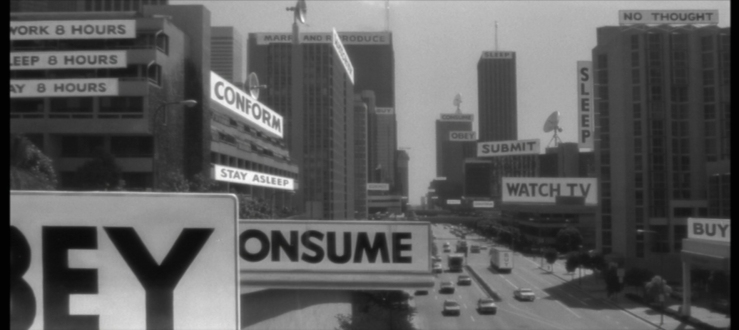
4. “The Subliminal Man” offers a critique of consumerism that John Carpenter would make with more humor, violence, and force in his 1988 film They Live (watch it online here). In Carpenter’s film, the hero John Nada (played by Roddy Piper) finds a pair of sunglasses that allow him to see through the ads, billboards, and other commercials he’s exposed. What’s underneath? Naked consumerism:
The images here recall the opening lines of “The Subliminal Man”: ‘The signs, Doctor! Have you seen the signs?’ Like Ballard’s story, Carpenter’s film is about waking up, to seeing the controlling messages under the surface.
In his film The Pervert’s Guide to Ideology, Slavoj Žižek offers a compelling critique of just how painfulit is to wake up to these messages:
It’s worth pointing out that Carpenter offers a far more optimistic vision than Ballard. Ballard’s hero gives in—goes back to sleep, shuts his eyes. Carpenter’s hero Nada resists the subliminal messages—he actually takes up arms against them. This active resistance is possible because Carpenter allows his narrative an existential escape hatch: In They Live, there are real, genuine bad guys, body-snatching ugly-assed aliens—others that have imposed consumerism on humanity to enslave them. That’s the big trick to They Live: It’s not us, it’s them.
Ballard understands that there is no them; indeed, even as the story skirts around the idea of a conspiracy to dupe consumers into cycles of nonstop buying, working, and disposing, it never pins that conspiracy on any individual or group. There’s no attack on corporations or government—there’s not even a nebulous “them” or “they” that appears to have controlling agency in “The Subliminal Man.” Rather, Ballard’s story posits ideology as the controlling force, with the only escape a kind of forced suicide.
5. By way of concluding—and, before I forget, obviously this story merits inclusion in the ideal collection I’ve been imagining, The Essential Short Stories of J.G. Ballard—by way of concluding I would return to my earlier point: I don’t think that those who engage in consumerism-as-sport, in shopping-as-a-feeling are quite as blind as Ballard or Carpenter represent. I think they are aware. Hell, they enjoy it. What I think Ballard and Carpenter (and others, of course) really point to is the deep dissatisfaction that many of us feel with this dominant mode of life. For Ballard, we have resistance in the form of the beatnik Hathaway, an artist, a creator, a person who can perceive what real leisure would mean. For Carpenter, Nada is the resister—an outsider, a loner, a weirdo too. It’s somehow far more satisfying to believe that those who engage in spectacle consumerism are brainwashed by aliens than it is to have to come to terms with the notion that these people are acting through their own agency, of their own will and volition. Happy shopping everyone!
That morning, the city was celebrating Consumer Thanksgiving Day. This feast came around every year, on a day in November, and had been set up to allow shoppers to display their gratitude toward the god Production, who tirelessly satisfied their every desire. The biggest department store in town organized a parade every year: an enormous balloon in the shape of a garishly colored doll was paraded through the main streets, pulled by ribbons that sequin-clad girls held as they marched behind a musical band. That day, the procession was coming down Fifth Avenue: the majorette twirled her baton in the air, the big drums banged, and the balloon giant, representing the Satisfied Customer, flew among the skyscrapers, obediently advancing on leashes held by girls in kepis, tassels, and fringed epaulets, riding spangly motorcycles.
At the same time, another parade was crossing Manhattan. The flaky, moldy moon was also advancing, sailing between the skyscrapers, pulled by the naked girls, and behind it came a line of beat-up cars and skeletons of trucks, amid a silent crowd that was gradually increasing in size. Thousands of people joined the throng that had been following the moon since the early hours of the morning, people of all colors, whole families with children of every age, especially as the procession filed past the crowded black and Puerto Rican areas of Harlem.



 Biblioklept