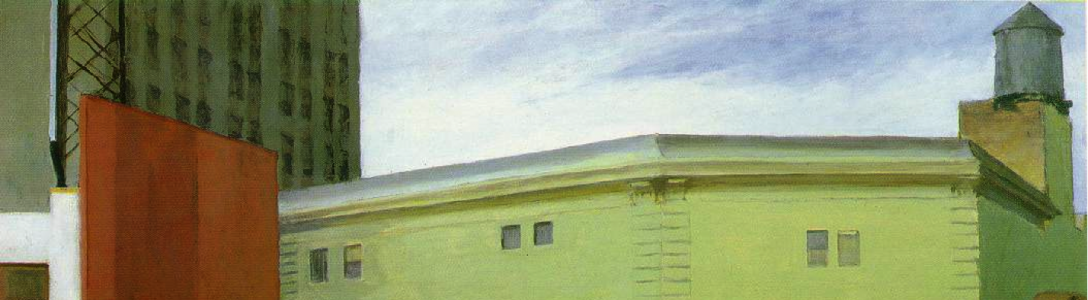
“Home Run” — Steven Millhauser

You can read along here…

“Ubazakura” –Lafcadio Hearn

“Ubazakura” –Lafcadio Hearn

Three hundred years ago, in the village called Asamimura, in the district called Onsengori, in the province of Iyo, there lived a good man named Tokubei. This Tokubei was the richest person in the district, and the muraosa, or headman, of the village. In most matters he was fortunate; but he reached the age of forty without knowing the happiness of becoming a father. Therefore he and his wife, in the affliction of their childlessness, addressed many prayers to the divinity Fudo Myo O, who had a famous temple, called Saihoji, in Asamimura.

At last their prayers were heard: the wife of Tokubei gave birth to a daughter. The child was very pretty; and she received the name of Tsuyu. As the mother’s milk was deficient, a milk-nurse, called O-Sode, was hired for the little one.


O-Tsuyu grew up to be a very beautiful girl; but at the age of fifteen she fell sick, and the doctors thought that she was going to die. In that time the nurse O-Sode, who loved O-Tsuyu with a real mother’s love, went to the temple Saihoji, and fervently prayed to Fudo-Sama on behalf of the girl. Every day, for twenty-one days, she went to the temple and prayed; and at the end of that time, O-Tsuyu suddenly and completely recovered.

Then there was great rejoicing in the house of Tokubei; and he gave a feast to all his friends in celebration of the happy event. But on the night of the feast the nurse O-Sode was suddenly taken ill; and on the following morning, the doctor, who had been summoned to attend her, announced that she was dying.

Then the family, in great sorrow, gathered about her bed, to bid her farewell. But she said to them:—

“It is time that I should tell you something which you do not know. My prayer has been heard. I besought Fudo-Sama that I might be permitted to die in the place of O-Tsuyu; and this great favor has been granted me. Therefore you must not grieve about my death… But I have one request to make. I promised Fudo-Sama that I would have a cherry-tree planted in the garden of Saihoji, for a thank-offering and a commemoration. Now I shall not be able myself to plant the tree there: so I must beg that you will fulfill that vow for me… Good-bye, dear friends; and remember that I was happy to die for O-Tsuyu’s sake.”


After the funeral of O-Sode, a young cherry-tree,—the finest that could be found,—was planted in the garden of Saihoji by the parents of O-Tsuyu. The tree grew and flourished; and on the sixteenth day of the second month of the following year,—the anniversary of O-Sode’s death,—it blossomed in a wonderful way. So it continued to blossom for two hundred and fifty-four years,—always upon the sixteenth day of the second month;—and its flowers, pink and white, were like the nipples of a woman’s breasts, bedewed with milk. And the people called it Ubazakura, the Cherry-tree of the Milk-Nurse.

“Rites of Melancholy” — W.G. Sebald

This realization of the impossibility of salvation matches the unrelated condition of melancholy which, in developing its own rituals, promises some relief but not release from suffering and the “feral deseases” so often mentioned in Robert Burton’s Anatomy of Melancholy. Among these rituals, in the narrator’s case, are the nocturnal reading of telephone directories and timetables, the unfolding of maps, and the making of plans for imaginary journeys to the most distant of lands, countries that might well lie beyond the sea shown in the background of Dürer’s Melencolia. Like Robert Burton, who was familiar with melancholy all his life, the narrator is a man “who delights in cosmography … but has never travelled except by map and card.” And the summer bed with room enough for seven sleepers where he meditates on stories such as that of the Black Death, with all its paths and coincidences, is of the same century as Burton’s compendium, an era of anxiety when the fear was first uttered “that the great mutations of the world are acted, or time may be too short for our designes.” The narrator’s digressive excursions from the starting point of this realization open up the view—again, a reminiscence from Hamlet—of a world lying far below melancholy, a “dead globe crawling with parasites” whose power of attraction is spent and forfeit. The icy sense of distance as the narrator turns away from all earthly life represents a vanishing point in the dialectic of melancholy. However, the other dimension of the Saturnian circumstances responsible for melancholy does point, as Benjamin has said and in the context of the heavy, dry nature of that planet, to the type of man predestined to hard and fruitless agricultural labor. It is probably no coincidence that the narrator’s only utilitarian occupation seems to be growing herbs. He sends these herbs, dried and in carefully adjusted mixtures, to various delicatessens in Milan and Amsterdam as well as to Germany, to Hamburg and Hannover. Perhaps they bear the words “Rosemary, that’s for remembrance” written in Ophelia’s hand.

From W.G. Sebald’s essay “Constructs of Mourning,” collected in Campo Santo.


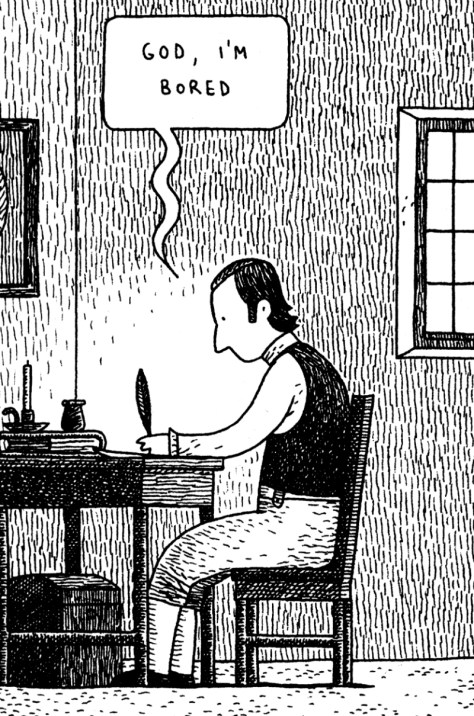
Bored (Tom Gauld)

bored

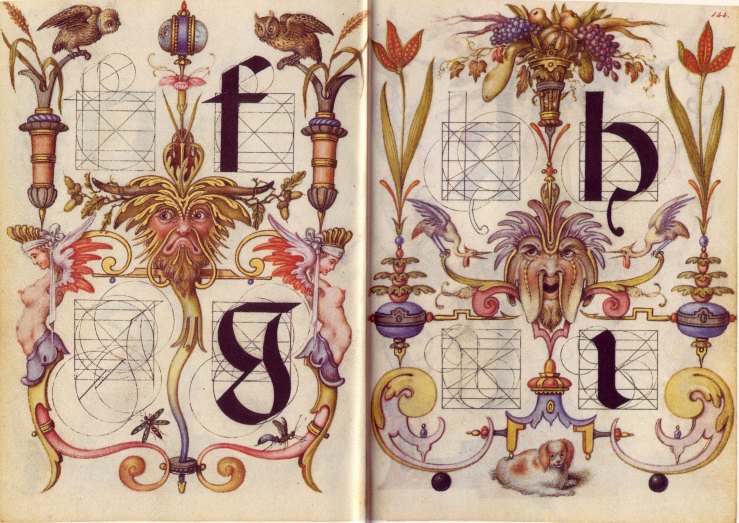
From Mira Calligraphiæ Monumenta — Joris Hoefnagel

hoefnagel2(Via/about/more).

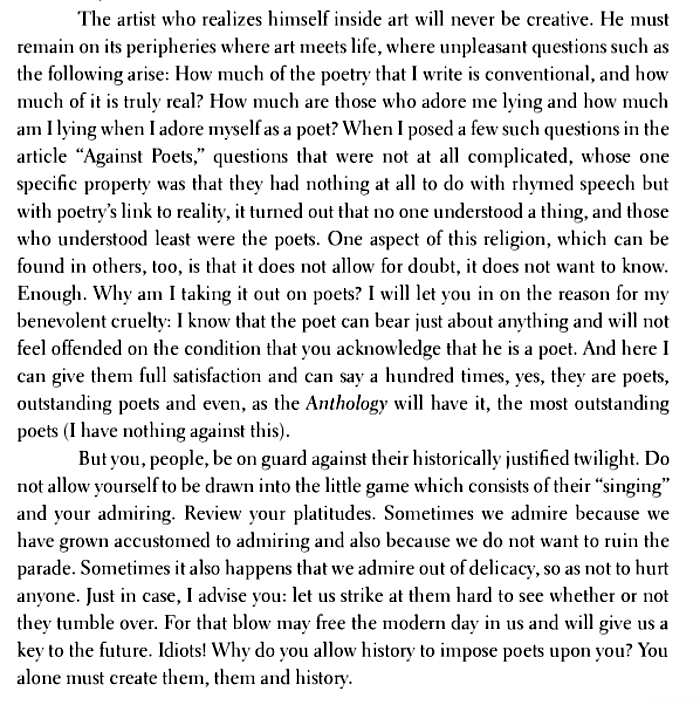
“The artist who realizes himself inside art will never be creative” (Witold Gombrowicz)

wg

“The Beloved,” A Short Surrealist Tale by Leonora Carrington

“The Beloved” by Leonora Carrington

ONE LATE afternoon, passing through a narrow street, I stole a melon. The fruit man who was hidden behind his fruits seized me by the arm and said to me: “Señorita, I’ve been waiting for an occasion like this for forty years. I have spent forty years hidden behind this pile of oranges with the hope that someone would steal a fruit from me. I will tell you why; I need to talk, I need to tell my story. If you don’t listen, I will hand you over to the police.”

“I’ll listen,’ I said. Without letting me go, he took me to the inside of the store, among fruits

Without letting me go, he took me to the inside of the store, among fruits and vegetables. We shut a door at the far end, and we reached a room where there was a bed on which an immovable and probably dead woman lay. It appeared to me that she had been there for a long time since the bed was covered with weeds.

“I water her every day,” said the fruitman with a pensive air. “In 40 years I have not succeeded in knowing whether she is dead or not. She has never moved, nor spoken, nor eaten during that time. But the curious thing is that she remains warm. If you don’t believe me, look.”

The man lifted a corner of the cover, which permitted me to see many eggs and some little chicks recently hatched.

“As you notice,” he said, “I incubate eggs here. I also sell fresh eggs.”

We each sat down on one side of the bed and the fruit man began to tell his story.

“Believe me; I love her so much! I have always loved her! She was so sweet! She had little agile white feet. Would you like to see them?”

“No,” I answered.

“Finally,” he continued, after exhaling a deep breath, “she was so beautiful! My hair was blonde; hers, magnificently black! Now, both of us have white hair. Her father was an extraordinary man. He had a mansion in the country. He was a collector of lamb chops. For that we came to know each other. I have a certain skill in drying meat with a glance. Mr. Pushfoot (so he was called) heard about me. He invited me to his house in order to dry his ribs to keep them from rotting. Agnes was his daughter. We loved each other from the first moment. We departed in a boat by way of the Seine. I rowed. Agnes said to me: ‘I love you so much that I only live for you.’ I answered her with the same words. I believe that it is my love which keeps her warm, perhaps she is dead, but the warmth persists.”

After a short pause, with an absent look, he continued: “Next year I will grow some tomatoes; it wouldn’t surprise me if they would grow well there inside … It became night, and I didn’t know where we would spend our wedding night. Agnes had become very pale, because of fatigue. Finally we had scarcely left Paris behind when I saw an inn that faced the river. I moored the boat and we walked toward an obscure and sinister terrace. There were two wolves there and a fox, who began to walk around us. There was nobody else … I knocked and knocked at the door, on the other side of which a terrible silence prevailed. ‘Agnes is tired! Agnes is very tired!’ I shouted with as much force as I could. Finally, an old lady’s head appeared at the window and said: ‘I don’t know anything. The landlord here is the fox. Let me sleep. You are bothering me.’ Agnes began to cry. There was no other remedy than to direct ourselves to the fox. ‘Have you beds?’ I asked several times. Nobody responded: he didn’t know how to speak. And again the head, older than the other, but which now descended slowly through the window tied to the end of a little cord. ‘Direct yourself to the wolves; I am not the landlord here. Let me sleep! please!’ I understood that that head was crazy and I did not have the heart to continue. Agnes kept crying. I walked around the house a few times and finally, I was able to open a window, through which we entered. Then we found ourselves in a kitchen with a high ceiling; over a large oven made hot by fire were some vegetables that were cooking and they jumped in the boiling water, a thing that much amused us. We ate well and then we laid ourselves down on the floor. I had Agnes in my arms. We did not sleep. That terrible kitchen contained all kinds of things. Many rats had stuck their heads out of their holes and then sang with screeching and disagreeable little voices. Filthy odors expanded and diminished one after the other, and there were air drafts. I believe that it was the air drafts that finished my poor Agnes. She never recovered. From that day, each time she spoke less . . .”

And the fruitman was so blinded by tears that I could escape with my melon.

In These Times the Home Is a Tired Place (Book Acquired, Some Time in Late October)

20131027-125420.jpg

Jessica Hollander’s story collection In These Times the Home Is a Tired Place is good stuff. It came in last month with several other books I was psyched about, so I’ve only gotten to the first three stories here, along with the title story (I’m a sucker for anything resembling a list), but they’ve made me want to read the other fifteen stories. Full review forthcoming.

Here’s Katherine Dunn (Geek Love) on In These Times the Home Is a Tired Place:

These are human tales of vigorously individual characters living with intensity. The author’s ear for revealing dialogue and double-edged humor ground these stories in a reality worth enduring. The characters connect despite suspicion and betrayal, beyond blood, circumstance or embarrassment at their own ridiculous humanity. Each piece is powered by a deep, slow boiling jubilation in the moment-to-moment, line-by-line fact of taking breath.

And here’s the first part of the title story (you can and should read the rest of it at Conjunctions):

1. Only one dream the mother remembered: driving, dead bodies on the road, the word PAPER large and black on a billboard. Sometimes she made up different dreams when she woke panicked in the gray morning, imagining an airport chase, a lake drowning—but they weren’t really hers, only dreams she believed she should have instead of always the one: driving through death and the urge to pull over.

2. The girl spent a Saturday morning cutting snowflakes from a pile of paper she’d found on her mother’s desk. The snowflakes were peppered with sliced negotiations, diamond-pierced words like child and property and alimony, and when the girl finished she strung the flakes together and hung them from her window so they trailed to the berry bush and flapped in the stirred summer wind.

3. Screamed in the kitchen one night. Too many cooks in the saucepan. Too little wine. Granite counters crusted with crushed tomato, sea salt, sausage casing, but no food besides the steaming meal bleeding over the bin. The girl sent to her room— Now. The father’s recipes stacked and chopped to pieces and confettied across the tile. Division always makes less unless one was a fraction to begin with. “Divide by me,” the father said. “Then we both come out ahead.”

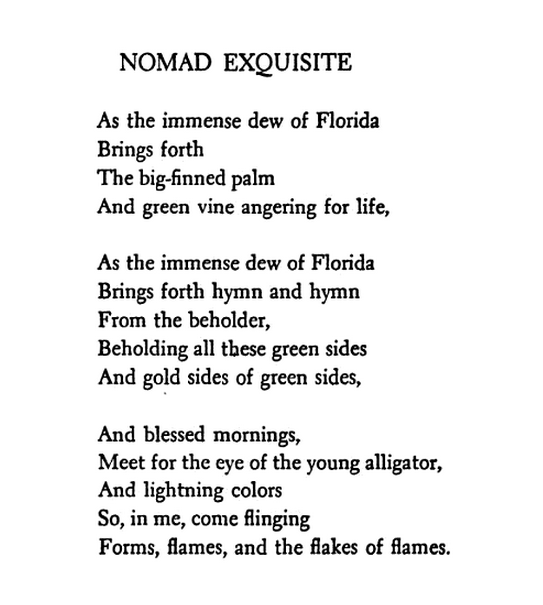
“Nomad Exquisite” — Wallace Stevens

nomad

Don Quixote — Albert Bloch

“Mankind is accursed because our existence on this earth does not tolerate any well-defined and stable hierarchy” (Witold Gombrowicz)

Memories! Mankind is accursed because our existence on this earth does not tolerate any well-defined and stable hierarchy, everything continually flows, spills over, moves on, everyone must be aware of and be judged by everyone else, and the opinions that the ignorant, dull, and slow-witted hold about us are no less important than the opinions of the bright, the enlightened, the refined. This is because man is profoundly dependent on the reflection of himself in another man’s soul, be it even the soul of an idiot. I absolutely disagree with my fellow writers who treat the opinions of the dull-witted with an aristocratic haughtiness and declare: odi profanum vulgus. What a cheap and simplistic way of avoiding reality, what a shoddy escape into specious loftiness! I maintain, on the contrary, that the more dull and narrow-minded they are, the more urgent and compelling are their opinions, just as an ill-fitting shoe hurts us more than a well-fitting one. Oh, those judgments, the bottomless pit of people’s judgments and opinions about your wisdom, feelings, and character, about all the details of your personality—it’s a pit that opens up before the daredevil who drapes his thoughts in print and lets them loose on paper, oh, printed paper, paper, paper! And I’m not even talking about the heartfelt opinions so fondly held by our aunts, no, I mean the opinions of those other aunts—the cultural aunts, those female semi-writers and tacked-on semi-critics who make pronouncements in literary magazines. Indeed, world culture has been beset by a flock of superfluous hens patched-on, pinned-on, to literature, who have become finely tuned to spiritual values and well versed in aesthetics, frequently entertaining views and opinions of their own, who have even caught on to the notions that Oscar Wilde is passé and that Bernard Shaw is a master of paradox. Oh, they are on to the fact that they must be independent, profound, unobtrusively assertive, and filled with auntie kindliness. Auntie, auntie, auntie! Unless you have ever found yourself in the laboratory of a cultural aunt and been dissected, mute and without a groan, by her trivializing mentality that turns all life lifeless, unless you have ever seen an auntie’s critique of yourself in a newspaper, you have no concept of triviality, and auntie-triviality in particular.

Further, let us consider the opinions of men and women of the landed gentry, the opinions of schoolgirls, the narrow-minded opinions of minor office clerks, the bureaucratic opinions of high officials, the opinions of lawyers in the provinces, the hyperbolic opinions of students, the arrogant opinions of little old men, and the opinions of journalists, the opinions of social activists as well as the opinions of doctors’ wives, and, finally, the opinions of children listening to their parents’ opinions, the opinions of underling chambermaids and of cooks, the opinions of our female cousins, the opinions of schoolgirls—a whole ocean of opinions, each one defining you within someone else, and creating you in another man’s soul. It’s as if you were being born inside a thousand souls that are too tight-fitting for comfort!

From Witold Gombrowicz’s novel Ferdydurke.


Slavoj Žižek on Atheism and Christianity

“The Adopted Son” — Guy de Maupassant

“The Adopted Son” by Guy de Maupassant

The two cottages stood beside each other at the foot of a hill near a little seashore resort. The two peasants labored hard on the unproductive soil to rear their little ones, and each family had four.

Before the adjoining doors a whole troop of urchins played and tumbled about from morning till night. The two eldest were six years old, and the youngest were about fifteen months; the marriages, and afterward the births, having taken place nearly simultaneously in both families.

The two mothers could hardly distinguish their own offspring among the lot, and as for the fathers, they were altogether at sea. The eight names danced in their heads; they were always getting them mixed up; and when they wished to call one child, the men often called three names before getting the right one.

The first of the two cottages, as you came up from the bathing beach, Rolleport, was occupied by the Tuvaches, who had three girls and one boy; the other house sheltered the Vallins, who had one girl and three boys.

They all subsisted frugally on soup, potatoes and fresh air. At seven o’clock in the morning, then at noon, then at six o’clock in the evening, the housewives got their broods together to give them their food, as the gooseherds collect their charges. The children were seated, according to age, before the wooden table, varnished by fifty years of use; the mouths of the youngest hardly reaching the level of the table. Before them was placed a bowl filled with bread, soaked in the water in which the potatoes had been boiled, half a cabbage and three onions; and the whole line ate until their hunger was appeased. The mother herself fed the smallest.

A small pot roast on Sunday was a feast for all; and the father on this day sat longer over the meal, repeating: “I wish we could have this every day.”

One afternoon, in the month of August, a phaeton stopped suddenly in front of the cottages, and a young woman, who was driving the horses, said to the gentleman sitting at her side:

“Oh, look at all those children, Henri! How pretty they are, tumbling about in the dust, like that!”

The man did not answer, accustomed to these outbursts of admiration, which were a pain and almost a reproach to him. The young woman continued:

“I must hug them! Oh, how I should like to have one of them—that one there—the little tiny one!”

Springing down from the carriage, she ran toward the children, took one of the two youngest—a Tuvache child—and lifting it up in her arms, she kissed him passionately on his dirty cheeks, on his tousled hair daubed with earth, and on his little hands, with which he fought vigorously, to get away from the caresses which displeased him.

Then she got into the carriage again, and drove off at a lively trot. But she returned the following week, and seating herself on the ground, took the youngster in her arms, stuffed him with cakes; gave candies to all the others, and played with them like a young girl, while the husband waited patiently in the carriage.

She returned again; made the acquaintance of the parents, and reappeared every day with her pockets full of dainties and pennies.

Her name was Madame Henri d’Hubieres. Continue reading ““The Adopted Son” — Guy de Maupassant”

John Huston’s Film Adaptation of Under the Volcano (Full Film)

(Here’s my review of Malcolm Lowry’s novel Under the Volcano).

Love (Peanuts)

love

Under the Volcano, Malcolm Lowry’s Antipodal Odyssey of Despair

Most of Malcolm Lowry’s dense, depressing novel Under the Volcano takes place over the course of November 2nd, 1938, the Mexican Day of the Dead. Like a reticent, dour Virgil, Lowry guides the reader through the day’s tragic arc, floating between the minds of his novel’s three protagonists: Geoffrey Firmin, his half-brother Hugh, and Geoffrey’s estranged wife Yvonne. Geoffrey is British Consul to Mexico — ex-Consul, really, as British-Mexican relations sour against the backdrop of Spanish fascism and the rise of nationalism in Mexico — but he is almost always referred to as “the Consul,” a blackly ironic title. See, the Consul bears little authority aside from an extreme expertise on how to stay drunk (or “drunkly sober un-drunk”) 24/7. He’s ambassador to bar stools, a manager of mescal and little else (certainly not his own life; certainly not diplomatic affairs). The Consul is a wreck, an alcoholic to put Hemingway and Fitzgerald’s (and even Bukowski’s) alter-egos to shame.

After a first chapter that seems to derail all but the most patient readers, the narrative conflict arrives when Yvonne returns to Quauhnahuac, Mexico, a year after leaving (and divorcing) the Consul. She arrives to find the Consul (“Geoffrey,” as he’s called when the free indirect style inhabits her mind) drinking whiskey in a hotel bar in order to sober up (yep). It’s not immediately clear why Yvonne has returned to the Consul, but it seems that she hopes to save him from drowning in a drunken downward spiral. As the pair walks to the Consul’s house, they pass numerous advertisements for a boxing match; a child’s funeral proceeds down the avenue. These motifs of fighting, death, and futility permeate the novel.

During the walk we learn that Yvonne is not the only one concerned about the Consul’s health; his (much) younger brother Hugh has come to stay with him in the hopes of sobering him up. (Hugh employs a revolting and unsuccessful “strychnine cure”). That Hugh has also returned doubly complicates the plot. Much of Under the Volcano remains implicit, unnamed, hinted at, and this seems especially true of the implication that Yvonne cheated on the Consul with Hugh in the recent past (this implication may have been stated conclusively at some point in the novel, but I’ve only read the book once, which is perhaps like not having read it at all). What’s certainly clear is that Yvonne cheated on the Consul with a French filmmaker, Jacques Laruelle, a man whom the Consul, through sheer bizarre coincidence (but of course it isn’t sheer bizarre coincidence), spent a childhood summer with, an experience which bonded them as brothers in an Edenic holiday that eventually (inevitably) soured.

Despite her infidelities, Yvonne is generally present (I choose the verb “present” over “presented as” to highlight Lowry’s impeccable Modernist style) as a sympathetic character. Still, it is hard not to identify with the Consul (with “Geoffrey,” I suppose, if we are going to be familiar), the dark soul of this novel, and his complicated, painful feelings for Yvonne form the core of Volcano’s tragedy. He longs for her, pines for a complete life with her, yet resents her, cannot forgive her, hates her. For what? For leaving him. For betraying him. But perhaps foremost, he despises her inability to understand his alcoholism (he is particularly upset when she refuses to share a morning libation with him when they meet for the first time in a year). I’ll quote a passage at length now, one that showcases Lowry’s free indirect style, and one that reveals the strange indignities of the Consul’s sense of his own alcoholism. For context, dear reader, you must only know that Yvonne has suggested that she and the Consul might make long-term plans when he is sober “in a day or two”—

The Consul sat perfectly still staring at the floor while the enormity of the insult passed into his soul. As if, as if, he were not sober now! Yet there was some elusive subtlety in the impeachment that still escaped him. For he was not sober. No, he was not, not at this very moment he wasn’t! But what had that to do with a minute before, or half an hour ago? And what right had Yvonne to assume it, assume either that he was not sober now, or that, far worse, in a day or two he would be sober? And even if he were not sober now, by what fabulous stages, comparable indeed only to the paths and spheres of the Holy Cabbala itself, had he reached this stage again, touched briefly once before this morning, this stage at which alone he could, as she put it, “cope,” this precarious precious stage, so arduous to maintain, of being drunk in which alone he was sober! What right had she, when he had sat suffering the tortures of the damned and the madhouse on her behalf for fully twenty-five minutes on end without having a decent drink, even to hint that he was anything but, to her eyes, sober? Ah, a woman could not know the perils, the complications, yes, the importance of a drunkard’s life! From what conceivable standpoint of rectitude did she imagine she could judge what was anterior to her arrival? And she knew nothing whatever of what all too recently he had gone through, his fall in the Calle Nicaragua, his aplomb, coolness, even bravery there—the Burke’s Irish whiskey! What a world! And the trouble was she had now spoiled the moment.

The “fall in the Calle Nicaragua” the Consul references is quite literally a drunkard’s blackout (followed by the aforementioned fortifying whiskey, courtesy of a tourist), but it — falling — is perhaps the dominant motif in a novel crammed with motifs. In allegorical terms, if we want to ruin a good book (I don’t recommend this, of course), Volcano is pure Faust-stuff: end of innocence, fall of man, intractability of the human condition, ethical peril, moral inertia. While the Consul’s fall dominates the novel, Lowry brings this decline into dramatic relief in a late, climactic episode when his (anti-)heroic trio encounter a dying (dead?) man on the side of the road. Hugh tries to help, but the Darwinian venality of Mexican commonplace law makes his attempt impotent. Yvonne and the Consul are basically paralyzed.

Hugh’s attempt to save the man is a desperate call to action, an endeavor to perform some good in a world dominated by war and fascism. Hugh’s character fascinates. We learn of his past in one of the novel’s most intriguing episodes, a mini-bildungsroman that finds young Hugh working in the merchant marine as a calculated ploy to lend romance to his persona — he longs to prevail as a songwriter. He returns to find that no one cares about — has even heard — his guitar compositions; his publicity stunt fails. Although Hugh is only twenty-nine, he already seems himself as a failure, a fallen hero; he obsesses over the Battle of Ebro, daydreaming of helming a ship laden with hidden arms that he will deliver to the Loyalists who oppose the Fascists. Hugh’s greatest pain — and perhaps (only perhaps) Lowry’s greatest cruelty — is the awareness that the idealism of romantic heroism is intrinsically bound to a kind of selfish egoism. Hugh, perhaps with the visceral signal of his half-brother as a kind of radical prescience, can already see his own fall; his parts in Volcano are in a sense a constant meditation on falling. Hugh tries to save the dying man on the road, the cold double of his brother, whom he also tries to save — and yet it is all to little avail.

In Lowry’s world, in the volcano-world, there is only expulsion from the Eden. Lowry spells out this theme near the middle of his novel in a strange episode. The Consul wanders into his neighbor’s garden and reads a sign —

¿LE GUSTA ESTE JARDÍN?
¿QUE ES SUYO?
¡EVITE QUE SUS HIJOS LO DESTRUYAN!

The Consul stared back at the black words on the sign without moving. You like this garden? Why is it yours? We evict those who destroy! Simple words, simple and terrible words, words which one took to the very bottom of one’s being, words which, perhaps a final judgement on one, were nevertheless unproductive of any emotion whatsoever, unless a kind of colourless cold, a white agony, an agony chill as that iced mescal drunk in the Hotel Canada on the morning of Yvonne’s departure.

Significantly, either the sign is posted with improper punctuation, or (and?) the Consul’s translation is wrong — in either case a meaningful misreading occurs. We later receive the “proper” version of the sign: “¿Le gusta este jardín, que es suyo? ¡Evite que sus hijos lo destruyan! – “Do you like this garden that is yours? See to it that your children do not destroy it!”  The Consul’s first reading is a corruption, a cruel misreading that questions humanity’s right to happiness, and, tellingly, he connects the sign to the end of his relationship with Yvonne. The second version of the sign, while still foreboding, perhaps signals a kernel of hope in Lowry’s bleak work — the idea that a garden might be preserved, might be tended to; that children might be raised who do not kill, cheat, steal, rape, enslave, or otherwise prey on each other. Still, Lowry refuses to imagine what such a world might look like for us. Did I mention that Volcano is really, really sad?

For all its bleak, bitter bile, Volcano contains moments of sheer, raw beauty, especially in its metaphysical evocations of nature, which always twist back to Lowry’s great themes of Eden, expulsion, and death. Lowry seems to pit human consciousness against the naked power of the natural world; it is no wonder then, against such a grand, stochastic backdrop, that his gardeners should fall. The narrative teems with symbolic animals — horses and dogs and snakes and eagles — yet Lowry always keeps in play the sense that his characters bring these symbolic identifications with them. The world is just the world until people walk in it, think in it, make other meanings for it.

In many ways, Under the Volcano is an antipodal response to Joyce’s Ulysses. Both novels stream through a number of consciousnesses over the course of one day; both novels invert and subvert mythical frameworks against diurnal concerns; both novels point to the ways that the smallest meannesses — and kindnesses — can color and affect our lives. And while there are many divergences (chiefest, I believe, the spirit of redemption in Ulysses that seems entirely absent from Volcano), the greatest similarity may be their difficulty. Simply put, Lowry, like Joyce, throws his readers into the deep end. The first chapter of the novel inhabits the mind of Jacques Laruelle and takes place exactly one year after the events of the rest of the novel. It is both overture and context for all that follows, and yet it is radically alienating; indeed, it only fully makes sense after one finishes the novel and goes back and reads it again, realizing it is the rightful coda, the sad epilogue of a sad story. Lowry leads with his conclusion, show us the fall-out up front, the splinters and shards of the narrative to come. Picking up these pieces is hardly easy and never joyful, but it is a rewarding experience. Very highly recommended.

[Editorial note: Biblioklept ran a version of this review in March of 2011; we run it again in honor of The Day of the Dead]

Fantastical Fictive Beers

big