All great literary men are shy. I am myself, though I am told it is hardly noticeable.
I am glad it is not. It used to be extremely prominent at one time, and was the cause of much misery to myself and discomfort to every one about me—my lady friends especially complained most bitterly about it.
A shy man’s lot is not a happy one. The men dislike him, the women despise him, and he dislikes and despises himself. Use brings him no relief, and there is no cure for him except time; though I once came across a delicious recipe for overcoming the misfortune. It appeared among the “answers to correspondents” in a small weekly journal and ran as follows—I have never forgotten it: “Adopt an easy and pleasing manner, especially toward ladies.”
Poor wretch! I can imagine the grin with which he must have read that advice. “Adopt an easy and pleasing manner, especially toward ladies,” forsooth! Don’t you adopt anything of the kind, my dear young shy friend. Your attempt to put on any other disposition than your own will infallibly result in your becoming ridiculously gushing and offensively familiar. Be your own natural self, and then you will only be thought to be surly and stupid.
The shy man does have some slight revenge upon society for the torture it inflicts upon him. He is able, to a certain extent, to communicate his misery. He frightens other people as much as they frighten him. He acts like a damper upon the whole room, and the most jovial spirits become in his presence depressed and nervous.
This is a good deal brought about by misunderstanding. Many people mistake the shy man’s timidity for overbearing arrogance and are awed and insulted by it. His awkwardness is resented as insolent carelessness, and when, terror-stricken at the first word addressed to him, the blood rushes to his head and the power of speech completely fails him, he is regarded as an awful example of the evil effects of giving way to passion.
But, indeed, to be misunderstood is the shy man’s fate on every occasion; and whatever impression he endeavors to create, he is sure to convey its opposite. When he makes a joke, it is looked upon as a pretended relation of fact and his want of veracity much condemned. His sarcasm is accepted as his literal opinion and gains for him the reputation of being an ass, while if, on the other hand, wishing to ingratiate himself, he ventures upon a little bit of flattery, it is taken for satire and he is hated ever afterward. Continue reading ““On Being Shy” — Jerome K. Jerome”→
“For me, the litmus test is always language,” George Saunders told Charlie Rose in a recent interview. “If the sentences are kind of jangly and interesting, then I know how to proceed.”
Saunders composes stories syntactically: his themes and plots and characters emerge from the right jangle, the right discordant note that simultaneously pleases and disturbs. This technique shows in his latest collection Tenth of December, a showcase for Saunders’s estimable verbal prowess and a reminder that he is one of America’s preeminent satirists.
Tenth of December also reveals some of Saunders’s limitations, the biggest of which is that he seems to write the same few stories again and again. Granted, these stories are sharp, funny, puncturing criticisms of American life—satires of corpocracy and the ways commerce infests language (and hence thought); satires of how late capitalism engenders cycles of manufactured desire and very-real despair; satires, ultimately, of how we see ourselves seeing others seeing us in ways that we don’t wish to be seen. Perhaps Saunders writes the same plots repeatedly because he thinks we need to read them repeatedly—and there’s certainly pleasure and humor and pathos in Tenth of December—but there isn’t any territory explored here that would be unfamiliar to anyone who read CivilWarLand in Bad Decline or Pastoralia.
Take “Escape from Spiderhead,” one of the stronger entries in December. This is pure Saundersville, a story nudging weirdly into a skewed future that might come too-true too soon. Said spiderhead is a prison command center where wardens subject their inmates to language and desire experiments, using drugs like “Verbaluce™, VeriTalk™, ChatEase™” (lord does Saunders love incaps) to manipulate the prisoners’ minds and bodies alike (all with consent, of course).
The story is a biting and often painful exploration of how our desires and actions might be constrained and controlled by others. It’s also an excellent excuse for Saunders to flex some of those verbal muscles of his:
He added some Verbaluce™ to the drip, and soon I was feeling the same things but saying them better. The garden still looked nice. It was like the bushes were so tight-seeming and the sun made everything stand out? It was like any moment you expected some Victorians to wander in with their cups of tea. It was as if the garden had become a sort of embodiment of the domestic dreams forever intrinsic to human consciousness. It was as if I could suddenly discern, in this contemporary vignette, the ancient corollary through which Plato and some of his contemporaries might have strolled; to wit, I was sensing the eternal in the ephemeral.
“Escape from Spiderhead” is one of several tales in Decemberthat ultimately posit selflessness and empathy as a metaphysical escape hatch, an out to all the post-postmodern awful. It’s a near-perfect little story, which is why it’s too bad when Saunders essentially repeats it (right down to the Verbaluce™/amplified language conceit) in “My Chivalric Fiasco.” (Perhaps “My Chivalric Fiasco” was necessary though; it provides the sole “weird theme park” story requisite to any Saunders collection).
An equal to “Spiderhead” is “The Semplica Girl Diaries,” the collection’s strongest condemnation of how capitalism engenders bizarre ethical positions within families, between neighbors—and even countries. The longest story in the collection, “The Semplica Girl Diaries” purports to be a harried middle class father’s diary, a conceit which gives Saunders plenty of space to jangle.
Our poor narrator just wants to keep up with the Joneses, a serious character flaw that often results in hilarious hyperbole. He takes his family to the birthday party of his daughter’s classmate. This classmate’s family is wealthy, perfect, glowing, healthy, innovative, happy:
Just then father (Emmett) appears, holding freshly painted leg from merry-go-round horse, says time for dinner, hopes we like sailfish flown in fresh from Guatemala, prepared with a rare spice found only in one tiny region of Burma, which had to be bribed out, and also he had to design and build a special freshness-ensuring container for the sailfish.
Set against such a pristine backdrop our hapless narrator’s own life seems stressful and shabby:
Household in freefall, future reader. Everything chaotic. Kids, feeling tension, fighting all day. After dinner, Pam caught kids watching “I, Gropius,” (forbidden) = show where guy decides which girl to date based on feeling girls’ breasts through screen with two holes. (Do not actually show breasts. Just guy’s expressions as he feels them and girl’s expression as he feels them and girl’s expression as guy announces his rating. Still: bad show.) Pam blew up at kids: We are in most difficult period ever for family, this how they behave?
I love how Saunders works I, Gropius in there—his dystopian touches work best when they are simultaneously over-the-top (idea) and graceful (delivery of idea). These moments of humor don’t deflate the extreme anxieties that “The Semplica Girl Diaries” produces; rather, the humorous, hyperbolic eruptions add to what turns out to be a horror story.
Like the narrator of “The Semplica Girl Diaries,” the eponymous would-be hero of “Al Roosten” is painfully attuned to how others might/do see him. “Al Roosten” is one of several of December’s exercises in how we see others seeing us (set against the backdrop of how we desire others to see us, etc.). The story starts at a charity auction where local businessmen are being auctioned off (including Roosten’s rival Donfrey—an echo of Emmett) and then heads precisely nowhere (or rather, remains entirely in poor Roosten’s skull). First paragraph:
Al Roosten stood waiting behind the paper screen. Was he nervous? Well, he was a little nervous. Although probably a lot less nervous than most people would be. Most people would probably be pissing themselves by now. Was he pissing himself? Not yet. Although, wow, he could understand how someone might actually—
That sentence-interrupting final dash precedes the intrusion of the “real,” phenomenological world into Roosten’s consciousness. There’s much of James Thurber’s “Walter Mitty” in “Al Roosten”—and, indeed, much of Mitty in Saunders generally—perhaps because Saunders’s jangles lead him to explore the strange gaps between thought and action, reality and imagination. It’s worth sharing a few paragraphs of Saunders’s technique:
Frozen in the harsh spotlight, he looked so crazy and old and forlorn and yet residually arrogant that an intense discomfort settled on the room, a discomfort that, in a non-charity situation, might have led to shouted insults or thrown objects but in this case drew a kind of pity whoop from near the salad bar.
Roosten brightened and sent a relieved half wave in the direction of the whoop, and the awkwardness of this gesture—the way it inadvertently revealed how terrified he was—endeared him to the crowd that seconds before had been ready to mock him, and someone else pity-whooped, and Roosten smiled a big loopy grin, which caused a wave of mercy cheers.
Roosten was deaf to the charity in this. What a super level of whoops and cheers. He should do a flex. He would. He did. This caused an increase in the level of whoops and cheers, which, to his ear, were now at least equal in volume to Donfrey’s whoops/cheers. Plus Donfrey had been basically naked. Which meant that technically he’d beaten Donfrey, since Donfrey had needed to get naked just to manage a tie with him, Al Roosten. Ha ha, poor Donfrey! Running around in his skivvies to no avail.
We can note here the transitions between what the world sees (in those first two paragraphs) to how Roosten sees the world seeing him. This is Saunders at perhaps his finest, showcasing a meticulous control of free indirect style; Roosten is simultaneously pathetically endearing and loathsome. He is attractive and repellent precisely because we understand him—what it is to see him, but also what it is to be seen in the way he is being seen.
The titular story, which closes the collection, also offers a Walter Mittyish figure, a “pale boy with unfortunate Prince Valiant bangs and cublike mannerisms” who sneaks off into the woods to fantasize about the Lilliputian “Nethers” who might try to kidnap his crush Suzanne (whom he’s never addressed, of course). “Somewhere there is a man who likes to play and hug, Suzanne said,” the poor boy imagines. Again, this is Saundersville, where we laugh out loud and then reprimand ourselves for our cruelty and then engage, empathize, say, Hey kid, I’ve been there too…
“Tenth of December” is a sort of rewrite of two stories from Pastoralia, “The End of FIRPO in the World” and “The Falls.” I suppose I don’t mind, but I wish that Saunders’s jangles might lead him to new plots. Despite its rehashing of these earlier stories, “Tenth of December” delivers possibly the strongest case for empathy-as-transcendence in the collection. Our boy gets a shot at actually living up to his haircut—he’ll valiantly help a suicidal terminally ill man, who will, in turn, help him. What the story illustrates best though is how impulse precedes action and action precedes thought, how action can be shot through with memory:
He was on his way down before he knew he’d started. Kid in the pond, kid in the pond, ran repetitively through his head as he minced. Progress was tree to tree. Standing there panting, you got to know a tree well. This one had three knots: eye, eye, nose. This started out as one tree and became two.
Suddenly he was not purely the dying guy who woke nights in the med bed thinking, Make this not true make this not true, but again, partly, the guy who used to put bananas in the freezer, then crack them on the counter and pour chocolate over the broken chunks, the guy who’d once stood outside a classroom window in a rainstorm to see how Jodi was faring with that little red-headed shit who wouldn’t give her a chance at the book table, the guy who used to hand-paint birdfeeders in college and sell them on weekends in Boulder, wearing a jester hat and doing a little juggling routine he’d—
There’s that dash again. Dare I liken it to the dashes of Poe, of Dickinson? Maybe, maybe not.
I’ve shared some highlights of December, which I believe outweigh its weaker spots, unremarkable pieces like “Puppy,” a transparent exercise in how class in America inheres through a system of seeing/not-seeing others, or “Exhortation,” an amusing but forgettable memorandum that reads like Saunders-doing-Saunders.
“Home” is really the only story I would’ve left out of December. It’s the story of a war veteran trying to reintegrate into a society that flatly reiterates “Thank you for your service” while doing precisely nothing to actually thank the vet. Saunders’s sentiments are clearly in the right place, but the story rings false and hollow, its authorial anger overriding the humanity of its characters. At its worst moments, “Home” gives us a world of shuffling grotesques whose quirks preëmpt any possibility for genuine pathos. Saunders, usually in command of language, seems strained here. And it’s not a strain of venturing into new territory; no, all of Saunders’s tricks and traps are on display here (including an unexplained/unexplored substance called MiiVOXmax). Perhaps that’s the problem. Perhaps there’s too much of the author in the story.
And maybe that’s why I like the short, visceral two-paragraph perfection of “Sticks” so much–it seems freer, sharper. At fewer than four hundred words it’s easily the shortest piece in the collection (and the shortest thing I’ve read by Saunders). “Sticks” condenses the harried middle class hero of almost every Saunders tale into one ur-Dad, stunning, sad, majestic. It’s also the oldest story in the collection, originally published by Harper’s in 1995, which means it predates the publication of all his other collections. I don’t know why Saunders included it in December but I’m glad he did. It breaks up some of his rut.
That rut, by the way, is a pleasure to roll through—a fast, funny pleasure, but a pleasure nonetheless. Saunders is very good at highlighting our culture’s ugly absurdities, and he usually does so with moving pathos. And if his jangly sentences are their own raison d’être, then so be it. They are harmonious and sour, soaring and searing. Recommended.
“Ye have heard that it hath been said, an eye for an eye and a tooth for a tooth: but I say unto you, That ye resist not evil.”—ST. MATTHEW V. 38, 39.
It was in the time of serfdom—many years before Alexander II.’s liberation of the sixty million serfs in 1862. In those days the people were ruled by different kinds of lords. There were not a few who, remembering God, treated their slaves in a humane manner, and not as beasts of burden, while there were others who were seldom known to perform a kind or generous action; but the most barbarous and tyrannical of all were those former serfs who arose from the dirt and became princes.
It was this latter class who made life literally a burden to those who were unfortunate enough to come under their rule. Many of them had arisen from the ranks of the peasantry to become superintendents of noblemen’s estates.
The peasants were obliged to work for their master a certain number of days each week. There was plenty of land and water and the soil was rich and fertile, while the meadows and forests were sufficient to supply the needs of both the peasants and their lord.
There was a certain nobleman who had chosen a superintendent from the peasantry on one of his other estates. No sooner had the power to govern been vested in this newly-made official than he began to practice the most outrageous cruelties upon the poor serfs who had been placed under his control. Although this man had a wife and two married daughters, and was making so much money that he could have lived happily without transgressing in any way against either God or man, yet he was filled with envy and jealousy and deeply sunk in sin.
Michael Simeonovitch began his persecutions by compelling the peasants to perform more days of service on the estate every week than the laws obliged them to work. He established a brick-yard, in which he forced the men and women to do excessive labor, selling the bricks for his own profit.
On one occasion the overworked serfs sent a delegation to Moscow to complain of their treatment to their lord, but they obtained no satisfaction. When the poor peasants returned disconsolate from the nobleman their superintendent determined to have revenge for their boldness in going above him for redress, and their life and that of their fellow-victims became worse than before. Continue reading ““The Candle” — Leo Tolstoy”→
In the department of—but it is better not to mention the department. There is nothing more irritable than departments, regiments, courts of justice, and, in a word, every branch of public service. Each individual attached to them nowadays thinks all society insulted in his person. Quite recently a complaint was received from a justice of the peace, in which he plainly demonstrated that all the imperial institutions were going to the dogs, and that the Czar’s sacred name was being taken in vain; and in proof he appended to the complaint a romance in which the justice of the peace is made to appear about once every ten lines, and sometimes in a drunken condition. Therefore, in order to avoid all unpleasantness, it will be better to describe the department in question only as a certain department.
So, in a certain department there was a certain official—not a very high one, it must be allowed—short of stature, somewhat pock-marked, red-haired, and short-sighted, with a bald forehead, wrinkled cheeks, and a complexion of the kind known as sanguine. The St. Petersburg climate was responsible for this. As for his official status, he was what is called a perpetual titular councillor, over which, as is well known, some writers make merry, and crack their jokes, obeying the praiseworthy custom of attacking those who cannot bite back.
His family name was Bashmatchkin. This name is evidently derived from “bashmak” (shoe); but when, at what time, and in what manner, is not known. His father and grandfather, and all the Bashmatchkins, always wore boots, which only had new heels two or three times a year. His name was Akakiy Akakievitch. It may strike the reader as rather singular and far-fetched, but he may rest assured that it was by no means far-fetched, and that the circumstances were such that it would have been impossible to give him any other.
This is how it came about.
Akakiy Akakievitch was born, if my memory fails me not, in the evening of the 23rd of March. His mother, the wife of a Government official and a very fine woman, made all due arrangements for having the child baptised. She was lying on the bed opposite the door; on her right stood the godfather, Ivan Ivanovitch Eroshkin, a most estimable man, who served as presiding officer of the senate, while the godmother, Anna Semenovna Byelobrushkova, the wife of an officer of the quarter, and a woman of rare virtues. They offered the mother her choice of three names, Mokiya, Sossiya, or that the child should be called after the martyr Khozdazat. “No,” said the good woman, “all those names are poor.” In order to please her they opened the calendar to another place; three more names appeared, Triphiliy, Dula, and Varakhasiy. “This is a judgment,” said the old woman. “What names! I truly never heard the like. Varada or Varukh might have been borne, but not Triphiliy and Varakhasiy!” They turned to another page and found Pavsikakhiy and Vakhtisiy. “Now I see,” said the old woman, “that it is plainly fate. And since such is the case, it will be better to name him after his father. His father’s name was Akakiy, so let his son’s be Akakiy too.” In this manner he became Akakiy Akakievitch. They christened the child, whereat he wept and made a grimace, as though he foresaw that he was to be a titular councillor. Continue reading ““The Cloak” — Nikolai Gogol”→
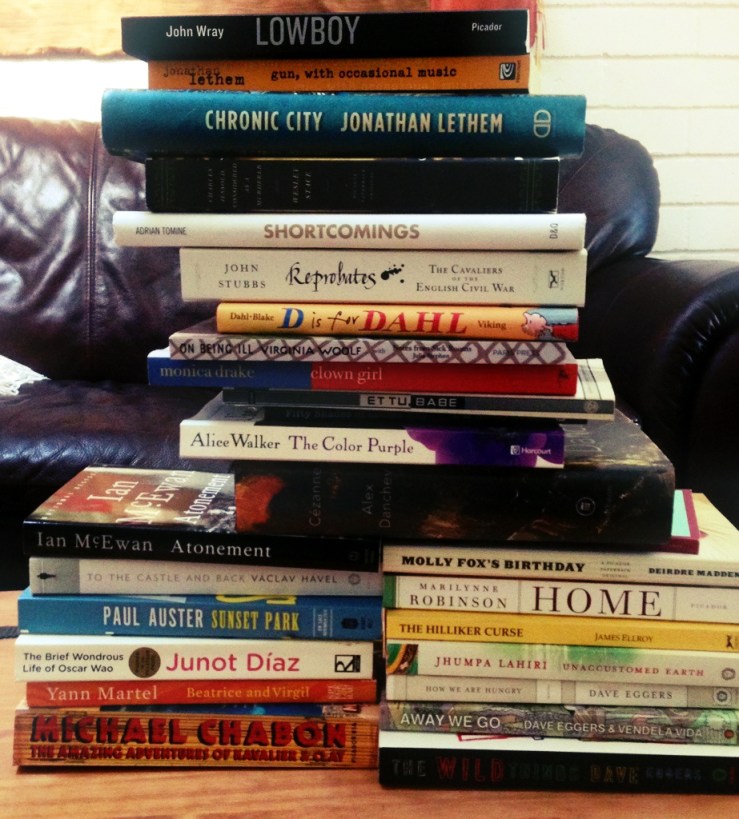
Got rid of some books today—traded some in at the used bookshop I frequent, others I put in a box to take to the office to give away to colleagues. Anyway, I read these, reviewed many of them on the site, and in some cases enjoyed them—but I can’t see myself ever rereading them or returning to them for anything. And, uh, I hated some of them too.
Sometimes when the printer is waiting for an article which really should have been sent to him the day before, I sit at my desk and wonder if there is any possible subject in the whole world upon which I can possibly find anything to say. On one such occasion I left it to Fate, which decided, by means of a dictionary opened at random, that I should deliver myself of a few thoughts about goldfish. (You will find this article later on in the book.) But to-day I do not need to bother about a subject. To-day I am without a care. Nothing less has happened than that I have a new nib in my pen.
In the ordinary way, when Shakespeare writes a tragedy, or Mr. Blank gives you one of his charming little essays, a certain amount of thought goes on before pen is put to paper. One cannot write “Scene I. An Open Place. Thunder and Lightning. Enter Three Witches,” or “As I look up from my window, the nodding daffodils beckon to me to take the morning,” one cannot give of one’s best in this way on the spur of the moment. At least, others cannot. But when I have a new nib in my pen, then I can go straight from my breakfast to the blotting-paper, and a new sheet of foolscap fills itself magically with a stream of blue-black words. When poets and idiots talk of the pleasure of writing, they mean the pleasure of giving a piece of their minds to the public; with an old nib a tedious business. They do not mean (as I do) the pleasure of the artist in seeing beautifully shaped “k’s” and sinuous “s’s” grow beneath his steel. Anybody else writing this article might wonder “Will my readers like it?” I only tell myself “How the compositors will love it!”
But perhaps they will not love it. Maybe I am a little above their heads. I remember on one First of January receiving an anonymous postcard wishing me a happy New Year, and suggesting that I should give the compositors a happy New Year also by writing more generously. In those days I got a thousand words upon one sheet 8 in. by 5 in. I adopted the suggestion, but it was a wrench; as it would be for a painter of miniatures forced to spend the rest of his life painting the Town Council of Boffington in the manner of Herkomer. My canvases are bigger now, but they are still impressionistic. “Pretty, but what is it?” remains the obvious comment; one steps back a pace and saws the air with the hand; “You see it better from here, my love,” one says to one’s wife. But if there be one compositor not carried away by the mad rush of life, who in a leisurely hour (the luncheon one, for instance) looks at the beautiful words with the eye of an artist, not of a wage-earner, he, I think, will be satisfied; he will be as glad as I am of my new nib. Does it matter, then, what you who see only the printed word think of it?
A woman, who had studied what she called the science of calligraphy, once offered to tell my character from my handwriting. I prepared a special sample for her; it was full of sentences like “To be good is to be happy,” “Faith is the lode- star of life,” “We should always be kind to animals,” and so on. I wanted her to do her best. She gave the morning to it, and told me at lunch that I was “synthetic.” Probably you think that the compositor has failed me here and printed “synthetic” when I wrote “sympathetic.” In just this way I misunderstood my calligraphist at first, and I looked as sympathetic as I could. However, she repeated “synthetic,” so that there could be no mistake. I begged her to tell me more, for I had thought that every letter would reveal a secret, but all she would add was “and not analytic.” I went about for the rest of the day saying proudly to myself “I am synthetic! I am synthetic! I am synthetic!” and then I would add regretfully, “Alas, I am not analytic!” I had no idea what it meant.
And how do you think she had deduced my syntheticness? Simply from the fact that, to save time, I join some of my words together. That isn’t being synthetic, it is being in a hurry. What she should have said was, “You are a busy man; your life is one constant whirl; and probably you are of excellent moral character and kind to animals.” Then one would feel that one did not write in vain.
My pen is getting tired; it has lost its first fair youth. However, I can still go on. I was at school with a boy whose uncle made nibs. If you detect traces of erudition in this article, of which any decent man might be expected to be innocent, I owe it to that boy. He once told me how many nibs his uncle made in a year; luckily I have forgotten. Thousands, probably. Every term that boy came back with a hundred of them; one expected him to be very busy. After all, if you haven’t the brains or the inclination to work, it is something to have the nibs. These nibs, however, were put to better uses. There is a game you can play with them; you flick your nib against the other boy’s nib, and if a lucky shot puts the head of yours under his, then a sharp tap capsizes him, and you have a hundred and one in your collection. There is a good deal of strategy in the game (whose finer points I have now forgotten), and I have no doubt that they play it at the Admiralty in the off season. Another game was to put a clean nib in your pen, place it lightly against the cheek of a boy whose head was turned away from you, and then call him suddenly. As Kipling says, we are the only really humorous race. This boy’s uncle died a year or two later and left about œ80,000, but none of it to his nephew. Of course, he had had the nibs every term. One mustn’t forget that.
The nib I write this with is called the “Canadian Quill”; made, I suppose, from some steel goose which flourishes across the seas, and which Canadian housewives have to explain to their husbands every Michaelmas. Well, it has seen me to the end of what I wanted to say—if indeed I wanted to say anything. For it was enough for me this morning just to write; with spring coming in through the open windows and my good Canadian quill in my hand, I could have copied out a directory. That is the real pleasure of writing.
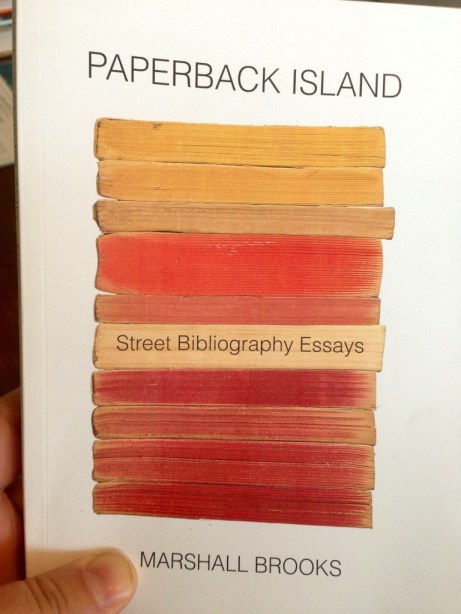
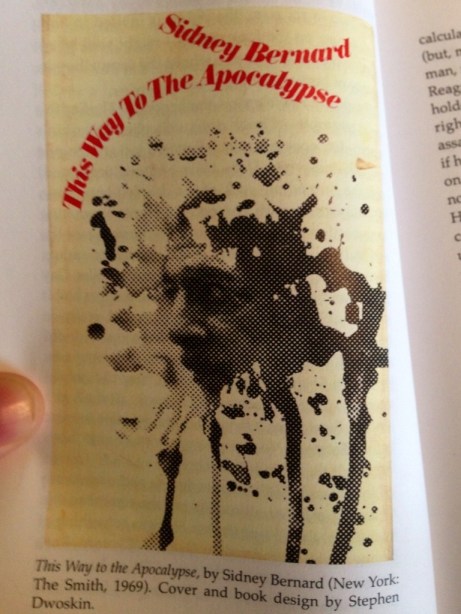
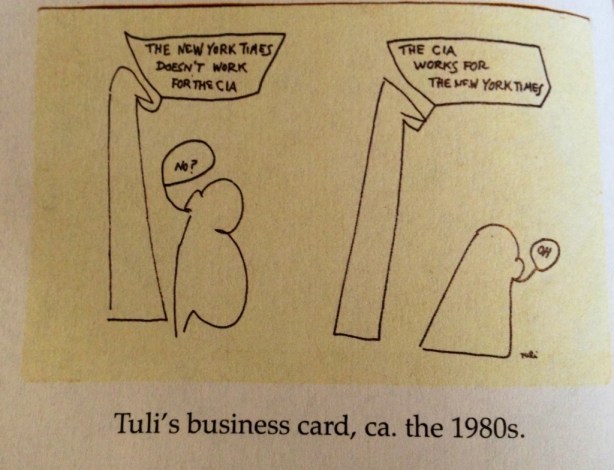
Marshall Brook’s memoir-in-essays, Paperback Island arrived at Biblioklept World Headquarters today. Brooks’s book snagged me into an hour of reading I hadn’t planned on doing, even from the preface (I usually skim or skip prefaces, but Brooks’s hooked me—he opens at Tuli Kupferberg’s funeral and then talks about reading a book that required him to actually stay in the author’s apartment). There’s an opening memoir about an adolescent friendship that revolves around books; this essay could easily tread into schmaltz but instead intrigues and foregrounds what comes next. The following essay, “Sid,” is about Sidney Bernard’s book This Way to the Apocalypse, which I now want to read.
This is followed by a piece on Tuli Kupferberg, whose funeral seems to serve as a galvanizing force throughout the essays. Anyway, I kept reading, and this is obviously not a review, just an enthusiastic entry on the blog, a sort of, yes, this is a beautiful, perhaps melancholy, but beautiful book, a book about books, writers, libraries…full review to come.
I reviewed the first full trailer for Baz Luhrmann’s adaptation of F. Scott Fitzgerald’s The Great Gatsby back in early summer of last year. The film, originally slated for a Christmas 2012 release, was delayed supposedly to finish effects, add new music (featured in this trailer), and give the film a higher-profile summer release.
Roger Ebert had a tremendous impact on how I thought about criticism and how a review should be written, voiced, pitched. I didn’t always agree with the guy, but I loved watching his show (usually more than the films he and Siskel reviewed) and reading his reviews, and I loved following him on Twitter, where I’ll miss him most I guess.
The bayou curved like a crescent around the point of land on which La Folle’s cabin stood. Between the stream and the hut lay a big abandoned field, where cattle were pastured when the bayou supplied them with water enough. Through the woods that spread back into unknown regions the woman had drawn an imaginary line, and past this circle she never stepped. This was the form of her only mania.
She was now a large, gaunt black woman, past thirty-five. Her real name was Jacqueline, but every one on the plantation called her La Folle, because in childhood she had been frightened literally “out of her senses,” and had never wholly regained them.
It was when there had been skirmishing and sharpshooting all day in the woods. Evening was near when P’tit Maitre, black with powder and crimson with blood, had staggered into the cabin of Jacqueline’s mother, his pursuers close at his heels. The sight had stunned her childish reason.
She dwelt alone in her solitary cabin, for the rest of the quarters had long since been removed beyond her sight and knowledge. She had more physical strength than most men, and made her patch of cotton and corn and tobacco like the best of them. But of the world beyond the bayou she had long known nothing, save what her morbid fancy conceived.
People at Bellissime had grown used to her and her way, and they thought nothing of it. Even when “Old Mis'” died, they did not wonder that La Folle had not crossed the bayou, but had stood upon her side of it, wailing and lamenting.
P’tit Maitre was now the owner of Bellissime. He was a middle-aged man, with a family of beautiful daughters about him, and a little son whom La Folle loved as if he had been her own. She called him Cheri, and so did every one else because she did.
None of the girls had ever been to her what Cheri was. They had each and all loved to be with her, and to listen to her wondrous stories of things that always happened “yonda, beyon’ de bayou.”
But none of them had stroked her black hand quite as Cheri did, nor rested their heads against her knee so confidingly, nor fallen asleep in her arms as he used to do. For Cheri hardly did such things now, since he had become the proud possessor of a gun, and had had his black curls cut off.
That summer—the summer Cheri gave La Folle two black curls tied with a knot of red ribbon—the water ran so low in the bayou that even the little children at Bellissime were able to cross it on foot, and the cattle were sent to pasture down by the river. La Folle was sorry when they were gone, for she loved these dumb companions well, and liked to feel that they were there, and to hear them browsing by night up to her own enclosure. Continue reading ““Beyond the Bayou” — Kate Chopin”→
[Ed. note: The following citations come from one-star Amazon reviews of George Orwell’s novel 1984. I think 1984 is an important dystopian work (although I think Huxley gave us a better book and a more accurate vision in his novel Brave New World). Anyway, I find myself fascinated by one-star Amazon reviews for some reason (see also: See also: Melville’s Moby-Dick,Joyce’s Ulysses and Markson’sWittgenstein’s Mistress) and to be clear, I think some of the one-star reviews of 1984–including ones I cite here—make some pretty valid points (others are atrocious, of course). I’ve preserved the reviewers’ unique styles of punctuation and spelling].
1984 is a fictional novel by George Orwell.
I don’t really like futuristic based books…
1984 might have been scary 100 years ago, but not now.
…the plot is fairly simplistic but with redundant lines. “Oceania has always been war with Eastasia.” “Freedom is slavery.” “Big Brother is watching you.” In other words, it was nothing but a lot of nonsensical fillers.
I truly believe that Orwell’s sole purpose for writing this novel was to encourage anarchy, and to convince his readers to be subordinate to authority.
The text was so long and unelaborate.
George Orwell is no wordsmith and his style of writing stinks and flows like verbal diarrhea.
i give this book one star i had to read it for class and i know it’s suposed to be a “classic” but god itis awful. first of all its NOTHING like the future is probly going to turn out. second of all every one says the aurthor george orwell is so trippy and wierd but i think he’s just trying to cover up for the fact that HE CAN’T WRITE. please george do us all a faver and stop writing books.
I am not at all intrested in the goverment. This may be part of the reason that I didnt like it.
I personally think big brother is the man.
It is crude, heavy-handed, superficial propaganda.
…a boring, unoriginal one-hit wonder who wanted to make a buck rehashing much-talked-of, much-written-of themes.
It is dark, depressing, and I finished reading it feeling like less of a human than when I started.
Quote from “1984”: “Humanity is nothing more than one man shoving another man’s face in the mud.” So, “1984” tells us that humans are completely useless and we have no reason to exist.
It was just thoughts of a sad man with perverse and suspicouis thoughts. The main character constantly dwelled on how horrible everything was and eventually how he was going to fight against it. But never did, unless you count having an affair and writing in a journal or buying an old paperweight.
Keep your dictionary handy.
I was greatly dissapointed with the redundent and unecessary words.
For me the book took a downword turn during the time where Winston started having a love affair with some girl.
…it doesn’t make any sense to think that a novel like this one is really any better than say, Michael Crichton or Stephen King.
The main character, Winston, daydreams about raping Julia, who later becomes his dirty mistress. Then about a hundred pages later, they get caught by the Thought Police, thrown into “prison,” and are brain washed. That’s pretty much what happens.
…and must we really keep reading in full detail the horror and disgust of Winston’s vericose veins?!
Today, his book is the modern bible of the paranoid disgruntled white male and other conspiracy nutcases.
Human beings are BETTER than this…
In addiction, the contradictions throughout the novel were frustrating.
On the surface it seems to be an interesting glance at the “future” that our grandparents envisioned. This however could not be farther from the truth. 1984 is in fact a lame, boring, and novel that attempts to be philosophical.
…a monumental ode to nothingness, an ideologically streamlined state of unbelievable being.
And please for the love of God don’t read that “Brave New World” book by Hoxley. It is twice as worse as 1984.
Last time I ever read a history book by this Orwell scrub. He doesn’t know a thing about the 80s. Not ONCE did he mention Def Leppard or Karma Chameleon.





 Biblioklept