“The Easter Hare” and “The Easter Hare Family” by Margaret Arndt

“The Easter Hare”  by Margaret Arndt

It is curious how little children of one country know about the lives and interests of the children of another. Perhaps if English people would send their children over to Germany, instead of their journalists, singers, etc., the danger of an International war would be lessened. The children would be sure to fall in love with Germany; for it is the land above all others that appeals to children. Women are said to come first in America, children are certainly the first consideration in Germany. Froebel’s motto: “Come let us live with our children,” is nowhere better carried out.

A little English girl, named Patsie, came over to visit her German friends, Gretel and Barbara, shortly before Easter this year; and she was much surprised to find all the shop-windows filled with hares; hares made of chocolate, toy hares, hares with fine red coats on, hares trundling wheelbarrows or carrying baskets full of Easter eggs. Moreover there was no end to the picture post cards representing the hare in various costumes, and in some connection with Easter eggs. One of these post cards represented a hare crawling out of a large broken egg just like a chicken.

Patsie asked her little friends eagerly what this all meant.

“Who is the Hare?” she said. “I do so want to know all about him.”

“Why, of course, it is the Easter Hare,” they replied.

“Is it possible that you have not heard of him? O, you poor English children! Why, he brings us the eggs on Easter Sunday morning!” said Gretel.

“O don’t you know,” said Barbara, “he hides them in the garden, unless it rains or is very wet; then we have to stay in our bedrooms for fear of frightening him, and he lays them downstairs in the dining-room or drawing-room. However, this has only happened once since I was born, and I am nine years old; it mustbe always fine at Easter.”

“We have to let all the blinds down before he will come into our garden, he is so dreadfully nervous,” said Gretel. “Then he hides the eggs in the most unexpected places, we have to hunt and hunt a long time before we have found them all. Last year we discovered an egg some weeks afterwards; luckily it was a glass one filled with sweeties; for if it had been of chocolate, we could not have eaten it, after it had lain on the damp mould, where the snails and worms would have crawled over it. Some of the eggs are made of chocolate or marzipan or sugar, and some are real eggs coloured blue or red or brown, or even sometimes with pictures on them.”

“We had two dear little baskets with dollies in them, and a big Easter Hare made of gingerbread, as well as the eggs this year,” said Barbara. “We hunt and hunt in every corner of the garden, and then we divide our treasures afterwards on two plates, so that is quite fair.”

“You are lucky children, why does not the Hare come to England?” said Patsie. “I am sure little English children would appreciate him too!” Continue reading ““The Easter Hare” and “The Easter Hare Family” by Margaret Arndt”

An Interview with Evan Lavender-Smith

Evan Lavender-Smith is an American writer who has published two books, Avatar and From Old Notebooks.

I really really really like his anti-novel (or whatever you want to call it) From Old Notebooks, which has recently been reissued by the good people at Dzanc Books.

(Here is my review of FON). I still haven’t read Avatar.

Evan talked with me about his writing, his reading, and other stuff over a series of emails. He was generous in his answers and I very much enjoyed talking with him.

Evan lives in New Mexico with his wife, son, and daughter. He has a website. Read his books.

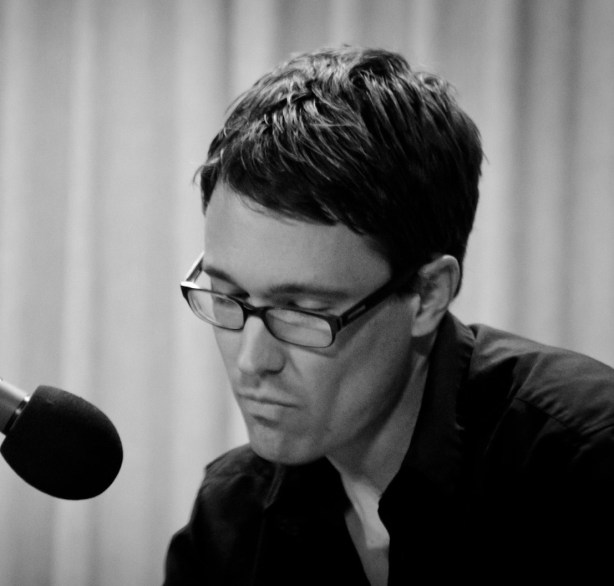
author-photo2

Biblioklept: Do you know that first editions of From Old Notebooks are going for like three hundred dollars on Amazon right now?

ELS: Here at the house I have a whole drawer full of them. That’s how I’m planning to pay for the kids’ college.

Biblioklept: I read that Cormac McCarthy won’t sign his books anymore because he has this reserve of signed editions that are for his son to sell and corner the market on. Or I think I read that.

Speaking of your kids: the parts in From Old Notebooks about them are some of my favorites, perhaps because the moments you describe seem so real to me, or that I relate so strongly to the feelings that you express. (My own kids, a daughter and son, are about the same age as your kids are in the book). Is it weird if I ask how your kids are?

ELS: Glad to hear some of that stuff resonates with you. No, I don’t think it’s weird. I believe the book even sort of self-consciously anticipates a certain reader’s empathetic engagement with it. There’s that passage somewhere, for example, in which we get something like an interview answer, something like “The real Evan Lavender-Smith has never made it past the first section of Ulysses, the real Evan Lavender-Smith has no children,” which I think maybe winks at the possibility of that type of readerly engagement. So no, it’s encouraging to hear that parts of the book seemed to work for you. My kids are great, by the way. Sofia’s at her violin lesson, Jackson’s doing an art project with his mom.

Biblioklept: The faux-interview answers crack me up. I think we’ve all done that in some way—that we go through these little experiments of interviewing ourselves, performing ourselves, imagining how others perceive us. You write your own obituary; at one point we get: ” ‘With my first book I hope to get all the cult of personality stuff out of the way’.” You remark that you don’t put dates on anything as “an act of defiance” against your “literary executors.” Moments like these seem simultaneously ironic and sincere.

I’m curious as to how closely you attended to these disjunctions—From Old Notebooks seems incredibly, I don’t know, organic.

ELS: At a certain point I became very aware that I was performing some version or versions of myself in the book, and I think the book tries to find ways of grappling with problems I perceived as bound up with that performance. One way was to insist on a narrative tone or mode somewhere in between irony and sincerity, or to regularly oscillate between or conflate these competing modes. Something like “I am the greatest writer in the history of the world!” might later be countered by “Gosh, my writing really blows, doesn’t it?”; or “My kids are so beautiful, I love them so much,” might be followed by “I wish those little fuckers were never born.” While the function of this variability is, in From Old Notebooks, probably mostly an apology or a mask for a kind of subjectivity I worry might come off as cliche and naive, that particular representation of the thinking subject — cleaved, inconsistent, heterogeneous — does strike me as truer of human experience and perception than the more streamlined consistency of expression and behavior we tend to associate with the conventional narratological device called “character.” When I try to look deep down inside myself, to really get a handle on my thinking, for example, or on my understanding of truth, I end up facing a real mess of disjunctive, contradictory forces competing for my attention. For me — and likely for the book, as well — the most immediate figure for this condition might be the confluence of sincerity and irony, the compossibility of taking a genuine life-affirming pleasure in, and exhibiting a kind of cynical hostility toward, the fact of my own existence.

Biblioklept: That contest between sincerity and irony seems present in many works of post-postmodern fiction. It’s clearly a conflict that marks a lot of David Foster Wallace’s stuff. You invoke Wallace a number of times in From Old Notebooks, but the style of the book seems in no way beholden to his books. Can you talk about his influence on you as a reader? A writer?

ELS: Wallace hugely influenced the way I think about any number of things. I think his most immediate influence on my writing is this blending of hieratic and demotic modes of language when I’m dealing with pretty much anything that requires the serious application of my writing mind; the hip nerdiness of his language was and still is very empowering to me. He made it seem super cool to geek out on books — “The library, and step on it,” says Hal in Infinite Jest — and back in high school and college that example was so vital for me, as someone entirely too obsessed with being both cool and well read. He served to guide my reading of other writers in a way that only John Barth and Brian Evenson have come close to matching; I poured over his essays for names, then went to the library and checked out and read all the books he mentioned, then reread his essays. His fiction’s most common subject matter — addiction, depression, the yearning for transcendence, the incommensurability of language and lived experience, problems of logic vis-a-vis emotion, metafiction’s values and inadequacies — all of this stuff hit very close to home. To my mind there’s little doubt that Infinite Jest is the best English-language novel published in the last 25 years. His advocacy for David Markson has got to be up there among the greatest literary rescue missions of the 20th century. In “Good Old Neon” he wrote what may be the most haunting long short story since “The Death of Ivan Ilych.” He galvanized young writers everywhere right when the internet was taking off and unwittingly served as a touchstone for emerging online literary communities that thrive today. I think for a lot of young writers, myself included, he was, maybe next to the emergence of the internet, the most important force in the language’s recent history. The list goes on and on. And also he helped me out personally, providing encouragement and advice that was so generous and inspiring. I was extremely troubled by his suicide and wasn’t able to write much or think about much else for quite a while.

With all that said, there are some things he says that bother me a bit. The synthesis of art and entertainment he espouses as it pertains to the role of the writer in the age of television — which I think in many ways corresponds to his striving for a new aesthetic in which the cerebral effects associated with 60s and 70s postmodernist fiction are complemented by or synthesized with the more visceral effects associated with 70s and 80s realist fiction — strikes me now as existing very much in opposition to what I believe in most passionately about writing: that it can and in the most important cases should exist in a state of absolute opposition to our entertainments. I’ve come to better appreciate, years after reading Wallace, the writing of people like Woolf and Beckett and Gaddis, those writers who are uncompromising in their vision of narrative art’s most radical and affecting possibilities and who necessarily, I believe, pay very little attention to any sort of entertainment imperative. The books I love most make me feel things strongly, and think things strongly, but rarely do they entertain me. If I want to be entertained, I know exactly where to go: a room without books. I’ve come to think of certain books as my life’s only source of intellectual solace; when I’m not despairing over the futility of everything under the sun, that unflagging commitment to a truly rigorous and uncompromising art that I perceive in a writer like Beckett seems to me a matter of life and death, just as serious as life can ever get. When Wallace talks that shit about art and entertainment, or about the need to add more heart or greater complexity of character to Pynchon or whatever, it makes me feel like I want to throw up. I heard him say once in an interview that he felt he couldn’t write the unfiltered stuff in his head, that it would be too radical or something, and the admission really upset me; it felt like in some serious way he had allowed his projection of an imaginary target audience’s desire to determine the form of his writing. I often feel something similar in the essays; I find many of them to be merely entertaining. I suppose I often judge the essays in relation to the fictions, which I find far superior in their attempt to overcome the strictures and conventions of language and form. Wallace was always at his best, to my reading, when he was really bearing down — when he was at his most difficult.

But no doubt he’s been monumentally important to me, more so than any other recent fiction writer, and in more ways than I can name. There’s something in From Old Notebooks where the methodical awkwardness and wordiness of so many of his sentences is likened to the affectation of bumping up against the limits of language. That’s probably what I take away from him more than anything: when I sit down at the laptop to face the language, I often feel myself struggling with the words as well as struggling to demonstrate that I’m struggling with the words. That’s pure Wallace: word-by-word, letter-by-letter self-consciousness. (There’s another thing in From Old Notebooks about how I’m always talking shit because I care for him so deeply … which is why the paragraph before this one). Continue reading “An Interview with Evan Lavender-Smith”

“On Eating and Drinking” — Jerome K. Jerome

I always was fond of eating and drinking, even as a child—especially eating, in those early days. I had an appetite then, also a digestion. I remember a dull-eyed, livid-complexioned gentleman coming to dine at our house once. He watched me eating for about five minutes, quite fascinated seemingly, and then he turned to my father with—

“Does your boy ever suffer from dyspepsia?”

“I never heard him complain of anything of that kind,” replied my father. “Do you ever suffer from dyspepsia, Colly wobbles?” (They called me Colly wobbles, but it was not my real name.)

“No, pa,” I answered. After which I added:

“What is dyspepsia, pa?”

My livid-complexioned friend regarded me with a look of mingled amazement and envy. Then in a tone of infinite pity he slowly said:

“You will know—some day.”

My poor, dear mother used to say she liked to see me eat, and it has always been a pleasant reflection to me since that I must have given her much gratification in that direction. A growing, healthy lad, taking plenty of exercise and careful to restrain himself from indulging in too much study, can generally satisfy the most exacting expectations as regards his feeding powers.

It is amusing to see boys eat when you have not got to pay for it. Their idea of a square meal is a pound and a half of roast beef with five or six good-sized potatoes (soapy ones preferred as being more substantial), plenty of greens, and four thick slices of Yorkshire pudding, followed by a couple of currant dumplings, a few green apples, a pen’orth of nuts, half a dozen jumbles, and a bottle of ginger-beer. After that they play at horses.

How they must despise us men, who require to sit quiet for a couple of hours after dining off a spoonful of clear soup and the wing of a chicken!

But the boys have not all the advantages on their side. A boy never enjoys the luxury of being satisfied. A boy never feels full. He can never stretch out his legs, put his hands behind his head, and, closing his eyes, sink into the ethereal blissfulness that encompasses the well-dined man. A dinner makes no difference whatever to a boy. To a man it is as a good fairy’s potion, and after it the world appears a brighter and a better place. A man who has dined satisfactorily experiences a yearning love toward all his fellow-creatures. He strokes the cat quite gently and calls it “poor pussy,” in tones full of the tenderest emotion. He sympathizes with the members of the German band outside and wonders if they are cold; and for the moment he does not even hate his wife’s relations.

A good dinner brings out all the softer side of a man. Under its genial influence the gloomy and morose become jovial and chatty. Sour, starchy individuals, who all the rest of the day go about looking as if they lived on vinegar and Epsom salts, break out into wreathed smiles after dinner, and exhibit a tendency to pat small children on the head and to talk to them—vaguely—about sixpences. Serious men thaw and become mildly cheerful, and snobbish young men of the heavy-mustache type forget to make themselves objectionable.

I always feel sentimental myself after dinner. It is the only time when I can properly appreciate love-stories. Then, when the hero clasps “her” to his heart in one last wild embrace and stifles a sob, I feel as sad as though I had dealt at whist and turned up only a deuce; and when the heroine dies in the end I weep. If I read the same tale early in the morning I should sneer at it. Digestion, or rather indigestion, has a marvelous effect upon the heart. If I want to write any thing very pathetic—I mean, if I want to try to write anything very pathetic—I eat a large plateful of hot buttered muffins about an hour beforehand, and then by the time I sit down to my work a feeling of unutterable melancholy has come over me. I picture heartbroken lovers parting forever at lonely wayside stiles, while the sad twilight deepens around them, and only the tinkling of a distant sheep-bell breaks the sorrow-laden silence. Old men sit and gaze at withered flowers till their sight is dimmed by the mist of tears. Little dainty maidens wait and watch at open casements; but “he cometh not,” and the heavy years roll by and the sunny gold tresses wear white and thin. The babies that they dandled have become grown men and women with podgy torments of their own, and the playmates that they laughed with are lying very silent under the waving grass. But still they wait and watch, till the dark shadows of the unknown night steal up and gather round them and the world with its childish troubles fades from their aching eyes.

I see pale corpses tossed on white-foamed waves, and death-beds stained with bitter tears, and graves in trackless deserts. I hear the wild wailing of women, the low moaning of little children, the dry sobbing of strong men. It’s all the muffins. I could not conjure up one melancholy fancy upon a mutton chop and a glass of champagne.

A full stomach is a great aid to poetry, and indeed no sentiment of any kind can stand upon an empty one. We have not time or inclination to indulge in fanciful troubles until we have got rid of our real misfortunes. We do not sigh over dead dicky-birds with the bailiff in the house, and when we do not know where on earth to get our next shilling from, we do not worry as to whether our mistress’ smiles are cold, or hot, or lukewarm, or anything else about them.

Foolish people—when I say “foolish people” in this contemptuous way I mean people who entertain different opinions to mine. If there is one person I do despise more than another, it is the man who does not think exactly the same on all topics as I do—foolish people, I say, then, who have never experienced much of either, will tell you that mental distress is far more agonizing than bodily. Romantic and touching theory! so comforting to the love-sick young sprig who looks down patronizingly at some poor devil with a white starved face and thinks to himself, “Ah, how happy you are compared with me!”—so soothing to fat old gentlemen who cackle about the superiority of poverty over riches. But it is all nonsense—all cant. An aching head soon makes one forget an aching heart. A broken finger will drive away all recollections of an empty chair. And when a man feels really hungry he does not feel anything else.

We sleek, well-fed folk can hardly realize what feeling hungry is like. We know what it is to have no appetite and not to care for the dainty victuals placed before us, but we do not understand what it means to sicken for food—to die for bread while others waste it—to gaze with famished eyes upon coarse fare steaming behind dingy windows, longing for a pen’orth of pea pudding and not having the penny to buy it—to feel that a crust would be delicious and that a bone would be a banquet.

Hunger is a luxury to us, a piquant, flavor-giving sauce. It is well worth while to get hungry and thirsty merely to discover how much gratification can be obtained from eating and drinking. If you wish to thoroughly enjoy your dinner, take a thirty-mile country walk after breakfast and don’t touch anything till you get back. How your eyes will glisten at sight of the white table-cloth and steaming dishes then! With what a sigh of content you will put down the empty beer tankard and take up your knife and fork! And how comfortable you feel afterward as you push back your chair, light a cigar, and beam round upon everybody.

Make sure, however, when adopting this plan, that the good dinner is really to be had at the end, or the disappointment is trying. I remember once a friend and I—dear old Joe, it was. Ah! how we lose one another in life’s mist. It must be eight years since I last saw Joseph Taboys. How pleasant it would be to meet his jovial face again, to clasp his strong hand, and to hear his cheery laugh once more! He owes me 14 shillings, too. Well, we were on a holiday together, and one morning we had breakfast early and started for a tremendous long walk. We had ordered a duck for dinner over night. We said, “Get a big one, because we shall come home awfully hungry;” and as we were going out our landlady came up in great spirits. She said, “I have got you gentlemen a duck, if you like. If you get through that you’ll do well;” and she held up a bird about the size of a door-mat. We chuckled at the sight and said we would try. We said it with self-conscious pride, like men who know their own power. Then we started.

We lost our way, of course. I always do in the country, and it does make me so wild, because it is no use asking direction of any of the people you meet. One might as well inquire of a lodging-house slavey the way to make beds as expect a country bumpkin to know the road to the next village. You have to shout the question about three times before the sound of your voice penetrates his skull. At the third time he slowly raises his head and stares blankly at you. You yell it at him then for a fourth time, and he repeats it after you. He ponders while you count a couple of hundred, after which, speaking at the rate of three words a minute, he fancies you “couldn’t do better than—” Here he catches sight of another idiot coming down the road and bawls out to him the particulars, requesting his advice. The two then argue the case for a quarter of an hour or so, and finally agree that you had better go straight down the lane, round to the right and cross by the third stile, and keep to the left by old Jimmy Milcher’s cow-shed, and across the seven-acre field, and through the gate by Squire Grubbin’s hay-stack, keeping the bridle-path for awhile till you come opposite the hill where the windmill used to be—but it’s gone now—and round to the right, leaving Stiggin’s plantation behind you; and you say “Thank you” and go away with a splitting headache, but without the faintest notion of your way, the only clear idea you have on the subject being that somewhere or other there is a stile which has to be got over; and at the next turn you come upon four stiles, all leading in different directions! Continue reading ““On Eating and Drinking” — Jerome K. Jerome”

Happy Days — Samuel Beckett (2000 Filmed Production)

“Sound and Fury” — O. Henry

“Sound and Fury” by O. Henry

PERSONS OF THE DRAMA

Mr. Penne An Author
Miss Lore An Amanuensis

Scene—Workroom of Mr. Penne’s popular novel factory.
Mr. Penne—Good morning, Miss Lore. Glad to see you so prompt. We should finish that June installment for the Epoch to-day. Leverett is crowding me for it. Are you quite ready? We will resume where we left off yesterday. (Dictates.) “Kate, with a sigh, rose from his knees, and—”

Miss Lore—Excuse me; you mean “rose from her knees,” instead of “his,” don’t you?

Mr. Penne—Er—no—”his,” if you please. It is the love scene in the garden. (Dictates.) “Rose from his knees where, blushing with youth’s bewitching coyness, she had rested for a moment after Cortland had declared his love. The hour was one of supreme and tender joy. When Kate—scene that Cortland never—”

Miss Lore—Excuse me; but wouldn’t it be more grammatical to say “when Kate saw,” instead of “seen”?

Mr. Penne—The context will explain. (Dictates.) “When Kate—scene that Cortland never forgot—came tripping across the lawn it seemed to him the fairest sight that earth had ever offered to his gaze.”

Miss Lore—Oh!

Mr. Penne (dictates)—”Kate had abandoned herself to the joy of her new-found love so completely, that no shadow of her former grief was cast upon it. Cortland, with his arm firmly entwined about her waist, knew nothing of her sighs—”

Miss Lore—Goodness! If he couldn’t tell her size with his arm around—

Mr. Penne (frowning)—”Of her sighs and tears of the previous night.”

Miss Lore—Oh!

Mr. Penne (dictates)—”To Cortland the chief charm of this girl was her look of innocence and unworldiness. Never had nun—”

Miss Lore—How about changing that to “never had any?”

Mr. Penne (emphatically)—”Never had nun in cloistered cell a face more sweet and pure.”

Miss Lore—Oh!

Mr. Penne (dictates)—”But now Kate must hasten back to the house lest her absence be discovered. After a fond farewell she turned and sped lightly away. Cortland’s gaze followed her. He watched her rise—”

Miss Lore—Excuse me, Mr. Penne; but how could he watch her eyes while her back was turned toward him?

Mr. Penne (with extreme politeness)—Possibly you would gather my meaning more intelligently if you would wait for the conclusion of the sentence. (Dictates.) “Watched her rise as gracefully as a fawn as she mounted the eastern terrace.”

Miss Lore—Oh!

Mr. Penne (dictates)—”And yet Cortland’s position was so far above that of this rustic maiden that he dreaded to consider the social upheaval that would ensue should he marry her. In no uncertain tones the traditional voices of his caste and world cried out loudly to him to let her go. What should follow—”

Miss Lore (looking up with a start)—I’m sure I can’t say, Mr. Penne. Unless (with a giggle) you would want to add “Gallegher.”

Mr. Penne (coldly)—Pardon me. I was not seeking to impose upon you the task of a collaborator. Kindly consider the question a part of the text.

Miss Lore—Oh!

Mr. Penne (dictates)—”On one side was love and Kate; on the other side his heritage of social position and family pride. Would love win? Love, that the poets tell us will last forever! (Perceives that Miss Lore looks fatigued, and looks at his watch.) That’s a good long stretch. Perhaps we’d better knock off a bit.”

(Miss Lore does not reply.)

Mr. Penne—I said, Miss Lore, we’ve been at it quite a long time— wouldn’t you like to knock off for a while?

Miss Lore—Oh! Were you addressing me before? I put what you said down. I thought it belonged in the story. It seemed to fit in all right. Oh, no; I’m not tired.

Mr. Penne—Very well, then, we will continue. (Dictates.) “In spite of these qualms and doubts, Cortland was a happy man. That night at the club he silently toasted Kate’s bright eyes in a bumper of the rarest vintage. Afterward he set out for a stroll with, as Kate on—”

Miss Lore—Excuse me, Mr. Penne, for venturing a suggestion; but don’t you think you might state that in a less coarse manner?

Mr. Penne (astounded)—Wh-wh—I’m afraid I fail to understand you.

Miss Lore—His condition. Why not say he was “full” or “intoxicated”? It would sound much more elegant than the way you express it.

Mr. Penne (still darkly wandering)—Will you kindly point out, Miss Lore, where I have intimated that Cortland was “full,” if you prefer that word?

Miss Lore (calmly consulting her stenographic notes)—It is right here, word for word. (Reads.) “Afterward he set out for a stroll with a skate on.”

Mr. Penne (with peculiar emphasis)—Ah! And now will you kindly take down the expurgated phrase? (Dictates.) “Afterward he set out for a stroll with, as Kate on one occasion had fancifully told him, her spirit leaning upon his arm.”

Miss Lore—Oh!

Mr. Penne (dictates)—Chapter thirty-four. Heading—”What Kate Found in the Garden.” “That fragrant summer morning brought gracious tasks to all. The bees were at the honeysuckle blossoms on the porch. Kate, singing a little song, was training the riotous branches of her favorite woodbine. The sun, himself, had rows—”

Miss Lore—Shall I say “had risen”?

Mr. Penne (very slowly and with desperate deliberation)—”The—sun—himself—had—rows—of—blushing—pinks—and—hollyhocks—and—hyacinths—waiting—that—he—might—dry—their—dew-drenched—cups.”

Miss Lore—Oh!

Mr. Penne (dictates)—”The earliest trolley, scattering the birds from its pathway like some marauding cat, brought Cortland over from Oldport. He had forgotten his fair—”

Miss Lore—Hm! Wonder how he got the conductor to—

Mr. Penne (very loudly)—”Forgotten his fair and roseate visions of the night in the practical light of the sober morn.”

Miss Lore—Oh!

Mr. Penne (dictates)—”He greeted her with his usual smile and manner. ‘See the waves,’ he cried, pointing to the heaving waters of the sea, ‘ever wooing and returning to the rockbound shore.'” “‘Ready to break,’ Kate said, with—”

Miss Lore—My! One evening he has his arm around her, and the next morning he’s ready to break her head! Just like a man!

Mr. Penne (with suspicious calmness)—There are times, Miss Lore, when a man becomes so far exasperated that even a woman—But suppose we finish the sentence. (Dictates.) “‘Ready to break,’ Kate said, with the thrilling look of a soul-awakened woman, ‘into foam and spray, destroying themselves upon the shore they love so well.”

Miss Lore—Oh!

Mr. Penne (dictates)—”Cortland, in Kate’s presence heard faintly the voice of caution. Thirty years had not cooled his ardor. It was in his power to bestow great gifts upon this girl. He still retained the beliefs that he had at twenty.” (To Miss Lore, wearily) I think that will be enough for the present.

Miss Lore (wisely)—Well, if he had the twenty that he believed he had, it might buy her a rather nice one.

Mr. Penne (faintly)—The last sentence was my own. We will discontinue for the day, Miss Lore.

Miss Lore—Shall I come again to-morrow?

Mr. Penne (helpless under the spell)—If you will be so good.

(Exit Miss Lore.)


A Riff on Lars Iyer’s Novel Exodus

l

I. Trilogy

Exodus is the third entry in a trilogy that Lars Iyer began with Spurious and Dogma.

What happens in Exodus?

Not much (but also maybe everything—like all sorts of philosophical investigations and intellectual adventure and despair and potential revolution and symbolic death, etc.).

If you’ve read Spurious and Dogma you’d expect this.

There is a quest though in Exodus, a quest that feels more visceral, more real, cuts closer to the bone than in the first two entries.

What is this quest?

Do our heroes W. and Lars vanquish despair? Figure out Kafka?

Do they save humanity (or at least the humanities department)?

Do they finally cast the One Ring into Mount Doom?

(They go on a lecture tour).

II. Quest

What is the connection between Kierkegaard and capitalism?: that’s our question, W. says. What does Kierkegaard tell us about the despair of capitalism?

And

‘The true and only virtue is to hate ourselves’, W. says, reading from his notebook.

And, perhaps more specifically

Of course, they’re going to close all humanities courses in British universities, W. says . . . They’re simply going to marketise education, W. says. They’re simply going to turn the university over to the free market. They’re going to submit philosophy to the forces of capitalism . . .

And

Imagine it! Two plastic cups of Plymouth Gin might usher in the reign of peace, W. says.

And

There are no jobs in philosophy — everyone knows that. No jobs in academia!

And etc.

III. The Call to Adventure

This is our last tour, W. says. He feels that strongly. Something’s going to happen. Something’s about to happen. . . Why does he feel such a sense of dread?

IV. The Road of Trials

Gin, Deleuze, Kafka, Kierkegaard, gin, Blade Runner, Guy Debord, postgraduate students, linguistic stupidity, anxiety over what Alan Badiou is doing right this very minute, gin, Gandhi, Marx, the blogosphere (so-called), Bartleby, Moses, God, logical-mathematical stupidity, the Talmud, gin, bodily-kinesthetic stupidity, cheap food, the Thames, Oxford, Rosenzweig, interpersonal stupidity, gin, Bela Tarr, Manchester, Wikipedia, gin, intrapersonal stupidity, Beckett, Gombrowicz, Middlesex, Weil, naturalistic stupidity, Abraham and Isaac, Old Europe, sports science students, moral stupidity, Solomon Maimon, gin, Plato (turning in his grave), public houses, existential stupidity, Kant, a friend from Taiwan, a plenary speaker, sartorial stupidity, gin, Krasznahorkai, blowing a great horn to have the horde come running (like that guy in Anchorman), a Dostoevskian innocence or a Grossmanian selflessness, religious stupidity, Master/Blaster as a metaphor for the mind-brain problem, Canadian laughter in the glittering light (etc.), Essex Postgraduates, gin, gin, gin, job security, painting-and-decorating stupidity, hangovers, posh people eating lunch in the sun, settling for cans of Stella from the trolley, philosophy of walking, gin, romantic stupidity, gin, culinary stupidity, gin, stupidity stupidity.

Revolution!

V. The Magic Flight

Alcohol makes people speak, that’s its greatness, W. says. It makes them religious, political, even as it shows them the impossibility of religion and the impossibility of politics. Drinking carries you through despair, W. says. Through it, and out beyond it, if you are prepared to keep drinking right all through the night.

VI. Apotheosis

W. dreams of the profound slumber from which we would rise reborn, ready for the morning, ready for work. He dreams of the great day that would follow our night of rest, and of the great ideas that would flash above us like diurnal stars.

How is it still alive in him, the belief that he might wake into genius?, W says. How is it that he still believes, despite everything, that he is a man of thought?

VII. Freedom to Live

Thought is the hangman, our hangman, W. says. Thought has its nooses ready just for us.

VIII. Cult Fiction

Judgment, evaluation, criticism: Exodus—the Spurious Trilogy, if that’s what we’ll call it—has reserved its own special place in the world of cult fiction. These novels (if they are in fact novels) perform their own deconstruction. They delineate metacognition. They frustrate. They are simultaneously sad and funny, and even a little bit scary, at least if you earn your bread by academicizin’.

They frustrate. Wait, do I repeat myself? Very well then, I repeat myself.

These novels dissect the problems of philosophy against the backdrop of late capitalism, but part of this dissection is also the covering up of the dissection: the fear, the failure, the despair, the doom. (Hence the anesthesia, the gin). So that the novels seem to be a series of references, contours, quirks, loops of dialog, declamations, insults . . . That the novels take their own central subject as the failure to mean, to communicate—and then perform these failures: deferral, delay, intellectual suspense. And that these suspensions replace the furniture and sets of the traditional novel, etc. Maybe I’m failing to mean. I’ve anesthetized myself a bit, I do admit.

I get it. I mean, that’s maybe what I mean, or hope to mean to say about these novels: That meaning is hard, that saying meaning doing thinking is hard; that thinking afteragainstbeyond other thinkers is hard, painful, produces despair, dread, etc. Maybe that’s why I like these novels. Because I think that maybe I get them even as I doubt that I do get them.

IX. An Idea

Publisher Melville House might consider putting all three of these books into one epic volume.

X. A Question

Do the eagles ever show up to fly W. and Lars out of Mordor?

Cage III — Free Show (Infinite Jest)

Cage III — Free Show. B.S. Latrodectus Mactans Productions/Infernatron Animation Concepts, Canada. Cosgrove Watt, P. A. Heaven, Everard Maynell, Pam Heath; partial animation; 35 mm.; 65 minutes; black and white; sound.

The figure of Death (Heath) presides over the front entrance of a carnival sideshow whose spectators watch performers undergo unspeakable degradations so grotesquely compelling that the spectators’ eyes become larger and larger until the spectators themselves are transformed into gigantic eyeballs in chairs, while on the other side of the sideshow tent the figure of Life (Heaven) uses a megaphone to invite fairgoers to an exhibition in which, if the fairgoers consent to undergo unspeakable degradations, they can witness ordinary persons gradually turn into gigantic eyeballs.

INTERLACE TELENT FEATURE CARTRIDGE #357-65-65

From David Foster Wallace’s novel Infinite Jest.

“Porcelain and Pink” — F. Scott Fitzgerald

“Porcelain and Pink” by F. Scott Fitzgerald

A room in the down-stairs of a summer cottage. High around the wall runs an art frieze of a fisherman with a pile of nets at his feet and a ship on a crimson ocean, a fisherman with a pile of nets at his feet and a ship on a crimson ocean, a fisherman with a pile of nets at his feet and so on. In one place on the frieze there is an overlapping—here we have half a fisherman with half a pile of nets at his foot, crowded damply against half a ship on half a crimson ocean. The frieze is not in the plot, but frankly it fascinates me. I could continue indefinitely, but I am distracted by one of the two objects in the room—a blue porcelain bath-tub. It has character, this bath-tub. It is not one of the new racing bodies, but is small with a high tonneau and looks as if it were going to jump; discouraged, however, by the shortness of its legs, it has submitted to its environment and to its coat of sky-blue paint. But it grumpily refuses to allow any patron completely to stretch his legs—which brings us neatly to the second object in the room:

It is a girl—clearly an appendage to the bath-tub, only her head and throat—beautiful girls have throats instead of necks—and a suggestion of shoulder appearing above the side. For the first ten minutes of the play the audience is engrossed in wondering if she really is playing the game fairly and hasn’t any clothes on or whether it is being cheated and she is dressed.

The girl’s name is JULIE MARVIS. From the proud way she sits up in the bath-tub we deduce that she is not very tall and that she carries herself well. When she smiles, her upper tip rolls a little and reminds you of an Easter Bunny, She is within whispering distance of twenty years old.

One thing more—above and to the right of the bath-tub is a window. It is narrow and has a wide sill; it lets in much sunshine, but effectually prevents any one who looks in from seeing the bath-tub. You begin to suspect the plot?

We open, conventionally enough, with a song, but, as the startled gasp of the audience quite drowns out the first half, we will give only the last of it:

JULIE: (In an airy sophrano—enthusiastico)

   When Caesar did the Chicago
He was a graceful child,
Those sacred chickens
Just raised the dickens
The Vestal Virgins went wild.
Whenever the Nervii got nervy
He gave them an awful razz
They shook is their shoes
With the Consular blues
The Imperial Roman Jazz

(During the wild applause that follows JULIE modestly moves her arms and makes waves on the surface of the water—at least we suppose she does. Then the door on the left opens and LOIS MARVIS enters, dressed but carrying garments and towels. LOIS is a year older than JULIE and is nearly her double in face and voice, but in her clothes and expression are the marks of the conservative. Yes, you’ve guessed it. Mistaken identity is the old rusty pivot upon which the plot turns.)

LOIS: (Starting) Oh, ‘scuse me. I didn’t know you were here.

JULIE: Oh, hello. I’m giving a little concert—

LOIS: (Interrupting) Why didn’t you lock the door?

JULIE: Didn’t I?

LOIS: Of course you didn’t. Do you think I just walked through it?

JULIE: I thought you picked the lock, dearest. Continue reading ““Porcelain and Pink” — F. Scott Fitzgerald”

Jorge Luis Borges Uses Zeno’s Paradox to Describe Kafka’s Literature

I once premeditated making a study of Kafka’s precursors. At first I had considered him to be as singular as the phoenix of rhetorical praise; after frequenting his pages a bit, I came to think I could recognize his voice, or his practices, in texts from diverse literatures and periods. I shall record a few of these here, in chronological order.

The first is Zeno’s paradox against movement. A moving object at A (declares Aristotle) cannot reach point B, because it must first cover half the distance between two points, and before that, half of the half, and before that, half of the half of the half, and so on to infinity; the form of this illustrious problem is, exactly, that of “The Castle”, and the moving object and the arrow and Achilles are the first Kafkian characters in literature.

Read the rest of “Kafka and His Precursors” by Jorge Luis Borges here.

“Samples of My Common-Place Book” — Walt Whitman

“Samples of My Common-place Book” — Walt Whitman (from Specimen Days)

I ought not to offer a record of these days, interests, recuperations, without including a certain old, well-thumb’d common-place book,[18] filled with favorite excerpts, I carried in my pocket for three summers, and absorb’d over and over again, when the mood invited. I find so much in having a poem or fine suggestion sink into me (a little then goes a great ways) prepar’d by these vacant-sane and natural influences.

 Samples of my common-place book down at the creek:

I have—says old Pindar—many swift arrows in my quiver which speak to the wise, though they need an interpreter to the thoughtless. Such a man as it takes ages to make, and ages to understand. H. D. Thoreau.

If you hate a man, don’t kill him, but let him live.—Buddhistic.
Famous swords are made of refuse scraps, thought worthless.

Poetry is the only verity—the expression of a sound mind speaking after the ideal—and not after the apparent.—Emerson.

The form of oath among the Shoshone Indians is, “The earth hears me.
The sun hears me. Shall I lie?”

The true test of civilization is not the census, nor the size of cities, nor the crops—no, but the kind of a man the country turns out.—Emerson.

    The whole wide ether is the eagle’s sway:
The whole earth is a brave man’s fatherland.—Euripides.

    Spices crush’d, their pungence yield,
Trodden scents their sweets respire;
Would you have its strength reveal’d?
Cast the incense in the fire.

Matthew Arnold speaks of “the huge Mississippi of falsehood called
History.”

    The wind blows north, the wind blows south,
The wind blows east and west;
No matter how the free wind blows,
Some ship will find it best.

Preach not to others what they should eat, but eat as becomes you, and be silent.—Epictetus.

Victor Hugo makes a donkey meditate and apostrophize thus:

    My brother, man, if you would know the truth,
We both are by the same dull walls shut in;
The gate is massive and the dungeon strong.
But you look through the key-hole out beyond,
And call this knowledge; yet have not at hand
The key wherein to turn the fatal lock.

“William Cullen Bryant surprised me once,” relates a writer in a New York paper, “by saying that prose was the natural language of composition, and he wonder’d how anybody came to write poetry.”

    Farewell! I did not know thy worth;
But thou art gone, and now ’tis prized:
So angels walk’d unknown on earth,
But when they flew were recognized.—Hood.

John Burroughs, writing of Thoreau, says: “He improves with age—in fact requires age to take off a little of his asperity, and fully ripen him. The world likes a good hater and refuser almost as well as it likes a good lover and accepter—only it likes him farther off.”

Louise Michel at the burial of Blanqui, (1881.)

Blanqui drill’d his body to subjection to his grand conscience and his noble passions, and commencing as a young man, broke with all that is sybaritish in modern civilization. Without the power to sacrifice self, great ideas will never bear fruit.

    Out of the leaping furnace flame
A mass of molten silver came;
Then, beaten into pieces three,
Went forth to meet its destiny.
The first a crucifix was made,
Within a soldier’s knapsack laid;
The second was a locket fair,
Where a mother kept her dead child’s hair;
The third—a bangle, bright and warm,
Around a faithless woman’s arm.

    A mighty pain to love it is,
And’tis a pain that pain to miss;
But of all pain the greatest pain,
It is to love, but love in vain.

Maurice F. Egan on De Guerin.

    A pagan heart, a Christian soul had he,
He followed Christ, yet for dead Pan he sigh’d,
Till earth and heaven met within his breast:
As if Theocritus in Sicily
Had come upon the Figure crucified,
And lost his gods in deep, Christ-given rest.

    And if I pray, the only prayer
That moves my lips for me,
Is, leave the mind that now I bear,
And give me Liberty.—Emily Bronte.

    I travel on not knowing,
I would not if I might;
I would rather walk with God in the dark,
Than go alone in the light;
I would rather walk with Him by faith
Than pick my way by sight


“Your first nightmare away from home” (Infinite Jest)

Your first nightmare away from home and folks, your first night at the Academy, it was there all along: The dream is that you awaken from a deep sleep, wake up suddenly damp and panicked and are overwhelmed with the sudden feeling that there is a distillation of total evil in this dark strange subdorm room with you, that evil’s essence and center is right here, in this room, right now. And is for you alone. None of the other little boys in the room are awake; the bunk above yours sags dead, motionless; no one moves; no one else in the room feels the presence of something radically evil; none thrash or sit damply up; no one else cries out: whatever it is is not evil for them. The flashlight your mother name-tagged with masking tape and packed for you special pans around the institutional room: the drop-ceiling, the gray striped mattress and bulged grid of bunksprings above you, the two other bunkbeds another matte gray that won’t return light, the piles of books and compact disks and tapes and tennis gear; your disk of white light trembling like the moon on water as it plays over the identical bureaus, the recessions of closet and room’s front door, door’s frame’s bolections; the cone of light pans over fixtures, the lumpy jumbles of sleeping boys’ shadows on the snuff-white walls, the two rag throw-rugs’ ovals on the hardwood floor, black lines of baseboards’ reglets, the cracks in the Venetian blinds that ooze the violet nonlight of a night with snow and just a hook of moon; the flashlight with your name in maternal cursive plays over every cm. of the walls, the rheostats, CD, Inter-Lace poster of Tawni Kondo, phone console, desks’ TPs, the face in the floor, posters of pros, the onionskin yellow of the desklamps’ shades, the ceiling-panels’ patterns of pinholes, the grid of upper bunk’s springs, recession of closet and door, boys wrapped in blankets, slight crack like a creek’s course in the eastward ceiling discernible now, maple reglet border at seam of ceiling and walls north and south no floor has a face your flashlight showed but didn’t no never did see its eyes’ pupils set sideways and tapered like a cat’s its eyebrows’ \ / and horrid toothy smile leering right at your light all the time you’ve been scanning oh mother a face in the floor mother oh and your flashlight’s beam stabs jaggedly back for the overlooked face misses it overcorrects then centers on what you’d felt but had seen without seeing, just now, as you’d so carefully panned the light and looked, a face in the floor there all the time but unfelt by all others and unseen by you until you knew just as you felt it didn’t belong and was evil: Evil.

And then its mouth opens at your light.

And then you wake like that, quivering like a struck drum, lying there awake and quivering, summoning courage and spit, roll to the right just as in the dream for the nametagged flashlight on the floor by the bed just in case, lie there on your shank and side, shining the light all over, just as in the dream. Lie there panning, looking, all ribs and elbows and dilated eyes. The awake floor is littered with gear and dirty clothes, blond hardwood with sealed seams, two throw-rugs, the bare waxed wood shiny in the windows’ snowlight, the floor neutral, faceless, you cannot see any face in the floor, awake, lying there, faceless, blank, dilated, playing beam over floor again and again, not sure all night forever unsure you’re not missing something that’s right there: you lie there, awake and almost twelve, believing with all your might.

From David Foster Wallace’s Infinite Jest.

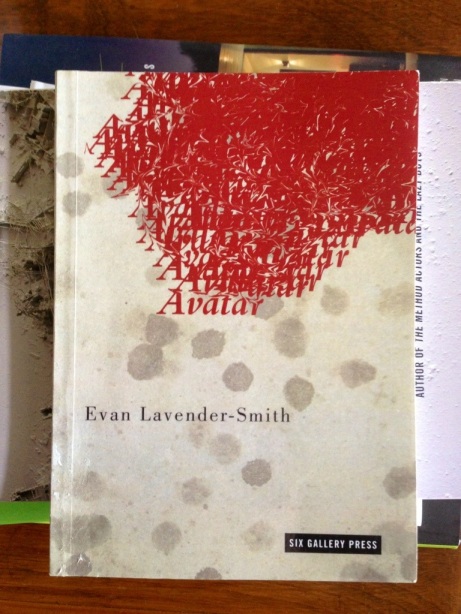
Evan Lavender-Smith’s Avatar (Book Acquired, 3.22.2013)

20130322-131801.jpg

Came home to Evan Lavender-Smith’s Avatar in the mail. Loved his book From Old NotebooksWhat is Avatar about? I asked Evan and he told me. This was in an interview we did that will run next week here on this very blog. Here’s a sample:

Biblioklept: I haven’t read your novel Avatar—can you tell us a little bit about it?

ELS: It’s a monologue spoken or thought by someone floating in the depths of space who can see only two points of light, two stars in the distance, one in front and one behind. The speaker/thinker has apparently been stuck in this condition for a very long time, having spent much of that time — hundreds, thousands, maybe millions of years — trying to puzzle out how he/she arrived in such an awful situation, what it means to be there, what to think about next, etc. It’s very different than From Old Notebooks in most respects — a number of people who liked From Old Notebooks told me they didn’t care for Avatar, and some people who liked Avatar told me they weren’t crazy about From Old Notebooks — but I believe they share at least one main concern, which is an attempt to come up with a formal analog that would describe a figure for thought, to formally systemize and to abstract or maybe almost to allegorize thought within the context of a book. Ulysses is probably my all-time favorite novel, and one of the things I love best about it is how its method of interior monologue functions, to my reading, both as this bizarre formal contrivance — people don’t really think like that at all, don’t rely so heavily on words to think, at least I don’t — and as a beautiful linguistic or formal analog to real human thought. In both From Old Notebooks and Avatar, I believe I was trying to do something along those lines, to come up with a way for a book to develop its own peculiar grammar or system of thought quite distinct from real human thought and at the same time have that grammar somehow formally or abstractly correspond to the ebbs and tides and the fits and starts and the beauty and boring repetition of how a mind really thinks; to develop over the course of a book a formal figure for thought that both does and doesn’t resemble thought as we encounter it in our day-to-day lives.

RIP Chinua Achebe

Achebe

RIP Chinua Achebe, 1930-2013

Nigerian author Chinua Achebe died today at the age 82.

I will never forget the first time I read Things Fall Apart, Achebe’s famous novel that mixes elements of magical realism and postcolonial criticism into the story of brave, stubborn Okonkwo, a killer, an exile, a man too big for his world. I was a high school senior and the book was part of an AP Literature reading list. I found a tattered copy in my classroom library, and compelled by the cover and the book’s name (what a great name!) and the author’s name, I read it. I devoured it. I absorbed it. I read it again.

And I stole the book of course.

And then years later, a student of mine stole it from me, which is as it should be.

I used Things Fall Apart for years in the classroom, reading it aloud with my classes in the inner-city school where I taught. Few of my students were avid readers, especially the angry young boys, who often seemed to show up merely to escape the violent streets they roamed or the chaos at home. But they liked Things Fall Apart and they loved Okonkwo and they understood him, his anger, his pride, his fury. Over the years my class set experienced that special kind of attrition all well-loved books face: The books disappeared, secreted into knapsacks and lockers, loaned to students in other classes. Or they fell apart, fittingly, the spines cracked, the glue brittle and crumbling, the pages torn. This is love, of course.

Achebe was always thrust into a strange position. He had to defend writing in English, for example, and discourse about Things Fall Apart often dwells too much on the book’s final chapters, where British colonials begin systemically decimating traditional Igbo culture. It’s not that that final section isn’t important or meaningful to the book, but there’s so much more there—so much is preserved—and shared—of Igbo culture in the book’s first three quarters. (Achebe’s scathing attack on Conrad’s Heart of Darkness often overshadows his fiction).

If we’re being honest though, let’s admit that what makes Things Fall Apart a great work of literature, a strange, strong work of literature, isn’t merely its anthropological or folkloric or political values. It’s not a book we read again and again because of its allegorical values or its maddening critique of colonialism. The reason that we continue to read and reread Things Fall Apart is that it’s an excellent novel, an aesthetic achievement, a work that produces its own anxieties, that captures terror and pity and humanity. So much humanity.

Chinua Achebe in Conversation with Bill Moyers

“Plato’s Dream” — Voltaire

“Plato’s Dream” by Voltaire

In ancient times, dreams were much revered, and Plato was one of the greatest dreamers. His dream The Republic is deservedly famous, but the following little-known tale is perhaps his most amazing dream–or nightmare:

The great Demiurgos, the eternal geometer, having scattered throughout the immensity of space innumerable worlds, decided to test the knowledge of those lesser superbeings who were also his creations, and who had witnessed his works. He gave them each a small portion of matter to arrange, just as our own art teachers give their students a statue to carve, or a picture to paint, if we may compare small things to great.

Demogorgon received the lump of mold we call Earth, and having formed it as it now appears, thought he had created a masterpiece. He imagined he had silenced Envy herself, and expected to receive the highest praise, even from his brethren. How great was his surprise, when, at the presentation of his work, they hissed in disappoval!

One among them, more sarcastic than the rest, spoke:

“Truly you have performed mighty feats! You have divided your world into two parts; and, to prevent them from communicating with each other, placed a vast collection of waters between the two hemispheres. The inhabitants must perish with cold under both your poles, and be scorched to death under the equator. You have, in your great prudence, formed immense deserts of sand, so all who travel over them may die with hunger and thirst. I have no fault to find with your cows, sheep, cocks, and hens; but can never be reconciled to your serpents and spiders. Your onions and artichokes are very good things, but I cannot conceive what induced you to scatter such a heap of poisonous plants over the face of the planet, unless it was to poison its inhabitants. Moreover, if I am not mistaken, you have created about 30 different kinds of monkeys, a still greater number of dogs, yet only four or five races of humans. It is true, indeed, you have bestowed on the latter of these animals a faculty you call Reason, but it is so poorly executed that you might better call it Folly. Besides, you do not seem to have shown any very great regard for this two-legged creature, seeing you have left him with so few means of defense; subjected him to so many disorders, and provided him with so few remedies; and formed him with such a multitude of passions, and so little wisdom and prudence to resist them. You certainly were not willing that there should remain any great number of these animals on Earth at once; for, over the course of a given year, smallpox will regularly carry off a tenth of the species, and sister maladies will taint the springs of life in the remainder; and then, as if this was not enough, you have so disposed things that half of those who survive are occupied in lawsuits, or cutting each other’s throats. Yes, they must be infinitely grateful to you, and I must admit that you have executed a masterpiece.”

Demogorgon blushed. He now realized there was much moral and physical evil in his work, but still believed it contained more good than ill.

“It is easy to find fault,” he said; “but do you imagine it is so easy to form an animal, who, having the gift of reason and free will, shall not sometimes abuse his liberty? Do you think that, in rearing 10,000 plants, it is so easy to prevent some few from having noxious qualities? Do you suppose that, with a certain quantity of water, sand, and mud, you could make a globe without sea or desert?

“As for you, my sneering friend, I think you have just finished the planet Jupiter. Let us see now what figure you make with your great belts, and your long nights, with four moons to enlighten them. Let us examine your worlds, and see whether the inhabitants you have made are exempt from folly and disease.”

Accordingly, his fellow entities examined the planet Jupiter, and were soon laughing at the laugher. He who had made Saturn did not escape without his share of censure, and his fellows, the makers of Mars, Mercury, and Venus, was each in his turn reproached.

They were in the midst of railing against and ridiculing each other, when the eternal Demiurgos thus imposed silence on them all:

“In your performances there is both good and bad, because you have a great share of understanding, but at the same time fall short of perfection. Your works will endure for only a few billion years, after which you will acquire more knowledge and perform much better. It belongs to me alone to create things perfect and immortal.”

“Us, for example?” asked Demogorgon.

Demiurgos scowled, and with that Plato awoke.

Or did he?


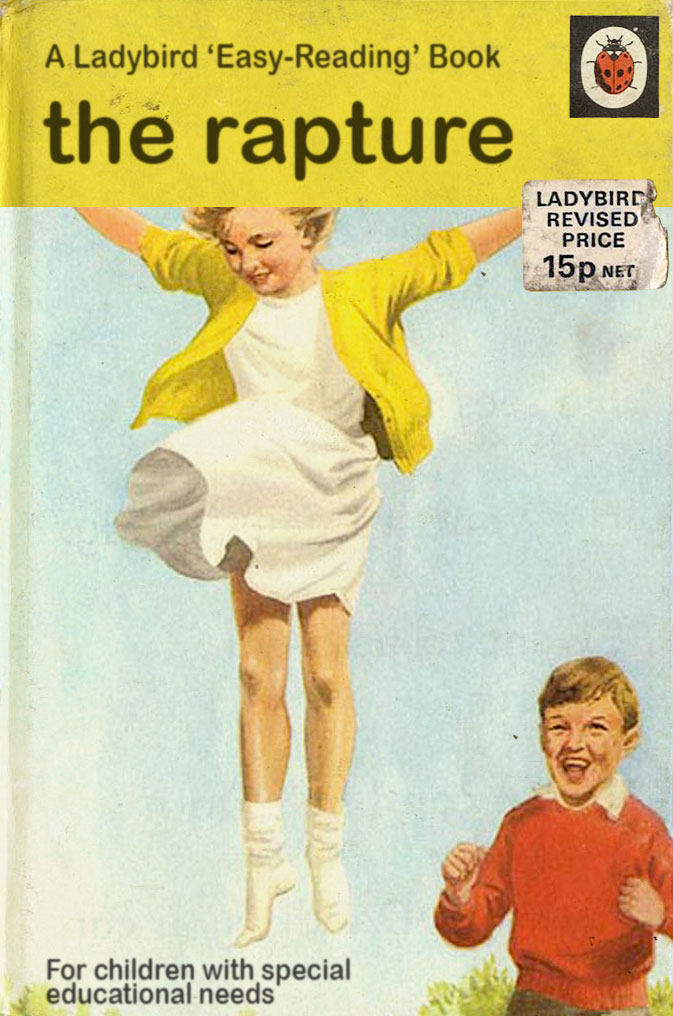
The Rapture — A Ladybird Easy-Reading Book for Children with Special Educational Needs

therapture

(From Scarfolk Council, a favorite new site).

Krabat, The Sorcerer’s Apprentice — Karel Zeman (Full Film)