“This Is What All Good Writers Are Doing” — Tom McCarthy on Library as Source Code

A passage from Tom McCarthy’s essay “Transmission and the Individual Remix”:

This is what all good writers are doing, and always have been. Here I’d part company even with Robbe-Grillet: there is nothing “new” about this. Shakespeare was remixing Ovid, Plutarch, Holinshed, not to mention the authors of the King Leirs and Hamlets already in circulation when he penned his versions. Cervantes was remixing Montalvo, Ariosto, Apuleius, and any number of picaresque authors—and doing this with such delirious selfconcsiousness that at one point he even makes the characters of Don Quixote pause to take stock of the library, the engine room behind their mad associate’s reenactments, perusing it as though it were some kind of source code—which it is. Pound was remixing Villon, Daniel, and Sordello; De Mailla, Marco Polo, and Malatesta; Jefferson, Adams, and Jackson, merging all these feed together as he wound them through his typewriter, splicing them in with fragments of newsprint, shards of radio transmissions—merging them yet in a manner that made no attempt to mask their fragmentary, collated character, to “naturalise” them. With the Cantos, he kept up this furious enterprise for five whole decades, ramping its intensity up and up until the overload destroyed him, blew his mind to pieces, leaving him to murmur, right toward the end: “I cannot make it cohere.”

Woman Reading (1960) — Pablo Picasso

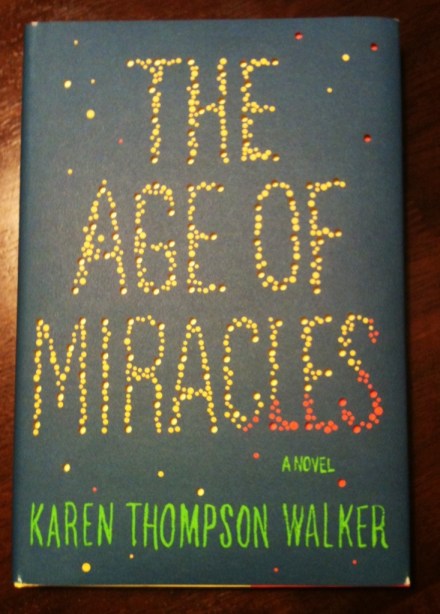
The Age of Miracles (Book Acquired, 6.08.2012)

20120622-180358.jpg

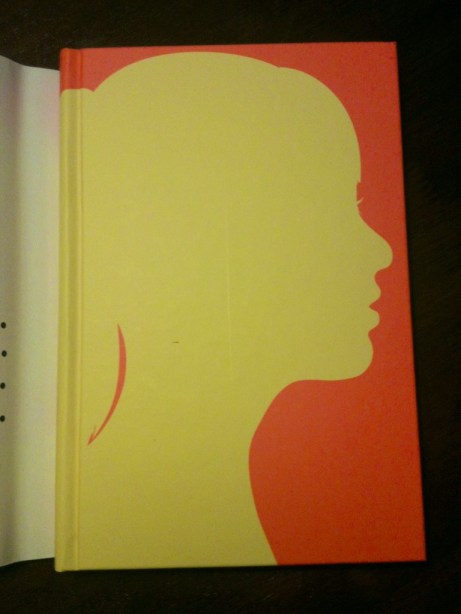
The design folks at Random House has been killing it lately with good hardback designs that integrate dust jackets in handsome ways. Check out what’s under the jacket for The Age of Miracles 

20120622-180407.jpg

I know I should write about what’s in the book, but, jeez, I hate dust jackets so much, so when the designers do something cool or innovative, it’s worth remarking on.

So, what’s in Karen Thompson Walker’s (much buzzed about) debut? Here’s the pub’s copy:

On a seemingly ordinary Saturday in a California suburb, Julia and her family awake to discover, along with the rest of the world, that the rotation of the earth has suddenly begun to slow. The days and nights grow longer and longer, gravity is affected, the environment is thrown into disarray. Yet as she struggles to navigate an ever-shifting landscape, Julia is also coping with the normal disasters of everyday life—the fissures in her parents’ marriage, the loss of old friends, the hopeful anguish of first love, the bizarre behavior of her grandfather who, convinced of a government conspiracy, spends his days obsessively cataloging his possessions. As Julia adjusts to the new normal, the slowing inexorably continues.

Walker’s book has been compared to The Lovely Bones by the publishers (Kakutani compares it favorably as well in her gushy review) as well as Margaret Atwood. I dunno. First 20 pages were not for me. It’s likely the book’s not for me.

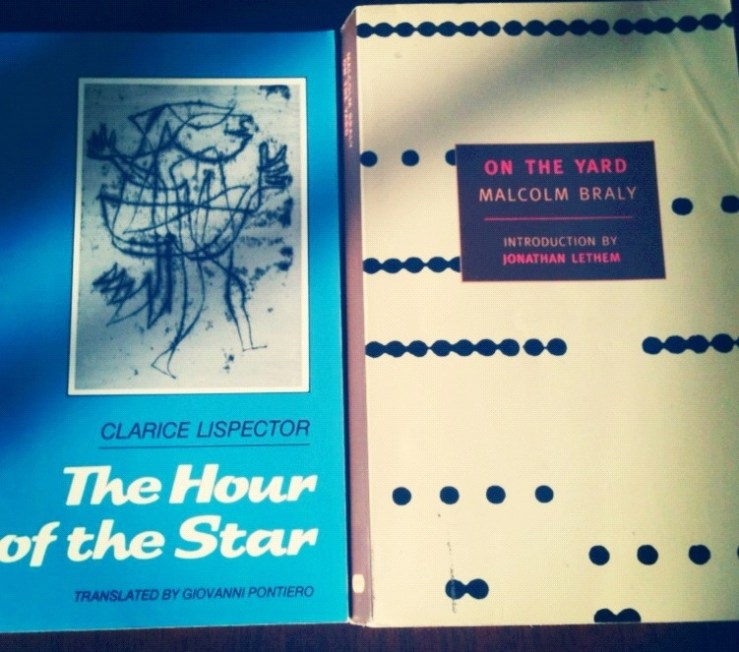
Clarice Lispector/Malcolm Braly (Books Acquired 6.22.2012)

20120622-184839.jpg

It’s a sickness. Should I explain that the bookstore is like 1.1 miles from my house? And that it holds somewhere between one and two million books? (No exaggeration). That it’s like three or four buildings  cobbled together in snaking passages, all said passages lined by books? It’s also like .2 miles from the grocery store I/we usually shop at. Which I had to go by to get mozzarella. For make your own pizza night. But of course, I had to stop off and browse. (Is it weird I set the timer on my iPhone? Gave myself 17 minutes?).

Anyway. Picked up these two.

The Lispector comes via recommendation of Scott Esposito, although this New Directions edition is not the latest translation, but, I dunno. It’s short. The Braly, well, I’d never heard of it, honestly, but it’s an NYRB edition, and the spines of those books always standout, and Lethem introduces it, and even though I haven’t liked Lethem’s last few books, well, he’s still a tastemaker par excellence, and Kurt Vonnegut blurbs it on the back, calling it, “Surely the great American prison novel.” And I just finished “The Part About the Crimes” in 2666 (yet again, more on that to come) and maybe a prison novel seems especially intriguing.

I Audit Hilary Mantel’s Bring Up the Bodies (Part 1)

The good people at Macmillan Audio were kind enough to send me a copy of the unabridged audiobook of Hilary Mantel’s Bring Up the Bodies, the highly anticipated sequel to her 2009 Booker prize winner, Wolf Hall. (I loved Wolf Hall, by the way). I’ll be writing about Bring Up the Bodies in brief installments as I audit the book, instead of waiting to complete the whole thing before reviewing (as I usually do) because a) it’s hard to dogear passages from an mp3 and b) the book is pretty damn long (about 24hrs) and c) I’ve yet to read a review of the book that might color my own perceptions.

Bring Up the Bodies—now seems as good a time as any to point out that, hey, that’s just a great title—Bring Up the Bodies picks up right where Wolf Hall left off. Just as that first book throws its audience into the deep end, with one of the more bewildering openings in recent memory, so too does Bring Up the Bodies begin abruptly in media res. Please forgive me if I begin in the middle of things as well—to be clear, it’s not a good idea to jump into Bodies until you’ve read Wolf Hall. And Wolf Hall is worth your time.

It’s 1535 and our protagonist Thomas Cromwell is 50 and starting to feel his age (he laments at one point that he no longer remembers any of the snippets of Welsh he once knew; he can no longer play tennis). His prince, King Henry VIII, is also quickly aging, his body turning to the fat lump that we tend to picture him as these days. An expanding tummy is the least of Henry’s worries, however—and Henry’s worries are Cromwell’s worries. The major plot arc will likely be Henry’s plans to oust his newish bride Anne Boleyn, a repetition of sorts from Wolf Hall, where Henry and Cromwell (mostly Cromwell) worked to annul Henry’s marriage to Queen Katherine. Obviously though, we can’t accuse Mantel of a lack of imagination in crafting her plots. She’s working from history of course, and what’s most amazing about both Wolf Hall and Bring Up the Bodies is how Mantel invigorates that history. Who knew the hoary Tudor saga needed a retelling?

It works here of course because Cromwell is such a fascinating character. Mantel anchors her impeccable free indirect style in Cromwell’s mind, and she channels his intense intellect with sharp grace.  Here’s a remarkable passage that somehow summarizes (broadly, of course) much of Wolf Hall and showcases Mantel’s ability to move her prose seamlessly from exterior to interior,  from how others might see Cromwell to how he might understand himself:

Thomas Cromwell is now about fifty years old. He has a labourer’s body, stocky, useful, running to fat. He has black hair, greying now, and because of his pale impermeable skin, which seems designed to resist rain as well as sun, people sneer that his father was an Irishman, though really he was a brewer and a blacksmith at Putney, a shearsman too, a man with a finger in every pie, a scrapper and brawler, a drunk and a bully, a man often hauled before the justices for punching someone, for cheating someone. How the son of such a man has achieved his present eminence is a question all Europe asks. Some say he came up with the Boleyns, the queen’s family. Some say it was wholly through the late Cardinal Wolsey, his patron; Cromwell was in his confidence and made money for him and knew his secrets. Others say he haunts the company of sorcerers. He was out of the realm from boyhood, a hired soldier, a wool trader, a banker. No one knows where he has been and who he has met, and he is in no hurry to tell them. He never spares himself in the king’s service, he knows his worth and merits and makes sure of his reward: offices, perquisites and title deeds, manor houses and farms. He has a way of getting his way, he has a method; he will charm a man or bribe him, coax him or threaten him, he will explain to a man where his true interests lie, and he will introduce that same man to aspects of himself he didn’t know existed. Every day Master Secretary deals with grandees who, if they could, would destroy him with one vindictive swipe, as if he were a fly. Knowing this, he is distinguished by his courtesy, his calmness and his indefatigable attention to England’s business. He is not in the habit of explaining himself. He is not in the habit of discussing his successes. But whenever good fortune has called on him, he has been there, planted on the threshold, ready to fling open the door to her timid scratch on the wood.

Of course, good fortune is not without its headaches, and Bring Up the Bodies quickly establishes the daily grind of being the king’s chief minister. Cromwell has to worry about the uncertain finances of the kingdom; the plots of the Catholic Church; the ever-present threat of Katherine’s nephew, Charles V, Holy Roman Emperor; Cromwell also has to worry about scheming at court and gossip in the towns. And yet he keeps a level head, even as he appeals to his memories of the late Cardinal Wolsey, who hangs like an ironic ghost over the early chapters of Bring Up the Bodies. (I’m hoping Wolsey’s ghost will continue to haunt the book). It’s when Cromwell turns his sharp mind to a critique of the cleric class (he’d turn out all the abbeys and seize their coffers), or to a flat rebuttal of the concept of confession (“God doesn’t require an intermediary”), or even when he sniffs at Machiavelli as too conservative that we see in Cromwell the advent of modernity.

A quick word on the audio production—it’s great stuff. Reader Simon Vance delivers the tale in a dry, clear cadence that perfectly suits Mantel’s prose. Vance knows when to lean into the ironic inflections that sometimes color Cromwell’s dialogue (both interior dialogue and speech with others), and he employs a range that easily differentiates the other voices that pop up in the narrative without losing a consistent tone. As I’ve stated on this blog many times, a good reader makes all the difference, and Vance is a good reader. More to come.

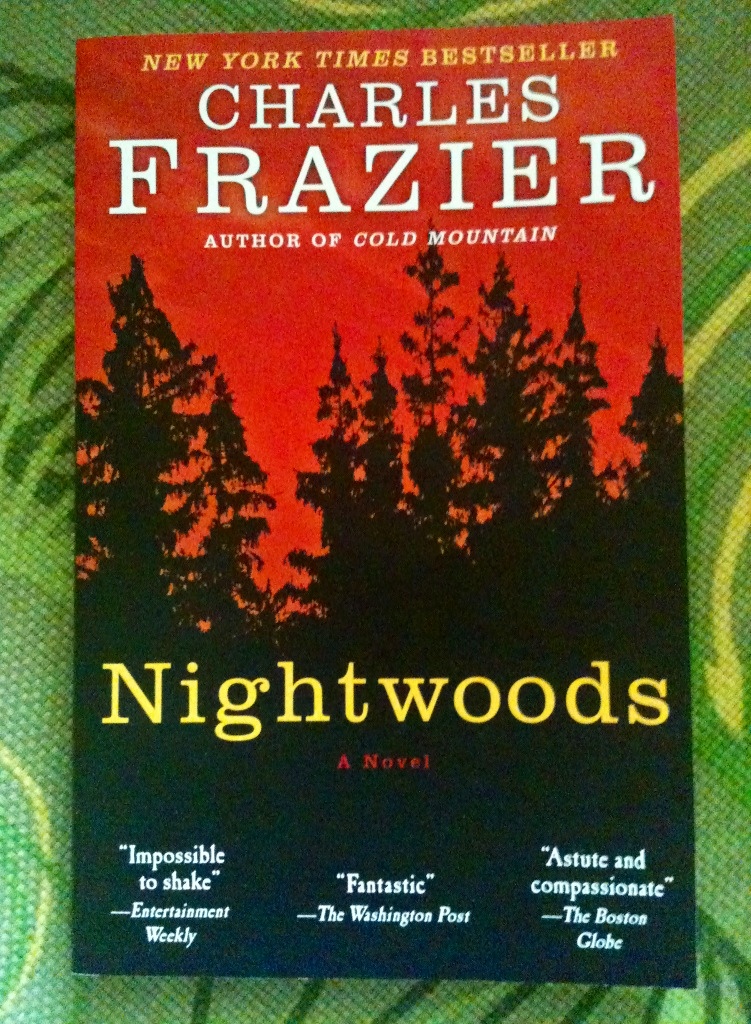
Charles Frazier’s Nightwoods (Book Acquired, 6.14.2012)

20120622-100218.jpg

Charles Frazier’s Nightwoods, new in trade paperback. From Randy Boyagoda’s NY Times review:

“Nightwoods,” Frazier’s new novel, is a departure from its predecessors in some respects. It’s set in the early 1960s rather than the 19th century, and it involves no literary or historical elements of comparable grandeur and gravity. Indeed, based on its premise, the new book feels remarkably stripped down: a young woman named Luce, the caretaker of an old lodge in small-town North Carolina, becomes the guardian of the twin children of her murdered sister. In turn, she must defend them from Bud, their former stepfather, who killed their mother while they watched, and who believes the traumatized children know the location of some stolen money. As a setup, this promises suspense and mystery, to which Frazier adds family tension (when Luce’s lawman-cum-drug-addict father buddies up with Bud) and romance (after the shy, handsome grandson of the lodge’s deceased owner visits his inheritance and falls for Luce).

Tom McCarthy on William Burroughs’s Verbal Remix Software

A passage from Tom McCarthy’s essay “Transmission and the Individual Remix:”

It might be inferred, from what I’ve said, that any old remix will do. Not so: there are good and bad ones. Tristan Tzara cutting Shakespeare sonnets up and pulling their words from hats is an exercise in randomizing. William Burroughs and Brion Gysin mixing poems in with sliced-up pages of The New York Times is quite another matter: it is assiduous composition—composition understood in all its secondary nature: as reading, tracing, reconfiguring. Using the same technique, Gysin comes up with a few clumsy permutations along the lines of “Rub the Word Right Out . . . Word Right Rub the Out” and so on—whereas Burroughs generates such gorgeous sequences as:

Visit of memories. Only your dance and your voice house. On the suburban air improbable desertions . . . all harmonic pine for strife.

or

The great skies are open. Supreme bugle burning flesh children to mist.

Why does Burroughs conjure so much more richness from the same source material? Because (unlike the painter Gysin, whose skill lies primarily in the domain of images), he has uploaded the right verbal remix software. He has read and memorized his Dante, his Shakespeare, his Eliot—to such an extent that his activity as a composer consists of giving himself over to their cadences and echoes, their pulses, codas, loops, the better that these may work their way, through him, The New York Times and any other body thrown into the mix, into an audibility that, booming and echoing in the here-and-now, transforms all the mix’s elements, and time itself.

This is what all good writers are doing, and always have been.

Denis Johnson’s Train Dreams Is a Perfect Audiobook

Going West (Express Train) — Thomas Hart Benton

A few weeks ago on this blog, I declared Denis Johnson’s Train Dreams a perfect novella, a claim that I feel even more certain about after listening to Macmillan audio’s new production of the book, read by Will Patton.

Precise, funny, and moving, Train Dreams tells the story of Robert Grainier, a laborer (and eventual hermit of sorts) who makes a life in (and against) the strange wilderness of the Idaho panhandle. The book somehow measures the first half of the twentieth century in the US without overreaching; instead, through Grainier’s human (but anti-social) presence, Johnson traces the end of Manifest Destiny, the last strands of the wild frontier. Train Dreams, poised tautly on a line that divides the mythic and metaphysical from the concrete and real, shows us a world where we might catch a glimpse of wolf-children and angels—the real thing, not just the sham show, not just a pale suggestion.

Moving through the book again via Patton’s expert narration, I was struck by how constructed yet seamless Johnson’s narrative is. Johnson gets so much credit for the precision of his syntax, but a rereading of Train Dreams reveals how tight and layered, yet never obvious, his plot is—how he lays out his themes repeatedly without brazenly calling attention to them. (One of the joys of reading is rereading; one of the joys of a novella is that its brevity allows us to easily reread). The book is a gem.

Will Patton’s reading perfectly matches the tone, pacing, and depth of Train Dreams. He understands the restraint of Johnson’s prose, never tripping over into bombast or ghastly over-emoting. Patton’s wry, not-quite-dusty, not-quite-dulcet tone brings Johnson’s small cast to vivid life. In particular, he breathes energy into the humorous dialogues. I found myself laughing aloud over a discourse between Grainier and a man who’s been shot by his own dog. Patton understands the material and brings the same sensitivity, pathos, and wit to it that he brought to his reading of Johnson’s 2007 opus, Tree of Smoke.

A good reader makes all the difference of course. In the wrong hands—excuse me, wrong voice—a book we thought we knew can come across stifled, squashed; the reader can actually hurt the book, impose the wrong tone: misread. A reader like Patton (and I should credit his director and production team too, of course) can enlarge a book for its audience, shining light on the subtle nuances we might overlook, or even clouding phrases we thought we fully understood, empowering the language with a new ambiguity that enriches the overall reading experience. Highly recommended.

Here’s Patton reading the first part of Train Dreams:

The Magdelene Reading — Rogier van der Weyden

List of Fictional Suicides (From David Markson’s Reader’s Block)

Emma Bovary.

Anna Karenina.

Othello.

Jocasta.

Brunnhilde.

Hedda Gabler.

Romeo and Juliet.

Werther.

Dido.

Cio-Cio-San.

Antigone and Haemon.

Miss Julie.

Axel Heyst.

Quentin Compson.

Aida.

Inspector Javert.

Mynheer Peeperkorn. Leo Naphta.

Smerdyakov.

Rudolf Virag.

Edna Pontellier.

Hero.

Manrico’s Leonora.

Cheri.

Goneril.

Richard Cory.

McWatt.

Tosca.

Stravrogin. Kirillov.

Martin Eden.

Hurstwood.

Pyramus and Thisbe.

Roithamer.

Pierre Glendinning.

Winnie Verloc.

George Wilson.

Hedvig Ekdal.

Christine Mannon. Orin Mannon.

Willy Loman.

Senta.

Maggie Johnson.

Peter Grimes.

Bess, the landlord’s black-eyed daughter.

Svidrigailov.

James O. Incandenza.

Konstantin Treplev.

Bartleby.

Septimus Smith.

Deirdre.

Seymour Glass.

Ophelia.

Samson.

Eustacia Vye.

Phaedra.

Alcetis.

Launcelot.

From David Markson’s Reader’s Block.  By my count, Markson references throughout the book 149 suicides (or near-suicides, or presumed suicides) of real, actual persons (i.e., not including the list above). This count does not include Markson’s reference to “Nine hundred and sixty Jews” who “committed suicide at Masada, in 73 A.D., rather than surrender to the Roman legions that had lately sacked Jersusalem.” It’s entirely possible I miscounted.

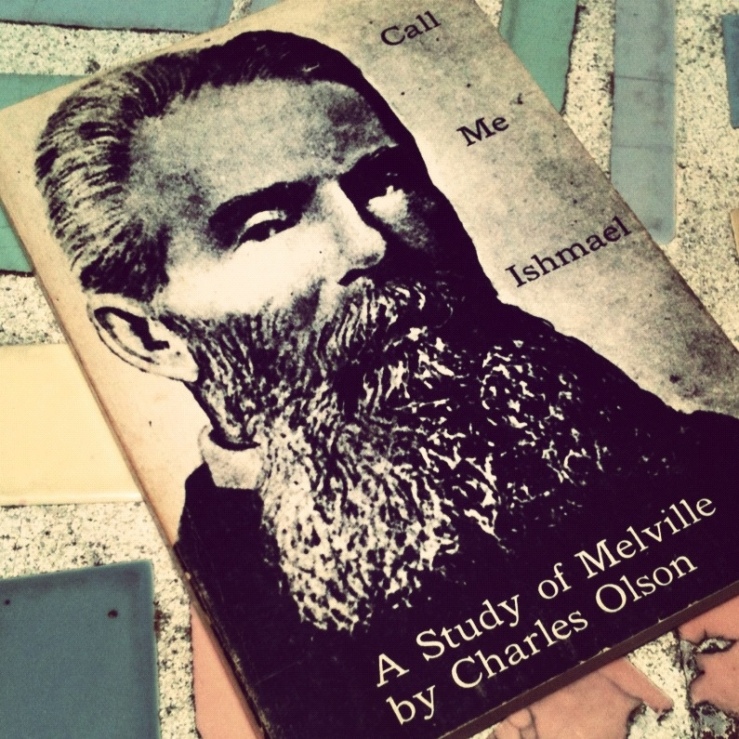
“Half Horse Half Alligator” — I Review Charles Olson’s Inimitable Melville Study, Call Me Ishmael

20120616-141629.jpg

The classical Greeks understood that literature is a form of competition. The eminent literary critic Harold Bloom folded a bit of Freudian psychology into this insight, describing the “anxiety of influence” that lurks beneath the impetus to write, the motivation to enter into an agon with the history of letters, to Oedipally assassinate—or at least assimilate—one’s literary forebears. To put this another way: What does it take to write after, say, The Odyssey? How does one answer to The Book of Job? The gall to write after Don Quixote, after Shakespeare, after Dostoevsky, after George Eliot . . .

What about Moby-Dick? What are the possibilities of even writing about Moby-Dick? (One thinks here of Ishmael’s own futile attempts to measure whales). How could Melville write after Job? After Lear? After Moby-Dick? How did Melville assimilate the texts that presented the strongest anxieties of influence in his opus? Could Melville survive the wreckage of The Pequod? These are the questions that poet-critic Charles Olson tackles—sometimes directly, sometimes obliquely, and always with brisk, sharp language—in Call Me Ishmael, his study of Melville and Moby-Dick.

Here’s one answer to my list of questions. It comes early in Olson’s book:

The man made a mess of things. He got all balled up in Christ. He made a white marriage. He had one son die of tuberculosis, the other shoot himself. He only rode his own space once—Moby-Dick. He had to go fast, like an American, or he was all torpor. Half horse half alligator.

Melville took an awful licking. He was bound to. He was an original, aboriginal. A beginner. It happens that way to the dreaming men it takes to discover America . . . Melville had a way of reaching back through time until he got history pushed back so far he turned time into space. He was like a migrant backtrailing to Asia, some Inca trying to find a lost home.

We are the last “first” people. We forget that. We act big, misuse our land, ourselves. We lose our own primary.

Melville went back, to discover us, to come forward. He got as far as Moby-Dick.

This passage illustrates Olson’s forceful, often blunt prose, the kind of language that cracks directly at Melville’s own impossible prose in Moby-Dick. I think here of the critic James Wood’s notation in his essay “Virginia Woolf’s Mysticism” that

The writer-critic, or poet-critic, has a competitive proximity to the writers she discusses. The competition is registered verbally. The writer-critic is always showing a little plumage to the writer under discussion. If the writer-critic appears to generalize, it is because literature is what she does, and one is always generalizing about oneself.

Olson may generalize as he shows a little plumage to master Melville, cutting through huge swaths of history and making poetic leaps into strange similes, but Call Me Ishmael is ultimately keenly attenuated to detail, to the processes of Melville’s constructions at the historical, economic, psychological, religious, and, yes, literary level. Although a slim 119 pages in my 1947 City Lights edition, Call Me Ishmael nevertheless vividly conveys the sources Melville synthesized to create Moby-Dick.

The book begins with an unsourced account of the whaleship Essex, attacked and destroyed by a sperm whale in the Pacific in 1820, a year after Melville’s birth. Olson trusts his readers to connect The Essex to The Pequod. Unlike so much literary scholarship, Olson’s Ishmael doesn’t torture every element of the text into overwrought explications. He provides an overview of the importance of whaling-industry-as-world’s-fuel source in a chapter that reads more like a prose poem than a stuffy history book, and then, in a chapter appropriately titled “Usufruct,” offers up entries from Melville’s own journals as primary evidence of the material that led to Moby-Dick. Olson rarely sticks his nose in here, letting the reader synthesize the selections.

Olson then plumbs Moby-Dick’s literary roots, delving into Shakespeare, particularly Lear and Antony and Cleopatra. He attends to Melville’s own annotations to Shakespeare, and then points out Melville’s literary/political condensation:

As the strongest force Shakespeare caused Melville to approach tragedy in terms of the drama. As the strongest social force America caused him to approach tragedy in terms of democracy.

It was not difficult for Melville to reconcile the two. Because of his perception of America: Ahab . . .

Ahab is the FACT, the Crew the IDEA. The Crew is where what America stands for got into Moby-Dick. They’re what we imagine democracy to be. They’re Melville’s addition to tragedy as he took it from Shakespeare. He had to do more with the people than offstage shouts in a Julius Caesar. This was the difference a Declaration of Independence made.

The Shakespeare section of Call Me Ishmael marvels: Olson’s perceptive powers simultaneously enlighten and make seemingly-familiar territory dark, strange. He then moves into a discussion of post-Moby Melville, a man perhaps crushed by his own achievement—not by any financial success, no, definitely no, but the metaphysical success. Like a Moses, Melville had found the god he so desperately needed:

Melville wanted a god. Space was the First, before time, earth, man. Melville sought it: “Polar eternities” behind “Saturn’s gray chaos.” Christ, a Holy Ghost, Jehovah never satisfied him. When he knew peaces it was with a god of Prime. His dream was Daniel’s: the Ancient of Days, garment white as snow, hair like the pure wool. Space was the paradise Melville was exile of.

When he made his whale he made his god. Ishmael once comes to the bones a Sperm whale pitched up on land. They are massive, and his struck with horror at the “antemosaic unsourced existence of the unspeakable terrors of the whale.”

When Moby-Dick is first seen he swims a snow-hill on the sea. To Ishmael he is the white bull Jupiter swimming to Crete with ravished Europa on his horns: a prime, lovely, malignant white.

Olson agrees with an 1856 journal entry by Nathaniel Hawthorne that he cites at length: Melville “can neither believe, nor be comfortable in his unbelief.” In Olson’s analysis, after having found god-in-the-whale, Melville plummets into an existential crisis. He gives over to his inner-alligator, torpid, enervated, numb, but still fierce and potent and monstrous. “He denied himself in Christianity,” writes Olson, linking the downward spiral of Melville’s career and family life to this religion.

To this end, Olson is too dismissive of Melville’s later work; when he can find nothing of the “old Melville” to praise in Benito Cereno, Bartleby, or Billy Budd, it’s almost as if he’s willfully ignoring evidence that contradicts his thesis. These are marvelous books, and if they can’t win a contest against Moby-Dick, it’s worth pointing out that little of what’s been written after that book can.

And yet we can write after Melville; we can even write on Melville. The will and vitality of Olson’s forceful, intelligent prose opens a way, or at least exemplifies a way. At the same time, paradoxically, a reading of Call Me Ishmael seems to foreclose the need, if not the possibility, of reading another study of Moby-Dick. This statement is not meant to be a knock against Melville scholarship. Here’s the thing though: life is short, time is limited, and if one plans to read a book about Moby-Dick, it should be Olson’s Call Me Ishmael. It’s great, grand stuff.

Woman Reading (1953) — Pablo Picasso

“They Passed in Review” (Mark Twain Illustration)

Image by Daniel Carter Beard for Twain’s 1897 volume Following the Equator.

Josh Henkin Talks to Biblioklept About His New Novel, The World Without You

Joshua Henkin’s new novel, The World Without You, tells the story of the Frankels, a large Jewish American family who gather over the Fourth of July weekend to mourn the death of their son Leo, a journalist who was kidnapped and then murdered in Iraq. The World Without You is Henkin’s third novel after Matrimony and Swimming Across the Hudson. Henkin directs the MFA program in Fiction Writing at Brooklyn College. The World Without You is new in hardback from Pantheon. You can learn more about Henkin at his website. He was gracious enough to talk to me over a series of emails about writing, teaching, verb tense, sympathy, and his new novel.

Biblioklept: There’s a lot going on in The World Without You, but it seems to be essentially a novel about a family—what it means to be a family, what it means to be in a family, what it means to be in conflict with a family—where did the Frankels come from?

Josh Henkin: The most simple answer is, My imagination.  The Frankels aren’t based on anyone I know, and like all characters in fiction (at least the kind of fiction I write), they developed slowly over time; I discovered them in the writing process over the course of quite a number of years.  What I would say is that I think that in the same way that people speak of “rebound relationships,” I think of my novels as “rebound novels.”  Matrimony took place over twenty years and focuses on a small cast of characters, and I wanted to write something different this time.  So, whether consciously or not, I set out to write a book that was more compressed, on one hand (it takes place over 72 hours instead of over 20 years), and more spacious, on the other hand (there are many more characters, and we go into many points of view).  If you’re asking where the inspiration for the book came from, I’d say it came mostly from the following.  I had a first cousin who died of Hodgkin’s disease when he was in his late twenties. I was only a toddler at the time, but his death hung over my extended family for years. At a family reunion nearly thirty years later, my aunt, updating everyone on what was happening in her life, began by saying, “I have two sons….” Well, she’d once had two sons, but her older son had been dead for thirty years at that point. It was clear to everyone in that room that the pain was still raw for her and that it would continue to be raw for her for the rest of her life. By contrast, my cousin’s widow eventually remarried and had a family. This got me thinking how when someone loses a spouse, as awful as that is, the surviving spouse eventually moves on; but when a parent loses a child they almost never move on. That idea was the seed from which The World Without You grew. Although there are many tensions in the novel (between siblings, between couples, between parents and children), the original tension was between mother-in-law and daughter-in law, caused by the gulf between their two losses, by the different ways they grieve.

Biblioklept: You mention the compression of The World Without You, which here strikes me as form of realism. The book takes place over the July 4th holiday—why did you choose this setting? Was the Independence Day setting always part of your design?

JH: I knew I wanted a compressed period of time–mostly because Matrimony took place over twenty years and I think of books like relationships:  one book is a rebound from the previous one.  I also knew that I wanted the book to be told in many points of view; this, too, makes it different from Matrimony, which was told only in Julian and Mia’s points of view.  In terms of Independence Day, I think that was a little more unconscious, though probably intentional as well.  Part of the issue was a practical one:  how do you get a large, disperse family together in one place?  You need an occasion for the telling, and a holiday like July 4th provides one.  Though of course the real occasion for the telling is Leo’s memorial.  But I think even there Independence Day is relevant because although the book is obviously about the specific characters (I think all fiction worth its salt is always first and foremost about the particular, not the general), I do think this novel in its own indirect way is a novel about America more broadly, and certainly about a certain segment of America, of which I consider myself a part.  The Frankels are a political family, with strong opinions about Bush and about the Iraq War, but they’re also privileged.  They’ve really known no one who has fought in the war, have been insulated from it in their day-to-day lives–and then, with Leo’s death, it comes and touches them in the most horrific and personal way.  And I wondered what that’s like–to be mourning while the rest of the country is celebrating, to be commemorating the independence of a country that has sent its young men and women to war, a country that’s responsible for their son and brother’s death.

Biblioklept: You mention the Frankels’s privileged background. They are, for the most part, liberal, secular, refined. Leo dies in Iraq, but, significantly, he’s a journalist, not a soldier. Do you worry that not all readers will connect to these characters? How do you make your characters sympathetic—or does sympathy even matter in fiction?

JH: My feeling is that people are people, and they merit as little or as much sympathy as they merit whether they’re rich or poor, healthy or sick, beautiful or ugly.  There’s a strand of anti-elitism in American culture  (one can see it every day, tirelessly, in our politics), and one sees it, too, in certain attitudes toward literature–the idea being that only the humble, the uneducated are worthy of our fiction.  But I find the idea pretentious; it smacks of a kind of reverse snobbery.  And tell it, in any case, to Fitzgerald, or Cheever, or Yates.  One of the things good literature does is it humanizes people we might not otherwise be drawn to.  And (this is at least as important) it allows us to enjoy the company of people on the page whose company we might not enjoy off the page.  Which is another way of saying that sympathy doesn’t matter in fiction, at least not sympathy narrowly construed.  In fiction, as in life, some people are likable and some people aren’t likable, and the world would be boring if everyone were likable.  The fiction writer’s job is to make his characters complex, interesting, fully human, not (or at least not necessarily) likable.

Biblioklept: The World Without You is conveyed in the present tense. I’m curious what led you to compose in the present tense, or if you drafted parts of the novel in the past tense—what advantages can the present tense offer the writer and reader? What are its limitations?

JH: I think about tense a lot, probably because I teach fiction writing and, more specifically, because I direct Brooklyn College’s Fiction MFA program, and so I end up reading 500 application manuscripts a year, a good number of which are written in the present tense.  It’s said that present tense makes the story feel more immediate, yet year after year I notice among our graduate applications that the present-tense stories are usually the least immediate, most inert stories in the bunch.  Why is that?  I think it’s because some writers use present tense as a substitute for narrative, as a way of hiding that nothing is happening in their stories.  They think that if they write in present tense their stories will feel immediate.

I also think that present tense is deceptive because it’s easy in present tense to slip out of scene and into general/habitual time.  In the past tense, you would write “She went to the store on Tuesday” to suggest that the character is going to the store at a specific time.  If, on the other hand, you wanted to indicate repeated or habitual action, you would write, “She would go to the store on Tuesday.”  But in the present tense there generally isn’t such a distinction between the specific and the habitual.  “She goes to the store on Tuesday” can mean either that she’s going to the store right now on Tuesday or that she’s a habitual store-goer on Tuesdays.  I think what happens in present tense is that a lot of writers end up slipping into the habitual, and so what seems immediate is actually not at all immediate.

The other thing I’d say is that it’s very hard to write a present-tense novel that takes place over ten years because it’s likely to feel artificial for all that time to be in present tense.  Present tense works best, then, in novels and stories told in compressed time.

The World Without You simply came to me in present tense.  That was the tense that felt right for the book.  This may be true, in part, because I’d been influenced by Richard Ford’s Independence Day, another novel told over a single July 4th holiday that’s told in present tense.  But I think it’s more than that.  The World Without You takes place over 72 hours, so it’s ideally suited for present tense, and it’s also told in confined space; most of the book is situated in the Frankel family home and the streets that surround it in Lenox, Mass.  One thing I was trying to do was balance the sprawling quality of the book (there are many characters and lots of different points of view) with the more focused time and space that I just mentioned, and I think present tense allowed me to do that.  But all this is post-facto, a case of me looking back at what I did.  I proceeded intuitively, which is what I always do, and present tense simply felt right (it was the right sound, the right voice) for this book.

Biblioklept: You bring up your position as Brooklyn College’s MFA fiction program director—I’m curious if reading so many manuscripts affects your own writing.

JH: I love teaching, and that’s in large part because I get to teach some of the most talented young writers out there.  In the last few months alone, five of our recent MFA graduates have gotten book contracts.  There are writers who wouldn’t know how to teach; for them, writing is an intuitive process and they aren’t fully conscious of what they’re doing.  For me, it was the opposite.  I could read someone else’s short story and figure out what wasn’t working long before I could make things work in my own stories.  I needed to learn how to become a more intuitive writer, and critiquing other people’s stories helped me do that; it still helps me.  I’ve been at this process longer than my students have, but we’re all struggling with the same thing—how to write convincing stories; how to make our characters comes so deeply to life they feel as real as, even realer than, the actual people in our own lives; how to use language in a way that’s precise and beautiful and utterly true.  That never changes.  So in a way, even though I’m the instructor, we’re all students in the room.  Also, I’m a fairly social person, and writing is incredibly solitary, so teaching gives me the chance to be with other people and to talk about the work I love.

Biblioklept: Are there manuscripts that come in where you just kind of slap your forehead and go, “Not another story about ______ again!”

JH: Absolutely.  Many of my graduate students are in their mid-twenties, and so they write about the concerns of people in their mid-twenties.  How to find love in the big city, that kind of thing.  That’s okay.  If it’s done well, just about any subject matter can make for compelling fiction, and in any case, my students won’t be in their mid-twenties forever.  That’s one of the nice things about being a writer.  You mature; you get better over time.  Writing is different from figure skating.  It’s even different from playing the violin.  You can be in your late forties and still be a young writer.  At least that’s what I like to tell myself!

Often it’s less a similarity of subject matter that I see than a similarity of voice or sensibility.  For a time I saw a lot of Lorrie Moore imitators.  Then I saw a lot of George Saunders imitators.  If you’re going to imitate someone, those are two pretty good choices, though in a lot of ways Moore and Saunders are inimitable.  But that’s fine.  Imitation is part of the maturing process.  It’s how a writer achieves her own voice.

Biblioklept: Do you have any upcoming writing projects? What are you working on next?

JH: My most immediate project is a trip to Hawaii! Writing a novel takes a lot out of you. Right now, I’m trying to figure out what comes next. I promised myself I would go back to writing short stories. It’s weird, I’ve spent the last nearly twenty years writing novels, when in so many ways I think of myself as a short-story writer. It was certainly my first love, and because I teach MFA students, I spend a lot of time reading and thinking about short stories. So last fall, when I finished the final draft of The World Without You, I immediately sat down to write a short story, and what happened? The draft I wrote was 113 pages along! And then the second short story I wrote was over 200 pages long! I still think I’m capable of writing a regular old twenty-to-thirty-page short story, but we’ll have to see. In the meantime, I’m tossing around some ideas for a new novel, but it’s still in the very early, incubating stages, so I’m not saying anything more than that.

Biblioklept: Have you ever stolen a book?

JH: Alas, I have not.  But I’m working on it.
Philosopher Reading — Rembrandt

“The Son Never Asked to Be Born” — Roberto Bolaño’s Parenting Advice

Roberto Bolaño, from an interview with Eliseo Álvarez, republished this month in Melville House’s Roberto Bolaño: The Last Interview:

I suppose that within his brutality and his courage–he is a very courageous man–my father loved me as I love my son. In the end, one could talk for hours about the relationship between a father and a son. The only clear thing is that a father has to be willing to be spat upon by his son as many times as the son wishes to do it. Even still the father will not have paid a tenth of what he owes because the son never asked to be born. If you brought him into this world, the least you can do is put up with whatever insult he wants to offer.

Okay, so sons didn’t ask to be born, but what about daughters? How did Bolaño feel about his daughter?

I won’t say anymore. I’ll start to cry. The only explanation I could give would be to cry. It’s beyond the beyond.

Reading these quotes, I thought about two of my favorite depictions of fathers and children in Bolaño’s work. First, there’s Bolaño as the son, “B,” in the title track from the collection Last Evenings on Earth. The story is a strange mix of sinister and funny, with the (perhaps overly literary) son fearing for his dad, a boxer who, at least in the son-narrator’s view, doesn’t seem to be paying attention to just how bad things seem to be turning on the pair’s vacation to Acapulco. Then there’s (possibly) Bolaño as parent, this time in the form of Oscar Amalfitano in 2666. If Bolaño would cry for his daughter’s safety, for anxiety and wariness of a cruel world, then Amalfitano becomes a literary center for those fears. And, if you’ve read that book, you know his paranoia is justified. In any case, it’s clear that Bolaño loved his children deeply. In another of the the book’s interviews–literally, “The Last Interview,” Bolaño, the exile who lived everywhere said, “my only country is my two children.” He even asked that his masterpiece 2666 be divvied up into five parts in the hopes that it would provide steady income for his son and daughter.

St. Jerome Reading in the Countryside — Giovanni Bellini