
 Image by Daniel Carter Beard for Twain’s 1897 volume Following the Equator.
Category: Literature
Josh Henkin Talks to Biblioklept About His New Novel, The World Without You
 Joshua Henkin’s new novel, The World Without You, tells the story of the Frankels, a large Jewish American family who gather over the Fourth of July weekend to mourn the death of their son Leo, a journalist who was kidnapped and then murdered in Iraq. The World Without You is Henkin’s third novel after Matrimony and Swimming Across the Hudson. Henkin directs the MFA program in Fiction Writing at Brooklyn College. The World Without You is new in hardback from Pantheon. You can learn more about Henkin at his website. He was gracious enough to talk to me over a series of emails about writing, teaching, verb tense, sympathy, and his new novel.
Biblioklept: There’s a lot going on in The World Without You, but it seems to be essentially a novel about a family—what it means to be a family, what it means to be in a family, what it means to be in conflict with a family—where did the Frankels come from?
Josh Henkin: The most simple answer is, My imagination. The Frankels aren’t based on anyone I know, and like all characters in fiction (at least the kind of fiction I write), they developed slowly over time; I discovered them in the writing process over the course of quite a number of years. What I would say is that I think that in the same way that people speak of “rebound relationships,” I think of my novels as “rebound novels.” Matrimony took place over twenty years and focuses on a small cast of characters, and I wanted to write something different this time. So, whether consciously or not, I set out to write a book that was more compressed, on one hand (it takes place over 72 hours instead of over 20 years), and more spacious, on the other hand (there are many more characters, and we go into many points of view). If you’re asking where the inspiration for the book came from, I’d say it came mostly from the following. I had a first cousin who died of Hodgkin’s disease when he was in his late twenties. I was only a toddler at the time, but his death hung over my extended family for years. At a family reunion nearly thirty years later, my aunt, updating everyone on what was happening in her life, began by saying, “I have two sons….” Well, she’d once had two sons, but her older son had been dead for thirty years at that point. It was clear to everyone in that room that the pain was still raw for her and that it would continue to be raw for her for the rest of her life. By contrast, my cousin’s widow eventually remarried and had a family. This got me thinking how when someone loses a spouse, as awful as that is, the surviving spouse eventually moves on; but when a parent loses a child they almost never move on. That idea was the seed from which The World Without You grew. Although there are many tensions in the novel (between siblings, between couples, between parents and children), the original tension was between mother-in-law and daughter-in law, caused by the gulf between their two losses, by the different ways they grieve.
Biblioklept: You mention the compression of The World Without You, which here strikes me as form of realism. The book takes place over the July 4th holiday—why did you choose this setting? Was the Independence Day setting always part of your design?
JH: I knew I wanted a compressed period of time–mostly because Matrimony took place over twenty years and I think of books like relationships: one book is a rebound from the previous one. I also knew that I wanted the book to be told in many points of view; this, too, makes it different from Matrimony, which was told only in Julian and Mia’s points of view. In terms of Independence Day, I think that was a little more unconscious, though probably intentional as well. Part of the issue was a practical one: how do you get a large, disperse family together in one place? You need an occasion for the telling, and a holiday like July 4th provides one. Though of course the real occasion for the telling is Leo’s memorial. But I think even there Independence Day is relevant because although the book is obviously about the specific characters (I think all fiction worth its salt is always first and foremost about the particular, not the general), I do think this novel in its own indirect way is a novel about America more broadly, and certainly about a certain segment of America, of which I consider myself a part. The Frankels are a political family, with strong opinions about Bush and about the Iraq War, but they’re also privileged. They’ve really known no one who has fought in the war, have been insulated from it in their day-to-day lives–and then, with Leo’s death, it comes and touches them in the most horrific and personal way. And I wondered what that’s like–to be mourning while the rest of the country is celebrating, to be commemorating the independence of a country that has sent its young men and women to war, a country that’s responsible for their son and brother’s death.
Biblioklept: You mention the Frankels’s privileged background. They are, for the most part, liberal, secular, refined. Leo dies in Iraq, but, significantly, he’s a journalist, not a soldier. Do you worry that not all readers will connect to these characters? How do you make your characters sympathetic—or does sympathy even matter in fiction?
JH: My feeling is that people are people, and they merit as little or as much sympathy as they merit whether they’re rich or poor, healthy or sick, beautiful or ugly. There’s a strand of anti-elitism in American culture (one can see it every day, tirelessly, in our politics), and one sees it, too, in certain attitudes toward literature–the idea being that only the humble, the uneducated are worthy of our fiction. But I find the idea pretentious; it smacks of a kind of reverse snobbery. And tell it, in any case, to Fitzgerald, or Cheever, or Yates. One of the things good literature does is it humanizes people we might not otherwise be drawn to. And (this is at least as important) it allows us to enjoy the company of people on the page whose company we might not enjoy off the page. Which is another way of saying that sympathy doesn’t matter in fiction, at least not sympathy narrowly construed. In fiction, as in life, some people are likable and some people aren’t likable, and the world would be boring if everyone were likable. The fiction writer’s job is to make his characters complex, interesting, fully human, not (or at least not necessarily) likable.
 Biblioklept: The World Without You is conveyed in the present tense. I’m curious what led you to compose in the present tense, or if you drafted parts of the novel in the past tense—what advantages can the present tense offer the writer and reader? What are its limitations?
JH: I think about tense a lot, probably because I teach fiction writing and, more specifically, because I direct Brooklyn College’s Fiction MFA program, and so I end up reading 500 application manuscripts a year, a good number of which are written in the present tense. It’s said that present tense makes the story feel more immediate, yet year after year I notice among our graduate applications that the present-tense stories are usually the least immediate, most inert stories in the bunch. Why is that? I think it’s because some writers use present tense as a substitute for narrative, as a way of hiding that nothing is happening in their stories. They think that if they write in present tense their stories will feel immediate.
I also think that present tense is deceptive because it’s easy in present tense to slip out of scene and into general/habitual time. In the past tense, you would write “She went to the store on Tuesday” to suggest that the character is going to the store at a specific time. If, on the other hand, you wanted to indicate repeated or habitual action, you would write, “She would go to the store on Tuesday.” But in the present tense there generally isn’t such a distinction between the specific and the habitual. “She goes to the store on Tuesday” can mean either that she’s going to the store right now on Tuesday or that she’s a habitual store-goer on Tuesdays. I think what happens in present tense is that a lot of writers end up slipping into the habitual, and so what seems immediate is actually not at all immediate.
The other thing I’d say is that it’s very hard to write a present-tense novel that takes place over ten years because it’s likely to feel artificial for all that time to be in present tense. Present tense works best, then, in novels and stories told in compressed time.
The World Without You simply came to me in present tense. That was the tense that felt right for the book. This may be true, in part, because I’d been influenced by Richard Ford’s Independence Day, another novel told over a single July 4th holiday that’s told in present tense. But I think it’s more than that. The World Without You takes place over 72 hours, so it’s ideally suited for present tense, and it’s also told in confined space; most of the book is situated in the Frankel family home and the streets that surround it in Lenox, Mass. One thing I was trying to do was balance the sprawling quality of the book (there are many characters and lots of different points of view) with the more focused time and space that I just mentioned, and I think present tense allowed me to do that. But all this is post-facto, a case of me looking back at what I did. I proceeded intuitively, which is what I always do, and present tense simply felt right (it was the right sound, the right voice) for this book.
Biblioklept: You bring up your position as Brooklyn College’s MFA fiction program director—I’m curious if reading so many manuscripts affects your own writing.
JH: I love teaching, and that’s in large part because I get to teach some of the most talented young writers out there. In the last few months alone, five of our recent MFA graduates have gotten book contracts. There are writers who wouldn’t know how to teach; for them, writing is an intuitive process and they aren’t fully conscious of what they’re doing. For me, it was the opposite. I could read someone else’s short story and figure out what wasn’t working long before I could make things work in my own stories. I needed to learn how to become a more intuitive writer, and critiquing other people’s stories helped me do that; it still helps me. I’ve been at this process longer than my students have, but we’re all struggling with the same thing—how to write convincing stories; how to make our characters comes so deeply to life they feel as real as, even realer than, the actual people in our own lives; how to use language in a way that’s precise and beautiful and utterly true. That never changes. So in a way, even though I’m the instructor, we’re all students in the room. Also, I’m a fairly social person, and writing is incredibly solitary, so teaching gives me the chance to be with other people and to talk about the work I love.
Biblioklept: Are there manuscripts that come in where you just kind of slap your forehead and go, “Not another story about ______ again!”
JH: Absolutely. Many of my graduate students are in their mid-twenties, and so they write about the concerns of people in their mid-twenties. How to find love in the big city, that kind of thing. That’s okay. If it’s done well, just about any subject matter can make for compelling fiction, and in any case, my students won’t be in their mid-twenties forever. That’s one of the nice things about being a writer. You mature; you get better over time. Writing is different from figure skating. It’s even different from playing the violin. You can be in your late forties and still be a young writer. At least that’s what I like to tell myself!
Often it’s less a similarity of subject matter that I see than a similarity of voice or sensibility. For a time I saw a lot of Lorrie Moore imitators. Then I saw a lot of George Saunders imitators. If you’re going to imitate someone, those are two pretty good choices, though in a lot of ways Moore and Saunders are inimitable. But that’s fine. Imitation is part of the maturing process. It’s how a writer achieves her own voice.
Biblioklept: Do you have any upcoming writing projects? What are you working on next?
JH: My most immediate project is a trip to Hawaii! Writing a novel takes a lot out of you. Right now, I’m trying to figure out what comes next. I promised myself I would go back to writing short stories. It’s weird, I’ve spent the last nearly twenty years writing novels, when in so many ways I think of myself as a short-story writer. It was certainly my first love, and because I teach MFA students, I spend a lot of time reading and thinking about short stories. So last fall, when I finished the final draft of The World Without You, I immediately sat down to write a short story, and what happened? The draft I wrote was 113 pages along! And then the second short story I wrote was over 200 pages long! I still think I’m capable of writing a regular old twenty-to-thirty-page short story, but we’ll have to see. In the meantime, I’m tossing around some ideas for a new novel, but it’s still in the very early, incubating stages, so I’m not saying anything more than that.
Biblioklept: Have you ever stolen a book?
JH: Alas, I have not. But I’m working on it.
Philosopher Reading — Rembrandt

“The Son Never Asked to Be Born” — Roberto Bolaño’s Parenting Advice
Roberto Bolaño, from an interview with Eliseo Álvarez, republished this month in Melville House’s Roberto Bolaño: The Last Interview:
I suppose that within his brutality and his courage–he is a very courageous man–my father loved me as I love my son. In the end, one could talk for hours about the relationship between a father and a son. The only clear thing is that a father has to be willing to be spat upon by his son as many times as the son wishes to do it. Even still the father will not have paid a tenth of what he owes because the son never asked to be born. If you brought him into this world, the least you can do is put up with whatever insult he wants to offer.
Okay, so sons didn’t ask to be born, but what about daughters? How did Bolaño feel about his daughter?
I won’t say anymore. I’ll start to cry. The only explanation I could give would be to cry. It’s beyond the beyond.
Reading these quotes, I thought about two of my favorite depictions of fathers and children in Bolaño’s work. First, there’s Bolaño as the son, “B,” in the title track from the collection Last Evenings on Earth. The story is a strange mix of sinister and funny, with the (perhaps overly literary) son fearing for his dad, a boxer who, at least in the son-narrator’s view, doesn’t seem to be paying attention to just how bad things seem to be turning on the pair’s vacation to Acapulco. Then there’s (possibly) Bolaño as parent, this time in the form of Oscar Amalfitano in 2666. If Bolaño would cry for his daughter’s safety, for anxiety and wariness of a cruel world, then Amalfitano becomes a literary center for those fears. And, if you’ve read that book, you know his paranoia is justified. In any case, it’s clear that Bolaño loved his children deeply. In another of the the book’s interviews–literally, “The Last Interview,” Bolaño, the exile who lived everywhere said, “my only country is my two children.” He even asked that his masterpiece 2666 be divvied up into five parts in the hopes that it would provide steady income for his son and daughter.
St. Jerome Reading in the Countryside — Giovanni Bellini

Five Favorite Fictional Fathers
Literature seems to have an ambivalence toward fatherhood that’s too complex to address in a simple blog post–so I won’t even try. But before I riff on a few of my favorite fathers from a few of my favorite books, I think it’s worth pointing out how rare biological fathers of depth and complexity are in literature. That’s a huge general statement, I’m sure, and I welcome counterexamples, of course, but it seems like relationships between fathers and their children are somehow usually deferred, deflected, or represented in a shallow fashion. Perhaps it’s because we like our heroes to be orphans (whether it’s Moses or Harry Potter, Oliver Twist or Peter Parker) that literature tends to eschew biological fathers in favor of father figures (think of Leopold Bloom supplanting Stephen Dedalus in Ulysses, or Merlin taking over Uther Pendragon‘s paternal duties in the Arthur legends). At other times, the father is simply not present in the same narrative as his son or daughter (think of Telemachus and brave Odysseus, or Holden Caulfield wandering New York free from fatherly guidance). What I’ve tried to do below is provide examples of father-child relationships drawn with psychological and thematic depth; or, to put it another way, here are some fathers who actually have relationships with their kids.
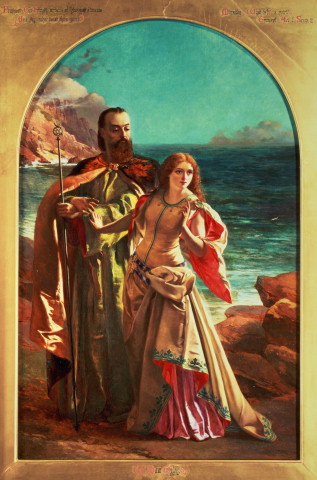
1. Prospero, The Tempest (William Shakespeare)
Prospero has always seemed to me the shining flipside to King Lear’s dark coin, a powerful sorcerer who reverses his exile and is gracious even in his revenge. Where Lear is destroyed by his scheming daughters (and his inability to connect to truehearted Cordelia), Prospero, a single dad, protects his Miranda and even secures her a worthy suitor. Postcolonial studies aside, The Tempest is fun stuff.
2. Abraham Ebdus, The Fortress of Solitude, (Jonathan Lethem)
Like Prospero, Abraham Ebdus is a single father raising his child (his son Dylan) in an isolated, alienating place (not a desert island, but 1970’s Brooklyn). After Dylan’s mother abandons the family, the pair’s relationship begins to strain; Lethem captures this process in all its awkward pain with a poignancy that never even verges on schlock. The novel’s redemptive arc is ultimately figured in the reconciliation between father and son in a beautiful ending that Lethem, the reader, and the characters all earn.
3. Jack Gladney, White Noise (Don DeLillo)
While Jack Gladney is an intellectual academic, an expert in the unlikely field of “Hitler studies” (and something of a fraud, to boot), he’s also a pretty normal dad. Casual reviewers of White Noise tend to overlook the sublime banality of domesticity represented in DeLillo’s signature novel: Gladney is an excellent father to his many kids and step-kids, and DeLillo draws their relationships with a realism that belies–and perhaps helps to create–the novel’s satirical bent.
4. Oscar Amalfitano, 2666 (Roberto Bolaño)
Sure, philosophy professor Amalfitano is a bit mentally unhinged (okay, more than a bit), but what sane citizen of Santa Teresa wouldn’t go crazy, what with all the horrific unsolved murders? After his wife leaves him and their young daughter, Amalfitano takes them to the strange, alienating land of Northern Mexico (shades of Prospero’s island?) Bolaño portrays Amalfitano’s descent into paranoia (and perhaps madness) from a number of angles (he and his daughter show up in three of 2666‘s three sections), and as the novel progresses, the reader slowly begins to grasp the enormity of the evil that Amalfitano is confronting (or, more realistically, is unable to confront directly), and the extreme yet vague danger his daughter is encountering. Only a writer of Bolaño’s tremendous gift could make such a chilling episode simultaneously nerve-wracking, philosophical, and strangely hilarious.
5. The father, The Road (Cormac McCarthy)
What happens when Prospero’s desert island is just one big desert? If there is a deeper expression of the empathy and bonding between a child and parent, I have not read it. In The Road, McCarthy dramatizes fatherhood in apocalyptic terms, positing the necessity of such a relationship in hard, concrete, life and death terms. When the father tells his son “You are the best guy” I pretty much break down. When I first read The Road, I had just become a father myself (my child was only a few days old when I finished it), yet I was still critical of McCarthy’s ending, which affords a second chance for the son. It seemed to me at the time–as it does now–that the logic McCarthy establishes in his novel is utterly infanticidal, that the boy must die, but I understand now why McCarthy would have him live–why McCarthy has to let him live. Someone has to carry the fire.
Apple, Calvino, Žižek (Books Acquired, 6.15.2012)

Woman Reading — Georges Braque

Blah Blah Bloomsday

A list of Irish heroes (from “The Cyclops” episode of Ulysses)
“Words,” a page from one of Joyce’s notebooks for Ulysses:

Another page of Joyce’s notes, plus links to more
James Joyce’s eye glasses prescription:

William Faulkner’s Joyce anxiety
Biblioklept’s lousy review (the review is lousy, not the book) of Dubliners
Joyce’s entry on the 1901 Irish Census
Joyce’s caricature of Leopold Bloom:

Biblioklept’s review (not so lousy, the review) of a superior full-cast audio recording of Ulysses
James Joyce explains why Odysseus is the most “complete man’ in literature
James Joyce’s passport:

Leopold’s Bloom’s recipe for burnt kidney breakfast
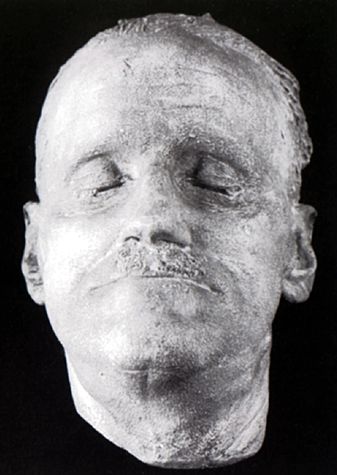
James Joyce’s death mask:
“Words” — A Page from James Joyce’s Notebooks
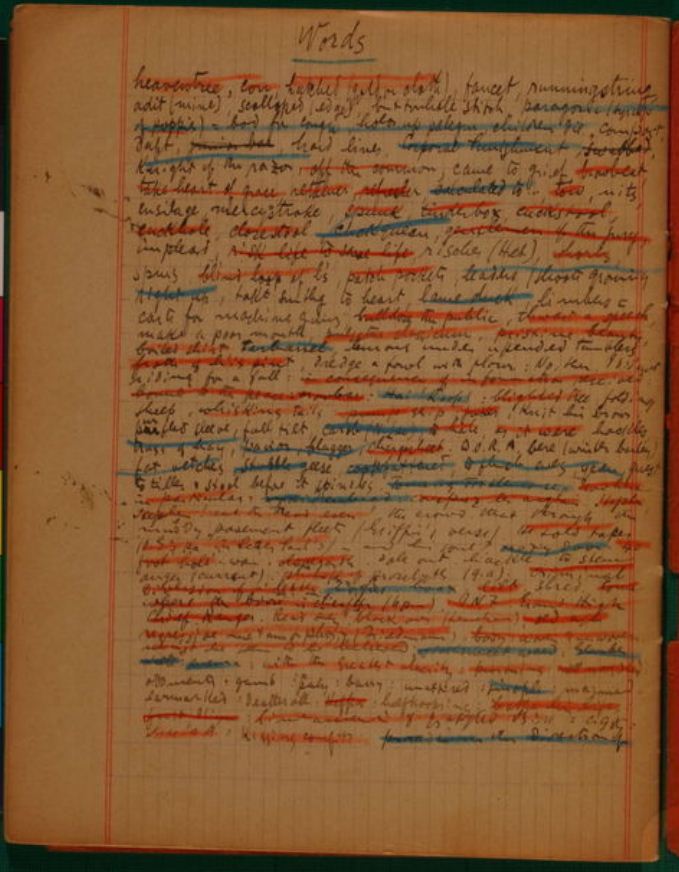
This page is from the same notebook where Joyce headed a page he titled “Rhetoric”; the notes in the books seem to suggest the notebook is part of the preparatory material for Ulysses. From the National Library of Ireland, which probably doesn’t want me posting their material like this.
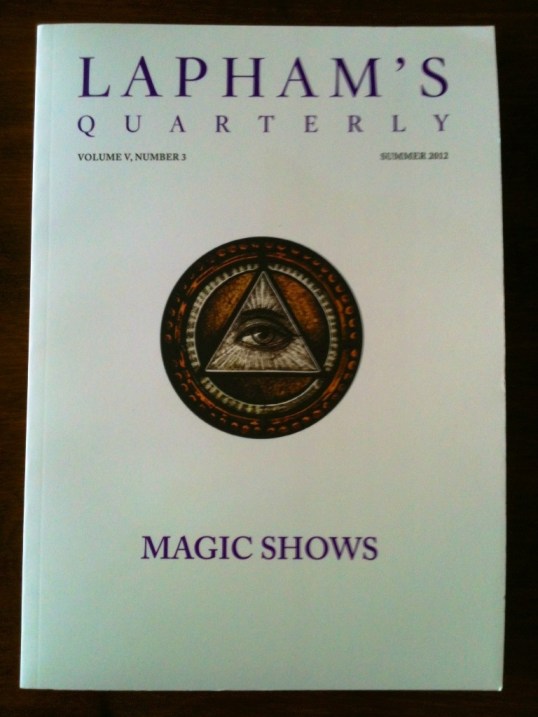
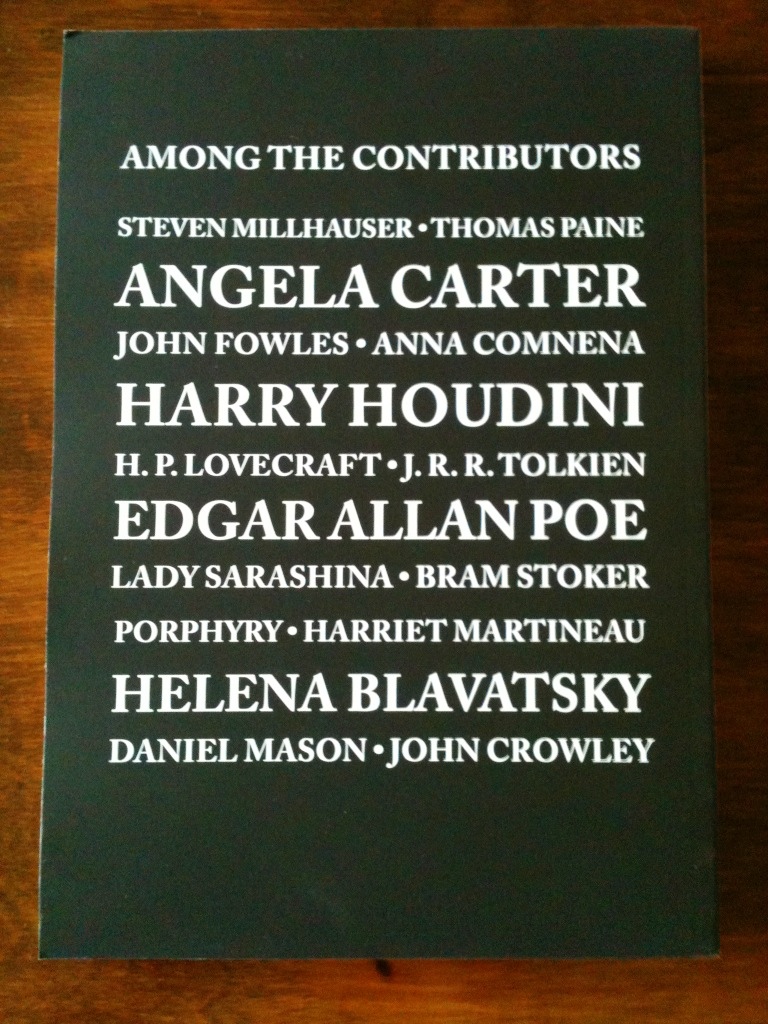
Magic Shows! (Lapham’s Quarterly, Summer 2012 — Book Acquired 6.11.2012)
William Gass on Gaddis, Calvino, Bernhard and More
In his Paris Review interview from 1977, William Gass riffs on the writers he admires:
INTERVIEWER
Who are some living novelists you respect?
GASS
Well, the question leaves out so many dead ones who are more alive. I think Barth is one of the great writers. I have admired his work since I first encountered it. I think he is incredible. Several of his books, in particular The Sot-Weed Factor, are the works which stand to my generation as Ulysses did to its. His habits of work are wholly unlike mine, and the kind of thing which engages him is quite different too. He is a great narrator, one of the best who ever plied the pen, as they used to say. He has been accused of being cold, purely mental, but I find him full of passion and excitement. And what I like about his work in great part is the unifying squeeze which that great intellectual grasp of his gives to his work, and the combination of enormous knowledge with fine feeling and artistic pride and energy and total control. I really admire a master. He’s one.
A lot of the work of Hawkes is extraordinary, breathtaking. Everybody likes Beckett. Now. It’s silly to mention Bellow, Borges, Nabokov—so obvious. And of course Stanley Elkin’s work I like enormously. Some of Coover’s, too, I find extraordinarily interesting. Control again. Gaddis. Control. Also Barthelme—a poet. A great many South American writers write rings around us. Infante’s Three Trapped Tigers is a great book. I taught Hopscotch once. I’ll never get over it. Márquez, Fuentes, Lima, Llosa . . . it is always an exciting time to be a reader. Lots of European writers are overblown, especially some of the French experimentalists, but Italo Calvino is wonderful. Thomas Bernhard’s The Lime Works is impressive. In general, I would think that at present prose writers are much in advance of the poets. In the old days, I read more poetry than prose, but now it is in prose where you find things being put together well, where there is great ambition, and equal talent. Poets have gotten so careless, it is a disgrace. You can’t pick up a page. All the words slide off.
Woman Reading — Fernand Leger

Charles Olson/Conrad Aiken (Books Acquired, 6.09.2012)

Charles Olson’s Selected Writing (New Directions): In all seriousness, why don’t more publishers go for simple covers like this one? Love it.
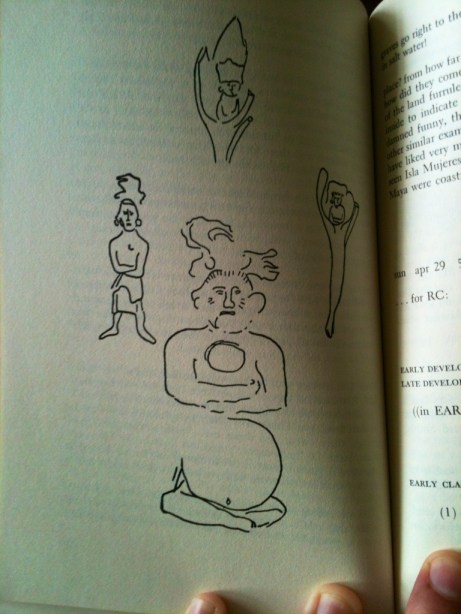
A scribbling:
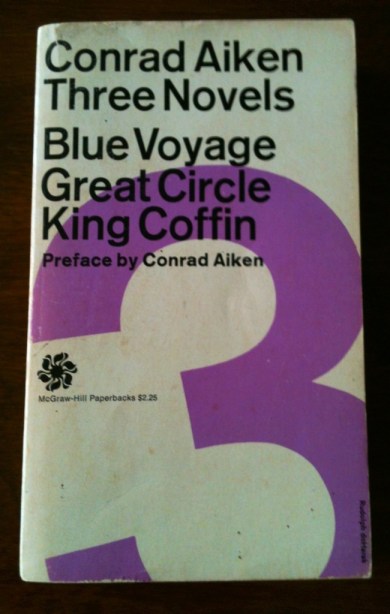
Also, had to pick up something by Conrad Aiken after reading about his influence on Malcolm Lowry:
The Orphan Master’s Son, Adam Johnson’s Novel About Identity and Storytelling in North Korea

Late in Adam Johnson’s novel The Orphan Master’s Son, the titular protagonist muses that, “In North Korea, you weren’t born, you were made.” The Orphan Master’s Son is a novel about what it means to claim agency—to literally make a self—in a totalitarian society that assigns an official narrative to each of its citizens. Our hero is Jun Do, a boy who takes on a martyr’s name like all North Korean orphans, even though he believes with absolute commitment in a narrative he’s created where he’s the son of the man who keeps him and the other orphan boys. His mother? Well, she’s a phantom in a photograph, a beautiful singer disappeared on a forgotten night.
In the orphanage, Jun Do decides which boys will eat and which ones will not, who will freeze and who will stay warm. He even chooses their names from the list of Revolutionary Martyrs. From the outset of his life, Jun Do must navigate a world where his own capacity for human feeling is always threatened, preëmpted, or outright destroyed by institutionalized suffering.
Reaching early adulthood, Jun Do joins the army where he’s trained in martial arts. He joins a tunnel unit, learning how to fight in total darkness. In the tunnels, Jun Do receives the first of many opportunities to defect (in this case to South Korea). Johnson explores the tension of such a choice again and again. In time, a special unit conscripts Jun Do to “pluck” (the official euphemism for kidnap) Japanese citizens from their own beaches and seafronts. As a reward for his skills, he’s allowed to learn English, and soon winds up as a radio spy on a North Korean fishing vessel (these are the best moments of the book). During this time, Jun Do eavesdrops on two American women who plan to row around the world, a plot point that resurfaces in the novel’s second-half. He also finds himself a decorated hero of North Korea—but almost as soon as he finds a would-be home and family in the fishing vessel and crew, he’s plucked away on a mission to Texas.
Okay: If the paragraph above seems all over the place, that’s because the first part of The Orphan Master’s Son, “The Biography of Jun Do,” is all over the place—in a good way. There’s a dazzling giddiness to the tale of Jun Do, and the swift turns of his identity read like a picaresque novel. I was repeatedly reminded of Candide or Invisible Man. It’s worth recalling Ralph Ellison’s description of Invisible Man : “it stands on its own if only as one of those pieces of writing which consists mainly of one damned thing after another sheerly happening.”
“The Biography of Jun Do” stands on its own as well, and for me it was the highlight of The Orphan Master’s Son, full of black humor, satirical venom, and genuine pathos. It also showcases some of the best prose in the novel. Let me share some, at length. Here’s the captain of the fishing boat (probably my favorite character in the novel). A bit of context: Pyongyang orders the fishing boat to obtain fresh shrimp, a mission that will take them illegally into Russian waters—an offense the captain has already been incarcerated for:
“The Russians gave me four years,” he said. “Four years on a fish-gutting ship, forever at sea, never once did we go to port. I got the Russians to let my crew go. They were young, village boys mostly. But next time? I doubt it.”
“We’ll just go out for shrimp,” the Pilot said, “and if we don’t get any, we don’t get any.”
The Captain didn’t say anything to that plan. “The trawlers were always coming,” he said. “They’d be out for weeks and then show up to transfer their catch to our prison ship. You never knew what it would be. You’d be down on the gutting floor, and you’d hear the engines of a trawler coming astern and then the hydraulic gates opening up and sometimes we’d even stand on our saw tables because down the chute, like a wave, would come thousands of fish—yellowtail, cod, snapper, even little sardines—and suddenly you were hip deep in them, and you’d fire up your pneumatic saws because nobody was getting out until you’d gutted your way out. Sometimes the fish were hoarfrosted from six weeks in a hold and sometimes they’d been caught that morning and still had the slime of life on them.
“Toward afternoon, they’d sluice the drains, and thousands of liters of guts would purge into the sea. We’d always go up top to watch that. Out of nowhere, clouds of seabirds would appear and then the topfish and sharks—believe me, a real frenzy. And then from below would rise the squid, huge ones from the Arctic, their albino color like milk in the water. When they got agitated, their flesh turned red and white, red and white, and when they struck, to stun their victims, they lanterned up, flashing bright as you could imagine. It was like watching underwater lightning to see them attack.
“One day, two trawlers decided to catch those squid. One set a drop net that hung deep in the water. The bottom of this net was tethered to the other trawler, which acted like a tug. The squid slowly surfaced, a hundred kilos some of them, and when they started to flash, the net was towed beneath them and buttoned up.
“We all watched from the deck. We cheered, if you can believe that. Then we went back to work as if hundreds of squid, electric with anger, weren’t about to come down that chute and swamp the lot of us. Send down a thousand sharks, please—they don’t have ten arms and black beaks. Sharks don’t get angry or have giant eyes or suckers with hooks on them. God, the sound of the squid tumbling down the chute, the jets of ink, their beaks against the stainless steel, the colors of them, flashing. There was this little guy on board, Vietnamese, I’ll never forget him. A nice guy for sure, kind of green, much like our young Second Mate, and I sort of took him under my wing. He was a kid, didn’t know anything about anything yet. And his wrists, if you’d seen them. They were no bigger than this.”
Jun Do heard the story as if it were being broadcast from some far-off, unknown place. Real stories like this, human ones, could get you sent to prison, and it didn’t matter what they were about. It didn’t matter if the story was about an old woman or a squid attack—if it diverted emotion from the Dear Leader, it was dangerous. Jun Do needed his typewriter, he needed to get this down, this was the whole reason he listened in the dark.
“What was his name?” he asked the Captain.
“The thing is,” the Captain said, “the Russians aren’t the ones who took her from me. All the Russians wanted was four years. After four years they let me go. But here, it never ends. Here, there is no limit to anything.”
“What’s that mean?” the Pilot asked.
“It means wheel her around,” the Captain told him. “We’re heading north again.”
The Pilot said, “You’re not going to do anything stupid, are you?”
“What I’m going to do is get us some shrimp.”
Jun Do asked him, “Were you shrimping when the Russians got you?”
But the Captain had closed his eyes. “Vu,” he said. “The boy’s name was Vu.”
I’ve quoted so much here—really more than belongs in a book review, I suppose—because I think that this little story perfectly condenses the novel’s best features. Our characters are forced into an impossible situation, one that can’t have a good end for them. We also get the sense of the deep personal loss—of disappeared persons—that haunts The Orphan Master’s Son. And: The power of story-telling, to move and motivate and thrill, but also to be yet another agent in the aforementioned disappearing.
The excerpt above is a really great stand-alone piece of writing, and I guess I feel the need to clarify that I think Johnson is a pretty good writer before I set about telling you why I didn’t like the second half of The Orphan Master’s Son.
I should probably clarify that I think many people will enjoy this novel and find it very moving and that the faults I found in its second half likely have more to do with my taste as a reader than they do Johnson’s skill as a writer, which skill, again I’ve tried to demonstrate is accomplished. I like picaresque novels, fragmentary novels, novels that let the reader do the heavy-lifting, novels that leave open spaces and gaps. The first half of The Orphan Master’s Son is such a novel. The second half, “The Confessions of Commander Ga,” settles down into a plot- and motif-driven arc that too-often overstates its case. For me, a good riff of dark, sad, occasionally hilarious tales cohered too heavily in “Confessions” into a gelatinous mess of plot strands verging on soap opera. Johnson’s admirable ambition leads him to overload the novel with unmanageable plot turns and leitmotifs.
The biggest problem though is the overwhelming suspicion that Johnson is simply out of his element in trying to inhabit the North Korean imagination. Although he’s clearly done his research, North Korea is essentially closed to the rest of the world. And Johnson is a U.S. American. I mean, there’s this whole other impossible-to-digest ball of wax here that makes Johnson’s admirable intent to write a novel about “propaganda” just way too complicated to suss out in a review, and I’ll admit that I tend to read like a reviewer, and that these notions just bugged the hell out of me as the novel progressed.
Johnson’s novel repeatedly reminded me of David Mitchell’s excellent historical epic The Thousand Autumns of Jacob de Zoet, a book that also obsesses over storytelling and identity in a closed nation. Mitchell’s novel provides the Western reader with a European surrogate in the titular de Zoet, an obvious device that nonetheless adds to the book a richness—and frankly an authenticity—that The Orphan Master’s Son lacks. Johnson’s title character (again, reader surrogate) is North Korean, and even though Johnson takes pains to show the internal machinations of his character’s changing personality, there’s a deeply U.S. American perspective that underwrites his psychology. We’re repeatedly told that in North Korea it’s the story that’s absolute, “But in America, people’s stories change all the time. In America, it is the man who matters.” By changing his story, Jun Do emotionally, spiritually, psychologically (choose your idiom) defects to The Land of Opportunity.
If I’ve withheld summarizing or even illustrating the plot of “The Confessions of Commander of Ga,” I’ve done so to avoid spoilers. Again, many people will dig this novel, and any explication would ruin its second half. Let’s just say there’s an actress. And a second life. And those rowers come up again. And a love story. And a branding iron. And the Americans. And The Dear Leader, of course. And Casablanca. And dogs. Etc.
The Orphan Master’s Son is very much a dystopian novel, and its second half often reads like the love story from 1984 (should I point out here how dreary I often found that plot form 1984? No? Fair enough). Toward the end of The Orphan Master’s Son, I began imagining how the novel might read as a work divorced from historical or political reality, as its own dystopian blend—what would The Orphan Master’s Son be stripped of all its North Korean baggage? (This is a ridiculous question, of course, but it is the question I asked myself). I think it would be a much better book, one that would allow Johnson more breathing room to play with the big issues that he’s ultimately addressing here—what it means to tell a story, what it means to create, what it means to love a person who can not just change, but also disappear. These are the issues that Johnson tackles with aplomb; what’s missing though, I think, is a genuine take on what it means to be a North Korean in search of identity.
Reading (1921) — Pablo Picasso

Books Acquired, 6.02.2012 (Comix + Angela Carter)

Little Lit: Strange Stories for Strange Kids is a collection of comix (and other oddities) for kids, edited by Art Spiegelman and his wife artist/publisher Françoise Mouly. I saw at random and picked it up for my daughter, whose birthday was the next day. She loves, loves, loves this book, spending hours poring over all its weird images and picture games. Cover is by the great Charles Burns; there are also comics by Spiegelman, the late great Maurice Sendak—

—a weird search picture by Martin Handford (here’s a detail)—-

—and comics by other notables like David Sedaris, Paul Auster, Claude Ponti, Jules Feiffer, and Kim Deitch. The endpapers — “Strange Cartoon Lessons” are by Kaz:

I also picked up Burning Your Boats, which collects all of Angela Carter’s short stories:

I was looking for her dystopian novel The Passion of New Eve, but no go. Of course, I couldn’t pass up this volume, which comprises four collections, as well as early and uncollected stuff.

