Henry Miller Interview (In a Swimming Pool)

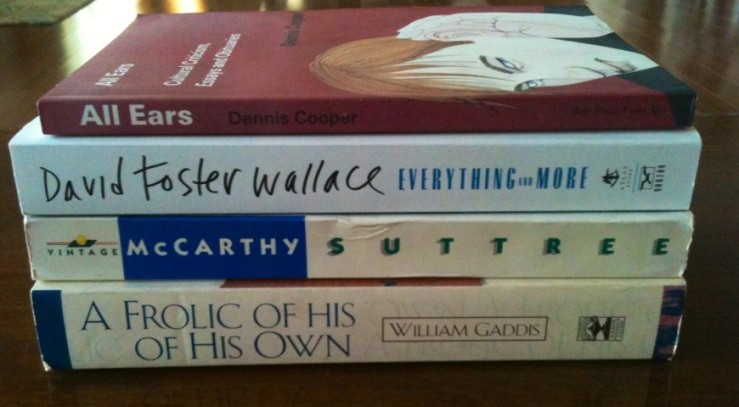
Gaddis, Wallace, McCarthy, Cooper (Books Acquired, 3.02.3012)

20120302-173432.jpg

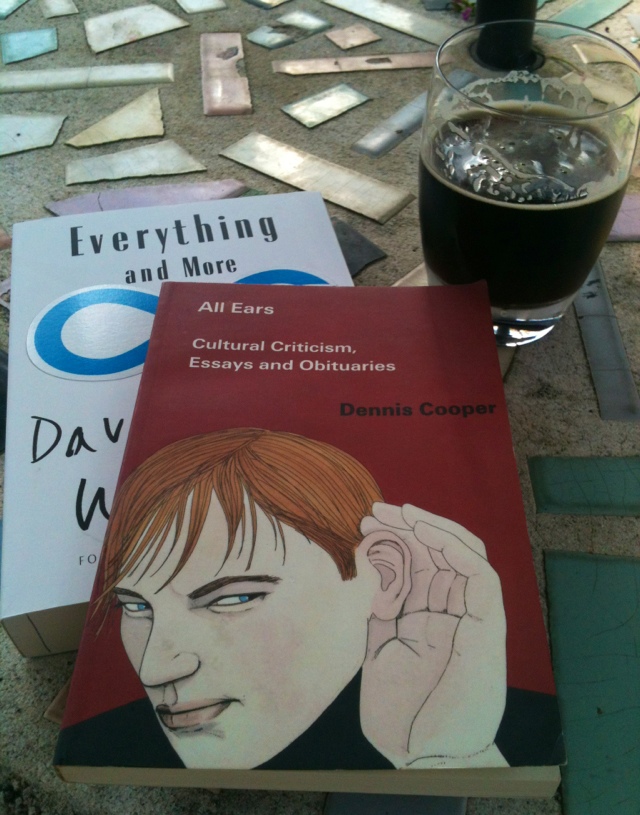
Picked up these four yesterday afternoon during my weekly visit to the bookshop (can’t help said visit; I live too close). Spent the afternoon reading Neal Stephenson’s introduction to David Foster Wallace’s Everything and More and a few of the pieces in All Ears, a collection of essays and interviews by Dennis Cooper. I read the interviews with Stephen Malkmus and Leonardo diCaprio. There’s something so nineties about the book.

20120302-173439.jpg

A nice afternoon of reading with a few homebrews.

Everything and More, DFW’s history of infinity, is one of the only books I haven’t read by him (I even got to read a big chunk of his rare early work Signifying Rappers years ago because a friend found it in a library book sale). Anyway, to the point: None of the DFW editions I owned, up to this point were posthumous (they were, uh humous (?))—so it was a little weird to see this on the back of the book:

20120302-173455.jpg

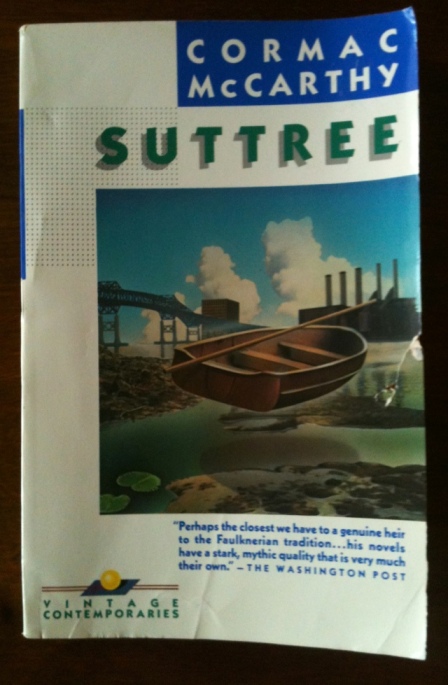
Finally: No, I didn’t need another copy of Cormac McCarthy’s Suttree (let me plug my review), but I’m a huge fan of these awful 1980s Vintage Contemporaries editions, so when I found a first ed. of Suttree, I couldn’t pass it up (I’m pretty sure this is the same edition DFW owned):

20120302-173509.jpg

Books Acquired, 2.28.2012

20120228-175055.jpg

Books acquired, 2.28.2012. All forthcoming from Pantheon, all hardback:

The Undead by Dick Teresi is a book about organ harvesting that claims to be funny. Publisher’s description:

Important and provocative, The Undead examines why even with the tools of advanced technology, what we think of as life and death, consciousness and nonconsciousness, is not exactly clear and how this problem has been further complicated by the business of organ harvesting.

Dick Teresi, a science writer with a dark sense of humor, manages to make this story entertaining, informative, and accessible as he shows how death determination has become more complicated than ever. Teresi introduces us to brain-death experts, hospice workers, undertakers, coma specialists and those who have recovered from coma, organ transplant surgeons and organ procurers, anesthesiologists who study pain in legally dead patients, doctors who have saved living patients from organ harvests, nurses who care for beating-heart cadavers, ICU doctors who feel subtly pressured to declare patients dead rather than save them, and many others. Much of what they have to say is shocking. Teresi also provides a brief history of how death has been determined from the times of the ancient Egyptians and the Incas through the twenty-first century. And he draws on the writings and theories of celebrated scientists, doctors, and researchers—Jacques-Bénigne Winslow, Sherwin Nuland, Harvey Cushing, and Lynn Margulis, among others—to reveal how theories about dying and death have changed. With The Undead, Teresi makes us think twice about how the medical community decides when someone is dead.

Jonathan Haidt’s The Righteous Mind. Publisher’s description:

Why can’t our political leaders work together as threats loom and problems mount? Why do people so readily assume the worst about the motives of their fellow citizens? In The Righteous Mind, social psychologist Jonathan Haidt explores the origins of our divisions and points the way forward to mutual understanding.

His starting point is moral intuition—the nearly instantaneous perceptions we all have about other people and the things they do. These intuitions feel like self-evident truths, making us righteously certain that those who see things differently are wrong. Haidt shows us how these intuitions differ across cultures, including the cultures of the political left and right. He blends his own research findings with those of anthropologists, historians, and other psychologists to draw a map of the moral domain, and he explains why conservatives can navigate that map more skillfully than can liberals. He then examines the origins of morality, overturning the view that evolution made us fundamentally selfish creatures. But rather than arguing that we are innately altruistic, he makes a more subtle claim—that we are fundamentally groupish. It is our groupishness, he explains, that leads to our greatest joys, our religious divisions, and our political affiliations. In a stunning final chapter on ideology and civility, Haidt shows what each side is right about, and why we need the insights of liberals, conservatives, and libertarians to flourish as a nation.

Daniel L. Everett’s Language: The Cultural Tool caught my fancy the most in this group; I spent two glasses of wine with it and may report more in the future. Publisher’s ‘script after the pic:

20120228-175104.jpg

A bold and provocative study that presents language not as an innate component of the brain—as most linguists do—but as an essential tool unique to each culture worldwide.

For years, the prevailing opinion among academics has been that language is embedded in our genes, existing as an innate and instinctual part of us. But linguist Daniel Everett argues that, like other tools, language was invented by humans and can be reinvented or lost. He shows how the evolution of different language forms—that is, different grammar—reflects how language is influenced by human societies and experiences, and how it expresses their great variety.

For example, the Amazonian Pirahã put words together in ways that violate our long-held under-standing of how language works, and Pirahã grammar expresses complex ideas very differently than English grammar does. Drawing on the Wari’ language of Brazil, Everett explains that speakers of all languages, in constructing their stories, omit things that all members of the culture understand. In addition, Everett discusses how some cultures can get by without words for numbers or counting, without verbs for “to say” or “to give,” illustrating how the very nature of what’s important in a language is culturally determined.

Combining anthropology, primatology, computer science, philosophy, linguistics, psychology, and his own pioneering—and adventurous—research with the Amazonian Pirahã, and using insights from many different languages and cultures, Everett gives us an unprecedented elucidation of this society-defined nature of language. In doing so, he also gives us a new understanding of how we think and who we are.
“They Told Me I Was Everything” — Orson Welles Plays King Lear

“Speaking of Beards” — Facial Hair in Shakespeare

From Thomas Firminger Thiselton-Dyer’s Folk-lore of Shakespeare (1883):

In speaking of beards, it may be noted that formerly they gave rise to various customs. Thus, in Shakespeare’s day, dyeing beards was a fashionable custom, and so Bottom, in “A Midsummer-Night’s Dream” (i. 2), is perplexed as to what beard he should wear when acting before the duke. He says: “I will discharge it in either your straw-colour beard, your orange-tawny beard, your purple-in-grain beard, or your French-crown-colour beard, your perfect yellow.” [915] To mutilate a beard in any way was considered an irreparable outrage, a practice to which Hamlet refers (ii. 2): “Who calls me villain? breaks my pate across? Plucks off my beard, and blows it in my face?”

And in “King Lear” (iii. 7), Gloster exclaims: “By the kind gods, ’tis most ignobly done To pluck me by the beard.” Stroking the beard before a person spoke was preparatory to favor. Hence in “Troilus and Cressida” (i. 3), Ulysses, when describing how Achilles asks Patroclus to imitate certain of their chiefs, represents him as saying: “‘Now play me Nestor; hem, and stroke thy beard, As he, being drest to some oration.’” Again, the phrase “to beard” meant to oppose face to face in a hostile manner. Thus, in “1 Henry IV.” (iv. 1), Douglas declares: “No man so potent breathes upon the ground, But I will beard him.” And in “1 Henry VI.” (i. 3), the Bishop of Winchester says to Gloster: “Do what thou dar’st; I’ll beard thee to thy face.” It seems also to have been customary to swear by the beard, an allusion to which is made by Touchstone in “As You Like It” (i. 2): “stroke your chins, and swear by your beards that I am a knave.” We may also compare what Nestor says in “Troilus and Cressida” (iv. 5): “By this white beard, I’d fight with thee to-morrow.” Our ancestors paid great attention to the shape of their beards, certain cuts being appropriated to certain professions and ranks. In “Henry V.” (iii. 6), Gower speaks of “a beard of the general’s cut.” As Mr. Staunton remarks, “Not the least odd among the fantastic fashions of our forefathers was the custom of distinguishing certain professions and classes by the cut of the beard; thus we hear, interalia, of the bishop’s beard, the judge’s beard, the soldier’s beard, the citizen’s beard, and even the clown’s beard.” Randle Holme tells us, “The broad or cathedral beard [is] so-called because bishops or gown-men of the church anciently did wear such beards.” By the military man, the cut adopted was known as the stiletto or spade. The beard of the citizen was usually worn round, as Mrs. Quickly describes it in “Merry Wives of Windsor” (i. 4), “like a glover’s paring-knife.” The clown’s beard was left bushy or untrimmed. Malone quotes from an old ballad entitled “Le Prince d’ Amour,” 1660: “Next the clown doth out-rush With the beard of the bush.”

Mostly Redneck (Book Acquired, 2.25.2012)

20120228-173245.jpg

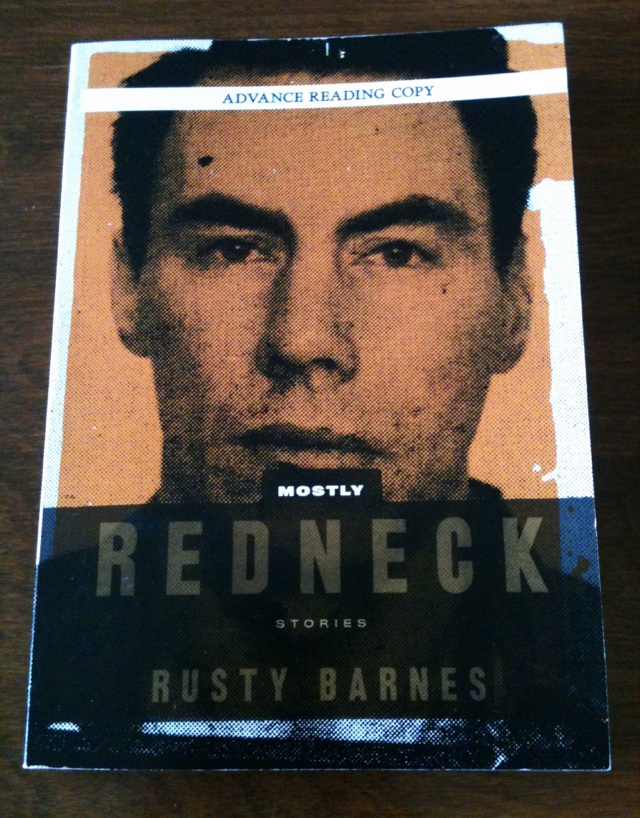
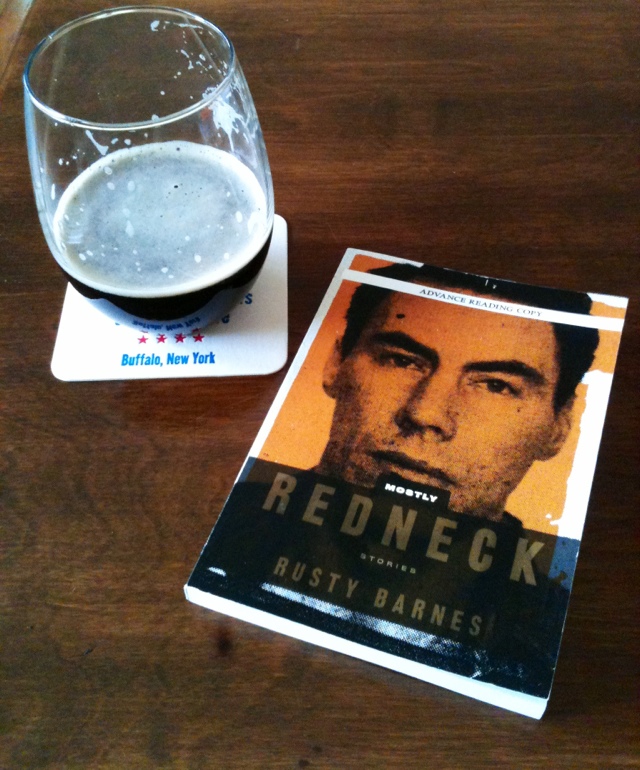
Mostly Redneck is a collection of stories by Rusty Barnes. It’s newish from indie press Sunnyoutside. Back of book:

In Mostly Redneck, Rusty Barnes expounds on his upbringing in disadvantaged rural northern Appalachia to deliver a mastery of country idiom and setting. In one minimalist story after another, he gives perspective and breadth to the widely misunderstood world of a people who still hunt for food, occasionally join their neighbors for church, and sometimes enjoy it when their city kin step in cow shit.

There’s a story about Saddam Hussein! It’s kind of surreal.

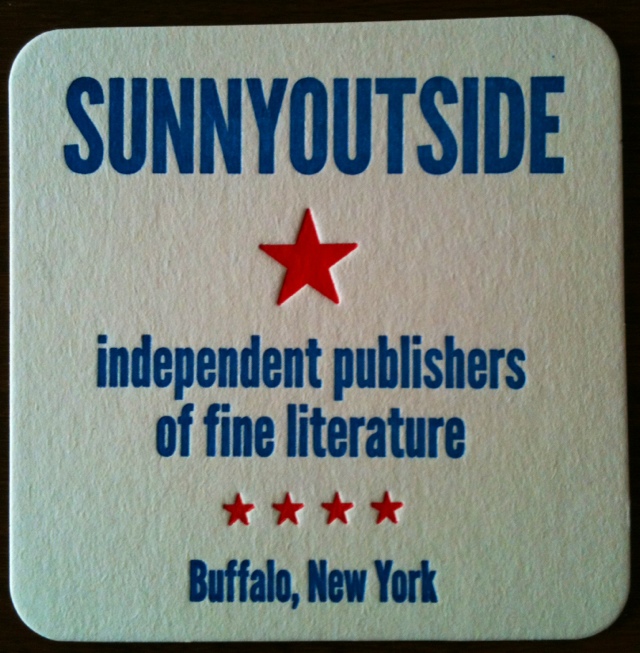
I’m pretty sure Sunnyoutside actually printed this book in-house; I know they own a printing press (two, if the website ain’t lying). Did they make this coaster?—

20120228-173252.jpg

I tested the coaster, in any case. It works. Here it is, protecting my midcentury coffee table from condensation that might seep from the interaction between a homebrewed black ale and yon glass:

20120228-173259.jpg

Sam Shepard Talks About Working with Terrence Malick on Days of Heaven

Gods Without Men — Hari Kunzu (Book Aquired 2.27.2012)

20120228-172842.jpg

I kind of love the cover of Hari Kunzru’s Gods Without Men: it’s all Keith Haring acid late eightiesish. Big hardback book from Knopf. Their write up:

In the desert, you see, there is everything and nothing . . . It is God without men.
—Honoré de Balzac, Une passion dans le désert, 1830

Jaz and Lisa Matharu are plunged into a surreal public hell after their son, Raj, vanishes during a family vacation in the California desert. However, the Mojave is a place of strange power, and before Raj reappears inexplicably unharmed—but not unchanged—the fate of this young family will intersect with that of many others, echoing the stories of all those who have traveled before them.

Driven by the energy and cunning of Coyote, the mythic, shape-shifting trickster, Gods Without Men is full of big ideas, but centered on flesh-and-blood characters who converge at an odd, remote town in the shadow of a rock formation called the Pinnacles. Viscerally gripping and intellectually engaging, it is, above all, a heartfelt exploration of the search for pattern and meaning in a chaotic universe.

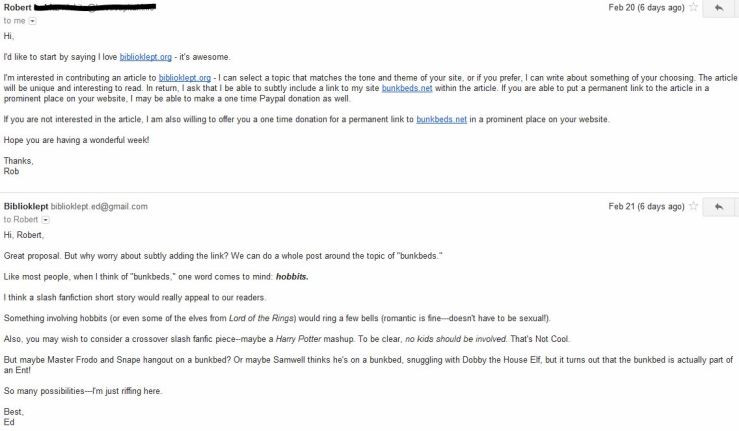
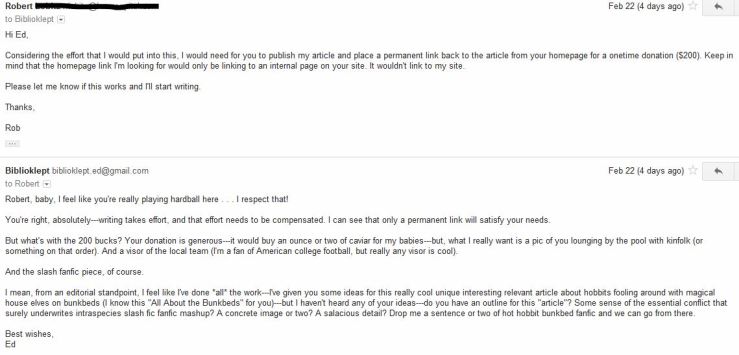
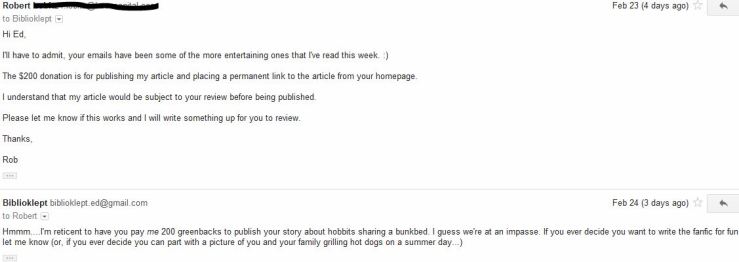
I’d Still Love to Get That Hobbit / Harry Potter / Bunkbed Slash Fanfic Mashup, Bro

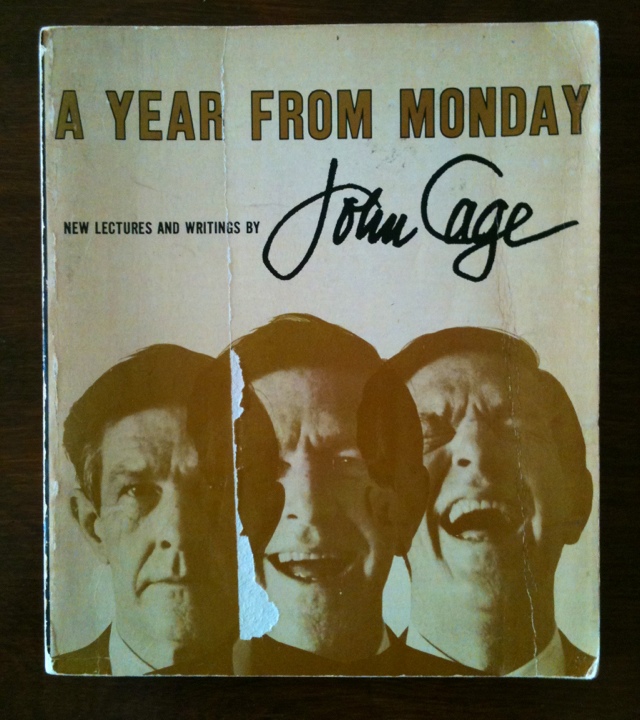
John Cage’s A Year from Monday (Book Acquired 2.21.2012)

20120228-172910.jpg

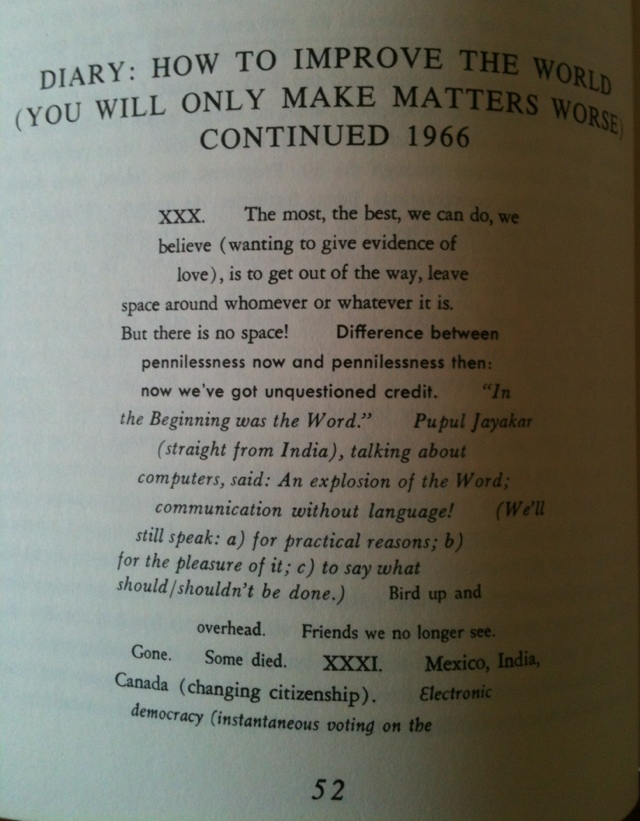
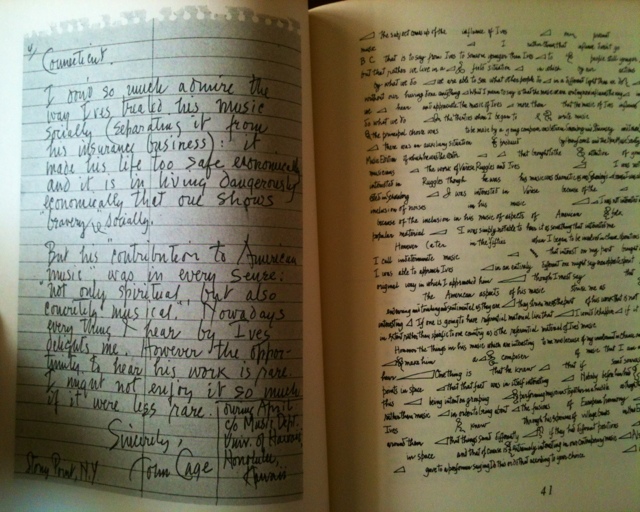
I found this one at random in my favorite used bookshop last week. Had never heard of it before, but it’s really neato—Cage’s lectures, notes, letters, etc. on  a range of subjects, including Charles Ives, Marcel Duchamp, and making the world better. Cover’s in rough shape, but it’s a first edition paperback, so all’s well &c.

A few pics from the strange interior (no worries, I will be plundering the book for posts in the months to come):

20120228-172941.jpg

20120228-172951.jpg

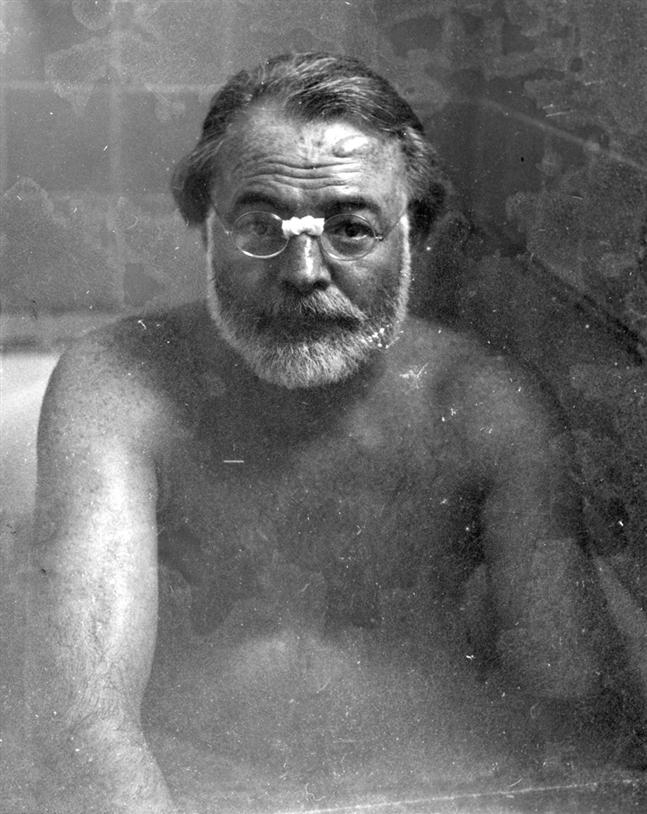
Topless Hemingway, Part V (Ernest Takes a Bath)

Haley Tanner’s Vaclav & Lena Is A Modern Day Fairy Tale (With Lots of Lists)

I like fairy tales, stories with happy endings. As the mother of two little ones, I also like stories about children. Which may be why  I liked Haley Tanner’s Vaclav & Lena as much as I did. I was actually surprised at just how much I liked it. Vaclav & Lena is a modern-day fairy tale, with all the right amounts of good and bad, kindness and evil. And there’s even a little magic, too.

Tanner’s writing is simple, witty and charming, not unlike the main character, Vaclav.  Her characters are real and believable, even as they are simultaneously too good to be true: Vaclav, completely earnest and selfless; Lena, a mystery to everyone, even herself; and Rasia, the adoring and dutiful guardian.

My love and concern for the welfare of the characters, coupled with a heartbreaking story line, made it hard to put this one down each night.  I fell in love with little, shy, neglected Lena and vulnerable, gallant, naïve Vaclav when they were just little kids, and my love only grew stronger when they matured into delicate, hormonal, irrational teenagers. And, as it was for Vaclav, Lena, and Rasia, it will be difficult for me too to forget this inseparable pair.

In keeping with Vaclav’s love of lists, I feel that it is only fitting to include some lists of my own:

List of What Vaclav Would Say this Book is About

Magic

Illusion

Friendship

The American Dream

The Importance of Lists

Loss

Secrets

Lena

Love

List of What Lena Would Say this Book is About

Mystery

Fear

Longing

Curiosity

Friendship

Secrets

Moms

Fairy Tales

Certainty

Uncertainty

Love

List of What Rasia Would Say this Book is About

Sacrifice

Fear

Guilt

Raising a Russian boy in America

Raising an American teenage boy in Brooklyn

Heartbreak

Pride

Knowledge

Love

Vaclav & Lena is new in trade paperback from Random House.

Book Shelves #9, 2.26.2012

We should first of all distinguish stable classifications from provisional ones. Stable classifications are those which, in principle, you continue to respect; provisional classifications are those supposed to last only a few days, the time it takes for a book to discover, or rediscover, its definitive place. This may be a book recently acquired and not read yet, or else a book recently read that you don’t quite know where to place and which you have promised to yourself you will put away on the occasion of a forthcoming ‘great arranging’, or else a book whose reading has been interrupted and that you don’t to classify before taking it up again and finishing it, or else a book you have used constantly over a given period, or else a book you have taken down to look up a piece of information or a reference and which you haven’t yet put back in its place, or else a book that you can’t put back in its place, or else a book that you can’t put back in its rightful place because it doesn’t belong to you and you’ve several times promised to give it back, etc.

—Georges Perec, from “The Art and Manner of Arranging One’s Books”

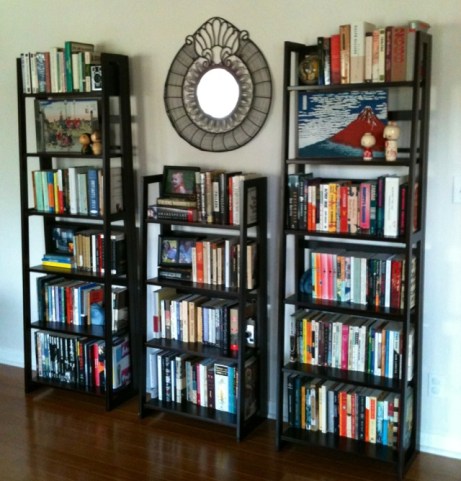
Book shelves series #9, ninth Sunday of 2012: In which I photograph three book shelves that I will examine more closely over the next several weeks.

Georges Perec goes on to admit that over three-quarters of his own books are provisionally categorized (at best). Libraries, like governments and tectonic plates and personalities, are not stable entities. Still, most of us try to impose some sense of order on our book collection, even if it’s an order apparent and relevant to ourselves alone. The three book shelves photographed below are probably the most “stable” in the house:

20120226-105205.jpg

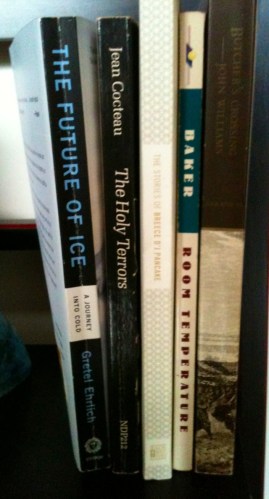
Despite an ongoing process of accretion, relocation, and removal, these shelves tend to remain fairly constant, with minor rearrangements happening maybe monthly instead of weekly or daily. As of today, there’s only one slim piece of a shelf “free”—that is, holding unsorted books waiting to be read, shelved, or, in one case, reviewed (I swear I’ll make another stab at writing up Breece D’J Pancake one day . . .). These books will be elsewhere by the time I get to photographing the shelf they rest on now:

20120226-105217.jpg

“The Wholesome Fermentation or Eructation of Those Processes Eternally Active in Language” — Walt Whitman on Slang

From Walt Whitman’s essay “Slang in America,” :

Slang, profoundly consider’d, is the lawless germinal element, below all words and sentences, and behind all poetry, and proves a certain perennial rankness and protestantism in speech. As the United States inherit by far their most precious possession–the language they talk and write–from the Old World, under and out of its feudal institutes, I will allow myself to borrow a simile even of those forms farthest removed from American Democracy. Considering Language then as some mighty potentate, into the majestic audience-hall of the monarch ever enters a personage like one of Shakspere’s clowns, and takes position there, and plays a part even in the stateliest ceremonies. Such is Slang, or indirection, an attempt of common humanity to escape from bald literalism, and express itself illimitably, which in highest walks produces poets and poems, and doubtless in pre-historic times gave the start to, and perfected, the whole immense tangle of the old mythologies. For, curious as it may appear, it is strictly the same impulse-source, the same thing. Slang, too, is the wholesome fermentation or eructation of those processes eternally active in language, by which froth and specks are thrown up, mostly to pass away; though occasionally to settle and permanently chrystallize.

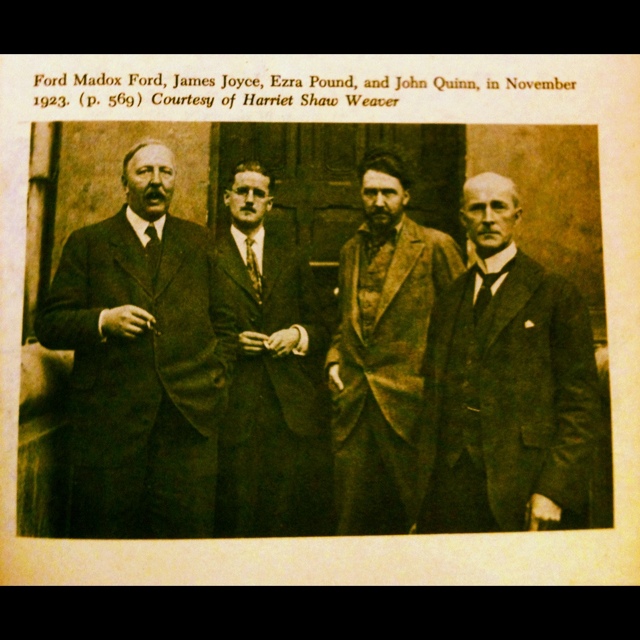
Modernist Bros

20120216-190332.jpg

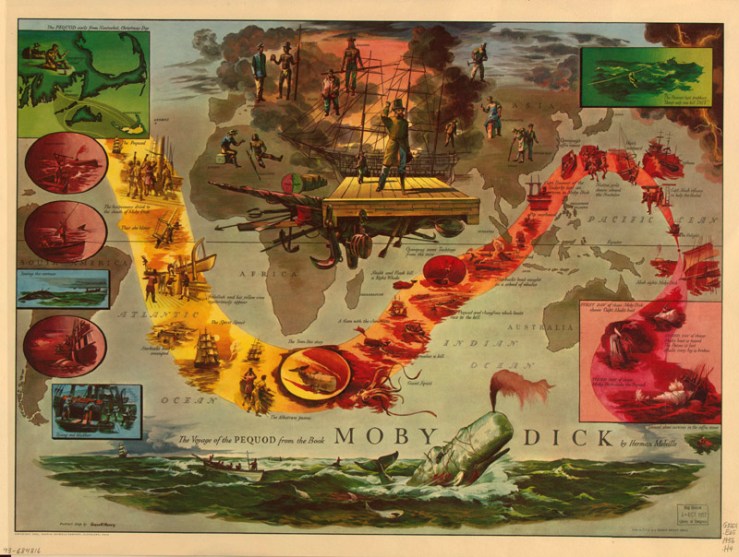
Voyage of the Pequod — A Map of Moby-Dick by Everett Henry

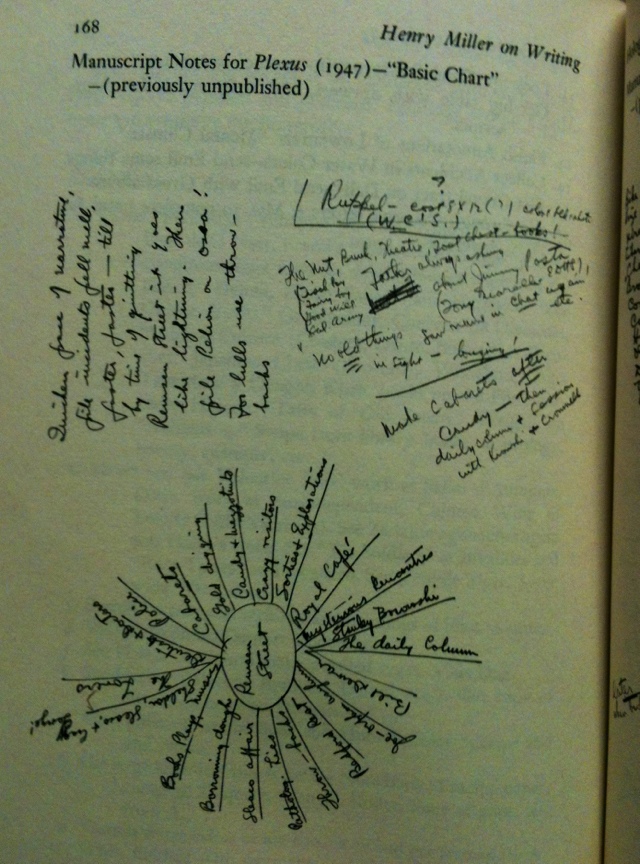
Henry Miller’s Basic Chart of Plexus

20120125-160448.jpg

(From Henry Miller on Writing, New Directions).