Eleven Authors Who Were Also Veterans of War

Eleven Authors Who Were Also Veterans of War

1. Stendahl (Napoleonic Wars)

2. Ambrose Bierce (Union Army, American Civil War)

3. Erich Maria Remarque (German Army, WWI)

4. George Orwell (Republican Army, Spanish Civil War)

5. Kurt Vonnegut (U.S. Army, WWII)

6. Joseph Heller (U.S. Air Force, WWII)

7. Eveyln Waugh (British Royal Marines, WWII)

8. Norman Mailer (U.S Army, WWII)

9. Gore Vidal (U.S. Army, WWII)

10. Tim O’Brien (U.S. Army, Vietnam War)

11. Anthony Swofford (U.S. Marine Corps, Persian Gulf War)

“My Books Are Forgeries” — Philip K. Dick

Slate has published an excerpt from the forthcoming collection of letters and other ephemera, The Exegesis of Philip K. Dick (by, uh, PK Dick). An excerpt of that excerpt—

My books are forgeries. Nobody wrote them. The goddam typewriter wrote them; it’s a magic typewriter. Or like John Denver gets his songs: I get them from the air. Like his songs, they—my books—are already there. Whatever that means.

The most ominous element from my books which I am encountering in my actual life is this. In one of my novels, Ubik, certain anomalies occur which prove to the characters that their environment is not real. Those same anomalies are now happening to me. By my own logic in the novel I must conclude that my or perhaps even our collective environment is only a pseudo-environment. In my novel what broke through was the presence of a man who had died. He speaks to them through several intermediary systems and hence must still be alive; it is they, evidently, who are dead. What has been happening to me for over three months is that a man I knew who died has been breaking through in ways so similar to that of Runciter in Ubik that I am beginning to conclude that I and everyone else is either dead and he is alive, or—well, as in the novel, I can’t figure it out. It makes no sense.

William Gibson: “Bleak House Is the Best Steampunk Landscape That Will Ever Be”

From The Paris Review interviewWilliam Gibson on on Charles Dickens’s Bleak House

INTERVIEWER

The Victorians invented science fiction.

GIBSON

I think the popular perception that we’re a lot like the Victorians is in large part correct. One way is that we’re all constantly in a state of ongoing t­echnoshock, without really being aware of it—it’s just become where we live. The Victorians were the first people to experience that, and I think it made them crazy in new ways. We’re still riding that wave of craziness. We’ve gotten so used to emergent technologies that we get anxious if we haven’t had one in a while.

But if you read the accounts of people who rode steam trains for the first time, for instance, they went a little crazy. They’d traveled fifteen miles an hour, and when they were writing the accounts afterward they struggled to describe that unthinkable speed and what this linear velocity does to a perspective as you’re looking forward. There was even a Victorian medical complaint called “railway spine.”

Emergent technologies were irreversibly altering their landscape. Bleak House is a quintessential Victorian text, but it is also probably the best steam­punk landscape that will ever be. Dickens really nailed it, especially in those proto-Ballardian passages in which everything in nature has been damaged by heavy industry. But there were relatively few voices like Dickens then. Most people thought the progress of industry was all very exciting. Only a few were saying, Hang on, we think the birds are dying.


“On the Difficulty of Imagining an Ideal City” — Georges Perec

“On the Difficulty of Imagining an Ideal City,” a poem or essay or something—a text—by Georges Perec. The piece is one of the selections in Perec’s collection of miscellany, Species of Spaces and Other Pieces:

I wouldn’t like to live in America but sometimes I would

I’d love to live on the Boulevard St Germain but sometimes I wouldn’t

I wouldn’t like to live on a coral reef but sometimes I would

I wouldn’t like to live in a dungeon but sometimes I would

I wouldn’t like to live in the East but sometimes I would

I love living in France but sometimes I don’t

I’d love to live in Greenland but not for too long

I’d like to live to a hundred but sometimes I wouldn’t

I wouldn’t like to live in Issoudun but sometimes I would

I wouldn’t like to live on a junk but sometimes I would

I wouldn’t like to live in a ksar but sometimes I would

I’d have loved to go in a lunar module but it’s a bit late

I wouldn’t like to live in a monastery but sometimes I would

I wouldn’t like to live at the Hotel Negresco but sometimes I would

I wouldn’t like to live in the open air but sometimes I would

I love living in Paris but sometimes I don’t

I wouldn’t like to live in Quebec but sometimes I would

I wouldn’t like to live by my own resources but sometimes I would

I wouldn’t like to live in a submarine but sometimes I would

I wouldn’t like to live in a tower but sometimes I would

I wouldn’t like to live with Ursula Andress but sometimes I would

I wouldn’t like to live in a village but sometimes I would

I wouldn’t like to live in a wigwam but sometimes I would

I’d love to live in Xanadu but not for ever

I wouldn’t like to live in the Yonne but sometimes I would

I wouldn’t like us all to live in Zanzibar but sometimes I would

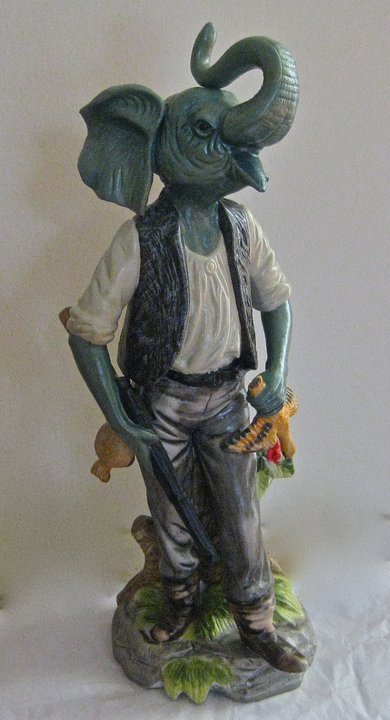
Elephant Disguised as Ernest Hemingway — Click Mort

(More).

A Bad Night’s Sleep — Michael Wiley

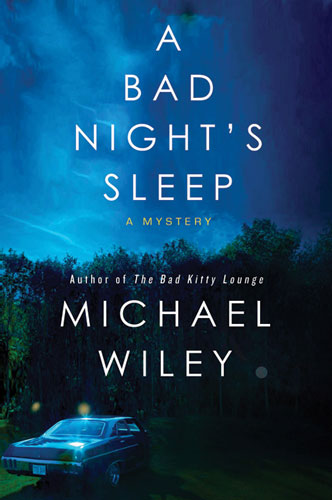
A Bad Night’s SleepMichael Wiley’s third detective novel, opens with protagonist PI Joe Kozmarski working what appears to be a boring job. He’s hired to investigate the repeated robberies of a Chicago construction site. Sure, it’s a glorified nightwatchman gig, but this job might get him closer to retiring in a certain north Florida fishing town he dreams about. The job gets too interesting too quickly, however, when the burglars arrive and begin stealing equipment and material. Then the police show up—and help rob the site. Kozmarski calls 911, more police arrive, and, in the firefight that ensues he shoots—and kills—one of the robber cops.

While waiting in jail to be charged—an event that never quite comes to light—Kozmarski reflects—

Every time I’d seen someone die I’d felt the world go a little quieter like I’d lost part of my hearing, and sooner or later the singing, laughing, and screaming would fade into a hushing wind of white noise. That had happened when my dad died. It had happened when Kevin, a boy I was supposed to be protecting, ended up twisted and broken on his mother’s kitchen floor. It happened. Shooting the cop felt worse. I’d ripped a little hole in the universe and I wondered what sound would fly through it.

Kozmarski’s little hole lets in more than strange sounds. The cop-shooting imperils his PI license, damages his (not exactly heretofore spotless) reputation, and leads undercover cops to threaten him (to the point of firing shots) as he leaves jail. The stress doesn’t exactly help protect his tenuous sobriety either, and Kozmarski’s soon on the sauce again (let’s not even mention that little bag of coke his “friend” sends him to help through these troubled times). Luckily (although that’s hardly an appropriate adverb here), Kozmarski’s friend on the force sets up another job for our distressed hero, one that could clear his name and clean out some of the dirty cops of the Chicago PD. Kozmarski infiltrates the corrupt gang of crooked cops, but as he plumbs deeper into the mystery, the line between good guys and bad guys becomes increasingly nebulous.

A Bad Night’s Sleep is a page turner telegraphed in terse, tense, vivid prose. Wiley’s plot and dialogue alike are hardboiled in the noir tradition of Hammett or Chandler, and his characters and pacing bristle with the gritty immediacy one might find in George V. Higgins. There’s a smart brush of black humor to A Bad Night’s Sleep that comes from Wiley’s characterization and his protagonist’s wry observations. And for all of his hard edges, we find in Kozmarski an engaged protagonist, a man of genuine pathos. Wiley delivers what readers want from an intelligent mystery—keen, suspenseful plotting, sharp action sequences, and a hero we can care about.

A Bad Night’s Sleep is available now in hardback from St. Martin’s Minotaur imprint. Read our interview with Michael Wiley.

Lars Iyer on Roberto Bolaño’s The Savage Detectives

Great great great essay from Lars Iyer today at The White Review. The essay is called “Nude in Your Hot Tub, Facing the Abyss (A Literary Manifesto After the End of Literature and Manifestos).” You should really just read it; I think Iyer does here what David Shields might have meant to do with Reality Hungeronly Iyer is far more clear and cogent (and not, like, all whiny). Here’s a taste, Iyer on Roberto Bolaño’s novel The Savage Detectives:

A final example of literature that faces its own demise and survives: Bolaño’s The Savage Detectives is a book about an attempt to create a literary vanguard in 1975, written after the conditions for vanguardist practice had collapsed. It is a book about political revolution written in a period after the inevitable failures of such revolutions have revealed themselves. It is a novel about a literary avant-garde and yet the novel itself resists the conceptualization and stylization that a literary avant-garde requires. It is an ecstatic, passionate novel—Bolaño himself describes it as a ‘love letter to my generation’—that plays out as a parody of the desires for Literature and Revolution. It is a novel, like all recent novels, that comes too late, but unlike most others it finds a way to address this lateness. In doing so, The Savage Detectives provides another model for how all would-be authors can appropriately speak about our anachronistic dreams.

The supposed heroes of the book, Ulises Lima and Arturo Belano, leaders of the literary ‘gang’ called the Visceral Realists, are rarely on stage in the novel for very long. For the most part, we hear of them only at a remove, through the disparate narrators Bolaño calls forward to tell their tale. And the verdict on them is mixed – they have an admirer in gauche and excitable law student Madero, whose brilliantly funny diaries bookend The Savage Detectives, but they have their detractors, too. ‘Belano and Lima weren’t revolutionaries. They weren’t writers. Sometimes they wrote poetry, but I don’t think they were poets, either. They sold drugs,’ says one of Bolano’s narrators. ‘The whole visceral realism thing was… the demented strutting of a dumb bird in the moonlight, something essentially cheap and meaningless,’ says another. In the end they head towards ‘catastrophe or the abyss’, as they wander the world, still attempting to strike literary and political poses when the time for Literature and Politics has gone. ‘We fought for parties that, had they emerged victorious, would have immediately sent us into a forced labour camp’, Bolaño writes of his generation. ‘We fought and poured all our generosity into an ideal that had been dead for over fifty years’.

(Read our review of Iyer’s novel Spurious. Read our interview with Iyer).

Bret Easton Ellis on David Fincher’s Film Zodiac

This weekend, Twitter followers of novelist Bret Easton Ellis were treated to BEE’s views on the films of director David Fincher, with particular consideration paid to Fincher’s overlooked (by audiences, at least) 2007 film Zodiac. I liked Ellis’s commentary, not just because I think he’s spot on here, but also because he points out why so many people might not have liked (or, dare I say “got”) Zodiac on first viewing: the movie was mismarketed. Here’s BEE—

In my original review of Zodiac, I pointed to my own early misunderstanding of what the film was—

When Zodiac came out last year, I prejudicially–and wrongly–assumed that the film, the tale of the infamous Zodiac killer who menaced California in the late sixties and early seventies, would be a moody character study, all ominous texture, smoggy chase scenes, and desperate anger à la Fincher’s 1995 thriller, Se7en (that movie where Gwyneth Paltrow’s head gets chopped off), or even worse, Fincher’s awful 1997 effort The Game. Most Hollywood suspense films–Fincher’s included–propel themselves on chase sequences, meaningless yelling, and overstated light and music queues that seem to scream “this is the part where you feel tense.” Zodiac, however, eschews all of these often vacuous tropes in favor of simply telling a story.

Zodiac is a methodical, investigative procedural about truth, a film that looks at what happens when we try to put order to disorder, when we try to give narrative to life’s loose ends—when we try to understand radically stochastic violence. In retrospect, it seems to me that Fincher’s work here is akin to Roberto Bolaño in some ways, and I think that if people went into it understanding that it was going to be a meditation on truth, and not, say, a cops and robbers thriller, they might appreciate it more (for what it’s worth, several people wrote in on my review to tell me how wrong I was about what I liked about the film. I think, like Ellis, they should give it another shot).

“I Think Life Is Full of Anxieties and Fears and Tears. It Has a Lot of Grief in It, and It Can Be Very Grim” — Charles Schulz on Religion

Lots of great quotes from Charles M. Schulz on religion (and more) via Biblioklept reader JESCIE.  Sample—

I don’t know the meaning of life. I don’t know why we are here. I think life is full of anxieties and fears and tears. It has a lot of grief in it, and it can be very grim. And I do not want to be the one who tries to tell somebody else what life is all about. To me it’s a complete mystery.”

All citations are from Charles M. Schulz: Conversations, which I now want to read.


Books Acquired, 11.02.2011

20111106-152604.jpg

I teach a night class on Wednesdays, and although I enjoy it, I also teach morning sections on Wednesdays, so I’m exhausted when I get home over twelve hours later that night. Anyway, I was thrilled to find a nice little packet from Shocken/Pantheon when I came home last Wednesday—a memoir, a graphic novel, and a book that blends and comments on both.

Meir Shalev’s My Russian Grandmother and Her American Vacuum Cleaner is new in translation from Schocken. Their description—

From the author of the acclaimed novel A Pigeon and a Boy comes a charming tale of family ties, over-the-top housekeeping, and the sport of storytelling in Nahalal, the village of Meir Shalev’s birth. Here we meet Shalev’s amazing Grandma Tonia, who arrived in Palestine by boat from Russia in 1923 and lived in a constant state of battle with what she viewed as the family’s biggest enemy in their new land: dirt.

Grandma Tonia was never seen without a cleaning rag over her shoulder. She received visitors outdoors. She allowed only the most privileged guests to enter her spotless house. Hilarious and touching, Grandma Tonia and her regulations come richly to life in a narrative that circles around the arrival into the family’s dusty agricultural midst of the big, shiny American sweeper sent as a gift by Great-uncle Yeshayahu (he who had shockingly emigrated to the sinful capitalist heaven of Los Angeles!). America, to little Meir and to his forebears, was a land of hedonism and enchanting progress; of tempting luxuries, dangerous music, and degenerate gum-chewing; and of women with painted fingernails. The sweeper, a stealth weapon from Grandpa Aharon’s American brother meant to beguile the hardworking socialist household with a bit of American ease, was symbolic of the conflicts and visions of the family in every respect.

The fate of Tonia’s “svieeperrr”—hidden away for decades in a spotless closed-off bathroom after its initial use—is a family mystery that Shalev determines to solve. The result, in this cheerful translation by Evan Fallenberg, is pure delight, as Shalev brings to life the obsessive but loving Tonia, the pioneers who gave his childhood its spirit of wonder, and the grit and humor of people building ever-new lives.

20111106-152615.jpg

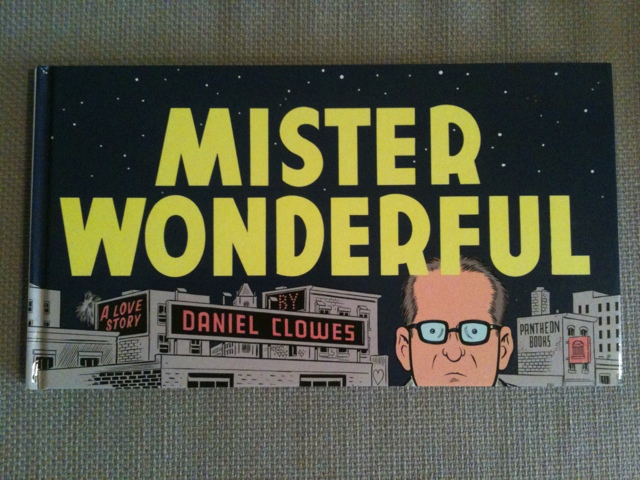
I read Daniel Clowes’s Mister Wonderful that Wednesday night. It was a treat—a wonderful balance of sweetness and acidity. I’m sometimes frightened by how closely I identify with Clowes’s protagonists. Full review next week.

20111106-152627.jpg

I can’t believe that Art Spiegelman’s MetaMaus hasn’t been remarked upon more—perhaps folks are still digesting it, like me, I guess. I consumed the first 50 pages immediately after finishing Mr. Wonderful, staying up way too late (all of this, accompanied by some mediocre red zin led to a mini-hangover and a generally poor performance teaching classes the next morn). Anyway, MetaMaus is far more engaging than any description of it might suggest. It combines Spiegelman’s cartoons with interviews and other media to detail the process behind creating the original Maus books (or, book singular I suppose is more appropriate). Fascinating stuff, covering memory and art and representation and mice &c. I’ll probably review it in bits and pieces—it seems like too much to process. It also comes with a DVD which I haven’t taken the time to look at yet—-

20111106-152636.jpg


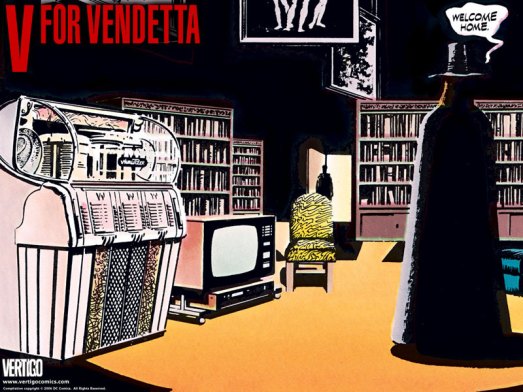
Guy Fawkes Day and V for Vendetta

“Remember, remember the 5th of November…”

I was lucky enough to live in New Zealand for a few years as a kid, so I got to experience Guy Fawkes Day. We made effigies of Guy, then we burned them on a bonfire. There was a barbecue and fireworks. To my American ass, it seemed a mixture of the Fourth of July and Halloween—strange and marvelous.

It was a few years after my last Guy Fawkes experience that I read Alan Moore’s V for Vendetta. V, an anarchist who wears a stylized Guy Fawkes mask, wages a vigilante war on a harsh authoritarian government. Along with Frank Miller’s The Dark Knight Returns, V was a first for me, something different from the comics I was reading at the time, stuff like Chris Claremont’s run on The Uncanny X-Men and other Marvel titles.

A film version of V for Vendetta was released in 2006; Alan Moore famously had his name removed from it. I enjoyed the film, although it certainly wasn’t as good or thought-provoking as Moore’s original story. And even though the film looked good, the passive experience of watching an action movie can’t measure up to David Lloyd’s original art work and that wonderful space between the panels of comics that engages the reader’s imagination.

v_for_vendetta_5_800×600.jpg

This afternoon [see editorial note below] I finished the first graphic novel of Alan Moore’s  run writing Swamp Thing, and I can’t wait until my library hold on the second graphic novel comes in. I had no idea Saga of the Swamp Thing would be as good as it was, nor as beautifully illustrated; it’s actually better than V for Vendetta or Moore’s other famed work, Watchmen (and none of these titles are even in the same league as Moore’s masterpiece, From Hell). Alan Moore and Steve Bissette’s run on the DC Comics series essentially led to DC’s creation of the edgier Vertigo imprint for their more “mature” titles, such as The Sandman. These titles helped to change the audiences of “comic books” and helped to make the graphic novel a new standard in the medium (no mean feat, considering the fanboyish culture of comic nerds, a culture that prizes rarity of print run over quality of storytelling).

One of the lessons in V for Vendetta is to illustrate what happens when we don’t allow for dissent, what happens when ideas are both prescribed and proscribed, and all dialogue is muted. Authoritarian governments consolidate their power from the silencing of ideas. A healthy society requires all sorts of opinions, even ones we don’t like. The smiling Americans in this photo aren’t burning effigies of would-be revolutionaries, they are burning something much more dangerous–books.

book-burning.jpg

[Editorial note: So, I ran a version of this post on Nov. 5, 2006—it’s actually one of the first posts I ever did on the blog, which I began in Sept. 2006. Looking over it—which is to say editing it and making minor revisions (and grimacing frequently, but trying to keep those revisions minor, like moving commas)—I can see the growth and scope of the blog; especially I can see my own limited sense of what I wanted Biblioklept to be. The post also strikes me as excessively vague and preachy (especially that last paragraph, written after years of Bush Era Fatigue, which is kinda sorta still going on, I guess, Bush Era Fatigue, I mean, only I’d give it another name now). I wish I could remember more details of Guy Fawkes Day/Night, but I was young—9, 10, 11—and it seems vague. I still remember the history of Guy Fawkes and the Gunpowder Plot, although that’s probably more a result of paying attention in AP European History than anything else. This editorial note is way too long. I never finished Alan Moore’s run on Swamp Thing, but the second volume was good, as I recall].

Books Acquired, Sometime Last Week (I Don’t Know, Maybe on Thursday or Friday)

I picked up a bevy of books at my favorite bookstore sometime last week ; can’t remember the day, exactly. Anyway, some of these selections come from reader recommendations re: nonconventional lit.

20111103-155310.jpg

I ordered David Markson’s novel Wittgenstein’s Mistress, which I’ve been meaning to read for yonks but had never found used. Horrible, horrible cover

20111103-155319.jpg

Bernhard’s Correction: Thomas Bernhard came recommended by a number of readers in the aforelinkedto post; dipping into Correction immediately recalled Sebald’s The Rings of Saturn for some reason.

20111103-155327.jpg

George Saunders: another reader recommendation. I actually read Pastoralia this week. I love short stories. Anyway, full review forthcoming. Short version: good stuff, but DFW casts a pretty big shadow.

20111103-155351.jpg

Georges Perec was another reader rec, but it was his novel Life: A User’s Manual that kept popping up. I found Species of Spaces and Other Pieces, his collection of essays and other stray bits, by sheer chance. I think I was looking for something by De Sade, actually. Anyway, I love, love, love this book—it kinda reminds me of Bolaño’s Between the Parentheses or even the Vollmann reader Expelled from Eden—the kind of book I see myself dipping into again and again, a little mini-labyrinth of ideas.

20111103-155359.jpg

I also picked up Faulkner’s last novel, The Reivers; been wanting to read it for a long time now. I’ll try to get it in over the Christmas break.

The Second Issue of Litmag C4 Is Out

The new issue of C4 is out now, featuring original short stories, nonfiction, art, and poetry. Good stuff (and free).

Under the Volcano — Malcolm Lowry

Most of Malcolm Lowry’s dense, depressing novel Under the Volcano takes place over the course of November 2nd, 1938, the Mexican Day of the Dead. Like a reticent, dour Virgil, Lowry guides the reader through the day’s tragic arc, floating between the minds of his novel’s three protagonists: Geoffrey Firmin, his half-brother Hugh, and Geoffrey’s estranged wife Yvonne. Geoffrey is British Consul to Mexico — ex-Consul, really, as British-Mexican relations sour against the backdrop of Spanish fascism and the rise of nationalism in Mexico — but he is almost always referred to as “the Consul,” a blackly ironic title. See, the Consul bears little authority aside from an extreme expertise on how to stay drunk (or “drunkly sober un-drunk”) 24/7. He’s ambassador to bar stools, a manager of mescal and little else (certainly not his own life; certainly not diplomatic affairs). The Consul is a wreck, an alcoholic to put Hemingway and Fitzgerald’s (and even Bukowski’s) alter-egos to shame.

After a first chapter that seems to derail all but the most patient readers, the narrative conflict arrives when Yvonne returns to Quauhnahuac, Mexico, a year after leaving (and divorcing) the Consul. She arrives to find the Consul (“Geoffrey,” as he’s called when the free indirect style inhabits her mind) drinking whiskey in a hotel bar in order to sober up (yep). It’s not immediately clear why Yvonne has returned to the Consul, but it seems that she hopes to save him from drowning in a drunken downward spiral. As the pair walks to the Consul’s house, they pass numerous advertisements for a boxing match; a child’s funeral proceeds down the avenue. These motifs of fighting, death, and futility permeate the novel.

During the walk we learn that Yvonne is not the only one concerned about the Consul’s health; his (much) younger brother Hugh has come to stay with him in the hopes of sobering him up. (Hugh employs a revolting and unsuccessful “strychnine cure”). That Hugh has also returned doubly complicates the plot. Much of Under the Volcano remains implicit, unnamed, hinted at, and this seems especially true of the implication that Yvonne cheated on the Consul with Hugh in the recent past (this implication may have been stated conclusively at some point in the novel, but I’ve only read the book once, which is perhaps like not having read it at all). What’s certainly clear is that Yvonne cheated on the Consul with a French filmmaker, Jacques Laruelle, a man whom the Consul, through sheer bizarre coincidence (but of course it isn’t sheer bizarre coincidence), spent a childhood summer with, an experience which bonded them as brothers in an Edenic holiday that eventually (inevitably) soured.

Despite her infidelities, Yvonne is generally present (I choose the verb “present” over “presented as” to highlight Lowry’s impeccable Modernist style) as a sympathetic character. Still, it is hard not to identify with the Consul (with “Geoffrey,” I suppose, if we are going to be familiar), the dark soul of this novel, and his complicated, painful feelings for Yvonne form the core of Volcano’s tragedy. He longs for her, pines for a complete life with her, yet resents her, cannot forgive her, hates her. For what? For leaving him. For betraying him. But perhaps foremost, he despises her inability to understand his alcoholism (he is particularly upset when she refuses to share a morning libation with him when they meet for the first time in a year). I’ll quote a passage at length now, one that showcases Lowry’s free indirect style, and one that reveals the strange indignities of the Consul’s sense of his own alcoholism. For context, dear reader, you must only know that Yvonne has suggested that she and the Consul might make long-term plans when he is sober “in a day or two”—

The Consul sat perfectly still staring at the floor while the enormity of the insult passed into his soul. As if, as if, he were not sober now! Yet there was some elusive subtlety in the impeachment that still escaped him. For he was not sober. No, he was not, not at this very moment he wasn’t! But what had that to do with a minute before, or half an hour ago? And what right had Yvonne to assume it, assume either that he was not sober now, or that, far worse, in a day or two he would be sober? And even if he were not sober now, by what fabulous stages, comparable indeed only to the paths and spheres of the Holy Cabbala itself, had he reached this stage again, touched briefly once before this morning, this stage at which alone he could, as she put it, “cope,” this precarious precious stage, so arduous to maintain, of being drunk in which alone he was sober! What right had she, when he had sat suffering the tortures of the damned and the madhouse on her behalf for fully twenty-five minutes on end without having a decent drink, even to hint that he was anything but, to her eyes, sober? Ah, a woman could not know the perils, the complications, yes, the importance of a drunkard’s life! From what conceivable standpoint of rectitude did she imagine she could judge what was anterior to her arrival? And she knew nothing whatever of what all too recently he had gone through, his fall in the Calle Nicaragua, his aplomb, coolness, even bravery there—the Burke’s Irish whiskey! What a world! And the trouble was she had now spoiled the moment.

The “fall in the Calle Nicaragua” the Consul references is quite literally a drunkard’s blackout (followed by the aforementioned fortifying whiskey, courtesy of a tourist), but it — falling — is perhaps the dominant motif in a novel crammed with motifs. In allegorical terms, if we want to ruin a good book (I don’t recommend this, of course), Volcano is pure Faust-stuff: end of innocence, fall of man, intractability of the human condition, ethical peril, moral inertia. While the Consul’s fall dominates the novel, Lowry brings this decline into dramatic relief in a late, climactic episode when his (anti-)heroic trio encounter a dying (dead?) man on the side of the road. Hugh tries to help, but the Darwinian venality of Mexican commonplace law makes his attempt impotent. Yvonne and the Consul are basically paralyzed.

Hugh’s attempt to save the man is a desperate call to action, an endeavor to perform some good in a world dominated by war and fascism. Hugh’s character fascinates. We learn of his past in one of the novel’s most intriguing episodes, a mini-bildungsroman that finds young Hugh working in the merchant marine as a calculated ploy to lend romance to his persona — he longs to prevail as a songwriter. He returns to find that no one cares about — has even heard — his guitar compositions; his publicity stunt fails. Although Hugh is only twenty-nine, he already seems himself as a failure, a fallen hero; he obsesses over the Battle of Ebro, daydreaming of helming a ship laden with hidden arms that he will deliver to the Loyalists who oppose the Fascists. Hugh’s greatest pain — and perhaps (only perhaps) Lowry’s greatest cruelty — is the awareness that the idealism of romantic heroism is intrinsically bound to a kind of selfish egoism. Hugh, perhaps with the visceral signal of his half-brother as a kind of radical prescience, can already see his own fall; his parts in Volcano are in a sense a constant meditation on falling. Hugh tries to save the dying man on the road, the cold double of his brother, whom he also tries to save — and yet it is all to little avail.

In Lowry’s world, in the volcano-world, there is only expulsion from the Eden. Lowry spells out this theme near the middle of his novel in a strange episode. The Consul wanders into his neighbor’s garden and reads a sign —

¿LE GUSTA ESTE JARDÍN?
¿QUE ES SUYO?
¡EVITE QUE SUS HIJOS LO DESTRUYAN!

The Consul stared back at the black words on the sign without moving. You like this garden? Why is it yours? We evict those who destroy! Simple words, simple and terrible words, words which one took to the very bottom of one’s being, words which, perhaps a final judgement on one, were nevertheless unproductive of any emotion whatsoever, unless a kind of colourless cold, a white agony, an agony chill as that iced mescal drunk in the Hotel Canada on the morning of Yvonne’s departure.

Significantly, either the sign is posted with improper punctuation, or (and?) the Consul’s translation is wrong — in either case a meaningful misreading occurs. We later receive the “proper” version of the sign: “¿Le gusta este jardín, que es suyo? ¡Evite que sus hijos lo destruyan! – “Do you like this garden that is yours? See to it that your children do not destroy it!”  The Consul’s first reading is a corruption, a cruel misreading that questions humanity’s right to happiness, and, tellingly, he connects the sign to the end of his relationship with Yvonne. The second version of the sign, while still foreboding, perhaps signals a kernel of hope in Lowry’s bleak work — the idea that a garden might be preserved, might be tended to; that children might be raised who do not kill, cheat, steal, rape, enslave, or otherwise prey on each other. Still, Lowry refuses to imagine what such a world might look like for us. Did I mention that Volcano is really, really sad?

For all its bleak, bitter bile, Volcano contains moments of sheer, raw beauty, especially in its metaphysical evocations of nature, which always twist back to Lowry’s great themes of Eden, expulsion, and death. Lowry seems to pit human consciousness against the naked power of the natural world; it is no wonder then, against such a grand, stochastic backdrop, that his gardeners should fall. The narrative teems with symbolic animals — horses and dogs and snakes and eagles — yet Lowry always keeps in play the sense that his characters bring these symbolic identifications with them. The world is just the world until people walk in it, think in it, make other meanings for it.

In many ways, Under the Volcano is an antipodal response to Joyce’s Ulysses. Both novels stream through a number of consciousnesses over the course of one day; both novels invert and subvert mythical frameworks against diurnal concerns; both novels point to the ways that the smallest meannesses — and kindnesses — can color and affect our lives. And while there are many divergences (chiefest, I believe, the spirit of redemption in Ulysses that seems entirely absent from Volcano), the greatest similarity may be their difficulty. Simply put, Lowry, like Joyce, throws his readers into the deep end. The first chapter of the novel inhabits the mind of Jacques Laruelle and takes place exactly one year after the events of the rest of the novel. It is both overture and context for all that follows, and yet it is radically alienating; indeed, it only fully makes sense after one finishes the novel and goes back and reads it again, realizing it is the rightful coda, the sad epilogue of a sad story. Lowry leads with his conclusion, show us the fall-out up front, the splinters and shards of the narrative to come. Picking up these pieces is hardly easy and never joyful, but it is a rewarding experience. Very highly recommended.

[Editorial note: Biblioklept ran this review in March of 2011; we run it again in honor of The Day of the Dead]


The Autobiography of a Super-Tramp — W.H. Davies

The Autobiography of a Super-Tramp documents W.H. Davies’s picaresque adventures in America in the last decade of the nineteenth century. In bildungsroman mode, Davies begins by relating the story of his childhood in Wales, where he was raised by his grandparents after his father died and his mother essentially abandoned her children. Despite his grandparents’ care, Davies soon turns to petty crime, shoplifting for sport (as well as to provide trifles for his girlfriend). He’s caught, tried,  and beaten, an early run-in that would set a template for future dealings with authority figures. A restless spirit with a hankering for adventure, Davies has trouble attaining steady work; he’s a bit of a romantic, always stuck in a book. He elects to set off for America. In one of the funnier moments in the book, Davies describes writing a letter comparing America to England. Davies mails the missive home—only he’s still in Liverpool and has yet to see the New World, let alone the open sea. Of course, after years trekking across the US, Davies got to know much of the national characteristic; here he is reflecting—

My impression of Americans from the beginning is of the best, and I have never since had cause to alter my mind. They are a kind, sympathetic race of people and naturally proud of their country. The Irish-American is inclined to be the most bitter, remembering from his youth the complaints of his parents, who were driven through unjust laws from their own beloved land; and such a man is not to be idly aggravated, for life is a serious subject to him. This man is not to be aggravated, especially under the consideration that our conscience is not too clean in this respect, and that we are apt to be very slow in making that open confession which is good for the soul. The most pleasing trait in Americans, which cannot for long escape us, is their respect for women and the way in which the latter do deserve it.

In a strange moment that’s never quite fully explained (there are lots of these in Super-Tramp), upon arrival in America, our hero elects to take up with a vagabond named Brum, who teaches the would-be tramp the ins-and-outs of jumping rail, beating trail, and begging from town to town. In one inspired episode, Brum takes our hero to Michigan, where vagabonds could wait out the winter in warm jails with plenty of food (and tobacco). Here, the tramps could barter their own sentences with the complicity of the judge and jailers, who were basically working a scam on the taxpayers. (Luckily, no one makes undue profits by overcrowding prisons in America today. Right? Right?) Brum is one of the first players in a large cast of indigents and outsiders, men of dubious honesty and strange talents whose common thread is that they are all aliens to mainstream society. These are self-exiles whose only telos is movement itself.

These themes of travel and outsider status link Davies’s narratives strongly to those two Jacks of all trades, London and Kerouac, although the clean, spare style of Super-Tramp shares more blood with London’s reportorial rhythms than Kerouac’s unbound typing. It’s also hard to read Super-Tramp without recalling Steinbeck’s bindlestiffs, and just as in Steinbeck’s finest works, there’s depth, humility, and pathos in Davies’s writing, whether he’s describing picking berries, sharing a drink with the fellows, or moving cattle across the Atlantic.

And if Davies demonstrates empathy for his fellow man, that empathy extends to his keen descriptions of nature and animals; his tender descriptions of the poor cattle he helps transport to England are especially moving. Here, Davies shows the reader his naturalist sympathies—

I like to see to a good scientific bout by men who know the use of their hands, but would rather walk twenty miles than see animals in strife. Although of a quiet disposition, my fondness for animals is likely at any time to lead me into danger. After reading cases of vivisection I have often had dreams of boldly entering such places, routing the doctors with an iron bar, cutting the cords and freeing the animals, despite of any hurt I might receive from bites and scratches. Perhaps I should cut a ridiculous figure, walking the crowded streets with a poor meek creature under each arm, but that would not bother me in the performance of a humane action.

These dual drives—empathy and outrage against injustice—guide Super-Tramp, set against an abiding spirit of freedom and nature. As the narrative progresses, Davies repeatedly foregrounds the Darwinian peril the emerging capitalist industrial culture places on ordinary people. His note on vivisection above becomes tragically ironic late in the book when a terrible accident on the rails claims one of his feet.

Despite his hard (if self-elected) life, Davies would later become more comfortable as one of the most famous poets of his age in England, lauded for his plain, naturalist style, and championed by George Bernard Shaw (who wrote the preface to Super-Tramp and helped get the book published). The Autobiography of a Super-Tramp is an engaging page-turner that will likely appeal to fans of Jack London and John Steinbeck or anyone fascinated by the grime and romance of a hobo jungle. With its emphasis on the human face of those who refuse to play into the capitalist system, the book is as timely as it ever was.

And yes, the band got their name from the book.

The Autobiography of a Super-Tramp is part of Melville House’s new Neversink line.

Seven More Horror Stories Masquerading in Other Genres

We often identify genre simply by its conventions and tropes, and, when October rolls round and we want scary stories, we look for vampires and haunted houses and psycho killers and such. And while there’s plenty of great stuff that adheres to the standard conventions of horror (Lovecraft and Poe come immediately to mind) let’s not overlook novels that offer horror just as keen as any genre exercise. Hence: Seven horror stories masquerading in other genres (and see our first post for more):

Oedipus Rex — Sophocles

Sure, Aristotle tells us that tragedy, by its very nature, must involve pity and terror, two emotions fundamental to horror as well. But the Oedipus story is so fundamental to our culture and its narratives that we easily overlook the plain fact that it is a horror story. Oedipus Rex begins with the attempted infanticide of the hero, including the brutal pinning of his feet, from which his name derives. Spared, Oedipus must endure the horrific uncertainty that he is not his parents’ natural son, a problem compounded when he learns from the Delphic oracle that he is predestined to kill his father and mate with his mother. You know what unfolds: a murder on the high road, a monster with riddles, a curse of famine, a horrible revelation, a suicide, and a bloody blinding.

Julius Caesar — William Shakespeare

History is its own horror show; Julius Caesar might be about the Roman Empire or the price of a republic, but it’s also very much a tale of paranoia, murder, and ghosts. Poor wavering Brutus recapitulates the crime of Oedipus when he stabs father-figure Brutus. The conspirators bathe their hands in Caesar’s blood, hoping to signal rebirth and shared responsibility, but the marking gestures are ultimately ambiguous. Great Caesar’s ghost will return, suicides will abound (Portia swallowing hot coals is particularly gruesome), and war will ravage the Republic.

“A Good Man Is Hard to Find” — Flannery O’Connor

This one may be a bit of a cheat, because I’m sure plenty of folks have the good sense to see “A Good Man Is Hard to Find” as the horror story it is. Still, O’Connor’s short masterpiece too often gets pushed into the “Southern Gothic” or even “Southern Grotesque” mini-genre, one which belies the story’s intense powers of horror. The intensity of “A Good Man” comes largely from its crystalline reality; half a century after its publication, the Misfit still has the power to shock readers (notice too that the Misfit’s first crime was again Oedipal—he was jailed for patricide). Here’s O’Connor on her story:

Our age not only does not have a very sharp eye for the almost imperceptible intrusions of grace, it no longer has much feeling for the nature of the violence which precede and follow them.  The devil’s greatest wile, Baudelaire has said, is to convince us that he does not exist.
I suppose the reasons for the use of so much violence in modern fiction will differ with each writer who uses it, but in my own stories I have found that violence is strangely capable of returning my characters to reality and preparing them to accept their moment of grace.  Their heads are so hard that almost nothing else will do the work.  This idea, that reality is something to which we must be returned at considered cost, is one which is seldom understood by the casual reader . . .

The Kindly Ones — Jonathan Littell

Keeping our Oedipal theme alive is Littell’s enormous novel The Kindly Ones, a horror story masquerading as a historical epic. The Kindly Ones, taking its name from the Greek tragedy, is about an SS officer who carries out probably every taboo one can think of during WWII, including incest, patricide, fantasies of coprophilia and cannibalism, and child murder. Oh, and mass murder. Lots and lots of mass murder. In my review, I argued that, “This is a novel that might as well take place in the asshole,” and I stick by that.

Kate Beaton's Take on "The Yellow Wallpaper"

“The Yellow Wallpaper” — Charlotte Perkins Gilman 

“The Yellow Wallpaper” has become a central text in feminist criticism for good reason. The story, told in first person POV, is a sad, scary descent into madness. And while it’s easy to point toward postpartum depression as the culprit, the story deserves a much more considered analysis, one which addresses the literal and metaphorical constraints placed upon the female body—a body that literary traditions have often tried to keep lying down (consider Sleeping Beauty, for example).

Steps — Jerzy Kosinski

Steps is an odd duck even for this list, because I’m not even sure if it’s ever been identified within a genre by any large group of readers. From my review:

At a remove, Steps is probably about a Polish man’s difficulties under the harsh Soviet regime at home played against his experiences as a new immigrant to the United States and its bizarre codes of capitalism. But this summary is pale against the sinister light of Kosinski’s prose. Consider the vignette at the top of the review, which begins with an autophagous octopus and ends with a transvestite. In the world of Steps, these are not wacky or even grotesque details, trotted out for ironic bemusement; no, they’re grim bits of sadness and horror. At the outset of another vignette, a man is pinned down while his girlfriend is gang-raped. In time he begins to resent her, and then to treat her as an object–literally–forcing other objects upon her. The vignette ends at a drunken party with the girlfriend carried away by a half dozen party guests who will likely ravage her. The narrator simply leaves. Another scene illuminates the mind of an architect who designed concentration camps. “Rats have to be removed,” one speaker says to another. “Rats aren’t murdered–we get rid of them; or, to use a better word, they are eliminated; this act of elimination is empty of all meaning. There’s no ritual in it, no symbolism. That’s why in the concentration camps my friend designed, the victim never remained individuals; they became as identical as rats. They existed only to be killed.” In another vignette, a man discovers a woman locked in a metal cage inside a barn. He alerts the authorities, but only after a sinister thought — “It occurred to me that we were alone in the barn and that she was totally defenseless. . . . I thought there was something very tempting in this situation, where one could become completely oneself with another human being.” But the woman in the cage is insane; she can’t acknowledge the absolute identification that the narrator desires. These scenes of violence, control, power, and alienation repeat throughout Steps, all underpinned by the narrator’s extreme wish to connect and communicate with another. Even when he’s asphyxiating butterflies or throwing bottles at an old man, he wishes for some attainment of beauty, some conjunction of human understanding–even if its coded in fear and pain.

“The Shawl” — Cynthia Ozick

Ozick’s short story “The Shawl” is a study in desperation and fear, and while any hack can milk horror from a concentration camp setting and a sick child, Ozick’s psychological study of a mother and her children skewers any hope of a simple sympathetic reading. At its core, “The Shawl” is about the dramatic Darwinism that underpins our fragile bodies, a Darwinism that can, under the right circumstances, remove our humanity. I never want to read “The Shawl” again.

Seven Horror Stories Masquerading In Other Genres

We often identify genre simply by its conventions and tropes, and, when October rolls round and we want scary stories, we look for vampires and haunted houses and psycho killers and such. And while there’s plenty of great stuff that adheres to the standard conventions of horror (Lovecraft and Poe come immediately to mind) let’s not overlook novels that offer horror just as keen as any genre exercise. Hence: Seven horror novels masquerading in other genres:

cormac5.jpg_jpeg_300x1000_q85

Blood Meridian — Cormac McCarthy

In my review (link above), I called Blood Meridian “a blood-soaked, bloodthirsty bastard of a book.” The story of the Glanton gang’s insane rampage across Mexico and the American Southwest in the 1850s is pure horror. Rape, scalping, dead mules, etc. And Judge Holden. . . [shivers].

Rushing to Paradise — J.G. Ballard

On the surface, Ballard’s 1994 novel Rushing to Paradise seems to be a parable about the hubris of ecological extremism that would eliminate humanity from any natural equation. Dr. Barbara and her band of misfit environmentalists try to “save” the island of St. Esprit from France’s nuclear tests. The group eventually begin living in a cult-like society with Dr. Barbara as its psycho-shaman center. As Dr. Barbara’s anti-humanism comes to outweigh any other value, the island devolves into Lord of the Flies insanity. Wait, should Lord of the Flies be on this list? 

2666 — Roberto Bolaño

Okay. I know. This book ends up on every list I write. What can I do?

While there’s humor and pathos and love and redemption in Bolaño’s masterwork, the longest section of the book, “The Part about the Crimes,” is an unrelenting catalog of vile rapes, murders, and mutilations that remain unresolved. The sinister foreboding of 2666‘s narrative heart overlaps into all of its sections (as well as other Bolaño books); part of the tension in the book–and what makes Bolaño such a gifted writer–is the visceral tension we experience when reading even the simplest  incidents. In the world of 2666, a banal episode like checking into a motel or checking the answering machine becomes loaded with Lynchian dread. Great horrific stuff.

King Lear — William Shakespeare

Macbeth gets all the propers as Shakespeare’s great work of terror (and surely it deserves them). But Lear doesn’t need to dip into the stock and store of the supernatural to achieve its horror. Instead, Shakespeare crafts his terror at the familial level. What would you do if your ungrateful kids humiliated you and left you homeless on the heath? Go a little crazy, perhaps? And while Lear’s daughters Goneril and Regan are pure mean evil, few characters in Shakespeare’s oeuvre are as crafty and conniving as Edmund, the bastard son of Glouscester. And, lest I forget to mention, Lear features shit-eating, self-mutilation, a grisly tableaux of corpses, and an eye-gouging accompanied by one of the Bard’s most enduring lines: “Out vile jelly!Peter Brook chooses to elide the gore in his staging of that infamous scene:

The Trial — Franz Kafka

Kafka captured the essential alienation of the modern world so well that we not only awarded him his own adjective, we also tend to forget how scary his stories are, perhaps because of their absurd familiarity. None surpasses his unfinished novel The Trial, the story of hapless Josef K., a bank clerk arrested by unknown agents for an unspecified crime. While much of K.’s attempt to figure out just who is charging him for what is hilarious in its absurdity, its also deeply dark and really creepy. K. attempts to find some measure of agency in his life, but is ultimately thwarted by forces he can’t comprehend–or even see for that matter. Nowhere is this best expressed than in the famous “Before the Law” episode. If you’re too lazy to read it, check out his animation with narration by the incomparable Orson Welles:

Sanctuary — William Faulkner

In my original review of Sanctuary (link above), I noted that “if you’re into elliptical and confusing depictions of violence, drunken debauchery, creepy voyeurism, and post-lynching sodomy, Sanctuary just might be the book for you.” There’s also a corn-cob rape scene. The novel is about the kidnapping and debauching of Southern belle Temple Drake by the creepy gangster Popeye–and her (maybe) loving every minute of it. The book is totally gross. I got off to a slow start with Faulkner. If you take the time to read the full review above (in which I make some unkind claims) please check out my retraction. In retrospect, Sanctuary is a proto-Lynchian creepfest, and one of the few books I’ve read that has conveyed a total (and nihilistic) sense of ickiness.

n14559

Great Apes — Will Self

Speaking of ickiness…Self’s 1997 novel Great Apes made me totally sick. Nothing repulses me more than images of chimpanzees dressed as humans and Great Apes is the literary equivalent (just look at that cover). After a night of binging on coke and ecstasy, artist Simon Dykes wakes up to find himself in a world where humans and apes have switched roles. Psychoanalysis ensues. While the novel is in part a lovely satire of emerging 21st-century mores, its humor doesn’t outweigh its nightmare grotesquerie. Great Apes so deeply affected us that I haven’t read any of Self’s work since.

[Ed. note: This post is a few years old. We run it again for Halloween and will run a follow up post later today].