Another entry in our ongoing series of literary recipes to celebrate Thanksgiving.
Ernest Hemingway is famous for writing classic novels like For Whom the Bell Tolls, The Old Man and The Sea, and The Sun Also Rises. Apparently, he also liked to imbibe the occasional alcoholic beverage.
A recipe for a drink named after Hemingway’s novel Death in the Afternoon was published in the 1935 cocktail book So Red the Nose, or Breath in the Afternoon by Sterling North and Carl Kroch. Here’s that recipe–
Add one jigger of absinthe to a champagne flute
Add iced champagne until it attains the proper opalescence.
A small amount of sugar or Gomme syrup can be added to round it out, especially when using a verte absinthe.
Here’s Hemingway’s note on the drink’s origin–
This was arrived at by the author and three officers of the H.M.S. Danae after having spent seven hours overboard trying to get Capt. Bra Saunders’ fishing boat off a bank where she had gone with us in a N.W. gale.
[Editorial note: We originally ran a version of this post in November of 2009. We’re republishing it as part of a series celebrating Thanksgiving, featuring recipes and food from some of our favorite books].
At the beginning of Zora Neale Hurston’s novel Their Eyes Were Watching God, Janie returns from the Everglades to Eatonville in ragged overalls to a gossipy and unwelcoming town. The one exception is her best friend Phoeby, who brings Janie a “heaping plate of mulatto rice.” Janie gobbles up the simple, delicious meal, even as Phoeby notes that it “ain’t so good dis time. Not enough bacon grease.” She does however concede that “it’ll kill hongry.” No doubt.
We’ve always been intrigued by mulatto rice. What could it be? Is the dish still around today, but under a new name? Although the term “mulatto” has fallen into disuse, and perhaps distaste (just ask Larry David if you don’t believe us), organizations like mulatto.org have also taken a certain ownership of it. For Hurston, mulatto rice is a positive thing. Hurston could have had Phoeby bring any number of dishes to her friend Janie, so it’s telling that she chooses “mulatto rice” as a homecoming meal. The dish represents a communion, an admixture that reflects Janie’s multiracial identity as well as her resistance to gender-typing. “Mulatto” is also probably etymologically akin to the word “mule,” and if you’ve read Eyes, you know that mules are a major motif in the story. But enough literazin’.
Down to the nitty-gritty–we made up a mess of mulatto rice tonight thanks to a recipe from The Savannah Cook Book by Harriet Ross Colquitt. Not that we found this 1933 cookbook ourselves. No, the real merit here goes to the very cool website Take One Cookbook, which explores the history and culture and sociology behind old, weird cookbooks–all while making the recipes. Colquitt’s recipe, via Wendy at Take One Cookbook (see Wendy’s versionhere):
Mulatto Rice
This is the very chic name given to rice with a touch of the tarbrush.
Fry squares of breakfast bacon and remove from the pan. Then brown some minced onion (one small one) in this grease, and add one pint can of tomatoes. When thoroughly hot, add a pint of rice to this mixture, and cook very slowly until the rice is done. Or, if you are in a hurry, cold rice may be substituted, and all warmed thoroughly together.
The rice is very easy to make and very, very tasty. We substituted green onions for a small onion, and used a hickory-smoked bacon that infused the rice with a lovely sweetness (we also included a tablespoon of brown sugar right after the tomatoes). We served the dish, pictured above, with ham steaks and fried green tomatoes with a spicy yogurt sauce. Hearty and rich and satisfying–just the sort of thing one wants to eat after a soul-searching quest (or maybe just a long day). Recommended.
Here’s another entry in our Thanksgiving series of literary recipes–a recipe for fish stew, adapted from Ian McEwan’s novel Saturday. The recipe is Henry Perowne’s, the novel’s protagonist who makes it for dinner on the titular day. The adaptation below comes from journalist Damian Barr, who wrote an excellent article about recipes in literature for The Times.
Into a stockpot of boiling water (a litre or more), put the bones of three skates (or other boned fish), with heads intact. If you have no obliging local fishmonger, use a pound or more of white fish.
Add a dozen or so mussels to the stock. Simmer for 25 minutes.
Meanwhile, strip and chop three onions and eight fat cloves of garlic. Soften over a low heat in a casserole with a lot of olive oil. When they have melted sufficiently, add: a couple of crushed red chillies, a pinch of saffron, some bay leaves, orange-peel gratings, oregano, five anchovy fillets, two cans of peeled tomatoes
When these have blended together in the heat, add a quarter bottle of white wine. Then strain off the stock and add to the casserole. Simmer the mix for 20 minutes.
Rinse and/or scrub the clams and remaining mussels and place in a bowl.
Cut the monkfish tails into chunks and place in a separate bowl.
Wash the tiger prawns and add to the monkfish bowl. Keep both bowls refrigerated until ready to cook. Just before dinner, reheat the casserole.
Simmer the clams, monkfish, mussels and prawns in the casserole for ten minutes.
Eat the stew with brown bread, or garlic bread, salad and a hearty red wine.
I read Pastoralia, George Saunders’s 2000 collection of stories very quickly, consuming one or two of the book’s six stories a night, usually wedged between other readings. There was a flavor of respite to these readings, a sense of ease or relaxation or—dare I say it—simple pleasure. Frankly, I’m suspicious of any book that I’m able to read very quickly; perhaps I’m prejudiced against any book that doesn’t pose (or impose) its own learning curve on the reader.
I’m perhaps off to a very bad start in this review, veering on the appearance of condescension (when, to be clear, I think that Pastoralia is sharp and wise and wicked and well-written and very, very funny)—but I feel like I have to get this out of the way up front: George Saunders’s prose, plots, and dialogue all reminded me very much of the prose, plots, and dialogue of David Foster Wallace.
A bit of objective data: DFW and Saunders are/were of a similar age (born in ’62 and ’58, respectively) and Infinite Jest and Saunders’s first collection, CivilWarLand in Bad Decline were published the same year (’96). But, because of the simple mechanical truth that I read Wallace much, much earlier than Saunders, I find his influence unduly there. No doubt that when I detect Wallacian curves and contours and rhythms in Saunders—the coupling of officialese with imaginary slang, the depiction of a postmodern America which is slightly (but only slightly) not our own, the analyses of power and fear and duty—when I find these points of comparison, what I am really finding is the shared influences of Wallace and Saunders (no doubt postmodernists like Pynchon, Barth, Barthelme, et al). In short, if I find a suspicious ease or comfort in Saunders, it’s because Wallace already taught me to read him. But like I said before, this is not a great start. I should just review the book.
Short review: the six tales in Pastoralia are hilarious, tender, and depressingly predictive of the decade that came after their composition (not to mention the strange dark horizon ahead of us). The long opener “Pastoralia” features a hapless man who works long hours apart from his wife and children in a failing history park. His job is to simulate a caveman, but his partner, an older woman with a troubled son, makes the job difficult to perform with any level of, uh, historical accuracy. When employees must be downsized, one of the managers tries to convince the narrator to rat out his partner’s shortcomings. “Pastoralia” is a study in how corporate power uses dehumanizing tactics to exploit workers. The communications the narrator receives from a nebulous plurality of managers are both hilarious and horrific, each one a contortion of logic that serves to strip the rights (and self-worth) of the workers. The story, depressingly, is more relevant than ever. (Readers familiar with CivilWarLand in Bad Decline will recognize “Pastoralia” as a revision of sorts to that earlier collection’s title story).
The next tale, “Winky,” moves along the same lines, exploring the clash between the Darwinian drives of self-protection and self-satisfaction set against the needs of others. In this story, the protagonist attends a self-help seminar (the scene is something so contemporaneous with Wallace that I’s tempted to write “straight out of DFW”), where the psychobabble and rationalizing of the speaker persuades him to ditch his weird, needy sister. Like the complex and funny managerial rhetoric we find in “Pastoralia,” the motivational lingo lulls and persuades not just the protagonist, but also the reader, into the easy trap of contemporary consumerism that centers the self as the ultimate telos of existence.
“Sea Oak” is the possible high point in the collection. It depicts an ersatz family living in a housing project that at one point we might have described as “on the margins of America” — only in Saunder’s vision (a vision increasingly realized) such housing projects are the reality for the majority of Americans. The middle class is not the norm. The (male) narrator strips to help bring money into the crappy apartment he shares with his aunt and two cousins and their two kids. A sample—
Sea Oak’s not safe. There’s an ad hoc crackhouse in the laundry room and last week Min found some brass knuckles in the kiddie pool. If I had my way I’d move everybody up to Canada. It’s nice there. Very polite. We went for a weekend last fall and got a flat tire and these two farmers with bright red faces insisted on fixing it, then springing for dinner, then starting a college fund for the babies. They sent us stock certificates a week later, along with a photo of all of us eating cobbler at a diner.
The hyperbolic vision of a Canada that cares for all of its citizens stands in sharp relief to the predatory Darwinism of the Sea Oak projects. As the story unfolds, Saunders uses his characters to examine just what exactly economic struggle in American is for—what does the American Dream mean when subsistence living alone is so difficult?
“The End of FIRPO in the World” is perfection, a sad, funny, rambling stream of consciousness that plumbs the mind of an alienated boy who imagines his future glories and the revenge that he will have for all the slights done him. “FIRPO,” sitauted in the middle of collection, moves the book from the familial and corporate to the individual, as the last few tales (“The Barber’s Unhappiness” and “The Falls”) inhabit the strange sad consciousness of ordinary, awful people. These are beautiful portraits, ones that explore the gravity of failure and the small glowing sparks of redemption that might be available to us.
If, as I remarked earlier, there’s a comfort in Saunders’s prose, it’s the strange uncomfortable comfort that there’s a perceptive and wise intelligence out there that can apprehend and satirize the sheer horrific injustice that pervades the modern condition. Pastoralia is great, and I picked up CivilWarLand in Bad Decline right after finishing it, so there’s an endorsement. Recommended.
Another literary recipe (of sorts). What better way to celebrate Thanksgiving than with caviar and vodka?
Truman Capote’s caviar-smothered baked potatoes with 80-proof Russian vodka (via)—
Though Truman Capote’s writing was mostly occupied with social dealings, he managed to find time to write a forward to Myrna Davis’ The Potato Book, a cookbook penned to raise funds for a Long Island day school. In his brief contribution, Capote offers a recipe for what he describes as “my one and only most delicious ever potato lunch.” In a tribute to the then existing potato fields of Long Island, the recipe called for a baked potato smothered in sour cream and caviar, then paired with a chilled bottle of 80-proof Russian vodka.
We celebrated Thanksgiving last year by offering up various literary recipes (don’t worry, we’re fond of leftovers, so we’ll be reheating those posts for second helpings). And even though we had a diverse range of meals on the menu, we didn’t come up with a turkey recipe.
Thankfully, F. Scott Fitzgerald shares some turkey tips in his Notebooks, and although he presents his recipes as a way to handle leftovers, it never hurts to plan ahead. Turkey thirteen ways—
TURKEY REMAINS AND HOW TO INTER THEM WITH NUMEROUS SCARCE RECIPES by F. Scott Fitzgerald
At this post holiday season the refrigerators of the nation are overstuffed with large masses of turkey, the sight of which is calculated to give an adult an attack of dizziness. It seems, therefore, an appropriate time to give the owners the benefit of my experience as an old gourmet, in using this surplus material. Some of the recipes have been in my family for generations. (This usually occurs when rigor mortis sets in.) They were collected over years, from old cook books, yellowed diaries of the Pilgrim Fathers, mail order catalogues, golfbags and trash cans. Not one but has been tried and proven—there are headstones all over America to testify to the fact.
Very well then: Here goes:
1. Turkey Cocktail
To one large turkey add one gallon of vermouth and a demijohn of angostura bitters. Shake.
2. Turkey at la Francais.
Take a large ripe turkey, prepare as for basting and stuff with old watches and chains and monkey meat. Proceed as with cottage-pudding.
3. Turkey and Water
Take one turkey and one pan of water. Heat the latter to the boiling point and then put in the refrigerator When it has jelled drown the turkey in it. Eat. In preparing this recipe it is best to have a few ham sandwiches around in case things go wrong.
4. Turkey Mongole
Take three butts of salami and a large turkey skeleton from which the feathers and natural stuffing have been removed. Lay them out on the table and call up some Mongole in the neighborhood to tell you how to proceed from there.
5. Turkey Mousee
Seed a large prone turkey, being careful to remove the bones, flesh, fins, gravy, etc. Blow up with a bicycle pump. Mount in becoming style and hang in the front hall.
6. Stolen Turkey
Walk quickly from the market and if accosted remark with a laugh that it had just flown into your arms and you hadn’t noticed it. Then drop the turkey with the white of one egg-well, anyhow, beat it.
7. Turkey a la Creme.
Prepare the creme a day in advance, or even a year in advance. Deluge the turkey with it and cook for six days over a blast furnace. Wrap in fly paper and serve.
8. Turkey Hash
This is the delight of all connoisseurs of the holiday beast, but few understand how really to prepare it. Like a lobster it must be plunged alive into boiling water, until it becomes bright red or purple or something, and then before the color fades, placed quickly in a washing machine and allowed to stew in its own gore as it is whirled around.
Only then is it ready for hash. To hash, take a large sharp tool like a nail-file or if none is handy, a bayonet will serve the purpose—and then get at it! Hash it well! Bind the remains with dental floss and serve.
And now we come to the true aristocrat of turkey dishes:
9. Feathered Turkey.
To prepare this a turkey is necessary and a one pounder cannon to compell anyone to eat it. Broil the feathers and stuff with sage brush, old clothes, almost anything you can dig up. Then sit down and simmer. The feathers are to be eaten like artichokes (and this is not to be confused with the old Roman custom of tickling the throat).
10. Turkey at la Maryland
Take a plump turkey to a barber’s and have him shaved, or if a female bird, given a facial and a water wave. Then before killing him stuff with with old newspapers and put him to roost. He can then be served hot or raw, usually with a thick gravy of mineral oil and rubbing alcohol. (Note: This recipe was given me by an old black mammy.)
11. Turkey Remnant
This is one of the most useful recipes for, though not, “chic”, it tells what to do with the turkey after the holiday, and extract the most value from it.
Take the remants, or if they have been consumed, take the various plates on which the turkey or its parts have rested and stew them for two hours in milk of magnesia. Stuff with moth-balls.
12. Turkey with Whiskey Sauce.
This recipe is for a party of four. Obtain a gallon of whiskey, and allow it to age for several hours. Then serve, allowing one quart for each guest.
The next day the turkey should be added, little by little, constantly stirring and basting.
13. For Weddings or Funerals. Obtain a gross of small white boxes such as are used for bride’s cake. Cut the turkey into small squares, roast, stuff, kill, boil, bake and allow to skewer. Now we are ready to begin. Fill each box with a quantity of soup stock and pile in a handy place. As the liquid elapses, the prepared turkey is added until the guests arrive. The boxes delicately tied with white ribbons are then placed in the handbags of the ladies, or in the men’s side pockets.
There I guess that’s enough turkey to talk. I hope I’ll never see or hear of another until—well, until next year.
Newt Gingrich, a sour, puffy-faced man who somehow retains a platform for his regressive ideas, ruffled a few metaphorical feathers this weekend when he proposed that failing schools (populated mostly by poor children) should fire their janitorial staffs and replace them with child labor. In Newt’s bizarre Dickensian vision, giving these poor children an opportunity to scrub toilets and mop floors (overseen, of course by one non-unionized “master janitor” ) will offer them, I don’t know, bootstraps by which they might pull themselves up. Notice too that his idea also works to eradicate the notion of a free and equitable public education system in this country. And while plenty of folks have called out the sheer regressivism inherent in Newt’s comments, there are far too many people in this country who think it’s not just a solid idea, but a viable plan.
Gingrich’s comments came the same weekend we witnessed police at UC Davis casually dispersing pepper spray into the faces of unarmed, peaceful students. Who were sitting down. Sitting down. The nonchalance that characterizes this particular violence against the students is particularly egregious, but it’s simply part and parcel of a greater wave of police actions targeting dissent in this country. The police themselves are not the ultimate culprit though—they are merely a tool of a corporatacracy that intends to enforce the status quo — namely, the continuing class disparity in this country that will disenfranchise the young in particular. The attitude that allows Gingrich to casually suggest reintroducing normalized child labor is the same attitude that allows one human being to casually spray poison into the face of another human being. Dehumanization underwrites all master-slave relationships.
Dehumanization in political rhetoric is nothing new. Still, I was particularly shocked while watching the Republican Presidential Candidate debate in Las Vegas last month. What shocked me was not necessarily the sentiments (or lack thereof) of most of the candidates (I’m too cynical for that), but the nakedness of their rhetoric. They made absolutely no attempt to rhetorically gloss over their dehumanizing ideas; instead, to the cheers of an audience, they trotted out one dystopian idea after another. (Read the transcript)
Herman Cain hemmed and hawed over whether or not he would build an electrified fence between the United States and Mexico. Perry insisted he would use unmanned predator drones (like the ones we are field testing in Pakistan) to, uh, “patrol” the border. Bachmann bragged about the pledge she’d signed to “build a double-walled fence with an area of security neutrality in between.”
What would a double-walled fence look like? (Especially an electrified one monitored by predator drones?).
What would that area of “security neutrality” look like?
It might resemble the refugee camp in Children of Men, Alfonso Cuarón’s dystopian film that engages the fascist future head on.
It’s easy to suggest that this is a hyperbolic vision of amplified grime and violence, an extrapolation of what happens when “security neutrality” becomes the normative space. But consider Ciudad Juárez, the violent Mexican twin city of El Paso, Texas. According to some sources, there have been over 1,500 murders in the first ten months of 2011 alone. Simply put, dystopian spaces similar to the ones we see in Children of Men already exist along the nebulous edges of our country.
Dystopian fiction isn’t solely predictive; rather, its job is to comment on contemporary society. Consider Fritz Lang’s 1927 masterpiece Metropolis. There’s a robot in the movie, sure. But at its core, this is a film about a divided world, a world where an underclass is deeply alienated from the product of their labor. Metropolis depicts a world split into two distinct classes: workers who live underground and managers who live in luxurious skyscrapers.
The manager class in Metropolis (is it too much for me to call them “the 1%”?) exploit the underclass from the comfort and safety of their greenzone. The “greenzone” is an essential component of any good dystopian fiction: this is the place not only of safety, but also of leisure, and hence, the refinement of culture that that leisure can help produce. Again, Children of Men is visually instructive here, in a scene (set to King Crimson’s “In the Court of the Crimson King”) that moves from the gritty streets of London (this is the middle class!) up to the gates that protect the aristocracy (notice that there’s a double-wall there folks)—
The great lie that our own “leaders” like to sell us is that we will all share in the greenzone, that we—the prosperous, culturally-normative “middle class”—will all be kept safe from the dirty, dark other that would otherwise seek to overtake our precious space. This is one way that leaders monopolize popular sentiment and consolidate power. We’ve seen this power-grab evince for years now in nebulous unending wars on abstract nouns like “drugs” and “terror,” and it will only continue.
Neil Postman is probably right—our contemporary society is more Brave New World than 1984. Again, the concept of the greenzone is instructive here. Simply put, greenzoning is far more prevalent in BNW than it is in 1984 (along with rigid and hierarchical class distinctions — “Oh no, I don’t want to play with Delta children. And Epsilons are still worse”). And it is not so much the greenzone but the idea of getting to share the greenzone that we will latch on to, distracted as we cede hard fought freedoms. We will convince ourselves that a double-fence (electrified and monitored by predator drones) will protect our freedom to be comfortable, even as other walls are built to keep us—and our children—out.
Earlier, I referred to Gingrich and his “plan” to reintroduce 18th century child labor practices as “regressive.” The core regressivism in Gingrich’s ideas (as well as the mentality that allows peaceful dissenters to be shot in the face with pepper spray by those who are supposedly sworn to protect them) is based on the teleological assumption that history is progressing toward some ultimate great grand good. To paraphrase Slavoj Žižek (and others), we need to cognitively remap our psyches here in the great free Western World. We need to return to real history, and lose the teleological illusion of infinite progress.
This is why dystopian fiction is invaluable: with one hand, dystopian fiction offers us the technological progression that we have come to identify with the imaginative space of “science fiction”; with the other hand, dystopian fiction shows us that technological progression is never a good in and of itself. The human position—which is to say humanity itself—is always under threat, and not from technology, but from other humans. How far removed is Newty’s plan for child labor from indentured servitude for debtors? At what point does a “security neutral” zone echo a concentration camp?
I’ll end by contrasting two dystopian visions. One I loathe and one I love.
The one I love is Adam Novy’s 2010 novel The Avian Gospels, a take on power and torture and greenzoning and undergrounding and dehumanizing and rehumanizing. (And birds. Great big flocks of birds). Novy’s novel features children at work, or at least kids of an age Newtykins would have swabbing the proverbial deck, teenagers from both the privileged greenzone and the awful underworld. The Avian Gospels explores the deep humanity of all people and the possibility inherent in all children (don’t worry, it’s never shlocky or sentimental, and deserves a better description than that last treacly sentence). At the same time, Novy’s novel shows the dramatic stakes at heart in the kind of world that dehumanizes children. You probably haven’t read Novy’s novel but you should. I highly recommend it.
You probably have seen (or at least are aware of) the dystopian vision I hate, Christopher Nolan’s 2008 Batman film The Dark Knight. I’ll concede upfront that the film seems to endorse some level of cooperation between citizens and “noncitizens” in its silly “prisoner dilemma” scene. This scene is the closest the film approaches to representing moral civic behavior, but ultimately it’s more or less another manipulative faux-moral tactic employed to manipulate the film’s audience (the first manipulation being, of course, that they are seeing a “superhero” film, and not a dystopian horrorshow). In truth, the scene invites the audience to identify with the film’s villain, the Joker, or with the fake protagonist, the fascist vigilante Batman (who is, of course, the deluded “alter-ego” of 1%er Bruce Wayne). There’s no moral dilemma; the people are not real people. The Dark Knight is a dark dystopian endorsement of fascism, one that tacitly asks people to kowtow to violent authority even as it pretends to present its “hero” as an outsider. Nolan’s Batman is an extension of Bush’s Abu Ghraib or Guantanamo Bay (just as Obama’s Guantanamo Bay extends GB’s GB). Nolan’s Batman is an extension of the Bush admin’s legacy of surveillance on private citizens. Most of all, Nolan’s Batman is an endorsement of the fake war on terror. The entire movie is predicated upon the idea that justice is relative and can be corrupted (or, in the film’s terms, normalized) by concrete events. The film’s greatest trick is its depiction of the Joker as a terrorist, as an inhuman monster who cannot be understood, who exists outside of the psychological plain of humanity.
Once a human isn’t a human it’s easy to endorse or elect or prescribe or suggest (or ignore) a fascist program for that inhuman human. Like making that inhuman human shut up because you don’t like that inhuman human’s ideas. Or spraying poison into that inhuman human’s face. Or locking up that inhuman human in a zone of vague laws. Or torturing that inhuman human. Or indenturing that inhuman human. Or denying that inhuman human an equitable education. Rhetoric like Gingrich’s is just rhetoric until it worms its way into brains and souls, supplanting human decency, at which point it becomes its own dystopian nightmare.
Definitions from Ambrose Bierce’s The Devil’s Dictionary, which was published 100 years ago—
WALL STREET, n. A symbol for sin for every devil to rebuke. That Wall Street is a den of thieves is a belief that serves every unsuccessful thief in place of a hope in Heaven.
DEBT, n. An ingenious substitute for the chain and whip of the slave-driver.
JUSTICE, n. A commodity which is a more or less adulterated condition the State sells to the citizen as a reward for his allegiance, taxes and personal service.
ARREST, v.t. Formally to detain one accused of unusualness.
‘God made the world in six days and was arrested on the seventh.’ The Unauthorized Version
DISOBEDIENCE, n. The silver lining to the cloud of servitude.
CORPORATION, n. An ingenious device for obtaining individual profit without individual responsibility.
DICTATOR, n. The chief of a nation that prefers the pestilence of despotism to the plague of anarchy.
FREEDOM, n. Exemption from the stress of authority in a beggarly half dozen of restraint’s infinite multitude of methods. A political condition that every nation supposes itself to enjoy in virtual monopoly. Liberty. The distinction between freedom and liberty is not accurately known; naturalists have never been able to find a living specimen of either.
LABOR, n. One of the processes by which A acquires property for B.
NOISE, n. A stench in the ear. Undomesticated music. The chief product and authenticating sign of civilization.
LAND, n. A part of the earth’s surface, considered as property. The theory that land is property subject to private ownership and control is the foundation of modern society, and is eminently worthy of the superstructure. Carried to its logical conclusion, it means that some have the right to prevent others from living; for the right to own implies the right exclusively to occupy; and in fact laws of trespass are enacted wherever property in land is recognized. It follows that if the whole area of terra firma is owned by A, B and C, there will be no place for D, E, F and G to be born, or, born as trespassers, to exist.
INCOME, n. The natural and rational gauge and measure of respectability, the commonly accepted standards being artificial, arbitrary and fallacious; for, as “Sir Sycophas Chrysolater” in the play has justly remarked, “the true use and function of property (in whatsoever it consisteth— coins, or land, or houses, or merchant- stuff, or anything which may be named as holden of right to one’s own subservience) as also of honors, titles, preferments and place, and all favor and acquaintance of persons of quality or ableness, are but to get money. Hence it followeth that all things are truly to be rated as of worth in measure of their serviceableness to that end; and their possessors should take rank in agreement thereto, neither the lord of an unproducing manor, howsoever broad and ancient, nor he who bears an unremunerate dignity, nor yet the pauper favorite of a king, being esteemed of level excellency with him whose riches are of daily accretion; and hardly should they whose wealth is barren claim and rightly take more honor than the poor and unworthy.
MACE, n. A staff of office signifying authority. Its form, that of a heavy club, indicates its original purpose and use in dissuading from dissent.
POLITICS, n. A strife of interests masquerading as a contest of principles. The conduct of public affairs for private advantage.
LAZINESS, n. Unwarranted repose of manner in a person of low degree.
JESTER, n. An officer formerly attached to a king’s household, whose business it was to amuse the court by ludicrous actions and utterances, the absurdity being attested by his motley costume. The king himself being attired with dignity, it took the world some centuries to discover that his own conduct and decrees were sufficiently ridiculous for the amusement not only of his court but of all mankind. The jester was commonly called a fool, but the poets and romancers have ever delighted to represent him as a singularly wise and witty person. In the circus of to-day the melancholy ghost of the court fool effects the dejection of humbler audiences with the same jests wherewith in life he gloomed the marble hall, panged the patrician sense of humor and tapped the tank of royal tears.
PLUNDER, v. To take the property of another without observing the decent and customary reticences of theft. To effect a change of ownership with the candid concomitance of a brass band. To wrest the wealth of A from B and leave C lamenting a vanishing opportunity.
TAKE, v.t. To acquire, frequently by force but preferably by stealth.
RABBLE, n. In a republic, those who exercise a supreme authority tempered by fraudulent elections. The rabble is like the sacred Simurgh, of Arabian fable— omnipotent on condition that it do nothing. (The word is Aristocratese, and has no exact equivalent in our tongue, but means, as nearly as may be, “soaring swine.”)
RIOT, n. A popular entertainment given to the military by innocent bystanders.
In a high wind the leaves fall from the trees. The zombies are standing about talking. “Beautiful day!” “Certainly is!” The zombies have come to buy wives from the people of this village, the only village around that will sell wives to zombies. “Beautiful day!” “Certainly is!” The zombies have brought many cattle. The bride price to a zombie is exactly twice that asked of an ordinary man. The cattle are also zombies and the zombies are in terror lest the people of the village understand this.
These are good zombies. Gris Grue said so. They are painted white all over. Bad zombies are unpainted and weep with their noses, their nostrils spewing tears. The village chief calls the attention of the zombies to the fine brick buildings of the village, some of them one thousand bricks high — daughters peering from the windows, green plants in some windows and, in others, daughters. “You must promise not to tell the Bishop,” say the zombies, “promise not to tell the Bishop, beautiful day, certainly is.” Continue reading ““The Zombies” — Donald Barthelme”→
See, this is why I go to my favorite local bookshop at least once once. (It doesn’t hurt that it’s like a mile from my house). I read Lillian Smith’s memoir Killers of the Dream back in grad school, but I checked my copy out from the school library (being like, a poor grad student and whatnot, and Biblioklept not being established enough to rack up, uh, free books). Anyway, this is one of the best covers I think I’ve ever seen; Doubleday seems to be taking a cue from Penguin here. The design is simple, elegant, and appropriately horrific. Anyway, I picked up Smith’s book because I had wanted to use a few passages from it for a particular class I was teaching, but I when I looked for it I realized I didn’t it own it. So. Anyway. If you haven’t read Killers, I highly recommend it: “groundbreaking” would be an understatement here. Smith plumbs the strange hypocrisies of Jim Crow South; more straightforward than Faulkner but equally affecting.
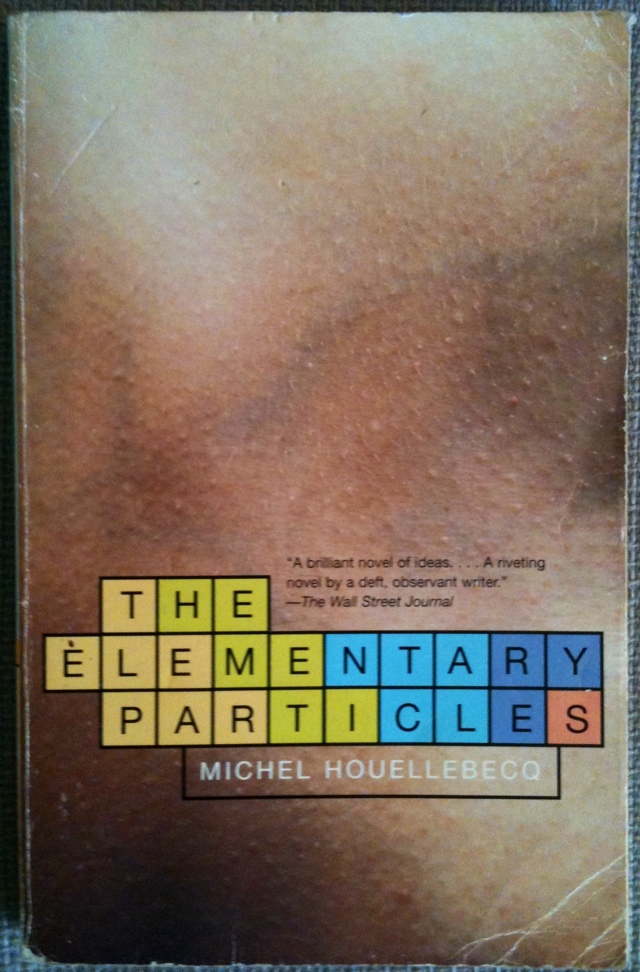
I have a little list I keep in my wallet. It’s ragged and rumpled, and some names are cribbed there in a meandering webby calligraphy that would prove to any team of forensic writing analysts that I cannot write by hand. Anyway, Michel Houllebecq (or, if we’re being honest, a bizarre corruption of that last name) has been on that list for a while—so I was happy to snap this one up. The cover is Ballardian, or maybe, more accurately, Cronenebergian (Cronenbergesque?). More forthcoming.
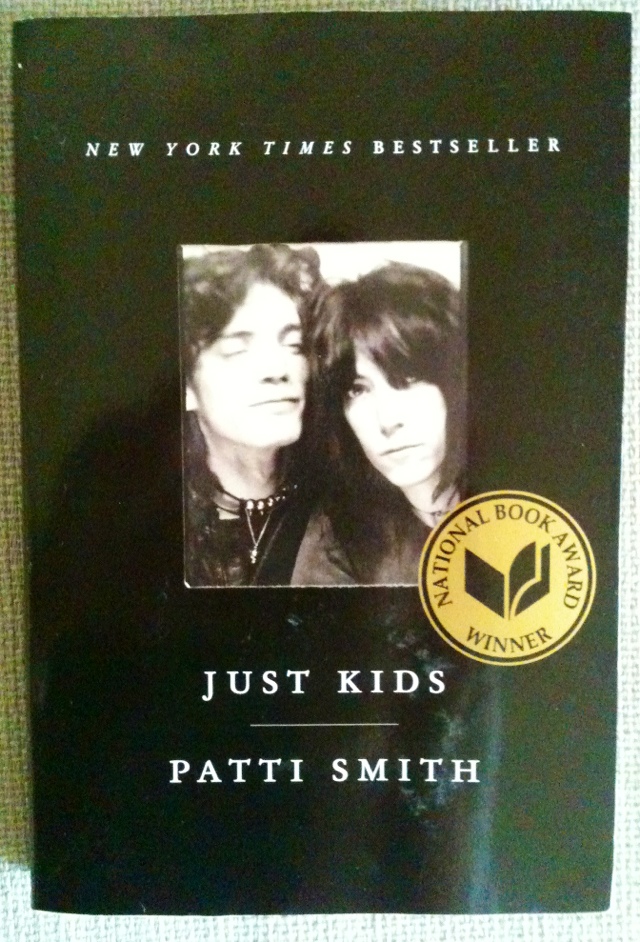
Just Kids: Patti Smith: Robert Mapplethorpe: I was looking under Biographies for Lillian Smith: found this: c’mon, you know this won the Nat’l BA: (or the sticker should tip you): will check out the fuss: extraneous colon: :
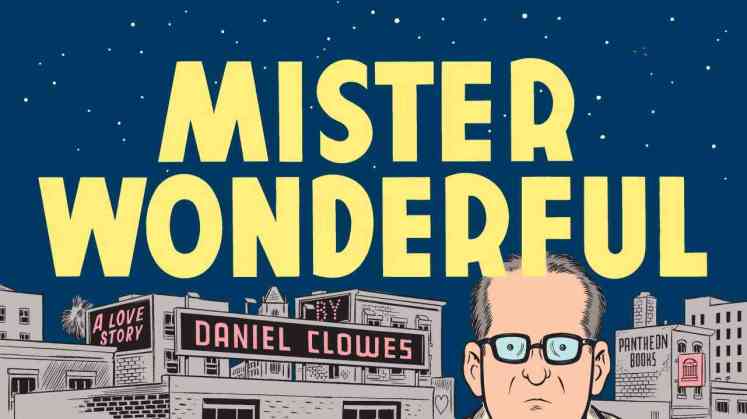
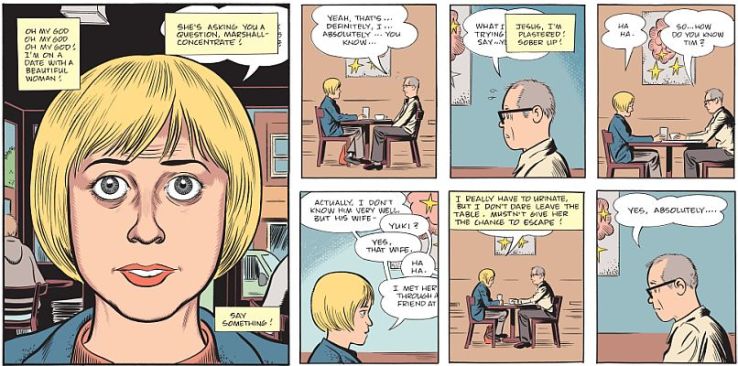
There’s an unexpected sweetness toMister Wonderful, the latest work from Daniel Clowes (new in hardback from Pantheon). Sure, we’re still deep in Clowes territory here, with misanthropic protagonist Marshall offering up acerbic observations on wealthy yuppies, phony poseurs, and jerks on cell phones—all shot through a lens of self-loathing—but Mister Wonderful (subtitled A Love Story) is optimistic, a study in possibility that never tips over the sheer cliff of despair on the other side of romanticism. With its sense of balance, both emotional and narrative, Mister Wonderful is in some way the “good twin” to last year’s Wilson, a work that pointed to the illusory nature of growth and the futility of human connection.
Where Wilson measured the life of its eponymous protagonist over decades (and in extreme hyperbole) as he sought to regain contact with his estranged family, Mister Wonderful covers just a few hours in the life of Marshall, a sad man set up on a blind date with nutty Natalie, a woman he immediately pegs as way out of his league. Marshall quickly romanticizes the possibility of a life with Natalie, struggling to keep his composure throughout their coffee and dinner date.
Natalie curtails the date to go to a party with old friends, but a surprise (violent) encounter allows Marshall a sliver of heroism—and a chance for more time with Natalie. They head to the party together, only to run into Natalie’s ex-boyfriend, giving Clowes plenty of oomph for a strong third act.
There’s a cinematic scope to Mister Wonderful. The book is 11″ x 6″, and Clowes makes excellent use of his Sunday’s comic page dimensions, exhibiting a level of detail and precision that imbue in Mister Wonderful an air of realism (one that contrasts the cartoony elements of evil twin Wilson). Clowes’s artistic powers are refined, balanced, and agile; he displays a command of color and shape that help define the strange emotional contours of Mister Wonderful, a book about second chances and those rare moments our interior lives might sync unexpectedly with the concrete possibilities life affords us.
Mister Wonderful is funny and balanced, but it’s not for everyone, including some longtime Clowes fans who might quibble with the book’s apparent slightness. Mister Wonderful clocks in at 80 pages, and while some readers may feel shortchanged, perhaps they are overlooking the scope of the work. Clowes is at the height of his powers here, deftly controlling a spare story about midlife tumult. There’s maturity and depth in this graphic novella. “Novella” isn’t the right term—Mister Wonderful is closer to a long short story, expertly told. Clowes still exhibits some of the sharp, mean edges that marked his earlier work, but the points are more finely honed, more subtle and precise. Some of the erratic weirdness we find in Clowes’s early stuff isn’t on display here, but this is more on account of Clowes’s stronger command of his medium’s formal elements. The bizarre, cynical spirit remains, however. Thankfully, Clowes makes no attempt to redeem his weirdos, nor does he push them into an unearned, false conclusion. Instead, Mr. Wonderful presents their problems and hang-ups and shortcomings as very real, even as it suggests a tint of unironic optimism. Recommended.
Mice live in our walls but do not trouble our kitchen. We are pleased but cannot understand why they do not come into our kitchen where we have traps set, as they come into the kitchens of our neighbors. Although we are pleased, we are also upset, because the mice behave as though there were something wrong with our kitchen. What makes this even more puzzling is that our house is much less tidy than the houses of our neighbors. There is more food lying about in our kitchen, more crumbs on the counters and filthy scraps of onion kicked against the base of the cabinets. In fact, there is so much loose food in the kitchen I can only think the mice themselves are defeated by it. In a tidy kitchen, it is a challenge for them to find enough food night after night to survive until spring. They patiently hunt and nibble hour after hour until they are satisfied. In our kitchen, however, they are faced with something so out of proportion to their experience that they cannot deal with it. They might venture out a few steps, but soon the overwhelming sights and smells drive them back into their holes, uncomfortable and embarrassed at not being able to scavenge as they should.
Mr Brain was a hermit dwarf who liked to eat shellfish off the moon. He liked to go into a tree then because there is a little height to see a little further, which may reveal now the stone, a pebble–it is a twig, it is nothing under the moon that you can make sure of.
So Mr Brain opened his mouth to let a moonbeam into his head.
Why to be alone, and you invite the stars to tea. A cup of tea drinks a luminous guest.
In the winter could you sit quietly by the window, in the evening when you could have vinegar and pretend it to be wine, because you would do well to eat doughnuts and pretend you drink wine as you sit quietly by the window. You may kick your leg back and forth. You may have a tendency to not want to look there too long and turn to find darkness in the room because it had become nighttime.
Why to be alone. You are pretty are you not/you are as pretty as you are not, or does that make sense.
You are not pretty, that is how you can be alone. And then you are pretty like fungus and alga, you are no one without some one, in theory alone.
Be good enough to go to bed so you can not think too much longer.
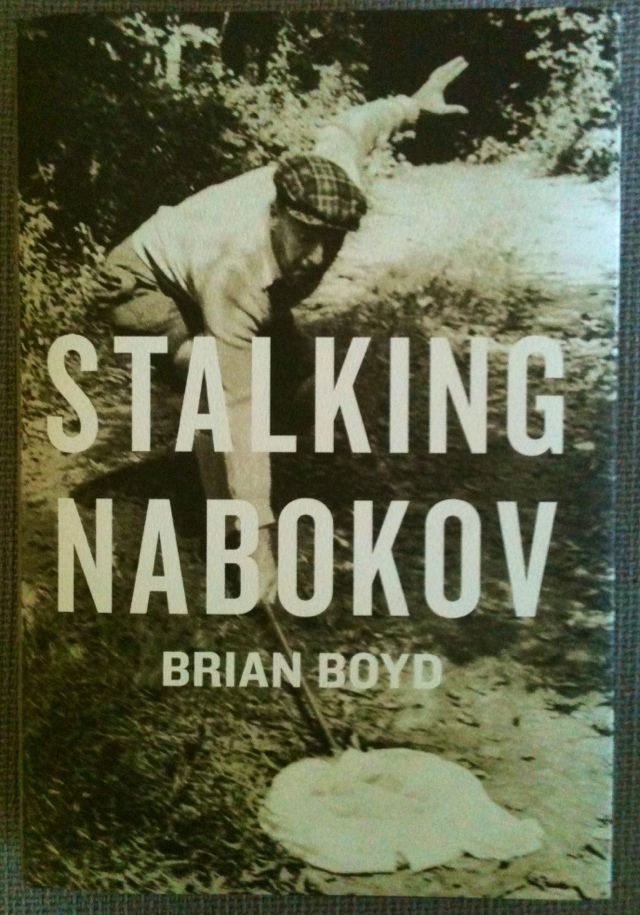
Stalking Nabokov by Brian Boyd. Publisher Columbia UP’s description—
At the age of twenty-one, Brian Boyd wrote a thesis on Vladimir Nabokov that the famous author called “brilliant.” After gaining exclusive access to the writer’s archives, he wrote a two-part, award-winning biography, Vladimir Nabokov: The Russian Years (1990) and Vladimir Nabokov: The American Years (1991). This collection features essays written by Boyd since completing the biography, incorporating material he gleaned from his research as well as new discoveries and formulations.
Boyd confronts Nabokov’s life, career, and legacy; his art, science, and thought; his subtle humor and puzzle-like storytelling; his complex psychological portraits; and his inheritance from, reworking of, and affinities with Shakespeare, Pushkin, Tolstoy, and Machado de Assis. Boyd offers new ways of reading Nabokov’s best English-language works: Lolita, Pale Fire, Ada, and the unparalleled autobiography, Speak, Memory, and he discloses otherwise unknown information about the author’s world. Sharing his personal reflections, Boyd recounts the adventures, hardships, and revelations of researching Nabokov’s biography and his unusual finds in the archives, including materials still awaiting publication. The first to focus on Nabokov’s metaphysics, Boyd cautions against their being used as the key to unlock all of the author’s secrets, showing instead the many other rooms in Nabokov’s castle of fiction that need exploring, such as his humor, narrative invention, and psychological insight into characters and readers alike. Appreciating Nabokov as novelist, memoirist, poet, translator, scientist, and individual, Boyd helps us understand more than ever the author’s multifaceted genius.


 I read Pastoralia, George Saunders’s 2000 collection of stories very quickly, consuming one or two of the book’s six stories a night, usually wedged between other readings. There was a flavor of respite to these readings, a sense of ease or relaxation or—dare I say it—simple pleasure. Frankly, I’m suspicious of any book that I’m able to read very quickly; perhaps I’m prejudiced against any book that doesn’t pose (or impose) its own learning curve on the reader.