When I had a house in Sri Lanka, my parents came out one winter to see me. Originally I had felt some qualms about encouraging their visit. Any one of several things–the constant heat, the unaccustomed food and drinking water, even the presence of a leprosy clinic a quarter of a mile from the house might easily have an adverse effect on them in one way or another. But I had underestimated their resilience; they made a greater show of adaptability than I had thought possible, and seemed entirely content with everything. They claimed not to mind the lack of running water in the bathrooms, and regularly praised the curries prepared by Appuhamy, the resident cook. Both of them being in their seventies, they were not tempted by the more distant or inaccessible points of interest. It was enough for them to stay around the house reading, sleeping, taking twilight dips in the ocean, and going on short trips along the coast by hired car. If the driver stopped unexpectedly at a shrine to sacrifice a coconut, they were delighted, and if they came upon a group of elephants lumbering along the road, the car had to be parked some distance up ahead, so that they could watch them approach and file past. They had no interest in taking photographs, and this spared me what is perhaps the most taxing duty of cicerone: the repeated waits while the ritual between man and machine is observed. They were ideal guests.
Colombo, where all the people I knew lives, was less than a hundred miles away. Several times we went up for weekends, which I arranged with friends by telephone beforehand. There we had tea on the wide verandas of certain houses in Cinnamon Gardens, and sat at dinners with professors from the university, Protestant ministers, and assorted members of the government. (Many of the Sinhalese found it strange that I should call my parents by their first names, Dodd and Hannah; several of them inquired if I were actually their son or had been adopted.) These weekends in the city were hot and exhausting, and they were always happy to get back to the house, where they could change into comfortable clothing.
One Sunday not long before they were due to return to America, we decided to take in the horse races at Gintota, where there are also some botanical gardens that Hannah wanted to see. I engaged rooms at the New Oriental in Galle and we had lunch there before setting out.
As usual, the events were late in starting. It was the spectators, in any case, who were the focus of interest. The phalanx of women in their shot-silk saris moved Hannah to cries of delight. The races themselves were something of a disappointment. As we left the grounds, Dodd said with satisfaction: It’ll be good to get back to the hotel and relax.
The reason the Dead do not return nowadays is the boredom of it.
In the old time they would come casually, as suited them, without fuss and thinly, as it were, which is their nature; but when such visits were doubted even by those who received them and when new and false names were given them the Dead did not find it worth while. It was always a trouble; they did it really more for our sakes than for theirs and they would be recognised or stay where they were.
I am not certain that they might not have changed with the times and come frankly and positively, as some urged them to do, had it not been for Rabelais’ failure towards the end of the Boer war. Rabelais (it will be remembered) appeared in London at the very beginning of the season in 1902. Everybody knows one part of the story or another, but if I put down the gist of it here I shall be of service, for very few people have got it quite right all through, and yet that story alone can explain why one cannot get the dead to come back at all now even in the old doubtful way they did in the ’80’s and early ’90’s of the last century.
There is a place in heaven where a group of writers have put up a colonnade on a little hill looking south over the plains. There are thrones there with the names of the owners on them. It is a sort of Club.
Rabelais was quarrelling with some fool who had missed fire with a medium and was saying that the modern world wanted positive unmistakable appearances: he said he ought to know, because he had begun the modern world. Lucian said it would fail just as much as any other way; Rabelais hotly said it wouldn’t. He said he would come to London and lecture at the London School of Economics and establish a good solid objective relationship between the two worlds. Lucian said it would end badly. Rabelais, who had been drinking, lost his temper and did at once what he had only been boasting he would do. He materialised at some expense, and he announced his lecture. Then the trouble began, and I am honestly of opinion that if we had treated the experiment more decently we should not have this recent reluctance on the part of the Dead to pay us reasonable attention.
In the first place, when it was announced that Rabelais had returned to life and was about to deliver a lecture at the London School of Economics, Mrs. Whirtle, who was a learned woman, with a well-deserved reputation in the field of objective psychology, called it a rumour and discredited it (in a public lecture) on these three grounds:
(a) That Rabelais being dead so long ago would not come back to life now.
(b) That even if he did come back to life it was quite out of his habit to give lectures.
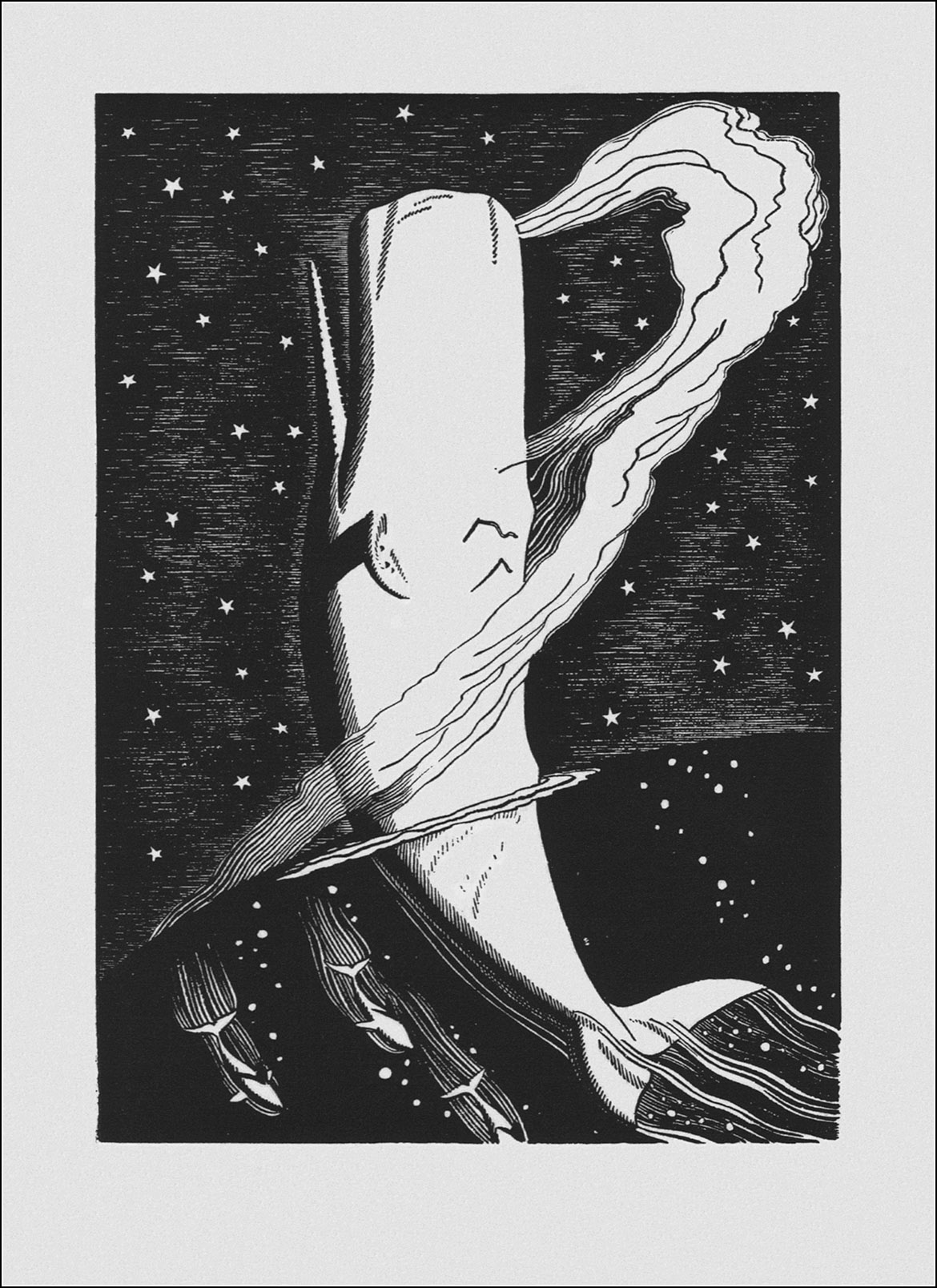
Moby-Dick, Rockwell KentI am a huge fan of audiobooks. I’ve pretty much always got one going—for commutes, jogs, workaday chores, etc. The usual. I love to listen to audiobooks of books I’ve already read, in particular, but I of course listen to new stuff too, or stuff that’s new to me, anyway. There just isn’t time to get to all the reading and rereading I want to do otherwise.
Beyond the fact that audiobooks allow me to experience more books than I would be able to otherwise, I like the medium itself: I like a reader reading me a story. Like a lot of people, some of my earliest, best memories are of someone reading to me. (The narrative in my family was always that my mother fell asleep while reading me The Lion, the Witch and the Wardrobe and that I picked it up and finished it on my own and that’s how I “learned” to read—I’m not really sure of this tale’s veracity, which makes it a good story, of course). So I’ve never fully understood folks who sniff their noses at audiobooks as less than real reading.
Indeed, the best literature is best read aloud. It is for the ear, as William H. Gass puts it in his marvelous essay “The Sentence Seeks Its Form”:
Breath (pneuma) has always been seen as a sign of life . . . Language is speech before it is anything. It is born of babble and shaped by imitating other sounds. It therefore must be listened to while it is being written. So the next time someone asks you that stupid question, “Who is your audience?” or “Whom do you write for?” you can answer, “The ear.” I don’t just read Henry James; I hear him. . . . The writer must be a musician—accordingly. Look at what you’ve written, but later … at your leisure. First—listen. Listen to Joyce, to Woolf, to Faulkner, to Melville.
Joyce, Woolf, Faulkner, Melville—a difficult foursome, no? I would argue that the finest audiobooks—those with the most perceptive performers (often guided by a great director and/or producer) can guide an auditor’s ear from sound to sense to spirit. A great audiobook can channel the pneuma of a complex and so-called difficult novel by animating it, channeling its life force. The very best audiobooks can teach their auditors how to read the novels—how to hear and feel their spirit.
I shall follow (with one slight deviation, substituting one William for another) Gass’s foursome by way of example. Joyce initiates his list, so:
I had read Joyce’s Ulysses twice before I first experience RTÉ’s 1982 dramatized, soundtracked, sound-effected, full cast recording of the novel (download it via that link). I wrote about the Irish broadcast company’s production at length when I first heard it, but briefly: This is a full cast of voices bringing the bustle and energy (and torpor and solemnity and ecstasy and etc.) of Bloomsday to vivid vivacious vivifying life. It’s not just that RTÉ’s cast captures the tone of Ulysses—all its brains and hearts, its howls and its harrumphs—it’s also that this production masterfully expresses the pace and the rhythm of Ulysses. Readers (unnecessarily) daunted by Ulysses’s reputation should consider reading the book in tandem with RTÉ’s production.
Woolf is next on Gass’s list. Orlando is my favorite book of hers, although I have been told by scholars and others that it is not as serious or important as To the Lighthouse or Mrs. Dalloway. It is probably not as “difficult” either; nevertheless, put it on the list! Clare Higgins’s reading of Orlando remains one of my favorite audiobooks of all times: arch without being glib, Higgins animates the novel with a picaresque force that subtly highlights the novel’s wonderful absurdities.
Faulkner…well, did you recall that I admitted I would not keep complete faith to Gass’s short list? Certainly Faulkner’s long twisted sentences evoke their own mossy music, but alas, I’ve yet to find an audiobook with a reader whose take on Faulkner I could tolerate. I tried Grover Gardner’s take on Absalom, Absalom! but alas!—our reader often took pains to untangle what was properly tangled. I don’t know. I was similarly disappointed in an audiobook of The Sound and the Fury (I don’t recall the reader). And yet I’m sure Faulkner could be translated into a marvelous audiobook (Apprise me, apprise me!).
Let me substitute another difficult William: Gaddis. I don’t know if I could’ve cracked J R if I hadn’t first read it in tandem with Nick Sullivan’s audiobook. J R is a tragicomic opera of voices—unattributed voices!—and it would be easy to quickly lose heart without signposts to guide you. Sullivan’s reading is frankly amazing, a baroque, wild, hilarious, and ultimately quite moving performance of what may be the most important American novel of the late twentieth century. A recent reread of J R was almost breezy; Sullivan had taught me how to read it.
Mighty Melville caps Gass’s list. I had read Moby-Dick a number of times, studying it under at least two excellent teachers, before I first heard William Hootkins read it. (Hootkins, a character actor, is probably most well-known as the X-wing pilot Porkins in A New Hope). As a younger reader, I struggled with Moby-Dick, even as it intrigued me. I did not, however, understand just how funny it was, and even though I intuited its humor later in life, I didn’t fully experience it until Hootkins’ reading. Hootkins inhabits Ishmael with a dynamic, goodwilled aplomb, but where his reading really excels is in handling the novel’s narrative macroscopic shifts, as Ishmael’s ego seems to fold into the crew/chorus, and dark Ahab takes over at times. But not just Ahab—Hootkins embodies Starbuck, Flask, and Stubb with humor and pathos. Hootkins breaths spirit into Melville’s music. I cannot overstate how much I recommend Hootkins audiobook, particularly for readers new to Moby-Dick. And readers old to Moby-Dick too.
“What can we do to find out how writing is written? Why, we listen to writers who have written well,” advises (or scolds, if you like) William Gass. The best audiobook performances of difficult books don’t merely provide shortcuts to understanding those books—rather, they teach auditors how to hear them, how to feel them, how to read them.
I got a lovely email, with the subject line “Audiobooks,” a few weeks ago from a guy named Ben. Basically, he asked me to do a post on some of my favorite audiobooks, which I suppose I could’ve done fairly easy as a list (and which, yes, if you want to drop down, I will list below, oh-so-non-definitively)—but after thinking about his question, I thought I might break the post up into a couple of posts on audiobooks in general—the excellent ones, the average ones, the terrible ones afflicted by readers who misread the material; the audiobooks I’m auditing now/recently; childhood favorites (on vinyl!); hell, maybe even a totally pretentious post called “How to listen to audiobooks” or some such garbage.
Before I go on though, let me share Ben’s email (he gave me his permission), which is mostly a marvelous anecdote about Álvaro Mutis’s Maqroll novellas:
After reading your post on The Adventures and Misadventures of Maqroll, I immediately ordered the book and read it with my father as we travelled through Borneo, passing it back and forth every dozen pages. The reading became even more significant as we reached the passage in which Maqroll is laid up sick in Northridge, California, in an area surrounded by orange groves. This area is where my father spent his childhood. Reading Maqroll with my father on that trip stands as my most meaningful reading experience. I thank you for putting us onto that book.
Have you done a post yet on your favorite audiobooks? I’d like to get your recommendations. I recall you mentioning a few in previous posts, but could not track them down. Keep at it.
Ben’s Maqroll story surely deserves a response in full, fleshed out detail, and my next post will discuss in detail why I praise the following audio productions. But for now a list (sans, alas, Álvaro Mutis: our Gaviero Maqroll has not found his way into an audiobook yet, at least to my knowledge).
In no real order, and by no means definitive, a list of eight perfect or near-perfect audiobooks:
October 3rd. — A strange occurrence has taken place today. I got up fairly late, and when Mawra brought me my clean boots, I asked her how late it was. When I heard it had long struck ten, I dressed as quickly as possible.
To tell the truth, I would rather not have gone to the office at all today, for I know beforehand that our department-chief will look as sour as vinegar. For some time past he has been in the habit of saying to me, “Look here, my friend; there is something wrong with your head. You often rush about as though you were possessed. Then you make such confused abstracts of the documents that the devil himself cannot make them out; you write the title without any capital letters, and add neither the date nor the docket-number.” The long-legged scoundrel! He is certainly envious of me, because I sit in the director’s work-room, and mend His Excellency’s pens. In a word, I should not have gone to the office if I had not hoped to meet the accountant, and perhaps squeeze a little advance out of this skinflint.
A terrible man, this accountant! As for his advancing one’s salary once in a way — you might sooner expect the skies to fall. You may beg and beseech him, and be on the very verge of ruin — this grey devil won’t budge an inch. At the same time, his own cook at home, as all the world knows, boxes his ears.
I really don’t see what good one gets by serving in our department. There are no plums there. In the fiscal and judicial offices it is quite different. There some ungainly fellow sits in a corner and writes and writes; he has such a shabby coat and such an ugly mug that one would like to spit on both of them. But you should see what a splendid country-house he has rented. He would not condescend to accept a gilt porcelain cup as a present. “You can give that to your family doctor,” he would say. Nothing less than a pair of chestnut horses, a fine carriage, or a beaver-fur coat worth three hundred roubles would be good enough for him. And yet he seems so mild and quiet, and asks so amiably, “Please lend me your penknife; I wish to mend my pen.” Nevertheless, he knows how to scarify a petitioner till he has hardly a whole stitch left on his body. Continue reading ““Memoirs of a Madman” — Nikolai Gogol”→
Dictionaries are supposed to influence usage. Usage is what dictionaries record. “This is what we have meant,” they say; “continue in the same vein so that communication will be accurate, reliable, and fluent.” Then the next dictionary will record that fidelity, and issue the same command, which will complete the cycle. Among users, however, there are many who are incompetent, inventive, or disobedient. The French Academy tries to drive strays back into the herd. English has no comparable guardian and its speakers lack every discipline. Soon meanings have multiplied or slid or mushed, and niceties—delicate distinctions—lost along the way. In this haphazard fashion, influence has come to mean a kind of causality that operates only through the agency of a consciousness. Where this puts the stars, I’m not sure. Because of smog or city glare, we often don’t even know the stars are there.
From: William H. Gass’s essay “Influence.” Collected in A Temple of Texts.
From The Heritage Press collection The Short Stories of Oscar Wilde (1968), featuring paintings by James Hill.
“The Star-Child”
by
Oscar Wilde
Once upon a time two poor Woodcutters were making their way home through a great pine-forest. It was winter, and a night of bitter cold. The snow lay thick upon the ground, and upon the branches of the trees: the frost kept snapping the little twigs on either side of them, as they passed: and when they came to the Mountain-Torrent she was hanging motionless in air, for the Ice-King had kissed her.
So cold was it that even the animals and the birds did not know what to make of it.
‘Ugh!’ snarled the Wolf, as he limped through the brushwood with his tail between his legs, ‘this is perfectly monstrous weather. Why doesn’t the Government look to it?’
‘Weet! weet! weet!’ twittered the green Linnets, ‘the old Earth is dead and they have laid her out in her white shroud.’
Vladimir Nabokov’s recipe for eggs (à la Nabocoque, natch)–
Boil water in a saucepan (bubbles mean it is boiling!). Take two eggs (for one person) out of the refrigerator. Hold them under the hot tap water to make them ready for what awaits them.
Place each in a pan, one after the other, and let them slip soundlessly into the (boiling) water. Consult your wristwatch. Stand over them with a spoon preventing them (they are apt to roll) from knocking against the damned side of the pan.
If, however, an egg cracks in the water (now bubbling like mad) and starts to disgorge a cloud of white stuff like a medium in an oldfashioned seance, fish it out and throw it away. Take another and be more careful.
After 200 seconds have passed, or, say, 240 (taking interruptions into account), start scooping the eggs out. Place them, round end up, in two egg cups. With a small spoon tap-tap in a circle and hen pry open the lid of the shell. Have some salt and buttered bread (white) ready. Eat.
I KNOW what they said. They said I didn’t run away from home but that I was tolled away by a crazy man who, if I hadn’t killed him first, would have killed me inside another week. But if they had said that the women, the good women in Jefferson had driven Uncle Willy out of town and I followed him and did what I did because I knew that Uncle Willy was on his last go-round and this time when they got him again it would be for good and forever, they would have been right. Because I wasn’t tolled away and Uncle Willy wasn’t crazy, not even after all they had done to him. I didn’t have to go; I didn’t have to go any more than Uncle Willy had to invite me instead of just taking it for granted that I wanted to come. I went because Uncle Willy was the finest man I ever knew, because even women couldn’t beat him, because in spite of them he wound up his life getting fun out of being alive and he died doing the thing that was the most fun of all because I was there to help him. And that’s something that most men and even most women too don’t get to do, not even the women that call meddling with other folks’ lives fun.
He wasn’t anybody’s uncle, but all of us, and grown people too, called him (or thought of him) as Uncle Willy. He didn’t have any kin at all except a sister in Texas married to an oil millionaire. He lived by himself in a little old neat white house where he had been born on the edge of town, he and an old nigger named Job Wylie that was older than he was even, that cooked and kept the house and was the porter at the drugstore which Uncle Willy’s father had established and which Uncle Willy ran without any other help than old Job; and during the twelve or fourteen years (the life of us as children and then boys), while he just used dope, we saw a lot of him. We liked to go to his store because it was always cool and dim and quiet inside because he never washed the windows; he said the reason was that he never had to bother to dress them because nobody could see in anyway, and so the heat couldn’t get in either. And he never had any customers except country people buying patent medicines that were already in bottles, and niggers buying cards and dice, because nobody had let him fill a prescription in forty years I reckon, and he never had any soda fountain trade because it was old Job who washed the glasses and mixed the syrups and made the ice cream ever since Uncle Willy’s father started the business in eighteen-fifty-something and so old Job couldn’t see very well now, though papa said he didn’t think that old Job took dope too, it was from breathing day and night the air which Uncle Willy had just exhaled.
But the ice cream tasted all right to us, especially when we came in hot from the ball games. We had a league of three teams in town and Uncle Willy would give the prize, a ball or a bat or a mask, for each game though he would never come to see us play, so after the game both teams and maybe all three would go to the store to watch the winner get the prize. And we would eat the ice cream and then we would all go behind the prescription case and watch Uncle Willy light the little alcohol stove and fill the needle and roll his sleeve up over the little blue myriad punctures starting at his elbow and going right on up into his shirt. And the next day would be Sunday and we would wait in our yards and fall in with him as he passed from house to house and go on to Sunday school, Uncle Willy with us, in the same class with us, sitting there while we recited. Mr. Barbour from the Sunday school never called on him.
Then we would finish the lesson and we would talk about baseball until the bell rang and Uncle Willy still not saying anything, just sitting there all neat and clean, with his clean collar and no tie and weighing about a hundred and ten pounds and his eyes behind his glasses kind of all run together like broken eggs. Then we would all go to the store and eat the ice cream that was left over from Saturday and then go behind the prescription case and watch him again: the little stove and his Sunday shirt rolled up and the needle going slow into his blue arm and somebody would say, “Don’t it hurt?” and he would say, “No. I like it.”
Gaddis’s cut-and-paste technique evinces in J R, particularly in the authorial stand-in Jack Gibbs, who muddles about with scraps of ideas in his pockets—scraps that perhaps eventually become (a version of) Gaddis’s last novel Agapē Agape.
I wrote about Agapē Agapehere and a recent rereading of J Rhere.
An intelligence without integrity (a condition so often found in people of public life) is likely to succumb to the blandishments of ideology; otherwise, the mind’s inherent skepticism will guarantee its safety from superstition and other forms of sugary conjecture. Socrates knew nothing really awful could happen to him if he kept his mind free of unwarranted opinions. True strength, throughout its spectrum, shows itself through unflustered gentleness and forbearance, since only such strength has nothing to fear. The con man succeeds by exploiting the greed of his marks and is often reluctantly admired because wit is on his side, as well as discipline. His cynicism is just good sense and his nose for moral weakness is like the dowser’s wand for water. Similarly, when ill-formed or palpably false ideas make their way through the multitude, it is because the comforts they bring are so ardently desired.If you enjoy the opinions you possess, if they give you a glow, be suspicious. They may be possessing you. An opinion should be treated like a guest who is likely to stay too late and drink all the whiskey.
Plato treated poetic inspiration as a case of such irrational infection: The gods bypass sober skill to make the pen prophetic so that the resulting poem, recited by a rhapsode similarly tranced, becomes an incitement to the mob. Or an unconscious wish, sneaky as an odor, enters the author’s awareness disguised as its opposite, and arranges the stage for a coup d’éclat. Thus the magnetic coil is closed: muse to poet, poet to page, page to performer, and performer to audience, whose applause pleases the muse, encourages the poet, and grants his forbidden desire: to rule.
From William H. Gass’s essay influence. Collected in A Temple of Texts.
On pages 611-613 of James Joyce’s Finnegans Wake, St. Patrick meets the archdruid Balkelly:
Tunc. Bymeby, bullocky vampas tappany bobs topside joss pidgin fella Balkelly, archdruid of islish chinchinjoss in the his heptachromatic sevenhued septicoloured roranyellgreenlindigan mantle finish he show along the his mister guest Patholic with alb belongahim the whose throat hum with of sametime all the his cassock groaner fellas of greysfriaryfamily he fast all time what time all him monkafellas with Same Patholic, quoniam, speeching, yeh not speeching noh man liberty is, he drink up words, scilicet, tomorrow till recover will not, all too many much illusiones through photoprismic velamina of hueful panepiphanal world spectacurum of Lord Joss, the of which zoantholitic furniture, from mineral through vegetal to animal, not appear to full up to-gether fallen man than under but one photoreflection of the several iridals gradationes of solar light, that one which that part of it (furnit of heupanepi world) had shown itself (part of fur of huepanwor) unable to absorbere, whereas for numpa one pura —— duxed seer in seventh degree of wisdom of Entis–Onton he savvy inside true inwardness of reality, the Ding hvad in idself id est, all objects (of panepiwor) allside showed themselves in trues coloribus resplendent with sextuple gloria of light actually re-tained, untisintus, inside them (obs of epiwo). Rumnant Patholic, stareotypopticus, no catch all that preachybook, utpiam, tomorrow recover thing even is not, bymeby vampsybobsy tap — panasbullocks topside joss pidginfella Bilkilly–Belkelly say pat — fella, ontesantes, twotime hemhaltshealing, with other words verbigratiagrading from murmurulentous till stridulocelerious in a hunghoranghoangoly tsinglontseng while his comprehen-durient, with diminishing claractinism, augumentationed himself in caloripeia to vision so throughsighty, you anxioust melan-cholic, High Thats Hight Uberking Leary his fiery grassbelong- head all show colour of sorrelwood herbgreen, again, nigger- blonker, of the his essixcoloured holmgrewnworsteds costume the his fellow saffron pettikilt look same hue of boiled spinasses,other thing, voluntary mutismuser, he not compyhandy the his golden twobreasttorc look justsamelike curlicabbis, moreafter, to pace negativisticists, verdant readyrainroof belongahim Exuber High Ober King Leary very dead, what he wish to say, spit of superexuberabundancy plenty laurel leaves, after that com-mander bulopent eyes of Most Highest Ardreetsar King same thing like thyme choppy upon parsley, alongsidethat, if please-sir, nos displace tauttung, sowlofabishospastored, enamel Indian gem in maledictive fingerfondler of High High Siresultan Em-peror all same like one fellow olive lentil, onthelongsidethat, by undesendas, kirikirikiring, violaceous warwon contusiones of facebuts of Highup Big Cockywocky Sublissimime Autocrat, for that with pure hueglut intensely saturated one, tinged uniformly, allaroundside upinandoutdown, very like you seecut chowchow of plentymuch sennacassia Hump cumps Ebblybally! Sukkot?
Punc. Bigseer, refrects the petty padre, whackling it out, a tumble to take, tripeness to call thing and to call if say is good while, you pore shiroskuro blackinwhitepaddynger, by thiswis aposterioprismically apatstrophied and paralogically periparo-lysed, celestial from principalest of Iro’s Irismans ruinboon pot before, (for beingtime monkblinkers timeblinged completamen-tarily murkblankered in their neutrolysis between the possible viriditude of the sager and the probable eruberuption of the saint), as My tappropinquish to Me wipenmeselps gnosegates a handcaughtscheaf of synthetic shammyrag to hims hers, seeming-such four three two agreement cause heart to be might, saving to Balenoarch (he kneeleths), to Great Balenoarch (he kneeleths down) to Greatest Great Balenoarch (he kneeleths down quite-somely), the sound salse sympol in a weedwayedwold of the firethere the sun in his halo cast. Onmen.
That was thing, bygotter, the thing, bogcotton, the very thing, begad! Even to uptoputty Bilkilly–Belkelly-Balkally. Who was for shouting down the shatton on the lamp of Jeeshees. Sweating on to stonker and throw his seven. As he shuck his thumping fore features apt the hoyhop of His Ards.
Thud.
Good safe firelamp! hailed the heliots. Goldselforelump! Halled they. Awed. Where thereon the skyfold high, trampa-trampatramp. Adie. Per ye comdoom doominoom noonstroom. Yeasome priestomes. Fullyhum toowhoom.
It seems very straightforward when I say “I.” At the time, “I” meant Justice of Toren, the whole ship and all its ancillaries. A unit might be very focused on what it was doing at that particular moment, but it was no more apart from “me” than my hand is while it’s engaged in a task that doesn’t require my full attention. Nearly twenty years later “I” would be a single body, a single brain.
That division, I–Justice of Toren and I–One Esk, was not, I have come to think, a sudden split, not an instant before which “I” was one and after which “I” was “we.” It was something that had always been possible, always potential. Guarded against. But how did it go from potential to real, incontrovertible, irrevocable?
On one level the answer is simple—it happened when all of Justice of Toren but me was destroyed. But when I look closer I seem to see cracks everywhere. Did the singing contribute, the thing that made One Esk different from all other units on the ship, indeed in the fleets? Perhaps. Or is anyone’s identity a matter of fragments held together by convenient or useful narrative, that in ordinary circumstances never reveals itself as a fiction? Or is it really a fiction?
I don’t know the answer. But I do know that, though I can see hints of the potential split going back a thousand years or more, that’s only hindsight. The first I noticed even the bare possibility that I–Justice of Toren might not also be I–One Esk, was that moment that Justice of Toren edited One Esk’s memory of the slaughter in the temple of Ikkt. The moment I—“I”—was surprised by it.
It makes the history hard to convey. Because still, “I” was me, unitary, one thing, and yet I acted against myself, contrary to my interests and desires, sometimes secretly, deceiving myself as to what I knew and did. And it’s difficult for me even now to know who performed what actions, or knew which information. Because I was Justice of Toren. Even when I wasn’t. Even if I’m not anymore.
A longish passage from Ann Leckie’s novel Ancillary Justice. I’ve put the language that particularly interests me in boldface, but I think the language around it should pique as much interest as any blurb.
I checked out the audiobook on the recommendation of the novelist Adam Novy. Ancillary Justice won like all the sci-fi awards a few years ago so you may know about it (I don’t read enough contemporary fiction in general, so it wasn’t really on my radar). The book is a fun, baroque space opera, a critique of imperial politics, and a headfuck for anyone addicted to gendered pronouns. Justice of Toren is a spaceship, by the way.
At last, about ten o’clock at night, I came to the doorway of the fine house where I was invited to spend the evening, after the man beside me, whom I was barely acquainted with and who had once again thrust himself unasked upon me, had marched me for two long hours around the streets.
“Well!” I said, and clapped my hands to show that I really had to bid him goodbye. I had already made several less explicit attempts to get rid of him. I was tired out.
“Are you going straight in?” he asked. I heard a sound in his mouth that was like the snapping of teeth.
“Yes.”
I had been invited out, I told him when I met him. But it was to enter a house where I longed to be that I had been invited, not to stand here at the street door looking past the ears of the man before me. Nor to fall silent with him, as if we were doomed to stay for a long time on this spot. And yet the houses around us at once took a share in our silence, and the darkness over them, all the way up to the stars. And the steps of invisible passers-by, which one could not take the trouble to elucidate, and the wind persistently buffeting the other side of the street, and a gramophone singing behind the closed windows of some room-they all announced themselves in this silence, as if it were their own possession for the time past and to come.
And my companion subscribed to it in his own name and–with a smile–in mine too, stretched his right arm up along the wall and leaned his cheek upon it, shutting his eyes.
But I did not wait to see the end of that smile, for shame suddenly caught hold of me. It had needed that smile to let me know that the man was a confidence trickster, nothing else. And yet I had been months in the town and thought I knew all about confidence tricksters, how they came slinking out of side streets by night to meet us with outstretched hands like tavernkeepers, how they haunted the advertisement pillars we stood beside, sliding round them as if playing hide-and-seek and spying on us with at least one eye, how they suddenly appeared on the curb of the pavement at cross streets when we were hesitating! I understood them so well, they were the first acquaintances I had made the town’s small taverns, and to them I owed my first inkling of a ruthless hardness which I was now so conscious of, everywhere on earth, that I was even beginning to feel it in myself. How persistently they blocked our way, even when we had long shaken ourselves free, even when, that is, they had nothing more to hope for! How they refused to give up, to admit defeat, but kept shooting glances at us that even from a distance were still compelling! And the means they employed were always the same: they planted themselves before us, looking as large as possible, tried to hinder us from going where we purposed, offered us instead a habitation in their own bosoms, and when at last all our balked feelings rose in revolt they welcomed that like an embrace into which they threw themselves face foremost.
And it had taken me such a long time in this man’s company to recognize the same old game. I rubbed my finger tips together to wipe away the disgrace. My companion was still leaning there as before, still believing himself a successful trickster, and his self-complacency glowed pink on his free cheek.
“Caught in the act!” said I, tapping him lightly on the shoulder. Then I ran up the steps, and the disinterested devotion on the servants’ faces in the hall delighted me like an unexpected treat. I looked at them all, one after another, while they took my greatcoat off and wiped my shoes clean.
With a deep breath of relief and straightening myself to my full height I then entered the drawing room.




,_Volume_1,_Songs_of_Experience_-_Holy_Thursday.png)


 Biblioklept