Read Gertrude Stein’s prose poem “Miss Furr and Miss Keene”

“Miss Furr and Miss Keene”

by

Gertrude Stein

from

Geography and Plays (1922)


Helen Furr had quite a pleasant home. Mrs. Furr was quite a pleasant woman. Mr. Furr was quite a pleasant man. Helen Furr had quite a pleasant voice a voice quite worth cultivating. She did not mind working. She worked to cultivate her voice. She did not find it gay living in the same place where she had always been living. She went to a place where some were cultivating something, voices and other things needing cultivating. She met Georgine Skeene there who was cultivating her voice which some thought was quite a pleasant one. Helen Furr and Georgine Skeene lived together then. Georgine Skeene liked travelling. Helen Furr did not care about travelling, she liked to stay in one place and be gay there. They were together then and travelled to another place and stayed there and were gay there.

They stayed there and were gay there, not very gay there, just gay there. They were both gay there, they were regularly working there both of them cultivating their voices there, they were both gay there. Georgine Skeene was gay there and she was regular, regular in being gay, regular in not being gay, regular in being a gay one who was one not being gay longer than was needed to be one being quite a gay one. They were both gay then there and both working there then.

They were in a way both gay there where there were many cultivating something. They were both regular in being gay there. Helen Furr was gay there, she was gayer and gayer there and really she was just gay there, she was gayer and gayer there, that is to say she found ways of being gay there that she was using in being gay there. She was gay there, not gayer and gayer, just gay there, that is to say she was not gayer by using the things she found there that were gay things, she was gay there, always she was gay there.

They were quite regularly gay there, Helen Furr and Georgine Skeene, they were regularly gay there where they were gay. They were very regularly gay. Continue reading “Read Gertrude Stein’s prose poem “Miss Furr and Miss Keene””

Big power laying still somewhere in the dark (Faulkner)

I be dog if hit don’t look like sometimes that when a fellow sets out to play a joke, hit ain’t another fellow he’s playing that joke on; hit’s a kind of big power laying still somewhere in the dark that he sets out to prank with without knowing hit, and hit all depends on whether that ere power is in the notion to take a joke or not, whether or not hit blows up right in his face like this one did in mine.

I just read William Faulkner’s “A Bear Hunt” for the first time in years…like most of Faulkner’s stuff, there’s a second narrative (or even third or fourth) going on under the surface tale. In the case of “A Bear Hunt,” the surface tale is about a man whose unrelenting hiccups are ruining a hunting party. The underlying plot revolves around race and revenge and human dignity. I love the citation above, which suggests that pranking one’s fellows is in some ways a gesture of cosmic impotence. The story is pretty easy to find online.

William Gaddis’s J R (A short riff on a long book)

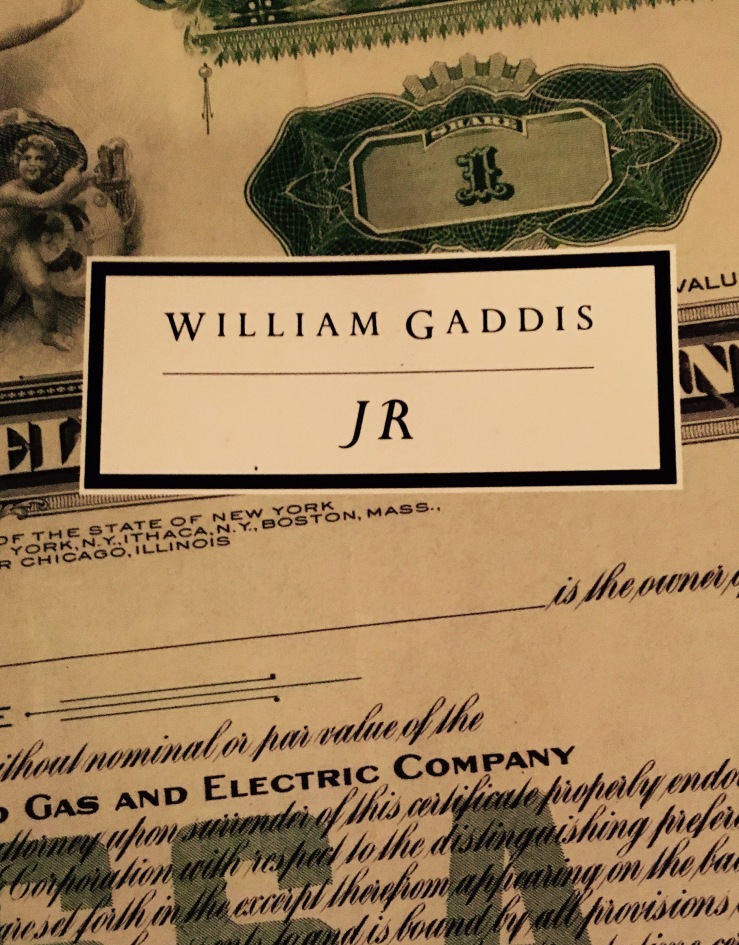
img_1659

1.

I reread William Gaddis’s 1975 novel J R this February and, as is usually the case with a reread, I was pleasantly unsurprised by all its unremembered surprises—the jokes and japes, riffs and routines that had oozed from my brain-sieve since that first read back in 2012.

How could I forget about a scheme to freeze sound, or an art theft subplot, or the Indian uprising? How could I forget that in J R, Gaddis anagrammatically parodies the critical rejections of his first novel The Recognitions? (I did remember the stuffed Eskimo).

2.

What I was surprised surprised surprised about in my rereading of J R was how much of the first reading had stuck. And stuck hard, soaked in, saturated—the sign of a great grand thing, the em-word thing, the masterpiece thing.

3.

Only a handful of novels are so perfectly simultaneously comic and tragic. Moby-Dick? Yes. Gravity’s Rainbow? Absolutely. (G R and J R, a duo published two years apart, spiritual twins, massive American novels that maybe America hardly deserves (or, rather: theses novels were/are totally the critique America deserves). I guess maybe what I’m saying is J  R is the Great American Novel to Come (The Recognitions is perhaps overpraised and certainly not Gaddis’s best novel; J R is. The zeitgeist has been caught up to J R, the culture should (will) catch up).

4.

So I already wrote on J R on this blog: A misfire of sorts from halfway through (in which I offer more description of the novel’s plot and form than I intend to here, maybe), and a thing I wrote after finishing it which (this thing I wrote before, I mean) might be better than anything I can muster here, in terms of analysis, of like, theme. I’ll limit myself to, I don’t know, eleven points in this riff, yes? (Why 11? Why not? Why not go to 11? 11 for Chapter 11, for bankruptcy, for the moral artistic intellectual bankruptcy that the novel J R skewers). So, having limited myself to eleven points, and having not gotten to the damn point yet, which is—

5.

J R is so good, y’all. The book is a performance, an opera, an essay on America, a howl, a condemnation, a farce, a romance, a tragedy. When I read it in 2012 I couldn’t believe how prescient it was, a feeling reconfirmed with force four years later. J R diagnoses and describes and ridicules American corporatism, the industrial-military-entertainment-banking-education-etc. -complex. And then it weeps.

6.

But wait—what I wanted to say is J R is so good—so, uh, entertaining. It’s fucking funny. And sweet.

7.

(And bitter).

8.

And J R’s not as hard a read as some dudes would have you believe. Sure, it’s composed almost entirely in unattributed dialogue—and that can be tough, to start, but you can learn to hear it very quickly.

In his essay “William Gaddis and His Goddamn Books,” William Gass writes that, “J R takes time. J R takes patience. J R takes faith.” But Gass also points out the payoff of J R “unlike other faiths…is immediately and continuously redeeming.”

It is redeeming (continuously), and I don’t just echo Gass here as some kind of rhetorical flourish—reading J R again was a reminder that the novel posits redemption through Bast’s call to action, to his resolve to, as the failed writer (or stymied writer) Eigen puts it, “go do what [he has] to do” to make real art—or, in our hero Bast’s own terms: “…until a performer hears what I hear and can make other people hear what hears it’s just trash isn’t it…”

9.

And in J R the reader becomes the performer, making the voices, singing the voices, (muttering the voices), navigating all the trash, the entropy—J R is a novel of unraveling, where art trips over commercial trash and literal trash–old ads, betting tickets, stock ticker tape, phone book pages, train tickets, scraps. Is there another American novel so aware of its own textuality, its own metatextuality—I mean one that doesn’t goddamn wink all the time at its readers like so much clever postmodern slop?

Gass again: “[J R] is written in speech scraps, confetti-like wiggles of brightly colored cliché. As a medium, it would appear to be as unpromising as might be imagined. And the reader has to ride in the parade and organize all that fluttering that’s come down from on high.” High and low.

10.

And all the heroes of J R—Bast and Gibbs and Amy Joubert, but also the titular J R his own goddamn self (and maybe, if we’re feeling charitable examining this novel of capitalism, Eigen)–they’re falling apart and trying to put themselves back together (even their clothes unraveling, their shoes falling apart). Chaos, entropy.

The whole deal is best summed up in an early episode in which Gibbs rants against the modern education system: “Order is simply a thin, perilous condition we try to impose on the basic reality of chaos…”

Or maybe it’s best summed up (not the right phrasal verb—maybe described by the chaos of, but gee-dee that’s clunky) in the scraps Gibbs keeps wadded in his pocket or in his folders, scraps toward something bigger

img_1658

Gibbs’s novel is Agapē Agape, which is also Gaddis’s last novel. And to go back to whatever thrust this riff had re: rereading—J R coheres, perhaps (it doesn’t have to cohere) after a reading of Agapē Agape (which also, Agapē Agape, works to dismantle coherence, or to emphasize the chaos of thought, or to highlight entropy, or to you know what goddamn it pick your own phrase). What I mean to say is I think it’s a good move to read Agapē Agape after J R.

(What I mean to say is that I care and cry for Jack Gibbs, and find in Agapē Agape for him a redemption and resurrection (and dissolution, of course…)).

11.

So I get to point 11 and fail to say so many things I intended to say—about the novel’s sexiness (it’s sexy!)—about its wit (goddamn!)—

——-about its repetition of phrases like god damn and its unrelenting use of forms of the verb threaten—and ——– and

—–and here I see/read/hear that I’ve been referring to the novel as its own agency, its own its, as if it were its own beast independent of its master Gaddis—

—-which I guess, like any Great Novel (American or otherwise), it is.

Independent, I mean.

And great, I mean.

And, <enthusiasm> You should read read it! </enthusiasm>.

I mean, I love it.

“The Auction,” a very short story by Stephen Crane

“The Auction”

by

Stephen Crane


Some said that Ferguson gave up sailoring because he was tired of the sea. Some said that it was because he loved a woman. In truth it was because he was tired of the sea and because he loved a woman.

He saw the woman once, and immediately she became for him the symbol of all things unconnected with the sea. He did not trouble to look again at the grey old goddess, the muttering slave of the moon. Her splendours, her treacheries, her smiles, her rages, her vanities, were no longer on his mind. He took heels after a little human being, and the woman made his thought spin at all times like a top; whereas the ocean had only made him think when he was on watch.

He developed a grin for the power of the sea, and, in derision, he wanted to sell the red and green parrot which had sailed four voyages with him. The woman, however, had a sentiment concerning the bird’s plumage, and she commanded Ferguson to keep it in order, as it happened, that she might forget to put food in its cage.

The parrot did not attend the wedding. It stayed at home and blasphemed at a stock of furniture, bought on the installment plan, and arrayed for the reception of the bride and groom.

As a sailor, Ferguson had suffered the acute hankering for port; and being now always in port, he tried to force life to become an endless picnic. He was not an example of diligent and peaceful citizenship. Ablution became difficult in the little apartment, because Ferguson kept the wash-basin filled with ice and bottles of beer: and so, finally, the dealer in second-hand furniture agreed to auction the household goods on commission. Owing to an exceedingly liberal definition of a term, the parrot and cage were included. “On the level?” cried the parrot, “On the level? On the level? On the level?”

On the way to the sale, Ferguson’s wife spoke hopefully. “You can’t tell, Jim,” she said. “Perhaps some of ’em will get to biddin’, and we might get almost as much as we paid for the things.”

The auction room was in a cellar. It was crowded with people and with house furniture; so that as the auctioneer’s assistant moved from one piece to another he caused a great shuffling. There was an astounding number of old women in curious bonnets. The rickety stairway was thronged with men who wished to smoke and be free from the old women. Two lamps made all the faces appear yellow as parchment. Incidentally they could impart a lustre of value to very poor furniture.

The auctioneer was a fat, shrewd-looking individual, who seemed also to be a great bully. The assistant was the most imperturbable of beings, moving with the dignity of an image on rollers. As the Fergusons forced their way down the stair-way, the assistant roared: “Number twenty-one!”

“Number twenty-one!” cried the auctioneer. “Number twenty-one! A fine new handsome bureau! Two dollars? Two dollars is bid! Two and a half! Two and a half! Three? Three is bid. Four! Four dollars! A fine new handsome bureau at four dollars! Four dollars! Four dollars! F-o-u-r d-o-l-l-a-r-s! Sold at four dollars.”

“On the level?” cried the parrot, muffled somewhere among furniture and carpets. “On the level? On the level?” Every one tittered.

Mrs. Ferguson had turned pale, and gripped her husband’s arm. “Jim! Did you hear? The bureau—four dollars—”

Ferguson glowered at her with the swift brutality of a man afraid of a scene. “Shut up, can’t you!”

Mrs. Ferguson took a seat upon the steps; and hidden there by the thick ranks of men, she began to softly sob. Through her tears appeared the yellowish mist of the lamplight, streaming about the monstrous shadows of the spectators. From time to time these latter whispered eagerly: “See, that went cheap!” In fact when anything was bought at a particularly low price, a murmur of admiration arose for the successful bidder.

The bedstead was sold for two dollars, the mattresses and springs for one dollar and sixty cents. This figure seemed to go through the woman’s heart. There was derision in the sound of it. She bowed her head in her hands. “Oh, God, a dollar-sixty! Oh, God, a dollar-sixty!”

The parrot was evidently under heaps of carpet, but the dauntless bird still raised the cry, “On the level?”

Some of the men near Mrs. Ferguson moved timidly away upon hearing her low sobs. They perfectly understood that a woman in tears is formidable.

The shrill voice went like a hammer, beat and beat, upon the woman’s heart. An odour of varnish, of the dust of old carpets, assailed her and seemed to possess a sinister meaning. The golden haze from the two lamps was an atmosphere of shame, sorrow, greed. But it was when the parrot called that a terror of the place and of the eyes of the people arose in her so strongly that she could not have lifted her head any more than if her neck had been of iron.

At last came the parrot’s turn. The assistant fumbled until he found the ring of the cage, and the bird was drawn into view. It adjusted its feathers calmly and cast a rolling wicked eye over the crowd.

“Oh, the good ship Sarah sailed the seas,And the wind it blew all day—”

This was the part of a ballad which Ferguson had tried to teach it. With a singular audacity and scorn, the parrot bawled these lines at the auctioneer as if it considered them to bear some particular insult.

The throng in the cellar burst into laughter. The auctioneer attempted to start the bidding, and the parrot interrupted with a repetition of the lines. It swaggered to and fro on its perch, and gazed at the faces of the crowd, with so much rowdy understanding and derision that even the auctioneer could not confront it. The auction was brought to a halt; a wild hilarity developed, and every one gave jeering advice.

Ferguson looked down at his wife and groaned. She had cowered against the wall, hiding her face. He touched her shoulder and she arose. They sneaked softly up the stairs with heads bowed.

Out in the street, Ferguson gripped his fists and said: “Oh, but wouldn’t I like to strangle it!”

His wife cried in a voice of wild grief: “It—it m—made us a laughing-stock in—in front of all that crowd!”

For the auctioning of their household goods, the sale of their home—this financial calamity lost its power in the presence of the social shame contained in a crowd’s laughter.

Read William Faulkner’s short story “Hair”

“Hair”

by

William Faulkner


THIS GIRL, this Susan Reed, was an orphan. She lived with a family named Burchett, that had some more children, two or three more. Some said that Susan was a niece or a cousin or something; others cast the usual aspersions on the character of Burchett and even of Mrs. Burchett: you know.

Women mostly, these were.

She was about five when Hawkshaw first came to town.

It was his first summer behind that chair in Maxey’s barber shop that Mrs Burchett brought Susan in for the first time.

Maxey told me about how him and the other barbers watched Mrs Burchett trying for three days to get Susan (she was a thin little girl then, with big scared eyes and this straight, soft hair not blonde and not brunette) into the shop. And Maxey told how at last it was Hawkshaw that went out into the street and worked with the girl for about fifteen minutes until he got her into the shop and into his chair: him that hadn’t never said more than Yes or No to any man or woman in the town that anybody ever saw. “Be durn if it didn’t look like Hawkshaw had been waiting for her to come along,” Maxey told me.

That was her first haircut. Hawkshaw gave it to her, and her sitting there under the cloth like a little scared rabbit.

But six months after that she was coming to the shop by herself and letting Hawkshaw cut her hair, still looking like a little old rabbit, with her scared face and those big eyes and that hair without any special name showing above the cloth. If Hawkshaw was busy, Maxey said she would come in and sit on the waiting bench close to his chair with her legs sticking straight out in front of her until Hawkshaw got done. Maxey says they considered her Hawkshaw’s client the same as if she had been a Saturday night shaving customer. He says that one time the other barber, Matt Fox, offered to wait on her, Hawkshaw being busy, and that Hawkshaw looked up like a flash. “I’ll be done in a minute,” he says. “I’ll tend to her.” Maxey told me that Hawkshaw had been working for him for almost a year then, but that was the first time he ever heard him speak positive about anything.

That fall the girl started to school. She would pass the barber shop each morning and afternoon. She was still shy, walking fast like little girls do, with that yellow-brown head of hers passing the window level and fast like she was on skates. She was always by herself at first, but pretty soon her head would be one of a clump of other heads, all talking, not looking toward the window at all, and Hawkshaw standing there in the window, looking out. Maxey said him and Matt would not have to look at the clock at all to tell when five minutes to eight and to three o’clock came, because they could tell by Hawkshaw. It was like he would kind of drift up to the window without watching himself do it, and be looking out about the time for the school children to begin to pass. When she would come to the shop for a haircut, Hawkshaw would give her two or three of those peppermints where he would give the other children just one, Maxey told me.

No; it was Matt Fox, the other barber, told me that. He was the one who told me about the doll Hawkshaw gave her on Christmas. I don’t know how he found it out. Hawkshaw never told him. But he knew some way; he knew more about Hawkshaw than Maxey did. He was a married man himself, Matt was. A kind of fat, flabby fellow, with a pasty face and eyes that looked tired or sad something. A funny fellow, and almost as good a barber as Hawkshaw. He never talked much either, and I don’t know how he could have known so much about Hawkshaw when a talking man couldn’t get much out of him. I guess maybe a talking man hasn’t got the time to ever learn much about anything except words.

Anyway, Matt told me about how Hawkshaw gave her a present every Christmas, even after she got to be a big girl. Continue reading “Read William Faulkner’s short story “Hair””

I CHOSE ROTTEN GIN and other forthcoming titles from J R Corp (William Gaddis)

I CHOSE ROTTEN GIN The story of a disillusioned Communist, who had not the courage to go against the party.

. . . so ostentatiously aimed at writing a masterpiece that, in a less ambitious work, one would be happy to call promising, for such readers as he may be fortunate enough to have . . .

—Glandvil Hix

OI CHITTERING ONES A serious work which urges us to lay aside our fears and realize our true

. . . the outside world of American life is described so imperfectly and so superficially as to make us feel that the novelist himself has never known it . . .

—M Axswill Gummer

THE R I COONS IGNITE Violence in a small southern community, the racial question delicately and faithfully dealt with.

. . . nowhere in this whole disgusting book is there a trace of kindness or sincerity or simple decency . . .

—S T Erlingnorf

TEN ECHOES RIOTING A delicately evocative novel.

. . . a delicately evocative novel . . .

—B R Endengill

. . . a literary event, of sorts . . .

—Newsleak Magazine

THE ONION CREST G I A rousing war novel, adventure with a tough talking sergeant from Wisconsin (the onion state).

. . . does not persuade us that it is based on any but a narrow and jaundiced view, a projection of private discontent . . .

—Milton R Goth

. . . another long and rather dreary saga of modem man in search of a soul . . .

—Baltimore Sun

THOSE NIGER CONTI Lusty romance with the Godzzoli family in love and the Italian secret service in Egypt.

. . . a complete lack of discipline . . .

—Kricket Reviews

THE TIGER ON SONIC A killer in provincial New England trapped by the brilliant deductions of the author’s popular armchair detective, Mr Ethan Frome.

. . . a really yummy read . . .

—D O’Lobeer

From William Gaddis’s novel J R. (The titles, I’m sure I don’t have to point out to you, dear reader, are all anagrams of The Recognitions).

James Joyce’s Death Mask

James Joyce’s death mask, by Paul Speck (1941)

Selections from One-Star Amazon Reviews of David Foster Wallace’s Infinite Jest

[Ed. note: I usually don’t preface these one-star Amazon selection riffs with much, other than to note the occasion for the post. In this case, the occasion is my coming to the end of a second reading of Pynchon’s novel Gravity’s Rainbow, a novel that is very much about the military-industrial-entertainment complex. And so well anyway, I keep thinking about Infinite Jest, which I have not read in full since 2002, but plan to reread later this summer. I expected Pynchon to show up a few times in the one-star reviews, but he’s present throughout, often obliquely referenced. Otherwise, the one-star reviews are typical: Rants against academia, “literary elites,” etc. The term “self-indulgent” appears again and again. Only one reviewer bothers to engage the plot though.

Update: I ran this post (minus this update) in the summer of 2015; I’m running it again because today’s the 20th anniversary of IJ’s publication]

***

slop

passably clever

completely pointless

superfluous logorrhea

spawn of PC Elitist writers

reads like a math textbook

This is the T.S. Eliot Effect

terminally adolescent drivel.

The footnotes have footnotes.

Big words and run-on sentences

utterly lacking in aesthetic merit

I only read the first 50 pages or so

wow, that’s a heck of a lot of words.

challenging, involving, and horrifying

A humorous book? – no. Absurd – Yes.

never made it to the end of chapter one.

I never did get through Gravity’s Rainbow

the magnum opus of American hipsterism.

the worst science fiction novel ever written.

If you like Pynchon, fine, go ahead, you’ll like this.

over a hundred pages of notes that serve no purpose

I pride myself on being an intelegent well read person

At least Pynchon, has humor, literary references, etc.

He probably sold more books on hype than on talent.

All in all, I suppose Wallace will just become a footnote.

this book(?) would not be worth the money if it was free

I trie d to think of Catcher in the Rye, but no comparison.

If you want to be warm, burn your overrated copy of Infinite Jest.

Wallace makes up words which does not help one reading a story.

I think it was in that book that I learned the word “omphaloskepsis.”

I’ll bet Dave had to beat off the nubile young co-eds after they read this one

obviously didn’t follow Elmore Leonard’s last tenet of his “10 Rules for Writing”

I suppose that some might consider Wallace a great writer, but was he popular?

It’s written in the first-person from the point of view of a mentally ill teenager.

he filled it with worthless footnotes that pretend to enlighten the victim of his prose

I just don’t understand how my fellow Amazon reviewers could have scored this book highly.

I realize that this book is considered to be “literature” but IMHO the internal ravings of mentally ill people isn’t literature.

It is called “INFINITE JETS” but there is not a single aircraft within, in fact the book is about people on land with drugs problems.

The book contains an anecdote plagiarized from the humorist, Gerard Hoffnung, who recorded it in the 1950s.

700 pages of clumsy sci-fi and the kind of smarty pants absurdist nonsense you’d expect from a precocious middle schooler

The premise for this novel derives from a Monty Python sketch in which the world’s funniest joke is also fatal.

Oh one other thing that drove me crazy: he started so many sentences with “And but so..” or “So but and…”

if Finnegans Wake was a rancid fart that was proudly left to rip, Infinite Jest is a weak one, lacking sound and odor.

Just a bunch of irrelevant words to set the scene…. not to mention he described everything into painful detail.

a kid thinks he’s going to the dentist but it’s really some sort of counselor and they have a long battle of wits to see which one of them is the bigger booger-eating nerd

DWF is desperately trying to emulate one of the century’s greatest authors, and utterly fails.

Put down the bong, go outside and get some real world experience before putting pen to paper.

Comparing Wallace to Pynchon is like comparing a kettle of sponges to Disney World

Academics also praise it as a badge of courage for (allegedly) reading it

It’s just the narrator’s interior thoughts about trying to buy drugs.

I was two pages in and started to feel confused, zoned out, and lost.

It reads like the stream of consciousness of a spoiled 10th grader.

What I read would have gotten an F in a freshman writing class.

The style is Pynchon. And by style, I mean, an exact duplication

At least, now I know where Dave Eggers ripped off his garbage

sorry Amazon,you definitely missed the boat with this one.

completely lacking in any kind of moral or ethical center

He and this book are simply silly, and a waste of pulp.

Book was a work of art, one I wasted my time viewing.

seems to spend forever talking about tennis and drugs

Characters are unbelievable and are over analyzed

Sure, he was making good points, for the 1990s!

Reading a thesaurus does not count as research.

Over 1000 pages of pseudo-subersiveness.

It’s the tyranny of the English Deparment

I only read about four percent of the book

For my taste, there were too many words

I think his suicide inflated his reviews.

I still feel awful thinking about it.

narcissistic garbage

wannabe Pynchon

Bad read no stars.

…is this an essay?

Generic Pynchon

Troglodyte.

Boring.

Skip it.

Nothing music (William Gaddis)

—No it’s all right . . . he’d brought his eyes up sharply from the loose collar of her blouseless suit, more the appeal of asking a favor than granting one in his tone—that was when he was old though, Wagner I mean, when Wagner was old and . . .

—Yes but that’s what you meant isn’t it, about creating an entirely different world when you write an opera, about asking the audience to suspend its belief in the . . .

—No not asking them making them, like that E flat chord that opens the Rhinegold goes on and on it goes on for a hundred and thirty-six bars until the idea that everything’s happening under water is more real than sitting in a hot plush seat with tight shoes on and . . .

—Mrs Joubert could I have a dime?

—I think you’ve had enough to eat Debby, we’re . . .

—It’s Linda.

—Linda yes I’m sorry, where’s your sweater.

—Over on the table, I don’t want to eat they said it costs a dime to go to the toilet here, you have to put a dime in to get in the . . .

—Yes yes all right if, oh thank you again we must be taking every penny you.

—No no it’s all right I’ve, I’d put some aside for the union and when they wouldn’t take me, when you say you’re a concert pianist they give you as hard a score as they can find there was a drummer there and all they asked for was give us a paradiddle . . .

—But why must you join at all, if you simply want to compose . . .

—No well since this teaching was, since it didn’t really work out too well I thought if I could find some work playing I could keep on with my . . .

—Mrs Jou . . .

—Here . . .! he thrust a dime at the figure shifting rapidly foot to foot beside her,—that I could keep working on my . . .

—But couldn’t you earn something writing music for, I don’t know but there must be somewhere you could . . .

—Yes well that’s what I did, what I’m doing I mean somebody I met there, a bass player, he was on standby he’s getting paid not to play at a Broadway show they say is a musical just because it . . .

—Mis . . .

—Excuse me, boys please! You’ve just had a dollar J R you don’t need . . .

—No I know, I just wondered if Mister Bast wants me to change some nickels from a dollar for him.

—Not, no but if you’d like something?

—Some, just some tea I think, I don’t feel awfully well . . .

—Yes wait, here . . . he peeled away a bill under the table.

—And he found you something? this bass player?

—No well yes sort of indirectly, he said he wanted to help me out and sent me to a place over on the West Side where they said they wanted some nothing music, three minutes of nothing music it’s for television or something, they said they had three minutes of talk on a track or a tape they needed music behind it but it couldn’t have any real form, anything distinctive about it any sound anything that would distract from this voice this, this message they called it, they . . .

—But of all things how absurd, paying a composer to . . .

—Yes well they didn’t, I couldn’t do it I mean, they were in a hurry they would have paid me three hundred dollars and I tried and all I could, everything I did they said was too . . .

—And that’s hardly what I meant, someone being paid not to play who sends you somewhere to write nothing mus . . .

—Well what do you think I . . .! he caught one hand back with the other,—I’m sorry I, three hundred dollars all I could think of was that concerto of Mozart’s the D-minor, that’s more than he got paid for the whole series and I couldn’t even . . .

—But I think it’s marvelous, that you couldn’t write their nothing music? I mean just because you can’t get paid to play Chopin or even write music that’s . . .

—No but I am though, I didn’t finish . . . he looked up from her fingertips touching his hands clenched there,—when I left somebody else there said he’d like to help me out and sent me downtown to see some dancers who want their own music for . . .

—Boys . . .! her hand was gone,—settle down! she called after the collision at the marbled cashier’s cage—I’m sorry, we . . .

—Do you like Chopin?

—Oh of course I do yes, that ballade the Ballade in G? it’s simply the most roman . . .

—In G-minor yes that’s on the program if I could get tickets would you, it’s next week would you like to go if I can get the tickets it’s a recital by . . .

—That’s awfully sweet Mister Bast I . . .

—No well I guess I, I mean you’re married I didn’t think of that I just . . .

—That’s hardly the reason no but, I’m just afraid I can’t, I’m . . .

—No that’s all right I just, I just thought you, you wanted some tea yes I’m sorry I’ll get it . . .

—Thank you I’d, oh be careful! she’d seized his wrist.

—No I’m all right . . . he came up slowly as her hand fell away,—I’ll get it . . . he righted the chair and stood looking, turned toward the figures huddled at a table near the telephone booths foreheads almost touching, hands churning coins.

Another intersection of art and commerce in William Gaddis’s novel J R.

Order is simply a thin, perilous condition we try to impose on the basic reality of chaos (William Gaddis)

Before we go any further here, has it ever occurred to any of you that all this is simply one grand misunderstanding? Since you’re not here to learn anything, but to be taught so you can pass these tests, knowledge has to be organized so it can be taught, and it has to be reduced to information so it can be organized do you follow that? In other words this leads you to assume that organization is an inherent property of the knowledge itself, and that disorder and chaos are simply irrelevant forces that threaten it from the outside. In fact it’s the opposite. Order is simply a thin, perilous condition we try to impose on the basic reality of chaos . . .

So I’m going through William Gaddis’s novel J R again (via Nick Sullivan’s amazing audiobook recording-performance)…

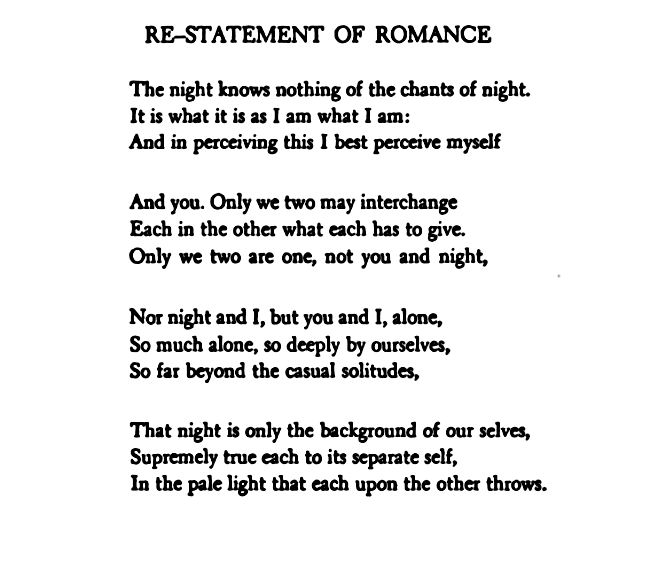
“Re-Statement of Romance” — Wallace Stevens

Screenshot 2016-01-14 at 8

Three Books

Last week on Three Books, I featured three books I kinda sorta maybe plan to read in 2016. Here are three more:

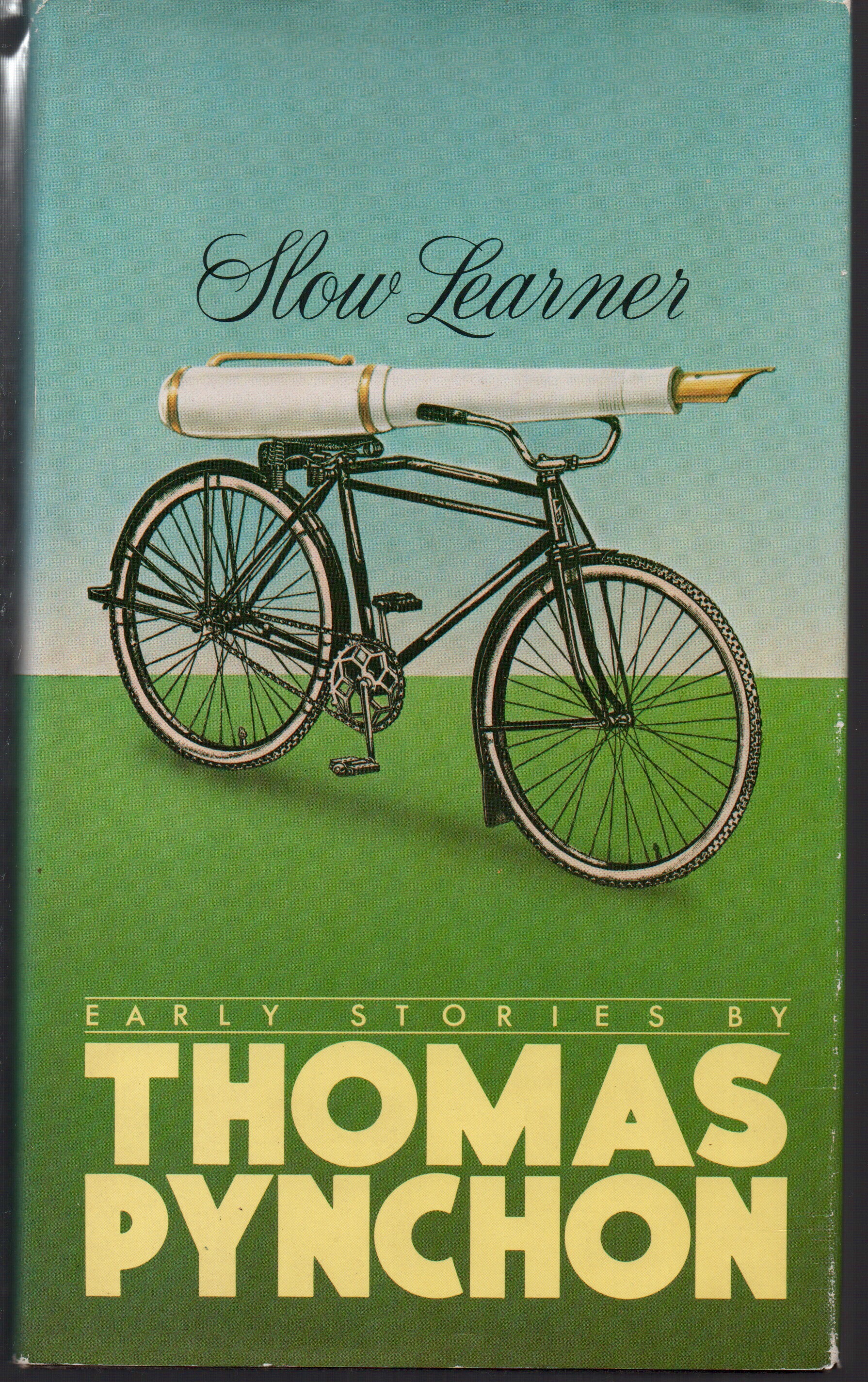
Slow Learner by Thomas Pynchon. First edition hardback by Little, Brown (1984). Jacket design by Fred Marcellino. I’ve only read “Entropy” from this collection so far. (I actually tried to use it in my Intro American Lit class—it’s in The Norton Anthology of American Literature, Vol. E, somehow—and no, it didn’t go over well, but hey).

The Weight of Things by Marianne Fritz; English translation by Adrian Nathan West. First edition trade paperback from Dorothy (2015). Cover art is Anonymous by Hella van ‘t Hof. Book design by Danielle Dutton. I started this as the chaser to Ishmael Reed’s The Free-Lance Pallbearers—proved to be a false start (went on a Le Guin jag instead). Feels like a one-sitting read.

The Easy Chain by Evan Dara. First edition trade paperback from Aurora (2008). Cover and design by Todd Michael Bushman. Does anyone want to read The Easy Chain with me?

Good or bad codes/good or bad deaths (Lucia Berlin)

While the staff members think in terms of good or bad codes – how well everyone did what they were supposed to do, whether the patient responded or not – I think in terms of good or bad deaths.

Bad deaths are ones with the manager of a hotel as next of kin, or the cleaning woman who found the stroke victim two weeks later, dying of dehydration. Really bad deaths are when there are several children and in-laws I have called in from somewhere inconvenient and none of them seem to know each other or the dying parent at all. There is nothing to say. They keep talking about arrangements, about having to make arrangements, about who will make arrangements.

Gypsies are good deaths. I think so. . .  the nurses don’t and security guards don’t. There are always dozens of them demanding to be with the dying person, to kiss them and hug them, unplugging and screwing up the TVs and monitors and assorted apparatus. The best thing about gypsy deaths is they never make their kids keep quiet. The adults wail and cry and sob but all the children continue to run around, playing and laughing, without being told they should be sad or respectful.

Good deaths seem to be coincidentally good Codes – the patient responds miraculously to all the life-giving treatment and then just quietly passes away.

From Lucia Berlin’s short story “Emergency Room Notebook, 1977.”

One gets put in a drawer which says Thomas Bernhard, a follower of Thomas Bernhard, etc. (W.G. Sebald)

Michael Silverblatt: It seems to me that this book is truly the first to pay extended stylistic respects to the writer who, it’s been said, has been your mentor and model, Thomas Bernhard. I wondered, was it after three books that one felt comfortable in creating a work that could be compared to the writing of a master and a mentor?

W.G. Sebald: Yes, I was always, as it were, tempted to declare openly from quite early on my great debt of gratitude to Thomas Bernhard. But I was also conscious of the fact that one oughtn’t to do that too openly, because then immediately one gets put in a drawer which says Thomas Bernhard, a follower of Thomas Bernhard, etc., and these labels never go away. Once one has them they stay with one. But nevertheless, it was necessary for me eventually to acknowledge his constant presence, as it were, by my side. What Thomas Bernhard did to postwar fiction writing in the German language was to bring to it a new radicality which didn’t exist before, which wasn’t compromised in any sense. Much of German prose fiction writing, of the fifties certainly, but of the sixties and seventies also, is severely compromised, morally compromised, and because of that, aesthetically frequently insufficient. And Thomas Bernhard was in quite a different league because he occupied a position which was absolute. Which had to do with the fact that he was mortally ill since late adolescence and knew that any day the knock could come at the door. And so he took the liberty which other writers shied away from taking. And what he achieved, I think, was also to move away from the standard pattern of the standard novel. He only tells you in his books what he heard from others. So he invented, as it were, a kind of periscopic form of narrative. You’re always sure that what he tells you is related, at one remove, at two removes, at two or three. That appealed to me very much, because this notion of the omniscient narrator who pushes around the flats on the stage of the novel, you know, cranks things up on page three and moves them along on page four and one sees him constantly working behind the scenes, is something that I think one can’t do very easily any longer. So Bernhard, single-handedly I think, invented a new form of narrating which appealed to me from the start.

From W.G. Sebald’s December 2001 interview with Michael Silverblatt; republished in The Emergence of Memory: Conversations with W.G. Sebald (Lynne Sharon Schwartz ed.).

“1 = 1,” new fiction from Anne Carson

She visits others. Before they’re up, dawn, she walks to the lake, listening to Bach, the first clavichord exercise, which she plans to have played at her funeral someday, has had this plan since she first heard the music and, thinking of it, she weeps lightly. The lake is whipped by wind and tides (big lake) doing what tides do, she never knows in or out. There is a man standing on shore and a big dog swimming back to him with stick in mouth. This repeats. The dog does not tire. She peels a swim cap onto her head, goggles, enters the water, which is cold but not shocking. Swims. High waves in one direction. The dog is gone. Now she is alone. There is a pressure to swim well and to use this water correctly. People think swimming is carefree and effortless. A bath! In fact, it is full of anxieties. Every water has its own rules and offering. Misuse is hard to explain. Perhaps involved is that commonplace struggle to know beauty, to know beauty exactly, to put oneself right in its path, to be in the perfect place to hear the nightingale sing, see the groom kiss the bride, clock the comet. Every water has a right place to be, but that place is in motion. You have to keep finding it, keep having it find you. Your movement sinks into and out of it with each stroke. You can fail it with each stroke. What does that mean, fail it.

Read the rest of Anne Carson’s short story “1 = 1” at The New Yorker.

Read Donald Barthelme’s story “Shower of Gold”

Because he needed the money Peterson answered an ad that said “We’ll pay you to be on TV if your opinions are strong enough or your personal experiences have a flavor of unusual.” He called the number and was told to come to Room 1551 in the Graybar Building on Lexington. This he did and after spending twenty minutes with a Miss Arbor who asked him if he had ever been in analysis was okeyed for a program called Who Am I? “What do you have strong opinions about?” Miss Arbor asked. “Art,” Peterson said, “life, money.” “For instance?” “I believe,” Peterson said, “that the learning ability of mice can be lowered or increased by regulating the amount of serotonin in the brain. I believe that schizophrenics have a high incidence of unusual fingerprints, including lines that make almost complete circles. I believe that the dreamer watches his dream in sleep, by moving his eyes.” “That’s very interesting!” Miss Arbor cried. “It’s all in the World Almanac,” Peterson replied.

“I see you’re a sculptor,” Miss Arbor said, “that’s wonderful.” “What is the nature of the program?” Peterson asked. “I’ve never seen it.” “Let me answer your question with another question,” Miss Arbor said. “Mr. Peterson, are you absurd?” Her enormous lips were smeared with a glowing white cream. “I beg your pardon?” “I mean,” Miss Arbor said earnestly, do you encounter your existence as gratuitous? Do you feel de trop? Is there nausea?” “I have enlarged liver,” Peterson offered. “That’s excellent!” Miss Arbor exclaimed. “That’s a very good beginning. Who Am I? tries, Mr. Peterson, to discover what people really are. People today, we feel, are hidden away inside themselves, alienated, desperate, living in anguish, despair and bad faith. Why have we been thrown here, and abandoned? That’s the question we try to answer, Mr. Peterson. Man stands alone in a featureless, anonymous landscape, in fear and trembling and sickness unto death. God is dead. Nothingness everywhere. Dread. Estrangement. Finitude. Who Am I? approaches these problems in a root radical way.” “On television?” “We’re interested in basics, Mr. Peterson. We don’t play around.” “I see,” Peterson said, wondering about the amount of the fee. “What I wanted to know now, Mr. Peterson, is this: are you interested in absurdity?” “Miss Arbor,” he said, “to tell you the truth, I don’t know. I’m not sure I believe in it.” “Oh, Mr. Peterson!” Miss Arbor said, shocked. “Don’t say that! You’ll be …” “Punished?” Peterson suggested. “You may not be interested in absurdity,” she said, “but absurdity is interested in you.” “I have a lot of problems, if that helps,” Peterson said. “Existence is problematic for you,” Miss Arbor said, relieved. “The fee is two hundred dollars.”

Read the rest of Donald Barthelme’s short story “Shower of Gold.”

The obligatory 2015 year-end list

img_1228

Favorite Reading Experiences

I finally read Thomas Pynchon’s novel Gravity’s Rainbow in full in 2015. Then I immediately read it again (which is sort of like really reading it), occasionally dipping into Steven Weisenburger’s A Gravity’s Rainbow Companion. Rewarding, hilarious, challenging, perplexing, Gravity’s Rainbow is too brilliant to look at directly, and is perhaps best approached slantwise, as one Ms. Dickinson of Amherst has advised.

On page 588 of Gravity’s Rainbow, the narrator (?!) suggests that we “Check out Ishmael Reed.” So I did. His novel Mumbo Jumbo is like nothing I’ve ever read before—the reviewer’s crutch “dazzling performance” comes to mind, because Mumbo Jumbo is a performance (jazz, bebop, soft shoe, vaudeville, a hoodoo magic show, an exorcism: performance art), and it does dazzle, overwhelm, energize, haunt, titillate, reverberate, howl…and there are pictures! Reed uses photos in a way that Sebald would a few decades later—documentary evidence of a sort. I don’t know. I just don’t know.

Like Reed’s novel, Anne Carson’s novel-poem-myth-book Autobiography of Red is impossible to categorize and extremely difficult to describe. I tried to write about it a few times on this site and failed, which is fine. What matters here is the reading experience: Carson’s book zapped me, gave me tingles, reminded me that what I want to think and feel when I read is, How is this possible? How is this allowed? (Another huge thank you to BLCKDGRD for sending me Autobiography of Red and its sorta-sequel Red Doc>).

Also: Nabokov’s Pale FireTwo Serious Ladies by Jane BowlesHomesick by Lucia Berlin and Evan Dara’s novel Fleewhich I loved reading with Biblioklept contributor Ryan Chang .

And finally, Ursula K. Le Guin, whose so-called Hainish Cycle I read most of this year. I still have to read The Telling, but great stuff, and a full write-up early in the new year.

Favorite Books I Read in 2015 That Were Actually Published in 2015

Signs Preceding the End of the World, Yuri Herrera

Cess, Gordon Lish

The Bus 2, Paul Kirchner

Mislaid, Nell Zink (although I liked The Wallcreeper better, but hey, it was published last year)

Favorite Indie Presses of 2015

You can’t beat Nobrow, Dorothy, OR, and/or And Other Stories.

Favorite Films I Saw in 2015 That Came Out in 2015

IMG_0340

I had a relatively contrarian opinion of Fury Road, but I enjoyed it overall, I suppose. The Force Awakens was a better spectacle for my money/nostalgia. Overall, 2015 was kind of a weak year for movies, filled with overrated indies, comic book schlock, and self-serious entertainments that Tried Too Hard. Hard to Be a God was the only thing that really zapped me, although a quick google shows that it was actually released in 2014.

You know, Inherent Vice was released in late 2014 too, but I saw it and loved it and obsessed over it in 2015…so, Inherent Vice, yeah…

I also liked that Scientology documentary, which was full-on Pynchon.

Favorite Television Shows of 2015

I thought the second season of Fargo was near-perfect and found the tawdry spectacle of The Jinx thrilling, but there was no show I enjoyed watching and reading about more than the second season of True Detective

Favorite Albums of 2015

The albums I listened to the most this year were soundtracks that came out before 2015: Inherent Vice and The Good, The Bad, and The Ugly. But I did like a number of new albums this year, including Joanna Newsom’s Divers, Jim O’Rourke’s Simple Songs, and Destroyer’s Poison Season.

Favorite Books I Didn’t Finish in 2015

I’ve been crawling my way through a full read of Leslie Fiedler’s Love and Death in the American Novel, but: No end in sight. I also read most of the essays in William T. Vollmann: A Critical Companion (check out my interview with the editors). I also read a hefty chunk of the Ben Marcus-edited collection New American Stories. My favorite discursive reading though was dipping into William H. Gass’s nonfiction.

Favorite Rereads

…speaking of Gass—well, I read his essay “Even If, by All the Oxen in the World” in conjunction with a reread of David Foster Wallace’s Infinite Jest, which turned out to be most rewarding—both the rereading and the reading-in-conjunction. Reading Infinite Jest for the first time since 2001 ended up being a deflating, even depressing experience, but I wouldn’t trade it. I also reread against the second reading of Gravity’s Rainbow. Other rereading highlights included Pynchon, Ursula K. Le Guin, High Rise by J.G. Ballard, and Blood Meridian by Cormac McCarthy (which I’ve reread every year since I first read it). But it was McCarthy’s Suttree that I got the most out of rereading this year.

2016

I’ll finish out Le Guin’s Hainish books with The Telling, and then probably crack into William H. Gass’s Eyes. In between I might read Marianne Fritz’s novel The Weight of Things. More Lucia Berlin for sure. Thomas Bernhard if it ever cools down again. (End of December 2015 and it feels like early summer here in Florida). I’d also love to take a shot at William T. Vollmann’s The Dying Grass, but who knows…there are always more pages than hours.