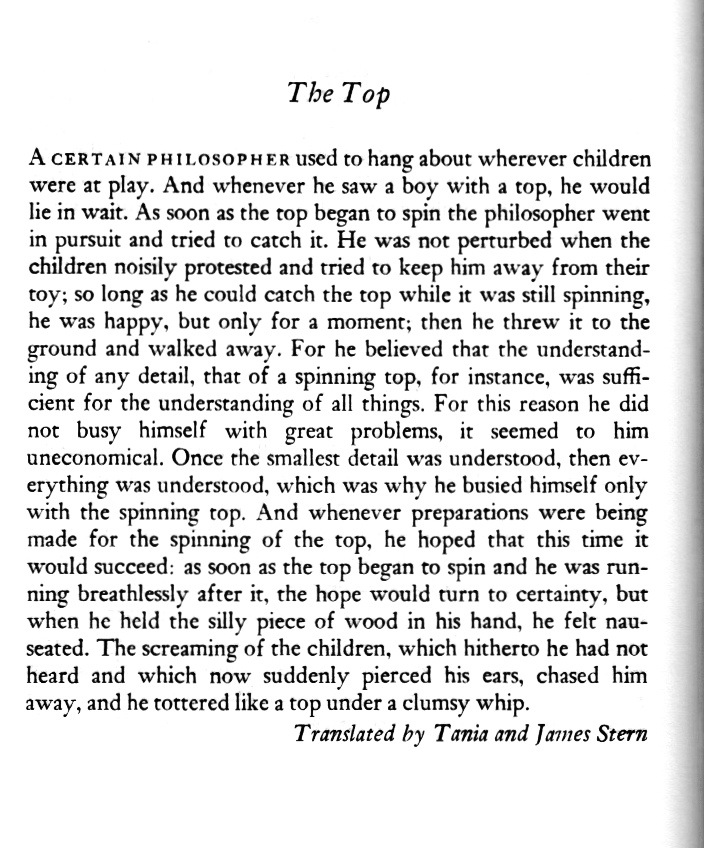
“The Top” — Franz Kafka

20140721-162337-59017474.jpg

What Kant meant when he said that the aesthetic experience is not mediated by concepts (William H. Gass)

My photographs, I used a lot, but I used them as a teaching tool, and they really worked wonderfully,in a sense. Let’s suppose you’re trying to get the students to understand what [Immanuel] Kant meant when he said that the aesthetic experience is not mediated by concepts. Okay, show them a photograph of a floor of an abandoned building—I used to go into all of these abandoned buildings—that’s been sitting abandoned for years, and there are all these pigeons flying around, and they’ve layered the floor with guano, pigeon shit. Huge warehouses, light coming in shining off this, and it’s gorgeous. So you take a picture, which looks like—you know how with aluminum foil, when you crumple it up and then smooth it out again you have all these little lines and it shines and stuff? That’s what it looks like. So you show them a slide. “Oh, boy,” they say. Then you say, “It’s pigeon shit.” Concept. Bing! And I used to take pictures of dog deposits and bird shit, especially during the season when there was lots of huckleberries, some berries that would stain it, and sometimes it would be quite nice, and I’d use things like this, so they’d see it right away, they’d understand that there are names for things, forbidden them to see, and to get them used to seeing, because they’ll never have an aesthetic experience until they can do that. So I used a lot of it, and some of it would have been okay to put in along with an essay as an illustration, but not as “Look at this as a photograph.”

William H. Gass, in a 2013 interview with Rain Taxi.

An authentically modern country (Michel Houellebecq)

At no moment in human history does growing old seem to have been a pleasure cruise; but, in the years preceding the disappearance of the species, it had manifestly become atrocious to the point where the level of voluntary deaths, prudishly renamed departures by the public-health bodies, was nearing 100 percent, and the average age of departure, estimated at sixty across the entire globe, was falling toward fifty in the most developed countries.

This figure was the result of a long evolution, scarcely begun at the time of Daniel1, when the average age at death was much higher, and suicide by old people was still infrequent. The now-ugly, deteriorated bodies of the elderly were, however, already the object of unanimous disgust, and it was undoubtedly the heat wave of summer 2003, which was particularly deadly in France, that provoked the first consciousness of the phenomenon. “The Death March of the Elderly” was the headline in Libération on the day after the first figures became known—more than ten thousand people, in the space of two weeks, had died in the country; some had died alone in their apartments, others in the hospital or in retirement homes, but all had essentially died because of a lack of care. In the weeks that followed, that same newspaper published a series of atrocious reports, illustrated with photos that were reminiscent of concentration camps, relating the agony of old people crammed into communal rooms, naked on their beds, in diapers, moaning all day without anyone coming to rehydrate them or even to give them a glass of water; describing the rounds made by nurses unable to contact the families who were on vacation, regularly gathering up the corpses to make space for new arrivals. “Scenes unworthy of a modern country,” wrote the journalist, without realizing that they were in fact the proof that France was becoming a modern country, that only an authentically modern country was capable of treating old people purely as rubbish, and that such contempt for one’s ancestors would have been inconceivable in Africa, or in a traditional Asian country.

From Michel Houellebecq’s novel The Possibility of an Island.

The difficulty of writing about sex (Doris Lessing’s The Golden Notebook)

Sex. The difficulty of writing about sex, for women, is that sex is best when not thought about, not analysed. Women deliberately choose not to think about technical sex. They get irritable when men talk technically, it’s out of self-preservation: they want to preserve the spontaneous emotion that is essential for their satisfaction.

Sex is essentially emotional for women. How many times has that been written? And yet there’s always a point even with the most perceptive and intelligent man, when a woman looks at him across a gulf: he hasn’t understood; she suddenly feels alone; hastens to forget the moment, because if she doesn’t she would have to think. Julia, myself and Bob sitting in her kitchen gossiping. Bob telling a story about the breakup of a marriage. He says: ‘The trouble was sex. Poor bastard, he’s got a prick the size of a needle.’ Julia: ‘I always thought she didn’t love him.’ Bob, thinking she hadn’t heard”
“heard: ‘No, it’s always worried him stiff, he’s just got a small one.’ Julia: ‘But she never did love him, anyone could see that just by looking at them together.’ Bob, a bit impatient now: ‘It’s not their fault, poor idiots, nature was against the whole thing from the start.’ Julia: ‘Of course it’s her fault. She should never have married him if she didn’t love him.’ Bob, irritated because of her stupidity, begins a long technical explanation, while she looks at me, sighs, smiles, and shrugs. A few minutes later, as he persists, she cuts him off short with a bad-tempered joke, won’t let him go on.

From Doris Lessing’s novel The Golden Notebook, which I was inspired to read after this essay by K. Thomas Khanh (aka @proustitute).

I started reading Lessing’s book after finishing Alasdair Gray’s novel Lanark. Gray’s novel was published in 1981 nineteen years after The Golden Notebook, but he was writing it for at least three decades before its publication, and the structural features of the two books are similar: both novels self-deconstruct, self-criticize, and rely on fragmentation and juxtaposition to evoke their themes. The themes are fairly different, I suppose, although not really. It’s all sex and death, yes?

Pain wears no mask (Oscar Wilde)

I now see that sorrow, being the supreme emotion of which man is capable, is at once the type and test of all great art. What the artist is always looking for is the mode of existence in which soul and body are one and indivisible: in which the outward is expressive of the inward: in which form reveals. Of such modes of existence there are not a few: youth and the arts preoccupied with youth may serve as a model for us at one moment: at another we may like to think that, in its subtlety and sensitiveness of impression, its suggestion of a spirit dwelling in external things and making its raiment of earth and air, of mist and city alike, and in its morbid sympathy of its moods, and tones, and colours, modern landscape art is realising for us pictorially what was realised in such plastic perfection by the Greeks. Music, in which all subject is absorbed in expression and cannot be separated from it, is a complex example, and a flower or a child a simple example, of what I mean; but sorrow is the ultimate type both in life and art.

Behind joy and laughter there may be a temperament, coarse, hard and callous. But behind sorrow there is always sorrow. Pain, unlike pleasure, wears no mask. Truth in art is not any correspondence between the essential idea and the accidental existence; it is not the resemblance of shape to shadow, or of the form mirrored in the crystal to the form itself; it is no echo coming from a hollow hill, any more than it is a silver well of water in the valley that shows the moon to the moon and Narcissus to Narcissus. Truth in art is the unity of a thing with itself: the outward rendered expressive of the inward: the soul made incarnate: the body instinct with spirit. For this reason there is no truth comparable to sorrow. There are times when sorrow seems to me to be the only truth. Other things may be illusions of the eye or the appetite, made to blind the one and cloy the other, but out of sorrow have the worlds been built, and at the birth of a child or a star there is pain.

More than this, there is about sorrow an intense, an extraordinary reality. I have said of myself that I was one who stood in symbolic relations to the art and culture of my age. There is not a single wretched man in this wretched place along with me who does not stand in symbolic relation to the very secret of life. For the secret of life is suffering. It is what is hidden behind everything. When we begin to live, what is sweet is so sweet to us, and what is bitter so bitter, that we inevitably direct all our desires towards pleasures, and seek not merely for a ‘month or twain to feed on honeycomb,’ but for all our years to taste no other food, ignorant all the while that we may really be starving the soul.

From Oscar Wilde’s essay De Profundis.

Biblioklept’s Dictionary of Literary Terms

AUTEUR

French for author, this term denotes a film director who makes the same film again and again and again.

BIBLIOGRAPHY

A detailed list of the books from which the author plundered all his or her good ideas.

CIRCUMLOCUTION

The rhetorical device of circumlocution can be seen by the reader or made evident to the reader when a writer chooses to compose phrases, clauses, or sentences that are inordinately complex, exaggerated, long-winded, or otherwise unnecessarily verbose in order to demonstrate, convey, show, or express an idea, image, or meaning that might have been demonstrated, conveyed, shown, or expressed via the use of shorter, simpler, more direct phrases, clauses, or sentences that demonstrate brevity.

Inexperienced writers, especially composition students, are advised to use circumlocution to pad their writing and meet the assigned word count.

DESCRIPTIVIST

A grammarian who holds strong opinions and judgments about prescriptivists.

EXPOSITION

Telling without showing. Exposition can be extremely useful to the reader, who will slight the author who successfully employs it.

FREE INDIRECT STYLE

James Wood Approved!™

GOLDEN AGE

A comforting, nebulous fantasy.

HAGIOGRAPHY

A biography composed entirely of distortions, half-truths, and outright lies.

INNUENDO

The funny dirty bits that make you feel clever.

JARGON

Trade-specific diction employed (preferably clumsily) to confuse the average reader and offend the expert reader.

KINDLE

Early 21st-century reading device, often mistaken as a harbinger of literary doom.

LITERALLY

An adverb that most often means figuratively.

MYTH

The most enduring—and therefore most true—kind of story.

NEGATIVE CAPABILITY

A writer’s ability to just chill and not know. (Also useful for lazy frauds).

OBJECTIVE POINT OF VIEW

A comforting, nebulous fantasy.

PRESCRIPTIVIST

A grammarian who holds strong opinions and judgments about descriptivists.

QUEST

The story-teller’s scheme. Make it up as you go along. Steal as necessary.

REALISM

A comforting, nebulous fantasy.

SEBALDIAN

An adjective used to describe a literary work that is not quite as good as anything by W.G. Sebald.

TRAGEDY

A work often mistaken as more serious or more important or more literary than a comedy.

UNIVERSAL SYMBOL

A comforting, nebulous fantasy.

VULGARITY

A specific type of lucidity that authors sometimes use.

WELTSCHMERZ

The emotional byproduct of attempting to maintain comforting, nebulous fantasies.

XANAX

A stop-gap for bouts of Weltschmerz.

YOKNAPATAWPHA COUNTY

Faulkner’s Middle-earth.

ZYZZYVA

Zyzzyva is a real word, and this fact should give us all some small measure of hope..

(Previous entries here and here and here.).

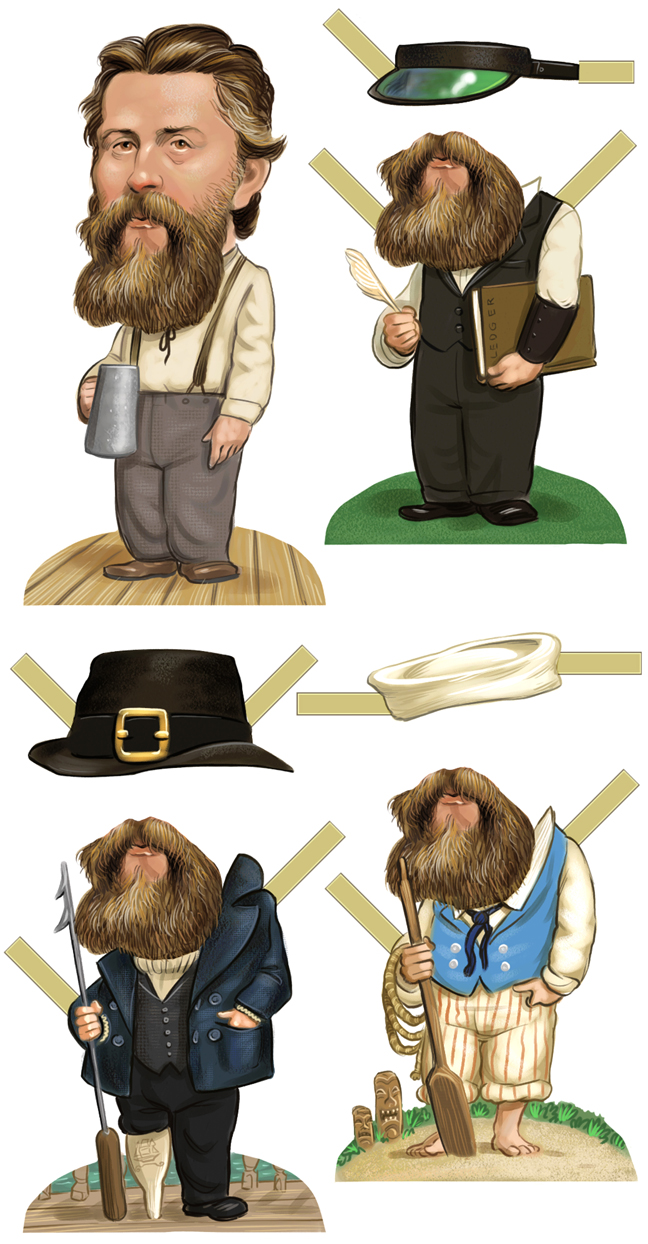
Herman Melville Paper Doll

melville

Herman Melville paper doll by Tim Foley.

Read an Early David Foster Wallace Story, “Order and Flux in Northampton”

David Foster Wallace’s “Order and Flux in Northampton” was published in the Fall 1991 issue of ConjunctionsPart I, Part II, Part III, Part IV.

First few paragraphs:

BARRY DINGLE, CROSS-EYED PURVEYOR of bean sprouts, harbors for Myrnaloy Trask, operator of Xerox and regent of downtown Northampton’s most influential bulletin board at Collective Copy, an immoderate love.

Myrnaloy Trask, trained Reproduction Technician, unmarried woman, vegetarian, flower-child tinged faintly with wither, overseer and editor of Announcement and Response at the ten-foot-by-ten-foot communicative hub of a dizzying wheel of leftist low-sodium aesthetes, a woman politically correct, active in relevant causes, slatternly but not unerotic, all-weather wearer of frayed denim skirts and wool knee-socks, sexually troubled, ambiguous sexual past, owner of one spectacularly incontinent Setter/Retriever bitch, Nixon, so named by friend Don Megala because of the dog’s infrangible habit of shitting where it eats: Myrnaloy has eyes only for Don Megala: Don Megala, middle-aged liberal, would-be drifter, maker of antique dulcimers by vocation, by calling a professional student, a haunter of graduate hallways, adrift, holding fractions of Ph.D.’s in everything from Celtic phonetics to the sociobiology of fluids from the University of Massachusetts at Amherst, presently at work on his seventh and potentially finest unfinished dissertation, an exhaustive study of Stephen Dedalus’s sublimated oedipal necrophilia vis à vis Mrs. D. in Ulysses, an essay tentatively titled “The Ineluctable Modality of the Ineluctably Modal.”

Add to the above Trask-data the fact that, though Barry Dingle’s spotlessly managed franchise, The Whole Thing Health Food Emporium, is located directly next to Collective Copy on Northampton’s arterial Great Awakening Avenue, Myrnaloy has her nutritional needs addressed at The Whole Thing’s out-of-the-way, sawdust-floored competition, Good Things to Eat, Ltd., the proprietor of which, one Adam Baum, is a crony of Megala, and add also that The Whole Thing is in possession of its own Xerox copier, and the following situation comes into narrative focus: Myrnaloy Trask has only the sketchiest intuition that Barry Dingle even exists, next door.

For Barry Dingle, though, the love of Myrnaloy Trask has become the dominant emotional noisemaker in his quiet life, the flux-ridden state of his heart, a thing as intimately close to Dingle as Myrnaloy is forever optically distant or unreal. 

(Continue reading Wallace’s “Order and Flux in Northampton”).

What I could no longer stand was laughter (Michel Houellebecq)

My attraction to film as a medium—i.e., a dead medium, as opposed to what they pompously called at the time a living spectacle—had undoubtedly been the first sign in me of a disinterest in, even a disgust for, the general public—and probably for mankind in general. I was working at that time on my sketches with a small video camera, fixed on a tripod and linked to a monitor on which I could control in real time my intonations, funny expressions, and gestures. I had always had a simple principle: if I burst out laughing at a given moment, it was this moment that had a good chance of making the audience laugh as well. Little by little, as I watched the cassettes, I became aware that I was suffering from a deeper and deeper malaise, sometimes bordering on nausea. Two weeks before the premiere, the reason for this malaise became clear to me: what I found more and more unbearable wasn’t even my face, nor was it the repetitive and predictable nature of certain standard impersonations that I was obliged to do: what I could no longer stand was laughter, laughter in itself, that sudden and violent distortion of the features that deforms the human face and strips it instantly of all dignity. If man laughs, if he is the only one, in the animal kingdom, to exhibit this atrocious facial deformation, it is also the case that he is the only one, if you disregard the natural self-centeredness of animals, to have attained the supreme and infernal stage of cruelty.

The three-week run was a permanent calvary; for the first time, I truly experienced those notorious, atrocious tears of the clown; for the first time, I truly understood mankind. I had dismantled the cogs in the machine, and I knew how to make it work, whenever I wanted. Every evening, before going on stage, I swallowed an entire sheet of Xanax. Every time the audience laughed (and I could predict it, I knew how to dose my effects, I was a consummate professional), I was obliged to turn away so as not to see those hideous faces those, hundreds of faces moved by convulsions, agitated by hate.

From Michel Houellebecq’s novel The Possibility of an Island.

Bob Schofield Discusses The Inevitable June and His Sad-Cartoon-Apocalypse Aesthetic

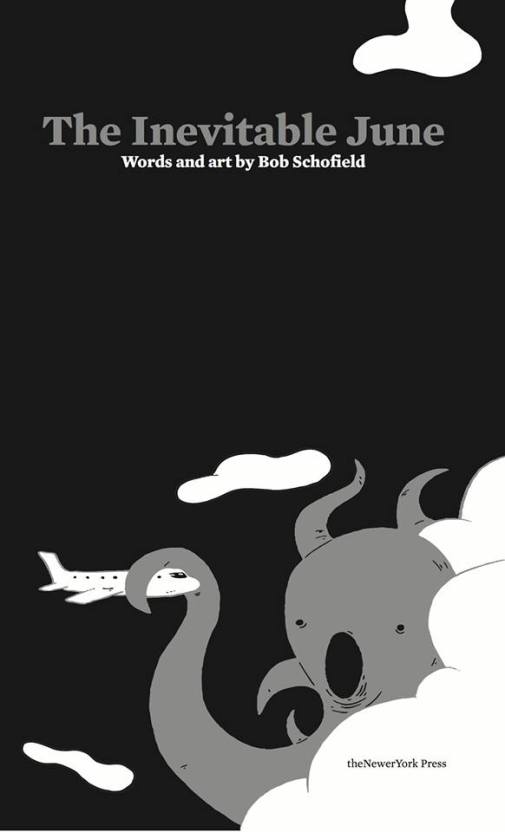
Bob Schofield is a writer and artist. He first showed up on my radar when theNewerYork sent me a digital file of his book The Inevitable June, which I described as “the kind of thing that we need more of; not a gimmick or a hybrid, but something new.” I’m still not sure what the book is, but I dig it. Bob was kind enough to talk to me over a series of emails about his work. Read some of Bob’s work at his website. Read my review of The Inevitable June here. Read our discussion below.

Biblioklept: What is The Inevitable June?

Bob Schofield: The Inevitable June is a collection of 30 surreal short prose pieces, one for every day in June, intercut with black and white illustrations. The drawings don’t always correspond to the text, and there isn’t really much of a coherent “story” per se, but there is certainly momentum and direction. The book definitely goes somewhere, though I’m not sure where exactly that “somewhere” is.

I kind of just wanted to build a little world that mirrored my imagination. A kind of scale-model. So I wanted it to be a little cold and sad and spooky and, hopefully, also fun. Like some kind of weird, floppy theme park made of bound paper squares.

Biblioklept: How did you compose that “scale-model”? Did you have an outline from the outset?

Schofield: There were a few structural “rules” I came up with, and the rest I sort of made up as I went. Like I knew I’d have thirty pieces total, and they’d all be titled for successive days in June. It’s funny, a lot of the momentum in the book just comes from that progression of calendar days. I guess we’re just culturally wired to feel like we’re going somewhere when we see those days slide by. But in the book it’s all relatively arbitrary, and if you were to take the days away as titles, things would feel a lot more meandering.

Photograph of Bob Schofield by Alex Broadwell

My other big structural decision was to start every piece with “This morning,” which would become a kind of refrain throughout the book. I kind of thought of it a bit like a dinner bell, indicating one course of the meal was over, and we were moving on to the next.

Then as I was writing all the individual pieces, I’d cherry pick certain images and phrases I liked, and then be sure to repeat them later on. That way the reader’s brain would kind of light up as they recognized parts of a pattern, even though the pattern wasn’t really saying anything specific. I think that kind of thing is important when you don’t have a more familiar storytelling structure to rely on. You need to give the reader something to hold on to.

And for myself as writer, all these patterns and rules gave me just as much of an anchor. It meant I wasn’t just spinning off into some sort of insane, incomprehensible word soup. I’d always be aware that I’d have to wrap things up at some point, and move on to the next “day.”

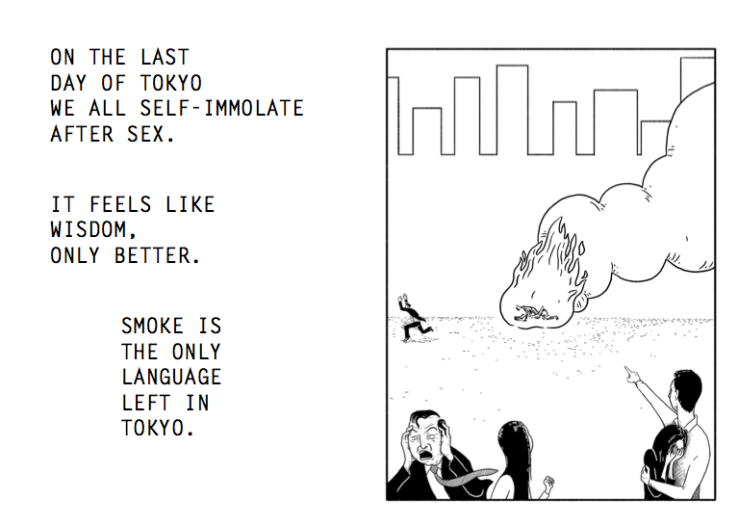
Biblioklept: Your book The Last Days of Tokyo shares some of the anchoring features you mention—beginning each page with the phrase “On the last day of Tokyo,” for example, and the image of a salaryman fleeing in horror, his face an echo of Munch’s The Scream.

1 Continue reading “Bob Schofield Discusses The Inevitable June and His Sad-Cartoon-Apocalypse Aesthetic”

Cthulhu — Tatsuya Morino

I was a slow reader (William H. Gass)

I was a slow reader. That is, I was slow getting to be fast. I remember having a hell of a lot of trouble reading in the third grade. I learned how to read in the fifth grade, I think it was. But that’s puzzling, because, although I remember having a lot of trouble when I was in school because I couldn’t read, I also remember that I was reading Malory’s Morte d’Arthur with love and astonishment then. It was the first book I read that I remember with absolute clarity. Yet that was before I officially “learned to read.” By the time I was in the seventh grade I was a speed-reader. I became a member of a speed-reading team. Speed-reading teams were at that time fairly common. Our high school had a team of readers, and you went out and read against other schools, and then did these comprehension tests. One year I was the speed-reading champ of the state of Ohio. I read slowly now. I learned to slow down, and read properly, when I started reading philosophy seriously, and, as a consequence, finally learned to read poetry properly too. Now I’m practically a lip reader again, although I can still go like hell if I have to.

From William H. Gass’s 1983 interview in Conjunctions.

A Clip from The Kidnapping Of Michel Houellebecq

Michel Houellebecq is always performing Michel Houellebecq.

Roberto Bolaño’s Fiction (Book Acquired, 07.24.2014)

20140728-123758-45478204.jpg
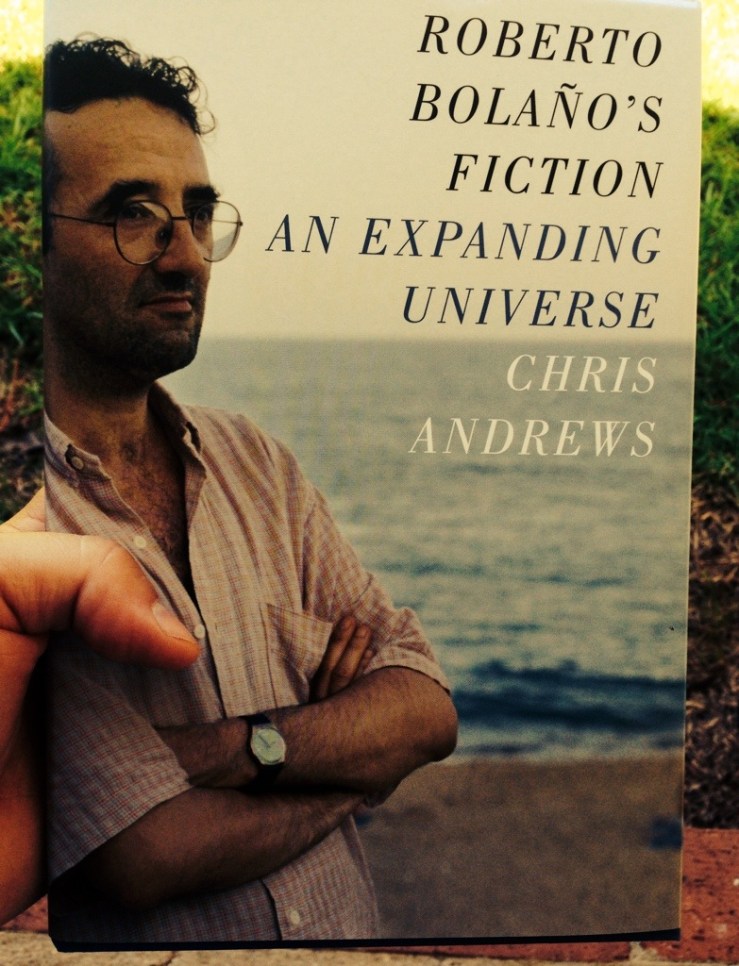
So of course I’ve been eating up Roberto Bolaño’s Fiction: An Expanding Universe, a new critical study by Bolaño’s translator Chris Andrews. I’ve read the introduction and the first three chapters so far, and the study, far from being dry and academic, compels me to dig deeper.

The book really starts with the second chapter, with Andrews simply trying to situate Bolaño-as-publishing-phenomenon in the first chapter. The introduction—which you can read at publisher Columbia UP’s site—offers a clear overview of what Andrews aims to do.

Andrews writes that:

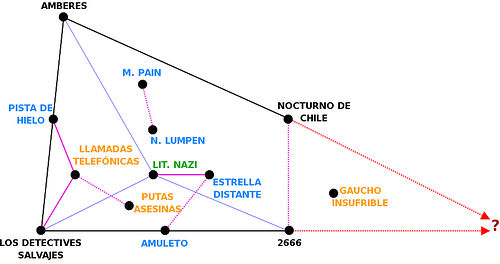
…the interconnected series of narratives that begins with Nazi Literatures in the Americas (originally published in 1996) and ends with the stories that appeared posthumously in The Secret of Evil … can be regarded as forming a single, openly structured edifice whose two sustaining pillars are The Savage Detectives and 2666, and for which Woes of the True Policeman served as a preparatory model.

Andrews’s description recalls Javier Moreno’s geometry of Bolaño’s fictions:

moreno

This model has greatly influenced my own reading of Bolaño over the years, leading to my conceptualization of Bolaño’s later work existing in a self-creating, self-deconstructing Bolañoverse.

Andrews’s description of the Bolañoverse (he doesn’t use the term):

Bolaño expanded or “exploded” his own published texts, blowing them up by adding new characters and episodes as well as circumstantial details. He also allowed characters to circulate or migrate from text to text, sometimes altering their names and properties. Within his novels and stories, he inclded representations of imagined texts and artworks, that is, metarepresentations. Finally, some of his characters and narrators are over-interpreters: they seize on details, invest them with significance, and invent stories to connect and explain them. 

More to come; for now, the publisher’s blurb:

Since the publication of The Savage Detectives in 2007, the work of Roberto Bolaño (1953–2003) has achieved an acclaim rarely enjoyed by literature in translation. Chris Andrews, a leading translator of Bolaño’s work into English, explores the singular achievements of the author’s oeuvre, engaging with its distinct style and key thematic concerns, incorporating his novels and stories into the larger history of Latin American and global literary fiction.

Andrews provides new readings and interpretations of Bolaño’s novels, including 2666, The Savage Detectives, and By Night in Chile, while at the same time examining the ideas and narrative strategies that unify his work. He begins with a consideration of the reception of Bolaño’s fiction in English translation, examining the reasons behind its popularity. Subsequent chapters explore aspects of Bolaño’s fictional universe and the political, ethical, and aesthetic values that shape it. Bolaño emerges as the inventor of a prodigiously effective “fiction-making system,” a subtle handler of suspense, a chronicler of aimlessness, a celebrator of courage, an anatomist of evil, and a proponent of youthful openness. Written in a clear and engaging style, Roberto Bolano’s Fiction offers an invaluable understanding of one of the most important authors of the last thirty years.

The final test of truth is ridicule (H.L. Mencken)

The final test of truth is ridicule. Very few religious dogmas have ever faced it and survived. Huxley laughed the devils out of the Gadarene swine. Dowie’s whiskers broke the back of Dowieism. Not the laws of the United States but the mother-in-law joke brought the Mormons to compromise and surrender. Not the horror of it but the absurdity of it killed the doctrine of infant damnation…. But the razor edge of ridicule is turned by the tough hide of truth. How loudly the barber-surgeons laughed at Harvey—and how vainly! What clown ever brought down the house like Galileo? Or Columbus? Or Jenner? Or Lincoln? Or Darwin?… They are laughing at Nietzsche yet…

From H.L. Mencken’s Damn! A Book of Calumny.


“A Fugue” — William H. Gass

My dad wouldn’t let me have a dog. A dog? A dog we don’t need. My mom made the neighbor’s spitz her pal by poisoning it with the gin she sprinkled on the table scraps. Feed it somewhere else, my dad said. A dog we don’t need. My dad wouldn’t let me have a dog. Our neighbor’s spitz–that mutt–he shits in the flower beds. Dog doo we don’t need. At least feed it somewhere else, my dad said. My mom made the table scraps tasty for her pal, the neighbor’s spitz– that mutt–by sprinkling them with gin. You’re poisoning Pal, my dad said, but never mind, we don’t need that mutt. My mom thought anything tasted better with a little gin to salt it up. That way my mom made the neighbor’s spitz her pal, and maddened dad who wouldn’t let me have a dog. He always said we didn’t need one, they crapped on the carpet and put dirty paws on the pant’s leg of guests and yapped at cats or anyone who came to the door. A dog? A dog we don’t need. We don’t need chewed shoes and dog hairs on the sofa, fleas in the rug, dirty bowls in every corner of the kitchen, dog stink on our clothes. But my mom made the neighbor’s spitz her pal anyway by poisoning it with the gin she sprinkled on the table scraps like she was baptising bones. At least feed it somewhere else, my dad said. My dad wouldn’t let me have a pal. Who will have to walk that pal, he said. I will. And it’s going to be snowing or it’s going to be raining and who will be waiting by the vacant lot at the corner in the cold wet wind, waiting for the damn dog to do his business? Not you, Billy boy Christ, you can’t even be counted on to bring in the garbage cans or mow the lawn. So no dog. A mutt we don’t need, we don’t need dog doo in the flower beds, chewed shoes, fleas; what we need is the yard raked, like I said this morning. No damn dog. No mutt for your mother either even if she tries to get around me by feeding it when my back is turned, when I’m away at work earning her gin money so the sick thing can shit in a stream on the flower seeds; at least she should feed it somewhere else; it’s always hanging around; is it a light string in the hall or a cloth on the table to be always hanging around? No. Chewed shoes, fleas, muddy paws and yappy daddle, bowser odor: a dog we don’t need. Suppose it bites the postman: do you get sued? No. I am the one waiting at the corner vacant lot in the rain, the snow, the cold wet wind, waiting for the dog to do his damn business, and I get sued. You don’t. Christ, you can’t even be counted on to clip the hedge. You know: snicksnack. So no dog, my dad said. Though we had a dog nevertheless. That is, my mom made the neighbor’s pal her mutt, and didn’t let me have him for mine, either, because it just followed her around–yip nip–wanting to lap gin and nose its grease-sogged bread. So we did have a dog in the house, even though it just visited, and it would rest its white head in my mother’s lap and whimper and my father would throw down his paper and say shit! and I would walk out of the house and neglect to mow or rake the yard, or snicksnack the hedge or bring the garbage cans around. My dad wouldn’t let me have a dog. A dog? A dog we don’t need, he said. So I was damned if I would fetch.

From William H. Gass’s novel The Tunnel.

We should never write without feeling (William T. Vollmann)

20140727-150921-54561555.jpg 20140727-150921-54561934.jpg From “American Writing Today: A Diagnosis of the Disease,” a manifesto William T. Vollmann published in the Spring ’90 issue of Conjunctions. The image here, along with the image of Vollmann in his press flak jacket (1992), are from the anthology Expelled from Eden.