Don Quixote — Gustave Doré

The Kindly Ones is simply “Houellebecq does Nazism” (From Laurent Binet’s HHhH)

A poster on an Internet forum expresses the opinion that Max Aue, Jonathan Littell’s protagonist in The Kindly Ones, “rings true because he is the mirror of his age.” What? No! He rings true (for certain, easily duped readers) because he is the mirror of our age: a postmodern nihilist, essentially. At no moment in the novel is it suggested that this character believes in Nazism. On the contrary, he displays an often critical detachment toward National Socialist doctrine—and in that sense, he can hardly be said to reflect the delirious fanaticism prevalent in his time. On the other hand, this detachment, this blasé attitude toward everything, this permanent malaise, this taste for philosophizing, this unspoken amorality, this morose sadism, and this terrible sexual frustration that constantly twists his guts … but of course! How did I not see it before? Suddenly, everything is clear. The Kindly Ones is simply “Houellebecq does Nazism.”

From Laurent Binet’s novel HHhH; English Translation by Sam Taylor.

Enjoyed the novel tremendously.

I’m not sure if Binet’s remarks (or, Binet’s narrator, who is Binet-performing-author-as-narrator) are exactly a literary dis or not (I’m pretty sure he’s dissing Littell, but unsure how Houellebecq fits in there, or what).

(My thoughts on The Kindly Ones; my thoughts on Houellebecq’s The Elementary Particles).

Eudora Welty on Austen, Chekhov, and Woolf

INTERVIEWER

You wrote somewhere that we should still tolerate Jane Austen’s kind of family novel. Is Austen a kindred spirit?

EUDORA WELTY

Tolerate? I should just think so! I love and admire all she does, and profoundly, but I don’t read her or anyone else for “kindredness.” The piece you’re referring to was written on assignment for Brief Lives, an anthology Louis Kronenberger was editing. He did offer me either Jane Austen or Chekhov, and Chekhov I do dare to think is more “kindred.” I feel closer to him in spirit, but I couldn’t read Russian, which I felt whoever wrote about him should be able to do. Chekhov is one of us—so close to today’s world, to my mind, and very close to the South—which Stark Young pointed out a long time ago.

INTERVIEWER

Why is Chekhov close to today’s South?

WELTY

He loved the singularity in people, the individuality. He took for granted the sense of family. He had the sense of fate overtaking a way of life, and his Russian humor seems to me kin to the humor of a Southerner. It’s the kind that lies mostly in character. You know, inUncle Vanya and The Cherry Orchard, how people are always gathered together and talking and talking, no one’s really listening. Yet there’s a great love and understanding that prevails through it, and a knowledge and acceptance of each other’s idiosyncrasies, a tolerance of them, and also an acute enjoyment of the dramatic. Like in The Three Sisters, when the fire is going on, how they talk right on through their exhaustion, and Vershinin says, “I feel a strange excitement in the air,” and laughs and sings and talks about the future. That kind of responsiveness to the world, to whatever happens, out of their own deeps of character seems very southern to me. Anyway, I took a temperamental delight in Chekhov, and gradually the connection was borne in upon me.

INTERVIEWER

Do you ever return to Virginia Woolf?

WELTY

Yes. She was the one who opened the door. When I read To the Lighthouse, I felt, Heavens, what is this? I was so excited by the experience I couldn’t sleep or eat. I’ve read it many times since, though more often these days I go back to her diary. Any day you open it to will be tragic, and yet all the marvelous things she says about her work, about working, leave you filled with joy that’s stronger than your misery for her. Remember—“I’m not very far along, but I think I have my statues against the sky”? Isn’t that beautiful?

From Eudora Welty’s interview with The Paris Review.

Eudora Welty — Barry Moser

moser-welty

“Five common methods by which sex gains an entrance into literature” (William H. Gass)

So I shall, keeping one in each of my four pockets while one is in my mouth, describe five common methods by which sex gains an entrance into literature . . . as through French doors and jimmied windows thieves break in upon our dreams to rape our women, steal our power tools, and vandalize our dreams. The commonest, of course, is the most brazen: the direct depiction of sexual material— thoughts, acts, wishes; the second involves the use of sexual words of various sorts, and I shall pour one of each vile kind into the appropriate porches of your ears , for pronounc-ing and praising print to the ear is what the decently encouraged eye does happily. The third can be considered, in a sense, the very heart of indirection, and thus the essence of the artist’s art— displacement: the passage of the mind with all its blue elastic ditty bags and airline luggage f r o m steamy sexual scenes and sweaty bodies to bedrooms with their bedsteads, nightstands, water-glasses, manuals of instruction, thence to sheets and pillowcases, hence to dents in these, and creases, stains and other cries of passion which have left their prints , and finally to the painted chalk-white oriental face of amorously handled air and mountains,, lewdly entered lakes. The fourth I shall simply refer to now as the skyblue eye (somewhere, it seems to me, there should be a brief pinch of suspense), and the fifth, well, it’s really what I’m running into all my inks about, so I had better mention it: the use of language like a lover . . . not the language of love, but the love of language, not matter, but meaning, not what the tongue touches, but what it forms, not lips and nipples, but nouns and verbs.

From William H. Gass’s essay-novel On Being Blue: A Philosophical Inquiry.

“Lily Daw and the Three Ladies” — Eudora Welty

“Lily Daw and the Three Ladies”

by Eudora Welty

Mrs Watts and Mrs Carson were both in the post office in Victory when the letter came from the Ellisville Institute for the Feeble Minded of Mississippi. Aimee Slocum, with her hand still full of mail, ran out in front and handed it straight to Mrs Watts, and they all three read it together. Mrs Watts held it taut between her pink hands, and Mrs Carson underscored each line slowly with her thimbled finger. Everybody else in the post office wondered what was up now.

“What will Lily say,” beamed Mrs Carson at last, “when we tell her we’re sending her to Ellisville!”

“She’ll be tickled to death,” said Mrs Watts, and added in a guttural voice to a deaf lady, “Lily Daw’s getting in at Ellisville!”

“Don’t you all dare go off and tell Lily without me!” called Aimee Slocum, trotting back to finish putting up the mail.

“Do you suppose they’ll look after her down there?” Mrs Carson began to carry on a conversation with a group of Baptist ladies waiting in the post office. She was the Baptist preacher’s wife.

“I’ve always heard it was lovely down there, but crowded,” said one.

“Lily lets people walk over her so,” said another.

“Last night at the tent show—-” said another, and then popped her hand over her mouth.

“Don’t mind me, I know there are such things in the world,” said Mrs Carson, looking down and fingering the tape measure which hung over her bosom.

“Oh, Mrs Carson. Well, anyway, last night at the tent show, why, the man was just before making Lily buy a ticket to get in.”

“A ticket!”

“Till my husband went up and explained she wasn’t bright, and so did everybody else.”

The ladies all clucked their tongues.

“Oh, it was a very nice show,” said the lady who had gone. “And Lily acted so nice. She was a perfect lady–just set in her seat and stared.”

“Oh, she can be a lady–she can be,” said Mrs Carson, shaking her head and turning her eyes up. “That’s just what breaks your heart.”

“Yes’m, she kept her eyes on–what’s that thing makes all the commotion?–the xylophone,” said the lady. “Didn’t turn her head to the right or to the left the whole time. Set in front of me.”

“The point is, what did she do after the show?” asked Mrs Watts practically. “Lily has gotten so she is very mature for her age.”

“Oh, Etta!” protested Mrs Carson, looking at her wildly for a moment.

“And that’s how come we are sending her to Ellisville,” finished Mrs Watts.

“I’m ready, you all,” said Aimee Slocum, running out with white powder all over her face. “Mail’s up. I don’t know how good it’s up.”

“Well, of course, I do hope it’s for the best,” said several of the other ladies. They did not go at once to take their mail out of their boxes; they felt a little left out.

The three women stood at the foot of the water tank.

“To find Lily is a different thing,” said Aimee Slocum.

“Where in the wide world do you suppose she’d be?” It was Mrs Watts who was carrying the letter.

“I don’t see a sign of her either on this side of the street or on the other side,” Mrs Carson declared as they walked along.

Ed Newton was stringing Redbird school tablets on the wire across the store. Continue reading ““Lily Daw and the Three Ladies” — Eudora Welty”

Language becomes a compromised ideology

20140406-123125.jpg

“Beside Schopenhauer’s Corpse” — Guy De Maupassant

“Beside Schopenhauer’s Corpse”

by

Guy de Maupassant

He was slowly dying, as consumptives die. I saw him each day, about two o’clock, sitting beneath the hotel windows on a bench in the promenade, looking out on the calm sea. He remained for some time without moving, in the heat of the sun, gazing mournfully at the Mediterranean. Every now and then, he cast a glance at the lofty mountains with beclouded summits that shut in Mentone; then, with a very slow movement, he would cross his long legs, so thin that they seemed like two bones, around which fluttered the cloth of his trousers, and he would open a book, always the same book. And then he did not stir any more, but read on, read on with his eye and his mind; all his wasting body seemed to read, all his soul plunged, lost, disappeared, in this book, up to the hour when the cool air made him cough a little. Then, he got up and reentered the hotel.

He was a tall German, with fair beard, who breakfasted and dined in his own room, and spoke to nobody.

A vague, curiosity attracted me to him. One day, I sat down by his side, having taken up a book, too, to keep up appearances, a volume of Musset’s poems.

And I began to look through “Rolla.”

Suddenly, my neighbor said to me, in good French:

“Do you know German, monsieur?”

“Not at all, monsieur.”

“I am sorry for that. Since chance has thrown us side by side, I could have lent you, I could have shown you, an inestimable thing—this book which I hold in my hand.”

“What is it, pray?”

“It is a copy of my master, Schopenhauer, annotated with his own hand. All the margins, as you may see, are covered with his handwriting.”

I took the book from him reverently, and I gazed at these forms incomprehensible to me, but which revealed the immortal thoughts of the greatest shatterer of dreams who had ever dwelt on earth. Continue reading ““Beside Schopenhauer’s Corpse” — Guy De Maupassant”

Nothing to be done.

20140409-151256.jpg

“Beckett is a very blue man” (William H. Gass)

Remember how the desperate Molloy proceeds:

I took advantage of being at the seaside to lay in a store of sucking stones. They were pebbles but I call them stones I distrutibed them equally between my four pockets, and sucked them turn and turn about. This raised a problem which I first solved in the following way. I had say sixteen stones, four in each of my four pockets these being the two pockets of my trousers and the two pockets of my greatcoat. Taking a stone from the right pockct of my greatcoat, and putting it in mv mouth , I replaced it in the right pocket of my greatcoat bv a stone from the right pocket of my trousers, which I replaced by a stone from the left pocket of my trousers, which I replaced by a stone from the left pocket of my greatcoat, which I replaced by the stone which was in my mouth, as soon as I had fin-ished sucking it. Thus there were still four stones in each of my four pockets , but not quite the same stones…. But this solution did not satisfy me fully. For it did not escape me that, by an extraordinary hazard, the four stones circulating thus might always be the same four. In which case, far from sucking the sixteen stones turn and turn about, I was really only sucking four, always the same, turn and turn about.

Beckett is a very blue man, and this is a very blue passage.

From William H. Gass’s On Being Blue: A Philosophical Inquiry (and of course, Samuel Beckett’s Molloy).

So musical a discord, such sweet thunder

Capture

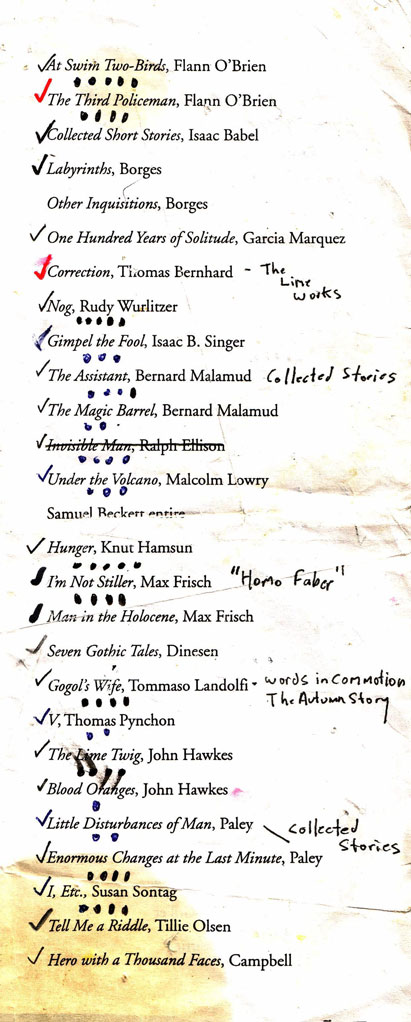
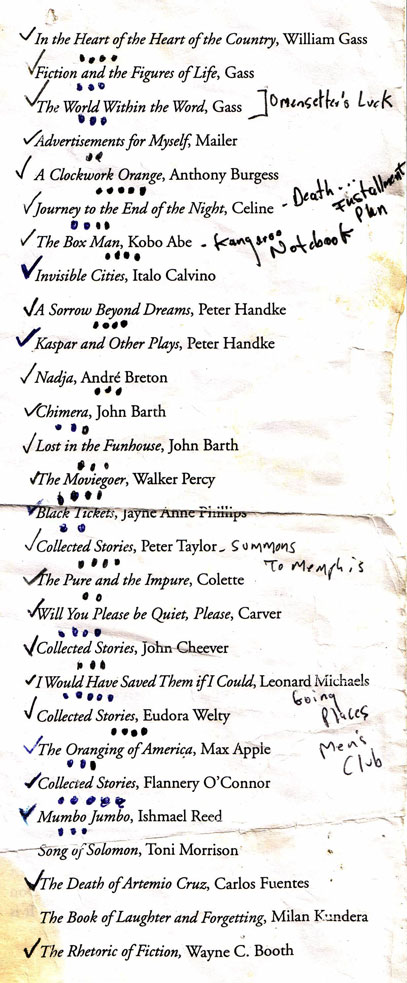
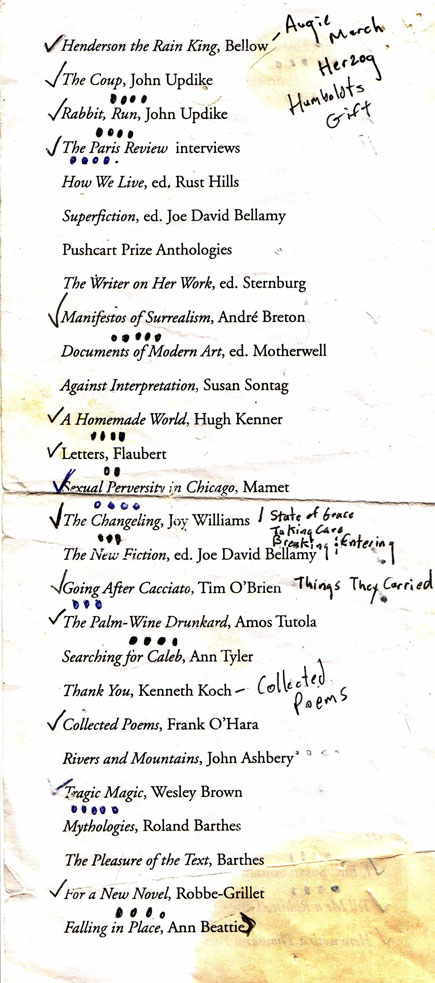
Donald Barthelme’s Book Recommendations

barthelme_1a barthelme_2a barthelme_3a

Sure–okay, sure, you’ve seen this before (or maybe not), I know I have (I’ve even posted it before). But today is D. Barthelme’s birthday (he’s dead of course), and I’ve read or reread (or, more accurately read) most of his stuff (sans The King, which I’ve been saving) over the past year. Anyway, this here list comes via Kevin Moffett who got it off DB’s former student, Padgett Powell, when he (that is Moffett) was finishing up at my alma mater, the University of Gators (where Powell continues to teach today, having replaced Harry Crews, RIP). Anyway (again with that transition!), check out Moffett’s original share-piece at The Believer; he describes Gainesville’s Friends of the Library Sale, which was always fun. I got a copy of John Barth’s Chimera there (on the list, natch), among other books, but I didn’t get any Barthelme. I’ve read 31 of the 81 books on the list (this includes fantastically awarding myself the “Samuel Beckett entire” entry but hell man I think it’s been counted as one work here (at least by Moffett?), which maybe it should be but no I haven’t read all of Beckett but hell I’ve read a lot, if not enough, but anyway (again!)–31).

“Graves were called homes, and apologies known as writing were carved in their surface” (Ben Marcus)

The time was technical summer, a season that had been achieved by nature so many times that a clotted arrangement of birds created splotches of ink called shadows, and whole days passed without gunfire. Shadows were blind spots that everyone shared. Graves were called homes, and apologies known as writing were carved in their surface. Rotten bags were called people. Milk was never sprayed from a fire hose at children until they skittered over the pavement like weevils, but the children wore shields of clothing regardless, and the people who guarded them were often trembling.

From Ben Marcus’s story”Against Attachment,” collected in Leaving the Sea.

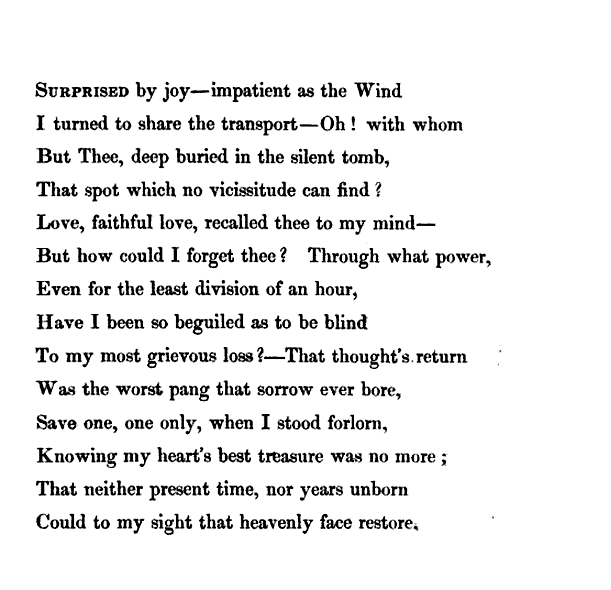
“Surprised by Joy” — William Wordsworth

Capture

Valar Morghulis

valar_morghulis_by_mustamirri-d519qyv

Arya Stark by Mustamirri/Anita. At deviantART; at tumblr.

“Nothing but Trouble” | Gordon Lish’s New Collection Goings Plays with the Problems of Language

20140115-151646.jpg

Ostensibly a collection of fictional short stories, Gordon Lish’s Goings reads more like a memoir-in-fragments. All thirteen stories are told by a first-person narrator named Gordon, who parenthetically appends an exclamatory repetition of his name (“I, Gordon (Gordon!)”) throughout the work, a verbal tic that registers the tension between the author and narrator, memory and truth. All these stories are in some way about memory and truth—and language, always language. Some of the tales are heavier on plot than others, although “heavier” is hardly the right modifier—let’s be honest—the plots here are thin, almost nonexistent: gestures, images, feelings—but that’s not why we read Gordon Lish, is it?

Opener “My Personal Memoir” sets the tone here, its title an honest ironic joke, I suppose. Old Gordon tells the story of young Gordon and his boyhood chums playing paddle-ball. A minor tragedy ensues. That’s pretty much the plot, but with Lish it’s really about the sentences, the memory behind the sentences, or maybe the inability of sentences to communicate the memories, or maybe just the failure of all of it—language, memory, truth—themes that carry through the collection in Lish’s (Lish’s!) often tortuous syntax.

In “Für Whom?”, Lish offers a sketch of his family, his boyhood piano lessons, his teacher, his competitive anxieties, his burgeoning lust:

Siblings, families—what else is there to say? Furthermore (I love that: the chance to flaunt it with echt balance), it was I whose fingers took up his arpeggios while his backside thrummed ever more thrummingly to a kind of low-register attunement to the propinquity of Miss Buggell’s same. Oh, the nearness of her ass (sirs, and madam, it was no rump, now was it?), all yearning angularities not infrequently settling itself within fractions of centimeters afar. I quote, of course. Yes, I, Gordon (Gordon!), aged seven, aged six, aged eight, hankered after that piano teacher as I have never since hankered after the person of a woman since.

In another strong story, “For My Mother, Reg, Dead in America,” Lish returns again to his parents, weaving them into a strange half-rant that moves from rutabagas to spelling to Kierkegaard to Grace Paley to lettuce. Like most of these stories, “For My Mother” is obsessed with its own telling (and the conditions that might authorize its telling). Its narrator tells us:

I don’t know. I don’t look anything up in any fucking dictionary. Who’s writing this? I’m writing this. The dictionary is not in any goddamn charge of this act of expression, or of this, if you please, scription. Even me, even I, even the author of this is barely in charge of it. Or of anything else. And you know why? Would you like to know fucking why? Because he does not fucking want to be—is that answership enough for you. Make sure you have mastered the spelling of your father’s name of of your mother’s name. Never refer to your mother as “Mom.” Never use the word “reference” as a verb. The same goes for “experience,” the word. Never start a sentence with the word “however.”

Lish’s narrator Gordon continues offering editorial advice, which I suppose we may take ironically or otherwise. In any case, the book is crammed with moments like these, little fits of our narrator’s (author’s?) doubt coupled with a commanding viewpoint on how language could, should, mean.

At least one (very funny) story, “Knowledge,” hangs entirely around Lish-as-editor—only this time, our Gordon isn’t cutting into Raymond Carver’s prose or tightening up some Barry Hannah. No, he’s tearing down a poorly-worded sign from a lamp post. Gordon (Gordon!), “for the decency of my community, for its bloody battered decency,” tears it down. The sign? — “WE ARE LOOKING FOR INFORMATION ABOUT THE MOTORCYCLE ACCIDENT THAT OCCURED THIS PAST SUNDAY IN THIS AREA. WE HIS FAMILY AND FRIENDS WANT TO FIND OUT WHAT HAPPENED.” There’s a story in there too, in that sign, but our narrator’s not interested in any human characters that the sign’s written characters, letters, might try to represent. The brilliance of the story: Lish leaves it to the reader to suss out the gap between the meaning of the sign—the information that it communicates—and the narrator’s critique of how that sign communicates.

“Avant La Lettre” offers another literary space for gaps to evince between reader, narrator, and author. Our narrator Gordon (Gordon!) tells us at the outset: “The title, pay it no mind. It does not apply. It does not appertain,” suggesting that he doesn’t even know what the phrase means, that it just came to him as he “sat down to tell you about a mystery (the vanishing of the man on the corner).” The immediate denial of a link between the meaning of the story’s title and the story’s content isutterly disingenuous, a clue really to the mystery here (more of a non-mystery, an anecdote at best). Lish pokes fun at the denial by repeatedly referencing literary theorists throughout the story: “(tell Barthes, tell Derrida, tell Badiou)” and then “Well name it and (tell Schopenhauer, tell Schelling, tell Spinoza or Freud) it dies.” The punch line to the story is too good to spoil here, but it can’t hurt to share part of the set-up. Lish writes (or Gordon (Gordon!) says):

Where’s in me anymore (in Gordon, in Gordon!) the discipline for the creation of the succession of elaborations, for the concatenation of the falsifications, for the accruing of the exhausting collocations?

I’m sad….Writing’s not the god of me.

Is writing not the god of you, speaker? And what is “Avant La Lettre” but a succession of elaborations, a concatenation of falsifications, an accrual of collocations?

“Avant La Lettre” admittedly requires from its reader a certain comfort with (or at least understanding of) postmodern literary theory; this is a story that casually (and of course not casually) references Alphonso Lingis and Julia Kristeva.

Other material here is less obscure (and more subtle) in its treatment of theory. “In the District, Into the Bargain” uses a chance meeting between widower Gordon and a widowed acquaintance to restage the central paradox of Rene Magritte’s painting The Treachery of Images (you know: “This is not a pipe”).  There’s also the oblique feminism of “Women Passing: O Mysterium!” and the semiotic play of “Troth.” This is all great stuff, or maybe not. I mean I loved it, lapped it up, but I’m the audience for this. I’m Lish’s (Gordon’s!) reader, the reader he addresses so directly in closer “Afterword.” Only I’m not—because “Afterword” is so clearly written to, spoken to Lish himself.

This literary solipsism, onanism, pick-your-ism is so not for everyone. Lish is a cult writer, and his performance here is appropriate to any aging (aged!) cult leader, one who’s painfully aware of how easy it is to point out a naked charlatan. The structure of Goings is something like I-see-you-seeing-me-seeing-myself-try-to-see-myself-etc. But the book is very funny, often painful, and downright moving at times, like in “Gnat,” where Lish shares a simple memory of trying on a new shirt for his wife, or the terror of “Speakage,” a two-page dialogue between young Gordon and his mother that begins “What is it, die?” The stories here are real—obscure, sure, difficult, yes, but also emotional, rewarding.

Goings In Thirteen Sittings is not the best starting place for anyone interested in Lish’s prose. This new book continues a project that will feel familiar to those who’ve read Self-Imitation of My Self, Epigraph, and My Romance, books that many critics felt were too insular, too inscrutable. New readers might do better to start with Mourner at the Door (although you can’t really lose in picking up Collected Fictions, which collects that book among others). I also highly recommend the Iambik recording of Lish reading selections from Collected Fictions. Hearing his intonation and rhythm totally changed how I read his prose, enriched my understanding of what he was doing and how he was doing it.

But the book accomplishes what it sets out to do, delivering on its two epigraphs. The second, ascribed to “Anon.” (another joke on Lish’s part, I think): “Mother! Father! Please!” The first is from a literary critic, but in its phrasing on the page it looks like a poem. In any case, it’s a fitting summary for Goings:

20140406-123125.jpg

Goings In Thirteen Sittings is available now from OR Books.

“Remembering The Tales of Hoffmann” — Robert Walser

“Remembering The Tales of Hoffmann”

by Robert Walser

I was living in the tranquility of rural, provincial isolation, in the flat countryside where fields and forests lie about motionless and mute, the plains and plots of land appear endless, broad wide regions often prove to be only narrow strips, and vast estates slumber peacefully one beside the other.

Brown, yellow, red autumnal foliage, fog that mysteriously wrapped the wintry earth in veils; large, wet, fat snowflakes tumbling down into a morning-dark courtyard, a white park covered in snow, a winter village with village lads and village women and geese in the village street—all this I had seen.

I’d seen a poor, sick, unhappy day laborer forgotten by all the world, lying in her squalid bed of sufferings; I heard her sighs.

Forests, hills, plains silent and wordless in the dull hush of the gleaming winter sun. Here and there a solitary person, an insignificant little word, an isolated sound.

One day I left all this remoteness and all this silence behind and set off for the seductive gleam of the capital, where soon thereafter I saw The Tales of Hoffmann at the Komische Oper.

I felt like an astonished hayseed amid all that gleaming intoxication, the graceful, sense-beguiling tumultuousness and the blindingly elegant society gathered there.

But when the interior of the grand edifice became as silent as a tiny chamber filled with reveries and fancies of the soul, as the might and art of sound opened their divine mouths and began to sing, ring out, and resound, beginning with the overture that wheedled its way into all our souls with its bright and dark, gay and earnest melodies, only to entwine them—now constricting, now liberating from constriction—with heavenly bliss, and then soft warm song burst from the lips of the singers and songstresses, images brimming with delicate, noble, magical colors and magical figures lightly and gaily emerged to delight the eye and taste, music and painting most beautifully took possession of every heart, eye, and ear, and everything became suddenly quiet as a mouse, only to resound once more as if it wished never to stop so beautifully resounding and conquering its listeners with its desired, delightful force: pain and sounds of joy mirroring the adventure of existence, exemplifying the meaning of life, and soaring up and down the scales like angelic figures ascending and descending Jacob’s ladder!

Oh, everything was so regally beautiful and luxurious all about our tear-filled, feverish eyes and in our hearts. All of life could now cease outright or else begin utterly anew.

What a presence to partake of! Thousands of hours flowed together to form this one single hour. Yes, what a beautiful, good, meaningful evening this was.