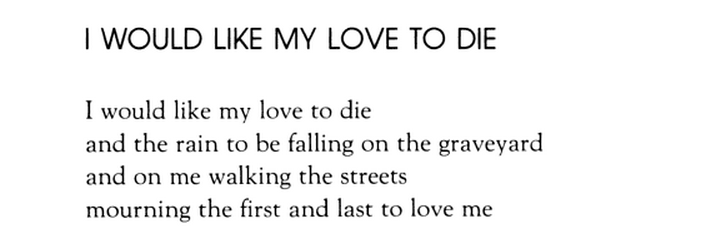
“I Would Like My Love To Die” — Samuel Beckett

Capture

“We Need Cruel Comedy” | A Lars Iyer Interview

I first interviewed Lars Iyer in 2011, after the publication of his novel Spurious, the beginning of a trilogy that concluded with Exodus (my favorite of the three). I asked Lars to talk with me about his trilogy for an email interview, and we ended up discussing failure, comedy, optimism, academia, American writing, Britain in the mid-eighties, and his forthcoming novel Wittgenstein Jr.

You can get Lars Iyer’s trilogy from publisher Melville House, check out his blog, and find him on Twitter.

Biblioklept: Why a trilogy? Was that by design? Is it a trilogy?

Lars Iyer: Spurious was only a beginning. I wanted to historicise my characters, to present their friendship as part of a larger social, economic and political context. Otherwise, I risked merely contributing belatedly to the literature of the absurd.

Biblioklept: I want to talk about the end of Exodus but that seems like bad form for an interview. Spoilers, etc. Can you comment on where you leave your protagonists, or how you leave them, or why you leave them?

LI: I leave my protagonists roughly where they were at the beginning of the trilogy: rudderless, rather lost, full of a sense of their failure, but with their friendship, such as it is, intact. ‘No hugs, no lessons’: my characters haven’t learned anything…

larsBiblioklept: Why can’t they learn? Why the repetition? Why not a heroic arc? Why not a saving grace?

LI: Perhaps because learning implies a kind of resolution that I think is inappropriate for the characters. Kundera says something apposite about Don Quixote. Cervantes makes his would-be knight-errant set off in search of battles, ready to sacrifice his life for a noble cause, ‘but tragedy doesn’t want him’. Kundera goes on:

since its birth, the novel is suspicious of tragedy: of its cult of grandeur; of its theatrical origins; of its blindness to the prose of life. Poor Alonzo Quijada. In the vicinity of his mournful countenance, everything turns into comedy.

So it is with my trilogy. No tragedy! No heroism! No tragic catharsis, that would see the tragic hero being dragged back into line. And no comic catharsis either, in which the older norms of a traditional societal system are reaffirmed. So much comedy is self-congratulatory, self-reassuring: the humour of good cheer, of port and cigars. It shores up things as they are. This is why I can never bear to watch comedy on television. It’s so rare to see comedians turn the joke on themselves. We need cruel comedy. Black comedy, which laughs at itself laughing…

Why the use of repetition in my novels? Because I want to portray the breakdown of things as they are, not once, but again and again. Failure, without amelioration. Serio-comic breakdown, without restitution. Anomie. Helplessness. Crushed hope. How else to acknowledge the prose of our lives?

Much of the humour of Don Quixote, depends on the contrast between lofty ideals and the concrete, everyday, corporeal life. The humour of my trilogy is analogous – but, of course, our everyday is utterly changed! A generalised precarity, un- and under-employment, free-floating anxiety, consumerism, the emphasis on self-representation, the sense that history is over, that politics is all played out, that financial and climatic catastrophe loom…

The tragedy of everyday life is that it’s not even tragic. It never reaches the lofty heights of tragic grandeur. Well, nor do my characters. When W. is at his most wretched, he cannot even die – that’s the end of Dogma. When W. is at his most revolutionary, participating in his own version of the Occupy movement, as at the end of Exodus … well, I won’t spoil the story, but it won’t surprise readers of previous books in the trilogy that there is neither a heroic arc nor a saving grace. Continue reading ““We Need Cruel Comedy” | A Lars Iyer Interview”

Pool of Tears 2 (After Lewis Carroll) — Kiki Smith

The Essential Short Stories of J.G. Ballard

jgb_complete_ss4003111

I. “Manhole 69” (1957)

II. “Chronopolis” (1960)

III.  “The Voices of Time” (1960)

IV. “The Overloaded Man” (1961)

V. “Billennium” (1961)

VI. “Thirteen to Centaurus” (1962)

VII. “The Subliminal Man” (1963)

VIII. “End-Game” (1963)

IX. “Time of Passage” (1964)

X. “The Lost Leonardo” (1964)

XI. “The Terminal Beach” (1964)

XII. “The Drowned Giant” (1964)

XIII. “The Beach Murders” (1966)

XIV.  “The Assassination of John Fitzgerald Kennedy Considered as a Downhill Motor Race” (1966)

XV. “Why I Want to Fuck Ronald Reagan” (1968)

XVI. “Notes Towards a Mental Breakdown” (1976)

XVII. “The Index” (1977)

XVIII. “The Dead Time” (1977)

XIX. “News from the Sun” (1981)

XX. “Myths of the Near Future” (1982)

XXI. “Memories of the Space Age” (1982)

XXII. “Answers to a Questionnaire” (1985)

XXIII. “A Guide to Virtual Death” (1992)

At 1200 pages and just under 100 stories, The Complete Short Stories is frankly too complete—but I read them all anyway. The list above is my suggestion for a volume I’d call The Essential Short Stories of J.G. Ballard. Each selection on the list is linked to a riff I wrote; in several cases, links to the full text of the story can be found at the riff.

Beware

beware

“How to recognize a work of art” (Roberto Bolaño on translation)

How to recognize a work of art? How to separate it, even if just for a moment, from its critical apparatus, its exegetes, its tireless plagiarizers, its belittlers, its final lonely fate? Easy. Let it be translated. Let its translator be far from brilliant. Rip pages from it at random. Leave it lying in an attic. If after all of this a kid comes along and reads it, and after reading makes it his own, and is faithful to it (or unfaithful, whichever) and reinterprets it and accompanies it on its  voyage to the edge, and both are enriched and the kid adds an ounce of value to its original value, then we have something before us, a machine or a book, capable of speaking to all human beings; not a plowed field but a mountain, not the image of a dark forest but the dark forest, not a flock of birds but the Nightingale.

From Roberto Bolaño’s essay “Translation Is an Anvil” (collected in Between Parentheses).

New in Translation from New Vessel Press (Books Acquired Some Time Earlier This Month)

20140313-175305.jpg

Some handsome titles from indie New Vessel Press:

First, Marek Hlasko’s Killing the Second Dog (translation by Tomaasz Mirkowicz). Blurb:

Robert and Jacob are two down-and-out Polish con men living in Israel in the early 1960s. They’re planning to run a scam on an American widow visiting the country. Robert, who masterminds the scheme, and Jacob who acts it out, are tough, desperate men, exiled from their native land and adrift in the hot, nasty underworld of Tel Aviv. Robert arranges for Jacob to run into the woman, who has enough trouble with her young son to keep her occupied all day. Her heart is open though, and the men are hoping her wallet is too. What follows is a story of love, deception, cruelty and shame, as Jacob pretends to fall in love with the American. But it’s not just Jacob who seems to be performing a role; nearly all the characters are actors in an ugly story, complete with parts for murder and suicide. Hlasko’s writing combines brutal realism with smoky, hardboiled dialogue, in a bleak world where violence is the norm and love is often only an act.

I’m gonna crack into this one next week.

The Good Life Elsewhere by Vladimir Lorchenkov (translation by Ross Ufberg):

The Good Life Elsewhere is a very funny book. It is also a very sad one. Moldovan writer Vladimir Lorchenkov tells the story of a group of villagers and their tragicomic efforts, against all odds and at any cost, to emigrate from Europe’s most impoverished nation to Italy for work. This is a book with wild imagination and heartbreaking honesty, grim appraisals alongside optimistic commentary about the nature of human striving. In Lorchenkov’s uproarious tale, an Orthodox priest is deserted by his wife for an art-dealing atheist; a rookie curling team makes it to an international competition; a mechanic redesigns his tractor for travel by air and sea; thousands of villagers take to the road on a modern-day religious crusade to make it to the promised land of Italy; meanwhile, politicians remain politicians. Like many great satirists from Voltaire to Gogol to Vonnegut, Lorchenkov makes use of the grotesque to both horrify us and help us laugh. It is not often that stories from forgotten countries such as Moldova reach us in the English-speaking world. A country where 25 percent of its population works abroad, where remittances make up nearly 40 percent of the GDP, where alcohol consumption per capita is the highest in the world, and which has the lowest per capita income in all of Europe – this is a country that surely has its problems. But, as Lorchenkov vividly shows, it’s a country whose residents don’t easily give up.

“I Am in Danger—Sir—” — Adrienne Rich

“I Am in Danger—Sir—” by Adrienne Rich

“Half-cracked” to Higginson, living,
afterward famous in garbled versions,
your hoard of dazzling scraps a battlefield,
now your old snood

mothballed at Harvard
and you in your variorum monument
equivocal to the end—
who are you?

you, woman, masculine
in single-mindedness,
for whom the word was more
than a symptom—

a condition of being.
Till the air buzzing with spoiled language
sang in your ears
of Perjury

and in your half-cracked way you chose
silence for entertainment,
chose to have it out at last
on your own premises.

I Never Stopped Loving You — Chris Ware

“The Executor” — Muriel Spark

“The Executor”

by

Muriel Spark

When my uncle died all the literary manuscripts went to a university foundation, except one. The correspondence went too, and the whole of his library. They came (a white-haired man and a young girl) and surveyed his study. Everything, they said, would be desirable and it would make a good price if I let the whole room go – his chair, his desk, the carpet, even his ashtrays. I agreed to this. I left everything in the drawers of the desk just as it was when my uncle died, including the bottle of Librium and a rusty razor blade.

My uncle died this way: he was sitting on the bank of the river, playing a fish. As the afternoon faded a man passed by, and then a young couple who made pottery passed him. As they said later, he was sitting peacefully awaiting the catch and of course they didn’t disturb him. As night fell the colonel and his wife passed by; they were on their way home from their daily walk. They knew it was too late for my uncle to be simply sitting there, so they went to look. He had been dead, the doctor pronounced, from two to two and a half hours. The fish was still struggling with the bait. It was a mild heart attack. Everything my uncle did was mild, so different from everything he wrote. Yet perhaps not so different. He was supposed to be “far out”, so one didn’t know what went on out there. Besides, he had not long returned from a trip to London. They say, still waters run deep. Continue reading ““The Executor” — Muriel Spark”

Sad Postcard in a Sad Book (Gass/Pancake)

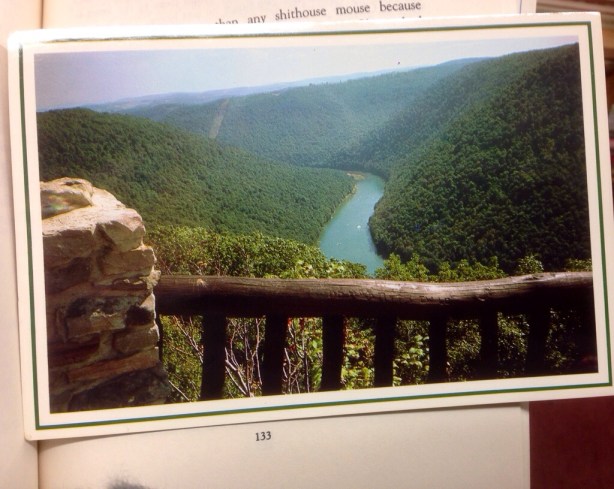
20140311-143226.jpg

A book, you would think, is not a pocket, a purse, or a wastebasket, but people dispose of their sniffle-filled Kleenex between unexposed pages, their toothpicks, too, dirty where they’ve gripped them while cleaning their teeth—such in-decency—matchbooks with things written on the underside of the flap, usually numbers, of telephones, I suppose; or they leave paper clips and big flat mother-of-pearl buttons—imagine—curls of hair and all sorts of receipts as well as other slips of paper they’ve used to mark the spot where they stopped; and they file correspondence between leaves as if a book were a slide drawer—do they do that to their own books?—or they tuck snapshots, postcards, unused stamps, into them, now and then a pressed bloom—they stain, I’ve seen leaf shadows—one- to five- to ten-dollar bills, you’d never guess, yes, rubber bands, a shoelace, candy and gum wrappers—even their chewed gum that I have to pry out with a putty knife—people—people—I dee-clare—and newspaper clippings, often the author’s reviews, that are among the worst intruders because in time they’ll sulfur the pages where they’ve been compressed the way people who fall asleep on the grass of a summer morning leave their prints for the use of sorcerers like me to make our magic.

–From William H. Gass’s novel  Middle C.

I leave stuff in books all the time. In fact, I almost always leave something (a movie stub, a photo, a note, a picture my son or daughter drew, something) in each book I finished.  (I even wrote about it a bit last year). So I guess Miss Moss, the old librarian in Gass’s Middle C, would be royally pissed with my habits. I read this passage a day or two after a visit to my favorite used bookstore, where, looking for books by Grace Paley, I came across an uncracked copy of Breece D’J. Pancake’s super sad super terrific collected stories. I own the book, but in a different edition (fox on the cover), so I grabbed it out. Lo and behold, a postcard!–and of a scene straight out of Pancake’s own semi-beloved West Virginia, no less! The note, a token of friendship, accompanied an inscription in the book itself—is there anything sadder than an inscribed book abandoned to a used bookstore?

I left the book, postcard in it, easily resisting the initial temptation to slide it into one of the Paley volumes. Destined for another reader.

20140311-143234.jpg

“Two Cures for Love” — Wendy Cope

Capture

“Hubert and Minnie” — Aldous Huxley

“Hubert and Minnie”

by

Aldous Huxley

For Hubert Lapell this first love-affair was extremely important. “Important” was the word he had used himself when he was writing about it in his diary. It was an event in his life, a real event for a change. It marked, he felt, a genuine turning-point in his spiritual development.

“Voltaire,” he wrote in his diary – and he wrote it a second time in one of his letters to Minnie – “Voltaire said that one died twice: once with the death of the whole body and once before, with the death of one’s capacity to love. And in the same way one is born twice, the second time being on the occasion when one first falls in love. One is born, then, into a new world – a world of intenser feelings, heightened values, more penetrating insights.” And so on.

In point of actual fact Hubert found this new world a little disappointing. The intenser feelings proved to be rather mild not by any means up to literary standards.

“I tell thee I am mad
In Cressid’s love. Thou answer’st; she is fair,
Pour’st in the open ulcer of my heart
Her eyes, her hair, her cheek, her gait, her voice….”

No, it certainly wasn’t quite that. In his diary, in his letters to Minnie, he painted, it is true, a series of brilliant and romantic landscapes of the new world. But they were composite imaginary landscapes in the manner of Salvator Rosa – richer, wilder, more picturesquely clear-obscure than the real thing. Hubert would seize with avidity on the least velleity of an unhappiness, a physical desire, a spiritual yearning, to work it up in his letters and journals into something substantially romantic. There were times, generally very late at night, when he succeeded in persuading himself that he was indeed the wildest, unhappiest, most passionate of lovers. But in the daytime he went about his business nourishing something like a grievance against love. The thing was a bit of a fraud; yes, really, he decided, rather a fraud. All the same, he supposed it was important. Continue reading ““Hubert and Minnie” — Aldous Huxley”

“Scolds, schlemiels, schnorrers, schnooks, schmucks, schlumps…” (William H. Gass)

When young and full of fellow feeling, Professor Joseph Skizzen had been tormented by the thought that the human race (which he naïvely believed was made up of great composers, a few harmlessly lecherous painters, maybe a mathematician or a scientist, a salon of writers, all aiming at higher things however they otherwise carried on) … that such an ennobled species might not prosper, indeed, might not survive in any serious way—symphonies sinking like torpedoed ships, murals spray-canned out of sight, statues toppled, books burned, plays updated by posturing directors; but now, older, wiser—more jaundiced, it’s true—he worried that it might (now that he saw that the human world was packed with politicians who could not even spell “scruple”; now that he saw that it was crammed with commercial types who adored only American money; now that he saw how it had been overrun by religious stupefiers, mountebanks, charlatans, obfuscators, and other dedicated misleaders, as well as corrupt professionals of all kinds—ten o’clock scholars, malpracticing doctors, bribed judges, sleepy deans, callous munitions makers and their pompous generals, pedophilic priests, but probably not pet lovers, not arborists, not gardeners—but Puritans, squeezers, and other assholes, ladies bountiful, ladies easy, shoppers diligent, lobbyists greedy, Eagle Scouts, racist cops, loan sharks, backbiters, gun runners, spies, Judases, philistines, vulgarians, dumbbells, dolts, boobs, louts, jerks, jocks, creeps, yokels, cretins, simps, pipsqueaks—not a mensch among them—nebbechs, scolds, schlemiels, schnorrers, schnooks, schmucks, schlumps, dummkopfs, potato heads, klutzes, not to omit pushers, bigots, born-again Bible bangers, users, conmen, ass kissers, Casanovas, pimps, thieves and their sort, rapists and their kind, murderers and their ilk—the pugnacious, the miserly, the envious, the litigatious, the avaricious, the gluttonous, the lubricious, the jealous, the profligate, the gossipacious, the indifferent, the bored), well, now that he saw it had been so infested, he worried that the race might … might what? … the whole lot might sail on through floods of their own blood like a proud ship and parade out of the new Noah’s ark in the required pairs—for breeding, one of each sex—sportscasters, programmers, promoters, polluters, stockbrokers, bankers, body builders, busty models, show hosts, stamp and coin collectors, crooners, glamour girls, addicts, gamblers, shirkers, solicitors, opportunists, insatiable developers, arrogant agents, fudging accountants, yellow journalists, ambulance chasers and shysters of every sleazy pursuit, CEOs at the head of a whole column of white-collar crooks, psychiatrists, osteopaths, snake oilers, hucksters, fawners, fans of funerals, fortune-tellers and other prognosticators, road warriors, chieftains, Klansmen, Shriners, men and women of any cloth and any holy order—at every step moister of cunt and stiffer of cock than any cock or cunt before them, even back when the world was new, now saved and saved with spunk enough to couple and restock the pop … the pop … the goddamn population.

From William H. Gass’s novel Middle C.

“People brutalise everything” (Thomas Bernhard)

People brutalise everything. They get up noisily, go about noisily all day, and go to bed noisily. And they constantly talk far too noisily. They are so taken up with themselves that they don’t notice the distress they constantly cause to others, to those who are sick. Everything they do, everything they say causes distress to people like us. And in this way they force anyone who is sick more and more into the background until he’s no longer noticed. And the sick person withdraws into his background. But every life, every existence, belongs to one person and one person only, and no one else has the right to force this life and this existence to one side, to force it out of the way, to force it out of existence. We’ll go by ourselves, as we have the right to do. That’s part of the natural course.

From Thomas Bernhard’s novel Concrete.

“Wants” — Grace Paley

“Wants”

by

Grace Paley

I saw my ex-husband in the street. I was sitting on the steps of the new library.

Hello, my life, I said. We had once been married for twenty-seven years, so I felt justified.

He said, What? What life? No life of mine.

I said, O.K. I don’t argue when there’s real disagreement. I got up and went into the library to see how much I owed them.
The librarian said $32 even and you’ve owed it for eighteen years. I didn’t deny anything. Because I don’t understand how time passes. I have had those books. I have often thought of them. The library is only two blocks away.

My ex-husband followed me to the Books Returned desk. He interrupted the librarian, who had more to tell. In many ways, he said, as I look back, I attribute the dissolution of our marriage to the fact that you never invited the Bertrams to dinner.

That’s possible, I said. But really, if you remember: first, my father was sick that Friday, then the children were born, then I had those Tuesday-night meetings, then the war began.Then we didn’t seem to know them any more. But you’re right. I should have had them to dinner.

I gave the librarian a check for $32. Immediately she trusted me, put my past behind her, wiped the record clean, which is just what most other municipal and/or state bureaucracies will not do.

I checked out the two Edith Wharton books I had just returned because I’d read them so long ago and they are more apropos now than ever. They were The House of Mirth and The Children, which is about how life in the United States in New York changed in twenty-seven years fifty years ago.

A nice thing I do remember is breakfast, my ex-husband said. I was surprised. All we ever had was coffee. Then I remembered there was a hole in the back of the kitchen closet which opened into the apartment next door. There, they always ate sugar-cured smoked bacon. It gave us a very grand feeling about breakfast, but we never got stuffed and sluggish.

That was when we were poor, I said.

When were we ever rich? he asked.

Oh, as time went on, as our responsibilities increased, we didn’t go in need. You took adequate financial care, I reminded him. The children went to camp four weeks a year and in decent ponchos with sleeping bags and boots, just like everyone else. They looked very nice. Our place was warm in winter, and we had nice red pillows and things.

I wanted a sailboat, he said. But you didn’t want anything.

Don’t be bitter, I said. It’s never too late.

No, he said with a great deal of bitterness. I may get a sailboat. As a matter of fact I have money down on an eighteen-foot two-rigger. I’m doing well this year and can look forward to better. But as for you, it’s too late. You’ll always want nothing.

He had had a habit throughout the twenty-seven years of making a narrow remark which, like a plumber’s snake, could work its way through the ear down the throat, half-way to my heart. He would then disappear, leaving me choking with equipment. What I mean is, I sat down on the library steps and he went away.

I looked through The House of Mirth, but lost interest. I felt extremely accused. Now, it’s true, I’m short of requests and absolute requirements. But I do want something.
I want, for instance, to be a different person. I want to be the woman who brings these two books back in two weeks. I want to be the effective citizen who changes the school system and addresses the Board of Estimate on the troubles of this dear urban center.

I had promised my children to end the war before they grew up.

I wanted to have been married forever to one person, my ex-husband or my present one. Either has enough character for a whole life, which as it turns out is really not such a long time. You couldn’t exhaust either man’s qualities or get under the rock of his reasons in one short life.

Just this morning I looked out the window to watch the street for a while and saw that the little sycamores the city had dreamily planted a couple of years before the kids were born had come that day to the prime of their lives.

Well! I decided to bring those two books back to the library. Which proves that when a person or an event comes along to jolt or appraise me I can take some appropriate action, although I am better known for my hospitable remarks.

“Oscar Wilde” — Dorothy Parker

oscar wilde