James Wood’s The Fun Stuff Reviewed

20131013-093435.jpg

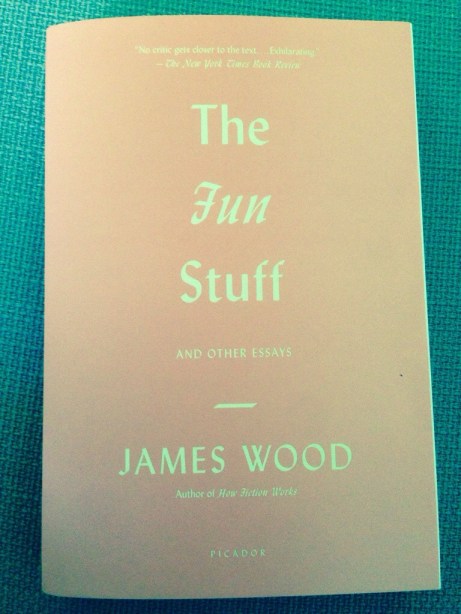
I hate that I love to hate reading James Wood—and when I love what he writes I hate that I love it. His take on Blood Meridian absolutely infuriated me, but a stray line from an essay he wrote on Virginia Woolf has informed pretty much every real review I’ve tried to write since I read it. Anyone who reads deeply and earnestly and cares about literary criticism is likely to find themselves shouting at Wood, and then maybe agreeing with him—with reserved qualifications, and then shouting again. (There is an entire blog devoted to pointing out the failures of Wood’s often deeply conservative aesthetic criticism, by the way).

The Fun Stuff, collecting many of Wood’s pieces from The New Yorker (but also elsewhere), is less pretentious than How Fiction Works, Wood’s last book, a polemic hiding behind the guise of literary criticism that faulted pretty much any prose stylist who deviated from a certain mode of 19th-century free indirect style.

I’ve already read a number of the pieces collected in The Fun Stuff, which is finally out in the U.S. in trade paperback thanks to Picador. You might have read them too. His essays championing Lydia Davis and László Krasznahorkai are fine fun stuff, as is his take on the late W.G. Sebald (first published as an introduction to Austerlitz). His appreciative review of Cormac McCarthy’s The Road though is in many ways a retake on his review of Blood Meridian—Wood can only view McCarthy’s existential questions through the lens of theodicy.

James Wood is maybe most fun—or most infuriating—when he’s at his harshest. The case file here is his pointed take-down “Paul Auster’s Shallowness.” Here, Wood goes through an Auster plot “checklist”:

 A protagonist, nearly always male, often a writer or an intellectual, lives monkishly, coddling a loss—a deceased or divorced wife, dead children, a missing brother. Violent accidents perforate the narratives, both as a means of insisting on the contingency of existence and as a means of keeping the reader reading—a woman drawn and quartered in a German concentration camp, a man beheaded in Iraq, a woman severely beaten by a man with whom she is about to have sex, a boy kept in a darkened room for nine years and periodically beaten, a woman accidentally shot in the eye, and so on. The narratives conduct themselves like realistic stories, except for a slight lack of conviction and a general B-movie atmosphere. People say things like “You’re one tough cookie, kid,” or “My pussy’s not for sale,” or “It’s an old story, pal. You let your dick do your thinking for you, and that’s what happens.” A visiting text—Chateaubriand, Rousseau, Hawthorne, Poe, Beckett—is elegantly slid into the host book. There are doubles, alter egos, doppelgängers, and appearances by a character named Paul Auster. At the end of the story, the hints that have been scattered like mouse droppings lead us to the postmodern hole in the book where the rodent got in: the revelation that some or all of what we have been reading has probably been imagined by the protagonist. Hey, Roger Phaedo invented Charlie Dark! It was all in his head.

I’m not a particular fan of Paul Auster, but I imagine those who deeply enjoy his work could feel personally insulted by Wood’s take-down. We get close to the books and authors we love. I think what manifests most in Wood’s criticism here—and elsewhere—is the weariness of someone who once deeply loved literature but who is now perhaps oppressed by it—who has become too aware of its mechanics, its forms, its stale formulations and bad parlor tricks.

Wood telegraphs far more passion and generosity in the collection’s title essay, which is about Keith Moon, the legendary drummer of The Who. He compares Moon’s rhythmic chops to D.H. Lawrence’s sentences:

For me, this playing is like an ideal sentence of prose, a sentence I have always wanted to write and never quite had the confidence to: a long, passionate onrush, formally controlled and joyously messy, propulsive but digressively self-interrupted, attired but disheveled, careful and lawless, right and wrong. (You can encounter such sentences in Lawrence’s prose, in Bellow’s, sometimes in David Foster Wallace’s.) Such a sentence would be a breaking out, an escape. And drumming has always represented for me that dream of escape, when the body forgets itself, surrenders its awful self-consciousness.

I like how personal he gets here. This essay opens the collection, and the one that closes it, “Packing My Father-In-Law’s Library” also communicates personally with the reader. Unconstrained by the pretense of a book review, Wood waxes on families and libraries and the meaning of life. When he writes of his father-in-law, whose books he’s sorting through, that “The books somehow made him smaller, not larger,” it’s hard not to hear a strong undertone of autobiography in the note.

Wood’s lyric essays are an unusual standout here (unusual in the sense that if someone had strung together the words James Wood’s lyric essays, I’d probably roll my eyes). They reveal a love of reading that goes missing in his attacks and his quibbling pieces. The serious literary critic is not, of course, beholden to being merely a cheerleader for literature (or worse, a cheerleader for publishing)—but I do think that the serious literary critic should offer something beyond condemnation or unenthusiastic grumbling. The risk the professional critic runs is to see the machinations of art too plainly, to become jaded to the point that experiencing the sublime is no longer possible (Tobias Wolff’s fantastic story “Bullet in the Brain” deals handily with this theme). Wood guides us here to several writers who disrupt, estrange, and resynthesize the tired tropes of literary fiction—and it’s in that strangeness where we can find the real fun stuff.

“The Mermaid Wife,” A Legend of Scotland

“The Mermaid Wife”

From Folk-Lore and Legends of Scotland (1889)

A story is told of an inhabitant of Unst, who, in walking on the sandy margin of a voe, saw a number of mermen and mermaids dancing by moonlight, and several seal-skins strewed beside them on the ground.  At his approach they immediately fled to secure their garbs, and, taking upon themselves the form of seals, plunged immediately into the sea.  But as the Shetlander perceived that one skin lay close to his feet, he snatched it up, bore it swiftly away, and placed it in concealment.  On returning to the shore he met the fairest damsel that was ever gazed upon by mortal eyes, lamenting the robbery, by which she had become an exile from her submarine friends, and a tenant of the upper world.  Vainly she implored the restitution of her property; the man had drunk deeply of love, and was inexorable; but he offered her protection beneath his roof as his betrothed spouse.  The merlady, perceiving that she must become an inhabitant of the earth, found that she could not do better than accept of the offer.  This strange attachment subsisted for many years, and the couple had several children.  The Shetlander’s love for his merwife was unbounded, but his affection was coldly returned.  The lady would often steal alone to the desert strand, and, on a signal being given, a large seal would make his appearance, with whom she would hold, in an unknown tongue, an anxious conference.  Years had thus glided away, when it happened that one of the children, in the course of his play, found concealed beneath a stack of corn a seal’s skin; and, delighted with the prize, he ran with it to his mother.  Her eyes glistened with rapture—she gazed upon it as her own—as the means by which she could pass through the ocean that led to her native home.  She burst forth into an ecstasy of joy, which was only moderated when she beheld her children, whom she was now about to leave; and, after hastily embracing them, she fled with all speed towards the sea-side.  The husband immediately returned, learned the discovery that had taken place, ran to overtake his wife, but only arrived in time to see her transformation of shape completed—to see her, in the form of a seal, bound from the ledge of a rock into the sea.  The large animal of the same kind with whom she had held a secret converse soon appeared, and evidently congratulated her, in the most tender manner, on her escape.  But before she dived to unknown depths, she cast a parting glance at the wretched Shetlander, whose despairing looks excited in her breast a few transient feelings of commiseration.

“Farewell!” said she to him, “and may all good attend you.  I loved you very well when I resided upon earth, but I always loved my first husband much better.”

“Leda and the Swan” — W.B. Yeats

leda

“She” — Tom Clark

she

“Eleonora” — Edgar Allan Poe

“Eleonora” by Edgar Allan Poe

I AM come of a race noted for vigor of fancy and ardor of passion. Men have called me mad; but the question is not yet settled, whether madness is or is not the loftiest intelligence—whether much that is glorious—whether all that is profound—does not spring from disease of thought—from moods of mind exalted at the expense of the general intellect. They who dream by day are cognizant of many things which escape those who dream only by night. In their gray visions they obtain glimpses of eternity, and thrill, in awakening, to find that they have been upon the verge of the great secret. In snatches, they learn something of the wisdom which is of good, and more of the mere knowledge which is of evil. They penetrate, however, rudderless or compassless into the vast ocean of the “light ineffable,” and again, like the adventures of the Nubian geographer, “agressi sunt mare tenebrarum, quid in eo esset exploraturi.”

We will say, then, that I am mad. I grant, at least, that there are two distinct conditions of my mental existence—the condition of a lucid reason, not to be disputed, and belonging to the memory of events forming the first epoch of my life—and a condition of shadow and doubt, appertaining to the present, and to the recollection of what constitutes the second great era of my being. Therefore, what I shall tell of the earlier period, believe; and to what I may relate of the later time, give only such credit as may seem due, or doubt it altogether, or, if doubt it ye cannot, then play unto its riddle the Oedipus.

She whom I loved in youth, and of whom I now pen calmly and distinctly these remembrances, was the sole daughter of the only sister of my mother long departed. Eleonora was the name of my cousin. We had always dwelled together, beneath a tropical sun, in the Valley of the Many-Colored Grass. No unguided footstep ever came upon that vale; for it lay away up among a range of giant hills that hung beetling around about it, shutting out the sunlight from its sweetest recesses. No path was trodden in its vicinity; and, to reach our happy home, there was need of putting back, with force, the foliage of many thousands of forest trees, and of crushing to death the glories of many millions of fragrant flowers. Thus it was that we lived all alone, knowing nothing of the world without the valley—I, and my cousin, and her mother.

From the dim regions beyond the mountains at the upper end of our encircled domain, there crept out a narrow and deep river, brighter than all save the eyes of Eleonora; and, winding stealthily about in mazy courses, it passed away, at length, through a shadowy gorge, among hills still dimmer than those whence it had issued. We called it the “River of Silence”; for there seemed to be a hushing influence in its flow. No murmur arose from its bed, and so gently it wandered along, that the pearly pebbles upon which we loved to gaze, far down within its bosom, stirred not at all, but lay in a motionless content, each in its own old station, shining on gloriously forever.

The margin of the river, and of the many dazzling rivulets that glided through devious ways into its channel, as well as the spaces that extended from the margins away down into the depths of the streams until they reached the bed of pebbles at the bottom,—these spots, not less than the whole surface of the valley, from the river to the mountains that girdled it in, were carpeted all by a soft green grass, thick, short, perfectly even, and vanilla-perfumed, but so besprinkled throughout with the yellow buttercup, the white daisy, the purple violet, and the ruby-red asphodel, that its exceeding beauty spoke to our hearts in loud tones, of the love and of the glory of God.

And, here and there, in groves about this grass, like wildernesses of dreams, sprang up fantastic trees, whose tall slender stems stood not upright, but slanted gracefully toward the light that peered at noon-day into the centre of the valley. Their mark was speckled with the vivid alternate splendor of ebony and silver, and was smoother than all save the cheeks of Eleonora; so that, but for the brilliant green of the huge leaves that spread from their summits in long, tremulous lines, dallying with the Zephyrs, one might have fancied them giant serpents of Syria doing homage to their sovereign the Sun.

Hand in hand about this valley, for fifteen years, roamed I with Eleonora before Love entered within our hearts. It was one evening at the close of the third lustrum of her life, and of the fourth of my own, that we sat, locked in each other’s embrace, beneath the serpent-like trees, and looked down within the water of the River of Silence at our images therein. We spoke no words during the rest of that sweet day, and our words even upon the morrow were tremulous and few. We had drawn the God Eros from that wave, and now we felt that he had enkindled within us the fiery souls of our forefathers. The passions which had for centuries distinguished our race, came thronging with the fancies for which they had been equally noted, and together breathed a delirious bliss over the Valley of the Many-Colored Grass. A change fell upon all things. Strange, brilliant flowers, star-shaped, burn out upon the trees where no flowers had been known before. The tints of the green carpet deepened; and when, one by one, the white daisies shrank away, there sprang up in place of them, ten by ten of the ruby-red asphodel. And life arose in our paths; for the tall flamingo, hitherto unseen, with all gay glowing birds, flaunted his scarlet plumage before us. The golden and silver fish haunted the river, out of the bosom of which issued, little by little, a murmur that swelled, at length, into a lulling melody more divine than that of the harp of Aeolus-sweeter than all save the voice of Eleonora. And now, too, a voluminous cloud, which we had long watched in the regions of Hesper, floated out thence, all gorgeous in crimson and gold, and settling in peace above us, sank, day by day, lower and lower, until its edges rested upon the tops of the mountains, turning all their dimness into magnificence, and shutting us up, as if forever, within a magic prison-house of grandeur and of glory.

The loveliness of Eleonora was that of the Seraphim; but she was a maiden artless and innocent as the brief life she had led among the flowers. No guile disguised the fervor of love which animated her heart, and she examined with me its inmost recesses as we walked together in the Valley of the Many-Colored Grass, and discoursed of the mighty changes which had lately taken place therein.

At length, having spoken one day, in tears, of the last sad change which must befall Humanity, she thenceforward dwelt only upon this one sorrowful theme, interweaving it into all our converse, as, in the songs of the bard of Schiraz, the same images are found occurring, again and again, in every impressive variation of phrase.

She had seen that the finger of Death was upon her bosom—that, like the ephemeron, she had been made perfect in loveliness only to die; but the terrors of the grave to her lay solely in a consideration which she revealed to me, one evening at twilight, by the banks of the River of Silence. She grieved to think that, having entombed her in the Valley of the Many-Colored Grass, I would quit forever its happy recesses, transferring the love which now was so passionately her own to some maiden of the outer and everyday world. And, then and there, I threw myself hurriedly at the feet of Eleonora, and offered up a vow, to herself and to Heaven, that I would never bind myself in marriage to any daughter of Earth—that I would in no manner prove recreant to her dear memory, or to the memory of the devout affection with which she had blessed me. And I called the Mighty Ruler of the Universe to witness the pious solemnity of my vow. And the curse which I invoked of Him and of her, a saint in Helusion should I prove traitorous to that promise, involved a penalty the exceeding great horror of which will not permit me to make record of it here. And the bright eyes of Eleonora grew brighter at my words; and she sighed as if a deadly burthen had been taken from her breast; and she trembled and very bitterly wept; but she made acceptance of the vow, (for what was she but a child?) and it made easy to her the bed of her death. And she said to me, not many days afterward, tranquilly dying, that, because of what I had done for the comfort of her spirit she would watch over me in that spirit when departed, and, if so it were permitted her return to me visibly in the watches of the night; but, if this thing were, indeed, beyond the power of the souls in Paradise, that she would, at least, give me frequent indications of her presence, sighing upon me in the evening winds, or filling the air which I breathed with perfume from the censers of the angels. And, with these words upon her lips, she yielded up her innocent life, putting an end to the first epoch of my own.

Thus far I have faithfully said. But as I pass the barrier in Time’s path, formed by the death of my beloved, and proceed with the second era of my existence, I feel that a shadow gathers over my brain, and I mistrust the perfect sanity of the record. But let me on.—Years dragged themselves along heavily, and still I dwelled within the Valley of the Many-Colored Grass; but a second change had come upon all things. The star-shaped flowers shrank into the stems of the trees, and appeared no more. The tints of the green carpet faded; and, one by one, the ruby-red asphodels withered away; and there sprang up, in place of them, ten by ten, dark, eye-like violets, that writhed uneasily and were ever encumbered with dew. And Life departed from our paths; for the tall flamingo flaunted no longer his scarlet plumage before us, but flew sadly from the vale into the hills, with all the gay glowing birds that had arrived in his company. And the golden and silver fish swam down through the gorge at the lower end of our domain and bedecked the sweet river never again. And the lulling melody that had been softer than the wind-harp of Aeolus, and more divine than all save the voice of Eleonora, it died little by little away, in murmurs growing lower and lower, until the stream returned, at length, utterly, into the solemnity of its original silence. And then, lastly, the voluminous cloud uprose, and, abandoning the tops of the mountains to the dimness of old, fell back into the regions of Hesper, and took away all its manifold golden and gorgeous glories from the Valley of the Many-Colored Grass.

Yet the promises of Eleonora were not forgotten; for I heard the sounds of the swinging of the censers of the angels; and streams of a holy perfume floated ever and ever about the valley; and at lone hours, when my heart beat heavily, the winds that bathed my brow came unto me laden with soft sighs; and indistinct murmurs filled often the night air, and once—oh, but once only! I was awakened from a slumber, like the slumber of death, by the pressing of spiritual lips upon my own.

But the void within my heart refused, even thus, to be filled. I longed for the love which had before filled it to overflowing. At length the valley pained me through its memories of Eleonora, and I left it for ever for the vanities and the turbulent triumphs of the world.

I found myself within a strange city, where all things might have served to blot from recollection the sweet dreams I had dreamed so long in the Valley of the Many-Colored Grass. The pomps and pageantries of a stately court, and the mad clangor of arms, and the radiant loveliness of women, bewildered and intoxicated my brain. But as yet my soul had proved true to its vows, and the indications of the presence of Eleonora were still given me in the silent hours of the night. Suddenly these manifestations they ceased, and the world grew dark before mine eyes, and I stood aghast at the burning thoughts which possessed, at the terrible temptations which beset me; for there came from some far, far distant and unknown land, into the gay court of the king I served, a maiden to whose beauty my whole recreant heart yielded at once—at whose footstool I bowed down without a struggle, in the most ardent, in the most abject worship of love. What, indeed, was my passion for the young girl of the valley in comparison with the fervor, and the delirium, and the spirit-lifting ecstasy of adoration with which I poured out my whole soul in tears at the feet of the ethereal Ermengarde?—Oh, bright was the seraph Ermengarde! and in that knowledge I had room for none other.—Oh, divine was the angel Ermengarde! and as I looked down into the depths of her memorial eyes, I thought only of them—and of her.

I wedded;—nor dreaded the curse I had invoked; and its bitterness was not visited upon me. And once—but once again in the silence of the night; there came through my lattice the soft sighs which had forsaken me; and they modelled themselves into familiar and sweet voice, saying:

“Sleep in peace!—for the Spirit of Love reigneth and ruleth, and, in taking to thy passionate heart her who is Ermengarde, thou art absolved, for reasons which shall be made known to thee in Heaven, of thy vows unto Eleonora.”
 

Moby-Dick(s)

20131019-174532.jpg

These are (as near as I can tell) all the versions (translations, if you will) of Herman Melville’s Moby-Dick at our house.

20131019-174553.jpg

This is my beloved copy, a hardback Signet Classic edition that’s the size of a mass market paperback.

I love this copy because it was the one that I read when I really read Moby-Dick (I also kinda sorta ‘klept it).

20131019-174611.jpg

These abridged versions for young readers are the same, despite the cooler updated cover on the right, which I guess fooled my wife into buying another copy for me to read with my daughter. (She liked it the first time though, so….). Even the illustrations are the same:

20131019-174620.jpg

20131019-174629.jpg

More of a resource than a reading copy—although as Norton Critical Editions go, this one’s footnotes aren’t too obtrusive. Handy dictionary of nautical terms.

20131019-174637.jpg

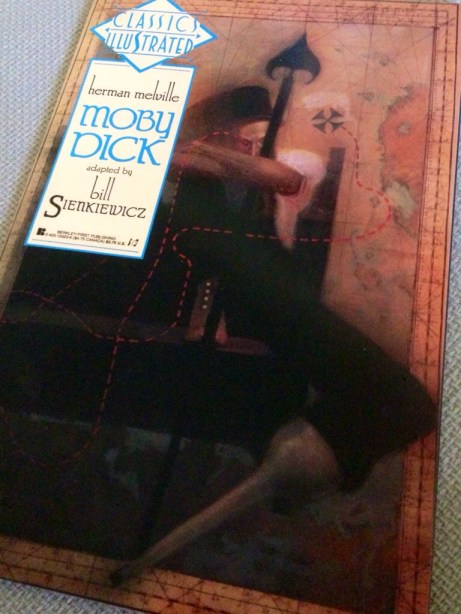
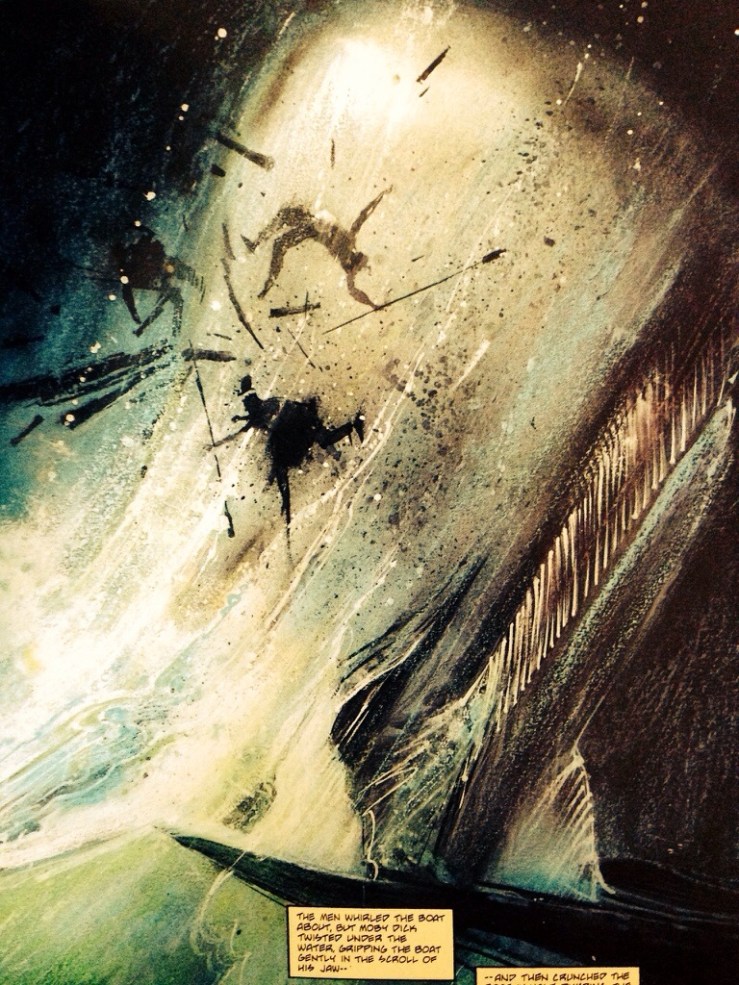
I am a huge fan of Bill Sienkiewicz. And Moby-Dick. I wish his Moby-Dick adaptation had no words though.

20131019-174646.jpg

20131019-174655.jpg

My dad’s childhood adaption, a Grosset & Dunlap from the early ’60s.

20131019-174705.jpg

20131019-174716.jpg

Sam Ita’s fantastic pop-up adaptation fails to mention Herman Melville’s name at all.

Despite the gross oversight, it’s given me hours of joy with my kids.

20131019-174740.jpg

20131019-174748.jpg

Moby-Dick was published on October 18th, 1851 in England.

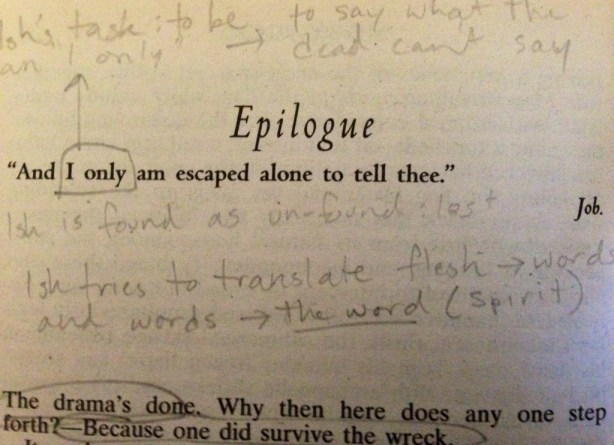
The English printer Peter Bentley’s text contained numerous errors, including leaving out the epilogue, where we learn that Ishmael survives to bear witness to disaster.

Although the American printing in November of 1851 emended many of these errors, the early reviews of Moby-Dick were scathing, and Melville’s career and reputation deteriorated.

It wasn’t until the advent of literary modernism in the first decades of the twentieth century that the world caught up to Moby-Dick.

20131019-174756.jpg

Vice Interviews Žižek

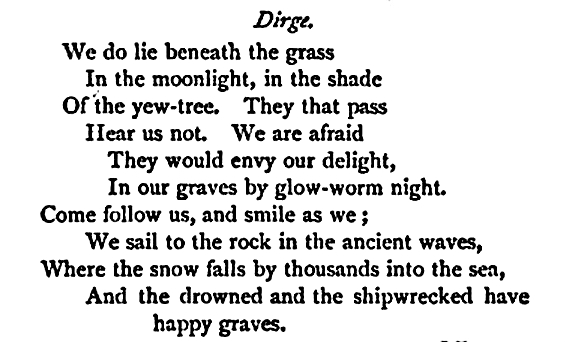
“Dirge” — Thomas Lovell Beddoes

dirge

“Key West” — Charles Olson

key west

“The Obliterated Man” — H.G. Wells

“The Obliterated Man” by H.G. Wells

I was—you shall hear immediately why I am not now—Egbert Craddock Cummins. The name remains. I am still (Heaven help me!) Dramatic Critic to the Fiery Cross. What I shall be in a little while I do not know. I write in great trouble and confusion of mind. I will do what I can to make myself clear in the face of terrible difficulties. You must bear with me a little. When a man is rapidly losing his own identity, he naturally finds a difficulty in expressing himself. I will make it perfectly plain in a minute, when once I get my grip upon the story. Let me see—where am I? I wish I knew. Ah, I have it! Dead self! Egbert Craddock Cummins!

In the past I should have disliked writing anything quite so full of “I” as this story must be. It is full of “I’s” before and behind, like the beast in Revelation—the one with a head like a calf, I am afraid. But my tastes have changed since I became a Dramatic Critic and studied the masters—G.A.S., G.B.S., G.R.S., and the others. Everything has changed since then. At least the story is about myself—so that there is some excuse for me. And it is really not egotism, because, as I say, since those days my identity has undergone an entire alteration.

That past!… I was—in those days—rather a nice fellow, rather shy— taste for grey in my clothes, weedy little moustache, face “interesting,” slight stutter which I had caught in my early life from a schoolfellow. Engaged to a very nice girl, named Delia. Fairly new, she was— cigarettes—liked me because I was human and original. Considered I was like Lamb—on the strength of the stutter, I believe. Father, an eminent authority on postage stamps. She read a great deal in the British Museum. (A perfect pairing ground for literary people, that British Museum—you should read George Egerton and Justin Huntly M’Carthy and Gissing and the rest of them.) We loved in our intellectual way, and shared the brightest hopes. (All gone now.) And her father liked me because I seemed honestly eager to hear about stamps. She had no mother. Indeed, I had the happiest prospects a young man could have. I never went to theatres in those days. My Aunt Charlotte before she died had told me not to.

Then Barnaby, the editor of the Fiery Cross, made me—in spite of my spasmodic efforts to escape—Dramatic Critic. He is a fine, healthy man, Barnaby, with an enormous head of frizzy black hair and a convincing manner, and he caught me on the staircase going to see Wembly. He had been dining, and was more than usually buoyant. “Hullo, Cummins!” he said. “The very man I want!” He caught me by the shoulder or the collar or something, ran me up the little passage, and flung me over the waste-paper basket into the arm-chair in his office. “Pray be seated,” he said, as he did so. Then he ran across the room and came back with some pink and yellow tickets and pushed them into my hand. “Opera Comique,” he said, “Thursday; Friday, the Surrey; Saturday, the Frivolity. That’s all, I think.” Continue reading ““The Obliterated Man” — H.G. Wells”

Correction (Blanchot)

correction

“The Huldrefish,” A Weird Tale of the Northern Seas

THE HULDREFISH

“The Huldrefish” by Jonas Lie; Translated from Norwegian by Nisbet Bain (Illustration by Laurence Housman)

It was such an odd trout that Nona hauled in at the end of his fishing-line. Large and fat, red spotted and shiny, it sprawled and squirmed, with its dirty yellow belly above the water, to wriggle off the hook. And when he got it into the boat, and took it off the hook, he saw that it had only two small slits where the eyes should have been.

It must be a huldrefish, thought one of the boatmen, for rumour had it that that lake was one of those which had a double bottom.

But Nona didn’t trouble his head very much about what sort of a fish it was, so long as it was a big one. He was ravenously hungry, and bawled to them to row as rapidly as possible ashore so as to get it cooked.

He had been sitting the whole afternoon with empty lines out in the mountain lake there; but as for the trout, it was only an hour ago since it had been steering its way through the water with its rudder of a tail, and allowed itself to be fooled by a hook, and already it lay cooked red there on the dish.

But now Nona recollected about the strange eyes, and felt for them, and pricked away at its head with his fork. There was nothing but slits outside, and yet there was a sort of hard eyeball inside. The head was strangely shaped, and looked very peculiar in many respects.

He was vexed that he had not examined it more closely before it was cooked; it was not so easy now to make out what it really was. It had tasted first-rate, however, and that was something.

But at night there was, as it were, a gleam of bright water before his eyes, and he lay half asleep, thinking of the odd fish he had pulled up.

He was in his boat again, he thought, and it seemed to him as if his hands felt the fish wriggling and sprawling for its life, and shooting its snout backwards and forwards to get off the hook.

All at once it grew so heavy and strong that it drew the boat after it by the line.

It went along at a frightful speed, while the lake gradually diminished, as it were, and dried up.

There was an irresistible sucking of the water in the direction the fish went, which was towards a hole at the bottom of the lake like a funnel, and right into this hole went the boat.

It glided for a long time in a sort of twilight along a subterranean river, which dashed and splashed about him. The air that met him was, at first, chilly and cellar-like; gradually, however, it grew milder and milder, and warmer and warmer.

The stream now flowed along calmly and quietly, and broadened out continually till it fell into a large lake.

Beyond the borders of this lake, but only half visible in the gloom, stretched swamps and morasses, where he heard sounds as of huge beasts wading and trampling. Serpent like they rose and writhed with a crashing and splashing and snorting amidst the tepid mud and mire.

By the phosphorescent gleams he saw various fishes close to his boat, but all of them lacked eyes.

And he caught glimpses of the outlines of gigantic sea-serpents stretching far away into the darkness. He now understood that it was from down here that they pop up their heads off the coast in the dog days when the sea is warm.

The lindworm, with its flat head and duck’s beak, darted after fish, and crept up to the surface of the earth through the slimy ways of mire and marsh.

Through the warm and choking gloom there came, from time to time, a cooling chilling blast from the cold curves and winds of the slimy and slippery greenish lichworm, which bores its way through the earth and eats away the coffins that are rotting in the churchyards.

Horrible shapeless monsters, with streaming manes, such as are said to sometimes appear in mountain tarns, writhed and wallowed and seized their prey in the fens and marshes.

And he caught glimpses of all sorts of humanlike creatures, such as fishermen and sailors meet and marvel at on the sea, and landsmen see outside the elfin mounds.

And, besides, that there was a soft whizzing and an endless hovering and swarming of beings, whose shapes were nevertheless invisible to the eye of man.

Then the boat glided into miry pulpy water, where her course tended downwards, and where the earth-vault above darkened as it sank lower and lower.

All at once a blinding strip of light shot down from a bright blue slit high, high, above him.

A stuffy vapour stood round about him. The water was as yellow and turbid as that which comes out of steam boilers.

And he called to mind the peculiar tepid undrinkable water which bubbles up by the side of artesian wells. It was quite hot. Up there they were boring down to a world of warm watercourses and liquid strata beneath the earth’s crust.

Heat as from an oven rose up from the huge abysses and dizzying clefts, whilst mighty steaming waterfalls roared and shook the ground.

All at once he felt as if his body were breaking loose, freeing itself, and rising in the air. He had a feeling of infinite lightness, of a wondrous capability for floating in higher atmospheres and recovering equilibrium.

And, before he knew how it was, he found himself up on the earth again.


Portrait of Oscar Wilde — Henri de Toulouse-Lautrec

Modernity (Oscar Wilde)

modernity

“The Alchemist” — H.P. Lovecraft

“The Alchemist” by H.P. Lovecraft

High up, crowning the grassy summit of a swelling mound whose sides are wooded near the base with the gnarled trees of the primeval forest, stands the old chateau of my ancestors. For centuries its lofty battlements have frowned down upon the wild and rugged countryside about, serving as a home and stronghold for the proud house whose honoured line is older even than the moss-grown castle walls. These ancient turrets, stained by the storms of generations and crumbling under the slow yet mighty pressure of time, formed in the ages of feudalism one of the most dreaded and formidable fortresses in all France. From its machicolated parapets and mounted battlements Barons, Counts, and even Kings had been defied, yet never had its spacious halls resounded to the footstep of the invader.

But since those glorious years all is changed. A poverty but little above the level of dire want, together with a pride of name that forbids its alleviation by the pursuits of commercial life, have prevented the scions of our line from maintaining their estates in pristine splendour; and the falling stones of the walls, the overgrown vegetation in the parks, the dry and dusty moat, the ill-paved courtyards, and toppling towers without, as well as the sagging floors, the worm-eaten wainscots, and the faded tapestries within, all tell a gloomy tale of fallen grandeur. As the ages passed, first one, then another of the four great turrets were left to ruin, until at last but a single tower housed the sadly reduced descendants of the once mighty lords of the estate.

It was in one of the vast and gloomy chambers of this remaining tower that I, Antoine, last of the unhappy and accursed Comtes de C——, first saw the light of day, ninety long years ago. Within these walls, and amongst the dark and shadowy forests, the wild ravines and grottoes of the hillside below, were spent the first years of my troubled life. My parents I never knew. My father had been killed at the age of thirty-two, a month before I was born, by the fall of a stone somehow dislodged from one of the deserted parapets of the castle, and my mother having died at my birth, my care and education devolved solely upon one remaining servitor, an old and trusted man of considerable intelligence, whose name I remember as Pierre. I was an only child, and the lack of companionship which this fact entailed upon me was augmented by the strange care exercised by my aged guardian in excluding me from the society of the peasant children whose abodes were scattered here and there upon the plains that surround the base of the hill. At the time, Pierre said that this restriction was imposed upon me because my noble birth placed me above association with such plebeian company. Now I know that its real object was to keep from my ears the idle tales of the dread curse upon our line, that were nightly told and magnified by the simple tenantry as they conversed in hushed accents in the glow of their cottage hearths. Continue reading ““The Alchemist” — H.P. Lovecraft”

Nature’s Nightmare, A Study of David Foster Wallace’s Oblivion (Book Acquired, 10.12.2013)

20131013-093333.jpg

I was psyched when Greg Carlisle’s Nature’s Nightmare: Analyzing David Foster Walalce’s Oblivion showed up in the mail. (You might recall Carlisle as the author of Elegant Complexity, a study of Infinite Jest). Blurb from publisher Slideshow Media Group:

Carlisle gives an in-depth narrative analysis of each story: “Mr. Squishy,” “The Soul is Not a Smithy,” “Incarnations of Burned Children,” “Another Pioneer,” “Good Old Neon,” “Philosophy and the Mirror of Nature,” “Oblivion,” and “The Suffering Channel.” Carlisle’s methodical approach walks readers through Wallace’s thematic interests and situates Oblivion in the broader arc of Wallace’s career. Every passage of each story is analyzed in terms of 1) interrelation of narrative form and content, 2) relation of story to the theme of oblivion, 3) recurring thematic motifs in Wallace’s work, and 4) assessment of content in relation to Infinite Jest and The Pale King. The book includes nine charts that illustrate narrative devices Wallace employs throughout the stories. Jason Kottke called Elegant Complexity the reference book for Infinite Jest and now Nature’s Nightmare is the primary reference work for Oblivion.

I read the introduction and first chapter, covering “Mr. Squishy,” this weekend, and Carlisle’s perceptive analysis made me want to reread the story. Of course, I had to scan over the chapter for “Good Old Neon,” maybe my favorite Wallace story and arguably his best piece of writing. Here’s the diagram from that chapter (did I neglect to mention that there are diagrams?):

20131013-093341

Full review forthcoming.


“A Poison Tree” — William Blake

poison