Every time I read Moby-Dick it seems funnier and sadder. Richer. Thicker.
I cobbled together my reading over different media and spaces: I listened to William Hootkins‘ outstanding unabridged audiobook version, and then reread on my Kindle key passages I’d mentally underlined; I then checked those passages against the copy of Moby-Dick I annotated the hell out of in grad school. As I read, I posted some of my favorite excerpts on this blog.
I posted some of my favorite excerpts of Moby-Dick here on Biblioklept because I knew that I wouldn’t be able to write about the book—not really—that I wouldn’t be able to handle all of its language. (My riff on Olson’s book obsesses over Olson’s ability to write after Melville and Melville’s ability to write after Shakespeare).
Really, in posting so many fragments of Moby-Dick, I suppose that I’ve attempted to abrogate any kind of critical duty to describe the book under discussion in terms of its own language.
The above is really a way of saying: Moby-Dick, like any sublime work of literature, is a self-defining, self-describing, and even self-deconstructing text.
Or, another way of making such a claim: Let me (mis)appropriate Samuel Beckett’s description of Finnegans Wake and contend that the description fits Moby-Dick just as aptly:
Here form is content, content is form. You complain that this stuff is not written in English. It is not written at all. It is not to be read – or rather it is not only to be read. It is to be looked at and listened to. His writing is not about something, it is that something itself.
So here circumnavigate back to my own recent reading and auditing of the book: Hootkins’ audio recording would make a great starting point for anyone (unnecessarily) daunted by Melville’s big book. He performs the book, commanding his audience’s attention. He unpacks the humor that might otherwise hide from untuned 21st century ears; he communicates the book’s deep, profound sorrow. His Ishmael is perceptive, clever, generous. His Stubb, hilarious. His Ahab a strange philosophical terror.
After listening to Hootkins on my commute, I’d return to key passages on my Kindle, and then finally review the notes I wrote in the cheap hardback Signet edition I read in grad school.
But why bring this up?
I don’t know.
Maybe: Unpacking Moby-Dick is too hard, too much—would require its own book, a book that would cite the entirety of Melville’s book.
But discussing the book this way seems a disservice to potential readers; it’s as if we would cloak the book in a mystic veil.
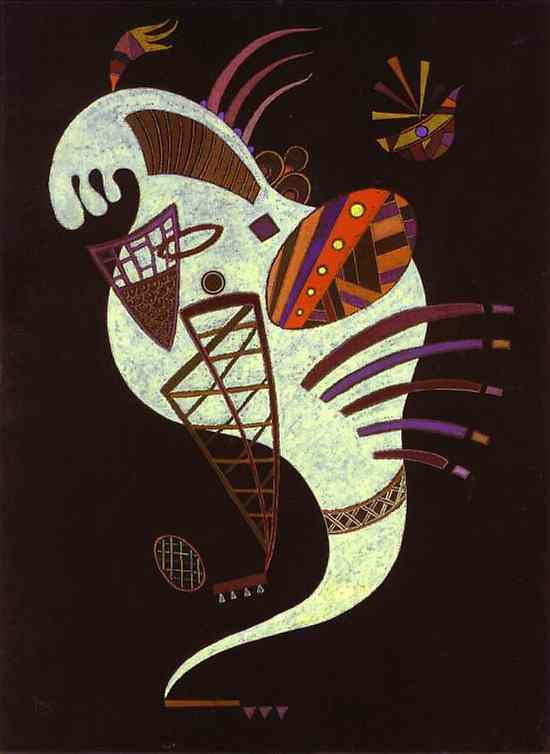
White Figure, Wassily Kandinsky
If I have a point to all of this: Moby-Dick is wonderful, funny, moving, engaging; a genre-bender that tackles philosophy, history, science; an adventure tale; a psychological novel brimming with ideas, allusions—but one delivered in sonorous, poetic language. It’s good, great, grand. Read it, if you haven’t. Reread it.
So I’ve failed to even try to begin to attempt to pretend to describe the plot.
Here: Ishmael, depressed, suicidal perhaps, decides to go to sea. To go whaling.
He tries to measure the whale, and by measuring the whale, maybe measure the world. But this is not really possible, certainly not in language. Certainly not in first-person perspective.
In Chapter 86, “The Tail,” Ishmael tells us:
The more I consider this mighty tail, the more do I deplore my inability to express it. At times there are gestures in it, which, though they would well grace the hand of man, remain wholly inexplicable. … Dissect him how I may, then, I but go skin deep. I know him not, and never will. But if I know not even the tail of this whale, how understand his head? much more, how comprehend his face, when face he has none? Thou shalt see my back parts, my tail, he seems to say, but my face shall not be seen. But I cannot completely make out his back parts; and hint what he will about his face, I say again he has no face.
(I don’t suppose I need to remark that Melville here lets one mighty tail stand in for another mighty tale—a tale he cannot face).
Call me Ishmael”: our protagonist hails us.
But these famous opening lines aren’t really the beginning of the book. First we have the section titled “Extracts,” and before that “Etymology.” The first entry on the etymology of the whale, from Hackluyt, warns us not to leave out “the letter H, which almost alone maketh up the signification of the word.”
Whaling. Hailing. Wailing.
The whiteness of the whale.
The witness of the wail.
How, just how, does Ishmael witness? How does he manage to tell this story? Did I obsess over this in earlier readings? I don’t think so—I was too concerned with absorbing the what and the why of the story to closely attend the how of its telling.
The novel begins in standard first-person point-of-view territory, Ishmael guiding us through Manhattan, New Bedford, Nantucket—but by the time he’s boarded the Pequod and set out into the wide watery world, this first-person perspective transcends the limits of physics: Our narrator not only attends the private conversations of Ahab, his mates, his harpooners, his men—but also the very interior of those men, their minds, their dreams, their imaginations.
Is Ishmael a ghost?
Leviathan-Job 40-21, Salvador Dali
And to return to Ahab for a moment: My god, what a voice! His infecting, addicting insanity. His agon with Moby Dick, with the sun, with himself.
And Starbuck: Starbuck comes across weaker and weaker each time I read the book. We’re to believe he’s a man of convictions, but he moves in half-measures. In his final moments he tries to match or feign or approximate Ahab’s insanity: tragicomedy.
And Stubb: Despite his cruelties, he may be my favorite character in the book.
While I’m riffing: Is there a novel more phallic in the American canon than Moby-Dick? All that sperm: All that life-force.
This is maybe what Moby-Dick is about: Life-force. The attempt to to resurrect and die and resurrect again. The coffin that serves as life-buoy. The life-line that connects men that might also be their death. A counterpane to counter pain. A condensation of oppositions.
A yarn, a rope, a series of knots, layered, layering, self-contextualizing.
An attempt to put into language what cannot be put into language.
Have I reached my end? Maybe too long for the “short riff” promised in the title, but also surely too short to even begin to start to approach to pretend to say something adequate about the novel. So a parting thought: Moby-Dick is better—richer, fuller, deeper—each time I read it, and I look forward to reading it again.
[Ed. note—Biblioklept originally ran a version of this riff in February 2013. I’m running it again for Herman Melville’s 200th birthday. I haven’t read Moby-Dick in full since 2013.]
[Ed. note: The following citations come from one-star Amazon reviews of Herman Melville’s novel Moby-Dick. To be very clear, I think Moby-Dick is fantastic—but I also enjoy seeing what people compelled to write negative reviews of the book on Amazon had to say. What follows are selections of one-star Amazon reviews; I’ve preserved the reviewers’ unique styles of punctuation and spelling].
Yechh.
It made for a smashing movie.
If you want to read lots of meaningless whale trivia read the book.
Boy gets whale. Boy loses whale. Boy gets whale. Spawns yawns
I think if you made it into a short comic strip, you would have liked it.
I bought this book for a friend in jail. Alas, he was unable to read it because the font was too small.
Ray Bradbury, who wrote the screenplay for this novel, (a la Gregory Peck) couldn’t even finish the damn thing!
If you like a story with nonessential information and an author that is entirely to verbose, then this book is for you.
I am quite the fan of stories which involve man eating sea creatures, such as Jaws. Moby Dick is nothing compared to such classics, I fear.
Throughout the book, you may read one chapter with some action only to be followed by 5 or 6 chapters of tangents that are not necessary to understand the story.
Moby Dick, was a horrible waiste of time. Along with its wordy paragraphs, it also talked about uninteresting issues. It is also to long, and you don’t hear of them encountering the whale until the end of the book.
The only people who like this book are english teachers who derive a feeling of moral superiority from forcing others to read this incredibly bad novel.
First of all, classiflying it as fiction is a mistake. Probably a good 60% of the book is non-fiction – chapter after chapter dedicated to every imaginable detail of the biology of the whale and every imaginable nuance of whaling.
I love literatur just as much as the next guy but we must face it 100 years or so ago American literature was reall weak and lagging from the rest of the world, perhaps now they’re starting to catch up with writers like Ann Rice and them.
I have seen better writing in a Hallmark card! Boring! Give me a good ole copy of Elvis and Me! A true story that really tugs at your heart strings! I sleep with that one under my pillow! Keep Moby Dick away from my bed!
Those chapters about Ishmael sleeping with whatever his name was and Ishamel had such a good time with the other guy’s arm over him and leg over him that he didn’t know if he was straight or gay any more.
i personally didn’t enjoy the philosophical or deep side of the book, i have read much much better books in that regard.
There is no suspense, and I find the idea of people hunting whales offensive. Offensive with a capital O.
Honestly, Over 400 pages devoted to killing a whale because it ate your hand? Come on.
It is hard to read. like work. Doubt he could get published today.
All of David Markson’s references in The Last Novel to Walt Whiman:
I am he that aches with amorous love. Wrote Whitman.
Walter, leave off.
Wrote D. H. Lawrence.
Walt Whitman’s claim — never in any way verified — that he had fathered at least six illegitimate children.
Gerard Manley Hopkins, on realizing that he feels a certain kinship with Whitman:
As he is a very great scoundrel this is not a very pleasant confession.
A writer of something occasionally like English — and a man of something occasionally like genius.
Swinburne called Whitman.
Future generations will regard Bob Dylan with the awe reserved for Blake, Whitman, Picasso and the like.
Said an otherwise seemingly rational writer named Jonathan Lethem.
Before the Euro, the portrait of Yeats on Ireland’s twenty-pound note.
America’s Whitman twenty-dollar bill, when?
The Melville ten?
Twenty-five years after his death, Poe’s remains were disinterred from what had been little better than a pauper’s grave and reburied more formally.
Walt Whitman, who made the journey from Camden to Baltimore in spite of being disabled from a recent stroke, was the only literary figure to appear at the ceremonies.
From Chapter XVII of Cormac McCarthy’s novel Blood Meridian—
They grew gaunted and lank under the white suns of those days and their hollow burnedout eyes were like those of noctambulants surprised by day. Crouched under their hats they seemed fugitives on some grander scale, like beings for whom the sun hungered. Even the judge grew silent and speculative. He’d spoke of purging oneself of those things that lay claim to a man but that body receiving his remarks counted themselves well done with any claims at all. They rode on and the wind drove the fine gray dust before them and they rode an army of gray-beards, gray men, gray horses. The mountains to the north lay sunwise in corrugated folds and the days were cool and the nights were cold and they sat about the fire each in his round of darkness in that round of dark while the idiot watched from his cage at the edge of the light. The judge cracked with the back of an axe the shinbone on an antelope and the hot marrow dripped smoking on the stones. They watched him. The subject was war.
The good book says that he that lives by the sword shall perish by the sword, said the black.
The judge smiled, his face shining with grease.
What right man would have it any other way? he said.
The good book does indeed count war an evil, said Irving. Yet there’s many a bloody tale of war inside it.
It makes no difference what men think of war, said the judge. War endures. As well ask men what they think of stone. War was always here. Before man was, war waited for him. The ultimate trade awaiting its ultimate practitioner. That is the way it was and will be. That way and not some other way.
He turned to Brown, from whom he’d heard some whispered slur or demurrer. Ah Davy, he said. It’s your own trade we honor here. Why not rather take a small bow. Let each acknowledge each.
My trade?
Certainly.
What is my trade?
War. War is your trade. Is it not?
And it aint yours?
Mine too. Very much so.
What about all them notebooks and bones and stuff?
All other trades are contained in that of war.
Is that why war endures?
No. It endures because young men love it and old men love it in them. Those that fought, those that did not.
That’s your notion.
The judge smiled. Men are born for games. Nothing else. Every child knows that play is nobler than work. He knows too that the worth or merit of a game is not inherent in the game itself but rather in the value of that which is put at hazard. Games of chance require a wager to have meaning at all. Games of sport involve the skill and strength of the opponents and the humiliation of defeat and the pride of victory are in themselves sufficient stake because they inhere in the worth of the principals and define them. But trial of chance or trial of worth all games aspire to the condition of war for here that which is wagered swallows up game, player, all.
Suppose two men at cards with nothing to wager save their lives. Who has not heard such a tale? A turn of the card. The whole universe for such a player has labored clanking to this moment which will tell if he is to die at that man’s hand or that man at his. What more certain validation of a man’s worth could there be? This enhancement of the game to its ultimate state admits no argument concerning the notion of fate. The selection of one man over another is a preference absolute and irrevocable and it is a dull man indeed who could reckon so profound a decision without agency or significance either one. In such games as have for their stake the annihilation of the defeated the decisions are quite clear. This man holding this particular arrangement of cards in his hand is thereby removed from existence. This is the nature of war, whose stake is at once the game and the authority and the justification. Seen so, war is the truest form of divination. It is the testing of one’s will and the will of another within that larger will which because it binds them is therefore forced to select. War is the ultimate game because war is at last a forcing of the unity of existence. War is god. Brown studied the judge.
Shakespeare has given several allusions to the old customs associated with drinking, which have always varied in different countries. At the present day many of the drinking customs still observed are very curious, especially those kept up at the universities and inns-of-court. Alms-drink was a phrase in use, says Warburton, among good fellows, to signify that liquor of another’s share which his companion drank to ease him. So, in “Antony and Cleopatra” (ii. 7) one of the servants says of Lepidus: “They have made him drink alms-drink.”
By-drinkings.This was a phrase for drinkings between meals, and is used by the Hostess in “1 Henry IV.” (iii. 3), who says to Falstaff: “You owe money here besides, Sir John, for your diet, and by-drinkings.”
Hooped Pots.In olden times drinking-pots were made with hoops, so that, when two or more drank from the same tankard, no one should drink more than his share. There were generally three hoops to the pots: hence, in “2 Henry VI.” (iv. 2), Cade says: “The three-hooped pot shall have ten hoops.” In Nash’s “Pierce Pennilesse” we read: “I believe hoopes on quart pots were invented that every man should take his hoope, and no more.” The phrases “to do a man right” and “to do him reason” were, in years gone by, the common expressions in pledging healths; he who drank a bumper expected that a bumper should be drunk to his toast. To this practice alludes the scrap of a song which Silence sings in “2 Henry IV.” (v. 3): “Do me right, And dub me knight: Samingo.” He who drank, too, a bumper on his knee to the health of his mistress was dubbed a knight for the evening. The word Samingo is either a corruption of, or an intended blunder for, San Domingo, but why this saint should be the patron of topers is uncertain.
Rouse.According to Gifford, [972] a rouse was a large glass in which a health was given, the drinking of which, by the rest of the company, formed a carouse. Hamlet (i. 4) says: “The king doth wake to-night, and takes his rouse.” The word occurs again in the following act (1), where Polonius uses the phrase “o’ertook in’s rouse;” and in the sense of a bumper, or glass of liquor, in “Othello” (ii. 3), “they have given me a rouse already.”
Sheer Ale. This term, which is used in the “Taming of the Shrew” (Induction, sc. 2), by Sly—“Ask Marian Hacket, the fat ale-wife of Wincot, if she know me not: if she say I am not fourteen pence on the score for sheer ale”—according to some expositors, means “ale alone, nothing but ale,” rather than “unmixed ale.”
Sneak-cup. This phrase, which is used by Falstaff in “1 Henry IV.” (iii. 3)—“the prince is a Jack, a sneak-cup”—was used to denote one who balked his glass.
From Thomas Firminger Thiselton-Dyer’s indispensable volume Folk-lore of Shakespeare.
From Thomas Firminger Thiselton-Dyer’s indispensable volume Folk-lore in Shakespeare:
Easter. According to a popular superstition, it is considered unlucky to omit wearing new clothes on Easter Day, to which Shakespeare no doubt alludes in “Romeo and Juliet” (iii. 1), when he makes Mercutio ask Benvolio whether he did “not fall out with a tailor for wearing his new doublet before Easter.” In East Yorkshire, on Easter Eve, young folks go to the nearest market-town to buy some new article of dress or personal adornment to wear for the first time on Easter Day, as otherwise they believe that birds—notably rooks or “crakes”—will spoil their clothes. In “Poor Robin’s Almanac” we are told: “At Easter let your clothes be new, Or else be sure you will it rue.” Some think that the custom of “clacking” at Easter—which is not quite obsolete in some counties—is incidentally alluded to in “Measure for Measure” (iii. 2) by Lucio: “his use was, to put a ducat in her clack-dish.” [649] The clack or clap dish was a wooden dish with a movable cover, formerly carried by beggars, which they clacked and clattered to show that it was empty. In this they received the alms. Lepers and other paupers deemed infectious originally used it, that the sound might give warning not to approach too near, and alms be given without touching the person. A popular name for Easter Monday was Black Monday, so called, says Stow, because “in the 34th of Edward III. (1360), the 14th of April, and the morrow after Easter Day, King Edward, with his host, lay before the city of Paris; which day was full dark of mist and hail, and so bitter cold, that many men died on their horses’ backs with the cold. Wherefore unto this day it hath been call’d the Blacke Monday.” Thus, in the “Merchant of Venice” (ii. 5), Launcelot says, “it was not for nothing that my nose fell a-bleeding on Black Monday last at six o’clock i’ the morning.”
Gene Wolfe was born in New York on May 7, 1931. He studied at Texas A&M for a few years before dropping out and fighting in the Korean War. After his return to the US he finished his degree at the University of Houston. He was an engineer, and worked as the editor of the professional journal Plant Engineering. He was also instrumental in inventing the machine that cooks Pringles potato chips.
…Wolfe went on to write over 30 novels, with his best best-known work, The Book of The New Sun, spanning 1980-1983. The series is a tetralogy set in the Vancian Dying Earth subgenre, and follows the journey of Severian, a member of the Guild of Torturers, after he is exiled for the sin of mercy.
Last night, I fell asleep listening to Chapter 15 of the audiobook version of Gene Wolfe’s 1980 novel The Shadow of the Torturer, the first book in The Book of the New Sun.I have been falling asleep to Chapter 15 of this particular audiobook for about three nights now. Before that, I was falling asleep to Chapter 14. There is nothing particularly boring about the book. I put headphones in my ears take sleeping pills and fall asleep to an audiobook every night. There’s something about plugging into a narrative that’s not my own life that takes me out of all the anxieties that creep out at bedtime. I get through 15, maybe 20 minutes, and I’m out. I restart a few minutes before the last bit I remember. Anyway, I fell asleep to Chapter 15 — “Baldanders” — last night. I might’ve even made it a little bit into Chapter 16. I’ll find out tonight.
I first read The Shadow of the Torturer as a young teen. I was too young for the book—I don’t think I fully appreciated its scope. I read the next book in The Book of the New Sun series, but I don’t remember if I finished it out. In a year or two, I had abandoned fantasy, a mistake that I corrected years later. Youthful indiscretion. I reread a chunk of The Shadow of the Torturer again in my twenties and found it more complex than I remember. Then I mistakenly left the mass market paperback copy I was reading at a beach condo we had conned from someone’s friend’s grandmother for the weekend, and that was that—until this February, when a brief Twitter conversation prompted me to get the audiobook. I’ve been listening to it every night since, and at the rate I’m going through it I’ll probably be done by the end of the summer. I’m digging it.
Will Wolfe now gain a wider audience outside of the sci-fi/fantasy cult audience now that he has died? Maybe. I mean, that happens sometimes, right? His work is challenging though, employing strange diction and proffering only the smallest crumbs of exposition. Ultimately, it’s clear that Gene Wolfe was a writer’s writer, as evidenced by a 2015 profile of him in The New Yorkerwhich proclaimed him “sci-fi’s difficult genius”—
Wolfe has published more than twenty-five novels and more than fifty stories, and has won some of science fiction and fantasy’s most prestigious awards. But he has rarely, if ever, been considered fully within the larger context of literature. His books contain all of the nasty genre tropes—space travel, robots, even dragons—and he hasn’t crossed into the mainstream on the strength of a TV or movie adaptation. Wolfe himself sees the trappings of science fiction and fantasy, the spaceships and so on, as simply “a sketchy outline of the things that can be done.” But even within fantasy fandom, Wolfe’s work presents difficulties. His science fiction is neither operatic nor scientifically accurate; his fantasy works are not full of clanging swords and wizardly knowledge. But ask science-fiction or fantasy authors about Gene Wolfe and they are likely to cite him as a giant in their field. Ursula K. Le Guin once called Wolfe “our Melville.”
It was December—a bright frozen day in the early morning. Far out in the country there was an old Negro woman with her head tied red rag, coming along a path through the pinewoods. Her name was Phoenix Jackson. She was very old and small and she walked slowly in the dark pine shadows, moving a little from side to side in her steps, with the balanced heaviness and lightness of a pendulum in a grand-father clock. She carried a thin, small cane made from an umbrella, and with this she kept tapping the frozen earth in front of her. This made a grave and persistent noise in the still air, that seemed meditative like the chirping of a solitary little bird.
She wore a dark striped dress reaching down to her shoe tops, and an equally long apron of bleached sugar sacks, with a full pocket: all neat and tidy, but every time she took a step she might have fallen over her shoelaces, which dragged from her unlaced shoes. She looked straight ahead. Her eyes were blue with age. Her skin had a pattern all its own of numberless branching wrinkles and as though a whole little tree stood in the middle of her forehead, but a golden color ran underneath, and the two knobs of her cheeks were illumined by a yellow burning under the dark. Under the red rag her hair came down on her neck in the frailest of ringlets, still black, and with an odor like copper.
Now and then there was a quivering in the thicket. Old Phoenix said, “Out of my way, all you foxes, owls, beetles, jack rabbits, coons and wild animals!. . . Keep out from under these feet, little bob-whites…. Keep the big wild hogs out of my path. Don’t let none of those come running my direction. I got a long way.” Under her small black-freckled hand her cane, limber as a buggy whip, would switch at the brush as if to rouse up any hiding things.
On she went. The woods were deep and still. The sun made the pine needles almost too bright to look at, up where the wind rocked. The cones dropped as light as feathers. Down in the hollow was the mourning dove—it was not too late for him.
The path ran up a hill. “Seem like there is chains about my feet, time I get this far,” she said, in the voice of argument old people keep to use with themselves. “Something always take a hold of me on this hill— pleads I should stay.” Continue reading ““A Worn Path” — Eudora Welty”→
“The Incredible and Sad Tale of Innocent Eréndira and Her Heartless Grandmother”
by
Gabriel García Márquez
translation by
Gregory Rabassa
Erendira was bathing her grandmother when the wind of her misfortune began to blow. The enormous mansion of moon like concrete lost in the solitude of the desert trembled down to its foundations with the first attack. But Erendira and her grandmother were used to the risks of the wild nature there, and in the bathroom decorated with a series of peacocks and childish mosaics of Roman baths they scarcely paid any attention to the caliber of the wind.
The grandmother, naked and huge in the marble tub, looked like a handsome white whale. The granddaughter had just turned fourteen and was languid, soft-boned, and too meek for her age. With a parsimony that had something like sacred rigor about it, she was bathing her grandmother with water in which purifying herbs and aromatic leaves had been boiled, the latter clinging to the succulent back, the flowing metal-colored hair, and the powerful shoulders which were so mercilessly tattooed as to put sailors to shame.
“Last night I dreamt I was expecting a letter,” the grandmother said.
Erendira, who never spoke except when it was unavoidable, asked:
“What day was it in the dream?”
“Thursday.”
“Then it was a letter with bad news,” Erendira said, “but it will never arrive.”
When she had finished bathing her grandmother, she took her to her bedroom. The grandmother was so fat that she could only walk by leaning on her granddaughter’s shoulder or on a staff that looked like a bishop’s crosier, but even during her most difficult efforts the power of an antiquated grandeur was evident. In the bedroom, which had been furnished with an excessive and somewhat demented taste, like the whole house, Erendira needed two more hours to get her grandmother ready. She untangled her hair strand by strand, perfumed and combed it, put an equatorially flowered dress on her, put talcum powder on her face, bright red lipstick on her mouth, rouge on her cheeks, musk on her eyelids, and mother-of-pearl polish on her nails, and when she had her decked out like a larger than life-size doll, she led her to an artificial garden with suffocating flowers that were like the ones on the dress, seated her in a large chair that had the foundation and the pedigree of a throne, and left her listening to elusive records on a phonograph that had a speaker like a megaphone. Continue reading ““The Incredible and Sad Tale of Innocent Eréndira and Her Heartless Grandmother” — Gabriel García Márquez””→
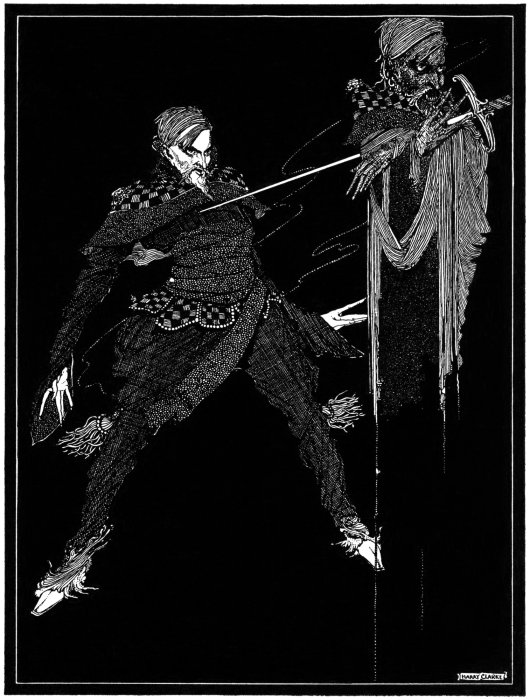
Harry Clarke’s 1919 illustration for “William Wilson”
“William Wilson”
by
Edgar Allan Poe
What say of it? what say of CONSCIENCE grim, That spectre in my path? Chamberlayne’s Pharronida.
LET me call myself, for the present, William Wilson. The fair page now lying before me need not be sullied with my real appellation. This has been already too much an object for the scorn—for the horror—for the detestation of my race. To the uttermost regions of the globe have not the indignant winds bruited its unparalleled infamy? Oh, outcast of all outcasts most abandoned!—to the earth art thou not forever dead? to its honors, to its flowers, to its golden aspirations?—and a cloud, dense, dismal, and limitless, does it not hang eternally between thy hopes and heaven?
I would not, if I could, here or to-day, embody a record of my later years of unspeakable misery, and unpardonable crime. This epoch—these later years—took unto themselves a sudden elevation in turpitude, whose origin alone it is my present purpose to assign. Men usually grow base by degrees. From me, in an instant, all virtue dropped bodily as a mantle. From comparatively trivial wickedness I passed, with the stride of a giant, into more than the enormities of an Elah-Gabalus. What chance—what one event brought this evil thing to pass, bear with me while I relate. Death approaches; and the shadow which foreruns him has thrown a softening influence over my spirit. I long, in passing through the dim valley, for the sympathy—I had nearly said for the pity—of my fellow men. I would fain have them believe that I have been, in some measure, the slave of circumstances beyond human control. I would wish them to seek out for me, in the details I am about to give, some little oasis of fatality amid a wilderness of error. I would have them allow—what they cannot refrain from allowing—that, although temptation may have erewhile existed as great, man was never thus, at least, tempted before—certainly, never thus fell. And is it therefore that he has never thus suffered? Have I not indeed been living in a dream? And am I not now dying a victim to the horror and the mystery of the wildest of all sublunary visions?
I am the descendant of a race whose imaginative and easily excitable temperament has at all times rendered them remarkable; and, in my earliest infancy, I gave evidence of having fully inherited the family character. As I advanced in years it was more strongly developed; becoming, for many reasons, a cause of serious disquietude to my friends, and of positive injury to myself. I grew self-willed, addicted to the wildest caprices, and a prey to the most ungovernable passions. Weak-minded, and beset with constitutional infirmities akin to my own, my parents could do but little to check the evil propensities which distinguished me. Some feeble and ill-directed efforts resulted in complete failure on their part, and, of course, in total triumph on mine. Thenceforward my voice was a household law; and at an age when few children have abandoned their leading-strings, I was left to the guidance of my own will, and became, in all but name, the master of my own actions. Continue reading “Read Edgar Allan Poe’s doppelgänger tale “William Wilson””→
It was Christmas night and the proper things had been done. The whole village had come to dinner in hall. There had been boar’s head and venison and pork and beef and mutton and caponsbut no turkey, because this bird had not yet been invented. There had been plum pudding and snap-dragon, with blue fire on the tips of one’s fingers, and as much mead as anybody could drink. Sir Ector’s health had been drunk with “Best respects, Measter,” or “Best compliments of the Season, my lords and ladies, and many of them.” There had been mummers to play an exciting dramatic presentation of a story in which St. George and a Saracen and a funny Doctor did surprising things, also carol-singers who rendered “Adeste Fideles” and “I Sing of a Maiden,” in high, clear, tenor voices. After that, those children who had not been sick from their dinner played Hoodman Blind and other appropriate games, while the young men and maidens danced morris dances in the middle, the tables having been cleared away. The old folks sat round the walls holding glasses of mead in their hands and feeling thankful that they were past such capers, hoppings and skippings, while those children who had not been sick sat with them, and soon went to sleep, the small heads leaning against their shoulders. At the high table Sir Ector sat with his knightly guests, who had come for the morrow’s hunting, smiling and nodding and drinking burgundy or sherries sack or malmsey wine.
After a bit, silence was prayed for Sir Grummore. He stood up and sang his old school song, amid great applausebut forgot most of it and had to make a humming noise in his moustache. Then King Pellinore was nudged to his feet and sang bashfully:
“Oh, I was born a Pellinore in famous Lincolnshire. Full well I chased the Questing Beast for more than seventeen year. Till I took up with Sir Grummore here In the season of the year. (Since when) ’tis my delight On a feather-bed night To sleep at home, my dear.
“You see,” explained King Pellinore blushing, as he sat down with everybody whacking him on the back, “old Grummore invited me home, what, after we had been having a pleasant joust together, and since then I’ve been letting my beastly Beast go and hang itself on the wall, what?”
“Well done,” they told him. “You live your own life while you’ve got it.”
William Twyti was called for, who had arrived on the previous evening, and the famous huntsman stood up with a perfectly straight face, and his crooked eye fixed upon Sir Ector, to sing:
“D’ye ken William Twyti
With his Jerkin so dagged? D’ye ken William Twyti
Who never yet lagged? Yes, I ken William Twyti,
And he ought to be gagged With his hounds and his horn in the morning.”
“Bravo!” cried Sir Ector. “Did you hear that, eh? Said he ought to be gagged, my dear feller. Blest if I didn’t think he was going to boast when he began. Splendid chaps, these huntsmen, eh? Pass Master Twyti the malmsey, with my compliments.”
The boys lay curled up under the benches near the fire, Wart with Cavall in his arms. Cavall did not like the heat and the shouting and the smell of mead, and wanted to go away, but Wart held him tightly because he needed something to hug, and Cavall had to stay with him perforce, panting over a long pink tongue.
“Now Ralph Passelewe.”
“Good wold Ralph.”
“Who killed the cow, Ralph?”
“Pray silence for Master Passelewe that couldn’t help it.”
At this the most lovely old man got up at the furthest and humblest end of the hail, as he had got up on all similar occasions for the past half-century. He was no less than eighty-five years of age, almost blind, almost deaf, but still able and willing and happy to quaver out the same song which he had sung for the pleasure of the Forest Sauvage since before Sir Ector was bound up in a kind of tight linen puttee in his cradle. They could not hear him at the high tablehe was too far away in Time to be able to reach across the roombut everybody knew what the cracked voice was singing and everybody loved it. This is what he sang:
“Whe-an/Wold King-Cole/was a /wakkin doon-t’street, H-e /saw a-lovely laid-y a /steppin-in-a-puddle. / She-a /lifted hup-er-skeat/ For to / Hop acrorst ter middle, / An ee /saw her /an-kel. Wasn’t that a fuddle? / Ee could’ernt elp it, /ee Ad to.”
There were about twenty verses of this song, in which Wold King Cole helplessly saw more and more things that he ought not to have seen, and everybody cheered at the end of each verse until, at the conclusion, old Ralph was overwhelmed with congratulations and sat down smiling dimly to a replenished mug of mead.
It was now Sir Ector’s turn to wind up the proceedings. He stood up importantly and delivered the following speech:
“Friends, tenants and otherwise. Unaccustomed as I am to public speakin’”
There was a faint cheer at this, for everybody recognized the speech which Sir Ector had made for the last twenty years, and welcomed it like a brother.
“Unaccustomed as I am to public speakin'” it is my pleasant dutyI might say my very pleasant dutyto welcome all and sundry to this our homely feast. It has been a good year, and I say it without fear of contradiction, in pasture and plow. We all know how Crumbocke of Forest Sauvage won the first prize at Cardoyle Cattle Show for the second time, and one more year will win the cup outright. More power to the Forest Sauvage. As we sit down tonight, I notice some faces now gone from among us and some which have added to the family circle. Such matters are in the hands of an almighty Providence, to which we all feel thankful. We ourselves have been first created and then spared to enjoy the rejoicin’s of this pleasant evening. I think we are all grateful for the blessin’s which have been showered upon us. Tonight we welcome in our midst the famous King Pellinore, whose labours in riddin’ our forest of the redoubtable Questin’ Beast are known to all. God bless King Pellinore. (Hear, hear!) Also Sir Grummore Grummursum, a sportsman, though I say it to his face, who will stick to his mount as long as his Quest will stand up in front of him. (Hooray!) Finally, last but not least, we are honoured by a visit from His Majesty’s most famous huntsman, Master William Twyti, who will, I feel sure, show us such sport tomorrow that we will rub our eyes and wish that a royal pack of hounds could always be huntin’ in the Forest which we all love so well. (Viewhalloo and several recheats blown in imitation.) Thank you, my dear friends, for your spontaneous welcome to these gentlemen. They will, I know, accept it in the true and warmhearted spirit in which it is offered. And now it is time that I should bring my brief remarks to a close. Another year has almost sped and it is time that we should be lookin’ forward to the challengin’ future. What about the Cattle Show next year? Friends, I can only wish you a very Merry Christmas, and, after Father Sidebottom has said our Grace for us, we shall conclude with a singin’ of the National Anthem.”
The cheers which broke out at the end of Sir Ector’s speech were only just prevented, by several hush-es, from drowning the last part of the vicar’s Grace in Latin, and then everybody stood up loyally in the firelight and sang:
“God save King Pendragon,
May his reign long drag on,
God save the King.
Send him most gorious,
Great and uproarious,
Horrible and Hoarious,
God save our King.”
The last notes died away, the hall emptied of its rejoicing humanity. Lanterns flickered outside, in the village street, as everybody went home in bands for fear of the moonlit wolves, and The Castle of the Forest Sauvage slept peacefully and lightless, in the strange silence of the holy snow.








 Biblioklept