I kinda sorta lost a big chunk of May this year, and some of the books that arrived at Biblioklept World Headquarters slipped through the cracks. Here, the cliche slipped through the cracks means got piled up in the wrong pile. Ainsley Morse’s and Geoff Cebula’s translation of Konstantin Vaginov’s Goat Song was one of these slipped-crack-wrong-pile titles. The volume actually collects two short novels by Vaginov: Goat Song, and Works and Days of Whistlin. Publisher NYRB’s blurb:
Konstantin Vaginov was an early and exemplary figure of Soviet modernist writing in all its agonized and glorious contradictions. Born into an educated middle-class family, Vaginov came of age with the Revolution. His novels of the late 1920s and early ’30s are daringly experimental and tragically nostalgic, using mercilessly ironic prose to mourn the loss of prerevolutionary intellectual culture. Adrift in the brave new Soviet world, Vaginov’s protagonists attempt to conjure the recent and distant past by stockpiling old books and songs, vulgar baubles and bad jokes, newspaper clippings, coins, and graffiti.
This volume contains two novels: Goat Song features thinly veiled portraits of Vaginov’s contemporaries as they flounder and self-destruct in their new bracingly materialist circumstances. Echoing Gogol, Dostoyevsky, and Bely, Goat Song is both a classic Petersburg city text and its swan song: “Now there is no Petersburg . . . the author is a coffin-maker by trade, not a cradle expert.”
Works and Days of Whistlin follows the novelist Whistlin as he unscrupulously mines the lives of his friends and fellow citizens for literary material. His exploitation of human material is a wry commentary on the concurrent efforts to industrialize and collectivize the Soviet economy, at a horrific human cost.
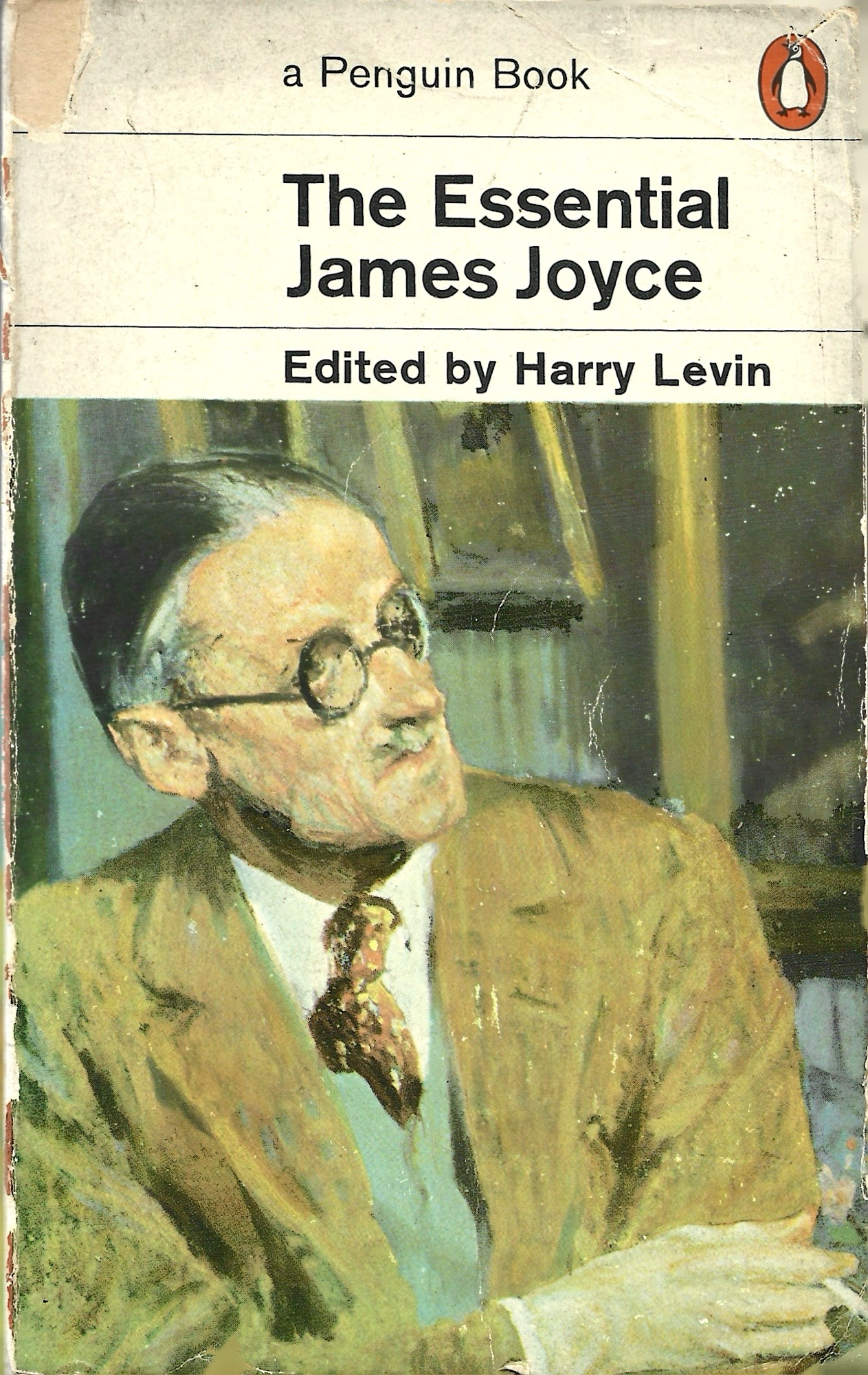
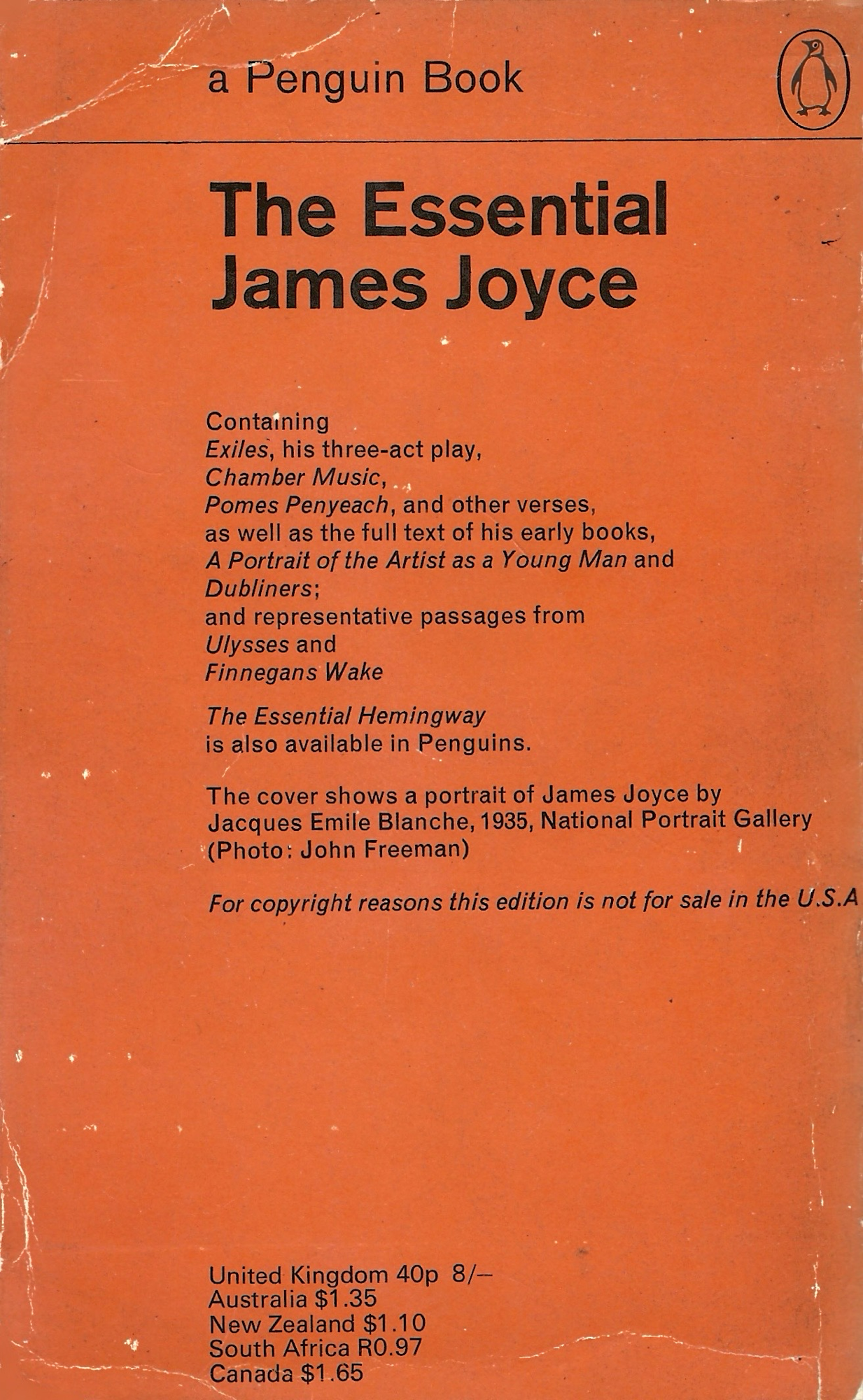
The Essential James Joyce, 1948, ed. Harry Levin. Penguin Books (1969). Cover art by Jacques Emile Blanche; photographed by John Freeman. 550 pages.
I found this book on the street in Shin-Kōenji, the neighborhood I lived in in Tokyo twenty-five years ago. It was, if I recall, stacked on top of a pile of pornographic manga. I may have taken those as well. Happy Bloomsday!
Fathers are
more fathering
these days they have
accomplished this by
being more mothering
what luck for them that
women’s lib happened then
the dream of new fathering
began to shine in the eyes
of free women and was irresistible
on the New York subways
and the mass transits
of other cities one may
see fatherings of many colors
with their round babies on
their laps this may also
happen in the countryside
these scenes were brand new
exciting for an old woman who
had watched the old fathers
gathering once again in
familiar army camps and com-
fortable war rooms to consider
the necessary eradication of
the new fathering fathers
(who are their sons) as well
as the women and children who
will surely be in the way.
NYRB is publishing new English language translations of works by Henrik Pontoppidan. The big boy is Pontoppidan’s opus A Fortunate Man; the much-slimmer The White Bear actually collects two novellas, The White Bear and The Rearguard. All three translations are the effort of Paul Larkin.
NYRB’s copy for The White Bear
The White Bear follows the fate of the odd, gangly, red-bearded Thorkild Müller. Born in rural Jutland and destined for the ministry, Thorkild proves to be a poor student and is assigned to a remote Inuit tribe in Greenland. There, with his mythic-looking staff and dogskin skullcap, he becomes known as the White Bear—a beloved legend among the locals and a freewheeling embarrassment to his fellow priests. Grown old, he returns to Denmark, where again his flock adores him while his fellow men of cloth try to tame the “whirling dervish in their midst.” In the end Thorkild mysteriously disappears, presumably back to the snow wilderness of Greenland.
And The Rearguard:
The Rearguard, on the other hand, is a marriage story. Newlyweds Jørgen Hallager and Ursula Branth are as different as night and day. The brash son of a poor village teacher, Jørgen is an avowed socialist whose revolutionary beliefs translate into his work as a painter of social realism; Ursula comes from a conservative, upper-middle-class family. At first, as they start their married life in Rome, they each try to change the other’s worldview with arguments and threats, but as time wears on and they wear each other down, it becomes clear there can be no reconciliation. It is a tragic tale of art and idealism, individuality and love.
And the big guy:
A Fortunate Man tells the story of Per Sidenius, a Lutheran pastor’s son who revolts against his family and flees the backwaters of Jutland for Copenhagen. Per is handsome, ambitious, and hungry for the technological future of the twentieth century. He studies engineering and draws up plans for a new port and new canals, for harnessing wind and wave energy to transform Denmark into a commercial giant. Fully persuaded of his own genius, Per first repels and then attracts Jakobe Salomon, a young Jewish woman whose family is eager to underwrite his plans. They fall in love and get engaged; gradually Jakobe opens Per’s eyes to the wider world. Meanwhile, he also falls under the spell of Dr. Nathan, a popular philosopher who rails against the conservative powers that be. But ultimately these powers win out, Per’s relationship with Jakobe founders, and he goes home to Jutland and marries a pastor’s daughter. Though fortunate, he is never happy.
One of the last great nineteenth-century novels and Henrik Pontoppidan’s masterpiece, A Fortunate Man anatomizes and skewers Danish society, from the small towns to the metropolis. Paul Larkin’s dazzing translation brings out the wide range and full force of a novel admired by Georg Lukács and praised by Ernst Bloch as “one of the foundational texts of world literature.”
But in the white culture outside, in that creepy world full of precardiac Mustang drivers who scream insults at one another only when the windows are up; of large corporations where Niceguymanship is the standing order regardless of whose executive back one may be endeavoring to stab; of an enormous priest caste of shrinks who counsel moderation and compromise as the answer to all forms of hassle; among so much well-behaved unreality, it is next to impossible to understand how Watts may truly feel about violence. In terms of strict reality, violence may be a means to getting money, for example, no more dishonest than collecting exorbitant carrying charges from a customer on relief, as white merchants here still do. Far from a sickness, violence may be an attempt to communicate, or to be who you really are.
“Togetherness,” by Thomas Pynchon was published in the vol. 16, no. 12 issue of Aerospace Safety in December 1960. The byline reads “Thomas H. Pynchon” (for Huggles, presumably).
My sweetheart and I had sealed our commitment at high noon. My father had raised a cup to our good fortune, issued a stern proclamation against peddlers, bestowed happiness and property upon us and all our progeny, and the party had begun. Whole herds had been slaughtered for our tables. The vineyards of seven principalities had filled our casks. We had danced, sung, clung to one another, drunk, laughed, cheered, chanted the sun down. Bards had pilgrimaged from far and wide, come with their alien tongues to celebrate our union with pageants, prayers, and sacrifices. Not soon, they’d said, would this feast be forgotten. We’d exchanged epigrams and gallantries, whooped the old Queen through her death dance, toasted the fairies and offered them our firstborn. The Dwarfs had recited an ode in praise of clumsiness, though they’d forgotten some of the words and had got into a fight over which of them had dislodged the apple from Snow White’s throat, pushing each other into soup bowls and out of windows. They’d thrown cakes and pies at each other for awhile, then had spilled wine on everybody, played tug-of-war with the Queen’s carcass, regaled us with ribald mimes of regicide and witch-baiting, and finally had climaxed it all by buggering each other in a circle around Snow White, while singing their gold-digging song. Snow White had kissed them all fondly after-wards, helped them up with their breeches, brushed the crumbs from their beards, and I’d wondered then about my own mother, who was she?—and where was Snow White’s father? Whose party was this? Why was I so sober? Suddenly I’d found myself, minutes before midnight, troubled by many things: the true meaning of my bride’s name, her taste for luxury and collapse, the compulsions that had led me to the mountain, the birdshit on the glass coffin when I’d found her. Who were all these people, and why did things happen as though they were necessary? Oh, I’d reveled and worshipped with the rest of the party right to the twelfth stroke, but I couldn’t help thinking: we’ve been too rash, we’re being overtaken by something terrible, and who’s to help us now the old Queen’s dead?
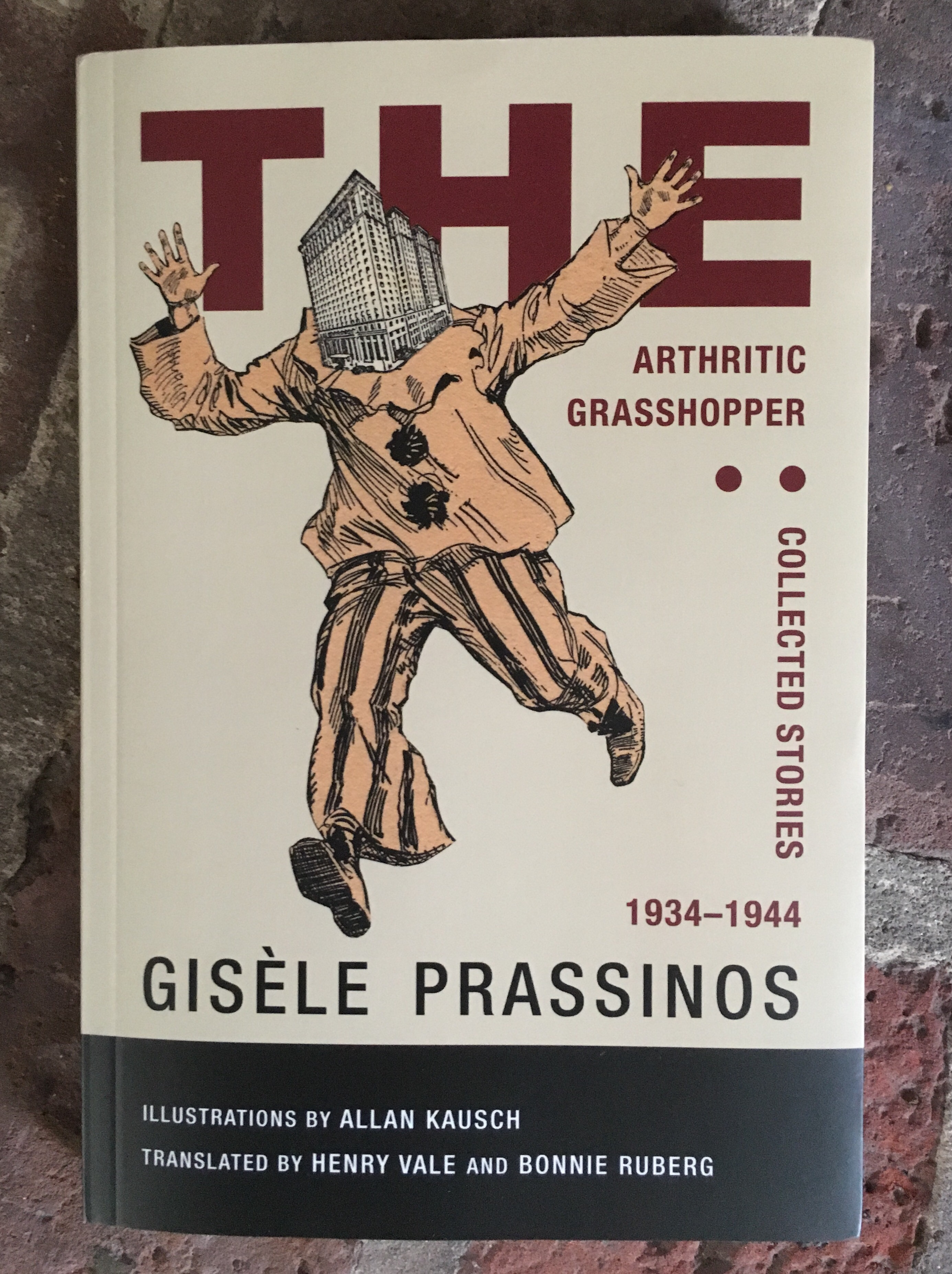
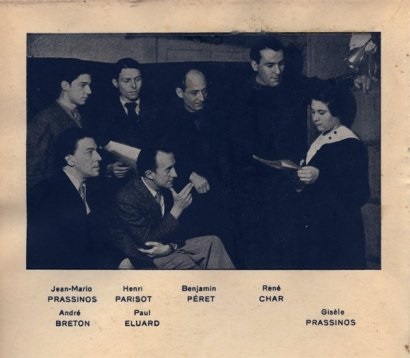
I can’t remember which particular Surrealist I was googling when I learned about Gisèle Prassinos. I do know that it was just a few weeks ago, and I’ve had an interest in Surrealist art and literature since I was a kid, so I was a bit stunned that I’d never heard of her before now—strange, given the origin of her first publication. In 1934, when she was 14, Prassinos was “discovered” by André Breton, and the Surrealists delighted in what they called her “automatic writing.” (Prassinos would later reject that label, and go as far as to declare that she had never been a surrealist). Her first book, La Sauterelle arthritique (The Arthritic Grasshopper) was published just a year later.
Prassinos reading her work to the Surrealists; photograph by Man Ray
I somehow found a .pdf of one of her stories, “A Nice Family,” a bizarre little tale that runs on its own surreal mythology. The story struck me as simultaneously grandiose and miniature, dense but also skeletal. It was impossible. Surreal. I wanted more.
Luckily, just this spring Wakefield Press released The Arthritic Grasshopper: Collected Stories, 1934-1944, a new English translation of a 1976 compendium of Prassinos’s tales, Trouver sans checher. The translation is by Henry Vale and Bonnie Ruberg, whose introduction to the volume is a better review and overview than I can muster here. Ruberg offers a miniature biography, and shares details from her letters and visits with Prassinos. She situates Prassinos within the Surrealists’ gender biases: “For a young writer such as Prassinos, being involved with the surrealists would have meant gaining access to resources like publishers, but it also would have meant being fetishized and marginalized.” Ruberg characterizes Prassinos’s tales eloquently and accurately—no simple feat given the material’s utter strangeness:
Taken collectively, their effect is a piercing cackle, a complete disorientation, rather than an ethical lesson. The politics of these stories are absurdist. They upend the world by making children dangerous, by reanimating the dead, by letting the carefully tended domestic deform, foam, and melt. No social structure holds power in the world of these stories—not on the basis of gender, or nationality, or class. The force that reigns is chaos.
Let’s look at that reigning chaos.
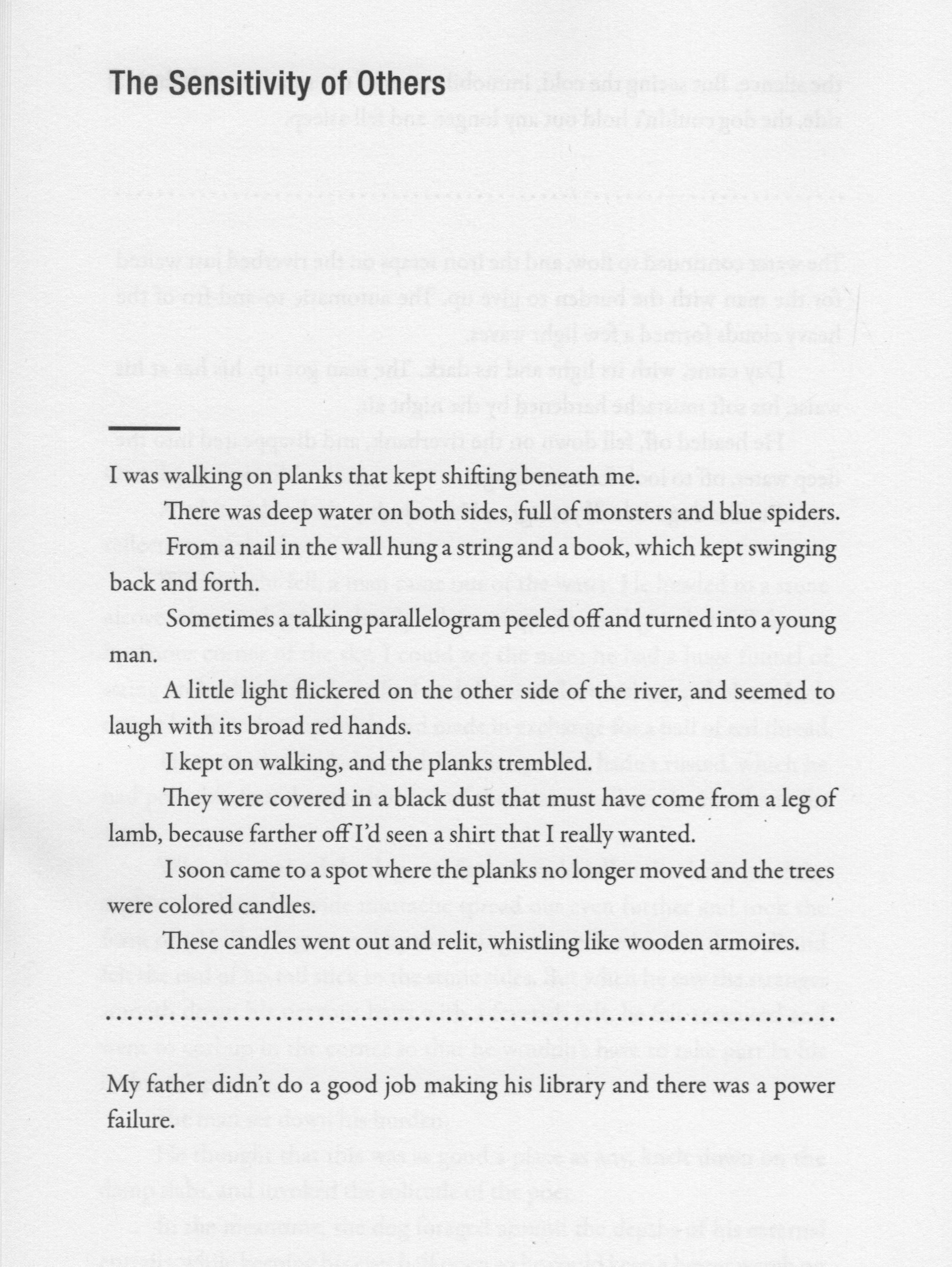
In “The Sensitivity of Others,” one of the earliest tales in the volume, we get the sparest narrative action seemingly possible: A speaker walks forward. And yet dream-nightmare touches impinge on all sides and on all senses. The opening line shows a world that is never stable, and if monsters and other dangers lurk just on the margins of our narrator’s shifting path, so do wonders and the promise of strange knowledge. Here’s the tale in full:
I still have no idea what to make of the punchline there at the end, but those final images—a father, a faulty library, a power failure—hang heavy against the narrator’s trembling walk.
Many of Prassinos’s anti-fables conclude with such apparent non sequiturs, and yet the final lines can also cast a weird light back over the previous sentences. In “Photogenic Quality,” a dream-tale about the act of writing itself, the final line at first appears as sheer absurdity. A man receives a pencil from a child, whittles it into powder, blots the powder on paper, and throws the paper in the river (more things happen, too). The tale concludes with the man declaring, “Brass is made from copper and tin.” It’s possible to enjoy the absurdity here on its own; however, I think we can also read the last line as a kind of Abracadabra!, magic words that describe an almost alchemical synthesis—a synthesis much like the absurd modes of transformative writing that “Photogenic Quality” outlines.
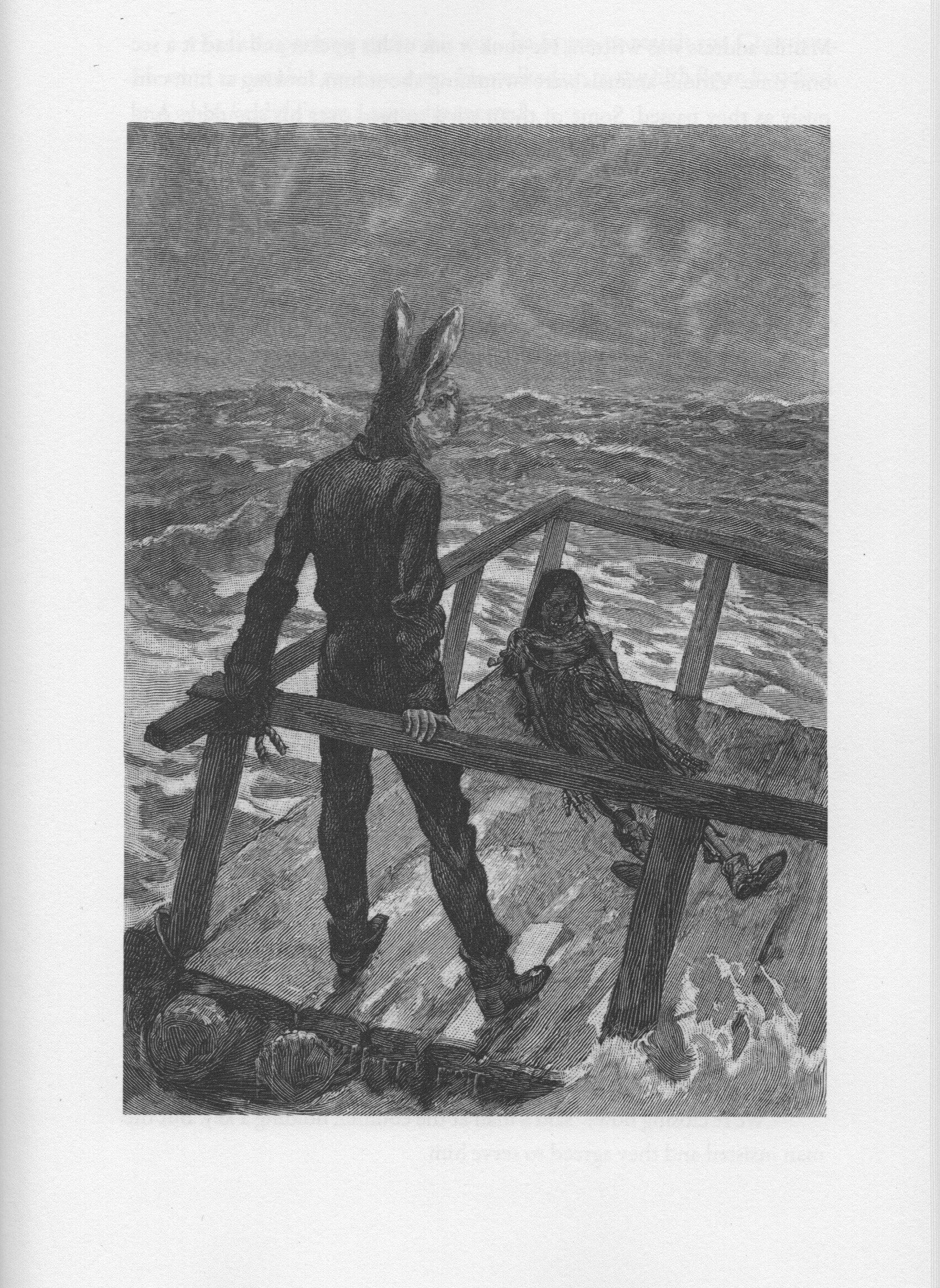
You’ll see above one of Allan Kausch’s illustrations for The Arthritic Grasshopper. Kausch’s collages pointedly recall Max Ernst’s surreal 1934 graphic novel Une semaine de bonté (A Week of Kindness). Kausch’s work walks a weird line between horror and whimsy; images from old children’s books and magazines become chimerical figures, sometimes cute, sometimes horrific, and sometimes both. They’re lovely.
Surreal figures shift throughout the book—monks and kings, daughters and mothers, deep sea divers and knights and salesmen and talking horses—all slightly out of place, or, rather, all making new places. Even when Prassinos establishes a traditional space we might think we recognize—often a fairy trope—she warps its contours, shaping it into something else. “A Marriage Proposal,” with its unsuspecting title, opens with “Once upon a time” — but we are soon dwelling in impossibility: “the garter snake appeared in the doorway, arm in arm with the snail, who was slobbering with happiness.” Other stories, like “Tragic Fanaticism,” immediately condense fairy tales into pure images, leaving the reader to suss out connections. Here is that story’s opening line: “A black hole, a little old woman, animals.” At five pages, “Tragic Fanaticism” is one of the collection’s longer stories. It ends with a four line poem, sung by five red cats to the old woman: “Go home and burn / Darling / You’re the only one we’ll love / Trash Bin.”
I still have a number of stories to read in The Arthritic Grasshopper. I’ve enjoyed its tales most when taken as intermezzos between sterner (or compulsory) reading. There’s something refreshing in Prassinos’s illogic. In longer stretches, I find that I tire, get lazy—Prassinos’s imagery shifts quickly—there’s something even picaresque to the stories—and keeping up with its veering rhythms for tale after tale can be taxing. Better not to gobble it all up at once. In this sense, The Arthritic Grasshopper reminds me strongly of another recently-published volume of surreal, imagistic stories that I’ve been slowly consuming this year: The Complete Stories of Leonora Carrington. In their finest moments, both of these writers can offer new ways of looking at art, at narrative, at the world itself.
I described Prassinos’s tales as “anti-fables” above—a description that I think is accurate enough, as literary descriptions go—but that doesn’t mean there isn’t something that we can learn from them (although, to be very clear, I do not think literature has to offer us anything to learn). What Prassinos’s anti-fables do best is open up strange impossible spaces—there’s a kind of radical, amorphous openness here, one that might be neatly expressed in the original title to this newly-translated volume—Trouver sans checher—To Find without Seeking.
In her preface (titled “To Find without Seeking”) Prassinos begins with the question, “To find what?” Here is a question that many of us have been taught we must direct to all the literature we read—to interrogate it so that it yields moral instruction. Prassinos answers: “The spot where innocence rejoices, trembling as it first meets fear. The spot where innocence unleashes its ferocity and its monsters.” She goes on to describe a “true and complete world” where the “earth and water have no borders and each us can live there if we choose, in just the same way, without changing our names.” Her preface concludes by repeating “To find what?”, and then answering the question in the most perfectly (im)possible way: “In the end, the mind that doesn’t know what it knows: the free astonishing voice that speaks, faceless, in the night.” Prassinos’s anti-fables offer ways of reading a mind that doesn’t know what it knows, of singing along with the free faceless astonishing voice. Highly recommended.
[Ed. note–Biblioklept originally ran this review in August of 2017.]






 Biblioklept