“Books are made out of books” | Blood Meridian and Samuel Chamberlain

In his 1992 interview with The New York Times, Cormac McCarthy said, “The ugly fact is books are made out of books. The novel depends for its life on the novels that have been written.” McCarthy’s masterpiece Blood Meridian, as many critics have noted, is made of some of the finest literature out there–the King James Bible, Moby-Dick, Dante’s Inferno, Paradise Lost, Faulkner, and Shakespeare. While Blood Meridian echoes and alludes to these authors and books thematically, structurally, and linguistically, it also owes much of its materiality to Samuel Chamberlain’s My Confession: The Recollections of a Rogue.

Chamberlain, much like the Kid, Blood Meridian’s erstwhile protagonist, ran away from home as a teenager. He joined the Illinois Second Volunteer Regiment and later fought in the Mexican-American War. Confession details Chamberlain’s involvement with John Glanton’s gang of scalp-hunters. The following summary comes from the University of Virginia’s American Studies webpage

According to Chamberlain, John Glanton was born in South Carolina and migrated to Stephen Austin’s settlement in Texas. There he fell in love with an orphan girl and was prepared to marry her. One day while he was gone, Lipan warriors raided the area scalping the elderly and the children and kidnapping the women- including Glanton’s fiancee. Glanton and the other settlers pursued and slaughtered the natives, but during the battle the women were tomahawked and scalped. Legend has it, Glanton began a series of retaliatory raids which always yielded “fresh scalps.” When Texas fought for its independence from Mexico, Glanton fought with Col. Fannin, and was one of the few to escape the slaughter of that regiment at the hands of the Mexican Gen. Urrea- the man who would eventually employ Glanton as a scalp hunter. During the Range Wars, Glanton took no side but simply assassinated individuals who had crossed him. He was banished, to no avail, by Gen. Sam Houston and fought as a “free Ranger” in the war against Mexico. Following the war he took up the Urrea’s offer of $50 per Apache scalp (with a bonus of $1000 for the scalp of the Chief Santana). Local rumor had it that Glanton always “raised the hair” of the Indians he killed and that he had a “mule load of these barbarous trophies, smoke-dried” in his hut even before he turned professional.
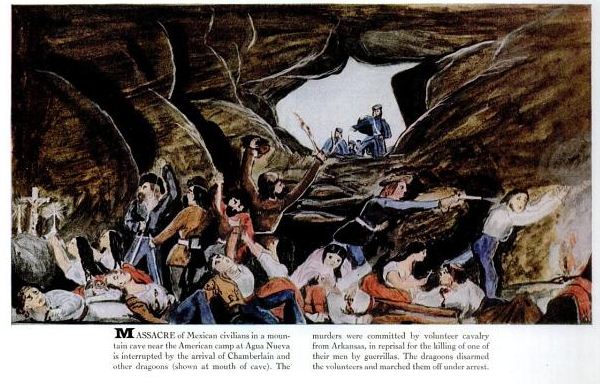
 

Chamberlain’s Confession also describes a  figure named Judge Holden. Again, from U of V’s summary–

Glanton’s gang consisted of “Sonorans, Cherokee and Delaware Indians, French Canadians, Texans, Irishmen, a Negro and a full-blooded Comanche,” and when Chamberlain joined them they had gathered thirty-seven scalps and considerable losses from two recent raids (Chamberlain implies that they had just begun their careers as scalp hunters but other sources suggest that they had been engaged in the trade for sometime- regardless there is little specific documentation of their prior activities). Second in command to Glanton was a Texan- Judge Holden. In describing him, Chamberlain claimed, “a cooler blooded villain never went unhung;” Holden was well over six feet, “had a fleshy frame, [and] a dull tallow colored face destitute of hair and all expression” and was well educated in geology and mineralogy, fluent in native dialects, a good musician, and “plum centre” with a firearm. Chamberlain saw him also as a coward who would avoid equal combat if possible but would not hesitate to kill Indians or Mexicans if he had the advantage. Rumors also abounded about atrocities committed in Texas and the Cherokee nation by him under a different name. Before the gang left Frontreras, Chamberlain claims that a ten year old girl was found “foully violated and murdered” with “the mark of a large hand on her throat,” but no one ever directly accused Holden.


It’s fascinating to note how much of the Judge is already there–the pedophilia, the marksmanship, the scholarship, and, most interesting of all, the lack of hair. Confession goes on to detail the killing, scalping, raping, and raiding spree that comprises the center of Blood Meridian. Chamberlain even describes the final battle with the Yumas, an event that signals the dissolution of the Glanton gang in McCarthy’s novel.

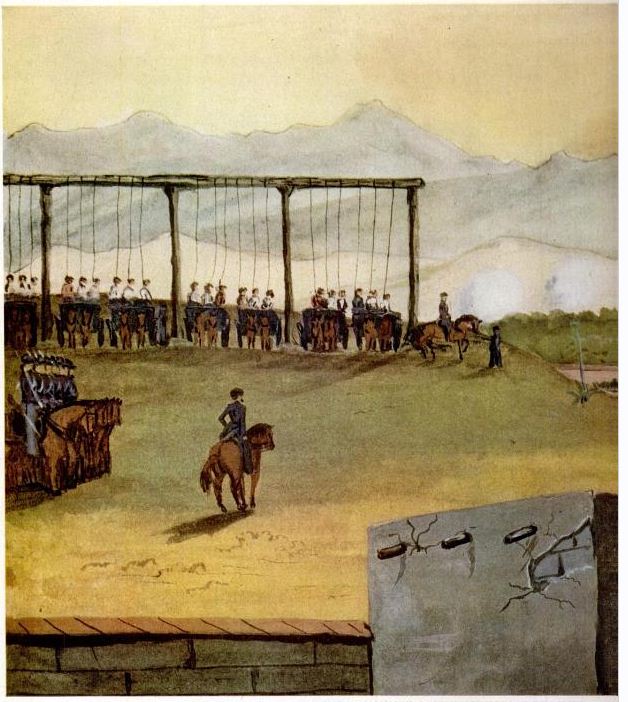
Content aside, Chamberlain’s prose also seems to presage McCarthy’s prose. In his book Different Travelers, Different Eyes, James H. Maguire notes that, “Both venereal and martial, the gore of [Chamberlain’s] prose evokes Gothic revulsion, while his unschooled art, with its stark architectural angles and leaden, keen-edged shadows, can chill with the surreal horrors of the later Greco-Italian painter Giorgio de Chirico.” Yes, Chamberlain was an amateur painter (find his paintings throughout this post), and undoubtedly some of this imagery crept into Blood Meridian.

You can view many of Chamberlain’s paintings and read an edit of his Confession in three editions of Life magazine from 1956, digitally preserved thanks to Google Books–here’s Part I, Part II, and Part III. Many critics have pointed out that Chamberlain’s narrative, beyond its casual racism and sexism, is rife with factual and historical errors. He also apparently indulges in the habit of describing battles and other events in vivid detail, even when there was no way he could have been there. No matter. The ugly fact is that books are made out of books, after all, and if Chamberlain’s Confession traffics in re-appropriating the adventure stories of the day, at least we have Blood Meridian to show for his efforts.
[Ed. note–Biblioklept first ran this post in September of 2010.]
Read “Girls at War,” a short story by Chinua Achebe

“Girls at War”

by

Chinua Achebe


The first time their paths crossed nothing happened. That was in the first heady days of warlike preparation when thousands of young men (and sometimes women too) were daily turned away from enlistment centres because far too many of them were coming forward burning with readiness to bear arms in defence of the exciting new nation.
The second time they met was at a check-point at Awka. Then the war had started and was slowly moving southwards from the distant northern sector. He was driving from Onitsha to Enugu and was in a hurry. Although intellectually he approved of thorough searches at road-blocks, emotionally he was always offended whenever he had to submit to them. He would probably not admit it but the feeling people got was that if you were put through a search then you could not really be one of the big people. Generally he got away without a search by pronouncing in his deep, authoritative voice: ‘Reginald Nwankwo, Ministry of Justice.’ That almost always did it. But sometimes either through ignorance or sheer cussedness the crowd at the odd check-point would refuse to be impressed. As happened now at Awka. Two constables carrying heavy Mark 4 rifles were watching distantly from the roadside leaving the actual searching to local vigilantes.

‘I am in a hurry,’ he said to the girl who now came up to his car. ‘My name is Reginald Nwankwo, Ministry of Justice.’

‘Good afternoon, sir. I want to see your boot.’

‘Oh Christ! What do you think is in the boot?’

‘I don’t know, sir.’

He got out of the car in suppressed rage, stalked to the back, opened the boot and holding the lid up with his left hand he motioned with the right as if to say: After you!

‘Are you satisfied?’ he demanded.

‘Yes, sir. Can I see your pigeon-hole?’

‘Christ Almighty!’

Continue reading “Read “Girls at War,” a short story by Chinua Achebe”

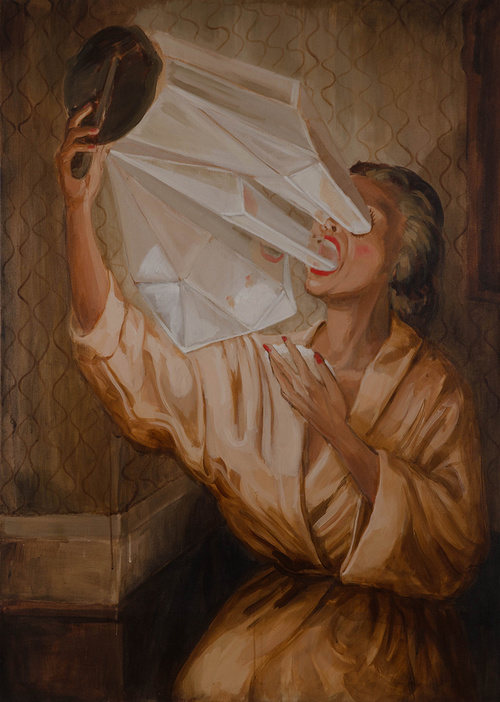
Mirror — Lucia Dovičáková

lucia-dovicakova

Mirror, 2011 by Lucia Dovičáková (b. 1981)

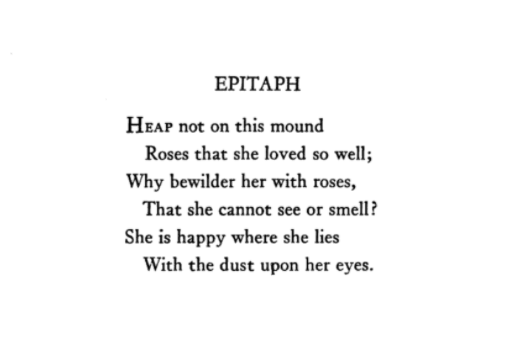
“Epitaph” — Edna St. Vincent Millay

Screenshot 2020-07-27 at 10.49.39 AM

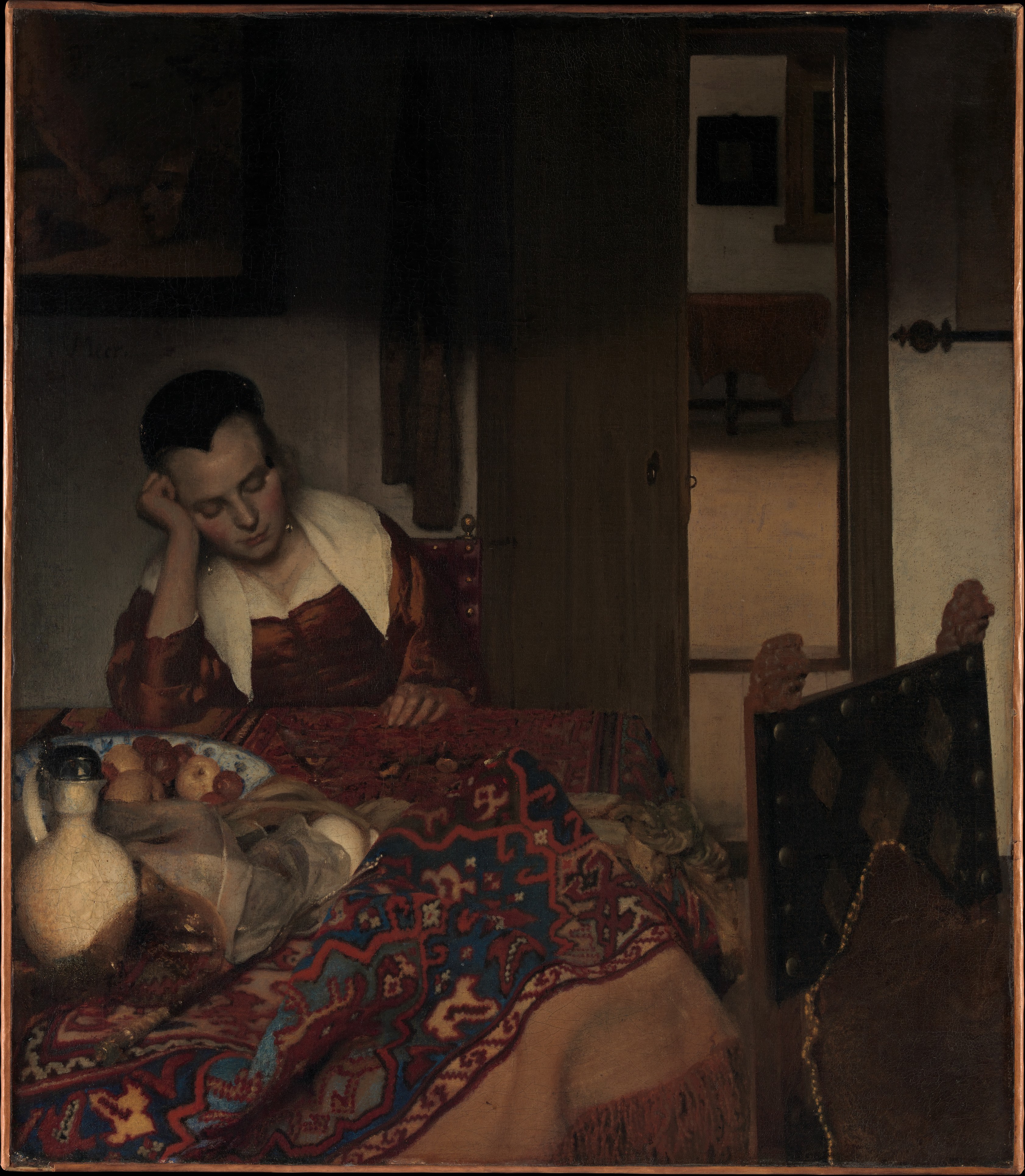
A Maid Asleep — Johannes Vermeer

dp355525

A Maid Asleep, c. 1657 by Johannes Vermeer (1632–1675)

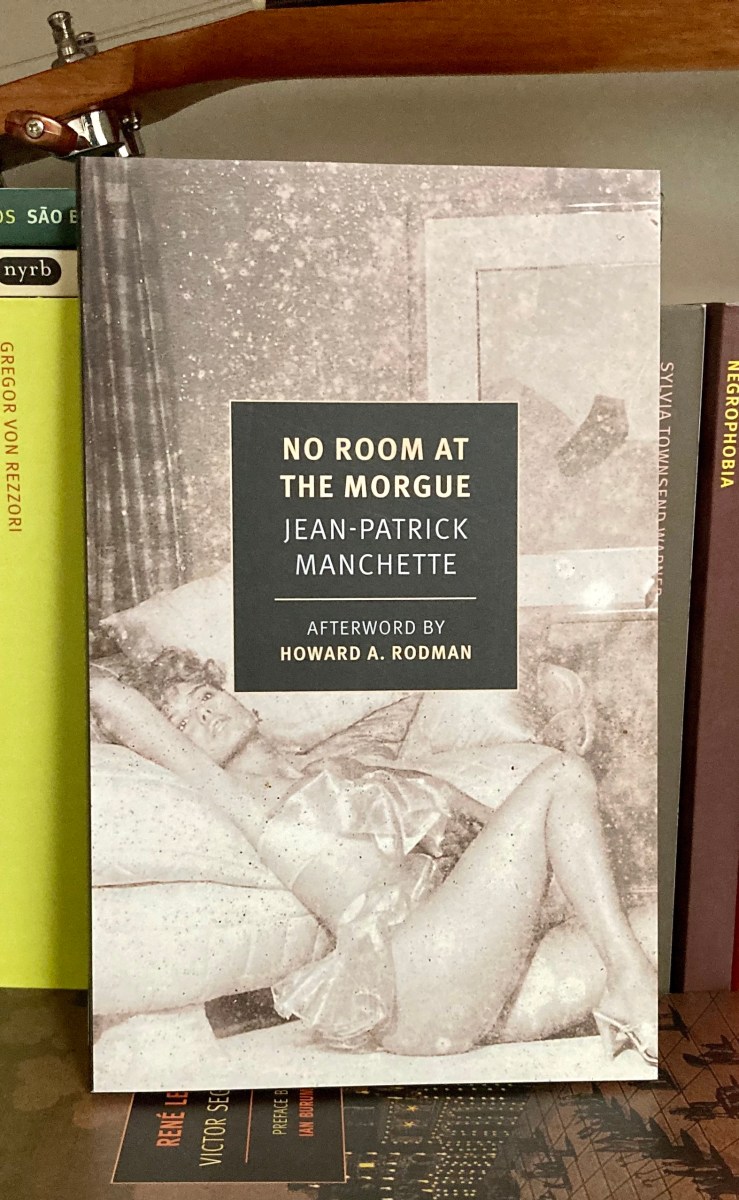
Manchette’s No Room at the Morgue (Book acquired, 22 July 2020)

img_5805

Jean-Patrick Manchette’s detective noir novel No Room at the Morgue (translated by Alyson Waters) is forthcoming in August from NYRB.

Their blurb:

No Room at the Morgue came out after Jean-Patrick Manchette had transformed French crime fiction with such brilliantly plotted, politically charged, unrelentingly violent tales as Nada and The Mad and the Bad. Here, inspired by his love of Dashiell Hammett, Manchette introduces Eugene Tarpon, private eye, a sometime cop who has set up shop after being kicked off the force for accidentally killing a political demonstrator. Months have passed, and Tarpon desultorily tries to keep in shape while drinking all the time. No one has shown up at the door of his office in the midst of the market district of Les Halles. Then the bell rings and a beautiful woman bursts in, her hands dripping blood. It’s Memphis Charles, her roommate’s throat has been cut, and Memphis can’t go to the police because they’ll only suspect her. Can Tarpon help?

Well, somehow he can’t help trying. Soon bodies mount, and the craziness only grows.

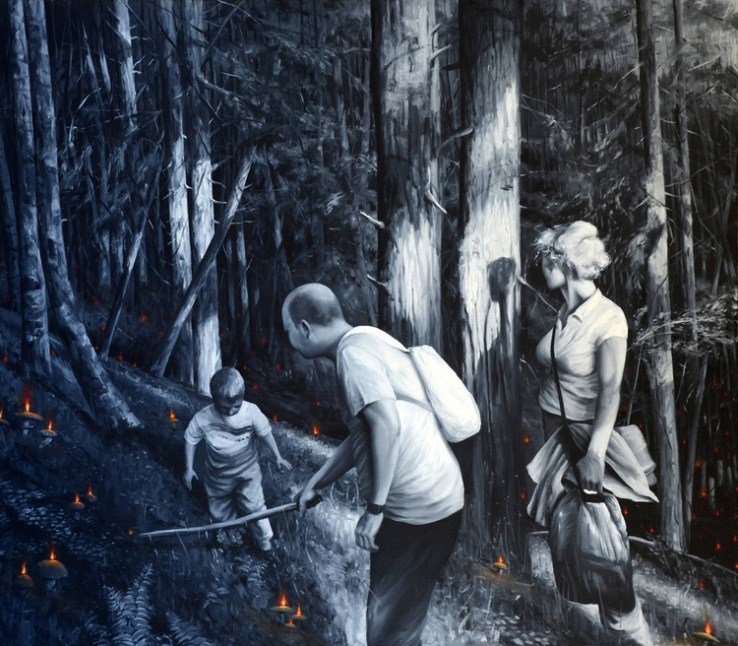
Burning Mushrooms — Robert Bielik

robert-bielik-Horiace-hriby

Burning Mushrooms, 2008 by Robert Bielik (b. 1963)

On Fran Ross’s postmodern picaresque novel Oreo

img_5795

Fran Ross’s 1974 novel Oreo is an overlooked masterpiece of postmodern literature, a delicious satire of the contemporary world that riffs on race, identity, patriarchy, and so much more. Oreo is a pollyglossic picaresque, a metatextual maze of language games, raps and skits, dinner menus and vaudeville routines. Oreo’s rush of language is exuberant, a joyful metatextual howl that made me laugh out loud. Its 212 pages galloped by, leaving me wanting more, more, more.

Oreo is Ross’s only novel. It was met with a handful of confused reviews upon its release and then summarily forgotten until 2000, when Northeastern University Press reissued the novel with an introduction by UCLA English professor Harryette Mullen(New Directions offered a wider release with a 2015 reissue, including Mullen’s introduction as an afterword.)

Mullen gives a succinct summary of Oreo in the opening sentence of her 2002 essay “‘Apple Pie with Oreo Crust’: Fran Ross’s Recipe for an Idiosyncratic American Novel“:

In Fran Ross’s 1974 novel Oreo, the Greek legend of Theseus’ journey into the Labyrinth becomes a feminist tall tale of a young black woman’s passage from Philadelphia to New York in search of her white Jewish father.

Mullen goes on to describe Oreo as a novel that “explores the heterogeneity rather than the homogeneity of African Americans.”

Oreo’s ludic heterogeneity may have accounted for its near-immediate obscurity. Ross’s novel celebrates hybridization and riffs–both in earnestness and irony—on Western tropes and themes that many writers of the Black Arts Movement of the 1960s and ’70s specifically rejected.

Indeed, Oreo still feels ahead of its time, or out of its time, as novelist Danzy Senna repeatedly notes in her introduction to the New Directions reissueSenna points out that “Oreo resists the unwritten conventions that still exist for novels written by black women today,” and writes that Ross’s novel “feels more in line stylistically, aesthetically, with Thomas Pynchon and Kurt Vonnegut than with Sonia Sanchez and Ntzoke Shange.”

In his review of Oreo, novelist Marlon James also posits Ross’s place with the postmodernists, suggesting that “maybe Ross is closer in spirit to the writers in the 70s who managed to make this patchwork sell,” before wryly noting, “Of course they were all white men: Vonnegut, Barth, Pynchon, and so on.”

Of course they were all white men. And perhaps this is why Oreo languished out of print so long. Was it erasure? Neglect? Institutional racism and sexism in publishing and literary criticism? Or just literal ignorance?

In any case, Ross belongs on the same postmodern shelf with Gaddis, Pynchon, Barth, Reed, and Coover. Oreo is a carnivalesque, multilingual explosion of the slash we might put between high and low. It’s a metatextual novel that plays zanily with the plasticity of its own form. Like Coover, Elkin, and Barthelme, Ross’s writing captures the spirit of mass media; Oreo is forever satirizing commercials, television, radio, film (and capitalism in general).

Ross plays with the page as well, employing quizzes, menus, and charts into the text, like this one, from the novel’s third page:

Screenshot 2020-07-24 at 3.14.00 PM

Oreo won me over with the postmodern paragraph that followed this chart, which I’ll share in full:

 A word about weather

There is no weather per se in this book. Passing reference is made to weather in a few instances. Assume whatever season you like throughout. Summer makes the most sense in a book of this length. That way, pages do not have to be used up describing people taking off and putting on overcoats.

What happens in Oreo? Well, it’s a picaresque, sure, but it goes beyond, as Ralph Ellison put it, being “one of those pieces of writing which consists mainly of one damned thing after another sheerly happening.” (Although there are plenty of damned things happening, sheerly or otherwise, after each other.)

Oreo is a mock-epic, a satirical quest for the titular Oreo to discover the “secret of her birth,” using clues left by her white Jewish father who, like her mother, has departed. All sorts of stuff happens along the way–run ins with rude store clerks, attempted muggings, rhyming little people with a psychopathic son camping in the park, a short voice acting career, a soiree with a “rothschild of rich people,” a witchy stepmother, and a memorable duel with a pimp. (And more, more, more.)

Throughout it all, Oreo shines as a cartoon superhero, brave, impervious, adaptable, and full of wit—as well as WIT (Oreo’s self-invented “system of self- defense [called] the Way of the Interstitial Thrust, or WIT.” In “a state of extreme concentration known as hwip-as [Oreo could] engage any opponent up to three times her size and weight and whip his natural ass.)

Indeed, as Oreo’s uncle declares, “She sure got womb, that little mother…She is a ball buster and a half,” underscoring the novel’s feminist themes as well as its plasticity of language. Here “womb” becomes a substitution for “balls,” a symbol of male potency busted in the next sentence. This ironic inversion might serve as a synecdoche for Oreo’s entire quest to find her father, a mocking rejoinder to patriarchy. As Oreo puts it, quite literally: “I am going to find that motherfucker.”

Find that motherfucker she does and—well, I won’t spoil any more. Instead, I implore you to check out Oreo, especially if you’re a fan of all those (relatively) famous postmodernist American novels of the late twentieth century. I wish someone had told me to read Oreo ages ago, but I’m thankful I read it now, and I look forward to reading it again. Very highly recommended.

My Waltz — Wei Dong

e1cf8cab9ff0a7f92b316c97d7ddca7b

My Waltz, 2010 by Wei Dong (b. 1968)

“Photograph of a Gathering of People Waving” — Clarence Major

“Photograph of a Gathering of People Waving”

by

Clarence Major


based on an old photograph bought in a
shop at Half Moon Bay, summer, 1999

No sound, the whole thing.
Unknown folk. People waving from a hillside of ripple grass
to people below in an ongoing meadow.

Side rows of trees waving in a tide of wind,
and because what is moving is not moving,
you catch a state of stasis.

Opposite of this inactivity
you imagine distant music and buzzing and crickets
and that special hot smell of summer.

To the garden past the Bay to the meadow,
cliff sheltered with low clouds, offset by nodding thistle.
Tatter-wort and Stinking Tommy along footpath
worn down by locals. But who and why?

In the photograph itself you’re now looking the other way
to unknown clusters of houses.
Where forces are balanced to near perfection.

Who could live
in such a great swollen silence and solitude?
You hear church bells
from Our Lady’s Tears breaking that silence nicely
but just in the right way so silence continues
as though nothing else matters day after day.

And anyway, each face seems so familiar.

What do you do when you wave back?
You wave vigorously.
You remember your own meadow,
your cliffside and town,
photographs forgotten,
the halfhearted motion of your hand,
your grandmother’s church-folk
gathering on a Sunday afternoon in saintly quietness.

You name the people
whose names are not written on the back.
You forgive them for wrapping themselves in silence.

You enter house after house and open top-floor windows
and you wave down to future generations like this.

The Sorceress — Allan Douglas Davidson

1721355

The Sorceress, 1912 by Allan Douglas Davidson (1873‑1932)

Unit 2 — Mikey Yates

yates2cmikey_3

Unit 2 by Mikey Yates

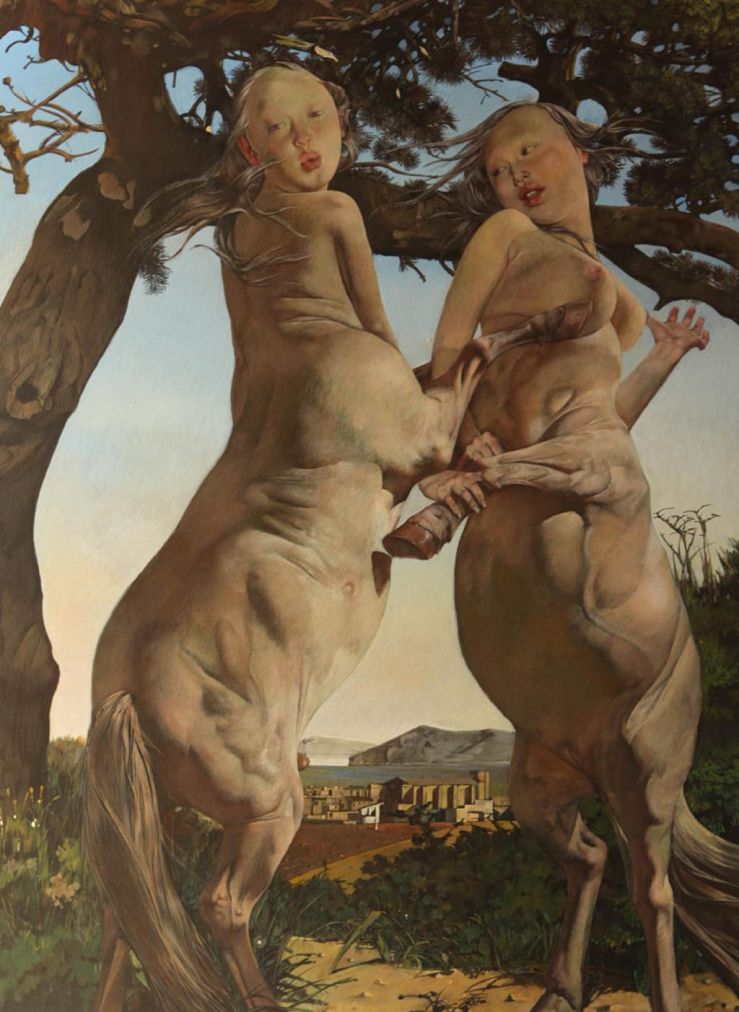
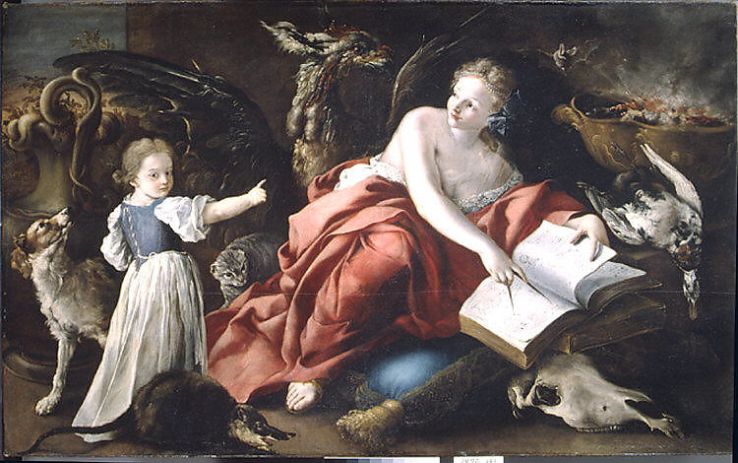
An Allegory — Domenico Guidobono

main-image (1)

An Allegory, c. 1720 by Domenico Guidobono (1668–1746)

“All art constantly aspires towards the condition of music”

Read “Details of a Sunset,” a short story by Vladimir Nabokov

“Details of a Sunset”

by

Vladimir Nabokov


The last streetcar was disappearing in the mirrorlike murk of the street and, along the wire above it, a spark of Bengal light, crackling and quivering, sped into the distance like a blue star.

“Well, might as well just plod along, even though you are pretty drunk, Mark, pretty drunk….”

The spark went out. The roofs glistened in the moonlight, silvery angles broken by oblique black cracks.

Through this mirrory darkness he staggered home: Mark Standfuss, a salesclerk, a demigod, fair-haired Mark, a lucky fellow with a high starched collar. At the back of his neck, above the white line of that collar, his hair ended in a funny, boyish little tag that had escaped the barber’s scissors. That little tag was what made Klara fall in love with him, and she swore that it was true love, that she had quite forgotten the handsome ruined foreigner who last year had rented a room from her mother, Frau Heise.

“And yet, Mark, you’re drunk….”

That evening there had been beer and songs with friends in honor of Mark and russet-haired, pale Klara, and in a week they would be married; then there would be a lifetime of bliss and peace, and of nights with her, the red blaze of her hair spreading all over the pillow, and, in the morning, again her quiet laughter, the green dress, the coolness of her bare arms. Continue reading “Read “Details of a Sunset,” a short story by Vladimir Nabokov”

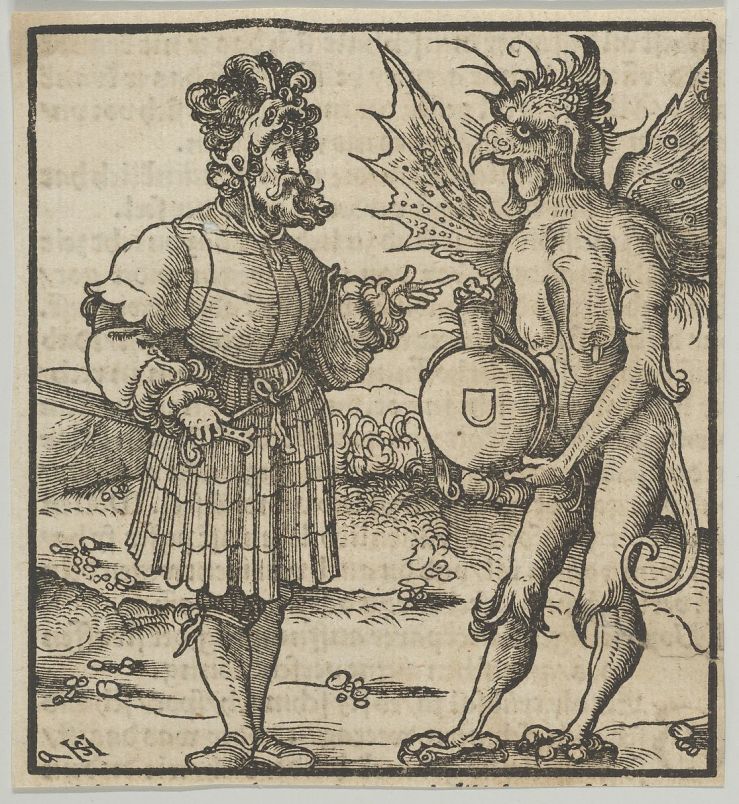
The Devil Offering Poison to a Knight –Hans Schäufelein

59.507.157(6)

The Devil Offering Poison to a Knight, 1517 by Hans Schäufelein (c. 1480–c. 1540)

Nathaniel Hawthorne’s journal entry for July 20th, 1837

July 20th.–A drive yesterday afternoon to a pond in the vicinity of Augusta, about nine miles off, to fish for white perch. Remarkables: the steering of the boat through the crooked, labyrinthine brook, into the open pond,–the man who acted as pilot,–his talking with B—- about politics, the bank, the iron money of “a king who came to reign, in Greece, over a city called Sparta,”–his advice to B—- to come amongst the laborers on the mill-dam, because it stimulated them “to see a man grinning amongst them.” The man took hearty tugs at a bottle of good Scotch whiskey, and became pretty merry. The fish caught were the yellow perch, which are not esteemed for eating; the white perch, a beautiful, silvery, round-backed fish, which bites eagerly, runs about with the line while being pulled up, makes good sport for the angler, and an admirable dish; a great chub; and three horned pouts, which swallow the hook into their lowest entrails. Several dozen fish were taken in an hour or two, and then we returned to the shop where we had left our horse and wagon, the pilot very eccentric behind us. It was a small, dingy shop, dimly lighted by a single inch of candle, faintly disclosing various boxes, barrels standing on end, articles hanging from the ceiling; the proprietor at the counter, whereon appear gin and brandy, respectively contained in a tin pint-measure and an earthenware jug, with two or three tumblers beside them, out of which nearly all the party drank; some coming up to the counter frankly, others lingering in the background, waiting to be pressed, two paying for their own liquor and withdrawing. B—- treated them twice round. The pilot, after drinking his brandy, gave a history of our fishing expedition, and how many and how large fish we caught. B—- making acquaintances and renewing them, and gaining great credit for liberality and free-heartedness,–two or three boys looking on and listening to the talk,–the shopkeeper smiling behind his counter, with the tarnished tin scales beside him,–the inch of candle burning down almost to extinction. So we got into our wagon, with the fish, and drove to Robinson’s tavern, almost five miles off, where we supped and passed the night In the bar-room was a fat old countryman on a journey, and a quack doctor of the vicinity, and an Englishman with a peculiar accent. Seeing B—-‘s jointed and brass-mounted fishing-pole, he took it for a theodolite, and supposed that we had been on a surveying expedition. At supper, which consisted of bread, butter, cheese, cake, doughnuts and gooseberry-pie, we were waited upon by a tall, very tall woman, young and maiden-looking, yet with a strongly outlined and determined face. Afterwards we found her to be the wife of mine host. She poured out our tea, came in when we rang the table-bell to refill our cups, and again retired. While at supper, the fat old traveller was ushered through the room into a contiguous bedroom. My own chamber, apparently the best in the house, had its walls ornamented with a small, gilt-framed, foot-square looking-glass, with a hair-brush hanging beneath it; a record of the deaths of the family written on a black tomb, in an engraving, where a father, mother, and child were represented in a graveyard, weeping over said tomb; the mourners dressed in black, country-cut clothes; the engraving executed in Vermont. There was also a wood engraving of the Declaration of Independence, with fac-similes of the autographs; a portrait of the Empress Josephine, and another of Spring. In the two closets of this chamber were mine hostess’s cloak, best bonnet, and go-to-meeting apparel. There was a good bed, in which I slept tolerably well, and, rising betimes, ate breakfast, consisting of some of our own fish, and then started for Augusta. The fat old traveller had gone off with the harness of our wagon, which the hostler had put on to his horse by mistake. The tavern-keeper gave us his own harness, and started in pursuit of the old man, who was probably aware of the exchange, and well satisfied with it.

Our drive to Augusta, six or seven miles, was very pleasant, a heavy rain having fallen during the night, and laid the oppressive dust of the day before. The road lay parallel with the Kennebec, of which we occasionally had near glimpses. The country swells back from the river in hills and ridges, without any interval of level ground; and there were frequent woods, filling up the valleys or crowning the summits. The land is good, the farms look neat, and the houses comfortable. The latter are generally but of one story, but with large barns; and it was a good sign, that, while we saw no houses unfinished nor out of repair, one man at least had found it expedient to make an addition to his dwelling. At the distance of more than two miles, we had a view of white Augusta, with its steeples, and the State-House, at the farther end of the town. Observable matters along the road were the stage,–all the dust of yesterday brushed off, and no new dust contracted,–full of passengers, inside and out; among them some gentlemanly people and pretty girls, all looking fresh and unsullied, rosy, cheerful, and curious as to the face of the country, the faces of passing travellers, and the incidents of their journey; not yet damped, in the morning sunshine, by long miles of jolting over rough and hilly roads,–to compare this with their appearance at midday, and as they drive into Bangor at dusk; two women dashing along in a wagon, and with a child, rattling pretty speedily down hill;–people looking at us from the open doors and windows;–the children staring from the wayside;–the mowers stopping, for a moment, the sway of their scythes;–the matron of a family, indistinctly seen at some distance within the house her head and shoulders appearing through the window, drawing her handkerchief over her bosom, which had been uncovered to give the baby its breakfast,–the said baby, or its immediate predecessor, sitting at the door, turning round to creep away on all fours;–a man building a flat-bottomed boat by the roadside: he talked with B—- about the Boundary question, and swore fervently in favor of driving the British “into hell’s kitchen” by main force.

Colonel B—-, the engineer of the mill-dam, is now here, after about a fortnight’s absence. He is a plain country squire, with a good figure, but with rather a heavy brow; a rough complexion; a gait stiff, and a general rigidity of manner, something like that of a schoolmaster. He originated in a country town, and is a self-educated man. As he walked down the gravel-path to-day, after dinner, he took up a scythe, which one of the mowers had left on the sward, and began to mow, with quite a scientific swing. On the coming of the mower, he laid it down, perhaps a little ashamed of his amusement. I was interested in this; to see a man, after twenty-five years of scientific occupation, thus trying whether his arms retained their strength and skill for the labors of his youth,–mindful of the day when he wore striped trousers, and toiled in his shirt-sleeves,–and now tasting again, for pastime, this drudgery beneath a fervid sun. He stood awhile, looking at the workmen, and then went to oversee the laborers at the mill-dam.

Nathaniel Hawthorne’s journal entry, 20 July 1837. From American Note-Books.