“Poem Beginning with a Line of Wittgenstein” — Donald Hall

Screenshot 2019-06-07 at 4.52.42 PM

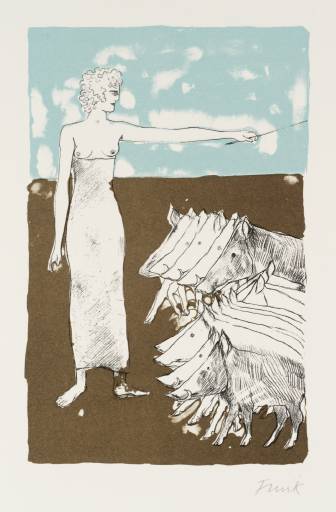
Circe — Elisabeth Frink

Circe 1973-4 by Dame Elisabeth Frink 1930-1993

Circe, 1974 by Elisabeth Frink (1930–1993). From Frink’s The Odyssey series.

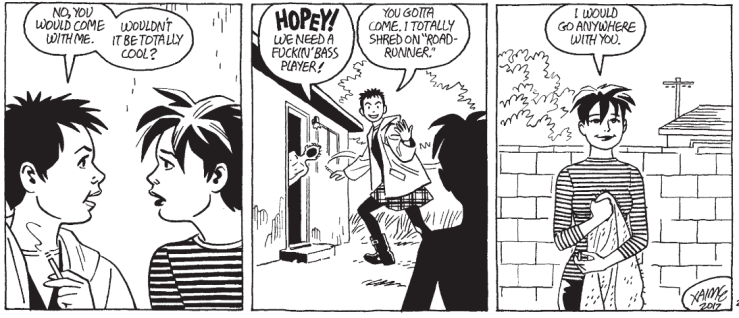
A review of Jaime Hernandez’s latest Love & Rockets graphic novel, Is This How You See Me?

Screenshot 2019-05-23 at 12.24.58 PM

My review of Jaime Hernandez’s latest Love & Rockets graphic novel, Is This How You See Me?, is up now at The Comics Journal. First few grafs—

Can you ever really go home again?

This is the central question of Jaime Hernandez’s Is This How You See Me? Collecting serialized comics from the past five years into a cohesive graphic novel, Is This How You See Me? is a moving tale of friendship, aging, and how the past shapes how we see the present.

Is This How You See Me? takes place over a single weekend in the mid-2010s. Best friends Maggie and Hopey return to their childhood hometown Huerta (or “Hoppers,” in Love & Rockets slang) for a punk rock reunion party and concert.

Read the whole review. 

Screenshot 2019-05-23 at 12.52.36 PM

“Time Does Not Bring Relief; You All Have Lied” — Edna St. Vincent Millay

“Time Does Not Bring Relief; You All Have Lied”

by

Edna St. Vincent Millay


Time does not bring relief; you all have lied
Who told me time would ease me of my pain!
I miss him in the weeping of the rain;
I want him at the shrinking of the tide;
The old snows melt from every mountain-side,
And last year’s leaves are smoke in every lane;
But last year’s bitter loving must remain
Heaped on my heart, and my old thoughts abide.
There are a hundred places where I fear
To go,—so with his memory they brim.
And entering with relief some quiet place
Where never fell his foot or shone his face
I say, “There is no memory of him here!”
And so stand stricken, so remembering him.

Rear Window Timelapse

Rear Window Timelapse by Jeff Desom/Alfred Hitchcock.

Incidentally (Peanuts)

Screenshot 2019-05-17 at 10.13.44 AM

Theseus and the Minotaur — Paul Reid 

43773756655_dd35648766_o

Theseus and the Minotaur, 2009 by Paul Reid (b. 1975)

La Suerte — Wyndham Lewis

La Suerte 1938 by Wyndham Lewis 1882-1957

La Suerte 1938, by Wyndham Lewis (1882–1957)

Proof — Kenton Nelson

kn

Proof by Kenton Nelson (b. 1954)

Here the mimic ship is the representation of an ideal one, and so gives us a more imaginative pleasure | Nathaniel Hawthorne’s journal entry for June 1st, 1842

June 1st, 1842.–One of my chief amusements is to see the boys sail their miniature vessels on the Frog Pond. There is a great variety of shipping owned among the young people, and they appear to have a considerable knowledge of the art of managing vessels. There is a full-rigged man-of-war, with, I believe, every spar, rope, and sail, that sometimes makes its appearance; and, when on a voyage across the pond, it so identically resembles a great ship, except in size, that it has the effect of a picture. All its motions,–its tossing up and down on the small waves, and its sinking and rising in a calm swell, its heeling to the breeze,–the whole effect, in short, is that of a real ship at sea; while, moreover, there is something that kindles the imagination more than the reality would do. If we see a real, great ship, the mind grasps and possesses, within its real clutch, all that there is of it; while here the mimic ship is the representation of an ideal one, and so gives us a more imaginative pleasure. There are many schooners that ply to and fro on the pond, and pilot-boats, all perfectly rigged. I saw a race, the other day, between the ship above mentioned and a pilot-boat, in which the latter came off conqueror. The boys appear to be well acquainted with all the ropes and sails, and can call them by their nautical names. One of the owners of the vessels remains on one side of the pond, and the other on the opposite side, and so they send the little bark to and fro, like merchants of different countries, consigning their vessels to one another.

Generally, when any vessel is on the pond, there are full-grown spectators, who look on with as much interest as the boys themselves. Towards sunset, this is especially the case: for then are seen young girls and their lovers; mothers, with their little boys in hand; school-girls, beating hoops round about, and occasionally running to the side of the pond; rough tars, or perhaps masters or young mates of vessels, who make remarks about the miniature shipping, and occasionally give professional advice to the navigators; visitors from the country; gloved and caned young gentlemen,–in short, everybody stops to take a look. In the mean time, dogs are continually plunging into the pond, and swimming about, with noses pointed upward, and snatching at floating chips; then emerging, they shake themselves, scattering a horizontal shower on the clean gowns of ladies and trousers of gentlemen; then scamper to and fro on the grass, with joyous barks.

Some boys cast off lines of twine with pin-hooks, and perhaps pull out a horned-pout,–that being, I think, the only kind of fish that inhabits the Frog Pond.

The ship-of-war above mentioned is about three feet from stem to stern, or possibly a few inches more. This, if I mistake not, was the size of a ship-of-the-line in the navy of Liliput.


Nathaniel Hawthorne’s journal entry for June 1st, 1842. From Passages from the American Note-Books

All of David Markson’s references in The Last Novel to Walt Whitman

All of David Markson’s references in The Last Novel to Walt Whiman:

I am he that aches with amorous love.            Wrote Whitman.

Walter, leave off.

Wrote D. H. Lawrence.


Walt Whitman’s claim — never in any way verified — that he had fathered at least six illegitimate children.


Gerard Manley Hopkins, on realizing that he feels a certain kinship with Whitman:

As he is a very great scoundrel this is not a very pleasant confession.


A writer of something occasionally like English — and a man of something occasionally like genius.

Swinburne called Whitman.


Future generations will regard Bob Dylan with the awe reserved for Blake, Whitman, Picasso and the like.

Said an otherwise seemingly rational writer named Jonathan Lethem.


Before the Euro, the portrait of Yeats on Ireland’s twenty-pound note.

America’s Whitman twenty-dollar bill, when?

The Melville ten?


Twenty-five years after his death, Poe’s remains were disinterred from what had been little better than a pauper’s grave and reburied more formally.

Walt Whitman, who made the journey from Camden to Baltimore in spite of being disabled from a recent stroke, was the only literary figure to appear at the ceremonies.

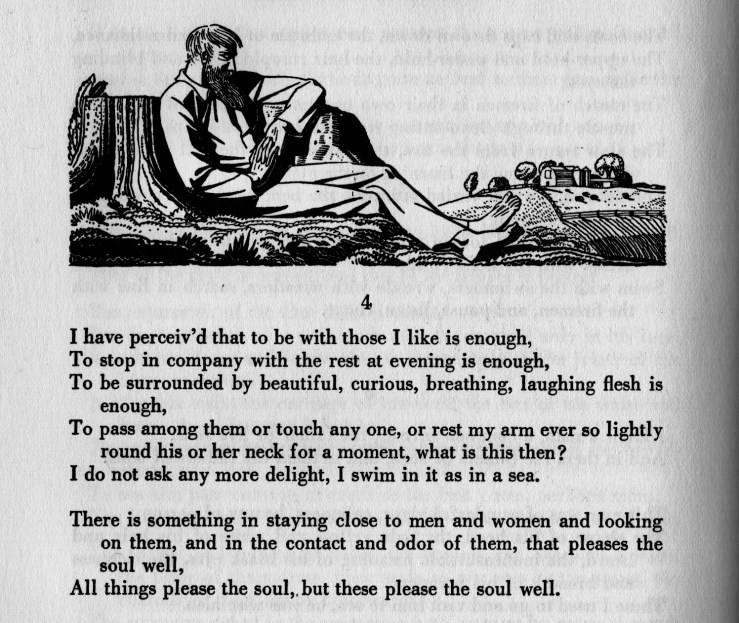
I have perceiv’d that to be with those I like is enough (Walt Whitman)

img_2888

From Leaves of Grass, illustrated by Rockwell Kent.

Errors on Walt Whitman (Jorge Luis Borges)

whitman

Almost as if it was one person

Never was there more hollowness at heart than at present (Walt Whitman)

I say we had best look our times and lands searchingly in the face, like a physician diagnosing some deep disease. Never was there, perhaps, more hollowness at heart than at present, and here in the United States. Genuine belief seems to have left us. The underlying principles of the States are not honestly believ’d in, (for all this hectic glow, and these melodramatic screamings,) nor is humanity itself believ’d in. What penetrating eye does not everywhere see through the mask? The spectacle is appaling. We live in an atmosphere of hypocrisy throughout. The men believe not in the women, nor the women in the men. A scornful superciliousness rules in literature. The aim of all the littérateurs is to find something to make fun of. A lot of churches, sects, &c., the most dismal phantasms I know, usurp the name of religion. Conversation is a mass of badinage. From deceit in the spirit, the mother of all false deeds, the offspring is already incalculable. An acute and candid person, in the revenue department in Washington, who is led by the course of his employment to regularly visit the cities, north, south and west, to investigate frauds, has talk’d much with me about his discoveries. The depravity of the business classes of our country is not less than has been supposed, but infinitely greater. The official services of America, national, state, and municipal, in all their branches and departments, except the judiciary, are saturated in corruption, bribery, falsehood, mal-administration; and the judiciary is tainted. The great cities reek with respectable as much as non-respectable robbery and scoundrelism. In fashionable life, flippancy, tepid amours, weak infidelism, small aims, or no aims at all, only to kill time. In business, (this all-devouring modern word, business,) the one sole object is, by any means, pecuniary gain. The magician’s serpent in the fable ate up all the other serpents; and money-making is our magician’s serpent, remaining to-day sole master of the field.

From Walt Whitman’s Democratic Vistas (1871).

The Muse’s Revenge — Ilya Milstein

ilya_milstein_muses_revenge

The Muse’s Revenge, 2019 by Ilya Milstein

“Himself let him unknown contain” — Tom Clark

“Himself let him unknown contain”

by

Tom Clark


Wyatt, with no insurance on his own head,
watching the execution of Anne Boleyn
from his cell in the Tower, while beyond
on Tower Hill her lovers also are executed,

reflects upon his wasted virtue and now
redundant innocence, rueful he ever did
let his name be known beyond the door of
his soul or hung his star from fate thrones.

(see also)