- Fargo
- No Country for Old Men
- A Serious Man
- The Big Lebowski
- Inside Llewyn Davis
- Barton Fink
- Burn After Reading
- The Ballad of Buster Scruggs
- O Brother, Where Art Thou?
- Raising Arizona
- Blood Simple
- The Man Who Wasn’t There
- Miller’s Crossing
- True Grit
- The Ladykillers
- The Hudsucker Proxy
- Hail, Caesar!
- Intolerable Cruelty
A recipe for Charles Dickens’s hare soup
Skin a hare and put it on to roast. Whilst it is cooking, fry in the best English butter two carrots, a head of celery, two onions, two ounces of raw ham, two bay leaves, two cloves, a blade of mace, four shallots, a little thyme and parsley. Fry all these to a brown color in a stew pan.
When the hare has been roasting for an hour, remove the back fillets and pound the remainder in a mortar and add it to the vegetables. Add to this mixture a half pound of brown thickening which has been made with a pound of butter and sifted flour, and cook over a slow fire. The mixture should be moistened with two quarts of good stock and stirred over a fire until it boils. A glass of wine should be added and a small pinch of cayenne.
The recipe comes from the unsigned article “London Chef Explains Dickens’s Hare Soup,” published in The New York Times, 26 Dec. 1926.
According to the article, a “well-known London chef” shared the recipe as “a kind of Christmas card” with his patrons in 1926. Apparently Dickens enjoyed eating this hare soup regularly “a Strand restaurant” in the 1850s.
Mother Lish’s Bologna Sandwich, a recipe from Gordon Lish
- First check the refrigerator to make certain none of the following are in there: lettuce, butter, margarine, mustard, ketchup or mayo.
- Remove the jar of mint jelly from the cupboard. (Marmalade is an acceptable substitution.)
- Your bread should be of the diet variety, well-aged and adequately chilled. If the counter is wet, place two slices of bread on it. Press down with the heel of your hand to make sure they lie flat. (If you experience some difficulty in separating two slices of bread from the rest of the loaf, rap the loaf smartly on the edge of the counter.)
- Never use presliced bologna. Your bologna should be of the sausage type, with good stout rind on it. Working with a dull knife, hack off what you need. What you’re aiming for here are pieces of bologna that display a certain ragged configuration.
- Spread mint jelly on one slice of your dampened bread. On the other slice, distribute chunks of bologna. Lift jellied slice up, jellied side up and lower it over the other slice. (If jellied slice sticks to the counter, use screwdriver to pry it off.)
- Still working with the same knife, halve the finished product, cutting from one corner to the other. (Bread should come apart into a number of small pieces all by itself. But if this does not occur, start over again.) Serve immediately. (If this is not possible, store in freezer for later use.) keeps indefinitely if wrapped in a brown paper bag with a rubber band around it.)
From “The Day Mother Invented Junk Food” by Gordon Lish. The full piece was published in The New York Times, 2 Aug. 1978. Thanks to David Winters for sharing it with me years ago.
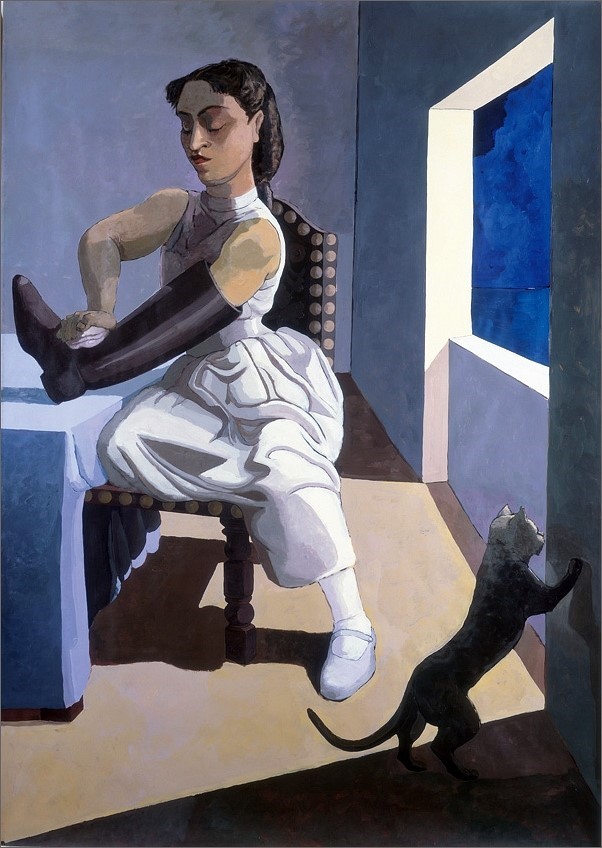
Snare — Paula Rego
100 phrases culled from The New York Times list of “100 Notable Books of 2018”
The following phrases appear in The New York Times list of “100 Notable Books of 2018.” There is one phrase culled from each blurb on the list.
slow burn
latest novel
bizarre story
tour de force
stunning debut
homage of sorts
explores this idea
tactile immediacy
fragmented novel
fascinating paean
grapples seriously
searching account
harrowing account
harrowing memoir
fascinating portrait
expansive narrative
novel that ricochets
fast-paced account
stunning new novel
bristling intelligence
impassioned account
incisive new collection
magisterial new novel
bighearted family saga
breezy, appealing style
impressive debut novel
bewitching debut novel
remarkable debut novel
private and public twists
stylish and inspired collection
deeply and lovingly personal
describes the years of research
reveals surprising connections
world of scams and seductions
our history and our current age
dire consequences for democracy
darkly comic and profound novel
memoir of an unstable childhood
powerful and realistic page turner
mammoth autobiographical novel
devastatingly beautiful debut novel
blazingly moral and devastatingly sidelong
capturing the themes of identity and reinvention
written by the actress herself and not a ghostwriter
seemingly quiet but ultimately volcanic collection
recounted here with great lyricism and emotion
sometimes fanciful, always gossipy portrait
navigate the political and the personal
tense, moment-by-moment account
illuminates her narrator’s inner life
public and private responsibilities
searing autobiographical novel
the personal and the political
more political than economic
vivid, slightly surreal history
writes about new research
sweeping, sobering account
deep dive into the question
unnerving cautionary tale
searingly passionate book
deeply reported account
monumental biography
heralds America’s future
much more complicated
posthumous collection
law professor recounts
marvelous debut novel
nervy, obsessive novel
shattering work of art
important biography
recounts her struggle
first major biography
semi-surreal sendup
landmark translation
thinly veiled memoir
satisfying slow burn
unbelievable debut
forgotten histories
reads like a thriller
fast-paced thriller
mine the question
capture the chaos
infinitely capable
rousing defense
widens the lens
singular portrait
sparkling novel
eloquent novel
riveting exposé
gritty depiction
noted historian
searing memoir
writerly passion
road-trip novel
think differently
page after page
Pulitzer finalist
tells his story
timely novel
wry catalog
The First Thanksgiving — Warrington Colescott
The First Thanksgiving, 1973 by Warrington Colescott (1921 – 2018)


A grave and dark-clad company!” quoth Goodman Brown.
In truth, they were such. Among them, quivering to-and-fro, between gloom and splendor, appeared faces that would be seen, next day, at the council-board of the province, and others which, Sabbath after Sabbath, looked devoutly heavenward, and benignantly over the crowded pews, from the holiest pulpits in the land. Some affirm, that the lady of the governor was there. At least, there were high dames well known to her, and wives of honored husbands, and widows, a great multitude, and ancient maidens, all of excellent repute, and fair young girls, who trembled lest their mothers should espy them. Either the sudden gleams of light, flashing over the obscure field, bedazzled Goodman Brown, or he recognized a score of the church-members of Salem village, famous for their especial sanctity. Good old Deacon Gookin had arrived, and waited at the skirts of that venerable saint, his reverend pastor. But, irreverently consorting with these grave, reputable, and pious people, these elders of the church, these chaste dames and dewy virgins, there were men of dissolute lives and women of spotted fame, wretches given over to all mean and filthy vice, and suspected even of horrid crimes. It was strange to see, that the good shrank not from the wicked, nor were the sinners abashed by the saints. Scattered, also, among their pale-faced enemies, were the Indian priests, or powows, who had often scared their native forest with more hideous incantations than any known to English witchcraft.
–From “Young Goodman Brown,” Nathaniel Hawthorne (1835)
Lear and Fool — Oskar Kokoschka

Lear and Fool, 1963 by Oskar Kokoschka (1886-1980)
Seek it like a dream | Another blog about Gaddis’s The Recognitions
Earlier this week, continuing my audit of William Gaddis’s 1955 novel The Recogntions, I felt a tingling sense of recognition in the following lines from which Basil Valentine reads from “a copy of Thoreau” (this is at the very end of Part I, on page 265):
What you seek in vain for, half your life, one day you come full upon, all the family at dinner. You seek it like a dream, and as soon as you find it you become its prey.
I attributed this tingling recognition to having read The Recognitions before (and to having read Part I once before that)—but then I realized that I’d read the line far, far more recently: It’s the epigraph to Gaddis’s fourth novel A Frolic of His Own, which I’d opened up again just a few weeks ago (and subsequently put back down).
This recognition is nothing special and certainly uninteresting to longtime Gaddis fans, but it motivated me enough to look more into the remark, so I plugged it into Google and quickly found J. M. Tyree’s essay “Henry Thoreau, William Gaddis, and the Buried History of an Epigraph.” Tyree’s essay was originally published in New England Review but I found it, natch, on Steven Moore’s The Gaddis Annotations.
Tyree’s essay is a fascinating read, tracking the strange history of the line. Thoreau’s words, it turns out, are not exactly Thoreau’s words—rather, they are Emerson’s recollections of a conversation between the pair from a walk in the woods. Additionally, Emerson wrote and attributed these words after Thoreau’s death. The remark initially appeared in Emerson’s literary eulogy “Thoreau,” published in the August 1862 edition of Atlantic Monthly. As Tyree observes,
This detail, which seems highly trivial at first, in fact slyly reinforces the theme of original and copy supersaturating Gaddis’s novel. The very nature of authorship falls into question here, in a manner similar to the problem of Socrates and Plato: is Thoreau’s saying from Emerson or from Thoreau, or is it from both?
While issues of originality and authenticity of authorship clearly correlate to the themes of The Recognitions, Tyree’s essay is most interesting to me in the ways by which it situates Gaddis’s work with/against the American Renaissance tradition. Tyree gives us some of the flavor of that tradition, recontextualizing Gaddis’s epigraph in a full paragraph of Emerson’s. Here’s Emerson eulogizing his friend Thoreau:
It was a pleasure and a privilege to walk with him. He knew the country like a fox or a bird, and passed through it as freely by paths of his own. He knew every track in the snow or on the ground, and what creature had taken this path before him. One must submit abjectly to such a guide, and the reward was great . . . Presently he heard a note which he called that of the night-warbler, a bird he had never identified, had been in search of twelve years, which always, when he saw it, was in the act of diving down into a tree or bush, and which it was vain to seek; the only bird that sings indifferently by night and by day. I told him he must beware of finding and booking it, lest life should have nothing more to show him. He said, “What you seek in vain for, half your life, one day you come full upon, all the family at dinner. You seek it like a dream, and as soon as you find it you become its prey.”
Tyree situates the passage within the contrasting (and quickly diverging) philosophies of the old friends: “Emerson was essentially cosmic in his Transcendentalism, while Thoreau sought the divine in the actual empirical details of nature.”
Tyree’s essay becomes most interesting to me when he begins to interpret just what the hell the quote means. His analysis hovers around the word family, underlining an obsession of American literature: escape from domesticity. Here’s Tyree’s paraphrase of the Thoreau’s/Emerson’s line:
One finds the object of a long quest, quite suddenly, at the family dinner table. But in the moment of discovery, something seems to go wrong; rather than capturing the truth, one becomes its prey. Clearly, the conversation here has expanded beyond night-warblers. Thoreau is now speaking of truth and its relationship to the family dinner table.
Tyree then susses out Thoreau’s complicated relationship with Emerson’s family:
It is possible to make too much of the fact that Thoreau’s intellectual life, as both a thinker and a man, developed in Emerson’s shade, in the shelter of Emerson’s house and family. But it is clear that Thoreau was often of two minds about living with or near Emerson. In a September 1841 letter….Thoreau told a friend that he was “living with Mr. Emerson in very dangerous prosperity.”
That “dangerous prosperity” of domestic life echoes one of the grand themes of American literature—namely, civilization is a blockade to be surpassed on the trek into wild nature, individuality, and freedom. Domestic duty interferes with such adventures. Just ask Rip Van Winkle, Ishmael, or Huck Finn. (Or perhaps Hawthorne’s cautionary figure, Young Goodman Brown).
Tyree underlines the point (final emphasis mine):
In the exchange over the night-warbler, the family is again identified in terms of danger; the quest is a danger to the family, or the family is a danger to the quest. One might read this as Thoreau’s critique of what would now be called Emerson’s “lifestyle.” A man who is the prey to truth must leave the dinner table to find it, but Emerson, in the comfort of his household, among his family, will never book the night-warbler. Thoreau does not say that having “all the family at dinner” stops one’s seeking, only that one becomes the prey of a protracted, half-conscious quest at mealtime. Then, one must decide what to do about it—whether to search out the night-warbler or not, and how to do it. The question seems to be whether the truth can be found through the life of the family, or whether one must leave it behind in some sense.
In The Recognitions, Wyatt circumvents the danger to his quest by not only removing himself from family (in the form of his wife Esther), but from removing himself from society in general. In J R (1975), most of Gaddis’s heroes find themselves unable to reconcile to Wyatt’s solution; their seeking fumbled out in half measures, neatly figured in the 96th Street apartment apartment shared by Gibbs, Eigen, and Bast. This hellhole is a transitory space, an inbetweeness of domesticity and city wilderness. Carpenter’s Gothic (1985) offers a more thorough critique of the impulse in American literature to send its (generally masculine) characters out into the wild spaces where they can transcend all the trappings of domesticity that bog them down. Carpenter’s Gothic confines its heroine to one haunted house, the men in her life flitting in and out if like silly birds on foiled quests. That domestic confinement reaches a kind of apotheosis in Gaddis’s posthumous novel Agapē Agape (2002), the stifling uninterrupted monologue of a man in a room, fighting against entropy.
And what about A Frolic of His Own (1994)? Well I haven’t read it yet.
House of Cards — Francine Van Hove

House of Cards, 2015 by Francine van Hove (b. 1942)
Nemesis — Agostino Arrivabene

Nemesi (Nemesis), 2017 by Agostino Arrivabene (b. 1967)
Golding’s Pincher Martin, DeWitt’s The Last Samurai (Books acquired,16 Nov. 2018)

I spent a relaxing hour and a half browsing my favorite local used bookstore this afternoon. I ended up finding a copy of Helen DeWitt’s debut novel The Last Samurai, which all kindsa smart folks have been telling me to read for years. I didn’t like her follow-up Lightning Rods, and stalled out on her collection Some Trick earlier this year—but we’ll see.
William Goldman died today. I’ve always thought of him primarily as a screenwriter, and I think much of his screenwriting work is pretty great, The Princess Bride in particular (the one Goldman novel we own is The Princess Bride, currently in my daughter’s possession). I couldn’t help but look over some of his books today.

…which is how I ended up picking up William Golding’s Pincher Martin. (Golding, not Goldman). I read his 1955 novel The Inheritors a few years ago and I think when I was talking about it somewhere (maybe online), someone recommended Pincher Martin—and I couldn’t pass up this Penguin edition with cover art by Paul Hogarth.

I also thumbed through a copy of Robert Scholes’s Fabulation and Metafiction (1980), reading a big chunk of the chapter called “The Nature of Experimental Fiction.” The chapter begins with four illustrating quotations from four masters of metafiction:

Barry Hannah reading “All the Old Harkening Faces at the Rail” on his porch swing
Barry Hannah reading “All the Old Harkening Faces at the Rail” (from Airships) and talking about memory and voice at his home in Oxford, Mississippi in February, 1986.
Boy Reading — Fairfield Porter

Boy Reading, 1955 by Fairfield Porter (1907-1975)
João Gilberto Noll’s Lord (Book acquired, 5 Nov. 2018)

João Gilberto Noll’s novel Lord is new in English translation (by Edgar Garbeletto) from Two Lines Press. I really enjoyed the last two I read by Noll, Atlantic Hotel and Quiet Creature on the Corner, so I’m looking forward to carving out time for Lord. In the meantime, Two Lines’ blurb:
As Lord begins, a Brazilian author is arriving at London’s Heathrow airport for reasons he doesn’t fully understand. Only aware that he has been invited to take part in a mysterious mission, the Brazilian starts to churn with anxiety. Torn between returning home and continuing boldly forward, he becomes absorbed by fears: What if the Englishman who invited him here proves malign? Maybe he won’t show up? Or maybe he’ll leave the Brazilian lost and adrift in London, with no money or place to stay? Ever more confused and enmeshed in a reality of his own making, the Brazilian wanders more and more through London’s immigrant Hackney neighborhood, losing his memory, adopting strange behaviors, experiencing surreal sexual encounters, and developing a powerful fear of ever seeing himself reflected in a mirror.
A novel about the unsettling space between identities, and a disturbing portrait of dementia from the inside out, Lord constructs an altogether original story out of the ways we search for new versions of ourselves. With jaw-dropping scenes and sensual, at times grotesque images, renowned Brazilian author João Gilberto Noll grants us stunning new visions of our own personalities and the profound transformations that overtake us throughout life.
Detail from Saint Michael and the Devil — Raphael
Untitled — Saul Steinberg

Untitled, c. 1957-60 by Saul Steinberg (1914-1999). From The Labyrinth.
Still-Life with Self-Portrait — Cornelis Norbertus Gysbrechts

Still-Life with Self-Portrait, 1663 by Cornelis Norbertus Gysbrechts (c. 1630 – c. 1675)