Between the first Sunday of September 2015 and the first Sunday of September 2016 I ran a series of posts—every Sunday that year—I called “Three Books.” I would scan the covers of the books, and I generally tried to find books with interesting design elements to them; I would also try to find a thread between the books (but not always). The posts allowed me to write about the design and aesthetics of covers, as well as other elements of the books (y’know, like, what was actually between the covers). The posts also gave me a regular goal on a Sunday. After a year, I moved on to another series of Sunday posts I called Sunday Comics; before the Three Books thing, I posted pics of my bookshelves on Sundays and wrote about that; and before that, I posted images of death masks on Sundays. A themed post of some kind every Sunday seemed to give this accursed blog a sense of direction, however false. I don’t remember how or why I quit posting Sunday comics, but searching the tag shows me I stopped at the end of June in 2017. This whole paragraph seems like a long and rambling preamble to saying something like, Maybe I should do these Blog about posts on Sundays? Huh? What do you think?
But the title said “Three Books”…so—Three Books, chosen somewhat at random:
Captain Maximus by Barry Hannah. First edition hardback by Knopf, 1985. Cover design by Fred Marcellino.
Last summer I visited Alias East Books East in Los Angeles, where, along with sometime-Biblioklept contributor Ryan Chang, I fondly fondled a signed first edition of Barry Hannah’s novel Ray. I couldn’t bring myself to pay sixty dollars for it, but one night, after a few drinks, broke down and bid on eBay for a signed Hannah—Captain Maximus. I wound up paying six dollars more than what Knopf wanted to charge folks for an unsigned edition back in ’85. This particular copy clearly has never been read. I ended up picking up the Penguin Contemporary Classics paperback version of Captain Maximus (for three dollars of used bookstore credit) and reading that instead. The signed Hannah’s spine is still pristine, and I realize that I am something awful.
The book is purple.
The Heart of a Dog by Mikhail Bulgakov. English translation by Michael Kenny. First edition hardback, Harcourt, Brace, & World, 1968. Design by Applebaum & Curtis Inc.
The World within the Word by William H. Gass. Trade paperback by Basic Books. Cover design by Rick Pracher.
Just a wonderful collection of essays. His essay on Stein is required reading, and “Carrots, Noses, Snow, Rose, Roses” is perfect metafiction posing as criticism. Lovely stuff.
I watched Martin Scorsese’s 1982 film The King of Comedy last weekend and then added it to a list of examples for a much bigger Thing I’ve been working on for a few years (and hence will never likely finish, unlike these Blog about posts). The much bigger Thing is about the relationship between Comedy and Horror—not purely the formal characteristics that belong to specific genres of literature, film, and art, but rather the relationship between the emotions themselves (with special attention to how literature, film, and art evoke that relationship).
The short thesis for this bigger Thing is that I think that comedy relies strongly on horror, and that the best provocations of horror are tempered in humor. There is a long list of examples in support of this thesis, including Goya and Bolaño and Larry David and Don Quixote and Candide and Thomas Bernhard and Surrealism and Get Out and etc. —-but that’s all for said bigger Thing, and the title of this post seems to promise Something (not a big Thing) on Martin Scorsese’s 1983 film The King of Comedy, which I recently rewatched.
I first saw The King of Comedy in the spring of 1998. I was a freshman at the University of Florida and had quickly discovered their library of films on VHS, which I would imbibe over my four years there. I started with stuff I was already a bit familiar with though. Like every other stupid eighteen-year old, I thought Taxi Driver was A Work of Genius (without fully understanding it), and I’d seen Goodfellas and Casino approximately one thousand times by this point. I started UF’s collection of Scorsese tapes with the neo-neorealism of Raging Bull, a brutal and hence thoroughly comprehensible character study, an ugly film shot in gorgeous black and white. The King of Comedy was next.
The internet in 1998 was not the internet of 2018. What I mean is that we generally learned about films through books and journals and magazines, or really other films, or really, really by word of mouth. I don’t think I had any word of mouth on The King of Comedy—what I mean is that I think I thought the film was a comedy. Which it is. Sort of. I mean, it’s funny—-very funny sometimes. But it’s also very cruel, and often scary and off putting, and generally queasy.
The King of Comedy stars Robert De Niro as Rupert Pupkin. That ridiculous name is on one hand a running joke, but on the other hand a vein of horror that pulsates throughout the film—an aberrant twitching oddity, a sort of literal curse, both on poor Rupert (who bears that name) and on every person who encounters him. Rupert is a would-be comedian who dreams (literally and often from his mother’s basement) of stardom. He dreams that he’ll achieve this stardom through a spotlight gig on The Jerry Langford Show, a Carson-style late night show hosted by Jerry Langford, played by a wonderfully fed-up Jerry Lewis.
Rupert is an autograph hound, an obsessive type of fan who makes Jerry’s life a literal terror. Rupert’s foil is Masha, a trust-fund baby played by Sandra Bernhard. Masha stalks Jerry with extreme competitive anxiety; her stalking is a lifestyle elevated to art. When Masha goes too far early in the film and hijacks Jerry’s limo, Rupert sees an opening—he saves the day, ousting Masha, but then he invades the limo (proving himself stalker supreme over Masha). In the limo ride, Rupert asks Jerry for help in advancing his career, and Jerry gives generous if general advice, which amounts to Put the work in and pay your dues. Rupert complains that he simply doesn’t have time to invest in doing the real hard grinding work, and basically demands that Jerry give him a shortcut.
In showing a deranged would-be artist who feels he’s entitled to bypass the years of work involved in honing a skill, Scorsese anticipates our current zeitgeist. Rupert Pupkin desires fame, adoration, and applause, but he is far less interested in producing an art that would earn these accolades. The King of Comedy slowly shows us that Pupkin is mentally ill, and that his disease is radically exacerbated by a culture of mass media.
The King of Comedy’s most sarcastic biteis that Rupert is eventually rewarded for his deranged behavior. He and Masha kidnap Jerry as part of a plan to get Rupert an opening set of The Jerry Langford Show. The plan succeeds, and Rupert executes it so that he not only gets to land his dream gig, he also gets to watch himself do it in front of The Girl He Liked in High School:
Rupert’s audacious gambit is part and parcel of a postmodern mass media era that makes only the slightest distinction between fame and infamy. Rupert is famous for doing something famous—and something horrific, kidnapping a beloved TV host. It’s his one bit of work, but it’s enough to land him a book deal, celebrity, and money (and a fairly short prison sentence).
Parts of Rupert’s monologue are funny, but other parts read like the memoir of a damaged soul trying to recover from an abusive childhood. And maybe these parts mix. Again, horror underwrites comedy.
This horror repeats in Scorsese’s framing of Rupert’s routine. There’s a dream-like quality to the monologue, with its television tube frame. This is not the first time we’ve seen this framing in King of Comedy—we get similar TV fantasies via Rupert’s deranged mind—but this time the plot asks us to think of it as “real,” even as Scorsese’s aesthetics suggest that the ending of the film may all be in Pupkin’s warped mind, the unseen clapping audience just another delusion of grandeur.
The same gesture is present at the end of Taxi Driver, which is essentially the twin of The King of Comedy. Travis Bickle—another ridiculous name, another loser—improbably ends up the hero of the narrative. But the conclusion of Taxi Driver has always struck me as the internal fantasy of its reactionary (anti-)hero. Likewise, The King of Comedy concludes in yet another fantasy in Rupert Pupkin’s addled consciousness.
With its metatextual contours and its insinuations of reality-as-mediated-by-mass-media, The King of Comedy is perhaps Scorsese’s most formally postmodern film (although his smaller follow-up After Hours might be his most thematically postmodern). It’s no wonder that the film didn’t land with audiences in 1983. Beyond its postmodern rhythms, The King of Comedy is essentially repulsive—nothing good happens; there is no clear hero; the world it depicts is devoid of any meaning not centered in relation to fame. Its satire is so black no light escapes. In comparison, Scorsese’s later films like Goodfellas and The Wolf of Wall Street are laugh riots.
The genius of The King of Comedy is something best felt. The film disrupts genre conventions (and audience expectations), pushing a comedy into a horror. Or maybe The King of Comedy is a horror film with comedic overtones. Or, really—I mean, what I really want to say here is:
The King of Comedy isn’t a horror film or a comedy film—like many of Scorsese’s best films, it’s a character study—realistic and engrossing and grotesque in its utter realism. Time has caught up with it. If Rupert Pupkin seemed an extreme example of the kind of derangement and alienation that could be aggravated by a mass media culture in the early 1980s, by today’s standards he’s perhaps charming. And that’s horrifying.
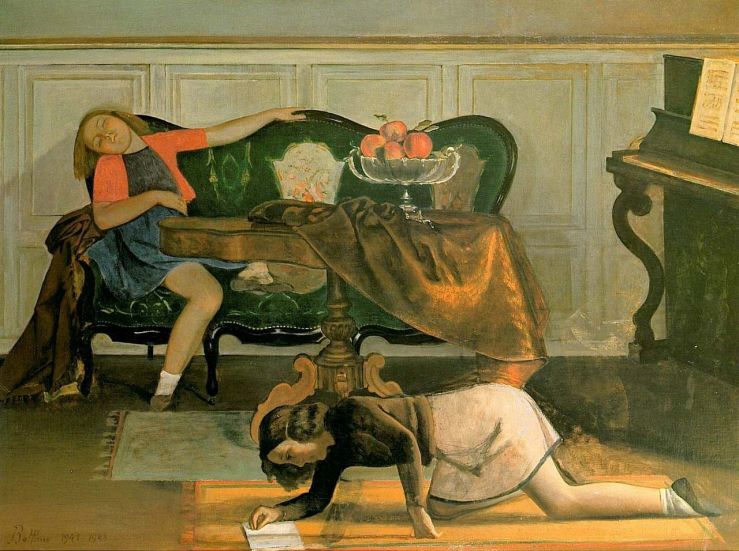
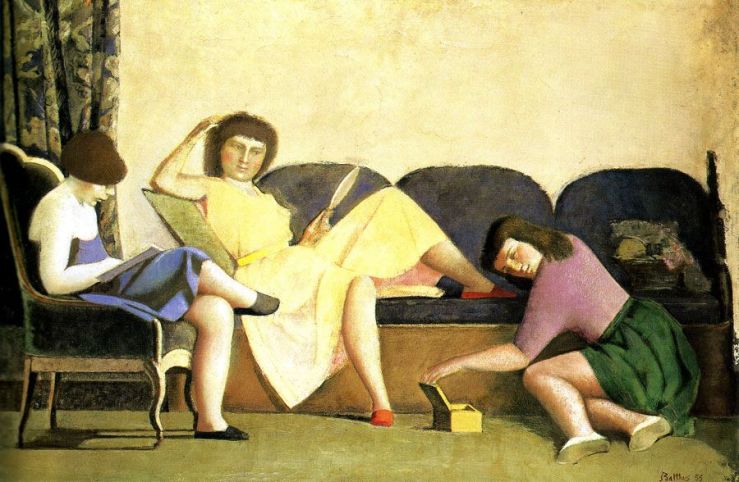
My young girls who read in dreaming poses are escaping from fleeting, harmful time: Katia, Frederique, and The Three Sisters. Fixing them in the act of reading or dreaming prolongs a privileged, splendid, and magic glimpsed-at time. A suddenly opened curtain sheds light from a window and is seen only by those who know how. Thus a book is a key to open a mysterious trunk containing childhood scents; we rush to open it like the child with butterflies, or the young girl with a moth. It is a gold-sprinkled time that avoids worldly alteration, time nimbused by a magic halo, time fixed in terms of what the smiling, dreaming girls see. It is surreal time in the true sense of the term.
—From Balthus’ 2001 memoir Vanished Splendors, “as told to” Alain Vircondelet. English translation by Benjamin Ivry.
The first Balthus painting I saw was The Bedroom. I saw it in Edward Lucie-Smith’s Movements in Art since 1945. I was maybe 17, and I found the painting not so much shocking as disturbing. It upset something in me, but I also found myself enchanted by it. In the painting an aesexual woman of dwarfish proportions, scowling and stern, pulls a black curtain to its side to allow sunlight to flood over the nude body of a young woman whose posture is simultaneously sexually vibrant and alarmingly comatose. A cat perched on a book glances out the window. There’s a dark fairy tale embedded in the painting. In its color, light, staging, subject, and theme, it’s of a piece with much of Balthus’ work. I didn’t know that over 20 years ago when I first saw it, but I did know that it intrigued me. I wanted to see more.
As a teenager, Balthus’ visions disturbed and engaged me. My response was aesthetic, but I also found a narrative even in his most static paintings. There’s an eerie peace to his reading girls that I saw then and see now. The rooms he painted were little dreams.
Now that I am older I find Balthus’ depictions of girls far, far more disturbing than I did two decades ago. Or rather, I find his paintings disturbing in a different way.
(I think here of rereading Lolita as an adult. I think I first read the book at 15 or 16, and was floored by its language; I read it again in my early 20s—and then in my late twenties. It was a different book).
And yet when I look at Balthus’ paintings of girls reading what emanates most strongly for me is that “gold-sprinkled time that avoids worldly alteration, time nimbused by a magic halo.” He captures something about the private world of reading that I identify with—what I mean is that I feel the feeling of the girls who read in his paintings.
Elsewhere in his memoir, Balthus declares—
…I completely reject the erotic interpretations that critics and other people have usually made of my paintings. I’ve accomplished my work, paintings and drawings, in which undressed young girls abound, not by exploiting an erotic vision in which I’m a voyeur and surrender unknowingly (above all, unknowingly) to some maniacal or shameful tendencies, but by examining a reality whose profound, risky, and unpredictable unreadability might be shed, revealing a fabulous nature and mythological dimension, a dream world that admits to its own machinery.
Balthus here gives us a fitting description of the “unreadability” of the visions he depicts. Key here is that both his negation (“not by”) and its parallel divergent conjunction (“but by”) frame a perfectly apt analysis of his own work—he is a voyeur, yes, and ushers in a voyeuristic eye—but he also stages a dream world that his viewers can feel.
Here is the first part of the first piece, “Dark Spirit,” a riff on Beauty and the Beast (with touches of Dante’s Inferno):
They are on a film lot, walking through a pre-shoot reading of a script that calls for a brave traveller—“That’s you, kid,” the director says, leading her forward with an arm around her shoulders—to be lured to the edge of a deep, mysterious forest, known portentously as the Forest of Time. The forest is fake, deep as a painted scrim, but the director has told them that a real forest from Transylvania will be pasted in later, and they have all been asked to bat at the air around their faces, as if to brush away foliage, bugs, bats, clinging cobwebs. “Out, out, damned spot, I say!” an actor screams in falsetto, batting wildly, and everyone laughs. The actor, who has a bit part in the film, as the enchanted prince, smirks shyly, blinking his long lashes. He’s a cute boy, but too full of himself. And just a runt. He’ll have to stand on a chair for their happily-ever-after smooch once she’s freed the Beast from his spell and let the prince out. The industry is obsessed with this hackneyed tale, once inflicted upon young virgins to prepare them for marriage to feeble old buzzards with money. She used to raise hell about such things. Now she doesn’t really care. “The gutsy heroine knows that many have perished here,” the continuity girl says, reading from the script, “victims of the absolute evil that is believed to pervade the treacherous Forest of Time.” “Oh, the horror, the horror!” growls the actor playing the Beast, wearing his shaggy gorilla suit, but holding the head on his knee like a trophy. “Who wrote this shit?” an actress wants to know. One of Beauty’s ugly sisters. Already into her sneering role. “I put the words in,” the writer confesses, “but the producers told me which ones to use.” They are all laughing, she is laughing, if you can’t laugh you’re fucked, she knows that, but she doesn’t feel like laughing. It’s the damned Beast, messing with her mood. Not the costumed actor, a beardy creep given to chummy slaps on the fanny (she’s learned to keep her back turned away), but the maddeningly empty eyes in the hairy head on his lap. “I think this is going to have a bad ending,” she says to no one in particular, and with effort looks away. She is Beauty, though she’s no longer beautiful, if she ever was (makeup and wardrobe will do what they can), and it is she, just by being who and what she is supposed to be, who moves the tale along, making the inevitable happen. It’s her destiny. The trap she’s in.
I listened to an audiobook of Claire-Louise Bennett’s 2016 book Pond a few weeks ago, and then wound up getting a digital copy so that I could reread the stories in it.
Pond did something electric to me.
I audited most of it over the course of a weekend. This particular weekend was the first weekend of March. We had an unusually cold February in North Florida, and I’d more or less let my lawn and gardens go to hell. I audited most of Pond while gardening—cutting back dead branches, pulling thorny vines, clipping bushes, etc. I even dug a hole or two.
I had not read a review of Pond before auditing and then reading it; I’d just heard (probably on Twitter) that it was good and odd. I point out that I did not know anything about Pond before getting in to it because I mistakenly thought that Pond was a novel for most of the auditing experience. I realized only toward the end that it was not, properly speaking, a novel—or at least not a novel in the sense that we think of novels as “novels.” Pond is more like a series of related vignettes about a young woman’s life in a remote village in Ireland. And I’m not even sure what I mean by “young woman’s life” in that previous sentence. Let it stand that the book won me over very quickly with “Morning, Noon & Night,” an episode that begins with the aesthetics of breakfast, includes an ill-advised gardening adventure, a hostile academic conference, some sexy emails, and culminates in chopping. It’s wonderful.
Pond does so many things that I always want a book to do, by which I mean that Pond does things that I didn’t know I wanted a book to do until the book has done them.
Pond is unique (are we allowed to use that word?) and thus reminds me of other innovative prose I love: William Carlos Williams’ poetry, Lydia Davis’s stuff, the fictions Jason Schwartz and Gary Lutz, David Markson’s Wittgenstein’s Mistress.
But the title of this post is “Blog about Claire-Louise Bennett’s short story ‘Stir-fry,'” and I have produced a few hundred words thus far, none about Claire-Louise Bennett’s short story “Stir-fry.”
(I chose to blog about “Stir-fry”not because it is my favorite in the collection or because it is an especially representative sample of Bennett’s prose, but because it is short. The longer piece “Morning, Noon & Night” offers a richer sample of Bennett’s powers and you can click on that link and read it for free and see for yourself).
Okay, “Stir-fry.”
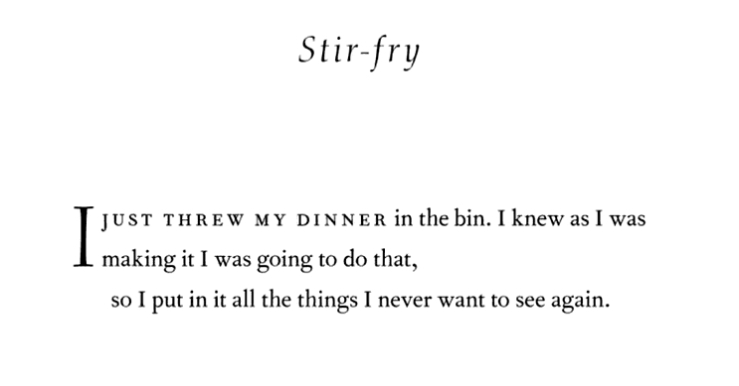
The story is a title and two sentences.
The title specifies the ostensible subject of the story, dinner.
But the story is not about dinner; the story is about throwing dinner away.
But is the story even about throwing dinner away? I suppose that’s the central action that takes place in “Stir-fry” — tossing food away — but the story is also about consciousness in the creative process.
Our narrator creates something that she knows she intends to throw away immediately after its creation.
Hence, the key line to the story is the one that begins with the coordinating conjunction so. Bennett emphasizes the line by typographically isolating it; the effect on the page approximates poetry rather than traditional prose.
“so I put in it all the things I never want to see again”: A stir-fry is usually made at least in part from leftovers or food that must be eaten soon or tossed. If we read the story literally (which we should of course), we can fill in the details with our sympathetic imaginations: A bit of rice from three days ago. That last onion. A solitary carrot going to rubber. A stub of ginger. Two small peppers, their skin now papery. The last bit of Sunday’s roast chicken. Etc.
There is something deeply satisfying for some of us in using all the food in our refrigerator.
But I think our sympathetic imagination could extend that phrase “things I never want to see again” even farther than the last few stray vegetables or half of a leftover pork loin or an egg clearly reaching its expiration: What else might have our narrator mixed into her stir-fry? The last little bits of blackberry jam that cling to a jar? Pickles she made two years ago? A questionable yogurt? Pine nuts past their prime? Those turnips? Why did we buy those turnips?
And we can push the phrase even farther if we want: If we are creating something that we know that we will immediately discard and not use for its ostensible purpose (in this case, sustenance, life force), what else might we stir in there? What are all the things we “never want to see again”? All our feeble faults and deficiencies? Our terrible creeping anxieties? Even the bad ambitions we so often trip over? Could we throw war, prejudice, avarice into our stir-fry, and then throw those away too?
Maybe I have pushed an interpretation of “Stir-fry” far too far. But I do read the vignette as a fantasy of sorts. Our narrator consciously creates something she intends to uncreate. This creative uncreation allows her to eliminate all the things she never wants to see again. The fantasy here is about opening up a new way of seeing, one unencumbered by the stale, the musty, the rancid. The desire I see is to see and taste with a fresh spirit.
Or maybe “Stir-fry” is just about throwing away dinner.
This weekend I picked up a new audiobook collection of Robert Coover short stories which has been titled Going for a Beer (presumably because “Going for a Beer” is a perfect short story). The audiobook contains 30 stories and is read by Charlie Thurston, a more than capable as an orator.
The opening story is one of Coover’s earliest published stories. “The Brother” (1962) retells the Noah narrative from the book of Genesis. I just wrote “retells,” but that’s not really the right term. Instead of retelling the story of Noah and the ark and YHWH’s flood, Coover imagines the apocalyptic affair from the perspective of Noah’s younger brother, who narrates this tale.
Noah’s unnamed brother is an earthy, sensual fellow who loves his wife and loves his wine. His wife—a sympathetic and endearing figure—is pregnant with their first child. They’re already picking out names (“Nathaniel or Anna”). Brother Noah keeps taking the narrator from his own familial duties to help build a boat though:
right there right there in the middle of the damn field he says he wants to put that thing together him and his buggy ideas and so me I says “how the hell you gonna get it down to the water?” but he just focuses me out sweepin the blue his eyes rollin like they do when he gets het on some new lunatic notion and he says not to worry none about that just would I help him for God’s sake and because he don’t know how he can get it done in time otherwise and though you’d have to be loonier than him to say yes I says I will of course I always would crazy as my brother is I’ve done little else since I was born and my wife she says “I can’t figure it out I can’t sec why you always have to be babyin that old fool he ain’t never done nothin for you God knows and you got enough to do here fields need plowin it’s a bad enough year already my God and now that red-eyed brother of yours wingin around like a damn cloud and not knowin what in the world he’s doin buildin a damn boat in the country my God what next? you’re a damn fool I tell you” but packs me some sandwiches just the same and some sandwiches for my brother
That’s kinda-sorta the opening paragraph—although no it’s not, because the whole story is just one big paragraph, a big oral fragment really, which begins with a lower-case r and keeps going in a verbal rush whose only concessions to punctuation are question marks and quotation marks. No periods or commas here folks. On the page, “The Brother” perhaps approximates the blockish brickish look of a Gutenberg Bible or even the Torah, neither of which give the reader a nice period to rest on, let alone a friendly pause between paragraphs.
“The Brother” might be typographically daunting, but the apparent thickness of verbal force on the page belies its oral charms. The story is meant to be read out loud. Hell, it’s biblical, after all—a witnessing. Read aloud, “The Brother” shows us a deeply sympathetic pair of characters, a husband and wife whose small pleasures, telegraphed in naturalistic speech, might remind the auditor of real persons living today. And yet there’s an apocalyptic backdrop here. Noah’s brother and Noah’s brother’s wife—and their unborn child, and all the unborn children—will not survive YHWH’s flood.
Coover does not paint Noah as anything but a shrugging reluctant weirdo. He’s no prophet who warns and helps his brother, but rather a defeated man:
and it ain’t no goddamn fishin boat he wants to put up neither in fact it’s the biggest damn thing I ever heard of and for weeks wee\s I’m tellin you we ain’t doin nothin but cuttin down pine trees and haulin them out to his field which is really pretty high up a hill and my God that’s work lemme tell you and my wife she sighs and says I am really crazy r-e-a-l-l-y crazy and her four months with a child and tryin to do my work and hers too and still when I come home from haulin timbers around all day she’s got enough left to rub my shoulders and the small of my back and fix a hot meal her long black hair pulled to a knot behind her head and hangin marvelously down her back her eyes gentle but very tired my God and I says to my brother I says “look I got a lotta work to do buddy you’ll have to finish this idiot thing yourself I wanna help you all I can you know that but” and he looks off and he says “it don’t matter none your work” and I says “the hell it don’t how you think me and my wife we’re gonna eat I mean where do you think this food comes from you been puttin away man? you can’t eat this goddamn boat out here ready to rot in that bastard sun” and he just sighs long and says “no it just don’t matter” and he sits him down on a rock kinda tired like and stares off and looks like he might even for God’s sake cry
Noah’s dismissing his brother’s work strikes me as utterly cruel—he makes no attempt to explain why his brother’s efforts at creating a better world are in vain. I shared the passage at length again in part because I hope you’ll read it aloud gentle reader, but also that you’ll note that maybe you didn’t note all its blasphemies—Coover’s story is larded with “my Gods” and “damns” and “goddamns,” no different than the speech of 1962, no different than the speech of 2018.
Coover gives us a narrator like us, human, earthly, driven by simple pleasures and a basic sense of love. Noah comes off like a prick. The Bible loves its heroes, but the ordinary folks don’t even get to live in the margins. There’s more morality in orality though—in conversation and communication and talk.
You don’t have to buy the audiobook though to hear “The Brother.” Here is Coover reading it himself:







 Biblioklept