The Somnambulist — Robin Ironside

01_lg

The Somnambulist, 1944 by Robin Ironside (1912-1965)

Orca — Jamie Wyeth

original (2)

Orca, 1990 by Jamie Wyeth (b. 1946)

“The Red Room,” a short story by H.G. Wells

“The Red Room”

by

H.G. Wells


“I can assure you,” said I, “that it will take a very tangible ghost to frighten me.” And I stood up before the fire with my glass in my hand.

“It is your own choosing,” said the man with the withered arm, and glanced at me askance.

“Eight-and-twenty years,” said I, “I have lived, and never a ghost have I seen as yet.”

The old woman sat staring hard into the fire, her pale eyes wide open. “Ay,” she broke in; “and eight-and-twenty years you have lived and never seen the likes of this house, I reckon. There’s a many things to see, when one’s still but eight-and-twenty.” She swayed her head slowly from side to side. “A many things to see and sorrow for.”

I half suspected the old people were trying to enhance the spiritual terrors of their house by their droning insistence. I put down my empty glass on the table and looked about the room, and caught a glimpse of myself, abbreviated and broadened to an impossible sturdiness, in the queer old mirror at the end of the room. “Well,” I said, “if I see anything to-night, I shall be so much the wiser. For I come to the business with an open mind.”

“It’s your own choosing,” said the man with the withered arm once more.

I heard the faint sound of a stick and a shambling step on the flags in the passage outside. The door creaked on its hinges as a second old man entered, more bent, more wrinkled, more aged even than the first. He supported himself by the help of a crutch, his eyes were covered by a shade, and his lower lip, half averted, hung pale and pink from his decaying yellow teeth. He made straight for an armchair on the opposite side of the table, sat down clumsily, and began to cough. The man with the withered hand gave the newcomer a short glance of positive dislike; the old woman took no notice of his arrival, but remained with her eyes fixed steadily on the fire.

“I said—it’s your own choosing,” said the man with the withered hand, when the coughing had ceased for a while.

“It’s my own choosing,” I answered.

The man with the shade became aware of my presence for the first time, and threw his head back for a moment, and sidewise, to see me. I caught a momentary glimpse of his eyes, small and bright and inflamed. Then he began to cough and splutter again.

“Why don’t you drink?” said the man with the withered arm, pushing the beer toward him. The man with the shade poured out a glassful with a shaking hand, that splashed half as much again on the deal table. A monstrous shadow of him crouched upon the wall, and mocked his action as he poured and drank. I must confess I had scarcely expected these grotesque custodians. There is, to my mind, something inhuman in senility, something crouching and atavistic; the human qualities seem to drop from old people insensibly day by day. The three of them made me feel uncomfortable with their gaunt silences, their bent carriage, their evident unfriendliness to me and to one another. And that night, perhaps, I was in the mood for uncomfortable impressions. I resolved to get away from their vague fore-shadowings of the evil things upstairs.

“If,” said I, “you will show me to this haunted room of yours, I will make myself comfortable there.”

The old man with the cough jerked his head back so suddenly that it startled me, and shot another glance of his red eyes at me from out of the darkness under the shade, but no one answered me. I waited a minute, glancing from one to the other. The old woman stared like a dead body, glaring into the fire with lack-lustre eyes.

“If,” I said, a little louder, “if you will show me to this haunted room of yours, I will relieve you from the task of entertaining me.”

“There’s a candle on the slab outside the door,” said the man with the withered hand, looking at my feet as he addressed me. “But if you go to the Red Room to-night—”

“This night of all nights!” said the old woman, softly.

“—You go alone.”

“Very well,” I answered, shortly, “and which way do I go?”

“You go along the passage for a bit,” said he, nodding his head on his shoulder at the door, “until you come to a spiral staircase; and on the second landing is a door covered with green baize. Go through that, and down the long corridor to the end, and the Red Room is on your left up the steps.”

“Have I got that right?” I said, and repeated his directions.

He corrected me in one particular.

“And you are really going?” said the man with the shade, looking at me again for the third time with that queer, unnatural tilting of the face.

“This night of all nights!” whispered the old woman.

“It is what I came for,” I said, and moved toward the door. As I did so, the old man with the shade rose and staggered round the table, so as to be closer to the others and to the fire. At the door I turned and looked at them, and saw they were all close together, dark against the firelight, staring at me over their shoulders, with an intent expression on their ancient faces.

“Good-night,” I said, setting the door open. “It’s your own choosing,” said the man with the withered arm.

I left the door wide open until the candle was well alight, and then I shut them in, and walked down the chilly, echoing passage.

I must confess that the oddness of these three old pensioners in whose charge her ladyship had left the castle, and the deep-toned, old-fashioned furniture of the housekeeper’s room, in which they foregathered, had affected me curiously in spite of my effort to keep myself at a matter-of-fact phase. They seemed to belong to another age, an older age, an age when things spiritual were indeed to be feared, when common sense was uncommon, an age when omens and witches were credible, and ghosts beyond denying. Their very existence, thought I, is spectral; the cut of their clothing, fashions born in dead brains; the ornaments and conveniences in the room about them even are ghostly—the thoughts of vanished men, which still haunt rather than participate in the world of to-day. And the passage I was in, long and shadowy, with a film of moisture glistening on the wall, was as gaunt and cold as a thing that is dead and rigid. But with an effort I sent such thoughts to the right-about. The long, drafty subterranean passage was chilly and dusty, and my candle flared and made the shadows cower and quiver. The echoes rang up and down the spiral staircase, and a shadow came sweeping up after me, and another fled before me into the darkness overhead. I came to the wide landing and stopped there for a moment listening to a rustling that I fancied I heard creeping behind me, and then, satisfied of the absolute silence, pushed open the unwilling baize-covered door and stood in the silent corridor.

The effect was scarcely what I expected, for the moonlight, coming in by the great window on the grand staircase, picked out everything in vivid black shadow or reticulated silvery illumination. Everything seemed in its proper position; the house might have been deserted on the yesterday instead of twelve months ago. There were candles in the sockets of the sconces, and whatever dust had gathered on the carpets or upon the polished flooring was distributed so evenly as to be invisible in my candlelight. A waiting stillness was over everything. I was about to advance, and stopped abruptly. A bronze group stood upon the landing hidden from me by a corner of the wall; but its shadow fell with marvelous distinctness upon the white paneling, and gave me the impression of some one crouching to waylay me. The thing jumped upon my attention suddenly. I stood rigid for half a moment, perhaps. Then, with my hand in the pocket that held the revolver, I advanced, only to discover a Ganymede and Eagle, glistening in the moonlight. That incident for a time restored my nerve, and a dim porcelain Chinaman on a buhl table, whose head rocked as I passed, scarcely startled me.

The door of the Red Room and the steps up to it were in a shadowy corner. I moved my candle from side to side in order to see clearly the nature of the recess in which I stood, before opening the door. Here it was, thought I, that my predecessor was found, and the memory of that story gave me a sudden twinge of apprehension. I glanced over my shoulder at the black Ganymede in the moonlight, and opened the door of the Red Room rather hastily, with my face half turned to the pallid silence of the corridor.

I entered, closed the door behind me at once, turned the key I found in the lock within, and stood with the candle held aloft surveying the scene of my vigil, the great Red Room of Lorraine Castle, in which the young Duke had died; or rather in which he had begun his dying, for he had opened the door and fallen headlong down the steps I had just ascended. That had been the end of his vigil, of his gallant attempt to conquer the ghostly tradition of the place, and never, I thought, had apoplexy better served the ends of superstition. There were other and older stories that clung to the room, back to the half-incredible beginning of it all, the tale of a timid wife and the tragic end that came to her husband’s jest of frightening her. And looking round that huge shadowy room with its black window bays, its recesses and alcoves, its dusty brown-red hangings and dark gigantic furniture, one could well understand the legends that had sprouted in its black corners, its germinating darknesses. My candle was a little tongue of light in the vastness of the chamber; its rays failed to pierce to the opposite end of the room, and left an ocean of dull red mystery and suggestion, sentinel shadows and watching darknesses beyond its island of light. And the stillness of desolation brooded over it all.

I must confess some impalpable quality of that ancient room disturbed me. I tried to fight the feeling down. I resolved to make a systematic examination of the place, and so, by leaving nothing to the imagination, dispel the fanciful suggestions of the obscurity before they obtained a hold upon me. After satisfying myself of the fastening of the door, I began to walk round the room, peering round each article of furniture, tucking up the valances of the bed and opening its curtains wide. In one place there was a distinct echo to my footsteps, the noises I made seemed so little that they enhanced rather than broke the silence of the place. I pulled up the blinds and examined the fastenings of the several windows. Attracted by the fall of a particle of dust, I leaned forward and looked up the blackness of the wide chimney. Then, trying to preserve my scientific attitude of mind, I walked round and began tapping the oak paneling for any secret opening, but I desisted before reaching the alcove. I saw my face in a mirror—white.

There were two big mirrors in the room, each with a pair of sconces bearing candles, and on the mantelshelf, too, were candles in china candle-sticks. All these I lit one after the other. The fire was laid—an unexpected consideration from the old housekeeper—and I lit it, to keep down any disposition to shiver, and when it was burning well I stood round with my back to it and regarded the room again. I had pulled up a chintz-covered armchair and a table to form a kind of barricade before me. On this lay my revolver, ready to hand. My precise examination had done me a little good, but I still found the remoter darkness of the place and its perfect stillness too stimulating for the imagination. The echoing of the stir and crackling of the fire was no sort of comfort to me. The shadow in the alcove at the end of the room began to display that undefinable quality of a presence, that odd suggestion of a lurking living thing that comes so easily in silence and solitude. And to reassure myself, I walked with a candle into it and satisfied myself that there was nothing tangible there. I stood that candle upon the floor of the alcove and left it in that position.

By this time I was in a state of considerable nervous tension, although to my reason there was no adequate cause for my condition. My mind, however, was perfectly clear. I postulated quite unreservedly that nothing supernatural could happen, and to pass the time I began stringing some rhymes together, Ingoldsby fashion, concerning the original legend of the place. A few I spoke aloud, but the echoes were not pleasant* For the same reason I also abandoned, after a time, a conversation with myself upon the impossibility of ghosts and haunting. My mind reverted to the three old and distorted people downstairs, and I tried to keep it upon that topic.

The sombre reds and grays of the room troubled me; even with its seven candles the place was merely dim. The light in the alcove flaring in a draft, and the fire flickering, kept the shadows and penumbra perpetually shifting and stirring in a noiseless flighty dance. Casting about for a remedy, I recalled the wax candles I had seen in the corridor, and, with a slight effort, carrying a candle and leaving the door open, I walked out into the moonlight, and presently returned with as many as ten. These I put in the various knick-knacks of china with which the room was sparsely adorned, and lit and placed them where the shadows had lain deepest, some on the floor, some in the window recesses, arranging and rearranging them until at last my seventeen candles were so placed that not an inch of the room but had the direct light of at least one of them. It occurred to me that when the ghost came I could warn him not to trip over them. The room was now quite brightly illuminated. There was something very cheering and reassuring in these little silent streaming flames, and to notice their steady diminution of length offered me an occupation and gave me a reassuring sense of the passage of time.

Even with that, however, the brooding expectation of the vigil weighed heavily enough upon me. I stood watching the minute hand of my watch creep towards midnight.

Then something happened in the alcove. I did not see the candle go out, I simply turned and saw that the darkness was there, as one might start and see the unexpected presence of a stranger. The black shadow had sprung back to its place. “By Jove,” said I aloud, recovering from my surprise, “that draft’s a strong one;” and taking the matchbox from the table, I walked across the room in a leisurely manner to relight the corner again. My first match would not strike, and as I succeeded with the second, something seemed to blink on the wall before me. I turned my head involuntarily and saw that the two candles on the little table by the fireplace were extinguished. I rose at once to my feet.

“Odd,” I said. “Did I do that myself in a flash of absent-mindedness?”

I walked back, relit one, and as I did so I saw the candle in the right sconce of one of the mirrors wink and go right out, and almost immediately its companion followed it. The flames vanished as if the wick had been suddenly nipped between a finger and thumb, leaving the wick neither glowing nor smoking, but black. While I stood gaping the candle at the foot of the bed went out, and the shadows seemed to take another step toward me.

“This won’t do!” said I, and first one and then another candle on the mantelshelf followed.

“What’s up?” I cried, with a queer high note getting into my voice somehow. At that the candle on the corner of the wardrobe went out, and the one I had relit in the alcove followed.

“Steady on!” I said, “those candles are wanted,” speaking with a half-hysterical facetiousness, and scratching away at a match the while, “for the mantel candlesticks.” My hands trembled so much that twice I missed the rough paper of the matchbox. As the mantel emerged from darkness again, two candles in the remoter end of the room were eclipsed. But with the same match I also relit the larger mirror candles, and those on the floor near the doorway, so that for the moment I seemed to gain on the extinctions. But then in a noiseless volley there vanished four lights at once in different corners of the room, and I struck another match in quivering haste, and stood hesitating whither to take it.

As I stood undecided, an invisible hand seemed to sweep out the two candles on the table. With a cry of terror I dashed at the alcove, then into the corner and then into the window, relighting three as two more vanished by the fireplace, and then, perceiving a better way, I dropped matches on the iron-bound deedbox in the corner, and caught up the bedroom candlestick. With this I avoided the delay of striking matches, but for all that the steady process of extinction went on, and the shadows I feared and fought against returned, and crept in upon me, first a step gained on this side of me, then on that. I was now almost frantic with the horror of the coming darkness, and my self-possession deserted me. I leaped panting from candle to candle in a vain struggle against that remorseless advance.

I bruised myself in the thigh against the table, I sent a chair headlong, I stumbled and fell and whisked the cloth from the table in my fall. My candle rolled away from me and I snatched another as I rose. Abruptly this was blown out as I swung it off the table by the wind of my sudden movement, and immediately the two remaining candles followed. But there was light still in the room, a red light, that streamed across the ceiling and staved off the shadows from me. The fire! Of course I could still thrust my candle between the bars and relight it.

I turned to where the flames were still dancing between the glowing coals and splashing red reflections upon the furniture; made two steps toward the grate, and incontinently the flames dwindled and vanished, the glow vanished, the reflections rushed together and disappeared, and as I thrust the candle between the bars darkness closed upon me like the shutting of an eye, wrapped about me in a stifling embrace, sealed my vision, and crushed the last vestiges of self-possession from my brain. And it was not only palpable darkness, but intolerable terror. The candle fell from my hands. I flung out my arms in a vain effort to thrust that ponderous blackness away from me, and lifting up my voice, screamed with all my might, once, twice, thrice. Then I think I must have staggered to my feet. I know I thought suddenly of the moonlit corridor, and with my head bowed and my arms over my face, made a stumbling run for the door.

But I had forgotten the exact position of the door, and I struck myself heavily against the corner of the bed. I staggered back, turned, and was either struck or struck myself against some other bulky furnishing. I have a vague memory of battering myself thus to and fro in the darkness, of a heavy blow at last upon my forehead, of a horrible sensation of falling that lasted an age, of my last frantic effort to keep my footing, and then I remember no more.

I opened my eyes in daylight. My head was roughly bandaged, and the man with the withered hand was watching my face. I looked about me trying to remember what had happened, and for a space I could not recollect. I rolled my eyes into the corner and saw the old woman, no longer abstracted, no longer terrible, pouring out some drops of medicine from a little blue phial into a glass. “Where am I?” I said. “I seem to remember you, and yet I can not remember who you are.”

They told me then, and I heard of the haunted Red Room as one who hears a tale. “We found you at dawn,” said he, “and there was blood on your forehead and lips.”

I wondered that I had ever disliked him. The three of them in the daylight seemed commonplace old folk enough. The man with the green shade had his head bent as one who sleeps.

It was very slowly I recovered the memory of my experience. “You believe now,” said the old man with the withered hand, “that the room is haunted?” He spoke no longer as one who greets an intruder, but as one who condoles with a friend.

“Yes,” said I, “the room is haunted.”

“And you have seen it. And we who have been here all our lives have never set eyes upon it. Because we have never dared. Tell us, is it truly the old earl who—”

“No,” said I, “it is not.”

“I told you so,” said the old lady, with the glass in her hand. “It is his poor young countess who was frightened—”

“It is not,” I said. “There is neither ghost of earl nor ghost of countess in that room; there is no ghost there at all, but worse, far worse, something impalpable—”

“Well?” they said.

“The worst of all the things that haunt poor mortal men,” said I; “and that is, in all its nakedness—‘Fear!’ Fear that will not have light nor sound, that will not bear with reason, that deafens and darkens and overwhelms. It followed me through the corridor, it fought against me in the room—”

I stopped abruptly. There was an interval of silence. My hand went up to my bandages. “The candles went out one after another, and I fled—”

Then the man with the shade lifted his face sideways to see me and spoke.

“That is it,” said he. “I knew that was it. A Power of Darkness. To put such a curse upon a home! It lurks there always. You can feel it even in the daytime, even of a bright summer’s day, in the hangings, in the curtains, keeping behind you however you face about. In the dusk it creeps in the corridor and follows you, so that you dare not turn. It is even as you say. Fear itself is in that room. Black Fear…. And there it will be… so long as this house of sin endures.”
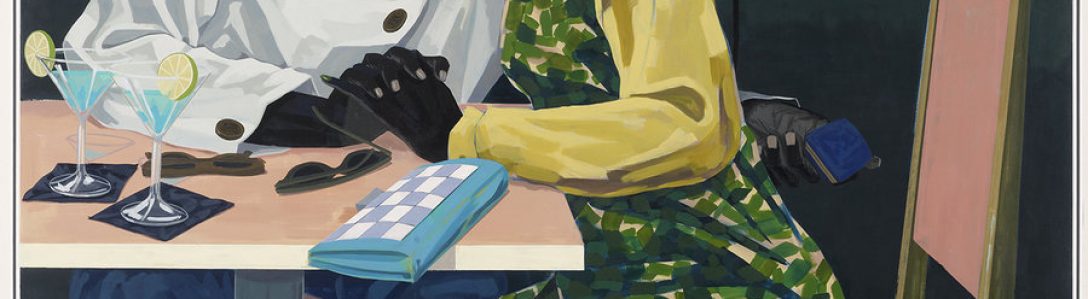
Sculptures — Neo Rauch

Rauch-Skulpteurin

Skulpterin (Sculptures), 2014 by Neo Rauch (b. 1960)

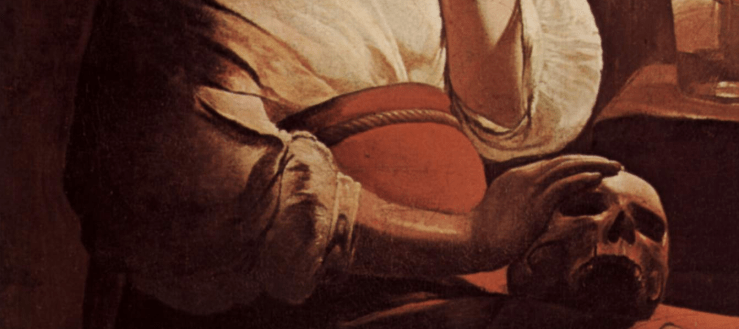
Mary Magdalene with a Night Light — Georges de la Tour

mary-magdalene-with-a-night-light-1635Screenshot 2017-06-07 at 6.42.44 PMScreenshot 2017-06-07 at 6.43.52 PM

Mary Magdalene with a Night Light, 1630-1635 by Georges de la Tour (1593-1652)

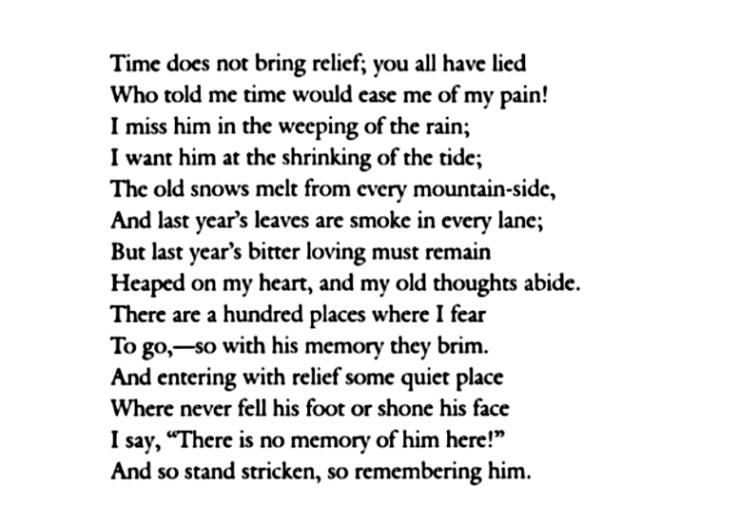
“Time does not bring relief; you all have lied” — Edna St. Vincent Millay

time

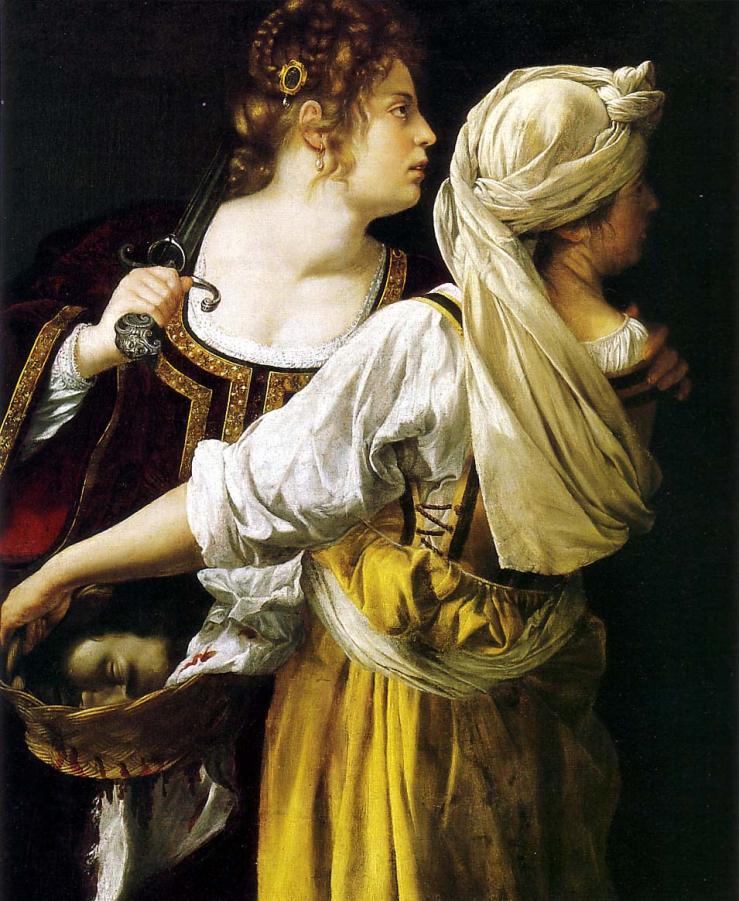
Judith and Her Maidservant — Artemisia Gentileschi

judith-and-her-maidservant-1613Screenshot 2017-06-07 at 6.37.06 PMScreenshot 2017-06-07 at 6.37.19 PMScreenshot 2017-06-07 at 6.38.28 PM

Judith and Her Maidservant, 1613 — Artemisia Gentileschi (1593-1653).

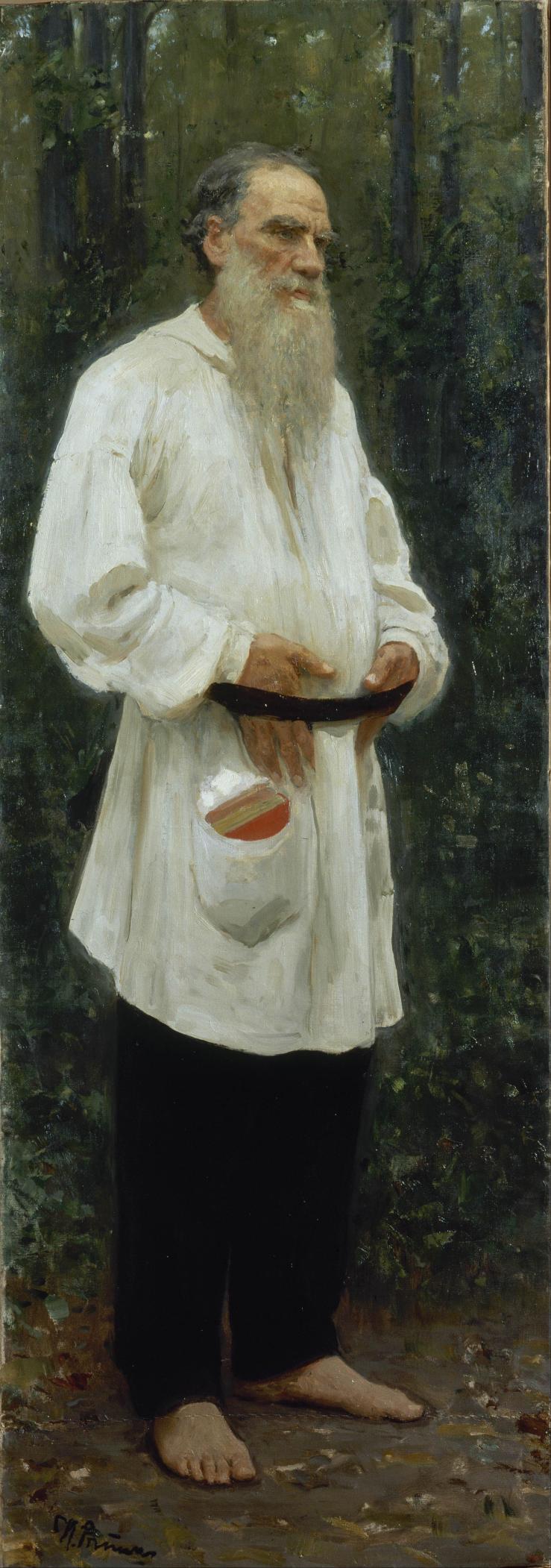
A review of Leo Tolstoy’s final work, Hadji Murad

ilya_repin_-_leo_tolstoy_barefoot_-_google_art_project-1457AC8C0DE4F21084B
Leo Tolstoy Barefoot, 1901 by Ilya Repin

Like many readers of Leo Tolstoy’s final work, Hadji Murad, I read the novella based on Harold Bloom’s praise in his work The Western Canon, where he declares it “my personal touchstone for the sublime of prose fiction, to me the best story in the world, or at least the best I have ever read.” It wasn’t just Bloom’s praise that attracted me to Hadji Murad—I had just finished Jonathan Littell’s bizarre opus The Kindly Ones, which devotes a lengthy section to WWII’s Eastern front in the Caucus mountains; Littell’s chapter traces the fallout after decades of Russian incursions. Hadji Murad takes place in 1851 and 1852 as the Caucasian people resist the encroaching Russian Empire. Littell’s book piqued my curiosity about a part of the world that still seems strange and alien, a genuinely multicultural place that signals the traditional border of East and West.

I’ll also admit that I’ve never really read Tolstoy, and the prospect of beginning with a novella was intriguing.

Hadji Murad tells the story of the real-life Caucasian Avar general Hadji Murad who fought under Imam Shamil, the leader of the Muslim tribes of the Northern Caucuses; Shamil was Russia’s greatest foe. The story begins in media res as Hadji Murad and two of his lieutenants flee from Shamil’s camp. Because of a feud born from familial drama, Shamil decides that Hadji Murad must die. The Imam captures and imprisons the rebel’s family. Hadji Murad begins the process of going over to the Russians; he plans to defect and then head a Russian-backed army to defeat Shamil. This is the basic plot—I will spoil no more.

In his essay “Leo Tolstoy, Two Hussars” (collected in Why Read the Classics?), Italo Calvino suggests—

It is not easy to understand how Tolstoy constructs his narratives. What other fiction writers make explicit – symmetrical patterns, supporting structures, counterbalances, link sequences — all remain hidden in Tolstoy. But hidden does not mean non-existent: the impression Tolstoy conveys of transferring ‘life’ just as it is on to the page (‘life’, that mysterious entity to define which we have to start from the written page) is actually merely the result of his artistry, that is to say an artifice that is more sophisticated and complex than many others.

Although Calvino writes of Two Hussars, his remarks are equally true of Hadji Murad. Tolstoy’s radical realism at times so disorients that it becomes hard to pick up the themes of the novella. Tolstoy, the grand director, shifts the action from his hero Hadji Murad to train his camera on an apparently insignificant character—for example, Butler, a happy-go-lucky Russian soldier with a Romantic outlook and a gambling problem. Then Tolstoy might focus on Prince Vorontsov and his wife Maria, who command at the Russian fortress Vozdvizhenskaya. In a wonderful setpiece, Tolstoy shows us a state dinner bristling with gossip and mannered energy. In another section, Tolstoy lets his camera follow bulky Czar Nicholas I, a vain womanizer who cannot see how disconnected he is from his subjects. The Czar cannot fathom the visceral consequences of his decisions. Yet Tolstoy makes no effort to connect the bloodshed in a massacre of a Chechen village to the Czar’s ambivalence or the richness of the dinner party. These connections are left to the reader.

The novella is almost a puzzle: the chapters are distinct setpieces that the reader must connect in order to see a bigger picture. This analysis should not suggest, however, any murkiness or ambiguity in Tolstoy’s chapters (let alone sentences). Hadji Murad is lucid, clear, and very sober, even when it depicts violence, confusion, and drunkenness. As Calvino points out, Tolstoy’s art replicates the messiness of “real life” in a way that seems mimetically appropriate to “real life’s” complexity, and at the same time to allow the reader to intellectually engage the narrative. Calvino again—

That fullness of life which is so much praised in Tolstoy by experts on the author is in fact — in this tale as much as in the rest of his oeuvre — the acknowledgement of an absence. As in the most abstract of narrators, what counts in Tolstoy is what is not visible, not articulated, what could exist but does not.

Again, Hadji Murad should not be taken for a work of abstraction. It is crushingly literal and historically concrete. What Calvino refers to then is the abstraction of narrative construction, the apparent invisibility of motive and meaning. And this is why wise readers will enjoy Hadji Murad. It’s one of those texts that confronts its readers with a problem to puzzle out. It’s one of those books that one finishes, feels a little stunned—cheated even!—and then wakes up the next morning thinking about, possibly having dreamed about it that night. And what does one do then? Why, pick it up again of course. Highly recommended.

[Editorial note: Biblioklept originally ran a version of this review in June, 2011. That review neglected to include the names of the translators, Aylmer and Louise Maude].

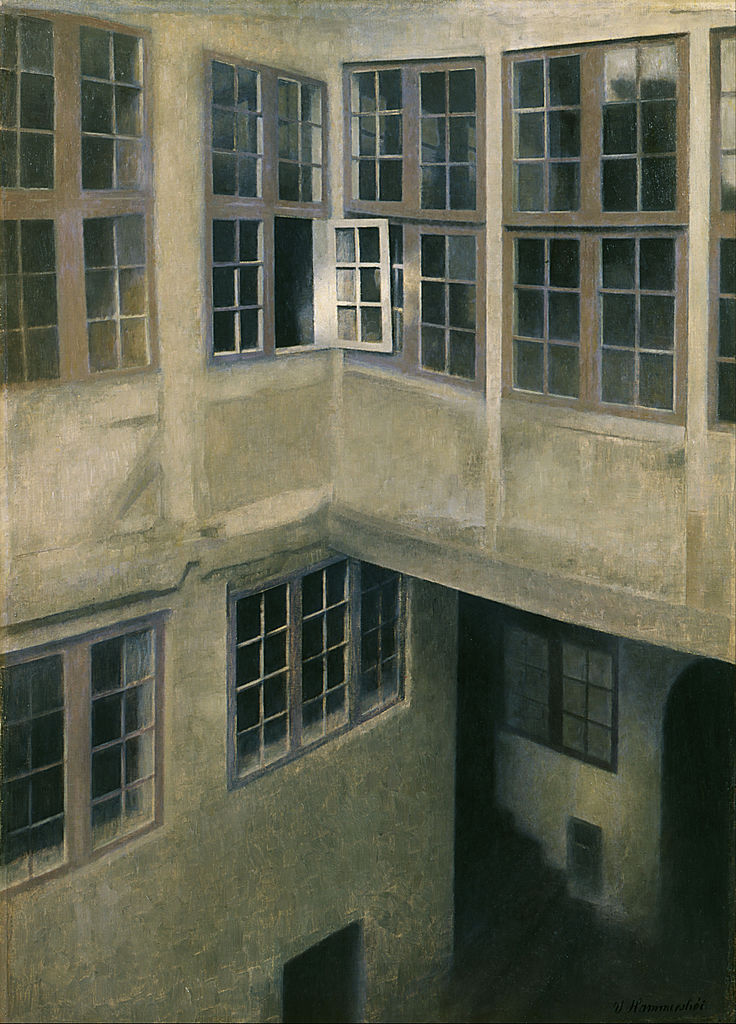
Interior Of Courtyard, Strandgade 30 — Vilhelm Hammershoi

interior-of-courtyard-strandgade-30-1899

Interior Of Courtyard, Strandgade 30, 1899 — Vilhelm Hammershoi (1864-1916)

Read Anton Chekhov’s short story “The Husband”

“The Husband”

by

Anton Chekhov

English translation by Constance Garnett


IN the course of the maneuvres the N—— cavalry regiment halted for a night at the district town of K——. Such an event as the visit of officers always has the most exciting and inspiring effect on the inhabitants of provincial towns. The shopkeepers dream of getting rid of the rusty sausages and “best brand” sardines that have been lying for ten years on their shelves; the inns and restaurants keep open all night; the Military Commandant, his secretary, and the local garrison put on their best uniforms; the police flit to and fro like mad, while the effect on the ladies is beyond all description.

The ladies of K——, hearing the regiment approaching, forsook their pans of boiling jam and ran into the street. Forgetting their morning deshabille and general untidiness, they rushed breathless with excitement to meet the regiment, and listened greedily to the band playing the march. Looking at their pale, ecstatic faces, one might have thought those strains came from some heavenly choir rather than from a military brass band.

“The regiment!” they cried joyfully. “The regiment is coming!”

What could this unknown regiment that came by chance to-day and would depart at dawn to-morrow mean to them?

Afterwards, when the officers were standing in the middle of the square, and, with their hands behind them, discussing the question of billets, all the ladies were gathered together at the examining magistrate’s and vying with one another in their criticisms of the regiment. They already knew, goodness knows how, that the colonel was married, but not living with his wife; that the senior officer’s wife had a baby born dead every year; that the adjutant was hopelessly in love with some countess, and had even once attempted suicide. They knew everything. When a pock-marked soldier in a red shirt darted past the windows, they knew for certain that it was Lieutenant Rymzov’s orderly running about the town, trying to get some English bitter ale on tick for his master. They had only caught a passing glimpse of the officers’ backs, but had already decided that there was not one handsome or interesting man among them…. Having talked to their hearts’ content, they sent for the Military Commandant and the committee of the club, and instructed them at all costs to make arrangements for a dance.

Their wishes were carried out. At nine o’clock in the evening the military band was playing in the street before the club, while in the club itself the officers were dancing with the ladies of K——. The ladies felt as though they were on wings. Intoxicated by the dancing, the music, and the clank of spurs, they threw themselves heart and soul into making the acquaintance of their new partners, and quite forgot their old civilian friends. Their fathers and husbands, forced temporarily into the background, crowded round the meagre refreshment table in the entrance hall. All these government cashiers, secretaries, clerks, and superintendents—stale, sickly-looking, clumsy figures—were perfectly well aware of their inferiority. They did not even enter the ball-room, but contented themselves with watching their wives and daughters in the distance dancing with the accomplished and graceful officers.

Among the husbands was Shalikov, the tax-collector—a narrow, spiteful soul, given to drink, with a big, closely cropped head, and thick, protruding lips. He had had a university education; there had been a time when he used to read progressive literature and sing students’ songs, but now, as he said of himself, he was a tax-collector and nothing more.

He stood leaning against the doorpost, his eyes fixed on his wife, Anna Pavlovna, a little brunette of thirty, with a long nose and a pointed chin. Tightly laced, with her face carefully powdered, she danced without pausing for breath—danced till she was ready to drop exhausted. But though she was exhausted in body, her spirit was inexhaustible…. One could see as she danced that her thoughts were with the past, that faraway past when she used to dance at the “College for Young Ladies,” dreaming of a life of luxury and gaiety, and never doubting that her husband was to be a prince or, at the worst, a baron.

The tax-collector watched, scowling with spite….

It was not jealousy he was feeling. He was ill-humoured—first, because the room was taken up with dancing and there was nowhere he could play a game of cards; secondly, because he could not endure the sound of wind instruments; and, thirdly, because he fancied the officers treated the civilians somewhat too casually and disdainfully. But what above everything revolted him and moved him to indignation was the expression of happiness on his wife’s face.

“It makes me sick to look at her!” he muttered. “Going on for forty, and nothing to boast of at any time, and she must powder her face and lace herself up! And frizzing her hair! Flirting and making faces, and fancying she’s doing the thing in style! Ugh! you’re a pretty figure, upon my soul!”

Anna Pavlovna was so lost in the dance that she did not once glance at her husband.

“Of course not! Where do we poor country bumpkins come in!” sneered the tax-collector.

“We are at a discount now…. We’re clumsy seals, unpolished provincial bears, and she’s the queen of the ball! She has kept enough of her looks to please even officers … They’d not object to making love to her, I dare say!”

During the mazurka the tax-collector’s face twitched with spite. A black-haired officer with prominent eyes and Tartar cheekbones danced the mazurka with Anna Pavlovna. Assuming a stern expression, he worked his legs with gravity and feeling, and so crooked his knees that he looked like a jack-a-dandy pulled by strings, while Anna Pavlovna, pale and thrilled, bending her figure languidly and turning her eyes up, tried to look as though she scarcely touched the floor, and evidently felt herself that she was not on earth, not at the local club, but somewhere far, far away—in the clouds. Not only her face but her whole figure was expressive of beatitude…. The tax-collector could endure it no longer; he felt a desire to jeer at that beatitude, to make Anna Pavlovna feel that she had forgotten herself, that life was by no means so delightful as she fancied now in her excitement….

“You wait; I’ll teach you to smile so blissfully,” he muttered. “You are not a boarding-school miss, you are not a girl. An old fright ought to realise she is a fright!”

Petty feelings of envy, vexation, wounded vanity, of that small, provincial misanthropy engendered in petty officials by vodka and a sedentary life, swarmed in his heart like mice. Waiting for the end of the mazurka, he went into the hall and walked up to his wife. Anna Pavlovna was sitting with her partner, and, flirting her fan and coquettishly dropping her eyelids, was describing how she used to dance in Petersburg (her lips were pursed up like a rosebud, and she pronounced “at home in Pütürsburg”).

“Anyuta, let us go home,” croaked the tax-collector.

Seeing her husband standing before her, Anna Pavlovna started as though recalling the fact that she had a husband; then she flushed all over: she felt ashamed that she had such a sickly-looking, ill-humoured, ordinary husband.

“Let us go home,” repeated the tax-collector.

“Why? It’s quite early!”

“I beg you to come home!” said the tax-collector deliberately, with a spiteful expression.

“Why? Has anything happened?” Anna Pavlovna asked in a flutter.

“Nothing has happened, but I wish you to go home at once…. I wish it; that’s enough, and without further talk, please.”

Anna Pavlovna was not afraid of her husband, but she felt ashamed on account of her partner, who was looking at her husband with surprise and amusement. She got up and moved a little apart with her husband.

“What notion is this?” she began. “Why go home? Why, it’s not eleven o’clock.”

“I wish it, and that’s enough. Come along, and that’s all about it.”

“Don’t be silly! Go home alone if you want to.”

“All right; then I shall make a scene.”

The tax-collector saw the look of beatitude gradually vanish from his wife’s face, saw how ashamed and miserable she was—and he felt a little happier.

“Why do you want me at once?” asked his wife.

“I don’t want you, but I wish you to be at home. I wish it, that’s all.”

At first Anna Pavlovna refused to hear of it, then she began entreating her husband to let her stay just another half-hour; then, without knowing why, she began to apologise, to protest—and all in a whisper, with a smile, that the spectators might not suspect that she was having a tiff with her husband. She began assuring him she would not stay long, only another ten minutes, only five minutes; but the tax-collector stuck obstinately to his point.

“Stay if you like,” he said, “but I’ll make a scene if you do.”

And as she talked to her husband Anna Pavlovna looked thinner, older, plainer. Pale, biting her lips, and almost crying, she went out to the entry and began putting on her things.

“You are not going?” asked the ladies in surprise. “Anna Pavlovna, you are not going, dear?”

“Her head aches,” said the tax-collector for his wife.

Coming out of the club, the husband and wife walked all the way home in silence. The tax-collector walked behind his wife, and watching her downcast, sorrowful, humiliated little figure, he recalled the look of beatitude which had so irritated him at the club, and the consciousness that the beatitude was gone filled his soul with triumph. He was pleased and satisfied, and at the same time he felt the lack of something; he would have liked to go back to the club and make every one feel dreary and miserable, so that all might know how stale and worthless life is when you walk along the streets in the dark and hear the slush of the mud under your feet, and when you know that you will wake up next morning with nothing to look forward to but vodka and cards. Oh, how awful it is!

And Anna Pavlovna could scarcely walk…. She was still under the influence of the dancing, the music, the talk, the lights, and the noise; she asked herself as she walked along why God had thus afflicted her. She felt miserable, insulted, and choking with hate as she listened to her husband’s heavy footsteps. She was silent, trying to think of the most offensive, biting, and venomous word she could hurl at her husband, and at the same time she was fully aware that no word could penetrate her tax-collector’s hide. What did he care for words? Her bitterest enemy could not have contrived for her a more helpless position.

And meanwhile the band was playing and the darkness was full of the most rousing, intoxicating dance-tunes.

Elective Affinities — Rene Magritte

rene magritte_06

Les affinités électives (Elective Affinities), 1933 by Rene Magritte (1898-1967)

One night, I woke up in a room in which a cage with a bird sleeping in it had been placed. A magnificent error caused me to see an egg in the cage, instead of the vanished bird. I then grasped a new and astonishing poetic secret, for the shock which I experienced had been provoked precisely by the affinity of two objects—the cage and the egg—to each other, whereas previously this shock had been caused by my bringing together two objects that were unrelated. [via]

From Marcel Paquet’s Magritte. Taschen, 2006.

“The Wrong Direction” — Alain Robbe-Grillet

“The Wrong Direction”

by

Alain Robbe-Grillet

Translated by Richard Howard

from “Three Reflected Visions,” in The Evergreen Review, Vol. 1, No. 3


Rain water has accumulated in the bottom of a shallow depression, forming among the trees a great pool roughly circular in shape and about thirty feet across. The soil is black around the edges of the pool, without showing the slightest trace of vegetation between the straight, tall trunks. In this part of the forest there are no thickets, no underbrush of any kind. The ground is covered instead by an even layer of felt, composed of twigs and leaves crumbled to veiny skeletons upon which, here and there, a few patches of half-rotten moss are barely discernible. High above the boles the bare branches

stand out sharply against the sky.

The water is quite tranparent, although brownish in color. Tiny fragments that have fallen from the trees—twigs, empty pods, strips of bark—accumulate at the bottom and steep there all winter long. But nothing is floating on the water, nothing breaks the uniformly polished surface. There is not the slightest breath of wind to disturb its perfection.

The weather has cleared. The day is drawing to its close. The sun is low on the left, behind the tree trunks. Its weakly slanting rays describe a few narrow, luminous stripes across the surface of the pool, alternating with wider bands of shadow.

Parallel to these stripes, a row of huge trees stands at the edge of the water on the opposite bank; perfectly cylindrical, without any low branches, they extend themselves downward to meet their reflections which are far more vivid than the trunks themselves; by contrast the trees seem almost indistinct, perhaps even blurred. In the black water the symmetrical boles gleam as if they were varnished, and on the sides facing the setting sun a last touch of light confirms their contours.

However, this admirable landscape is not only upside down, but discontinuous as well. The rays of the sun that crosshatch the mirror-like surface interrupt the reflection at regular intervals perpendicular to the trunks; one’s vision is obscured by the very intensity of the light which reveals innumerable particles suspended in the upper layer of the water. It is only in the zones of shadow, where these tiny particles are invisible, that the brilliance of the reflection can now be remarked. Thus each trunk is interrupted at apparently equal intervals by a series of uncertain rings (something like the rings on the trees themselves), so that this whole forest “in depth” has the appearance of a checkerboard.

Within reach of one’s hand, near the southern bank, the branches of the reflection overlap some old, sunken leaves, rust-colored but still whole, whose perfect outlines contrast sharply with the background of mud—they are oak leaves.


Someone walking noiselessly on this carpet of humus has appeared at the right, heading for the water. He walks to the edge and stops. The sun is in his eyes and he has to step to
one side to be able to make out anything at all.

Then he sees the striped surface of the pool. But from where he is standing the reflection of the trunks coincides with their shadows—partially at least, for the trees in front of him are not perfectly straight. The light in his eyes keeps him from seeing anything clearly, and there are certainly no oak leaves at his feet.

This was the place toward which he was walking. Or has he just discovered that he came the wrong way? Afer a few uncertain glances around him, he turns back toward the east, walking through the woods as silently as before along the path by which he had come.


The place is deserted again. The sun is still at the same height on the left; the light has not changed. Across the pool, the sleek, straight boles are reflected in the unrippled water, perpendicular to the rays of the setting sun.

At the bottom of the bands of darkness gleam the truncated reflections of the columns upside down and black, miraculously washed.

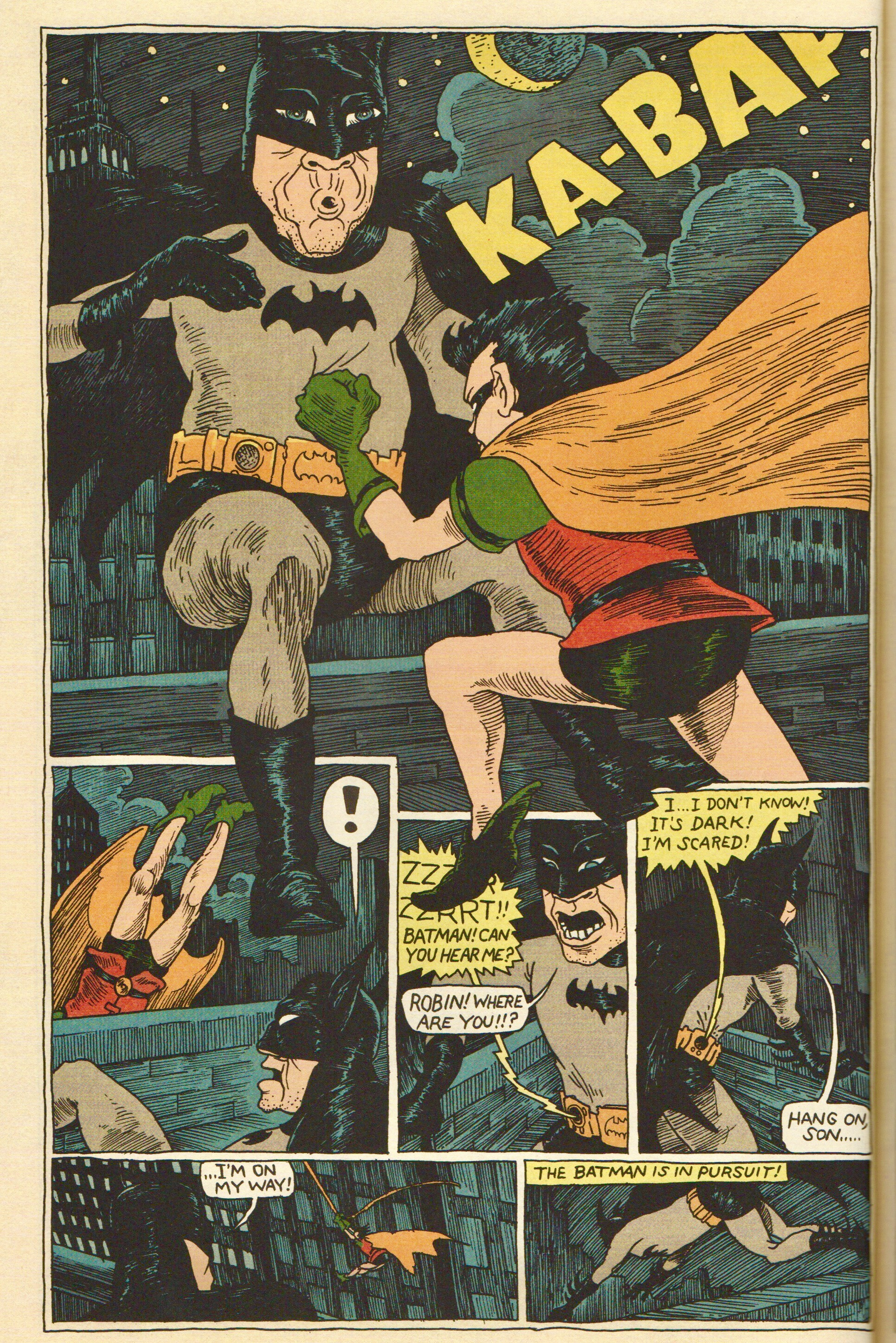
Sunday Comics 

From “Batman with Robin the Boy Wonder.” Art by Tony Millionaire, story by Chip Kidd, colors by Jim Campbell.  From Bizarro World, DC Comics, 2005. 

Space Monkey — Walton Ford

Space Monkey, 2001 by Walton Ford (b. 1960). From Pancha Tantra, Taschen Books, 2009.

25 21st-century films missing from that New York Times list

Have you seen that New York Times list of “The 25 Best Films of the 21st Century” that Manohla Dargis and A.O. Scott put together? I haven’t seen about half of the films on the list, but there are definitely some good ones on there. (But damn, like, Million Dollar Baby? Really? And I’ll never get why people think Munich is a good film).

Anyway, here’s a list I put together in about five minutes of 25 films missing from their list. I did limit myself to one entry by a director for some silly reason–otherwise I’d end up with a bunch of films by three people on here. I’m sure I missed hundreds of other films. But, hey, it’s all in the name of stupid fun.

  1. Mulholland Drive
  2. Ponyo
  3. Hard to Be a God
  4. In the Mood for Love
  5. Upstream Color
  6. WALL-E
  7. The Hateful Eight
  8. Holy Motors
  9. Drive
  10. No Country for Old Men
  11. The Master
  12. Fantastic Mr. Fox
  13. Bright Star
  14. Children of Men
  15. The Tree of Life
  16. Russian Ark
  17. Only Lovers Left Alive
  18. Dredd
  19. Talk to Her
  20. Adaptation
  21. A History of Violence
  22.  Pan’s Labyrinth
  23.  The Assassination of Jesse James by the Coward Robert Ford
  24. Gomorrah 
  25. Synecdoche, New York


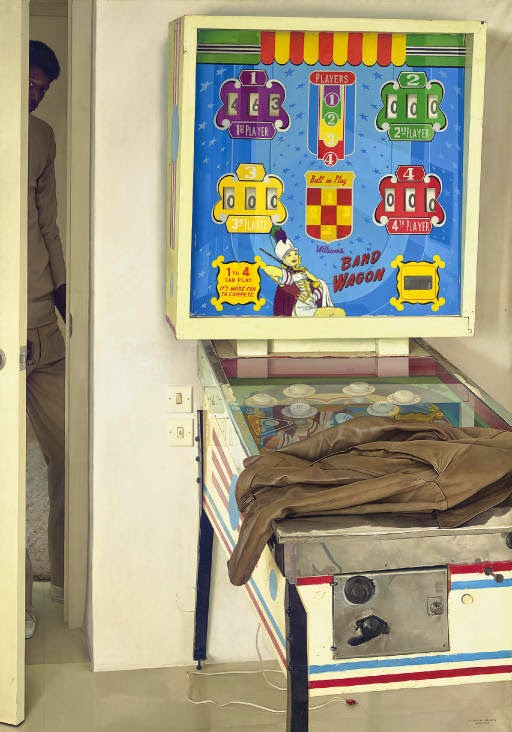
Pinball — Claudio Bravo

Claudio Bravo - Pinball

Pinball, 1973 by Claudio Bravo (1954-2011)

A review of Barry Hannah’s cult classic collection Airships

img_1423

In his 1978 collection Airships, Barry Hannah sets stories in disparate milieux, from the northern front of the Civil War, to an apocalyptic future, to the Vietnam War, to strange pockets of the late-twentieth century South. Despite the shifts in time and place, Airships is one of those collections of short stories that feels somehow like an elliptical, fragmentary novel. There are the stories that correspond directly to each other — the opener “Water Liars,” for instance, features (presumably, anyway), the same group of old men as “All the Old Harkening Faces at the Rail.” The old men love to crony up, gossip, tell tall tales. An outsider spoils the fun in “Water Liars” by telling a truth more terrible than any lie; in “Harkening,” an old man shows off his new (much younger) bride. These stories are perhaps the simplest in the collection, the homiest, anyway, or at least the most “normal” (whatever that means), yet they are both girded by a strange darkness, both humorous and violent, that informs all of Airships.

We find that humor and violence in an outstanding trio of Civil War stories (or, more accurately, stories set during the Civil War). The narrator of “Dragged Fighting from His Tomb,” a Confederate infantryman relates a tale of heroic slaughter with a hypberbolic, phallic force. Observe—

I knew the blueboys thought they had me down and were about ready to come in. I was in that position at Chancelorsville. There should be about six fools, I thought. I made the repeater, I killed four, and the other two limped off. Some histrionic plumehead was raising his saber up and down on the top of a pyramid of crossties. I shot him just for fun. Then I brought up another repeater and sprayed the yard.

Later, the narrator defects, switches to the Union, and claims he kills Jeb Stuart, a figure that towers over the Civil War tales. The narrator of “Dragged Fighting” hates Stuart; the narrator of “Knowing He Was Not My Kind Yet I Followed” is literally in love with the General. In contrast to the narrator of “Dragged Fighting,” the speaker in “Knowing” — an avowed “sissy” whom the other soldiers openly detest — hates the violence and madness of war—

We’re too far from home. We are not defending our beloved Dixie anymore. We’re just bandits and maniacal. The gleam in the men’s eyes tells this. Everyone is getting crazier on the craziness of being simply too far from home for decent return. It is like Ruth in the alien corn, or a troop of men given wings over the terrain they cherished and taken by the wind to trees they do not know.

He despairs when he learns of Jeb Stuart’s death. In the final Civil War story, “Behold the Husband in His Perfect Agony,” a Union spy is given the task to communicate news of Stuart’s death through enemy lines. Rather than offering further explication, let me instead point you, dear reader, to more of Hannah’s beautiful prose, of which I have not remarked upon nearly enough. From “Behold the Husband” —

Isaacs False Corn, the Indian, the spy, saw Edison, the Negro, the contact, on the column of an inn. His coat was made of stitched newspapers. Near his bare feet, two dogs failed earnestly at mating. Pigeons snatched at the pieces of things in the rushing gutter. The rains had been hard.

The short, descriptive passage rests on my ears like a poem. Hannah, who worked with Gordon Lish, evinces in his writing again and again that great editor’s mantra that writing is putting one sentence after another.

Although set in the Vietnam War, “Midnight and I’m not Famous Yet” seems an extension of the Civil War stories. In it, an officer from a small Southern town goes slowly crazy from all the killing, yet, like the narrator of “Dragged Fighting,” he presents himself as a warrior. Above all though, he laments that the war has robbed him of some key, intermediary phase of his late youth, a phase he can’t even name—

The tears were out of my jaws then. Here we shot each other up. All we had going was the pursuit of horror. It seemed to me my life had gone straight from teen-age giggling to horror. I had never had time to be but two things, a giggler and a killer.

This ironic sense of a “pursuit of horror” pervades Airships, particularly in the collection’s most apocalyptic visions. “Eating Wife and Friends” posits an America where food shortages and material scarcity leads people to eating leaves and grass — and then each other. In “Escape to Newark,” the environment is wildly out of balance—

In August it’s a hundred fifty degrees. In December it’s minus twenty-five and three feet of snow in Mississippi. In April the big trees explode.

A plan is made to “escape” these conditions via a rocket, but of course there’s not enough fuel to get past Newark. In Airships, modes of flight are transcendent but ultimately transient. Gravity’s pull is heavy stuff.

Just as Hannah’s war stories are not really war stories, his apocalypse tales are really about human relationships, which he draws in humor, pathos, and dark cynicism. In “Green Gets It,” an old man repeatedly attempts his suicide, only to fail again and again. His suicide note, written to his daughter, is scathing and shocking and sad and hilarious and wise–

My Beloved Daughter,

Thanks to you for being one of the few who never blamed me for your petty, cheerless and malign personality. But perhaps you were too busy being awful to ever think of the cause. I hear you take self-defense classes now. Don’t you understand nobody could take anything from you without leaving you richer? If I thought rape would change you, I’d hire a randy cad myself. I leave a few dollars to your husband. Bother him about them and suffer the curse of this old pair of eyes spying blind at the minnows in the Hudson.

Your Dad,

Crabfood

Although Hannah explores the darkest gaps of the soul in Airships, he also finds there a shining kernel of love in the face of waste, depravity, violence, and indifference. This love evinces most strongly perhaps in Airships trio of long stories. These tales, which hover around 30 pages, feel positively epic set against the other stories in the collection, which tend to clock in between five and ten pages. The first long story, “Testimony of Pilot,” details the development of a boyhood friendship over a few decades. It captures the strange affections and rivalries and unnameable bonds and distances that connect and disconnect any two close friends. The second of the long tales is “Return to Return,” a tragicomic Southern drama in the Oedipal vein (with plenty of tennis and alcoholism to boot). As in “Testimony of Pilot,” Hannah finds some measure of redemption, or at least solace, for his characters in their loving friendship, yet nothing could be more unsentimental. The final long story, which closes the collection, is “Mother Rooney Unscrolls the Hurt,” a daring work of stream of consciousness that seems to both respond to — and revise — Katherine Anne Porter’s “The Jilting of Granny Weatherall.” The story concludes (and of course concludes the volume) with a vision of love that corresponds to the imagery of The Pietà, a kind of selflessness that ironically confirms the self as an entity that exists in relation to the pain of others.

I could keep writing of course — I’ve barely touched on Hannah’s surrealism, a comic weirdness that I’ve never seen elsewhere; it is Hannahesque, I suppose. Nor have I detailed Hannah’s evocations of regular working class folk, fighting and drinking and divorcing and raising children (not necessarily in that order). Airships is a world too rich and fertile to unpack in just one review, and I’ve already been blathering too long, I fear, when what I really want  to do is just outright implore you, kind reader, to find it and start reading it immediately. Very highly recommended.

[Editorial note: Biblioklept published a version of this review on March 20th, 2011. I am currently listening to the audiobook of the Hannah omnibus Long, Last, Happy, and just finished the first section, which contains most of Airships. The audiobook is good, but I wish it was Hannah reading it himself.]