Shortcut (Mulholland Drive)

Pinks and Clematis in a Crystal Vase — Edouard Manet

Selections from One-Star Amazon Reviews of Thomas Pynchon’s Mason & Dixon

[Ed. note: The following citations come from one-star Amazon reviews of Thomas Pynchon’s novel Mason & Dixon—which I loved. (See also: Chinua Achebe’s Things Fall Apart, Mary Shelley’s Frankenstein, Thomas Pynchon’s Gravity’s RainbowGeorge Orwell’s 1984, Herman Melville’s Moby-Dick, James Joyce’s Ulysses and David Markson’s Wittgenstein’s Mistress). I’ve preserved the reviewers’ own styles of punctuation and spelling].

What crap.

A talking dog?

I made a mistake.

Dialogue that is meaningless?

But what is the point of this story?

Pynchon is simply messing around

I can’t believe I read the whole thing.

I guess there’s no accounting for taste.

Rarely have I anticipated a book so hungrily.

Lost me at the talking dog, and never recovered.

I’ve also seen Pynchon praised for his erudition.

You think a talking dog or mechanical duck is funny?

Supposedly it’s a literary adventure through the 18th century

George Washington smoking pot and getting the munchies?

I consider my myself a reader who relishes literary challenges.

I am a reader who enjoys being bluntly told what the author thinks

The only book I’ve ever read that was a complete waste of time !

just an endless series of unconnected and unrelated ramblings…

Yes, it was a different world back then, and people talked funny (to our ear).

The publisher should have left the trees to grow rather than putting this in print.

I had to finish it – but resorted to scanning the text for references to my 7th great grandfather.

Pynchon is like strolling through a garbage dump full of meaningless, forgotten pop culture relics.

Wow, I give up on Mr. Pynchon who apparently has some intergalactic literary insights well above my head.

Regretfully, I’ll need to wait for the english language translation before properly assessing this novel’s merits.

Thomas Pynchon surely must have been smoking something more powerful than plain tobacco when he wrote this debacle…

I admit to approaching this book with a great deal of reverence, along with guilt for never having attempted either “V” or “Gravity’s Rainbow.”

Mr.Pynchon may be considered one of today’s great writers by the cosmopolitan literati, but this provencial reader found his work to be a 773 page morass of archaic vernacular with no particular point.

I would like to assert, however, as one who has read quite deeply in English prose of the last 400 years, that the much-praised “18th-century English” is nothing like, being full of anachronisms and lapses of decorum.

Pynchon doesn’t descibe. He makes lists of objects, as if the acculation of things or people surrounding the characters is enough to create some semblance of reality, or alternate reality, or hyperreality or whatever.

I am in the vast minority, obviously, who “didn’t get it.” Some times I wonder if reviewers, too “didn’t get it” but were afraid to say so, because this conglomeration of words is just that – a pointless, incomprehensible waste of trees.

My Tedium never Ceases, yet have I only Dredged thru half of this Tome. My eyes grow Tir’d and my Thoughts grow more hateful towards this Author. History is barely Reveal’d and the style has Vex’d me thru and thru. Hemp smoking Franklin? Confus’d and Stupid Astronomers? Half the book not spent in the country of interest? Yet I plod on, making a use of this Fantastique tale, to knaw away at the Minutes spent in the loo. Wouldst it be quite the thing, if only the Paper t’was softer, I can then make of it a Cleansing Agent for my Posterior once Finished with each page.

It was evidently written for a limited audience–people who can actually read eighteenth century style prose and who still find jokes about “not inhaling” to be amusing.

Pynchon’s style is clotted, mannered, meretricious and UNpoetic in the extreme. Indeed, I think much of the book, in word and matter, is a stale exercise in collecting academic trivia and faddish modern-day truisms about the period.

To be sure, there is some real history reported, but there is also much nonsense and fakery–the first pizza, golems–and interminable, leaden dialogues that could never have taken place.

Really Pynchon was just showing off his “imagination” with endless derails, whimsical characters that didn’t figure into the story at all, and stupid jokes bathed in obscure jargon.

If you like rambling verbiage that not only obstructs but obliterates the point, you’ll love this author, whose neurotic word dribblings are gnosticed by critics to be visionary insights.

For all the scribblings in this book’s 800 some pages, 90% of it just feels like hot air lacking any real message or content.

One could read this book from front to back, back to front, or from the middle both ways and not be able to tell the difference..

I love sentimental literature but I couldn’t for the life of me see much connection between Pynchon’s writings and the major works of the 18th century.

I challenge any fan to give even one insight about life or the universe that they gleaned from Mason and Dixon..

Just because the gags are about the hollow earth theory does not make them any more than just gags.

The reader is presented with one choppy chapter after another, often with little or no context.

The book is a mess and sorely needed a large pair of scissors to trim out the inane chatter.

Thers’s an old phrase about good writing: show, don’t tell. Phynchon don’t show nothun’.

For years Pynchon has intrigued me as being one of the “bosses” of modern literature.

There’s no sense of place, no compelling plotline. The characterization is merely O.K.

Pynchon is all over the map willy nilly throwing out anything that diverts his attention.

In what way was this an homage, parody, or imitation of 18th century literature?

If Thomas Pynchon has a plot or a story line, he surely has hidden it very well..

To this day I do not know what the book was about and what was going on.

The overall scheme of the novel is stupid and amateurish.

Too hard to read for this master’s degree English teacher.

Hundreds of unrelated and disconnected characters too..

Some as ridiculous as a talking dog, and a robot duck…

This book is a waste of time and paper.

What is all this supposed to mean?

Honestly, this book is just annoying.

The first pizza made in England?

Clearly, the fault is mine.

Wicks Cherrycoke?

Big @#$%ing deal.

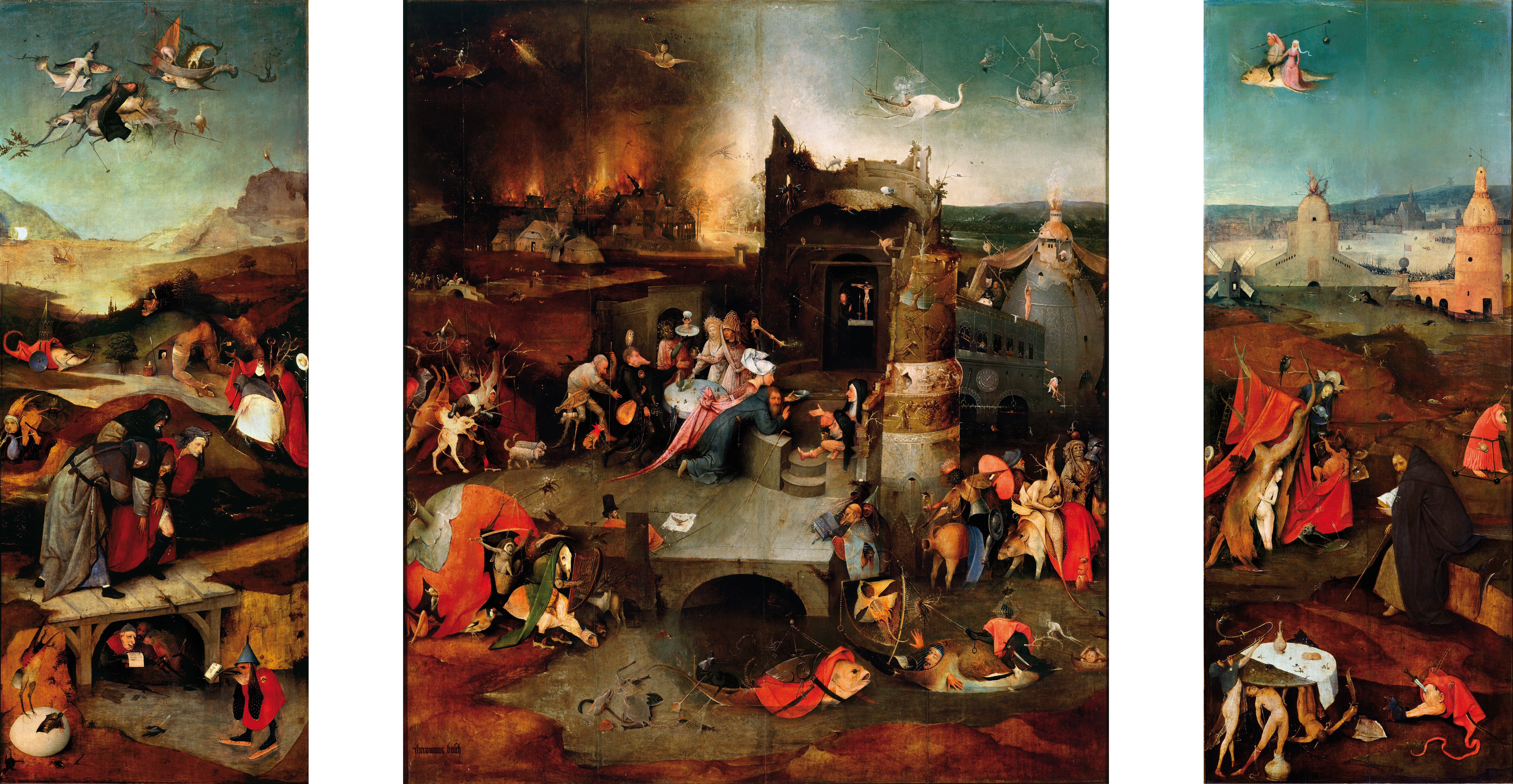
The Temptation of St. Anthony (Detail) — Hieronymus Bosch

14

“The Man and the Snake” — Ambrose Bierce

“The Man and the Snake”

by

Ambrose Bierce

I

It is of veritabyll report, and attested of so many that there be nowe of wyse and learned none to gaynsaye it, that ye serpente hys eye hath a magnetick propertie that whosoe falleth into its svasion is drawn forwards in despyte of his wille, and perisheth miserabyll by ye creature hys byte.

Stretched at ease upon a sofa, in gown and slippers, Harker Brayton smiled as he read the foregoing sentence in old Morryster’s “Marvells of Science.” “The only marvel in the matter,” he said to himself, “is that the wise and learned in Morryster’s day should have believed such nonsense as is rejected by most of even the ignorant in ours.”

A train of reflections followed—for Brayton was a man of thought— and he unconsciously lowered his book without altering the direction of his eyes. As soon as the volume had gone below the line of sight, something in an obscure corner of the room recalled his attention to his surroundings. What he saw, in the shadow under his bed, were two small points of light, apparently about an inch apart. They might have been reflections of the gas jet above him, in metal nail heads; he gave them but little thought and resumed his reading. A moment later something—some impulse which it did not occur to him to analyze—impelled him to lower the book again and seek for what he saw before. The points of light were still there. They seemed to have become brighter than before, shining with a greenish luster which he had not at first observed. He thought, too, that they might have moved a trifle—were somewhat nearer. They were still too much in the shadow, however, to reveal their nature and origin to an indolent attention, and he resumed his reading. Suddenly something in the text suggested a thought which made him start and drop the book for the third time to the side of the sofa, whence, escaping from his hand, it fell sprawling to the floor, back upward. Brayton, half-risen, was staring intently into the obscurity beneath the bed, where the points of light shone with, it seemed to him, an added fire. His attention was now fully aroused, his gaze eager and imperative. It disclosed, almost directly beneath the foot rail of the bed, the coils of a large serpent—the points of light were its eyes! Its horrible head, thrust flatly forth from the innermost coil and resting upon the outermost, was directed straight toward him, the definition of the wide, brutal jaw and the idiotlike forehead serving to show the direction of its malevolent gaze. The eyes were no longer merely luminous points; they looked into his own with a meaning, a malign significance. Continue reading ““The Man and the Snake” — Ambrose Bierce”

Girl Reading a Letter at an Open Window — Johannes Vermeer

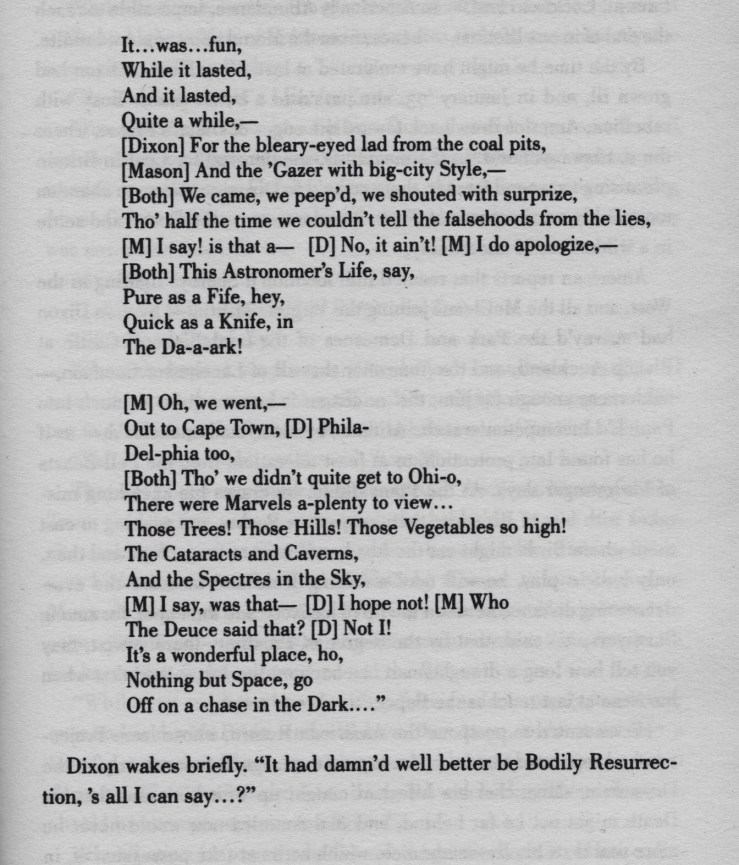
Musical Duet Summary of Pynchon’s Mason & Dixon in Two Stanzas

IMG_4610

From Ch. 77 of Thomas Pynchon’s Mason & Dixon. I love the elision expressed in those dashes — “I say, was that–” — I say, was that a talking dog? I say, was that were-beaver? I say, was that a giant cannabis plant? I say, was that a Sino-Jesuit cabal? I say, was that the Lost Tribe of Israel? I say, was that the missing 11 days, and the Asiatick Pygmies who inhabit them? I say, was that a mechanical duck, looking for love? I say, was that an electric eel? I say, was that a recipe for catsup? I say, was that the first English pizza? I say, was that The Black Dog? I say, was that an iron bathtub? I say, was that a ridotto of inflamed debauchery? I say, was that a Masonic conspiracy? I say, was that the metaphysical wind? I say, was that a dead wife’s ghost? I say, was that a friendship? I say!

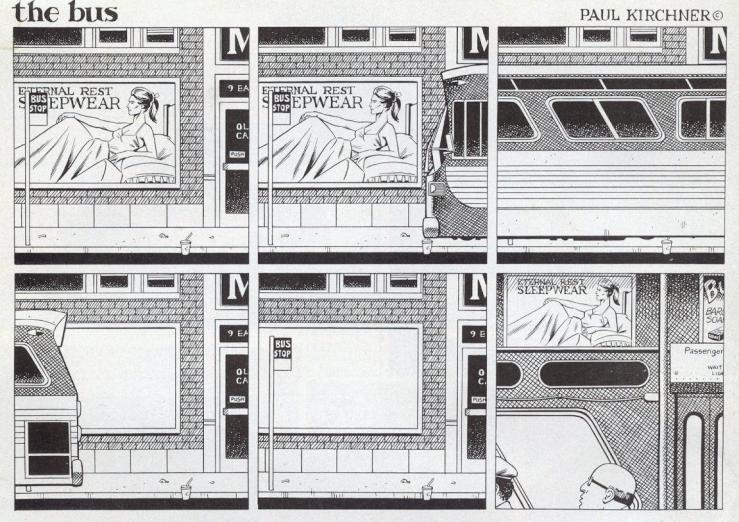
The Bus — Paul Kirchner

86k3dP3

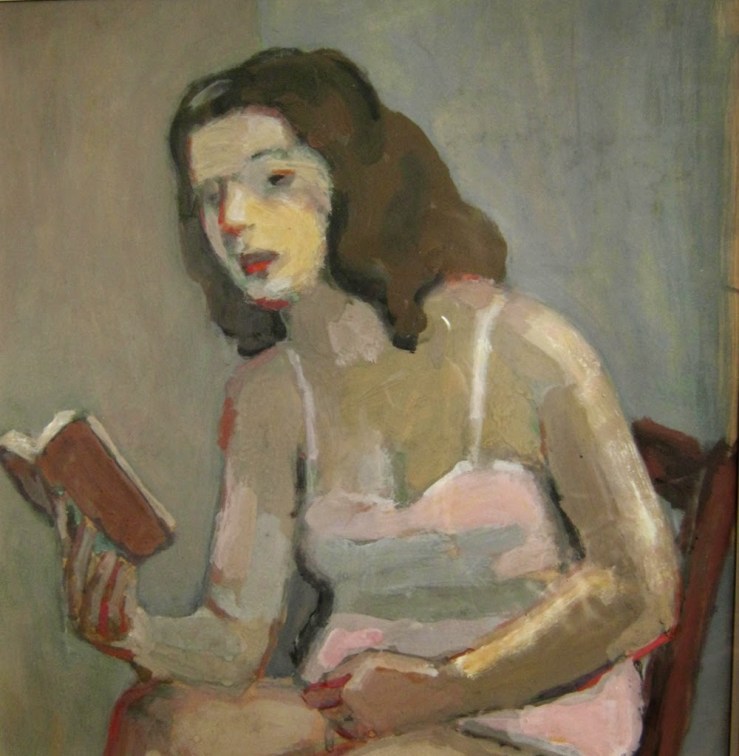
Young Woman Reading — Ossip Lubitch

Lubitch, Ossip 3

“All art constantly aspires towards the condition of music”

Thomas Pynchon’s Mason & Dixon (Third Riff: The Rabbi of Prague)

A. I’m a few chapters–three, precisely—from finishing Mason & Dixon. “Finishing” is not the right verb here, though—Pynchon’s novel is so rich, funny, strange, and energetic that I want to return to it immediately.

B. But I need to backtrack a bit, riff on one of my favorite episodes—Chapter 50.

C. (First riff and second riff for those inclined).

D. In Chapter 50,

’tis Dixon’s luck to discover The Rabbi of Prague, headquarters of a Kabbalistick Faith, in Correspondence with the Elect Cohens of Paris, whose private Salute they now greet Dixon with, the Fingers spread two and two, and the Thumb held away from them likewise, said to represent the Hebrew letter Shin and to signify, “Live long and prosper.”

Pynchon plays here on the reader’s initial understanding of the signal and phrase as a pop culture reference—


—but the goof isn’t merely postmodernist shtick—Pynchon is pointing to how the invisible manifests itself in signs and wonders, covert, cryptic, but perhaps—perhaps—decipherable.

E. (Maybe this needs clarification: The Rabbi of Prague is a tavern. I lost track of how many bars taverns pubs inns alehouses coffeehouses etc. show up in M&D). Continue reading “Thomas Pynchon’s Mason & Dixon (Third Riff: The Rabbi of Prague)”

The Temptation of St. Anthony (Detail) — Hieronymus Bosch

13

Balestrini/Pasolini (Books acquired, 12.27.2014)

verso

So I picked up two ebooks from Verso today for less than a pint of beer. Ridiculous! The Unseen by Nanni Balestrini, and Pasolini’s unproduced screenplay St. Paul. All kinds of great stuff. I think my favorite thing about Verso’s ebooks is how straightforward they are to access—no weird third-party app or DRM issues.

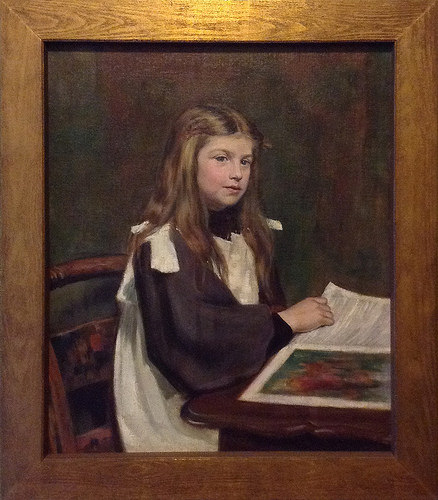
Sarah Allen — Allen Butler Talcott

dhdchifd

A Troubled Soul — Ferdinand Hodler

“Fancy’s Show-Box” — Nathaniel Hawthorne

“Fancy’s Show-Box”

by

Nathaniel Hawthorne

What is guilt? A stain upon the soul. And it is a point of vast interest whether the soul may contract such stains in all their depth and flagrancy from deeds which may have been plotted and resolved upon, but which physically have never had existence. Must the fleshly hand and visible frame of man set its seal to the evil designs of the soul, in order to give them their entire validity against the sinner? Or, while none but crimes perpetrated are cognizable before an earthly tribunal, will guilty thoughts—of which guilty deeds are no more than shadows,—will these draw down the full weight of a condemning sentence in the supreme court of eternity? In the solitude of a midnight chamber or in a desert afar from men or in a church while the body is kneeling the soul may pollute itself even with those crimes which we are accustomed to deem altogether carnal. If this be true, it is a fearful truth.

Let us illustrate the subject by an imaginary example. A venerable gentleman—one Mr. Smith—who had long been regarded as a pattern of moral excellence was warming his aged blood with a glass or two of generous wine. His children being gone forth about their worldly business and his grandchildren at school, he sat alone in a deep luxurious arm-chair with his feet beneath a richly-carved mahogany table. Some old people have a dread of solitude, and when better company may not be had rejoice even to hear the quiet breathing of a babe asleep upon the carpet. But Mr. Smith, whose silver hair was the bright symbol of a life unstained except by such spots as are inseparable from human nature—he had no need of a babe to protect him by its purity, nor of a grown person to stand between him and his own soul. Nevertheless, either manhood must converse with age, or womanhood must soothe him with gentle cares, or infancy must sport around his chair, or his thoughts will stray into the misty region of the past and the old man be chill and sad. Wine will not always cheer him. Continue reading ““Fancy’s Show-Box” — Nathaniel Hawthorne”

The Dark Knight Returns (His Presents)

dkr

By  Marco d’Alfonso