Chair Car — Edward Hopper

“Come to King’s Landing and take your rightful seat on my Iron Throne!” (Venture Bros.)

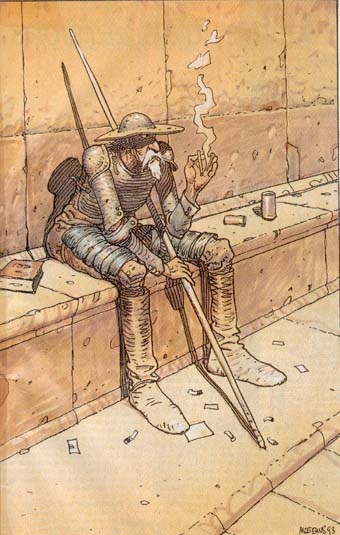
Don Quixote — Moebius

donquixotemoebius

I Review Paperback Island, Marshall Brooks’s Love Letter to Books and the People Who Make Them

20130526-164356.jpg

There’s something gently elegiac about Marshall Brooks’s Paperback Island, which collects over a dozen essays on reading. While Brooks’s essays on books, libraries, publishers, and the friendships that hold all of them together are never dour, they nevertheless evoke a world now shifting into the realm of memory alone.

It’s fitting then that the starting point for the book is beat legend Tuli Kupferberg’s funeral. Here, Brooks runs into Susanna Cuyler, who lends him her apartment in New York just so he can read her book Not Just Another Voice there: “There was no overlooking the fact that her apartment and her book are virtually one,” writes Brooks. This early detail hooked me, encapsulating so much of the themes of time, place, and friendship that Paperback Island emphasizes.

The lead essay in the collection is “Paperback Island.” Here, Brooks relates an adolescent friendship codified in books: “Besides symbolizing the excitement of what books can mean to people, especially young people who are in the process of formulating their own world, these books are all that remain to me of this once close friendship.” Brooks renders the transformative power that this bookswapping friendship had on him, set against the backdrop of the culture shift of the late sixties and early seventies:

Informationally, and in other ways as well, the early 1970s prefigured the Internet. Vast amounts of information, heretofore beyond the reach of the masses, became available. The visually compartmentalized newsprint portions of Harper’s Magazine and the encyclopedic paperbound Whole Earth Catalog come immediately to mind, as does the collectively-produced—via the Boston Women’s Health Collective—1970 paperback, Our Bodies, Ourselves. Design-wise, they all accelerated the absorption of information from off the printed page in completely innovative ways, which today’s web pages perforce echo. In conjunction with FM radio, foreign films, Super 8 film, Swinger cameras, stereo records, tape cassettes , early video, offset printing, the 1976 Freedom of Information Act, and such empowering movements as Women’s Lib, etc. , they revolutionized the lives of everyone, and youth culture in particular.

It would perhaps be easy for Brooks to have crammed his book with anecdotes illustrating the effects of these changes, but instead Paperback Island focuses on something much more personal, following the tone of its eponymous essay. There are memory-essays for Tuli Kupferberg, James T. Farrell, and Sidney Bernard, whose rogue journalism collection This Way to the Apocalypse I am now on the lookout for. In the background of all of this looms Harry Smith, the poet-publisher and founder of The Smith, where Brooks cut his teeth in the seventies. Smith’s influence on Brooks resonates in loving passages like this one:

A legendary figure in the American small press movement, Harry more than fulfilled the role of patron-protector for countless contributors to his press. He impressively looked the role, too, nowhere more so than when he grandly made the circuit at small press fair . . . The Smith published scores of unknown and neglected writers . . . The press resembled nothing else in the publishing world large or small partly for this reason. I had always assumed that a place exactly like it existed, somewhere. That it had to. (Why else write, really?) A place where poetry counted for everything. Fate, in its greatness, encouragingly provided for its existence, and Harry Smith supplied that place.

It’s that sense of place that comes through so strongly in Paperback Island, whether Brooks is describing the offices of The Smith or the hotels that James T. Farrell adored. Brooks also captures the strange ways that microlibraries evolve from place, time, and friendship (he inherited many of Farrell’s paperbacks). I think most bibliophiles will instantly understand Brooks’s impulse to collect, catalog, keep the tomes.

And of course there are the bookshops, the wanderings, the meanderings, the notes on books and how we find them. A late riff on visiting a Boston Barnes & Noble finds Brooks picking up a Nook and reading a passage from Austen’s Pride & Prejudice—his first time with an e-reader. The moment is not couched in resentment or alienation but simply experience—encountering an old book in a new way.

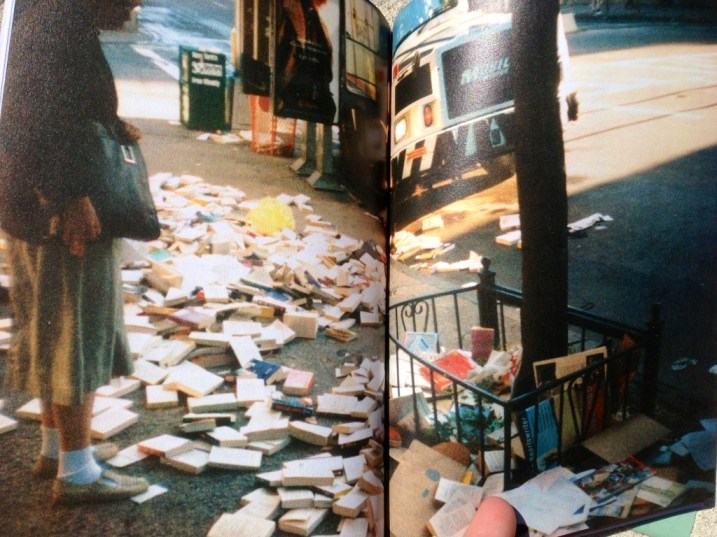
I should point out that Brooks has illustrated Paperback Island with photographs—of people, places, books—the things that make the book. (Books are made out of other books, some writer said). The photos are printed in rich color and add a documentary dimension to the book. Here’s a striking image of the closing of the Upper West Side branch of Shakespeare & Company—an image that perhaps captures more of the elegiac underpinnings of Paperback Island than I can do in words:
20130526-164401.jpg

Paperback Island is shot-through with bibliophilia, a love of books that encompasses writers, readers, libraries, and publishers, yes—but also the mechanics of the book, the physical properties. It’s a love letter to books and the people who make them—and not just the writers and publishers, but the readers who make them, preserve them—and the friends who pass them on, make sure that others read them.

In a latter essay, “Physical Allure of the Book,” Brooks writes, “My friend Roger Skillings became a writer on account of picking up a Penguin edition of James Joyce’s Dubliners in a train station in Rome.” I’ll end this write-up in what I take to be the spirit of Brooks’s book, sharing a little anecdote of my own about a book I can’t part with.

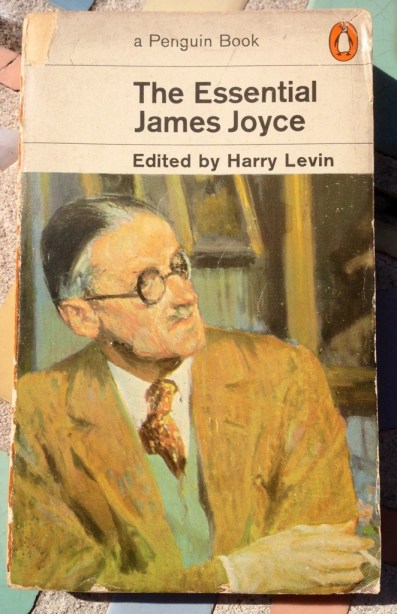
In 2002 I was wandering Jimbocho, an area of Tokyo crammed with nearly 200 bookshops. I found, lying in the gutter but unsullied, a paperback Penguin Book — The Essential James Joyce, edited by Harry Levin. I glanced around, trying to see if the book was somehow connected to a nearby vendor, but it didn’t seem to be for sale. In any case, I surreptitiously slipped the book into my bag and walked on. I read “The Dead” on the train ride home. I’ve kept the book to this day, even though I have no need of a Joyce digest. I can’t help it. I love it.
20130526-164407.jpg

The Oceanides — Gustave Dore

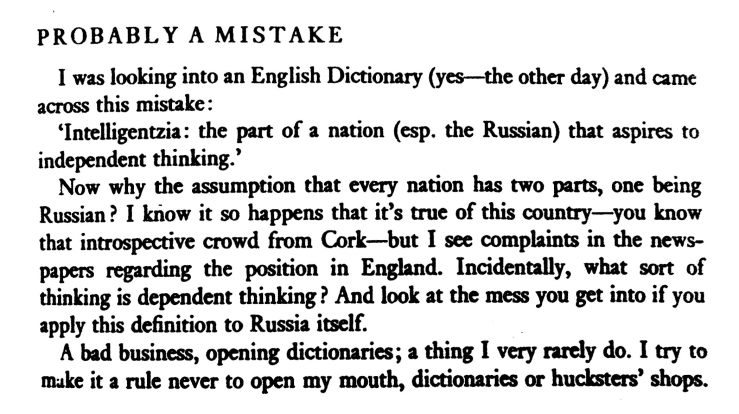
“Probably a Mistake” — Flann O’Brien

mistake

“Death in the Woods” — Sherwood Anderson

“Death in the Woods” by Sherwood Anderson

She was an old woman and lived on a farm near the town in which I lived. All country and small-town people have seen such old women, but no one knows much about them. Such an old woman comes into town driving an old worn-out horse or she comes afoot carrying a basket. She may own a few hens and have eggs to sell. She brings them in a basket and takes them to a grocer. There she trades them in. She gets some salt pork and some beans. Then she gets a pound or two of sugar and some flour.

Afterwards she goes to the butcher’s and asks for some dog-meat. She may spend ten or fifteen cents, but when she does she asks for something. Formerly the butchers gave liver to any one who wanted to carry it away. In our family we were always having it. Once one of my brothers got a whole cow’s liver at the slaughter-house near the fairgrounds in our town. We had it until we were sick of it. It never cost a cent. I have hated the thought of it ever since.

The old farm woman got some liver and a soup-bone. She never visited with any one, and as soon as she got what she wanted she lit out for home. It made quite a load for such an old body. No one gave her a lift. People drive right down a road and never notice an old woman like that.

There was such an old woman who used to come into town past our house one Summer and Fall when I was a young boy and was sick with what was called inflammatory rheumatism. She went home later carrying a heavy pack on her back. Two or three large gaunt-looking dogs followed at her heels.

The old woman was nothing special. She was one of the nameless ones that hardly any one knows, but she got into my thoughts. I have just suddenly now, after all these years, remembered her and what happened. It is a story. Her name was Grimes, and she lived with her husband and son in a small unpainted house on the bank of a small creek four miles from town.

The husband and son were a tough lot. Although the son was but twenty-one, he had already served a term in jail. It was whispered about that the woman’s husband stole horses and ran them off to some other county. Now and then, when a horse turned up missing, the man had also disappeared. No one ever caught him. Once, when I was loafing at Tom Whitehead’s livery-barn, the man came there and sat on the bench in front. Two or three other men were there, but no one spoke to him. He sat for a few minutes and then got up and went away. When he was leaving he turned around and stared at the men. There was a look of defiance in his eyes. “Well, I have tried to be friendly. You don’t want to talk to me. It has been so wherever I have gone in this town. If, some day, one of your fine horses turns up missing, well, then what?” He did not say anything actually. “I’d like to bust one of you on the jaw,” was about what his eyes said. I remember how the look in his eyes made me shiver. Continue reading ““Death in the Woods” — Sherwood Anderson”

Man Reading a Newspaper — Rene Magritte

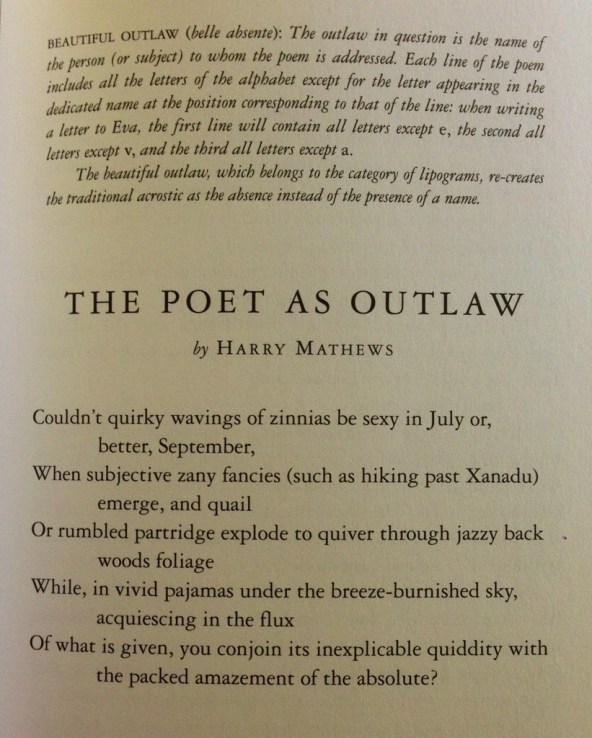
“The Poet as Outlaw” — Harry Mathews

20130527-113327.jpg

Barbecue — Eric Fischl

A Summer Reading List

20130527-122151.jpg

Okay:

Prospective reading list for the summer.

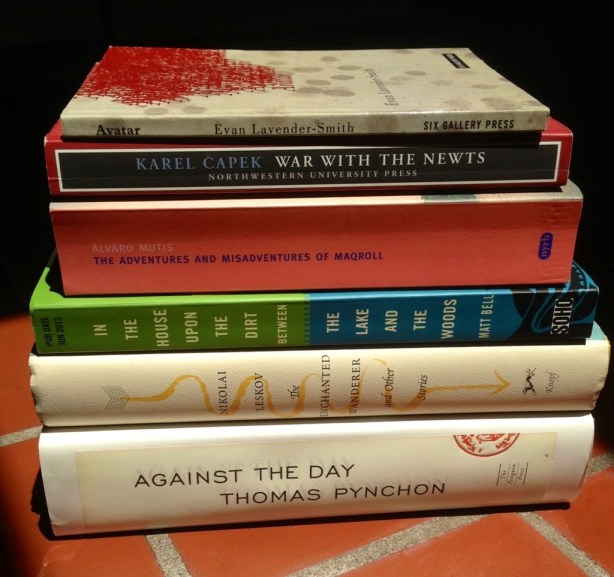
First, I’ll finish Mikhaíl Bulgakov’s The Master & Margarita, not pictured here because I’m reading it on the Kindle. No new novels until I finish this novel! (Will break this rule).

I just finished another trip through Ulysses, again via audiobook plus tandem-rereading on the Kindle. I like big audiobooks (and I cannot lie), so I’ll get into Against the Day on mp3.

This weekend I read “The Lady Macbeth of Mtsenk,” the first story in a freshly translated collection from Nikolai Leskov. The Enchanted Wanderer is new in translation by Richard Pevear and Larissa ­Volokhonsky. I’ll be reading it in chunks this summer.

Speaking of reading in chunks: I devoured the first three novellas in Álvaro Mutis’s Maqroll series and then took a break to get some other stuff in. Break over.

Also: Matt Bell’s novel In the House Upon the Dirt Between the Lake and the Woods.

And I still haven’t read Karel Čapek’s War with the Newts, so I’ll try to fix that this summer.

I also plan to read Evan Lavender-Smith’s Avatar, but I’d like to do it in one sitting, which means I need to free up a few hours.

Finally: Who knows. Reading lists are kind of ridiculous.

“Dirge for Two Veterans” — Walt Whitman

ww

The Veteran in a New Field — Winslow Homer

“Decoration Day” — Sarah Orne Jewett

“Decoration Day” by Sarah Orne Jewett

I.

A week before the thirtieth of May, three friends—John Stover and Henry Merrill and Asa Brown—happened to meet on Saturday evening at Barton’s store at the Plains. They were ready to enjoy this idle hour after a busy week. After long easterly rains, the sun had at last come out bright and clear, and all the Barlow farmers had been planting. There was even a good deal of ploughing left to be done, the season was so backward.

The three middle-aged men were old friends. They had been school-fellows, and when they were hardly out of their boyhood the war came on, and they enlisted in the same company, on the same day, and happened to march away elbow to elbow. Then came the great experience of a great war, and the years that followed their return from the South had come to each almost alike. These men might have been members of the same rustic household, they knew each other’s history so well.

They were sitting on a low wooden bench at the left of the store door as you went in. People were coming and going on their Saturday night errands,—the post-office was in Barton’s store,—but the friends talked on eagerly, without being interrupted, except by an occasional nod of recognition. They appeared to take no notice at all of the neighbors whom they saw oftenest. It was a most beautiful evening; the two great elms were almost half in leaf over the blacksmith’s shop which stood across the wide road. Farther along were two small old-fashioned houses and the old white church, with its pretty belfry of four arched sides and a tiny dome at the top. The large cockerel on the vane was pointing a little south of west, and there was still light enough to make it shine bravely against the deep blue eastern sky. On the western side of the road, near the store, were the parsonage and the storekeeper’s modern house, which had a French roof and some attempt at decoration, which the long-established Barlow people called gingerbread-work, and regarded with mingled pride and disdain. These buildings made the tiny village called Barlow Plains. They stood in the middle of a long narrow strip of level ground. They were islanded by green fields and pastures. There were hills beyond; the mountains themselves seemed very near. Scattered about on the hill slopes were farmhouses, which stood so far apart, with their clusters of out-buildings, that each looked lonely, and the pine woods above seemed to besiege them all. It was lighter on the uplands than it was in the valley, where the three men sat on their bench, with their backs to the store and the western sky.

“Well, here we be ‘most into June, an’ I ‘ain’t got a bush-bean above ground,” lamented Henry Merrill.

“Your land’s always late, ain’t it? But you always catch up with the rest on us,” Asa Brown consoled him. “I’ve often observed that your land, though early planted, was late to sprout. I view it there’s a good week’s difference betwixt me an’ Stover an’ your folks, but come first o’ July we all even up.”

“‘Tis just so,” said John Stover, taking his pipe out of his mouth, as if he had a good deal more to say, and then replacing it, as if he had changed his mind.

“Made it extry hard having that long wet spell. Can’t none on us take no day off this season,” said Asa Brown; but nobody thought it worth his while to respond to such evident truth.

“Next Saturday’ll be the thirtieth o’ May—that’s Decoration Day, ain’t it?—come round again. Lord! how the years slip by after you git to be forty-five an’ along there!” said Asa again. “I s’pose some o’ our folks’ll go over to Alton to see the procession, same’s usual. I’ve got to git one o’ them small flags to stick on our Joel’s grave, an’ Mis’ Dexter always counts on havin’ some for Harrison’s lot. I calculate to get ’em somehow. I must make time to ride over, but I don’t know where the time’s comin’ from out o’ next week. I wish the women folks would tend to them things. There’s the spot where Eb Munson an’ John Tighe lays in the poor-farm lot, an’ I did mean certain to buy flags for ’em last year an’ year before, but I went an’ forgot it. I’d like to have folks that rode by notice ’em for once, if they was town paupers. Eb Munson was as darin’ a man as ever stepped out to tuck o’ drum.” Continue reading ““Decoration Day” — Sarah Orne Jewett”

Blossoming Almond Branch in a Glass with a Book — Vincent van Gogh

The Adjectives of Cormac McCarthy’s Road

the-road


(By/via).

Rooms by the Sea — Edward Hopper