Yellow Zine #3 (Books, Comix, Etc. Acquired 5.13.2013)

20130526-120127.jpg

Got a sweet bundle from Roman Muradov a few weeks ago: Yellow Zine #3 plus some other comix, including a take on Italo Calvino’s If on a Winter’s Night. Love the Joyce bookmark.

The comix themselves are funny, weird, and strangely heartfelt (why “strangely” — I suppose because there’s this weird cerebral/linguistic bent to them + literary allusion — these aren’t  sad boy emo comics — but emotion and feeling comes through in Roman’s clean, expressive style).

Check out Roman’s site for more. I’m hoping for a graphic novel one day…

20130526-120140.jpg


Elmore Leonard Talks About His Writing Process

List with No Name #25

  1. Barry Lyndon
  2. Paths of Glory
  3. 2001: A Space Odyssey
  4. Dr. Strangelove
  5. The Shining
  6. A Clockwork Orange
  7. Eyes Wide Shut
  8. Spartacus
  9. Full Metal Jacket
  10. Lolita


Coloring Page of Dali’s The Persistence of Memory

Memory-by-Salvador-Dali-coloring-page

“Casablanca, or, the Clichés Are Having a Ball” — Umberto Eco

“Casablanca, or, the Clichés Are Having a Ball” by Umberto Eco


When people in their fifties sit down before their television sets for a rerun of Casablanca, it is an ordinary matter of nostalgia. However, when the film is shown in American universities, the boys and girls greet each scene and canonical line of dialogue (“Round up the usual suspects,” “Was that cannon fire, or is it my heart pounding?”–or even every time that Bogey says “kid”) with ovations usually reserved for football games. And I have seen the youthful audience in an Italian art cinema react in the same way. What then is the fascination of Casablanca?

The question is a legitimate one, for aesthetically speaking (or by any strict critical standards) Casablanca is a very mediocre film. It is a comic strip, a hotch-potch, low on psychological credibility, and with little continuity in its dramatic effects. And we know the reason for this: The film was made up as the shooting went along, and it was not until the last moment that the director and script writer knew whether Ilse would leave with Victor or with Rick. So all those moments of inspired direction that wring bursts of applause for their unexpected boldness actually represent decisions taken out of desperation. What then accounts for the success of this chain of accidents, a film that even today, seen for a second, third, or fourth time, draws forth the applause reserved for the operatic aria we love to hear repeated, or the enthusiasm we accord to an exciting discovery? There is a cast of formidable hams. But that is not enough.

Here are the romantic lovers–he bitter, she tender–but both have been seen to better advantage. And Casablanca is not Stagecoach, another film periodically revived. Stagecoach is a masterpiece in every respect. Every element is in its proper place, the characters are consistent from one moment to the next, and the plot (this too is important) comes from Maupassant–at least the first part of it. And so? So one is tempted to read Casablanca the way T. S. Eliot reread Hamlet. He attributed its fascination not to its being a successful work (actually he considered it one of Shakespeare’s less fortunate plays) but to something quite the opposite: Hamlet was the result of an unsuccessful fusion of several earlier Hamlets, one in which the theme was revenge (with madness as only a stratagem), and another whose theme was the crisis brought on by the mother’s sin, with the consequent discrepancy between Hamlet’s nervous excitation and the vagueness and implausibility of Gertrude’s crime. So critics and public alike find Hamlet beautiful because it is interesting, and believe it to be interesting because it is beautiful.

On a smaller scale, the same thing happened to Casablanca. Forced to improvise a plot, the authors mixed in a little of everything, and everything they chose came from a repertoire of the tried and true. When the choice of the tried and true is limited, the result is a trite or mass-produced film, or simply kitsch. But when the tried and true repertoire is used wholesale, the result is an architecture like Gaudi’s Sagrada Familia in Barcelona. There is a sense of dizziness, a stroke of brilliance. Continue reading ““Casablanca, or, the Clichés Are Having a Ball” — Umberto Eco”

Self Portrait — Gerrit Dou

Little Goblins — Goya

43 Minutes of This Heat Playing Live in 1980

Mozart Sneezes — Milton Glaser

mozart sneezing

Saul Bellow’s Review of Ralph Ellison’s Invisible Man

“Man Underground,” a Review of Ralph Ellison’s Invisible Man, by Saul Bellow

A few years ago, in an otherwise dreary and better forgotten number of Horizon devoted to a louse-up of life in the United States, I read with great excitement an episode from Invisible Man. It described a free-for-all of blindfolded Negro boys at a stag party of the leading citizens of a small Southern town. Before being blindfolded the boys are made to stare at a naked white woman; then they are herded into the ring, and, after the battle royal, one of the fighters, his mouth full of blood, is called upon to give his high school valedictorian’s address. As he stands under the lights of the noisy room, the citizens rib him and make him repeat himself; an accidental reference to equality nearly ruins him, but everything ends well and he receives a handsome briefcase containing a scholarship to a Negro college.

This episode, I thought, might well be the high point of an excellent novel. It has turned out to be not the high point but rather one of the many peaks of a book of the very first order, a superb book. The valedictorian is himself Invisible Man. He adores the college but is thrown out before long by its president, Dr. Bledsoe, a great educator and leader of his race, for permitting a white visitor to visit the wrong places in the vicinity. Bearing what he believes to be a letter of recommendation from Dr. Bledsoe he comes to New York. The letter actually warns prospective employers against him. He is recruited by white radicals and becomes a Negro leader, and in the radical movement he learns eventually that throughout his entire life his relations with other men have been schematic; neither with Negroes nor with whites has he ever been visible, real. I think that in reading the Horizon excerpt I may have underestimated Mr. Ellison’s ambition and power for the following very good reason, that one is accustomed to expect excellent novels about boys, but a modern novel about men is exceedingly rare. For this enormously complex and difficult American experience of ours very few people are willing to make themselves morally and intellectually responsible. Consequently, maturity is hard to find. Continue reading “Saul Bellow’s Review of Ralph Ellison’s Invisible Man”

“I bristle at the idea that the only thing Susan Sontag or David Foster Wallace had to offer is advice for me.”

If I had first encountered Anaïs Nin by reading a quote of hers about love or dreams or fulfilling your potential or massaging your inner child superimposed on an insufferably twee image, I would never have picked up her wonderful remarkably-transgressive books. Perhaps this shows the shortsightedness of my own prejudices but it’s still not a fair or substantial representation of her work. What I want when I encounter Anaïs Nin is Anaïs Nin, not a therapist or a motivational speaker. The same goes for Susan Sontag or Henry Miller or David Foster Wallace or any of the other incandescently brilliant writers whose writing has recently been cherry-picked and repackaged as glorified self-help tracts. The quotes are certainly theirs, being culled from diaries, journals, speeches and interviews (with the double meaning of culled being entirely apt). The sentiments may well be true. Yet it seems to me duplicitous because the quotes have been carefully selected to fit a pre-existing agenda – us. I am a ludicrously solipsistic and selfish person but even I bristle at the idea that the only thing Susan Sontag or David Foster Wallace had to offer is advice for me. At the risk of impertinence, if I chance upon someone using the currently virulent “there is actually no such thing as atheism” quote by Foster Wallace out of context to bash atheists (ignoring its implicit ‘worship God precisely because He is so ineffectual He can’t harm you’ angle) with no further interest in his writing or life, I’m going to nail a copy of Infinite Jest to their collective forehead.

—From an essay that had me enthusiastically mumbling yes the whole way, “Albert Camus and the ventriloquists” by Darran Anderson. Read it.

Vagabond — Remedios Varo

“Powerhouse” — Eudora Welty

“Powerhouse” by Eudora Welty

Powerhouse is playing!

He’s here on tour from the city–“Powerhouse and His Keyboard”– “Powerhouse and His Tasmanians”–think of the things he calls himself! There’s no one in the world like him. You can’t tell what he is. “Nigger man”?–he looks more Asiatic, monkey, Jewish, Babylonian, Peruvian, fanatic, devil. He has pale gray eyes, heavy lids, maybe horny like a lizard’s, but big glowing eyes when they’re open. He has African feet of the greatest size, stomping, both together, on each side of the pedals. He’s not coal black– beverage colored–looks like a preacher when his mouth is shut, but then it opens–vast and obscene. And his mouth is going every minute: like a monkey’s when it looks for something. Improvising, coming on a light and childish melody–smooch–he loves it with his mouth.

Is it possible that he could be this! When you have him there performing for you, that’s what you feel. You know people on a stage–and people of a darker race–so likely to be marvelous, frightening.

This is a white dance. Powerhouse is not a show-off like the Harlem boys, not drunk, not crazy–he’s in a trance; he’s a person of joy, a fanatic. He listens as much as he performs, a look of hideous, powerful rapture on his face. Big arched eyebrows that never stop traveling, like a Jew’s–wandering-Jew eyebrows. When he plays he beats down piano and seat and wears them away. He is in motion every moment–what could be more obscene? There he is with his great head, fat stomach, and little round piston legs, and long yellow-sectioned strong big fingers, at rest about the size of bananas. Of course you know how he sounds–you’ve heard him on records–but still you need to see him. He’s going all the time, like skating around the skating rink or rowing a boat. It makes everybody crowd around, here in this shadowless steel-trussed hall with the rose-like posters of Nelson Eddy and the testimonial for the mind-reading horse in handwriting magnified five hundred times. Then all quietly he lays his finger on a key with the promise and serenity of a sibyl touching the book.

Powerhouse is so monstrous he sends everybody into oblivion. When any group, any performers, come to town, don’t people always come out and hover near, leaning inward about them, to learn what it is? What is it? Listen. Remember how it was with the acrobats. Watch them carefully, hear the least word, especially what they say to one another, in another language–don’t let them escape you; it’s the only time for hallucination, the last time. They can’t stay. They’ll be somewhere else this time tomorrow.

Powerhouse has as much as possible done by signals. Everybody, laughing as if to hide a weakness, will sooner or later hand him up a written request. Powerhouse reads each one, studying with a secret face: that is the face which looks like a mask–anybody’s; there is a moment when he makes a decision. Then a light slides under his eyelids, and he says, “92!” or some combination of figures–never a name. Before a number the band is all frantic, misbehaving, pushing, like children in a schoolroom, and he is the teacher getting silence. His hands over the keys, he says sternly, “You-all ready? You-all ready to do some serious walking?”–waits–then, STAMP. Quiet. STAMP, for the second time This is absolute. Then a set of rhythmic kicks against the floor to communicate the tempo. Then, O Lord! say the distended eyes from beyond the boundary of the trumpets, Hello and good-bye, and they are all down the first note like a waterfall. Continue reading ““Powerhouse” — Eudora Welty”

List with No Name #24

  1. Goodfellas
  2. The King of Comedy
  3. Taxi Driver
  4. Casino
  5. Mean Streets
  6. Raging Bull
  7. After Hours
  8. The Last Temptation of Christ
  9. Shutter Island
  10. Gangs of New York
  11. The Age of Innocence
  12. Cape Fear
  13. Bringing Out the Dead
  14. Kundun
  15. The Departed
  16. The Aviator
  17. The Color of Money

Required Reading — Carl Larsson

“What past consecutive causes, before rising preapprehended, of accumulated fatigue did Bloom, before rising, silently recapitulate?” (Ulysses)

What past consecutive causes, before rising preapprehended, of accumulated fatigue did Bloom, before rising, silently recapitulate?

The preparation of breakfast (burnt offering): intestinal congestion and premeditative defecation (holy of holies): the bath (rite of John): the funeral (rite of Samuel): the advertisement of Alexander Keyes (Urim and Thummim): the unsubstantial lunch (rite of Melchisedek): the visit to museum and national library (holy place): the bookhunt along Bedford row, Merchants’ Arch, Wellington Quay (Simchath Torah): the music in the Ormond Hotel (Shira Shirim): the altercation with a truculent troglodyte in Bernard Kiernan’s premises (holocaust): a blank period of time including a cardrive, a visit to a house of mourning, a leavetaking (wilderness): the eroticism produced by feminine exhibitionism (rite of Onan): the prolonged delivery of Mrs Mina Purefoy (heave offering): the visit to the disorderly house of Mrs Bella Cohen, 82 Tyrone street, lower and subsequent brawl and chance medley in Beaver street (Armageddon)—nocturnal perambulation to and from the cabman’s shelter, Butt Bridge (atonement).

A summary of sort of Bloom’s day. From the penultimate chapter of James Joyce’s Ulysses.

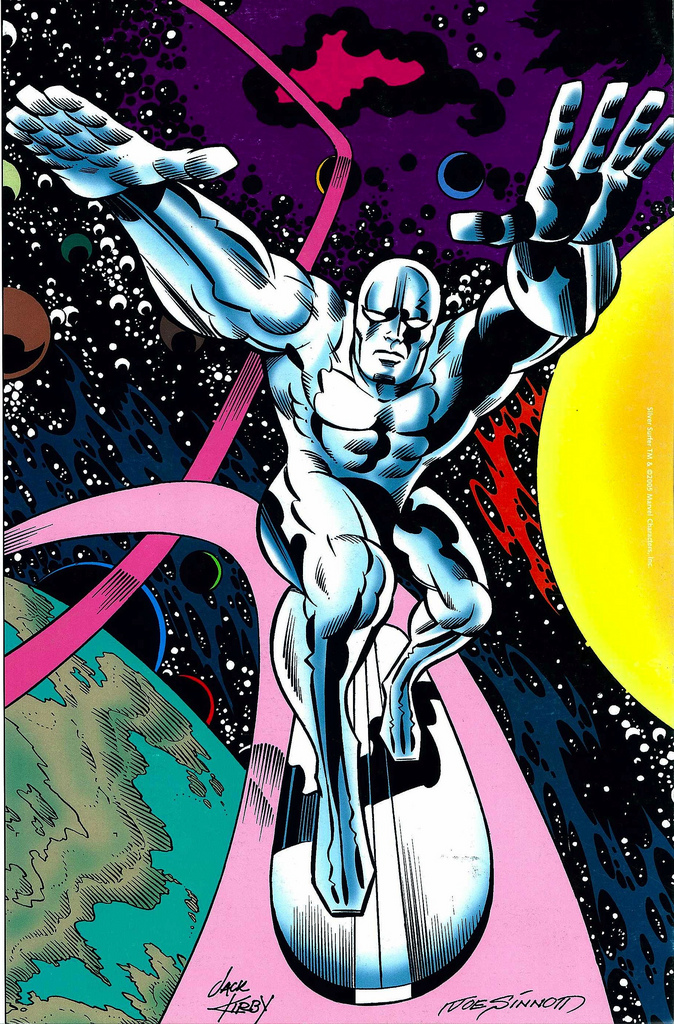
Silver Surfer — Jack Kirby

silver surfer jack kirby