“Llorando” (Mulholland Dr.)

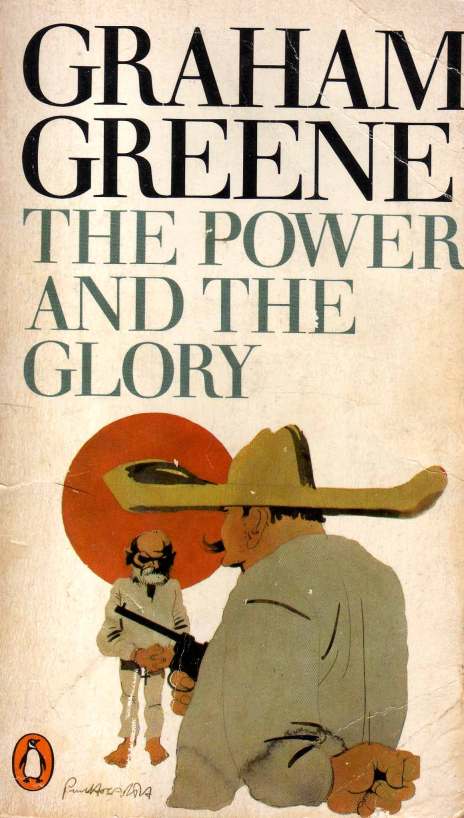
“The Priest Is Us”: The Power and The Glory, Graham Greene’s Adventure of Religion and Faith

The Gospels are powerful not simply because Christ performed miracles and taught kindness, strength, and humility. Humanity has long attributed to certain individuals impossible deeds, tremendous suffering, and inordinate wisdom. We survey the collective memory and search for meaning in the lives of renowned teachers so that they might serve as an example during our own unpredictable, harrowing journey. What separates the story of Jesus from the stories of other merely great people in history is the idea that God manifested itself to humans as a human: wracked with doubt, vulnerable to temptation, victim of unimaginable pain.  Although he taught that love is the first commandment, Christ was flailed, tortured, left to die on a cross between two thieves, all ostensibly for no benefit but our own.  Wasn’t it Borges who said that every story is either the Odyssey or the Crucifixion?  The stories we tell each other, in their reflection, become the same nothing cycle of words, told again and again, a record of our inadequacy and cowardice.

Graham Greene, in his short and powerful novel The Power and the Glory, considers the life and death of Jesus as he narrates the life of a man brought low by pride and circumstances. The last priest someplace in southwestern Mexico flees from the authorities.  His hunters seek to free the peasant farmers who populate the land from exploitation and superstition with their own imperfect liberation theologies: the abolition of superstition and private property; the self-sufficiency that follows honest labor.  The men in red shirts ride horses and believe in the impending, always near, revolution.  On the back of a mule, the father sneaks from town to town, trying to fulfill his duty, but without understanding the significance of the words that tumble clumsily from his mouth in Latin. He performs sacred rites in exchange for sanctuary until even a hiding spot is denied to him. The police have started to execute men and boys in villages who they believe have colluded to shelter this wayward man of God.

As the priest travels, he finds himself stripped not only of the vestments of his profession: his chalice, his incense, his robes, and his bible, but his own air of invincibility, privilege and comfort. Exposed, fearful, living in a state of mortal sin and unable to confess, this fallen man of God, like Christ himself, is destroyed.  The priest is, by his own admission, a bad one. He drinks heavily and thinks too much of his own comfort. Led to his profession not so much by attention to the divine will but by a desire for status and privilege, during his exile he recalls fondly dinners lavish dinners with wealthy members of his assembly and the gifts they gave him. While he may have seen that the most of his flock made a meager living on small farms after taxes and fees paid to local bosses, he never stopped to consider the meaning of his own observations, busying himself instead with ambitions for his own greater glory. He is, for the first half of the book, greedy, proud, and self-concerned.

But, as he eludes the authorities and traverses the country, he becomes, in Greene’s capable hands, a symbol of redemption and an affirmation of a full but unrealized life.  Words that lacked meaning help to ameliorate the strongest pain he has ever felt. He is jailed, extorted, and rejected by the people who love him the most, but in humiliation finds real faith.  Performing the sacred rites of his profession, he confronts the banality of evil and comes to finally realize the true power of the promise he brought to those who came to him:

He had an immense self-importance; he was unable to picture a world in which he was only a typical part — a world of treachery, violence, and lust in which his shame was altogether insignificant. How often the priest had heard the same confession — Man was so limited he hadn’t even the ingenuity to invent a new vice: the animals knew as much. It was for this world that Christ had did; the more evil you saw and heard about you, the greater glory lay around the death. It was too easy to die for what was good or beautiful, for home or children or a civilization — it needed a God to die for the half-hearted and the corrupt.

This is a book about religion and faith, but The Power and the Glory doesn’t require its reader to have an inclination towards either.  It is an adventure story, recounted in bold, confident sentences, about a normal man who fears that incorrect choices will cause him to suffer. This fear is real and it manifests itself in the priest’s moral and ethical dilemmas.  We are asked to ponder those things that lead from sadness to strength.  The priest is us: we see ourselves completely in him and give him our sympathy.

David Markson on Harold Bloom

From David Markson’s The Last Novel:

Where the synecdoche of tessera made a totality, however illusive, the metonymy of kenosis breaks this up into discontinuous fragments.

Somewhere declareth Harold Bloom.

It may be essential to Harold Bloom that his audience not know quite what he is talking about.

Commenteth Alfred Kazin — pointing out other immortal phrasings altogether.

Book Shelves #12, 3.18.2012

20120318-142208.jpg

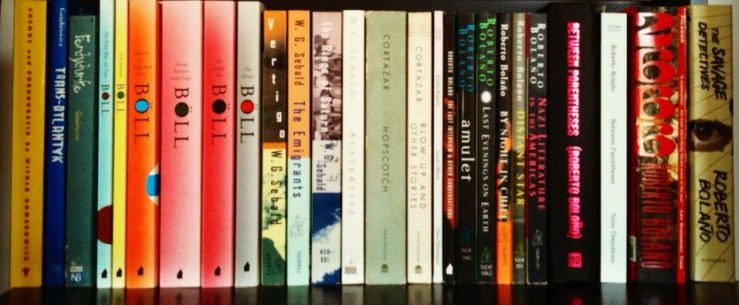
Book shelves series #12, twelfth Sunday of 2012.

The shelf holds literature in translation: Witold Gombrowicz, Heinrich Böll, W.G. Sebald, Julio Cortázar, and Roberto Bolaño. There was a geode bookend here until Thursday, when I reorganized (finally giving the Gombrowicz a home and restoring the finished copy of Between Parentheses to its brothers). No, I never finished Hopscotch, nor much of the Böll (although I did read Irish JournalThe Train Was on Time, and The Clown); I haven’t read Ferdydurke yet either.

Satantango (Book Acquired, 3.15.2012)

20120317-165939.jpg

Was happy to get a finished copy of Laszlo Krasznahorkai’s Satantango (new in English translation for the first time from the good people at New Directions). From Jacob Silverman’s review at The New York Times:

As in much of Krasznahorkai’s work, a sense of hallucinatory conspiracy is in the air. People speak ominously, if vaguely, about what lies ahead. They see visions and hear bells they can’t place. “If they read the papers properly,” one character says, “they would know that there is a real crisis out there.”

But there is also a shared belief that things aren’t as they appear. Some mistake must have been made; things can’t be as bad as they seem. And so the residents “are waiting. They’re waiting patiently, like the long-suffering lot they are, in the firm conviction that someone has conned them. They are waiting, belly to the ground, like cats at pig-killing time, hoping for scraps.” (This repetition, with its gradual slathering of metaphoric detail, characterizes Krasznahorkai’s style.)

I started the ARC I got of Satantango (mistitled on the spine; see below), but got sidetracked with epic books by William Gaddis and William Vollmann. (Blame the Bills). I will give the book my full attention in the nearish future.

20120317-165946.jpg

“There Is a Polish Story of a Witch Who Made a Girdle of Human Skin”

From Sabine Baring-Gould’s indispensable work Curious Myths of the Middle Ages (1866):

There is a Polish story of a witch who made a girdle of human skin and laid it across the threshold of a door where a marriage-feast was being held. On the bridal pair stepping across the girdle they were transformed into wolves. Three years after the witch sought them out, and cast over them dresses of fur with the hair turned outward, whereupon they recovered their human forms, but, unfortunately, the dress cast over the bridegroom was too scanty, and did not extend over his tail, so that, when he was restored to his former condition, he retained his lupine caudal appendage, and this became hereditary in his family; so that all Poles with tails are lineal descendants of the ancestor to whom this little misfortune happened.

Blonde Scene (The Limits of Control)

Portrait of Joseph Bueys — Lothar Wolleh

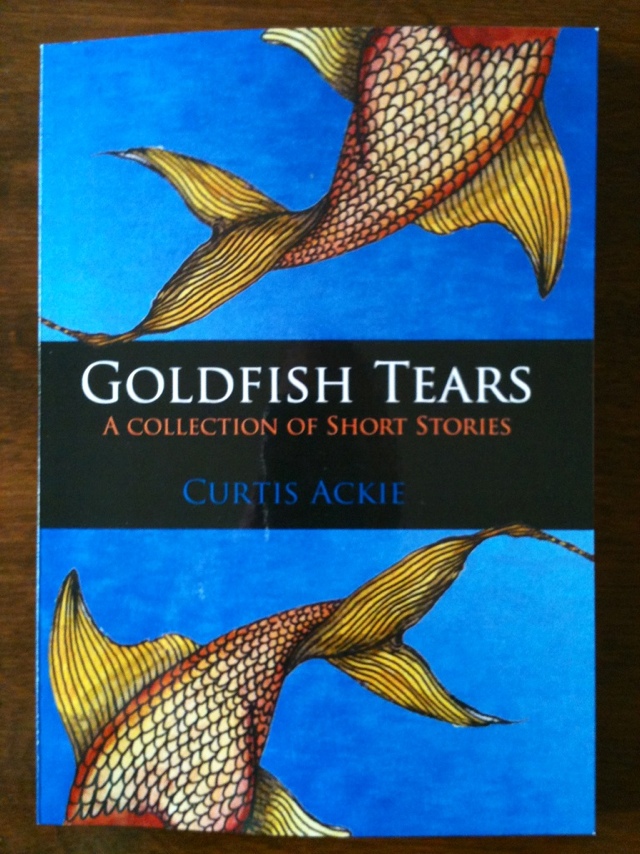
Goldfish Tears (Book Acquired, 3.16.2012)

20120317-170959.jpg

Goldfish Tears by Curtis Ackie: A good looking collection of shorts. Here’s the descriptor:

A perturbed bachelor is beleaguered by his misbehaving shadow; a reclusive alchemist builds a machine to right his wife’s disfigurement; the sun forgets to rise over a sleepy town in the middle of nowhere. Equal parts haunting and outlandish, Goldfish Tears is an enchanting collection of short stories by Curtis Ackie, a young British-born author concerned with the magic of dreams as escapism.

(More).

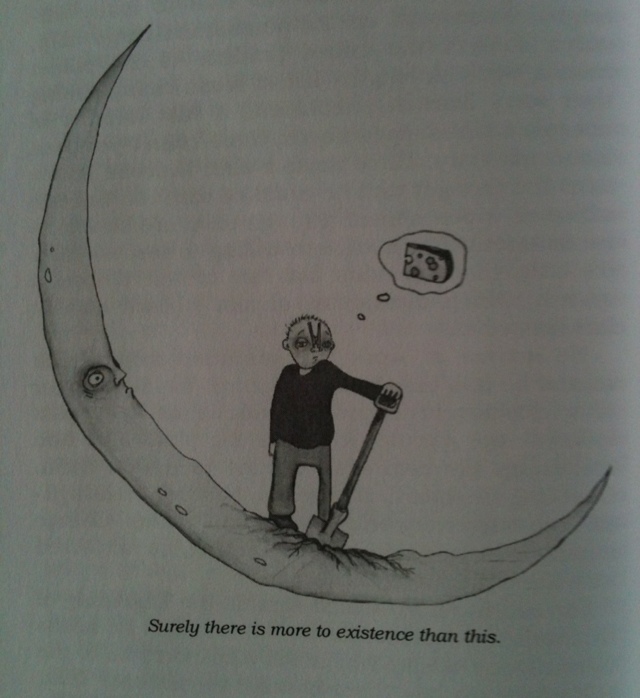
The book is full of charming illustrations that evoke whimsy and dread:

20120317-171007.jpg

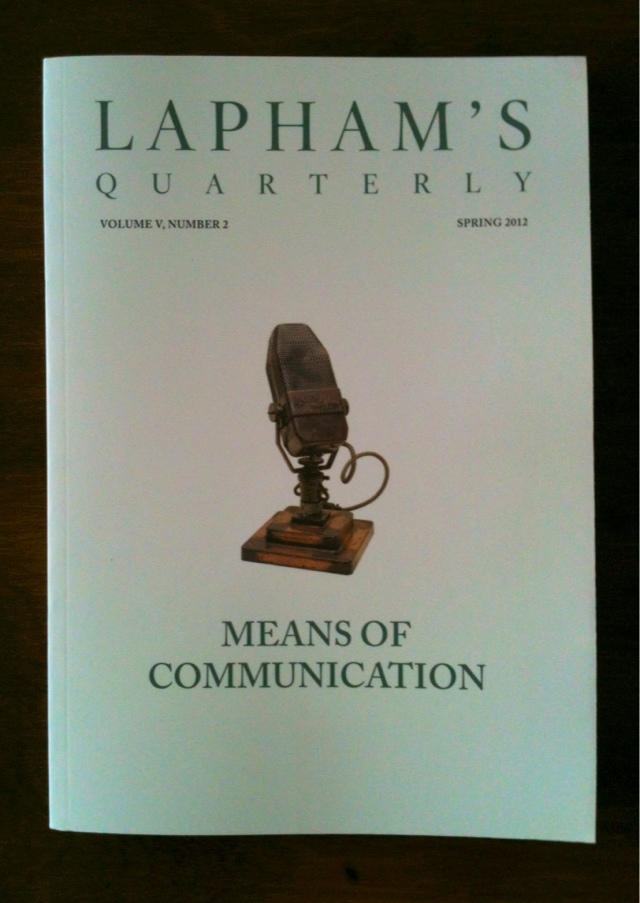
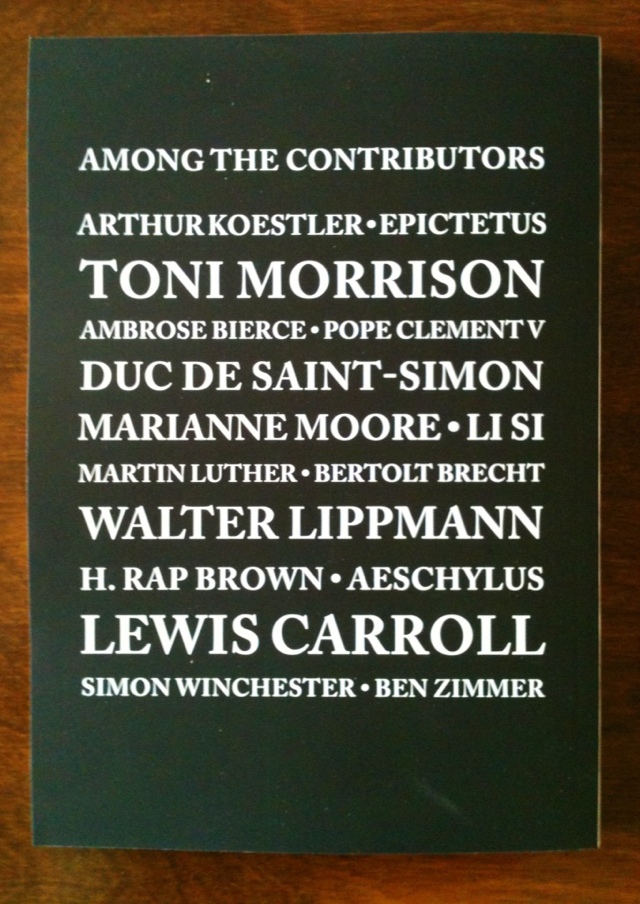
Book Acquired, 3.14.2012 (Lapham’s Quarterly, Spring 2012)

20120317-165618.jpg

20120317-165625.jpg

(Yes, I am enjoying my subscription).

Letter from WB Yeats to Ezra Pound (July 1918)

Young Jesus Among the Scribes — Albrecht Dürer

A List of Irish Heroes from Joyce’s Ulysses

One of my favorite passages in Ulysses (it’s from the “Cyclops” chapter, episode 12). Hilarious–

He wore a long unsleeved garment of recently flayed oxhide reaching to the knees in a loose kilt and this was bound about his middle by a girdle of plaited straw and rushes. Beneath this he wore trews of deerskin, roughly stitched with gut. His nether extremities were encased in high Balbriggan buskins dyed in lichen purple, the feet being shod with brogues of salted cowhide laced with the windpipe of the same beast. From his girdle hung a row of seastones which dangled at every movement of his portentous frame and on these were graven with rude yet striking art the tribal images of many Irish heroes and heroines of antiquity, Cuchulin, Conn of hundred battles, Niall of nine hostages, Brian of Kincora, the Ardri Malachi, Art MacMurragh, Shane O’Neill, Father John Murphy, Owen Roe, Patrick Sarsfield, Red Hugh O’Donnell, Red Jim MacDermott, Soggarth Eoghan O’Growney, Michael Dwyer, Francy Higgins, Henry Joy M’Cracken, Goliath, Horace Wheatley, Thomas Conneff, Peg Woffington, the Village Blacksmith, Captain Moonlight, Captain Boycott, Dante Alighieri, Christopher Columbus, S. Fursa, S. Brendan, Marshal Mac-Mahon, Charlemagne, Theobald Wolfe Tone, the Mother of the Maccabees, the Last of the Mohicans, the Rose of Castille, the Man for Galway, The Man that Broke the Bank at Monte Carlo, The Man in the Gap, The Woman Who Didn’t, Benjamin Franklin, Napoleon Bonaparte, John L. Sullivan, Cleopatra, Savourneen Deelish, Julius Caesar, Paracelsus, sir Thomas Lipton, William Tell, Michelangelo, Hayes, Muhammad, the Bride of Lammermoor, Peter the Hermit, Peter the Packer, Dark Rosaleen, Patrick W. Shakespeare, Brian Confucius, Murtagh Gutenberg, Patricio Velasquez, Captain Nemo, Tristan and Isolde, the first Prince of Wales, Thomas Cook and Son, the Bold Soldier Boy, Arrah na Pogue, Dick Turpin, Ludwig Beethoven, the Colleen Bawn, Waddler Healy, Angus the Culdee, Dolly Mount, Sidney Parade, Ben Howth, Valentine Greatrakes, Adam and Eve, Arthur Wellesley, Boss Croker, Herodotus, Jack the Giantkiller, Gautama Buddha, Lady Godiva, The Lily of Killarney, Balor of the Evil Eye, the Queen of Sheba, Acky Nagle, Joe Nagle, Alessandro Volta, Jeremiah O’Donovan Rossa, Don Philip O’Sullivan Beare. A couched spear of acuminated granite rested by him while at his feet reposed a savage animal of the canine tribe whose stertorous gasps announced that he was sunk in uneasy slumber, a supposition confirmed by hoarse growls and spasmodic movements which his master repressed from time to time by tranquillising blows of a mighty cudgel rudely fashioned out of paleolithic stone.


“Mutter, Ich Bin Dumm” — Opening Scene of Béla Tarr’s Film The Turin Horse

Atlanta and Savannah — Glennray Tutor

Robert Louis Stevenson on Walt Whitman’s Leaves of Grass: “It Is Only a Book for Those Who Have the Gift of Reading”

From Robert Louis Stevenson’s essay “The Books Which Have Influenced Me”:

I come next to Whitman’s Leaves of Grass, a book of singular service, a book which tumbled the world upside down for me, blew into space a thousand cobwebs of genteel and ethical illusion, and, having thus shaken my tabernacle of lies, set me back again upon a strong foundation of all the original and manly virtues. But it is, once more, only a book for those who have the gift of reading. I will be very frank–I believe it is so with all good books except, perhaps, fiction. The average man lives, and must live, so wholly in convention, that gun-powder charges of the truth are more apt to discompose than to invigorate his creed. Either he cries out upon blasphemy and indecency, and crouches the closer round that little idol of part-truths and part-conveniences which is the contemporary deity, or he is convinced by what is new, forgets what is old, and becomes truly blasphemous and indecent himself. New truth is only useful to supplement the old; rough truth is only wanted to expand, not to destroy, our civil and often elegant conventions. He who cannot judge had better stick to fiction and the daily papers. There he will get little harm, and, in the first at least, some good.

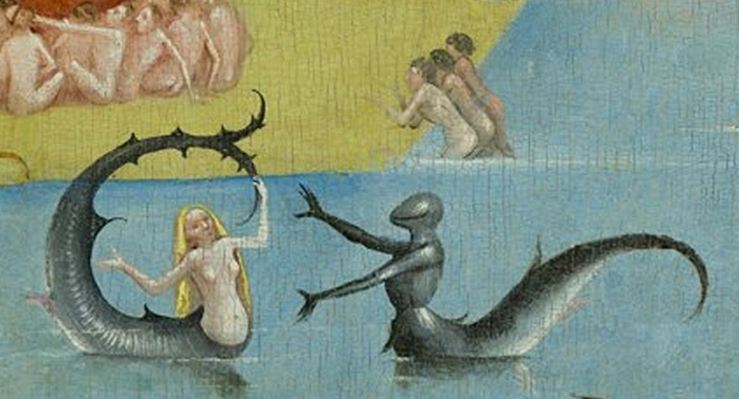
Merfolk (Bosch Detail)