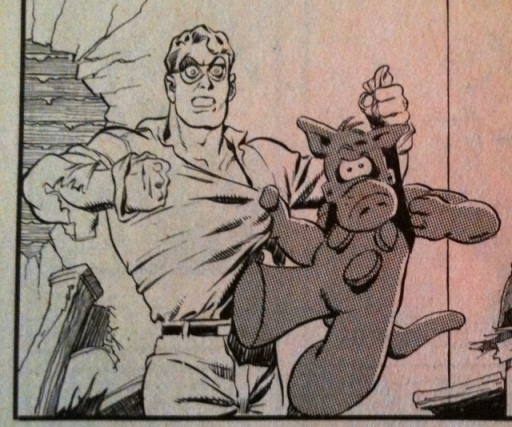
“Hair Rebels” (A Favorite Scene from a Favorite Film, if . . . .)

Book Acquired 1.03.2012 — Tim Tebow Edition

My father doesn’t read a lot of books, or at least I don’t think he does, but I know he read Through My Eyes, the Tim Tebow memoir. I’m pretty sure he must have gotten a duplicate for Christmas, because he sent a copy my way yesterday.

If you don’t know who Tim Tebow is (that is, if you’re not a fan of U.S. football, or not from the States, or you just don’t care about sports, or Twitter, or whatever), he was one of the greatest college players of all time, leading the Florida Gators to two national championship titles and two SEC titles. He’s also a devout Christian, the son of missionaries. He currently is the starting quarterback for the Denver Broncos, a team he helped take (quite improbably) to the playoffs this year.

Also: a vocal contingent of people really enjoy hating on him.

Not me. Tebow is from my hometown. I went to the University of Florida. I’m a big Gator fan. And even though I’m not exactly simpatico with evangelical Christianity, Tebow has always struck me as a genuinely good, nice person.

Anyway, I have some interest in the book, although I’m sure it’s pretty standard ghostwritten sports celebrity memoir stuff.

20120103-175429.jpg

Here is what my dad also got for Christmas: a signed Tebow ball. (My name is also Ed, so one day maybe I will have this ball too):

20120103-175448.jpg

“Seen in a Junk Yard” — F. Scott Fitzgerald

From F. Scott Fitzgerald’s Notebooks

Dogs, chickens with few claws, brass fittings, T’s elbow, rust everywhere, bales of metal 1800 lbs., plumbing fixtures, bathtubs, sinks, water pumps, wheels, Fordson tractor, Acetylene lamps for tractors, sewing machine, bell on dingy, box of bolts, No. 1 van, stove, auto stuff (No. 2), army trucks, cast iron, body hot dog stand, dinky engines, sprockets like watch parts, hinge all taken apart on building side, motorcycle radiators, George on the high army truck.

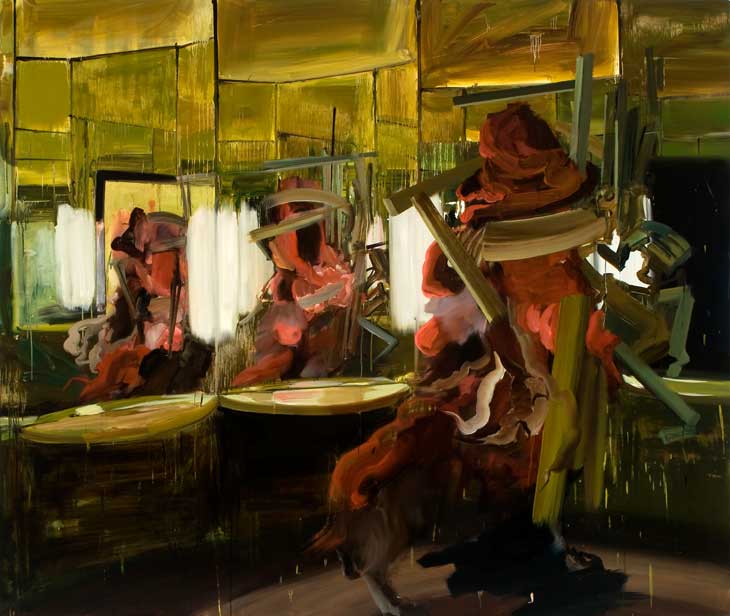
Blotter — Peter Doig

“Halleluhwah” — Can

“Books Are Like Ghosts” — Roberto Bolaño on Lost Books

Roberto Bolaño on lost books. From Between Parentheses:

To search for those copies or similar copies, the same font, the same layout, the same plot, the dark or bright syntax, somehow forces me to remember a time when I was young and poor and careless, though I know that the same copies, the exact same ones, will never be found, and to set myself to such a task would be like marching into Florida in search of El Dorado.

Even so, I often browse used bookstores, sorting through stacks of books left behind by others or sold in a dark moment, and in corners like these I try to find the books that I lost or forgot more than thirty years ago on another continent, with the hope and dedication and bitterness of those who search for their first lost books, books that if found I wouldn’t read anyway, because I’ve already read them over and over, but that I would look at and touch just as the miser strokes the coins under which he’s buried.

But books have nothing to do with greed, though they do have something to do with coins. Books are like ghosts.

Slavoj Žižek on David Lynch’s Lost Highway

A Chart of U.S. Presidents Who Sported Facial Hair

(From Wikipedia, natch).

Book Shelves #1, 1.01.2012

Every library answers a twofold need, which is often also a twofold obsession: that of conserving certain objects (books) and that of organizing them in certain ways.

—Georges Perec, from “Brief Notes on the Art and Manner of Arranging One’s Books” (1978)

For all of 2011 and half of 2010, I ran a death mask on this blog every Sunday. I liked the idea of having a regular, uniform post on the blog, and I enjoyed searching for death masks (and life masks) and learning about them. However, my interest is waning; it’s time to move on.

Still wanting to run a regular post each Sunday, I’ve elected to photograph the bookshelves, or the surfaces that hold books in my house. These will not be beautiful, arranged pictures, but rather simple pics from my iPhone documenting the spaces that books occupy. I will photograph each space “as is” and then remove a book or two, photograph it, and then comment on it.

I didn’t know where to start, so I started with what may be the most plain book shelves in my home, the nightstand next to my bed. (Right now it is unusually tidy, having been cleaned out and partially restocked for the new year; in a week or two it will be crammed to its wooden gills). Here is what it looks like:

20111231-112128.jpg

Not very exciting, I know! This is perhaps the only photo in this book shelf series that will not feature shots of spines. Like I said, I don’t plan to arrange any of the shots in this series. I talked about a lot of what’s in here in yesterday’s riff on recent reading and a post last week on stuff I plan to read in 2012.

Stuff on the top tier tends to be stuff I’m currently reading; the second shelf is filled with books I’m always rereading, or picking at slowly. The third shelf is where stuff goes to marinate or get dusty or cry to be shelved.

There’s also a bunch of kids book on the floor. More kids books are in this giant magazine stand, along with some notebooks, art pads, and probably an actual magazine or two (Anthony Browne’s book Changes is a surrealist masterpiece for kids, by the way):

20111231-112135.jpg

The Perec quote above comes from an essay collected in Species of Spaces and Other Pieces. “Brief Notes on the Art and Manner of Arranging One’s Books” will be in some ways the guiding inspiration for the Biblioklept book shelf series; my aim is not so much to present beautiful pictures that show off my books (I’m not equipped to do that, and other people do it very well already), but to comment on how my books are arranged and how they move and flow throughout the house; it will also give me a good opportunity to pick up books that might have been lingering (do books linger?) on a shelf for sometime.

I pulled these three books, not quite at random, from the shelves. The Perec book is one of those volumes I like to read scattershot-style. The latest issue of Paris Review still has a few pieces I haven’t read. Nausicaa: I meant to start it the other night. It will migrate to another room, a day-reading room, not a night-reading room:

20111231-112151.jpg

I don’t anticipate future book shelf posts being quite this long; my intention here is to kind of set the ground rules (for myself) or delineate both spirit and letter to this project. As such, a final note on movement: I will move “outward” from this nightstand, photographing any place where books are set. I will photograph every kind of book in this house in its natural habitat; this includes children’s books and cookbooks, but does not include personal photograph albums, instruction manuals, or anything else of that nature. I plan to do 53 total book shelf posts, including this one (there are 53 Sundays in 2012).

My hope is that readers will respond to these posts by sharing their own bookshelving habits.

An Incomplete List of Stuff I Wish I’d Written About in 2011

Let me get this out of my system:

In no particular order a list of stuff I wished I’d written about in 2011:

1. Renata Adler’s amazing novel-in-vignettes Speedboat.

2. Wittgenstein’s Mistress by David Markson. End of the world cultural riffage. No raffage.

3. The Stories of Breece D’J Pancake: soul-crashing sad. [Not a typo].

4. Season two of Boardwalk Empire: The Oedipal complex as a plot arc hasn’t been done so well since The Sopranos. Most HBO shows seem to be about capitalism and law (see also: Deadwood, The Wire, The Sopranos).

5. That first episode of Luck. I love David Milch. Michael Mann seems imminently capable of filming things (although I think Heat is overrated, even though it has Val Kilmer, and he’s radness in the form of a lion in the form of a sea lion). The opening episode was dry like vermouth. But I will watch, because of Deadwood.

6. Hung. My wife and I are the only two people in America who liked Hung. Then it got canceled.

7. Captain America: All of the shots + set design in this film seem to have been straight up stolen from the Star Wars films—except the shots that were stolen from the Indiana Jones films. It’s funny in a way because Lucas (and Spielberg) were stealing from old serial films that were contemporaneous with the age that Captain America is meant to be set in. (And, oh, yeah, the movie was contrived bullshit).

8. I wish I’d reviewed How to Keep Your Volkswagen Alive by Chris Boucher. It was new and fresh and strange and deserved a good review from this blog, but it was very difficult to write about. I tried. It’s simultaneously sad, funny, too-experimental, but also rich and rewarding. An excellent flawed début.

9. The Trip: Steve Coogan and Rob Brydon take a trip through Northern England, eating at Michelin starred inns, creeping on the wild misty moors, referencing plenty of Romantic lit, and riffing—and backbiting—a lot. Comedy + tragedy done right. Lovely.

10. The Adventures of Buckaroo BanzaiAcross the 8th Dimension: Okay, frankly, I was ashamed to admit that I hadn’t seen it until this summer. Batshit insane interstellar hi-jinks. Rasta aliens. Buckaroo and his men are in a band! The ending credits sequence is the second best I’ve ever seen (after Lynch’s closing credits for INLAND EMPIRE).

11. The last Harry Potter movie. It was good. I’m glad they’re over though.

12. Baudolino by Umberto Eco, which I listened to on mp3 while refinishing a room in my new house. The first half was great—silly, bawdy, funny—but it unraveled into a sloppy mess by the end.

13. The Hunger Games by whoever wrote The Hunger Games, I think her name is Suzanne Collins, but Christ I’m not gonna waste any time checking: I listened to this audiobook working on the same room project that I worked on while listening to Baudolino. Look, I get that these books are for kids, and that they’re probably a sight better than Twilight, but sheesh, exposition exposition exposition. There’s nothing wrong with letting readers fill in the gaps (especially when your book is ripping off The Running Man + a dozen other books). Also, there’s a character in this book who I think is named after pita bread.

14.  A Canticle for Leibowitz by Walter M. Miller. Another audiobook that I listened to working on the aforementioned project—only this book is pure excellence, a post-apocalyptic examination of faith and meaning set against Big Nothing. The first third recalled Blood Meridian to me, although McCarthy’s book must have been composed 25 years after Miller’s.

15. I finally watched Party Down after all of my friends kept telling me, “You gotta watch Party Down!” Have you seen Party Down? You gotta watch Party Down!

16. Various short stories by Melville and Hawthorne: I read a lot of short pieces from these guys, mostly obscure, often half-baked stories that were still better than 99.9% of the contemporary stuff American writers are doing.

17. Uncreative Writing by Kenneth Goldsmith. Goldsmith is a hero: Ubuweb is magic. But a lot of Uncreative Writing just felt like an excuse for Goldsmith to share his favorite riffs on avant gardism from the classroom. And I know he’s probably a great and inspiring teacher, and I’m sure his Uncreative Writing class was gangbusters and meaningful for his students. Maybe it’s because I teach at a community college; maybe I’m conservative—I’m a fan of Dada; I get Walter Benjamin, blah blah blah. I just think we should cite sources still. Originality may be a fiction, but synthesis isn’t. Research and documentation are meaningful. Still, an entertaining book.

18. Music. Although most writing about music sucks.

19. Probably several dozen other books, movies, TV shows, etc. But there’s always 2012 to become overwhelmed by!

Happy New Year!

A Scapegoat for Promiscuous Drunks, Friendly Calls, and Humbug Resolutions

mark-twain

From Mark Twain’s January 1st, 1863 column in the Territorial Enterprise:

Now is the accepted time to make your regular annual good resolutions. Next week you can begin paving hell with them as usual. Yesterday, everybody smoked his last cigar, took his last drink, and swore his last oath. To-day, we are a pious and exemplary community. Thirty days from now, we shall have cast our reformation to the winds and gone to cutting our ancient short comings considerably shorter than ever. We shall also reflect pleasantly upon how we did the same old thing last year about this time. However, go in, community. New Year’s is a harmless annual institution, of no particular use to anybody save as a scapegoat for promiscuous drunks, and friendly calls, and humbug resolutions, and we wish you to enjoy it with a looseness suited to the greatness of the occasion.

Basil Wolverton’s Guide to Drinking

Riff on Recent Reading, 12.31.2011

20111229-200717.jpg

1. Donald Harington, The Architecture of the Arkansas Ozarks

I want to publicly thank blogger BLCKDGRD for sending me this book; it arrived in sections, the binding glue cracked, its abused condition surely a sign of love. I happened to be recaulking the margins of my screened in porch the day it arrived, so I used silicone caulk (along with c-clamp) to repair it.

The Architecture of the Arkansas Ozarks rightfully should have shown up on my Books I Didn’t Read in 2011 post, but it was doubly neglected, left under a pile of half-read books that I intend to keep reading: Georges Perec’s Species of Spaces, the Vollmann reader Expelled from Eden, a volume of stories by Breece D’J Pancake (two stories remain unread; I am sure they are awfully sad), Stendahl’s The Charterhouse of Parma. In short, I didn’t want to own up to abandoning it because I intend to go back and finish it. I read a little over half of Harington’s big, rich, funny history of Arkansas, told through the lens of the species of spaces inhabited by the Ingledews and their fellow Stay Morons. The book is lively, deeply ironic, and stands with Kurt Vonnegut as perfect American satire.

2. Just Kids, Patti Smith

I found Just Kids, which was a Big Deal book in 2010, while looking for a copy of Lillian Smith’s The Killers of the Dream (don’t fret; I found that book too). I’ve loved Smith’s music since I was a kid; like The Talking Heads, she was hard to place, not outright punk rock, definitely not pop, very weird.

I usually read the first few pages of books in the store if I think I’m going to buy them; I ended up reading about 10 pages of Just Kids, taking it home, and then reading for a few more hours. I’m almost finished with it now.

Smith documents a fascinating time in a fascinating place (New York City’s art/lit/music scene in the late sixties/early seventies), but her perspective for most of the book is that of an outsider, a would-be artist struggling to help Robert Mapplethorpe become famous for his art. Smith is in love with literature, particularly Romantic French stuff.

She’s also an object fetishist; I can’t think of another book that details so many tchotchkes, so many surfaces, so many contours, so many things. She’s an aesthete. There are also several incidences of book theft. I’m not sure if I’ll write up a proper review of this book—it won the Nat’l Book award and made all the year end lists in 2010—but I have been enjoying it as a chronicle of creative energy.

3. Imperial, William T. Vollmann

There’s a strange shift between the first and second chapters of Vollmann’s massive book about Imperial County. The first chapter, “The Gardens of Paradise,” reads like a magazine article (and it was; it was published in abbreviated form in Gear in 1999)—lots of dialogue, short paragraph breaks, a spare, lucid syntax, but nevertheless rippling with verve. The second chapter, “Delineations” is a heady brew, a page right out of Ishmael’s big book, as we see Vollmann try to delineate or define his white whale Imperial. And yet he seems to realize that delineation is a fantasy:

People say it was miraculous that Christ walked across the water, and yet they don’t think twice when the same is performed by this entity invisible everywhere except in its representations, whose substance is comprised of equal parts imagination, measurement, memory, authority, and jurisdiction! Delineation is the merest, absurdest fiction, yet delineation engenders control.

The territory and the time Vollmann treks in just a few dozen pages astounds . . .

4. MetaMaus, Art Spiegelman

Okay—not really recent reading, although I did pick it up again and thumb through it before writing this piece; mostly, I wanted to try to write something about this book before the end of the year (I put it on my “best of ’11” list, by the bye). This book is Spiegelman’s attempt to measure Maus: where it came from, how it was made, what making it did to him and for him—and to his family. Like Smith’s book, MetaMaus is very much about the creative process (forgive the hackneyed phrase)—only, where Smith breathlessly gushes in the glowing, enriching flames of art, Spiegelman guides us through the nitty-gritty nooks and crannies of how he made what is perhaps the signature work of comics art of the twentieth century.

The book is beautiful. Take a gander:

5. Pancha Tantra, Walton Ford

The index at the end of Pancha Tantra contains a series of citations that illustrate Ford’s paintings (hang on, the elements of that last phrase should be vice versa, right?). To wit:

20111230-205013.jpg

20111229-200847.jpg

6. A Dance with Dragons, George R. R. Martin (audiobook read by Roy Dotrice)

I really liked the first three Game of Thrones books (yeah, I know they have that long silly name; I’m not gonna write it). I listened to them on audio, all read by Roy Dotrice—who is a great reader—and I gave them a positive review. The first three books detail a world of Machiavellian scheming, a phallocentric, desacralized universe where power is constantly shifting and idealism will get you beheaded. The character development is excellent, the plots are engaging, and the prose is good enough.

The fourth book, narrated by John Lee, was almost too much to get through. Here are some words to describe it: bloated, plodding, sagging, lazy, meandering, over-expansive.

I’d heard that A Dance with Dragons was much better, knew that Dotrice was narrating again, and knew that the book picked up with some of my favorite characters who were left out of that fourth book (Tyrion, Danaerys).

I’m nearing the end—it’s much better than the last one, but not nearly as good as the first three. Martin could probably make the book a third shorter simply by cutting out the endless descriptions of food, the awful, gross sex scenes (actually, he can go ahead and keep those), and the terrible stock phrases. (How long do things last in ADwD? “Half a heartbeat.” Also, I would love to never hear the phrase “Much and more” again in my life. I’m not even kidding. And “Useless as the nipples on a breastplate” doesn’t need to show up more than once in your book).

Even with my gripes, there have been some good episodes so far, including a creepy cabin fever Sadean setpiece that reminded me of the South Africa episode of Pynchon’s V, which is like one of my favorite things in literature.

7. Various public domain books on Kindle Fire, including Poe, Hawthorne, Melville, Whitman, and Dickinson

I got a Kindle Fire. I like it. I downloaded a bunch of obscure American Renaissance stuff—letters, reviews, essays—and have been scrolling over it quite a bit late at night. More thoughts on this device to come.

Read (And Not Read) in 2011

[Our West Coast correspondent A King at Night weighs in on the books he read—and didn’t read—in 2011. Where they fit, I’ve linked book titles to my own reviews, or Noquar’s, our Brooklyn correspondent. –Ed.]

All of the books I did read in 2011:

1. The Recognitions – William Gaddis

If more people were able/interested in surmounting this 960 page giant I think it would be roundly considered possibly the best American novel. But as it is Gaddis sabotaged himself by writing a book that is almost literally too good.

2. City of Glass – Paul Auster

I think this one was my favorite of the New York Trilogy, except that I didn’t think of separating them until I made this list. So really I read three books as three parts of the same novel. One which I loved and adored fully. It was my first Auster and a the beginning of a beautiful friendship.

3. Ghosts – Paul Auster

See above.

4. The Locked Room – Paul Auster

See above.

5. Bright Lights Big CityJay McInerny

Not sure why I read this one. I think I just had it sitting around and it read fast enough to keep me engaged. I’m also not sure why this was as apparently popular as it was upon release. I know he was friends with Bret Ellis, but it just seems like Ellis but kind of declawed. So maybe that’s a good thing for some people. The use of second person narration was cool, I guess you don’t see that very often.

6. Blood Meridian  – Cormac McCarthy

There is almost literally nothing I can say about this that will have any value. I should mention that it fully lived up to the years and years of personal hype I had built up for it.

7. Powr Mastrs vol. 2, 3  – C.F.

This is a weird comic book series a friend introduced me to. Apparently it is ongoing and I think I would like to continue reading it.

8. Point Omega – Don DeLillo

This was my first attempt at DeLillo and I’m pretty sure I chose it because of its minuscule length and awesome cover art. I was totally enthralled and blown away. So much so in fact that Point Omega gets the distinction of the being, so far, the first and only book I have actually read twice in a row. As in I finished it and then flipped back to page one and read it a second time and it was brilliant again.

9. In The Country of Last Things – Paul Auster

I didn’t fully love this as much as I did the NY Trilogy, but I think that is due to a certain lack of detectives and the New York setting. This book kind of reminds me of a big, sad Terry Gilliam movie. Auster is in my opinion the unquestioned master of that meta-text device where what you are reading is actually being written by the character in the book. (I’m sure there is a name for that, but I don’t know it).

10. The Pale King – David Foster Wallace

I’ll try and cut the hyperbole on this one. I don’t care what any people are saying about this book or the man who wrote it. My enjoyment of this and other DFW books is entirely a personal experience. He may in fact be the smartest novelist who ever lived or whatever but I’m not going to browbeat you into believing me, and somehow trying to make myself look good by extension. This book did things for me that no book (including Infinite Jest) has ever done and for that I am grateful. I’ll say no more.

11. Day of The Locust – Nathaniel West

What a weird, dark, little book this is. And why have I never been told that the name Homer Simpson is used prominently throughout? The end of this book was basically jaw-dropping and could be the best sequence Fellini never filmed. I hear there was a movie made based on this, but I think it supposedly wasn’t very good.

12. The Time Machine Did It – John Swartzwelder

This is the first book in a series written following Detective Frank Burly. And the ONLY reason I haven’t immediately read each and every one of them is because they are self-published by the author and therefore impossible to find used. And since I almost never buy books new it would be a huge price adjustment for me. So I’ll take them slow, but if the rest are as fun as this is I predict I will love all of them.

13. Ubik – Phillip K. Dick

Very enjoyable, packed full of ideas (as usual for Dick) and with a pretty engaging plot to tie it all together.

14. Carpenter’s Gothic – William Gaddis

Last time I was home visiting my family I discovered that a copy of this book in my mom’s bathroom. Apparently she had seen me post about Gaddis on Facebook and decided to take my word for it. She was about a third of the way through this relatively slim book but confessed to having a hard time reading it. She asked what about it appealed to me so much and I told her that I view Gaddis as maybe the greatest American writer who ever lived, but that of the three books I’ve read of his Carpenter’s Gothic is the weakest, (or the least amazing, maybe) but that, you know, good luck telling anyone to read a 700 page book written entirely in unattributed dialogue (JR) or a 960 pager about classical art. So yeah CG is more of a little experiment in storytelling (the goal was to tell a massive sociopolitical epic, but done entirely in one location, a house in the country outside new york) than it is an essential work. But if you want to wet yr feet in regards to Gaddis but won’t/can’t commit to his larger, better books, then this is a decent starting point.

15. Child of God – Cormac McCarthy

Totally awesome. I started reading it late at night after finishing the previous book and ended up sitting on the couch until 4:30am and did the whole thing in one sitting. That doesn’t happen too often with me and I can’t really account for why it happened this time . . . but yeah this is the most readable McCarthy I’ve read since The Road.

16. The Transmigration of Timothy Archer – Phillip K. Dick

This is the (sort of) conclusion to PKD’s VALIS trilogy, which I started reading last year. It was the last book he wrote and is I think a pretty wonderful swan song for a guy as freakishly imaginative as him. It isn’t even really sci-fi even, but more like “spi-fi” (the term I just made up for Spiritual Fiction) which is sort of what all of his latter work was I guess, and is a thing that really resonates with me personally.

17. Leviathan – Paul Auster

My fifth Auster of the year: I picked this up because it had a cool cover and I read it mostly on flights to and from a wedding I attended in Wisconsin. This is totally wonderful and probably my second favorite Auster novel (behind NY3). I think if I were to write a longer piece on PA I would probably use this book to talk about his interest in choosing protagonists who are frequently less interesting than a supporting character whom they idolize. And also his interesting views on marriage and adultery. It’s worth noting that the book is dedicated to Don DeLillo and upon seeing that I was inspired to pick up some more of his books and finally some of the others that were piling up on my shelf.

18. White Noise – Don DeLillo

I’ve had a copy for this for like ten years and somehow could never make it past the first two pages, even though they are a really good two pages. Honestly in this case I think it was the edition. I had one of those scholarly ones with all the annotation and stuff that make the book look twice as long and 10x more boring. And then I found the newly printed Penguin paperback and burned through it in like a week. It’s one of the funniest things I’ve read and was really a gateway drug into a binge of DeLillo that was incredibly fulfilling.

19. Running Dog – Don DeLillo

This was probably the least mind-blowing (and the earliest) of the DeLillo I read this year. But still a good time, slightly Pynchonian (Pynchonesque?) probably as a result of DD still finding his own voice at that point. I probably wouldn’t recommend it to anyone who wasn’t already pretty well-into DeLillo but for fans of his I think it would be a good read.

20. Libra – Don DeLillo

Two things in life constantly threaten to destroy me: The Zodiac Killer and JFK. There is always this looming sense that if I were to ever really, fully commit to researching either case I would be entering rabbit-hole I’d never find my way out of. This book was simultaneously the most tempting experience but also the most satisfying. Because even if DD had to invent some of this he still presents a version of the story that is totally plausible. So maybe it’s a placebo but at least I can sleep at night.

21. Underworld – Don DeLillo

It was all a rehearsal for this one though. This big guy had been taking up space on my night stand for months and I’d had a number of friends basically begging me to read it for years. When I finally got around to reading it I was pleased to discover that it is NOT difficult at all, it’s just long. There is a sort of genre of these “big, complex, post-modern(?)” type of books. It’s a thing that I have a weakness for: Gravity’s Rainbow, Mason & Dixon, Against The Day, The Tunnel, The Recognitions, JR, Infinite Jest, etc. And I mean while Underworld has some things in common with these books I would actually characterize it as almost more like a Norman Mailer book or something. Yeah, I’d put it somewhere between a more-sober Thomas Pynchon and a less-horny Norman Mailer. Does that make sense at all?

22. The Orchard Keeper – Cormac McCarthy

I was hoping for a repeat of my Child of God experience with this one. And while that didn’t quite happen I still enjoyed this book a lot. Major props to McCarthy for mentioning Melungeons in the first chapter, being descended from that obscure ethnic group myself, with my dad’s family from east Tennessee, I can tell you that that is exactly the type of super-esoteric, colloquial reference that he later got a lot of praise for utilizing in his more-celebrated western novels. I guess it’s just neat to see that as a part of his style so early and is further proof that he is not in fact a writer of westerns at all, but just possibly the best writer of any region, just wherever he decides to dedicate his interest.

23. Train Dreams – Denis Johnson

I love Denis Johnson so much. I don’t usually buy hardback books but when I saw this cute little book I knew I had to have it. It reads super fast and is really just a great little character piece, telling basically the whole life of this one particular guy. Johnson could write two dozen of these things and I would read every one of them. But he won’t because he’s busy doing whatever other random thing he decides to write brilliantly—-

24. Nobody Move  – Denis Johnson

—-Like this little crime novel he wrote. I don’t think anyone who was around when his first few books would ever have thought he would end up trying to write a pulp novel. I certainly wouldn’t have. But boy am I glad he did. This book was so totally fun to read, with some of the most enjoyable dialogue I’ve ever read in my life. It isn’t as tightly plotted as any of the Coen bros. movies that it reminds me of, but for sentence-by-sentence writing it was one of the best things I read all year.

25. Wild at Heart – Barry Gifford

I had seen the movie a few times and knew I wanted t try the book. I heard that Lynch wrote the script in six days and having read it now I can say that I completely believe that is true. It’s probably one of the closest adaptations I’ve ever seen and really I’m just stunned by how Lychian Gifford’s book already was. It makes so much sense that these two collaborated on Lost Highway and my only wish is that they would work together again sometime.

26. Travels in The Scriptorium – Paul Auster

So I guess with this one Auster officially beat DeLillo for the most-read author of the year prize. I wasn’t even intending to buy another one until I saw the cover of this and instantly knew I had to. Anything that is this visually reminiscent of Twin Peaks has to be good right? It ended up being a great, easy read, which I am learning is typical of PA.

27. The Bailbondsman – Stanley Elkin

This is the first novella is book of three called Searches and Seizures that I just bought the other day. I was sold when I saw that William Gass had a blurb on the back cover saying something like “the three books contained in this volume are among the greatest in our literature” to which I mentally responded “well jeez Bill, I guess we’re going for the hard sell today, fine, I’ll buy it, say no more.” So I’m not ready to agree or disagree with Gass on this one, but I can see why he would like Elkin’s style, which sort of reminds me of a funnier more playful version of what Gass does.

28. The Making of Ashenden – Stanley Elkin

The second novella in Searches and Seizures is shorter and packs a bigger punch than the first. It’s one of these things where if I told you what happens in the story you would probably want to read it, but knowing what happens would reduce the impact when it does happen, so just trust me and read it. The writing is just terrific and it’s really funny. Humor isn’t really a quality that I value in visual entertainment as much, but when someone can write literary fiction that actually has me laughing out loud I tend to think it’ s worth mentioning.

29. No One Belongs Here More Than You – Miranda July

So I was fully ready to finish the third novella in that Elkin collection until I found myself at a friend’s apartment cat-sitting on Christmas Eve and this book was sitting on the shelf. So in keeping with the name of this blog I just went ahead and stole it. I proceeded to read it very quickly and I laughed out loud more than I expected to (remember when I mentioned literary fiction that elicits laughter? This was like that too). I confess that I don’t read a ton of short stories, (a truth this list will generally attest to) but I found this whole collection just wonderful. It might also be that this is the only book written by a woman that I read all year. In the past few years I have generally been on a strict diet of books that fit loosely to the idea of “American Post-Modern Novels” but generally means “Books published after the 60s by white guys mostly from new york.” And while I am proud of the big reading accomplishments this focus has helped me attain, (how else does one read Gaddis if not through sheer force of will?) this slight, sad, funny, collection of contemporary short fiction written by a young-ish female writer has shown me that I definitely need to broaden my palate.

Some of the books I did not read in 2011:

1. Freedom – Jonathan Franzen

Yeah yeah yeah yeah yeah yeah blah blah blah blah blah blah glasses glasses glasses glasses glasses smug smug smug smug smug smug smug. I think I’ll let this one age a bit more before I attempt to read it. Granted his short “Breakup Stories” may literally be my favorite piece of fiction to appear in the new yorker in the past ten or twenty years… but, I have read the first page of The Corrections on three separate occasions (in three different sized editions, so now I know the physical copy is in fact NOT the problem) and each time I woke up in the spring, without having read the book. If I ever did decide to crack this one it would probably be in audio form, and maybe as part of a long road trip alone, specifically without a cell phone or cigarettes so that I would have nothing else I could possibly do.

2. 2666 – Roberto Bolano

I’m sorry Ed. I really am. It will happen, I swear it. But every time I pick this book up I am baraged by random four-part spanish sounding names that are indistinguishable for me, sample sentence: “What Jaun-Carlos Hernandez Jr. admired most about the poetry of Jullio Valdez-Herrara was the tactility of words. They leapt off the page with such precision and style that Jaun-Carlos was transported from the dusty villa where he sat to candlelit hut with a thatched roof, where revolutions are planned. He tried in vain to explain the power of the work to his professor Guillermo-Carlos Nunez but he scoffed at the work of Veldez-Herrara, calling it unworthy of the literary crown of the great Gabriell Marco San Flores.”

3. Suttree – Cormac McCarthy

After all the other McCarthy I read this year, I kind of thought I might just push on through with this one. I’ve been told by a number of people that it is one of his best. But the first page just stopped me dead in my tracks and I instantly knew it wasn’t the right time. No big deal, I’ll get around to it and then the border trilogy afterward.

4. Ulysses – James Joyce

Yes another year busy not-reading Ulysses. I feel I’m in good company on this though so oh well. It can’t really be that difficult can it? I enjoyed both Gravity’s Rainbow and Infinite Jest so my hope is that when I finally do get around to this big guy it will somehow seem quaint and easy. I’m sure that’s an exaggeration though.

5. Anything by David Mitchell

Because seriously fuck this guy. That Cloud Atlas movie adaptation is going to be a huge pile of shit too.

6. Middlesex – Jeffrey Euginides

This book has been haunting me for years, seemingly begging to be read and for some reason I am just 100% uninterested. But it has this weird habit of managing to show up on the bookshelves of people I like and trust, oftentimes sitting very close to other books I like. And sometimes these people tell me to read it. But it never seems very dire does it? No one is rapterous about this book and that makes me think that the Whatever-Prize sticker on the front is causing more people to read it than the actual urgency of the content. Somehow though last year Middlesex managed to get itself into a thrift store in the 50 cent bin, atop a pile of romance novels and pamphlets about Mormons. So now it sits on my shelf, tucked away on that hard to reach, shitty corner next to Cloud Atlas and whatever Dave Eggers books people insist I borrow but that I will never read (because: fuck that guy too). Sometimes though I hear a noise at night and when I wake up Middlesex is lying next to me on the pillow. So I’m pretty much going to have to read it at some point . . . not this year though.

7. Zodiac – Robert Greysmith

Bought it at the Farmer’s Market book stand and held it like a dark version of Willy Wonka’s golden ticket or some kind of box that when opened unleashes Chaos and Evil into the otherwise peaceful world. Right now I have a wife and an apartment and two cats, but I’m pretty sure I would somehow lose all of that the moment I cracked this book. Part of me is delusionally convinced that if I just dedicate my life to the cause that I could solve the Zodiac mystery. NOT reading this book has kept me from indulging that dark obsession for another year.

8. The Beckett Trilogy

Read ten pages or so and just felt like I wasn’t smart enough. Give me a few years and I’ll try it again.

9. Anything by Dennis Cooper

This dude sounds intense and disturbing, but also maybe really awesome. I heard about him first while googling interviews with the band Whitehouse and found Cooper’s blog and a massive post he did on them. Anyone who likes Whitehouse has to be okay right? Well at least I can’t say I wasn’t warned. I plan to get ahold of some of his books but I have no idea where to start, or where to find a bookstore that will give them to me in a plain brown paper bag so I don’t feel weird taking the bus home, as though by holding a Dennis Cooper book I’m sending some strange signal to all the secret sexual deviants around me every day.

10. Crime Wave – James Ellroy

Because I thought it was a novel when I bought it and since I have never read Ellroy I didn’t want to start with a collection of essays.

11. Paradise – Donald Barthelme

I am thrilled to still have a rainy day Barthelme novel left. So as much as it sounds hilarious I am going to hold off reading it for as long as I can.

12. Infinite Jest – David Foster Wallace

Granted I read it three years ago, but every year that I don’t re-read it I get sort of sad. I live vicariously through the one friend every year who reads it for the first time, and every time I listen to them rave for an hour I get it in my head that I’ll snatch it up and give it a quick once over. But when faced with the actual commitment involved I never do it. One day, one day.

Ezra Pound’s Mugshot

From the Wikipedia entry “1945 in poetry”:

May 2, 1945, Ezra Pound was arrested by Italian partisans, and taken (according to Hugh Kenner) “to their HQ in Chiavari, where he was soon released as possessing no interest.” The next day, he turned himself in to U.S. forces. He was incarcerated in a United States Army detention camp outside Pisa, spending 25 days in an open cage before being given a tent. Here he appears to have suffered a nervous breakdown. While in the camp he drafted the Pisan Cantos, a section of the work in progress which marks a shift in Pound’s work, being a meditation on his own and Europe’s ruin and on his place in the natural world. The Pisan Cantos won the firstBollingen Prize from the Library of Congress in 1948.

Books I Didn’t Read in 2011 (And Books I Will Try to Read in 2012)

Okay. So obviously a list of the books I didn’t read in 2011 would be, y’know, long.

This post is about the books I set out to read, tried to read, wanted to read, abandoned, neglected, acquired and thought looked interesting, etc. It’s also about what I want to—what I plan to—read in 2012.

20111228-115819.jpg

A reasonable starting place: I wrote a post in early January of this year detailing the books I would try to read in 2011. I actually read most of the books I named in that post. But:

I failed to read past page 366 of Adam Levin’s incredibly long novel The Instructions, although I think I was a bit too harsh in my semi-review. Chalk it up to exhaustion.

I failed to even begin to try to read William Gaddis’s incredibly long novel JR. (But I swear to read it one year. Not next year, but maybe the year after?).

I failed to read past the first chapter of Katherine Dunn’s Geek Love.

I read most of the Tintin collections I picked up last year, but I didn’t get to volumes 5 or 6.

20111228-115848.jpg

Moving beyond that early post, books that I recall abandoning (although I’m sure there must be more):

I abandoned Nathaniel Hawthorne’s Italian romance The Marble Faun after about 30 pages.

I abandoned 334 by Thomas Disch after about 50 pages. Somehow simultaneously dense and loose, it struck me as intensely imagined and sloppily composed.

I abandoned John Williams’s Butcher’s Crossing after the first chapter; it was a great opening chapter, but I thought it was going to be, I don’t know, more like Blood Meridian.

I also abandoned Chad Harbach’s big book The Art of Fielding (after 100 pages) because it was lame (notice it’s not pictured above because I traded in that sucker), but I had a nice dialog with some readers who responded to a post I wrote about abandoning it, so that was a plus.

20111228-115828.jpg

Books I bought in 2011 that I aim to read in 2012:

Correction by Thomas Bernhard. Bernhard was a repeated suggestion from readers in the aforementioned Harbach post/rant, and he was apparently a huge influence on W.G. Sebald, so, yes, looking forward to this.

The Reivers by William Faulkner. I read A Light in August this year and reread most of Go Down, Moses. My plan is to read one Faulkner a year for the next ten years.

Ferdydurke by Witold Gambrowicz. I struggled to make it through Gombrowicz’s bizarre jaunt Trans-Atlantyk, but once the novel taught me how to read it, I was enchanted by its strange humor and frenetic syntax. Over some beer and wine, I had a conversation about Ferdydurke with my father-in-law’s priest who is Polish. His pronunciation of Ferdydurke should win an award for charm.

I will read Georges Perec’s big book Life: A User’s Manual.

I have already promised to read William Vollmann’s Imperial.

There are many, many more, of course (too many, really).

20111228-115835.jpg

Books people sent me to read and review that look really cool that I will be reading and reviewing at some point in the very near future:

Satantango by László Krasznahorkai: I will read this and review this in the very near future.

The Funny Man by John Warner: Comedy, drugs, celebrity culture.

The Book on Fire by Keith Miller: This one is about a biblioklept. It’s been at the top of my stack for a few months now, but I keep letting myself get distracted.

Thirst by Andrei Gelasimov: Apparently this novella about a maimed alcoholic war vet is funny. (I hate the cover).

Mule by Tony D’Souza: Middle class man sells marijuana cross country. (I love the cover).

Various titles from Melville House’s Neversink line: I’ve got a few in the stack.

Also: I got a Kindle Fire for Christmas. I actually stayed up really late last night reading free public domain books from Hawthorne, Melville, Whitman, and Dickinson; I’ll read a contemporary novel on it this year—Neal Stephenson’s Snow Crash, perhaps? Suggestions welcome!—and try to review both novel and the process of reading the novel on a warm glowing machine.

And: I’m sure there are a ton of novels that will come out in 2012 that I’ll want to read; I’m already primed for Dogma, Lars Iyer’s sequel to Spurious.

So: What are you guys looking forward to reading in 2012? What did you fail to read in 2011?

John Cage Performs “Waterwalk” in front of a Laughing Audience