X’ed Out — Charles Burns

If you like Charles Burns, go ahead and pick up X’ed Out, the first (and very promising) entry in a new trilogy. Skip this review. You’ll probably be happier (and more unsettled) just experiencing all that vivid, glorious weirdness for yourself without any potential spoilers. If you need convincing, read on.

X’ed Out begins in a strange fever-dreamland that doesn’t immediately announce itself as such. Instead, we tentatively enter this weird world with Doug, the book’s protagonist, who, like Alice following the white rabbit, chases his (long dead) childhood cat through a crack in the wall. Doug traverses a cavernous, ruinous place, littered with murky detritus and swamped in a strange flood, to finally arrive in a bizarre desert town that approximates William Burroughs’s Interzone. Populated by mean lizards who dress like Mormon slackers and other grubby grotesques, the terrain readily recalls both Tatooine and Asian bazaars. Hapless Doug, still in pajamas, house coat, and slippers — and marked by an as-yet-unexplained head wound — soon finds himself under the guidance of a strange little diapered dwarf, who may or may not have his best interest in mind. The dreamworld unravels as Doug glances an old man — an “oldie,” as the dwarf says — who we will learn later is Doug’s father. An all of a sudden we’re back in the real world, back in waking life.

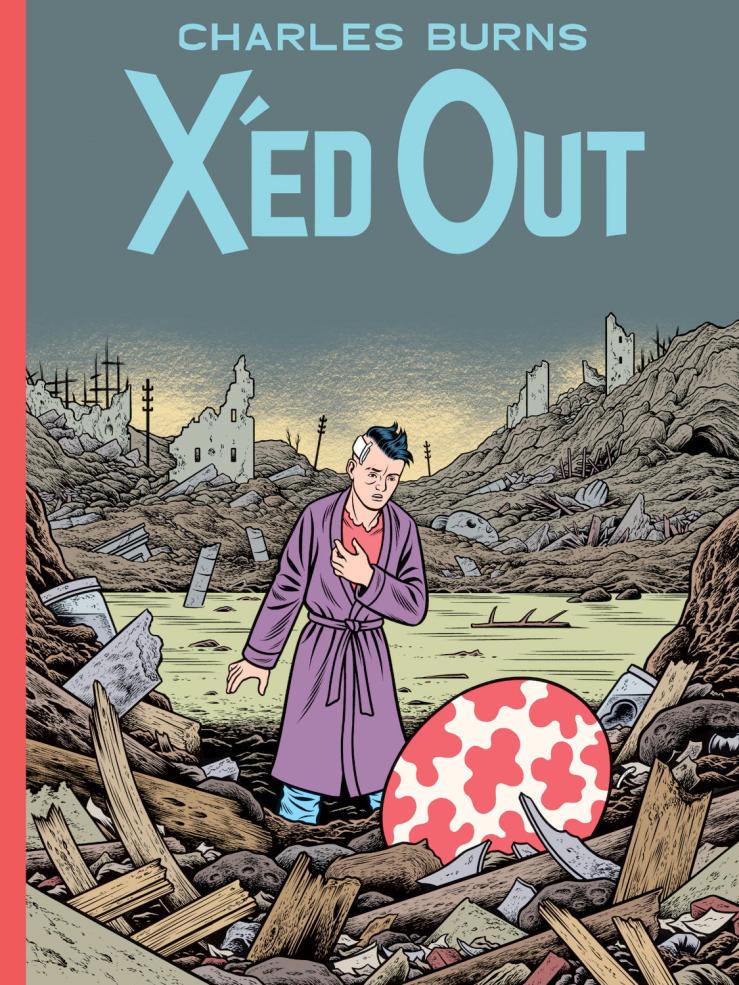
But no. That’s not right. Not “back” — we were never in the waking world to begin with. Significantly, X’ed Out begins in the Burroughsian dreamworld and then moves to a conscious, concrete reality. Burns’s dreamworld sequences explicitly reference Belgian cartoonist Hergé’s seminal Tintin comics (you can see how X’ed Out’s cover riffs on the Tintin adventure The Shooting Star here). Doug’s dream face is an expressive, stark mask, a naïve, cartoonish contrast to the bizarre nightmare to which it reacts.


from X'ed Out by Charles Burns


Doug — the waking world Doug, the “real” Doug, that is — pulls a similar mask over his more realistically drawn face later in the story when he does his “Burroughs thing” at a slummy art punk party. Alienated from the scenesters who don’t get his cut-up poetry performance, Doug takes up with Sarah, a girl from his photography class with a thing for razor blades and pig hearts. The same night they meet, he loses his girlfriend, and her crazy boyfriend goes to jail for assaulting a cop. They initiate their romance in Patti Smith records, lines of cocaine, and sick Polaroids. Ah, young love.

But all of that is in another kind of dreamworld, the past, a retreat for the “real,” contemporary Doug, who spends his few waking hours cringing in his bathrobe, poring over old photos, and eating the occasional Pop Tart. At night he eats pain pills and goes to Interzone-land, a place that seems as real and solid and valid as his past with Sarah, a past he has apparently lost. Doug bears a huge patch over half his head (significantly x-shaped in his Interzone version), and both this wound as well as the psychic trauma he’s obviously endured (and is enduring) remain unexplained throughout X’ed Out. However, Burns’s often-grisly images hint repeatedly at a past event filled with violence and loss. X’ed Out leaves us in the Interzone, with the dwarf making long-term plans for Tintinized Doug. There’s even talk of establishing residency and employment–it feels like Doug is here to stay (at least in his non-waking hours). X’ed Out ends maddeningly with a girl who visually recalls Sarah being borne by lizard men to a giant hive. The dwarf explains that she is their new queen–and like some insect queen, she is a breeder. Yuck. The ending is the biggest problem with X’ed Out, simply because it leaves one stranded, wanting more weirdness.

In Black Hole, Burns established himself as a master illustrator and a gifted storyteller, using severe black and white contrast to evoke that tale’s terrible pain and pathos. X’ed Out appropriately brings rich, complex color to Burns’s method, and the book’s oversized dimensions showcase the art beautifully. This is a gorgeous book, both attractive and repulsive (much like Freud’s concept of “the uncanny,” which is very much at work in Burns’s plot). Like I said at the top, fans of Burns’s comix likely already know they want to read X’ed Out; weirdos who love Burroughs and Ballard and other great ghastly fiction will also wish to take note. Highly recommended.

X’ed Out is available in hardback from Pantheon on October 19th, 2010.

Blood Meridian Contest Winner Announced

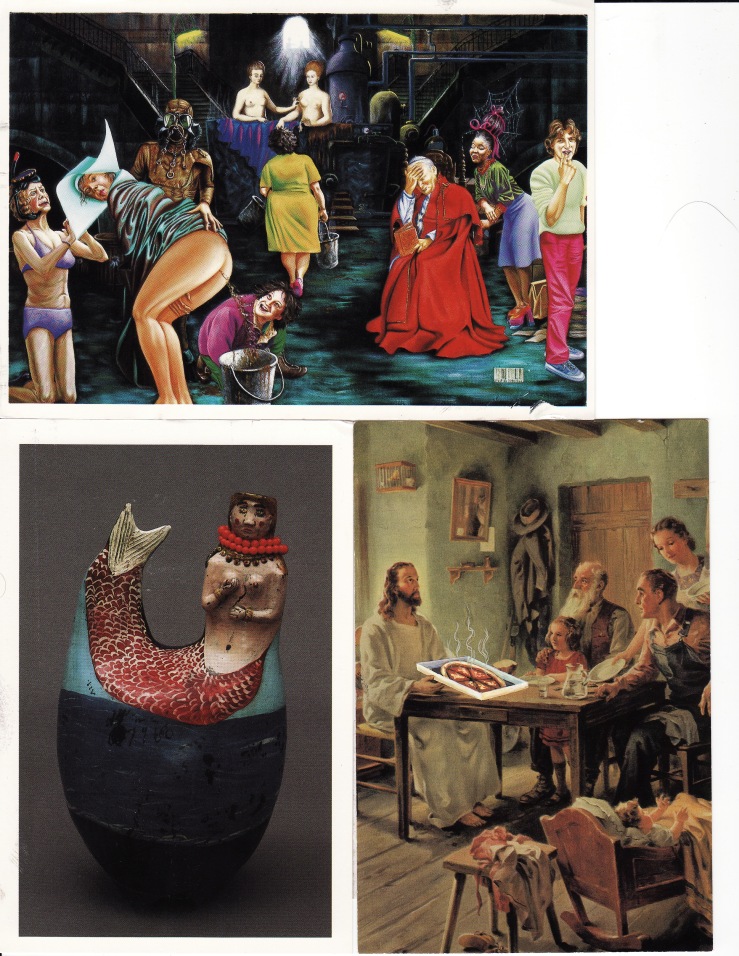
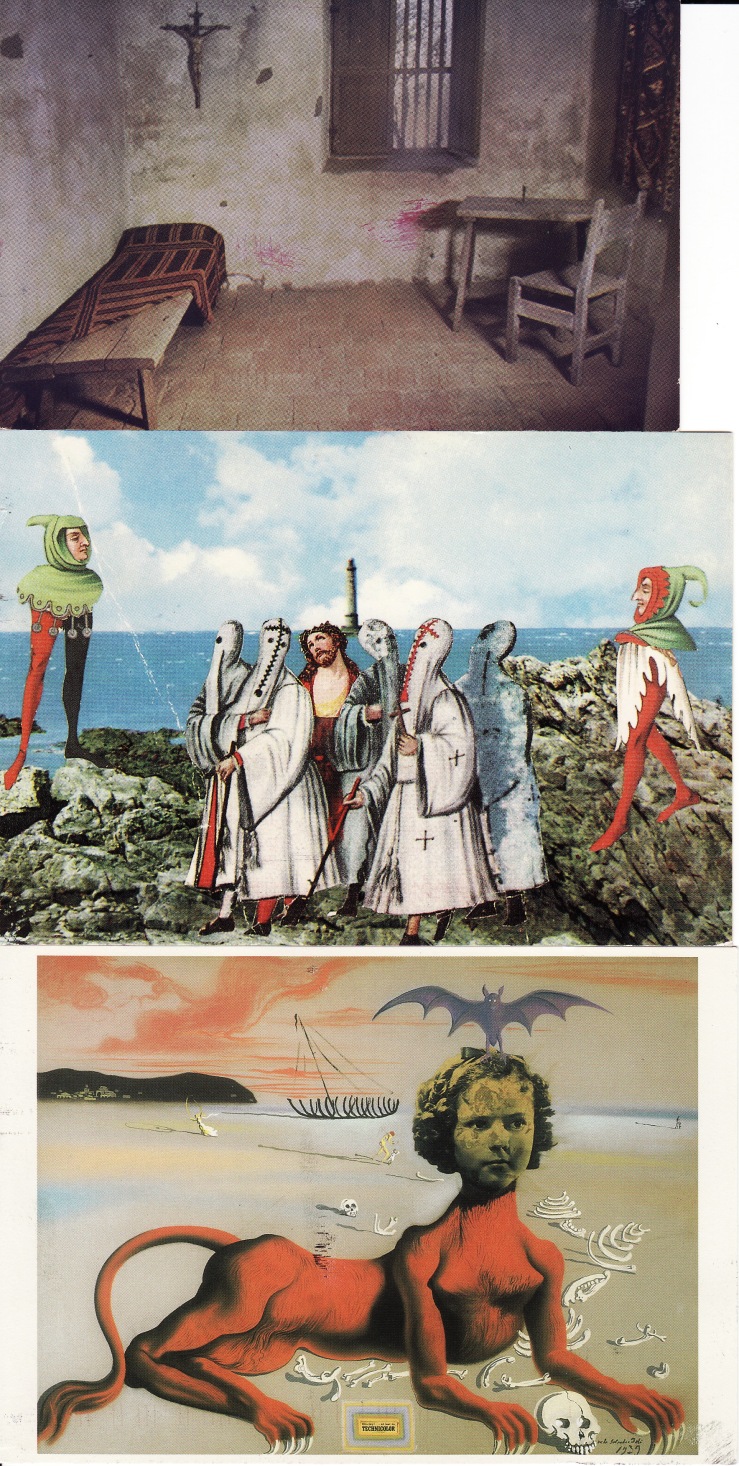
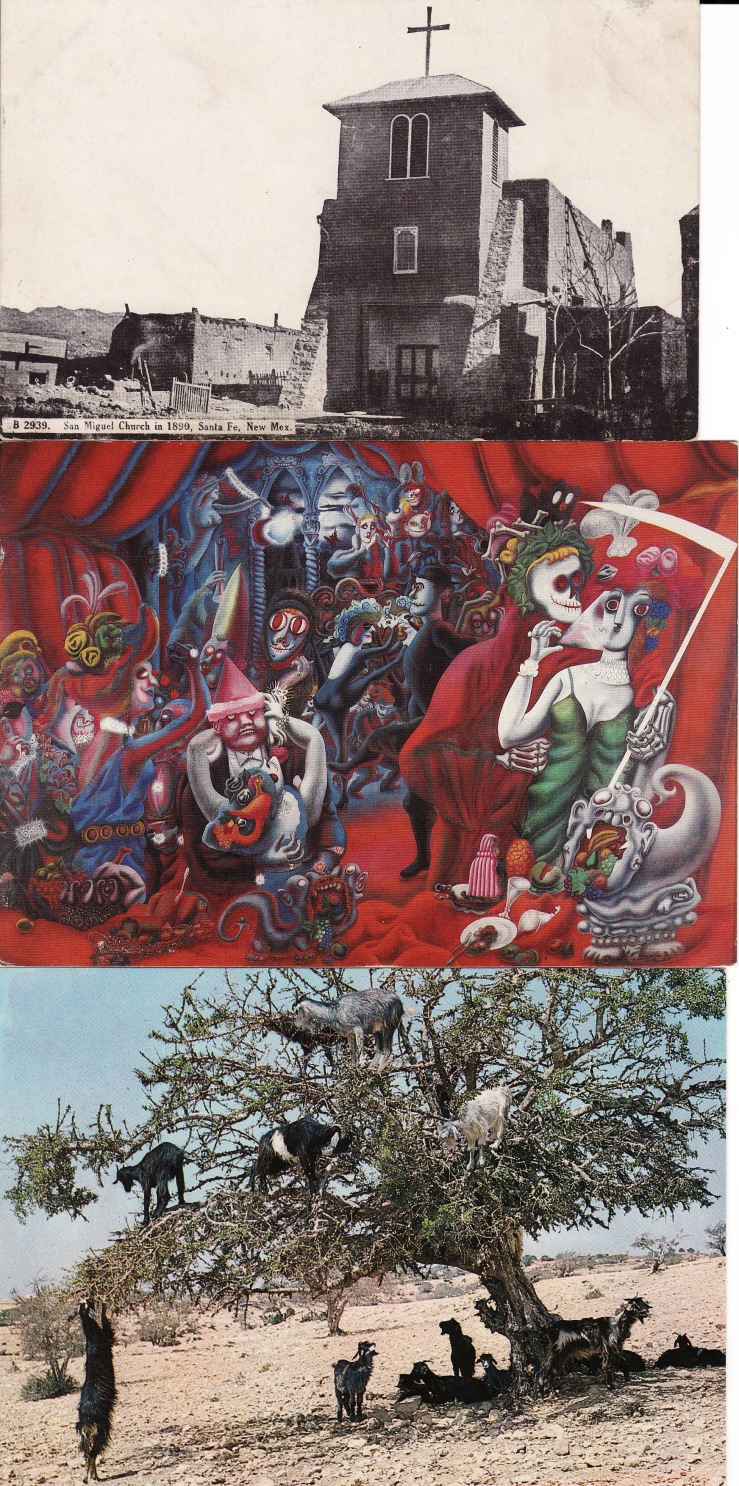
Big congratulations to Michael Cooke, a librarian from Flower Mound, Texas who is the winner of our Blood Meridian contest. Michael will receive a copy of the 25th anniversary hardback edition of Cormac McCarthy’s seminal anti-Western/awesome Western courtesy Biblioklept and Modern Library. Michael had the unfair advantage of being from Texas, and he totally cheated by sending in a baker’s dozen postcards, which was totally awesome. Cheating and being evil is the core of Blood Meridian. Each of Michael’s stark, garish, gritty, surreal, or just plain wicked postcards came with a wonderful corollary quote from the novel. The postcards come from Michael’s personal collection; he’s had some of them for years, and they’re from all over the place, several came from New Mexico, Cormac McCarthy’s chosen home. Here comes the weird–

James Franco and Michael Cunningham on Writing and MFA Programs

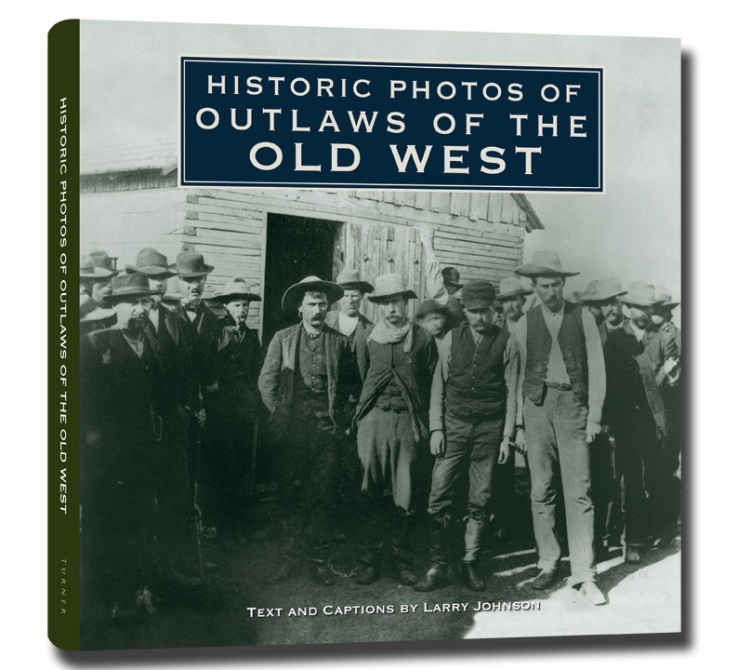
Historic Photos of Outlaws of the Old West

The romantic myth of the Western outlaw still remains central to American identity. If we are part Puritan, we also like to think of ourselves as the kind of anti-social cowboys who go out and manifest our own destiny. It’s no wonder that we have a tradition of valorizing outlaws like Billy the Kid, the Dalton gang, and Frank and Jesse James, transfiguring their bullying and theft into a kind of partisan resistance to hegemony. These men did not steal from the rich to give to the poor, yet we like to pretend that they were Robin Hoods. Turner Publishing’s new collection Historic Photos of Outlaws of the Old West presents 200 archival images of infamous (and not so famous) robbers, road agents, and rascals in the kind of gruesome detail that outlines just how awful these people really were. The Old West isn’t so romantic after all.
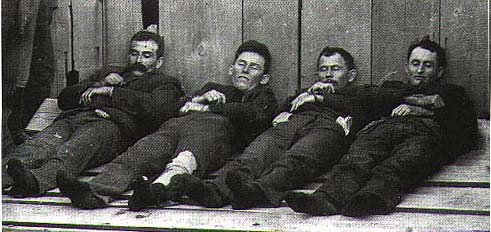
The book moves from the beginning of photography in the early 1850s to the unlikely end of an era, the 193os when the West Coast finally settled down and civilized (at least a little bit). Larry Johnson provides informative and unobtrusive text, letting the stark and often grisly photos convey the tone and emotion of the book. Simply put, this isn’t for kids. There are plenty of dead bodies, many hanging from nooses or laid out in a row, like this charmer of the Dalton gang–

Or how about Ned Christie, unfairly framed for the murder of Deputy Marshal David Maples in 1887, Oklahoma? This picture of Christie reveals that the emerging art/science of photography allowed for a certain fetishizing of the dead body–that the corpse, via mechanical reproduction, might somehow live on. Grisly.

We can see the same fascination with death in this famous image of Jesse James, who was shot in the back by Robert Ford while adjusting a picture. (Their complicated story is told in the brilliant revisionist film The Assassination of Jesse James by the Coward Robert Ford, by the way).

There are less famous but equally intriguing figures as well, like Benjamin Hodges, a black Mexican cowboy who made his living as a con artist in Dodge City. Here is the confident confidence man–

The images in Outlaws of the Old West are both fun and unsettling, and Johnson never glosses over or sugar coats the ugly truths behind these images (he even points out that, though we see the shootout at the OK Corral as a kind of archetypal battle between good vs. evil, the Earps and their pal Doc Holliday were hardly angels). The pictures in this book gel more with the imagery we find in revisionist Westerns like Cormac McCarthy’s Blood Meridian or Sam Peckinpah’s bloody films, which is another way of saying that they aren’t for the faint of heart–and I enjoy that about the volume. Check it out.

“Money” — Lydia Davis

“Money” by Lydia Davis, from Samuel Johnson Is Indignant, collected in the forthcoming volume The Collected Stories of Lydia Davis

I don’t want any more gifts, cards, phone calls, prizes, clothes, friends, letters, books, souvenirs, pets, magazines, land, machines, houses, entertainments, honors, good news, dinners, jewels, vacations, flowers, or telegrams. I just want money.

“Three Figures and a Dog” — Roberto Ransom (A Single Sentence Animation by Andre da Loba)

Andre da Loba animates a sentence from Roberto Ransom’s “Three Figures and a Dog.” Published in Electric Literature No. 4. Here’s the first paragraph–

He liked to be in the chapel at dawn, and also in the afternoon when something similar, though not identical, occurred. For that to happen, he had to leave home when his wife got up to milk the cow. He’d finally wake himself up by putting his hand into the bucket next to the well and wiping his face. He usually carried a loaf of bread, a piece of onion, and sometimes a little cheese, wrapped in a handkerchief. He’d leave his brushes, pencils, paints, and other tools in a corner of the chapel, behind some stones that hadn’t been used during its construction. He didn’t paint at that hour. He was waiting for the right color. He’d observe the sky and mix paints in a small clay vessel, smudging them with his finger, measuring quantities, adding water or oil or, on one occasion, wine. He imagined that if the wine was his blood and the blue of the sky he was seeking was the Virgin’s color, and the Virgin was his mother and if he and the Virgin were of the same blood, then maybe…

Albert Dubout’s Charming Illustrations for Don Quixote

Überblog A Journey Round My Skull has posted (another) fantastic set of illustrations for Don Quixote, this time by French cartoonist and illustrator Albert Dubout. See some of our favorites below, but check out A Journey’s post for more (including a link to all 381 images from the book)–

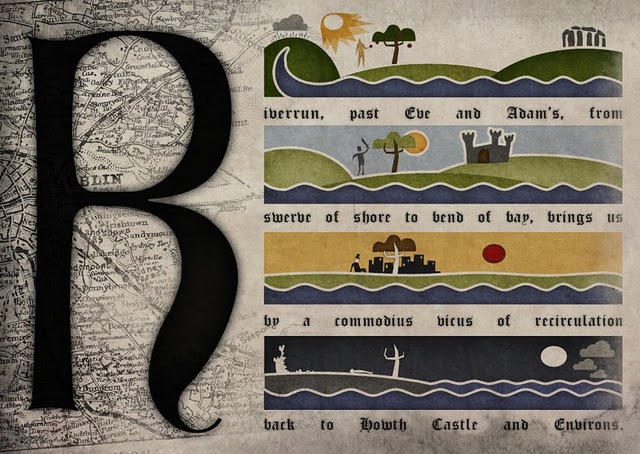
“Riverrun, past Eve and Adam’s” — Stephen Crowe Illustrates Finnegans Wake

First Line - Stephen Crowe

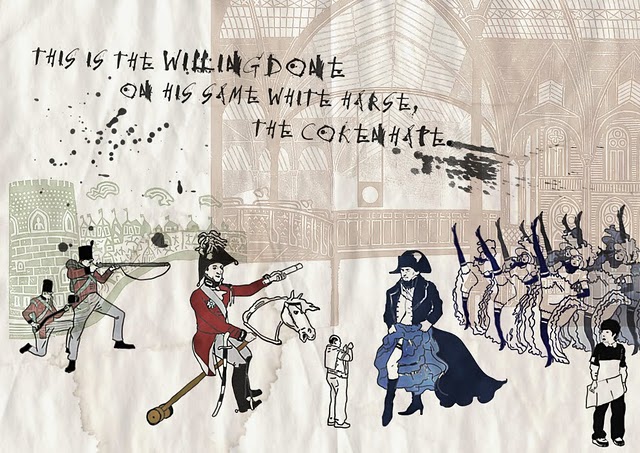
At Wake In Progress, Stephen Crowe has given himself the daunting task of illustrating James Joyce’s novel/linguistic black hole Finnegans Wake. It’s pretty cool stuff, and we love projects like these (see also: Six Versions of Blood Meridian and One Drawing for Every Page of Moby-Dick). Crowe’s site makes an interesting if different companion for the ongoing project at Ulysses “Seen.” Good luck to Stephen–keep them coming! (and thanks to @RhysTranter for sharing). More images–

Page 8 - Stephen Crowe
Page 19 - Stephen Crowe
Page 16 - Stephen Crowe

The Mike Hammer Novels — Mickey Spillane

Online auctions allow book-lovers to engage in what could be labeled “biblio-sharking.”  Some poor sap needs to clear out his basement to make room for a foosball table or a Jacuzzi, and readers take his books for an extraordinary profit. While the seller may hesitate to dispose of their treasures, I’ll readily pay negligible sums to compensate him for his losses.  So, if your rumpus room means more to you than fiction, please please please place your ads on Ebay.

Some poor mug did just that last week, allowing me to take home 18 detective novels for five clams and nominal shipping and handling charges.  Because anthologies were included in the package, I scored twenty-four books for about thirty cents apiece.  Ed Biblioklept, kept busy for weeks at a time supervising hooligans and future delinquents of America, has granted me permission to review one of my purchases, the New American Library’s collection of Mickey Spillane’s first three Mike Hammer novelsI, the Jury, My Gun is Quick, and Vengeance is Mine.

Spillane sold hundreds of millions of detective and spy stories during a long career, and the Hammer stories guaranteed him an interested and rabid following.  Although private dick Mike Hammer finds himself in any number of slippery situations, Spillane’s central character, rather than any individual plot twist, is what makes these stories both convincing and compelling.
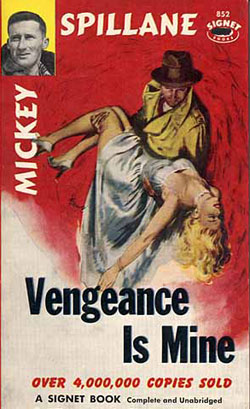
Hammer is the archetypal square-jawed detective, but he demands that you listen to his recollections of a case because he’s clever, resourceful, and vulgar. Although indelicate by today’s standards, Hammer is a tough guy for his times, beguiling dames who are used to getting just what they want, burning through decks of unfiltered Luckies, and drinking brandy for breakfast.  What’s timeless, though, is his belief that bad guys are afforded too many protections by an impotent system of justice and that once all the pieces are put together, one extraordinary man performs a public service by putting a few slugs in the guts of murderers.  In each of these stories Hammer begins unraveling the mysteries only after someone close to him has been killed.

This was the first collection of detective stories I’ve ever finished, and each page dragged me further into a black and white world filled with villains, vixens, and corrupt politicians.  The reader becomes an unpaid extra in a B-level film noir.

Hammer explained to me, a snob, the enduring popularity of the literary detective: “You’ve forgotten that I’ve been in business because I stayed alive longer than some guys who didn’t want me that way.  You’ve forgotten that I’ve had some punks tougher than you’ll ever be on the end of a gun and I pulled the trigger just to watch their expressions change.”  Mind what you think.

Howard Jacobson’s The Finkler Question Wins the Booker Prize

The Guardian and other sources report that Howard Jacobson has won the 2010 Man Booker Prize for his novel The Finkler Question. The novel, which we haven’t read, is apparently a comic piece about love, loss, Jewish identity, and male friendship. The win is perhaps something as an upset, as many folks had Tom McCarthy’s C pegged as the favorite (last week bookmaker Ladbrokes even suspended betting on the Booker after bets on C crowded out the competition). Read our review of C here.

Uncivil Society — Stephen Kotkin

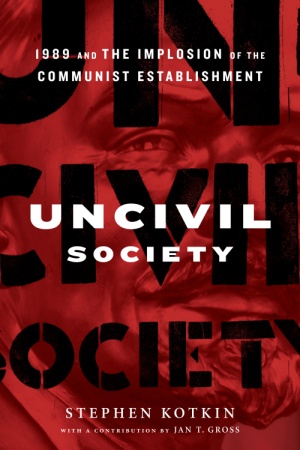
Stephen Kotkin’s Uncivil Society earned rave reviews when it debuted last year in hardback; this week Modern Library releases the trade paperback version. Uncivil Society is a revisionist history that dispels the romantic myth that a “civil society” of dissenting citizens orchestrated the fall of Eastern European Communism (and its symbol, the Berlin Wall). Rather, Kotkin (along with colleague Jan T. Gross) concisely and methodically shows that the Eastern Bloc’s demise resulted from the corruption and incompetence of the ruling class of bureaucrats and ideologues–the “uncivil society” who borrowed massively from the West to buy consumer goods they could not afford. Kotkin finds case studies in East Germany, Romania, and Poland, but his analysis extends beyond these countries to indict the Soviet model.
Kotkin’s writing is direct and precise, stuffed with concrete facts and political analysis without sacrificing narrative integrity. In other words, he takes a murky subject and illuminates it. The narrative proper is slim at under 150 pages, making the book a quick and ideal survey of a widely misunderstood time. Students and politics of history will wish to take note of Uncivil Society, a straightforward and agile read.

“By the Mouth for the Ear” — William Gass on Good Writing

More from The Paris Review’s vaults. In an interview from 1977, William Gass weighs in on the oral/aural aspects of literature–

I think contemporary fiction is divided between those who are still writing performatively and those who are not. Writing for voice, in which you imagine a performance in the auditory sense going on, is traditional and old-fashioned and dying. The new mode is not performative and not auditory. It’s destined for the printed page, and you are really supposed to read it the way they teach you to read in speed-reading. You are supposed to crisscross the page with your eye, getting references and gists; you are supposed to see it flowing on the page, and not sound it in the head. If you do sound it, it is so bad you can hardly proceed. It can’t all have been written by Dreiser, but it sounds like it. Gravity’s Rainbow was written for print, J.R. was written by the mouth for the ear. By the mouth for the ear: that’s the way I’d like to write. I can still admire the other—the way I admire surgeons, bronc busters, and tight ends. As writing, it is that foreign to me.

See Banksy’s Opening Sequence for The Simpsons

In case you missed it: Last night’s episode of The Simpsons featured an intro directed by graffiti artist Banksy. The intro is a fairly grim, mostly unfunny satire of the how cheap South Korean and Chinese labor is used to produce The Simpsons animation and merchandise. Observe–

The Sopranos Debate Christopher Columbus’s Cultural Legacy (NSFW)

Also, Howard Zinn on Columbus Day.

Three Literary Lists for 10-10-10

You may have noticed (and probably don’t care) that today is October 10, 2010, 0r 10/10/10 (or 10.10.10, or 10-10-10, or whatever iteration you prefer). But some people like lists. So, with very little thought put into the process, here are three literary lists to celebrate 10 Oct. 10–

Ten Ridiculous Character Names

1. Stephen Dedalus (A Portrait of the Artist as a Young Man and Ulysses, James Joyce. Even Stephen ponders how ridiculous and overdetermined his name is)

2. Major Major Major Major (Catch-22, Joseph Heller)

3. Bilbo Baggins (The Hobbit and The Lord of the Rings, J.R.R. Tolkien. Sure, he’s a hobbit, but “Bilbo Baggins” is still pretty much off the silly scale)

4. Brackett Omensetter (Omensetter’s Luck, William Gass)

5. Horselover Fat (VALIS, Philip K. Dick)

6. Milkman Dead (Song of Solomon, Toni Morrison)

7. Humbert Humbert (Lolita, Vladimir Nabokov)

8. Lionel Essrog (Motherless Brooklyn, Jonathan Lethem)

9. Tie:  Wang-Dang Lang/Peter Abbott/Candy Mandible/Judith Prietht/Biff Diggerance (David Foster Wallace suffers from Pynchon-fever in his début novel, Broom of the System)

10. Tie: Benny Profane/Oedipa Maas/Tyrone Slothrop/Zoyd Wheeler/Rev. Wicks Cherrycoke et al. — (Various novels by Thomas Pynchon. Yes, Pynchon should probably get his own list)

Ten Excellent Dystopian/Post-apocalyptic Novels That Aren’t Brave New World or 1984

1. Riddley Walker, Russell Hoban

2. Camp Concentration, Thomas Disch

3. A Clockwork Orange, Anthony Burgess

4. Oryx and Crake and The Year of the Flood, Margaret Atwood

5. The Hospital Ship, Martin Bax

6. Naked Lunch, William S. Burroughs

7. VALIS, Philip K. Dick

8. Ronin, Frank Miller

9. Ape and Essence, Aldous Huxley

10. The Road and Blood Meridian, Cormac McCarthy

Ten Movies Better Than or Equal to the Books On Which They Were Based

1. The Godfather

2. The Shining

3. The Thin Red Line

4. Children of Men

5. Harry Potter and the Prisoner of Azkaban

6. Trainspotting

7. No Country for Old Men

8. The Grapes of Wrath

9. There Will Be Blood

10. Jaws

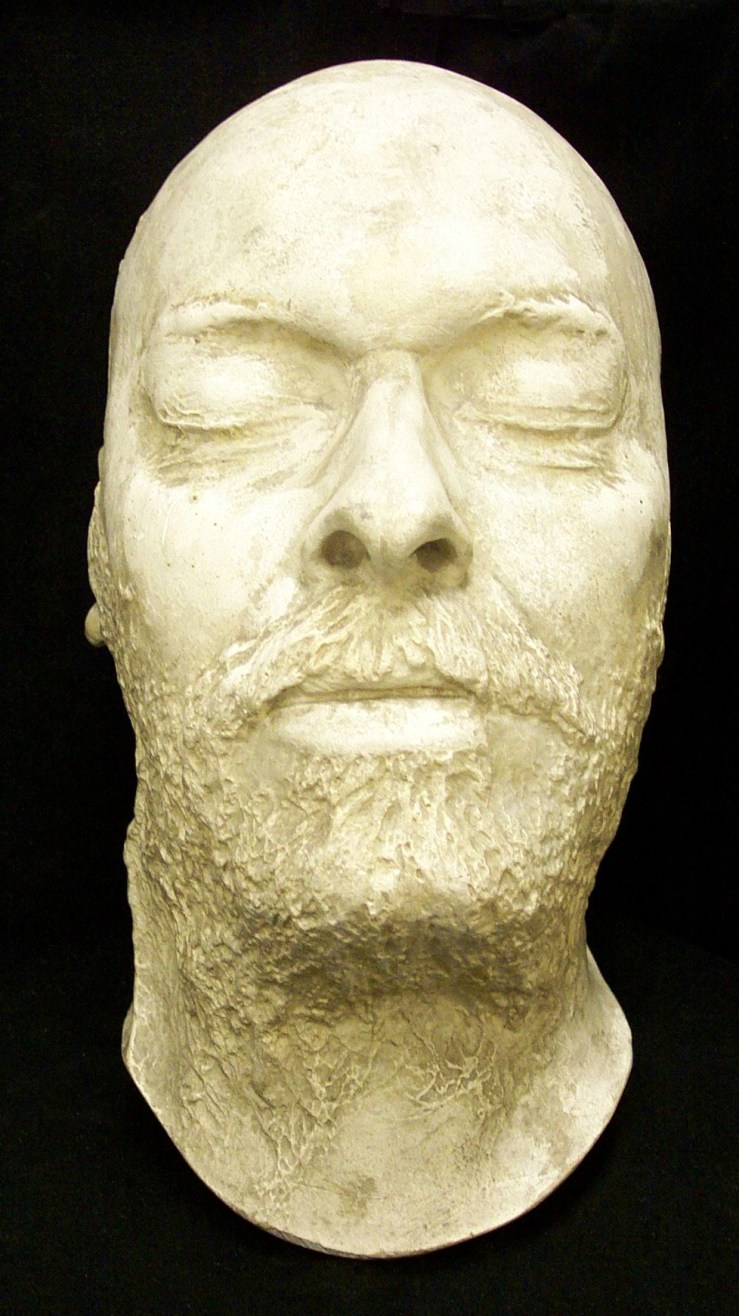
Dante Gabriel Rossetti’s Death Mask

William Burroughs Shoots William Shakespeare