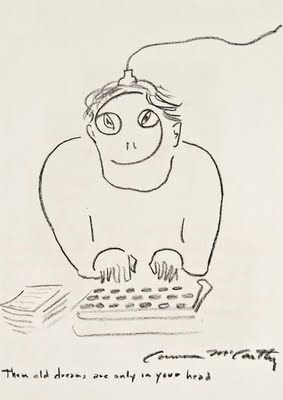
From Burt Britton’s collection of self-portraits, um, Self-portrait. McSweeney’s 34 has taken the work as inspiration. See a full gallery here, including portraits from Jorge Luis Borges, Maurice Sendak, and Margaret Atwood, among others. This goofy Cormac McCarthy self-portrait is priceless, especially from a guy famous for images of trees hanging with dead babies.
Stéphane Massa-Bidal (aka Hulk4598, aka Rétrofuturs) created these fantastic “book covers” for internet services late last year, so you might’ve already seen them; anyway, they fit nicely into Biblioklept’s Book Covers Week. Massa-Bidal’s images of familiar web two point oh apps masquerading as book covers remind us that book covers are their own special medium, and that we perhaps read the information in book covers in its own special way, regardless of whether the book actually exists or not (or, in this case, exists as something other than a book. See also: Spacesick’s “I Can Read Movies” Series).
Got an hour to kill? Lose yourself in the surreal world of French artist Moebius (Jean Giraud) at this cool little gallery. Moebius’s art taps into the mythological, exploring themes that seem at once both strangely familiar but also wildly divergent from our expectations. We love his pictures best when there are no cartoon speech bubbles imposing language on the scene; far better to engage him in his projects of imagination. Great stuff.
So, I’m on my fourth trip through Herman Melville’s masterpiece, Moby-Dick, courtesy of an excellent unabridged audio version read with aplomb, gusto, humor, and great pathos by the late character-actor William Hootkins. I’ll’ go out on a limb and suggest that Hootkins’s reading is so nuanced and attuned to Ishmael’s voice and Melville’s purpose that it would make a great starting point for anyone (unnecessarily) daunted by Melville’s big book.
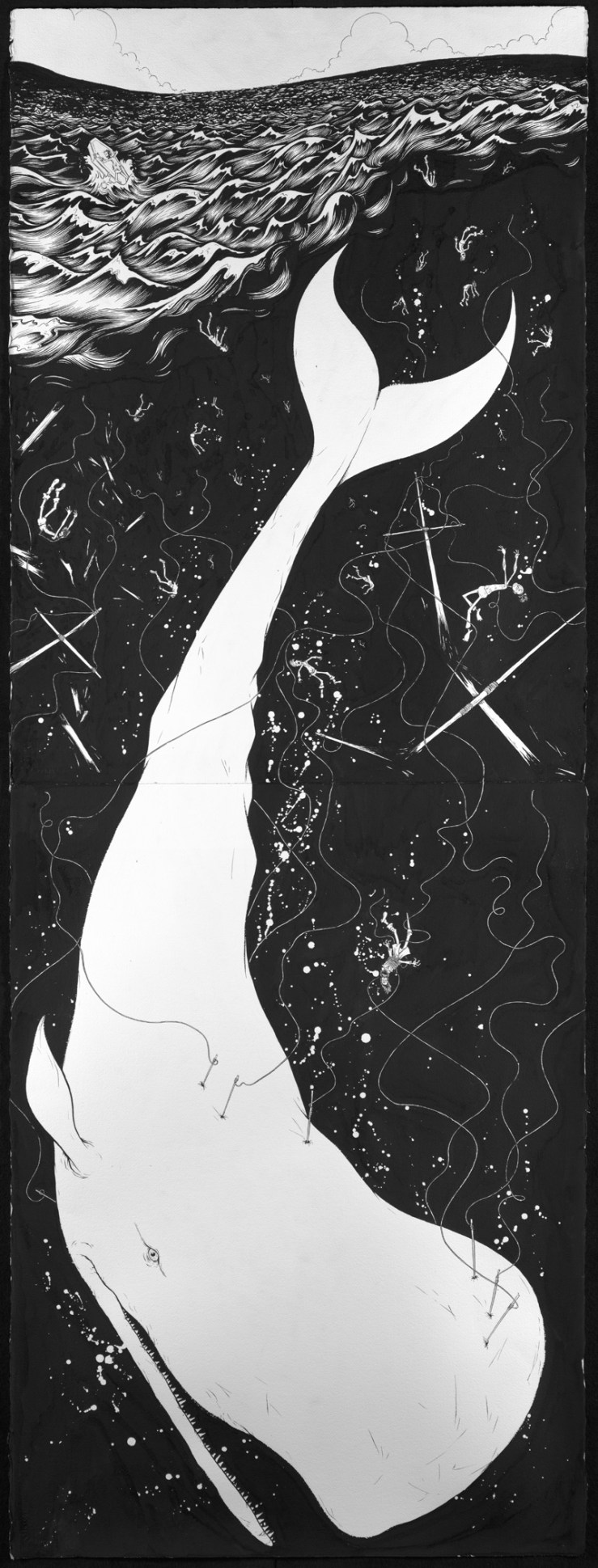
I’ve been enjoying the book more than ever this time, in part because, knowing its themes, plot, and tone, I can relax a bit more and enjoy its nuance and humor, its weird little nooks and crannies. I’m also really digging Matt Kish’s mixed-media illustrations for the book. Kish is illustrating each page of his 552 page Signet Classics Edition–the same edition I used for a graduate seminar years ago. Kish’s art is fresh, fun, and invigorating; it’s also quite thoughtful in its interpretation of Melville’s text, and never fussy. You can check out an easy-to-use visual index here, or visit his blog here.
Page 046 : "...and from the shuddering cold and blackness of the sea, the whale came breeching up
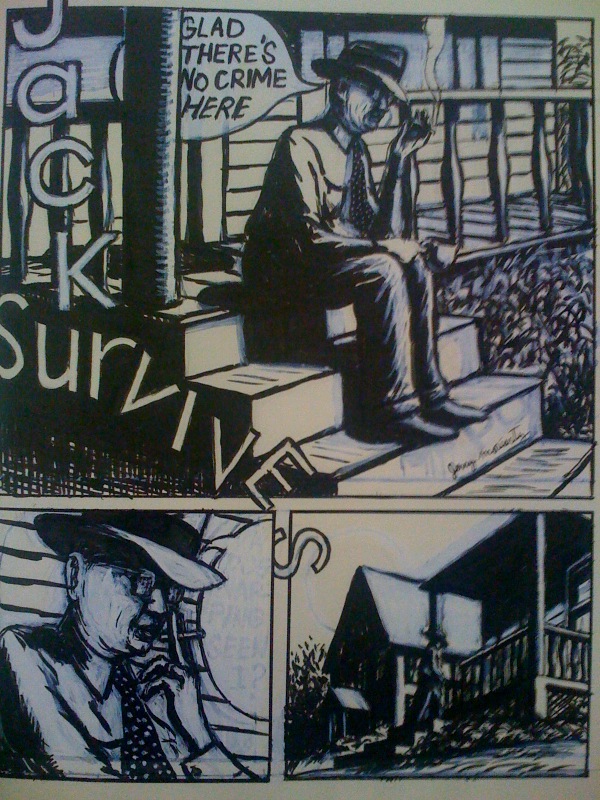
The Beilever’s 2009 Art Issue came in the mail today. It’s got cool interview between Chris Ware and Jerry Moriarty. A large poster of one of Moriarty’s painting comes with issue, which also prints several of the “paintoonist’s” works. But not this one:
Jerry Moriarty
Image via Molossus, where you can read an insightful review of Moriarty’s collection, The Complete Jack Survives.
The new Believer also features an interview with Aline Kominsky-Crumb, as well as some of her images. But not this one:
Aline Kominsky-Crumb
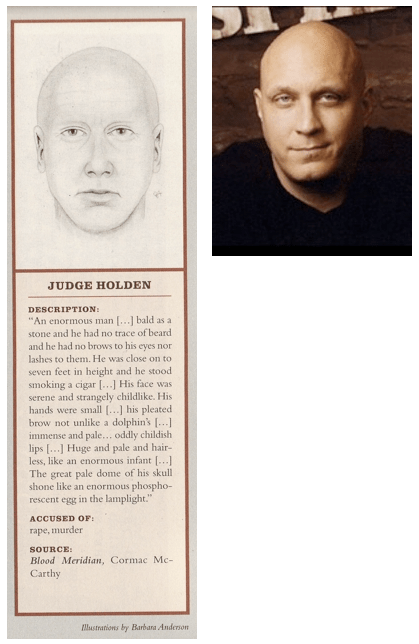
There’s also a pretty cool rogue’s gallery of of famous literary criminals. Forensic artist (y’know, a police sketch-artist) Barbara Anderson recreates eight criminals based solely on literary description. The list includes Oliver Twist’s Fagin, who looks like some dark-elf pedophile, Crime and Punishment’s Raskolnikov, that irascible pedophile Humbert Humbert, and, surprisingly, master forger Wyatt Gwyon, erstwhile hero of William Gaddis’s The Recognitions. One of our all-time favorite baddies is also there, although we really didn’t imagine Blood Meridian‘sJudge Holden would look look like Steve from The Jerry Springer Show:
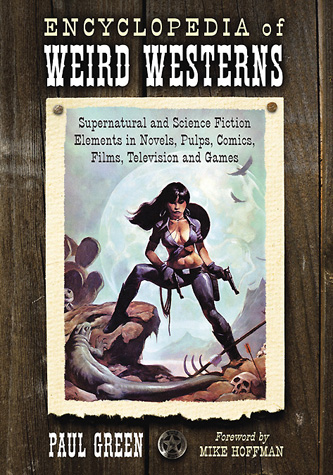
In the preface to his Encyclopedia of Weird Westerns, Paul Green gives us the following definition:
Weird Western
A Western story incorporating horror, supernatural or fantasy elements and themes and usually including one or more of the following subjects: vampires, werewolves, mummies, man-made monsters, mythological beings, mutants, zombies, ghosts, haunted buildings, demons, witchcraft, Satanism, possession, demonic or possessed animals, mentalists, shamans, visions, restless or wandering spirits, damned souls, enchantment, shape-shifters, angels, goblins, faeries, sirens, flying horses, psychopathic killers, psychological terror, dismembered moving body parts, spirit guides, the occult, hexes and curses, rising from the dead, talking animals, superhuman abilities, and magical potions.
This fun, hyperbolic list would seem to be enough to cover all possible entries in Green’s almanac of Western weirdness, yet his preface goes on to catalog and define the Weird Menace Western genre (popular in the 1930s), Science Fiction Westerns, Space Westerns, Steampunk Westerns, and even Weird Western Romance. Over the course of about 250 pages, Green attempts to catalog 0ver a 100 years of Weird Western stories, novels, pulps, radio shows, films, TV shows, RPGs and video games. And comic books. Lots and lots of comic books.
You probably know more Weird Westerns than might immediately come to mind. Green hits on examples that have had great mainstream success like Stephen King’s Gunslinger series, the old Kung Fu TV series, and Westworld. He also extends his entries to cover the many forays TV shows and comic books take into the Western Genre, from Star Trek: The Next Generation to MacGyver. Green even contends that Star Wars is a Space Western.
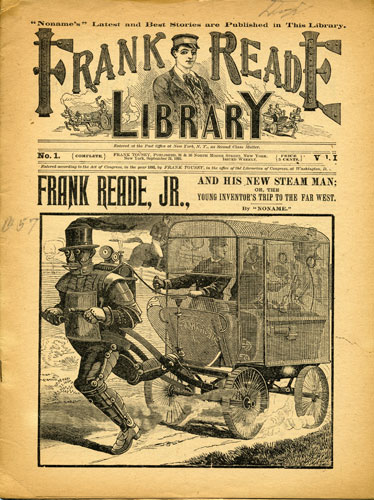
There’s mention of some of our favorite Westerns, like Cormac McCarthy’s Blood Meridian, Jim Jarmusch’s Dead Man, and Alejandro Jodorowsky’s El Topo, as well as the salient recognition that William Burroughsis a writer of Westerns. But for every comic or film or movie or TV show we’ve heard of, like Jonah Hex or The Adventures of Brisco County, Jr., there seem to be at least a dozen bizarre counterparts. How did we not know of the late-nineteenth century steampunk dime novels featuring hero Frank Reade (and either his Steam Man or Steam Horse)? Reade is such an oddity because it’s steampunk contemporaneous with its own setting–which sorta kinda makes it not steampunk but maybe kinda imaginative fiction. Or something. In any case, it’s intriguing.
If we hadn’t read Green’s Encyclopedia, we also wouldn’t have any knowledge of Gene Autry’s 1935 space opera film serial, The Phantom Empire. The twelve-parter apparently features Autry as a singing cowboy who has to save his Radio Ranch when speculators want to buy up the supply of Muranian radium under his property. Did we forget to add that the ancient civilization of Mu lives under Radio Ranch?
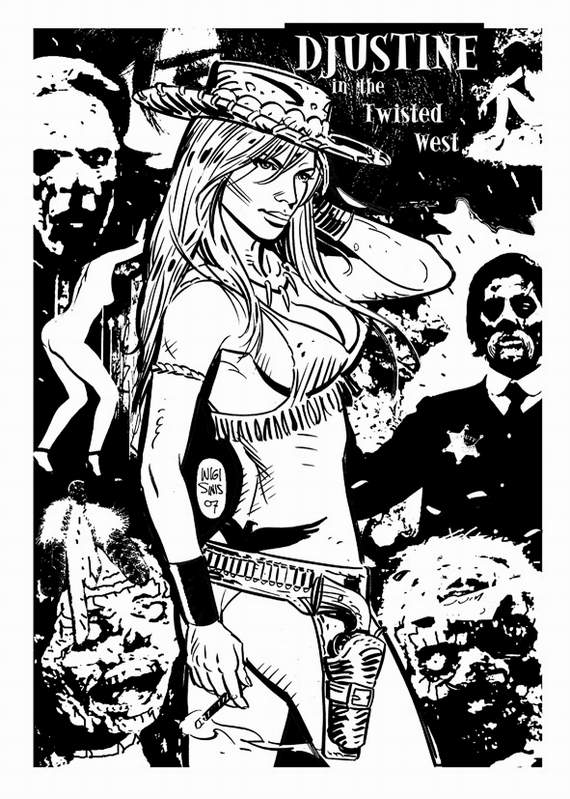
We also, somehow, were previously unaware of the Djustine comics before Green sought to correct this oversight by including two whole pages of images of the buxom lass. His description: “The sexually graphic adventures of the large-breasted female gunslinger Djustine and her fight with the supernatural, including zombies, vampires, and Diabla, daughter of Satan.” You had us at sexually graphic.
Okay, so we’re probably not going to go stock up on back issues of Djustine (it’s in Italian anyway . . . we swear we’re only interested in the tight-plotting!) . . . But most of the fun of Encyclopedia of Weird Western is simply in all the bizarre descriptions and images, of which there are plenty. I’m not an aficionado, so I can’t testify to the depth or analytic penetration of Green’s catalog, but I do know that I enjoy browsing through the book’s welcome weirdness. It’s a great entry point to any number of strange Google searches. And it’s also got me hunting for a torrent of the 1977 film, Welcome to Blood City.
You probably know by now whether or not any of this is up your alley. We’re digging it. Encyclopedia of Weird Westerns is now available from McFarland.
David Byrne’s new book, Bicycle Diaries (new in hardback from Viking),is an engaging, discursive, and often meditative memoir about the Talking Heads founder’s strange experiences bicycling through some of the world’s most distinct cities. Byrne uses W.G. Sebald’s The Rings of Saturn(one of our favorite books) as an entry point for his book. Like Sebald, Byrne attempts to synthesize history, memory, art, architecture, philosophy, science, and a host of other subjects in his writings on cities like Berlin, London, Manila, Istanbul, and San Francisco. The result is a book that is profound and very readable; Byrne communicates complex ideas in ways that are both fun to read and also highly relevant to an age of changing attitudes about how we are to get where we are going.
While hardly a political screed, Bicycle Diaries does contain a central argument: plainly put, Byrne suggests that cities that are bicycle-friendly tend to be more human-friendly, and that the modern/industrial reliance on cars and trucks has resulted in fundamental disconnects between people and their communities. In the first chapter, “American Cities,” Byrne surveys a number of decidedly unglamorous American cities like Pittsburgh, Baltimore, and Columbus, as well as smaller towns like Sweetwater, Texas. Byrne’s discussion of Detroit is particularly affecting. From the vantage of his bicycle, Byrne sees a Detroit most will miss, a place of modern ruins and decay. “In a car, one would have sought out a freeway, one of the notorious concrete arteries, and would never have seen any of this stuff,” Byrne writes. “Riding for hours right next to it was visceral and heartbreaking–in ways that looking at ancient ruins aren’t. I recommend it.”
Byrne repeatedly communicates this will to immediacy, for unmediated experiences in Bicycle Diaries. He’s the explorer of the real, trying to understand why folks don’t ride bikes in Buenos Aires, or trying to figure out the cultural significance of Imelda Marcos to the people of the Philippines, or pondering the brutal fauna of Australia. Byrne’s bike rides, as well as his music and art careers, give the book something like a center, but Bicycle Diaries thrives on digressions, asides on ring tones or the Stasi or amateur backyard wrestling or the history of PowerPoint. We loved these moments: it’s when Byrne relates the sad history of George Eastman, founder of Kodak, or when he tells the story of Australian outlaw legend Ned Kelly that Byrne best communicates the thrill of exploration.
Byrne’s voice is ever-earnest and never didactic. There’s a plainness and honesty to his delivery that often seems in direct contrast with the content of his message. And this is the key to the book’s success–and perhaps, more generally speaking, Byrne’s career–this ability to see, to suspend the biases and blocks and filters that too often mediate our perception, and to actually see what is actually around us. From his earliest days in the Talking Heads, Byrne displayed an uncanny knack for turning his eyes on his own culture like an alien ethnographer, yet he always did it with empathy and engagement, and never with smack of clinical remove that might otherwise characterize such a project. In Bicycle Diaries, Byrne approaches America’s reliance on roads and oil and cars with an admirable pragmatism. Where some might scold (and, implicitly, ride a high horse), Byrne is always positive, pointing out the numerous advantages of returning to a community-oriented way of life, with bicycling as a simple and efficient means of getting around in lieu of the cars–and attendant urban/suburban/exurban sprawl–that keep us separated. Byrne also suggests a number of ways that communities and cities can work toward making bicycling a more viable option for their citizens. He even provides a few fun bicycle rack designs for his hometown New York (and yes, they got made).
Finally, we’d be remiss if we didn’t mention that the book itself is a beautiful aesthetic object. Why don’t more publishers skip those annoying, flimsy dust jackets, and opt instead for something like Bicycle Diaries lovely embossed cloth deal? Just a thought. There are lots and lots of black and white photographs, many by Byrne himself, that genuinely shed light on Byrne’s narrative (the design here is of course reminiscent of Sebald’s use of photographs, only Byrne’s aren’t cryptic and actually make sense in the text). It’s great to love both the content and the design of a book, but we’d really expect nothing less from Byrne. It’s also great when a hero of ours lives up to and then surpasses our expectations–we’ve always loved Byrne’s music and his ideas, so it’s great that we can add books to that list. Highly recommended.
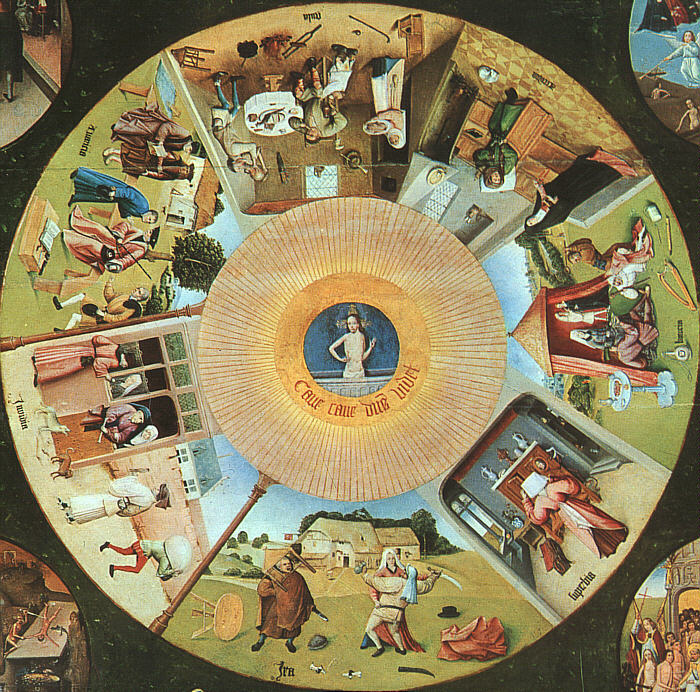
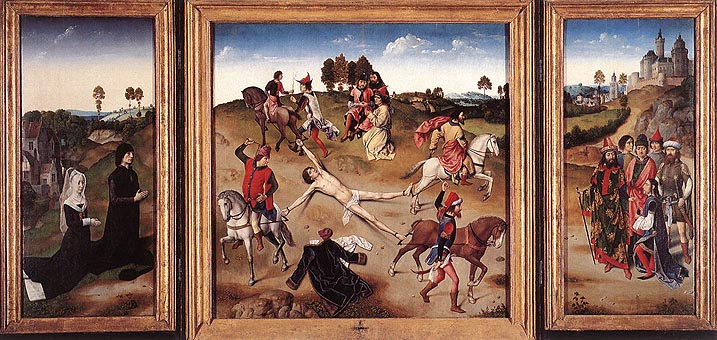
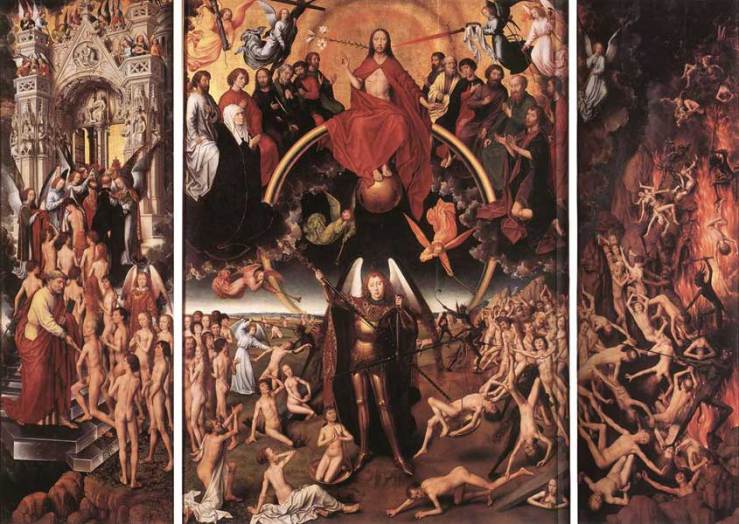
In William Gaddis‘s massive first novel, The Recognitions, Wyatt Gwyon forges paintings by master artists like Hieronymous Bosch, Hugo van der Goes, and Hans Memling. To be more accurate, Wyatt creates new paintings that perfectly replicate not just the style of the old masters, but also the spirit. After aging the pictures, he forges the artist’s signature, and at that point, the painting is no longer an original by Wyatt, but a “new” old original by a long-dead genius. The paintings of the particular artists that Wyatt counterfeits are instructive in understanding, or at least in hoping to understand how The Recognitions works. The paintings of Bosch, Memling, or Dierick Bouts function as highly-allusive tableaux, semiotic constructions that wed religion and mythology to art, genius, and a certain spectacular horror, and, as such, resist any hope of a complete and thorough analysis. Can you imagine, for example, trying to catalog and explain all of the discrete images in Bosch’s triptych, The Garden of Earthly Delights? And then, after creating such a catalog, explaining the intricate relationships between the different parts? You couldn’t, and Gaddis’s novel is the same way. I’ve finished the first of the novel’s three parts, 277 of 956 pages, and I’m going to go out on a limb and guess that the Gaddis has structured the novel as a triptych. The first part, like Bosch’s painting, The Seven Deadly Sins, is comprised of seven sections.
The Seven Deadly Sins – Hieronymous Bosch
Early in The Recognitions, teenage Wyatt copies The Seven Deadly Sins–his father owns the original, a painted table top he purchased in Europe. Wyatt replaces the original with his own and gets away with this strange crime–no small feat considering the genius of his father, the Rev. Gwyon, a New England priest who, after the death of his wife at sea, comes to reject the austere puritanism of his order and embrace (much to the consternation of his dwindling congregation) a pluralistic religious world view. In one of many stunning passages centering on Gwyon and religion, the congregation is “stirred with indignant discomfort after listening to the familiar story of virgin birth on December twenty-fifth, mutilation and resurrection, to find they had been attending, not Christ, but Bacchus, Osiris, Krishna, Buddha, Adonis, Marduk, Balder, Attis, Amphion, or Quetzalcoatl.” This series of substitutions enacts a chain of recognitions, and, in a sense, compartmentalizes much of the thematic material of the novel: What is it to be a hero, a redeemer, a savior? What is originality, and how does one recognize it? Who originates whom? What does it mean to create? How is art separate from religion? Clearly, these are not simple questions, and The Recognitions is not a simple book.
Triptych with the Martyrdom of St. Hippolytus — Dierck Bouts and Hugo van der Goes
In order to pose (and perhaps offer varying answers to) these questions, Gaddis employs daring, richly detailed prose, larded with esoteric (and not so esoteric) references to mythology, religion, art, music, and literature. Like the discrete sections of Bosch’s Sins, each of the chapters of the first section of The Recognitions has its own distinct idiom, comportment, and rhythm; yet, even as Gaddis’s approaches seem discontinuous from chapter to chapter, these coalesce to a larger picture.
The first chapter is the best first chapter of any book I can remember reading in recent years. It tells the story of Rev. Gwyon looking for solace in the Catholic monasteries of Spain after his wife’s death at sea under the clumsy hands of a fugitive counterfeiter posing as a doctor (already, the book posits the inherent dangers of forgery, even as it complicates those dangers by asking who isn’t in some sense a phony). There’s a beautiful line Gaddis treads in the first chapter between pain, despair, and melancholy and caustic humor, as Gwyon slowly realizes the false limits of his religion. The chapter continues to tell the story of young Wyatt, growing up under the stern care of his puritanical Aunt May, whose religious attitude is confounded by the increasingly erratic behavior of Wyatt’s often-absent father. While deathly ill, Wyatt teaches himself to paint by copying masterworks. He also attempts an original, a painting of his dead mother, but he cannot bear to finish it because, as he tells his father, “There’s something about . . . an unfinished piece of work . . . Where perfection is still possible. Because it’s there, it’s there all the time, all the time you work trying to uncover it.” This problem of originality, of Platonic perfection guides much of the novel’s critique on Modernism.
The Last Judgment – Hans Memling
Wyatt studies but ultimately rejects the ministry, opting instead to become an artist. The second chapter finds him in Paris, attempting to sell his original work. The chapter is a bravura shift into the sounds, sights, and consciousness of another world, another distinct mythology–ex-patriot Paris, Hemingway’s Paris, Woolf’s Paris. Gaddis shows a heavy debt to James Joyce‘s innovations in Ulysses here (and throughout the book, of course), although it would be a mistake to reduce the novel to a mere aping of that great work. Rather, The Recognitions seems to continue that High Modernist project, and, arguably, connect it to the (post)modern work of Pynchon, DeLillo, and David Foster Wallace. (In it’s heavy erudition, numerous allusions, and complex voices, the novel readily recalls both W.G. Sebald and Roberto Bolaño as far as I’m concerned). By the third chapter we find Wyatt married, quite unhappily, producing hack work, copies he lets his boss put his name on. The chapter is painful and often ugly, as we see his marriage disintegrate. In this chapter he meets Recktall Brown, the Mephistophelean business man who will arrange Wyatt’s future career as a counterfeiter of original paintings. As the chapter ends, Wyatt is no longer referred to by his name, a device that continues throughout the rest of part one (and perhaps the whole book). It’s as if he’s lost something intrinsic, some core originality in exchange for the ability to “become” the artist he is emulating. Wyatt now disintegrates into the background of the narrative, and is exchanged for a young Harvard grad named Otto. Otto follows Wyatt around like a puppy, writing down whatever he says, absorbing whatever he can from him, and eventually sleeping with his wife. Otto is the worst kind of poseur; he travels to Central America to finish his play only to lend the mediocre (at best) work some authenticity, or at least buzz. He fakes an injury and cultivates a wild appearance he hopes will give him artistic mystique among the Bohemian Greenwich Villagers he hopes to impress. In the fifth chapter, at an art-party, Otto, and the reader, learn quickly that no one cares about his play–everyone’s busy making their own original art. Gaddis’s evocation of a Village party in the late forties/early fifties here is wonderful, fly-on-the-wall stuff. His rhetoric captures the buzzing musicality of a raucous house party, and even if his mockery of the assembled artists, critics, and wannabes is savage, it’s also loving. Gaddis has an astute ear for the mid-twentieth century, where gossip infiltrates debate on aesthetics, and commercials punctuate classical scores on the radio.
Wyatt (unnamed) returns for the seventh (and longest) chapter of part one. He’s been very successful at his work, although he seems not to care at all for the money he’s making. Instead, he seems obsessed with channeling these ancient masters, for only in this pre-modern world is originality possible. Of course, the levels of irony are confounding here: Wyatt’s only access to originality is to pretend to be another person. The originality of the paintings he creates is subject to the condition that they be not original to him (their creator) but to another. While this attack on Modernity–namely, that originality is impossible–is severe, it’s also worth noting that Gaddis’s writing enacts originality, even as it cobbles together disparate sources. This is what makes the novel such an addictive pleasure to read. While I cannot make any final claims about a novel before finishing it, I will go out on another limb and suggest that those who already own this novel and have not yet made a crack at it for fear of its massive size and allusive structure should go ahead and take it up: it’s dark, erudite, sad, and very, very funny. It’s also not that hard to read, and if the allusions get too dense, there’s always Steven Moore‘s fantastic resource, A Reader’s Guide to William Gaddis’s The Recognitions, now available in its entirety online. Have at it. More when I finish Part II.
My buddy Tilford lent me his RESearch edition of The Atrocity Exhibition (I didn’t steal it and that makes me a moral being). I think it’s probably the definitive edition. I wish I had it (maybe I should’ve stolen it…).
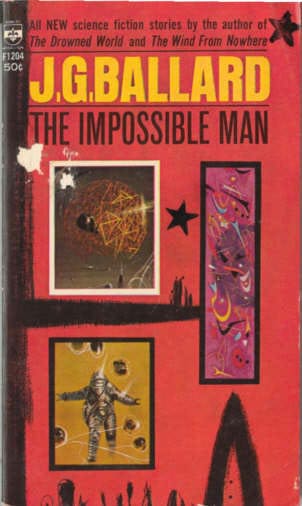
Pulp fiction.
Why is “Ballard” in katakana?
This one is sorta Magritte by way of Calvino (if that makes any sense).
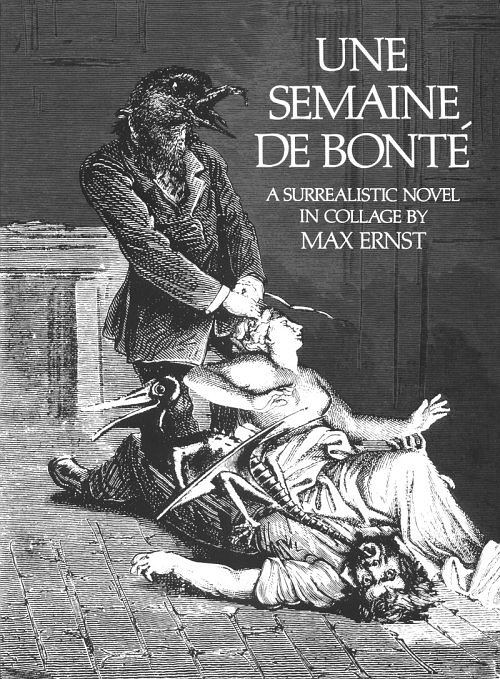
Max Ernst’s graphic novel, Une Semaine de Bonté, is one of the coolest books I own. Comprised of concise collages utilizing black and white images from periodicals and catalogs, Ernst’s narrative is both engrossing and disturbing. Full of birds and breasts and beasts, Semaine plays out like a weird, violent, funny mindfuck, its repeated scenes of submission and domination ironizing its title (A Week of Kindness). Great stuff. There’s a decent enough chunk of the book available for preview at Google Books.
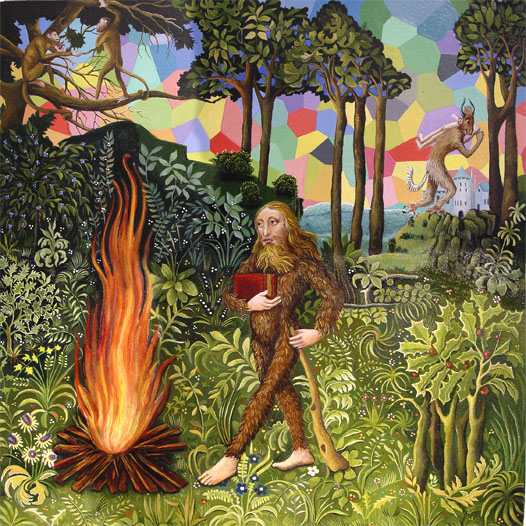
We are just loving the strangely disquieting art of Nancy Baker. Baker’s world–much of it a night world–teems with vibrant birds and manic jesters, spaceships and dissolving flowers. Paintings like Plato’s Revenge and Listening to Reason suggest achronistic landscapes, merging Arcadian fantasy, Renaissance tropes, and retrofuturism, while works such as In and Of Itself(below), Temptation, and Pokeyboth allude to–and at the same time puncture–the conflation of religious myths, fairy tales, and modern pop narratives that inform our culture.
In and Of Itself -- Nancy Baker
We love the playfulness at work in Baker’s paintings, an overt and primal innocence impinged by a looming sinister something. There’s an underlying tension here that everything might, in the briefest of moments, snap into incoherence and chaos. Yet each painting retains a core of displaced meanings, an invitation to the viewer to tell herself a story. Great stuff.
We picked up a pretty cool book last weekend at the Friends of the Library Sale–Pierre Cabbanne’s Dialogues with Marcel Duchamp. Duchamp is way more straightforward than you would think, and also quite funny. He’s also, as his work would attest, often reflective and philosophical. Here, he waxes heavy on art, beauty, transience, and mediocrity:
I think painting dies, you understand. After forty or fifty years a picture dies, because its freshness disappears. Sculpture also dies. This is my own little hobbyhorse, which no one accepts, but I don’t mind. I think a picture dies after a few years like the man who painted it. Afterward it’s called the history of art. There’s a huge difference between a Monet today, which is black as anything, and a Monet sixty or eighty years ago, when it was brilliant, when it was made. Now it has entered history–it’s accepted as that, and anyway that’s fine, because that has nothing to do with what it is. Men are mortal, pictures too.
The history of art is something very different from aesthetics. For me, the history of art is what remains of an epoch in a museum, but it’s not necessarily the best of that epoch, because the beautiful things have disappeared–the public didn’t want to keep them. But this is philosophy…
So, I guess all those urinals Duchamp made aren’t so fresh today.
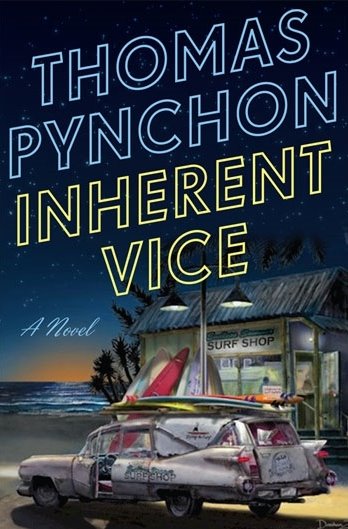
The site doesn’t have any covers for Vineland, Mason & Dixon, or Against the Day yet. Also, they skip over the horrendous cover for Pynchon’s forthcoming novel, Inherent Vice:
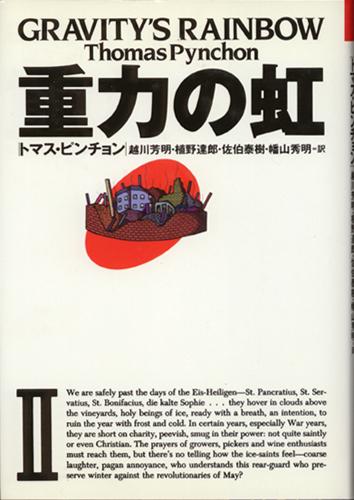
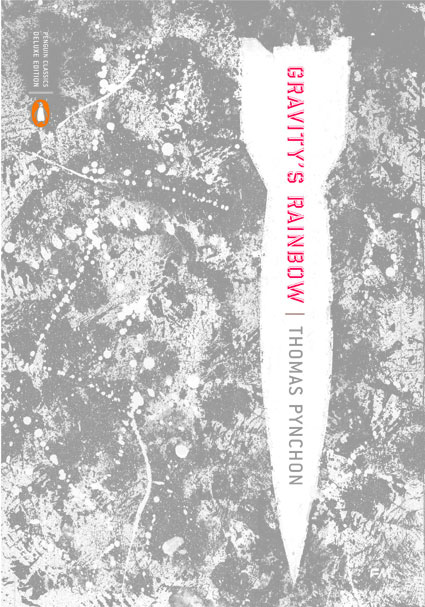
Also omitted: Frank Miller’s cover design for Gravity’s Rainbow:

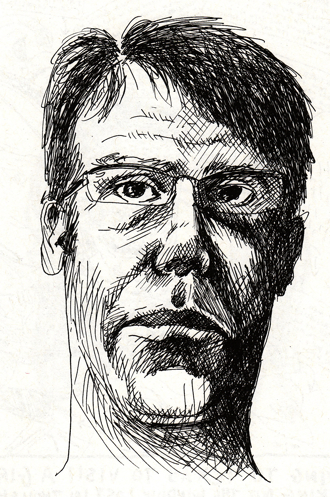



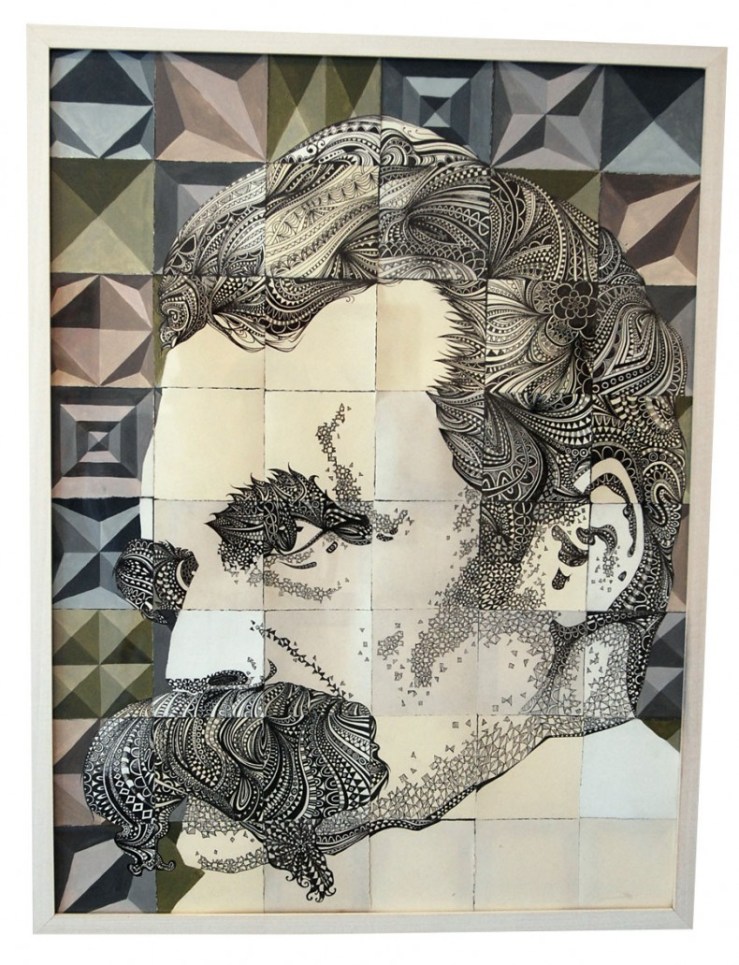



 Nice gear shift…
 Love the enthusiasm there…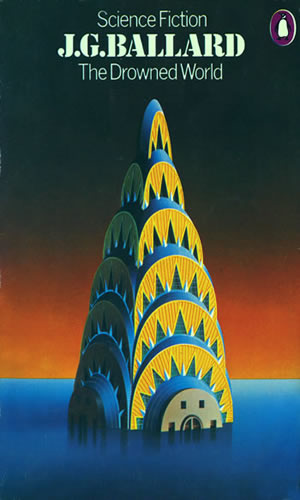





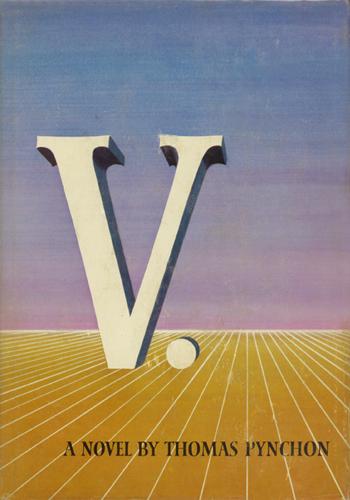
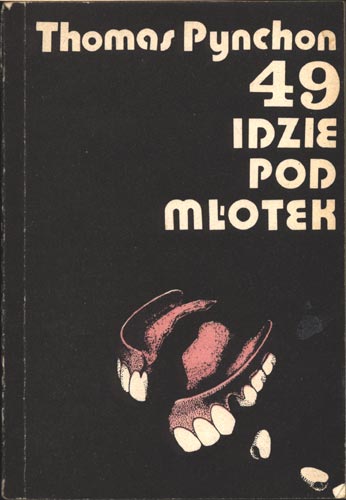
 Biblioklept