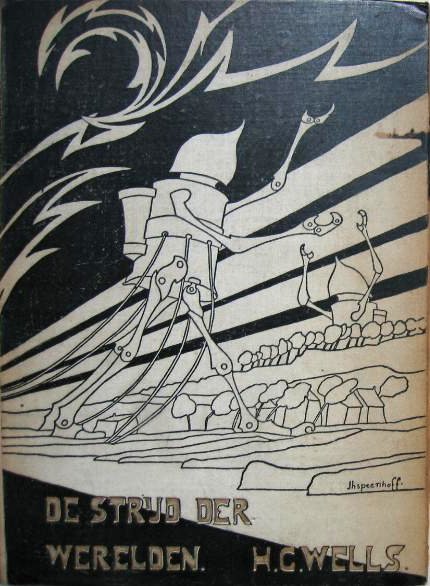
Chez Zeus has a very thorough and thoroughly fun cover gallery for H.G. Wells’s sci-fi classic The War of the Worlds. We’ve picked a few of our favorite covers here, but the full collection is great. For full artist credits and dates, check out Zeus’s complete gallery.
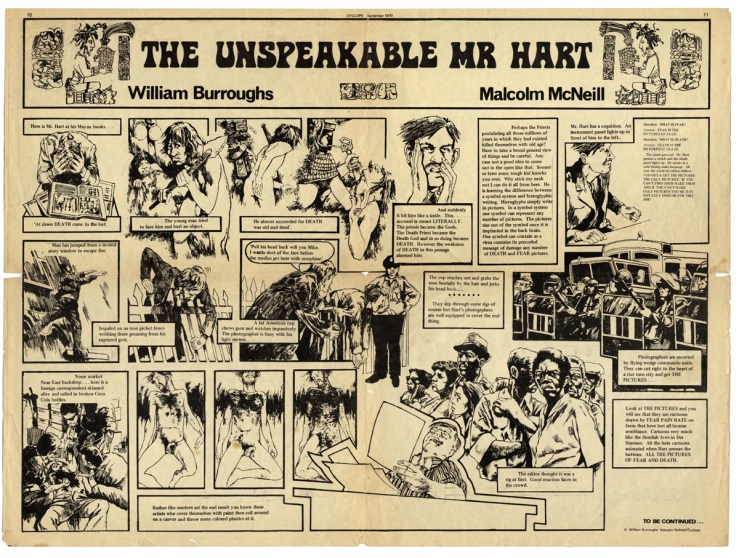
In 1970, William Burroughs was living in London. While there, he collaborated with young English artist Malcolm McNeill on a comic series for a magazine called Cyclops. The series was called The Unspeakable Mr. Hart, and remains uncollected/reprinted to date. Too bad, because it looks like really cool stuff. We got these images via The Virtual Library’s Beats collection, where there’s a really cool interview with McNeill (he discusses Burroughs habit of “going to movies to admire hard-ons and talking about them all afternoon,” which is kinda hilarious):
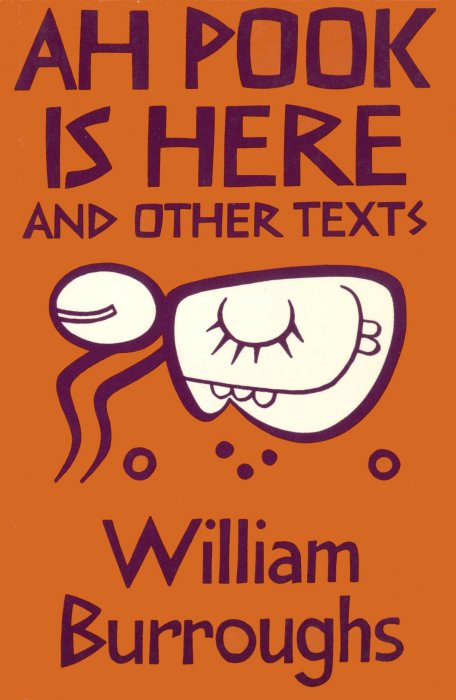
After Cylcops went kaput, Burroughs and McNeill continued the story in a project called Ah Pook Is Here, (a reference to the Mayan death god). Ah Pook Is Here, unfinished, was collected in the early eighties in Ah Pook Is Here and Other Texts which unfortunately is out of print. And very expensive. (Feel free to send it to me, anyone).
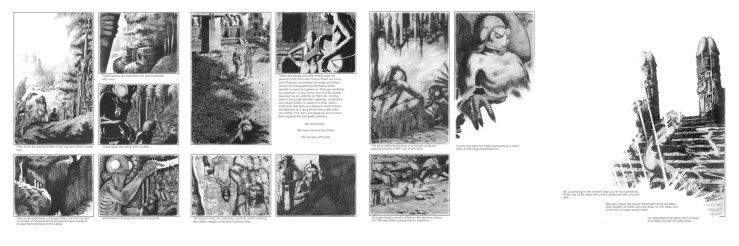
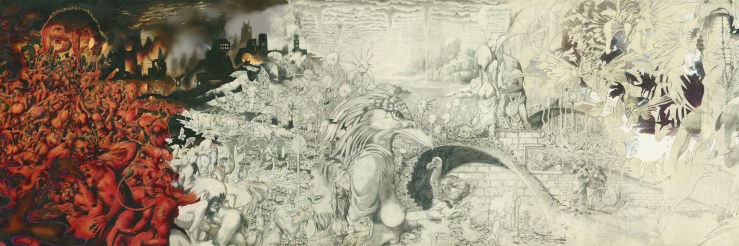
Fortunately, we can at least get a peek at some of McNeil’s hellish art at burroughsmcneillart.com. A few Boschian samples
Again, we want this book. Please send us this book. In the meantime, filmmaker Philip Hunt made this 1994 6 minute animated short of Ah Pook Is Here:
Gus Van Sant’s great little short film from 1978, based on William Burroughs’s essay, explains the art of DE, or “Do Easy.” Our clumsy ass has been trying too hard, apparently. The film is quite funny but also useful, and well worth watching in full. It’s also included in the latest issue of Wholphin, if thou art so moved.
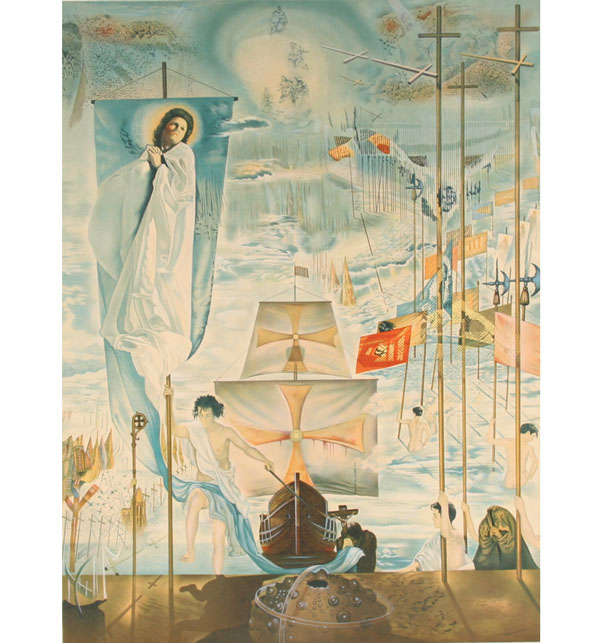
Salvador Dalí, The Discovery of America by Christopher Columbus, 1959, oil on canvas, 410 x 284 cm, St. Petersburg, Florida: Salvador Dalí Museum.
“Prayer of Columbus” by Walt Whitman
A batter’d, wreck’d old man,
Thrown on this savage shore, far, far from home,
Pent by the sea and dark rebellious brows, twelve dreary months,
Sore, stiff with many toils, sicken’d and nigh to death,
I take my way along the island’s edge,
Venting a heavy heart.
I am too full of woe!
Haply I may not live another day;
I cannot rest O God, I cannot eat or drink or sleep,
Till I put forth myself, my prayer, once more to Thee,
Breathe, bathe myself once more in Thee, commune with Thee,
Report myself once more to Thee.
Thou knowest my years entire, my life,
My long and crowded life of active work, not adoration merely;
Thou knowest the prayers and vigils of my youth,
Thou knowest my manhood’s solemn and visionary meditations,
Thou knowest how before I commenced I devoted all to come to Thee,
Thou knowest I have in age ratified all those vows and strictly kept them,
Thou knowest I have not once lost nor faith nor ecstasy in Thee,
In shackles, prison’d, in disgrace, repining not,
Accepting all from Thee, as duly come from Thee.
All my emprises have been fill’d with Thee,
My speculations, plans, begun and carried on in thoughts of Thee,
Sailing the deep or journeying the land for Thee;
Intentions, purports, aspirations mine, leaving results to Thee.
O I am sure they really came from Thee,
The urge, the ardor, the unconquerable will,
The potent, felt, interior command, stronger than words,
A message from the Heavens whispering to me even in sleep,
These sped me on.
By me and these the work so far accomplish’d,
By me earth’s elder cloy’d and stifled lands uncloy’d, unloos’d,
By me the hemispheres rounded and tied, the unknown to the known.
The end I know not, it is all in Thee,
Or small or great I know not–haply what broad fields, what lands,
Haply the brutish measureless human undergrowth I know,
Transplanted there may rise to stature, knowledge worthy Thee,
Haply the swords I know may there indeed be turn’d to reaping-tools,
Haply the lifeless cross I know, Europe’s dead cross, may bud and
blossom there.
One effort more, my altar this bleak sand;
That Thou O God my life hast lighted,
With ray of light, steady, ineffable, vouchsafed of Thee,
Light rare untellable, lighting the very light,
Beyond all signs, descriptions, languages;
For that O God, be it my latest word, here on my knees,
Old, poor, and paralyzed, I thank Thee.
My terminus near,
The clouds already closing in upon me,
The voyage balk’d, the course disputed, lost,
I yield my ships to Thee.
My hands, my limbs grow nerveless,
My brain feels rack’d, bewilder’d,
Let the old timbers part, I will not part,
I will cling fast to Thee, O God, though the waves buffet me,
Thee, Thee at least I know.
Is it the prophet’s thought I speak, or am I raving?
What do I know of life? what of myself?
I know not even my own work past or present,
Dim ever-shifting guesses of it spread before me,
Of newer better worlds, their mighty parturition,
Mocking, perplexing me.
And these things I see suddenly, what mean they?
As if some miracle, some hand divine unseal’d my eyes,
Shadowy vast shapes smile through the air and sky,
And on the distant waves sail countless ships,
And anthems in new tongues I hear saluting me.
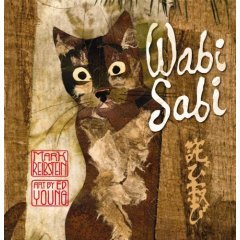
Wabi Sabi tells the story of of a cat from Kyoto named, uh, Wabi Sabi, who goes on a journey of self discovery in order to find out the elusive meaning of her name. Mark Reibstein’s simple but lovely script effectively incorporates haiku poems (including three haiku composed by Wabi Sabi herself, who finds artistic freedom at Ginkaku-ji) that can stand on their own as a simple story. Artist Ed Young brings Reibstein’s story to vivid, shimmering life. Not enough praise will do justice to Young’s rich, dense collage illustrations, which evoke the luxurious complexity one associates with masterpieces of ukiyo-e. Young’s kinetic yet peaceful art resonates with the book’s theme of finding beauty in the incomplete or imperfect, and is probably the best reason to buy this book. Wabi Sabi reads up-and-down as opposed to left-to-right, evoking a traditional scroll, allowing Young to utilize the depth and motion of the full space. The book also features short but detailed (and aesthetically-pleasing) endnotes explain the history of wabi sabi, haiku, and haibun. This short appendix also includes an English translation of the 14 haiku poems by Basho and Shiki that show up in the margins (in kanji, no less) on each of the pages.
Wabi Sabi was too long for my fifteen-month old daughter’s precious attention, and the scroll-style layout made it almost impossible to read with her on my lap (the book is also pretty much impossible for my scanner to handle, unfortunately for you dear reader). Also, I think the illustrations were a little too nuanced and complex for her–very young children tend to like strong, defined lines and bright primary colors. I’m convinced, however, that Wabi Sabi isn’t so much a children’s book as it is an art book for aesthetes with an interest in traditional Japanese culture–and I enjoyed it very much. Recommended.
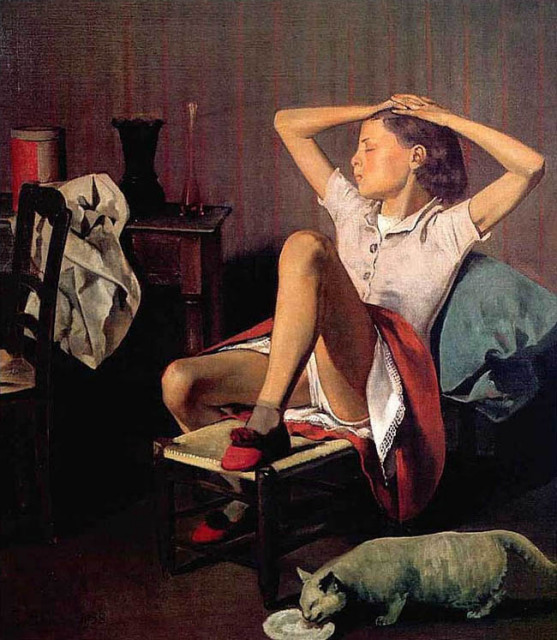
Flipping through Balthus‘s digressive, discursive, elliptical memoir Vanished Splendors, I came across this notation:
I deeply believe in the genius of painting, which parallels that of childhood. I’ve used painting as a language without really having decided to do so, because it suits me better than writing. Writing tries to be too explicit and go directly to meaning. That’s why I could never be a writer like many of my friends. Some aspects of my life might be clarified by the present short texts, similar to letters. . . . For me, writing can only be in the ellipses, where I express myself; painting conveys this magnificently, sometimes unbeknownst to the painter himself.
Elsewhere, Balthus lists the writers and texts he loves, and gives us (what I believe to be) a great definition for reading:
I often paint young girls who are reading. It’s surely because I saw the act of reading as a way to enter life’s deeper secrets. Reading is the great means of access to myths. Green, Gracq, Char, Jouve, Michaux, and Artuad were frequent passageways, as well as the great holy writings of the Bible and initiates like Dante, Rilke, the Pléiade poets, the great Chinese writers, the mystics John of the Cross and Teresa of Avila, not to mention Carroll, the pure German poet Ludwig Tieck, and Indian epics. All these texts and authors were landmarks in my life, and gave me another dimension of time to which I soon felt myself summoned. My young girls who read in dreaming poses are escaping from fleeting, harmful time . . . Fixing them in the act of reading or dreaming prolongs a privileged, splendid, and magic glimpsed-at time. A suddenly opened curtain sheds light from a window and is seen only by those who know how. Thus a book is a key to open a mysterious trunk containing childhood scents. .
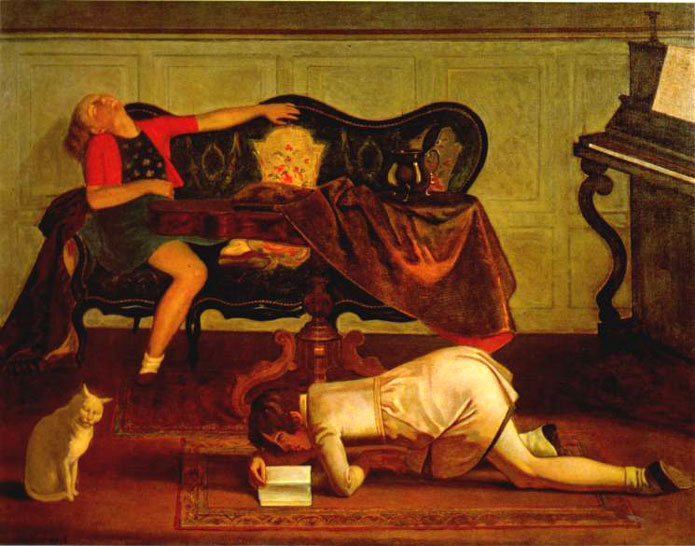
Balthus--Girl with Cat
But, my favorite lines in the book come at the end of the following passage:
Painting is something both embodied and spiritualized. It’s a way of attaining the soul through the body. . . . Being too cerebral and jokey can obstruct an artisan’s manual labor, and impede the ascent to the soul. Believing that my young girls are perversely erotic is to remain on the level of material things. It means understanding nothing about the innocence of adolescent languor, and the truth of childhood.
Exactly. Whenever I look at Girl with Cat, I think, man, that’s not perversely erotic at all…that’s just the innocence of adolescent languor–the real truth of childhood, actually. Nice try, Count Balthasar.
Who is more heroic or more American than Henry Hill, Jimmy Conway, Paulie Cicero, or Tommy DeVito? No
one, that’s who! Also, for that matter, is there anyone more American than Joe Pesci? No way, Jose! Painting by William Parsons.
Okay well so, we’re more or less “off” this week, because we love America sooooooooo much that we’re going on vacation. Still, because we are totally American, which is to say totally industrious, and because “the U.S. is the greatest, best country god has ever given man on the face of the Earth,” we’ll be leaving you with a series of fantastic images of great American heroes over the next week, starting with this stunning portrait of Superman himself, Christopher Reeve, by talented painter Adam Brooks. Great stuff.
“Landscape with the Fall of Icarus” by William Carlos Williams
According to Brueghel
when Icarus fell
it was spring
a farmer was ploughing
his field
the whole pageantry
of the year was
awake tingling
near
the edge of the sea
concerned
with itself
sweating in the sun
that melted
the wings’ wax
unsignificantly
off the coast
there was
a splash quite unnoticed
this was
Icarus drowning
“Musée de Beaux Arts” by W.H. Auden
About suffering they were never wrong,
The Old Masters: how well, they understood
Its human position; how it takes place
While someone else is eating or opening a window or just walking dully along;
How, when the aged are reverently, passionately waiting
For the miraculous birth, there always must be
Children who did not specially want it to happen, skating
On a pond at the edge of the wood:
They never forgot
That even the dreadful martyrdom must run its course
Anyhow in a corner, some untidy spot
Where the dogs go on with their doggy life and the torturer’s horse
Scratches its innocent behind on a tree.
In Brueghel’s Icarus, for instance: how everything turns away
Quite leisurely from the disaster; the ploughman may
Have heard the splash, the forsaken cry,
But for him it was not an important failure; the sun shone
As it had to on the white legs disappearing into the green
Water; and the expensive delicate ship that must have seen
Something amazing, a boy falling out of the sky,
had somewhere to get to and sailed calmly on.
If you had a million years to do it in, you couldn’t rub out even half the ‘Fuck you’ signs in the world. It’s impossible. –Holden Caulfield in The Catcher in the Rye
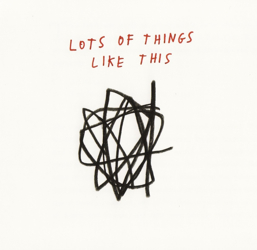
Royal Art Lodge piece from Lots of Things Like This, a slim volume of pictures with words (or words with pictures?) included with McSweeney’s #27 (two other books comprise the issue: a volume of short stories including pieces by Jim Shepard and Stephen King, and a really cool notebook of weird doodles and crazy thoughts by Art Spiegelman). Other artists represented in Lots of Things Like This include Magritte, Goya, Warhol, Raymond Pettibon, Jeffrey Brown, Leonard Cohen, David Mamet, David Berman, Basquiat, and more.
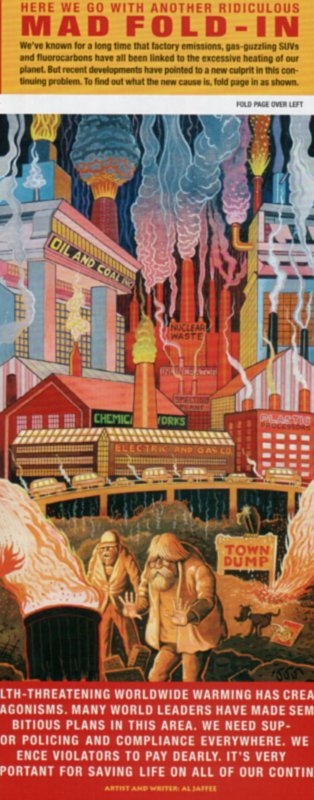
I’ve already documented my love of MAD magazine when I was younger. It pretty much was my cultural currency, and, perhaps unfortunately, much of my understanding of pop culture was warped through the lens of MAD. Anyway, I was psyched when Longlunch sent me this fun, playful link to the New York Times‘s “Fold-In Feature.” You remember Al Jaffee’s fold-ins, right? They always got all messed up after one or two folds…but they were fun. Interactive. I like that. More fold-ins here. Bleechh!
Sorry for the long delays between posts lately. I’ve been really, really busy, and I’m trying to resist the “hey, look at this cool shit” type of posting so common in Blogworld. I promise to come back soon with regular updates with (hopefully) meaningful content. In the meantime: Hey, look at this cool shit–
The new Man Man album, Rabbit Habits is set to drop next week. Raucous and ramshackle, yet paradoxically tight as a snare, Rabbit Habits works in the same post-Beefheart idiom as their last album, Six Demon Bag, refining some of the rough edges without losing the rawness. Good for some occasions.
Pirates with good taste probably know by now that Animal Collective’s Water Curses has leaked. The EP is as delicious and warped as fans might expect, and has been on repeat around Biblioklept Central Headquarters for the past two weeks. Great for most occasions.
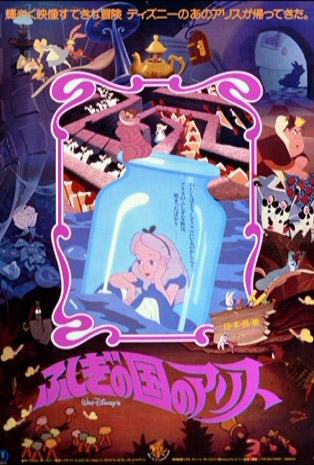
Incidentally, according to AC’s Wikipedia page: “It has been said that the Animal Collective album Strawberry Jam can be synchronized with the Disney animated clasic [sic] Alice in Wonderland [sic].” See folks, this is why we discourage writing in the passive voice. Who has said that Strawberry Jam syncs with Alice in Wonderland? When was this said? Where, and in what context? Sophomores getting stoned somewhere in Wisconsin? Oh, Wikipedia! See, this is why so many people regard you as the ugly stepchild of legitimate encyclopedias…Anyway…has anyone tried this?
Art Spiegelman’s Maus, released as a graphic novel over twenty years ago, did more to legitimize the comic as an art form than any other work I can think of. It won a Pullitzer Prize Special Award in 1992 (the Pullitzer committee found it hard to classify…perhaps they didn’t want to admit that they were giving a prestigious award to a comic book!), and today Maus is a standard on many college English syllabi.
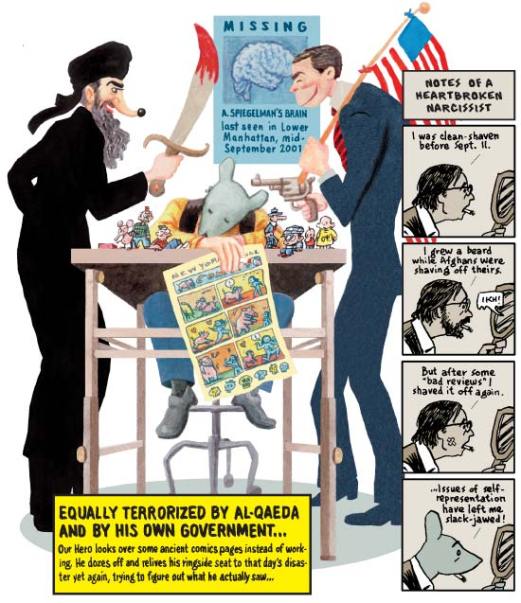
After Maus, Spiegelman worked for The New Yorker for over ten years, quitting in early 2002 after the September 11th attacks to work on a series of broadsheets entitled In the Shadow of No Towers. These broadsheets were collected in 2004 in an unwieldy 15″ x 10″ book.
Spiegelman lived in downtown Manhattan, right by the towers; his daughter attended school a few blocks away. He saw the towers collapse in person, fleeing for his life with his family. Spiegelman attempts to capture this raw, unmediated, and very personal experience in In the Shadow of No Towers (Sonic Youth’s 2002 album Murray Streetworks to the same end–only much more abstractly): the narrative is discontiguous, fluctuating from bitter satire to earnest inquiry. Spiegelman’s choice of the broadsheet as his medium (the broadsheets were published monthly by different newspapers as Spiegelman produced them) is tremendously affective: just like the 9/11 attacks, the broadsheets are larger than life, hard to grasp, hyperbolically resisting easy, singular readings. Spiegelman balances bitter attacks against the conformist mentality spurred by the Bush administration with pathos and humor; In the Shadow of No Towers recalls the good-natured satire of broadsheet comics from a hundred years ago, bittersweetening the content. The 2004 collection wisely contextualizes Spiegelman’s work by reprinting broadsheets of “The Yellow Kid” and “The Katzenjammer Kids.”
Like Maus, In the Shadow of No Towers is a fascinating exploration of how disaster confronts and transforms identity. And reflecting its heinous subject, In the Shadow of No Towers ends without concluding: as the foolish Iraq war begins, Spiegelman can no longer shape any meaning or sense from his work. This isn’t a graphic novel–don’t look for a cohesive narrative structure here; instead, In the Shadow of No Towers explores the loose ends, the detritus, the psychic remnants of disaster.









 Biblioklept