Idiots get respect out here, they’re believed to be in touch with invisible forces | Notes on Thomas Pynchon’s Shadow Ticket, Ch. 24-26

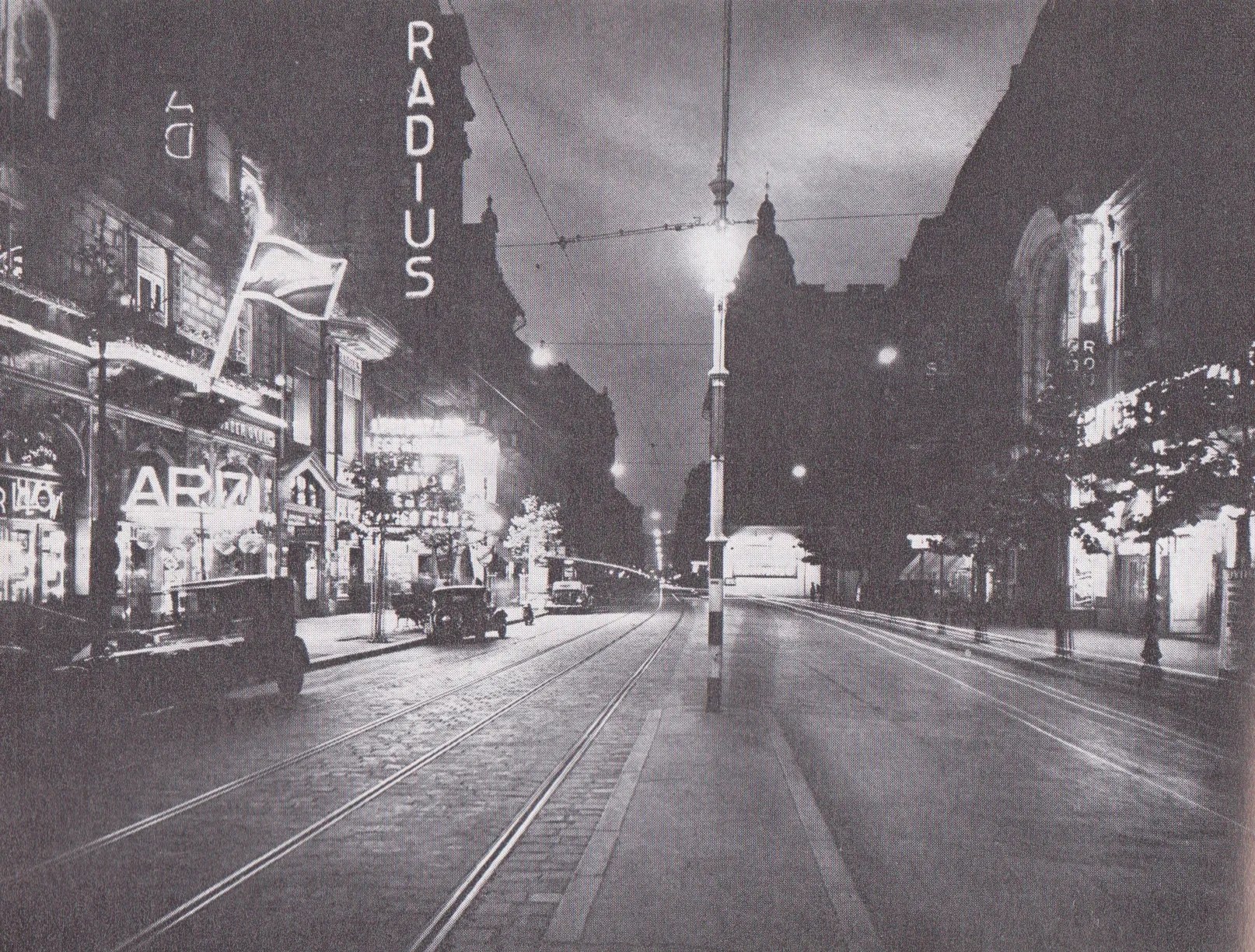
Nagymező Street, the Radius Film Theater (Radius Filmszínház)

Notes on Chapters 1-7 | Glows in the dark.

Notes on Chapters 8-14 | Halloween all the time.

Notes on Chapters 15-18 | Ghostly crawl.

Notes on Chapters 19-20 | The needs of cold capitalist reality and those of adjoining ghost worlds come into rude contact.

Notes on Chapters 21-23 | Phantom gearbox.


Chapter 24: Another fairly long chapter for Shadow Ticket. I’ve been over-summarizing in these notes, and maybe I’ll keep over-summarizing — at this point doing these notes has been my second reading of Shadow Ticket. I would say though, that we’ve reached a point well beyond the novel’s quick change glamour, its bilocative split — or its bait n’ switch, if you feel that way. The novel initially presents as a hardboiled noir send-up in the dark American Heartland only to pivot (or bilocate, to misapporpriate a term from Against the Day) to Central Europe where there’s preparation for a war on (moron). Hero Hicks fades, just a little, in the background; a larger cast steps up.

But Hicks is still the heart of Ch. 24, which begins at Egon Praediger’s office in Budapest, where the ICPC detective is snorting soup spoonfuls of cocaine while ranting about his inability to catch Bruno Airmont. Egon fears he’s wasting his talent “not on an evil genius but on an evil moron, dangerous not for his intellect, what there may be of it, but for the power that his ill-deserved wealth allows him to exert, which his admirers pretend is will, though it never amounts to more than the stubbornness of a child.” Oh man–wonder if that sounds like any evil moron of recent vintage? Egon would rather face off against a worthy villain, a “Dr. Mabuse or Fu Manchu,” references again underlining Shadow Ticket’s lurid pop Goth bona fides.

Hicks then runs into Terike, “just emerging from her latest run-in with the authorities over her motorcycle, a 500 cc Guzzi Sport 15″ — which more on this transport later. On the way to the bike, Hicks finds that he has somehow percolated through Terike, who has performed some kind of metaphysical quick change. He apports, I guess.

1937 Moto Guzzi GTS 500 with matching sidecar

For Terike, the Guzzista “is a metaphysical critter. We know, the way you’d say a cowboy knows, that there’s a fierce living soul here that we have to deal with.” As we should expect now in Ole Central Europe, this bike is spooky, and Terike is a superhero on it: “she can go straight up the sides of walls, pass through walls, ride upside down on the overheads, cross moving water, jump ditches, barricades, urban chasms one rooftop to the next, office-building corridors to native-quarter alleyways quicker than a wink.”

Hicks rides along in the sidecar. (A bit later we’ll see a charming pig, a spirit animal, really, riding sidecar–perhaps there’s a link between Hicks and Pynchon’s other pigmen, like Seaman Bodine or Tyrone Slothrop (or the unfortunate Major Marvy.) Their mission: deliver a batch of experimental vacuum tubes “specially designed for the theremin” to Club Hypotenuse,” a “cheerfully neon-lit” venue featuring a rotating dance floor and “not just one soloist on theremin but a half dozen, each expensively gowned tomato with more or less identical platinum bobs, waving their hands at these units and pulling music out of some deep invisibility, swooping one note to the next, hitting each one with pitch as perfect, Terike assures him, as the instrument’s reigning queen, Clara Rockmore. The joint effect of these six virtuoso cuties all going at once in close harmony is strangely symphonic.”

(Forgive me if I let the quote linger too long, the image is just too lovely.)

At Club Hypotenuse we get a bit of background on Terike, her rejection of her bourgeoisie upbringing, and recent Hungarian political struggles, before meeting yet another character, freelance foreign correspondent Slide Gearheart (he uses the alias “Judge Crater” at the bar. We last heard the name back in Ch. 18, but Crater, icon of the disappearing act, will pop up again). Slide lets Hicks in on a lead he has to cheese heiress Daphne Airmont’s whereabouts; he also gives our P.I. some advice about (not) fitting in to Hungary: “…best stick to English and there’s a chance they’ll take you for an idiot and leave you alone. It might help if you could also pretend now and then to hear voices they don’t. Idiots get respect out here, they’re believed to be in touch with invisible forces.” 

But Slide’s bigger note for Hicks is a soft warning to prepare him for the reality that you can never really go home.


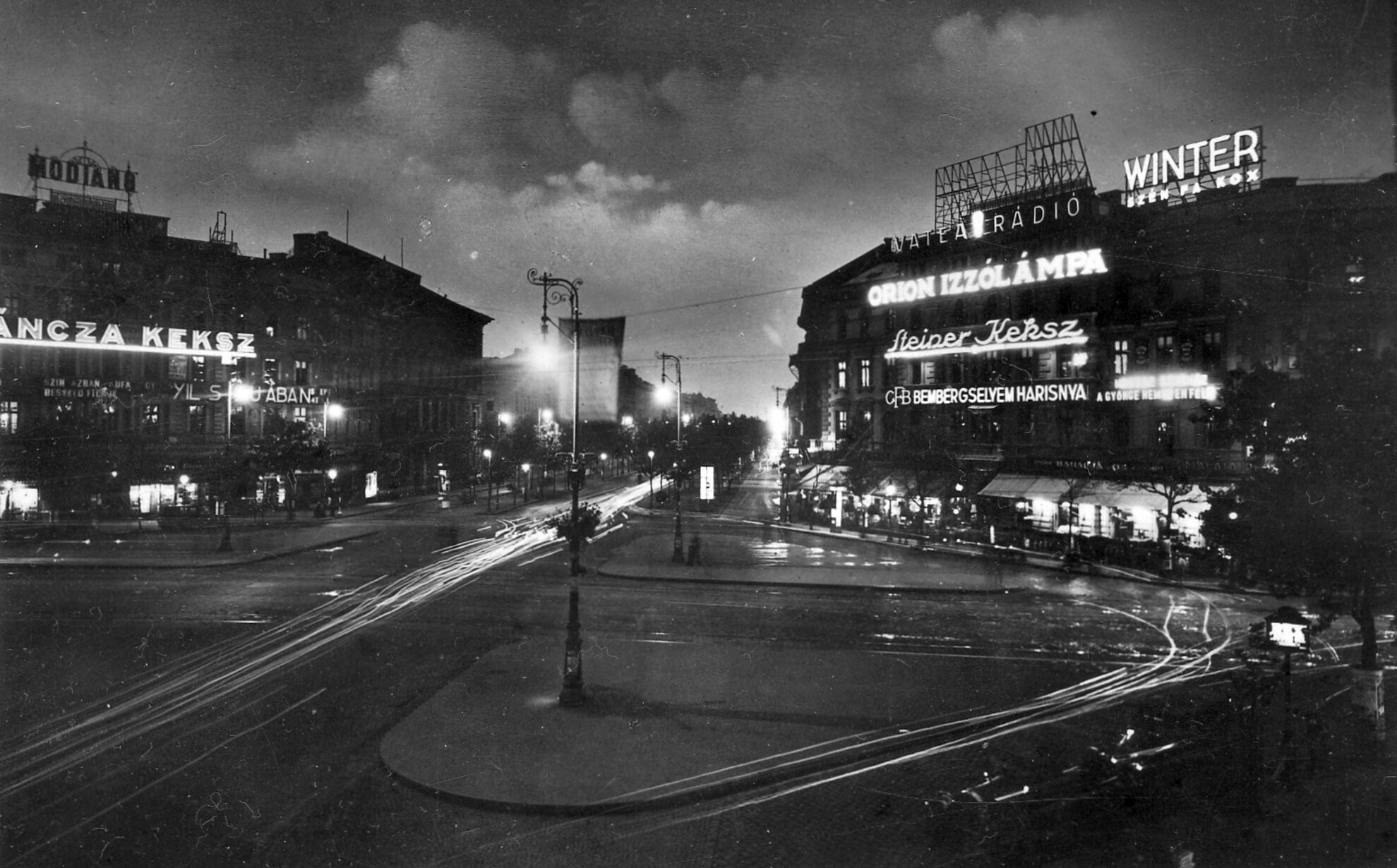
Chapter 25: “Things pick up a day or two later when Slide reports that Daphne has been sighted at the Tropikus nightclub, in Nagymező utca, the Broadway of Budapest.” (This is I suppose the inspiration for the use of the photograph of Nagymező Street used on the cover of the first edition of Shadow Ticket.)

Daphne sings a song and then she and Hicks dance together.

So–I have really neglected Shadow Ticket as a song and dance routine. I think if you’ve read Pynchon you’d expect it; it’s a bit more prevalent here, the singing and dancing, in Shadow Ticket I mean, then in some of the other novels, but it’s certainly what you’d expect. The songs probably deserve their own whole blog or something to deal with (which I will never do); the dancing — well the dancing — I think something I should’ve highlighted much earlier is that Hicks is a really good dancer. Like fucking excellent. He’s a magician who goes into “one of those hoofer’s trances” in the previous chapter while dancing with Terike to the theremin orchestra. That notation — of the trance state — is given for various characters in Shadow Ticket who achieve a kind of short-term perfection outside the physical realm. (It’s the drummer Pancho Caramba (and like, Pynchon, c’mon man, that’s too much, name wise) — it’s the drummer Pancho Caramba in Ch. 25 who goes “into this kind of trance” at his drum kit, enchanting his audience.)

Most of the chapter is the dance and the dance-within-the-dance between Hicks and Daphne. There are Gothic-tinged allusions to their past in Wisconsin–his saving her from the “North Shore Zombie Two-Step” of forced psychiatric hospitalization, incurring a “Chippewa hoodoo” debt as her caretaker in perpetual.

We also start to get Daphne’s backstory with Hop Wingdale, the jazz clarinetist she left home for. She’s followed Hop and his band the Klezmopolitans around Europe, but is worried that the ill-fated lovers “need to relocate before it’s all Storm Trooper chorales and three-note harmony.” Daphne again underlines Shadow Ticket’s departure point — a big ugly change is gonna come. Hop is (rightfully) worried about Papa “Bruno’s invisible hand…” though. Awkwardly enough,” he tells Daphne, “it turns out more of your life than you think is being run on the Q.T. by none other” but her pops.

The phrase “on the Q.T.” — meaning quiet (or “on the quiet tip,” as I thought way back as a teen encountering it) — shows up a few times in Shadow Ticket. It’s phonetically doubled in the word cutie, which shows up more than a few times in Shadow Ticket.


Chapter 26: Another longish section by Shadow Ticket standards, and less breezy than the novel as a whole.

There’s a lot of Daphne-Hicks and Daphne-Hop stuff here — more bilocations, maybe? — in any case, our boy Hicks gets himself more wrapped up than he intended to. After Daphne urges him to help hunt down Hop, who’s kinda sorta left her, he reminds himself of his mantra “No More Matrimonials! Ever!”

By the end of the chapter our American idiot is wondering if “wouldn’t it be a nice turnaround to bring some couple back together again, put the matrimony back in ‘matrimonial’ for a change, instead of divorce lawyers into speedsters and limousines.” Here, I couldn’t help but think of Paul Thomas Anderson’s film revision to Pynchon’s novel Inherent Vice; PTA ties a neater bow on the narrative by letting its lead P.I. Doc Sportello restore the marriage of musician Coy Harlingen.

Anyway, we get Daphne and Hop’s origin story: “Talk about meeting cute. You’d think she’d have known better by then. It was in Chicago a few years back, still deep in her teen playgirl phase.” General gunplay shatters Daphne’s double aviation cocktail. She’s smitten with his woodwind serenades.
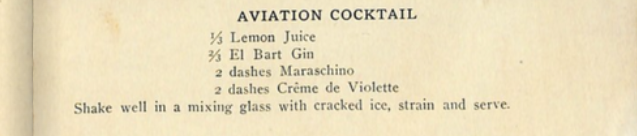
1917 recipe for aviation cocktail.

This chapter is chocked full of motifs and mottoes we’d expect from Shadow Ticket in particular at this point and Pynchon in general: invisibility, inconvenience, Judge Crater, “Who killed vaudeville?,” etc. It’s also pretty horny, with Hicks and Daphne finally consummating their meet cute from years gone by. Sorry if I’m breezing through.

I’m more interested in a specific exchange.

Carl Jung’s house in Kusnacht, Switzerland: VOCATUS ATQUE NON VOCATUS DEUS ADERIT —  “Called or not called, the god will be there.”

Daphne hips Hicks to something she saw “once, in one of these mental fix-it shops I kept getting sent to, up on the office wall was a motto of Carl Jung—Vocatus atque non vocatus deus aderit. I said what’s this my Latin’s a little rusty, he sez that’s called or not called, the god will come.”

The end of Ch. 23, at least in my guess, seemed to obliquely reference Jung’s Answer to Job, with the narrator suggesting that a trinity can only truly operate as a whole in the form of a stealth quatro — it’s phantom fourth piece balancing out the visible trio in the foreground. The reference to Jung here is not oblique but direct and maybe I will do something more direct with it down the line.

Of course the thing that comes to save Daphne isn’t “the god” but that Big Gorilla Hicks. He notes that, “Your old pals from the rez think it’s spoze to be a critter” who shows up to save the day. In a moment of vulnerability that I take to be sincere, Daphne asks Hicks if he didn’t think that she might actually be insane and should be returned to the hospital and not set free. His reply is a repetition of one of the novel’s several theses: “You were on the run, that was enough.”
Phantom gearbox | Notes on Thomas Pynchon’s Shadow Ticket, Ch. 21-23

Notes on Chapters 1-7 | Glows in the dark.

Notes on Chapters 8-14 | Halloween all the time.

Notes on Chapters 15-18 | Ghostly crawl.

Notes on Chapters 19-20 | The needs of cold capitalist reality and those of adjoining ghost worlds come into rude contact.


Chapter 21:

We move from trans-Atlantic passage to Central Europe pretty quickly. Hicks’s spy handlers Alf and Pip (and like at this point I don’t think he fully realizes Alf and Pip are his handlers on whatever shadow ticket he’s picked up) — Hicks’s spy handlers Alf and Pip leave Hicks on the train while they depart into Belgrade, Kingdom of Serbs, Croats, and Slovenes.

In the Quarrenders’ place emerges Egon Praediger, claiming to be of ICPC — the International Criminal Police Commission (not the Insane Clown Posse Crew), progenitor of Interpol (not the dour 2000s band, but the ICPO). Egon produces “a jarful of cocaine crystals” and grinds up some fat lines — “a routine known around Chicago as ‘hitching up the reindeer,'” the narrator informs us. While ingesting the coke, Egon eventually discloses the shadow ticket Hicks is working: “as you pursue the elusive Miss Airmont, we keep the shadow on you day and night, hoping that Bruno at a moment of diminished attention will make some fateful lunge.” (In another nod to Shadow Ticket’s Gothic motif, the narrator tells us that Egon pronounces the name Bruno Airmont “the way Dracula pronounces the name Van Helsing”).

It turns out that the Al Capone of cheese is the ICPC’s “most sought-after public enemy,” wanted for “criminal activities including murder, tax evasion in a number of countries, [and] Cheese Fraud.” For the terrible crime of counterfeiting cheese, “the International Cheese Syndicate,” or “InChSyn,” want to lock up Bruno. In a cocaine thrall, Egon riffs a bit at the sinister implications behind the scenes: “Cheese Fraud being a metaphor of course, a screen, a front for something more geopolitical, some grand face-off between the cheese-based or colonialist powers, basically northwest Europe, and the vast teeming cheeselessness of Asia.” Egon’s ranting here echoes the academic discussions of cheese back at the Airmont compound in Ch. 13, when discussion turns to breaking into the Asian markets: “How the heck do we create a market for dairy products in Japan short of invading and occupying the country outright? Taking away their tea or sake or whatever it is they drink and forcing them to drink milk like normal human beings?”

(Going back to Ch. 13 to find these lines, I realized that I’d neglected to include a Gothic reference in my riff on that chapter, where cheese is described as “a strange new form of life that was deliberately invented, like Doctor Frankenstein”).

Egon’s coked-up rant culminates in another of Shadow Ticket’s prophetic warnings of the Next Big War to Come. A glistening, entranced Egon declares:

“This is the ball bearing on which everything since 1919 has gone pivoting, this year is when it all begins to come apart. Europe trembles, not only with fear but with desire. Desire for what has almost arrived, deepening over us, a long erotic buildup before the shuddering instant of clarity, a violent collapse of civil order which will spread from a radiant point in or near Vienna, rapidly and without limit in every direction, and so across the continents, trackless forests and unvisited lakes, plaintext suburbs and cryptic native quarters, battlefields historic and potential, prairie drifted over the horizon with enough edible prey to solve the Meat Question forever…”

To repeat a claim I made in my last riff: Shadow Ticket is a bridge novel between two of Pynchon’s masterpieces, Against the Day and Gravity’s Rainbow.

And, to repeat another claim I’ve been making throughout these notes, as Hicks moves eastward, Shadow Ticket’s supernatural elements come closer to the foreground. He’s en route to Budapest, where, according to Egon, there “carouses a psychical Mardi Gras in every shade of the supernatural no matter how lurid.We learn that “Budapest just at the moment is the metropolis and beating heart of asport/apport activities, where objects precious and ordinary, exquisite and kitsch, big and small, have been mysteriously vanishing on the order of dozens per day.” The “asport/apport” motif was first announced back in Ch. 4, via ex-vaudeville psychic Thessalie Wayward. Whereas folks back in Wisconsin were far more skeptical about — or at least reticent to openly speak about — the spooky stuff, Central Europe doesn’t try to deny it.

The chapter ends with Egon giving Hicks a present: a brand new type of pistol called the “Walther PPK.” 


A photograph of the Oktagon, circa 1930

Chapter 22 begins in the Oktogon, a major intersection in Pest. Here, Hicks (and the readers) meet two new characters: Zoltán von Kiss, “once an echt working apportist, lately more of a psychic celebrity detective,” and motorcycle courier Terike who downplays her role as Zoltán’s “Glamorous Assistant.” Hicks is intrigued by Terike, and when she departs with “Szia!” — Hungarian for hello/goodbye, he responds with a “Hope so.” The pun is low hanging fruit but our boy Pynchon loves to eat from that tree.

Zoltán, or “Zoli,” as he prefers to be called has a mission for Hicks. But before getting into that (and a demonstration of his psychic and telekinetic powers), he distinguishes metaphysical Central Europe from concrete America:

“You are a practical people, Americans, everyone is either some kind of inventor or at least a gifted repairman. I myself have grown to rely too much on the passionate mindlessness which creeps over me just as an apport is about to arrive or depart. I am painfully aware of how much more exposure I need to the secular, material world.”

The phrase “passionate mindlessness” recalls Mindless Pleasures — a working title Pynchon used for what would become Gravity’s Rainbow.

mindless-pleasures

But onto that mission: Hicks will assist in the recovery and return of “the crown jewel of tasteless lamps… known in underworld Esperanto as La Lampo Plej Malbongusto.” (Zoli’s ever-inflating description of the lamp’s tastelessness is pure Pynchon.) Again, we get an echo of the Airmont compound back in Ch. 13, where Hicks stumbled into “an excessive number of electric lamps… Some are unusual-looking, to say the least, and few if any in what you’d consider good taste.” 

While the tasteless-lamp bit is, on the surface very goofy, it nevertheless highlights the novel’s concern with what can be seen and what remains unseen; with what casts a shadow, and with what is immaterial. Zolti posits the lamp’s recovery in language that approaches a holy restoration: “even the most hopelessly ill-imagined lamp deserves to belong somewhere, to have been awaited, to enact some return, to stand watch on some table, in some corner, as a place-keeper, a marker, a promise of redemption.” I think the notion here is beautiful answer to a rhetorical question posed in the opening nightmare of Gravity’s Rainbow: “Each has been hearing a voice, one he thought was talking only to him, say,You didn’t really believe you’d be saved. Come, we all know who we are by now. No one was ever going to take the trouble to save you…‘ Pynchon is for the preterite; even the ugliest light-bearer is poised for redemption.

Hicks and Zoli eventually make their way to “a neighborhood of warehouses, corner taverns, cafés and hashish bars, metallic shadows, sounds of mostly invisible train traffic” and into speakeasyish spot “turbulent with kleptos conferring in Esperanto, featuring a lot of words ending in u (‘Volitive mood,’ comments Zoltán, ‘used for yearnings, regrets, if-onlys…’)” (When I was young my mother had a friend who was a member of an Esperanto society. The notion of an invented language fascinated me; I also recognized, even as a child, that it was a doomed project. I love that Pynchon includes a few nods to L. L. Zamenhof’s utopian linguistic project, and highlights the “yearning” behind the invented grammar.) After some funny business by a vaudevillian magic act trio called Drei Im Weggla (secret agents themselves, we’re assured parenthetically) and a nonviolent showdown with “Bruno Airmont’s deputy Ace Lomax,” Hicks fulfills his mission with Zoli.


Chapter 23 sees Hicks reunite with the Quarrenders. Pips has performed a quick change glamour, to Hicks’s admiration. She tells him it’s, All part of the craft, give whoever’s watching something blonde and shiny to fix their attention, then should one need to disappear, simply get rid of it and fade into the mobility.” Like Terike and the other sleight-of-hand artists of Shadow Ticket, Pips understands the value of posing as the “Glamorous Assistant.” Later in this chapter we’ll meet another spy, Vassily Midoff, of whom we’re told “Impressions of what he looks like also vary widely. Not that he’s invisible, exactly, people see him all the time, but they don’t remember that they saw him.”

Alf soon (literally) materializes and complains of an exhausting morning at the “Crossword Suicide Café.” Alf then goes on to detail how “an unemployed waiter named Antal Gyula steps in to what was then known as the Emke Café,” committed suicide, and left a “farewell note in the form of a crossword puzzle he designed himself, whose solution will reveal the reasons he did the deed, along with the names of other people involved.” The puzzle remained unsolved, a “crypto bonanza potentially and yet just as easily somebody’s idea of a practical joke.” The note is zany and sinister, silly and sad, utterly Pynchonian but also, like, totally real.

1937 Böhmerland 603cc Langtouren

The chapter ends with the “nightclub apport trio Schnucki, Dieter, and Heinz, seated one behind another on a Böhmerland Long Touring motorcycle, ten and a half foot wheelbase, red and yellow paint job, riding patrol…” The spectacle upsets Vassily Midoff, who senses a fourth “invisible rider” at the motorcycle’s stern. He hits the high road, “spooked…back into invisibility,” the narrator noting that “for a trinity to be effective, and not just a set which happens to contain three members, there must be a fourth element, silent, withheld. A fourth rider, say, working a phantom gearbox…” 

Perhaps the invisible fourth rider alludes to Carl Jung’s Answer to Job, which argues for a unified, reconciled quaternity, and not a trinity; a symbolic totality that acknowledges the shadow (ticket?) suppressed by the idealized triad. In Jung’s schema, the fourth element completes the cycle by restoring what has been excluded, granting wholeness rather than perfection. The phantom rider becomes an embodiment of that hidden completion, an invisible force that trails behind the spectacle of the three visible figures, suggesting that beneath their exuberant surface rides the unacknowledged presence that makes the whole thing work. (Or perhaps threatens to undo it.)

Glows in the dark | Notes on Thomas Pynchon’s Shadow Ticket, Ch. 1-7

Let’s start with the epigraph:

“Supernatural, perhaps. Baloney…perhaps not.”

Bela Lugosi,
in The Black Cat (1934)

Dr. Vitus Werdegast, Bela Lugosi’s character in The Black Cat, gives this line to mystery novelist Peter Alison (portrayed by David Manners). Here is the scene:

Pynchon is not the first to sample this line.

The epigraph for Shadow Ticket highlights a concern with the metaphysical that Pynchon has shown throughout his novels. The epigraph encapsulates this concern, ties it to the talkies, the American Gothic tradition, and wedges in a slice of absurd (and drily-delivered) humor early on.


Chapter 1; the novel’s first line:

“When trouble comes to town, it usually takes the North Shore Line.”

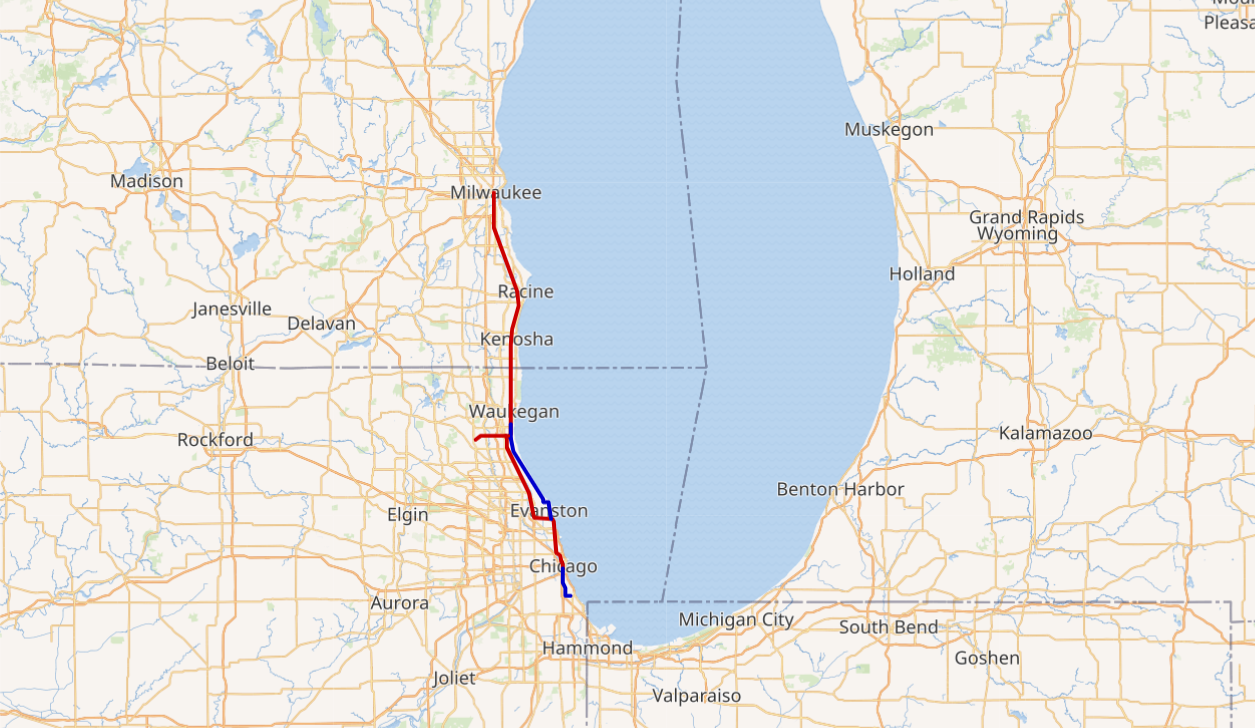
Shadow Ticket is set, thus far and for the most part, in Milwaukee Wisconsin in early 1931. For about half a century, The Chicago North Shore and Milwaukee Railroad ran from Chicago to Milwaukee, roughly a long the coast of Lake Michigan. It ceased operations in early 1963.

(Even went through Kenosha, kid.)

The opening paragraphs introduce us to Shadow Ticket’s hero Hicks McTaggart and establish a snappy, hardboiled style reminiscent of films of the thirties and forties (or films of the Coen Brothers that pay homage to those films).


“Everybody is looking at everybody else like they’re all in on something. Beyond familiarity or indifference, some deep mischief is at work.”

These lines append the postprandial scene of a noontime explosion. We get paranoia and a whiff of the supernatural — that “deep mischief…at work.”


“Pineapples come and pineapples go,” declares Hicks’s boss Boynt Crosstown, dismissing the explosion. (Perhaps the name Boynt Crosstown evokes “Burnt Cross Town”?)

Pineapples, slang for grenades specifically or explosives more generally, pops up repeatedly early on in Shadow Ticket.


“…local multimillionaire Bruno Airmont, known throughout the dairy industry as the Al Capone of Cheese in Exile…this one’s more about his daughter Daphne…Seems your old romance has just run off with a clarinet player in a swing band.”

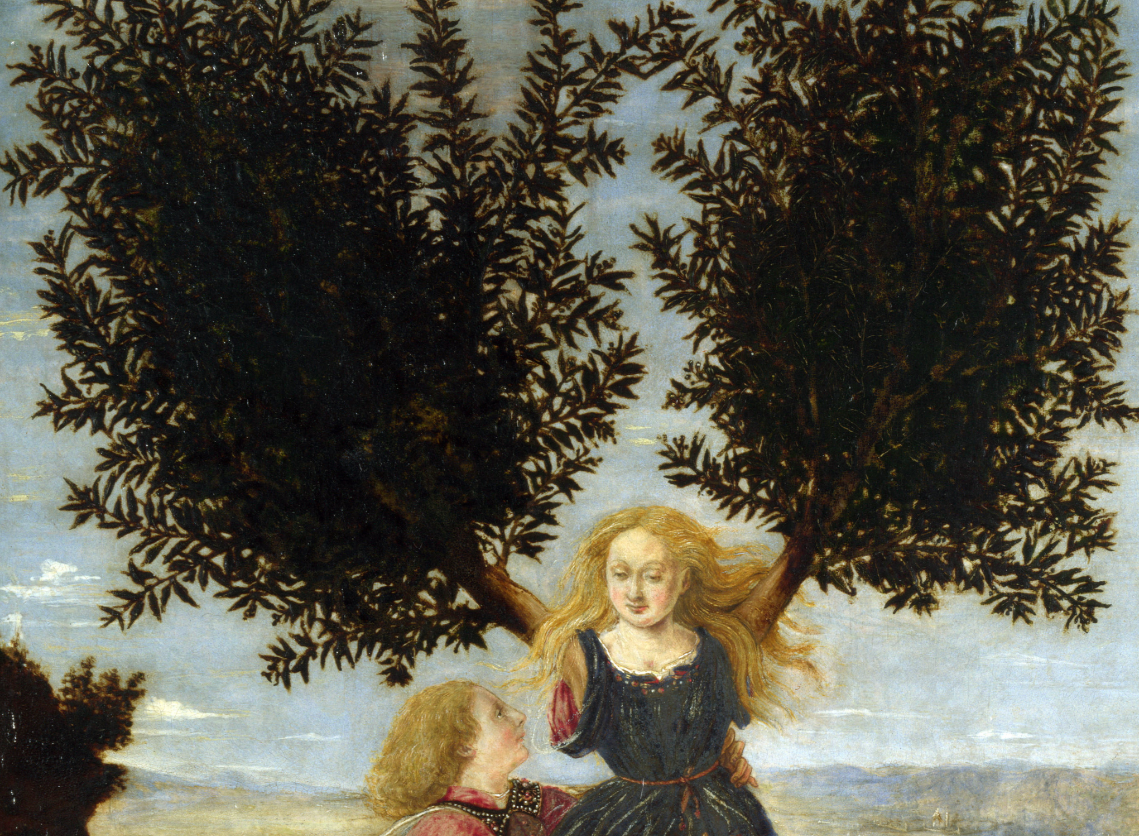
Daphne Airmont, Runaway Cheese Heiress: an early MacGuffin or possible red herring to look out for. One of many, many of Pynchon’s female characters on the run.

Detail from Apollo and Daphne by Pollaiuolo, c. 1470–1480

(Parenthetically, I suppose, because it’s of such minor note, but there’s a mention of one “Zbig Dubinsky” — surely, Shirley, a minor character? — but the name seems to echo the Coens’ film The Big Lebowski.)


“Getting sentimental, kid, better watch ’at, once.”

A warning from Hicks to his protege Skeet Wheeler, a “flyweight juvenile in a porkpie hat.” We’ll see more of Skeet’s apparent sentimentality when he pockets a ball bearing from an exploded REO Speed Wagon. The line would be a throwaway for me, except that it is the first instance of the word kid in the novel. We see it pop up frequently in several forms, including kidding and kiddies. In Ch. 1, Skeet refers to his snub nose service .32″ pistol as a “Kids’ Special.” We learn that Skeet is tapped into the kid underworld—drifters, truants, and guttersnipes, newsboys at every corner and streetcar stop—who in turn have antennas of their own out.” The system of littler kids reporting to bigger kids, etc., reports Skeet to bigger kid Hicks, is “like Mussolini.” (Hitler will show up soon.)


“‘…New watch, I see.’

‘Hamilton, glows in the dark too.'”

The first of (by my count) four specific references to things that glow in the dark. I’ll remark on them in turn, but the other three are Hicks’s hair gel (Ch. 3), a jello salad served at the Velocity Lunch diner (Ch. 5), and a pair of novelty vampire fangs (Ch. 7).

In Pynchon’s books, and in particular in Against the Day and Mason & Dixon, there is a concern with the invisible world, which might be taken as the metaphysical world, or, the supernatural-but-not-baloney world. Perhaps these novelties that glow in the dark point in that direction?


Chapter 2 begins at the crime scene, the scene of an exploded bootlegger’s hoochwagon (the aforementioned REO Speed Wagon).

The “kid” motif develops with references to “Federal kiddies that nobody’s ever heard of,” “Chicago Latin kids, and “German storm kiddies. A page or two later soda jerk Hoagie Hivnak (of a certain “adenoidal brashness”) laments that his Ideal Pharmacy “was no place for kids, the words ‘soda fountain’ would send mothers all over town into fits, worse than ‘opium den.'” No more coke in the sodas for the “Leapers and sleigh riders” to enjoy.

Hoagie moves the plot forward, telling Hicks to “Track down Bruno Airmont wherever he’s got to.”

Chapter 3: We meet Hicks’s special lady, April Randazzo. She’s a femme fatale, folks, a singer-dancer making the late night speakeasy scene. Hicks and April seem like a suave match, but we learn that she has a fetish for married men: “A gold-accented ring finger has the same effect on April as a jigging spoon on a Lake trout, especially when kept on while kidding around, good as a framed copy of a marriage license hanging up on a love-nest wall.” 

Note the kidding around there; perhaps Pynchon teases kidness as the illusion of a romanticized time of faux-innocence, an idealized (and ironized) notion of primeval purity. “Any town but this one / Couldn’t we be kids again” croons April in “what’s gotten to be her trademark ballad, backed by a minor-key semi-Cuban arrangement for accordion, saxes, banjo-uke, melancholically muted trumpet.”


Oh and before I forget, our glow-in-the dark fetish for this episode is delivered from Hicks’s “hip flask from which he pours not hooch but some slow green liquid, rubs it between his hands, runs both hands through his hair as an intensely herbal aroma fills the room…” (21). Hicks attests that his hair jelly “Lasts for days, glows in the dark” (21).


(Parenthetically–we get our first two Pynchon songs in this chapter, one from Hicks and one from April (as cited above.) The chapter ends with Hicks getting nudged again, this time to visit his Uncle Lefty, a retired cop.)


Chapter 4 starts at Uncle Lefty and Aunt Peony’s house. They, sorta, raised Hicks; like his protege Skeet (and every other hero), Hicks is an orphan.

Uncle Lefty has prepared a special “Surprise Casserole [in which] Hicks can detect sport peppers, canned pineapple, almost-familiar pork parts marinated in Uncle Lefty’s private cure, based on wildcat beer from a glazed-crock studio just across the Viaduct.” Here, a pineapple is a pineapple. But it can still be part of a surprise.


Uncle Lefty’s name is a bit ironic. He opines: “Der Führer,” gently, “is der future, Hicks. Just the other day the Journal calls him ‘that intelligent young German Fascist.’ ”

Aunt Peony is more sympathetic. We learn that her words have taken on an edge as her marriage advanced, “as if some maidenly spirit, searching and pious, has set out on a trip Peony has no plans herself to make, toward a destiny quietly lifted away from her when she wasn’t looking.” Unlike Daphne (and April?), Peony failed to make her escape in good time.


We learn of Hicks’s fresh-out-of-school job as a strikebreaker. This job would generally make him on the wrong side in Pynchonian terms, but the novel extends some heartstrings his way, pulling him over to the light. Hicks, it seems, would not turn a Pinkerton villain the likes of which Pynchon castigated in Against the Day. His road to Damascus moment happens when his “lead-filled beavertail sap” disappears before he can decimate a striking “truculent little Bolshevik.” The metaphysics of this disappearing object has a profound effect on our hero.


A bit later in the chapter, Boynt offers a through-a-glass-darkly description of Milwaukee, Cream City USA, evoking, “Hitler kiddies, Sicilian mob, secret hallways and exit tunnels, smoke too thick to see through, half a dozen different languages, any lowlife thinks they can turn a nickel always after you for somethin, there’s your wholesome Cream City, kid, mental hygiene paradise but underneath running off of a heartbeat crazy as hell, that’s if it had a heart which it don’t.” 

There’s the invisible world, but it might sometimes glow in the dark.


Chapter 4 segues into Chapter 5; Uncle Lefty tells Hicks to talk to ex-vaudeville mentalist Thessalie Wayward. They meet at Velocity Lunch, a cafe where “Today’s Special [is] a vivid green salad centerpiece the size and shape of a human brain, molded in lime Jell-O, versions of which have actually been observed to glow.” Hicks is hoping to learn more about the metaphysical disappearance of his beavertail sap–what divine hand intervened to prevent his killing another person?

Thessalie teaches him about ass and app: “Asported. When something disappears suddenly off to someplace else, in the business that’s called an asport. Coming in at you the other way, appearing out of nowhere, that’s an ‘apport.’ Happens in séances a lot, kind of side effect. Ass and app, as we say.”

After some speculation on this “unnamed force,” Thessalie sends Hicks out again, this time to “Talk to Lew.”


That Lew, as we see in Chapter 6, is none other than Lew Basnight, one of the many heroes of Pynchon’s opus Against the Day (which, so far, Shadow Ticket feels very much akin to). Lew’s chapter is beautiful, short and sweet, a kind of elegy for Western phantasia. He was already late to the Manifest Destiny goldrush: “Didn’t even get out there till late in life, after years of dancin the Pinkertonian around what only a couple of old-timers were still callin the Wild West anymore. Hell, I’m ready to go back…”

Pynchon then extends Lew’s fantasy of returning to a mythical Old West via “lucid dreaming… flown in from strange suburban distances, past radio antennas and skyscrapers, down the gloomy city canyons, skimming echo to echo, banking into the Dearborn station, flown invisible, ticketless, right onto the Santa Fe Chief. And away. Away, so easy…” An escape from the Modern world. Invisible, ticketless–that’s the fantasy.


Lew’s episode ends with a warning to Hicks not to become “another one of these metaphysical detectives, out looking for Revelation.”


In Chapter 7, Hicks takes his (his?) gal April to Chicago to see Dracula. April’s smitten by Bela Lugosi, and “Soon she is sending away to Johnson Smith down in Racine for a set of Glow-in-the-Dark Vampire Choppers, 35¢ postpaid.”

A paragraph later our hero is getting some bad news about his (his..?) gal April and one Don Peppino Infernacci. “April Randazzo is in fact the promised bride of evil,” we learn; Infernacci (good golly that name, Pynchon, chill) is “lord of the underworld.” 

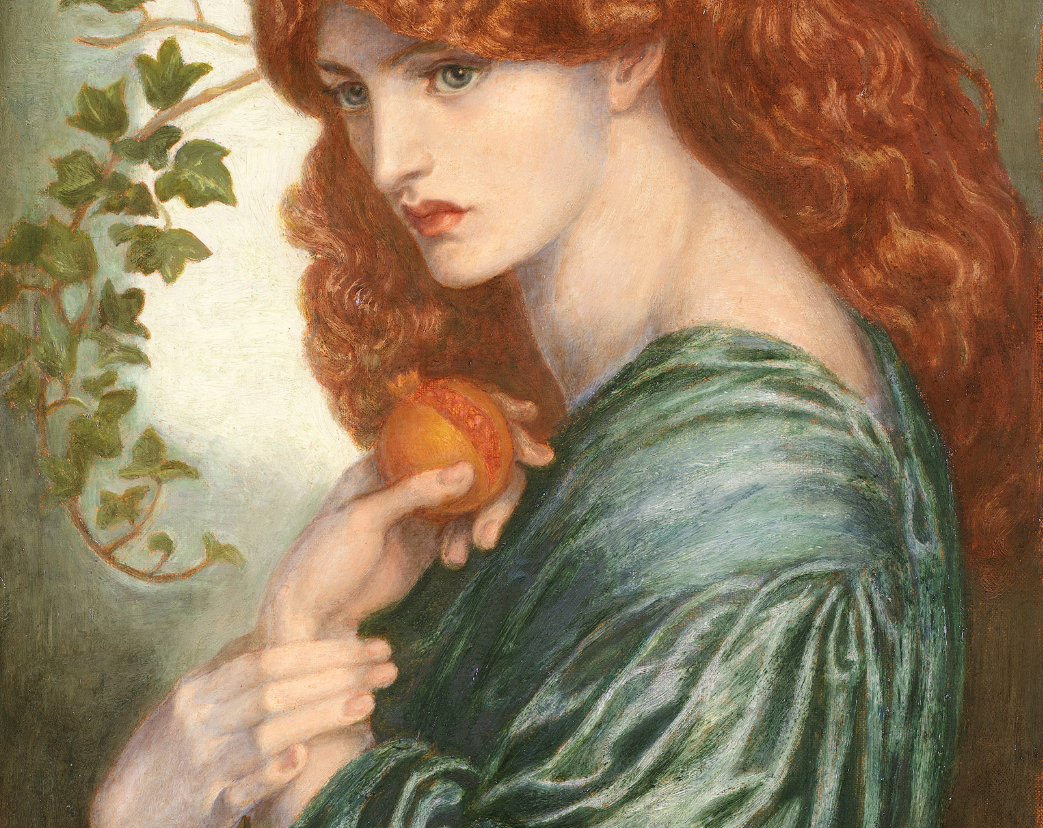
Infernacci could be Hades, but April doesn’t strike me as a Persephone. But we’ll see.

Detail from Proserpine, 1882 by Rossetti

Birthday stacks | Not really a blog about Biblioklept turning nineteen

A few weekends ago we did the take-your-kid-to-college thing, made the ninety-minute SW drive to Gainesville, FL to move our daughter into her first place on her own. She’s living in the same apartment complex her mom lived in, only under a different name. (The apartment complex has a different name. Not my daughter or wife — although I guess my wife has something of a different name, having taken my own last name up as hers.) There was some nostalgia, some weird feelings, etc. But mostly excitement, followed by backache, muscle ache, and an intense week of schlepping even more stuff around my house, cleaning, painting, refinishing, etc. as we repurposed our daughter’s room into an office and my wife’s old office into a studio space for our son.

This process displaced many many books. The house was already littered with stacks, with at least two established semi-permanent piles of incoming volumes and TBRs and etc., but somehow all the furniture relocation led to an entire bookcase heading south and west of Biblioklept World Headquarters. I culled what I could and vowed to get to the rest later. And here we are.


I started this blog on 9 Sept. 2006, nineteen years ago today. I don’t think I would have remembered this connection, even though I’ve blogged about Biblioklept’s birthday several times before, if I hadn’t heard the local sportscaster on his local morning-commute sports show give a shoutout to his wife, whose birthday is today. I thought, Oh, that’s Biblioklept’s birthday too.


(The local sportscaster’s wife is his second wife, or maybe third, I’m not really sure. But he used to be married, way back in the gay nineties, to the news anchor. They were our little big town’s version of a celebrity couple, maybe. (I remember I took a date to Barnes & Nobles and then the Chili’s by the Barnes & Noble — these places are long gone — and I saw the sportscaster and his anchor wife bickering in the Chili’s parking lot before I ate fajitas or whatever.) The sportscaster’s news anchor wife had an affair with the weatherman, a bold blond surfer specimen who frequently wore suspenders on air. This affair was something of an open secret, and I think some of the people involved were fired, or shuffled to different networks. It’s like the most low rent version of prime Fleetwood Mac you could imagine.

Anyway, the anchor and the weatherman are still married. He still does the weather and she’s the mayor of the city now. Her ex covers local sports on TV, the web, and the radio. I listen to his show in the mornings as a diversion from reality. It’s not very good, but it’s better than the complacent centrism of NPR. I haven’t been able to listen to music on morning drives in decades (I would have to pull the vehicle over and weep); I cannot follow audiobooks or even podcasts in the mornings; I take the inane meaningless chatter for aural breakfast. Today was the sportscaster’s current wife’s birthday. And Biblioklept’s.)


So well and anyway, I thought, I should do some kind of birthday post for the blog. So again, here we are. (Or maybe you have wisely left by this point.)


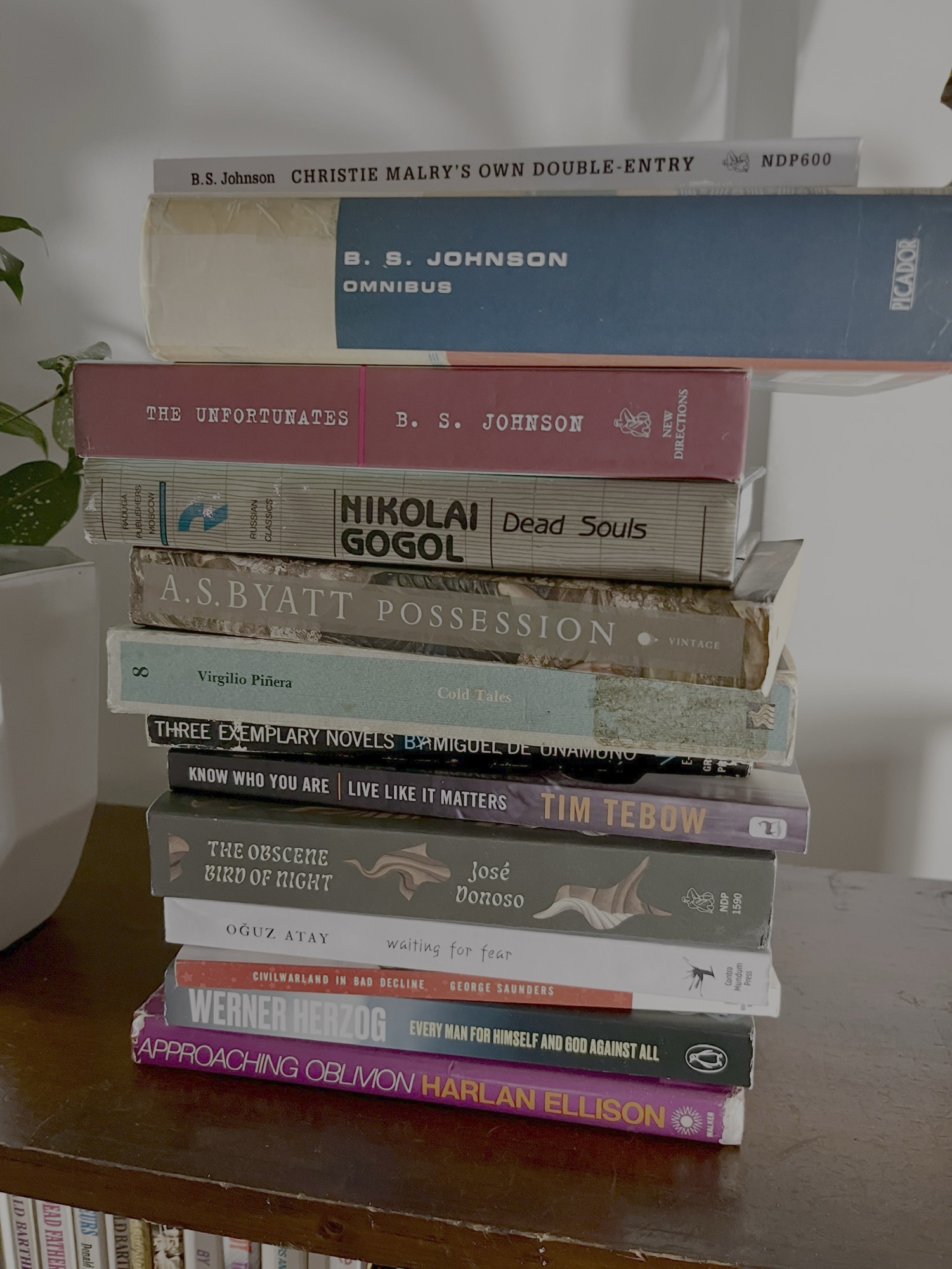
How about those promised stacks, those totem poles that keep getting moved from room to room? Here’s one:

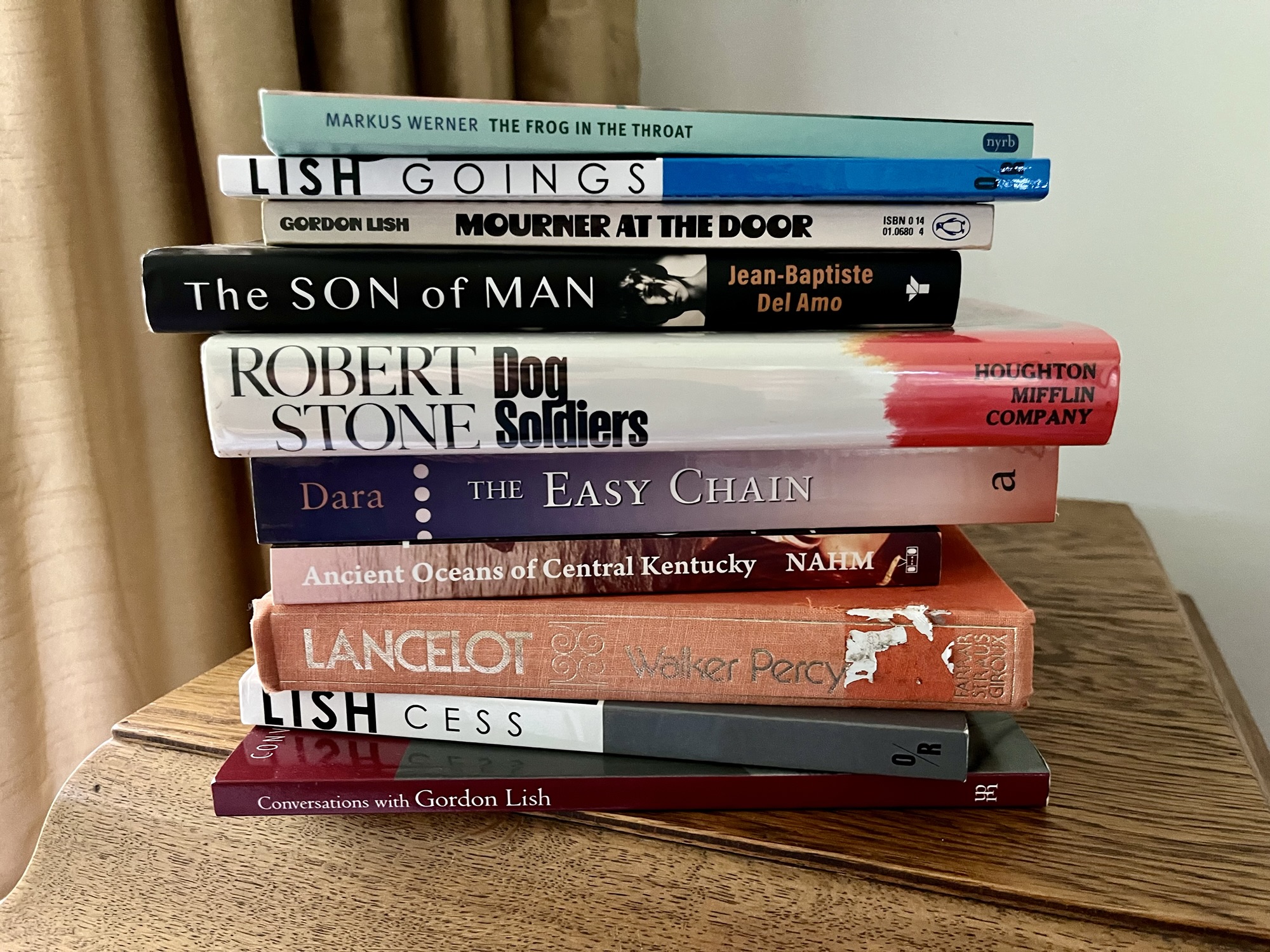
What these books have in common is that some of them used to be in a bookcase that is now in Gainesville and I don’t know where to put them. All the B.S. Johnson books came from a B.S. Johnson jag I went on a few years ago, and they ended up tucked away — can’t stick them on the shelf of American postmodernists, right? And Christie Malry’s Own Double-Entry? What an amazing novel? How have I not reread it. I got the Tim Tebow and Werner Herzog books for Christmas and I read them both. José Donoso’s The Obscene Bird of Night is maybe my richest reading experience of the past year.


Here’s another picture of a stack of books:

I got another copy of Woolf’s Mrs Dalloway a few weeks ago, which I think led to me pulling out some Woolfs (Wolves?); everything else here seems random, chaotic, emblematic maybe of my self-disgust—what am I doing with all these books? Of course I want to own a hardback first of Angela Carter’s Wise Children, even if I can’t find a proper home for it, right? And why wouldn’t I snap up every Alasdair Gray novel I come across? I think all these Evan Dara books were stacked up in the same missing bookcase that the B.S. Johnson books were stacked in; now they are loose, reminding me of the novelist’s diminishing career. Do I really need to hold on to Permanent Earthquake? The novel is terrible and the book itself is a cheaply-bound print-on-demand thing. It makes me feel sad. The Lost Scrapbook is amazing.


I was 27 when I started this blog.


What am I even doing here?


The Gordon Lish books were almost certainly smashed up against the B.S. Johnson and Evan Dara books — I think I wasn’t sure where to shelf them. I have been very mad at Gordon Lish for a few years now for reasons I promised not to divulge but which basically have to do with his being a flaming asshole. I finished Markus Werner’s novel The Frog in the Throat a week ago and the ending made me tear up. It’s a novel about aging and failure and fear; it’s very, very funny. The late great David Berman once said that Robert Stone’s Dog Soldiers was his favorite novel. I loved it and I suppose I’ll refuse to read another Robert Stone novel. (Why?)


For some years, David Berman kept Biblioklept on the blog roll of his blog Menthol Mountains. That’s like the proudest I’ve ever been of anything that ever happened on this blog. I miss him.


Last stack — not really the last stack, there are at least three others, but I’m getting tired of this, in several senses:

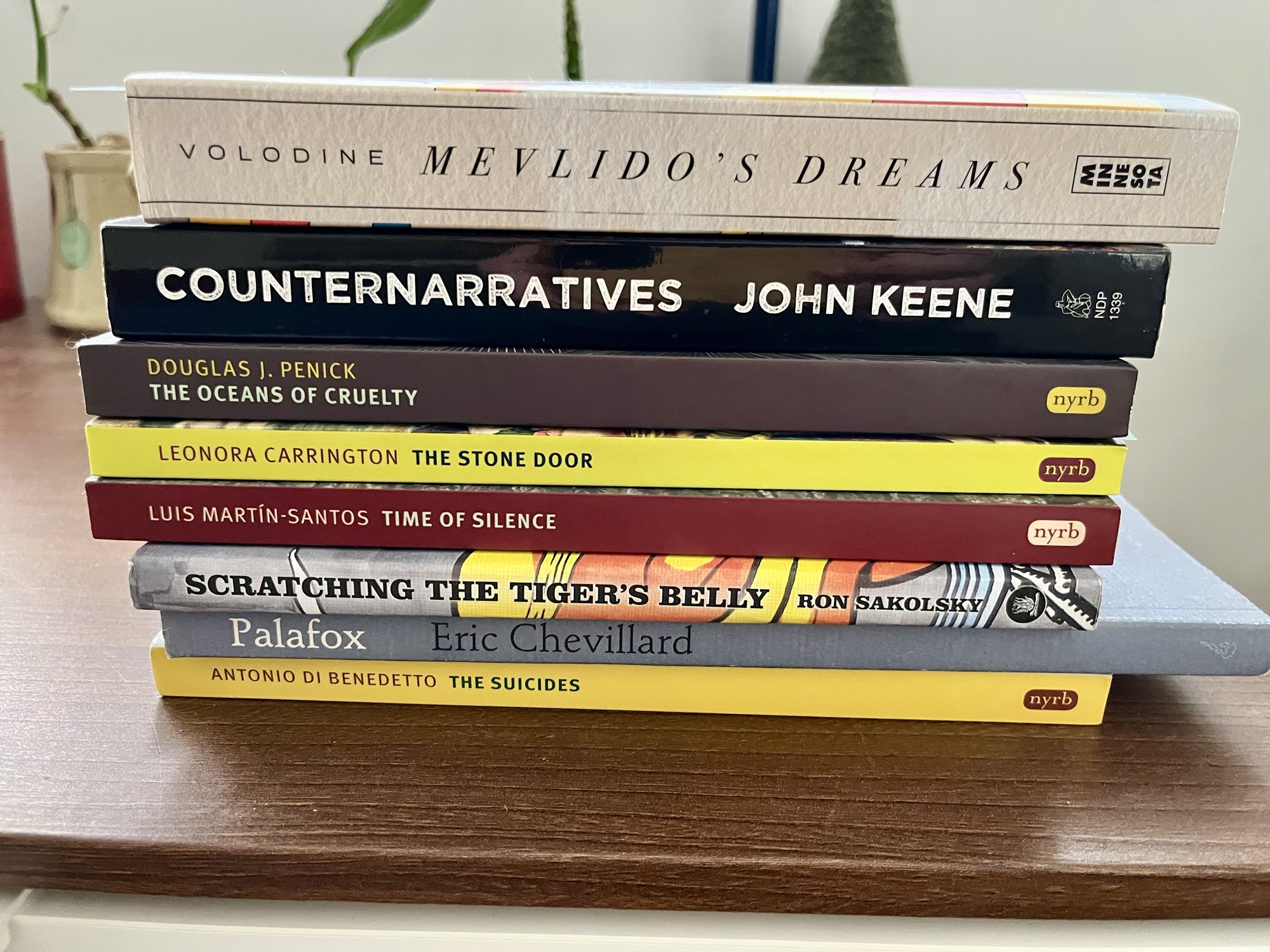
John Keene’s collection/semi-novel Counternarratives is one of the best things I’ve read in forever. He refracts history through these layered polyphonic fictions that pull truth from the margins. My favorite piece in the collection reads like a riff on Melville’s Benito Cereno. I read Leonora Carrington’s novel The Stone Door, realized I misread it, then read it again. I have about four tabs open attempting to properly review it, but alas! I don’t know. I keep failing to find a grip into Di Benedetto’s The Suicides; maybe it’ll take soon. I started reading Antoine Volodine’s Mevlido’s Dreams around 12:30am this morning. It’s much funnier so far than I would have imagined. I’d mislaid the novel maybe a year ago; it was in a pile in the back of a bookcase that is now south and west of here.


I don’t have a way out of this post. I’ll do this blog at least one more year. Odysseus did twenty years, right? That’s a ridiculous stupid fucking sentence, the previous one.


This summer has been the weirdest one of my life, but it’s over now, right?

Blog about recent (non)reading

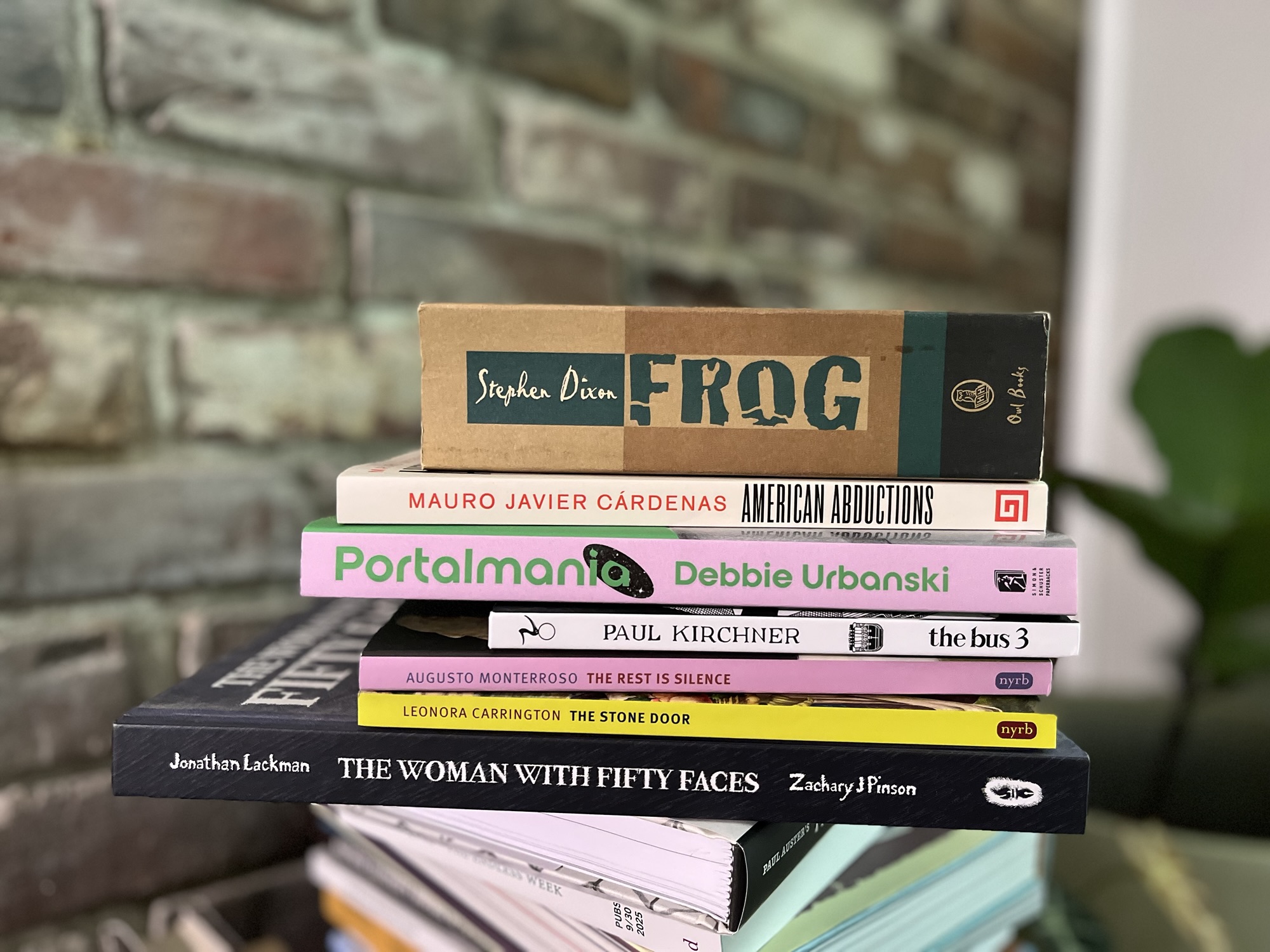
I read one novel in May 2025, the historical graphic biography The Woman with Fifty Faces: Maria Lani and the Greatest Art Heist That Never Was, by Jon Lackman and Zack Pinson. I think it was the only book I’ve read in full in the past two months. It was excellent and I owe it a full review.

I’ve read so so so many Wikipedia pages lately, tunneling down there almost every night (even all night) over the last six weeks. Last night I think I started, for some reason I can’t recall, on Julia Lennon’s page, maybe around eleven pm, and a few hours later I was reading about the visual systems of cuttlefish (this is when my wife woke up and told me to go to sleep). I didn’t start Leonora Carrington’s The Stone Door and I didn’t finish Augusto Monterroso’s The Rest Is Silence, even though they were on my cute little night stand.

I read a big chunk of The Rest Is Silence last Monday at the beach. I took my son and his friends there; despite their claims to being “goth” (or whatever, false claims) they wanted to hang out all day at Hannah Park. So we did that. I walked for a few miles and then discreetly drank a carton of sauvignon blanc and almost finished The Rest Is Silence and then promptly forgot all of the feeling of having read it, having replaced that feeling with the blazing Florida heat (a heat obscured by a heavy gray Atlantic breeze). There was a camp of young musicians wading in the water. I don’t know how I recognized them as teenage musicians, other than years of recognizing such persons in public — the same way I can recognize, say, college football coaches out for barbecue on a Saturday afternoon or late Friday. Some people just look like some people. I chatted with one of the music camp coaches. A lot of these kids hadn’t ever been to the ocean, he assured me, which he didn’t have to. Their movements against the waves showed it. I’m sure they are all graceful with their chosen instruments. Like I said, the slim novella was gone. The sand covered it over (this is a stupid metaphor; I am all rotten inside lately).

I have also not finished Paul Kirchner’s The Bus 3, mostly because I wanted to not finish it, to save it for a different shade of my disposition that is sure to arrive any day now. I love what Paul Kirchner has done, and I have never felt the strips whimsical; or, rather, their whimsy struck me as wise, a sharper whimsy. I’m having a hard time laughing lately.

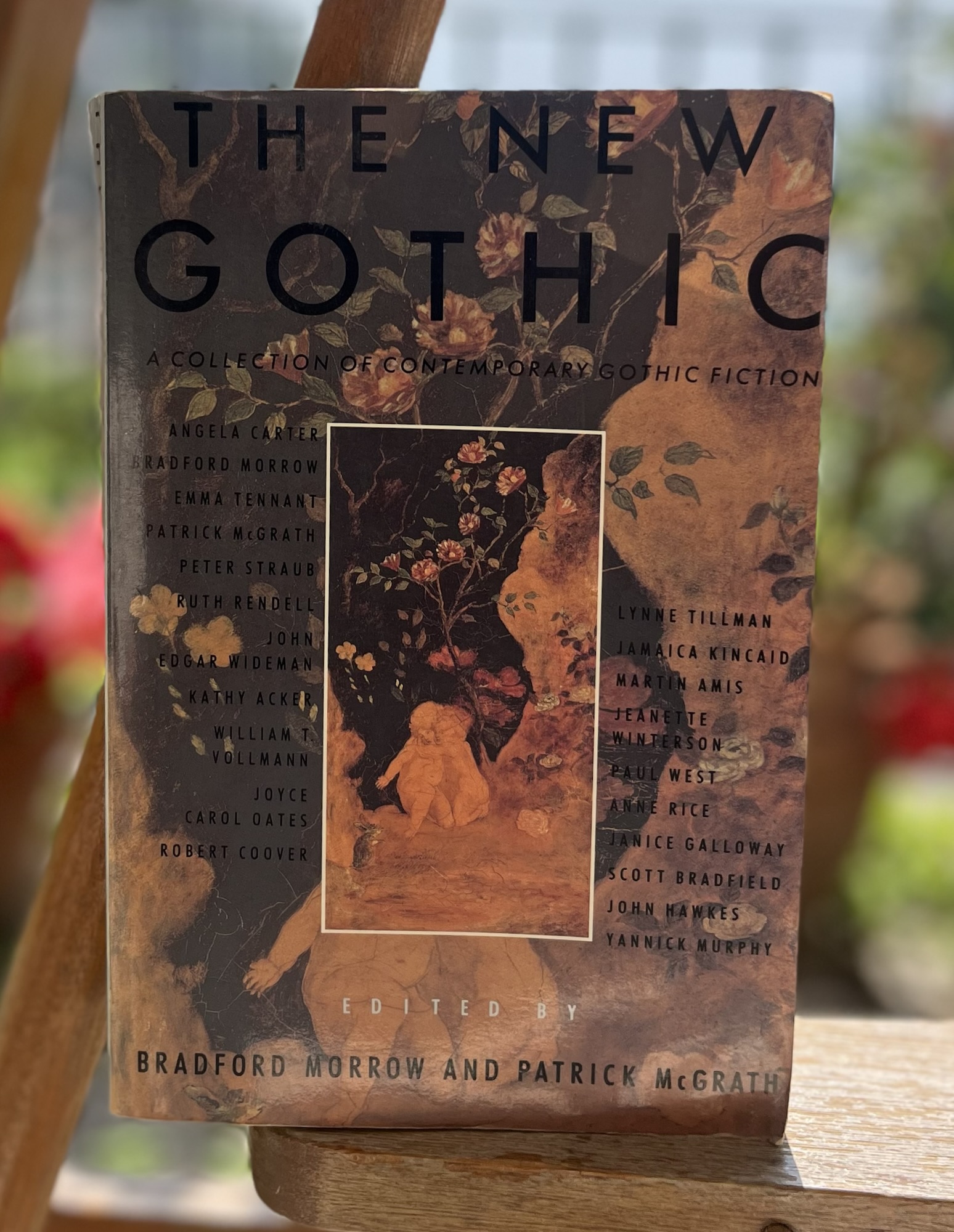
I read a big chunk of an anthology called The New Gothic about three weeks ago. It was in the house we — we my family, my wife and kids — were staying at in Minori, a smallish town in the Amalfi Coast of Italy. We spent the first fifteen days of June in Italy to celebrate my daughter’s 18th birthday and high school graduation. In a lovely little house on the side of a mountain (maybe it was a big hill, I’m a Florida boy), in a small shelf of mostly non-English language books, I picked out The New Gothic and read tales by Coover, Carter, Vollmann and others. The book is a love letter to Poe, really, with a wonderful introductory essay by editors Bradford Morrow and Patrick McGrath.

The story that really stood out though was Lynne Tillman’s “A Dead Summer.” This particular paragraph made me cry:

The Mets were doing better, but with so many new players on the team, she didn’t have the same relationship to them. Her dead friend had loved the Mets too. Sometimes she watched a game just for him, as if he could use her as a medium. She was sure his spirit was hovering near her, especially at those times. But she did not speak of this to her boyfriend who was talking about breaking up. That night she let him gag her. She didn’t have anything to say anyway, not anything worthwhile. She read that the Ku Klux Klan had marched in Palm Beach.

The story is about grief and bad dreams set against a terrifying American political backdrop. The notion of witnessing something so that one’s dead friend might use your eyes as a medium is what did me in. I’ve had such thoughts a few times in the last two months after my best friend died unexpectedly, moments where I thought I might somehow channel his spirit to, say, listen to the new Pulp record. But I don’t think he’s haunting me.

(I didn’t steal The New Gothic from the house in Minori, although I thought about it for two or three minutes.)

I have almost finished reading the stories in Debbie Urbanski’s collection Portalmania (it is a “collection” but I suspect it is a stealth novel — about escapes, transitions, aesexuality, monsters, uh, portals, etc.). Review to come. (I will absolutely get might shit together, any day now.)

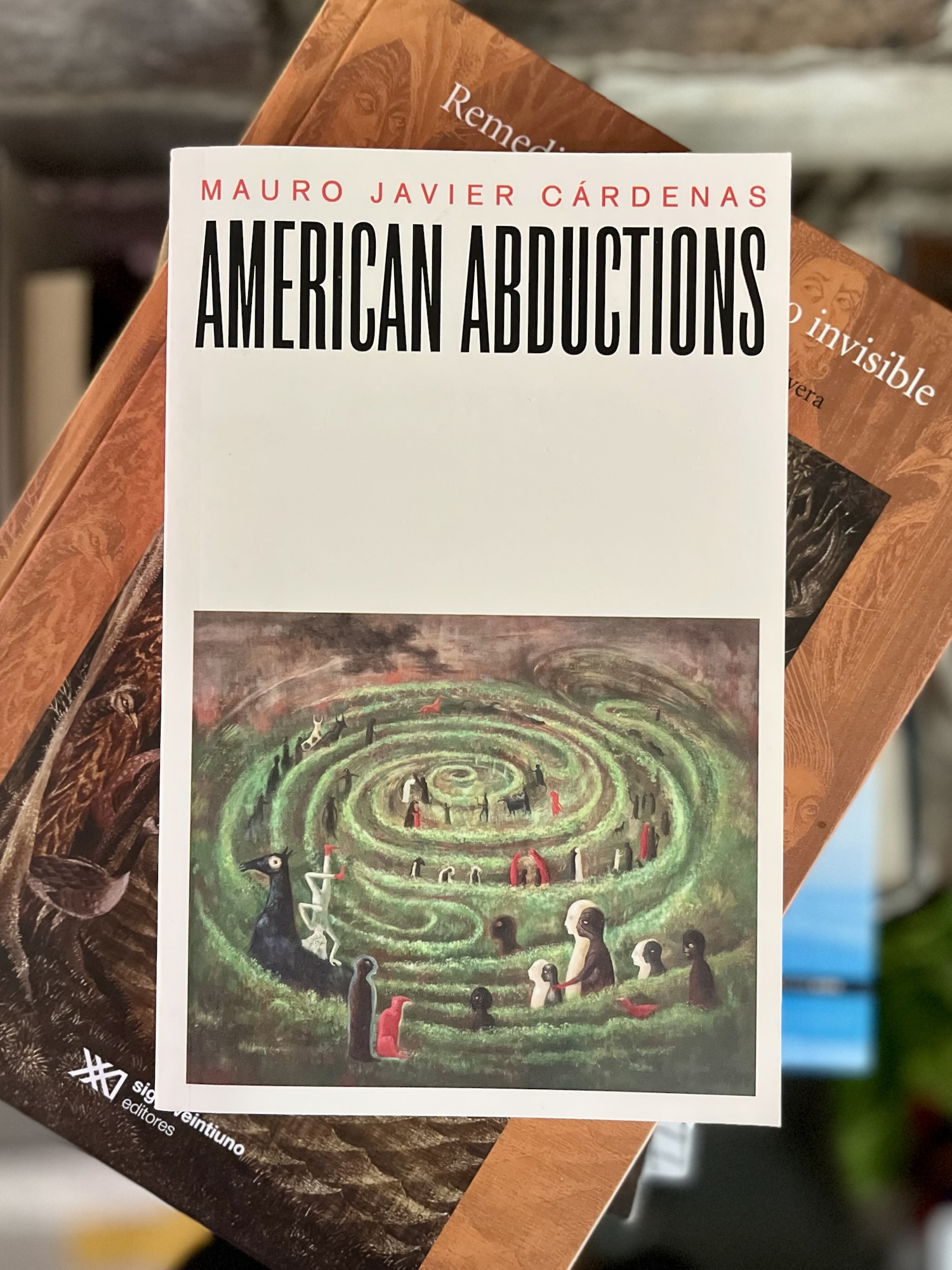
I read and reviewed Mauro Javier Cárdenas’s American Abductions back in March. It’s only in this stack — this organizing picture that I use as an outline — because it is the most timely novel in America right now. It is a novel I read, loved, and highly recommend. Its narrative power surpasses the timeliness I’ve imposed upon it.

I was, what?, maybe 200, 225 pages? into Stephen Dixon’s massive novel Frog before I abandoned it. I was really loving it, its tics, repetitions, its noisy monotonous howl, its droll jabs at normal fucking people. It could have been one of my favorite novels ever, I think, but I’m not sure I’ll ever wade back in. I tried a few times, but it’s all enmeshed with some bad intense feelings I felt in early May.

Which is what? I guess? another way of saying that reading is just a series of feelings for me now. Maybe at some point I thought of reading novels as an intellectual exercise, and maybe at one point I turned that into an ideal of an aesthetics of reading — but I don’t care about any of that shit now.

I believe in reading for

pleasure

pain

other feelings, in between and otherwise.

Statements of missingnessness | On Mauro Javier Cárdenas’s prescient novel American Abductions

Mauro Javier Cárdenas’s American Abductions is a novel of relentless, layered consciousness, its immersive, labyrinthine sentences pulling the reader into a fugue of voices, memories, and anxieties. American Abductions takes place in a proximal version of the United States, a digital carceral state where palefaced goons kidnap Latin Americans. Sometimes the abductees are deported; sometimes they are disappeared. Sometimes they tell stories.

The dystopia here is hardly a YA world-building exercise full of hope and heroics. Instead, the novel moves through fragmented, fevered perspectives, primarily those of sisters Ada and Eva their disappeared father, Antonio, a novelist abducted by the Pale Americans, the faceless bureaucratic enforcers of this new regime. The novel oscillates between Ada and Eva’s attempts to reconstruct what happened, Antonio’s own recursive, metafictional writing, and interjections from various other voices—family members, interrogators, digital surveillance logs—until the narrative itself becomes a reflection of the fragmented reality the characters are trapped within.

Yes, American Abductions is bleak, but it is not merely dystopian horror. Cárdenas builds his world through a dizzying interplay of language, wielding the long, unspooling sentence with the precision of Bernhard, Krasznahorkai, and Sebald. Each chapter is a single winding comma splice that careens from realism to surrealism. Cárdenas’s run-ons layer and loop back on themselves, rhetorically mirroring the characters’ attempts to make sense of their unraveling world.

The book moves forward with an absurdist energy that resists despair, its rhythms and repetitions building not just a critique of authoritarian power but something stranger, something more human—an exploration of consciousness itself, an attempt, perhaps, to make a grand “statement of missingnessness,” to borrow one of the character’s phrases.

The effect is hypnotic, dreamlike, sometimes nightmarish, but often, surprisingly, very funny. There is a dark, absurdist humor in the way bureaucratic jargon collides with intimate grief, in the way digital surveillance reports are laced with banal observations, in the way Antonio’s own metafictional writing seems to both clarify and obscure the truth of his disappearance. The novel is not just about authoritarian violence but about how language itself is manipulated under such regimes—how it obfuscates, justifies, betrays, resists. At times, American Abductions reads like a political thriller rewritten as a fever dream, at others, like a linguistic experiment that spirals into a meditation on memory, exile, and state terror.

American Abductions is not just unsettlingly prescient. Rather, it obliquely underscores the U.S. surveillance state’s direct lineage to Latin America’s Dirty Wars. Governments systematically disappeared those deemed threats to the state—intellectuals, activists, ordinary people unlucky enough to be caught in the wrong place at the wrong time. Cárdenas’s dystopia does not just critique contemporary American immigration policies; it situates them within a long history of state-sanctioned violence in the Americas.

The novel’s themes take on chilling immediacy when considered alongside the real-world abductions of those who speak truth to power, like Mahmoud Khalil and Rumeysa Ozturk. Indeed, the disturbing video footage of Ozturk’s kidnapping by masked men this week has gone viral, echoing the opening of American Abductions, wherein we learn that Ada has captured “that moment when the American abductors captured her father as he was driving her and her sister to school, which she recorded on her phone.” Ada’s video goes viral, mutates, becomes its own beast:

…and later, after her father had been captured and hundreds of thousands of people around the world were watching her video of her father asking what have I done, officer, the supervisory official probably watched it too and left an anonymous comment below it that said ice / ice baby great job ICE, illegal is illegal and wrong is wrong bye you forgot the crybaby in the backseat, for years Ada arguing in her mind with the thousands of messages berating her and her father, even after she discovered some of the comments had been manufactured by bots controlled by a Pale American in Salt Lake City — twelve million to go please continue to remove the illegal alien infestation — except the comments by Doctor Sueño, of course, which made no sense to anyone but her, just as it made no sense to anyone but her to feel, for no more than a few seconds, proud that the supervisory official of the supervisory official of the supervisory official in an agency building had taken time out of his busy schedule to focus on her father — if enough time passes, Doctor Sueño says, even the most preposterous possibilities will navigate the sea of your mind — cry like an eagle / to the sea — just as it made no sense to anyone but her to laugh at some of the videos her video had spawned for instance the video of her video but with sappy music instead of her sister politely asking the abductors where were they taking her father, as if someone figured hey no one’s going to feel sorry enough for you people let me add sad violin music to the video of your father saying I’ve done nothing wrong, officer, or how about the video from a self proclaimed irreverent news organization from China that, via computer animation as if from an obsolete video game, replicated the trajectory from her house to the sensitive location as if it were a car chase, the abductors rushing to drag her father out of the car as if it were a drug bust, the video game representation of Ada recording her father’s capture with her phone from the backseat of the car, waterfalls of tears surging from her eyes, no not waterfalls, more like someone’s comical representation of lawn sprinklers superimposed on the eyes of the video game representation of me…

Apologies if I’ve let the run-on run on too long — but you’ll have wanted a taste of Cárdenas’s style, no? His sentences, unbroken and unrelenting, mimic the inexorability of history itself—cycles of erasure, resistance, recovery, and repetition. American Abductions is not just a novel about the present; it is a novel that recognizes the past has never ended. Its characters, trapped in linguistic torrents of grief and absurdity, seem painfully aware that history is repeating itself. And yet, as despairing as that recognition might be, American Abductions refuses to be silent. It makes its “statement of missingnessness” loud, insistent, impossible to ignore, resisting erasure, demanding we listen. Very highly recommended.

A run-on sentence on Gabriel García Márquez’s delirious novel The Autumn of the Patriarch

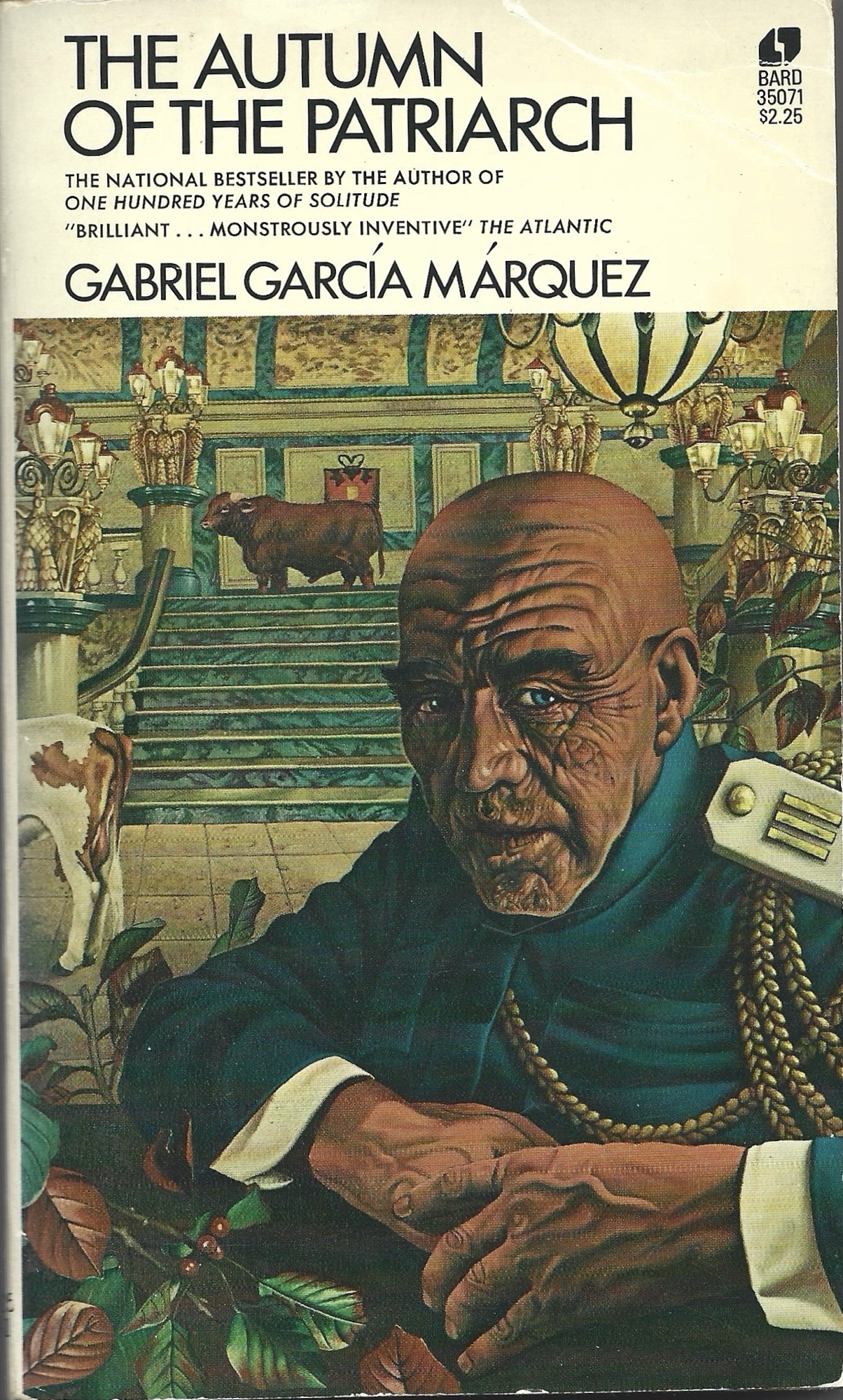
Gabriel García Márquez’s The Autumn of the Patriarch isn’t so much a novel as it is a delirium, a swamp fever, a sun-bleached hallucination stretched across centuries, a beast that coils and uncoils, bloated with its own rot, a thing that does not begin or end but only festers, looping back on itself in great, heaving tides of unpunctuated or undepunctuated or mispunctuated thought, García Márquez dragging us under, drowning us in the mind or minds of the titular dictator, a paranoid consciousness so swollen with its own power that it warps reality itself, a man who reigns forever and is always dying, whose past rewrites itself with every breath, whose power is infinite and yet always slipping, slipping, slipping through his fingers like the stolen sea, parceled off and shipped to Arizona, because why not, because what is truth if not what he declares it to be, because when you have lived for centuries, when your general is served up at a Thyestean feast, when your nation’s children are disappeared to an island, never to return, when the cattle are branded with your mark, when the very hour itself is subject to your whim, then nothing is real, nothing but the fear, the violence, the rape, the predation, the endless grinding machinery of power that must sustain itself, and so we cycle, we spiral, we convulse through six sections, six deaths, six endless iterations of his reign, six grotesque confirmations that absolute power is an ouroboros swallowing its own tail, devouring itself, erasing itself, until nothing is left but the silence of his ruin, the empty palace where his corpse will be found again and again, where his legacy is nothing but absence, and translator Gregory Rabassa—mad saint, linguistic necromancer—renders it all in English without breaking the spell, his translation a relentless incantation that doesn’t just mimic the novel’s crushing, hypnotic cadence but becomes it, suffocating, pressing, forcing you to inhabit the mind of this eternal, rotting god-tyrant, this cosmic mistake, this doomed and doom-dealing beast whose power, no matter how total, will crumble, will fade, will rot, will vanish into nothing, just like everything else.

Blog about some recent reading

What an interesting few weeks it’s been! Here’s (some of) what I’ve been reading so far this year:

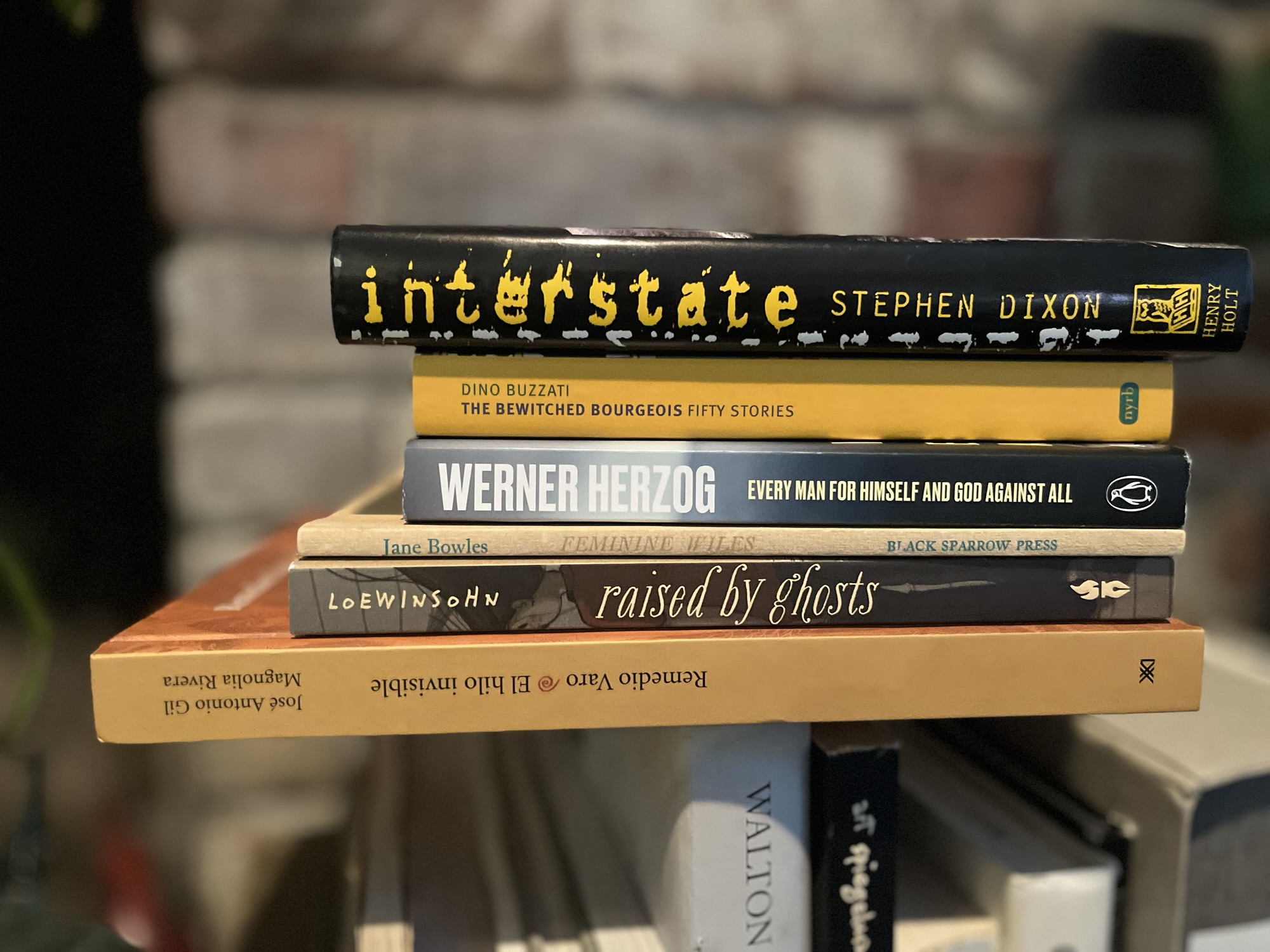
I’m in the middle of Stephen Dixon’s novel Interstate. It is a devastating, ugly, addictive, beautiful novel; I have no idea if it is “good” or not but I love it. I can’t really think of a single person I know (in real life) I could recommend it to. We played cards with some friends and one of them asked about what I was reading, and I said a novel called Interstate by this guy Stephen Dixon, and she asked of course What’s it about? and I said something, Well, this guy’s driving on the interstate with his daughters and two guys in a van pull up along side him and start shooting at them, killing his younger daughter–this happens in like, the first few paragraphs–and then we see how this event destroys his life–but then Dixon repeats the initial scenario like seven more times with different (but all really tragic so far) outcomes–and it’s written in this addictive vocal style that might be really off-putting to many readers, and it also makes really fascinating use of the coordinating conjunction for, which may just be a verbal tic –and it’s also really funny at times? I am not trying to sell this novel to anyone but I love it.

My reading experience of Briana Loewinsohn’s graphic novel Raised by Ghosts was kinda sorta the opposite of Dixon’s Interstate in that after I finished it I immediately pressed it on my wife and then my kids and then texted some of my oldest friends about it (oldest in the previous clause should be understood to modify the friendship, not the actual friend’s years–although we’re all getting older). We’re all getting older, all the time, and Raised by Ghosts provoked an aged nostalgia in me. I’m about half a year older than Loewinsohn and so much of her semi-autobiographical novel resonated with me. She gets everything right about what it was like to be a little bit of a weirdo at school in the nineties. There’s this wonderful passage on how important it was to get a handwritten note from a friend; there’s a page that’s nothing but a notebook page filled with band names; there’s a marvelous scene where our hero loses her shit watching You’re a Good Man, Charlie Brown. I should have a proper review this week or next, but great stuff. (The whole family loved it, by the way.)

I’ve been reading a collection of Dino Buzzati short stories translated by Lawrence Venuti; my technique is to read one of the shorter stories when I feel a bit of dread or anxiety from, like, reading something else. (The collection is called The Bewitched Bourgeois by the way.) I’ve enjoyed reading them, and have especially enjoyed allowing myself to read them at random instead of following the collection’s chronological trajectory. Very Kafka, very Borges, but also very original.

Not in the picture above, but I’ve also been working my way through a digital copy of Vladimir Sorokin’s short story collection Dispatches from the District Committee, in translation by Max Lawton (and illustrated by Gregory Klassen). Great gross stuff.

I picked up a collection of Jane Bowles’ sketches, letters, and other ephemera a few weeks ago–I love her stuff, but really it was that these were contained in the somewhat-rare Black Sparrow Press edition Feminine Wiles. I’m pretty sure all of the stuff here is collected in My Sister’s Hand in Mine, but I’ve enjoyed dipping into this one more. It’s slim, not bulky, but that bulky boy’s around her (My Sister’s) if I need him.

My uncle sent me a copy of Werner Herzog’s 2022 memoir Every Man for Himself and God Against All for Christmas (in translation by Michael Hofmann). I devoured the first few chapters and then a colleague hipped me to the fact that there’s an audiobook of Herzog reading his memoir (available on Spotify and other platforms) — so on my commute I’ve been listening to him read his own memoir, which is just amazing. Like fucking amazing. Hearing him say phrases like “the escapades of Christopher Robin, Winnie-the-Pooh, Piglet, and Eeyore” or that “chipmunks…have something consoling about them” is surreal. There are like fifty insane things that happen in every chapter, and if Dwight Garner of the failing New York Times attested that he didn’t “believe a word” of the memoir, I take the opposite tack. Everything is true, everything is permitted.

Finally, I can’t really say I’ve been “reading” Remedios Varo: El hilo invisible by Jose Antonio Gil and Magnolia Rivera. My grasp of Spanish cannot graspingly grasp too much of the Spanish (although my iPhone’s picture-text-translate thing works fine when I’m really curious), but the book is a lovely visual catalog of not just one of my favorite artist’s works (including many pieces I haven’t seen before), but also documents her visual influences. I picked it up at the Museo de Arte Moderno in Mexico City back in January, still floating on the high of seeing many of Varo’s lovely paintings there that afternoon.

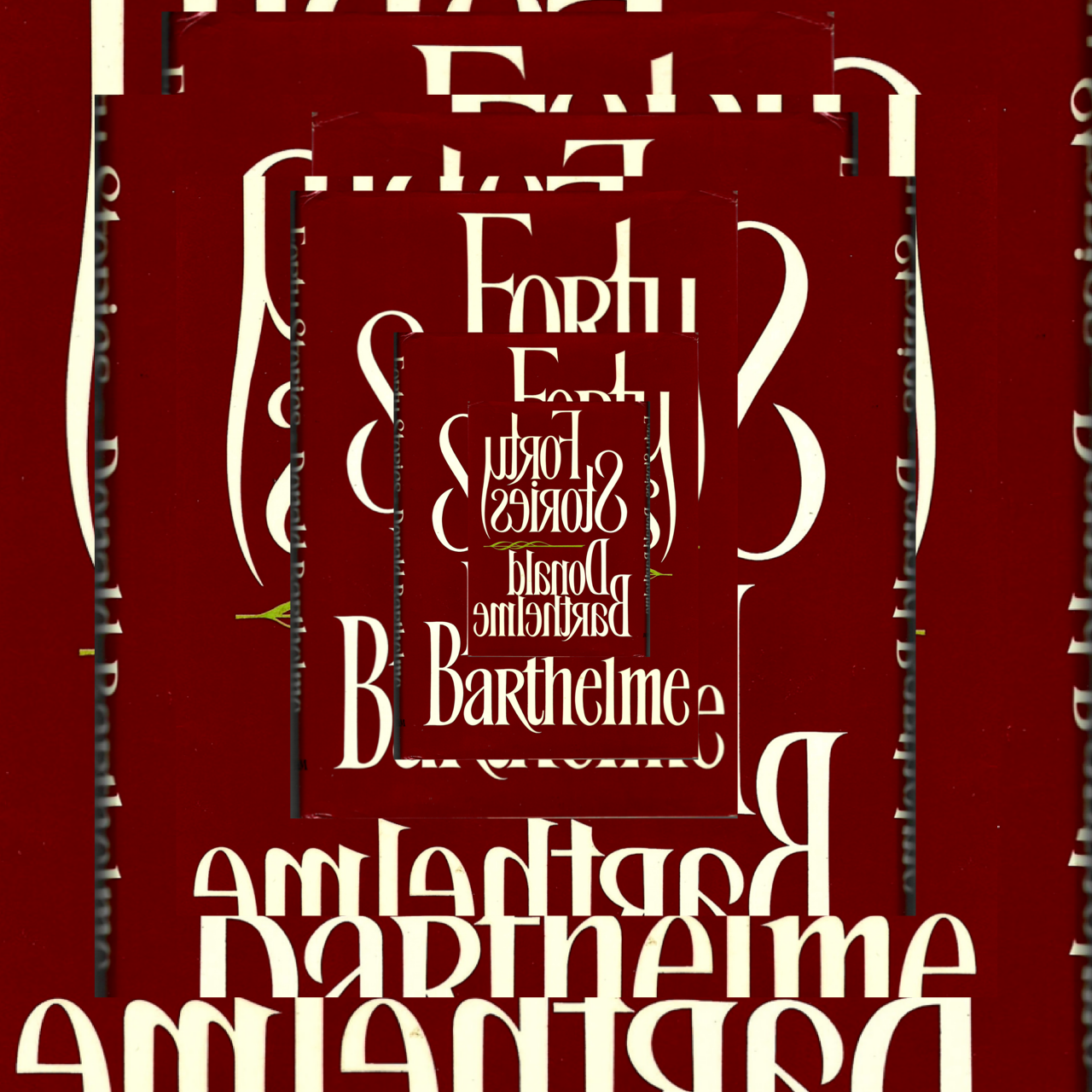
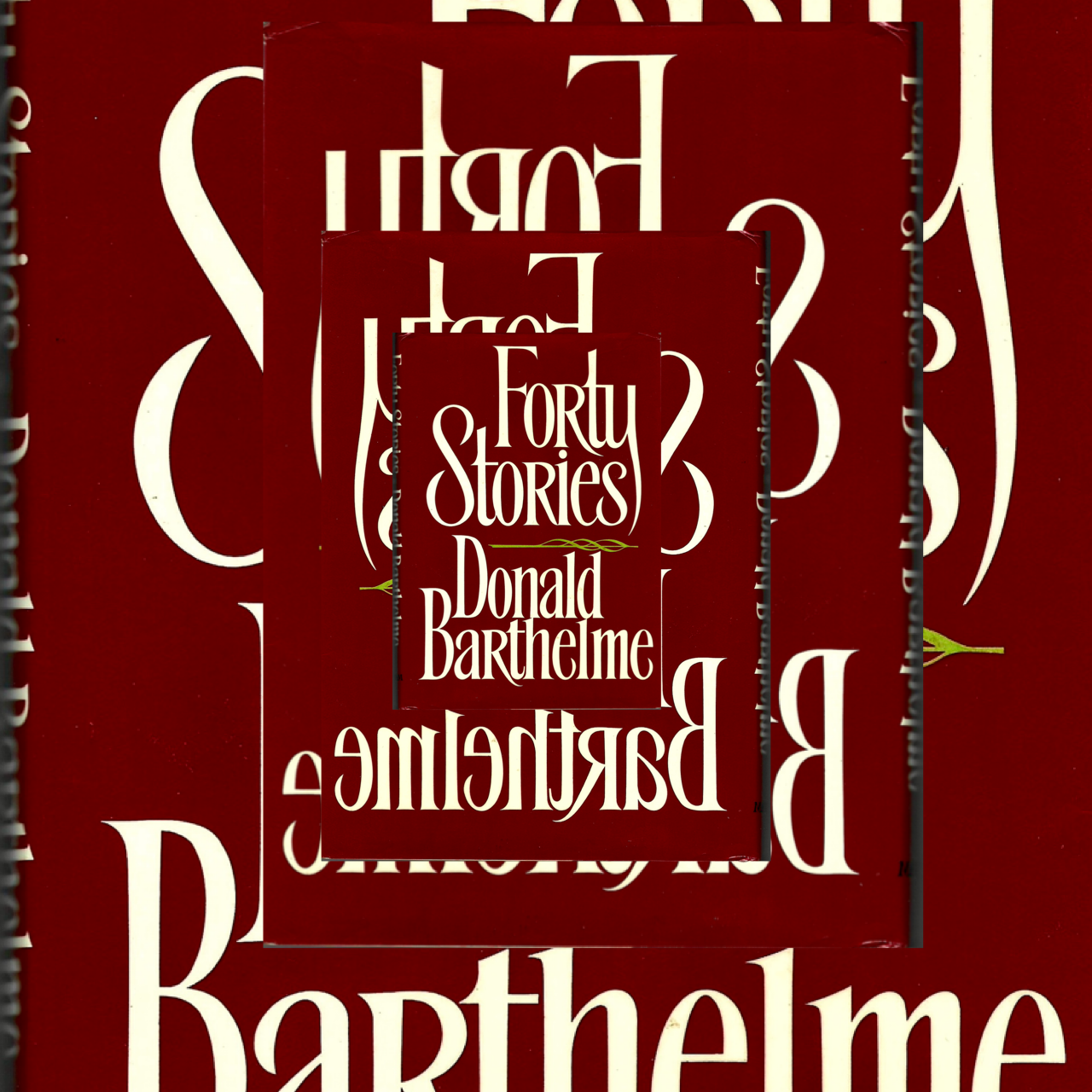
Donald Barthelme’s Forty Stories in reverse, Part IV

Previously,

Stories 40-36

Stories 35-32

Stories 31-28

27. “Some of Us Had Been Threatening Our Friend Colby” (Amateurs, 1976)

This is probably the first essential story in Forty Stories—maybe at the end of this silly project I’ll put together something like Fifty Stories, whittling down Sixty Stories and Forty Stories. Here are the first few sentences:

Some of us had been threatening our friend Colby for a long time, because of the way he had been behaving. And now he’d gone too far, so we decided to hang him. Colby argued that just because he had gone too far (he did not deny that he had gone too far) did not mean that he should be subjected to hanging. Going too far, he said, was something everybody did sometimes. We didn’t pay much attention to this argument. We asked him what sort of music he would like played at the hanging. He said he’d think about it but it would take him a while to decide.

Colby finally settles on Ive’s Fourth Symphony.

“Some of Us” showcases in a non-showy way the best of Barthelme—absurdity balanced by syntactic restraint; surreal humor weighted in the visceral specter of impending violence. It’s a very, very funny story, and while I think it resists simple allegorical interpretation, it’s nevertheless a little parcel of domestic fascism in practice. Great stuff. Read “Some of Us Had Been Threatening Our Friend Colby”  here.

26. “Pepperoni” (first published in The New Yorker, 23 Nov. 1980)

Published over four decades ago, “Pepperoni” is a depressingly prescient riff on what happens when capital decides to take over journalism. Newspapers become just another widget, a slice of pepperoni, a trifle, a nothing to sell and sell and resell:

Financially, the paper is quite healthy. The paper’s timber-lands, mining interests, pulp and paper operations, book, magazine, corrugated-box, and greeting-card divisions, film, radio, television, and cable companies, and data-processing and satellite-communications groups are all flourishing, with overall return on invested capital increasing at about eleven percent a year.

Despite the vertical integration, all is not well: “But top management is discouraged and saddened, and middle management is drinking too much.” Barthelme’s hyperbole is jaunty in 1980, where the paper’s “editorials have been subcontracted to Texas Instruments, and the obituaries to Nabisco, so that the staff will have ‘more time to think.'” But in 2024 it reads as a grim warning about the gross intersection of capital and journalism. Read “Pepperoni” here.

25. “Sentence” (City Life, 1970)

I mean what if I just…

Or a long sentence moving at a certain pace down the page aiming for the bottom-if not the bottom of this page then some other page-where it can rest, or stop for a moment to think out the questions raised by its own (temporary) existence, which ends when the page is turned, or the sentence falls out of the mind that holds it (temporarily) in some kind of embrace, not necessarily an ardent one, but more perhaps the kind of embrace enjoyed (or endured), by a wife who has just waked up and is on her way to the bathroom in the morning to wash her hair, and is bumped into by her husband, who has been lounging at the breakfast table reading the newspaper, and doesn’t see her coming out of the bedroom, but, when he bumps into her, or is bumped into by her, raises his hands to embrace her lightly, transiently, because he knows that if he gives her a real embrace so early in the morning, before she has properly shaken the dreams out of her head, and got her duds on, she won’t respond, and may even become slightly angry, and say something wounding, and so the husband invests in this embrace not so much physical or emotional pressure as he might, because he doesn’t want to waste anything-with this sort of feeling, then, the sentence passes through the mind more or less, and there is another way of describing the situation too, which is to say that the sentence crawls through the mind like something someone says to you while you are listening very hard to the FM radio, some rock group there, with its thrilling sound, and so, with your attention or the major part of it at least already rewarded, there is not much mind room you can give to the remark, especially considering that you have probably just quarreled with that person, the maker of the remark, over the radio being too loud, or something like that, and the view you take, of the remark, is that you’d really rather not hear it, but if you have to hear it, you want to listen to it for the smallest possible length of time, and during a commercial, because immediately after the commercial they’re going to play a new rock song by your favorite group, a cut that has never been aired before, and you want to hear it and respond to it in a new way, a way that accords with whatever you’re feeling at the moment, or might feel, if the threat of new experience could be (temporarily) overbalanced by the promise of possible positive benefits, or what the mind construes as such, remembering that these are often, really, disguised defeats (not that such defeats are not, at times, good for your character, teaching you that it is not by success alone that one surmounts life, but that setbacks, too, contribute to that roughening of the personality that, by providing a textured surface to place against that of life, enables you to leave slight traces, or smudges, on the face of human history-your mark) and after all, benefit-seeking always has something of the smell of raw vanity about it, as if you wished to decorate your own brow with laurel, or wear your medals to a cookout, when the invitation had said nothing about them, and although the ego is always hungry (we are told) it is well to remember that ongoing success is nearly as meaningless as ongoing lack of success, which can make you sick, and that it is good to leave a few crumbs on the table for the rest of your brethren, not to sweep it all into the little beaded purse of your soul but to allow others, too, part of the gratification, and if you share in this way you will find the clouds smiling on you, and the postman bringing you letters, and bicycles available when you want to rent them, and many other signs, however guarded and limited, of the community’s (temporary) approval of you, or at least of it’s willingness to let you believe (temporarily) that it finds you not so lacking in commendable virtues as it had previously allowed you to think, from its scorn of your merits, as it might be put, or anyway its consistent refusal to recognize your basic humanness and its secret blackball of the project of your remaining alive, made in executive session by its ruling bodies, which, as everyone knows, carry out concealed programs of reward and punishment, under the rose, causing faint alterations of the status quo, behind your back, at various points along the periphery of community life, together with other enterprises not dissimilar in tone, such as producing films that have special qualities, or attributes, such as a film where the second half of it is a holy mystery, and girls and women are not permitted to see it, or writing novels in which the final chapter is a plastic bag filled with water, which you can touch, but not drink: in this way, or ways, the underground mental life of the collectivity is botched, or denied, or turned into something else never imagined by the planners, who, returning from the latest seminar in crisis management and being asked what they have learned, say they have learned how to throw up their hands; the sentence meanwhile, although not insensible of these considerations, has a festering conscience of its own, which persuades it to follow its star, and to move with all deliberate speed from one place to another, without losing any of the “riders” it may have picked up just being there, on the page, and turning this way and that, to see what is over there, under that oddly-shaped tree, or over there, reflected in the rain barrel of the imagination, even though it is true that in our young manhood we were taught that short, punchy sentences were best (but what did he mean? doesn’t “punchy” mean punch-drunk? I think he probably intended to say “short, punching sentences,” meaning sentences that lashed out at you, bloodying your brain if possible, and looking up the word just now I came across the nearby “punkah,” which is a large fan suspended from the ceiling in India, operated by an attendant pulling a rope-that is what I want for my sentence, to keep it cool!) we are mature enough now to stand the shock of learning that much of what we were taught in our youth was wrong, or improperly understood by those who were teaching it, or perhaps shaded a bit, the shading resulting from the personal needs of the teachers, who as human beings had a tendency to introduce some of their heart’s blood into their work, and sometimes this may not have been of the first water, this heart’s blood, and even if they thought they were moving the “knowledge” out, as the Board of Education had mandated, they could have noticed that their sentences weren’t having the knockdown power of the new weapons whose bullets tumble end-over-end (but it is true that we didn’t have these weapons at that time) and they might have taken into account the fundamental dubiousness of their project (but all the intelligently conceived projects have been eaten up already, like the moon and the stars) leaving us, in our best clothes, with only things to do like conducting vigorous wars of attrition against our wives, who have now thoroughly come awake, and slipped into their striped bells, and pulled sweaters over their torsi, and adamantly refused to wear any bras under the sweaters, carefully explaining the political significance of this refusal to anyone who will listen, or look, but not touch, because that has nothing to do with it, so they say; leaving us, as it were, with only things to do like floating sheets of Reynolds Wrap around the room, trying to find out how many we can keep in the air at the same time, which at least gives us a sense of participation, as though we were Buddha, looking down at the mystery of your smile, which needs to be investigated, and I think I’ll do that right now, while there’s still enough light, if you’ll sit down over there, in the best chair, and take off all your clothes, and put your feet in that electric toe caddy (which prevents pneumonia) and slip into this permanent press hospital gown, to cover your nakedness-why, if you do all that, we’ll be ready to begin! after I wash my hands, because you pick up an amazing amount of exuviae in this city, just by walking around in the open air, and nodding to acquaintances, and speaking to friends, and copulating with lovers, in the ordinary course (and death to our enemies! by and by)-but I’m getting a little uptight, just about washing my hands, because I can’t find the soap, which somebody has used and not put back in the soap dish, all of which is extremely irritating, if you have a beautiful patient sitting in the examining room, naked inside her gown, and peering at her moles in the mirror, with her immense brown eyes following your every movement (when they are not watching the moles, expecting them, as in a Disney nature film, to exfoliate) and her immense brown head wondering what you’re going to do to her, the pierced places in the head letting that question leak out, while the therapist decides just to wash his hands in plain water, and hang the soap! and does so, and then looks around for a towel, but all the towels have been collected by the towel service, and are not there, so he wipes his hands on his pants, in the back (so as to avoid suspicious stains on the front) thinking: what must she think of me? and, all this is very unprofessional and at-sea looking! trying to visualize the contretemps from her point of view, if she has one (but how can she? she is not in the washroom) and then stopping, because it is finally his own point of view that he cares about and not hers, and with this firmly in mind, and a light, confident step, such as you might find in the works of Bulwer-Lytton, he enters the space she occupies so prettily and, taking her by the hand, proceeds to tear off the stiff white hospital gown (but no, we cannot have that kind of pornographic merde in this majestic and high-minded sentence, which will probably end up in the Library of Congress) (that was just something that took place inside his consciousness, as he looked at her, and since we know that consciousness is always consciousness of something, she is not entirely without responsibility in the matter) so, then, taking her by the hand, he falls into the stupendous white puree of her abyss, no, I mean rather that he asks her how long it has been since her last visit, and she says a fortnight, and he shudders, and tells her that with a condition like hers (she is an immensely popular soldier, and her troops win all their battles by pretending to be forests, the enemy discovering, at the last moment, that those trees they have eaten their lunch under have eyes and swords) (which reminds me of the performance, in 1845, of Robert-Houdin, called The Fantastic Orange Tree, wherein Robert-Houdin borrowed a lady’s handkerchief, rubbed it between his hands and passed it into the center of an egg, after which he passed the egg into the center of a lemon, after which he passed the lemon into the center of an orange, then pressed the orange between his hands, making it smaller and smaller, until only a powder remained, whereupon he asked for a small potted orange tree and sprinkled the powder thereupon, upon which the tree burst into blossom, the blossoms turning into oranges, the oranges turning into butterflies, and the butterflies turning into beautiful young ladies, who then married members of the audience), a condition so damaging to real-time social intercourse of any kind, the best thing she can do is give up, and lay down her arms, and he will lie down in them, and together they will permit themselves a bit of the old slap and tickle, she wearing only her Mr. Christopher medal, on its silver chain, and he (for such is the latitude granted the professional classes) worrying about the sentence, about its thin wires of dramatic tension, which have been omitted, about whether we should write down some natural events occurring in the sky (birds, lightning bolts), and about a possible coup d’etat within the sentence, whereby its chief verb would be-but at this moment a messenger rushes into the sentence, bleeding from a hat of thorns he’s wearing, and cries out: “You don’t know what you’re doing! Stop making this sentence, and begin instead to make Moholy-Nagy cocktails, for those are what we really need, on the frontiers of bad behavior!” and then he falls to the floor, and a trap door opens under him, and he falls through that, into a damp pit where a blue narwhal waits, its horn poised (but maybe the weight of the messenger, falling from such a height, will break off the horn)-thus, considering everything very carefully, in the sweet light of the ceremonial axes, in the run-mad skimble-skamble of information sickness, we must make a decision as to whether we should proceed, or go back, in the latter case enjoying the pathos of eradication, in which the former case reading an erotic advertisement which begins, How to Make Your Mouth a Blowtorch of Excitement (but wouldn’t that overtax our mouthwashes?) attempting, during the pause, while our burned mouths are being smeared with fat, to imagine a better sentence, worthier, more meaningful, like those in the Declaration of Independence, or a bank statement showing that you have seven thousand kroner more than you thought you had-a statement summing up the unreasonable demands that you make on life, and one that also asks the question, if you can imagine these demands, why are they not routinely met, tall fool? but of course it is not that query that this infected sentence has set out to answer (and hello! to our girl friend, Rosetta Stone, who has stuck by us through thick and thin) but some other query that we shall some day discover the nature of, and here comes Ludwig, the expert on sentence construction we have borrowed from the Bauhaus, who will-“Guten Tag, Ludwig!”-probably find a way to cure the sentence’s sprawl, by using the improved way of thinking developed in Weimer-“I am sorry to inform you that the Bauhaus no longer exists, that all of the great masters who formerly thought there are either dead or retired, and that I myself have been reduced to constructing books on how to pass the examination for police sergeant”-and Ludwig falls through the Tugendhat House into the history of man-made objects; a disappointment, to be sure, but it reminds us that the sentence itself is a man-made object, not the one we wanted of course, but still a construction of man, a structure to be treasured for its weakness, as opposed to the strength of stones

Is good if not great.

24. “The Temptation of St. Anthony” (Sadness, 1972)

After rereading this one, the thought that dominated my stupid brain was, How the fuck did an editor allow DB to use the word “ineffable” four times in this short story? He uses a version of the word here, in this nice little excerpt in which one of the things that St. Anthony did was the passive doing of being mugged:

 There was the ineffableness I’ve already mentioned, and there were certain things that he did. He was mugged, for example. That doesn’t happen too often here, but it happened to him. It was at night, somebody jumped on him from behind, grabbed him around the neck and began going through his pockets. The man only got a few dollars, and then he threw St. Anthony down on the sidewalk (he put one leg in front of the saint’s legs and shoved him) and then began to run away. St. Anthony called after him, held up his hand, and said, “Don’t you want the watch?” It was a good watch, a Bulova. The man was thunderstruck. He actually came back and took the watch off St. Anthony’s wrist. He didn’t know what to think. He hesitated for a minute and then asked St. Anthony if he had bus fare home. The saint said it didn’t matter, it wasn’t far, he could walk. Then the mugger ran away again.

If not essential, “St. Anthony” is a robust and colorful example of DB riffing in his prime. Read “The Temptation of St. Anthony” here.

Donald Barthelme’s Forty Stories in reverse, Part III

Previously,

Stories 40-36

Stories 35-32

31. “Sakrete” (first published in The New Yorker, 25 Sep. 1983)

“Sakrete” is a silly little domestic riff about garbage can theft, rats, and an alcoholic trying to work with concrete. It’s not a very good story and I have no idea why it was included in Forty Stories. I do like that it shows a general respect for garbage cans and garbage collection (very interested parties should check out Stephen Dixon’s excellent novel Garbage). Here is the last paragraph, the highlight of the story:

 There are now no garbage cans on our street—no garbage cans left to steal. A committee of rats has joined with the Special Provisional committee in order to deal with the situation, which, the rats have made known, is attracting unwelcome rat elements from other areas of the city. Members of the two committees exchange secret grips, grips that I know not of. My wife drives groups of rats here and there in her yellow Pontiac convertible, attending important meetings. The crisis, she says, will be a long one. She has never been happier.

30. “Porcupines At The University” (Amateurs, 1976)

Another trifle—am I regretting this project, this rereading of Forty Stories? The stories in Sixty Stories are so, so much stronger—and those stories were organized chronologically. Going backwards through these is not really going backwards through time, through the artist’s anti-maturation, but rather just, like, making it more difficult to find one’s place in a book. “Porcupines” is a goof on academia that — and I say this as a compliment — at best reads like an alcoholic’s surrealist riff on a college film. Skip it!

29. “The Catechist” (Sadness , 1972)

This is a good story, “The Catechist.” But also a very Catholic one, without being, like, small-c catholic. There’s a bit of narrativizing here that Barthelme would eventually dispense with in his dialogues, the form that he would eventually settle on for his short stories. I say “settle on” but Barthelme died quite young, or, it seems to me, at 45, quite young—dying at 58. Barthelme died from throat cancer, probably a result of his alcoholism (pure conjecture on my part, this last clause):

The catechist reads from his book. “The candidate should be questioned as to his motives for becoming a Christian.”
I think: My motives?
He says: “Tell me about yourself.”
I say: “I’m forty. I have bad eyes. An enlarged liver.”
“That’s the alcohol,” he says.
“Yes,” I say.
“You’re very much like your father, there.”
“A shade more avid.”

28. “Lightning” (Overnight to Many Distant Cities, 1983)

This is a great story. Or at least a very good story, unexpectedly so, written a mode approaching near-realism or even near-dirty-realism. Was Barthelme flexing his muscles in the mirror after having read a story by Raymond Carver? Probably not, but I like to imagine it (I imagine his muscles beefier and musclier than they likely were). “Lightning” has a fairly straightforward ( and unBarthelemesque) plot:

Edward Connors, on assignment for Folks, set out to interview nine people who had been struck by lightning. “Nine?” he said to his editor, Penfield. “Nine, ten,” said Penfield, “doesn’t matter, but it has to be more than eight.” “Why?” asked Connors, and Penfield said that the layout was scheduled for five pages and they wanted at least two people who had been struck by lightning per page plus somebody pretty sensational for the opening page. “Slightly wonderful,” said Penfield, “nice body, I don’t have to tell you, somebody with a special face. Also, struck by lightning.”

The story is ultimately a romantic comedy, with reporter Edward finally finding his “face”:

People would dig slant wells for this woman, go out into a producing field with a tank truck in the dead of night and take off five thousand gallons of somebody else’s crude, write fanciful checks, establish Pyramid Clubs with tony marble-and-gold headquarters on Zurich’s Bahnhofstrasse. What did he have to offer?

He finds something to offer. This is probably the best one yet in Forty Stories (in reverse, anyway).

RIP Robert Coover, Prince of American Metafiction

RIP Robert Coover, 1932-2024

Robert Coover passed away a few days ago at ninety-two years old. In his decades-spanning career, Coover published twenty-one novels, four plays, and four short story collections. He also published dozens of (as-yet) uncollected stories, essays, and a host of so-called “electronic fiction.” A fifth short story collection, 2018’s Going for a Beer, collected some of Coover’s greatest hits, and is generally an excellent starting place for those interested in Coover’s metatextual fabulism.

Coover didn’t start out as a metatextual fabulist. His first novel, 1966’s The Origin of the Brunists, is vivid, humanist realism with the slightest tinges of magic brightening its edges. 1968’s follow-up, The Universal Baseball Association, Inc., J. Henry Waugh, Prop., strays much deeper into the pop-myth fantasies that Coover would perfect in his mature career.

Coover’s 1969 collection Pricksongs & Descants shows a remarkable shift into postmodern metafiction. Pricksongs features some of his better stories, like “The Brother” (told from the point of view of the biblical Noah’s brother), “The Elevator,” and “The Magic Poker,” which begins with the sentence “I wander the island, inventing it” — a tidy encapsulation of Coover’s growing motif of the self-creating story. At times, this metatextual motif can exhaust the reader, as in Pricksongs’ capper “The Hat Act.” However, the collection features one of Coover’s best stories, “The Babysitter,” in which the titular character serves as a locus for a mundane suburban community’s collective repressed anxieties of sex and violence.

Coover would continue to explore such themes throughout his career, refining and sharpening his metatextual hat act in standout novels like Spanking the Maid (1982), Gerald’s Party (1986), and 1977’s The Public Burning—arguably Coover’s most important novel. It’s easy to think of The Public Burning as the last part of a loose postmodern American trilogy of large daring novels, the first two parts comprised of Pynchon’s Gravity’s Rainbow (1973) and William Gaddis’s J R (1975).

Indeed, Coover was regularly grouped with a (very white, very male) clique of postmodern American writers. In his 1980 essay “The Literature of Replenishment,” John Barth halfheartedly counted up the members: “By my count, the American fictionists most commonly included in the canon, besides the three of us at Tubingen [William H. Gass, John Hawkes and Barth himself], are Donald Barthelme, Robert Coover, Stanley Elkin, Thomas Pynchon, and Kurt Vonnegut, Jr.”

There was some chatter on social media that Coover’s passing left just Pynchon–and maybe Don DeLillo and Joseph McElroy–as the last living luminaries of twentieth-century US American postmodernist fiction. Of course, Pynchon really wasn’t a member of this or any other clique (he declined an invitation to Donald Barthelme’s so-called “postmodernists dinner“), and, as is too often the case with such groupings, Ishmael Reed’s contribution to American postmodernist fiction continues to be marginalized.

Let it stand then that Robert Coover, despite whatever connections and friendships he held with other writers and artists, was his own special self-made creation. He was prolific, especially later in life, publishing nine novels in the twenty-first century. One of these was The Brunist Day of Wrath (2014), a sequel to his debut; he also collaborated with comix artist Art Spiegelman on the graphic novelette Street Cop (2021) and even found a sliver of mainstream readers with Huck Out West, his wonderful 2017 “sequel” to Adventures of Huckleberry Finn. Coover’s latest novel Open House was published just over a year ago.

Clearly, Coover leaves behind a large body of work, and we’ll likely see more of his work collected and published over the next decade. I won’t pretend to have read most of what he’s written, but I’ve loved a lot of it—particularly Pricksongs & DescantsHuck Out WestSpanking the Maid, and Briar Rose, which, as far as I can recall, is likely the first thing I read of his (my girlfriend at the time’s sister had to read it in college; she professed that she hated it but thought I’d like it). The aforementioned 2018 collection Going for a Beer is a nice starting place for Coover; those more interested in novels might like Spanking the Maid. Or jump into one of his later short novels, like 2004’s Stepmother or 2018’s The Enchanted Prince, both of which exemplify his metamagicianist mode. Or hell, just go for the big boy, The Public Burning. Ultimately, Coover leaves behind a trove of trembling, writhing, vividly-living words, an oeuvre that will continue to engage readers fascinated by a certain stamp of so-called experimental literature–and for that I thank him.


A(nother) completely subjective and thoroughly unnecessary ranking of Thomas Pynchon’s novels


In 2018—six years ago—on Thomas Pynchon’s 81st birthday, I put together a thoroughly unnecessary ranking of his eight novels. I’m somewhat ashamed of the post, as I included two novels I had abandoned a few times—Vineland and Bleeding Edge. Three years ago, on Pynchon’s 84th birthday, I wrote a few sentences on each of Pynchon’s novels, having, at that point, made my way through all of them. The first post, perhaps because it contains the word “ranking” in its title gets far more traffic to this day than the more thoughtful and finished post from 2021. Indeed, the “ranking” post regularly shows up in the top ten percentile of my weekly and monthly stats on Biblioklept, which, I guess, has bothered me enough to write this (thoroughly unnecessary still) “ranking.”

I know that if I were to approach Pynchon’s eight novels on eight different days, I’d likely end up with a consistent #1, #2, #3, and #8—but the other spots would shift depending on my memory or fancy or whatever spell I’d fallen under, chemical, metaphysical or otherwise. But here’s the list I came up with today.

8. Vineland (1990)

In my 2018 post (where I ranked Vineland at number 7) I noted that “Vineland seems to have a strange status for Pynchon cultists—its a cult novel in an oeuvre of cult novels,” and I’ve found that intuition confirmed over the years. I stick by my assertion in my 2021 post in which I asserted that “Vineland is ultimately depressing and easily my least-favorite Pynchon novel, but it does have some exquisite prose moments.” I’m sure I’ll revisit it before seeing Paul Thomas Anderson’s film adaptation though.

7. Inherent Vice (2009)

Speaking of Paul Thomas Anderson—I think I like his film adaptation of Inherent Vice more than I like the novel. And I love Inherent Vice. But I think PTA provides an emotional ballast that gives the narrative a center that’s missing from Pynchon’s novel (which is, likely, the point, or at least the byproduct of Pynchon’s shaggy dogging it). (I originally ranked Inherent Vice at number 6).

6. Bleeding Edge (2013)

So I finally found my way into Bleeding Edge in the earliest weeks of the COVID-19 lockdown. I’d stuck the book at the bottom of my 2018 list. I’m not really sure why I stalled out on—maybe it feels the closest to my own timeline of any Pynchon novel. Anyway, it’s one I want to revisit again soon. I riffed on it some in 2020, writing “Pynchon captures a time in America during which I was, at least theoretically, becoming an adult (a becoming which may or may not have happened yet). Reading Bleeding Edge helped evoke all the weirdness the 2000s were about to lay out for us. It made me angry again, or reminded me of the anger that I’d sustain for most of the decade. It reminded me of our huge ideological failure after 9/11, an ideological failure we are watching somehow fail even more today.  But I also loved the novel’s unexpectedly sweet domestic plot, and found a kind of solace even in its affirmation of family, even as its final image pointed to the kind of radical inconclusiveness at the heart of being a parent.”

5. V. (1963)

So from here on out my rankings are identical to my stupid 2018 list, with that big caveat that I would easily swap, say, V. and 49 here. I’ll repeat my endorsement that “V. makes a good starting place for anyone new to Pynchon” and recommend that anyone interested in Pynchon but daunted by the scope check out the book from their library and read the ninth chapter, the story of of Kurt Mondaugen.

4. The Crying of Lot 49 (1966)

The Crying of Lot 49 is probably a better novel than V. but I think I like V. better. 49 is very funny and showcases Pynchon’s tonality of paranoia/hope wrapped up in zaniness/horror. It’s an excellent sophomore novel, but also dense, claustrophobic even. I guess I like the Pynchon sprawl a bit better.

3. Against the Day  (2006)

Speaking of sprawl: Against the Day is Pynchon’s biggest novel, just fat and giddy and overstuffed with goodies. I think this novel would make an excellent American history textbook. Its thesis: resist the military-industrial-entertainment-complex. Start here!

2. Mason & Dixon (1997)

A measurement of the world and a story about friendship. It would be Pynchon’s best novel if he hadn’t written—

1. Gravity’s Rainbow (1973)

The best book. I reread it earlier this summer and it’s roomier and stranger and more rewarding each time.

Riff on July 2024 reading, etc.

I experienced the middle weeks of July 2024 as simultaneously rapid and static. Doldrums should never be so frenetic. If this decade were a novel I would’ve put it down several chapters back. I try not to obsess over things I cannot control. I try to get away from screens. I try to go outside, but the feels like heat index here in north Florida goes over a hundred and five every day. (At least it’s raining again and nothing is on fire.) So I try to read more (and actually write more).

This July I read some great stuff.

I finished Katherine Dunn’s first novel Attic a couple of days ago. The book is seriously fucked up—like William Burroughs-Kathy Acker fucked up—an abject rant from a woman in prison in the mode of Ginsberg’s Howl. The narrator seems to be an autofictional version of Dunn herself, which is perhaps why Eric Rosenblum, in his 2022 New Yorker review described it as “largely a realist work in which Dunn emphasizes the trauma of her protagonist’s childhood.” Rosenblum uses the term realism two other times to describe Attic and refers to it at one point as a work of magical realism. If Attic is realism then so is Blood and Guts in High School. I need to read her second and third novels (Truck, 1971 and the posthumous Toad) and then go back and reread Geek Love, which I remember as being Gothic and gross but also whimsical. (I don’t sniff any whimsy in Attic.)

There are eight stories in Oğuz Atay’s story collection Waiting for the Fear (in translation by Ralph Hubbell); I’ve read the first five this summer, including the long title story, which is especially good, as is the opener “Man in a White Overcoat.” Atay’s heroes (I use the term loosely) find their antecedents in Kafka’s weirdos. Or Paul Bowles. Or Jane Bowles. I should have a proper review up near the end of October when NYRB publishes Waiting for the Fear.

I had picked up Mauro Javier Cárdenas’s third novel American Abductions earlier this summer and finally started it a few nights ago after finishing Attic. Each chapter is a run-on sentence that has made me want to keep reading and reading, running on with it. The novel is, at least so far, both challenging and entertaining; it is not difficult, exactly, but rather engrossing. Sometimes I’ll find myself a bit lost in the layered consciousnesses, layers (layerings) of speech in Cárdenas’s sentences—especially when I find myself startled by an image or a joke or idea—and then I’ll wade backwards again and pick up the rhythm and keep going. The plot? I’ll steal from the Dalkey Archive’s blurb: “American Abductions opens in a near-future United States whose omnipresence of data-harvesting and algorithms has enabled the mass incarceration and deportation of Latin Americans—regardless of citizenship.” But that’s not really the plot; I mean, this isn’t a third-person dystopian world-building YA thing. The novel, at least its first half, is about a family, daughters Ada and Eva and their father Antonio, a novelist who was abducted by the titular abductors (the Pale Americans!). It’s also about writing, how we construct memory in a surveillance state, and, I suppose, love.

I reviewed Jean-Baptiste Del Amo’s latest novel The Son of Man (in translation by Frank Wynne) in the middle of July, although I think I probably read it in late June. In my review I suggested that The Son of Man “is ultimately a novel about the atavistic transmission of violence from generation to generation.” I also highly recommended it.

I went on a big Antoine Volodine binge a couple of years ago which stalled out before I got to (what I believe is) his longest novel in English translation, Radiant Terminus. I finally started into it a few weeks ago (in translation by Jeffrey Zuckerman), and I think it might be Volodine’s best work. In my longish review, I declared Radiant Terminus “an astounding novel, a work that will haunt any reader willing to tune into its strange vibrations and haunted frequencies. Very highly recommended.” I think it’s a perfect starting place for anyone interested in Volodine’s so-called post-exotic project.

Denis Johnson’s The Stars at Noon was one of two novels I revisited via audiobook this month (the other is Portis’s Gringos, which we’ll get to in a moment). I honestly didn’t remember much about The Stars at Noon other than its premise and the fact that its narrator was an alcoholic journalist-cum-prostitute in Nicaragua. It hadn’t made the same impression on me as other Johnson novels had when I went through a big Johnson jag in the late nineties and early 2000s, and I think that assessment was correct—it’s simply not as strong as AngelsFiskadoro, or Jesus’ Son. As an audiobook though I enjoyed it, especially in Will Patton’s reading. (His narration of Johnson’s perfect novella Train Dreams is the perfect audiobook.) I guess the audiobook came out in conjunction with Claire Denis’ 2022 adaptation of the film, which I still haven’t seen.

The collection of Remedios Varo’s writings On Homo rodans and Other Writings is another book I read earlier in the summer but didn’t write about until July. I was fortunate enough to get a long interview with the translator, Margaret Carson, and I think the result is one of the better things Biblioklept has published this year.

I picked up Dinah Brooke’s “lost” novel Lord Jim at Home in late June, and then read it in something of a sweat over a few days. In my review, I wrote that

Lord Jim at Home is squalid and startling and nastily horrific. It is abject, lurid, violent, and dark. It is also sad, absurd, mythic, often very funny, and somehow very, very real for all its strangeness. The novels I would most liken Lord Jim at Home to, at least in terms of the aesthetic and emotional experience of reading it, are Ann Quin’s BergAnna Kavan’s Ice, Mervyn Peake’s Gormenghast novels, Virginia Woolf’s Mrs. Dalloway, and James Joyce’s Portrait (as well as bits of Ulysses).

Gringos is the other book I “reread” via audiobook this July. Charles Portis wrote five novels and all of them are perfect—but I think Gringos might be my favorite. David Aaron Baker’s reading of the novel is excellent. He conveys the dry humor of narrator Jimmy Burns as well as the cynical sweet pathos at the core of Portis’s last novel. Highly recommended.

So well I guess July is over; the kids will be back in school again soon, and so will I. The air here will remain swamp thick, humidity that starts cooking you the minute you venture out of the desiccating AC that licensed growth on this weird peninsula. It might let up by November. Maybe because I’ve spent my entire adult career as a teacher I have always thought of August as the end of the year, not December. And some years I feel melancholy at this end, this pivot away from freer hours. But writing this on the last day of July, I think I want a return to routine, to something I can think of as a return to normalcy, the kind of normalcy that makes me appreciate the weird fucked up oddball novels that I do so love to hang out inside of.

On Vladimir Sorokin’s Blue Lard, pp. 223-76 | I love coarse aesthetics! Fucking people up furiosamente!

Previously on Blue Lard…

pp. 1-47

pp. 48-110

pp. 111-61

pp. 162-87

pp. 188-222

The following discussion of Vladimir Sorokin’s novel Blue Lard (in translation by Max Lawton) is intended for those who have read or are reading the book. It contains significant spoilers; to be very clear, I strongly recommend entering Blue Lard cold.

When I started this series of posts, I was rereading the print edition of Blue Lard after having read Max’s manuscript translation a few years ago. I have gotten so behind in this post series that I am now re-rereading. After having read the book essentially three times now, I find that it is far more precise and controlled than my initial impression–which I guess makes sense. Blue Lard is hypersurreal, shocking, deviant. But it’s also more balanced and nuanced than a first go-through might suggest, not just absurdist shit-throwing and jabberwocky, but an accomplished analysis of the emerging post-Soviet era.

We left off our Blue Lard riffs with the pop art glamour and swagger of the Stalin family, drawn in bold but neat caricature. Stalin departs the dramatic inner circle/family circle on his way first to lieutenant Beria’s and then to his part-time lover Khrushchev’s, but as he’s on his way, “a fat woman dressed in rags hurl[s] herself toward the motorcade with a mad cry.” Stalin’s guards draw their weapons, but Our Boy is quicker: “‘Don’t shoot!’ Stalin ordered. ‘It’s Triple-A! Stop!'”

Triple-A is the poet Anna Akhmatova (who we first met via reincarnation as the kindaclone Akhmatova-2 back in the future). She’s fat gross and happy, pregnant with an aesthetic revelation of abjection:

Her wide, round face with its broken nose was flat and her small eyes shone with madness; tiny rotten teeth stuck out from beneath her formless wet lips; her unbelievably tattered rags adorned a squat body that widened freakishly as it went down; her dirty gray hair stuck out from beneath a ragged woolen kerchief; her bare feet were black with filth.

AAA is one of Sorokin’s fouler concoctions, proclaiming proclamations like

“Did you know that Kharms feeds canaries with his worms?” Stalin asks AAA. (The absurdist poet and children’s author Daniil Kharms died in a Soviet prison in his mid-thirties. “Send him to the deepest north!” Sorokin’s Akhmatova advises Sorokin’s Stalin.) The conversation over Soviet writing continues: “‘I have an active dislike for Fadeyev’s Young Guard,'” declares Stalin.” A paragraph or two later, AAA licks the soles of his boots. I don’t know nearly enough about Soviet and Russian literature to figure out what or if Sorokin is satirizing here, but I think I know enough about the relationship of aesthetics and power to take a big hint. 

Stalin’s motorcade drove up to Arkhangelskoye. Here, in a magnificent palace built during the reign of Catherine II, lived the count and previous member of the Politburo and of the Central Committee of the CPSU Nikita Aristarkhovich Khrushchev, who had been removed from his state duties by the October Plenum of the Central Committee.

There is a famous infamous horny sensual sex scene between Stalin and Khrushchev coming up, one that has made Blue Lard famously infamous—but let’s set that aside for now. Sorokin’s Khrushchev’s patronymic Aristarkhovich doesn’t gel with our historical Khrushchev’s patronymic Sergeyevich. Is the “new” patronymic “Aristarkhovich” an allusion to the avant-garde painter Aristarkh Lentulov? 

Sorokin’s presentation of Khrushchev as a hunchback may allude to the following incident, as reported in a 1973 The New York Times profile on the poet Yevgeny Yevtushenko:

A review of June-Alison Gibbons’ unsettling novel The Pepsi-Cola Addict

Fourteen-year-old Preston Wildey-King has a lot of problems. He’s on the outs with his girlfriend Peggy. His best friend Ryan always leers at him in a funny way, and Ryan’s older brothers want him to join their gang and do crimes. His older sister Erica accuses him of stealing from her. Preston’s failing at math, and his teacher might be trying to seduce him. His mother doesn’t know what to do with him.

And he’s addicted to Pepsi Cola.

This is, roughly, the premise of June-Alison Gibbons’ 1981 novel The Pepsi-Cola Addict, a raw and distressing young-adult novel that was actually written by a young adult. Gibbons was just sixteen-years-old when she wrote The Pepsi-Cola Addict and pooled her dole money with her twin sister Jennifer to have it published by a vanity press. Two years later, after a spree of petty crimes and then more serious crimes culminating in arson, Gibbons and her sister were committed to a psychiatric hospital and confined there for over a decade. The Gibbons twins’ story was detailed in a book by journalist Marjorie Wallace called The Silent Twins, later followed by a television documentary; in 2022, Wallace’s book was adapted into a feature film of the same name.

I knew nothing of the Gibbons’ sad early life when I picked up The Pepsi-Cola Addict at an indie bookstore, intrigued by the goofy title and bright pop art cover. The jacket copy informed me briefly of the Gibbon twins’ incarceration in Broadmoor psychiatric hospital and called the novel “one of the great works of twentieth-century outsider literature,” but I restrained myself from further exploring the author’s biography until after I’d read her novel (I’d recommend you do the same, reader).

It is difficult to explain how unnerving the world of The Pepsi-Cola Addict is. Gibbons grew up in Wales, the daughter of Barbadian immigrants, but she sets her novel in a version of Malibu Beach the creation of which seems informed primarily by picture postcards and pure fantasy. Preston lives in a shabby apartment in Malibu with his mother and sister. This ratty apartment is across from the beach, where he often wanders at night. He attends something called MALIBU STATE SCHOOL, which (contrary to U.S. school customs) runs year round, even in the (contrary to coastal California meteorological customs) sweltering summer heat.

Everything is more-than-slightly off in Gibbons’ setting. She anchors the plot in realistic visual detail, but the events, mediated via Preston’s bewildered consciousness, can’t square with their own apparent reality. The effect reminds one of the sinister dread the films of David Lynch often evoke from the most mundane of images—a lawn sprinkler, a Dumpster—or the fiction of Roberto Bolaño, which so frequently gnaws at the reader’s stomach, anxiously assuring him that everything could go to shit at any moment.

There’s a grittiness to Gibbons’ version of “Malibu” that belies its pop art contours, an essential griminess that finds its most repeated expression in Preston’s constantly sweating. Our hero sweats and sweats some more. And why shouldn’t he? Preston might be confronted with radical violence or unwanted sexual encounters at any time, and even if it’s not the twin axis of sex and violence coming at him, he’s always in danger of misinterpreting the language, faces, and intentions of every single person he interacts with. But he sweats nonetheless, addict that he is.

I haven’t really touched on Preston’s Pepsi addiction, although it’s definitely a problem, although no one can quite say why it’s a problem. (And, to be clear, he’s addicted to Pepsi, not Coca-Cola, as he makes very clear to Peggy during a date gone wrong (she tries to bring him a Coke)). Girlfriend Peggy has already left Preston once before because of his addiction. Preston’s sister Erica beats him up over the apparent theft of a five-dollar bill she’d saved, which she’s convinced he’s used to buy Pepsi. Preston’s mother is concerned that the Pepsi addiction prevents her boy from his studies—and indeed, he does skip class to surreptitiously sip the sweet nectar from a can he’s hidden in his gym locker.

The novel’s opening scene depicts Preston buying Pepsi in bulk, openly at a grocery store, during daylight, but as the story progresses, his purchases become more coded in furtive anxiety and sexual confusion. Consider this night scene, where a young liquor store clerk looks “somewhat lasciviously” at Preston while he purchases his cans:

He took three cans of pepsi and walked directly toward her. She looked about twenty; her large blue eyes seemed prominent from the rest of her face. Her white pinafore dress strained across her breasts as she turned to calculate money on the large till.

Preston glanced at her hands. Finding no ring on her finger, he looked closer at her. She looked back at him.

“That’ll be one dollar, two nickels please.” Feeling the touch of her hand as he handed her the money, Preston felt a quiver pass through him. He looked intently into her eyes, his excited passion aroused as he sensed a new look come about her. Immediately a hardening pain hit him between his eyes. Preston detached himself from his trance. Hot, speechless he turned and went through the open door, carrying his cans awkwardly.

By the novel’s climax, Preston’s craving for the soda has crossed into criminal territory. He helps a gang ransack a store, but only has eyes for the fizzy dark stuff:

He watched as they pulled down the shelves, scattering food onto the floor. He watched as they raided the store tills, pushing money into their pockets. Preston glanced around nervously. His eyes rested on a familiar stack standing in the corner of the store. With one move of his body Preston was over there, fighting desperately to free them from the cardboard box. His eyes dilated; he ripped off the ring, tilting the can to his lips, as the liquid ran down his chin. The pepsi cola, cool and tingling, entered his throat, like the spray of a fireman’s hose, killing the hotness of the fire.

Have I spoiled the plot’s trajectory by sharing that Preston takes part in the gang’s crime? I don’t think so. The Pepsi-Cola Addict is a picaresque novel, sure, but it also, perhaps paradoxically to the claim I made just a few words before, has clear, linear, and somewhat tragic plot.

And that plot—well, look, I have no idea whether or not Gibbons had read S.E. Hinton’s 1967 novel The Outsiders, a seminal work of American (so-called) “young adult” fiction—but it is the book that, at least in my narrow estimation, The Pepsi-Cola Addict has the most in common with. Like Hinton, Gibbons captures the ever-present anxiety of being a teenager, that time of amorphous body and amorphous mind, that time we find ourselves an outsider among outsiders. And like Hinton, Gibbons was also a teenager writing about teenagers—again, this is truly a “young adult” novel, and to read it is to be thrust into an alienating and alienated consciousness.

It is likely though that we do not immediately think of S.E. Hinton’s The Outsiders as the work of an “outsider artist,” although she likely fits the loosest definitions of that term. (The term’s originator, Roger Cardinal, didn’t really think much of the term; he wanted to use Art Brut for his book’s title, but the publisher made him go with something more “English.”) But The Outsiders was and remains controversial and still faces challenges in school libraries, even if its apparent grittiness has since been synthesized and integrated into the confines of the YA genre proper. In contrast, The Pepsi-Cola Addict truly is “outsider” (even if its author took a correspondence writing course)—the general vibe is closer to a Paul Morrissey or early John Waters film than it is the gentle realism of Francis Ford Coppola. Like Hinton’s teens, Gibbons’ adolescents have their own argot, but it is bewildering at times. Characters call frequently call each other “babe,” for example, no matter if their relationship warrants it or not. At one point, his sister demands to know where he got the “roorback” on her. Has any teen—any person, really—used the term “roorback” in slang?

I’ve neglected so much in this short book—Preston’s confused sexual/nonsexual relationships with his best friend Ryan and his teacher Ms. Rosenberg, in particular, are central to the themes of the book, and will no doubt be of great interest to many readers. I might also have made the book sound befuddling and unattractive, when, to be clear, I fucking loved it—The Pepsi-Cola Addict is odd and distressing, yes, but it’s also very well-written, somehow simultaneously naïve and sophisticated, raw and refined, resoundingly truthful and plainly artificial. It’s full of strange little flickers, images that creep into Preston’s view, never to be explored or explained, simply witnessed in a kind of anxious low-level terror. And while I’ve compared The Pepsi-Cola Addict to The Outsiders, the feeling of reading the book is much closer to, say, Ann Quin’s Berg or João Gilberto Noll’s Quiet Creature on the Corner or Kathy Acker’s Blood and Guts in High School. Obviously, this book Not For Everyone, but I think it will appeal to readers who enjoy a certain queasy, semi-surreal flavor. Finally, I think the novel can and should be enjoyed outside of any lurid interrogation of its author’s mental health and unusual background. Undoubtedly, there will be some readers drawn to Gibbons’ novel by the various Silent Twins stories out there—the film, the documentary, the book…but, to be clear, The Pepsi-Cola Addict is a strange and unsettling tale of teen angst that stands on its own as a small burning testament of adolescent creativity unspoiled by any intrusive “adult” editorial hand. Recommended.

On Vladimir Sorokin’s Blue Lard, pp. 111-61 (L-harmony, 2 measures of red ants, a child’s tiny golden hand, fantasies on paper)

Previously on Blue Lard…

pp. 1-47

pp. 48-110

The following discussion of Vladimir Sorokin’s novel Blue Lard (in translation by Max Lawton) is intended for those who have read or are reading the book. It contains significant spoilers; to be very clear, I strongly recommend entering Blue Lard cold.

The first hundred or so pages of Sorokin’s Blue Lard switch between Boris Gloger’s letters to his lover and the narratives of seven cloned Russian writers (the clone-narratives are, textually speaking, included in Boris’s letters).

The shifts between these layered texts are initially quite disarming. Boris’s letters are filled with invented futurese, neologisms, and Chinese slang; the clone-narratives each impose their own linguistic taxes (and rewards) on the reader.

However, these first hundred pages do establish some of the baselines one might expect of a traditional novel: setting (a futuristic laboratory in frozen northeast Siberia), characters (scientists with a military guard—and seven clones), and a basic mission (cloning Russian writers who, in writing their compositions, produce an enigmatic substance called blue lard).

That mission is a clear success by the time we get to Boris’s last letter (dated 8 April for those keeping track), and our team, “the arbiters of the BL-3 Project, have total L-rights to relax.” So they decide to throw a cocktail party. (“It’s sometimes necessary to drink cocktails all day. Not, of course, for L-harmony, rips ni ma de, but JUST ‘CAUSE,” bold Boris boasts boldly.)

As in some of the previous scenes of hard-drinking downtime, the BL-3 Project’s futuristic cocktail party feels like something from a pop sci-fi film. Much of the dialogue seems inscrutable in a first run through the novel, but the jargon and bickering and bantering over political and cultural circumstances alien to the reader are simply texture–verbal adornment to fill out the scene.

Sorokin does bolster his futurese with occasional asides of historical analysis though:

Everything is working out for the Chinese now, just as it did for the Americans in the twentieth century, the French in the nineteenth century, the English in the eighteenth century, the Germans in the seventeenth century, the Italians in the sixteenth century, the Russians in the fifteenth century, the Italians in the fourteenth century, and the Jews in the first (I think) century.

That “I” is Boris, although the style of the party section has subtly but significantly shifted from the flirtatious and gossipy tone of his love letters home.

But enough with style! Back to the party!

There is drinking and dancing and drinking and drinking and drinking. The ol’ fashioned colonel whips up a batch of whiskey sours (“A drink for lonely men who test AEROSEX once a month and prefer books to holo-bubbles,” a geneticist opines), and from there, the BL-3 Project crew goes to town in inventing ever-more daring cocktails.

Here is the recipe for Fan Fei’s CHINA 21:

5 measures of tomato juice

3 measures of spiritus vini

2 measures of red ants

1 measure of salty ice

1 pod of red pepper

Our party is in full drunken swing, abject sweat flung from the dancefloor, another round of cocktails called for, when all of a sudden the novel’s perspective upends itself (again).

The disruptive narrative event here would, again, not be out of place in a sci-fi actioner. A band of rebels (the “Brothers,” as they refer to themselves) breach the laboratory’s bunker, exchange gunshots with the soldiers, and kill everyone but our heretofore main character, Boris.

But the stylistic shift is intense—we go from the strange comfort of Boris’s letters to a new style, one utterly outside of Boris’s consciousness. Indeed, it’s through the eyes of these invading “Brothers” that we actually see Boris for the first time: The Brothers-centered narrator informs us he is “rail-thin… His face was narrow and swarthy skin clung to the bones of his skull. Metal plates in complicated shapes were visible beneath the skin of his temples.” He is the last living witness to the BL-3 Project—but not for long.

Again, the scene plays out as a cinematic trope, the scientist interrogated before his death. Boris isn’t much use explaining just what the blue lard is for or how it works. But he does tell us there’s

something called the MINOBO Project. I don’t know the details… [but] they’re building a reactor on the moon, a constant-energy reactor. They’re building it in the shape of pyramids… pyramids made of fifth-generation superconductors and blue lard… layers… layers and layers of it… and that allows them to plus-directly solve the problem of perpetual energy.

Our one-time narrator is then summarily executed, his brains ironically sprayed over a safety placard.

We are now firmly in the narrative purview of the Brothers. They harvest the blue lard from the bodies of the clones and head back to their lair, mumbling about their poor diet and their ever-constant war with “the whorish” who populate the surface of the earth. They are of the Earth-Fuckers, a bizarre monastic sect dwelling in a strange hierarchical series of underground caverns that seem to descend infinitely into the earth.

The narrative too moves with these earth-fucking brothers, as does the blue lard, a vibrant constant in a constantly-changing scene. Along the way we are treated to ever-stranger rituals and routines. Sorokin, in Lawton’s deft translation, gives us a surreal but limpid portrait of this subterrestrial monastery, where sacred cloister gives way to another sacred cloister:

The descent was quick––the staircase led into a large, dusky hall with a marble floor and marble walls. In the hall, there were ten marble desks, at which bald men in black suits were sitting. Green lamps were burning atop their desks. On the wall, a sigil made of rock crystal, jasper, and granite was illuminated in green light: a man copulating with the earth.

The blue lard slowly makes its way down to “the magister” who informs the reader that when he looks at his hands, he sees tiny golden children’s hands on his wrist. These tiny golden children’s hands speak to him through a language based on wrist rotations. He has transcribed some of these communications, including something called “The Swim,” a very short story about a group of military swimmers who hold torches aloft to create a constellation of language. They are swimming raft of lighted language, passing by crowds who read from afar the quotations they have created—quotations that the swimmers themselves cannot rightly read. They are, quite literally, marks. The story “The Swim” is actually a version of an older Sorokin short story, underscoring the intertextual nature of Blue Lard’s internal and external composition. This is a novel about writing; or, a novel about writing writing.

The Earth-Fuckers section of Blue Lard is probably where, on first reading, I truly gave into the novel’s strange wave and just went with it. After all, my dear epistolarian Boris Gloger was now deceased and I found myself far from the false stability of the BL-3 Project’s base. The section plays out as a series of wonderful deferrals, stories that descend into new stories as one Earth-Fucker descends to a new level of their strange subterranean labyrinth. There’s the infanticidal Nadelina, who gives birth to a child by a different father every year–twenty-six children in total in Max’s translation (one for each letter of the English-language alphabet?). She sacrifices the children so that she might always be able to “water the earth with her milk.” There are three mischievous “babes” — devilishly horny little cherubs who float around in what could be the set of a nightmarish technicolor Hollywood musical. There’s the history lesson of the great schism between the Northern and Southern Earth-Fuckers. There are enormous genitals.

The Earth-Fuckers section is larded with surreal episodes (all anchored in precise, clear imagery), but a re-read reveals that Sorokin is not solely interested in throwing bizarre satirical scenarios at his reader. Traditional novel-making elements are in play here, even if it’s easy to miss them in a dazzled first read. As Sorokin prepares to transition to a new sequence, he offers his readers a recap of the story so far, a blunt summary from an Earth-Fucker’s perspective. After declaring the blue lard an “eternal substance” that will never burn or freeze but “shall forever be exactly as warm as the blood of man,” we get this exchange:

And how did the whorish manage to produce this substance?

By accident, oh my father. They were doing whorish experiments restoring and regrowing people from the memories in their bones. These were people of various professions. But only those people who had at some point written down their fantasies on paper turned out to be capable of producing blue lard.

Again, Blue Lard is writing about writing (about writing about writing…). And, soon, another writer will enter the text and deliver the textual tissue between Blue Lard’s lobes: “The Indigo Pill.”

More to come.

On Vladimir Sorokin’s Blue Lard, pp. 48-110 (sheep’s fat, bourgeois voice, stuffed shark, ferret pâté)

The following discussion of Vladimir Sorokin’s novel Blue Lard (in translation by Max Lawton) is intended for those who have read or are reading the book. It contains significant spoilers; to be very clear, I strongly recommend entering Blue Lard cold.

Previously on Blue Lard… We enjoyed the first of our clone narratives, Dostoevsky-2’s  “Count Reshetovsky” (our dear correspondent Boris brag’s that the tale’s composition will yield “up to 6 kg. of blue lard”).

It is now Akhmatova-2’s turn to whip up some blue lard. Boris reports that “During the script-process, the object didn’t become at all deformed. Just heavy bleeding: vaginal and nasal.” Sorokin mixes abjection with creation. The Anna Akhmatova clone composes the song-poem “Three Nights.” I confess much of my idea of Ann Akhmatova’s poetry is informed by her sympathetic characterization in William T. Vollmann’s novel Europe Central—I’ve read fewer than a dozen of her poems, I’d guess—but nevertheless I found “Three Nights” very, very funny. Sorokin skewers Akhmatova in his parodic evocation of her earnest declaiming, perhaps lovingly, perhaps not, but with a fine ear, as telegraphed in Max Lawton’s translation. The plaintive sincerity of Akhmatova-2’s poem culminates in a riff on the old “farmer’s daughters” joke:

They rubbed sheep’s fat over his hard plow,
So that he could better plow the girls,
The three kolkhoznitsas-in-arms stripped down to their skin,
They lay down next to Comrade Akhmat.
Oh my!
Comrade Akhmat plowed them all night,
Gaptieva––three times,
Gazmanova––three times,
Khabibulina––three times.
Oh my!

Oh my! (A few pages later we’re treated (treated?) to the image of Lenin’s “heavy balls…crimson balls…shaggy balls… his hunchbacked balls.)

The clone narratives take over the text proper of Blue Lard (at least for now) and Boris’s tender letters to his tender bastard dwindle in length. (Boris does note in a letter dated 15 January that he’s reading Romance of the Three Kingdoms (attributed to Luo Guanzhong); perhaps the 14th-century historical novel , with its real-life figures and its epic sweep, signals a precursor text for Blue Lard.)

Our next clone is Platonov-3. Of all the cloned writers, Andrei Platonov was the one with whom I was most unfamiliar. That didn’t stop me from enjoying the scenario the first time I encountered it. It’s an actioner, featuring fight scenes on a train—uh, excuse me, a proletarian lumpomotive. Our hero is Bubnov, a stoker, machinist, engineer (and fighter) who takes on a new mission. The passenger who gives him this mission has to yell these new orders over “the class roar of the furnace with his bourgeois voice.” Such satirical lines riddle Platonov-3’s episode; later after digging a mass grave (I suppose such a scene shouldn’t be so slapstick, but it is), Bubnov’s comrade “got ready to say something sentimental, but was only able to growl because of the poverty of a human language that had entirely dried up in revolutionary winds.” I won’t spoil the trick of Platonov-3’s story, but it’s of a piece with Snowpiercer or The Train to Busan; one can easily reimagine Sorokin’s cloned Platonov-3’s riff as a sci-fi horror flick.

Another letter from Boris to bastard transitions to our next clone narrative, a one-act play by Chekhov-3 called “The Burial of Attis” (I should clarify that Boris includes the clone compositions in his letters). On my first reading of Blue Lard, I tuned into the depravity and linguistic difficulty of Boris’s letters. In the letter of 16 January that precedes Chekhov-3’s story, for instance, he complains that the colonel makes a pass at him while they are both drunk, tempting him to “test” some drug called “3 plus Caroline.” Boris’s letters are filled with futurese along with Chinese slang (he describes the colonel as a “hangkong mujian,” for example). A reread reveals more straightforward plotting elements–the letter of the 19th reminds us that this isn’t just a science mission but a military operation; the base is loaded with soldiers. And guns!

But on to Chekhov-3’s play, “The Burial of Attis.” The titular character is a beloved borzoi, now deceased. Attis belonged to Viktor Nikolayevich Polozov, a young aristocrat who seems to be barely maintaining his ancestral estate. He’s aided Anton, an aging footman. A former lover shows up at the burial, but he shouts her away in disgust after she declares that unlike dead people, “Dead dogs look just like dogs that are alive.” Later, an alcoholic neighbor, Dr. Schtange comes by to tie one on; in his drunkenness he urges Polozov to sell the ancestral manse: “Sell everything, sell it all! And as soon as possible! All this junk, all this decay, all this graveside garbage. A Chinese vase, a stuffed shark, these crystal goblets, what the devil are they to you?!” He does recommend keeping the weapons collection though, including a certain Mexican throwing knife. Chekhov-3’s Mexican throwing knife? Again, no spoilers, but the monologue that Polozov delivers at the end of the play is something else. A selection:

All things correspond to their names. The Chinese vase was, is, and shall always be a Chinese vase. Crystal is crystal and shall be thus until the day the moon falls to earth. You stood amidst these dead things––a living, warm-blooded man––and you alone did not correspond to your name. It wasn’t to do with the properties of your soul, not because of your decency or your wickedness, your honesty or your deceitfulness, not because of the good or the evil that was inside of you. You simply did not have a name… A person cannot have a name… They’re mere titles. We have no name. And never shall.

“There’s something M-unpleasant in this script,” muses Boris, “But I can’t figure out just what.” Something to return to later?

Nabokov-7’s “Kardosso’s Way” is up next. The clone has composed this text “in blood,” which, as Boris archly notes, “the original [Nabokov] couldn’t quite manage.” The linguistic fussiness of Nabokov-7’s composition is soaked in some of the foulest culinary abjection since Roger Mexico and Pig Bodine served snot soup, vomit vichyssoise wart waffles in Gravity’s Rainbow. “I only eat white meat!” the golddigger Svetalana exclaims before digging into a “silver dish filled with the prostates of catamites baked in grated cheese and generously sprinkled with lemon juice.” Later, “having nepresnified herself,” Svetlana “immersed her feet in a vase filled with ferret pâté.” And what to order when dining out?

The spouses never betrayed their gastronomic preferences, as they always ordered an 1889 Tokay, a swamp grass salad, the roots of elderly proletarians’ wisdom teeth, marengo made from bolonkas, parchment with toad caviar, and the menisci of third league Belarussian football players under a pile of vomit. For dessert, Svetlana would have rock crystal with whipped bull saliva or “Lair.” Having eaten their fill, they would move on to the jointer-inlaid tabernacle, wipe the prisms and trample the hamsters for forty minutes, then slide down the larded chute into the cloakroom.

The diction above is obscure, to be sure, but it’s possible to figure out what a marengo made of bolonkas might look like (you might not want to imagine what it would taste like, natch). Beyond obscurantism though, Nabokov-7 lards his narrative with terms that seem utterly alien to any known language: geobnorobdy, sodictionepresenifiedhalf-gronzezilyIn his recent interview on this blog, translator Max Lawton stated that he “worked in a few of Nabokov’s pet words,” but I’m not sure if jebraifying was one of those.

“I’m sending this one without comment,” Boris begins his letter of 18 January, referring to Pasternak-1’s 13-stanza poem “Pussy.” “You know I can’t stand Russcenities. Because of this, I offer no commentary,” he appends. I too will withhold commentary on the Pasternak pastiche, but will note that Boris’s brief letter reminds us that their experiment is part of a military operation: a certain Sgt. Prut allows him to shoot off a Cyclops-238 MC, a “slaughtersome thing” that Boris notes “could easily hew a clearing into our taiga all the way to the ocean.”

The last of the clone narratives, Tolstoy-4’s, is my favorite of the group. We get three chapters from the middle of an unnamed novel set in what seems to be 17th-century Russia. In media res, we find out that, “Having spent the whole winter in Pospelov, the old prince Mikhail Savvich found out about Boris’s duel too late, after his son’s wound had already closed up, and, along with it, so too had the whole business of his quarrel with Nesvitsky closed up and scabbed over.” So prodigal Boris returns home, where he will relax by bear hunting with his father and his father’s retainers. These scenes are richly-detailed and wonderful to walk through. Sorokin doesn’t seem to parody or skewer Tolstoy, nor does he mimic or mock him (at least to my ear)—instead the Tolstoy-4 passages evoke what I sense is a tempered if contested respect for the old master. Of all the clones, this narrative points to Sorokin’s intertextual competition with Tolstoy, which Sorokin enters into not with barbed neologisms or depraved abjection (although there is a bit of that here!), but with strange pop-fantasy eruptions. Accompanying the aristocrats and their retinue on their hunt are three “crushers,” a bizarre Cerberus troop of beasts who also seem to be men. The crushers speak in cracked, harsh voices and possess hands, yet walk leashed and lick their master’s lardshined boots. (Tatyana Tolstoya’s 2000 novel The Slynx (in English translation by Jamey Gambrell) would expand on these “crushers,” reinventing them as “degenerators,” human hybrid slaves used as beasts of burden.) Later, as Boris recuperates in a bathhouse, the wound he received in the duel reopens and one of the crushers gently licks it clean. Sorokin weaves abjection and purity in this strange bathhouse tableaux. The wound/scabbing motif here at the end of Tolstoy-4’s narrative echoes a remarkable passage from the section’s outset:

How does an awakened person differ from one who is awakened a s  i t  w e r e ? An awakened individual, that is to say, an individual who has been awakened by their conscience once and for all, has shaken off the evil of indifference to the lives of other people, as if it were a scab strongly and tightly clinging to the body, which, like a shell or suit of armor, clings to the conscience of every contemporary person living in contemporary society, which is based on the lawful oppression of certain people, the weak and the poor, by other people, the strong and the rich; this awakened individual will always evaluate all his deeds and misdeeds based on his new, young conscience, which has just awoken from its slumber. A person who is awakened, a s  i t  w e r e, shall continue to evaluate his deeds and misdeeds based not on his conscience, but on the shape of the scab of socially legitimized deception that clings to his conscience, continuing to flatter himself as before.

I would read an entire novel by Tolstoy-4; at the same time, I love that we only get three chapters, reifying Blue Lard’s apparently discontinuous structure. The writing of the section is evocative enough that we can imagine our own befores and afters if we like.

The first six clone narratives included linguistic aberrations–mechanical repetitions, scatological eruptions, perverted interludes, abject impossibilities–but the only real syntactical tic throughout Tolstoy-4’s story are three iterations of a sentence that might best be understood as “Sonya, get the hammer out of the cupboard” — although we see those words recombined, repeated, and inverted. Is this the Sonya of War and Peace? A version of Sofiya Tostoya? Is this Sonya merely (merely!) the verbal tic of cloned version of a nineteenth-century Russian realist whose erregen object is a stuffed albino panther? Does it matter?

Ahead: cocktail hour, dance party, armed combat, earthfuckers, THE SWIM, THE INDIGO PILL…