

Tag: Books
Roberto Bolaño’s Powers of Horror

- Scenes of Rape and Murder, Francisco Goya
- In Powers of Horror philosopher Julia Kristeva describes the idea with which she’s most closely identified, the abject, the intense horror our subjective psychology—and our bodies—experience when faced with corporeal reality: the edges of our body: filth, vomit, shit, blood, death: the me that is not me. Breakdown of subject and object: abject.
- Julia Kristeva shows up as a character, a phantom from a photograph in Roberto Bolaño’s story “Labyrinth,” collected in The Secret of Evil, new from New Directions.
- (Can there be a more Bolañoesque title than “Labyrinth”?)
- This is ostensibly a review of that Bolaño collection, but I’ll be riffing on some other things.
- Bolaño created his own genre. His oeuvre, piecemeal and posthumous at times, is nevertheless a complete fiction or discourse of its own. Think of the Bolañoverse like Middle Earth, like Yoknapatawpha County, like dark Narnia with no Aslan to redeem it.
- The Bolañoverse is abject. Consider the pile of bodies that heap like rubbish in “The Part About the Crimes,” the cruel center of 2666—has ever a book repeated the phrase “vaginally and anally raped” so many times?
- Kristeva, in Powers of Horror:
The corpse, seen without God and outside of science, is the utmost of abjection. It is death infecting life. Abject. It is something rejected from which one does not part, from which one does not protect oneself as from an object. Imaginary uncanninness and real threat, it beckons to us and ends up engulfing us.
It is thus not lack of cleanliness or health that causes abjection but what disturbs identity, system, order. What does not respect borders, positions, rules. The in-between, the ambiguous, the composite. The traitor, the liar, the criminal with a good conscience, the shameless rapist, the killer who claims he is a savior . . . Any crime, because it draws attention to the fragility of the law, is abject, but premeditated crime, cunning murder, hypocritical revenge are even more so because they heighten the display of such fragility.

- Sex Murder, Otto Dix
- But I promised to remark upon The Secret of Evil; I used the term “review” even.
A few things:
It’s a beautiful book (I mean the physical book itself; the cover, the design). The name is perfect.
Much of what’s collected here is perhaps unfinished—-scraps, riffs, bits of tales, sketches.
But also:
Much of what’s here is finished, or, more to the point, much of what’s here—scratch that, all of what’s collected in The Secret of Evil—fits into the Bolañoverse, fleshes it out, or stretches it, or condenses it maybe (let me have my paradoxes, will you?).
- Bolaño’s friend (and literary executor) Ignacio Echevarría puts it aptly in his introduction to The Secret of Evil:
Bolaño’s work as a whole remains suspended over the abysses that it dares to sound. All his narratives, not just The Secret of Evil, seem to be governed by a poetics of inconclusiveness. The eruption of horror seems to determine the interruption of the storytelling; or perhaps it is the other way around: the interruption of the telling suggests the imminence of horror.
- I have been slowly, slowly rereading my way through 2666, edging my way into it in the latest of hours. I’m nearing the end, or the end of “The Part About Archimboldi,” and what I find most remarkable upon rereading is how precise, how tight it seems this time, how each book seems to answer to the other. (Take, for instance the female politician who, at the end of “The Part About the Crimes,” seems to peer through a strange mirror into the future (past?) to see the English critic Norton, who, in “The Part About the Critics,” in turn gazes into (the same?) mirror at a woman—not herself but surely the politician. Or take another instance: The visitations to madhouses made by peripheral characters to even more peripheral characters: artists, suspects, lovers, poets, teachers. Or take all the abysses. Or the labyrinths. Or mirrors. Or dreams. Or murders. Maybe I’m tipping into a simple recitation of motifs and themes now).
- But no, what I want to remark on is how The Secret of Evil is part and parcel of the Bolañoverse, how it answers backward and forward and throughout Bolaño’s “poetics of inconclusiveness,” his “eruption[s] of horror.” Fragments like “The Secret of Evil” and “Crimes,” with their journalist heroes and noir lighting seem to dance around the same central mysteries that pulse through 2666. The strange literary criticism of “Vagaries of the Literature of Doom” and “Scholars of Sodom” answers not only to “The Part About the Critics,” but to the entire course of Bolaño’s work as well. And continuing—
- Of course Arturo Belano appears in The Secret of Evil, as does his erstwhile partner Ulisses Lima. How could they not? They roam the Bolañoverse beyond their own narrative proper, The Savage Detectives (that is what detectives do), even popping up (unnamed) in 2666 where they father (both of them figuratively and one of them literally) that other savage detective, Lalo Cura.
- And then (back to The Secret of Evil) there’s “The Colonel’s Son,” a sketch of a zombie film, a B-movie, shades of Robert Rodriguez’s Planet Terror (recall that Rodriguez is given a vague credit for a surreal porno horror film that plays in “The Part About Fate” in 2666). “The Colonel’s Son” shows Bolaño’s poetics of inconclusiveness at their sharpest. Our narrator describes a terrible film he sees on late night TV, only he misses the beginning, so we are without context, without rationale or reason for the awful onslaught that happens. There’s a labyrinth, 0f course, a dark twisting complex of passageways that hide secrets under a military facility, and then a twin labyrinth, a sewer system. There’s love, familial and romantic. There are Kristevan bodies, zombies, corpses infected with life (or is it the other way around). There’s horrific indeterminancy.
- I remarked on Bolaño’s powers of horror back in the spring, making a bizarre argument that 2666 was somehow a werewolf story. 2666 and the Bolañoverse in general is crawling with all kinds of monsters though.

- The Murderer, Franz Stuck
- I’ve used the word Lynchian repeatedly when writing about Bolaño, in reference to the American film director David Lynch—whose name is in fact directly evoked in 2666, in “The Part About Fate.” In his essay “David Lynch Keeps His Head,” David Foster Wallace provides a succinct description of David Lynch’s powers of horror, a description that I believe applies to Bolaño as well:
Characters are not themselves evil in Lynch movies—evil wears them. This point is worth emphasizing. Lynch’s movies are not about monsters (i.e. people whose intrinsic natures are evil) but about hauntings, about evil as environment, possibility, force. This helps explain Lynch’s constant deployment of noirish lighting and eerie sound-carpets and grotesque figurants: in his movies’ world, a kind of ambient spiritual antimatter hangs just overhead. It also explains why Lynch’s villains seem not merely wicked or sick but ecstatic, transported: they are, literally, possessed.
- The Bolañoverse is darkly haunted, comically haunted, savagely haunted, haunted by history and the present as well. The crimes of the Nazis, maddeningly, expertly elided in “The Part About Archimboldi” extend in “The Part About the Crimes” to Santa Teresa, fictional stand-in to real-life murder capital Juarez—and Nazism percolates out into neo-fascism, into the horrific confessions in By Night in Chile or the art-terror of Distant Star, or to the absurdity of Nazi Literature of the Americas. Throughout it all though, Bolaño crafts his powers of horror not so much through evil individuals (although they are easy to find there) but through, to use Wallace’s term, “evil as environment.”
- How often do the characters in 2666 look out on the desert in a horror approaching madness?
- And then madness, too, madness as a type of possession, but also madness as a kind of inescapable outcome, or madness as even a type of salvation, the sense that we might end up mad or dead (murder or suicide).
- Let me try to connect these last few points in a citation from late in “The Part About the Crimes,” a few lines from our female politician trying to find justice for her friend Kelly who soon learns about the extensive victimization of women in Santa Teresa:
As I learned about other cases, however, as I heard other voices, my rage began to assume what you might call mass stature, my rage became collective or the expression of something collective, my rage, when it allowed itself to show, saw itself as the instrument of vengeance of thousands of victims. Honestly, I think I was losing my mind. Those voices I heard (voices, never faces or shapes) came from the desert. In the desert, I roamed with a knife in my hand. My face was reflected in the blade. I had white hair and sunken cheeks covered with tiny scars. Each scar was a little story that I tried and failed to recall. I ended up taking pills for my nerves.
We see here the descent into madness, the rage of it all, the violence of the landscape, the great ventriloquist act of insanity.
- Bolaño, master ventriloquist, authors the heteroglossic Bolañoverse with an abyssal void at its invisible center. His characters wish to speak some kind of truth or name or answer to this void, but it exists outside of the realm of language, of possibility, accessible instead only in dreams or nightmares or mirrors or strange transmissions, psychic or otherwise. It’s terrifying, of course.
- But it’s a mistake to cast Bolaño as some kind of malevolent puppet master, confounding his ventriloquized characters and driving them mad (not to mention his poor readers!). Perhaps it’s instructive to dip into Kristeva again, who gives us the deject to go with her abject. From Powers of Horror:
The one by whom the abject exists is thus a deject who places (himself), separates (himself), situates (himself), and therefore strays, instead of getting his bearings, desiring, belonging, or refusing. Situationist in a sense, and not without laughter—since laughing is a way of placing or displacing abjection.
. . . wishing to know his abjections is not at all unaware of them. Often, moreover, he includes himself among them, casting within himself the scalpel that carries out his separations. . . the space that engrosses the deject, the excluded, is never one, nor homogeneous, nor totalizable, but essentially divisible, foldable, and catastrophic. A deviser of territories, languages, works, the deject never stops demarcating his universe whose fluid confines—for they are constituted of a nonobject, the abject–constantly questions his solidity and impel him to start afresh. A tireless builder, the deject is in short a stray.
- Bolaño the exile. Bolaño the stray.
- This riff has swollen now, ballooned up, mutated; I can no longer wrangle the rest of my outline into cohesion at this point. Save it for later.
- I’ll try to end more sensibly, or at least more practically. The Secret of Evil is not some grand intertextual key that unlocks the secret of the Bolañoverse; the “secret” in the title is not a revelation but a synonym for “mystery”. Fans will find some sharp moments here, but it’s not a good starting place for those unfamiliar with his writing (try Last Evenings on Earth or Distant Star). For completists only—but completists will find dark joy here.
I Audit Hilary Mantel’s Bring Up the Bodies (Part 3 of 3)

(Parts one and two for those who care).
I suppose one sign of a great book is that it leaves you wanting more, and as Bring Up the Bodies arrived smoothly and precisely to its end, I found myself wanting more—more of those impeccable period details, more shots of London crowds gathering to ogle corpses, more of Henry VIII’s pretzel logic—but most of all, more time in Thomas Cromwell’s mind, which is the supreme pleasure of the book. Mantel’s restraint pays off, although a glance at Bring Up the Bodies hardly seems restrained: it’s 432 pages in hardback, or 24 hours in the audiobook version I listened to. I usually shudder when a review copy of 400 pages shows up at Biblioklept World Headquarters. It seems to me that most books of 400 pages could be improved dramatically if the author cut 200 pages—or added 600 more. And surely Mantel could have added 600 or 700 pages to the story of Henry’s offing the Boleyn siblings. The material is just that rich. But Mantel knows what she’s doing here, and the book she delivers is balanced and thorough and engaging and, as I said, leaves the reader wanting more, leaves us anticipating the trilogy’s conclusion, The Mirror and the Light.
Mantel’s ability to express Cromwell’s keen intelligence reanimates the Tudor saga, which I frankly could give a rat’s ass about on its own. Okay, the plot is fascinating, but much of history fascinates. What’s remarkable is the manner by which Mantel channel’s Cromwell’s mind. His brain is always at work, and Mantel shows us that brain at work. It would be a mistake to suggest that Bring Up the Bodies has no prose style, but it’s difficult to describe the style—Mantel elides authorial intrusion; her free indirect style stays close to Cromwell’s perceptions, but she knows when to move her camera out, knows when to show her audience a shot of his face or a gesture of his hand when he receives some piece of information or imparts some command. She rarely tells us what Cromwell is thinking, instead allowing us to go through the cognitive process with him.
And that cognitive process never rests. There’s a remarkable passage near the end of the book that ties together so many of the book’s themes and images. I would quote in full but I listened to the audio, so I’ll have to paraphrase (forgiveness, please). Cromwell is busy making arrangements for the executions of Boleyn and the men accused of sleeping with her, and his mind turns somehow to imagery of gristle and bone and fat—and he wonders what the ancient Greek pagans and Hebrews of the bible did with the meat from their sacrifices—Surely they didn’t waste the meat, surely they gave it to the poor, he thinks. Cromwell figures Boleyn as a sacrifice and then converts that sacrifice into a concern for the common people of the commonwealth.
Of course, it’s a mistake to see Cromwell’s motivations as absolutely pure. The revenge plot of Bring Up the Bodies unfolds so smoothly that the reader (okay, this reader) is slow to catch on, to see how delicately and expertly Cromwell snares those who brought down his beloved mentor Cardinal Wolsey. His control is so precise (Mantel’s control is so precise) that he refuses to tip his hand to himself, let alone the schemers around him, let alone the reader.
Still, Bring Up the Bodies concludes with an uneasy Cromwell, a man already looking for solace in grandchildren, in some kind of futurity, in a life (in a rare metatextual gesture on Mantel’s part) on paper, a figure marked in ink and words. He’s too perceptive—too sharp a reader—not to see the writing on the wall, even if that wall is some years out, even if that writing is still malleable and undefined. Cromwell has controlled the myriad political, familial, and personal circumstances that surround the wishes of his prince, King Henry, but he knows that it’s only a matter of time before his favor falls.
Bring Up the Bodies is a fantastic sequel to Wolf Hall, picking up the reins in media res, yet never resting on that first book’s tropes (“Choose your prince”; “Arrange your face”), but rather absorbing them and then adding to them. Mantel has given those of us not particularly interested in historical fiction a great reason to read some, although dithering about genre seems silly here. Ultimately, she gives us a powerful, character-driven story, a story that we think we already know, but understand anew in her retelling. Recommended.
The Virgin and Child Reading — Jan van Eyck

Woman Reading (1935) — Pablo Picasso

Woman Reading — Camille Corot

Clarice Lispector/Malcolm Braly (Books Acquired 6.22.2012)
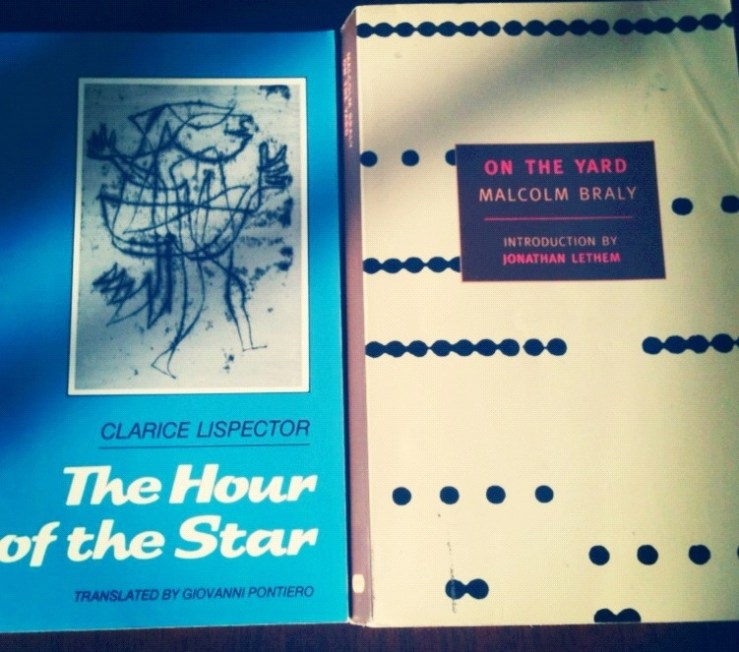
It’s a sickness. Should I explain that the bookstore is like 1.1 miles from my house? And that it holds somewhere between one and two million books? (No exaggeration). That it’s like three or four buildings cobbled together in snaking passages, all said passages lined by books? It’s also like .2 miles from the grocery store I/we usually shop at. Which I had to go by to get mozzarella. For make your own pizza night. But of course, I had to stop off and browse. (Is it weird I set the timer on my iPhone? Gave myself 17 minutes?).
Anyway. Picked up these two.
The Lispector comes via recommendation of Scott Esposito, although this New Directions edition is not the latest translation, but, I dunno. It’s short. The Braly, well, I’d never heard of it, honestly, but it’s an NYRB edition, and the spines of those books always standout, and Lethem introduces it, and even though I haven’t liked Lethem’s last few books, well, he’s still a tastemaker par excellence, and Kurt Vonnegut blurbs it on the back, calling it, “Surely the great American prison novel.” And I just finished “The Part About the Crimes” in 2666 (yet again, more on that to come) and maybe a prison novel seems especially intriguing.
St. Jerome Reading — Giovanni Bellini

Charles Frazier’s Nightwoods (Book Acquired, 6.14.2012)
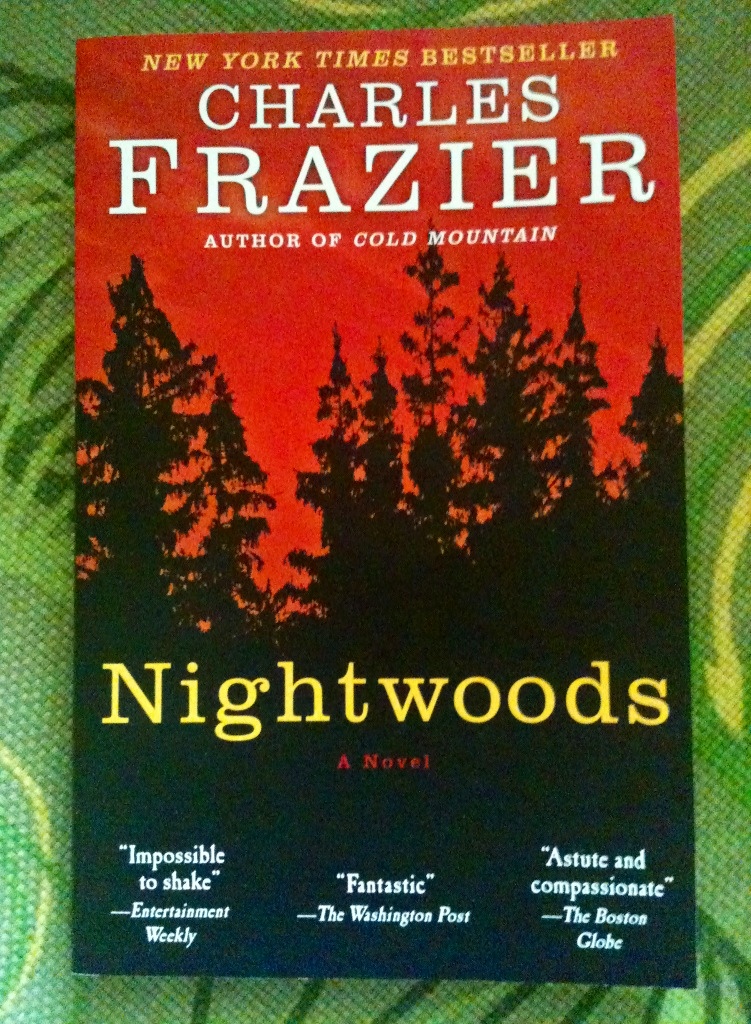
Charles Frazier’s Nightwoods, new in trade paperback. From Randy Boyagoda’s NY Times review:
“Nightwoods,” Frazier’s new novel, is a departure from its predecessors in some respects. It’s set in the early 1960s rather than the 19th century, and it involves no literary or historical elements of comparable grandeur and gravity. Indeed, based on its premise, the new book feels remarkably stripped down: a young woman named Luce, the caretaker of an old lodge in small-town North Carolina, becomes the guardian of the twin children of her murdered sister. In turn, she must defend them from Bud, their former stepfather, who killed their mother while they watched, and who believes the traumatized children know the location of some stolen money. As a setup, this promises suspense and mystery, to which Frazier adds family tension (when Luce’s lawman-cum-drug-addict father buddies up with Bud) and romance (after the shy, handsome grandson of the lodge’s deceased owner visits his inheritance and falls for Luce).
Denis Johnson’s Train Dreams Is a Perfect Audiobook

A few weeks ago on this blog, I declared Denis Johnson’s Train Dreams a perfect novella, a claim that I feel even more certain about after listening to Macmillan audio’s new production of the book, read by Will Patton.
Precise, funny, and moving, Train Dreams tells the story of Robert Grainier, a laborer (and eventual hermit of sorts) who makes a life in (and against) the strange wilderness of the Idaho panhandle. The book somehow measures the first half of the twentieth century in the US without overreaching; instead, through Grainier’s human (but anti-social) presence, Johnson traces the end of Manifest Destiny, the last strands of the wild frontier. Train Dreams, poised tautly on a line that divides the mythic and metaphysical from the concrete and real, shows us a world where we might catch a glimpse of wolf-children and angels—the real thing, not just the sham show, not just a pale suggestion.
Moving through the book again via Patton’s expert narration, I was struck by how constructed yet seamless Johnson’s narrative is. Johnson gets so much credit for the precision of his syntax, but a rereading of Train Dreams reveals how tight and layered, yet never obvious, his plot is—how he lays out his themes repeatedly without brazenly calling attention to them. (One of the joys of reading is rereading; one of the joys of a novella is that its brevity allows us to easily reread). The book is a gem.
Will Patton’s reading perfectly matches the tone, pacing, and depth of Train Dreams. He understands the restraint of Johnson’s prose, never tripping over into bombast or ghastly over-emoting. Patton’s wry, not-quite-dusty, not-quite-dulcet tone brings Johnson’s small cast to vivid life. In particular, he breathes energy into the humorous dialogues. I found myself laughing aloud over a discourse between Grainier and a man who’s been shot by his own dog. Patton understands the material and brings the same sensitivity, pathos, and wit to it that he brought to his reading of Johnson’s 2007 opus, Tree of Smoke.
A good reader makes all the difference of course. In the wrong hands—excuse me, wrong voice–—a book we thought we knew can come across stifled, squashed; the reader can actually hurt the book, impose the wrong tone: misread. A reader like Patton (and I should credit his director and production team too, of course) can enlarge a book for its audience, shining light on the subtle nuances we might overlook, or even clouding phrases we thought we fully understood, empowering the language with a new ambiguity that enriches the overall reading experience. Highly recommended.
Here’s Patton reading the first part of Train Dreams:
The Magdelene Reading — Rogier van der Weyden

“Half Horse Half Alligator” — I Review Charles Olson’s Inimitable Melville Study, Call Me Ishmael
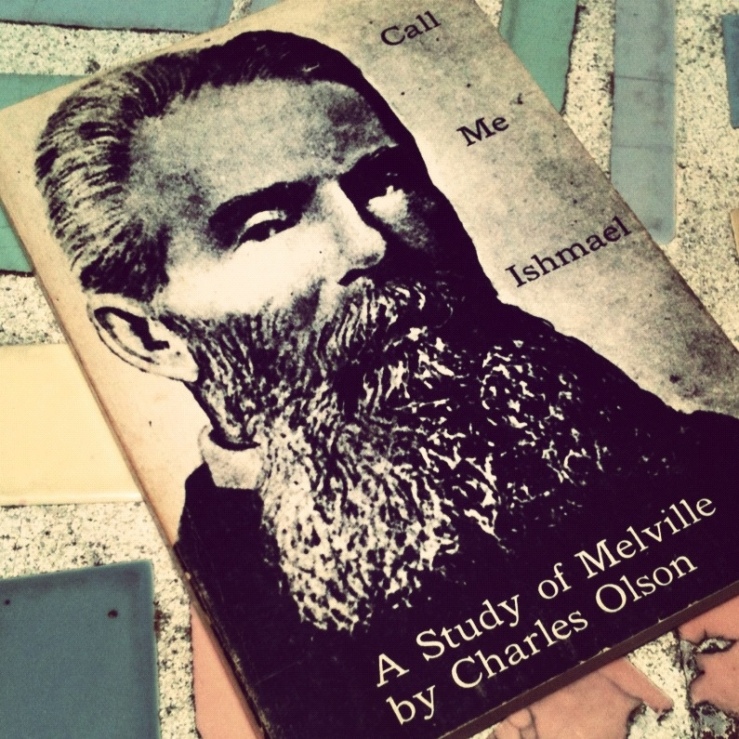
The classical Greeks understood that literature is a form of competition. The eminent literary critic Harold Bloom folded a bit of Freudian psychology into this insight, describing the “anxiety of influence” that lurks beneath the impetus to write, the motivation to enter into an agon with the history of letters, to Oedipally assassinate—or at least assimilate—one’s literary forebears. To put this another way: What does it take to write after, say, The Odyssey? How does one answer to The Book of Job? The gall to write after Don Quixote, after Shakespeare, after Dostoevsky, after George Eliot . . .
What about Moby-Dick? What are the possibilities of even writing about Moby-Dick? (One thinks here of Ishmael’s own futile attempts to measure whales). How could Melville write after Job? After Lear? After Moby-Dick? How did Melville assimilate the texts that presented the strongest anxieties of influence in his opus? Could Melville survive the wreckage of The Pequod? These are the questions that poet-critic Charles Olson tackles—sometimes directly, sometimes obliquely, and always with brisk, sharp language—in Call Me Ishmael, his study of Melville and Moby-Dick.
Here’s one answer to my list of questions. It comes early in Olson’s book:
The man made a mess of things. He got all balled up in Christ. He made a white marriage. He had one son die of tuberculosis, the other shoot himself. He only rode his own space once—Moby-Dick. He had to go fast, like an American, or he was all torpor. Half horse half alligator.
Melville took an awful licking. He was bound to. He was an original, aboriginal. A beginner. It happens that way to the dreaming men it takes to discover America . . . Melville had a way of reaching back through time until he got history pushed back so far he turned time into space. He was like a migrant backtrailing to Asia, some Inca trying to find a lost home.
We are the last “first” people. We forget that. We act big, misuse our land, ourselves. We lose our own primary.
Melville went back, to discover us, to come forward. He got as far as Moby-Dick.
This passage illustrates Olson’s forceful, often blunt prose, the kind of language that cracks directly at Melville’s own impossible prose in Moby-Dick. I think here of the critic James Wood’s notation in his essay “Virginia Woolf’s Mysticism” that
The writer-critic, or poet-critic, has a competitive proximity to the writers she discusses. The competition is registered verbally. The writer-critic is always showing a little plumage to the writer under discussion. If the writer-critic appears to generalize, it is because literature is what she does, and one is always generalizing about oneself.
Olson may generalize as he shows a little plumage to master Melville, cutting through huge swaths of history and making poetic leaps into strange similes, but Call Me Ishmael is ultimately keenly attenuated to detail, to the processes of Melville’s constructions at the historical, economic, psychological, religious, and, yes, literary level. Although a slim 119 pages in my 1947 City Lights edition, Call Me Ishmael nevertheless vividly conveys the sources Melville synthesized to create Moby-Dick.
The book begins with an unsourced account of the whaleship Essex, attacked and destroyed by a sperm whale in the Pacific in 1820, a year after Melville’s birth. Olson trusts his readers to connect The Essex to The Pequod. Unlike so much literary scholarship, Olson’s Ishmael doesn’t torture every element of the text into overwrought explications. He provides an overview of the importance of whaling-industry-as-world’s-fuel source in a chapter that reads more like a prose poem than a stuffy history book, and then, in a chapter appropriately titled “Usufruct,” offers up entries from Melville’s own journals as primary evidence of the material that led to Moby-Dick. Olson rarely sticks his nose in here, letting the reader synthesize the selections.
Olson then plumbs Moby-Dick’s literary roots, delving into Shakespeare, particularly Lear and Antony and Cleopatra. He attends to Melville’s own annotations to Shakespeare, and then points out Melville’s literary/political condensation:
As the strongest force Shakespeare caused Melville to approach tragedy in terms of the drama. As the strongest social force America caused him to approach tragedy in terms of democracy.
It was not difficult for Melville to reconcile the two. Because of his perception of America: Ahab . . .
Ahab is the FACT, the Crew the IDEA. The Crew is where what America stands for got into Moby-Dick. They’re what we imagine democracy to be. They’re Melville’s addition to tragedy as he took it from Shakespeare. He had to do more with the people than offstage shouts in a Julius Caesar. This was the difference a Declaration of Independence made.
The Shakespeare section of Call Me Ishmael marvels: Olson’s perceptive powers simultaneously enlighten and make seemingly-familiar territory dark, strange. He then moves into a discussion of post-Moby Melville, a man perhaps crushed by his own achievement—not by any financial success, no, definitely no, but the metaphysical success. Like a Moses, Melville had found the god he so desperately needed:
Melville wanted a god. Space was the First, before time, earth, man. Melville sought it: “Polar eternities” behind “Saturn’s gray chaos.” Christ, a Holy Ghost, Jehovah never satisfied him. When he knew peaces it was with a god of Prime. His dream was Daniel’s: the Ancient of Days, garment white as snow, hair like the pure wool. Space was the paradise Melville was exile of.
When he made his whale he made his god. Ishmael once comes to the bones a Sperm whale pitched up on land. They are massive, and his struck with horror at the “antemosaic unsourced existence of the unspeakable terrors of the whale.”
When Moby-Dick is first seen he swims a snow-hill on the sea. To Ishmael he is the white bull Jupiter swimming to Crete with ravished Europa on his horns: a prime, lovely, malignant white.
Olson agrees with an 1856 journal entry by Nathaniel Hawthorne that he cites at length: Melville “can neither believe, nor be comfortable in his unbelief.” In Olson’s analysis, after having found god-in-the-whale, Melville plummets into an existential crisis. He gives over to his inner-alligator, torpid, enervated, numb, but still fierce and potent and monstrous. “He denied himself in Christianity,” writes Olson, linking the downward spiral of Melville’s career and family life to this religion.
To this end, Olson is too dismissive of Melville’s later work; when he can find nothing of the “old Melville” to praise in Benito Cereno, Bartleby, or Billy Budd, it’s almost as if he’s willfully ignoring evidence that contradicts his thesis. These are marvelous books, and if they can’t win a contest against Moby-Dick, it’s worth pointing out that little of what’s been written after that book can.
And yet we can write after Melville; we can even write on Melville. The will and vitality of Olson’s forceful, intelligent prose opens a way, or at least exemplifies a way. At the same time, paradoxically, a reading of Call Me Ishmael seems to foreclose the need, if not the possibility, of reading another study of Moby-Dick. This statement is not meant to be a knock against Melville scholarship. Here’s the thing though: life is short, time is limited, and if one plans to read a book about Moby-Dick, it should be Olson’s Call Me Ishmael. It’s great, grand stuff.
Book Shelves #25, 6.17.2012
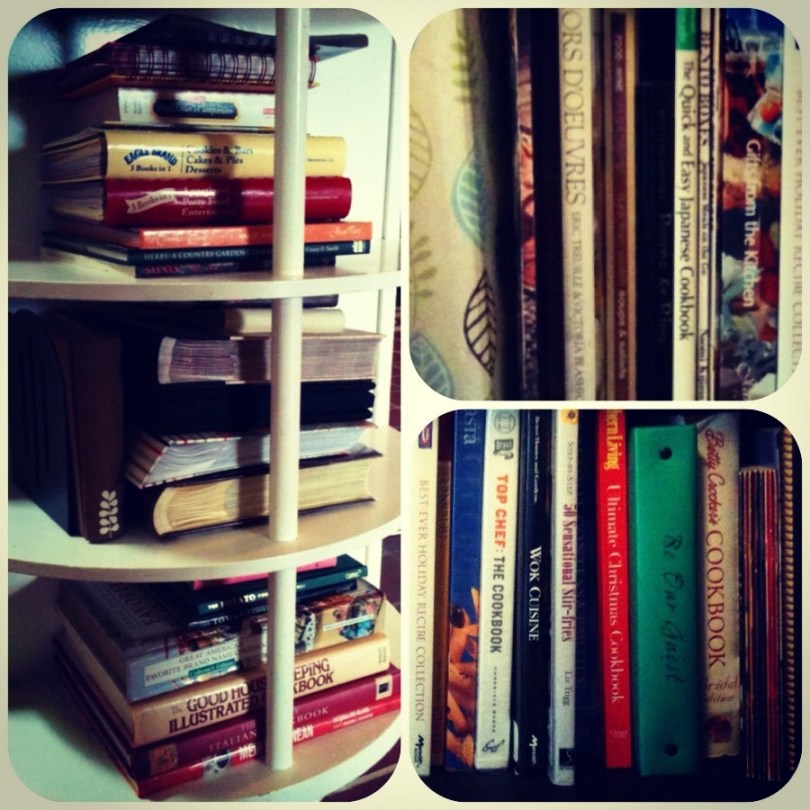
Book shelves series #25, twenty-fifth Sunday of 2012: Cookbooks and some photo albums.
We’ve moved out of the living room and looped into the kitchen/eat-in dining room. Cookbooks and photo albums occupy a little-built in under the eat-in counter.
There’s a shelf of cookbooks at the bottom of a buffet-thing. In the good old days it held vinyl LPs.
Five Favorite Fictional Fathers
Literature seems to have an ambivalence toward fatherhood that’s too complex to address in a simple blog post–so I won’t even try. But before I riff on a few of my favorite fathers from a few of my favorite books, I think it’s worth pointing out how rare biological fathers of depth and complexity are in literature. That’s a huge general statement, I’m sure, and I welcome counterexamples, of course, but it seems like relationships between fathers and their children are somehow usually deferred, deflected, or represented in a shallow fashion. Perhaps it’s because we like our heroes to be orphans (whether it’s Moses or Harry Potter, Oliver Twist or Peter Parker) that literature tends to eschew biological fathers in favor of father figures (think of Leopold Bloom supplanting Stephen Dedalus in Ulysses, or Merlin taking over Uther Pendragon‘s paternal duties in the Arthur legends). At other times, the father is simply not present in the same narrative as his son or daughter (think of Telemachus and brave Odysseus, or Holden Caulfield wandering New York free from fatherly guidance). What I’ve tried to do below is provide examples of father-child relationships drawn with psychological and thematic depth; or, to put it another way, here are some fathers who actually have relationships with their kids.
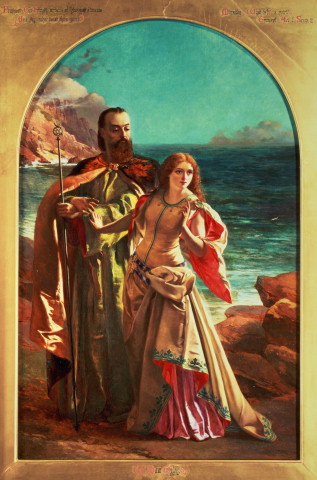
1. Prospero, The Tempest (William Shakespeare)
Prospero has always seemed to me the shining flipside to King Lear’s dark coin, a powerful sorcerer who reverses his exile and is gracious even in his revenge. Where Lear is destroyed by his scheming daughters (and his inability to connect to truehearted Cordelia), Prospero, a single dad, protects his Miranda and even secures her a worthy suitor. Postcolonial studies aside, The Tempest is fun stuff.
2. Abraham Ebdus, The Fortress of Solitude, (Jonathan Lethem)
Like Prospero, Abraham Ebdus is a single father raising his child (his son Dylan) in an isolated, alienating place (not a desert island, but 1970’s Brooklyn). After Dylan’s mother abandons the family, the pair’s relationship begins to strain; Lethem captures this process in all its awkward pain with a poignancy that never even verges on schlock. The novel’s redemptive arc is ultimately figured in the reconciliation between father and son in a beautiful ending that Lethem, the reader, and the characters all earn.
3. Jack Gladney, White Noise (Don DeLillo)
While Jack Gladney is an intellectual academic, an expert in the unlikely field of “Hitler studies” (and something of a fraud, to boot), he’s also a pretty normal dad. Casual reviewers of White Noise tend to overlook the sublime banality of domesticity represented in DeLillo’s signature novel: Gladney is an excellent father to his many kids and step-kids, and DeLillo draws their relationships with a realism that belies–and perhaps helps to create–the novel’s satirical bent.
4. Oscar Amalfitano, 2666 (Roberto Bolaño)
Sure, philosophy professor Amalfitano is a bit mentally unhinged (okay, more than a bit), but what sane citizen of Santa Teresa wouldn’t go crazy, what with all the horrific unsolved murders? After his wife leaves him and their young daughter, Amalfitano takes them to the strange, alienating land of Northern Mexico (shades of Prospero’s island?) Bolaño portrays Amalfitano’s descent into paranoia (and perhaps madness) from a number of angles (he and his daughter show up in three of 2666‘s three sections), and as the novel progresses, the reader slowly begins to grasp the enormity of the evil that Amalfitano is confronting (or, more realistically, is unable to confront directly), and the extreme yet vague danger his daughter is encountering. Only a writer of Bolaño’s tremendous gift could make such a chilling episode simultaneously nerve-wracking, philosophical, and strangely hilarious.
5. The father, The Road (Cormac McCarthy)
What happens when Prospero’s desert island is just one big desert? If there is a deeper expression of the empathy and bonding between a child and parent, I have not read it. In The Road, McCarthy dramatizes fatherhood in apocalyptic terms, positing the necessity of such a relationship in hard, concrete, life and death terms. When the father tells his son “You are the best guy” I pretty much break down. When I first read The Road, I had just become a father myself (my child was only a few days old when I finished it), yet I was still critical of McCarthy’s ending, which affords a second chance for the son. It seemed to me at the time–as it does now–that the logic McCarthy establishes in his novel is utterly infanticidal, that the boy must die, but I understand now why McCarthy would have him live–why McCarthy has to let him live. Someone has to carry the fire.
Woman Reading — Georges Braque

Woman Reading — Fernand Leger

Charles Olson/Conrad Aiken (Books Acquired, 6.09.2012)

Charles Olson’s Selected Writing (New Directions): In all seriousness, why don’t more publishers go for simple covers like this one? Love it.
A scribbling:
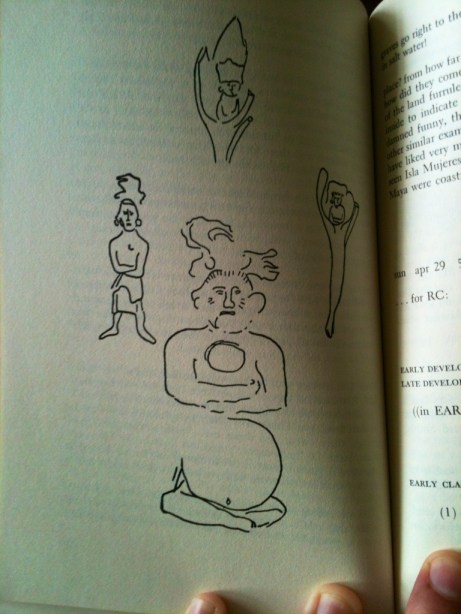
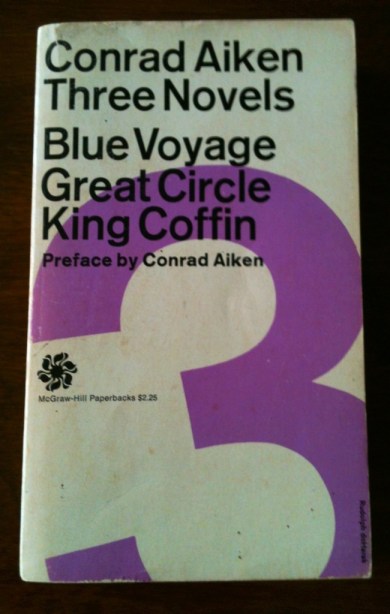
Also, had to pick up something by Conrad Aiken after reading about his influence on Malcolm Lowry:
 Biblioklept