(An Incomplete List of) Writers Who Died in 2010

J. D. Salinger, 91, American author

Howard Zinn, 87, American historian

Barry Hannah, 67, American novelist and short story writer

David Markson, 82, American writer

Harvey Pekar, 70, American comic book writer (American Splendor)

Tuli Kupferberg, 86, American poet, cartoonist and musician (The Fugs)

David Mills, 48, American author, journalist and television writer (NYPD BlueThe CornerKingpin)

Dick Giordano, 77, American comic book artist and editor (BatmanGreen Lantern)

José Saramago, 87, Portuguese novelist, playwright and journalist, Nobel Prize winner for literature

Lucille Clifton, 73, American poet (Blessing the Boats), Poet Laureate of Maryland

Robert Dana, 80, American poet, Iowa poet laureate

Rajendra Keshavlal Shah, 96, Indian poet

Tibet, 78, French comics artist

Mary Daly, 81, American radical feminist philosopher

Knox Burger, 87, American editor, writer, and literary agent

George Leonard, 86, American writer, editor and educator, pioneer of the Human Potential Movement

Robert B. Parker, 77, American detective writer

Laura Chapman Hruska, 74, American writer, co-founder and editor in chief of Soho Press

Stephen Morse, 65, American poet

P. K. Page, 93, Canadian poet

Bingo Gazingo, 85, American performance poet

Kage Baker, 57, American science fiction and fantasy author

Ralph McInerny, 80, American philosopher (University of Notre Dame) and mystery author

Erich Segal, 72, American professor, author (Love Story), and screenwriter (Yellow Submarine)

Carlos Montemayor, 62, Mexican writer

Violet Barclay, 87, American comic book artist

David Severn, 91, British author

Colin Ward, 85, British anarchist writer

William Tenn, 89, American science fiction writer

Liz Carpenter, 89, American feminist author, press secretary to Lady Bird Johnson (1963–1969)

John Eric Holmes, 80, American science fiction and fantasy author

Ai Ogawa, 62, American poet, breast cancer

Patricia Wrightson, 88, Australian children’s writer

Matilde Elena López, 91, Salvadoran poet, essayist and playwright

Elena Schwarz, 61, Russian poet

Ella Mae Johnson, 106, American social worker and author

Miguel Delibes, 89, Spanish author, journalist and scholar

Sid Fleischman, 90, American children’s writer

Bill DuBay, 62, American comic book editor, writer, and artist

Henry Scarpelli, 79, American comic book artist (Archie)

Alan Sillitoe, 82, British writer (Saturday Night and Sunday Morning)

Jan Balabán, 49, Czech writer, recipient of the Magnesia Litera award

William Neill, 88, British poet

Carolyn Rodgers, 69, American poet

Peter Orlovsky, 76, American poet

Leslie Scalapino, 65, American poet, publisher and playwright

Peter Seaton, 67, American poet

Judson Crews, 92, American poet

Hoàng Cầm, 88, Vietnamese poet and playwright

Donald Windham, 89, American novelist

Bree O’Mara, 42, South African novelist

Robert Tralins, 84, American author

Ruth Chew, 90, American children’s author

Randolph Stow, 74, Australian writer

Arthur Herzog, 83, American writer

Peter O’Donnell, 90, British writer

T. M. Aluko, 91, Nigerian writer

Kovilan, 86, Indian novelist

F. Gwynplaine MacIntyre, 62, Welsh science fiction author

Allen Hoey, 57, American poet

José Albi, 88, Spanish poet

Andrei Voznesensky, 77, Russian poet and writer

Vladimír Bystrov, 74, Czech writer and translator

Suso Cecchi d’Amico, 96, Italian screenwriter (Bicycle Thieves)

Tom Mankiewicz, 68, American screenwriter (James BondSuperman)

Iris Gower, 75, Welsh novelist

Jon Cleary, 92, Australian novelist (The SundownersHigh Road to China)

James P. Hogan, 69, British science fiction author

Michèle Causse, 74, French lesbian theorist, author and translator

Vance Bourjaily, 87, American novelist

Patrick Cauvin, 77, French novelist

Sir Frank Kermode, 90, British literary critic and writer

Ludvík Kundera, 90, Czech writer and translator

George Hitchcock, 96, American poet and publisher

Jennifer Rardin, 45, American author

Edwin Charles Tubb, 90, British science fiction author

Micky Burn, 97, British writer and poet

Belva Plain, 95, American novelist (Evergreen)

Bärbel Mohr, 46, German author

George Cain, 66, American author

Claire Rayner, 79, British author

Alí Chumacero, 92, Mexican writer and poet

Monica Johnson, 54, American novelist and screenwriter (Lost in America, Modern Romance)

Philip Carlo, 61, American crime author

Adrian Păunescu, 67, Romanian author, poet and politician

Dmitry Gorchev, 47, Russian writer

Richard Stanley “Dick” Francis, 79, a British jockey who later wrote crime novels about horse racing

The Minimum Number of Books in Harvard’s Libraries That Are Bound in Human Flesh (and Other Fun Facts from Harper’s Index)

The following citations are culled from a search of Harper’s Index that used the term “literature.” (If it’s not obvious, the numbers before each datum are the month and year that Harper’s originally published the datum in its Index)–

5/84    Percentage of Americans who say they never read books: 45

Percentage of these who can’t read: 13

12/87  Number of direct-mail solicitations sent to Henry David Thoreau at Walden Pond this year: 90

4/87   Copies of Gabriel García Márquez’s new book burned by the Chilean government last November: 15,000

2/88   Exclamation points in Tom Wolfe’s The Bonfire of the Vanities: 2,343

10/90   Number of years George Bush has been citing Bonfire of the Vanities as an example of his pleasure reading: 2

11/90   Number of Georgia third-graders Representative Newt Gingrich paid $2 for every book they read last summer: 282

3/91   Percentage of American households in which no books were bought last year: 60

12/92   Chances that an attempt to ban or restrict access to school materials or books last’ year was successful: 2 in 5

6/94   Amount Random House lost on the 29 of its books included on the 1993 New York Times Notable Books list: $698,000

11/95   Estimated number of books banned since 1965 in Indonesia: 2,000

3/95   Amount for which a Mississippi man attempted to sue “the Bible” last year, citing it as “oppressive hearsay”: $45,000,000

5/95   Tons of remaindered books destroyed in the United States each year: 250,000

5/95   Number of Shakespeare’s thirty-seven plays quoted on the Senate floor last year by Robert Byrd: 37

9/95   Percentage of Americans who own at least five Bibles: 27

9/95   Number of California library books of modern American poetry from which pages have been reported stolen this year: 250

1/00   Estimated temperature of Hell, according to two Spanish physicists ‘ interpretation of the Bible: 832° F

Estimated temperature of Heaven: 448°F

3/00  Number of Playboy centerfold models since 1959 whose bios claimed their favorite book was by Ayn Rand: 12

9/00   Ratio of the number of copies of The Great Gatsby sold each month in the U.S. to the number sold in the author’s lifetime: 5:3

9/03   Estimated acres of forest Henry David Thoreau burned down in 1844 trying to cook fish he had caught for dinner: 300

6/04   Minimum number of the brand names mentioned in James Joyce’s Ulysses that are still extant: 28

Number of the brand holders that are sponsoring Dublin’s centennial Bloomsday celebration this month: 2

9/06   Minimum number of books in Harvard’s libraries that are bound in human flesh: 2

The Best Books of 2010

Here are our favorite books published in 2010 (the ones that we read–we can’t read every book, you know).

Sandokan — Nanni Balestrini

A dark, elliptical treatise on the mundane and inescapable violence wrought by the Camorra crime syndicate in southern Italy.

Everything Ravaged, Everything Burned — Wells Tower (trade paperback)

Tower’s world is a neatly drawn parallel reality populated by down-on-their-luck protagonists who we always root for, despite our better judgment, even as they inadvertently destroy whatever vestiges of grace are bestowed upon them.

The Union Jack — Imre Kertész

Kertész’s slim novella explores a storyteller’s inability to accurately and properly communicate spirit and truth against the backdrop of an oppressive Stalinist regime.

BodyWorld — Dash Shaw

Shaw’s graphic novel is sardonically humorous in its psychoanalytic/post-apocalyptic visions. It’s a sweet and sour subversion of 1950’s comics and contemporary conformist groupthink politics. Witty and poignant, it advances its medium.

The Thousand Autumns of Jacob de Zoet — David Mitchell

An unexpected historical romance from postmodern poster boy David Mitchell. Thousand Autumns is a big fat riff on storytelling and history and adventure–but mostly, Mitchell’s Shogunate-era Japan is a place worth getting lost in.

C — Tom McCarthy

“I see what I’m doing as simply plugging literature into other literature,” McCarthy said in an interview this year. “For me, that’s what literature’s always done.” C, our favorite novel of 2010, seems plugged into the past and the present, pointing to the future.

Wolf Hall — Hilary Mantel (trade paperback)

Who knew that we needed to hear the Tudor saga again? Who knew that Thomas Cromwell could be a good guy?

The Ask — Sam Lipsyte

A mean, sad, hilarious novel that simultaneously eulogizes, valorizes, and mocks the American Dream.

X’ed Out — Charles Burns

Charles Burns does Tintin in William Burroughs’s Interzone. ‘Nuff said.

The Collected Stories of Lydia Davis — Lydia Davis

An epic compendium of, jeez, I don’t know, how do you define or explain what Davis does? Inspection, perception, mood, observation. Tales, fables, riffs, annotations, skits, jokes, japes, anecdotes, journals, thought experiments, epigrams, half-poems, and would-be aphorisms. Great stuff.

Suttree — Cormac McCarthy

In his 1992 interview with The New York TimesCormac McCarthy said, “The ugly fact is books are made out of books. The novel depends for its life on the novels that have been written.” McCarthy’s fourth novel, 1979’s Suttree is such a book, a masterful synthesis of the great literature — particularly American literature — that came before it. And like any masterful synthesis, Suttree points to something new, even as it borrows, lifts, and outright steals from the past. But before we plumb its allusions and tropes and patterns, perhaps we should overview the plot, no?

The novel rambles over several years in the life of Cornelius Suttree. It is the early 1950s in Knoxville, Tennessee, and Suttree ekes out a mean existence on the Tennessee River as a fisherman, living in a ramshackle houseboat on the edge of a shantytown. This indigent life is in fact a choice: Suttree is the college-educated son of an established, wealthy family. His choice is a choice for freedom and self-reliance, those virtues we like to think of, in our prejudicial manner, as wholly and intrinsically American. Suttree then is both Emersonian and Huck Finnian, a reflective and insightful man who finds his soul via a claim to agency over his own individuality, an individuality poised in quiet, defiant rebellion against the conforming forces of civilization. These forces manifest most pointedly in the Knoxville police, a brutal, racist organization, but we also see social constraint in the form of familial duty. One thinks of the final lines of Huckleberry Finn: “I reckon I got to light out for the Territory ahead of the rest, because Aunt Sally she’s going to adopt me and sivilize me and I can’t stand it. I been there before.”

Like Huck, Suttree aims to resist all forces that would “sivilize” him. His time on the river and in the low haunts of Tennessee (particularly the vice-ridden borough of McAnally) brings him into close contact with plenty of other outcasts, but also his conscience, which routinely mulls over its place in the world. Suttree is punctuated by–perhaps even organized by–several scenes of hallucination. Some of these psychotrips result from drunkeness, one comes from accidentally ingesting the wrong kind of mushrooms (or, the right kind, if that’s your thing), and the final one, late in the novel, sets in as Suttree suffers from a terrible illness. In his fever dream, a small nun–surely a manifestation of the guilt that would civilize us–accuses him–

Mr. Suttree it is our understanding that at curfew rightly decreed by law in that hour wherein night draws to its proper close and the new day commences and contrary to conduct befitting a person of your station you betook yourself to various low places within the shire of McAnally and there did squander several ensuing years in the company of thieves, derelicts, miscreants, pariahs, poltroons, spalpeens, curmudgeons, clotpolls, murderers, gamblers, bawds, whores, trulls, brigands, topers, tosspots, sots and archsots, lobcocks, smellsmocks, runagates, rakes, and other assorted and felonious debauchees.

The passage is a marvelous example of McCarthy’s stream-of-consciousness technique in Suttree, moving through the various voices that would ventriloquize Suttree, into the edges of madness, strangeness, and the sublimity of language. The tone moves from somber and portentous into bizarre imagery that blends humor and pathos. This is the tone of Suttree, a language that gives voice to transients and miscreants, affirming the dignity of their humanity even as it details the squalor of their circumstance.

It is among these criminals and whores, transvestites and gamblers that Suttree affirms his own freedom and humanity, a process aided by his comic foil, Gene Harrogate. Suttree meets Harrogate on a work farm; the young hillbilly is sent there for screwing watermelons. After his release, Harrogate moves to a shantytown in Knoxville. He’s the country mouse determined to become the city rat, the would-be Tom Sawyer to Suttree’s older and wiser Huck Finn. Through Harrogate’s endless get-rich-quick schemes, McCarthy parodies that most-American of tales, the Horatio Alger story. Simply put, the boy is doomed, on his  “way up to the penitentiary” as Suttree constantly admonishes. In one episode, Harrogate tries to buy arsenic from “a grayhaired and avuncular apothecary” to poison bats he hopes to sell to a hospital (don’t ask)–

May I help you? said the scientist, his hands holding each other.

I need me some strychnine, said Harrogate.

You need some what?

Strychnine. You know what it is dont ye?

Yes, said the chemist.

I need me about a good cupful I reckon.

Are you going to drink it here or take it with you?

Shit fire I aint goin to drink it. It’s poisoner’n hell.

It’s for your grandmother.

No, said Harrogate, craning his neck suspectly. She’s done dead

Suttree, unwilling father-figure, eventually buys the arsenic for the boy against his better judgment. The scene plays out as a wonderful comic inversion of William Faulkner’s “A Rose for Emily,” from which it is so transparently lifted. McCarthy borrows liberally from Faulkner here, of course, most notably in the language and style of the novel, but also in scenes like this one, or a later episode that plays off Faulkner’s comic-romantic story of a man and a woman navigating the aftermath of a flood, “Old Man.” Unpacking the allusions in Suttree surpasses my literary knowledge or skill, but McCarthy is generous, if oblique, with his breadcrumb trail. Take, for example, the following sentence: “Suttree with his miles to go kept his eyes to the ground, maudlin and muttersome in the bitter chill, under the lonely lamplight.” The forced phrase “miles to go” does not immediately present itself as a reference to Robert Frost’s famous poem, yet the direction of the sentence retreats into the history of American poetry; with its dense alliteration and haunted vowels, it leads us into Edgar Allan Poe territory. Only a few dozen pages later, McCarthy boldly begins a chapter with theft: “In just spring the goatman came over the bridge . . .” The reference to e.e. cummings explicitly signifies McCarthy’s intentions to play with literature. Later in the book, while tripping on mushrooms in the mountains, Suttree is haunted by “elves,” the would-be culprits in Frost’s poem “Mending Wall.” The callback is purposeful, but tellingly, McCarthy’s allusions are not nearly as fanciful as their surface rhetoric might suggest: the goatman does not belong in Knoxville–he’s an archaic relic, forced out of town by the police; the elves are not playful spirits but dark manifestations of a tortured psyche.

Once one spots the line-lifting in Suttree it’s hard to not see it. What’s marvelous is McCarthy’s power to convert these lines, these riffs, these stories, into his own tragicomic beast. An early brawl at a roadhouse recalls the “Golden Day” episode of Ralph Ellison’s Invisible Man; a rape victim’s plight echoes Hubert Selby’s “Tralala”; we find the comic hobos of John Steinbeck’s Cannery Row–we even get the road-crossing turtle from The Grapes of Wrath. A later roadhouse chapter replays the “Circe/Nighttown” nightmare in James Joyce’s Ulysses. Ulysses is an easy point of comparison for Suttree, which does for Knoxville what Joyce did for Dublin. Suttree echoes Ulysses’s language, both in its musicality and appropriation of varied voices, as well as its ambulatory structure, its stream-of-consciousness technique, its rude earthiness, and its size (nearly 600 pages). But, as I argued earlier, there’s something uniquely American about Suttree, and its literary appropriations tend to reflect that. Hence, we find Mark Twain, Herman Melville, Ernest Hemingway, Walt Whitman, Emerson and Thoreau, Emily Dickinson, and William Carlos Williams, to name just a few writers whose blood courses through this novel (even elegant F. Scott Fitzgerald is here, in an unexpected Gatsbyish episode late in the novel).

Making a laundry list of writers is weak criticism though, and these sources–all guilty of their own proud plagiarisms–are mentioned only as a means to an end, to an argument that what McCarthy does in Suttree is to synthesize the American literary tradition with grace and humor, while never glossing over its inherent dangers and violence. So, while it appropriates and plays with the tropes of the past, Suttree is still pure McCarthy. Consider the following passage, which arrives at the end of a drunken, awful spree, Suttree locked up for the night–

He closed his eyes. The gray water that dripped from him was rank with caustic. By the side of a dark dream road he’d seen a hawk nailed to a barn door. But what loomed was a flayed man with his brisket tacked open like a cooling beef and his skull peeled, blue and bulbous and palely luminescent, black grots his eyeholes and bloody mouth gaped tonguless. The traveler had seized his fingers in his jaws, but it was not alone this horror that he cried. Beyond the flayed man dimly adumbrate another figure paled, for his surgeons move about the world even as you and I.

Suttree’s dark vision points directly toward the language of McCarthy’s next novel, 1985’s Blood Meridian, roundly considered his masterpiece. Critics who disagree tend to point to Suttree as the pinnacle of McCarthy’s writing. I have no interest at this time in weighing the books against each other, nor do I think that doing so would be especially enlightening. For all of their sameness, they are very different animals: Suttree provides us intense access to its hero’s consciousness, where Blood Meridian always keeps the reader on the outside of its principals’ souls (if those grotesques could be said to have souls). And while Blood Meridian does display some humor, it is the blackest and driest humor I’ve ever read. Suttree is broader and more compassionate; it even has a fart joke. Blood Meridian, at least in my estimation (and many critics will contend this notion) has no flawed episodes; much of this results from the book’s own internal program–it resists love, compassion, and even human dignity. In contrast, Suttree is punctuated by two deaths the audience is meant to read as tragic, yet I found it impossible to do so. The first is the death of Suttree’s child, whom he has abandoned, along with its mother. As such, he is not permitted to take part in the funeral, observing the process rather from its edges. The second tragedy is the death of Suttree’s young lover in a landslide. The book begs us to empathize with Suttree, just as he often empathizes with the marginal figures in the novel, but ultimately these tragedies are a failed ploy. They underwrite a sublime encounter with death for Suttree, an encounter that deepens and enriches his character while paradoxically freeing him from the burdens of social duty and familial order. McCarthy is hardly alone in such a move; indeed, it seems like the signature trope of American masculine literature to me. It’s the move that Huck Finn wishes to make when he promises to light out for the Territory to escape the civilizing body of Aunt Sally; it’s the ending that Hemingway was compelled to give to Frederic Henry at the end of A Farewell to Arms; it’s all of Faulkner, with his mortification of fatherhood and the dramatic responsibility fatherhood entails. It is a cost analysis that neglects any potential benefits.

But these are small criticisms of a large, beautiful, benevolent novel, a book that begs to be reread, a rambling picaresque of comic and tragic proportions. “I learned that there is one Suttree and one Suttree only,” our hero realizes, but this epiphany is set against a larger claim. Near the end of the novel, Suttree goes to check on an old ragman who he keeps a watchful eye on. He finds the man dead, his shack robbed, his body looted. Despairing over the spectacle’s abject lack of humanity, Suttree cries, “You have no right to represent people this way,” for “A man is all men. You have no right to your wretchedness.” Here, Suttree’s painful epiphany is real and true, an Emersonian insight coded in the darkest of Whitman’s language. If there is one Suttree and one Suttree only, he is still beholden to all men; to be anti-social or an outcast is not to be anti-human. Self-hood is ultimately conditional on others and otherness. To experience the other’s wretchedness is harrowing; to understand the other’s wretchedness and thus convert it to dignity is life-affirming and glorious. Suttree is a brilliant, bold, marvelous book. Very highly recommended.

Ian McEwan’s Fish Stew

Here’s another entry in our Thanksgiving series of literary recipes–a recipe for fish stew, adapted from Ian McEwan’s novel Saturday. The recipe is Henry Perowne’s, the novel’s protagonist who makes it for dinner on the titular day. The adaptation below comes from journalist Damian Barr, who wrote an excellent article about recipes in literature for The Times.

Into a stockpot of boiling water (a litre or more), put the bones of three skates (or other boned fish), with heads intact. If you have no obliging local fishmonger, use a pound or more of white fish.

Add a dozen or so mussels to the stock. Simmer for 25 minutes.

Meanwhile, strip and chop three onions and eight fat cloves of garlic. Soften over a low heat in a casserole with a lot of olive oil. When they have melted sufficiently, add: a couple of crushed red chillies, a pinch of saffron, some bay leaves, orange-peel gratings, oregano, five anchovy fillets, two cans of peeled tomatoes

When these have blended together in the heat, add a quarter bottle of white wine. Then strain off the stock and add to the casserole. Simmer the mix for 20 minutes.

Rinse and/or scrub the clams and remaining mussels and place in a bowl.

Cut the monkfish tails into chunks and place in a separate bowl.

Wash the tiger prawns and add to the monkfish bowl. Keep both bowls refrigerated until ready to cook. Just before dinner, reheat the casserole.

Simmer the clams, monkfish, mussels and prawns in the casserole for ten minutes.

Eat the stew with brown bread, or garlic bread, salad and a hearty red wine.

Zora Neale Hurston’s Mulatto Rice

[Editorial note: We originally ran a version of this post in November of 2009. We’re republishing it as part of a series celebrating Thanksgiving, featuring recipes and food from some of our favorite books].

At the beginning of Zora Neale Hurston’s novel Their Eyes Were Watching God, Janie returns from the Everglades to Eatonville in ragged overalls to a gossipy and unwelcoming town. The one exception is her best friend Phoeby, who brings Janie a “heaping plate of mulatto rice.” Janie gobbles up the simple, delicious meal, even as Phoeby notes that it “ain’t so good dis time. Not enough bacon grease.” She does however concede that “it’ll kill hongry.” No doubt.

We’ve always been intrigued by mulatto rice. What could it be? Is the dish still around today, but under a new name? Although the term “mulatto” has fallen into disuse, and perhaps distaste (just ask Larry David if you don’t believe us), organizations like mulatto.org have also taken a certain ownership of it. For Hurston, mulatto rice is a positive thing. Hurston could have had Phoeby bring any number of dishes to her friend Janie, so it’s telling that she chooses “mulatto rice” as a homecoming meal. The dish represents a communion, an admixture that reflects Janie’s multiracial identity as well as her resistance to gender-typing. “Mulatto” is also probably etymologically akin to the word “mule,” and if you’ve read Eyes, you know that mules are a major motif in the story. But enough literazin’.

Down to the nitty-gritty–we made up a mess of mulatto rice tonight thanks to a recipe from The Savannah Cook Book by Harriet Ross Colquitt. Not that we found this 1933 cookbook ourselves. No, the real merit here goes to the very cool website Take One Cookbook, which explores the history and culture and sociology behind old, weird cookbooks–all while making the recipes. Colquitt’s recipe, via Wendy at Take One Cookbook (see Wendy’s versionhere):

Mulatto Rice

This is the very chic name given to rice with a touch of the tarbrush.

Fry squares of breakfast bacon and remove from the pan. Then brown some minced onion (one small one) in this grease, and add one pint can of tomatoes. When thoroughly hot, add a pint of rice to this mixture, and cook very slowly until the rice is done. Or, if you are in a hurry, cold rice may be substituted, and all warmed thoroughly together.

The rice is very easy to make and very, very tasty. We substituted green onions for a small onion, and used a hickory-smoked bacon that infused the rice with a lovely sweetness (we also included a tablespoon of brown sugar right after the tomatoes). We served the dish, pictured above, with ham steaks and fried green tomatoes with a spicy yogurt sauce. Hearty and rich and satisfying–just the sort of thing one wants to eat after a soul-searching quest (or maybe just a long day). Recommended.


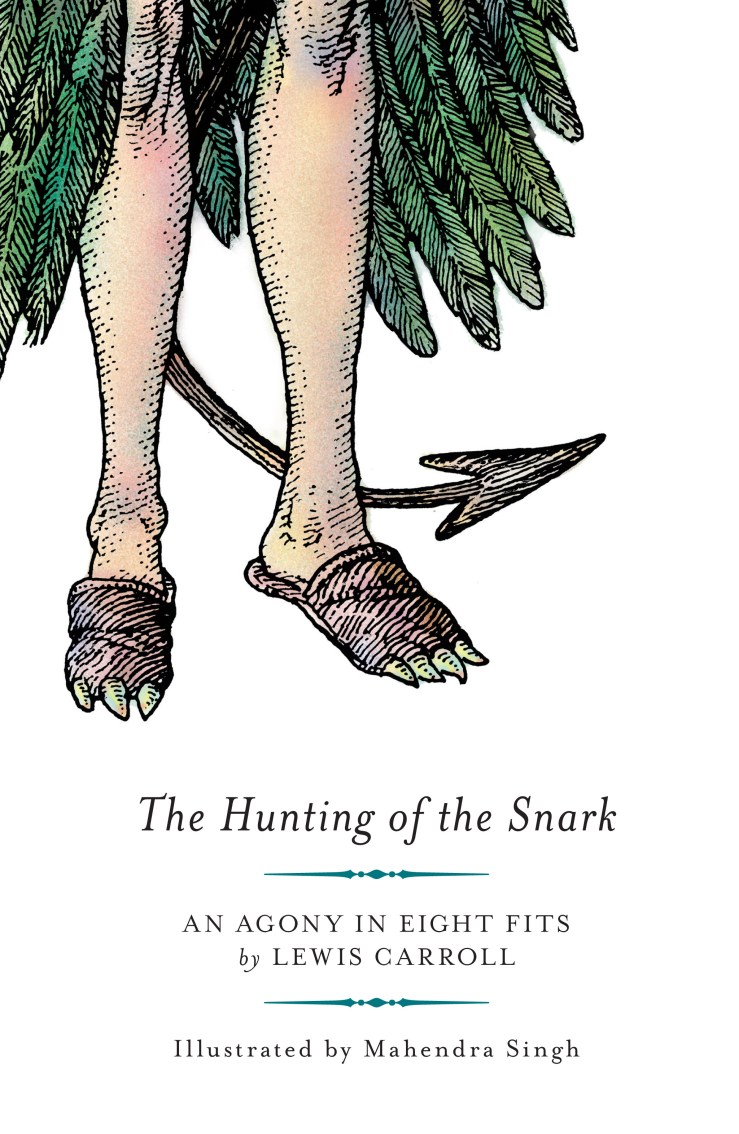
The Hunting of the Snark — Lewis Carroll (with Surreal New Illustrations by Mahendra Singh)

I scrapped my first two drafts for a review of Melville House’s new edition of Lewis Carroll’s The Hunting of the Snark. The problem was that I was struggling to figure out Carroll’s Nonsense poem (subtitled An Agony in Eight Fits) about a ten man crew who take to the sea, to, you know, hunt a Snark. The Bellman seems to lead them. There’s the Banker, Baker, and other guys whose names start with “b” — including enemies the Beaver and the Butcher (who wind up tight allies). The poem is both silly and dense, rippling with weird wordplay and allusions that are, for the most part, beyond me. It’s often hard to follow, and sometimes has the effect of making the reader (or at least this reader) feel like he’s skating on the surface of some deeper profundities — or, alternately, maybe it’s just Nonsense, to use Carroll’s term.

Anyway. I solve my dilemma by retreating to the real occasion for reviewing the book, namely Mahendra Singh’s marvelous and strange illustrations. Singh, a member of the Lewis Carroll Society of North America (and an editor of their journal, Knight Letter), describes his illustrated version as “fitting Lewis Carroll into a proto-Surrealist straitjacket with matching Dada cufflinks.” In both its imagery and heavy, dark lines, Singh’s project readily recalls one of my favorite books, Max Ernst’s proto-graphic novel, Une Semaine de Bonté, as well as Henry Holiday’s original illustrations for the book. Singh lards his illustrations with visual paradoxes, puzzles, and puns, as well as references to artists ranging from de Chirico and Magritte to Dali and Bosch. There are also nods to pop culture (including the Beatles).  And Freud, because, hey, why not. Observe–

Singh’s puzzles, like Lewis’s, do not immediately reveal their meaning, but of course this is part of the joy of the book. In his instructive afterword, Singh tells us that “each drawing should make some sort of sense of the verse it explains or at least, make Nonsense.”  His greater goal though seems to be to share his love of Carroll with his readers (“in particular the younger ones”), who he hopes will “further pursue on their own that immense cultural heritage which silently — and so faithfully — awaits them.” My three year old daughter enjoyed the book very much, and had the good sense (Nonsense?) not to get too flummoxed over what Snark means. This is probably a wise course to follow. As Singh observes in his afterword, “whenever Carroll was asked what the poem meant, he always replied that he did not know. “Of course, just because its creator didn’t know its meaning (or at least claimed not to) doesn’t mean that Snark doesn’t have meaning–it’s just the kind of ambiguous meaning that floats around on dream logic, and Singh’s surrealism, with its playful, amorphous shifts, is the right choice to illustrate the poem. I’m not sure if “illustrate” is the right verb here, though. Certainly these are illustrations, but Singh’s goal isn’t so much to literally render Lewis’s words in pictures as it is to echo their spirit. Singh’s art works in tandem with the poem, accompanying it through symbolic and metaphorical transfers, arriving at times to weird conjunctions and discordances, and, perhaps, generating new meanings. Recommended.

The Hunting of the Snark is new in hardback this month from Melville House. More at Singh’s blog.

The AV Club Interviews Charles Burns

The AV Club’s Sam Adams interviews Charles Burns about Tintin, Burroughs, why he’s not involved in making the Black Hole movie, 1977, why he had to change how he colored his art, and his new book, X’ed Out. There’s also this nugget (we’d been wondering)–

AVC: Is the completed three-volume work going to be called X’ed Out?

CB: They’re all going to be different stories. So for the next one, it says “Next: The Hive.” So the next book is called The Hive.

AVC: Is there a name for the trilogy?

CB: No, not in my mind.

Sex, Drugs, and Harry Potter

[Editorial note–We originally ran this post in the summer of 2009 when Harry Potter and the Half-Blood Prince was in theaters. We run it again now to celebrate the premiere of Harry Potter and the Deathly Hallows, Part I (we also are running it again ’cause we’re lazy)].

First thing’s first: if you’re looking for Harry Potter slash fiction, you’ll have to check out our original Harry Potter Sex Romp post for links, you dirty dawg (you’re weird but you’re welcome). Just like that post a few years ago, this post’s title is really kinda sorta mostly irrelevant to what this post is about. What is it about? I want to take a look at some of the homoerotic tension in the new Harry Potter movieHarry Potter and the Half-Blood Prince. If you want to find a proper review of the film, with plot summary and insight, shop around. That’s not gonna happen here.

Also, there will be SPOILERS, okay? Fair warning.

INTL_HarryDumbledore (Large)

Okay. So, I saw the new film last night (henceforth HP6). And it was pretty good or whatever. But I noticed a subtext that cracked me up quite a bit, an underlying motif that might be lost on most summer blockbuster audiences. I’m talking about the implicit love between men and boys in this film.

At the beginning of the film, in an apparently insignificant scene, young Harry makes a date with an attractive young girl. However, old man Dumbledore shows up and dashes any hopes for a late sumer romance. Instead of meeting up with this lithe young thing, Harry has to grip hard to Dumbledore’s stiff arm to be apparated away to meet Horace Slughorn, an old potions master. Dumbledore uses Harry as fresh young bait for Slughorn, who has something the old wizard needs–a key memory about the development of Tom Riddle–Voldemort–a former protégé of Horace’s (lots of mentors and mentees here). Much of the narrative’s conflict revolves around the task Dumbledore has given Harry; it’s almost as if Dumbledore is pimping out the young wizard. These multiple man-boy relationships are doubled darkly in the failing bond between Snape and emo Draco.

In contrast, heterosexual relationships between the teens are treated with a lightness and even frivolity that codes such romances as ephemeral, or perhaps even inessential. Although the film solidifies the groundwork for the long-term relationships between the series’ principals (Harry-Ginny/Ron-Hermione), the real love story here is between older men and their young apprentices. HP6 depicts teen romance as silly without coloring any of its fragility with pathos. What the film really argues for is a sort of Greek or Platonic ideal of love; that love exists as a conduit for wisdom, passed from an older, experienced man to a younger boy in exchange for some of that youth’s beauty and vitality. Although moments of teenage adventure punctuate the film, the real scope of heroic encounters are shared between older men and their attendant lads (particularly Dumbledore and Harry, although even Snape, through the annotations of his old textbook, manages to plant part of himself into Harry).

The film reaches its climax with a lot of phallic wand waving and a bit of indecision over who gets to shoot off at whom. The climactic scene encodes the strange aggressions and series of shifting allegiances between the male wizards present. Dumbledore becomes the tragic figure; his death allows for Harry’s maturation, enacting a definitive arc in Harry’s Oedipal complex, where Dumbledore is both father figure and secret sex object. The weight of this tragedy initiates Harry into the adult world and adult responsibilities.

So why bother to write about this? No reason really, and I’m sure plenty of readers will find my analysis insupportable, silly, offensive, or just plain wrong. That’s fine. I guess I mostly find it remarkable that this motif should prevail so heavily in a summer blockbuster. There was also a whole drug motif going on–so many of the film’s plot development hinge on the ingestion of mind-altering substances–so maybe I just like the idea that the film is kinda sorta subversive.

“Have You Ever Been Diddled?”

The Ozark folktale “Have You Ever Been Diddled?” from Vance Randolph’s indispensable collection, Pissing in the Snow & Other Ozark Folktales

[Told by J.L. Russell, Harrison, Ark., April, 1950. He heard this one near Berryville, Ark., in the 1890s.]

One time there was a town girl and a country girl got to talking about the boys they had went with. The town girl told what kind of car her boyfriends used to drive, and how much money their folks has got. But the country girl didn’t take no interest in things like that, and she says the fellows are always trying to get into her pants.

So finally the town girl says, “Have you ever been diddled?” The country girl giggled, and she says yes, a little bit. “How much?” says the town girl. “Oh, about like that,” says the country girl, and she held up her finger to show an inch, or maybe an inch and a half.

The town girl just laughed, and pretty soon the country girl says, “Have you ever been diddled?” The town girl says of course she has, lots of times. “How much?” says the country girl. “Oh, about like that,” says the town girl, and she marked off about eight inches, or maybe nine.

The country girl just sat there goggle-eyed, and she drawed a deep breath. “My God,” says the country girl, “that ain’t diddling! Why, you’ve been fucked!